
Racism and anti-racism in Belfast


DSC_0117“Islam is heathen, Islam is satanic, Islam is a doctrine spawned in hell.  Enoch Powell was a prophet, he called it that blood would flow on the streets and it has happened.”

When a Protestant minister in North Belfast’s Metropolitan Tabernacle Church declared that Islam was “satanic” and “heathen” and compared “cells” of Muslims in Britain to the IRA the First Minister of Northern Ireland, Peter Robinson, who is known to have attended the church, was widely called upon to speak out.

Oh dear.

When he did, he said that Pastor McConnell had been demonised, that it was the duty of any preacher to denounce what he described as “false prophesy” and said he would not trust Muslims either, particularly with regard to those who had been involved in violence, or those who are “fully devoted to Sharia law, I wouldn’t trust them for spiritual guidance”; however he would trust Muslims to “go down to the shops” for him or to deal with a number of “day-to -day issues”.

Cue lots of people with their heads in their hands, especially those considering the Northern Ireland administration sponsored trips to the Middle East to promote trade and investment.

NWS_2014-06-02_NEW_006_31867640_I1

A newly elected unionist councillor for Belfast had that week been found to have tweeted a year earlier that “I’m so sick of the poor Catholic b*stards they make me sick I wish they would just go down to Ireland . .” but she was young and sectarianism is hardly news in the North of Ireland unless someone in the media decides to make it news.

But racist attacks, especially by loyalist paramilitaries, have already been in the news and have increased by 43 per cent over the year, twenty seven per cent of them in North Belfast.  Having been called upon to comment in order to denounce racism, Robinson was then called upon to apologise for his own offensive and insulting remarks.

Anna Lo, the Hong Kong born local politician, had just received some racist harassment herself and called upon him to resign if he did not publicly apologise, vowing to leave Northern Ireland because of local racism and  sectarianism and stating that she would not stand for election again.  One Democratic Unionist Party councillor then called her a “racist” and was dropped by that party as its candidate for mayor of Newtownabbey, which is adjacent to North Belfast.  Other ministers and unionist politicians backed McConnell and claimed Christianity was being persecuted.

Two Muslim men where then beaten in their homes in the north of the city and stated that their attack was connected to Robinson’s statement – he had “lit the fire”.

Some in the press and other unionist leaders attempted to minimise the impact of the insult by claiming he was just clumsy.  Michael Nesbitt, leader of the Unionist Party, claimed that “we say things we don’t really mean or express them in ways that perhaps we could have thought through better.”

Robinson then made a private apology to some prominent local Muslims, except it wasn’t an apology.  He didn’t admit to being wrong, did not withdraw the remarks and did not say he was unconditionally ‘sorry’.   What apparently he did say was that “If” anyone thought he had said anything derogatory “he would be hurt” and he would apologise, but he didn’t because he didn’t think so.  He had been ‘misinterpreted’.

So he might be the injured party in this episode and it was everybody else’s fault for not understanding him.

But still the calls for a public apology raged and eventually Peter Robinson did publicly apologise – except the apology wasn’t public.  It was one of those occasions when the media reports something and you look to see when and how it happened but you can’t actually find any evidence of it having happened, and when you look closer it appears that it hasn’t actually happened.  Yet most assume it has because it has been reported and before you now it it has happened because, well, that is how it has been reported.

In such cases this can only occur because everyone with any power to get across a media message has decided it’s in their interests to go along with the concealment.  For the unionist parties the interest involved is obvious.  Any gain in stature among its racist, sectarian and lumpen base has been achieved, while the reality of selling local business to Saudi Arabia etc. cannot be ignored so the controversy has to be closed down.

The British Government especially would be happy for the story to die no matter how this might happen and they showed no intention of doing anything that might shine a light on the bigoted character of their local political settlement, sold to the world as a model to be admired and to emulate.

But what about the nationalists, including Sinn Fein?  The second dog that did not bark was the failure of these parties to call upon Robinson to resign, as – to her credit – Anna Lo did.  Had such remarks been made in Britain by a leading member of the Conservative Government their feet would not have touched the ground as they headed for political exile and extinction. But not here.

What we got here was a bland resolution sponsored by Sinn Fein in the Northern Ireland Assembly opposing “racism, discrimination and intolerance of any kind, wherever it occurs”  but for God’s sake don’t mention that the First Minister has promoted all three.

What such resolutions reveal is not the willingness of Irish nationalism to oppose racism and bigotry but its willingness to avoid doing so, to avoid identifying and condemning it in reality, to replace lofty, banal and meaningless condemnations of racism in general for dealing with it in concrete reality.

Sinn Fein is setting itself up to be in Government North and South in 1916, 100 years from the Easter Rising that saw the beginnings of an attempt, that failed, to achieve Irish independence.  To do so it must ensure that there is an administration around in the North for it to be a part of.  Since this requires unionist participation no provocation or act, irrespective of how outrageous it is, will be allowed to threaten the political structure in the North no matter how rotten, dysfunctional and bereft of credibility it may prove itself to be.

In this way a political settlement based on sectarianism demonstrates its bigoted logic by ensuring that the most offensive statements can be made without fear.   In this way, but not only in this way, Irish nationalism becomes complicit in feeding the bigotry on which the Northern state rests, even while it self-righteously insists on its own non-sectarian character and its supporters continue to be the main victims of the bigotry.

What the Government parties are called upon to do, unionist and nationalist, is to deliver another document on “building a united, shared and reconciled community “, another piece of paper reviewing Stormont’s ‘Unite Against Hate’ campaign and together parrot inane promises from within ”its clear commitment within the Programme for Government.”

So if nationalism cannot provide an opposition to racist bigotry who can?

In a demonstration of thousands called quickly over social media a trade union spokesmen could only say that it was organised “in response to a worrying increase in the number of racist attacks in recent weeks, a situation which has been exacerbated by inflammatory comments by some religious and political leaders.”

Once again the identity of these racists couldn’t be stated.  Throwing a punch in mid-air takes the place of landing a blow on the real bigots who are allowed to continue to disclaim responsibility through the connivance of the media, political opponents and cowardice of others.

What political leaders are the racists?  How can you oppose something when you cannot even name it?  How are their excuses and non-apologies to be challenged?  How is the collusion of others to be highlighted and exposed?  How is their hypocrisy to be demonstrated?  And what is your alternative?

The trade unions bemoaned “the absence of the promised Racial Equality Strategy and the lack of coherent political leadership from the Northern Ireland Executive” as if pieces of paper are a solution and coherent racism would be better.

This hasn’t worked before and it’s not going to work now.

The Irish Congress of Trade Unions, Amnesty International and the Northern Ireland Council for Ethnic minorities called a second demonstration today and got a good turn-out given the bad weather.  Again however there was no call for Robinson to resign despite his remarks and his non-public public apology that retracted nothing of the substance of what he had said.

Some People Before Profit placards called for his resignation and some chants from the Socialist Party contingent called for him to go but the latter’s leaflet didn’t mention it and instead claimed his apology was a great victory for anti-racists despite it being obvious that these forces played a relatively minor role.

Such repulsive episodes highlight the rotten character of politics in the North of Ireland because they involve relatively new targets but the solution that is always proposed is that local politicians be something that they are not and do something opposite to what they have just done.  That they oppose bigotry and sectarianism even while the sectarian basis of the political settlement is supported because it is part of the peace process.  ‘Peace’ becomes the excuse for yet more and more injustice because an alternative to the present political deal cannot be conceived.

Debating what such an alternative could be would be a start to addressing this obstacle.


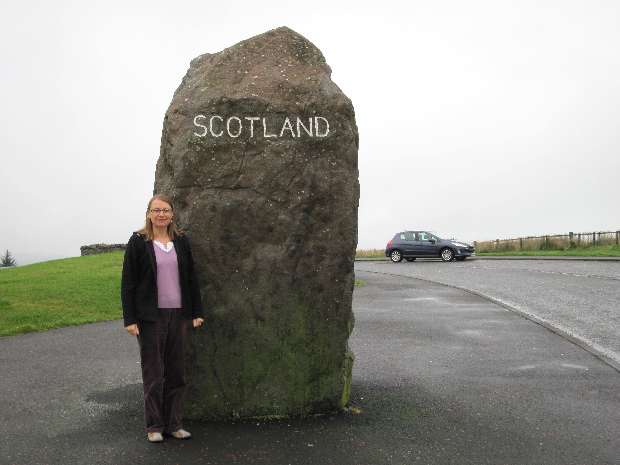
Scotland is different II

Image


IMG_0333a

the-england-scotland-border-thornaby-on-tees


‘Is there a Scottish Road to Socialism?’, edited by Gregor Gall, Scottish Left Review press, 2007.

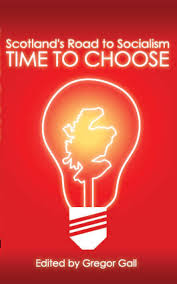
‘Scotland’s Road to Socialism: Time to Choose’, edited by Gregor Gall, Scottish Left Review press, 2013

My sister received a leaflet from the local Scottish Socialist Party branch opposing the bedroom tax and saying it would be abolished by independence.  It also announced a meeting which would show Ken Loach’s film ‘Spirit of ‘45’, which records the famous victory of the Labour Party in the 1945 election.

It is therefore ironic to note that the Labour vote in 1945 in Scotland was not very different from the rest of the UK. One observer noted that “The most Conservative of the big British cities is – Glasgow!  And it did so by staying as it was before.  London is far “redder” than Glasgow” (quoted in ‘The Strange Death of Labour Scotland’, p. 205).

When one considers that the only party ever to get an overall majority of the vote in a Scottish election is the Conservative Party in 1955 a claim for Scotland’s necessary or intrinsic progressiveness looks pretty weak.  At this time many Scottish workers voted Conservative, the party having a membership of 250,000, and many were infected by Orange, anti-Catholic sectarianism.  This strain in Scottish society has of course very much diminished but it has not at all disappeared.

Historically Scotland was a stronghold of the Liberal Party; in the19th century it won a majority of the vote in every of the 20 elections held between 1832 and 1910.  Trade unions developed earlier in England and Scottish workers were lower paid and considered more docile.  This may have built a head of steam for ‘Red Clydeside’ before, during and after World War 1, on which rests to a significant degree Scotland’s reputation for workers’ militancy.

However the main burden of the argument for a more left wing Scotland rests on the domination of the Labour Party in Scotland for most of the last 50 years.  In 1959 the Conservative Party was still ahead of Labour but in the 1966 election Labour won 49.9%, the highest it was to achieve.

Subsequently the dominance of the Party relied more and more on the first-past-the-post electoral system and the limitations of its support were masked somewhat by the decline in the Conservatives, with that party being negatively affected by the electoral system.   So in the 1992 Westminster election the Tories gained over one quarter of the vote but only 11 (15%) of the seats.  In the following 1997 election its vote was 17.5% but it won no seats.  The decline of Labour is reflected in the fact that its vote in Glasgow in 2011 was less than 24% of its vote in that city in 1951 and this is only partly explained by the decline of the city itself.

The Labour Party was never the ‘national’ party of Scotland not only because its strength was essentially regional, for example it only won Edinburgh for the first time in 1984, but because the country’s class differences meant that it would have been very difficult for any single party to play this role.  It is this role that the SNP now hopes to take up but it can only succeed if class distinctions are buried.  Victory in the referendum would help such a project.

Two authors put the strength of the Labour Party in Scotland down to the relatively large role of council housing, the size of the trade union movement in Scotland and the political patronage of the Labour Party in local government.  They contrast this with the relative low membership of the Scottish party, which has generally been on the decline since the 1950s; its weak organisation, limited resources and relative lack of ideological ferment.

The decline in the three pillars of Labour is pretty dramatic: council housing fell from 54.4% of all homes in 1979 to 15.1% in 2005.  Trade union membership fell from 55% of the Scottish workforce in 1980 to 39.2% in 1991 and 32.2% in 2010.

Its power base in local councils has also declined.  In 1980 it won 45.4% of the vote, getting 494 councillors elected out of 1,182 seats and winning 24 out of 53 district councils while in the proportional vote election in 2007 it won only 28.1% of the vote, only 348 out of 1,222 seats and only 2 councils.  This decline has run parallel with nepotism and corruption scandals damaging the party but revealing the rotten underbelly of municipal state ‘socialism’.

Some of these trends are not unique to Scotland.  English council housing fell from a peak of 29% of homes in 1975 to 18% in 1985.  Trade union membership across the UK fell from a density of 55.4% in 1979 to 23.5% in 2009.  In English local government Labour had 9,630 out of 20,380 councillors (47.3%) in 1979 falling to 3,743 out of 18,216 (20.5%) in 2009. It controlled 169 out of 386 councils in 1998 (43.8%) and only 33 out of 351 in 2009 (9.4%).

Scotland has a proud history of working class struggle from Red Clydeside to the 16 month Upper Clyde Shipbuilders occupation beginning in 1971, to the 103 day sit-in in the Caterpillar plant in Uddingston in 1987 and the occupation of Timex in Dundee in 1993.  All this is something to learn from and share with workers from every other country as part of the international struggle of the working class, not a claim to some special badge of righteousness on which to pin a nationalist programme.

These can be seen as proud episodes in working class struggle within Scotland and Britain but they should not be placed within some supposed innate Scottish empathy with the oppressed that contrasts a Scottish “desire for fairness and justice” to the English ”ideological base”. (‘Scotland’s Road to Socialism, Time to Choose’, p. 34)  The Scottish working class never developed, even at the height of its militancy, a separate mass working class party or an autonomous political programme.  The story of the Scottish working class movement is inextricably linked with that of the British working class movement as a whole.  Within this framework each nation’s socialists can be proud of the history of revolt against oppression in their own particular country.

So while Scottish socialists can be proud of Red Clydeside, so English socialists can be proud of the Peasants Revolt, the Putney Debates, the Peterloo massacre, the Tolpuddle Martyrs,  the General Strike in 1926, Saltley Gate, Grunwick and  the heroic miners strikes in England, Wales and Scotland.

This is the history of the fight against exploitation and oppression that socialists across Britain should see as reference points in the fight for working class unity across the three nations.

Such an appreciation of the British class struggle would allow comparisons to be drawn between today’s referendum and previous elections.  In February 1974 the Tory Party in Government called an election in the wake of the miners’ strike under the slogan ‘Who Governs Britain?’ and after another election in October it was clear that is wasn’t the Tories when a new Labour Government was elected.  Today the independence referendum does not arise on the cusp of working class struggle in Scotland but is timed more to coincide with the 700th anniversary of a medieval battle.

A final argument can be put that, even if Scotland is not materially more left wing or progressive, left leadership can make the independence movement a progressive agent of change.  This is supported by the fact that supporters of independence, it is argued, are disproportionately left wing: “. . . the vast majority of support for independence in Scotland comes from the most progressive sections of society – young people and workers in Scotland’s larger town and cities.  On the other hand, who do we find lined up to support the British state?  The elderly (!), the wealthy, and those whose business and political interests mean that they have most to lose from the break up of the British state – in other words, the most conservative and reactionary elements of Scottish society.” (Is there a Scottish Road to socialism? p 53)

All three independent Scottish parties are on the political left and “believe in Scottish democracy” and Scottish nationalism now plays “a much more progressive role in recent decades”. (Is there a Scottish Road to socialism? p 48 & 52).  The SNP election programme contains “anti-imperialist pledges” it is claimed. (Time to Choose p. 36)

On the other hand even some supporters of independence would presumably regard this latter remark as nonsense, as the SNP “are a pro-capitalist party who favour neoliberal corporate control.” (Time to Choose p. 89)

Against the claim that the pro-independence support is relatively more left-wing others have argued that “only a minority of working people in Scotland currently support independence and most independence supporters do not have strongly socialist perspectives”.  The “programmatic demands and slogans of the main pro-independence party, the SNP, are likely to weaken rather than strengthen attitudes of working class solidarity in the process of any independence struggle.” (p 92)  Another author records an opinion poll which shows that of those supporting independence in 2002 46% were ‘left’ and 48% ‘centre/right’. (Is there a Scottish Road to socialism? P. 35)

Irrespective of left hopes of political leadership of the independence movement, it is the SNP which dominates in the real world.  Those claiming that a left leadership can make all the difference need to explain how this works in reverse when this is not the case. Does right wing leadership not rob the demand for independence of progressive content if left leadership is necessary?

It is also the base of the SNP which is the bedrock  of the independence vote – “elements of the new middle class, small businesses, unorganised sections of the working class, and nouveau riche ‘entrepreneurs’”. (Time to Choose p. 16)

Use of rather nebulous descriptions such as ‘left’, ‘right’ and ‘centre’ allows all sorts of violence to political principle to be perpetrated.  What matters is the objective significance of a political programme and practice. A demand becomes socialist not because a left wing movement takes it up.  It is equally logically possible that the Scottish left is less socialist for its championing of nationalism.

It is not what people think they are that matters but the objective meaning of their political programme.  Many women will be familiar with the guy who walks into a bar thinking he’s god’s gift to the opposite sex . . . Because parts of the left take up a cause it must therefore be progressive or correct needs to be demonstrated; it does not by itself stand as proof of anything.

The British working class – including its Scottish component – has suffered from ‘Thatcherism’ and the political retreat that this has engendered.  The rise of nationalism amongst much of the Scottish left is the product of this defeat as its rise is hardly conceivable without it.

This is not at all surprising.  What would be surprising would be that Scottish workers somehow resisted this shift, not by sticking to their traditional politics, but by embracing nationalism.

Were Scottish workers really so different, more radical and militant, this would be reflected in their ability to lead the rest of the British working class in resisting what is called neoliberalism.  The left case for independence has arisen because it has been unable to do so not because it is – uniquely within these islands – in a position to play this role.

This failure has led to, for some, a collapse into narrow nationalism while pretending that somehow Scotland is more left wing.  We will come to the proposed strategy that arises from this in the next post on the independence referendum.


Scotland is different

_72456913_signreuters,jpg


In my first post on the Scottish referendum debate I noted that the Yes campaign appeared to be offering something positive  while the No campaign was involved in almost purely negative rhetoric.  This is also how it appears in the left case for Scottish separation.  This argues that a Yes vote will open up a Scottish road, if not to socialism, then to a place that brings the possibility of achieving socialism much nearer.

There are two parts to this assertion.  First that Scotland is in some senses more left wing than England (Wales it would seem, unfortunately, doesn’t really count) and secondly that ‘independence’ would free Scotland, the Scottish people or the Scottish working class, to make advances to socialism.  Sometimes socialism is framed in terms of a kind of Scandinavian social democracy and sometimes in more radical terms.

Let’s take these claims one by one.

First that Scotland is more left wing, radical or in some way more egalitarian; a more fertile ground for socialism if separated from the rest of Britain.

Marxists believe that the ideas in peoples’ heads arise not simply from within their heads, from preformed views, but are a result of their interaction with the world around them, particularly their interaction with fellow human beings, through the way that the society in which they live is structured.  One fundamental way society is structured is how people cooperate to produce the means by which they survive and prosper, or otherwise.  This involves the creation of classes and even when not class conscious workers’ views of the world are heavily imprinted by the fact that they see the world as workers.

This means that if Scottish workers are in some fundamental sense more egalitarian or progressive this should be reflected in Scottish society. This does not mean that there is any one-to-one correlation between the economic and social structure of society and the politics expressed in that society but if there was a strong and persistent egalitarian politics within Scotland while its society was not otherwise very different from, say England, this would require some explanation, especially since both have existed under the same state and both with a similar relationship to that state.

Inequality is high in the UK relative to other OECD countries, ranked 7th out of 35.  Inequality in Scotland is lower than it is in the rest of the UK, a result of particularly high inequality in London, resulting in inequality in Scotland being roughly equivalent to the median level of the OECD.  Tax and social transfers by the UK state are slightly more redistributive than other OECD states but not particularly high given the higher initial level of inequality.

Inequality has been rising in the OECD countries for the past few decades and particularly in the 1980s and 1990s in the UK, although it has been rising at a much slower rate since.  In the OECD however it grew much more quickly in this latter period and even more so in the Nordic countries that the SNP and some on the left see as the model to emulate.

The level and worsening trend of inequality in Scotland is therefore very similar to that of the rest of the UK outside London.  The richest 1% of Scotland’s adult population earned 6.3% of total pre-tax income in 1997 and 9.4% in 2009.  In Sweden the richest 1% increased its share to 9%.

This growing failure of the Nordic countries is a result of growing basic inequality in these countries and a reduction in effectiveness of redistributive policies.  In addition some of these Nordic countries display high levels of wealth (as opposed to income) inequality.

The authors of the report from which these figures are taken state that adoption of Nordic style redistribution policies would not result in closing the gap between Scotland and the Nordic countries given the different starting points of inequality.  That is, given the basic inequality within the economic system to begin with before tax and benefit changes involving redistribution.

The authors point out that in order to redistribute income from high earners to lower income earners you need high earners in the first place.  In other words the basic economic system must still be inequitable.  It is not a very robust socialist policy to rely on income inequality based on basic economic relationships to generate the revenue to equalise society.  It accepts this basic inequality and hopes that the rich will simply accept that they become significantly less rich despite the underlying inequality of power.

This is why Marxists do not place much faith in any capitalist state redistributing the high incomes of the rich to workers, not to mention their wealth and ownership of capital.  In its place we seek the growth of worker-owned production so that more equal income and power relations are generated by workers through their own actions rather than rely on taxing – and therefore relying on – the unequal ownership of productive resources.  The identification of socialism with acceptance of basic capitalist relations and the simple amelioration of the worst effects of this by state tax and spending is therefore mistaken.  It has increasingly failed in those countries held up as the exemplars of success.

One of the authors in ‘Scotland’s Road to Socialism, Time to Choose’ illustrate the figures above:

“. . . Scotland is a capitalist, class society with staggering inequalities of wealth and power.  One study, in 2003, showed that two Edinburgh districts have more millionaires than anywhere in Britain other than Hampshire in London.  ‘Blackhill is better heeled than Belgravia and Morningside is more upmarket than Mayfair’ reported the Telegraph (6 February 2003). Contrast this to the figure that men in the Calton ward of Glasgow live to an average age of 54.  With these facts in mind, we dispute any idea that Scotland has a distinctively ‘collectivist’ civil society.  The neo-liberal trajectory in Scotland, like elsewhere, has led to extreme polarisation of income.”

So Scotland is not an unusually equal society and is much like most of the rest of Britain, outside London, and even London (!) has many millions of working class residents.

However I did say that there is no one-to-one correlation between the economic and social structure of society and the politics expressed in that society.  The report above notes that there is “some evidence for preference heterogeneity between Scotland and the rest of the UK. . . As well as persistent differences in voting patterns according to the British Social Attitudes Survey, Scots are: more likely than English voters to think the gap between high and low incomes is too large (78% v. 74%); are more likely to support government efforts at redistribution (43% v. 34%); are more likely to say that social benefits are not high enough (6.2% v. 3.6%); and more likely that unemployment benefits are too low and cause hardship (22% v. 18%).

What is noteworthy about these results is not the differences, which are not pronounced except perhaps somewhat in attitudes towards redistribution, but how similar they are – how the first question results in high scores in both and such low scores for the third question in both.  Since all the questions are aspects of workers dependence on the state, except the first, they measure not so much attitudes to socialism but attitudes to reliance on the state, which workers must overcome to realise their own society.

The Red Paper collective provides further evidence of similarities of views in England and Scotland.[i]  It quotes a Nuffield foundation report in 2011 which “concluded that in terms of being ‘more social democratic in outlook than England, the differences are modest at best’.  In what perhaps should serve as a warning for those who would conflate constitutional and social change they also note that “Like England, Scotland has become less – not more – social democratic since the start of devolution.”

The data quoted by the Red Paper collective shows that when it comes to the three northern regions of England not only are there no big differences in attitudes compared to Scotland but no real difference at all.  They therefore state that “insisting progress for people in Scotland depends on independence is saying that those with similar problems and outlook to our own must be written off as partners in building something better.”

“The problems facing Merseyside and Clydeside have the same causes and as we have seen, people feel similarly about them.  Maintaining that the difficulties of the former are ‘economic’ and the latter ‘national’ is to take the advocates of nationalism at face value.  Accepting rather than analysing their claims, and ignoring the reality of class power.”

The telling of national myths should be left to nationalists.  “Our national story has been shaped down the generations by values of compassion, equality, an unrivalled commitment to the empowerment of education” says Alex Salmond.  In fact the national story of Scotland is failure to build an empire by itself and then joining the English in creation of a British empire in which the values of compassion, equality and empowerment were conspicuous by their absence.

2f07fc81-cf36-4e2b-8b49-54a9eb0e03b8

“A more collective sense of society, of looking out for one another, is a strong part of Scottish life” says the chief executive of the Yes campaign.  Except the figures for inequality and working class mortality in Glasgow show this up for the crap that it is.  Just like England and Wales working class solidarity has suffered defeats in Scotland and the values of compassion, equality and looking out for each other will come not from the state, decked in tartan or not, but from the working class itself.

It might be objected that the attitudes of Scotland are those of a nation while similar attitudes in the three English regions are only of a part of England. However to privilege the national breakdown of social attitudes is to accept privileging the interests of the national unit over those of class.  It presupposes what it has to prove – the overwhelming salience of national division – and begs the question in the assertion that only by itself can the Scottish working class move forward.  It ignores the much larger potential for working class unity – the 5 million Scots and the fifteen million in northern England together.

For socialists the unity of the working class within the 20 million is infinitely more important than the unity of all classes within the 5 million.

It can be argued that even if the basic nature of society is hardly very different in Scotland from the rest of the UK and social attitudes not very different either, and more or less the same as northern England, that still politically Scotland has proven more progressive and more left wing.  Since independence is not just for Christmas but for keeps any such political differences must be pretty fundamental and long-lived.  Does the political history of Scotland demonstrate such fundamental and more or less permanent differences?

To be continued


[i] It is interesting to note some of the nationalist comments on this paper which state tha it is not their claim that Scotland is different but that it can be different through independence that matters.  What they ignore is the nationalist claim that the latter is possible because of the former.

The arrest of Gerry Adams

images (6)When Gerry Adams was arrested for the murder in 1972 of mother-of- ten Jean McConville Sinn Féin claimed it was “political policing. The arrest of a high profile political leader during an election could hardly be anything else.  That the intention to question him was notified by the Police Service of Northern Ireland (PSNI) to the highest levels of government in advance and that this government tells us it is keeping Washington informed is simply confirmation.

Yet when it comes to explaining what this political policing amounts to, Sinn Féin’s Martin McGuinness claims lamely that the arrest is due to a “small cabal” of police officers, “an embittered rump of the old RUC (Royal Ulster Constabulary)”.  McGuinness claims that other police sources have described these people as the “dark side”.

So it’s not really political policing but a “rump” that presumably can be dealt with.

Yet Sinn Féin hasn’t asked for this but just a vague wish that the episode is “resolved in a satisfactory way”.  Meanwhile the party will continue to “support the reformers who have made a massive contribution to policing” while saying that if it “does not work out the way that it should” the party will review the situation “in the context of continuing with a positive and constructive role in a vitally important peace process”.

However the press conference at which all this was said was really about a threat to reverse its previous political support for the PSNI, an event that would precipitate yet another crisis in the never-ending peace process.

But how can Sinn Féin complain of political policing when it supports this policing?  How can it issue vague hopes that everything turns out ok when it also claims that policing is accountable?  Why is it threatening to withdraw support (in a very vague and indirect way) when it can hold the police to account for its actions?  Why doesn’t it just do that?

Graffiti has gone up in West Belfast attacking “Boston College Touts” (informers), i.e. those who gave their accounts of their own and Adams’ involvement in the IRA and its abduction of Jean McConville to the American institution , the acquisition of which may be the basis of his arrest.

_74622246_img_1763

Yet how can these people be touts when Sinn Féin supports the PSNI and has called for everyone to give the police whatever information they have on the actions of republicans (i.e. the dissidents)?  The hypocrisy involved is as staggering as it is completely unselfconscious.

McGuinness claims that “Sinn Féin’s negotiations strategy succeeded in achieving new policing arrangements, but we always knew that there remained within the PSNI an embittered rump of the old RUC (Royal Ulster Constabulary).”  Yet it never made any qualification when it announced its original support for the PSNI.

Does this mean it only supports part of the PSNI or only partly support the PSNI?  Which part? How is everyone else supposed to know which part to support?  How would it and everyone else partly support the PSNI?

How can such a situation exist when Sinn Fein is in government?  How could the brilliant negotiators of Sinn Fein agree to a deal to support the police without getting a guarantee its leader would not be lifted for allegations made years ago?

Why is Sinn Féin making such an issue of Adams’ arrest when it never threatened to withdraw support from the PSNI when the PSNI spent months allowing loyalist crowds, led by the UVF, to disrupt everyone else trying to get home during the flags protests?

Why did it not threaten to withdraw support when these illegal parades were allowed by the PSNI, in fact the PSNI met with organisers to arrange them, and not do so when these parades attacked the small Catholic area of the Short Strand?  Only this week a judge found the PSNI (all of it, its leadership included and not just some “rump”) guilty of failing to enforce the law when it came to illegal loyalist parades.

Again these last few weeks drunken loyalist paramilitary mobs have taken down legal election posters and put up their own flags on main roads in Belfast,  right in front of police stations, while the PSNI has told local residents on no account to take them down.  Is it only Sinn Féin’s leaders who must be protected from the “dark side”?

And why indeed should Adams be protected?  He denies any responsibility for Jean McConville’s killing but then he also denies ever being in the IRA.  Other former IRA members, with unimpeachable republican credentials, have admitted their involvement and claimed Adams was in on it.

As the recently deceased IRA member Dolours Price put it “I wanted very much to put Gerry Adams where he belonged and where he had been. We had worked so closely with him, on many occasions and taken orders from him on many occasions and then to deny us, particularly after we had been through such a harrowing experience in prison … we were offended that he chose to deny us as much as he chose to deny his belonging to the IRA. To deny it is to offend those of us who partook in what we partook in.”

The message on the hill overlooking Belfast calls for the truth about the British Army murders of 11 people in Ballymurphy in August 1971, an enquiry into which has just been rejected by the British Government, but the same demand can apply to Adams.

But bad as these questions are for Sinn Féin none of them get anywhere near the biggest problem it has.   And this problem is that Adams would not have been arrested if the British Government had not given it the ok.  The political policing of which Sinn Féin speaks is not the actions of a “small rump” but the actions of a state.

That Sinn Féin should peddle the line of ‘sources’ within the PSNI that what is involved are the actions of “dark forces” against the reformers, “the many progressive and open-minded elements” of the PSNI that McGuinness hallucinates, is to swallow the old good-cop bad-cop tactic that old IRA men must have been warned about if caught or arrested.  That this is now the line of Sinn Féin shows how far it has travelled and so low it has sunk.

Swallowing and parroting this means buying into the designs of the British state just as much as swallowing the good cop line gives you the bad cop result.  What this means has been signalled by the British Government.

Recent speeches by Teresa Villiers, the NI Secretary of State, have glossed over the refusal of the Unionists to accept the deal offered by US diplomat Richard Haas, and supported by the British state itself,  and have conciliated their intransigent line, which itself is a play to extreme loyalism.  So the crimes of the state, never investigated with any seriousness it has been revealed, are even more to be airbrushed out of existence and instead it is the crimes of the “terrorists” which must be centre stage.  The role of state forces in sponsoring these terrorist gangs will of course also be occluded.

So the past will more and more become the one imagined by unionism.  Parades? Well the Parades Commission has given every evidence that its restrictions on loyal orders can be ignored with impunity.  Getting a form of words that ends with the same result might not be difficult given even a minimal willingness of loyalism to engage with Catholic residents whose neighbourhoods they parade in.  Flegs? Well we have noted the PSNI’s preference to let drunken loyalist mobs put up whatever symbols of intimidation they want.

That about completes the Haas agenda but even these do not signal the end game and this too is coming more into focus in a statement of Villiers.

In a speech widely reported, but the reporting of which missed its most significant element, Villiers anticipated the rewriting of the political deal on which Sinn Féin can claim success.  She foresees the “evolution” of the power-sharing institutions towards them having an opposition.

The whole point however of these institutions is that no one is in opposition, in particular nationalists are not put into opposition by unionists who have not demonstrated any capacity to act in other than a sectarian fashion.

It’s put in the usual honeyed words:

“The third way in which politics could be moved forward here is through the evolution of the devolved institutions.

Let me be clear, power sharing and inclusivity are enshrined in the Belfast Agreement and the government is not going to undermine any of those principles.

. . . Yet at the same time nobody can plausibly argue that the institutions must be set in stone for all time.

Political institutions the world over adapt and change.

As the founding father of modern Conservatism – the Irishman Edmund Burke – once put it:

‘A state without the means of change is without means of preservation.’

And there are inherent weaknesses in a system in which it is very difficult to remove one’s rulers by voting and to choose a viable alternative.

That’s why this government is clear that we would welcome moves that facilitate a more normal system at Stormont that allows for formal opposition, so long as a way can be found to do this which is consistent with power sharing and inclusivity.

But we also believe that if or how this happens really has to be primarily for parties in the Assembly to take forward, not least because it is so firmly within the Assembly’s competence to deal with those matters that might characterise an opposition, such as speaking rights, financial assistance and committee chairmanships.”

So at the moment the British Government would be quite happy for the Stormont regime to have parties outside Government if this was accepted by these parties, if it was voluntary.  No longer is this anathema, no longer is such a suggestion the antithesis of what the new arrangements are about.  Now this is both a viable and even preferred destination.

But of course it has to be voluntary.  Since having the nationalists in opposition is the primary objective of unionism such a policy stance is not so much a disinterested, absent-minded meandering on possible future directions as an incentive for unionism to get nationalists, or at least Sinn Féin, out of Government, “voluntarily”.

This is not actually the preferred British solution but it is testimony to how far it will go to keep unionism inside the existing deal that it floats ideas that while mollifying unionism actually increase instability.

That it only undermines the deal more and more by emboldening unionism and feeding its triumphalist agenda demonstrates only the continuing contradictions within the imperialist settlement – continuation of a sectarian state and sectarian political arrangements while hoping that this sectarianism can be made innocuous or at least reduced to an acceptable level, just as there used to be an “acceptable level of violence.”

So the incentive for unionism is to continue not to work the existing institutions while seeming to maintain a modicum of good faith, obstruct and provoke Sinn Féin as much as it can without damaging itself and hope that the sheer impossibility of Sinn Féin putting up with its obvious powerlessness gets the right reaction.

Unfortunately for them it is perfectly obvious that Sinn Féin will cling to the Stormont regime like grim death with no humiliation too embarrassing and no rebuke too severe for it to walk away. Sinn Féin will hold on to the appearance of power even when this appearance has gone.

But if clinging to the trappings of office becomes the main objective the point of actually having it – making changes – grows ever less important.  Being in office in the North is important for Sinn Féin getting into office in the South and it believes that it being in office in both Irish states on the centenary of 1916 will be a powerful symbol.

Indeed it will.  It will symbolise that the party has realised its strategy but that this strategy is ultimately a failure.  A Sinn Féin in government in both partitioned states will still leave both partitioned states in place.  Sinn Féin will simply sit over both.  Should it stay in office the sight of it doing so will prove no more remarkable than the sight of Sinn Féin toasting the Queen of Great Britain.

How quickly can illusions be shattered.  Fresh from congratulating themselves and being congratulated by the chattering classes for its wearing of white tails and standing for “God save the Queen” the acceptance of the privileges of the British monarchy is rammed home by her state exercising its powers as it sees fit.

Why toasting the symbol of oppression should lessen this oppression or limit its exercise can nowhere be explained by Sinn Féin.  When one swallows the toast there can be little complaint when one has to swallow a whole lot more.

Whatever the outcome of Adams’ arrest the whole exercise is a brutal demonstration of Sinn Féin failure and it will cost it in the long run.  The grounds for creation of an alternative are clearer but unfortunately there is no sign yet that any such alternative is arising or has some progressive working class content.

Is Scotland an oppressed nation?

Scot2scot1


‘Is the a Scottish Road to Socialism?’, edited by Gregor Gall, Scottish Left Review press, 2007.

‘Scotland’s Road to Socialism: Time to Choose’, edited by Gregor Gall, Scottish Left Review press, 2013.

I remember having a brief chat with a left nationalist who argued that, in the context of a reference to Ireland, that there are degrees of national oppression. And so undoubtedly there is. What is demonstrated by the Scottish independence debate is that the measure of it, if it even exists, is very small. We know this because there is no real demand for change.

What we have had are references to “bluff, bullying and bluster” by Alex Salmond over leaders of the Labour Party, Tories and Liberal Democrats, rejecting use of sterling by a new ‘independent’ state. But even here the essential nationalist case is not that Scotland is being told what it can and cannot do but that all this is bluff and bluster, a pure negotiating tactic and not meant to be taken seriously.

Not strong grounds to claim oppression.

A couple of arguments have been raised to demonstrate the national oppression of Scotland. These include the prevention of devolution after the 1979 referendum despite the nearly 52% yes vote on an almost 64% turnout. This was indeed a denial of national democratic rights. It was changed very quickly when the New Labour government of Tony Blair took office in 1997, a new referendum held within six months and the Scottish parliament set up two years later.

It is claimed that Conservative Governments are elected in Britain without a mandate from Scotland. In the 1989 Euro elections Scotland became, for the first time at any elected level, a ‘Tory-free zone’ and in 1992 they were elected for a fourth term with just 25% of the Scottish vote.

Yet governments are elected all the time in Britain without a majority of the vote. English and Welsh workers have suffered the depredations of Conservative Governments no less than Scottish workers and the Tories do not devise policies aimed specifically at the Scottish people. In 2010 the ‘no mandate’ argument became weaker when eleven Liberal Democrats joined the single Tory as Scottish representatives of the new ConDem Government.

It is claimed that the introduction of the poll tax a year earlier in Scotland than England represented national oppression. If it did it obviously didn’t last long. Let’s also forget that one of the two authors of the tax was himself Scottish, dubbed “father of the poll tax.”

The referendum in itself, whatever its limitations, is a demonstration that Scotland has the right to self-determination and can exercise this right.

In this exercise there is no question of nationalists having to face questions of oppression – of the national language; the teaching of Scottish history; the right to fly the Scottish flag; discrimination in employment in favour of English colonists; the mass arrest and detention without trial of political opponents; of English police or an English army called in to police demonstrations or protests; the widespread inflicting of torture on political opponents; the shooting of demonstrators demanding civil rights or the creation of armed gangs to intimidate and terrorise those demanding independence.

If there were any of these or anything like it the referendum debate would be very different; not only the terms of the debate but also the methods of struggle.

The exploitation and oppression that does exist has been displaced and subsumed within a debate within which they cannot be clearly articulated, at least with any honesty, and certainly with any perspective that provides solutions.

Solutions to unemployment and poverty; to chronic insecurity and stress; to ignorance and powerlessness cannot be found in any nationalist programme, either left or right. They arise from the nature of the economic system not the nationality of the state apparatus that presides over it.

Class grievances are portrayed as those of a people, of Scots against ‘London’ or the ‘British state.

Through nationalism the class exploitation of workers either disappears or is rendered secondary to the more immediate demand for national ‘freedom’.

As I have said before such ‘freedom’ does not exist; there are always restrictions and external limitations, which means that pursuit of it, which requires that the demands of workers are postponed, means that they will always be postponed. Nationalism acts as a permanent brake on the aspirations of the working class.

At a certain stage the true class character of nationalism becomes clearer when the new nation trumpets its cause as competitiveness with other nations in the battlefields of lower wages, lower business taxes and willing workers. Such at least has been the Irish experience.

So Scotland is not an oppressed nation but ironically it is nationalism that has the potential to take it in such a direction and the referendum debate has demonstrated how.

Alex Salmond has made much of the “bluff, bullying and bluster” coming from leaders of the Labour Party, Tories and Liberal Democrats. But these parties are very aware that they cannot engage in too open a form of bullying because it has the potential to alienate voters and upset the legitimacy of the state they seek to rule. So their bullying has limits. A separated Scotland would provide less restrictions.

Salmond has portrayed all the decisions that will arise from separation, such as sharing the pound sterling and financial regulation, as ones that will be easily agreed to his satisfaction but in such negotiations the UK state has no reason not to flex its muscles with the smaller state. Such actions by the UK state would, within Scotland, no doubt strengthen SNP nationalism and scotch the illusions of the left that after independence nationalism would suddenly dissipate to be replaced by a left-right divide. Real bullying by the UK state would feed Scottish nationalism and further its growth within the Scottish working class while increasing the divisions between Scottish, English and Welsh workers.

So the rump British state would have every reason to want Scotland to use sterling but enough reasonable arguments to place more or less onerous conditions on Scotland in order for it to happen. It is well known that currency union must involve severe limits on monetary policy within Scotland and there is no reason why the rest of Britain should consider Scotland’s interests as equal to that of England and Wales. If burdens have to be borne there is no reason to make them equitable.

It is also clear that currency union would limit the fiscal policy of a separated Scotland so that its taxation and expenditure policy would also be subject to limits, again set at least partly by the UK state. As the Governor of the Bank of England, Mark Carney, put it: “in short, a durable, successful currency union requires some ceding of national sovereignty.”

Scottish debt might find itself being owned by UK institutions demanding a premium from the new state and any new financial crisis arising within Bank of Scotland and RBS etc. would all too clearly demonstrate the respective powers of the two states.

Financial regulation will also come from London and there is no reason why this regulation would be to the benefit of anyone other than the City of London except with nationalist hopes or assumptions that what is good for the City is good for Edinburgh – exactly the sort of attitude now so scorned by these Scottish nationalists.

Only recently the BBC reports that the siting of Trident in Scotland is one of many areas that would be up for negotiation. Only a fool believes Salmond when he claims all these negotiations will give the SNP what they want in all of the issues, and he will be first to call out the fools when they complain about it after the negotiations are over.

The BBC states that ‘a dozen high-ranking defence veterans have written to Mr Salmond claiming a proposed constitutional ban on nuclear weapons in an independent Scotland “would be unacceptable for NATO”.’

“Were the Scottish people to vote for independence, then Scotland, as a new small nation in an uncertain world, would need international partners to help secure its economic and social objectives and allies to provide national security.”

“NATO, as an alliance with nuclear deterrence as a central part of its strategic concept, could hardly be expected to welcome a new member state whose government put in jeopardy the continued operation of the UK independent nuclear deterrent – a deterrent which protects not only the UK but all of NATO as well.”

Those putting their names to the letter include former chief of the general staff General Sir Mike Jackson (he of Bloody Sunday), Admiral Lord West of Spithead, and former chief of the air staff, Air Chief Marshal Sir Peter Squire. This was followed up the next day by another political intervention, this time by a serving member of the top brass, Admiral Sir George Zambellas.

How comforting is it to know that NATO will help secure the economic and social objectives of the new state? Whose security does NATO seek to protect? Why is the SNP not denouncing the political interference of the armed forces?

Such a political intervention by those recently and currently in uniform portends the future pressure put on the new separated state should it seek to have its cake of being in NATO and eating it by frustrating its operation. Of course the British monarchy, with all its disguised powers, will also continue to preside over the newly separated state.

So, while Scotland is not currently an oppressed nation, the law of unintended consequences might conceivably shift it in that direction. Just as Thatcher’s policies strained the bonds within the British state she so loudly championed so Scottish nationalists might deliver their separated state into a new partnership of subordination with the rest of Britain.

But perhaps this doesn’t matter to the left nationalist case. After all as I noted right at the start, this case is based on the difference between Scotland and England and the view that socialism or moves towards it are more easily achieved through a separate state. I’ll turn to this in the next post.

PS. In his comment on my previous post Boffy correctly states that even where a nation suffers some form of national oppression within a larger state entity the “priority should still be to defend the unity of the workers.”

This should always be the case. The issue is how this might be achieved.

It might be necessary in certain circumstances not only to champion the right of a nation to self-determination but also to advocate its exercise through separation.

This will depend on the degree of national oppression and related to this (more importantly) whether the socialist movement would place itself outside of a real democratic struggle that dominated politics if it did not advocate separation (by so doing isolating itself from the working class).

Even where this is the case the role of socialists would be to warn workers about the limits of national separation, whether called national liberation or not; to separately organise the working class under its own banner and prosecute the class struggle not only against imperialism but against native capitalism.

Its role would be to draw out the class nature of working class oppression and exploitation and warn that nationalism has no solution to these. It would warn that a new capitalist state will not address working class needs, will not empower it but will be set up to enforce the power of the native capitalist class.

None of this applies to Scotland. It does not suffer such national oppression and the Scottish working class has throughout its history fought its greatest class battles in unity with English and Welsh workers.

The nationalist left in Scotland has not prioritised workers unity or, as the two books under review have made clear, prioritised exposure and condemnation of Scottish nationalism and the future to be offered by a capitalist Scotland. What they have done is attempt to argue the priority of supposed national restrictions on Scottish workers and to conflate opposition to class oppression with that of the nation claiming ‘freedom’.

The need to support separation because of national oppression, which I see as sometimes necessary, entails recognising the need for a retreat from a more open and clear class struggle against capitalism and should be the subject of bitter regret for socialists should they consider it necessary.

The opportunistic championing of Scottish nationalism by sections of the Scottish left is therefore doubly mistaken for it is assisting creation of the barriers to the fight for socialism and a united working class that they should be seeking to destroy.

Scottish nationalism and British imperialism

Canny-Glasgow


‘Is there a Scottish Road to Socialism?’, edited by Gregor Gall, Scottish Left Review press, 2007.

‘Scotland’s Road to Socialism: Time to Choose’, edited by Gregor Gall, Scottish Left Review press, 2013.

One way of addressing the arguments about socialism and Scottish independence is to review the two books above, which give a platform to a fairly wide range of views, both those in favour of a Yes vote in the coming referendum and those in favour of a No vote.  It is also interesting to compare the arguments between the two over time to see how they have stood up, or fallen down.

In my first post I said that for socialists the relationship between independence and the self-determination of the working class involves a number of questions and not just that independence must in some way be a move towards socialism or makes it easier to achieve.  It would be possible to be a passionate supporter of independence by believing that in itself it was a step forward without also implying any great move forward for socialism.  What is striking in both books is the absence of this argument and the keenness of those supporting independence to minimise such an argument and argue that independence is either intimately bound up with socialism or makes it easier to achieve.

In 2007 one contributor wrote that “when the national question rears up again, as it inevitably must, the debate will not be over the degree of devolution, but a blunt choice between defending the British state or a bold demand for independence and socialism”.  In fact, of course, it is not.  It appears as a choice between the British state and a Scottish state – both capitalist.  Two instead of one and the consequences of each.

Colin Fox argues in ‘Time to Choose’ that “the key question is can the socialist cause be advanced in Scotland through independence or not?  And the answer is yes it can, but only provided it involves a complete repudiation of neo-liberalism, corporatism, the financialisation of our economy and existing class relations.”

The first problem is that the independence campaign is led by the Scottish National Party, a “pro-capitalist, neo-liberal party moving to the right” according to Fox, which would undoubtedly form the first government of the new capitalist state and, buoyed by a stunning victory, would put an indelible stamp on its new constitution. If there is a Yes majority there will therefore be no “repudiation of neo-liberalism, corporatism, the financialisation of our economy and existing class relations.”

If independence can only advance the socialist cause in Scotland by a complete renunciation of these things then clearly independence, the real independence currently on offer, will not advance the cause of socialism.

However if Scotland was an oppressed country, so that everyone within it suffered some denial of democratic rights, by virtue of being Scottish or living in Scotland, then it would be possible to argue that Scotland should be independent and that socialists should support such a demand even without the repudiation of neoliberalism etc.

Once again however the argument that Scotland is an oppressed nation is by and large conspicuous by its absence in the two books, despite the large and varied pro-independence contributions.

However one contribution in ‘Time to Choose’ does not shy away from making such a claim.  “The struggle for Scottish independence is, at its heart, an anti-colonial struggle.”

But who are the colonists?  It can hardly be the English born population in Scotland, its largest ‘minority’, all 422,386 of them.  But what other candidates for this role are there?

“Scottish independence is a blow at the heart of imperialism.”  But if imperialism is understood as an economic system nothing of the economic system in Scotland will essentially change.  If it is understood as the political arrangement of states we will have two capitalist states instead of one, both in the EU and both in NATO.

Both countries currently form a unitary state in which both are part of the same imperialist state.  While Britain has often been called England the Empire has always been called by its proper name – the British Empire.  Scotland has played a disproportionate role in this Empire, in its expansion and exploitation of the rest of the world, despite the proclivity of Scottish nationalists to talk about the British state and Scotland as if they were two entirely different places.

Left nationalists obscure the integral role of Scotland in British imperialism, talking about “independence that would . . .  free us from the shackles of British imperialism”, (Colin Fox ‘Time to Choose’). How could Scotland be shackled by British imperialism?  The Scottish people have been exploited not by the English but by fellow Scots.

Or rather they used to be.  Scottish capitalism, in partnership with the English as part of the British Empire, took an identifiably large role in building this empire precisely because it was separately involved.  The Scottish banks and other financial institutions, which continue to this day, and most of its major industrial corporations were owned and controlled within Scotland.  So much was this the case that one recent study by an economic historian has said that Scotland was even more oriented to Empire than the English.[i]

Part of this was due to the narrowness of the domestic market, a result of low incomes, itself a result of relatively low wages or the greater exploitation of Scottish workers by Scottish bosses.

In the 1960s however manufacturing employment began to fall in Scotland, in this respect no different from that of Britain as a whole.  In the UK manufacturing as a share of employment peaked in 1966 while in Scotland the percentage of industrial employment fell from 39.3% in 1965 to 32.3% in 1979, 17.7% in 1993 and 11.1% in 2007.  Scottish deindustrialisation looks greater than that of many other OECD (advanced capitalist) countries only because its starting point was higher while its finishing point is unremarkable.

The British government succeeded in postponing this deindustrialisation through regional policy and attracting multinationals through incentives, which increased sixteen-fold from 1962/63 to 1969/70, but these increasingly failed to have the desired effect in the 1970s, at the end of the post-war upswing in the world economy.  Decline in Empire and decline in industrial Scotland went in tandem because the latter was in integral part of the former.

The British state had failed to prevent deindustrialisation and the demands of the Left today for nationalisation show how little they have learnt from this failure, with their repeated calls for nationalisation.  Much of the Scottish left now wants a Scottish instead of the British state to do the business.  Nationalisation did little to reverse the decline of the railways, coal or steel industries.  In fact much of the decline took place under nationalisation, with employment in the Scottish railways falling from 55,393 in 1951 to 22,910 in 1971 and employment falling in the coal industry from 89,464 to 34,315 during the same period.

It has been argued that the beginning of deindustrialisation coincided with the beginning of serious pressure for devolution and the growth of Scottish nationalism; a section of the petty bourgeoisie clearly registering the need for another capitalist project to take over from the existing partnership in a declining empire.

In this the nationalists typically saw things in reverse, with the SNP candidate in the famous Hamilton by-election in 1967 proclaiming “stop the world, Scotland wants to get on”.  In fact Scotland had been rampaging on the world for two centuries and many colonies at the time wanted it to get off.

Aden2005


Today however 87% of Scotland’s manufacturing industries turnover is in companies owned outside Scotland.  One study quoted in ‘Time to Choose’ states that “economic power does not lie in Scotland.  It still predominantly lies at a UK level.”  Scotland does have an autonomous financial services industry, in so far as any financial services in Britain can be described as autonomous. It also has oil but it isn’t owned by Scotland no matter what we think ‘Scotland’ means in this context.  Trade is dominated by the relationship with the rest of the UK – “Scotland exports more than twice as much to England, Wales and Northern Ireland as we do to the whole of the rest of the world put together.” (Time to Choose p. 108)

The basis for a nationalist Scotland has therefore eroded except in one very important respect, pointed out in the paper noted above.  This is in the growth of employment by the state: official Scottish Executive figures give public sector employment as a share of total employed as 23.5 % or 580,000.  However another estimate, taking account of out-sourcing and the growth of state-funded but non-state employment, puts the figure at 31% or 772,000.  The responsibility for most of this employment belongs to Edinburgh, not London; the official figures showing that 485,000 of the 580,000, or over 80%, falls under devolved budgets.

State employment in this respect substitutes for that lost by deindustrialisation.  This employment is financed by taxation of the increasingly service based economy including financial services, with its imperialist appropriation of surplus value, and of course oil, and also by debt.  What matters to Scottish nationalists are the revenues controlled by the state and hence the centrality of the debate about the tax revenue from oil and the levels of state expenditure it might support.

Scottish nationalism represents an attempt not so much to turn its back on Empire as to give a layer of the middle classes and capitalists direct access to the fruits of state activity, its taxation and expenditure.  To the working class the SNP promises fairness while to big business it promises a lower rate of corporation tax.  It doesn’t particularly matter what this rate is as long as it’s lower than that set in London; as the Tories lower it the SNP say lower still.

The state is no less the base of the nationalist left, in fact more so since it expects the state to do even more wonderful things to the Scottish working class.  For those who believe socialism is nationalisation of the economy it is no matter of principle what state might appear the most likely candidate to carry it out.

All this is why the proposals of the SNP promise such remarkable results from independence while also promising such little change to the fundamental features of the status quo.  While the currency stays the same and no radical change in policy is offered, relatively minor differences based on pure assumptions and assertions are open to the grandest of unproven promises.  No wonder there are complaints about the lack of clarity generated by the debate and confusion caused by claim and counter-claim.

Hypotheses, projections and counterfactuals take the place of hard and immediate alternatives.  So the debate is about can Scotland continue to use the pound sterling; can it stay a member of the EU or negotiate membership within months; can it continue with the Bank of England as lender of last resort and with financial regulation ‘from London’, otherwise a term of nationalist abuse.

There is no or precious little debate about whether the pound should be the currency or what a currency means or is supposed to achieve, or about how the financial services industry could provide the catalyst for a new economic crisis.  Keeping the pound, keeping financial regulation from the city of London, staying in the EU and continuing to cut corporation taxes are the marginal ‘changes’ upon which grand nationalist rhetoric hides reality.   Meanwhile the No camp assists the nationalists by claiming that they can’t have many of their fairly timid set of demands.

But if Scotland actually was an oppressed nation the nature and characteristics of such oppression would be central to the debate.  Even accepting a continuing capitalist Scotland there would be something important, something urgent, something raw that would inflame passion.  But there isn’t.


[i] The Economic basis of Scottish Nationhood since 1870, Jim Tomlinson, University of Glasgow.

Yes to self-determination for Scotland

alexapldev1I was in Glasgow a few weeks ago and was talking about the upcoming independence referendum to my daughter and sister who both live in Scotland, are eligible to vote and are keenly interested in the debate.  They had just watched the latest referendum debate on BBC Scotland during the previous week and we were discussing what they thought about it.

They are both undecided, one having been strongly No, and the other expressing the view that while her heart said Yes her head said No.  Neither had found the contributions from the two sides of the debate wholly convincing or even very enlightening and the claims and counter-claims had caused some confusion as to who was telling the truth.  All this in my view is an inevitable result of the proposal being put forward, which I will come to in a later post.

What was clear to both was that the Yes side was perceived as putting forward something positive, appeared to be expressing optimism and confidence, proposing something apparently constructive and forward-looking.  Whether it was at all persuasive was another matter but inevitably it is compared to the arguments of the No side, which are seen as almost purely negative.

I have written before that a political programme can only truly be judged on what it is for, not what it is against, and this appears as a problem primarily for the No side, which is composed mainly of the Labour Party and the Tories who can hardly present a coherent positive message together that goes much beyond the banal.  On the other hand the Yes side is dominated by the Scottish National Party.

It might be possible to argue that the first principle of politics should be that of the Hippocratic oath – to never do harm.  Thus if one thinks that Scottish independence is wrong that should be good enough to vote against it.  And so it should, except such an outlook would also have to have some view of the thing that is good which is impaired by independence.

The debate has revolved around the nature of the new currency, possible membership of the European Union, the strength of an independent Scottish economy and the view that an independent Scotland would in some sense be a fairer one.  There are a host of other reasons that again I will come to.

For a socialist the reason to support independence must be that in some way it is a move towards socialism, makes it easier to achieve socialism or at least results in a less onerous form of capitalism.

Since, not surprisingly, the debate has assumed no revolutionary change to the existing economic system, and those advocating independence as a route to socialism are very much a minority in the Yes camp, it is on the last ground – that independence will involve a less onerous form of capitalism – that it might seem most necessary to come to a view.

In my view this would be wrong.  Not because the immediate impacts for working people of independence of a still capitalist Scotland are unimportant but because socialism is necessary for workers even while it is not currently any sort of immediate possibility given the current weakness of the socialist and workers’ movement.  This is obviously, after all, a decision with long term consequences.

This weakness only demonstrates its importance negatively, through the fundamental problems of capitalism being essentially unaltered by the particular national form that capitalism takes.  This has been demonstrated by the effects of the financial crisis on a wide variety of countries and the political crises in the various parts of the world it has given a major impulse to, including most recently the Ukraine.  The financial crisis impacted on all capitalist countries and if one believes, as one should, that the underlying causes have certainly not disappeared but in fact only grown then the nature of the economic system remains the fundamental question regardless of the form of the state.

In this respect it is amusing to hear both sides’ claims in the referendum debate about the risks that would exist in an independent Scotland – when the Yes side point to the oil and the No side points to the very large banking industry that the Scottish state could not afford to bail out should another financial crisis break out.

What both sides do is invite comparisons which show how fundamentally similar the Scottish and wider UK economy are.  Oil could provide a larger revenue base for a Scottish State (at least for a while) and another financial crisis has the potential to blow it out of the water. The UK state would have a proportionately smaller revenue base from oil but would be proportionately less blown up.  What a choice.

A few days ago I came across another striking comparison of the Scottish and UK states here .

So it is on the basis that independence must in some way be a move towards socialism or makes it easier to achieve that a view on the independence vote must be taken, at least if one is convinced in some way by the need for socialism.  And this task involves raising the horizon of the debate in such a way that events that seem very far away, such as the Ukraine, can be incorporated into an understanding of the issues at stake.  It is commonplace to say that we live in an interconnected world, but just how is this world interconnected and how should it be connected?  At least it is obvious that the question of national independence raises these issues.

The standard view as understood by Marxists was recently set out in Boffy’s Blog here, repeating the words of Lenin about the view of Marxists (here called Social-Democrats) on the rights of nations to determine their own future, which applies to Scotland today:

“The Social-Democrats will always combat every attempt to influence national self-determination from without by violence or by any injustice. However, our unreserved recognition of the struggle for freedom of self-determination does not in any way commit us to supporting every demand for national self-determination.”

“As the party of the proletariat, the Social-Democratic Party considers it to be its positive and principal task to further the self-determination of the proletariat in each nationality rather than that of peoples or nations. We must always and unreservedly work for the very closest unity of the proletariat of all nationalities, and it is only in isolated and exceptional cases that we can advance and actively support demands conducive to the establishment of a new class state or to the substitution of a looser federal unity, etc., for the complete political unity of a state.”

The Scottish people therefore have the right to self-determination and the referendum gives them the opportunity to exercise that right.  How they do so is another matter and it is entirely possible for the exercise of the right to self-determination to mean continued unity with Wales and England.

The creation of a separate state is only one possible means of expressing self-determination and it would be a mistake to seek to measure the degree of independence attained as if some absolute and complete independence could be achieved.

This is not possible and seeking it only sets one off on an impossible nationalist quest for ‘real’ independence for a new Scottish state, which is doubly impossible for a small nation.  In other words absolute state self-determination is impossible, which means it can both permanently be put it on the agenda of nationalists, especially left ones, and leads to permanent failure.

Alex Salmond of the SNP has criticised the “bluff, bullying and bluster” coming from leaders of the Labour Party, Tories and Liberal Democrats, particularly their rejecting use of sterling by a new independent state.  The intervention of the later is of course all these things but Salmond and other nationalist are in no position to complain too much for this is also a ‘welcome to the world of nation states’ where bluff, bullying and bluster is the name of the game and the name of the game they seek to join.  Figures from the European Union have also weighed in to exercise their right to bully and the nationalist campaign seeks to be fully paid up and contributing members of the bullying club.

The meaning of the second part of Lenin’s argument – the self-determination of the proletariat in each nationality rather than that of peoples or nations – has been explained on this blog again and again and again.  It involves rejecting the view that socialism is the result of action by the state through, for example, it taking ownership of production or taxing the rich or spending more.  An examination of this approach in Ireland is set out here , here and here.

Self-determination of the proletariat means the creation of independent trade unions irrespective of workers’ nationality so that they can more forcefully mitigate the bullying and exploitation of capitalism – Scottish, British, Irish or otherwise – and the national divisions of workers promoted.  Such organisations are the means by which they can gain some control over their working lives.

This is taken further through the creation of workers’ cooperatives in which workers can free themselves of the bluster and bullying of owners and managers over whom they have no control and instead build the foundations of a new society based on equality of ownership and power.

It means creation of a political Party through which they can educate themselves about the bluff, bullying and bluster of current politics and find within it a basis for struggling for the creation of a new society that fulfills their desires because it is their creation.

It should therefore be obvious that the self-determination of nations, which is defined and relies on the independent power of the state, is not at all the same as the self-determination of the working class, which is not divided by nationality and is not subordinated or defined by the state.  Not only are they not the same by definition but they cannot be reconciled.

The experience of Ireland is that even the most militant nationalist movement does not lead to socialism even when it is based on a struggle against oppression.

So where does this leave the socialist argument for Scottish independence?  Well, the relationship between independence and the self-determination of the working class involves a number of questions and I shall take these up in future posts.

The debate on socialist strategy and the Irish Left – Part 6

istanbul-red1Again and again the socialism of Mendel-Gleason and O’Brien rests not on the initiative of the workers but dependence on the state and the support of its bureaucracy – “Only a mass party with roots throughout the community, with an organisational reach comparable to the Catholic Church of old, can hope to win the active and passive support from the bureaucracy which is necessary to carry through socialisation measures.”

To their credit however, Mendel-Gleason and O’Brien are too intelligent and honest not to acknowledge the obvious and very painful lessons of working class history.

They acknowledge the reactionary role of the state bureaucracy – “as it is, the bureaucracy stymies existing pro-capitalist governments all the time.”

And they acknowledge the potential for violence from the capitalist class and the necessity for the working class to prepare for it:

“At some point the reactionaries will try to move onto more aggressive measures, including investment strikes and ultimately a coup d’état. . . should the socialist-labour movement prove too resilient to fold before the disruption aimed at fostering economic breakdown, the doomsday weapon of violent reaction, whether through the mobilisation of a mass fascist movement or via a straight-forward coup d’état always looms over its head, ready to detonate. . . then an old-fashioned street revolution becomes not only desirable but inevitable.”

Unfortunately for them this acknowledgement renders much of their argument either mistaken or incoherent.

They do not develop what their acknowledgement of the potential for state violence means for their reliance on this same state to usher in socialism (at the behest of the workers’ movement). But they are hardly ignorant of how the state was behind the most vicious fascist and reactionary movements which decimated the working class movement in defeats that over 80 years later have not been reversed.

In the 1920s and 1930s in Italy, Germany and Spain and Chile in 1973 the capitalist state, under pressure from mass workers’ movements such that we do not have today, and in some cases with parties in Government with a perspective not very different from Mendel-Gleason and O’Brien, clamped down on workers independent activity precisely because initiative and control was to lie with the state.  The state then succumbed to fascism where it did not succumb to the workers and either directly or indirectly handed power over to fascist or military dictatorships.

Only workers independent organisation apart from and against the state could have prevented this.

Mendel-Gleason and O’Brien are correct to repeat the dictum of Marx that we must win the battle of democracy but they are wrong to see this battle within the terms presented by bourgeois democracy.

They are actually right to say that “parliamentary democracy . . . remains the best gauge of public support for a political tendency”.  Right in the sense that right now it accurately tells us where what passes for the socialist movement actually is, which is a small minority.

This means we must reject the phantasies of much of the so-called Marxist Left that workers are champing at the bit to vote for the left social democracy if only Marxists would forget their previous criticisms of this political tendency and pretend to be, or rather more accurately reveal themselves to be, left social democrats.

Parliamentary democracy will not and cannot, as the working class develops its organisation, political consciousness and power, reflect the support for socialism because it is not capable of expressing or reflecting the expansion of all of the aspects of socialist development of the working class.

I have said it does so now only because all these are at such a low ebb.  As they develop parliamentary democracy at best expresses the lag in development and its weakest aspects at that and it would be a cruel education of worker-socialists to tell them that their powers and potential are reflected in what they see in parliament.

The truth of this is so fundamental that it is true even in the opposite case – where parliamentary support for socialism exceeds the real social and political development of the working class in society.  The parliamentary road sought by Mendel-Gleason and O’Brien, and by the small Left organisations, walks wide-eyed and innocent into the trap explained by Engels:

“The worst thing that can befall a leader of an extreme party is to be compelled to take over a government in an epoch when the movement is not yet ripe for the domination of the class which he represents and for the realisation of the measures which that domination would imply.

What he can do depends not upon his will but upon the sharpness of the clash of interests between the various classes, and upon the degree of development of the material means of existence, the relations of production and means of communication upon which the clash of interests of the classes is based every time.

What to do, what his party demands of him, again depends not upon him, or upon the degree of development of the class struggle and its conditions. He is bound to his doctrines and the demands hitherto propounded which do not emanate from the interrelations of the social classes at a given moment, or from the more or less accidental level of relations of production and means of communication, but from his more or less penetrating insight into the general result of the social and political movement.

Thus he necessarily finds himself in a dilemma. What he can do is in contrast to all his actions as hitherto practised, to all his principles and to the present interests of his party; what he ought to do cannot be achieved. In a word, he is compelled to represent not his party or his class, but the class for whom conditions are ripe for domination. In the interests of the movement itself, he is compelled to defend the interests of an alien class, and to feed his own class with phrases and promises, with the assertion that the interests of that alien class are their own interests.

Whoever puts himself in this awkward position is irrevocably lost. We have seen examples of this in recent times. We need only be reminded of the position taken in the last French provisional government by the representatives of the proletariat, though they represented only a very low level of proletarian development.

Whoever can still look forward to official positions after having become familiar with the experiences of the February government — not to speak of our own noble German provisional governments and imperial regencies — is either foolish beyond measure, or at best pays only lip service to the extreme revolutionary party.” 

Without large and powerful trade unions and other workers’ societies standing proudly independent of the capitalist class and its state; without a large cooperative sector owned, controlled and managed by workers; without a mass workers’ party with deep roots in the working class, with the confidence and respect of the masses outside its ranks, the votes of workers and wider society will not provide strong enough  foundations either to overthrow capitalism in the advanced capitalist countries or begin the building of socialism.

But these hardly feature, have walk-on parts or have a purely supporting role in the Mendel-Gleason and O’Brien production.  For them “Electoralism is the most important political activity in the European and North American societies and in practice it forms the centrepiece.”

They say that “It is only as a component part of the strategy of attrition that electoralism plays a critical part in moving beyond capitalism. Winning power is therefore not the only goal of electoralism; every bit as important is the role it plays in building a mass socialist party capable of winning it and of controlling the apparatus when it gets there.”

But even here they get the order wrong.  “But in order to benefit from electoral work there has to be an institutionalisation of the gains, whether through increased participation in the party or union, more subscriptions to sympathetic left-wing media, joining a co-op or simply voting for the party come election time. These and other possible methods of harvesting the labour expended in the springtime of campaigning all depend on having institutions capable of soaking up the goodwill.”

Here it is electoralism that is the engine to drive working class organisation, that builds the other wings and activities of the working class movement.  In fact, as an old Official republican said to me a few years ago, it is in elections that you reap what you sow, even in the narrow terms posed by Mendel-Gleason and O’Brien.

The commitment by them to bourgeois democracy is ironic given the decay of this form.  At the beginning of March ‘The Economist’ had a six page essay and a front page that asked “What’s gone wrong with democracy”.

It noted – “Nor is the EU a paragon of democracy. The decision to introduce the euro in 1999 was taken largely by technocrats; only two countries, Denmark and Sweden, held referendums on the matter (both said no). Efforts to win popular approval for the Lisbon Treaty, which consolidated power in Brussels, were abandoned when people started voting the wrong way. During the darkest days of the euro crisis the euro-elite forced Italy and Greece to replace democratically elected leaders with technocrats. The European Parliament, an unsuccessful attempt to fix Europe’s democratic deficit, is both ignored and despised.”

“Adjusting to hard times will be made even more difficult by a growing cynicism towards politics. Party membership is declining across the developed world: only 1% of Britons are now members of political parties compared with 20% in 1950. Voter turnout is falling, too: a study of 49 democracies found that it had declined by 10 percentage points between 1980-84 and 2007-13. A survey of seven European countries in 2012 found that more than half of voters “had no trust in government” whatsoever. A YouGov opinion poll of British voters in the same year found that 62% of those polled agreed that “politicians tell lies all the time”.

images (5)

20140301_ESC004


All this reflects the supplicant position which reliance on the state places workers and the failure of the state to respond to popular opinion.  It reflects the legacy of the parties supported by workers who have embraced bourgeois democracy very much in the way proposed as much as it reflects the cynicism of other classes.

Mendel-Gleason and O’Brien are aware of the dangers of integration into the existing political-economic system, of a tendency towards conservatism and dangers of bureaucracy but their strategy of attrition and its reliance on the state and representation as opposed to direct participation all feed these problems.

This approach teaches passivity, that someone else has responsibility for political activity and leadership.  That power lies in a machine (the state) that exists outside your own competence and capability.  That your own activity is primarily to engage in voting for someone else to press forward your interests and that your own productive activity is not directly something that you should seek to control.

All this can be said of the existing capitalist state and its bourgeois politicians. What Mendel-Gleason and O’Brien see as important – the state and electoralism – does not go beyond this.

Their confused perspective leads to incoherence and what is generally well considered in their argument succeeds only in accurately enumerating problems.

Mendel-Gleason and O’Brien are correct when they say that we need to convince workers “that they have to do great things for the socialist organisation, that the future itself depends on us all playing our role in that great collective project, outside of which there is no salvation.”

My argument has been that their conception of this great collective project is mistaken and that within it there is no road to salvation.

Concluded


The debate on socialist strategy and the Irish Left – Part 5

The strategy of attrition proposed by Mendel-Gleason and O’Brien proposes democratisation of the existing state through electoralism. They pose the question of the existing state as “whether its form in the advanced capitalist countries is so antithetical to socialism that it is of little use in the project of socialist transformation. But what is this form?”

Irish-times-march232011

I have tried to answer this question in the last post by setting out that the form the state takes is an expression of its role in resolving class conflict according to the rules of the capitalist system.  The rule of law performs an ideological role by disguising the rule of people, a particular class of people.

The capitalist state is adept at hiding its class nature as does the economic system itself because the rules of the state are universal in the same degree as the laws of the capitalist economy.  To challenge either is to invite economic, social or political collapse – unless one has a real, practical and concrete alternative.

The class character of society is not hidden from Mendel-Gleason and O’Brien but the class character of the state is, so that they consider democracy as something that is devoid of any essential class character.  There is only more or less democracy; not ‘bourgeois’ democracy or ‘proletarian’ democracy.

Presumably as the state becomes more democratic it reflects more and more the interests of the majority working class within society and if this were the only distinction between their view and that of classical Marxist then it might be argued that there would be differences only of terminology and views on the possibility of such democratisation.

Unfortunately this is not the case because their view of a democratised state leaves out the essential content of workers democracy, which because it is the rule of the vast majority of a class whose interests lie in the abolition of all oppression and exploitation, leads not to the perfection of the state but to its disappearance.

So the answer to their question is Yes, the “form [of the state] in the advanced capitalist countries is . . . antithetical to socialism [so] that it is of little use in the project of socialist transformation.”

The post by Revolutionary Programme sets out the views of Marx as to what a working class state might look like including the revocability of the elected, their working class membership, the working character of the elected body and the payment of the elected at a workers’ wage.

Much of the functions of the present state, such as education, would no longer belong to the state proper but would be functions of society.  Other functions would also be abolished in their present form such as the standing army and become a workers’ militia staffed by workers for short periods.  Hierarchical structures would be reduced and eventually eliminated while those at the top of certain functions would be elected and thus cease to be directly accountable parts of the state but an accountable part of the wider society.

Such a state that immediately begins to wither away is incompatible with the existing state which distinguishes itself by characteristics that are precisely opposed to these.  The capitalist state stands above and apart from society, apart from its ‘vested interests’, and prides itself on its hierarchical and bureaucratic character, its rules, its procedures and pure administrative logic.

Its staff pride themselves not on what they have in common with wider society but their professionalism that separates them from it.  Its representatives, elected and non-elected, require ‘adequate’ remuneration so that they aren’t vulnerable to corruption from it.  Their position must be insulated from popular pressure especially in choreographed periodic elections when extra care must be taken by the non-elected through entering a period of purdah and the elected have a few weeks in which to attempt to manipulate political debate.

Those who make laws must not be infected by their application.  Hierarchies are required to discipline and train the state’s staff in the rigours of bureaucracy.  All this is cemented by an ideology that eschews particular interests that actually do exist in favour of the interests of the state itself or the interests of the nation, which do not exist, except to hide the interests of the nation’s ruling class.

Such a state can only be separate and stand above and apart from society because society stands apart from the functions of the state.  This can only happen when society is characterised by the ownership of its productive powers by a small class and by the existence of a much larger class without ownership of any productive property and thus in little or no position to assert rights or interests within society or have them reflected by the state.  If the latter did the state would disintegrate through the struggle of incompatible interests.

Thus whatever impact working class struggle has on the workings of the state it is relatively minor and certainly cannot transform it into a mechanism for advancing the socialist project.

Where the productive powers of society, including its factories, offices, warehouses, transport, hospitals and schools are the collective property of society and controlled and managed by its members the possibility exists for the functions of the state to merge with this society.  Under capitalism no such possibility exists.

This is why the alternative democratisation proposed by Mendel-Gleason and O’Brien, of the state becoming the tool for the socialisation of production, does not succeed.  Even by doing so it does not cease to stand above society, above the working majority, who continue to work for it and not for themselves.   The state cannot therefore socialise society as it ‘socialises’ production.

For them the ‘herculean’ task becomes one of “learning to guide a large bureaucracy into a democratic mode of operation.”  In the same breath they say that it is “only in certain forms of organisation and under certain conditions that their (workers) capacity is actually realised.”  Unfortunately large bureaucracies are not one of them.  In fact such bureaucracies are the antithesis of free and democratic organisation.  How do you guide the democratic operation of bureaucracies without them either ceasing to be bureaucracies or ceasing to be guided?

The Stalinist states, the capitalist states, and the workers organisations in capitalists countries are all evidence of the incompatibility of bureaucracy with workers democracy.  Elsewhere in their argument Mendel-Gleason and O’Brien recognise this but unfortunately the logic of their position compels them to propose the employment of bureaucracy to extend democracy within the existing state.

I am reminded of the quote by Lenin, exasperated by the growing bureaucratisation of the new workers’ state: “If we take Moscow with its 4,700 Communists in responsible positions, and if we take the huge bureaucratic machine, that gigantic heap, we must ask: who is directing whom? I doubt very much whether it can be truthfully said that the Communists are directing that heap. To tell the truth, they are not directing, they are being directed.” (Works, vol. 33, page 288, our emphasis)

The working class is now more cultured than was the Russian working class of the 1920s but the state bureaucracy is now also much larger.  Besides the impossibility of steering a large bureaucracy to democracy, why would one want to? Surely the task is to remove bureaucracy in the way described by Marx and removing functions from it to be democratically run by the workers as part of the rest of society?

The strategy of Mendel-Gleason and O’Brien to achieve such democratisation of the state through a political party seems wilfully to ignore the lessons of the degeneration of the Russian revolution.

Their proposals do not undermine bureaucracy but are inevitably built on its own principles since it is the state which they propose must be at the “centre” of democratisation.

So, for example “the state could mandate various banks to invest according to certain criteria which have won support through the majority socialist party.”

How could the state mandate the banks in any sort of sensible way as to how or where to invest?  What rules, which the banks already have, would they devise and bring to bear that those seeking money would not then present in a tick-box manner simply to get the money?  The lending decisions of the banks would therefore have to be monitored.

The decision of where to invest would now involve two parties where previously one existed.  But it is argued that it is the socialist party that will know what these rules should be although how a political party will know this is a mystery.  So we actually have three parties involved now where one existed before and we get more bureaucracy.

What we don’t get is any idea that workers taking control of production should establish their own banks and, being directly involved in production and finance, might have a better idea about where to invest.

But no, it is the state “by using its legislative and judicial functions in a pro-labour way . . . which promotes workers’ self-activity.”  As an example they argue that a bureaucratic ‘independent’ judicial process must decide whether workers can take over their workplace and create a cooperative enterprise.

“Workers would not be handed the products; the socialist militants would still have to persuade the workers in each enterprise to seek their legal right. Independent jury tribunals can decide in these and other cases between employers and workers. Assuming the juries are randomly selected, as they are now, then the working class will make up its majority, thereby facilitating pro-labour judgments. Of course, if the tribunals were to return consistently anti-labour decisions, we would have good evidence that support for socialisation was waning.”

Everything I have said about bureaucratic rules and the supposed independence of the state is employed to enforce dependence of workers on the state even when they seek to establish their own ownership of production.

Again the idea that workers should be free to establish their own cooperative production free from state interference seems alien to this idea of a rules-based socialism; for what is more rules-based that judicial proceedings where those with the greatest resources (the capitalist) argue and frustrate those with far less resources?  The reality of class justice in current society, which also has working class juries, seems to be lost on Mendel-Gleason and O’Brien.

To be continued.

The debate on socialist strategy and the Irish Left – Part 4

picture-17

As part of the Mendel-Gleason and O’Brien argument that the state is not essentially a capitalist one they state that society is more complicated than it once was.   Implicitly they must be arguing that it is less fully capitalist since the state now performs functions that workers should be defending.  Indeed they go much further than this:

“A further reason for not smashing the existing state is that we need it. . . . The modern state is needed for the simple reason that it performs socially necessary functions without which a technologically advanced, densely populated society would collapse. And compared to the pre WW I state, today’s one runs vastly more essential services like healthcare, education, food and pharmaceutical safety regulation, environmental controls, provision of infrastructure, and a civil and criminal justice system.”

“If those functions go unfulfilled by a future socialist polity, the day-to-day experience of life for everyone will quickly degrade leading to an erosion of support for the socialist government (or polity). Court summonses for drink driving, to take just one example, will have to be issued under a socialist administration just as much as they would under a capitalist one. In theory, the state justice system can be replaced by popular tribunals but rules of procedure, expertise in summarising and arguing the law, administrative clerks and the like cannot just be recreated at will. The legal norms are the product of a long, messy, and less than edifying social evolutionary process. Limited as they may be, they have the under-appreciated virtue of actually existing — not a trivial accomplishment.”

The last part of this long quote is particularly bad, with it having more in common with Edmund Burke than Karl Marx.  It is also amusing that they choose what might seem an everyday and unremarkable state function such as enforcing road traffic laws since we have just seen how the Irish State through the Garda have torn up thousands of penalty points. Even in performing such a humdrum function the state exhibits its propensity to bias and corruption.

As for the response to their overall argument, it is not the point that certain state functions, or rather certain functions currently carried out by the state, should not be done.  The question is how and by whom and for what purpose?

When we look at how the current state performs these roles we can see how it does so in subordination to the capitalist economic system.

We shall do this ‘logically’ but it should not be forgotten that the historical evolution of the state shows how it acquires its capitalist character.  So for example, as Marx pointed out, the growth of the state and the debts of the state became a powerful means of developing capitalist accumulation.

When capitalists turn money capital into productive capital they need to buy labour power capable of carrying out certain tasks effectively and efficiently.  Workers need to be healthy and with increasing levels of education to carry out increasingly complex tasks.  Even routine and boring tasks are not completely devoid of training.

The capitalists could try to pay for the health and education of their own workforce by themselves.  Unfortunately if some capitalists did this other capitalists would not and would then poach the healthy and skilled workers educated and kept healthy by competitors.  Such is one of the contradictions of capitalism.  Much better then to socialise the cost by getting the state to provide health services and education.

The market provided by the health and education services can then be milked by capitalist providers of health and education products such as drugs, medical equipment and hospitals and schools built through Private Finance Initiatives.

This then costs the health and education services more than necessary and results in either poorer quality services or higher taxes. And although these taxes are paid overwhelmingly by workers, who pay for the welfare state, the capitalists prefer cheaper and effective health and education services so that the value of labour power they pay for does not decline by higher taxes on workers’ income putting pressure on them to raise wages to compensate.

So the contradiction within capitalism isn’t removed, it is just displaced.  Getting the state to carry out functions doesn’t resolve the contradiction between seeking healthy and skilled workers and keeping down the costs while trying as much as possible to make these services easily exploitable commodities subject to direct capitalist provision.

The capitalist system doesn’t find it easy to negotiate through these requirements so, for example, it constantly reorganises the NHS in Britain, boosts then restricts private finance, changes school governance one way and then another and seeks to make working class children more suitable for employment while trying to limit the costs of educating them.

But all these changes of policy and seemingly confused changes of direction within state provided services are not direct examples of struggle between a progressive state and private capital but expressions of the contradictions of the capitalist system itself.

They do not reflect the pressure of the working class as against that of capitalists, although the working class will have its own views and interests bound up in such issues.

In Ireland and in Britain the working class has not been so weak for a very long time and while welfare is being tightened it is not being abolished.  Were welfare states the simple result of the balance of forces between capitalist and workers we would have expected much greater changes.

When the capitalist has bought labour power the state does not generally intervene in their prerogatives or that of their managers and then only if these are challenged by workers.  Factories and offices however generally don’t work without infrastructural facilities such as roads, transport, water and power and sometimes the state provides these or regulates the private companies that do.

Again the desires the private companies that do can often conflict with the needs of the private companies that use their services.

When production has ceased and the goods and services need to be sold to workers or to other capitalists the state intervenes by setting minimal standards, including contract laws and customer protection legislation, and supporting trade through tariff reductions, provision of insurance and sponsoring trade promotion.

When money is recovered from sales it goes into the financial system in one way or another and once again the venality of this system is a problem not just for workers but also for certain capitalists who would like the state to increase credit to business, reduce charges  and make the financial capitalists less privileged.  Opposition to ‘parasitic’ finance is not the monopoly of the left but has been a theme of the most reactionary movements in history.

In summary the main functions of the state as it has developed both reflects the needs of the growing capitalist system and reflects its contradictions.

An historical analysis also undermines the view that such aspects of the state as welfare, the ‘welfare state’, are examples of working class influence on what the state does.  The first steps in welfareism were taken by Bismarck in Germany, by the Liberal Party and Conservatives in Britain and a welfare state exists in the Irish State where there has never been a social democratic government of any type.

The argument that state functions have to be carried out for society to function is true but this does not support the Mendel-Gleason and O’Brien argument but exposes their strategy, for it is not technical aspects that define state functions but the social relations of production that define the roles that are performed.

Were the state to start to carry out the economic functions currently performed by the capitalist class and on an international basis it would undermine the functioning of the capitalist system itself and would lead to economic dislocation and collapse.

This would happen because of the sabotage of the capitalist class itself, because of the internationalisation of capitalist production which the nation state cannot substitute for without enormous economic regression and because the state cannot carry out the economic functions of capitalism without either being the capitalist itself or it beoming the sort of society we saw in Eastern Europe and the Soviet Union.

This sort of society proved unviable. It collapsed almost everywhere and is no model to emulate where it has not.  The inability of the state to substitute itself for capitalism both shows that it is not the road to socialism, or socialism would also be unviable, and that it is workers’ owned means of production that is.

In other words the functions carried out by the state that are recorded above are necessary for society to work without severe economic regression but only in so far as the society is a capitalist one.  Too little state intervention and the economic system will regress but too much and it invades what are more properly tasks of private capitalists.  The contradictory nature of capitalism, the bureaucratic rationality of aspects of state functioning and ideological disputes all mean that the concrete operation and role of the state is constantly in dispute.

The working class has an interest in who wins (temporarily) in this struggle but it does not take sides but advances its own powers to impose its own solutions upon the system and its state by ultimately replacing both.

The functions of the capitalist state are therefore performed because of the way the capitalist system works and are performed in a way determined by that system.  Just as the way the capitalist system works seems natural so does the workings of the state and the respective roles that they both have. All seem natural.

The economic system produces what Marx calls commodity fetishism where the attributes of people become the attributes of things.  The productive relations formed by people to produce the things they need become requirements of ‘the economy’, which has demands which people can’t control but can only accede to.

The actions of the state are complimentary to this economic system so that what it does not do – the activities of the capitalist class – also seems natural.  Just as capitalism delivers economic growth the state is seen to distribute the fruits of that growth.

The need of the former for the services of the latter become, as in the argument of Mendel-Gleason and O’Brien, mere technical functions that must be performed regardless so that the class character of the state is not at all fundamental.

These technical requirements however only exist because of the capitalist nature of the mode of production and would not exist as they do in another mode of production.  For example under a socialist mode of production health services, education, product safety and infrastructure provision would not be carried out by the state or any state-like body.

The capitalist character of the state is therefore reflected in a number of ways.

So for example, the claim that the state is autonomous is also held to be proof that it is not capitalist.  But to the extent it is not autonomous it directly reflects particular (capitalist) interests and for socialists the fact that it does in general exist autonomously from society is also demonstration that it exits separate and opposed to it, including from  the vast majority of society, particularly its working class.  Under the new society no body autonomous from society with any political powers would exist.  The powers of society would be wholly integral to it under socialism.

We have seen that what the state does and does not do demonstrates its capitalist character.  Under a new society it will disappear and no coercive body above or autonomous from society would exist.  The state, as Marxists have claimed, will wither away.

The personnel of the state are carefully selected, vetted and trained.  In Britain the most important forces declare loyalty not to the people but to the Queen.  In Britain and Ireland and elsewhere there is no greater crime than those committed against the armed forces of the state.  Witness the media coverage of killings of Garda for example.

The most senior positions in the state are almost invariable held by members of the most privileged classes and their rank and position within the state cements this where it does not create it.  Many can make a lucrative career on the Boards of capitalist corporations when they leave state employment.

The bureaucratic and hierarchical structure of the state reflects its need to insulate itself from democratic control and accountability.  When it needs to enforce its wishes it acts with force and decisively, it is hard.  When it evades accountability it appears as a blancmange, a maze and an impenetrable system in which no one appears to know how things work and no one is responsible.  One may as well try to pick up mercury with tweezers or cut through water.  Excuses are offered that we have asystemic failure but no one in this system made up of people is responsible.  Once again the actions of people become the property of things.

Laws are broken by the state so we have an enquiry.  When laws are broken by workers they are put in jail.  In no other country in Western Europe more than Ireland is it less credible to believe that the state is a neutral upholder of the law.   A cursory examination of the actions by state forces in the North of the country would explode the most ingrained prejudices, except of course the North of Ireland is always held up as a place apart.  And so the state always upholds the law except when it doesn’t.

The state is also a nation state so right from the start loyalty to it immediately involves division, the division of the working class, even when the workers belong to the same firm and would be out of work were their fellow (foreign) workers to fail to carry out their labour as they should.  The state teaches dependency on it not on the cooperative labour of the working class of all countries without which “a technologically advanced, densely populated society would collapse.”

The symbols, rules, hierarchies, uniforms, traditions and ideology of the state all make it inimical to working class self-emancipation from the rules symbols, rules, hierarchies, uniforms, traditions and ideology that oppress it.

In the final part of this post I will look at the argument that the state is, on the contrary, the mechanism of working class liberation.