Nationalist answers 1 – Scotland

scoty images (11)A common analysis on much of the left is that the EU is a capitalist club that pursues an imperialist agenda, just confirmed by its brutal treatment of Greece.  The socialist answer is therefore to be in favour of leaving it.

Many of these same people argue that the UK is a capitalist state that has just re-elected a Tory Government committed to further austerity.  The election has shown that it too, just like the EU, is unreformable and should be split up; so for example Scotland should separate from it.

The answer to both is therefore a nationalist one.  Let’s not be distracted by the bells and whistles attached.  The objective is a change in the nature of the state but in both cases this means a return to the nation state, a smaller state, is the answer.

Ironically, as a recent post I read noted, while the treatment of Greece by the EU in the name of austerity has been acknowledged by more or less everyone to be brutal, the reaction of some nationalists has been much more muted.

Thus the SNP who are portrayed as opponents of austerity have rallied much of the British left around its nationalist argument for separation on the basis of its opposition to UK austerity.  It argues that any move to get out of the EU will see it demand a new indy referendum so Scotland can stay in.  Yet the austerity inflicted by the EU on Greece is of a magnitude many times greater than that directed from London.

From a socialist point of view it gets worse.  Their answer to this exposure to the contradictions of nationalism is to be even more nationalist than the nationalists.  Many of them demand that the UK (or the Irish State for that matter) leave the EU.  Of course it is claimed all the new states created will not be like their old incarnations  but progressive, if not socialist, but if they were there would be no need for them to be separate and if they are separate they will be in the position all nation states are in, which is in competition with each other.

We see such competition in the proposals of the various nationalists and left nationalists to reduce corporation tax.  Sinn Fein and the left in Ireland want to keep the low 12.5% rate but want it to be the effective rate while the SNP want a lower rate than the rest of the UK, whatever it is, and the Tories have just cut it to 18 per cent, so it now has to be lower than this.  When the Tories took office with the Liberal Democrats it was 28 per cent.  If my sums are right I think this makes Sinn Fein, the Irish Left and the SNP softer on the big corporations than Tony Blair.  But this doesn’t fit the narrative so let’s stick with it.

In an earlier post I promised I would look at an article notified to me by a friend, on the Left’s attitude to the SNP, just before the UK General Election so I’ll do that here.  I’ll also look in a second part at one of the many responses on the Left seeking to learn the lessons from the Syriza U-turn in Greece.  What they have in common is an accommodation to nationalism.

What they also have in common is being written from the Socialist Workers Party tradition.  As I noted before, this tradition, through their forerunner of the International Socialists, used to have much better positions on both the EU and Scottish nationalism.  However the two articles show that accommodation has not yet become capitulation.

The article in ‘Jacobin’ is in the form of an interview and it is revelatory that the first question doesn’t ask the interviewee why he supported Yes in the independence referendum but “what did you see in the movement that made it worthy of support?”

As I noted during the campaign, many on the left voted yes because they liked the campaign for it rather than any very compelling reasons for having a campaign for such an objective in the first place.

In this sense they were guilty of what Marx warned against – “Just as one does not judge an individual by what he thinks about himself, so one cannot judge such a period of transformation by its consciousness, but, on the contrary, this consciousness must be explained from the contradictions of material life. . “  Instead the Left supported a nationalist campaign, driven by social and economic concerns and desire for an alternative, and having done so declared it left wing.  It looked at itself in the mirror and liked what it saw.

Just like Sinn Fein in Ireland it does a grand job at telling itself and anyone else who will listen how great it is.  It might be something about nationalism.

I am also reminded by another less glorious figure in the history of the socialist movement who once declared “the movement means everything for me and . . . what is usually called “the final aim of socialism” is nothing.”

I exaggerate?  Well let’s look at the interview.  Davidson gives three reasons for changing his view to now supporting independence and, in his own words, he says that “the most important change was simply the nature of the campaign itself”

He says that “for many people it wasn’t about nationalism of any sort”. .  “It was about how to realise various social goals: an end to austerity, the removal of nuclear weapons, defence of the National Health Service”.  The fact that the answer to each of these problems is nationalism seems not to make the movement for it nationalist.

That the problems are not nationalist ones appears to mean that when the solution is national separation (“independence will improve their [workers’} situation immediately”) we don’t have to call it a nationalist solution.   Ironically if the problems were nationalist ones (like national oppression for example) a nationalist response might make more sense.

This self-regard leads to an exaggerated view of the role of the Left in the independence campaign, which, he says, dramatically changed its dynamic and drove the entire discussion of independence to the left.

In fact the landslide for the SNP in Scotland in the General election showed just who drove the campaign, who put independence on the agenda for decades before and who then benefited.

That the campaign for independence won the support of many working class people for a party Davidson admits is “on the extreme left of what I call “social neoliberalism” and “which broadly supports the neoliberal economic settlement”, i.e. austerity, is such an admission that it is simply staggering.

He supported separation because of the independence referendum campaign that led a neoliberal party to a landslide on the basis of that party claiming to lead opposition to austerity!

Davidson goes on to say that the SNP has moved to the left in economic terms “above all in rejection of austerity” and “is offering reforms” but also says they took up their “social democratic” position “in order to win votes” because “it would have been difficult to compete with New labour from the right”.

He accepts as good coin SNP claims of opposing austerity but fails utterly to examine its actual record in the Scottish Government, which would blow such claims out of the water.  Such an examination doesn’t fit the narrative.

In fact this narrative clashes obviously with reality.

He claims that the SNP sought an alliance with the Labour Party against the Tories, when in reality their strategy depended on destroying Labour in Scotland and keeping it to their right everywhere else.  Does he think the SNP would welcome a Jeremy Corbyn victory in the Labour leadership contest?

Why would it, since this would immediately demonstrate the efficacy of fighting together, that the Labour Party was not quite a dead loss and that there did actually exist a labour movement undivided by nationality.

He congratulates the SNP on their honesty, they’ll  never do a deal with the Tories he says, which means we can forget the one it had with them when in a minority administration in 2007 reliant on Tory support.

By supporting separation the pro-nationalist left has already separated itself from wider struggles.  In so far as there is a fight about austerity and its alternative in Britain today it is centred around the Corbyn campaign for leadership of the Labour Party.  I wondered on this blog whether the British Left would be part of it.  Were the unthinkable to happen and Corbyn actually win it could hardly be ignored.  Would an all-British movement against austerity in such circumstances be better than a purely Scottish one or would the Left insist on introducing national divisions where none were necessary?

It would appear that Davidson would answer the latter in the negative. “We must not give up the question of independence.  Unless a revolutionary situation emerges in England . . .”.  And of course Corbyn is far from being a revolutionary.

So it looks like English workers will have to deliver a revolutionary situation in England before the Scottish Left will be interested in political unity within one state.  (Talk about playing hard to get!) Not, mind you, that they are steaming ahead in the creation of a revolutionary party themselves because, Davidson says, “we are not in a position in Scotland to immediately set up a revolutionary party.”

Of course there are the ritualistic claims of wanting “solidarity” with English workers against the British State but not solidarity with English workers against a Scottish capitalist state which would replace the British one lording it over them come separation.  Joining with English workers to overthrow the Scottish state?  Now that really doesn’t fit the narrative.

Instead solidarity with English workers will mean we’ll demand the removal of Trident, which means moving these weapons to . . . err, England maybe?

And if the English follow this example and say that we’ll take the same position as you in Scotland and demand they’re not sited in our country, they can stay. . .err, in Scotland maybe?

What a splendid recipe for solidarity!

I mentioned that Davidson has accommodated to nationalism but not capitulated.  This is because although the article asks the question how the Left should relate to the SNP in advance of the General election he nowhere calls for a vote for the SNP.  The problem is, given what he says, I can’t see the reason for him not to.  Why not? given that he claims it opposes austerity, wants to introduce reforms, has moved to the Left and is now full of left-wing working class people who are ‘consolidating’ its position there.

It would be some slight comfort if it could be hoped that the reason for this is that, as a relatively recent convert to Scottish nationalism, at some level he just doesn’t quite believe his own argument.

Unfortunately the real reason may well be political sectarianism.  His reason appears to be that an SNP Government bent on reforms would face pressure and intransigence from capitalism when it would try to introduce its reforms.

He doesn’t say how this would not be the case in any other circumstance.  He doesn’t say how, what he might call a revolutionary party, would not face the same if not greater pressure.  He doesn’t say how it should be dealt with.  He doesn’t say why nationalist division prepares workers for such international capitalist intransigence and he does not say why this means that denial of support to the SNP now is justified by a future need for a revolutionary break, especially when he says the alternative party to be built now must not be revolutionary.  So how does he prepare all those inside and outside the SNP who must be prepared for this revolutionary break?

But what’s wrong with all this is not that Davidson should follow through on the implications of his analysis of the SNP and join it, but that his view of what is required of revolutionary politics now leads to a nationalist blind alley of supporting nationalist separatism now and being just as exposed to nationalist limitations when the grand day of revolutionary rupture might break out in the future.

His argument for national separation and endorsement of the SNP demand for independence falls apart because he refuses to support that party on the grounds that when it will be faced with international capitalist pressure it will be in no position to resist, most importantly because the working class will be divided by nationality whilst the capitalists won’t.

A convincing narrative or what?
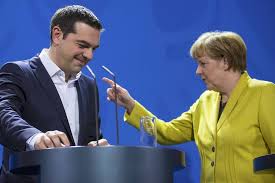
Greece Crucified

ws jimagesAlexis Tsipras justified his humiliating U-turn, and commitment to imposition of austerity worse than he had just rejected, by saying that he had no mandate for Greece to exit the Euro.  Very true.  But he had just claimed that the referendum a week before had not been about the Euro.  By 61 to 39 per cent he has no mandate for austerity, which is what he said the referendum was really about.

He came into office promising an end to failed bail outs and has ended with a third one bigger than the first.  He called for debt reduction and now seeks support for debt inflation.

Such is the scale of the crushing terms of the latest ‘bailout’ that no one is attempting to say that it is nothing other than complete humiliation for Greece.  Even the Eurozone bureaucrats stated the truth behind the unpalatable words spewed out by their leaders – Tsipras had been subjected to “mental waterboarding” and had been “crucified”.

What has been mental torture for Tsipras will be brutal and catastrophic austerity for the Greek people.

I could write a whole blog on the capitulation of Tsipras and what looks like the majority of Syriza, and there would be good political reasons for doing so.  The policy and strategy of Syriza has been endorsed by Irish opponents of austerity such as Sinn Fein and these now lie in tatters.

In fact in my own view Sinn Fein is not even as radical as Syriza and this is an easy claim to substantiate.  It has already implemented austerity in the North of Ireland while hiding behind opposition to some welfare cuts.   In the South it supported the fateful decision to make the debts of corrupt banks and property speculators the burden of Irish workers and in doing so made the struggle against paying this odious debt much more difficult.

But there will be plenty of voices pointing out that what radical politics Sinn Fein has to offer have been trialled in a real life laboratory and been found wanting.  The capitulation of Syriza is in principle no greater than the Republican’s own acceptance of British rule in Ireland, acceptance of partition, surrender of weapons and dissolution of the IRA.  But that is all now a history that no one wants to talk about.

What is more important therefore is to try to understand what has happened and whether it could have been any different.  Not that it must be accepted that the ‘coup’ against Greece cannot or will not be resisted.  It can and will but it would be blindness to reality not to acknowledge that under Syriza the fight against austerity has suffered a demoralising defeat.

As that new aphorism says: it’s not the despair, I can take the despair.  It’s the hope.  Syriza gave hope.

Working out what has happened is not easy. For the man or woman on the street they see television reports of quantitative easing by the Eurozone involving the figurative printing of  millions of Euros by the European Central Bank, yet this same institution is involved in the vindictive pursuit of Greece for sums it could easily accommodate.

The proposals of the conservative leaders of the EU seem equally hard to understand or justify.  In fact for many they seem stupid, if not crazy. So draconian are they that they seem designed to achieve the very opposite of what they claim to be for.

The imposition of yet greater austerity when this austerity has demonstrably failed might be explained by ideological blindness.  And the humiliation involved might seem to invite rejection while being another attempt to remove Syriza from office.  But many commentators have explained that Syriza may possibly remain the only force that can push austerity through without complete chaos and collapse.

This humiliation is perhaps not just a message to a small and weak Greece but an unmistakeable one to a larger Italy and France: that the development of the EU will be under a model defined by Germany and its allies.  Yet even here the degree of malevolence can only invite small countries with parties equally blinded by reactionary ideology as Germany to wonder just what fate would befall them in an EU with such a definition of ‘solidarity.’

So while ‘good’ reasons might be found for what would appear to be ideological blindness the proposal for a “timeout” exit by Greece from the Euro appears as simply stupid; unless of course it is also a means of pushing Greece out permanently. But then it is such a stupid idea as justification that its purpose might only seem to be how open the imperial bullying can become, ‘pour encourager les autres’.

For the Greek people the surrender of even nominal control of their affairs is way beyond what has gone before.  The original proposal to ring fence €50 billion of Greek assets under German control,  to be sold at the discretion of its creditors, was such an open declaration of debt bondage as to render the humiliation utter and complete. What is yours is no longer even yours to sell.  Now it is reported it will simply be wasted on insolvent Greek banks with the needs of financial capital once again talking precedence not only over people but over real productive activities.

Thus in many ways, its failure to actually work being the first, its effects on undermining the legitimacy of the EU second and materially weakening the incentives to solidarity among its members third, all make the bailout deal a defeat for the idea of a European Union.  This is not even a European imperialism to rival the US, Russia or China but an imperial core and vassal periphery.

The price being paid seems so unnecessary because the main demand of Syriza – in order to give hope and reduce the impact of austerity, i.e. debt forgiveness, will be given and is already hinted.  Not in the shape of outright reduction but in the form of postponing or extending repayments and similar measures on the interest due.  After all, what cannot be repaid will not be repaid.

What matters however to the right wing conservative leadership of Germany, the Netherlands etc. is that their strength, and by extension that of the European imperialist project, is not diluted by the weak European nations and that the Euro remain in position as a world currency and not a vehicle for default and certainly not by what is considered an advanced nation.  Greece must be bled dry in order that the Euro remains strong and the pretensions of the EU remain in place.

The vision of a united Europe is not being abandoned by Germany etc, but it is one in which austerity is the bond that unites. It can be claimed that austerity will be inflicted on German workers if crisis hits the German banks; except of course that Germany has broken the rules before and would do so again.  It is easier to be ideologically blind when the price is paid by someone else.

Could it have worked out differently?    Syriza had hoped that enlightened self-interest would have combined with pressure from the US and the legitimacy gained by the referendum to mitigate the demands for austerity by Germany, The Netherlands and all the other little right-wing led states that curry favour with the powerful.  They have been rudely disabused of their illusions.

The more fundamental reason for this outcome is the weakness of the alternative at an international level.  Where were the left wing Governments calling for debt forgiveness, an alternative to austerity or even its reduction?  Where were the mass movements pressurising their Governments to accede to Greek requests?  Greece could not push back the demands of much stronger states on its own but on its own it was.

The demand for a revolutionary socialist alternative seeking the destruction of the Greek capitalist state and take-over of the Greek economy by its workers fails to provide any sort of immediate alternative, which is what we are discussing, for two rather obvious reasons.

Such a strategy relies on the aspiration and activity of the working class and the Greek working class neither desires nor is organised to destroy the existing state, create its own and take over the running of Greek production.  The anti-capitalist ANTARSYA for example got less than 1 per cent of the vote and Syriza, it should not need to be said, is not a revolutionary party.  How does a revolution arise out of this except through a long and painful process of learning lessons and making advances on this basis?

I was recently reading an article entitled ‘Marxism and Actually Existing Socialism’ written, what seems like a long time ago, before the collapse of the Soviet Union, and which defended Marx’s theory and politics.  In it the author wrote that:

“Marx envisaged that socialism would come first in the most advanced industrial societies of Europe, and it has not done so. Arguably, however, Marxism is capable of comprehending this fact. In any case, this is a matter of detail, even if an important one; and it seems difficult to resist the conclusion that, in its broad and general outlines, Marx’s account of the historical tendencies of capitalism has been remarkably confirmed by historical events.”

But of course the coming of socialist revolution not to the most advanced countries is not a detail, not even an important one.  It has been fundamental to the development and future possibility of socialism and has led to the very definition of socialism being distorted and disfigured.

Socialism is not possible in Greece alone any more, and certainly less, than it was in Russia not least because it is too weak and poor.   It is obvious that no other working class within any other country in Europe is at a stage of development where it could either join or support working class rule in Greece.

This does not mean Syriza should not have taken office or that it should not have engaged in negotiations with the Troika. Its strength however derives fundamentally from the class consciousness and organisation of the working class and not from any superior moral position.  The building of an international European party of the working class, of a militant current within the working class movement including trade unions, and of international workers’ cooperatives is the only road to creating the foundations for a successful conquest of political power.

On the other hand capitalist economic and political crises and socialist propaganda are, respectively, simply the occasion for such a conquest and the means of spreading word of the need for it.

As I have said before: the worst result would be Syriza implementing austerity.  It should now reject the bailout, call fresh elections on such a platform and if elected pursue an alternative.  If in opposition it should develop a movement as set out above.

The alternative it should pursue is that which the Irish should have carried out in 2008.  Let the banks go bust and let its owners and lenders take part in a ‘bail-in’ in which they pay the price for their investment in insolvent companies.  This is sometimes known as capitalism.

A radical Greek Government would encourage Greek workers to turn the banks into cooperatives that would shed their bad debts into a ‘bad bank’ (like NAMA in Ireland, in theory if not in its practice) and guarantee deposits that would fund development of worker owned enterprise.

The Greek debt would thereby suffer default and the reactionary gamblers Merkel, Juncker, Schäuble, Draghi and Dijsselbloem would see where the chips fall.

The blogger Boffy has suggested that a solution to the currency problem would involve electronic Euros that would allow circulation of money without the requirements for additional notes etc. from Brussels.  While this could work for the domestic economy I cannot see how it could function as a means of payment for international trade and, while Greece is a relatively closed economy, it cannot function without it.

In any case the leadership of the EU would, on current form, expel Greece from the Euro and introduce its own capital controls on the country.

Greece would be forced into issuing a new currency, a new Drachma, which the people do not want.  This could not be done quickly or without significant disruption.  It has been asserted that the argument that this would result in devaluation and a massive reduction in Greek living standards is false because the catastrophe predicted has already happened.  ‘Internal devaluation’ has already achieved what external devaluation of the new currency would otherwise have done.

I am not convinced by this argument but this too might be academic if the EU decided that Greece would no longer be part of the Euro.

The strategy suggested therefore provides no guarantee of success.  There is no ‘technical’ solution or answer in this sense.   And why should one be expected?

I have said that socialist revolution depends on the prior creation of a working class power consisting of an international party, international trade union action and development of workers’ cooperatives on an extensive scale.  What on earth could substitute itself for these?

What is suggested is a strategy for struggle and not a ‘solution’ but we have reached the stage where not even the leaders of the EU can present false promises on this with any credibility.  Austerity will continue not to work.  Struggle is what we have.


ICTU Congress Ennis 7th and 8th July – David Begg & ICTU should answer for his role on Central Bank Board‏

ICTU_david_beggs_Dec282009When the Irish financial system collapsed in 2008 bringing down the finances of the State with it there were plenty of people to point the finger at.

The banks who lent recklessly; the property developers who speculated wildly, the politicians for having encouraged and benefited from the bubble, the Regulator for having fallen asleep at the wheel, the Finance Ministry for having fuelled the fire with tax breaks, the auditors for having signed off on bankrupt organisations and sanctioning absurd valuations, the European Union for making us pay for  the bankers, the IMF for not warning about the danger, the economists who saw nothing wrong and assured everyone of a ‘soft landing’, the press and media for eulogising the Celtic Tiger miracle economy that fed it ever growing revenue from property advertising, and of course  the current Taoiseach Enda Kenny who told the people that they were to blame – “What happened in our country was that people simply went mad borrowing” he told the rich and powerful at Davos in 2012.

cartoon_independent_284347d

Have I missed anyone?

Well actually I have.

The following appeal was sent by a reader of the blog in Dublin.

“There is an opportunity to highlight the need to end the culture of collusion between full time trade union bureaucrats and Government/Troika at the Irish Congress of Trade Unions biennial conference on Tuesday and Wednesday next week. We the victims of austerity should let the bureaucrats and delegates attending know the collusion must end. They have sold out Irish workers.

It has been rumoured that David Begg former General Secretary of ICTU who sat on the Central Bank board for 13 years and never uttered a word of warning to Irish workers about what was happening will be receiving a send off as he retired last year. Mr Begg was formally representing ICTU on the CB board and crucially was chair of the Central Bank Audit committee during the crucial years of the boom and subsequent bust.  He’s due to appear before the banking inquiry on 22nd July.

Activists could leaflet delegates to demand that Mr Begg compile a report answering to Irish workers and their families for his failure to alert us about what was going on and for which we’re now paying. He and ICTU had a watchdog role on the CB and owe us an explanation for their failure in fulfilling that role. Some of the responsibility for water charges, cuts, misery, poverty, homelessness and plundering of resources falls on their shoulders because of their inaction in the years leading up to the crash and bail out.

 
ICTU have other questions to answer –Mr Begg’s role on the Central Bank board was raised on RTE’s Liveline, following the programme ICTU complained and RTE immediately took down the podcast of the programme and issued a disclaimer the following day.

Can ICTU now reveal what their role was in this episode of censoring entirely legitimate questions and debate on Mr Begg’s role on the Central Bank Board? Perhaps Denis O’Brien has just been following in their footsteps in demanding censorship. In case anyone wants to get in contact I have a page Stop Union Sell out which I’m promoting and would be more than happy for you to post on it.”

Some comments on the Greek referendum

Greece3543The decision of the Syriza Government to call a referendum on the proposed austerity proposals of the Troika (European Commission, European Central Bank and IMF) in return for another ‘bailout’ programme reminds me of the Irish austerity referendum three years ago.  It gave rise to one of the first posts on this blog.

The Irish people voted by a large majority to support austerity.  Will the Greeks do the same?

The Irish voted reluctantly to accept austerity (how else could you do so?) because there was no alternative at hand.   The arguments of the Left that the Irish State could lead a growth agenda of Keynesian stimulus hardly convinced when that State had just bankrupted itself bailing out the banks.

Both the reason for the defeat and its effects have not been appreciated.  Of the latter it is enough to ponder the proposals of the trade unions behind the largest sustained opposition to the austerity agenda – the Right2Water proposals for ‘A New Fiscal Framework for a Progressive Government’, which proposes additional State expenditure of €9.4 billion over 4 years.  This would amount to less than 4.5% of the 2014 level of Government expenditure.

The Right2Water’s ‘Policy Principles for a Progressive Irish Government’ contains a section which proclaims the need for additional investment in the water and sanitation system of “between €6 and €7 billion”, which leaves just around €2.5 to €3.5 billion for education, health, investment and everything else.  This is not so much an alternative to the current Government’s strategy as a variant of it.  So much have horizons been lowered.

According to the authors of this document the rules of the EU will be adhered to while seeking flexibility within them and negotiating additional scope for spending.  But the case of Greece exposes that the rules of the EU, ECB and IMF can be bent to suit.

So the claim that joining the Euro was irrevocable has been discarded by the leading powers in the EU to be replaced as the biggest threat to the Greek Government and people – vote against our austerity plan and you are voting to leave the Euro.

The propaganda campaign by the EU leaders includes European Commission President Jean Claude Juncker, who says he feels ‘betrayed’, and complains about a lack of “good faith” and “sincerity” from the Greeks.  This from a man who presided over the building of Luxembourg into a tax haven.  Yet he sees fit to question the Greek Government and people over their right and capacity to raise taxes.  Has the tax evasion facilitated by Luxembourg not contributed to the Greek predicament?

Christine Lagarde of the IMF proclaims she wants “adults in the room” with whom to negotiate, attempting to infantilise the Greek Government representatives and by extension the Greek people.  This is the Lagarde who has been placed ‘under investigation’ in a fraud case.  One can’t help but recall the behaviour of the previous head of the IMF, Dominic Strauss-Kahn.  Getting fucked by the IMF is a pleasure for no one.

In the current case this involves Troika demands for drastic reductions in the pensions of some of the poorest Greek pensioners and increases in VAT that will hit both those who will pay increased prices and the small businesses compelled to charge them.

On the Left these demands of the Troika are likewise treated as in effect an ultimatum which should lead to exiting the Euro – as the only effective response to the unceasing demands for austerity.  What for the leaders of the EU is a threat which the Greek people should retreat from is for some on the Left a major part of the solution.  What for the former is a recipe for chaos is for the latter the way out of it.

In my view the former are correct.  Exiting the Euro would lead to a new Drachma that would involve massive devaluation and a large reduction in Greek workers’ living standards.  Cutting one’s own throat is not preferable to having someone else do it.  If Greece is thrown out of the Euro it naturally has no choice but that is not a choice it should itself make.

It is clear however that the choice at the end of the day is not Greece’s to make.  It is not in a position to compel a significant reduction in austerity or debt relief even while many commentators who support the austerity demanded admit that debt relief is inevitable.  The reason that they demand austerity nevertheless, even while recognising that it has failed, is that they seek the removal of the Syriza Government.

The EU leaders tried it last week and now seek it this week through refusing to accept Syriza’s huge concessions, refusing to extend the ‘bailout’ and through freezing ECB liquidity provision to the Greek banks.

The Greek workers should reject the austerity plan from the EU and reject the non-solution of leaving the Euro.  Only on the basis of fighting austerity and refusing a go-it-alone nationalist solution can it minimally seek to build a movement that would stem the demands for austerity.  What the Greek crisis shows is that such austerity can only be fought at an international level.

What does this mean?

Well, let’s look at what the Channel 4 journalist Paul Mason, who is covering the crisis, had to say.   Exit from the Euro may be inevitable he says because of democracy – the population of Northern Europe would not support the transfers required to reverse austerity inflicted on Greece while the Greek people may no longer accept it.

In this he is at least partly right.  Only an international campaign of solidarity with the Greek people, which explained that the bailout was not for them, but for the German and French banks and hedge funds who invested in lending to Greece, could explain the real function of austerity and lay out the grounds for convincing those outside Greece to reject it.  On this basis it might force a retreat from the austerity demanded by other EU Governments, including the repulsive Irish one.

Within Greece it would require not just an ‘OXI’ vote but a mass movement that would compel implementation of a Syriza programme to tax the oligarchs through occupations to open the books of these businesses and in doing so help put in place a rigorous system of tax collection.

In itself this would only form the starting point of a workers’ alternative – one that is based on development of worker owned production.  Such workers’ cooperatives are the alternative to the weak and crony capitalism from which Greece suffers.  It offers practical proof of the socialist alternative and is a basis for its growth this side of political revolution.  The latter in turn will gain credibility from practical demonstration of a socialist programme.

The lack of such international and domestic conditions caused defeat for Irish workers in their referendum.  A very different vote in Greece would be a step forward for Irish workers now.

On the other hand the very worst result would be defeat in the referendum and a Syriza Government implementing austerity.

While the Dutch hatchet-man Jeroen Dijsselbloem again reveals the Euro leaders agenda of getting rid of the elected Greek Government – “ who are we trusting” he says if Syriza promised to implement the austerity it had just rejected, Varoufakis is quoted as saying that Syriza would do just this.  “If the people give us a clear instruction to sign up on the institutions’ proposals, we shall do whatever it takes to do so – even if it means a reconfigured government.”

Such an approach would discredit any sort of Left alternative and pave the way for a hard right Government to eventually push through austerity on a demoralised workers’ movement.

The long resistance of Greek workers to austerity has given hope that we are not yet at such a result and that the struggle against austerity will continue.

The Left and the fight for reforms

SFimagesIn the first of these posts I argued that the apparent differences in various contributions to the debate on recent developments in Irish politics, including the prospects for the left, did not reveal fundamental disagreements.  Everyone from Sinn Fein to the Left alliances looks forward to a very significant challenge to the establishment and see great potential for success.

In the previous post I mentioned that the general policy platform of anti-austerity and its implementation through forming a Left Government, supported by mass mobilisation outside, is endorsed by these same organisations.

Yet proposals for an overarching alliance formed by these organisations are rejected by both sides.  Sinn Fein rejects “the Trotskyist left” because it has sought to divide the anti-water charges movement formed under the banner of the Right2Water campaign.  And it is clear that it is also rejected because Sinn Fein thinks this Left is unwilling to form a Government with the Labour Party, and incapable of any sort of political unity with the trade unions that support the Right2Water campaign.

Of course there are good grounds for these positions.  The Labour Party has spent four years inflicting austerity in Government with Fine Gael in the South and Sinn Fein has been in office with the even more rabidly right-wing Democratic Unionist Party in the North, also inflicting austerity, while claiming to oppose it through vetoing some welfare changes.  In the South Sinn Fein also voted for the justification for much of the austerity by voting to bail out the rotten banks and their gambling investors.  In this way the Irish State transferred the debts of the banks to the working class.

However the centre piece of the Left’s strategy is the formation of a Left Government in order to reverse austerity – they propose no other effective or credible means of doing so.  As I have also argued – their privileging of the non-payment tactic as the only route to defeating water charges leaves them otherwise naked when it comes to explaining how they would defeat the much greater effects of the other austerity measures.

In their arguments, despite claims to prioritise mass mobilisation over electoral success, they reveal the central and indispensable role in their strategy of electoral success.  Only by forming a Government could their demands for reversing austerity be carried out: through taxation increases for the rich and reductions for the rest; for increased state spending to create jobs; for reversing privatisation and for repudiation of the state’s debt.  The actions proposed by the Left are inconceivable without forming a Government to do these things, which is why they naturally call for a Left Government.

The Left say that mass mobilisations are key and elections are there to support them but what these mobilisations are supposed to achieve in themselves, beyond single victories on various issues that develop, is never explained.  Mass mobilisation is not itself a programme, not itself a strategy unless given some purpose and objective, given some content.  What for? To achieve what?  How and in what way would such mobilisations put forward and actually implement an alternative, except other than through a Left Government?

The genuine order of priority is made clear when Paul Murphy explains the real importance of the anti-water charges campaign – “Winning the water charges battle is strategically central to the prospect of building a left that can fight for a real left government.”

The strategy of capturing government office in a capitalist state is what Marxists call reformism and I have written a series of posts criticising this view, beginning with this one.

I’m not going to criticise the Left here for being reformist but simply to point out that their strategy requires capturing Governmental office while rejecting any arrangement with Sinn Fein or the Labour Party.  The prospect of them doing this in the foreseeable future is therefore practically zero.

I have criticised the specific proposals of the Left before not because it has proposed reforms but because they are viewed, not as making capitalism less oppressive and creating better conditions within which workers can fight for a replacement, but because the reforms themselves are seen as in some way instituting an alternative to capitalism.  In this sense their policies are not an alternative to capitalism but an alternative to the real alternative to capitalism, which is socialism.

To sum up what their approach involves – it entails the capitalist state, presided over by the Left, intervening much more into the economy and creating a fairer and more just system.  It doesn’t involve a fundamental change in the economic or political structure and amounts to a fairer form of capitalism, full stop.

If their strategy ‘secretly’ involves revolution in the traditional sense of an insurrection, one that aims at the destruction of the capitalist state, this isn’t going to happen either, if only because they haven’t gone around doors giving out leaflets and telling the only people who can carry it out that this is what they should do.

Paul Murphy presents a related reason for opposition to unity with Sinn Fein and/or the Labour Party.   He says that the latter involves “the notion of constructing a “social majority”, instead of building a class based movement.”  Unfortunately this opposition of a social majority to a class based movement is false since a working class movement in itself will be a majority and its creation will win to its ranks individuals and social layers who are not working class.  The idea of a ‘social majority’, however described, should not be, or allowed to be, counter posed to a working class movement.

It is almost as if what this reformist strategy needs, and what its reformists-in-practice require, is some concrete reforms in an explicit strategic alliance with reformists.

So the Left says it cannot countenance a coalition that would include the Labour Party and/or Sinn Fein because these parties have already and will in future impose austerity when in Government.

However to many voters the alternatives offered by Sinn Fein and the Left do not seem very different.  The by-election victory of Paul Murphy of the Socialist Party over Sinn Fein, in part due to a more militant stance on opposing water charges, is not unfortunately likely to be the template for the general election.

The actions of the trade unions involved in the Right2Water campaign and their transparent attempts to endorse a left alternative that includes Sinn Fein, and even Labour if it went along with it, demonstrate this.

But the answer to this is not to simply denounce these parties, for if that were all that was required, as I have said before, we wouldn’t have the problem.  The answer must be to challenge the credentials of these parties and to win the trade union members and other workers who have supported the Right2Water campaign to a real anti-austerity alternative.  If such a process were to take place it could only be through joint activity and joint debate with the leaders and members of these parties.

In such a process it would be my view that the weakness of the Left’s own anti-austerity programme, in no essential terms different, would be exposed.   However such a strategy makes sense even from the Left’s point of view.

So, in order to begin to demonstrate their claims and in order to be seen to be seeking the maximum unity of anti-austerity forces the Left, perhaps paradoxically, would need to take its pretensions to reform the Southern State and economy more seriously.

It might do this by, for example, proposing the specific measures that it would take in the first 100 days and first year in office while demonstrating that unity around these policies is essential, challenging both Sinn Fein and the Labour Party to endorse them and fight for them together.  The Left would openly propose and debate these measures, this strategy, and seek to make itself accountable to its constituency, in the process attempting to leverage this support to engage with that of Sinn Fein and the trade unions.

The purposes of this would not only be to win these supporters to more radical politics but to promote their capacity and willingness to make the parties they currently support more accountable.  The aim of this is not so much to put pressure on these parties to keep their word, or even to facilitate their rejection when they do not, but to encourage and stimulate the independent political activity of these workers.

So, for example, the mechanisms put forward in the contribution by Rory Herne come across as elaborate and wishful scenario building that involve earnest but utopian blueprints for the ‘perfect’ movement.  But they do offer some sense of how such accountability might be achieved.

Would such tactics work? Maybe, maybe not.  But the point is that a means has to be created that allows the Left to engage with those voting for Sinn Fein and (more importantly from my point of view) for Marxists to go beyond denunciation of the Left’s Keynesianism to engage it and its supporters in clarifying the means to advance working class politics and organisation.

As Marx said:

“. . nothing prevents us from making criticism of politics, participation in politics, and therefore real struggles, the starting point of our criticism, and from identifying our criticism with them. In that case we do not confront the world in a doctrinaire way with a new principle: Here is the truth, kneel down before it! We develop new principles for the world out of the world’s own principles. We do not say to the world: Cease your struggles, they are foolish; we will give you the true slogan of struggle. We merely show the world what it is really fighting for, and consciousness is something that it has to acquire, even if it does not want to.”

What exactly divides the Irish Left?

ballot downloadIn the last article on the debate on the Left and its potential in the upcoming general election I said that I would look at the most important area in which the Left generally, despite the purported differences, were pretty much agreed.  Not on everything, but what they don’t agree on is in principle secondary.

The fundamental unity is on the nature of the new society the different groups want to bring about and the means to achieve it.

Taking the contributions quoted in the last post:

Sinn Fein: “We need to present a clear, coherent and credible programme for Government, based on an alternative model of social and economic development, that offers people well paid secure employment, high quality public and community services, fair and adequate taxation – all rooted in a strategy for economic growth that is environmentally sustainable and socially just.”

Rory Hearne:   “There is, despite the caricatures of division, much ground for agreement on policy amongst the diverse groups, for example, reversing water and household charges and austerity hitting the most vulnerable, standing up to the EU on Ireland’s debt, a write-down of mortgage arrears, a living wage, proper public health, housing, education and delivering human rights for all, direct democracy returning power to local areas and communities and a state and indigenous-led economic strategy away from overreliance on foreign multinationals, wealth taxes, expressing solidarity with Greece for a European debt conference and much more.”

The joint statement of the Anti-Austerity Alliance, People before Profit and others is:

“. . . committing to oppose and organise to fight against any more austerity and for an immediate reversal of key austerity measures such as water charges, property tax, USC for those on average or low incomes, health, education and welfare cuts. It also means developing a strategy for repudiation of the bankers’ debt; for a write-down of residential mortgages; for taxation of wealth and big business profits; and against privatisation of public services and natural resources.  Instead of putting money into bank debt, we think there should be public investment in housing, healthcare, education, childcare, public transport, water services, renewable energy and environmental protection – as the start of re-orienting economic activity to meet social need and provide useful work for young people and the unemployed.”

So if there is broad agreement on a radical but not revolutionary policy there is also broad agreement on how to implement it.

Sinn Fein: “We need to translate all of this activism into change at the polls to break the Fianna Fail-Fine Gael stranglehold on the southern Irish state and install a left wing Government implementing a left wing programme – if such a Government is not possible after the upcoming general election we should maintain the momentum and keep building until we have secured the requisite public support.”

“So the immediate tasks for those of us on the Left who want to seriously challenge the Right for control of the state are clear.”

“We need to ensure that popular mobilisation continues if and when a left wing Government is installed to act as a guarantor of the promises made by progressive politicians at election time.”

Brendan Ogle Right2Water: “We will win this campaign. Of that I have no doubt whatsoever. We will return a Government that will be voted in to reverse the current crazy, wasteful, ideological, neo-liberal privatisation of our publicly owned water. And then what? Is that it? What about our right to housing, to a job and decent workers rights, to decent healthcare, to education? Do we, those in what has clearly become a ‘movement’ care about these things? And if so, can a water movement become a vehicle of real social and political change?”

“The anger, and mass mobilisation necessary to reclaim our nation for its citizens are present. The citizen’s hunger for their democracy back is present and the electoral means are present.”

The joint statement of the Anti-Austerity Alliance, People before Profit, said of the alternative that:

“It should fight for a Left government committed to breaking the rules that impose austerity and that prioritise the restoration of the profits of banking and big business; for a government committed to restructuring the economy and society to meet the needs of people and to protect our environment  – including unilateral repudiation, if necessary, of bankers’ debt.”

In commenting on these joint statements Paul Murphy says that:

“These statements were a positive engagement with the process – in particular focused on three areas – calling for non-payment as part of a non-electoralist, struggle orientation; a call to rule out coalition with Fianna Fail, Fine Gael and Labour; and a clear left programme, including commitment to debt repudiation and repeal of the 8th amendment.”

Ruling out coalition with Fianna Fail, Fine Gael and Labour is a central part of this. The left needs to be ambitious and inspiring – this means not settling for the old mistakes of coalition with the right, and betraying and disappointing people in order to get Ministerial positions. Instead, it means fighting for a real left government.”

“A left government is not just one where people who describe themselves as left-wing are in government. It is one that implements a left programme – which reverses austerity measures, which pursues a strategy of debt repudiation, which stands up to bullying from the EU, which uses the wealth and resources of society for people’s needs rather than corporations’ profits and which tackles the oppression of women, migrants and LGBTQ people.”

However where Murphy claims to be in disagreement with the likes of Sinn Fein, and those in the Right2Water campaign who wish to see it as part of a left alternative Government, is his claim that a real left alternative is not so focused on elections and would not include the Labour Party.

For him the real left alternative is one that is less focused on the elections, in particular the next election, and is orientated more to both struggles outside of the Dail and to using elections and elected positions to assist the building of these movements.

Of Eoin Ó Broin’s contribution he says that “The embracing of the Labour Party by someone who has a profile of being on the left of Sinn Fein is significant. It is an illustration that unfortunately Sinn Fein is prepared to be part of a government that will continue with austerity.”

So despite similar programmes the Socialist Party opposes an alliance with the Labour Party and Sinn Fein, which means that the prospect of a ‘left’ Government after the next elections is practically zero.

It is in this sense that Burtenshaw’s argument that the population has rejected the left’s alternative is rather obviously true, so obviously true it is difficult to see how it can be denied.  A left Government in the next election that does not include Sinn Fein and/or the Labour Party is not going to happen.

In the next post I’ll look at what the Left might do, even with a reformist strategy.

Has the Irish Left missed the boat?

Screen-Shot-2015-05-31-at-02.29.362An article in the ‘Village’ magazine presents the argument that the Left has missed the opportunity to translate widespread opposition to water charges into a significant challenge to the status quo in the coming general election.

As a hard fact that must be faced, the author of it notes that it’s now possible to imagine not only a Fine Gael and Fianna Fail coalition but even the re-election of a Fine Gael/Labour Party Government.  What a kick in the teeth that would be!  Rather like the re-election of the Tories in Britain.  “It’s time for some serious self-criticism” he says.

The conclusion drawn, although it remains totally unexplored, is that the people “have found the alternatives unconvincing.”  That is, they have found the left alternative unconvincing.

It’s not clear to me from the argument of the article that many ever did but I’m not going to go very far in this post in looking at this either.

Instead I want to reflect on the response that the article has evinced from the Socialist Party TD Paul Murphy.  While there appears to be a debate here the grounds of it are very narrow indeed.

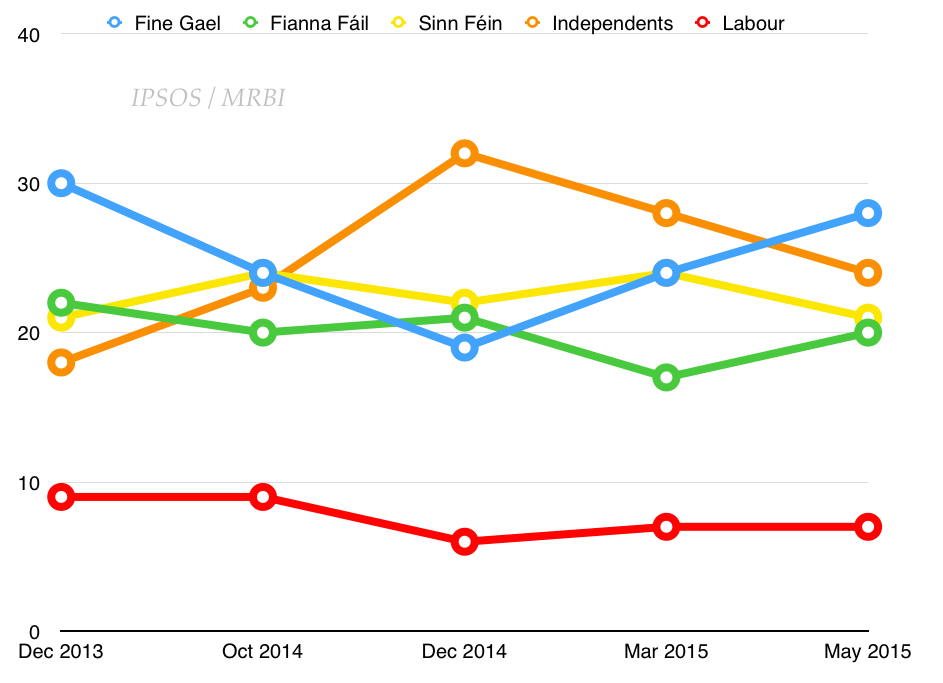
In his call for self-criticism Ronan Burtenshaw first points to opinion polls which showed a rise in support for independents during 2014, from 18% or 22% (depending on the poll) to 32% and 30%.  Support for the two established right-wing parties on the other hand had fallen from 30%/28% and 22%/22% for Fine Gael and Fianna Fail respectively to 19%/21% and 21%/19%.

The problem he points to is that in May this year one poll showed support for independents down to 24% and another back down at 22%.  Since he explains the original increase as a result of a series of mass mobilisations against water charges he argues that the effect of this “has evaporated pretty much completely.”

Paul Murphy argues that Ronan’s conclusion is wrong –

“His conclusion, that the fall in opinion polls is because people looked at the alternatives and found them to be unconvincing, simply does not flow from the data, or his preceding analysis. Instead, I would contend that the opinion polls worsened primarily because of the decline of major mobilisations as well as because the low point for the government wasn’t fully capitalised on by a sufficiently authoritative force to consolidate the indicated trends.”

The second part of this explanation is part-admission of Burtenshaw’s case – his argument that the alternative was not convincing might be seen as just another way of saying that there was no sufficiently authoritative force to consolidate gains.

Of course what Paul Murphy is arguing is that if the forces arguing for the left alternative were bigger its alternative would have been accepted by more people and there is nothing inherently unpersuasive about the left alternative.  But this leaves aside the problem why the left was not bigger and why its argument, if it was persuasive, did not lead to further growth than it did, or rather did not allow growth to be maintained.  If it was persuasive would it not also have been authoritative and, if authoritative is a euphemism for being bigger, how did being persuasive not lead to this increased size?

Paul Murphy argues that Burtenshaw’s case has two flaws, the first of which is that it ignores the temporary impact on the popularity of the governing parties of victory in the referendum on marriage equality.  He says that this allowed the Labour Party in particular “to wrap itself in a rainbow flag and present itself as socially progressive . . . I think much of that can be reversed as people are reminded by the real role of the Labour Party”, which includes further privatisation of Aer Lingus.

By the way, Murphy accuses Burtenshaw of ‘confirmation bias’.  That is the tendency to interpret new evidence as confirmation of one’s existing beliefs or theories.  But Murphy is guilty of this himself, no more obvious than when he dismisses the Labour Party’s role in the marriage equality referendum.  The “real role of the Labour Party” that Murphy wishes to counterpose to its progressive role in the recent referendum includes support for such liberal measures as marriage equality.

But Paul Murphy’s bigger argument is that the decline in opinion poll ratings was due to the absence of visible mass mobilisations around water charges such as the huge demonstrations that started in Dublin and around the State in the last quarter of 2014.  There is no doubt some merit in this argument but it is not as strong as it is presented and does not bear the weight he places on it.

But he also acknowledges two things which again support Burtenshaw’s argument about the weakness of the Left’s alternative.  The first is admission that the role of the leaders of the Right2Water campaign cannot be substituted by the campaigns of the Left, (which calls into question the creation of separate campaigns by the Left groups).

Second is the acknowledgement that protest demonstrations cannot in themselves be the answer.  They cannot substitute for a movement, one that is organised with permanent structures, which provide it with a life of its own outside the calls of unelected leaders to come onto the streets.  So Murphy admits that “It may not be the case that the same level of mobilisation could be achieved now.”

So if the decline in poll ratings is at least partly due to the decline in mass protest and the decline in mass protest is at least partly unavoidable this looks very much like another admission of the weakness of the Left alternative.  Even with support from the Right2Water leaders a series of mass protests could not continue to have the same effect as the first demonstrations that were such a shock to the political system.

Partly this is because the political consciousness of many participants does not go beyond protest politics, involving illusions that the Governing parties will listen, content that they have protested, or simply unable to find a way to turn anger and protest into an alternative.

Less importantly, but necessary to learn, the decline is due to the excessive weight put on the tactic of non-payment by some on the Left.  This tactic might be helped by regular mass demonstrations of opposition but this is not an absolute requirement.   It does not justify a separate campaign with this tactic as its raison d’etre, with its necessary downgrading of creation of a genuine democratic and united campaign that the Right2Water should have been and should still become.

So another illustration of weakness is the inability of the Left to effectively challenge the Right2Water leadership to create a genuine democratic campaign.

The weight put on the tactic of non-payment can be interpreted to mean that more or less on its own it will deliver victory, so why be so concerned about anything else?  But this anything else, as I have noted before, includes the opposition responding to a particular tactic with one of its own such as deducting payment out of incomes.

The Government has also responded by major concessions in terms of the amount to be paid.  As I have also noted before with the carrot comes the stick and shortly after the carrot came the attempts to criminalise and intimidate opposition activists through arrests.

So no tactic by definition is a guarantee of success.

The anything else also involves the whole austerity offensive to which non-payment is so clearly not relevant.  Cuts in services, unemployment, increases in taxes and wage cuts are not going to be prevented or reversed by non-payment so an anti-austerity campaign that features so heavily on non-payment as the key to success has a big question to answer about how success will be achieved in all the other, bigger areas in which austerity has bitten into workers’ living standards.  How if only non-payment works can we fight back in these other areas?

The biggest challenge to the Left which the anti-water charges campaign cannot by itself answer is the seeming success of the governing parties in implementing austerity and now being in a position to claim success.

The upturn in economic fortunes is real.  Unemployment has fallen, the series of major cut-backs has ended and new increases in public spending, cuts in taxation and pay Increases are promised.

The contribution of Eoin Ó Broin from Sinn Fein makes a number of correct points in relation to this:

“Trying to read the poll-on-poll movements against specific political events is always speculative.

Fine Gael’s poll decline in the second half of 2014 was as much to do with the controversies surrounding medical cards, penalty points and Garda Ombudsman as it was to do with the politics of water.

Indeed middle class discomfort with water charges during 2014 had more to do with the initial charging regime, the handing over of PPS numbers and the excessive costs of Irish Water than with principled opposition to the charges and privatisation.

It is not at all clear that the Right2Water mobilisations had any material impact on Fine Gael’s poll numbers or standing with the electorate during 2014.

Replacing Shatter and Reilly with Fitzgerald and Varadkar coupled with the impact of job growth and tax cuts on middle class voters is clearly driving the Fine Gael poll recovery.

Alan Kelly’s revised water package will also have eased the concerns of some middle class voters.”

While one can argue that it is very unlikely that the protests had no impact on the polls, it would be hardly deniable that both the polls and the protests flowed from the same anger at austerity and the charges in particular.  As I have pointed out before, the fact that there appears a clear way of defeating them, through non-payment, has been a big spur to mobilisation.

Also suspect is Ó Broin’s focus on the influence of the events he mentions on the middle class.  There is no reason why changed economic conditions will not have influenced many working class voters as well

Finally, there are two other aspects upon which those involved in this debate are not really so very far apart.   Regardless of the recent movement in the polls, they all note positively the long-term decline in the support levels of the three establishment parties (Fine Gael, Fianna Fail and Labour).

Burtenshaw points out that these parties received over 90% of the vote in every election from 1965 to 1989 while he quotes one recent poll that now puts their support at 57%.

However the participants to the discussion acknowledge, but refuse to digest, the reality that the majority of the electorate have not broken from the politics that delivered them austerity.  The evidence for this is pretty clear – from the 57% figure just quoted, to the election of a Fine Gael Government in 2011, the passing of the austerity referendum in 2012 and the character of much of the opposition to the established parties today.

The biggest and most coherent bloc of this opposition is Sinn Fein, which only the politically naïve could believe will oppose austerity in any comprehensive way.  The experience in the North is well known to political activists on the Left, while workers supporting Sinn Fein will take it at its word, and will then judge it on its actions.  Sinn Fein is no more than a more modern version of the old populist Fianna Fail and neither its nationalism nor its political practice is left wing, never mind socialist.

Meanwhile the Left has collapsed its political judgement and political practice into seeking a ‘left’ alternative instead of a socialist one.  It moved from an analysis based on some version of socialism to one in which the alternative must be ‘left wing’, to one that is simply termed ‘anti-establishment.’  But much of this anti-establishment vote is not even left-wing never mind imbued with any sort of socialism.

As Burtenshaw states:  “In the vast majority these new independent voters weren’t defining as Left but were a nebulous grouping, supporting a wide variety of positions, who found a degree of representation in being “independent” of established politics or wanted an alternative to “party politics” as practiced in Ireland.”

Of independents he notes that “this category, of course, included People Before Profit and the Anti-Austerity Alliance, though neither registered more than one percent at any stage.”

No one disputes this, but it rather puts into perspective any illusion of a Left Government after the next election.

Burtenshaw is right that the Left needs to be self-critical.

The spontaneous outburst of anger that arose in the anti-water charges demonstrations and the organisation of it thereafter will not of itself create the working class movement that is needed.

It will not be a question of surfing the wave of working class struggle; not a question of seizing some short term opportunity that will render history the long term weakness of Irish workers’ political consciousness, and it is not a question of what the Left does or does not do before the next election.

In the next post I’ll look at the most important aspect in which the contributors to the discussion are more or less agreed – the political programme to be advanced as the solution, whether currently estimated to be convincing and authoritative or not.

The UK general election part 3: sectarianism and democracy

SF 1 downloadIn the final post on the UK general election I want to look at the results from my own little polity and the political slum that is Northern Ireland.  Like all slums the blame for its condition lies with the landlord, the British state.  As usual all the tenants hope and expect that the landlord will clean it up. But it never does.

There the analogy should rest.  The most recent election was notable for what the front page of the Northern nationalist paper, ‘The Irish News’, described as ‘Nationalists turn away from the polls’.  Their parties, Sinn Fein and the SDLP, collected 38.4% of the vote while the DUP and Ulster Unionists captured 41.7%.  The latter figure does not include the various other unionist parties such as Traditional Unionist Voice and UKIP which brings the unionist total to 46.6%. If we include the Alliance Party, which is a unionist party in all but name, the unionist vote was 55.2%.

The message?  There isn’t going to be a United Ireland any time soon.  The Sinn Fein vote went down slightly by 1% even while the SDLP vote declined by 2.6% and it lost the Fermanagh and South Tyrone seat, not the way they wanted to enter into the historic hundredth anniversary of the 1916 rising.  ‘The Irish News’ explained that the nationalist vote had declined to its lowest level since the 1992 Westminster vote, which is before the ceasefires. That is, before the current peace process ‘strategy’ of republicans was/is supposed to deliver a united Ireland.

None of this fits with the accepted story of a rising Catholic population and a more and more demoralised Protestant one.  Sooner or later, the story goes, there will be a Catholic majority that will vote in a united Ireland. The truth of this is accepted by many and, I would hazard a guess, by many who would deny it vehemently in public.  I remember my aunt, a Shankill Road Protestant, remark about 25 years ago that there would eventually be a united Ireland, but not in her lifetime.  And she was at least half right in that.

Socialists have always supported self-determination for the Irish people as a whole, as the only democratic response to the Irish national question.  Not of course universally.  The Militant Tendency/Socialist Party tradition with its notoriously statist view of socialism, which incidentally has nothing to do with Marxism, has always managed to get it wrong.  Its statist view has seen it join left nationalist formations in Britain such as NO2EU, and it led the rightward collapse of the left in Scotland into Scottish nationalism.  In the North of Ireland on the other hand, entirely consistent with its accommodation to whatever nationalism is strongest, it has capitulated time and time again to loyalism and the British State.

This general response of socialist to the national question remains correct but the growth of nationalism in the North of Ireland, which now appears halted, has demonstrated that democracy is not a classless construct.  Bourgeois democracy in a society which has always been characterised by sectarianism has definite limits.

These limits are demonstrated in the more and more sectarian expression of northern nationalism.  This means that the expression of democracy by the working class can only be of a non-sectarian character, or it would fail to be a particular expression of the working class.  In other words the expression of a democratic alternative to partition must come from the working class and not from any nationalist formation.  It must therefore be non-sectarian, not in an unconscious sense, in which to be anti-imperialist is somehow also to be ‘objectively’ anti-sectarian, but in a conscious sense that this is the key objective – of uniting the working class.  Just like Scotland so must this be the case in Ireland, that socialism cannot be derived from what happens to be bad for the UK state but from the political unity of workers.

The degeneration of Sinn Fein and Irish republicanism demonstrates that fidelity to the belief in a united Ireland is no guarantee of progressive politics.  It used to be said that Irish republicanism was largely confined to Catholics because of sectarianism and this also remains true but it is also now the case that the Irish republicanism of Sinn Fein is confined to Catholics because it is sectarian.

Once the Provisionals stopped fighting the British and decided to join in the governance of its system, and started asking the landlord to sort out the slum – the landlord responsible for its creation – it stopped having any claim to progressive status.  It then became the most militant and vocal champion of Catholic rights, not civil rights, but sectarian rights.  This has been exposed in the case of a prominent Sinn Fein Minister and also in the recent election.

In North Belfast Sinn Fein put out an election leaflet that included a graphic showing the Catholic and Protestant proportions of the constituency, the none too subtle message being that the majority Catholic constituency should be electing a Sinn Fein MP.  But of course that also means that Protestants must vote for the sitting Unionist MP.

The Sinn Fein excuses for it only bury it deeper in the sectarian mire.  First the excuses arrived only after it spent weeks defending the leaflet.  Then it wanted, it said, to use the terms nationalist and unionist but the Post Office said census figures had to be couched in terms of Catholic and Protestant.  So what it is saying, after trying to blame the Post Office, is that  instead of rejecting the graphic it decided that yes indeed substitution of Nationalist and Unionist by Catholic and Protestant was fine.  Now we know what it means when it uses the former terms in future.

Oh, and one more thing.  It regretted its decision to include the graphic – as Mr Gerry Kelly said “I think, in retrospect, the decision then should probably have been to withdraw the graph, because it did give an argument to our opponents, whether that was the SDLP or unionists.”  Yes Gerry, you’re right about that.

SF2images (10)

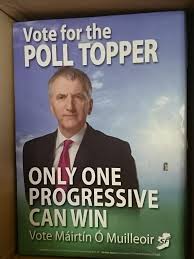
The reactionary position of Sinn Fein was also demonstrated in another graphic used on its leaflet for their candidate in South Belfast.  Having misleadingly described the candidate as ‘the poll topper’ – in fact the sitting MP was from the SDLP – it then said he was the ‘only Progressive Candidate who can win’ – clearly not the case since the SDLP were not listed by the leaflet as one of the five parties ‘united for austerity.’

These five parties were the Conservatives, DUP, UUP, UKIP and Alliance Parties. One of these parties stood out from the others – the DUP.  Why? – because Sinn Fein is in permanent coalition with this party.  And at the time the leaflet was put through the doors the Tories looked like they might be relying on the DUP to get them into power.

Wouldn’t that have looked lovely – the so-called anti-austerity Sinn Fein in Government with the DUP who were keeping the austerity-inflicting Tories in Government.  Don’t bother to try to work out how Sinn Fein would have justified it, they have been justifying inflicting one of the most right wing parties in Europe on this part of the continent for years.

‘The Irish News’ front page has reflected the disorientation of Northern nationalism following the election.  It produced some commentator to explain what had gone wrong.

Apparently  there is a ‘growing number of nationalists who appear switched off from the electoral process (reflecting) a community more at ease with Northern Ireland.’

The commentator said that “I think unionism is more highly strung about identity issues.  Nationalism is more happy in general with the status quo and there is a lack of competition between the parties.  Nationalism is suffering a retreat.”

Almost all of this is rubbish.

Yes, nationalism is suffering a retreat, it’s been retreating for years, and now endorses the legitimacy of partition and its institutions, the British nationality of Irish Protestants and the unionist veto on a united Ireland.

Contrary to its assertion, there is no lack of competition among nationalist parties and unlike unionism there was no electoral pact between the SDLP and Sinn Fein during the election.

Relatively high unionist participation in the election is not because they are more highly strung about identity; in fact the lack of unionist voter participation has been remarked upon for years.  Did they suddenly get a fit of the nerves just recently?  Newspapers have recently reported increasing numbers of parents from what is called ‘a Protestant background’ refusing to designate their children as Protestant at school.

The fall in the nationalist vote is not because nationalists are happy with the status quo but exactly the opposite.  The stench of nepotism, cronyism and corruption from Stormont is all the more repelling on the nationalist side given the claims to radical politics and progressive change from the nationalist parties, particularly Sinn Fein.

Instead the DUP/Sinn Fein coalition Government has been beset by crisis, incapacity, incompetence, secrecy, arrogance, lack of accountability, lack of transparency and financial scandal.  The simplest of questions don’t get answered for years (perhaps never) by Government departments with dozens of communications staff.

The latest such offerings are the revelation of the extent of the employment of Special Advisors (SPADS) employed by all the parties in office without any public recruitment process.  These SPADS are supposed to bring special skills to their political masters, the most prominent of which appears to be their close connection to the parties and their ability to hide any special skills.

freedom of information request revealed that in one financial year the Stormont Executive spent almost £2m on these SPADS, more than the Scottish and Welsh governments combined.  In 2013/2014, the pay bands and grades for these special advisers varied across the UK, going from £36,000 up to £91,000.  In Scotland, three of them were in the top pay band while at Stormont all 21 posts were.

The second is the scandal around a contractor to the Housing Executive which we reported on before here and here.  The SPAD at the centre of the controversy, far from being dumped has been promoted while it is reported that the DUP member who took a more principled stand is being subject to disciplinary action by the party.  At the end of an editorial dripping with scorn ‘The Irish News’ declared of the Stormont regime that “it is increasingly doubtful if the institutions are worth preserving in the first place.”

When the main voice of constitutional nationalism expresses exasperation with the peace process institutions it really does mean a lot of nationalists are thoroughly disillusioned.  This is one of the main results of the election.  In itself it is not a positive but it is certainly a prerequisite for one to develop.


The UK general election part 2: DIY austerity

8841963_origDuring the election, instead of selling themselves as a vote for independence the SNP presented themselves as the leaders of Scotland’s opposition to austerity who would make the new Labour Government keep true to its word of opposing austerity.  As I have and others have said, this was a lie.  The SNP opposed a vote for Labour in England and Wales since they supported the Greens and Plaid Cymru.  So where was this Labour Government to come from?

The SNP vote cannot therefore be characterised as any sort of left vote except in the sense I mentioned earlier: that workers often express their interests in very distorted form.  In this case in the form of nationalism that put forward the idea that Scots are uniquely opposed to austerity and the English not.  The SNP vote can also be said to be a nationalist one because a nationalist solution to austerity was proposed, even if it was supported by some who would not want to go as far as independence.

If the Scots were uniquely opposed to austerity they would also have demonstrated opposition to the cuts transmitted by their own Scottish parliament led by the SNP.

This party has slipped seamlessly from standing in order to put a backbone into a new Labour Government to the election being “a vote to make Scotland’s voice heard loudly” in Westminster.  Those who think there isn’t really any difference should read the last sentence again.  They should also consider if the SNP in any way contributed to getting the Tories out.  As I have also said before the only Tories they wanted out was the ‘red’ variety.

The absence of Labour in Government, which they said would be reliant on them, now means their real reliance on those in power in London is exposed.  Like the nationalists that they are the SNP demands privileges that they would not even consider for others.  So the new Tory Government has to listen to the ‘voice of Scotland’ even though they are 50 per cent of Scottish voices with 1.45 million votes.  UKIP on the other hand won 3.88 million votes, over two and half times the SNP vote. Should their voice not be louder?

However, now that the Conservatives are in Government the SNP will be seeking to cut a deal with them to increase devolved powers – so much for excoriating Labour and their promises not to do deals with the hated Tories.  The Guardian on Saturday reported an SNP advisor saying that Sturgeon will now negotiate with the Tories and that all the repeated promises that the party would never work with the Tories were based on the Conservatives forming a minority coalition government – not an outright majority.

Perhaps this approach seems obvious to SNP supporters but it isn’t at all obvious to anyone else.  If, as it claimed, it stood in this election against austerity why isn’t it trying to cut a deal on reducing austerity instead of more constitutional powers?

The election demonstrated that the SNP and Conservative Party were good for each other.  The inherently anti-English message of independence produced an anti-Scottish response led by the Tories and UKIP who were able to argue that a Labour Government in hock to a party bent on destruction of their nation was a mortal danger.  Both the Tories and SNP knew what they were doing in this mutual loathing.

Now, as the mutually beneficial conflict between the rival nationalisms continues to play itself out, it will become clear that English nationalism is bigger and uglier – because England is bigger and nationalism throwing its weight about is always ugly.

Boris Johnson has advocated giving the SNP greater devolved powers for the Scottish parliament – “some kind of federal offer”.  This is not such a novel departure since the Tories were already more radical than Labour before the referendum in what they promised as devolution in place of separation.

An offer by the Tories of full fiscal autonomy would call the SNP’s bluff since they know full well that Scotland could not afford such an arrangement given the fall in oil prices.  In effect it would be DIY austerity.

The SNP will argue that it wants any new arrangement to maintain current levels of financing.  In other words a settlement that allows Scotland the benefit of higher oil prices should they return but no down side when they don’t.  The English oppressors in the meantime will have to subsidise higher levels of public expenditure in Scotland.

When the Tories make mincemeat of these demands the SNP can then make the case that the dastardly anti-Scottish Tories are at it again and only independence will allow them to borrow more, make savings on Trident and make the independence sums add up again irrespective of the oil price.  Something they haven’t been very convincing at doing so far.

In the meantime increased tax and spending powers may allow the SNP led Scottish parliament to cut corporation tax, as will the Stormont administration in Belfast with the new tax varying powers that the Tories have already promised.  They can then unite with their Celtic cousins in the Irish State in a joint project of cutting each other’s throat.

The debate has begun on what the lessons are for Labour with the Blairites already dominating the media agenda that Ed Miliband was too left wing.

Such an argument hardly squares with the Labour rout in Scotland and nor with Labour gains in London.  It was obvious when Miliband became leader that he had to distance himself from the Blair legacy of the Iraq war and the obsequious defence to the city of London and the financial interests behind the crash.  We’re now asked to believe that a return to this politics is the way back.

Such a policy would have led the Labour Party into an even more confused message than it already had and would have left it with little or nothing to distinguish itself from a Tory Party promising deficit reduction, tax cuts and more money for the health service.

Even the rise of UKIP and the part of its vote that was taken from Labour cannot be seen as an endorsement of a move right.  In this case just how far right would you have to move to rival the xenophobic policies of that lot?

I remember two weeks ago listening to a vox pop on radio 4 from a constituency in the North of England.  A young man was saying he was voting UKIP as a protest against Labour even though he did not at all agree with UKIP policies because he wanted Labour to be more left wing!  I’m not for a moment suggesting that the working class UKIP vote is a left wing protest but some of it is a working class vote that is Labour’s to win.  These voters are not all irredeemably reactionary.  It is rather another example of some workers expressing their class interests as they see them, in a very distorted and disfigured way.

They are demoralised workers who blame immigrants, foreigners or Europe, or simply the establishment understood in some vague way, for the precarious position they find themselves in.

These people did not vote Tory and they did not do so because demoralised or not they don’t confuse their interest with those of the Tory classes and their smarmy representatives.  They just can’t identify their position with an uninhibited and robust defence of their class interests from a socialist perspective.  Perhaps because they haven’t been presented with it or because they have grown cynical with promises of it in the past that haven’t been delivered on.

There is no Blairite answer to workers who blame immigrants for lack of affordable housing, low wages, unemployment and failing health and education services.  There is a left wing answer and however weak it may be from a Marxist perspective it certainly makes more sense than voting UKIP.

The parliamentary arithmetic looks very bad for Labour, behind the Tories by almost 100 seats and suffering almost complete wipe-out in Scotland.  But that is only half the story.

Their vote increased by more than the Tories, and that despite the losses in Scotland.  They may trail by 99 seats but they lag only by 6.5 percentage points of the vote.  The Tories are not in as strong a position as they appear.

First they have a small majority and second they are about to go through a debate about Europe that has the potential to split them extremely badly.  This will take place most likely against the backdrop of gloomy economic news and growing unpopularity as the reality of their election promises come home to roost.  Cameron may seek to provide raw meat to the most Thatcherite elements of his party in order to provide himself with some room to keep the UK inside the EU.

Right now the opportunity exists to have a debate in front of working people about the wide range of policies that they need to advance their interests.  This arises from the debate on who will be the replacement leadership of the Labour Party.  It will not of course be a debate pitting a pure revolutionary programme (however understood) against a cowardly watered down Keynesianism.  But what could ever lead anyone to expect that?  This is where the working class is at and no amount of wishful thinking will make it otherwise.

Will those organisations claiming to be Marxist be able to place themselves in the middle of this debate?  Will they even want to? The debate will happen anyway and many will look to it for a new way forward beyond the despair that the new Tory regime will inevitably create.

The UK general election – part 1: ‘they’re all the same’

images (9)“Were you watching the election last night?” the doorman asked me when I walked into work on Friday morning.

“Yeah, five more years of Tory cuts”, I answered disconsolately.

“They’re all the same”, he said.

A common enough view.  Certainly the view of the left who stood for election, hoping for a vote while realistically knowing that they had no chance of being elected and discounting the effect of taking votes away from the Labour Party.

But not the view of others.

‘The Guardian’ reported that once the result became clear bank shares went up as the threat of more restrictive regulation receded and higher taxes on bankers’ bonuses loomed less large.

Around £1billion was added to the value of the energy company Centrica with the disappearance of the prospect of tougher rules in the energy sector.  The share value of companies that provide outsourced services (privatisation to you and me) also rose, as did those of Sports Direct, whose shares rose by £95m without a Labour threat to their use of zero hours contracts.

“Enquiries came in just after midnight” said one London estate agent, from prospective clients who no longer had to ‘worry’ about Labour’s ghastly mansion tax.  Even bookmakers did well, with Ladbrokes share value rising as the plan to crack down on fixed odds betting terminals, the ‘crack cocaine’ of the industry, disappeared, as Labour’s promise of a crackdown became a ripped up betting slip.

But the report in the ‘Financial Times’ on Saturday put it best, beginning its article like this. .

“. . as the surprise exit poll results came in shortly after 10pm on Thursday night, the mood in the Cavalry and Guards club on Piccadilly turned from funereal to one of incredulous celebration.”

“Earlier in the evening , diners at the Mayfair gentlemen’s club had wallowed in gallows humour as they declared that the election result could mark a fin d’époque for the wealthy in London. . . This stiff upper lip turned to genuine joy as it transpired that the fortunes of the Conservative party had exceeded both the opinion polls and the party’s wildest dreams.”

“This could turn into the biggest celebration ever”, said one Tory supporter. . “We can cancel the removal vans. Non-doms watching the exit polls are unpacking their bags”, said his friend.”

All overstated of course, but those who won’t acknowledge any truth in the report are blowing out of the wrong end.

In some ways I find such reports reassuring.  The super-rich, the real capitalist class, are daily invisible and even the reports of their reaction to the result are through their minions who sell their shares for them or sell them houses or advise them and the rest of us that higher taxes for the rich are a jolly bad thing.

These reports reveal the existence and power of those behind the system, who benefit most from its inequality, and provide glimpses of the class structure within the capitalist mode of production.

While the thought of champagne-popping celebrations in London gentlemen’s’ clubs are valuable because they provide an instinctive and visceral view of what the election victory means it really is no more than that.  The existence and power of the capitalist class, which can appear rather abstract and esoteric in Marxist analysis, is impersonal and largely invisible not only because we don’t run across the mega-rich every day but because it is the system itself which is the problem.  The super-rich are just the personalised expression of the social relations of the system, just as the rich hangers-on of these people such as the estate agents, city dealers and tax advisors represent themselves as the appearance of their mega-rich clients.

Understanding the system and how it works and what the alternative to it is are therefore fundamental.  Understanding the class nature of society and what side you’re on is what’s called class consciousness and it is oddly reassuring that at least one section of society understands theirs.

However the impersonal and systematic nature of capitalism makes this difficult for workers and in so far as they do recognise their own interests this is often expressed in distorted ways. Sometimes very distorted ways, as shown in the election results.

So a lot of the explaining of the election result takes off from the appearance that, for example, Miliband was a bit of a geek and Cameron much more Prime Ministerial.  While Sturgeon, a career politician in the Scottish parliament since 1999, is genuine and sincere and not like the other career politicians; one who could be trusted not so much despite the record of the SNP in Government but sometimes in more or less total ignorance of it.

At only a slightly more sophisticated level of analysis it is claimed that the election was lost because Labour did not have a coherent narrative.  They allowed the Tories to get away with lying that the recession was a ‘Labour recession’ caused by excessive Government spending instead of a financial crisis that affected the world.  They had a confused message that promised to reduce the deficit but also to protect public services and they appeared to both stand for and not stand for robust social-democratic politics.  All very true of course but hardly convincing by itself.

After all, if Labour sent mixed messages the Tory story was beyond belief. They waved the big scary deficit monster in everyone’s faces while promising to pass a law that appeared to prevent them from putting up taxes.

They were going to cut welfare, and not in a nice way either, but nobody would really get hurt, or rather they refused to say who would get hurt.  They had done it before they said and therefore could be relied upon to do it again.  Their record spoke for itself they said, except their record on welfare cuts didn’t at all support their claims.

While the deficit was their number one priority and hard choices had to be made they were still going to cut taxes and give the NHS an increase of £8 billion!  Was anyone supposed to believe this rubbish?

If they looked like they were confident of winning, while almost no one believed they would, it had to be because Eton and all the other posh schools they go to teach smarmy self-confidence and born to rule self-belief, while their management of the economy would appear to reflect that PPE at Oxford now means a piss poor education.

At a more persuasive level it has been argued that the improving economy allowed the Tories to claim that their austerity policies were working, and Labour appeared to have no convincing rebuttal to such claims.  In some respects therefore the Tories got lucky.  The recent upturn is very likely to be very temporary as the most recent figures for economic growth herald the downturn to come.  The recent upturn has therefore been based on short-term cyclical movements and one-off factors.

To really be able to rebut the Tories on this point would therefore have required a more advanced understanding of economic development than Labour was ever going to argue for, and frankly a more advanced understanding than many workers show themselves ready for at the moment.

It is nevertheless true, that despite these problems, the fact is that for many austerity has not ‘worked’ and has still led to the longest period of falling living standards for a very long time regardless of the latest limited improvement.

Finally it has been argued that the Labour party was caught between competing nationalisms in Scotland and England.  This would appear obvious but if you really believed the claims of the SNP it’s not.  This is because the SNP stated that the general election was not about independence.  They stated this because despite all the hype, the SNP lost the referendum, they might lose it again if they tried to have another one soon and they know they have perhaps only one more chance.  The sharp drop in the price of oil since the last one means the independence sums don’t add up.