It would seem ironic if demographics determined a united Ireland. Socialists over the decades have advanced a political strategy based on working class unity and opposition to sectarian arrangements, including partition, which has strengthened division. We have condemned a strategy based on Catholics ‘out-breeding’ Protestants.
In fact, of course, demographics is not a political strategy anyway. It will not of itself produce working class unity and remove division. It will weigh on the balance of forces, but will not determine how this balance is ultimately determined, because any referendum will not be the result of demographics but of the weight of political arguments arising out of any changed economic and social circumstances. A referendum will not just be a count but a result of a political struggle, a struggle based on political argument, interests and organisation.
Religion does not map one to one onto politics and there are Catholic unionists and Protestant nationalists, although rather fewer of the latter. Many nationalists may be described as soft and Lord Ashcroft’s poll records that ‘In our groups, many on all sides felt there was a growing number of voters, particularly younger voters, who would see a referendum in terms of practicalities rather than religion, nationality or tradition – or as one put it . . .“some will vote green or orange, but a lot of people will vote with their heads.”’
The 2021 census results will not show a Catholic majority or a Protestant one, while those defined as ‘other’ or ‘neutral’ are split two to one in favour of those from a Protestant background, who are currently more likely to favour remaining in the UK. The nationalist vote has remained at around 40% for some time and the potential for the census to show the number of Catholics exceeding Protestants will not translate into votes for a generation. The issue will sharpen well before this happens meaning that those who consider themselves soft nationalists or neutral will play a significant role in determining any majority. Hence the importance given to non-nationalist opposition to Brexit and the poll findings of people changing their minds on the constitutional question.
The poll records that ‘More than a quarter of voters (27%) said they had changed their mind on the question of whether or not Northern Ireland should stay in the UK, including 16% who said they had done so more than once.’ This seems improbable and invites some scepticism; somewhat mitigated by the elaboration that ‘31% of women, 38% of those aged 18-24 and 71% of those who describe themselves as neutral on the constitution said they had changed their minds at least once.’ A significant change of mind would currently be required to create a majority in favour of a united Ireland.
All this points to a referendum on a united Ireland not being a question of simply counting the numbers within two blocs but of a political struggle that will much more immediately set the agenda and result.
This is more obviously the case since a referendum will inevitably be required in the South and there is no doubt that this will require a political debate and struggle. One only has to recall the history of Articles 2 and 3 of the Irish constitution, which included that ‘The national territory consists of the whole island of Ireland, its islands and the territorial seas’, and its overwhelming popularity before it was overturned by a 94% vote because it would deliver ‘peace’. The nature of events in the North will affect voting in the South but equally the debate in the South will impact on the North.
Since socialists do not want a sectarian headcount the necessary debate on a united Ireland will be a welcome opportunity to fight for our ideas. This will include support for a united Ireland, defending its claims for democracy and ensuring, in so far as we can, that promises are delivered. At the same time we must admit that it is currently very likely that any unity will take place on a capitalist basis and will require socialists to oppose the particular form that this unity will take.
We should not fool ourselves that what will be on the agenda is anything other than the incorporation of the North into the Southern state. We should obviously oppose the importation of sectarian practices from the North into the South in the name of accommodating unionism, as covered in this post. In the meantime, we must continue to fight for the building, expansion and democratisation of the organisations of the working class and the influence upon them of militant socialist politics.
In this way we can hope that the struggle over a referendum will not involve just a count but will allow our politics to count.
The pessimism of unionism revealed again in the Lord Ashcroft poll is based on their uncomfortable reliance on perfidious Albion – ‘more voters thought the Westminster government would rather see Northern Ireland leave the UK than thought it would rather keep the province as part of the Union. Only 11% of voters, and only 21% of Unionists, said they thought Westminster very much wanted Northern Ireland to remain part of the UK. A further 22% of all voters thought it would prefer to keep the province as part of the Union.’
If the Northern state were really as British as Finchley this would be inexplicable.
‘In our focus groups, voters on all sides said they thought Northern Ireland was an “inconvenience” or an “afterthought” for the rest of the UK. The “levelling up” agenda seemed to apply to the north of England, rather than anywhere further afield.’
Nationalist voters are more convinced that Britain wants to get out, with 68% believing this. Given the determination of the British State to defeat the struggle against its rule by some of them this is somewhat surprising, but is only one element of their view of the world, and in part reflects their view of the patent illegitimacy of partition and the palpable failure of the Northern state to be what is considered ‘normal’.
Another element is that one third of nationalists think the Southern state is indifferent or opposed to a united Ireland. While almost 95% think there should be a referendum on Irish unity within 10 years and 86% think there will be, there is apprehension at how it might occur. Commentary to the poll states that ‘Many were also nervous about the prospect, including some who favoured a united Ireland in principle. They tended to think that a referendum would be divisive, re-awakening tensions rather than resolving them, and that a return to violence would be more than likely.’
This view can hardly be dismissed, since every change to the Northern State, including the demand for civil rights, has been met with protest and violence by unionism. The view that a referendum in the South should follow one in the North is an additional incentive for unionist aggression and to make any threats credible.
The latest change is the Protocol to the Trade and Cooperation Agreement between the British government and EU following Brexit. Unionist leaders claim it has constitutional implications, that their agreement to it is therefore required, and that they’re not giving it. Since the argued direct constitutional effect is mistaken, although not its implications, unionism is arguing – as it always does – that no change can be made to the arrangements within the Northern State without its agreement. Since its politics are overwhelmingly sectarian and wholly reactionary this is one reason why partition should be ended and a united Ireland is progressive.
The main reason for nationalist optimism is demographic, that the share of the Catholic population is growing and Protestant Unionist one is declining; Ashcroft states that ‘one Catholic voter told us cheerfully and candidly in nationalist Strabane, “we breed better than they do. They have big TVs; we have big families.” More than seven in ten voters aged under 25 said they would vote for a united Ireland.’
The poll states that ‘Support for a united Ireland declined sharply with age: 71% of those aged 18-24 said they would vote for unification, with 24% opting to stay in the UK; among those aged 65 or over, only 25% backed a united Ireland, with 55% choosing the status quo.’
It also reports the finding that ‘More than a quarter (27%) of voters said they had changed their mind as to whether Northern Ireland should stay in the UK . . . Among neutrals, 62% thought voters would choose the status quo tomorrow, but 66% thought they would back a united Ireland in ten years’ time.’ Nationalists anticipate that people will change their minds and change them in only one direction.
One reason for this belief is the claimed effect of Brexit. According to the poll 95% of nationalists/republicans opposed Brexit while 66% of unionists supported it. The 30% of unionists who opposed Brexit and the 92% of those defined as ‘neutral’ (those who described themselves as neutral on the constitution) who also opposed it are expected to, or at least it is hoped will, change their views on the constitutional question because of the UK leaving the EU.
The poll makes much of its effects – ‘Participants in all our focus groups spoke about rising prices and shortages of goods, including food, clothes, household items and building materials. Several noted that ordering items from overseas had become more expensive or in some cases impossible; several had experienced Amazon being unable to ship certain items to Northern Ireland. Such problems were attributed to Brexit, the Protocol, covid, the Suez Canal blockage, or various combinations of all four.’
It finds that ‘Nearly 9 in 10 voters (88%) said they thought Brexit had been a cause of shortages of food and other goods in Northern Ireland, including 62% who said it had been a major factor. This was especially true of Nationalist/Republicans, with 73% of 2017 SDLP voters and 90% of Sinn Féin voters saying they believed Brexit had been a major factor.’
‘Three quarters of 2016 Leave voters said Brexit had had a part to play in shortages, including 29% thinking it had been a major factor.’
‘Unionists, however, were more likely to blame the pandemic and (especially) the Northern Ireland Protocol. Nearly 8 in 10 (78%) of them, including 89% of 2017 DUP voters, said they thought the Protocol had been a major factor, compared to 38% who said the same of Brexit more generally.’
The poll asked ‘whether Brexit had affected people’s views as to whether Northern Ireland should be part of the UK. For three quarters, it had made no difference: 43% said they had thought the province should be part of the UK before Brexit and still did; 32% said they had favoured a united Ireland before Brexit and they still did.’
However, ‘13% said they had thought Northern Ireland should stay in the UK before Brexit, but now favoured a united Ireland. This included 40% of 2017 SDLP voters, 34% of those who had backed the Alliance party, and 36% of those who described themselves as neutral on the constitution.
A further 9% (including 36% of 2017 Alliance voters, 29% of constitutional neutrals and 9% of self-described Unionists) said Brexit had made them less sure that Northern Ireland should be part of the UK.’
Again, its perceived effects reflect previous dispositions, with 34% of unionists believing Brexit makes a united Ireland more likely, 99% of nationalists thinking it does, and 89% of ‘neutrals’ believing the same. Nationalist optimism and unionist pessimism are long standing but have not changed the existing political division. It is therefore an open question whether Brexit will have the effect of persuading some unionists or ‘neutrals’ to support a united Ireland. It will certainly not strengthen opposition to it and its longer term economic effects may be more powerful in shifting views than relatively minor shortages.
I went to see ‘Belfast’ by the actor and Director Kenneth Branagh with an open mind, and I left wanting to like it more than perhaps I did. It’s an autobiographical film of a small Protestant boy and his working class family at the beginning of the Troubles.
Since I was once a small Protestant boy at the beginning of the Troubles, and living in a working class area, I came with my own experience as a comparison. Despite this being a political blog, and almost obliged to pen a political review, I’ll do that less than I would otherwise because of this. An autobiographical review then of an autobiographical film.
So, some things struck me that perhaps others wouldn’t notice and are probably irrelevant to any reasonable review, but there are points I really would like to make. I’ve written a long series of posts on the start of the Troubles but this one relates particularly to the initial period in the film and provides some political context.
My wife informed me that a friend of hers told her that the film was from a Protestant view. I’m not sure if this was a criticism but it is obviously true. The story of a Catholic family in a mixed, but mainly Protestant street, would be more harrowing. It could easily be more ugly and bloody. It is, however, no criticism of the film to say that this is not what the film is about, or ever could be.
A review of the film, or rather of the reality of the film’s backdrop, by Max Hastings in ‘The Times’, who covered the events as a journalist, mentions at the end of it – of Branagh – that ‘back in 1969 his tribe bestrode the dunghill, while Catholics suffered at Protestant hands.’
Whether intended or not, this gives the impression that Branagh belongs to a tribe and that this tribe, without distinction, oppressed all Catholics. At which point I’m compelled to say that he’s missed the effing point.
For the point of the film, in so far as it can be interpreted as a political film, is not that all Protestants oppressed Catholics; but rather that some didn’t, that some even opposed it, and that some had to get out because they too became targets of loyalist bigots on account of this refusal. To get all autobiographical myself, my own family did not oppress Catholics, were not even unionist in politics never mind loyalist, and actually supported the civil rights movement as some other Protestants did.
This matters, because it points to an alternative to forever being a creature of your ‘tribe’ both then and now. I don’t see any nostalgia in the film for any tribe and the cliched love across the sectarian divide is not overwrought as it so often is. Whatever saccharine aspects the film has, it avoids any empty self-exoneration because none is required. If anything, the Catholic characters are hardly developed; to repeat, that’s not what the film is about.
As it proceeds it becomes less political and more personal. For this reviewer the personal elements are often more evocative of my own back story than the political. The discovery by the small boy recalls my own that there are such things as Catholics and Protestants; that we were Protestants and some people expected us to hate Catholics, although without me having a clue why, or them for that matter.
On a lighter note, I remember going to see ‘Chitty Chitty Bang Bang’ but I refuse to buy the portrayal of the family as hard up. They have a phone and the boy has more toys than I could ever have dreamed of. They do say they haven’t had many holidays but however many they had was exactly the number more than me.
We didn’t have any religious upbringing, which is rather more important to the characters in the film, but the role of the organised, determined and principled woman in holding the family together was from my experience typical. Hiding under the table when there was a riot outside reminds me of doing the same when there was a gun battle in my street. The uncertainty of leaving also reminds me of my own experience although I didn’t have the film character’s desire to stay.
On other aspects Hastings is right, especially that Belfast was a much uglier city than portrayed in the film. The streets are too clean and tidy as is the entry at the back, which in my granny’s Shankill Road home was a rotting tip the whole way down. There are no painted kerb stones and no flagpole holders on the houses, not to mention flags sticking out of them.
The film is too soft in this respect, so that the loyalists are not dark, repellent and menacing enough, and the film doesn’t therefore truly portray the stifling and oppressive environment of the time and place. Again, it’s not that sort of film because it arises from an escape that is not only the author’s history but, he appears to believe, the history of the place full stop. It is ultimately a story of good fortune because that’s what came out of it.
The film is a simple story made vivid by the excellent performances from all the cast. Only one scene borders on the ridiculous and if the background just about passes muster, the accents and language do so as well. Enough certainly for the vast majority of audience which will watch it.
My main qualification for being a critic is that I am comfortably at home being critical, and as I say, I left wanting to like it more, and maybe I will. It reminds me of something I heard a long time ago – that Belfast is a great place to come from.
Everyone loves an opinion poll on the potential result of a referendum on a united Ireland. The media has something to report and its commentators have something to comment on.
Nationalists in particular like them – they are a good fit with Sinn Fein policy of being in favour of a united Ireland while not actually being able to do very much about it. It keeps the pot simmering with the promise that someday soon it will come to the boil. Nationalism repeats that there needs to be a conversation about what a united Ireland will be like, as if talking about it brings it closer – giving the impression of doing so – at least to its supporters.
The Dublin Governing parties don’t mind since their policy of sometimes expressing support for a united Ireland tallies with the general view of the Southern population that it would be a nice idea, although without much evidence of it exercising itself to bring it about. A perfect fit for the Southern establishment and its political representatives.
The British government doesn’t mind because it has said it will do whatever the people want, once again demonstrating its good offices, while it can be confident that it will not be required to do anything very much.
Only Unionists seem not be enamoured with them, even though they should, since they usually show there being no realistic chance of the majority in the North voting for unity in the foreseeable. This might be a result of their normally dour political outlook in which seventeenth century politics seems by far the most attractive, and among whom some think flying the union flag for Prince Andrew on his birthday is the honourable and righteous thing to do.
Of course, they have an aversion to seeing the little enclave carved out for them being anything other than as British as Finchley, and nobody asks this North London district if it wants to leave the union. They are also concerned that opinion polls may show them winning most of the time, but that they only have to lose the real thing once to have lost definitively, which is progress of a sort, since the last time they lost such a vote they changed the rules to ensure that they couldn’t.
Two opinion polls were reported at the end of last year, one in the North and one in the South, and the issue will become more excited as the results of the March 2021 census in Northern Ireland begin to be published in March this year, although with full results only by next year.
These polls are attractive because they allow for various interpretations. As we have seen in the vote for Brexit, some on the left still see it as a great idea even if it rallied a reactionary vote around Boris Johnson and split the Labour Party. If only, they say, the Party had supported Brexit it could have stolen Johnson’s thunder and won over all the pissed-off working class voters available to a progressive sovereignty politics!
Fortunately, opinion polls can rule some claims out, including the idea of Brexit powered by progressive politics, as the Lord Ashcroft poll showed. It demonstrated that it was primarily an English nationalist vote with strong anti-immigrant content that would supposedly have expanded the Labour Party vote by pissing off the 63 per cent of its supporters who voted Remain. Very convincing, I don’t think.
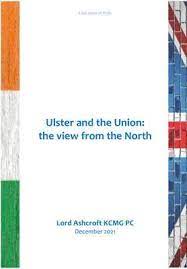
The Ashcroft poll on Irish Unity reported that ‘The news that Northern Ireland voters would choose to stay in the UK – by a majority of 54% to 46% in my poll, once undecideds are excluded – is a welcome early Christmas gift for unionists. In a similar survey two years ago, I found a wafer-thin margin for Ulster to join the Republic in a united Ireland.’
It then said that ‘My latest research, published today, shows a clear swing back towards remaining in the United Kingdom . . . But as I also found in my survey of over 3,000 voters and focus group discussions throughout the province, it is the nationalists who feel things are heading their way.’
When I first heard this previous poll result, I didn’t believe it to be accurate and in discussion with a colleague in work he didn’t believe it either. It wasn’t consistent with what I knew and with other polling results. There has also been no political development in the past two years that could explain an increase in support for remaining in the UK or a fall in support for a united Ireland.
The latest poll has recorded that ‘Nearly two thirds (63%) of voters thought that in a border poll tomorrow, Northern Ireland would vote to stay in the UK. However, by 51% to 34% they thought that a referendum in 10 years’ time would produce a majority for joining the Republic in a united Ireland.’
‘While 90% of self-described Unionists thought voters would choose the UK in an immediate border poll, only 64% thought this would be the outcome ten years from now,’ while Nationalists belief that the vote would be for a united Ireland increased from 47% to 91%.
Nationalists overwhelmingly (93%) expected Northern Ireland to be out of the UK within 20 years, two thirds (67%) of unionists thought they would still be part of the Union at that stage. However, fewer than half (47%) of unionists thought the status quo would still prevail in 50 years; 23% said they thought Ulster would have left by then, and 30% said they didn’t know.
This reflects a certain pessimism of unionists, consistent with their reactionary and generally paranoid politics where ‘Lundies’ and traitors are a constant threat, but also reflects for some a nagging unspoken acknowledgement of the illegitimacy of their position, which doesn’t however extend to shifting from it. I recall my not very political late Aunt from the Shankill Road in Belfast saying that there would be a united Ireland, but not in her lifetime. That, it appears, continues to be another largely unacknowledged view.
Whether the pessimism of unionism collapses into resignation and the optimism of nationalism becomes a spur to action is yet to be determined.
Professor Tim Colbourn of University College London was quoted in the ‘Financial Times’ (on 4 Jan) that it was “entirely reasonable to think that the burden of Covid can be reduced by 95 per cent in 2022, so that it’s no longer a top 10 health problem. That would be a reasonable goal to end the pandemic.”
The article notes that ‘some experts view Omicron itself as a pointer to future evolution of the Sars-Cov-2 virus, as natural selection favours mutations that pass quickly and efficiently between people who already have some immune protection . . . These conclusions are supported by epidemiological evidence that the risk of severe disease is reduced by half or more with Omicron.’
The Director of the Wellcome Medical foundation, Jeremy Farrar, is quoted as saying that he was reassured at the prospect of Omicron taking over from Delta and that “I’d be more worried if you had different variants circulating at the same time.”
The article states that ‘another variant of the virus is a certainty and that while individual changes in the genetic code are random the environmental pressures that allow some to thrive are not. This favours variants that transmit quickly while evading immune response but mutations that make the virus more lethal are unlikely to make it fitter and may even be a handicap.’
Jennifer Rohn, a cell biologist and UCL professor, said that “although you can imagine a deadly new variant emerging that’s more harmful . . . I don’t know how feasible that would be for this virus. Sars-Cov-2 depends on infecting cells and it may already be close to the limits of its repertoire.”
The article notes that the view that the virus will become milder is ‘a matter of debate among scientists’, but quotes another professor of medicine at the University of East Anglia, Paul Hunter, that he is convinced this is true of coronaviruses. “Sars-Cov-2 will continue to throw up new variants forever but our cellular immunity will build up protection against severe disease every time we’re infected. In the end we’ll stop worrying about it.”
Jeremy Farrar notes that there is a small risk of an evolutionary jump – “something out of left field that does not come from existing lineages”, the article states that ‘most experts regard it as extremely unlikely. “I’m much more scared of another pandemic caused by a new virus that we don’t yet know about than by some variant of Sars-Cov-2” says Tim Colbourn.
Since much of the left has taken a doomsday view of Covid-19 this is perhaps not good news for their perspectives. How they can continue to argue for a zero-Covid policy – the article quotes a forecast of 3bn infections world-wide over the next two months – is a terrain I don’t really want to explore. With perspective not far from the fictitious character Private Frazer of ‘Dad’s Army’, perhaps they will cling to a dialectical understanding of the non-linear revolutionary genetic leap that will confirm their pessimism.
They will not, in addition, be enamoured with the views of the former chairman of the UK’s vaccine taskforce, Dr. Clive Dix, who has said ‘Covid should be treated as an endemic virus similar to flu, and ministers should end mass-vaccination after the booster campaign.’
He effectively repeats the views of Dr. Gerald Barry in Dublin quoted in the previous post in calling ‘for a major rethink of the UK’s Covid strategy, in effect reversing the approach of the past two years and returning to a “new normality”.
“We need to analyse whether we use the current booster campaign to ensure the vulnerable are protected, if this is seen to be necessary,” he said. “Mass population-based vaccination in the UK should now end.”
‘The Guardian’ article goes on to report him saying that ministers should urgently back research into Covid immunity beyond antibodies to include B-cells and T-cells (white blood cells). This could help create vaccines for vulnerable people specific to Covid variants . . . adding: “We now need to manage disease, not virus spread. So stopping progression to severe disease in vulnerable groups is the future objective.”’
The article quotes Professor Eleanor Riley, professor of immunology and infectious disease at the University of Edinburgh, saying: “Everything depends on whether another variant comes up. A fourth dose or second booster of the existing vaccine probably isn’t going to achieve very much. The evidence is that immunity against severe disease is much longer lasting. The only justification for doing a second booster for the majority of the population would be if we saw clear evidence of people, five or six months after their booster, ending up in hospital with severe Covid.”
Most people will welcome these views, if only because it’s what they want to hear, as they are tired of lockdown and fed up with the restrictions on their lives. One danger of pretending everyone has been equally in danger from Covid-19 was always that the vulnerable would be overlooked. A continuing blanket assertion that we are all still threatened, including children, is worse than useless.
The left’s zero-Covid strategy has nowhere to go, except to expose its exponents as wild catastrophists whose ultra-left politics is exposed once again; supporting longer restrictions for which more and more people can see little justification. Believing that socialist revolution can only arise out of crisis, they wrongly assume that every crisis requires revolutionary methods. They do so in pursuit of relevance and sign of their revolutionary purity. That social crisis has not shown itself conducive to working class politics was the subject of some of the earliest posts on this blog.
A continued forlorn and regressive campaign for zero-Covid will ignore the real issues that are arising, and will have to argue that individual, very basic, freedoms and civil rights should continue to be suppressed by the state.
The issues arising include other costs of lockdown, which will affect working people, and the young especially, for decades. A left that wants this lockdown extended and deepened has no credibility in responding to these problems.
These costs include financial, health and educational losses. Calls by the left for the government to pay for workers not to work exhibit all the ignorance often called out by conservatives and reactionaries. Those workers genuinely at risk or sick must be fully protected but this requires that the rest of the working class actually continues to work. Real mass lockdown of society is impossible. Pretending that only ‘essential’ workers should continue to work divides the working class perniciously and reveals levels of ignorance about a division of labour under capitalism that makes the vast majority ‘essential’.
As for asking the government to pay, this reveals incredible confusion at multiple levels – illusions in the capitalist state; illusions in the power of money without workers producing goods and services to buy with this money; the effects of inflation on workers’ living standards in simply handing out money, and the fact that governments don’t pay for anything – they tax or borrow and pay back the latter with the former, unless of course they print money, but then see previous comment.
If any of what this left claimed was true for any length of time, the ‘property question’ which Marx said was key would not be the ‘leading question’ in socialist politics.
More immediately, socialists should support workers being back in the workplace, in order to strengthen their feelings of shared identity, interests, solidarity and organisation. Concern about health and safety should be dealt with collectively, which is much easier to do if you actually work closely together.
The Health Service has failed – see this earlier post – but to say so is almost to be damned as impugning the staff who work in it, some of whom have made real sacrifices during the pandemic. Unfortunately, the politicians and bureaucrats who have been responsible for the incapacity of health services to carry out their role have cynically hid behind them, substituting rhetoric about heroes and rituals of hand-clapping for an effective service.
The British left is especially bought into illusions in the NHS, which is a health bureaucracy that was exposed from the start as incapable of protecting even its own staff. The overwork of many staff is testament to its essential nature as a medical bureaucratic creature of the state, which for socialists is first and foremost a capitalist state with operations, functions and direction determined by the requirements of its class character.
Much of the Irish left wants an Irish NHS, because health care in the South is two tier, in complete ignorance of the fact that the failure of the NHS in the North means that health care there is more and more two tier as well.
Health provision in the pandemic has undergone a real crisis, with services closed down or restricted, waiting lists increased and diagnoses not carried out. Just like an economic crisis, no crisis goes to waste as far as those in power are concerned. Simply defending the existing service and believing that more money is the answer is an illusion.
So, to answer the question – Covid-19 will only go away if a zero-Covid policy was possible and was implemented. It isn’t possible so it isn’t going to happen. Instead Covid-19 and the mistaken reaction to it will leave in its wake multiple problems. We need to understand the reason for this mistaken reaction and what the correct approach now is to the current and future evolution of the disease.
When University College Dublin virologist Dr Gerald Barry was interviewed by ‘The Irish Times’ and asked – why have we so many cases when we’re so highly boosted? – he said ‘Even asking the question points to the root of our problem in Ireland and in many parts of the world, we are using a tool that isn’t designed to stop infections and then wondering why it didn’t stop infections.’
‘I would strongly advocate for a complete reassessment of everything we have done to this point, identify everything else that could be done that would help, knock off everything that isn’t feasible or is unaffordable and do everything else.’
So we have failed? – ‘The problem with a “do more” strategy is that some countries that have demonstrably done less to curb the spread of infection, such as England, seem to be doing better overall.’
Just such a reassessment was recently reported in ‘The Guardian’ from Professor Mark Woolhouse, ‘one of the country’s leading epidemiologists’, who has written a forthcoming book, ‘The Year the World Went Mad: A Scientific Memoir’. Lockdown, he says, ‘was a lazy solution to a novel coronavirus epidemic, as well as a hugely damaging one”.
The day Britain went mad is reported as when ‘the No 10 briefing in March 2020, cabinet minister Michael Gove warned the virus did not discriminate. “Everyone is at risk,” he announced.’ To which Woodhouse responds: “I am afraid Gove’s statement was simply not true. In fact, this is a very discriminatory virus. Some people are much more at risk from it than others. People over 75 are an astonishing 10,000 times more at risk than those who are under 15.”
“We did serious harm to our children and young adults who were robbed of their education, jobs and normal existence, as well as suffering damage to their future prospects, while they were left to inherit a record-breaking mountain of public debt. All this to protect the NHS from a disease that is a far, far greater threat to the elderly, frail and infirm than to the young and healthy.”
“We were mesmerised by the once-in-a-century scale of the emergency and succeeded only in making a crisis even worse. In short, we panicked. This was an epidemic crying out for a precision public health approach and it got the opposite.”
That Covid-19 is a disease that discriminates is a point made often on this blog and by others, which should have signaled that a blanket approach wasn’t warranted. A recent paper analysing this has recently been published, which shows the disparity in effect by age, despite the difficulties in measurement.
It records that in ‘Twenty-five seroprevalence surveys representing 14 countries were included . . . the median IFR [Infection Fatality Rate] in community-dwelling elderly and elderly overall was 2.9% (range 0.2%-6.9%) and 4.9% (range 0.2%-16.8%) . . . IFR was higher with larger proportions of people >85 years. Younger age strata had low IFR values (median 0.0013%, 0.0088%, 0.021%, 0.042%, 0.14%, and 0.65%, at 0-19, 20-29, 30-39, 40-49, 50-59, and 60-69 years . . .’
These IFRs have been calculated using data from 2020 and are therefore before widespread vaccination, at least in richer countries and before the less virulent Omicron variant. We can therefore expect these numbers to have fallen not only due to vaccination but also better hospital treatment as lessons began to be learned about ventilation etc. The paper notes that ‘absolute risk values still have substantial uncertainty’ and mentions the low number of elderly in the studies examined by the paper, but which might also reflect uncertainty about the total number of infections and number of deaths actually caused by Covid as opposed to deaths of people with Covid.
The link here to IFRs for various diseases shows that for the younger age groups Covid-19 is far down the list. According to the European Centre for Disease Prevention and Control here Influenza (over all ages) appears more severe than Covid-19 for those aged below 30 although this also depends on the virus, host issues, and other factors.
The paper also notes that ‘besides age, comorbidities and lower functional status markedly affects COVID-19 death risk. Particularly elderly nursing home residents accounted for 30-70% of COVID-19 deaths in high-income countries in the first wave, despite comprising <1% of the population. IFR in nursing home residents has been estimated to be as high as 25%.’
Professor Woolhouse argues in ‘The Guardian‘ article that:
‘the country should have put far more effort into protecting the vulnerable. Well over 30,000 people died of Covid-19 in Britain’s care homes. On average, each home got an extra £250,000 from the government to protect against the virus . . . “Much more should have been spent on providing protection for care homes,”
He ‘castigates the government for offering nothing more than a letter telling those shielding elderly parents and other vulnerable individuals in their own homes to take precautions,’ something this bloggers’ wife found particularly galling as medical personalities and politicians congratulated themselves and were congratulated by others for efforts on her and others’ behalf which consisted of nothing much more than a letter.
As ‘The Guardian’ goes on in reporting Woodhouse’s views – ‘The nation could have spent several thousand pounds per household on provision of routine testing and in helping to implement Covid-safe measures for those shielding others and that would still have amounted to a small fraction of the £300bn we eventually spent on our pandemic response, he argues. Indeed, Woolhouse is particularly disdainful of the neglect of “shielders”, such as care home workers and informal carers. “These people stood between the vulnerable and the virus but, for most of 2020, they got minimal recognition and received no help.”
The British Government, according to Woodhouse, thus “lacked a convincing plan for adequately protecting the more vulnerable members of society, the elderly and those who are immuno-compromised.”
“Lockdowns aren’t a public health policy. They signify a failure of public health policy.”
Back in December the Deputy First Minister warned that Omicron will hit Northern Ireland “like a ton of bricks”. “Once again we find ourselves dealing with what potentially is going to be the worst time through the whole of the pandemic,” she added. ‘We are continuing to work around the clock with public health officials to understand the impact because there are things that we currently know, but there are also things that we do not know.’
The Chief Medical Officer for Northern Ireland said that he was ‘more concerned than at any previous point in the pandemic’. The Chief Scientific Advisor said that it was inevitable that cases would double every couple of days.
In Dublin the Health Minister said that ‘the reality is the situation is very stark.’ Asked about the comment of the English Chief Medical Officer, Chris Whitty, that hospitalisations will be as bad if not worse than last winter, he said ‘we could well see that, yes.’ Leo Varadkar warned that the situation was ‘beyond our worst feras’
Mike Ryan of the World Health Organisation has said that Omicron will ‘fill the hospitals up, we will fill the ICUs up.’ Similar warnings were made by politicians and health authorities across the world.
A month later the tone has changed. The Ministry for Health in Northern Ireland has admitted Omicron has not been the threat anticipated, now acknowledged in the South as well. Learning to live with Covid has been accorded greater weight alongside recognition that lockdowns cannot continue forever. There are now more prominent questions about exactly what the threat from Covid-19 is, and just how many in hospital have been admitted with Covid or for something else but just happen to also be infected.
At the end of last week it was reported that 44 per cent of those in hospital In the Irish State were diagnosed with Covid only after being admitted, some of whom will not have been admitted due to its effects. While nearly 1,000 Covid related patients are in hospital with the infection almost 500 patients are awaiting discharge from hospital but have nowhere to go, filling beds and potentially posing a risk of further infection.
The need for adequate social services is a longer story than ‘War and Peace’ and as unfinished as most people’s efforts at ‘Ulysses’. The health service bureaucracy complains that services are under threat from Covid but the real problem is its own failings, in capacity and organisation. In the South there was much dismay at news that five times more senior managers were recruited in the second quarter of last year than medical staff.
These senior managers complain about staff absences due to Covid but many of these staff are not actually sick but following the isolation rules recommended by them. And this is not the only part of their lockdown strategy which is worse than useless and is falling apart. Useless, because testing results take so long when people are most infectious in the first few days. Useless because many people have been unable to get tests when they want, Useless because to be effective tests would have to be carried out continuously in a way that cannot be performed. At €200 per PCR test it is an expensive waste. Falling apart because testing cannot meet demand so it is not even a reliable indicator of extent of infection. It has been estimated that between 300,000 and 500,000 infections went unrecorded last week, up to about 10 per cent of the population. In what possible way could testing act as any sort of measure of control?
The argument between the National Public Health Emergency Team (NPHET) and Government about whether hospitality should close at 5pm or 8pm now looks laughably pointless, while widespread use of derogations calls into question the whole policy as does reduced periods required in isolation. At the end of the first week in January there were fewer people in ICU than before Christmas. What is happening is that lots of people are now getting natural immunity.
Even in December it was still clear that infection was primarily an issue for elderly people and especially those unvaccinated. In mid-December it was reported that 68 per cent of deaths related to Covid in the previous week were among those with an underlying condition and two-thirds were among those aged 65 or older. This age group accounted for 50 per cent of hospitalisations while the unvaccinated accounted for 45 per cent of patients in ICU. The unvaccinated were more likely to be in hospital and had a higher death rate. The majority in ICU over the last month have had the Delta and not Omicron variant.
When warnings were first made about the new Omicron variant it was stated by the CMO in England, Chris Whitty, that ‘there are several things we don’t know [about Omicron] but all things that we do know are bad’, which wasn’t true. The administration in the North and Government in the South took their cue from these warnings.
When the Taoiseach Micheál Martin warned that the projections by NPHET were ‘sobering’, one journalist noted that ‘nobody pointed out that NPHET’s projections have frequently been almost drunkenly inaccurate.’ He admitted that this might not matter given the large numbers involved but this brings us back to Whitty’s remark about all the things known about Omicron were bad.
It was widely argued that the danger of hospitalisation, requirement for ICU, and death – let’s call each of these ‘ Z’ – were all a function of cases, let us call this ‘X’. The severity of the Omicron variant was known from South Africa to be significantly milder but when the sheer number of cases was taken into account a milder variant with a lower severity – let’s call this level of severity ‘Y’, meant that a much bigger X multiplied by a lower Y still meant a very large Z, i.e. large number of hospitalisations etc. All making perfect sense in algebraic terms but pretty meaningless in real terms.
If the severity of infection was lower there could be no assumption that a higher number of infections with a mild disease would be a calamity rather than a lot of people suffering a mild infection; but as we see, Whitty and those following simply assumed that a higher number of cases would almost inevitably bring a higher number of hospitalisations, requirement for ICU, and deaths.
Given the much increased transmissibility of Omicron and large numbers forecast it is hardly justified to believe that any general lockdown was going to work, an inadequate testing regime would be relevant, and that a strategy bases on protecting everyone could possibly work. A policy of focused protection of those known to be most vulnerable is the only one to make sense but hostility to this, in the form of the ‘Great Barrington Declaration’, has been widespread for a long time and defaulting to it would have opened up those responsible for the existing approach to questions.
The reason not to do so, as at the start of the pandemic, was the claim that with so much uncertainty about the new virus the precautionary principle was required: assume the worst and prepare for it while perhaps hoping for the best. Unfortunately, this explanation doesn’t convince.
If it must be assumed millions would be infected then it should have been obvious that generalised lockdown could not work, even more obvious now with Omicron. The precautionary principle would require that an optimistic view of its efficacy could not be assumed. The precautionary principle would also mandate a serious analysis of the prospective harm caused by generalised lockdown and I’ve yet to see any.
Relevant also is the fact that right from the start of the pandemic it was not a question of complete uncertainty – some things were known and should have been acted upon but were effectively ignored. This was that the real threat to the population was highly correlated with age, with the more elderly suffering a risk multiple times greater than of younger people, which would point to a focused strategy of protection.
Instead of precaution, the real reason was the assumption that the health system could not cope with a sudden increase in cases but, since these were overwhelmingly those at risk, this too was no answer to those advancing the argument of an alternative approach.
‘From Empire to Europe: The Decline and Revival of British Industry since the Second World War, Geoffrey Owen, Harper Collins, 2000.
This is another book I read last year: a history that more than most has contemporary relevance. It charts the story of British manufacturing from the end of the Second World War to the end of the century. The majority consists of ten chapters on the experience of separate industries, from textiles and steel to cars and pharmaceuticals. Not all are stories of failure.
Two early chapters present the historical background and four at the end review differing explanations for Britain’s relative decline.
The book was first published in 1999 and screams ‘BREXIT’ – as a history of the future of Britain outside the EU, or so it might too easily be concluded. In fact, given the relative starting positions of Britain and the rest of Europe, then and now, the mistake of standing outside of the rest the continent now looks more obviously stupid and will more quickly be seen to be so. If it isn’t already.
After the war ended it was expected that in due course Germany would resume its pre-war role of supplying Europe with manufactures; Britain could concentrate on the rest of the world with which it already traded. The Labour Government decided against joining the European Coal and Steel Community (ECSC) and ceding sovereignty over its two most important industries, while the left of the Labour Party complained of the economic liberalism on the Continent it said led to social injustice. Foreign Secretary, Ernest Bevin, insisted that Britain was ‘not just another European country.’ Some economists at the Board of Trade favoured membership of the ECSC on the grounds of exposure to European competition, but this was a minority view.
The Tory Government from 1951 broadly followed its predecessor, rejecting a second opportunity to join the ECSC or taking part in negotiations to create the Common Market. European integration was, in the words of another author quoted, ‘at best irrelevant to Britain’s economic self-interest and at worst a political nuisance which had to be tolerated, if only in public, because of the Americans.’
Again and again, Owen records the effect of being outside the European market. In textiles small and medium-sized firms from Italy and Germany benefited ‘to a far greater extent than the British industry from the expansion of intra-European trade in the 1950s and 1960s . . . where the long-standing bias towards non-European export markets proved to be a serious disadvantage’ (p57)
When eventually Britain did join the Common Market, it found that its European competitors ‘instead of scale and standardisation . . . had put more emphasis on design and technical innovation . . . imports from the Continent rose sharply in the second half of the 1970s, and the British textile industry, having neglected European markets in the 1950s and 1960s, was not well equipped to respond.’ (p77)
In shipbuilding ‘the export trade was regarded as marginal and unpredictable’ and ‘a marketing strategy geared to the requirements of domestic owners was becoming obsolete’. (p97 & 100). In steel, ‘traditionally the most nationalistic of all major industries . . . European steel-makers needed a market as large and competitive as that of the US’, and ‘while recognising that the smaller domestic market-imposed limits on how far British steel-makers could go in the American direction . . .’ there were barriers to this being achieved within Britain.
On the other hand, while ‘there was a long tradition of price-fixing in French steel, and the industry had bee oriented almost entirely to the domestic market the effect of the European Coal and Steel Community (which was opposed by most French steel makers) was to break down the parochialism of the industry and force it to plan for a wider European market.’ (p 148, 127 & 130).
In the paper industry, joining the Common Market ‘would have exposed it ‘at an earlier stage to competition in a large dynamic market; ‘modernisation and rationalisation which occurred in the 1980s and 1990s might have occurred earlier’ and it would ‘have provided export opportunities’ which might also ‘have started earlier.’ (p170)
In relation to the engineering industry Owen writes that, after the war, ‘when the continental economies were in disarray and the need for hard currency was urgent’, when standing aside might been seen as explicable, ‘the neglect of Continental Europe . . . after its recovery in the 1950s . . . was to prove a serious error.’ Seemingly strongly placed in the early 1960s, low economic growth and lack of involvement in intra-European trade meant that ‘an increasing number of British manufacturers were falling behind their Continental counterparts in the scale of their production.’ The failure to Europeanise in the 10–15 years after the war meant that for many firms it was too late when they did.
A similar experience les behind the decline of the British motor industry: ‘the decline of Leyland has to be seen as an avoidable disaster, largely attributable to the failure to Europeanise the business in the 1950s and 1960s.’ (p249). The ‘low priority’ given by British firms to Continental Europe meant that they did not join ‘homogenous, fast-expanding and highly competitive mass market enabled companies such as Renault, Volkswagen and Fiat to narrow the productivity gap with American manufactures . . .’ (p250)
Owen points out that European industry was itself not always successful and notes its failure in computers and semiconductors. Of the former he says that ‘European industry might have done better if governments, instead of nurturing and protecting national champions, had concentrated on widening the market for computers . . . As it was, nationalistic, producer-oriented policies, discriminating in favour of chosen domestic suppliers, exacerbated Europe’s most serious weakness vis-à-vis the US, the small size of the market.’ (p270)
Owen makes clear that lack of orientation to a European market was sometimes a mistake not just made by the British, and that failure was not simply a result of lack of access to that market. Other strategic mistakes were made. Half a century later it would therefore be an identical mistake to see market restrictions only on a continental scale as the problem, when many industries now have global markets and global production.
So, Renault is partnered with Nissan and Mitsubishi; Volkswagen includes Audi, Bentley, Bugatti, Porsche, SEAT, Škoda plus others and has an alliance with Ford, while Fiat is now part of Stellantis, which includes Chrysler, Jeep, Peugeot, and Citroën. Britain has a small luxury car market with volume production owned by foreign companies.
Owen tells a similar story about chemicals, noting however that the success of ICI by the end of the period covered was despite the factors that harmed the development of British companies in other industries.
Others were also successful, such as pharmaceuticals, which Owen says was due, among other things, to its ‘openness to foreign investment.’ (p372). This ensured that ‘British-owned firms were forced to compete against the world leaders and learn from them.’ (p387)
In the last chapters he looks at common explanations for the decline of British industry after the war, including the nature and dominance of the financial system; the quality of training, education and culture; poor industrial relations, and Government policy.
On the first, he says that ‘the financial system on its own does not have a decisive influence on which countries succeed in particular industries, although it may play a supporting role.’ (p403). He does not believe culture or education factors were decisive either, and although he notes that ‘there is no doubt that some British companies were badly managed in the 1950s and 1960s . . . there was significant improvement in the 1980s and 1990s.’ (p 422)
On Government policy ‘the decision to opt out of European integration was the biggest missed opportunity of the 1945–60 period, more important than any mistakes in macro-economic policy. Indeed, it is hard to argue that Britain suffered from uniquely incompetent macro-economic management during these years.’ (p 450) Britain became a member of the EEC ‘fifteen years too late.’ He concludes on an optimistic note, telling us that ‘by the end of the 1990s Britain had found a role for itself as a medium-sized industrial nation, well integrated into the world market.’ (p 461)
Everyone loves a happy ending so maybe it’s as well the book hasn’t had another edition. The ‘unique incompetence’ of British Government economic policy that didn’t exist after the war looks as if it has arrived. But not only the government, the informed commentariat look as if they think this policy should persist, or, more charitably, be persevered with.
In today’s ‘Financial Times’ (6 January) Robert Shrimsley records the view that ‘Tories are wondering what happened to the Brexit they promised’, as if they got ‘the house red’ rather than the ‘vintage claret’. He recommends that ‘whether one sees Brexit as fabulous or foolhardy, it is absurd not to take the wins that are available.’
Unfortunately, the wins he seems to champion do not seem to be up to very much and also have downsides. His recommendation, therefore, is to continue better with a failed policy that will do nothing much more than deliver failure. He, like Kier Starmer – the so-called leader of the opposition – can no more think of going back into the EU than Tory Eurosceptics could previously stop dreaming of leaving it.
The book tells a sorry tale of British failure to appreciate where the world was going and what its place in this changing world was to be. It has happened again with Brexit. Deciding to persevere is what’s called déjà vu all over again.
The appearance of widespread support among organisations describing themselves as Marxist for demands that don’t have a material basis – I’m referring to the claims of some trans activists that men can become women simply by declaring it – has come as has surprise to many, although perhaps it should not.
In attempting to explain this, those Marxists who are rooted in a materialist understanding of the world have referred to these organisations’ orientation to students, who are a strong constituency of the broad movement supporting this particular claim. In effect, it is argued that these organisations that should know better do not want to alienate potential recruits and presumably don’t see the issue as important enough to risk doing so.
They are acutely aware that even to raise any question invites denunciation as a transphobe and calls for what is now called cancelling – ‘trans rights are not a debate’ is not only a slogan. This censorious approach does not sit well with Marxists, for whom this is simply not an approach we can afford to take even if we wanted to, which we don’t.
It is all very well for trans activists to refuse to debate, or refuse to argue for their views and address challenges; their demands have had access in corporate boardrooms and HR departments, and in the corridors of government departments, judiciary and university administrations. This is a more than inviting substitute. For Marxists this is impossible – our politics are based on the self-emancipation of working people and this isn’t going to come from within these locations.
Of course, a more interesting question is how this constituency came to support these views in the first place, although the book reviewed doesn’t really focus on this. I’ve rather read it with a view as to how these views, that should be so alien, have been so easily embraced by sections of the Left.
Reading Terry Eagleton’s ‘The Illusions of Postmodernism’, published twenty-five years ago, makes a number of observations about its target that help inform this inquiry.
So, in his preface, he defends himself against the anticipated criticism that he is placing himself on the same side as conservatives, which has often been an argument of some on the Left, thus the examples are numerous. As one example we have Brexit, which supposedly must be supported because the EU is capitalist, and big business supports it, so we can’t be on the same side as it. Of course, this also requires a certain set of blinkers.
Eagleton agrees that ‘radicals and conservatives, after all, necessarily share some ground in common’, which explains resistance to postmodernism and its progeny, including the type of claim above. ‘Radicals, for example, are traditionalists., just as conservatives are; it is simply that they adhere to entirely different traditions.’ (page ix)
The Left has lots of ‘antis’ – anti-imperialism, anti-capitalism and anti-austerity. That none of them necessarily entails socialism gets missed, so much so that some organisations name or define themselves in these terms, forgetting that there are reactionary movements that endorse each. Ironically, many ‘social justice’ demands today are not even anti-capitalist.
He thus notes that postmodernist ideas (and their offspring) can be subversive but not transformative; positive content is effectively evacuated and the power to change does not arise, even if it were contemplated, from reality but from moral outrage against the oppressive power of language, hence the need to police it.
‘Some, one might predict, would assume that the dominant system was entirely negative – that nothing within this seamlessly non-contradictory whole could by definition be of value – and turn from it in dismay to ideologise some numinous Other.’ (page 7)
Many on the Left have long thought of capitalism as in terminal decline, in continual crisis with workers equally as long being exhorted to be angry and outraged. Capitalism has no contradictions, otherwise it would not simply be utterly reactionary and, faced with a simple negative, the positive becomes a socialism that is not grounded in capitalism but has its own foundations. Since these are uncontaminated by capitalism they are uncontaminated by reality and must rest on purely ethical claims – as do the claims of trans activists that men can become women and that they must be supported because they are oppressed: ‘only the oppressed know their oppression’ so no need to be ‘labouring away in the British museum’, as Eagleton explains, in order to understand it. (page 5)
In responding to postmodernist claims that it is opposed to dogma – and Marxism is always characterised by opponents as such – Eagleton notes that ‘one of the commonest forms of postmodernist dogma is an intuitive appeal to ‘experience’, which is absolute because it cannot be gainsaid.’ (page 67) This, of course, also means that anyone else’s experience, of postmodernists for example, cannot be challenged either.
The low level of class struggle facilitates the alternative arising out of capitalism being judged on purely moral grounds because a real mass struggle will contain lots of impurities (which of course Marxists will want to combat) so will not therefore withstand any test based on a perfectly moral yardstick.
We know this from the experience Marxist organisations continually hark back to – the Russian revolution. The issue here is not to excuse or condemn its failings but to recognise it is not a great example for today and that these failings were not moral but material and political. It wasn’t ripe for socialism, particularly if left on its own – and it was left on its own – and given this it was inevitable that something other than working class self-emancipation would rise to take over.
This is what has happened with opposition to racism and sexual oppression etc. Without a working class movement which can embrace them and offer a totally different system, within which their needs can be expressed, their demands are enveloped by politics compatible with capitalism. All the rhetoric and ‘Theory’ is mainly camouflage.
So, the autonomous and rational individual subject that is the basis of liberalism is taken to another level when such an individual can determine the sexual nature of their own body. It is claimed by some transgender activists that their gender identity is innate and not an internal processing of external culture, but this is similar to ‘any brand of epistemological anti-realism, it consistently denies the possibility of describing the way the world is, and just as consistently finds itself doing so.’ (page 28)
Hence, some trans activists deny the world has caused their gender dysphoria but just as consistently demand that this world can and must ameliorate it.
As Eagleton notes ‘at a certain point in the 1970s, all concern with biology became ‘biologistic’ overnight . . . Properly afraid of a vulgar reductionism, some strands of postmodernism responded to this danger by the rather more violent tactic of erasing the biological, and occasionally the economic, altogether. In speaking materially about culture, it began to speak culturally about the material.’ (page 48)
‘What culture you inhabit is not definitive of your humanity, in the sense that beings of different cultures are not creatures of different species. To be some kind of cultural being is indeed essential to our humanity, but not to be any particular kind. There are no non-cultural human beings, not because culture is all there is to human beings, but because culture belongs to their nature.’ (page 101)
Eagleton takes up the sibling of race and gender as these are perceived by some postmodernists, which is class. But ‘classism’ is not something Marxists have ever complained about, unlike racism and sexism.
‘’Classism, on this analogy, would seem to be the sin of stereotyping people in terms of social class, which taken literally would mean that it was politically incorrect to describe Donald Trump as a capitalist. Socialists, however, churlishly refuse to subscribe to the orthodoxy that social class is a bad thing, even though they are out to abolish it. For socialism, the working class is an excellent thing, since without it one could never usurp the power of capital.’
‘On the surface, the class–race–gender triplet appears convincing enough. Some people are oppressed because of their gender, some on account of their race, and others by virtue of their class. But this is a deeply misleading formulation. For it is not as though some individuals display certain characteristics known as ‘class’, which then result in their oppression. On the contrary, Marxists have considered that to belong to a social class just is to be oppressed, or to be an oppressor. Class is in this sense a wholly social category, as being female or having a certain skin pigmentation is not.’ (page 57)
‘The oppression of women is a matter of gender, which is wholly a social construct; but women are oppressed as women, which involves the kind of body one happens to have. Being bourgeois or proletarian, by contrast, is not biological at all.’ (page 58)
Some of these ideas are obvious for Marxists, which points not to explaining how easily some Marxist organisations have adopted idealist constructs of woman, but how difficult it should be. Any explanation should therefore entail how this departure is not really unique and surely a result of some general malaise.
So, to come back to what I have called the moral basis of much of the politics practiced by some on the Left; Eagleton asks a question that returns us to social reality – ‘Is the capitalist system progressive?’
He responds – ‘The only reasonable answer is a firm yes and no. On the one hand, Marx’s praise for capitalism is surely well justified. Capitalism, as he never tires of arguing, is the most dynamic, revolutionary, transgressive social system known to history, one which melts barriers, deconstructs oppositions, pitches diverse life-forms promiscuously together and unleashes an infinity of desire . . . As the greatest accumulation of productive forces which history has ever witnessed, it is capitalism which for the first time makes feasible the dream of a social order free of want and toil.’
‘All of this, of course, is bought at the most terrible cost. This dynamic, exuberant release of potential is also one long unspeakable human tragedy, in which powers are crippled and squandered, lives crushed and blighted, and the great majority of men and women condemned to fruitless labour for the profit of a few. Capitalism is most certainly a progressive system, and is just as certainly nothing of the kind.’ (page 61)
For a long time, many on the Left have sought to overcome their marginality by relying on capitalist crises to radicalise workers, but through a moral critique unhinged from how that capitalism works. The key question for them was creation of a revolutionary party, but neither capitalist crises or moral indignation will create it, so it becomes as idealistic a construct as postmodern ideas of social justice that look to other agencies, if they look at all. When they do they especially look to the state.
Today some of the Left endorses claims that are utterly unrelated to reality, doing so because these appear as demands of the oppressed, forgetting that the working class is not the agent of change because it is particularly oppressed; others have been much more oppressed and much more numerous. Unfortunately, an ungrounded moralistic alternative is very unlikely to be accepted by the working class and especially its more irrational claims. This Left will make another mistake, and if we have learnt anything, it is that it always pays for them.
The rapid economic growth of China to one of the world’s leading powers has prompted debate on how this was achieved, from its extreme poverty to the prodigious development associated with its insertion into the world capitalist system. This book traces the evolution of the earlier relations between China under Mao and the capitalist world, before the explicit economic reorientation and while still proclaiming adherence to the revolutionary transformation to socialism.
The fact that the Chinese Communist Party (CCP) still proclaims socialism, and that before the Deng Xiaoping era China had relations with the capitalist world, means that the story is not a simple one, hence the debate on whether China today is capitalist or imperialist. This book doesn’t directly address these issues but seeks to provide the story of the early Maoist relations with the capitalist world, starting with the semi-underground trading arrangements set up by the CCP in British ruled Hong Kong in 1938, years before the conquest of political power nationally in 1949.
In the first full year of Maoist rule roughly 74 per cent of trade was with capitalist countries; two years later this had fallen to 21 per cent, with the share taken by the Soviet Union etc. dramatically increasing. Like the experience of the USSR surveyed in the previous post, China sought to trade its farm goods for advanced technology and equipment, plus chemicals and fuels, in order to build its industry.
As is well known, the 1949 revolution did not initially involve state takeover of all private capitalist enterprises and the Maoists were acutely conscious of their lack of economic experience, which had been limited to relatively remote rural regions. CCP policy involved repeatedly contacting foreign capitalists to explore trading opportunities, and the book records their meeting in Tianjin with the American Chamber of Commerce to discuss cooperation, although with no success.
This policy was very much encouraged by Stalin, with the Maoist leadership supporting trade with Japan despite the very recent and brutal war against their occupation. This and later engagements were far from smooth. For Stalin, geopolitical considerations of defending the Soviet Union were paramount while the Chinese sought to expose latent contradictions between Japan and the US; something which was to become a recurring theme as the US attempted to isolate the new regime and China attempted to wriggle free. Other capitalist states showed themselves to be more open to acceptance of it by way of developing trading opportunities.
The eruption of the Korean war set back Mao’s plans; when meeting with Stalin for the first and only time he told him that “China needs a period of 3–5 years of peace”. Their negotiations yielded a new Sino-Soviet Treaty in 1950 but relationships were not particularly warm as Stalin kept Mao hanging about Moscow for a second meeting in order to show him who was boss.
Most welcome was a loan from the Soviet Union, its need apparent from the government budget in the first three months of the new year being nearly balanced, having been in deficit by nearly two-thirds in the previous year.
The importance given to trade was made clear through the decision to break the unwritten rule – that commercial work should remain in the hand of trusted CCP members – and employ technical experts from the old Nationalist regime. The new Korean war-time conditions meant a return to clandestine trading activities, with the CIA estimating that “China was smuggling between two hundred and three hundred tons of strategic materials from Hong Kong to mainland China every night.” (page 82)
The launch of the “three Anti Campaign” targeting corruption, waste and obstructionism in 1951 was followed in 1952 by the “Five Anti Campaign” which mobilised the population against China’s corrupt bourgeoisie. Native private capitalists would no longer be protected as the CCP consolidated its control of the economy.
These campaigns also involved targeting the type of individuals that the Party wanted to recruit to agencies set up to assist its development of trade with capitalist countries, a problem that was to recur again, requiring the support of leading sections of the bureaucracy for the state bodies involved and their work. Zhou Enlai told the Chinese delegation to an international conference in Moscow that “You must make friends widely, don’t just make friends with progressives; make reactionary friends, too.” (page 89). The US opposed the conference but the Chinese delegation were able to sign its first contract with the British, while the CIA lamented that “our side can be expected to sustain loss after loss.” (page 91)
The CCP showed its elastic use of Marxist categories, developing “a new narrative for China’s place in global markets, one that centred on the theme of trading with capitalists as an anti-imperialist struggle.” (page 99).
In this vein, the end of the Korean war in 1953 was received by China as an opportunity to undermine the US blockade and use the Geneva Conference, organised to settle the peace at the end of hostilities, to enhance the new line of “peace in economics”. In that year the country’s volume of trade reached its highest level since 1930; exchange with the capitalist countries growing by 29 per cent on the previous year. China however was still not important globally, so this didn’t prevent its share of capitalist countries’ trade falling relatively as world exchange soared.
On the back of this the CCP elaborated the concept of the “five principles of peaceful coexistence”, which entailed containing American imperialism and hastening the demise of capitalism. Meanwhile relations with other capitalist countries such as Britain and France could be improved.
In 1958 China opened its first significant trade exhibition in Canton from April 25 to May 25 hosting 1,200 people from nineteen countries. Later in the year Britain decided unilaterally to eliminate the differential (greater restrictions compared to the Soviet Union) in controls on exports to China, followed within weeks by a host of other countries including France, West Germany, Italy and Holland.
Not long after this Mao launched the Great Leap Forward, by which he hoped to mobilise the population to overcome existing material constraints and rapidly accelerate the industrialisation and modernisation of the country. It was a project that seemed directly to contradict the foundations of the Marxist doctrine he claimed to hold, which recognised that the underdevelopment of the forces of production could not be overcome by sheer will. In the event, they couldn’t, and the initiative failed in its objective, including that of catching up with Britain in fifteen years.
Part of it was meant to involve a key role for trade with foreign capitalism. Like the Soviet Union, taxation of agriculture – in effect the peasant – was to provide the resources to feed the growth of the working class which would also allow for increased trade with foreign capitalism. Unfortunately, this period saw political considerations lead to a major spat with Japan and a fall in trade until the early 1960s.
This, however, was only one aspect of the harmful effects of the Great Leap Forward on the conduct of trade policy. Decentralisation of decision making led to import orders from capitalist markets in the first six months exceeding by twice the ministry budget for the whole year. Targets were missed, foreign currency reserves fell and the risk arose of defaulting on contracts. The central state struggled to regain control while “chaos” reigned in Chinese ports causing “crippling” delays. (page 145)
Japanese business and others started to complain about Chinese price “dumping”, pirating of designs and copying of Western patents. Other South-East Asian countries complained of special financial inducements, while China encouraged ethnic Chinese in these countries to boycott Japanese goods, although British diplomats in a number of them reported scant evidence of this happening.
At the same time relations with the Soviet Union started to fall apart and China launched an artillery attack on the Nationalist Kuomintang-occupied Island of Jinmen. For Mao this was part of the effort to rally the people to the demands of the Great Leap Forward.
Zhou Enlai again intervened to support the organisation of the work of the Ministry of Foreign Trade, including to ensure contracts with foreign capitalist were honoured. At a meeting of staff he told them that “[we would] rather ourselves not eat or eat less, not use or use less, and fulfil the contracts already signed.” (page 149). The Ministry had for years been aware of the need to defend China’s credit rating and Zhou was concerned that dumping was affecting relations with capitalist countries, including India, which was concerned about “dumping” of cotton on the market.
Zhou acknowledged that international trade with capitalists was a form of class struggle, ‘but China could not afford to struggle blindly.’ The Ministry had to differentiate between different capitalists in order to serve China’s diplomatic objectives and avoid behaviour that would undercut relationships. (page 150).
Zhou emphasised the political purpose of trade but the Ministry was caught between the demands of the Great Leap Forward (GLF) and commercial requirements. He repeated the mantras of zili gengsheng (revival through one’s own efforts) and repudiated the concept of shangzhan (“commercial war”), emphasising heping jingji (“peaceful economics”. (Page 152) ‘“The Great Leap Forward must also accord with objective realties”, he said. “Foreign trade cannot jump 40–50 percent all at once,” he told ministry officials.’ (page 152).
Unfortunately, ‘Zhou’s call for a more moderate trade policy in late 1958 proved too nuanced for the brute force of the GLF’. New, more modest, targets for exports and imports were set but ‘still exceeded the actual 1958 values by 19 percent and 3 percent respectively.’
Inevitably contracts were not fulfilled. Like the other aspects of the GLF, ‘the situation became absurd. Regions without a single walnut tree had been ordered to harvest the nuts for export.’ (page 153). The demands of the GLF for “more, faster, better, more economical” continued into the new decade.
The state failed to meet its grain target but exceeded its export targets as the last-ditch efforts of the Ministry of Foreign Trade to do so were successful. Food stocks declined precipitously in 1959 and early 1960 and a crisis was imminent: ‘people were already starving in some places. The bottom was falling out of the Great Leap Forward.’ (page 158)
Relations with the Soviet Union finally collapsed and the Ministry of Trade had nowhere to turn except the capitalist world for the imports necessary for modernisation and the grain necessary to save lives in the famine. The Maoist regime was led to discover that Soviet “revisionism” was worse than US imperialism. One task considered an immediate priority was consequently taken to be wiping out the debt to the ‘socialist countries’, necessary in order to defend China’s “international reputation” (guoji shang de shengyu).
The Chinese state struggled to procure the grain necessary to avoid greater catastrophe, especially while trying to keep the famine a secret. Billed as a great step forward to socialism, and while denouncing “revisionism”, the Great Leap Forward precipitated the requirement for grain imports from the capitalist world throughout the first half of the 1960s. (Although the degree to which other factors were responsible is controversial). It compelled compromising on the principle of avoiding capitalist debt, which up to then had had the effect of limiting China’s fuller entry into the world capitalist market.
The necessity to regularly import grain from the capitalist world, and maximise exports to it in order to earn the foreign currency to pay for the grain, while husbanding its reserves, meant that foreign trade could no longer be ‘tightly scripted, discrete transactions conducted at arm’s length’. Jason Kelly states that ‘It presaged a much more consequential shift in China’s relationship to the global economy that would occur during Reform and Opening.’(page 176)
Trade then increased, first with Japan, then with Western Europe, so that trade with the capitalist world that had been 18 per cent of the total in 1955 reached 70 per cent by volume in 1964. The CCP also moved away from the Great Leap Forward, Zhou Enlai telling the National People’s Congress in 1962 that ‘“blindness” (mangmuxing) to objective laws had marred China’s socialist construction.’ (page 184)
China was, however, about to go through another tumultuous upheaval before learning the same lesson again. The Great Proletarian Cultural Revolution (1966-1976), of which the late socialist Neil Davidson said ‘every word was a lie’, launched an antibureaucratic campaign against potential capitalist restoration that included familiar target such as ‘bourgeois specialists’ and ‘venerable masters’.
Launched by a section of the CCP bureaucracy it was ended by same, although in-between it witnessed mass assaults on the state apparatus, so that its origin eventually allowed for the manner of its ending. The Cultural Revolution hit China’s trade but the “figures seem mild in relation to the chaos . . . These were significant declines, but not catastrophic” and “were not caused solely by the Cultural Revolution.” (page 189)
These developments, including skirmishes with the Soviet Union from 1967 but more seriously in 1969, led to rapprochement with the United States. The logic of socialism in one country, the unity of the Communist – more accurately Stalinist – World, took a giant step towards its ultimate conclusion. China’s planners thus forecast a significant increase in trade with the capitalist world in the fourth Five-Year Plan (1971–1975), including import of whole plant equipment, and later for thousands of foreign workers to come to work in the country.
Many of these developments to closer ties with the capitalist world, and without all the talk about it undermining that world, preceded the changes introduced by Deng Xiaoping, who until 1973 was repairing tractor parts in Jiangxi Province following his purge. The following years saw the post-Mao leadership of Hua Guofeng launch an even larger, too large as it turned out, import programme, while other CCP leaders worried that China was embracing capitalist markets ‘too enthusiastically.’ (page 208)
Deng Xiaoping, speaking to Party officials in 1978, sums up the history presented in the book: “when Comrade Mao Zedong was alive, we also wanted to expand economic and technological exchanges between China and the outside world, including developing economic and trade relations with some capitalist nations, and even the introduction [into China] of foreign capital, joint ventures, etc.” (page 209).
The book chronicles the early history of one aspect of China’s relationship with capitalism and illustrates incidentally the Marxist understanding of the necessary preconditions for the achievement of socialism and the inevitable failure of trying to leap over them or seeking to achieve this goal in a single country. The book is, of course, not written from a Marxist perspective and given the size and importance of China, and its rich history over the last 70 or so years, it can be no more than a partial history. It is nevertheless very interesting for its exploration of one aspect of China’s less recent economic development.