The book Citizen Marx, which deals with Marx’s engagement with republicanism, has been favourably reviewed in a number of socialistpublications. In previous posts we have shown that this was an engagement coloured by competition for the allegiance of a radicalising working class. This involved starting from a materialist analysis of the conditions facing workers and other classes, which brought to the fore the property question and involved a clear separation of socialist politics from even the most radical republicanism.
The book notes both Marx and Engels very brief alignment with anti-political communism that eschewed political struggles because of their claimed irrelevance to the over-riding social question, which resolved into the question of property. For Marx and Engels this involved the socialisation of production by the working class that would lead to the abolition of all classes, including itself.
This required the conquering of political power by the working class and the book deals with Marx and Engels treatment of the Paris Commune as the first example of the capture of such power (with some qualifications). Many of their tributes to it and the force of its example included elements of the democratic functioning of the Commune that were championed by republicanism, for example the direct election of workers’ delegates to state office and their being subject to recall.
This state however was to be a workers’ state, and qualitatively different to existing capitalist states, whether an absolute monarchy, constitutional monarchy or bourgeois republic. It was to be a state not ‘superimposed upon society’ but ‘one completely subordinate to it.’ (Citizen Marx p 392)
‘It was essentially a working-class government, the produce of the struggle of the producing against the appropriating class, the political form at last discovered under which to work out the economical emancipation of Labour.’ (Marx and Engels Collected Works, Volume 22 p334)
The most famous lesson learned was that ‘the working class cannot simply lay hold on the ready-made state machinery and wield it for their own purpose. The political instrument of their enslavement cannot serve as the political instrument of their emancipation.’ (MECW Vol 22 p533)
This is not the bourgeois state democratised, à la radical republicanism, but the destruction of the bourgeois state and creation of one that would serve as a political instrument of working class emancipation. And as the emancipation of the working class was to be achieved by the working class itself this meant not just creation of a workers’ state but the working class emancipating society from the state – a state not ‘superimposed upon society’ but ‘one completely subordinate to it.’ As Bruno Leipold notes in Citizen Marx, for Marx the Commune was a ’Revolution against the State itself . . . a resumption by the people for the people, of its own social life.’ It was “the people acting for itself by itself.’ (Citizen Marx p 389 & 366)
Leipold states that through the experience of the Commune Marx not only changed his understanding of what a ‘social republic’ was but that this also ‘went hand in hand with a new attitude to the bourgeois republic. While his Commune writings contain similar condemnations of the emancipatory limits of the bourgeois republic that we find in his 1848 writings, we find no corresponding statements that the bourgeois republic still remains the terrain on which this emancipation is to be fought for.’ (Citizen Marx p 357)
Much of the book covers the period before the Paris Commune and deals with the role of the working class in a purely democratic revolution, i.e. a bourgeois revolution. Marx and Engels set out the policy of communists, in which the working class, particularly in Germany, must fight for a democratic republic – as an independent force – alongside the bourgeoisie (if and when it does indeed fight) in circumstances where it cannot yet impose its own interests because of undeveloped material conditions.
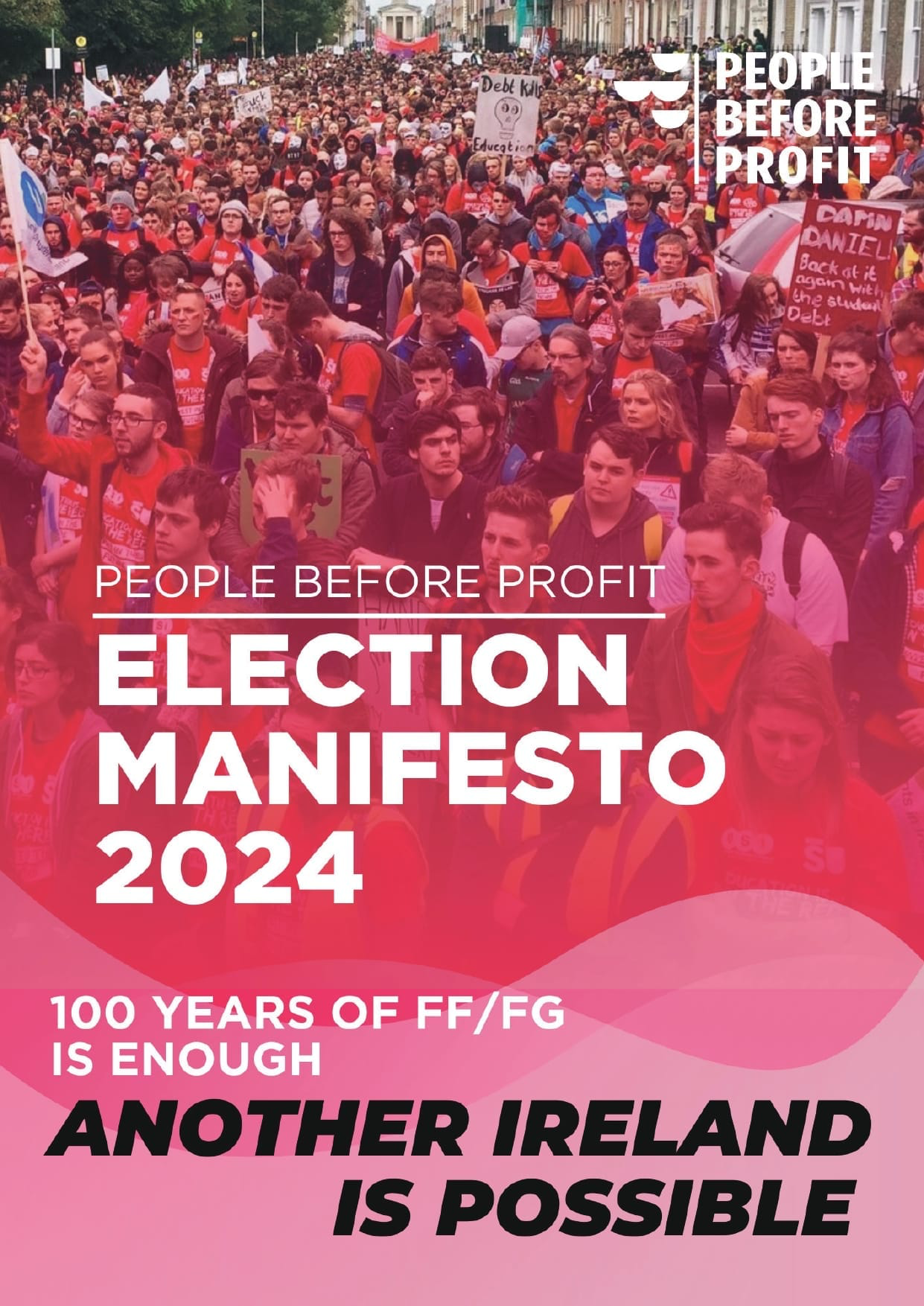
The substitution of ‘the people’ for the working class as the subject of struggle is presented In Ireland, in an almost classic case, by the People before Profit organisation, whose reformist politics are based on actions demanded from the Irish capitalist state. While ‘people’ are to come ‘before profit’, ‘people’ replaces the working class, while coming before profit still leaves profit in place. And anyway, aren’t capitalists people as well?
This precept fails to bring to the fore the ‘property question’, demanded by Marx in the Communist Manifesto, whereby the profit of capital arising from exploitation of the working class is not de-prioritised but abolished!
It might be argued ‘what’s in a name’, were it not for the fact that the name was deliberated on and selected precisely in order to avoid clearer identification with the working class and socialism. Presumably because reference to ‘the people’ is more readily acceptable; postponing the task of raising awareness of the paramount role of class and denying the centrality previously accorded to it by anyone calling themselves Marxist. In asserting the priority of the people, and so rejecting the primacy of class, the organisation is setting an example to be followed, not one to be excused or ignored.
Failure to root socialist politics in the material reality of the working class leaves it rootless and prey to the material reality of other forces – we have already pointed to the role of the state in the political alternative offered by People before Profit – but the ideologies encompassing this are many. Nationalism and racism require denial of the separate political interests of the working class – socialism is international while racism denies working class unity. It is precisely class interest that is the alternative to these reactionary programmes, not acceptance of the prior interests of an undifferentiated people.
It is possible to fill this missing foundation with moral claims to ‘humanity’ which bases internationalism on ‘human rights’; the ‘self-determination of (capitalist) states’, or protection of minorities based simply on their being a minority. Similarly, it is possible to oppose racism based on human rights, ‘diversity’, ‘inclusion’ and opposition to ‘hate’, but these are even more vague and useless than the concept of ‘the people’. Their employment by many on the left, tellingly often paraded under the banner of a ‘social justice’ movement, is testament to a collapse into liberal (i.e. bourgeois) politics compared to which the 19th century republicanism we have been examining in the previous posts looks positively revolutionary.
If class is not primary and immediately necessary in order to take forward a movement and programme what is opened up is the intrusion of a wide variety of identity politics that makes nationality, race, or sex etc. the primary means of securing freedom from oppression. This in turn can lead to ‘intersectional’ coalitions that further divide while pretending to unify.
It leads to rejection of the view that the working class is the only social force able to create a new society and which alone can unite the oppressed through the abolition of class. It thereby simply becomes one segment of society with no reason to prioritise its role more than any other. Petty bourgeois ideas of individual subjective identity flourish where the nebulous abstraction of ‘people’ becomes the source of power to change the world. With this view of politics the numerous instantiations of the people come to substitute for the working class, which in turn leads to the search for a mechanism for them to do so, and which is invariably found to be the state.
In 1849 Marx criticised the naive belief in a single “will of the entire people” rather than that of a singular ruling class (or grouping of classes) that might represent its own interest as that of society as a whole, or at least of its large majority:
‘For the National-Zeitung there exists one will of the entire people, which is not the sum of contradictory wills but a united and fixed will. How is that?
That is—the will of the majority.
And what is the will of the majority?
It is the will which emerges out of the interests, life situation, and conditions of existence of the majority.
In order to have one and the same will, the members of the majority must therefore have the same interests, the same life situation, the same conditions of existence, or must be temporarily linked together in their interests, their life situation, their conditions of existence.
In plain words: the will of the people, the will of the majority, is not the will of separate estates and classes but of one single class, and of those classes and fragments of classes that are socially—i.e., industrially and commercially—subordinated to this ruling class.
“What should we say to that?” Is the will of the entire people the will of the ruling class?’
(Marx, Marx and Engels Collected Works Vol 8 p272, Articles from the Neue Rheinische Zeitung)
Marx, in The Civil War in France, noted that the Paris Commune ‘was the first revolution in which the working class was openly acknowledged as the only class capable of social initiative, even by the great bulk of the Paris middle class—shopkeepers, tradesmen, merchants—the wealthy capitalists alone excepted. The Commune had saved them by a sagacious settlement of that ever-recurring cause of dispute among the middle classes themselves—the debtor and creditor accounts.’
It was necessary then (as it is now) for the working class to be the ‘universal’ class and to represent the needs of a society oppressed by the prevailing system: ‘For the first time in history the petty and moyenne middle class has openly rallied round the workmen’s Revolution, and proclaimed it as the only means of their own salvation and that of France!.’ (Marx, The Civil War in France, Marx and Engels Collected Works Vol. 22 p336 & 496)
This was not something that Marx learned only from the Commune but was something strikingly demonstrated by it, particularly the need to win the majority of the population that was then composed of peasants. How this need is addressed today depends on the particular class composition of society, but this requires that the idea of a unified people is abandoned and the various classes and their interests identified. In relation to the peasantry, for example, it did not mean strengthening or enlarging their individual property, while a programme based on the demands of ‘the people’ would leave this wide open.
In the writings through which he and Engels formulated their particular politics, The German Ideology, he argued that ‘For each new class which puts itself in the place of one ruling before it, is compelled, merely in order to carry through its aim, to represent its interest as the common interest of all the members of society, that is, expressed in ideal form: it has to give its ideas the form of universality, and represent them as the only rational, universally valid ones.’ For the working class, this is realised through the abolition of all classes, including itself.
Marx identified this early in his political development (in 1843) before becoming a ‘Marxist’ and expressed himself in the language of the philosophy of the time: ‘No class of civil society can play this role without arousing a moment of enthusiasm in itself and in the masses, a moment in which it fraternises and merges with society in general, becomes confused with it and is perceived and acknowledged as its general representative, a moment in which its claims and rights are truly the claims and rights of society itself, a moment in which it is truly the social head and the social heart.’ (Marx, Introduction to A Contribution to the Critique of Hegel’s Philosophy of Right)
For this to happen the working class must win others as allies to its programme. This can only be done if, in the words of The Communist Manifesto, socialists ‘disdain to conceal their views and aims.’ It will not be done by pretending that its views are those of an amorphous ‘people’. You can only rally others to your flag if it is your flag.
Republicanism and Communism differed on the nature of the revolution that was required and so disagreed on the social force that would accomplish it. For the former it was ‘the people’ and for the latter the ‘proletarians of all countries’, which should ‘unite.’
Republicans accused communists of “ignoring the rest of humanity” while they viewed the people as the non-elite sections of the population, which may or may not have included the capitalist class, depending on the particular republican view. Karl Heinzen, for example, did not see the new bourgeoisie as the enemy.
Marx argued that “The people . . . was a vague expression” to be replaced “by a definite one, the proletariat . . .” The attempt to use the former combined various classes with an assumed common interest so that any separation within them was an unwarranted division that set back their common interests.
Even were a “privileged class” identified such a view failed to identify the different interests of the ‘non-privileged’ classes as if they had common class interests, including, for example, the working class, independent artisans, peasants and other petty bourgeois classes.
Only an identification of class and their associated interests could specify their material interests that might unite them or divide them. Such an analysis was inevitable as soon as one identified the particular class interest of the “privileged class”, which might prove to be varied – feudal princes or modern capitalists for example – which would then identify the subordinate class(es) they oppressed and exploited. Talk of “the people’ obscured the interests of all classes, particularly the subordinate ones, and most importantly for the creation of a new society, concealed or blurred the interests of the working class.
Marx argued that failure to identify the separate interests of the different classes making up “the people” resulted in a false understanding of contemporary political realities. So, in the elections to the French Constituent National Assembly in 1848 the republicans’ “imaginary people” were replaced by the “real people” the majority of whom voted for the candidates of the anti-republicans and elected the representatives of the bourgeoisie and landowners.
‘Accordingly, when a struggle is impending, they do not need to examine the interests and positions of the different classes. They do not need to weigh their own resources too critically. They have merely to give the signal and the people, with all its inexhaustible resources, will fall upon the oppressors.’ (Marx in Marx and Engels Collected Works Vol 11 p 65)
In the event of defeat ‘then either the fault lies with pernicious sophists, who split the indivisible people into different hostile camps, or the army was too brutalised and blinded to comprehend that the pure aims of democracy are also the best thing for it, or the whole thing has been wrecked by a detail in its execution, or else an unforeseen accident has this time spoilt the game. In any case, the democrat comes out of the most disgraceful defeat just as immaculate as he was innocent when he went into it, with the newly-won conviction that he is bound to win, not that he himself and his party have to give up the old standpoint, but, on the contrary, that conditions have to ripen to suit him.’ (Marx in Marx and Engels Collected Works Vol 11 p 65-66)
Politics based on the purported interests of ‘the people’ create imaginary interests that are not shared. Marx gives the example in France of its famous fraternité, which in the 1848 revolution ‘found its true, unadulterated and prosaic expression in civil war, civil war in its most terrible aspect, the war of labour against capital.’ (Marx in Marx and Engels Collected Works Vol 7 p 147)
Marx accused the republican, Karl Heinzen, of invoking the solemn concept of ‘humanity’ to distract from the fact that while individuals may adopt a position that does not accord with their class position, this cannot be true of ‘whole classes which are based on economic conditions independent of their own will.’ (Marx in Marx and Engels Collected Works Vol 6 p 330)
The result is to deny the reality of class struggle, which has the result not of abolishing it but of confirming the interest of the bourgeoisie. In 1850 Marx and Engels wrote that:
‘The struggles of the various classes and factions of the classes against each other, whose progress through their individual stages of development actually constitutes the revolution, are in the view of our evangelists only the unfortunate consequences of the existence of divergent systems, whilst in reality the reverse is true, the existence of various systems is the consequence of the existence of the class struggles. This itself shows that the authors of the manifesto deny the existence of the class struggles. Under the pretext of combating dogmatists, they do away with all specific content, every specific party point of view, and forbid the individual classes to formulate their interests and demands vis-à-vis the other classes. They expect them to forget their conflicting interests and to become reconciled under the flag of a vagueness as shallow as it is unblushing, which only conceals beneath the apparent reconciliation of all party interests the domination of the interest of one party—the bourgeois party.’ (Marx in Marx and Engels Collected Works Vol 10 p 530)
Concepts such as ‘the people’ are unable to identify the specific interest of classes and are very rarely appropriate terms of analysis. Their use usually denotes a false unity of interest behind which lies the interests of the capitalist class. This can also appear credible because the social system, the dominant mode of production, aligns with the interest of the dominant class. So, the claim to represent or act in the interests of the people is also the primary ideological justification of the capitalist state.
The concept of the people is incapable of exposing the claims of the state to act on behalf of the people because it rejects the separate interest of the working class. At most it permits the view that the state is imperfectly or unsatisfactorily acting on behalf of the people but that it can be made to act in a way that remedies this. This is the basis for the view that the state can reform the social system in such a way as to truly implement the interests of ‘the people’ and therefore that the state itself can be made to carry this out by reforming itself. It is what Marxist call reformism, which denies that a replacement of capitalism and its state is necessary or possible.
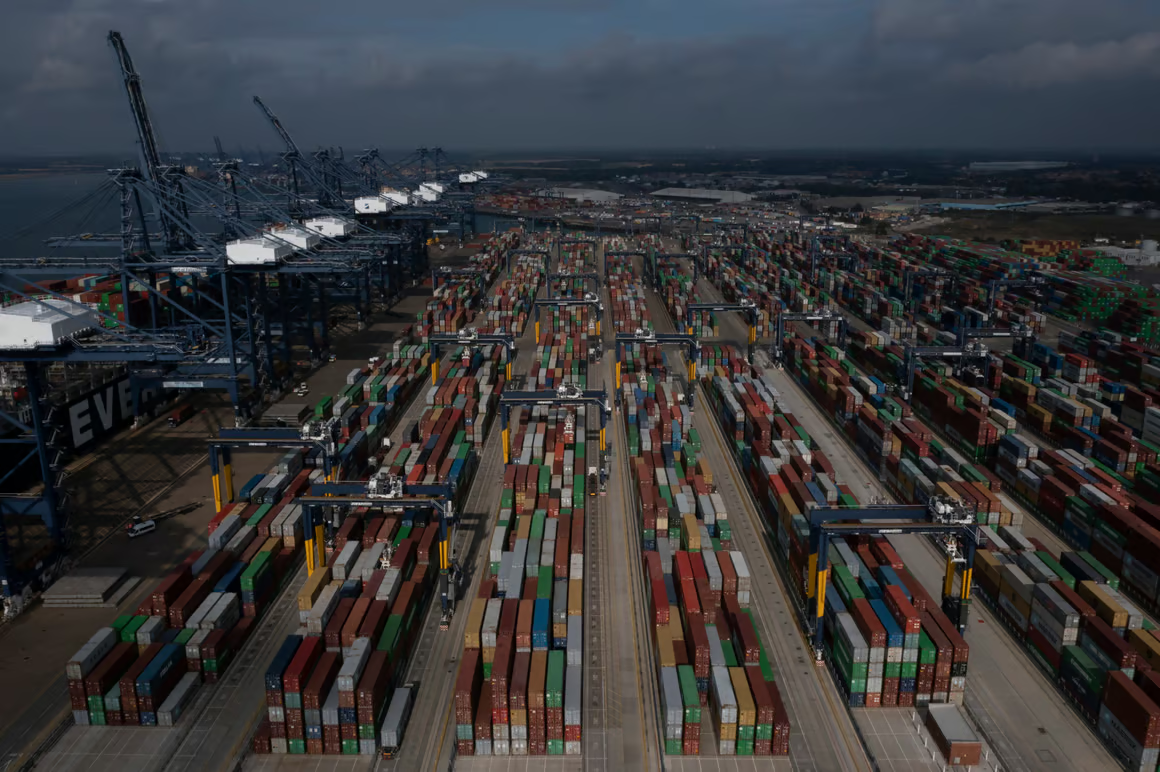
Containers sit on the tarmac at Felixstowe Port | Dan Kitwood/Getty Images
At the end of a lecture to workers in Brussels written in 1847, Karl Marx stated that:
‘Before we conclude, let us draw attention to the positive aspect of wage labour . . . I do not need to explain to you in detail how without these production relations neither the means of production—the material means for the emancipation of the proletariat and the foundation of a new society—would have been created, nor would the proletariat itself have taken to the unification and development through which it is really capable of revolutionising the old society and itself.’
(Marx, “Wages”, Marx and Engels Collected Works, vol. 6, p 436.)
For him, capitalism had already so revolutionised society that it provided the conditions for the creation of a new one and the means to achieve the emancipation of the working class – ‘material conditions . . . that could be produced by the impending bourgeois epoch alone’ (Marx and Engels, Manifesto of the Communist Party. Collected Works, vol. 6, p 514)
Today, one very rarely reads a positive analysis of material conditions for working class emancipation created by capitalism, even though these have massively developed since Marx wrote these words, when they were really only becoming evident in one country and were too undeveloped even then. They provide the most striking proof of the potential for the development of socialism out of present society. In many respects however they are no longer recognised as such and rarely considered; in other respects they are rejected, but we will come to that later.
In Volume I of Capital Marx describes the creation of these conditions:
‘As soon as this process of transformation has sufficiently decomposed the old society from top to bottom, as soon as the labourers are turned into proletarians, their means of labour into capital, as soon as the capitalist mode of production stands on its own feet, then the further socialisation of labour and further transformation of the land and other means of production into socially exploited and, therefore, common means of production, as well as the further expropriation of private proprietors, takes a new form.’
‘That which is now to be expropriated is no longer the labourer working for himself, but the capitalist exploiting many labourers. This expropriation is accomplished by the action of the immanent laws of capitalistic production itself, by the centralisation of capital. One capitalist always kills many.’
‘Hand in hand with this centralisation, or this expropriation of many capitalists by few, develop, on an ever-extending scale, the co-operative form of the labour process, the conscious technical application of science, the methodical cultivation of the soil, the transformation of the instruments of labour into instruments of labour only usable in common, the economising of all means of production by their use as means of production of combined, socialised labour, the entanglement of all peoples in the net of the world market, and with this, the international character of the capitalistic regime.’ (Marx, Capital Volume I p929)
In earlier posts on Marx’s alternative to capitalism we outlined many of these and how the contradictions within this development, including that between the forces and relations of production, would lead to social revolution. We outlined the increasing socialisation of production through the colossal expansion of capitalism across the world, turning more and more activities into commodities to be sold for profit, through a massive increase in the division of labour – within and between workplaces – that involves the the creation and enabling of new, previously undreamed of, technologies.
This massive ‘development of the forces of production is the historical task and justification of capital. This is just the way in which it unconsciously creates the material requirement of a higher mode of production.’ (Capital Volume 3 p 181)
This is elaborated in the Grundrisse:
‘The great historic quality of capital is to create this surplus labour, superfluous labour from the standpoint of mere use value, mere subsistence; and its historic destiny is fulfilled as soon as, on one side, there has been such a development of needs that surplus labour above and beyond necessity has itself become a general need arising out of individual needs themselves – and, on the other side, when the severe discipline of capital, acting on succeeding generations, has developed general industriousness as the general property of the new species – and, finally, when the development of the productive powers of labour, which capital incessantly whips onward with its unlimited mania for wealth, and of the sole conditions in which this mania can be realized, have flourished to the stage where the possession and preservation of general wealth require a lesser labour time of society as a whole, and where the labouring society relates scientifically to the process of its progressive reproduction, its reproduction in a constantly greater abundance; hence where labour in which a human being does what a thing could do has ceased.’
‘Capital’s ceaseless striving towards the general form of wealth drives labour beyond the limits of its natural paltriness, and thus creates the material elements for the development of the rich individuality which is as all-sided in its production as in its consumption, and whose labour also therefore appears no longer as labour, but as the full development of activity itself, in which natural necessity in its direct form has disappeared; because a historically created need has taken the place of the natural one. This is why capital is productive; i.e. an essential relation for the development of the social productive forces. It ceases to exist as such only where the development of these productive forces themselves encounters its barrier in capital itself.’ (Marx, Grundrisse p 409-410)
The passages above, which might appear difficult – the first paragraph is comprised of only one sentence! – demonstrates capitalism’s contradictions, with its laying of the foundation for its supersession. So, the drive for capitalism to ever greater exploitation of workers – by their giving up more and more of their time labouring for the capitalist that is not recompensed in wages – is indeed their intensified exploitation. However, this very development of production, beyond what is required to simply maintain the working class at some minimum level of existence, expands productive powers in such a way that greater and higher needs can be satisfied – of course for the benefit of the capitalist class initially and to the utmost extent – but also increasingly for workers by increasing what they can consume; in their whole mode of living, and how they can further their personal interests and development. Above all, this expansion can allow this development by potentially reducing the time necessary for work, permitting time to take part in the running of society while also pursuing other collective and individual interests. The massive increase in the productivity of labour forced by capital in ruthless competition can be turned from a means of capitalist exploitation to working class emancipation.
Capitalist expansion of exploitation is ceaseless because it seeks the accumulation of wealth in the form of money, for which there is no limit, but at the same time must do this in the form of the creation of real objects and services which address genuine needs, even if capitalist society distorts and degrades their development and expression. The potential freedom from want, insecurity, inequality and from the subordination of everyone subject to the imperatives of capitalist accumulation, is the foundation for the belief that the ending of the class system will herald the end of all social domination and oppression.
The capitalist has only a ‘transitory existence implied in the transitory necessity for the capitalist mode of production’ who ‘ruthlessly forces the human race to produce for production’s sake; he thus forces the development of the productive powers of society, and creates those material conditions, which alone can form the real basis of a higher form of society, a society in which the full and free development of every individual forms the ruling principle.’ (Marx Capital Volume 1 p 739)
Consequently, ‘from the moment that the bourgeois mode of production and the conditions of production and distribution which correspond to it are recognised as historical, the delusion of regarding them as natural laws of production vanishes and the prospect opens up of a new society, [a new] economic formation of society, to which the bourgeois mode of production is only the transition.’ (Marx, Theories of Surplus `value MECW Vo 33 p 346.) Capitalism is therefore just a transitional phase in the evolution of human society and its development of productive powers through which it shapes itself and its environment.
* * *
This post is the continuation of a series, the previous one of which is linked here, and the first of which can be found here.


 Sráid Marx