Left reaction to the ‘discovery’ that a woman is an adult human female (4) – questions and answers

Of all the misconceptions and egregious nonsense in the responses of the left to the UK supreme court judgment the most irrational I have seen comes from the Fourth International and its British organisation Anti-Capitalist Resistance.

The former asks a number of questions as if these on their own expose the falsehood of the court decision but which really require only straight forward answers from anyone not immersed in gender identity ideology.

“What of the practical impacts that this ruling will have on cis women?” it asks.

The impacts are that single sex spaces will be open only to women and exclude men.  This means no men in women’s prisons, no men in women’s refuges, and no men in women’s sports etc.  Something taken for granted in the previous century during which no one was claiming that this involved women’s oppression – quite the reverse.

“What do we tell our young women when we say, ‘a woman is only biological sex’, that a man is also only biological sex?” 

Who is claiming that any woman or man is only a biological woman or biological man regardless of their other qualities, experiences and achievements?  What Marxists affirm is that, just like the assumption in the question itself, humanity is made up of women and men, and most will know that the distinction between them arises solely from their biological difference.

This reality does not at all mean, as this organisation seems to claim, “that because of a man’s biological sex, he is right to partake in oppressive structures of male hierarchy? That his desire to rape and sexually assault women is justified because of his biology?”  The biology of men does not mean that “oppressive structures” and “desires” are inevitable and if the Fourth International thinks the biological reality of humanity necessitates such structures, how then is it going to negate this biological reality and destroy these structures?

Does it think that gender identity is the answer to such ‘structures and desires?’  Does it seek to compel or convince everyone to adopt a gender identity that dispenses with their knowledge of their biological nature?  Would this not be an admission that it is they who wish to narrow young women and men’s understanding of themselves to a ‘gender identity’ that many reject they even have?

Anti-Capitalist Resistance states that trans “existence directly challenges the social order, which is structured by gendered power relations”, but fails to explain how identifying as the opposite sex (regardless of what that really means) actually changes “gendered power relations”, unless the gendered identities adopted are not those of real existing men and women that it currently argues constitute these “oppressive structures.” In other words, in their world in which sex is unimportant, but gender is decisive and in which we still have gender oppression, how will such oppression be ended simply by some (or all) identifying as the other (irrelevant!) sex?  Unless, that is, transmen aren’t actually identifying as men with all their claimed oppressive desires and transwomen aren’t really identifying as women with all their experience of oppressive structures.

Anti-Capitalist Resistance further claims that feminism seeks to overcome the view “that biology is destiny”, but only the adherents of gender identity ideology are arguing that biology is destiny, which is why they attempt the false claim that it can be dismissed.

Biology isn’t destiny in the way they claim – that it necessarily involves social oppression – but it is reality.  Biology is reality and if biology is physically and socially unimportant why does gender identity ideology base itself on being able to identify into the other sex with whatever physical changes that an individual believes they can make (with or without medical and surgical intervention)?

If these ideologists really want to stick to the claim that biology is not destiny I have an additional concept for them – death.

This organisation further claims that feminism opposes ideas “that bodily autonomy is socially dangerous” and “that organising social reproductive work on gendered lines is “natural”.  Yet the foundation of human reproduction is biological – one hundred percent of people reading this blog will be born to a woman.  The claim to autonomy is meant to evoke the rights of women to abortion but this autonomy – this independence and freedom – refers to the right to choose, which then requires the recognition by others for its effective exercise.  Trans people, as autonomous individuals, can think of themselves in any way they like but they cannot by this alone compel the world to accept their view of themselves and act upon it without violating everyone else’s right to the same autonomy. 

The Fourth International asks some more straight forward questions even more simply answered.

“How do you balance sex characteristics with gender reassignment characteristics?”  – Since these are separate characteristics, no balancing is required, the latter does not alter the essential nature of the former. 

“How do you prove sex discrimination when you are not recognized as that sex?”  – You can’t.

The Fourth International states that without this ideology we would have “an absurd ahistorical view of the working class as a homogenised lump that apparently never had gender queer people, or gay people or drag queens among its ranks.”  It sticks out a mile that women are absent from the list but yet another category of men pretending to be women is included.  That the history of the Marxist movement, going back to the man himself, has recognised the special oppression of women, and sought their organisation, is lost.  Instead, we have the truly ahistorical view of the working class in which we have something called ‘cis women’, and trans women whose very existence somehow “directly challenges the social order.”

For a Marxist the issue is also the claim that “There will be no revolution without trans liberation!”  Except, if this were true it would require the erasure of the female sex as a separate part (half!!) of humanity with all their specific oppression and need to organise.  It would also require abandoning any critical thought, with acceptance of the claim that ‘transwomen are women’ with no debate allowed over what are palpably untrue claims because of hyperbolic rhetoric and juvenile name calling.

Marx once said that ‘the philosophers have only interpreted the world, in various ways; the point is to change it.’  The left supporters of gender identity ideology think they can change it by reinterpretation but since the real world is a stubborn thing it cannot be changed by declaration, and it cannot even be reinterpreted by incantation of inane slogans or without debate.  The attempt to silence opposition by naming the gender critical left as ‘fascist’ or ‘transphobic’ is another illustration of denying reality and attempt to close down challenges to its imagined world of changing sex and many genders.

The demonisation of opponents however is only a device to buttress a position already acquired because adherents have accepted that gender identity ideology is ‘progressive’; to stand against it would see individuals also stand against those they would normally stand beside.  Support for the ideology no longer depends on rational argument because it is simply considered to be the ‘left wing’ position; it is left wing because I/she/he/we are left wing and therefore so must it.  It is circular reasoning, and a form of identity politics inoculated from reality by a form of solipsism.  The exploitation of their mistake by the right is then held aloft as ‘proof’ of their position’s left credentials.

The phenomenon of a political position being held up as left wing because so much of the left supports it has been seen before; as previously much of the left capitulated to Scottish nationalism and is now capitulating to western imperialism through support for Ukraine, both of which are their unlikely candidates as beacons of ‘democracy’ for the world.

It’s a case of political gangrene that occurs ‘as a result of an injury, infection or a long-term condition that affects blood circulation’.  The defeats of the working class and its movement are the injury; the infection is petty bourgeois politics, and these long term factors have affected the circulation of critical thought and Marxism.

Concluded

Back to part 3
Left reaction to the ‘discovery’ that a woman is an adult human female (3) –  a far-right victory?

Alex Callinicos from the Socialist Workers Party writes that the ‘latest attack on trans people in Britain is part of a global offensive driven by the far right.’  Having created the narrative that only the far right opposes gender identity ideology he starts off his attack on the supreme court decision by claiming that For Women Scotland is a far right movement!  I suppose if your whole position rests on a refusal to recognise reality you find it easier to just keep on going.  Where would the gender identity left be without the claim that the recognition of the reality of being a woman is a far right programme? 

But this is just the first fiction in what is a very short article.  The most amusing is when Callinicos states that ‘Judith Butler puts it very well’! – apparently when she says that the transphobes seek “the restoration of a patriarchal dream-order”.  So, the erasure of the separate identity and reality of women, with all their rights and claims, by men is a strike against patriarchy!

The most becoming fiction for a professor who has written many books on Marxism is the following slippery circumlocution: 

‘The intellectual core of Marxism is historical materialism. It doesn’t in the slightest ignore our variable biological constitution but integrates this into the broader historical process through which human beings form and are formed by their societies.”

This involves a reference to a Marxist term, including the word “materialism”, followed by a sentence that doesn’t have the courage to say what it means – that men can become, or already are, women.  So instead, we are to swallow that our biology is “variable” and we are integrated into history and “formed” by it.  All very true, except our biology is not so variable that it means men are or can become women, or is it the case that “the broader historical process” has or can (trans)form men into women.

It is not necessary to believe that “women’s oppression” can be “reduced . .  to biology” to recognise that it is biology that makes women separate from men (and vice versa) in the first place.  Without these biological differences there would not exist the grounds upon which oppression could be built.  Women’s liberation will not remove biological differences, but Callinicos presents a view that oppression can exist without them.

His article is testament to Brandolini’s law that the amount of energy (and words) needed to refute bullshit is an order of magnitude bigger than that needed to produce it. He repeats, for example, the nonsense that the supreme court decision fails to bring “clarity and confidence.”  He has both forgotten the previous ease by which men and women could find the appropriate facilities, such as toilets, while also forgetting about the confidence the ruling gives women who might enter a facility to find a man who may or may not be trans (since she cannot read minds) and may be apprehensive about their presence whether trans or not.

As I mentioned in the first post, the rights of women are invisible to the left that adheres to gender identity ideology.  Even if every woman somehow identified as a man, they would still be prey to sexual assault, still experience childbearing and still face sexism despite some new name for it having to be invented.  Whatever new name would need to reflect reality and to exclude men identifying as women since they would not experience it.  But then, even this would be seen by the gender identity movement as discriminatory and lessening the ‘womanhood’ of transwomen. 

In an example of a recurring characteristic of the movement – that the allegations of gender identity ideology are actually admissions, Callinicos argues that “the far-right drive against “gender ideology” is aimed at reinstating the traditional heteronormative family.’” This charge is one he would presumably level at everyone who denies the veracity of gender identity ideology, including socialists who recognise the centrality of human biology to human existence and potential.  In fact, this argument against heteronormativity rebounds on the supporters of gender identity ideology.

In so far as the term has any positive content – that it privileges heterosexuality by denigrating same sex attraction – it is gender identity ideology that turns sexual stereotypes into the measure of humanity through self-identification and through, for example, permitting men identifying as women to claim to be lesbians.  In effect, same sex attraction is abolished to the extent that sex is rendered irrelevant or subsidiary to gender identity.

In a final example, he claims that “supporting trans+ liberation therefore has nothing to do with “identity politics”.  As I noted before, if gender identity ideology, self-identification, and men becoming women by identifying as one is not identity politics, nothing is.

Back to part 2

Forward to part 4

Left reaction to the ‘discovery’ that a woman is an adult human female (2) – the ‘usurpation of Parliament’

After accounting for all the explanations for the success of gender identity ideology on the left – opportunism, moralistic politics, petty bourgeois influences etc. – it is still difficult to fully comprehend its success.  It is one thing to make a mistake and to find it uncomfortable to reconsider and change one’s view, partly because of the censorious culture of tans activism summed up in the demand “no debate.”  It is quite another to come out with the nonsense polemics that characterise the attempts to defend it.

It invites the thought that if some left groups can justify this (including to themselves) they can justify anything.  Mistakes are common, refusing to learn from them is fatal, and the series of factors that are explanations for the mistake are revealed as permanently conditioning.

If we look at some of the reactions to the UK supreme court decision, we can see evidence of gender critical feminists’ repeated observation that for some, contact with this issue seems to turn their brains to mush.

One ideologue of the British Weekly Worker made a presentation in opposition to the supreme court decision in which he essentially says that the court usurped the prerogatives of parliament when it interpreted the meaning of sex in biological terms, in effect re-interpreting the conscious decision of parliament when it passed the 2004 Gender Recognition Act.  Sex, in legislation, has different meanings depending on its purpose and does not require a single ‘coherent’ definition as argued by the supreme court, or so he says.

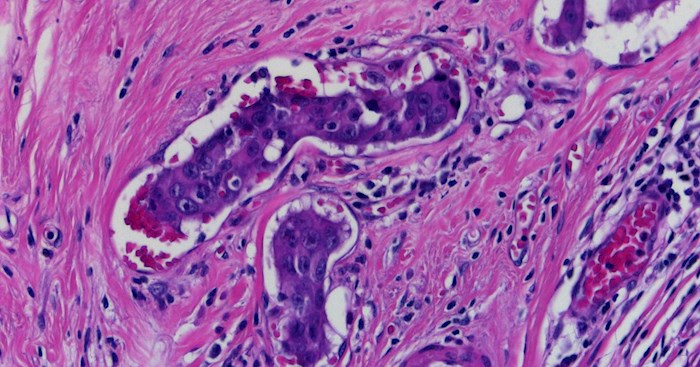
While he recognises sex as biology, for example in relation to the difference in the incidence of breast cancer in men compared to women, and in women compared to men in prostate cancer (in women’s Skene’s glands), he disagrees that sex is defined by biology or that there are only two sexes. In justification he points to intersex people, ignoring that differences/disorders in sexual development (DSDs) are a biological phenomenon and people with DSDs are either male or female and not a third sex.

He also fails to notice that intersex is irrelevant to the issue because no one is self-identifying as intersex but as a woman or man; even as they deny the biological nature of these terms men identifying as women fetishise elements of female biology.  It cannot be escaped that to identify as a woman is to identify with their biological character, often in stereotypes of secondary sex characteristics; through delusional ‘experience’ of menstruation or menopause, or artificially replicating female functions such as breast feeding.

He is left with the problem of justifying self-identification with any of the other innumerable genders invented by the ideology, which can only have one ‘definition’, and it isn’t biological sex.  What purposes are these to be legitimately legislated for, and if none, what does this imply for the validity of gender self-identification in toto?

In relation to the question of usurpation of parliament by the reinterpretation of the meaning of sex, he ridicules the view that the word ‘sex’ can be subject to interpretation based on its ‘ordinary meaning’.  He claims that this leads only to an “arbitrary and unsatisfactory decision” (a “dodgy” decision) and is precisely what is to be decided, not assumed. 

It is, however, the case that the word ’sex’ does have an ordinary meaning and that it would be extraordinary that it should have a another one so radically different yet dependent and parasitic upon it. Given, on top of this, the novelty of self-identification as a route to defining a woman, and that it would therefore have an unstable meaning such that it could include men as a particular sort of women – a transwoman – it is difficult to claim that an interpretation based on the age-old ordinary meaning is “arbitrary” or “dodgy”, even if supporters of gender identity ideology think it is “unsatisfactory.”

In this case “unsatisfactory” pertains to the consequences of the decision, which involves the surrendering of claims by men so as to be able to assert the rights of women.  The problem the gender identity left has is that the latter is invisible because they have accepted the invisible justifications of the claims of certain men.

As for the integrity of parliament and the rigour and cogency of its decisions! Backbenchers of the Government will generally vote whatever way is in the interests of their career, which is with the government.  Whatever they thought they were doing with the concept (and real world consequences) of “sex”, I don’t recall any mandate for changing it in 2004.  As for today’s argument, it would appear that even the Labour Party’s ‘LGBTQ+’ MPs are not keen to proclaim that transwomen really are women.

The exceedingly legalistic lecture gives the impression of hitting the target of the supreme court adjudication but missing the political point.  It is argued that the reasoning employed by the court is appropriate only for a parliament when what needs to concern him is not the integrity of the division of powers in the British state – the executive branch breaks the law every day – but what reasoning should be applied to what purpose by the working class to determine its own principled position.

How does it benefit the working class for half its membership to accept that their history of oppression and continuing disadvantage in multiple spheres of life – arising from their existence as the distinct female part of humanity – is to be erased by a group of men claiming a special oppression through claims to their membership?  How are men and women to unite to rid themselves of the sexual oppression that exists if ‘for some purposes’ this sexual division doesn’t exist, ceasing to exist by the simple declaration of men?  There is no liberation to be found in men colonising the existence of women.

Back to part 1

Forward to part 3

Left reaction to the ‘discovery’ that a woman is an adult human female (1)

Reactions to the decision of the UK supreme Court in Britain can be put into two camps; those that dealt with the case decided – what is a woman – and therefore about the rights of women, and those for whom it is really about trans.  The media generally took the latter approach while the government has been compelled, simply because it is the government and is responsible for acting on the actual decision, to take up the former.

Reactions among the defenders of gender identity ideology, whether they see themselves in this way or not, made various claims – that this was a terrible threat to trans people, with the hyperbole everyone is long used to; that nothing had really changed and transwomen would be permitted to access women’s single sex spaces on a sort of case by case basis; or that trans activists would ‘break the boundaries’ and just access them as they saw fit.  There were also very learned claims from legal figures that the judges had gotten the law wrong.  For some, they were bigots and transphobes.

None of these will succeed.  The law has changed, attempts to pretend it hasn’t won’t cut it, and moves to challenge it will be more difficult than defending their previous claims.1 The demonstrations will not achieve their demands because the prior success of gender identity ideology did not lie in mass public support but on widespread ignorance and policy capture of state and private bureaucracies by trans activists.

The demonstrations have a limited appeal and exhibit too much anger and aggressiveness, with too much misogynistic and fetishist behaviour to win any friends, although all these appear to be completely invisible to their self-identified left supporters.  The ideology does not fare well in open debate, which is why the mantra ‘no debate’ was more than a choice by trans activists.  The movement demanded that its claims be swallowed whole, and while some supporters now admit that this was a mistake, claiming the untrue and impossible, alongside a catalogue of male entitlements, means it has no internal dynamic for restraint.  Hence the ridiculous hyperbole that heightens fear in the most vulnerable people within its own ranks.  The movement offers less than nothing to many of its own supporters.

The widespread claim that the court’s judgement was flawed because it didn’t hear from trans people ignores the failure of the multiple trans lobby groups to openly argue their case, again not a glitch  The legal representatives of the Scottish Government and Amnesty International put it for them and they failed, the whole process was not inferior to the one that put the ideology into law in the first place.

The Labour Government and SNP have had their fingerprints all over the imposition of gender identity ideology and now hope that the whole issue will subside.  Their opportunism involved complete disregard for women’s rights, while appearing completely unaware that this was what they were doing.

The state bureaucrats responsible for HR policies in their organisations will therefore also be keen not to embarrass their political masters or expose their own position. They may be expected to generally implement the decision of the court while delaying where they can and doing as little as they can get away with .  This will not prevent gender identity activists continuing to push men into women’s and girls’ spaces but the road to stopping them is clear.  

This process can be expected to be repeated more or less in the north of Ireland where, of the two governing parties, the DUP is opposed to the ideology in principle and Sinn Fein doesn’t have any.  The media will be under pressure to drop its reverence for the ideology and is already under more obligation to acknowledge the opposition to it. In the Irish State, liberal and left opinion is even more wedded to it and the movement opposing it is weaker.  The façade of Irish liberalism faces increasing economic and political threats from Trump and the growth of anti-immigrant movements – fanned by the governing parties – so the right is therefore in a much better place to take the lead in opposing the ideology, facilitated by the stupidity of the left in defending it.

This left should consider the media spotlight thrown on certain British Green politicians who have embarrassed themselves in attempts to oppose the court judgement.  It has generally tail ended the most radical trans movement and thus swallowed whole and complete its demands, partly from the same opportunism as the main parties and partly from the moralistic character of its politics, where emotive claims to oppression substitute for argument and the politics of subjective identity substitutes for material reality.  

This is the politics of the petty bourgeoisie, which can come in either right or left variants. For those on the left, progressive politics arises from oppression (real or perceived) and not from the social and political power of the working class with its potential to create a new society as an alternative to capitalism.  This politics can go no further than seeking equality under capitalism and amelioration of the worst social conditions.

In the case of the Irish left in particular, it reflects their de facto accommodation with the trade union leadership and increasing deference to NGOs and their liberal progressivism.  It’s why the gender identity left are blind to the real nature of gender ideology and the reactionary manifestations of it in public demonstrations. It is why it is claimed that this identity ideology and its policy of gender self-identification, by men who claim to be women because they ‘identify’ as one, is not a form of identity politics!

1 Technically the law hasn’t changed and a woman has always been legally an adult human female. However the effect of the judgement is to make this clear and therefore, among other things, provides a robust legal route to defend single sex spaces or rights on the basis of women understood in this sense.

Forward to part 2

UK Supreme Court decides a woman is an adult human female

Although this is how the decision of the supreme court has been interpreted, the actual decision is the narrower one of what the GB Equality Act (EA) of 2010 means by ‘sex’, which it has decided means biological and not certified sex.  It has therefore been hailed by ‘gender critical’ activists as a victory for common sense and by certain trans activists as an attack on their human rights.

An alternative potential judgment – that the term ‘sex’ and thus sex itself – is determined by a certificate demonstrates how bizarre an alternative decision would have been.  In effect, it would mean one’s sex as far as the state is concerned was determined through its award of a certificate.  This would not have represented the continuation of the status quo, with the advances already achieved by the gender identity movement, but would have provided the grounds for a further attack on the rights of women, and then men.  If sex was certified, what obstacle would exist to certification being required?

The judgement of the court dealt with the problem of pretending that there were two types of women with all the incoherence that this would involve. Anyone from the left lamenting the judgment, and state interference in matters that do not belong to it, should consider how we got to this position through gender recognition certificates and how the scope for its massive inflation would have been prepared by the alternative decision some seem to have wanted.

The court ruled that ‘Any other interpretation would render the EA 2010 incoherent and impracticable to operate’, and rejected ‘the suggestion . . . that the words can bear a variable meaning so that in the provisions relating to pregnancy and maternity the EA 2010 is referring to biological sex only, while elsewhere it refers to certificated sex as well.’  (para 265) In doing so the court rejected the deliberate ambiguity and confusion of trans arguments presented by the lawyers for the Scottish government in which use of the words ‘sex’ and ‘gender’ can alternatively be employed as synonyms and as different concepts as suited their purposes.  I have looked at this sort of confusion before by what, for example, is meant by the word ‘gender’?

The court judgement stated that in getting a gender recognition certificate ‘there is nothing to suggest that undergoing such a process changes a person’s sex as a matter of law. It does not. Indeed, a full process of medical transition to the opposite gender without obtaining a GRC has no effect on the person’s sex as a matter of law.’ (para 200) It is also the case that this is true as a matter of fact, while the gender identity movement obviously thought the imprimatur of the law would allow them to claim this.

However, as the judgement stated: ‘a strong indicator that the words “sex”, “man” and “woman” in the EA 2010 have their biological meaning (and not a certificated sex meaning) is provided by sections 13(6), 17 and 18 (which relate to sex, pregnancy and maternity discrimination) and the related provisions. The protection afforded by these provisions is predicated on the fact of pregnancy or the fact of having given birth to a child and the taking of leave in consequence. Since as a matter of biology, only biological women can become pregnant, the protection is necessarily restricted to biological women.’ (para 177)

As the court notes ‘Put another way, if the acquisition of a certificate pursuant to section 9(1) of the Gender Recognition Act 2004 applies to these words, so that biological women living as trans men (with a GRC in the male gender) are male, they would nonetheless be excluded from protection when pregnant notwithstanding a continued capacity to become pregnant . . .’   So, some women (identifying as men) would lose the rights that come with pregnancy were sex to be defined by the gender recognition certificate they might have.

The court ruled that ‘We can identify no good reason why the legislature should have intended that sex-based rights and protections under the EA 2010 should apply to these complex, heterogenous groupings, rather than to the distinct group of (biological) women and girls (or men and boys) with their shared biology leading to shared disadvantage and discrimination faced by them as a distinct group.’ (para 172)  ‘Moreover, it makes no sense for conduct under the EA 2010 in relation to sex- based rights and protections to be regulated on a practical day-to-day basis by reference to categories that can only be ascertained by knowledge of who possesses a (confidential) certificate.’ (para 173).

Media reaction, and almost all previous media attention to the issue, has framed the judgement as one primarily impacting on trans women, much less on trans men (i.e. biological women), while some on the left that we have addressed before have repeatedly referred to the ‘small numbers’ (of trans people) involved, as if this meant that their feelings could be accommodated by any ‘solution’ regardless of any changed meaning to the word ‘women’, and thus the rights of half of humanity.

For all the faux left denunciations of a reactionary court by gender identity supporters, its recognition of the material reality of the sex class of women and of the shared ‘disadvantage, and discrimination faced by them as a distinct group’ shows it has a better grasp of reality and how to address it than some self-identified Marxists.

I am reminded of a tweet by the bête noir of the supporters of gender identity ideology, JK Rowling, who noted that she doubted Marx would have supported them:

‘Ironically, I can’t see Marx having any truck with gender ideology at all. He believed women were oppressed on the basis of their sex and I doubt he’d embrace a highly individualistic ideology that offers fertile new marketing opportunities for the capitalists of Big Pharma.’

The court seemed impressed by another argument that left supporters of gender identity ideology have failed to understand:

“Arguments concerning the definition of a protected characteristic are never simply  manifestations of individual claims. They are always group orientated. The claim that one is a woman is a claim to be included within a particular category of persons and to be excluded from another. It is also a claim to include some persons and to exclude other persons within the group that one is a part of. This matters especially for aspects of the Equality Act 2010 which require duty-bearers to be cognisant of how their conduct might affect those who share a protected characteristic or where there is an obligation to account for the distinct needs and interests of those who share a particular characteristic.” (para 142)

This blog has repeatedly criticised the moralistic politics of much of the left, which has departed from class analysis based on an understanding of objective reality to moralistic claims divorced from this reality.  So, their support for the supposed moral value of ‘inclusion’ means the inclusion of men in the category of women along with appropriation of their specific rights and prerogatives, regardless of women’s own views.  In fact, if challenged some of these men claim that as women they are the best defenders of such rights!

All this is based on purportedly unverifiable subjective claims that this left makes no attempt to verify or validate.  It thus accepts or acquiesces in all the most outlandish nonsense the radical trans movement throws out.  The claim to the impossible – to be, or to be able to change to, the other sex – defies reality and thus rational debate but becomes an assertion that is to be accepted without question or to be asserted and imposed.

This is the significance of the compelled use of the ‘right’ pronouns on others and the ‘crime’ of ‘misgendering’, which can demonstrate acceptance of, if not agreement to, the tenets of this ideology.  What is involved is not the exercise of rights but compulsion to unagreed social norms.  In capitalist society the state stands over the boundaries and content of many social norms and this defeat for gender identity ideology not only sets duties and responsibilities on state institutions and private bodies but frees up restrictions on social intercourse that the gender identity movement has been so successful in imposing.

The court noted the argument of Sex Matters that ‘many organisations feel pressured into accepting de facto self-identification for the purposes of identifying whom to treat as a woman or girl when seeking to apply the group-based rights and protections of the EA 2010 in relation to the protected characteristic of sex. The result in some cases is that certain women-only groups, organisations, and charities have come under pressure (including from funders and commissioners) to include trans women and policy decisions have been taken simply to accept members or users of the opposite biological sex . . .’ (para 203)

Judge Lord Hodge from the court said the ruling should not be seen as a triumph of one side over the other, but it is.

Marxism and Gender Identity Ideology (8) – Identity politics on steroids

For some on the left the executive order by Donald Trump that the Federal Government will recognise only two sexes – that gender identity “cannot be recognized as a replacement for sex’, and that it will not replace ‘the biological category of sex with an ever-shifting concept of self-assessed gender identity, permitting the false claim that males can identify as and thus become women and vice versa’ – will be seen as confirming their support for these views.  His decision, it will be said, is one from an arch-reactionary who is only being consistent with his other reactionary views.

It is a pity for the holders of such views that their perspective on consistency should lead them to celebrate the progressiveness of the previous Presidential champion of gender ideology, Joe Biden – the sponsor of war in Ukraine and accomplice in the carrying out of genocide in Gaza.  The ability of Trump to weaponise simple truths is as much a feature of identity politics as its pernicious role in undermining socialist politics and the primacy of working class unity.  The role it has played in the Presidential election and in Western media reports demonstrates the salience of the issue for the health of socialist politics, quite apart from the threat the ideology poses to women’s rights.

I remember, when I was a young teenager and had joined the International Marxist Group, an older gay man telling me that there was nothing inherently left-wing or socialist about being gay and that this was also true of the gay movement. Socialists may have been heavily involved in the fight for gay and lesbian rights, but this has not prevented their incorporation by capitalism into questions of individual identities and attitudes, with no question of structural oppression.  In seeking acceptance and equality, capitalist society in many countries has accepted their demands through incorporation on its terms by commodifying them.

The constraints on this incorporation are strict.  The UK may have had three women Prime Ministers, but the names Thatcher, May and Truss are hardly symbolic or symptomatic of progress for anything but the most miserable form of feminism.  The rotten character of this liberal feminism is demonstrated in its willingness to erase the essential nature of women altogether by prioritising the demands of men who claim to be women.  Ireland has had a right-wing gay Taoiseach, and the sectarian arrangement in the North is headed by two women, but belonging to a social group that suffers some form of oppression does not by that fact entail resistance or opposition to the social system that generates it.

Moves to equal representation under capitalism get you closer to equality, but only equality of exploitation and oppression, which affects the working class, including in its ranks the majority of women, black people, gays, and lesbians.  It doesn’t get you anywhere near emancipation or liberation from exploitation and oppression.   Identity politics creates division that breeds competition, undermining the grounds for the unity required to remove capitalist exploitation as well as sexual oppression and homophobia.

Gender identity ideology is an extreme example of this sort of politics that has commodified sex by pretending that it can be changed while simultaneously denying its centrality. This, for example, removes coherence to any claim to same sex attraction.  Ironically, it has done this through attaching its letter to LGB alongside an expanding set of letters – LGBTQQIP2SAA+ – that bear no relation to the initial three, except to cannibalise them, with a + for whatever can be imagined next.

One feminist has described it as akin to religious belief, ‘that trans ideology’s appeal rests on a metaphysical salvation fantasy, that would help explain why it functions far more like a religious cult than a political discourse—and why true believers are so impervious to rational argument and so fond of denouncing heretics and apostates’, ‘the primacy of gender identity would then express the drive to transcend bodily limitation analogous to the thought of The Resurrection’. (Jones, Jane Clare. The Annals of the TERF-Wars and Other Writing (p. 351-2). Kindle Edition.)

While this may be true of some adherents and provides clear parallels of the ideology with religious belief – based on faith and not material reality – it does not explain its attraction to the left in more secular western societies.  Ironically, the more religious, with traditional views of sexuality, are less prone to swallow it because they recognise that their conservative sexual norms apply to real sexes.

Instead, the vulnerability of certain sections of the left to gender identity ideology is due to their abandonment of socialist politics based on the material world and their flight into a more congenial and comforting world of moralistic claims, of good and bad, to be addressed through the assertion of rights to be imposed by the state.  The liberal left now dominates as its natural home is the state, which provides the environment of NGOs and other state-funded organisations that substitute for the working class movement as the agent of radical change.  The long-standing view that the state can embody socialism eases the journey to this destination even of it does not make it inevitable.

Identity politics is a world of the sanctity of self-identity (no matter how detached from reality); of self-determination of the individual (how is this possible and what does it permit or not permit?); of the claims of the oppressed and their ‘lived experience’ (what other kind is there?); with an absolute value placed on ‘inclusion’ and absolute exclusion of ‘exclusion’.  The solipsism involved prevents the liberal left responding in the standard way to the claims of the religious – that extraordinary claims demand commensurate explanations – and instead pronounce the empty and ignorant mantra of ‘no debate’.  It forgets that freedom of religion also requires freedom from religion just as the freedom to associate requires the freedom not to associate.  The freedom for women to associate also requires their freedom not to associate with men, those ‘identifying’ themselves as women or not.

Politics based on moral values free from actual struggle can find its grounding on the claims of oppressed groups, irrespective of their politics, based simply on the fact that they are oppressed, or claim to be.  No need to elaborate theories or political programmes that analyse oppression, ground it on an analysis of material conditions, seek to learn from historical struggles and test alternatives in debate.

When these struggles do not exist, or have not existed for some time, or have been defeated, and thus do not impose their requirements on participants, all this is unknown – especially to generations in which mass working class struggle is largely history. Hence the attraction to youth, highlighted by the generational divide over gender identity ideology, and the noteworthy fact that this ideology has flourished especially, although no longer solely, in English speaking Western countries where working class struggle has suffered long term defeats.  In such reactionary periods reactionary ideas take hold, and this is one.

Unfortunately, the experience of some countries in Latin America illustrates its compatibility with left presenting regimes accommodating reactionary policies, such as gender ideology in the constitution of Ecuador and Bolivia and legislated in Argentina and Brazil, while in all except Argentina legal abortion is not allowed.  In the latter it was introduced in 2020 for ‘pregnant people’, while women became a ‘gestating person’. (Women’s Rights, Gender Wrongs p66 and 68)

That the left is identified with this ideology is one more piece of alien baggage it will have to discard and to do so not by ignoring it but by exposing and defeating it. 

Back to part 7

Marxism and Gender Identity Ideology (7) – what the movement’s success explains about it

It might be asked how gender identity ideology, and the movement it represents, have been successful, despite its contradictions and impossible claims – claims by men to women’s rights while erasing the very meaning of woman; and claims to the ability to change one’s sex while denying the biological and binary nature of it and its basis in human reproduction.

There are various strands to the answer that have been touched upon in previous posts. Undue discrimination and prejudice evoke sympathy and support, and it is particularly popular among the young, who feel much less need to ask themselves how and why this issue has arisen and dominates certain milieus. Almost by definition they have less sensitivity to historical experience and awareness.  Their need for some historical validation – on the grounds that gender identity is innate – is shown by the attempts to read the modern idea of gender identity back into history, even if this results in yet more unsupported claims.

In the past week four ‘non-binary’ girls tried to disrupt a gay, lesbian and bi-sexual conference in London by releasing insects into the venue.  Their youth obviously permitted their oblivion to the irony of attacking the conference while claiming to be part of a wider LGBTQ+ movement – in doing so exposing their cannibalism of the original LGB and the incompatibility of their ideology with these original struggles.

It was also yet another demonstration that the T in the assortment of letters is interested solely in itself and is prepared to shaft its presumptive allies in pursuit of its own claims.  The young have had no experience of the struggle for gay and lesbian rights in many countries, or the experience of PRIDE marches not being huge parades that include numerous corporate sponsors; but rather, marginal demonstrations viewed by many with prejudicial revulsion and contempt.  But then, if men can aggressively and menacingly confront feminists while demanding that they be considered women, there would seem to be no set of circumstances for some in which gender ideology can be seen for what it is.

Defenders of women’s rights, and of reality itself, have thus found it necessary to explain how this modern and reactionary phenomenon has risen to such prominence.

As befits her occupation as a philosopher, Kathleen Stock in her book Material Girls, sets out ‘a brief history of Gender Identity’ in terms of the development of its ideas: from Simone de Beauvoir’s “one is not born, but rather becomes a woman”; through biological sex being “a continuum” and Judith Butler’s ‘gender as performance’; to the invention of the concept of TERF and the explosion of gender identities.

Helen Joyce, as a journalist, goes for ‘a brief history of transexuality’ in her book Trans, looking at the story of the medical and psychological treatment of what became transgender status.  Jane Clare Jones, in her essay on ‘the history of sex’ in the book Sex and Gender, looks at the ‘intellectual development and cogency of the sex-denialist ideas’ and identifies ‘the emergence of the contemporary trans movement to the early 1990s on both sides of the Atlantic through a blend of legal activism and academic theorisation.’

The periodisation of the movement to the 1990s helps understanding of the grounds upon which gender ideology has been able to drive its anti-woman and irrational claims into society.  Most obviously through the state and its various bureaucracies – especially health – and through NGOs, which are more and more reflections of the interests of the state despite their name. These often act as its conscience that the state can either ignore – if it is criticised – or hold up as justification for interventions if it is another rival state that is criticised

Legal changes supported by the gender identity movement have often been made surreptitiously, with little debate and without widespread public knowledge, as in Ireland, Denmark, Australia and Iceland.  No women’s organisations were included in the parliamentary enquiry by the UK Women and Equalities Committee in 2015 which led to consultation on changes to the UK Gender Recognition Act (2004), or for legislating for Gender self-identification in New Zealand.

The state has bought into and imposed gender identity ideology, from the local hospital and school, all the way up to the European Court of Human Rights and United Nations.  Sanctioning by such bodies has been seen as proof that the ideology and its claims are progressive by a left that has identified these bureaucracies as progressive, just as this left has more and more taken on the identity of an NGO rather than of a revolutionary working class organisation.  Law firms, prisons, sports organisations, religious and medical institutions, all normalise the abnormal so that we have ‘normal’ organisations claiming to believe in the preposterous.

It is rarely, if ever, noted by this left that the movement and ideology draws support from prominent capitalists, their corporate executives; bourgeois political parties, governments and state bureaucracies, and the NGOs they finance.  Some of these come together in the Gates, Soros and Ford foundations, which have committed $2.62bn to support self-identification.  (Women’s Rights, Gender Wrongs p187). And we haven’t even mentioned the fashionable philosophical and political ideologies pumped out of universities that give it the thinnest of veneers of intellectual legitimacy.

A small number of billionaires have played an outsized role in promoting the ideology and using their enormous wealth to fund the transgender movement through their own political organisations and corporations.  More important than the financing going directly to trans organisations is the money invested in health and pharmaceutical corporations in order to cater for the fact that many who undergo surgical and medical interventions can become lifetime patients.  The ideology has a growing material basis in the profitability of transgender medicine, especially in the US.

This is another difference between gay men and lesbians, who do not require medical or surgical intervention, and some who buy into gender identity and become lifelong patients, and especially in the US – lifelong paying customers.  For young people it can begin with puberty blockers, opposite-sex hormones, radical removal of healthy tissue, the addition of false secondary sex characteristics, and also the potential for repeated treatment to deal with the deleterious side-effects and consequences of these interventions.  In this respect, yet another difference between LGB and T.

Transgender health treatment has entailed creation of a medical-industrial complex with, for example, thousands of gender clinics around the world to deliver and support it, which also play a role in adding important ideological defences for it.  One writer gives the example of one billionaire sponsor of the ideology, Jennifer Pritzker:

‘Once a family man and a decorated member of the armed forces, Jennifer Pritzker now identifies as transgender. He has made transgenderism a high note in philanthropic funding through his Tawani Foundation. He is one of the largest contributors to transgender causes and, with his family, an enormous influence in the rapid institutionalization of transgenderism.’ 

‘Some of the organizations Jennifer owns and funds are especially noteworthy for examining the rapid induction of transgender ideology into medical, legal and educational institutions. Pritzker owns Squadron Capital, an acquisitions corporation, with a focus on medical technology, medical devices, and orthopedic implants, and the Tawani Foundation, a philanthropic organization with a grants focus on gender and human sexuality.’

‘Pritzker sits on the leadership council of the Program of Human Sexuality at the University of Minnesota, to which he also committed $6.5 million over the past decade. Among many other organizations and institutions Pritzker funds are Lurie Children’s Hospital, a medical center for gender non-conforming children, serving 400 children in Chicago; the Pritzker School of Medicine at the University of Chicago; a chair of transgender studies at the University of Victoria in Canada (the first of its kind); and the Mark S. Bonham Centre for Sexual Diversity Studies’ at the University of Toronto. He also funds the American Civil Liberties Union and his family funds Planned Parenthood, two significant organizations for institutionalizing female-erasing language and support for transgender causes. Planned Parenthood also recently decided to get into the transgender medical market.’

‘There doesn’t seem to be a sphere of influence that is untouched by Pritzker money, from early childhood education and universities to law, medical institutions, LGBT lobby and organizations, politics, and the military.’  (Bilek, Jennifer. Transsexual Transgender Transhuman: Dispatches from The 11th Hour (pp. 38-39, 43). Spinifex Press. Kindle Edition.. The money from these sources buys the spread of this influential ideological network across the world, including Ireland, which is hardly immune to economic, social, political and cultural influences from the US.

That such a tiny number of men, like Pritzker, have been able to impact in such a powerful fashion, and with such irrational effect from the point of view of our understanding and working of society, is a tribute to the irrational nature of capitalism and the power of the inequalities it generates.  The massive socialisation of production by capitalism that brings humanity together in innumerable connections exists beside the increasing monopolisation of production and the power of the tiny number of capitalists who benefit most from it: an illustration of the Marxist understanding of the contradiction between the forces and relations of production.

This impact should not be put down solely to the tiny number of billionaires who are themselves transgender, or are otherwise devoted to the idea of it as a way to advance some transhumanist agenda – in which technology increasingly renders biology (including sex) irrelevant – but to the wider influence and power that they can mobilise.  The author above also notes that:

‘Along with support by pharmaceutical giants such as Janssen Therapeutics, Johnson & Johnson, Viiv, Pfizer, Abbott Laboratories, Bristol-Myers Squibb, and Boehringer Ingelheim Pharmaceuticals, major technology corporations including Google, Microsoft, Amazon, Intel, Dell, and IBM are also funding the transgender project. In February 2017, Apple, Microsoft, Google, IBM, Yelp, PayPal, and 53 other mostly tech corporations signed onto an amicus brief pushing the US Supreme Court to prohibit schools from keeping private facilities for students designated according to sex. (Bilek, Jennifer. Transsexual Transgender Transhuman: Dispatches from The 11th Hour (pp. 43-44). Spinifex Press. Kindle Edition.)

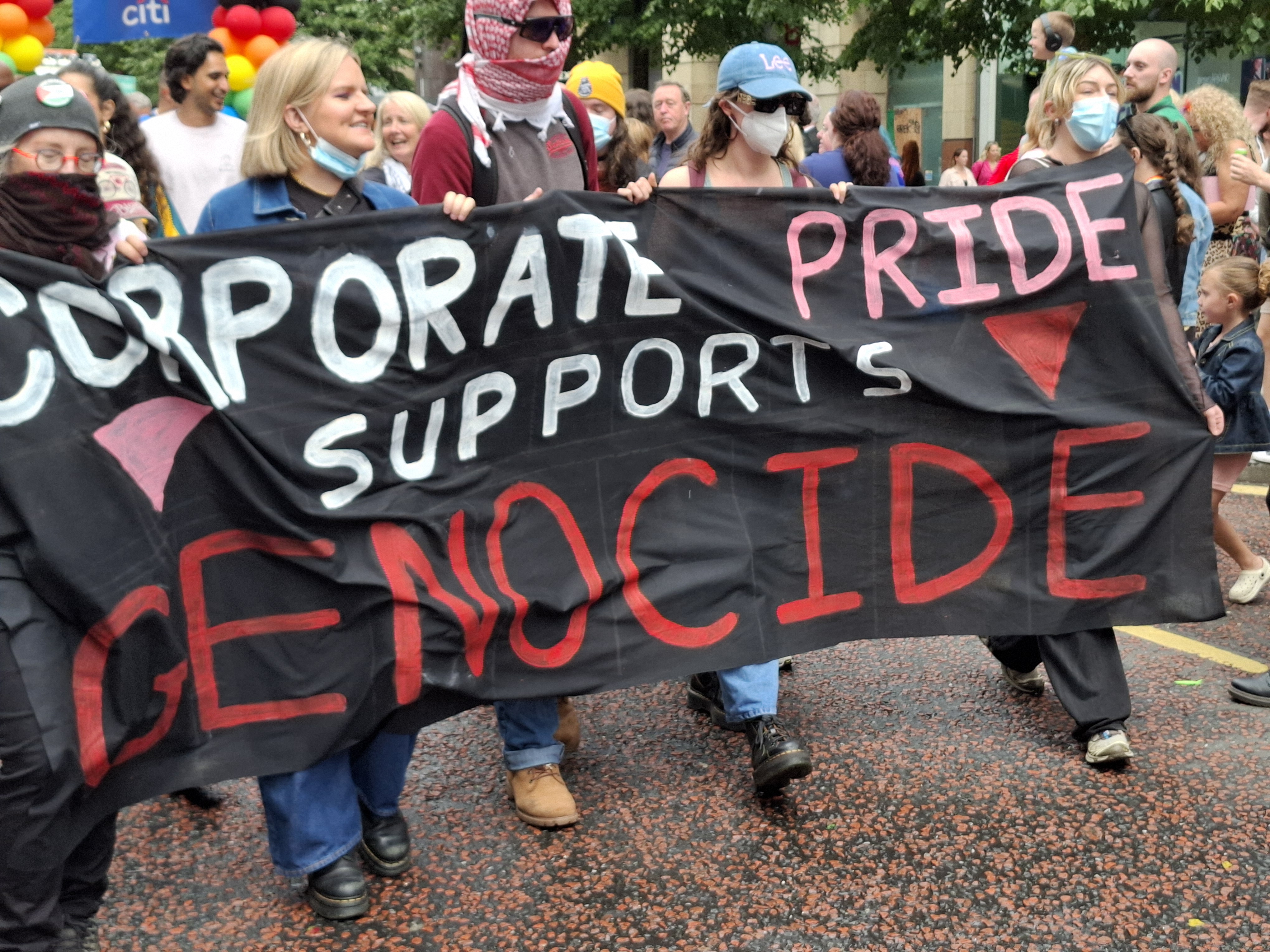
With such powerful support from big business and the state it is not hard to explain the gender identity movement’s success.  The corporate sponsorship of Pride and their HR departments’ Diversity and Inclusion departments are all examples of the appropriation of the claims of oppressed groups by capitalism.  Annual Pride demonstrations are no longer an expression of rebellious campaigns but a rainbow of multinational corporations; state agencies; NGOs; the mainstream mass media and bourgeois politicians, in what is more a fancy dress party – themed by inane slogans such as ‘love your mind’ – than a progressive campaign.  The idea that this is a grass-roots movement is as true as the claim of men to be women.

One banner at this year’s Pride parade in Belfast that hit the nail on the head.

Back to part 6

Forward to part 8

Bourgeois democracy in Ireland in two Acts (2) – Orwellian and Surreal

Bourgeois democracy can not only lie, it can also invent crimes for which you can be punished.  The Government is going ahead with the hate crime bill, shorn of its hate speech elements.  This follows its stinging defeat in the family and care referendum in which it also lied about the implications of what it was proposing when asked whether these had been raised within it as a concern.

The original proposals about ‘hate’ speech were particularly threatening but the retention of the definition of “protected characteristics” raises all sorts of questions that the government will again have to spin and lie about in order to defend.

These “protected characteristics” include ‘race, colour, nationality, religion, ethnic origin, descent, sex characteristics, sexual orientation, disability and gender’.  Beyond general issues about the wisdom of agreeing to greater repressive powers for the state, and the inclusion of essentially subjective considerations such as ‘hate’ in punishment, there are two questions – what is ‘sex characteristics?’  Is this just another term for sex, in which case what is the point of two words instead of just three letters?

The second is the definition of gender included in the legislation: “’gender” means the gender of a person or the gender which a person expresses as the person’s preferred gender, or with which the person identifies, and includes transgender and a gender other than those of male and female”.

This farrago of words is obviously not a definition of anything, certainly not of ‘gender’ or ‘transgender’, and as I have written before, it’s doubtful that one can be clearly stated.  It seeks to protect people who are ‘other than those of male and female.’  Who are they?  Where are they and how do they, or could they, exist?  In what way is this not putting into law the nonsensical ideas of gender identity ideology that the Government parties don’t have the courage to openly argue for?

When the right wing Senator Michael McDowell asked the Department of Justice what is intended by the term ‘transgender’ and ‘a gender other than those of male and female’ he got no response.  Instead, the department provided a statement that included this: 

“If someone is assaulted because they are transgender, that is a hate crime.”

“People identify as non-binary. That’s a fact. If someone follows a non-binary person after they leave a gay nightclub, and then assaults them while shouting homophobic abuse, they would likely be charged with assault causing harm aggravated by hatred (carrying a max sentence of 12 years, instead of 10 years because of the aggravating factor). If it’s not found that it has been aggravated by hatred, then the person could still be charged with assault causing harm,” it said. “A definition is required to protect that person. It has absolutely no implications outside of this law.” (Emphasis added – Sráid Marx)

The department also asked: “Does Michael McDowell believe that this person should be protected by this law, or does he believe this person should have to identify as male or female to be protected?”

There is so much that is simply stupid in this that it’s difficult to know where to start.

I am quite sure that Michael McDowell would respond that it does not require anyone to identify as anything in order to be protected, which is what the Department of Justice seems to imply. Or does the Department believe it must be proved that an assailant knows the inner thoughts of someone in order to secure conviction or aggravated punishment?  For that is what the department assumes when it wants to protect someone who is in some way not either male or female and walks out of a gay club.

How on earth could someone be attacked for being ‘non binary’ without the assailant having some prior knowledge of the person?  If a stranger was attacked for coming out of a gay club it is much more likely that any motive beyond purely violent intent would consist of homophobia, which is obviously what would be indicated by their “shouting homophobic abuse”.

It is indeed a fact that “people identify as non-binary” but it is also a fact, that the government wants to elide, that there is no such thing as a non-binary person (neither male nor female or both).  Assaulting someone for this reason is not an assault on someone because of what they are (e.g. gay) but an assault because of their (misconceived) ideas about what they are.  Since such ideas are as varied as there are ‘genders’, the state has opened up a panoply of grounds upon which to claim hate crime warranting additional punishment.

The state may have dropped attacks on free speech that might lead to criminal punishment arising from disagreement with the idea of the many ‘genders’ claimed by some activists, but this still leaves open the potential for punishment for those disputing such claims.  This may seem absurdly alarmist but it is already the case that the Department of Justice is implying that only inclusion of a gender identity in a victim ensures protection, something just as absurd.

The ability of the state to conjure up offences and therefore punishment on grounds that are non-existent is surreal.  The word Orwellian is overused but the Irish state is claiming that not only can it identify the inner thought crime of an accused but also that the inner thoughts of the victim can also be divined by the accused and in turn accessed by the state.

It is a feature of gender identity ideology that it throws up such idiocies that are easily dismissed, but these are a result of the foundational one that men can be women just by claiming to be one, and this is one nonsensical claim that is already being validated and legislated for.

McDowell has also noted that ‘the Bill suggests that there are genders (plural) other than male or female. It does not enumerate or describe such other genders”. He argues that unspecified genders beyond male and female would raise questions “over statutory provisions providing for gender balance in judicial appointments, board compositions, etc”.  “There is no case for legislating for an open-ended multiplicity of subjective genders the meaning of which is obscure,” he said.

The idea that the numerous legal and social provisions based on gender – understood as sex – will not be affected by the legal recognition in this Bill is naïve at best and does not accord with experience across the world.  I have argued elsewhere that these implications are reactionary.  They have included attacks on freedom of belief; freedom of speech and freedom of association; destroying women’s sex based rights; putting males in female spaces; attempting to obliterate sexual orientation and lying to children that they can change sex before they even have a full appreciation of what it is.

Those who think that because McDowell is right wing he cannot be quoted or we cannot agree with him on this should consider why a government and state that is complicit in genocide, as we pointed out in the previous post, should now be considered to be in the vanguard of social progress.  They might also consider that Genocide Joe Biden described trans rights as “the civil rights issue of our time. There is no room for compromise when it comes to basic human rights”. Tell that to the Palestinian people.

Back to part 1

Marxism and Gender Identity Ideology (6) – what it demands

EPA source BBC

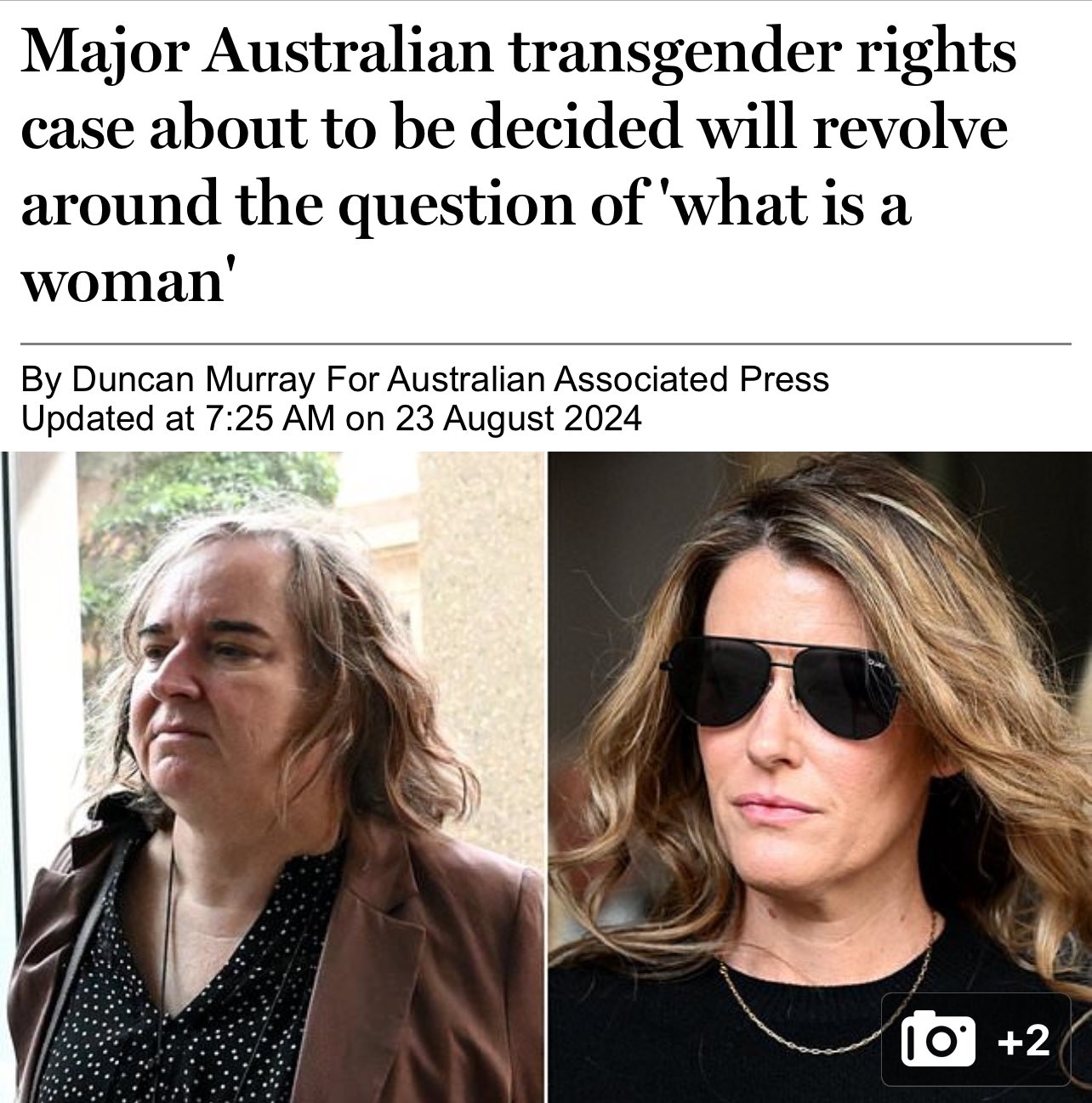
Yesterday I listened to part of a podcast that discussed the view that the gender critical movement was over because the gender identity ideology had peaked.  The claim wasn’t convincing and today I woke up to an Australian judge deciding that sex is “changeable and not necessarily binary” with the BBC pointing to its worldwide implications.  In Australia the Prime Minister has claimed that there is an “epidemic” of violence against women, something akin, then, to the reported levels of violence against women in Ireland.

It is wryly amusing to look at the number of changes to the photographs used in the BBC article, illustrating the old proverb that a picture paints a thousand words.  While this post was mainly written long before the court decision, I can’t help noting a couple of things about the photographs used above and other media material on Roxanne Tickle.

First, Tickle is clearly a man. Second he would appear to have women supporters. That some women are happy to undermine their own sex-based rights is not exactly news but it does reinforce the view that the struggle for women’s rights doesn’t pit women against men but is one critical part of a general struggle against all oppression and for a new society that this blog argues is socialism.

Gender Identity ideology has some bizarre consequences, as we noted in previous posts and I wrote before this recent event, including that the intimidation of women defending their sex-based rights is somehow progressive.  Rejection of the idea that men can become women and entitled to the rights of women is claimed to constitute oppression, with the consequence that women can thus become the oppressors of certain types of men.  Discrimination against women cannot be measured, in fact cannot even be conceived since gender identity is everyone’s ‘true self’, whatever that is, something outside our material reality and social interaction as we noted when we tried to work out exactly what gender is.

Feminists who oppose gender identity ideology are criticised for focusing on body parts, such as the male genitalia of transwomen, even as this ideology leads to women becoming ‘menstruators’ or ‘cervix owners’.  When not so described, they are totally erased and described as ‘pregnant people.’  Even the British medical journal The Lancet referred to ‘bodies with vaginas’, ‘birthing parents’ instead of mothers, and breast milk as ‘human milk’, before having to apologise.  Johns Hopkins University in the US defined a lesbian as ‘a non-man’ attracted to a non-man’ before again having to retract.

Despite the insults, censorship and objectification of women into body parts, the assertion of the impossible – that ‘transwomen are women’ – is often accompanied with the demand to ‘be kind’, in other words accept the ideology because the feelings of a group of men, many with a sexual fetish, have their feelings hurt.  Diverse groups with little in common but an irrational ideology defend it and ignore the fetishism of many men claiming to be women.

It is instructive to note part of the Australian court proceedings that held out the criteria by which it appears we can decide that some men are actually women. Tickles’ lawyer asked the woman who was CEO of the women-only social media app the following:

“Even where a person who was assigned male at birth transitions to a woman by having surgery, hormones, gets rid of facial hair, undergoes facial reconstruction, grows their hair long, wears make up, wears female clothes, describes themselves as a woman, introduces themselves as a woman, uses female changing rooms, changes their birth certificate – you don’t accept that is a woman?” 

Since no amount of surgical or medical treatment, including cosmetic surgery; dressing up, wearing lip stick and dresses; self-description, using women’s spaces or changing the text of a piece of paper, changes one’s sex, the answer was ”No.”

It has often been noted that the gender ideology movement has achieved success rapidly, coming to public consciousness relatively recently and without the long struggle engaged in by gay men and lesbians.  Trans people are held up to be particularly oppressed, vulnerable, and marginalised and politicians who are asked to explain their support for the ideology’s demands often fail to answer questions by immediately stating their unique vulnerability and marginalisation as if this covers all the issues.

This movement is portrayed as a ground-up, grass-roots movement for liberation yet it has powerful support and achieved its success in part because of support from some who are very definitely not oppressed.  This includes the corporate executives of some very large companies, and their HR departments and Diversity and Inclusion policies, employed to burnish their PR and boost the bottom line.  (Becoming less popular precisely because it doesn’t).

It has had the support of prominent politicians such as the Joe Biden who, in his first day in office as President of the United States, stated that ‘transgender equality is the civil rights issue of our time’, issuing an executive order instructing federal agencies not to discriminate on the basis of gender identity.

State bureaucracies such as the NHS now pretend women inhabit men’s bodies, which is an impossible way to consider human health.  A whole book has been written on how the pretence that there is no difference between male and female bodies (making the male one the default) has affected many areas of women’s lives, including most obviously their heath.  

Well-funded NGOs such as Stonewall spread the message through awards to businesses and organisations that adhere and implement the ideology, including awards to such progressive organisations as MI5.

It has achieved it successes not through mass demonstrations and civil disobedience but through lobbying the powerful and through policy capture.  In other words, through bureaucratic means, for which shutting down questions through the mantra ‘no debate’ is perfectly suited.  It has inspired legislative changes erasing the importance of sex and imposing gender identity that have been introduced under the radar with most people unaware of it happening or innocent of the consequences.

The British National Health Service is a good example of the consequences of the intrusion of this ideology and its regressive consequences.  The Cass Report into the treatment of young people with difficulties attributed to gender identity was a stinging rebuke of gender identity ideology, recording many of the damaging consequences of its intrusion into health care.  These include the lack of evidence for puberty blockers and opposite sex hormone treatment, which may have permanently damaging and irreversible effects that vulnerable young people may easily be unable to fully appreciate.  Cass noted the fear of some clinicians of working in the area and the lack of evidence for the ‘gender affirming’ approach.

Six of the seven gender clinics involved refused to cooperate with the inquiry in supplying data and information on their patients and treatment, raising suspicions that what was being practised had more to do with ideology than best treatment for the “various combinations of confusion about sexuality, psychosis, neurodevelopmental disorders, trauma and deprivation, forensic issues and a range of other undiagnosed conditions” (Transgender Trend). Without shame, the supporters of the ideology have attempted to discredit the evidence behind the report, without success.

Finally, in the ’Weekly Worker’ series of articles on transgender rights that we have occasionally referenced, the author notes that a socialist response will have to be one that is not grounded on ‘trans’ as an independent single issue and/or on the politics of anti-discrimination and ‘rights’.

He states that “I think that the political nature of this positive approach has to be one which stresses the commonality of the oppression of trans people with other experiences of oppression and exploitation, rather than stressing the difference.’  Yet, even with that approach, the claims of Gender Identity ideology must be assessed and challenged.  When it impacts on the rights of women to their detriment, even this mistaken approach must look at what commonality of oppression exists – how does defending the reality of sex against a false and spurious claim that men are oppressed by not being recognised as women constitute any sort of oppression?

The ‘Weekly Worker‘ articles repeat again and again the paucity of the distinct demands from the ideology’s movement that socialists can support or that are not already common currency, such as against discrimination for anyone diverging from sexist stereotypes.

Others are explicitly rejected: ‘Trans rights activists have identified doctors’ ‘gatekeeping’ access to drugs and surgery as an aspect of their oppression. But self-diagnosis is not always the right answer.’  (An unacknowledged hole below the waterline for the whole ideology since it rests totally on acceptance of the word of those making claims to belong to the other sex).  In relation to the Tavistock gender clinic, it notes ‘some evidence of belief by some children and parents, shared by some staff, that a trans outcome for the children involved would be preferable to self-acceptance as gay or lesbian.’

The demand for adequate health care by trans activists is a common need for all working class people unable to pay directly for satisfactory services, while the particular and specific demands of gender identity ideology are reactionary.  These demands involve access to women’s places in society including toilets, changing rooms, rape crisis centres and refuges, hospital wards, women’s prison estate, and participation in women’s sports where men’s physique gives them an advantage.

In all these cases women’s comfort, privacy and safety are compromised and considered irrelevant to the demands of men identifying as women, justified on the grounds that not all men are violent predators.

This simply ignores that violent and sexual crime is overwhelmingly carried out by men and that women are unable to identify which men are not disposed to carrying it out.  Since there is no evidence that transwomen are any different to the general male population in this respect, it cannot be claimed that transwomen are not a potential threat.  The argument for transwomen in women’s spaces is therefore one that applies to all men. The view that men and women should ideally be able to share all public spaces might be made a reality when the reality of this pattern of criminal behaviour is changed.

These demands also include opposition to ‘conversion’ therapy for children reporting their belief that they are trans.  These young people have many other difficulties that might explain their symptoms of unhappiness, stress and depression etc. These include puberty and the accompanying anxiety arising out of their sexual development, or their autism, eating disorders, or simply finding their attraction to the same sex. Instead it is demanded that their claims to be trans are immediately affirmed without consideration of the potential for this self-diagnosis by immature young people to be the result of social contagion, peer pressure from friends or social media, or arising from any of their other comorbidity conditions.

Once again, the world is turned upside down.  The therapeutic approach of watching, waiting, and talking over young people’s feelings of alienation – to get to the root of their distress, whatever it might be – is damned as ‘conversion’ therapy.  Yet the radical medical and surgical treatment that can involve the removal of perfectly healthy tissue; consumption of puberty blockers and opposite sex hormones, which have known significant risks to long term health and fertility – this is supposedly not conversion treatment but ‘affirmative’ treatment when what is really being affirmed is gender identity ideology.

There is nothing progressive about any of this.   We have gone from men claiming to be woman, claiming and replacing their places in society, to the idea that it is impossible even to tell the difference between a man and a woman (courtesy of the head of the International Olympic Committee).  Despite this we have a left captured by identity politics, or influenced by liberal and hollow claims to oppression, that defends this nonsense and attacks the rights and essential existence of half the human race. When challenged it often responds with angry and empty insults. It is a big part of the problem.

Back to part 5

Forward tom part 7

Marxism and Gender Identity Ideology (5) – Believe as you’re told

It’s always been said that if you’re going to tell a lie, tell a big one.  The more outrageous the better. It immediately requires a big denial that itself feels like it is making a big claim.  A big lie also has numerous and wide consequences, so denial equally requires a lot of follow-through.

For many people the social opprobrium of denial is enough to impose silence and there are lots of incentives to keep schtum, including entreaties to ‘be kind’, be ‘on the right side of history’, not to be a bigot – or what seems to work better – not have anyone call you one.  And so many people on ‘your side’ seem to go along with it, and so many not on ‘your side’ seem to be against.  Anyway, it all involves a small number of people so let’s not get exercised about it.

An additional factor is the temptation not to think too hard about it all, lest you end up having the debate in your head that you have been insistently told you can’t have outside it. The ‘no debate’ mantra of some trans activists thus functions at two levels.  It immediately fences off from acceptable discussion disagreement with the view that men can become women – and in doing so claim all their rights – and treats such disagreement as akin to racism or homophobia. The assertion itself is therefore free from questioning.

Since there is now a fashion for the introduction of hate crimes in certain countries, the subjective views of those carrying out alleged criminal acts are also taken into account; meaning that what you think can also be taken as an aggravating factor and in effect become an ancillary crime itself. We are not quite in ‘thought-crime’ territory but we are definitely in the land of ‘impure thoughts’, so you must not only do as you are told but believe it as well.

I have written before that this ‘no debate’ mantra is the cause of the ‘toxicity’ of the (non) debate, so is largely the result of the virulence of tans activism.  Of course, this is a product of the preposterous nature of the claim itself but the consequence of this combination – of the outlandish claim and command to agree – results in the anger of those critical of the claim, and their exasperation at those who just want to ignore it, or turn a Nelsonian eye to the whole thing.

Again and again, however, the ideology hits you in the face, with the claim to be a uniquely vulnerable and marginalised minority clashing with the obvious support accorded to it by the state and other institutions.  Often, when it does, it’s because the consequences of the claim once again conflict with reality.

Let’s take an example I came across in the past week.

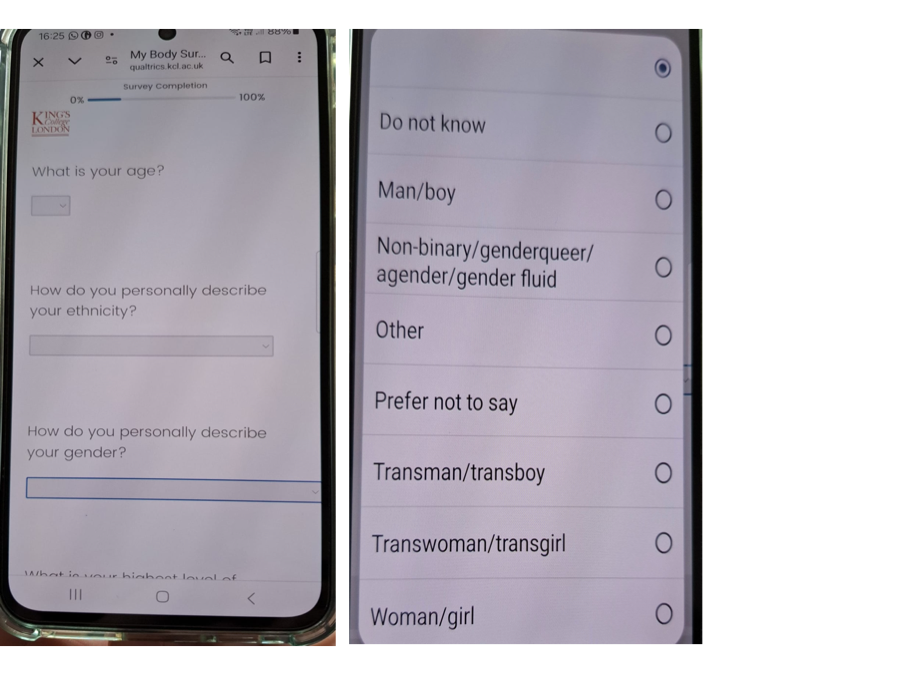
My wife was asked to complete a survey originating from Kings College in Britain, the purpose of which was stated as follows:

‘We would like to invite you to participate in this online survey which will explore how anxiety, emotion and wellbeing are experienced in the body after primary breast cancer and in secondary breast cancer. Before you decide whether you want to take part, it is important for you to understand why the research is being done and what your participation will involve’

‘We know that many people struggle with their mental health after primary breast cancer and in secondary breast cancer. Breast cancer and our emotions are also both rooted in the body. However, research has not yet explored how people feel emotions in their body during and after breast cancer, and how this can impact people’s general wellbeing.’

The survey is designed to take about 30 minutes, so not a quick on-line poll: ‘The purpose of the study is to understand how interoceptive sensibility – how someone feels able to sense their internal bodily sensations – impacts people’s experiences of mental health and wellbeing after primary breast cancer and in secondary breast cancer.’

By way of context, Cancer Research UK records that there are around 56,800 new breast cancer cases in the UK every year and that it is the most common cancer in females with around 56,400 new cases every year (2017-2019) but not among the 20 most common cancers in males, with around 390 new cases every year (2017-2019).  This translates into an annual death toll among women of 11,415 and among men of 85 with a mortality rate of 33.9 and 0.3 respectively. This means that women account for over 99 per cent of deaths from breast cancer.

So, if men can also suffer from breast cancer and it is not a women-only disease, perhaps we can accept the use of the word ‘people’ in the survey from Kings College.  What is hard to accept is one of the questions at the start of the survey, which I captured on my phone and the range of potential answers expected and requested:

Question and permitted Answers:

If we were to be (very) charitable, we might say that the survey is about subjective responses to having had or still having breast cancer and that it is a valid objective to distinguish, and then compare, the subjective response of women, men and trans individuals. The permitted answers forswear the outer reaches of trans ideology by lumping together a number of ‘identities’ and excluding the myriad of others of uncertain number.

In doing this however, we would have to ignore the biological basis of cancer and that the overwhelming risk attaching to it is not ‘gender’, whatever that is, but sex.  We would also have to pass over the recognition by the survey’s authors that the study already recognises the primacy of biology by stating that ‘Breast cancer and our emotions are also both rooted in the body’ and that ‘The purpose of the study is to understand how interoceptive sensibility – how someone feels able to sense their internal bodily sensations. . .’

The problem is that the question is designed to find out not only what ‘gender’ someone thinks they are but what sex they are, and if someone were to reasonably state that non-binary/genderqueer/agender/gender fluid are not a sex then the question is at best ambiguous. At worst it is an invitation to accept gender identity ideology; that all the answers are equivalent and gender = sex and there are more than two.  If you don’t accept this equality then you would be entitled not to answer the question on the grounds that you do not have a gender identity.

In this case, from any scientific perspective, the survey is flawed. And in any case, anyone studying the responses who thinks ‘I don’t know’ is a valid answer to the question ‘how do you personally describe your gender’ has a big problem. Is the respondent stupid, confused or does she or he think that the question is stupid or the result of confusion?

Occam’s Razor would lead one to the conclusion that the survey is an example of gender identityideology positing the salience of self-ID to the feelings of women who have or are suffering from cancer. Does this matter?

This is often the question used to puncture opposition to expressions of gender identity ideology.  In this case the scientific soundness of the survey is called into question by mixing incommensurate concepts.  The introduction of the survey, on the stresses of having cancer, to be read by participants before they complete it, is keen to avoid causing further stress, advising ‘that you contact your GP in the first instance.’  One wonders how a question relating to a disease that by over 99 per cent affects women could put this category at the bottom of eight when attempting to identify its public.

Perhaps this will also be excused as a mistake, but that would be to deny the claims of gender identity ideology for which such a question is totally appropriate and absolutely necessary.  Don’t ask why, because that is to presume an explanation that itself presumes reasoning that itself must be open to interrogation, and that would require a debate.

Back to part 4

Forward to part 6