What does “Don’t betray Ukraine?” mean (3 of 3)

In a Facebook discussion on why socialists should oppose the war I received a reply that stated:

‘In ninety cases out of a hundred the workers actually place a minus sign where the bourgeoisie places a plus sign. In ten cases however they are forced to fix the same sign as the bourgeoisie but with their own seal, in which is expressed their mistrust of the bourgeoisie. The policy of the proletariat is not at all automatically derived from the policy of the bourgeoisie, bearing only the opposite sign – this would make every sectarian a master strategist; no, the revolutionary party must each time orient itself independently in the internal as well as the external situation, arriving at those decisions which correspond best to the interests of the proletariat. This rule applies just as much to the war period as to the period of peace.’

This of course is a quote from Trotsky.  The problem is not to quote this as if this explains left support for the Ukrainian/Western imperialist alliance, but why this combination requires socialists to place a plus sign when the chances are only one in ten of that being correct.

If we look at the examples in the article from which the quote is taken, we see the sort of circumstances in which this would be correct.  These include when a ‘rebellion breaks out tomorrow in the French colony of Algeria’ and receives help from a rival imperialism such as Italy.  The second is when ‘the Belgian proletariat conquers power . . . Hitler will try to crush the proletarian Belgium’ and’ the French bourgeois government might find itself compelled to help the Belgian workers’ government with arms.’

In a footnote, Trotsky says that: ‘We can leave aside then the question of the class character of the USSR. We are interested in the question of policy in relation to a workers’ state in general or to a colonial country fighting for its independence.’

The Ukrainian working class has not come to power; Ukraine is not a workers’ state and has just celebrated Independence Day, so it is not a colony.  Some have tried to squeeze in the ridiculous idea that it is an oppressed country, but this is false.  It is a country backed by the whole of Western imperialism; is in an open alliance with it, and the war was provoked by both parties to this de facto alliance which sought to make it formal.

Ukraine will most likely lose territory but will not be totally occupied, unless Russia does something stupid, which it has not signalled it will do.  At least part of the territory occupied is pro-Russian so that it is not possible to see either sides’ occupation as being unambiguously liberating.  In other words, thinking in terms of oppressor and oppressed states does not provide a solution; more fundamentally because this is an imperialist war in which Ukraine is on one of the sides, and cloaking it with oppression does not explain either the origin and nature of the war or the approach that socialists should take to it. 

Victory for Ukraine, it is claimed, would be a victory against Russian imperialism, but it would also be a victory for Western imperialism with which Ukraine is now an ally. Claims that this is any sort of anti-imperialist war are therefore obviously spurious.  Only from a campist position can it be claimed that a victory for the camp of western imperialism is preferable to a victory of the Russian.  Complete disorientation and political degeneration explains why supporters of this position regularly accuse those opposed to it of ‘campism’ and describe themselves as ‘internationalist.’ 

It is irrelevant who fired the first shot, as Trotsky noted elsewhere:

‘Imperialism camouflages its own peculiar aims – seizure of colonies, markets, sources of raw material, spheres of influence – with such ideas as “safeguarding peace against the aggressors,” “defence of the fatherland,” “defence of democracy,” etc. These ideas are false through and through. It is the duty of every socialist not to support them but, on the contrary, to unmask them before the people.’

“The question of which group delivered the first military blow or first declare war,” wrote Lenin in March 1915, “has no importance whatever in determining the tactics of socialists. Phrases about the defence of the fatherland, repelling invasion by the enemy, conducting a defensive war, etc., are on both sides a complete deception of the people.”

He goes on: ‘The objective historical meaning of the war is of decisive importance for the proletariat: What class is conducting it? and for the sake of what? This is decisive, and not the subterfuges of diplomacy by means of which the enemy can always be successfully portrayed to the people as an aggressor. Just as false are the references by imperialists to the slogans of democracy and culture.’

Trotsky makes the following summary judgement: ‘If a quarter of a century ago Lenin branded as social chauvinism and as social treachery the desertion of socialists to the side of their nationalist imperialism under the pretext of defending culture and democracy, then from the standpoint of Lenin’s principles the very same policy today is all the more criminal.’  Over one hundred years has passed since Lenin’s judgement, how much more does this criminal treachery deserve condemnation today?

The depths of disorientation can be gleaned from one article reviewing the latest film documentary on the war, in which the author states that the film 2000 Meters to Andriivka is ‘the Ukrainian working class at war.’

‘The young men we see in this documentary about the capture of a village called Andriivka by the 3rd Assault Brigade of the Ukrainian army are a snapshot of the country’s working class. One is a lorry driver, their commander previously worked in a warehouse and a third is a polytechnic student studying electronics. They are virtually all in their early twenties and all volunteered to fight the Russian invasion.’ 

‘Ukraine continues to resist against overwhelming odds at the price of losing its bravest and most self-sacrificing young people’, while telling us why they are fighting, reminding him of the Soviet ‘partisans fighting Nazi invaders.’  What a pity for such a claim that it is the 3rd Assault Brigade of the Ukrainian army that the author lauds, which is composed of today’s Nazis, and hails as its historic heroes the Ukrainian fascists who collaborated with the Nazis in World War II and who fought Soviet partizans.

Aleksei ‘Kolovrat’ Kozhemyakin looks at a photo of himself. Exhibition opening in Kyiv, September 27, 2023. Source: Vechirnii Kyiv

The author, like me, will have been stopped in the streets of Belfast many times by soldiers of the British army who may have previously been lorry drivers or worked in a warehouse; certainly more or less all of them would have been working class.  This would not in the slightest have determined the nature of the British army or answered Lenin’s questions ‘What class is conducting it? and for the sake of what?’  Nor would – who fired the first shot? – have defined the conflict in the North of Ireland.

The working class British squaddies were fighting for an imperialist army in the interests of their imperialist state just as the Ukrainian workers in the 3rd Assault Brigade are fighting for the capitalist Ukrainian state in its alliance with western imperialism, from whom it will have received its funding, training, weapons and intelligence.  That the neo-Nazis within it are not the least bit interested in ‘democracy’ and are bitter enemies of anything remotely resembling socialism just puts the tin hat on the preposterous claims of the social imperialist supporters of Ukraine.

Quotes from Trotsky won’t therefore exculpate today’s social-imperialists who support imperialism while proclaiming socialism.  Even the isolated passage quoted at the start of this post assumes an independent working class movement to apply its own seal, but no such movement exists in Ukraine.  In raising the demand “Don’t betray Ukraine” the Ukraine Solidarity Campaign has fixed a plus sign to the actions of imperialism where no independent working class movement exists in Ukraine to place its own.

The demand “Don’t Betray Ukraine” is not therefore a call to take advantage of a contradiction within imperialism but to take one side of it instead of opposing both.   It is a demand for capitalist solidarity; that one section of it remain united in its struggle against the other. It is a call for Western imperialism to be united in full commitment to a particularly rotten capitalist state, signalling the total abasement of those declaring it.

Back to part 2

Oppressor and Oppressed (10) – separating nations or uniting workers?

1920: M.N. Roy (centre, with black tie) with Vladimir Lenin (left) and Maxim Gorky (behind Lenin). An émigré communist party emerged in October 1920 in Soviet Tashkent under Roy’s guidance.

All the arguments employed against Lenin are claims on behalf of a national solution to national oppression.  The USC article asserts that Lenin believed that ‘the separation of an oppressed people and its creation of an independent state divided the proletariats of various nations, while a bourgeois multinational state with a ruling nation in command united them.’  But this makes no sense.

If Lenin believed that bourgeois empires united workers, why did he oppose great Russian chauvinism, or even place such importance on the right to self-determination if the former did not divide workers and the latter was required in order to unite them?  The article goes on to say that ‘state boundaries do not hinder the international drawing together of the workers of various nations. On the contrary, boundaries signify a respect for equal rights, and a real drawing together is only possible among equals.’

The world has by and large witnessed the end of multinational empires but where is the equality of nations?  How does the imposition of different laws, rules and regulations of labour; the creation of separate national labour organisations; the creation of separate economic, social and political circumstances in general – giving rise to different struggles – lead to drawing workers together?  Is not the point of the creation of such nations, from the nationalist point of view, that the different classes of the nation are ‘naturally’ to be separate from other nationalities and united within – workers with capitalists etc?

Since when was it possible for unequal nation states to achieve equality, and when did larger states stop imposing their interests on smaller ones, through political interference, economic coercion and war?  Is Ukraine not dramatic proof of all of these, by the West as well as Russia?  The author appears to recognise this when he writes that ‘modern American capitalism, which is not weighed down by feudal traditions, does not require the incorporation of other peoples into its state borders in order to dominate them.’  As we know, this hasn’t prevented repeated direct military invasion and occupation by it.  

The socialist demand for the equality of nations means only the right to independence and not belief in the possibility of real equality between vastly different states.   Their drawing together does indeed require the right to separation but rejection of the exercise of such a right can evidence that that this has already happened, to a greater or lesser extent.  Ultimately only the removal of the capitalist imperative to accumulate capital can remove the dynamic of antagonism between capitalist states.

In the Draft Theses on National and Colonial Questions for the Second Congress Of The Communist International, Lenin wrote that the 1914-18 war and the imperialists’ actions after it ‘are hastening the collapse of the petty-bourgeois nationalist illusions that nations can live together in peace and equality under capitalism.’

It is claimed in the USC article that the demise of the Tsarist multinational state after the First World War demonstrated the progressiveness of purely national formations, but the Second World War rather exposed the very restricted limits to this.  Cold War conflict muted direct war in Europe after World War 2, but even the success of the European Union in muting conflict between the major powers within Europe has not made all states within it equal.  The collapse of multinational Yugoslavia was not a progressive event, entailing war, ethnic cleansing and lasting bitterness and conflict.  Again, the war in Ukraine demonstrates that nation state independence is no obstacle to the intrusion of the more powerful.

The author opposes what Marx, and subsequently Lenin, considered as progressive tasks: ‘it was unfitting for a workers’ social-democratic party to support even the “progressive” tasks of capitalism on the eve of the First World War, because these tasks were accomplished with steel and blood.’   As Marx said, capitalism had never ‘effected a progress without dragging individuals and people through blood and dirt, through misery and degradation’, but that through its ‘development of the productive powers of man . . .  bourgeois industry and commerce create these material conditions of a new world . . .’  K Marx, The Future results of British rule in India, Collected Works Vol 12 p 221 and 222)

The author argues that Lenin’s concept of imperialism meant that ‘capitalism was decaying and that the only way out was through a socialist revolution and the disintegration of multinational and colonial empires. . . In this second period Lenin linked the resolution of the national question in Russia to the victory of the proletarian revolution’ and ‘considered that the peoples of Russia could unite again only in a union of republics with equal rights.’

In the Draft Theses on National and Colonial Questions Lenin wrote at its beginning that ‘In conformity with its fundamental task of combating bourgeois democracy and exposing its falseness and hypocrisy, the Communist Party, as the avowed champion of the proletarian struggle to overthrow the bourgeois yoke, must base its policy, in the national question too, not on abstract and formal principles but, first, on a precise appraisal of the specific historical situation and, primarily, of economic conditions.’

In this document he noted that ‘from these fundamental premises it follows that the Communist International’s entire policy on the national and the colonial questions should rest primarily on a closer union of the proletarians and the working masses of all nations and countries for a joint revolutionary struggle to overthrow the landowners and the bourgeoisie. This union alone will guarantee victory over capitalism, without which the abolition of national oppression and inequality is impossible.’

In 1916, after writing his brochure on imperialism, he wrote against a political opponent – in A Caricature of Marxism – that ‘every sensible worker will “think”: here we have P. Kievsky telling us workers to shout “get out of the colonies”. In other words, we Great-Russian workers must demand from our government that it get out of Mongolia, Turkestan, Persia; English workers must demand that the English Government get out of Egypt, India, Persia, etc.’

‘But does this mean that we proletarians wish to separate ourselves from the Egyptian workers and fellahs, from the Mongolian, Turkestan or Indian workers and peasants? Does it mean that we advise the labouring masses of the colonies to “separate” from the class-conscious European proletariat? Nothing of the kind. Now, as always, we stand and shall continue to stand for the closest association and merging of the class-conscious workers of the advanced countries with the workers, peasants and slaves of all the oppressed countries. We have always advised and shall continue to advise all the oppressed classes in all the oppressed countries, the colonies included, not to separate from us, but to form the closest possible ties and merge with us.’

‘We demand from our governments that they quit the colonies, or, to put it in precise political terms rather than in agitational outcries—that they grant the colonies full freedom of secession, the genuine right to self-determination, and we ourselves are sure to implement this right, and grant this freedom as soon as we capture power. We demand this from existing governments, and will do this when we are the government, not in order to “recommend” secession, but, on the contrary, in order to facilitate and accelerate the democratic association and merging of nations. We shall exert every effort to foster association and merger with the Mongolians, Persians, Indians, Egyptians.’

In June 1920 ‘a precise appraisal of the specific historical situation’ meant that ‘world political developments are of necessity concentrated on a single focus—the struggle of the world bourgeoisie against the Soviet Russian Republic, around which are inevitably grouped, on the one hand, the Soviet movements of the advanced workers in all countries, and, on the other, all the national liberation movements in the colonies and among the oppressed nationalities, who are learning from bitter experience that their only salvation lies in the Soviet system’s victory over world imperialism.’

‘Consequently, one cannot at present confine oneself to a bare recognition or proclamation of the need for closer union between the working people of the various nations; a policy must be pursued that will achieve the closest alliance, with Soviet Russia, of all the national and colonial liberation movements. The form of this alliance should be determined by the degree of development of the communist movement in the proletariat of each country, or of the bourgeois-democratic liberation movement of the workers and peasants in backward countries or among backward nationalities.’

‘Federation is a transitional form to the complete unity of the working people of different nations. The feasibility of federation has already been demonstrated in practice both by the relations between the R.S.F.S.R. and other Soviet Republics . .  . In this respect, it is the task of the Communist International to further develop and also to study and test by experience these new federations, which are arising on the basis of the Soviet system and the Soviet movement. In recognising that federation is a transitional form to complete unity, it is necessary to strive for ever closer federal unity . . . ; second, that a close economic alliance between the Soviet republics is necessary, otherwise the productive forces which have been ruined by imperialism cannot be restored and the well-being of the working people cannot be ensured; third, that there is a tendency towards the creation of a single world economy, regulated by the proletariat of all nations as an integral whole and according to a common plan. This tendency has already revealed itself quite clearly under capitalism and is bound to be further developed and consummated under socialism.’

He finishes the draft theses with the statement, that ‘complete victory over capitalism cannot be won unless the proletariat and, following it, the mass of working people in all countries and nations throughout the world voluntarily strive for alliance and unity.’  From all this it is clear that Lenin never departed from the view that the purpose of socialists, including in its national policy, was to create the maximum unity of the working class in its struggle for socialism. 

The Ukraine Solidarity Campaign has published an article that usurps the purpose of the demand for national self-determination as argued by Lenin, from one of strengthening the unity of the working class across and between countries to one of supporting the creation of new capitalist states in order to create an (impossible) equality of states; one that somehow leads to working class unity.  Internationalism as the unity of the working class regardless of nation has become the equality of nations, the solidarity of nationalisms with the retention of separate states and, by implication, the rights arrogated by them based on claims for the necessity of their existence.

The purpose is clear: to justify the war in Ukraine and the claims of the capitalist Ukrainian state on the subterfuge that these encompass the interests of its workers, which ‘Lenin’s contradictions’ have supposedly helped prevent from being appreciated.  It has the merit of recognising that Lenin cannot be summoned in support of Ukraine in the war, thereby undermining the arguments of others who think he can.

Series concluded

Back to part 9

Oppressor and Oppressed (9) – Lenin’s contradictions

The article published by the Ukraine Solidarity Campaign (USC) tells us that:


‘In another place Lenin stated that “large states can accomplish the task of economic progress and the tasks of proletarian struggle against the bourgeoisie more successfully than can small ones.” But Lenin also wrote the following: “In 1905 Norway separated from Sweden… What does this mean? Did the people lose? Did the interests of culture lose? Or the interest of democracy? Or the interests of the working class from such a separation? Not at all!… The unity and closeness of the Swedish and Norwegian peoples in fact gained from the separation.” This contradiction in Lenin (the progressive nature of multinational states and the progressive nature of the dissolution of multinational states).’

Lenin, however, says no more here than when larger states separate it is better that they do so without conflict, if unity does not have the necessary support, in order that the primary unity sought – that of the working classes of the various nations – is less impaired. Whether Lenin got this right in this particular case is secondary to the general argument.


The article goes on to say that ‘Most of Lenin’s statements, nevertheless, were in support of preserving the integrity of the Russian Empire, in 1903 he considered its disintegration “an empty phrase as long as its economic development continued to bind its various parts more closely into one political whole.” The break-up of Russia, according to Lenin, would be a step backwards, “in contrast to our aim of overthrowing autocracy,” In 1913 Lenin wrote:

“Autonomy is our plan for the organization of a democratic state. Separation is not our plan at all… On the whole we are opposed to separation. But we support the right to separation.”
This, indeed, was Lenin’s position. Both from the necessary, and much to be desired, purposes of development of the productive forces and the unity of the workers’ movement within the Tsarist Empire, the Bolsheviks were opposed to disintegration. As the article goes on to say, “The aim of socialism is not only to destroy the division of humanity into small states and all national aloofness, not only the rapprochement of nations, but also their merging,”


The author of the USC article criticises the idea of multinational states: ‘History has not yet provided us with the example of nations in one state enjoying complete equality, because a state is not only class coercion, but also national coercion. The stronger nation in a multinational state always wishes to be the ruling one.’[1]


Other lessons from history are, however, ignored; such as nation states often being the creation of nationalism, upon which national antagonisms have facilitated wars based on capitalist competition. Nation states often contain national minorities and attempts to create single-nation states often result in odious oppression of national minorities. Nationalism is not the answer to the disease of national oppression that it itself engenders.


It might therefore also be said that History has not yet provided us with the example of nation states enjoying complete equality, because a state is not only an instrument of class coercion, but also of national coercion of one against another. Instruments of class oppression will not be equal when there is competition between them to increase the resources that they can exploit.
The article appears to agree with this but seems to see it as relevant only within multinational states, in which it says that ‘as long as the state — violence — exists, equal rights for nations will be impossible, no matter how democratic the state might be.’


The USC article quotes from a ‘Ukrainian Marxist’ in 1916 ‘disagreeing with Lenin’s statement that a democratic Russian republic would make the realisation of the national right of separation a possibility’:


‘It is ridiculous to speak of the possibility of the ruler of a capitalist state “safeguarding rights of nations to self-determination,” Every state, even the most democratic, and especially today in the age of imperialism, would not only never agree to the separation of oppressed peoples but would always aspire towards new territorial gains, to a further oppression of nations. Capitalist governments have always looked upon the “rights of nations to self-determination” as treason to the fatherland and have punished the guilty with the death penalty… A blind faith in the democratic and socialist advantages of Russia…is in no way an expression —as is often thought — of the Great Russian socialism. On the contrary…the national program of Russian revolutionary social democrats is nothing other than the repetition of Great-Russian liberal patriotic programs.’


This argument contains some measure of truth – that capitalist governments cannot be relied upon not to oppress smaller national groups within their Empire, and is even true against Lenin who believed at this time that only a bourgeois democratic and not a working class revolution was possible. It ignores, however, that national minorities within nation states separated from Empires will also often be oppressed.


In terms of the class nature of the revolution that Lenin at that time believed would occur, he foresaw the working class taking the lead in this bourgeois democratic revolution, ensuring its thoroughly democratic character. Above all, as we have seen from the earlier post, the purpose of the demand for self-determination of nations by Lenin was the unity of the working class; not a presumed higher unity among different classes within a separating nation, with such unity always being that of the working class united with its ruling classes in its subordination. It is precisely this ‘solution’ to national oppression that the USC article attempts to assert.


It is claimed that the greater number of Lenin’s contradictions come from the period of the First World War and Russian 1917 revolutions, attacking what it sees as the cultural implications of Lenin’s policy:


‘Lenin wrote, on the one hand, that it was impermissible to force the Russian language upon the peoples of Russia: “you cannot drive people to heaven with an oak-wood club.” But, on the other hand, he wrote that in Ukraine in the Donbas region ‘the assimilation of the Great Russian and Ukrainian proletariat is an incontestable fact, and this fact is undoubtedly a progressive thing,” even though Tsarist assimilation was precisely the “oak-wood club” that Lenin condemned. For the Tsarist regime forbade the Ukrainian proletariat its own schools and compelled the Ukrainians to learn only in Russian. In another place Lenin wrote that he was for assimilation as long as it was not forced. But where in history does one see an uncompelled, voluntary assimilation?!’


Let’s start at the end – it is exactly the objective of socialist revolution to remove all oppression. That the chronicle of oppression, including national oppression, continues to exist is not at all surprising, given the heretofore failure of socialism. It is also possible, and what matters most, is that what is meant by assimilation is that the political unity of the different national proletariats is not prevented by national cultural, ethnic or racial differences.


‘Assimilation’ does not in itself entail oppression of cultural differences, including in language, but it is not the role of socialism to push against voluntary cultural assimilation, rather to allow those who wish to retain or develop cultural distinctions not to be forced by the state to disavow their cultural practices or to suffer discrimination against them. The example of the Donbas region quoted by Lenin is instructive: Ukrainian independence and Ukrainian nationalism have now, very obviously, failed to unite the different proletariats of the region and only Ukrainian nationalists can claim that ‘decolonisation’, that is the suppression of the Russian language and culture, is now the solution.

[1] We will leave aside such cases as the United States (are these states separate nationalities?) or the UK, where claims for the oppression of Scotland are false, with this country playing an equal, even outsized role, in creation of an Empire. There are other cases such a Belgium and Switzerland where the existence of two and several nationalities within one state has been the case.

Back to part 8

Forward to part 10

Oppressor and Oppressed (8) – where Lenin went wrong?

Lenin, in the National question in our programme (July 1903), stated that :

‘The Social-Democrats will always combat every attempt to influence national self-determination from without by violence or by any injustice. However, our unreserved recognition of the struggle for freedom of self-determination does not in any way commit us to supporting every demand for national self-determination. As the party of the proletariat, the Social-Democratic Party considers it to be its positive and principal task to further the self-determination of the proletariat in each nationality rather than that of peoples or nations. We must always and unreservedly work for the very closest unity of the proletariat of all nationalities, and it is only in isolated and exceptional cases that we can advance and actively support demands conducive to the establishment of a new class state or to the substitution of a looser federal unity, etc., for the complete political unity of a state.’

Further, in his Theses on the National Question in June 1913, ten years later, he wrote that:

‘The Social-Democratic Party’s recognition of the right of all nationalities to self-determination most certainly does not mean that Social-Democrats reject an independent appraisal of the advisability of the state secession of any nation in each separate case. Social-Democracy should, on the contrary, give its independent appraisal, taking into consideration the conditions of capitalist development and the oppression of the proletarians of various nations by the united bourgeoisie of all nationalities, as well as the general tasks of democracy, first of all and most of all the interests of the proletarian class struggle for socialism.’

‘Social-Democracy, therefore, must give most emphatic warning to the proletariat and other working people of all nationalities against direct deception by the nationalistic slogans of “their own” bourgeoisie, who with their saccharine or fiery speeches about “our native land” try to divide the proletariat and divert its attention from their bourgeois intrigues while they enter into an economic and political alliance with the bourgeoisie of other nations and with the tsarist monarchy.’

In Critical Remarks on the national question at the end of 1913 Lenin wrote that:

‘The principle of nationality is historically inevitable in bourgeois society and, taking this society into due account, the Marxist fully recognises the historical legitimacy of national movements. But to prevent this recognition from becoming an apologia of nationalism, it must be strictly limited to what is progressive in such movements, in order that this recognition may not lead to bourgeois ideology obscuring proletarian consciousness.’

In 1916, in The Discussion On Self-Determination Summed Up, he wrote that:

‘The several demands of democracy, including self-determination, are not an absolute, but only a small part of the general-democratic (now: general-socialist) world movement. In individual concrete casts, the part may contradict the whole; if so, it must be rejected. It is possible that the republican movement in one country may be merely an instrument of the clerical or financial-monarchist intrigues of other countries; if so, we must not support this particular, concrete movement, but it would be ridiculous to delete the demand for a republic from the programme of international Social-Democracy on these grounds.’

He goes on to say that no ‘democratic demand can fail to give rise to abuses, unless the specific is subordinated to the general; we are not obliged to support either “any” struggle for independence or “any” republican or anti-clerical movement.’

Supporters of the Ukrainian state in its war against the Russian state and in its alliance with Western imperialism have often held up the words of Lenin on self-determination of nations to justify their support.  In doing so they empty the policy of its purpose, its relevance to the circumstances, its required programmatic context, and break from all the conditions necessary to it that are contained in the various quotations above.

Having taken this historic red flag of out of the cupboard they have made it ready by washing all the colour out of it so that now the flag they wave is white.

An article dug up from the past and published by the Ukraine Solidarity Campaign has done everyone a favour and decided that Lenin’s ‘contradictions’ should be led bare.

The article does two things.  It firstly points out the failures of Bolshevik policy in the smaller and less developed countries of the Tsarist Empire, with a failure to live up to their declared aims.  In this regard, there is nothing exceptional to the less developed counties that did not also apply to the heartlands of the revolution in St Petersburg and Moscow; the underdevelopment of the grounds for socialism in these countries was just more pronounced than in Russia itself.  The contradictions in Bolshevik words and actions created by material circumstances were therefore real.

This, however, is subsidiary to the real purpose of the article, which is not to damn Lenin’s policy for its failure due largely to these circumstances, but to damn the policy itself.

This is divided into three periods with different emphases.  So: ‘in the first period Lenin clearly supported the idea of the progressive nature of multinational large-scale states. He considered that such states were more suitable for the workers’ movement and lead to the fusion of nations, which Lenin considered to be the ideal of socialism.’

‘In 1913 he wrote: The wide-ranging and rapid development of productive forces under capitalism demands territories unified and enclosed by large states, in which the bourgeois class alone will be able, together with its antipode, the proletarian class, to concentrate, destroying all the old, medieval, sexual, narrowly local, religious and other obstacles… As long as and insofar as various nations comprise one state, Marxists will in no case propagate either a federalist principle or decentralization. A centralized large state is a great historical step forward from medieval divisions towards a future of socialist unity of the whole world; and other than through such a state (indissolubly tied to capitalism) there is not and cannot be any path to socialism.’

This development carried forward by capitalism continues today, for example, in the creation of the European Union.  The attempts to reverse it are reactionary and have been demonstrated to be so, even to many of its supporters – we need only think of Brexit.  The failure of nation states to accommodate the international development of capitalism led to two world wars and today the development of the world capitalist system – characterised by rivalry between large states – threatens a third.  Neither the contradictions of the current system nor their solution by socialism will be resolved by attempting to go back to purely national development, which never in any case fully existed.  Today, smaller nations become proxies for the largest powers, such as Ukraine is for the US, and their nationalism becomes window dressing for the ‘intrigues . . . and political alliance(s) with the bourgeoisie of other nations’, as Lenin described.

In other words, the analysis of Lenin is valid today.

Back to part 7

Forward to part 9

Oppressor and Oppressed (4) – Against Annexations

Source

Russia invaded Ukraine with an army much smaller than that of Ukraine and could not hope to annex the country with this force, even when combined with pro-Russian Ukrainian forces in the separated Eastern states.  It would have been stupid to attempt it, and although the Western media has been keen to present the Russians as stupid, and Putin as crazy, their conduct of the war demonstrates otherwise.

Russia has already proclaimed parts of Ukraine as now part of Russia but this in itself demonstrates the intention not to annex the whole country.  Those parts that it claims have populations that reflect the previous deep division in the country, and many within them will support incorporation into Russia.  Many will not and many of these will have fled to areas under control of Kyiv or to Western countries while many others have gone to Russia.

Some supporters of the Ukrainian state on the left started by endorsing the maximalist and unachievable objective of recovery of the Donbas and Crimea from Russian rule.  In this they were promising a forever war and far from defending Ukrainians from any oppression were in reality promoting its continuation. Some have moved away from this maximalist position in acceptance of its impossibility but done so at the cost of greater incoherence.  They now want only gains from the February 2022 invasion to be overturned, which still involves war but also must involve acceptance of what they consider oppression.

This oppression derives, it is claimed, from denial of Ukraine’s right to self-determination and only the free exercise of this right can put an end to this national oppression.  I have done this argument to death in many posts but will briefly recap.

Ukraine was already independent when it chose to ally with Western imperialism against Russia.  From that point it surrendered its freedom of manoeuvre, and its state committed its people to suffer the consequences of advancing NATO membership, which threatened Russia.  If a capitalist state employs its independence to condemn its people to war and invasion it is not its lack of independence that is the problem but the use to which it has been put.  

The regime in Kyiv pursued policies that irretrievably split its own people and undermined the basis of a united Ukraine.  Its nationalist project could not satisfy the ultra-nationalists predominantly in the West of the country while making their demands acceptable to many of the Russian speaking Ukrainians in the East.  The invasion has only radicalised Ukrainian nationalism and make it even less capable of peacefully encompassing both.

Criminally, some socialists in Ukraine and their supporters in the West have decided that some Ukrainians matter more than others and have supported the idea that what is needed is some sort of process of decolonisation from everything Russian.  Unfortunately, such a process will create as much oppression as it purports to relieve.  Ukrainian nationalism is not the solution to the oppression of the Ukrainian people.

The last thing to do then is defend the Ukrainian state but to point out its role in creating the oppressive conditions that stoked division in its people, and now is attempting to impose as the natural order a state oppressive of its pro-Russian minority.

So, if not all of Ukraine is going to be annexed to Russia and the country was already divided, does this exhaust the question?

Is the issue that parts of Ukraine have been annexed by force; is this is the problem and some other means would be valid and legitimate?

Lenin quotes a previous resolution of the socialist movement that ‘a protest against annexations is nothing but recognition of the right to Self-determination”. The concept of annexation usually includes: (1) the concept of force (joining by means of force); (2) the concept of oppression by another nation (the joining of “alien” regions, etc.), and, sometimes (3) the concept of violation of the status quo. We pointed this out in the theses and this did not meet with any criticism.’

On the question of force he goes on to say that ‘Can Social-Democrats be against the use of force in general, it may be asked? Obviously not. This means that we are against annexations not because they constitute force, but for some other reason. Nor can the Social-Democrats be for the status quo. However you may twist and turn, annexation is violation of the self-determination of a nation, it is the establishment of state frontiers contrary to the will of the population.’ (Lenin, The Discussion on Self-Determination Summed Up)

Lenin states in another article that ‘The right of nations to self-determination means only the right to independence in a political sense, the right to free, political secession from the oppressing nation. Concretely, this political, democratic demand implies complete freedom to carry on agitation in favour of secession, and freedom to settle the question of secession by means of a referendum of the nation that desires to secede’ (The Socialist Revolution and the Right of Nations to Self-Determination)

The Russian state has held referenda in annexed regions, to the derision of the West, but the West has talked and acted as if Ukraine consists of only those who support the Kyiv regime.  This regime rejected the Minsk agreements that promised autonomy for Russian controlled regions within Ukrainian sovereignty, which followed only after its initial ‘Anti-Terrorist Operation’ to reclaim full control was stopped by Russian and pro-Russian forces.  Since the Zelensky regime has run out of democratic legitimacy by banning opposition parties, censoring the media and cancelling Presidential elections, the various warring parties have no valid claim to be fighting for democracy even of the minimal bourgeois variety.

Ukraine can only occupy Crimea by force and Russia has already incorporated regions of Ukraine by force.  Russia, however, has annexed much of the East of the country, and the question of self-determination, as repeatedly argued by Lenin, is about such annexation.  

This is not to make a fetish of the current internationally ‘recognised’ boundaries of Ukraine, which are drawn from the administrative boundaries of the Soviet Union, but again this simply poses the question and does not answer it. So, we will have to pursue this question.

Back to part 3

Forward to part 5

5 Self-determination subordinated

UN Security Council

In The Right of Nations to Self-Determination Lenin stated that

‘The categorical requirement of Marxist theory in investigating any social question is that it be examined within definite historical limits, and, if it refers to a particular country (e. g., the national programme for a given country), that account be taken of the specific features distinguishing that country from others in the same historical epoch.’

In The Discussion On Self-Determination Summed Up he says that

‘What is the lesson to be drawn from this concrete example which must he analysed concretely if there is any desire to be true to Marxism? Only this: (1) that the interests of the liberation of a number of big and very big nations in Europe rate higher than the interests of the movement for liberation of small nations; (2) that the demand for democracy must not be considered in isolation but on a European—today we should say a world—scale.’

The globalisation of the war in Ukraine is evident not just from the antagonism between Russia and US (plus other NATO countries) but the determination of the latter to get every other country to impose its sanctions on Russia.  In other words, the demand that every other country join the war on its side.  This is echoed on the left where some make the smallness of a nation, contra Lenin, a reason to support its demands!

Evaluation of the war obviously requires Lenin’s recommendation – ‘that the demand for democracy must not be considered in isolation but on a European—today we should say a world—scale.’

Lenin gives an example of what this might mean:

‘When the Dutch and Polish Social-Democrats reason against self-determination, using general arguments, i.e., those that concern imperialism in general, socialism in general, democracy in general, national oppression in general, we may truly say that they wallow in mistakes. But one has only to discard this obviously erroneous shell of general arguments and examine the essence of the question from the standpoint of the specific conditions obtaining in Holland and Poland for their particular position to become comprehensible and quite legitimate . . .’

After addressing the Dutch example, he turns to the case of Poland:

‘Karl Radek, a Polish Social-Democrat, who has done particularly great service by his determined struggle for internationalism in German Social-Democracy since the outbreak of war, made a furious attack on self-determination in an article entitled “The Right of Nations to Self-Determination” . . . and propounds, amongst others, the argument that self-determination fosters the idea that “it is allegedly the duty of Social-Democrats to support any struggle for independence.”

Lenin’s response is that ‘From the standpoint of general theory this argument is outrageous, because it is clearly illogical . . .’  He then notes that ‘I recall Rosa Luxemburg saying in an article written in 1908, that the formula: “against national oppression” was quite adequate. But any Polish nationalist would say—and quite justly—that annexation is one of the forms of national oppression, consequently, etc.’

In other words, if you say you are ‘against national oppression,’ and Poland is nationally oppressed, then you should support Poland’s struggle for independence.  But Lenin doesn’t agree to this, and examines the specific conditions applying from the viewpoint of the interests of the struggles of the working class:

‘However, bake Poland’s specific conditions in place of these general arguments: her independence today is “impracticable” without wars or revolutions. To be in favour of an all-European war merely for the sake of restoring Poland is to be a nationalist of the worst sort, and to place the interests of a small number of Poles above those of the hundreds of millions of people who suffer from war.  . . . . To raise the question of Poland’s independence today, with the existing alignment of the neighbouring imperialist powers, is really to run after a will-o’-the-wisp, plunge into narrow-minded nationalism and forget the necessary premise of an all-European or at least a Russian and a German revolution.’

‘A third and, perhaps, the most important example. We read in the Polish theses (III, end of 82) that the idea of an independent Polish buffer state is opposed on the grounds that it is an “inane utopia of small impotent groups. Put into effect, it would mean the creation of a tiny fragment of a Polish state that would be a military colony of one or another group of Great Powers, a plaything of their military or economic interests, an area exploited by foreign capital, and a battlefield in future war”.’

‘This is all very true when used as an argument against the slogan of Polish independence today, because even a revolution in Poland alone would change nothing and would only divert the attention of the masses in Poland from the main thing—the connection between their struggle and that of the Russian and German proletariat. It is not a paradox but a fact that today the Polish proletariat as such can help the cause of socialism and freedom, including the freedom of Poland, only by joint struggle with the proletariat of the neighbouring countries, against the narrow Polish nationalists. Tile great historical service rendered by the Polish Social-Democrats in the struggle against the nationalists cannot possibly be denied.’

The parallel with Ukraine is obvious, but this is not even the point.  The point is that the specific conditions of each national struggle should be considered from the viewpoint of the working class and its class struggle and this can lead us very far from support for bourgeois nationalism, even in the case of a country dismembered by empires. Often this nationalism is painted red although generally this has not been attempted on behalf of the nationalism of Ukraine notwithstanding attempts on the left to now soften its far-right complexion.

Does this mean there is nothing left of the policy of self-determination of nations? Lenin goes on:

‘But these same arguments, which are true from the standpoint of Poland’s specific conditions in the present epoch, are manifestly untrue in the general form in which they are presented. So long as there are wars, Poland will always remain a battlefield in wars between Germany and Russia, but this is no argument against greater political liberty (and, therefore, against political independence) in the periods between wars. The same applies to the arguments about exploitation by foreign capital and Poland’s role as a plaything of foreign interests.’

‘The Polish Social-Democrats cannot, at the moment, raise the slogan of Poland’s independence, for the Poles, as proletarian internationalists, can do nothing about it without stooping, like the “Fracy” [Polish Socialist Party], to humble servitude to one of the imperialist monarchies. But it is not indifferent to the Russian and German workers whether Poland is independent, they take part in annexing her (and that would mean educating the Russian and German workers and peasants in the basest turpitude and their consent to play the part of executioner of other peoples).’

‘The situation is, indeed, bewildering, but there is a way out in which all participants would remain internationalists: the Russian and German Social-Democrats by demanding for Poland unconditional “freedom to secede”; the Polish Social-Democrats by working for the unity of the proletarian struggle in both small and big countries without putting forward the slogan of Polish independence for the given epoch or the given period.’

Such are the considerations that must be taken into account when seeking to apply the demand for self-determination for any particular nationality.  Only in extremis has this been done in the case of the war in Ukraine – when it comes to opposing the imposition of a no-fly zone over Ukraine by NATO, which risks a direct war with Russia and nuclear oblivion.  In this the pro-war left has had cause to pause, a pragmatic concession without theoretical support, their whole policy being otherwise based on bourgeois morality. As we have seen, expressed by Lenin:

‘To be in favour of an all-European war merely for the sake of restoring Poland is to be a nationalist of the worst sort, and to place the interests of a small number of Poles above those of the hundreds of millions of people who suffer from war.’ (The Discussion On Self-Determination Summed Up)

But apart from this glaringly obvious acceptance of limits to its defence of the Ukrainian capitalist state the pro-war left has demonstrated itself content with the effects of its policy.

These effects include the proposed massive militarisation of Germany and the incorporation of Sweden and Finland into NATO, not to mention the enrichment of the US military industrial complex and its consequent increased political influence. They also involve the effects of supporting imperialist sanctions and their contribution to the reduction in living standards for workers and the poor across the globe.  The working class is thereby enrolled on the side of their own ruling class in the conflict with Russia, on behalf of another corrupt capitalist state that resembles no country so much as the one uniquely damned by ‘the international community.’ 

The pro-war left demands supply of all the weapons required to achieve Ukraine’s war objectives, which requires that Ukraine be able to finance the war; imperialism does not come free.  So, for example, the requirement to address the ‘food catastrophe’ caused by the war, as headlined by ‘The Economist’, which notes that Ukraine’s food exports alone provide the calories to feed 400m people.  In true fashion the newspaper raises the prospect of NATO convoys in the Black sea to remedy this, although this too risks direct conflict between the armed forces of NATO and Russia.

Facing escalating war or threat of famine the pro-war left finds that their ‘practical’­, ‘something must be done’, approach of supporting imperialism supporting Ukraine leaves them with an unenviable ‘practical’ choice.

In this regard there is nothing new, Lenin excoriated it – ‘The bourgeoisie, which naturally assumes the leadership at the start of every national movement, says that support for all national aspirations is practical . . . The whole task of the proletarians in the national question is “unpractical” from the standpoint of the nationalist bourgeoisie of every nation . . . This call for practicality is in fact merely a call for uncritical acceptance of bourgeois aspirations.’ 

How far all this support for imperialism is from the policy of Lenin is obvious, but then equally obvious is that this left is not really interested in this policy.

concluded

back to part 4

4 Supporting the democratic content of nationalism

In ‘The Right of Nations to Self-Determination’ Lenin stated that 

‘The bourgeois nationalism of any oppressed nation has a general democratic content that is directed against oppression, and it is this content that we unconditionally support, At the same time we strictly distinguish it from the tendency towards national exclusiveness; we fight against the tendency of the Polish bourgeois to oppress the Jews, etc., etc.’

We have already explained in the previous posts the limits to such support but there are others that we have not addressed and that have further relevance when considering the situation in Ukraine today.  We should obviously be wary of claims of a democratic content to a nationalism that has already shown its reactionary character.

The recent history of Ukraine has demonstrated that the growth of nationalism in that country has been the product of the cynical strategy and policies of certain oligarchic factions in struggle with rivals.  It has been advanced not as the flag under which democratisation of Ukrainian society has advanced but as a cover for austerity and repression, and as a substitute for the failure of a number of bourgeois leaderships to carry out promises to rid Ukraine of corruption and systematic abuses of democracy.

As this nationalism has advanced it has not broadened the scope of democracy through inclusion of different ethic, linguistic and cultural groups but acted as a weapon to restrict the rights of minorities and impose a single ethno-nationalism.  This has included restrictions on freedom of speech through crack-downs on rival media organisations; the banning of political parties and silencing of particular political views; promotion of an ideology of anti-communism, and attacks on workers’ rights.

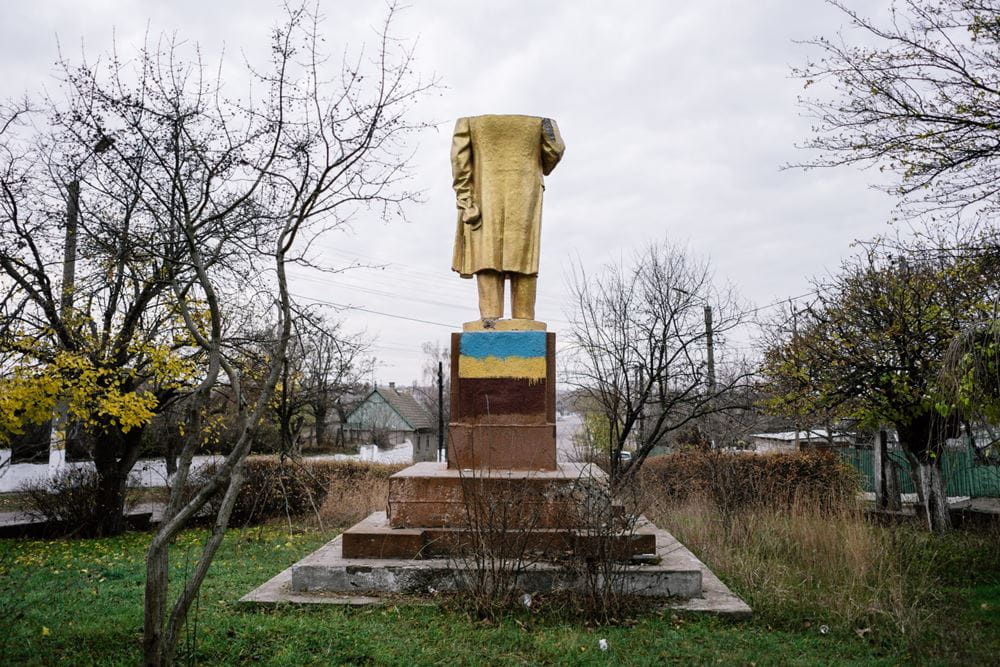
This nationalism has celebrated and legitimised fascist figures from its history (see above picture) and current political slogans from far-right organisations, going so far as to integrate their armed organisations into the state, and at times place significant figures in positions of power within the Government.  The significance of the far right has advanced under the banner of, and in lock-step with, wider Ukrainian nationalism.  It is not that mainstream Ukrainian nationalism and the state that promotes it have become fascist but that the mainstream has seen no need or want to separate itself from the far-right movement, which it has celebrated as its ‘best fighters’.

The Ukrainian state has faced a number of secessionist movements but the policy advocated by Lenin in dealing with such movements by offering the right of secession in order to forge democratic unity, as the best grounds for uniting its working class, has been rejected. When Ukrainian nationalism has demanded self-determination it has ignored its own responsibility to defend consistent democracy within the territory it claims.  Instead, it has moved further and further into alliance with the world’s greatest enemy of equality between nations – US imperialism and its NATO alliance.

In sum, there is no democratic content to Ukrainian nationalism and it cannot be defended.  If it currently wields hegemony, this is not only the responsibility of the far-right in the country, or the oligarchic and political factions who solidify their position with its support, but also due to the reactionary policy of the Russian state. This state can offer no democratic alternative because it too is headed by a corrupt and reactionary nationalist regime.  Between two such regimes the ‘instinctive and automatic rush to reach for the policy of self-determination of nations in order to justify the decision to support one side’, as explained in a previous post, is a betrayal of the working class of both nations.

The liberation of the Ukrainian working class will not be achieved in alliance with US imperialism, which is forging the strongest chains for this class through its superior economic and military power.  The utter dependency of Ukraine and its nationalists on US policy has now been firmly entrenched by the massive armed and associated financial support of the US.  Through this war Ukrainian nationalism has definitively made its country a client of the United States; so much for the promise of nationalism. 

Only by a struggle against this can the freedom of the Ukrainian working class be achieved, including in the East and South of the country, and only in conjunction with neighbouring countries including Russia.  This cannot be achieved by the US and NATO which seeks the permanent submission of Ukraine through radical diminution and debasement of Russia.

*                                  *                                  *

Unfortunately, some on the Ukrainian left acknowledge the reactionary character of US imperialism – ‘In this conflict, Russia can in no way be considered a different project than the US and the rest of the capitalist powers’ – but go on to frame the war as a purely anti-colonial struggle, with Russia as the imperial power.  ‘Ukraine needs to decolonize and de-Russify’, which neglects to explain how unity of the Ukrainian working class, including ethnic Russian workers with divided political loyalties, can be advanced.

Lip service is paid to ‘the centrality of Ukraine’s fight for independence from both Russian and Western Imperial domination’, and the war is presented as an ‘existential’ one for Ukrainians’ ‘very existence’, with war aims including the incorporation of Crimea and the Russian controlled Donbas republics under Kyiv rule.  Lenin’s policy of seeking unity through the right to secession isn’t on the table and the Ukrainian right to self-determination has simply become an example of the ‘refined nationalism’ that he warned against.

The article is therefore full of references to historic Russian oppression while defending Ukrainian ‘agency’ and ‘subjectivity’, all the while forgetting that it is now an independent state with its own capitalist structure and dynamics.  The war is framed as a national struggle, just as it is presented in the West; the war aims supported are those of the most rabid US neocon, and the current means of struggle by its capitalist state are endorsed.  How the war is understood, the appropriate war aims and means of struggle supported by Yuliya Yurchenko are the same as that of Western imperialism. 

What we have then is not a policy that will combat the most rabid forms of Ukrainian nationalism, which Yurchenko accepts is a real problem, even admitting the ‘risk [of] confirming Putin’s obscene lie that we are a nation of bigots and fascists.’  What it proposes is an idea that Ukrainian nationalism can be made progressive.  The problem with this is threefold.

First, Ukrainian nationalism is already presented as progressive in a very objective sense, although by no means only that, through the ‘spirit of collective solidarity’ that the war has inspired.  This is despite her acknowledgement that previous democratic protests and mobilisations have only led to the strengthening of different oligarchic factions and the far-right. She claims that ‘Russia’s invasion has stirred up a healthy degree of Ukrainian nationalism.’

Second, the view that a healthy nationalism can arise from the war understood in existential national terms is simply beyond any credible belief.  This is especially the case since Yurchenko’s war policy, being the same as the most reactionary nationalist, promises a ‘long fight’, one that can therefore be guaranteed to build up massive bitterness and resentment. The policy of reliance on imperialism and domestic austerity necessary to finance it, coupled with opposition to the right of minorities to secede, means that nothing progressive could emerge from such a war, unless it provoked a revolt against it and the policy behind it.  But Yurchenko is not proposing that.

Lastly, the idea that any sort of nationalism, however ‘healthy’, could be the cause that would carry the Ukrainian working class forward is simply absurd for the reasons enumerated in the previous paragraph.  Nothing in the answers given in Yurchenko’s interview indicates any strategy to expose the role of US imperialism or that of domestic capitalist and bourgeois political forces in bringing this war to the Ukrainian working class.  The war, she says, was ‘a completely unprovoked attack.’ Nothing about the moves towards joining NATO or the repeated attacks on the break-away regions in the Donbas. Nothing to indicate that the Ukrainian working class has separate interests in the war from its rulers.

‘Compromise’ is rejected and the Minsk peace process merely ‘so-called’ and also rejected.  There is no acknowledgement of any Ukrainian state responsibility for the failure.  Instead ‘we will not settle for anything less than the reunification and independence of Ukraine.’  How this can happen through subordination to the US and NATO is something she is no more able to explain that the rest of the Ukrainian nationalist spectrum.

Capitulation to nationalism means avoiding assignment of any responsibility, and hence any opposition, to domestic capitalism and its rotten state.

Ukrainian nationalism does not find any democratic content that justifies any defence of it just because some on the left support it, portray it as democratic, or think they can make it so.

Yurchenko declares that ‘the international left must put its decolonial hat on in thinking about Ukraine’; in other words, put on its blinkers and accept the progressiveness of a war backed by US imperialism, the corrupt Ukrainian capitalist state, and the ‘best fighters’ of the ‘Ukrainian resistance’–the fascists of the Azov regiment.

Whoever thinks there is any democratic content in this nationalist melange is irretrievably lost to the struggle for socialism.

Back to part 3

Forward to part 5

3 Lenin Against Nationalism

In the previous post we noted that capitalism extends itself across the globe, leading to both bigger capitals and bigger states and then to international economic and political organisation.  Inevitably small capitals and small nations suffer.  This does not mean that socialists seek to halt or reverse such processes.

Within the Great Russian Empire, with its prison house of peoples, Lenin advocated the closest relations between its nations and the united organisation of the working class movement.  In his article ‘Corrupting the Workers with Refined Nationalism’ he states that:

‘Marxists, stand, not only for the most complete, consistent and fully applied equality of nations and languages, but also for the amalgamation of the workers of the different nationalities in united proletarian organisations of every kind.’

How far this is from some of today’s ‘Marxists’ can be seen in their championing of the likes of Scottish nationalism or Catalan nationalism.  Where Lenin argued that socialists should demonstrate their proletarian internationalism through membership of united organisations, these left nationalists have demonstrated their nationalism by leading the way in splitting their own organisations along nationalist lines.

Lenin emphasises the need for unity in ‘On the National Pride of the Great Russians’:

“No nation can be free if it oppresses other nations,” said Marx and Engels, the greatest representatives of consistent nineteenth century democracy, who became the teachers of the revolutionary proletariat. And, full of a sense of national pride, we Great-Russian workers want, come what may, a free and independent, a democratic, republican and proud Great Russia, one that will base its relations with its neighbours on the human principle of equality, and not on the feudalist principle of privilege, which is so degrading to a great nation.’

‘Just because we want that, we say: it is impossible, in the twentieth century and in Europe (even in the far east of Europe), to “defend the fatherland” otherwise than by using every revolutionary means to combat the monarchy, the landowners and the capitalists of one’s own fatherland, i.e., the worst enemies of our country.’ 

‘We say that the Great Russians cannot “defend the fatherland” otherwise than by desiring the defeat of tsarism in any war, this as the lesser evil to nine-tenths of the inhabitants of Great Russia. For tsarism not only oppresses those nine-tenths economically and politically, but also demoralises, degrades, dishonours and prostitutes them by teaching them to oppress other nations and to cover up this shame with hypocritical and quasi-patriotic phrases.’

It is not necessary to endorse Lenin’s remarks about ‘desiring defeat’ or ‘lesser evil’ to appreciate the motivation of absolute opposition to the nationalism of Great Russia; the nationalism that lives on today in the pronouncements of Vladimir Putin but which is ideological garb draped over the body of the Russian state and oligarchic capitals that it is designed to protect.

Just as Marx supported the development of united nation states such as Germany and Italy, because this involved the internal overthrow of reactionary feudal privileges and restrictions, so he opposed national oppression within nations and looked to the progressive social forces within the oppressed and oppressor nations to achieve this free unity and benefit from it.  Lenin in this article mentions the ‘freedom and national independence for Ireland in the interests of the socialist movement of the British workers.’

The idea that in Ukraine any positive nationalist programme could issue from a corrupt capitalist state, one more and more the supplicant of US imperialism, and this spearheaded by its ‘best fighters’ who are fascists, shows the drastic illusions consuming many on the left. 

In relation to his opposition to Great Russian chauvinism, Lenin said that:

‘The objection may be advanced that, besides tsarism and under its wing, another historical force has arisen and become strong, viz., Great-Russian capitalism, which is carrying on progressive work by economically centralising and welding together vast regions. This objection, however, does not excuse, but on the contrary still more condemns our socialist-chauvinists . . .’

‘Let us even assume that history will decide in favour of Great-Russian dominant-nation capitalism, and against the hundred and one small nations. That is not impossible, for the entire history of capital is one of violence and plunder, blood and corruption. We do not advocate preserving small nations at all costs; other conditions being equal, we are decidedly for centralisation and are opposed to the petty-bourgeois ideal of federal relationships.’

He goes on to say that this does not mean supporting the capitalist political forces that promote this economic development.  However, it also means we do not seek to reverse it either.

In ‘The Revolutionary Proletariat and the Right of Nations to Self-Determination’ Lenin states that:

‘The Russian proletariat cannot march at the head of the people towards a victorious democratic revolution (which is its immediate task), or fight alongside its brothers, the proletarians of Europe, for a socialist revolution, without immediately demanding, fully and unreservedly, for all nations oppressed by tsarism, the freedom to secede from Russia. This we demand, not independently of our revolutionary struggle for socialism, but because this struggle will remain a hollow phrase if it is not linked up with a revolutionary approach to all questions of democracy, including the national question.’

‘We demand freedom of self-determination, i.e., independence, i.e., freedom of secession for the oppressed nations, not because we have dreamt of splitting up the country economically, or of the ideal of small states, but, on the contrary, because we want large states and the closer unity and even fusion of nations, only on a truly democratic, truly internationalist basis, which is inconceivable without the freedom to secede.’

Many of today’s ‘Marxists’ see in self-determination only separation and not the objective of unity.  They see the creation of new states where Lenin saw the unification of nationalities.  They think the right to secede mean support for secession when it is the means to provide guarantees to unification.  They think self-determination is only expressed by separation and creation of a new capitalist state when for Lenin it was the means for ensuring voluntary unity and the avoidance of such an outcome. Lenin advocated this policy even in the case of colonies.

In A Caricature of Marxism and Imperialist Economism Lenin writes that:

‘We demand from our governments that they quit the colonies, or, to put it in precise political terms rather than in agitational outcries—that they grant the colonies full freedom of secession, the genuine right to self-determination, and we ourselves are sure to implement this right, and grant this freedom, as soon as we capture power.’

‘We demand this from existing governments, and will do this when we are the government, not in order to “recommend” secession, but, on the contrary, in order to facilitate and accelerate the democratic association and merging of nations. We shall exert every effort to foster association and merger with the Mongolians, Persians, Indians, Egyptians. We believe it is our duty and in our interest to do this, for otherwise socialism in Europe will not be secure.’ 

‘We shall endeavour to render these nations, more backward and oppressed than we are, “disinterested cultural assistance”, to borrow the happy expression of the Polish Social-Democrats. In other words, we will help them pass to the use of machinery, to the lightening of labour, to democracy, to socialism.’

‘If we demand freedom of secession for the Mongolians, Persians, Egyptians and all other oppressed and unequal nations without exception, we do so not because we favour secession, but only because we stand for free, voluntary association and merging as distinct from forcible association. That is the only reason!’

The failure of Russia to offer a powerful and attractive example to Ukraine lies behind its turn towards invasion to substitute for this failure.  Undoubtedly this has divided the Ukrainian people themselves whose attempts to clean their own stables have been frustrated time and time again by oligarchic factions.

Through some of these factions the country has been turned towards the EU and NATO, membership of which its oligarchs and bourgeois political parties have attempted to impose even when the majority of the people have opposed it.  So, an unconstitutional Government signed an EU Association agreement and IMF loans, with their consequent massive implications for austerity, without any elections following the Maidan overthrow of the previous Yanukovych Government. The prime minister responsible, Yatsenyuk, admitted that “I will be the most unpopular prime minister in the history of my country . . .’

Three weeks before the ouster of Yanukovych the most popular opposition figure was Klitschko with a poll rating of 28.7% while Yatsenyuk didn’t even reach 3%.  Yatsenyuk however had the support of the United States, whose plans to put him in place were famously discussed in the leaked phone-call between US Deputy Secretary of State Victoria Nuland and the US ambassador Geoffrey Pyatt days before formation of the post-Maidan regime. 

The current divisions within Ukraine are not simply externally imposed but prove the failure and hypocrisy of nationalist claims to further national unity and oppose foreign interference.  In February 2017 a Gallop opinion poll recorded that more Ukrainians considered NATO a threat than a protection.  Nevertheless, the Ukrainian Government changed the constitution in 2019 to add a stipulation on “the strategic course” of Ukraine toward NATO membership.

This course has played no small part in causing the current massive escalation of war and making Ukraine utterly dependent on US imperialism, exposing all calls for defence of this state and its regime on the grounds of self-determination to be deceitful lies.

It is ironic that this subordination to the United States has been accompanied by, and is the product of, the growth of Ukrainian ultra-nationalism, proving that Lenin was right to warn that bourgeois nationalism will happily ally with external imperialism while demanding sacrifice from its own people.  This nationalism disguised as ‘self-determination’ has inevitably infected its left supporters in exactly the same way; we noted at the end of the previous post the absurdity of some on the left declaring that self-determination requires the ability of Ukraine to decide its own international alliances, including subordination within NATO.

The result of such subordination makes all talk of self-determination by the left while welcoming weapons from ‘anywhere’ – read NATO – not so much utter delusion, or even mistaken, but treacherous betrayal.  Having invited the US to determine the outcome of the war does this left really pretend the US will not determine the outcome of the peace? 

Back to part 2

Forward to part 4

2 What Lenin did not mean by self-determination of nations

In Ireland it has been common to hear left-wing nationalists claim that Marxists support the nationalism of oppressed nations.

In ‘Critical Remarks on the National Question’, quoted in the previous post Lenin writes:

‘The principle of nationality is historically inevitable in bourgeois society and, taking this society into due account, the Marxist fully recognises the historical legitimacy of national movements. But to prevent this recognition from becoming an apologia of nationalism, it must be strictly limited to what is progressive in such movements, in order that this recognition may not lead to bourgeois ideology obscuring proletarian consciousness.’

‘The awakening of the masses from feudal lethargy, and their struggle against all national oppression, for the sovereignty of the people, of the nation, are progressive. Hence, it is the Marxist’s bounden duty to stand for the most resolute and consistent democratism on all aspects of the national question. This task is largely a negative one. But this is the limit the proletariat can go to in supporting nationalism, for beyond that begins the “positive” activity of the bourgeoisie striving to fortify nationalism.’

‘To throw off the feudal yoke, all national oppression, and all privileges enjoyed by any particular nation or language, is the imperative duty of the proletariat as a democratic force, and is certainly in the interests of the proletarian class struggle, which is obscured and retarded by bickering on the national question. But to go beyond these strictly limited and definite historical limits in helping bourgeois nationalism means betraying the proletariat and siding with the bourgeoisie. There is a border-line here, which is often very slight and which the Bundists and Ukrainian nationalist-socialists completely lose sight of.’

‘Combat all national oppression? Yes, of course! Fight for any kind of national development, for “national culture” in general? — Of course not. The economic development of capitalist society presents us with examples of immature national movements all over the world, examples of the formation of big nations out of a number of small ones, or to the detriment of some of the small ones, and also examples of the assimilation of nations.’

‘The development of nationality in general is the principle of bourgeois nationalism; hence the exclusiveness of bourgeois nationalism, hence the endless national bickering. The proletariat, however, far from undertaking to uphold the national development of every nation, on the contrary, warns the masses against such illusions, stands for the fullest freedom of capitalist intercourse and welcomes every kind of assimilation of nations, except that which is founded on force or privilege.’

So we see the progressiveness of nationalism, as the political framework for the development of capitalism against feudal restrictions, but not as support for capitalist states or their various nationalisms that develop thereafter.  Thereafter, the development of capitalism creates a working class with the interests of this class the same across national borders and therefore opposed to the division of the class that nationalism entails.

Support for nationalism beyond the negative sense of opposition to national oppression is to capitulate to bourgeois nationalism.  Support against national oppression is limited to what is progressive in any nationalist movement and although there may be a border-line between this and betraying the working class to bourgeois nationalism, what we have in the approach of much of the left today is an instinctive and automatic rush to reach for the policy of self-determination of nations in order to justify the decision to support one state in any particular conflict.

Lenin’s ‘formula’ of self-determination of nations has been carried forward as the key to unlocking any national issue without regard to its historical limitation and by ignoring Lenin’s explicit subordination of this justification to the determining interests of the working class.  

Instead of the unity of the working class coming first, the demand for self-determination for a particular nation is placed beforehand, with the assumption that this leads to the former.  Since the demand for self-determination is a bourgeois democratic demand it cannot even on its own terms be seen to lead to the unity of the working class.  We have countless historical examples of self-determination being enacted through creation of new nation states with capitalist social relations and no progressive working class unity established.

Supporters of ‘Ukraine’ have, for example, said that ‘the people of Ukraine must be allowed to exercise freely their right to democratic self-determination, without any military or economic pressure’.  This has been accompanied with calls to cancel Ukraine’s foreign debt – ‘it is important in ensuring that, when they have reconquered their independence, Ukrainians won’t be even more dependent on creditors or domestic oligarchs over whom they have no control.’

But we have demonstrated that the demand for self-determination is not only not applicable to an independent country like Ukraine in this war, but is a capitulation to bourgeois nationalism, with the long quote above demonstrating why.

As Lenin says – self-determination is not support for anything other than the right to secede and form an independent state, and in doing so to reject feudal or dynastic chains such as were forged by the Tsarist, Ottoman and Austro-Hungarian Empires.  This will allow for the free development of capitalism by that particular state.  It is no job of socialists to uphold that state’s capitalist economic development that is built on the exploitation of workers, except in so far as we welcome this development by its creation of a working class that will overthrow it, and which more and more removes national differences.  It is therefore, not our job to seek to constrain such development through reactionary political projects such as Brexit or splitting already established states, such as Britain.

When left nationalists welcome that ‘Ukrainians’ have ‘reconquered their independence’ but complain that foreign debt must be also be cancelled, so that they won’t be dependent on foreign creditors or domestic oligarchs, they fall exactly into the camp of bourgeois nationalism.

Firstly, the cancellation of past debt will without doubt be followed by incurring new debts, debts that will be paid from the surplus produced by Ukrainian workers who will not be free and independent of either this debt or the domestic oligarchs, who can only be disposed of through socialist revolution and not mitigation of foreign loans.  It is no job of socialists to defend the capitalist development of smaller or weaker capitalist states as if they are somehow oppressed and exploited when the real exploitation involved is class exploitation.

While, on its own, socialists will not object to the cancellation of foreign debt (but why just foreign? what would these socialists demand if the debt was gifted to domestic creditors? ) this cannot be as part of support for a programme of capitalist economic development.  To repeat, for us the development of capitalism is of benefit because it creates the working class, and its greater development objectively prepares this class for its historic task of becoming the new ruling class and undertaking the task of abolishing class altogether. 

The capitalist development of new nations inevitably involves insertion into a world system that will rob the innocent of any illusion that their nation is really independent of the forces that determine its future.  Overwhelmingly these forces are based on the interests of the most powerful states and the largest capitals.  Just as big capitals destroy small ones within the framework of their own state, these capitals get too big for the nation state and seek existence across states, creating multinational capitals and multinational para-state bodies, which determine the fortune of smaller states and smaller capitals. 

In attempting to counter such forces Lenin goes on to say that ‘Consolidating nationalism within a certain “justly” delimited sphere, “constitutionalising” nationalism, and securing the separation of all nations from one another by means of a special state institution—such is the ideological foundation and content of cultural-national autonomy. This idea is thoroughly bourgeois and thoroughly false.’

‘The proletariat cannot support any consecration of nationalism; on the contrary, it supports everything that helps to obliterate national distinctions and remove national barriers; it supports everything that makes the ties between nationalities closer and closer, or tends to merge nations. To act differently means siding with reactionary nationalist philistinism.’  This is the ground on which socialists oppose all varieties of nationalism and oppose reactionary national movements.  

In one Facebook discussion a supporter of the Ukrainian state argued that self-determination required the ability of Ukraine to decide its own international alliances.  When someone tries to argue that socialists should fight for the right of a capitalist state to join an imperialist alliance such as NATO you know you aren’t dealing with any sort of socialist, and certainly not arguing with support from Lenin’s formulation of self-determination of nations.

to be continued

Back to part 1

Forward to part 3

1 What did Lenin mean by self-determination of nations?

A recurring theme of those backing the Ukrainian state in the current war is reliance on  Lenin’s support for the right of nations to self-determination.  It is the purpose of this and the following posts set out what this policy was.

In 1903 Lenin wrote ‘The National Question in Our Programme’ in which he set out its meaning to those who ‘did not find this demand sufficiently clear’, something that needs to be attempted again over a century later.

He wrote that the demand to be clarified was the “recognition of the right to self-determination for all nations forming part of the state.”  He explained it in this way:

‘The Social-Democrats will always combat every attempt to influence national self-determination from without by violence or by any injustice. However, our unreserved recognition of the struggle for freedom of self-determination does not in any way commit us to supporting every demand for national self-determination.’

‘As the party of the proletariat, the Social-Democratic Party considers it to be its positive and principal task to further the self-determination of the proletariat in each nationality rather than that of peoples or nations. We must always and unreservedly work for the very closest unity of the proletariat of all nationalities, and it is only in isolated and exceptional cases that we can advance and actively support demands conducive to the establishment of a new class state or to the substitution of a looser federal unity, etc., for the complete political unity of a state.’

The main points of this clarification of the responsibilities of the socialist party bear repeating:

  1. ‘its positive and principal task to further the self-determination of the proletariat in each nationality rather than that of peoples or nations.’
  2. ‘We must always and unreservedly work for the very closest unity of the proletariat of all nationalities.’ and
  3. ‘it is only in isolated and exceptional cases that we can advance and actively support demands conducive to the establishment of a new class state or to the substitution of a looser federal unity.’

In relation to Ukraine, it is an independent state, it is not part of a separate state so the question of whether socialists ‘can advance and actively support demands conducive to the establishment of a new class state’ does not arise.

So if this passage does not support application to it of the “recognition of the right to self-determination . . . ” in respect of Ukraine, this does not at all mean that the passage has no relevance.  For it advances the view that the ‘principal task [is] to further the self-determination of the proletariat in each nationality rather than that of peoples or nations’ and that this is to be done through seeking ‘the very closest unity of the proletariat’.

The role of this policy at the time Lenin wrote is explained in reference to the situation in Poland; that 

‘Class antagonism has now undoubtedly relegated national questions far into the background, but, without the risk of lapsing into doctrinairism, it cannot be categorically asserted that some particular national question cannot appear temporarily in the foreground of the political drama.’  

He goes on:

‘In including in its programme recognition of the right of nations to self- determination, it takes into account all possible, and even all conceivable, combinations. That programme in no way precludes the adoption by the Polish proletariat of the slogan of a free and independent Polish republic, even though the probability of its becoming a reality before socialism is introduced is infinitesimal.’

‘The programme merely demands that a genuinely socialist party shall not corrupt proletarian class-consciousness, or slur over the class struggle, or lure working class with bourgeois-democratic phrases, or break the unity of the proletariat’s present-day political struggle. This reservation is the crux of the matter, for only with this reservation do we recognise self-determination.’

Lenin may be criticised (in retrospect) for unjustified optimism on the prospects for socialism, and it is clear that the context of the class struggle affects the application of the policy, but neither of these considerations justify the widespread application of this policy today, which is used to advance the argument that Ukraine should be considered to avail of it like every other country.  Rather, the numbered priorities above renders its widespread application untenable and the particular circumstances of Ukraine, and its alliance with imperialism, render it least applicable to that country.

In general the increased economic development of previously economically backward countries; the consequent enormous development of the working class and therefore potential for class struggle, and the disappearance of nearly all colonial possessions, means that the above numbered priorities have even greater salience today.

In 1913 Lenin noted in ‘The Working Class and the National Question’ that ‘In our times the proletariat alone upholds the real freedom of nations and the unity of workers of all nations.  For different nations to live together in peace and freedom or to separate and form different states (if that is more convenient for them), a full democracy, upheld by the working class, is essential.’

This was written while Lenin believed that the coming revolution in the Tsarist Empire would create a democratic dictatorship of the workers and peasants and not a socialist revolution. 

In ‘Theses on the National Question’ written in 1913 Lenin explained specifically what the programme of the Party meant: ‘The article of our programme (on the self-determination of nations) cannot be interpreted to mean anything but political self-determination, i.e., the right to secede and form a separate state.’ (emphasis added -SM)

He then went on to state its application, including considering ‘the fact that throughout Eastern Europe (Austria and the Balkans) and in Asia—i.e., in countries bordering on Russia—the bourgeois-democratic reform of the state that has everywhere else in the world led, in varying degree, to the creation of independent national states or states with the closest, interrelated national composition, has either not been consummated or has only just begun.’

This meant that socialists should ‘be unconditionally hostile to the use of force in any form whatsoever by the dominant nation (or the nation which constitutes the majority of the population) in respect of a nation that wishes to secede politically.’  Again, we can see that we are not speaking of socialists defending the prerogatives of an already independent capitalist state.

Instead Lenin warns ‘Social-Democracy, therefore, must give most emphatic warning to the proletariat and other working people of all nationalities against direct deception by the nationalistic slogans of “their own” bourgeoisie, who with their saccharine or fiery speeches about “our native land” try to divide the proletariat and divert its attention from their bourgeois intrigues while they enter into an economic and political alliance with the bourgeoisie of other nations and with the tsarist monarchy.’

In the case of Ukraine, this quote reminds one of the ‘saccharine’ and ‘fiery’ speeches of Volodymyr Zelensky and that the working people of that country are paying for the intrigues of its current ruling class and its alliance with NATO and western imperialism.  This policy has historically been against the opposition of the majority of the Ukrainian people; but it is testament to the thoroughly reactionary character of the Russian invasion and previous Russian policy that these have driven many to now support NATO membership who previously did not.  However, as Lenin notes, it is not socialist policy to absolve the Ukrainian people’s bourgeois leadership of its criminal policy never mind rally behind it.

That Lenin supported self-determination, the right to secede and form a separate state, did not mean that he favoured it, quite the contrary.  In a letter in 1913, in relation to the right to federation and autonomy, he wrote:

“Right to autonomy?” Wrong again. We are in favour of autonomy for all parts; we are in favour of the right to secession (and not in favour of everyone’s seceding!). Autonomy is our plan for organising a democratic state. Secession is not what we plan at all. We do not advocate secession. In general, we are opposed to secession.’

In ‘Critical Remarks on the National Question’, also written in 1913 Lenin writes:

‘If a Ukrainian Marxist allows himself to be swayed by his quite legitimate and natural hatred of the Great-Russian oppressors to such a degree that he transfers even a particle of this hatred, even if it be only estrangement, to the proletarian culture and proletarian cause of the Great-Russian workers, then such a Marxist will get bogged down in bourgeois nationalism. Similarly, the Great-Russian Marxist will be bogged down, not only in bourgeois, but also in Black-Hundred nationalism, if he loses sight, even for a moment, of the demand for complete equality for the Ukrainians, or of their right to forum an independent state.’

Ukraine is already an independent state, but it is not in the interests of Russian workers that the Russian state invade Ukraine in the interests of its great power pretensions, however relatively strong or weak either state may be.  Neither can the invasion be justified by reference to claims to ensure geopolitical security.  For socialists, however much they can be referenced to explain the actions of the Russian state, they in no way justify it. Socialists are not beholden to the security claims of capitalist states.  Many ordinary Russians have courageously publically opposed the war and this has been welcomed by many Ukrainians.

But this is not enough, as Lenin implies.  It is not enough for Ukrainian workers to oppose Russian aggression as some brave Russians have done. Just as these Russians have opposed their own ruling class and its state so must Ukrainians do the same and oppose their own rulers.  These rulers have quite easily whipped up the most extreme nationalist poison against everything Russian so that in the West even Russian artists and athletes have been assigned responsibility for the invasion and sanctioned.  In Ukraine itself this nationalism has gone as far as mobilising the most reactionary armed forces, including outright fascists whose hatred of all things Russian can guarantee nothing but death.

to be continued

Forward to part 2