Crisis? What Crisis? part 2 – the Tories become the workers’ friend

theresaSome people might object to the view expressed in the previous post that the Tories are intent on even more drastic austerity – after all hasn’t the new Chancellor scrapped the target for achieving a budget surplus by 2020?  And as one Tory official is reported to have said – “perhaps only a Tory government can save capitalism from itself.”

And hasn’t Theresa May gone even further than this?  Hasn’t she said she will make capitalism fairer for workers, crack down on corporate greed, promote state intervention, provide for more workers’ rights and put “the power of government squarely at the service of ordinary working-class people.”  Hasn’t she criticised uncaring bosses, tax-avoiding multinationals and directors who took out “massive dividends while knowing the company pension is about to go bust”?

Yes of course, she has gone further, but none of these steps are necessary for a Tory government “to save capitalism from itself” and the chances of a Tory government putting “the power of government squarely at the service of ordinary working-class people” is zero.  So what is going on?  Is it just a case of ideology being employed, not to unconsciously blind the beholder, but consciously to blind those naive enough to believe Tory lies?

Before I answer this it is useful to make two observations. First, the language of the Tories shows how bankrupt the anti-Corbyn forces in the Labour Party are – afraid to mention class while the Tories outflank them from the left.  Just how much of a future would the Labour Party have if it stood permanently exposed on the left by a Thatcher Mark II?  What future would it have to endlessly repeat an approach symbolised by allowing cuts to disability benefits to go through only for the Tories to then scrap them?  Would the Labour right have wanted to abstain on scrapping them as well?

The second point is that this Tory rhetoric is described, by the same political commentators who got Brexit wrong, as the Tories moving against the Labour Party by ‘moving to the centre ground’.  This is almost as funny as their voting for Cameron while opposing Brexit.  Since when did promoting workers’ rights and cracking down on corporate greed, even if only verbally, been the centre ground – surely this is moving to the left?

And to answer the question – of course it’s moving to the left, and its only became the centre ground since Jeremy Corbyn arrived from Mars to become leader of that part of the British people regarded as swivel-eyed-mad-lefties by the media.  But of course it is also claimed he leads an ineffective opposition – despite him causing the ‘centre ground’ to shift leftwards.

It’s difficult to know whether this ridiculous view of the Tories’ approach is unconscious ideological self-deception – that the political battle is always fought on the centre ground –  without pausing to think just where this ground might be; but I tend to think that it’s more likely to be cover for the fact that the political commentators who write such rubbish know that it’s all Tory rhetoric without any chance of being implemented.  If the Tories have moderated austerity it is only because they fear they have to because, as we have seen, a Tory government is necessary “to save capitalism from itself”, or rather a new Tory government is necessary to save the country from the last Tory government.  But then, even the last Tory government carefully implemented austerity and extolled its virtues only to ensure it could continue as a political weapon and as an economic policy option that fitted an ideological agenda.  They were well aware, or at least some of them were, of the limits of a policy that involved bleeding the patient to death.

The case for this new Tory tilt to the left being a conscious attempt to blind those naive enough to believe Tory lies is supported for two reasons.  First, a ‘sovereign’ UK outside the EU will slip down the global power rankings like a stone.  It will be too big to ignore but too small to decisively shift its environment to its benefit.  The EU cannot afford to indulge its delusions of greatness because it’s big enough to matter but not big enough to influence the EU to submit to its claims or demands.  Some Tories might believe it can trade with the rest of the world while turning its back on those next door – that it already has almost half its trade with – but it requires outside investment to pay its way and this can only come through modelling itself as an attractive centre for foreign investment.

To do this will not entail the reassertion of British sovereignty but will expose its weakness and expose its lack of sovereignty.  The inability of relatively small and even medium sized states to interact in the world mainly to their benefit is precisely why larger economic blocs like the EU were formed.  The world will not change its rules because the British don’t like them.  The British state will therefore become weaker with less capacity to intervene and the economy it has to intervene into will be even more in need of assistance.

to be continued

Back to part 1

Forward to part 3

Fight for Jeremy Corbyn!

corbyn imagesIn one of the post-Brexit debates on Irish social media a supporter of the Socialist Party in Ireland claimed that one of Corbyn’s two mistakes was that he hadn’t tried to build outside the Labour Party.  For sheer blind chutzpah this isn’t bad.

Immediately after the UK elections I wrote the following:

“Right now the opportunity exists to have a debate in front of working people about the wide range of policies that they need to advance their interests.  This arises from the debate on who will be the replacement leadership of the Labour Party.  It will not of course be a debate pitting a pure revolutionary programme (however understood) against a cowardly watered down Keynesianism.  But what could ever lead anyone to expect that?  This is where the working class is at and no amount of wishful thinking will make it otherwise.  Will those organisations claiming to be Marxist be able to place themselves in the middle of this debate?  Will they even want to? The debate will happen anyway and many will look to it for a new way forward beyond the despair that the new Tory regime will inevitably create.”

Of course the left organisations ignored the Corbyn phenomenon until they noticed the world was passing them by, whereupon they suddenly discovered that the world was passing them by.  Now Corbyn and his supporters are criticised for not creating a mass anti-austerity movement and not kicking out all the Blairite MPs immediately.

In a world in which the fundamental problem for working people has been a “crisis of working class leadership”, i.e. workers have not found their revolutionary leaders (for nearly 80 years now – how on earth could this be possible?); for this view all that is required is for a political leadership to decide something and it sort of happens, just like that.  Think of the US TV series ‘Bewitched’ (look it up if you’re too young).

Having contributed nothing, not even awareness of what was at stake after the election, they think Corbyn can magic up a mass movement and upend the whole Labour Party in less than a year.  We’re expected to believe the push to kick him out has been a surprise to him.

Now the immediate and medium term fate of socialist forces in Britain is overwhelmingly being determined by the fight to keep Jeremy Corbyn as leader of the Labour Party.  All the criticisms that he is an electoralist is so much irrelevance because this fate will likely depend on an election, one in which the left group members don’t have a vote.

Of course it is correct to criticise Corbyn for being a reformist who is opposed to a total transformation of a capitalist society that can only be achieved in a revolutionary fashion but this is the sheerest hypocrisy from the members of these groups, and here’s why.

For the last few decades these parties have claimed that the problem is a crisis of working class representation arising from the move of social democracy to the right, leading to the political death of the Labour Party; no longer a working class party in any sense and no longer a viable vehicle for workers to struggle from.

So their bright idea was to replace the Labour Party with themselves as the social democratic alternative: in effect a new Labour Party still standing on a Keynesian economic programme.  All the while displaying their new found talent for bourgeois politics by failing to openly present what is supposed to be their real politics, or what they consider to be Marxism, rather like bourgeois politicians who promise one thing but mean quite another. It’s almost as if they stole the Labour party’s old clothes only to find Corbyn appear on the stage with the Labour Party’s genuine old clothes.

Now they have the cheek to criticise Corbyn, who in less than a year has inspired a movement that dwarfs the fruits of their years of effort, on a programme not qualitatively different from their own, while still failing to register the importance of what is happening.

We all make political mistakes but we learn from them.  Since the left organisations never admit to political mistakes they never learn.

Worse still, they have contributed to the disastrous threats that now threaten British workers by having supported Brexit and the tide of reaction it has unleashed.  Like cynics who know the price of everything and the value of nothing they know, or rather think they know, how to destroy capitalism but not a clue how to create socialism.  They know what they are against but are incapable of saying what in the real world, the world that exists now, they are for. They now prattle on about a political crisis oblivious of the nature of that crisis and how well placed the working class is to resolve it in its interests.

Once again they remain blind to the real world, describing the referendum as a workers revolt, “a revolt . . against the people at the top of society”.  This overwhelmingly nationalist ‘revolt’ heavily saturated by racism and xenophobia can, according to ‘Socialist Worker’, “be dragged left or right.  The right will ty to use the Leave vote to deepen racism.”  All this in a leaflet entitled ‘Unite to Shape Revolt against Establishment.’

Once again they’re a bit late.  The Leave campaign started off very right wing but managed to shift even further right the longer it went on.  The Leave campaign has already deepened racism – turn on your TV and watch the news to see its effects.  So who exactly are they going to unite with? Who?  Even ‘Socialist Worker’ had to admit that “#Lexit – the Left Leave campaign we were part of – had only a marginal effect” and that’s being generous.   So who do they think did have an effect?  How did “the campaign get dragged to the right?  Through whose influence?

And what’s their alternative?

They think that Labour should have joined the Leave campaign, a ‘tragedy’ it didn’t.  Apparently it would have “transformed the debate to be far more about democracy, breaking from austerity . . .” an admission of the real character of the real Leave campaign that wasn’t about democracy and wasn’t about breaking from austerity.   Their alternative is the next ‘big’ demonstration in October at the Tory conference and “a general election now.”  But who on earth would they vote for?

The referendum campaign demonstrated the growth of reactionary sentiments in some working class areas presided over by Blairite MPs, in other words demonstrated the importance of that Party, and the importance of a victory for Corbyn as leader of that Party.  The struggle in the Labour Party is not therefore simply an internal matter even if it is the fight inside the party that will decide.

In this fight the Blairite careerists have launched a premeditated and calculated campaign using a mass media that brazenly shows little pretence at balance.    The purpose of this mass media is to make people feel isolated, alone and despondent; that their left wing views are marginal and that all they can do is accept whatever media friendly candidate the Blairites finally unite around.

As I type these words Channel 4 news reports on a demonstration in Edinburgh in favour of Remain and some nationalist says he feels zero per cent British.  Immediately the camera cuts to an unofficial demonstration at Westminster by predominantly young people also demanding Remain.  The obvious lesson – unity, the obvious lesson for nationalists – separation; although now they will find it a tad more difficult to use ‘London’ as some sort of swear word and they will be fighting with that dirty label ‘unionist’ as supporters of the European Union.

The only credible vehicle of such unity now is a Labour Party led by Jeremy Corbyn but that party is now split and will split.  The mass membership will not stay in a party that overturns its democratic decision, that seeks to turn its back on opposition to austerity and seeks to join the movement that scapegoats immigrants.  Equally there is no room for careerist MPs in a Corbyn led Labour Party, MPs who would rather see the Party lose than see it win under Corbyn.  This being the case there is no room for unity.

If the Left wants to do something useful it should re-evaluate its disastrous association with a reactionary cause and throw its weight into fighting in the Labour Party to defend the movement that has given hope to many millions.  Millions that they otherwise have no hope of reaching.

Their Marxism should be the most internationalist, the most alive to the needs of young people, of the workers and its movement; in so doing being the most attractive to all those seeking an alternative to the current system.

“In what relation do the Communists stand to the proletarians as a whole?

The Communists do not form a separate party opposed to the other working-class parties.

They have no interests separate and apart from those of the proletariat as a whole.

They do not set up any sectarian principles of their own, by which to shape and mould the proletarian movement.

The Communists are distinguished from the other working-class parties by this only: 1. In the national struggles of the proletarians of the different countries, they point out and bring to the front the common interests of the entire proletariat, independently of all nationality. 2. In the various stages of development which the struggle of the working class against the bourgeoisie has to pass through, they always and everywhere represent the interests of the movement as a whole.”

(Karl Marx, The Communist Manifesto)

Reflections on Brexit

EU referendumMy daughter wrote in her Facebook page that “I’ve attempted to write how disappointed and shocked I am over the results and I just can’t put it into words.”

My partner said she struggled to get to sleep because she was worried about Brexit, while earlier in the day she had long text conversations with her English cousins who were apologising for the result and (jokingly?) asking if they could come and live in Ireland.

In my office I signed an application for an Irish passport for someone who wants to retain EU citizenship and the freedom of movement it brings, while my partner says she’s going to stop calling herself Northern Irish and will also apply for an Irish passport.  Even in unionist areas applications for them have risen dramatically.

These personal responses to the Brexit vote are instinctive, since we don’t know exactly the changes coming down the line.  None of them are in themselves a political response in any real sense although they are healthy personal reactions.  However they aren’t answers.

Will the EU allow citizenship to those who are citizens of a state, the UK, that is not a member of the EU so that they could be both a citizen and non-citizen of the European Union?

Even assuming you wanted and were able to move to the Irish State the issues of nationalism, the EU and austerity would follow you.  The EU sent the Troika to impose austerity but thinking the Irish state can be some sort of protector is insane when you recall it would rather bankrupt itself than let down the gambling French and German bank bondholders.

And consider this: how fair is it that just because your parents were Irish you are entitled to Irish citizenship while children actually born in the Irish State are denied such citizenship?

The lovable and cosmopolitan Irish had their own referendum in 2004 in which they voted not to allow automatic Irish citizenship to children born in Ireland of foreign migrant (read – black) parents who were ‘obviously’ coming to Ireland to gain citizenship and residency for their whole family.  It was brutal and it was racist and the Irish voted almost 80 per cent in favour of it.

Today, after the Brexit vote, we have faced the smug and reactionary mug of Nigel Farage boasting that “real” and “decent” people have won “without a shot being fired” while these decent people are now emboldened to repeat xenophobic and racist comments to reporters, where previously they repeated them only in private.  The family and friends of the Labour MP murdered by a right wing zealot declaring ‘Britain First’, a rallying cry of the Brexit campaign, may stand shocked and horrified at the claim that not a shot has been fired.

Last night a TV reporter stated how difficult it has always been to get people on the streets to respond to political questions but that now in this Brexit town everyone was prepared to speak.  But of course now nationalist prejudice has been validated; it is now legitimate to repeat bigotry because the Brexit campaign won, it is the majority, its campaign was successful and it will now govern.

That this was a victory for the most reactionary forces is understood by many, and understood in the responses recounted at the start of the post, even by people who aren’t particularly political.  Not only was the campaign reactionary but so also are its consequences, including an invigorated Tory Party, soon under an even more reactionary leader; a rancorous exit procedure that will stir up xenophobic feeling even more; and further accommodation to racist attitudes by Blairite MPs who are plotting against Jeremy Corbyn.

So while the motives for the Brexit campaign have been reactionary and its campaign became even more so as it went along for some, despite all this, it must be considered  as some sort of workers’ revolt against austerity and denial of democracy.  Even Farage has claimed it was a campaign against the establishment, “against the multinationals” and “against the big merchant banks”. This, from an ex-City trader!  But it is no truer when mouthed by the left than it is when claimed by Farage.

Some on the Left have looked on the Brexit majorities in some working class towns and hailed this alienation from the political system as progressive, merely distorted somewhat by anti-immigrant attitudes but nevertheless a healthy revolt.  Since many of the same people also hailed the nationalist illusions of many Scottish workers in the Scottish referendum this creates something of a problem for their view of the world. I have yet to see a rationale for both a vote to remain by Scots and a vote to exit by the English both being valid expressions of opposition to the establishment.

I have also yet to hear what these left nationalists have to say about the millions of workers – including two thirds of Labour Party voters, in London, Manchester, Liverpool and Scotland who voted to remain, who obviously also oppose austerity but who refused to blame immigrants for their problems.  I doubt very much they have many great illusions in the EU either, certainly their leader Jeremy Corbyn gave them no reason to have any, and I don’t recall anyone saying the EU was wholly progressive.  Except of course the Blairite MPs who want to get closer to the one-third of Labour voters who endorsed the bigoted Leave campaign and get further away from the two-thirds who rejected its reactionary appeal to nationalism.

Which brings us to yet another reactionary consequence of the referendum – the renewed, but not entirely confident, demand for another Scottish referendum: a case of maybees aye, maybees naw.  After all, even the most wilfully blind Scottish nationalist is going to wonder how the Scottish state will finance state services with the price of oil through the floor.  Another Scottish nationalist vote against austerity that inevitably inflicts austerity is exactly the same sort of non-solution English workers voting Brexit have just embraced.

So Scottish nationalists, having played the nationalist card and lost, see English nationalists play their own and have responded in kind.  Like the Irish who have forgotten their own shameful racist referendum, Scots nationalists regard other peoples’ nationalism as ugly and their own always attractive.  Except for some really lost people on the left who now seem to regard all these nationalisms as healthy, at least underneath it all, and sometimes not even underneath.  Like most left nationalists they have left wing opinions and right wing politics.

Returning from work on Friday evening I had my MP3 player on, listening to the media show on Radio 4 in which some BBC editor was making a poor show of defending himself against the charge of one listener/viewer who said the BBC unduly emphasised the Tory versus Tory argument in its referendum coverage. Five minutes later the PM news programme headlines carried statements from Cameron, Sturgeon, Boris Johnson and a couple of others but not Jeremy Corbyn.  No wonder BBC pundits claim Corbyn didn’t do enough!

Like some on the Left they have an outsiders view of what is going on in the real world, where some workers are voting for racism but somehow are never themselves racist while workers who reject scapegoating are written out of the picture, swallowed up in categories such as youth, metropolitan elites or middle class because some of them have a good job.  Only voters against immigration apparently express genuine alienation while the others have uncomplicated pro-EU views.

But they, and the near 50 per cent who voted Remain, are the hope for the immediate future in this bleak hour.  The left that supported Brexit can get lost chasing an ‘anti-austerity’ vote consumed by reaction while the former is the basis for stemming the tide of reaction.  The anger expressed on social media, the barracking of Johnson as he travelled to his victory press conference, signal that though there has been initial despair this can translate into anger that can transform into action.

That the campaign was portrayed primarily as a Blue on Bluey fight, which of course was its catalyst, reflects deep divisions in the Tory party, although this is no time for purveying false confidence on this count.  The Tories heightened class consciousness has given them a keen sense of self-preservation and understanding of the need for unity.  Now that UKIP has achieved its programme many of these reactionaries may return to their Tory home.

However precisely because it is the Tories who wrought this overturning of the existing arrangements it is they who will have to account for it and all its looming failure to deliver on its promises.  Already the £350bn to the NHS has been dropped.  The reaction of EU leaders to the hope for a slow exit negotiation process is a warning that the other EU states have no incentive to pander to the requirements of a party that has threatened their project.  The arrogance of British nationalism will clash against the reality of Britain’s much reduced power in the world that has been reduced further by the vote.  Now more than ever the British state is reliant on “the kindness of strangers”, as the Governor of the Bank of England put it, in particular the US. The latter has no reason to disrupt the UK economy, particularly now, but now less reason to give it any privileged protection.

So if the Tories have the potential to split, and will be under stress for their responsibility for Brexit and all it will entail, it is the Labour Party and wider British labour movement that alone offers hope to the nearly half the voters who voted Remain, and even to those who opposed austerity by blaming immigration. Most unions supported Remain and in my own little part of the world, my own union NIPSA, which voted Brexit, got some considerable grief from many members who first heard of the debate after the decision was publicised.  In this decision it aligned itself with that bastion of progressive thought in Ireland – the Democratic Unionist Party.

The centrality of Corbyn to this fight is illustrated by that steadfast and trusted friend of the labour movement, Polly Toynbee in ‘The Guardian’ today:

“Jeremy Corbyn faces an immediate leadership challenge after a performance that was dismally inadequate, lifeless and spineless, displaying an inability to lead anyone anywhere. What absence of mind to emphasise support for free migration on the eve of a poll where Labour was haemorrhaging support for precisely those metropolitan views.”

These ‘metropolitan’ views are socialist views, it’s called freedom. Like all liberals, Toynbee will defend it except when it’s under attack.  Corbyn, to his eternal credit, defended it when every other leading politician was uttering weasel words of exclusion and discrimination.  Having defended these principles it is up to all those who voted Remain to defend him from the blinkered and opportunist attacks of Blairite MPs who would rather see a Tory victory than a Labour victory under Corbyn.

It is speculated that a general election will arise when the new righter-than-right Tory leader takes over, supposedly to give him or her a mandate but equally to protect them from the developing failure of a Brexit project that will breed disappointment and anger.  It is also speculated that this failure, and the anger that will flow from it, will not rebound on the promoters of this crazed project but will intensify antagonism to the already identified scapegoat – immigrants, ethnic minorities and foreigners.  But this is not inevitable, or at least the scale of it certainly is not.  But to ensure it is minimised and defeated requires a working class alternative based on those workers who have already rejected it, as many as possible of whom should be organised into the labour movement.

The underlying weakness of the Brexit project is revealed in its reliance on xenophobia and prejudice because it has no strong rationale of its own.  It will fail to make good its promises, which is why some have been deserted so quickly.  This weakness is reflected in the incredulity of some Leave voters that they actually won. More than one has revealed that they doubt they have made the correct decision.

The evening before the vote I heard an interview with two intending Leave voters who said they were ‘voting with their heart and not their head’; an admission that they couldn’t defend their decision.  This is not to say that the majority who voted leave are unsure, many are dyed-in-the-wool nationalists or even racists but many will not be.  But what will not convince them that they are wrong is the proposal from Toynbee, Blair, Mandelson and all the other career politicians that actually they are right!

The majority of young people voted Remain, another reason for hope.  The millions of EU citizens in the UK are also a reservoir of support.  Claims by the Leave campaign that their rights will be protected are exposed by the fact that they weren’t allowed to vote.

There are therefore some grounds for hope in what is an otherwise depressing situation.  But I am reasonably sure that my grounds for hope are stronger than the optimism that it must be assumed is felt by those lefties who ‘won’ through supporting Brexit.  Lexit was a failure.  The left case for Brexit or whatever you want to call it was and is miserable.

The Socialist Party (SP) in Ireland has claimed that the creation of an EU border in the middle of Ireland will not mean a “hard border” because the common travel area between the UK and the Irish State pre-dates EU membership.  They fail to recognise that both jurisdictions were then outside the EU; they were then both in and shortly one will be out. The only chances that there will not be a hard border is if the EU doesn’t care about its borders, the Brexit campaigners don’t care about immigration or they decide to keep all the Paddies at arms lengthy by putting the hard border at Holyhead, Stranraer, Glasgow airport or Heathrow etc.

The SP make the frankly nonsensical statement that “there is nothing genuinely internationalist about the EU.”  Where do you start with this?

Well you start with capitalism as it exists and fight to make a socialist society based on capitalism’s already international development, not try to wind the clock back to an earlier period that actually never existed.  In this the supporters of Lexit are the same as Brexit – pining for a mythical national development that, even were you to attempt to return to it, would lead forward again to internationalism.  The fact that the EU is an international  political arrangement of international capitalism makes the statement that the EU is not internationalist simply a stupid thing to say.

It may not be our internationalism but the nationalist socialism of the SP is not genuine internationalism either.  The failure of the Lexit campaign means that they may have been on the right side of the result but were on the wrong side of the campaign.  They too, just like the Tories, can look forward to telling us how the evolving exit from the EU is such a great step forward, for them supposedly for working people and for socialism.  Both promised money for the NHS and not the EU and that promise is as worthless from both.

What those disappointed by the result should do now is not simply put down in words how gutted they are but think for a while and put down what they think could be done to make things better.  Even working to understand the issues better is a contribution because out of understanding comes a realisation that there is an alternative and knowing this is an invitation to make it happen.
Fighting terrorism after Paris

_86692951_86692950One expression of the dogmatic campaign that has followed the terrorist attacks in Paris is the near hysterical reaction of politicians and media in Britain to Jeremy Corbyn’s reply to a question on support for a police shoot-to-kill policy, that he ‘would not be happy with it’.

This has evoked an opportunist and cynical moral outrage that seeks to marginalise opposition to repressive measures by making everyone feel that, of course, the very idea of opposition to such an idea is crazy.  Yet when you look at the question asked, Jeremy Corbyn would have had to be crazy to answer it in any other way – ‘would you be happy to order the police to shot to kill.’

So a politician orders the police to adopt a shoot-to-kill policy, a licence-to-kill, that, if it were to mean anything other than incoherent frothing at the mouth, would mean rewriting the law by simply ignoring it.

All obviously in the course of defending our liberties and the rule of law.  Giving the police the prior authority to kill in advance ‘of split-second decisions’ (what a contradiction that is for a start) is held up as defence of western civilisation.

Jean Charles de Menezes at Stockwell station on CCTV........pic by Gavin Rodgers/Pixel 07917221968

Jean Charles de Menezes at Stockwell station on CCTV……..pic by Gavin Rodgers/Pixel 07917221968

Has the name of John Charles de Menezes slipped from everyone’s memory already?  Isn’t it revealing that the same BBC that only five months ago was reporting the tenth anniversary of his murder are demanding  that just such an approach to policing is made the benchmark of a rational response to terrorism. Have the police ever shown any reluctance before to do anything other than shoot-first-ask-questions-later?  How many are languishing in jail for having murdered innocent people?

The great British liberal establishment once again demonstrates every criticism made of its hypocritical self-righteous arrogance to be completely true.  These liberals will wrestle with their conscience and their conscience will lose.  They will defend democratic and civil rights, except when they are under attack.  And they will defend our freedom by ridding us of as much of it as they can get away with.

What has been staggering has been the sheer stupidity of some of the contributions to this ‘debate’, a debate in which no one is allowed to present a different opinion.  One can almost still hear the BBC Radio 4 presenter raise his voice to exasperated levels asking why Corbyn didn’t answer a different question from the one he was asked.

We have a Labour MP saying, and I paraphrase: ‘we have bombed Iraq why can’t we bomb Syria – it would be like bombing Hamburg and not Berlin in the Second World War.’

They’re different bloody countries you idiot!

When you bomb a country you are declaring war on it.  (This blog by Boffy explains.)  Not hard to understand but easily proclaimed by the politically hysterical in the safe and secure knowledge that as long as you bare your bloated chest in moral outrage and demand more repressive measures you will be saved the cross examination meted out to Corbyn or, last night, to Ken Livingstone.

So the Radio 4 ‘Today’ programme had some Tory MP and ex-Brit (as we put it in this part of the world) saying that, just like the Prime Minister, we ‘shouldn’t look back’, which was in response to another interviewee pointing out the disastrous consequences of western intervention in the Middle East in the past.  The latter of course is called learning from history, or ‘evidence based policy’ as it might also be called nowadays.

For the educated and discerning liberal, with the memory of a goldfish, there is this article in ‘The Guardian’ which says – yes the west has screwed up the Middle East but (and this is the bit where you need a goldfish memory) Corbyn’s argument is “mangled history without a conclusion, half an argument, the sound of one hand wringing.”

So we begin with this “mangled history”:-

“The charge sheet against western policy dating back a generation is easily drafted. It takes moments to weave a tale of counterproductive geopolitical vandalism, starting from US support for the mujahideen against the Soviets in Afghanistan, via the chaos of post-Saddam Iraq, pausing to condemn blind eyes turned and arms sold to Saudi Arabia, whence the theology of infidel-murder pullulates.”

Only for all this to be simply “selective history that adorns jihadi propaganda” at the end of the short article.

This is not unlike some commentary on the Left which, recognising the thoroughly reactionary nature of Islamic fundamentalism and the attacks in Paris, seeks to deny that these acts are at least partly the result of imperialist intervention; as if this rather obvious fact necessarily lends some little bit of legitimacy to the terrorists’ actions.

So they echo in left phraseology the claim that the Paris attacks were solely motivated by a barbaric and obscurantist religious fanaticism, which at the very most uses western actions as cynical justification.

That it was indeed inspired by the former does not exhaust its motivation or that of those who join it.

With a liberal understanding of politics, of moral absolutes that get applied relatively- depending on the circumstances, but rolled out as absolutes again when it suits, it is easy to see the logic.  (A good article pointing out the hypocrisy is here.)

With a Marxist approach it is not.  Those who seek the development of a working class movement don’t have to think twice about denying anything legitimate in, or any progressive impulse within, movements that would happily destroy any manifestation of socialism in societies they control.

The reason all this is important is not really that we must demand fair and balanced coverage from the BBC.  If you’re waiting, hoping or something like expecting that, you must also be expecting a new ten-part series on massive welfare sponging by a long-established German immigrant family in a palace called Buckingham.

The class bias of the BBC is part of its DNA.  While we can expose it and condemn it and even demand it stop, the answer does not lie in expecting this to happen.  Its blatantly biased treatment of Corbyn will become a vaccine to more and more people, and will prove to be the case when the British labour movement builds its own mass media to counter the BBC and the gutter press who manufacture many of the stories it regurgitates.

The real importance of this analysis is the fact that the state that is the author of  the ‘mangled history’ is now presented as our only protector against unmerciful violence.  And the working class movement is in no position to present an immediate and live means of defence as an alternative.

An armed mass labour movement does not exist and will not forseeably for some time so our alternative means of defence starts with political argument.  And prime among these is a fact already apparent to many, that western imperialist intervention in the Arab region has fertilised the soil of Islamic fundamentalism and must share responsibility for the monster it has both directly and indirectly created.

To expect this imperialist state to place the needs of working people above its own needs is a political innocence that needs to be shaken off and renounced.

To win an argument that working people cannot rely on the armed forces of the state never mind agree it be allowed vastly increased powers is a difficult one where we are under direct threat and direct attack.  We should therefore not accept its exculpation of its own sins on the basis that we must simply damn the reactionary terrorists.  The depths of this terrorist reaction is testified not only by the barbarity of the attacks on ordinary working people but by their objective of seeking to make all of us part of the undifferentiated ranks of western decadence and aggression.

This is not the West that really exists just as Islamic fundamentalism is not the Arab world that exists.  There is a unity between the peoples of both that stands separate and above the alliance of western imperialists and reactionary rulers of the Arab peoples.

However far away this might now seem there will be no justice for those murdered through surrendering our own freedoms and cheering the imperialist acts of violence that brought us to where we now seek to escape from.


John McDonnell’s IRA apology

Brent-Hosts-Question-Time-1If you relied on the mainstream media to know what was happening in the world you would be mightily confused.  Some bearded, deluded and dishevelled guy has just become leader of the Labour Party.  Even worse, the BBC Six O’clock news led its programme with the announcement that he had just named a guy called John McDonnell as shadow chancellor, someone, the voiceover immediately told us, who once supported the IRA.

Who he was, what he had previously done that made him qualified for the job, what his economic policies were, none of these were the foremost issue for the BBC.

Now, John McDonnell has apologised for saying “It’s about time we started honouring those people involved in the armed struggle. It was the bombs and bullets and sacrifice made by the likes of Bobby Sands that brought Britain to the negotiating table.”

He explained the remarks by saying that  “I accept it was a mistake to use those words, but actually if it contributed towards saving one life, or preventing someone else being maimed it was worth doing, because we did hold on to the peace process.  There was a real risk of the republican movement splitting and some of them continuing the armed process. If I gave offence, and I clearly have, from the bottom of my heart I apologise, I apologise.”

A number of things should be said about this.

Firstly, there’s little point complaining about the obvious bias that pervades not only the Tory press but also the BBC.

This is fuelled by the social background of those in the organisation and their political views.  Their commitment to a view of objectivity and balance embraces such a narrow conception of what is acceptable that Corbyn and his supporters are clearly beyond the pale and don’t fall within the normal rules.

Along with this there is an inability to fully comprehend their politics, partly as a result of their limited experience of political debate that doesn’t stretch back beyond the Thatcherite consensus imposed on society during the 1980s.This means for example that the idea that the leader doesn’t make all the decisions is not seen as an example of democracy but as a weakness, causing confusion and division. And of course, there is fear of the Tories who have put the squeeze on the BBC as an organisation.

Complaining about bias is not going to change any of these.

What would change the situation is the British labour movement building its own mass media which, given modern technology, does not need to immediately seek to replicate the scale of the capitalist media.  Within the hundreds of thousands who voted for Jeremy Corbyn and the many more millions who support him there is the basis to do this.

The second thing to note is that the media presentation on this issue is only one example of a barrage of attacks that reveal not only bias but the current weakness of the Corbyn led movement.  It is not a surprise that Jeremy Corbyn and his support have not been prepared for the tasks of leading the opposition to the Tories.  They will obviously for example have to build a team to deal with a hostile media.

The greatest weakness however is not in this lack of media preparedness but in the weakness of their support among the mass of careerist Labour MPs.  It is this that has allowed the media to present the new leadership as shambolic.

There’s nothing that can immediately be done about this either.  In one ironic sense it is to be hoped that this right wing shower are actually motivated by careerism and not ideological fidelity to their rotten right wing politics.  If they are simply careerists they might understand that if they attempt to destroy Corbyn they will in all likelihood so damage their party that they would scupper their own careers as well.

In contrast the great strength of the Corbyn phenomenon, which put him where he is, is invisible, or invisible to the mass media anyway.  While appearing to recognise his mandate the media presents the world from ‘the Westminster bubble’, the same bubble it claims everyone else is outside of, although not apparently themselves.

Even in the case of John McDonnell’s apology on ‘Question Time’, the reporter in the local BBC Northern Ireland news noted that his apology seemed to go down well with the audience.

This support will be tested and its cohesion and growth depends not so much on Jeremy Corbyn himself but on what these people do.  In order to resist and fight the media as part of rebuilding the labour movement they must organise for this objective.  The arguments and political activism of hundreds of thousands will be the only effective response to a hostile media.

What Corbyn and McDonnell’s are now in a position to do is deliver political leadership, with arguments that can effectively galvanise, educate and rally their supporters.  Organisation of their support is the number one objective because only this support can convince the millions who can be won to their cause.

When it comes to the question of Ireland their position needs to be better.  The original political position of McDonnell arose because he put solidarity with the political leadership of the resistance to British rule before opposition to his own country’s oppression of Ireland.  And he did this at a time when this political leadership was surrendering its opposition.

So McDonnell claimed that armed struggle forced the British state to the negotiating table.  So it did, but once it got there this armed struggle showed how useless it was at getting anything from it.  It also showed that there wasn’t going to be any real negotiations unless the armed struggle stopped.  This is always the demand of the British and they get their way.  In fact it is more accurate to say that armed struggle gets them to the table which only becomes a negotiating table when they stop it.

But even in the recent ‘peace process’ this is to overstate its importance.  The Provos had to make significant political concessions before the British would get into substantive political talks, including accepting the supposed neutrality of the British state.  This is before we even consider the capitulation required before unionists would talk to them.

The result of these negotiations and the so-called peace process is something that the British Labour Party should not support.  It should reject the argument that an end to political violence is predicated on a sectarian and increasingly corrupt political settlement.  The political deal, one that has been in crisis since it was born, appeared after the ceasefires.  Of course the rotten nature of this settlement will pass the vast majority of British people by, but then so did the North of Ireland for decades before 1968.

The primary role of a Labour party is to support the independent organisation of workers and this is true of the Labour Party in the imperialist country.  This can best be done by solidarising with Irish workers’ own attempts to do this and campaigning to remove the foreign state presence that frustrates this.

In the North of Ireland the British state does this in a number of ways, including the sponsorship of loyalist paramilitaries and political policing of republicanism, where it has found ‘good’ republicans in the form of the Provos, for whom it will attempt to cover up violence, and ‘bad’ republicans who are labelled dissidents. (See here )

But even if Jeremy Corbyn became prime minister he would be able to do little to prevent the British military continuing its criminal conspiracies.  It swears loyalty to the Queen not parliament and certainly not to the people and it does so for a reason.  Marxists make the distinction between being in Government and being in power, between sitting on the top of a state and controlling and directing it.  The example of the British state’s operations in Ireland is graphic proof of the difference.

And there is yet another problem, as a comrade of mine put it last weekend at a rally in support of the refugees: Corbyn is more left wing than anyone in Ireland.  Who would be his political allies here?  Even if he wanted a united Ireland there is no significant political force in Ireland demanding it never mind in a position to do anything about it.

And don’t give me a response of ‘what about Sinn Fein’.  We have been at the stage for some time that when Sinn Fein politicians appear on TV claiming that they’re ‘for a united Ireland’ the reaction is one of – what?  Really?

What Sinn Fein does, its support for sectarian partitionist institutions and its ideological capitulation to unionism, betrays what it sometimes says about being republican.

The truth is that today there is no significant political force fighting for an end to imperialist rule.  Sinn Fein ‘support’ for a united Ireland is on a spectrum of such support declared by every nationalist party in the country and just as empty as the rest.

The task for Irish socialists is therefore very like the one for British socialists – rebuild a working class movement committed to democracy and socialism independent of their respective capitalist states.  That these are essentially the same is why socialists are internationalists.

For British socialists a democratic policy on Ireland is nothing to apologise for and nothing to hide from the British people, but it does not involve hitching their banner to the failed organisations of Irish nationalism including Provisional republicanism.


The scripted reactions to Jeremy Corbyn’s victory

corbynwinsimages (12)The scripts say it all.  Boffy’s blog has recorded two Tory spokespeople giving identical responses on television to the victory of Jeremy Corbyn as leader of the Labour party.  Looking at the BBC web site the SNP leader gave two identical answers to two different questions.  They’ve worked out their script beforehand and they’re sticking to it and it ain’t that impressive.

The Tories now know they have an opposition as opposed to competition.  Warning about the dire consequences of some things that many people actually agree with opens up the debate beyond the previous claustrophobic confines of what passed for politics.  They, the Labour Party, are a “serious risk” say the Tories.

Well so much for having no chance of being elected.

Watching the BBC and its litany of Blairite talking heads warning of the problems ahead isalmost amusing – picking a shadow cabinet, prime minister’s questions – how will he cope?; no experience – like has he ever helped pump up a credit bubble; and – the bit I’ve just watched – printing money!!  “The voters don’t understand the technicalities but they know it doesn’t make sense” says a Blair advisor, and you can be sure he doesn’t want them to know either.  Let’s just forget the Blair government’s presiding over a deregulated city that allowed banks to create massive amounts of money that dwarf the Corbyn plans for useful investment.

The BBC questions his ability to keep the Labour Party together after getting almost 60 per cent of the vote, while letting the potential right wing splitters off the hook.

The answer of the SNP leader was also scripted and like all good career politicians she stuck to it, regardless of the question.  She wants a progressive alliance with Labour against Tory cuts, which admits the initiative is really with Labour and only it has the power to defeat the Tories.

Still, while saying she wants an alliance she manages also to say the opposite – “it is clearer than ever that the only credible and united opposition to the Tories, actually north and south of the border, is the SNP”.

Does anyone think that makes any sense?  United – north and south of the border? The Scottish National Party?

All talk of the SNP wanting the Labour party to succeed in opposing the Tories is obvious nonsense. Where would the nationalist platform stand if the Labour Party actually defeated the Tories?

To be fair Nicola Sturgeon explains why it’s nonsense in the short 1 minute 18 second interview – “if Labour cannot quickly demonstrate that they have a credible chance of winning the next UK general election, many more people in Scotland are likely to conclude that independence is the only alternative to continued Tory government.”

Which is of course exactly what the SNP wants.

What about the SNP quickly demonstrating that it will oppose austerity once in office in Scotland?  Or are we to forget they have actually been in it for over 8 years?

So “we no longer have Red Tories” the journalist said – ouch! So Sturgeon repeats the BBC line – “the reality today is that, at a time when the country needs strong opposition to the Tories, Jeremy Corbyn leads a deeply, and very bitterly, divided party.”

So does the SNP want Jeremy to defeat the right wing of the party?  Or would it suit its purposes better for it to remain divided?  But since only a British Labour Government could scrap Trident as opposed to just shift it down the road where does that leave the apparent radical credentials of the SNP?  If nationalism sees itself getting stronger on the back of the working class movement failing isn’t it maybe time the left supporters of nationalism had a rethink?

Texting away to my daughter today I warmly welcomed the election of Jeremy Corbyn, said there was hope and quoted an old socialist slogan ‘lotta continua’ –the struggle continues.  But perhaps this is not quite right.

Jeremy Corbyn is not a revolutionary and his platform of ‘people’s quantitative easing’ is not that radical (see here and here) as he himself admits, and getting corporations to pay their taxes while saying the current taxes on the banks are about right, is not earth shattering.

But what it may be is eye opening and the beginning of something bigger.  So it’s not that the struggle continues but that in an important way it is beginning, and beginnings always bring hope.

Of course the left is always characterising whatever it does as the beginning, often to hide the fact that what it is doing is the same as before and it is failing, or it is actually the end and has already failed.

But you can’t really say that about the election of Jeremy Corbyn to the leadership of the British Labour party.


Jeremy Corbyn’s economics 2

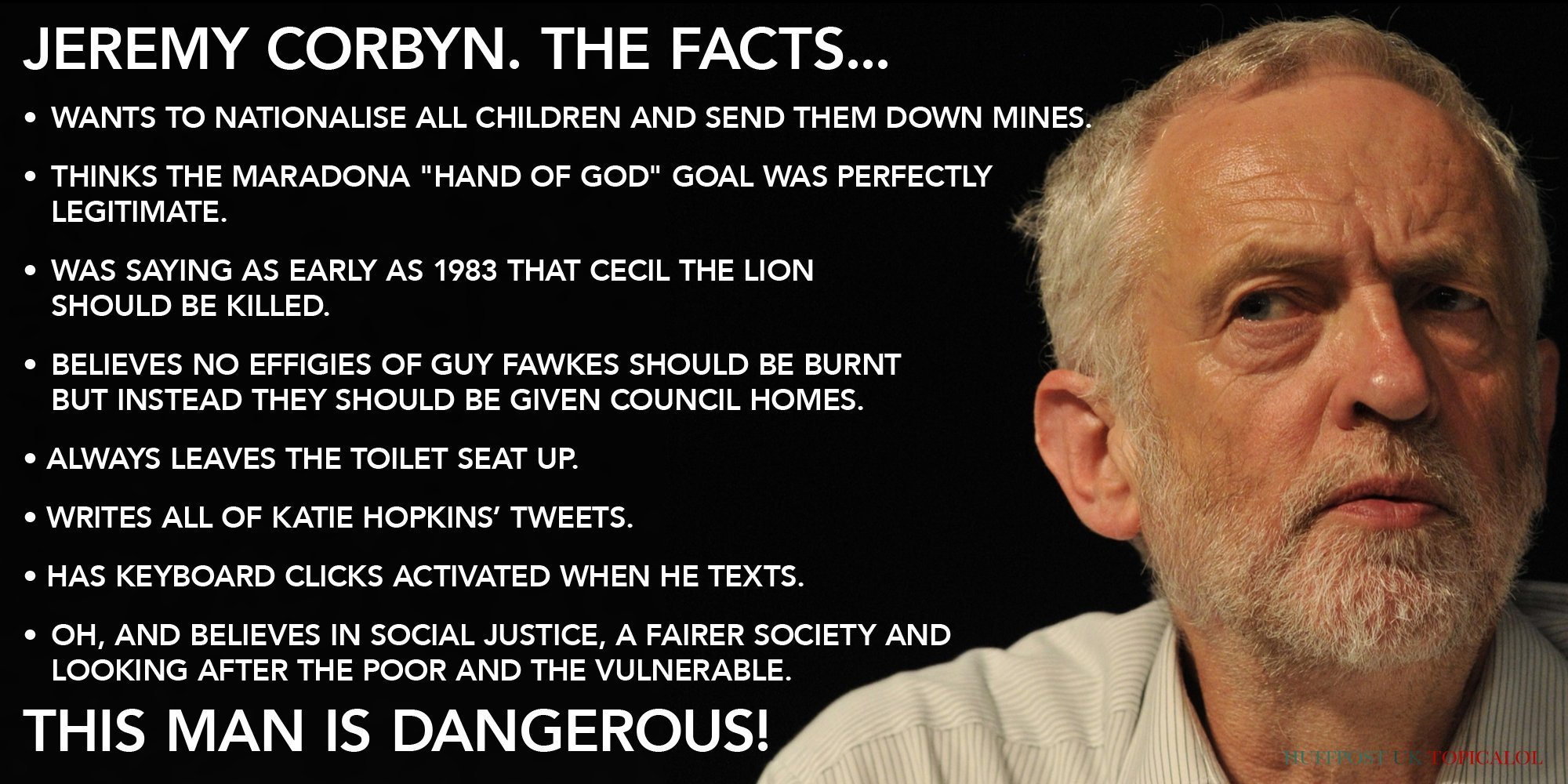
o-JEREMY-CORBYN-THE-FACTS-facebookIt would appear that Newton Emerson doesn’t buy the view that quantitative easing might be about investment in real activities that promote growth but his disdain for the economic rationality of Corbynomics and his arguments opposing it are full of contradictions and holes.  So for example while he appears to see it Corbyn’s approach as dangerously radical he notes other, apparently more radical, alternatives such as giving out unfunded tax cuts or rebates, which have come from decidedly mainstream quarters such as George Bush or the head of the Financial Services Authority, who noted that the Bank of England had considered something similar.

The rationale behind Corbyn’s proposal is that the British economy needs sharply rising investment to boost economic growth.  This would produce higher levels of employment with people paying more taxes and taking fewer benefits, in the process reducing the public sector deficit and debt while realising better public services.

Newton Emerson however sees only the prospect of increased inflation because it would mean printing money and giving it to the government who would waste it, leading to rising prices.  He compares this unfavourably with simply handing out money through unfunded tax reductions (characterised as dropping money from a helicopter)or the Bank of England’s own quantitative easing explained in the first post, although he favours each of these for totally different reasons!

So, simply handing out money is good because “it is spent immediately on the high street” while the existing quantitative easing is even better because it “is a more effective and responsive version of the helicopter drop, where the cash is handed out under circumstances that ensure it will be hoarded by the banks.”  So if it’s spent that’s good and if it’s not that’s even better!

I don’t think I’m sticking my neck out very much by saying that most commentators think that the banks not lending the money but hoarding it, as explained in the last post, is a problem with quantitative easing as practised by the Bank of England and not a plus.

Of routeing the money through the banks, he says: “Better still, the moment prices start rising, the made-up pounds can be recalled and lending will instantly shrink by a factor of 20, reversing inflation in its tracks”.  Yes indeed, monetary policy usually takes around 18 months to two years but one that works instantly would be even better, except that if it worked by reducing lending instantly and by a factor of 20 the effect would be a catastrophic depression.

Emerson is right when he says that capital investment projects might take two to five years to get off the ground while the money paid on wages and to suppliers starts to be spent right away but this is an effect of any investment, state or private, so why is this only a problem with state investment?

If there were already an investment boom and a cyclical upturn that might shortly lead to overproduction and a glut of goods that cannot be sold profitably because of saturation of the market there would be a point to Emerson’s objection.  But preventing this would require some sort of economic planning, basically an end to capitalism, and he definitely doesn’t favour this.  In circumstances of a meagre upturn after a long recession it is unlikely there is constrained capacity that would lead to rapid inflation if additional money was pumped into the economy in the way proposed.

Emerson shines his Tory credentials by recalling the economic crisis in Britain in the mid-1970s in which deficit spending by the Labour party Government in 1976 led to the IMF being called in to give Britain a loan.  This shows that this sort of Keynesian policy leads only to inflation.  Four decades on, he says, the Corbyn supporters dismiss this lesson.

But his problem is two-fold.  What exactly is the lesson to be learnt and is the situation today the same as that in the mid-1970s?

The lesson drawn by certain advisors to city traders in the mid-1970s was that too much money was being created which was causing inflation and that Governments should target measurements of money supply to ensure that they do not exceed predetermined levels.  This monetarist policy was taken on board by the new Thatcher Government and dropped when it didn’t work.

But even his quoting of Labour leader Jim Callaghan in the 1970s ignores the admission in it that this policy had previously worked.  Post war recessions were shorter and less severe because of Keynesian policies.  Today’s critics of these policies now proposed by Corbyn ignore this, while Keynesians forget that it cannot solve underlying problems.  So yes these policies did lead to inflation, which increased over the post war period and eventually took off, but this brings us to the second question whether conditions today are the same as those of the 1970s?

The ‘money printing’ carried out by the Bank of England etc., which Emerson supports, is not free of inflationary consequences itself, it’s just that he fails to notice because they appear in rising property, share and other asset prices.  The policy of investment by the state at least promises investment in activities that support real production.

The Corbyn alternative is not madcap economics and is more supportive of working class interests than stuffing money into banks whose Directors were only yesterday appearing in parliamentary hearings explaining how they didn’t really know what they were doing.

Nevertheless the Corbyn policy of infrastructural investment by the state is limited in two senses and isn’t itself socialist.  First it’s investment in infrastructure where private capitalist initiative has failed.  The investment proposed is not therefore the sort that would be in competition with private capitalist production and in so far as it will be private capitalist concerns that pick up the contracts, such state investment will be a big boost for them.  Emphasis on state investment in infrastructure is something Corbyn shares with the many left electoral alternatives that have decried the desertion of old labour from its past.  They are pretty naked now it may be back.

The second way it isn’t socialist is that it is the capitalist state that is increasing its role in the economy not worker owned cooperative production, in which workers can democratically take the initiative and learn to run things themselves.  This could lay the economic and social grounds for a political challenge to the system as a whole where workers to decide they should own and run the whole lot.

There is nothing very democratic about current state ownership and the workers within it still answer to a boss.  The success of state led investment in efficiency terms is very much dependent on the developmental capacities of the state itself but when private capitalist intervention has failed it’s not a very strong argument for the likes of Emerson.

Like the rest of the shrill and desperate attacks from the right the local criticism of Corbyn doesn’t hold much water.  Others in the mainstream have recognised openly the limited radicalism in what is being proposed, which may actually be understood by those venting their disapproval.

Their opposition may therefore be motivated by fear that what is being proposed opens other more radical vistas for those seeking an alternative to austerity.  That this may well be the case is a reason why Corbyn should be supported.

Jeremy Corbyn’s economics 1

corbynimages (12)I hadn’t even gotten out of my scratcher yesterday morning when I looked at my mobile and the BBC news web site to see what was happening in the world, only to see yet another attack on Jeremy Corbyn’s campaign for Labour party leader.  This time the Brlairite was Blair himself, looking skull-like and definitely not very well – all that chasing after money mustn’t be good for his health.  “Labour must come to its senses” he apparently said.  I didn’t read any more.

Corbyn has been criticised in just about every way imaginable, from the Mail prophesying a return to the “dark ages”, riots and intervention by international peace keepers, to the oh so condescending approach of Janen Ganesh of the ‘Financial Times’: that Corbyn’s policies, “eccentric” and a “joke” as they are, are not really the problem, it’s the “soft left” and Andy Burnham and Yvette Cooper who are the ultimate problem.  Poor Jeremy, he’s either responsible for a new dark ages or he’s such a joke he doesn’t deserve consideration, even as a problem.

At the centre of all this dismissal is contempt and ridicule of Corbyn’s economic proposals for “quantitative easing for people instead of banks.”  Our local biggest daily ‘The Irish News’ had its own columnist to hurl his own critique, this time mixing both dire prediction and condescending ridicule.

The author, Newton Emerson, thinks that fewer than 1% of the population will understand “why Corbynomics is ridiculous” even though “it takes little more than an A-level to understand why.”

Emerson is normally an acute commentator on politics in the North of Ireland, frequently exposing the hypocrisy of political culture here and the rottenness of the political arrangements.  Unfortunately he has two problems.  First, when it comes down to it he actually supports the rotten political arrangements, and secondly, he gives every indication of having been educated in the dismal science of economics as taught in the universities.

He is undoubtedly correct that the general population is seriously under-educated in economics and this is a real problem for them identifying their interests in any debate.  On the other hand I don’t believe that Corbyn’s ideas are very radical and certainly not ridiculous, so going to university or doing an A-level really isn’t the answer.

So let’s see if we can understand what the issues are in this case.

Quantitative easing as practiced by the Bank of England involves the bank loaning newly created money (created as an electronic entry in the bank’s accounts) to a fund which has to pay it back, so theoretically it’s a loan and not just giving away newly created money.  This fund then uses these loans to buy government issued bonds (IOUs payable by the Government) that are held by pension funds.  These pension funds now have money instead of these bonds.

The theory is that these pension funds will then want to use the money to buy other assets from banks such as bonds to replace the ones just sold back to the government or buy other sorts of securities such as private debt instruments (IOUs issued by private corporations to raise money for investment).

The end result is that money has been created electronically by the Bank of England and it now rests in the banks which, it is hoped, will use the new money to buy debt issued by private firms that will in turn help them invest directly through the money just received.  This investment will create jobs and economic growth.   That’s roughly the theory anyway.

However, once the banks have the money they can do what they want with it.  They could buy bonds or securities issued by other countries; they could buy existing shares or securities which would give no more money to firms to invest but simply increase the price of these pieces of paper; they could buy commodities or property and cause inflation in these assets or they could simply sit on the cash.  In each case there would be no increased employment or contribution to economic growth.

Even if they bought newly issued debt from private companies, these too could decide not to invest the money in new factories, offices or equipment and instead do any of the above and join in the great speculative boom in property or share prices etc.  Many banks and companies appear to have done just this, which has made them richer but not helped economic growth.

In other words the ‘money printing’ that has been carried out has helped the banks and made the rich who hold financial assets richer by increasing their price.

Hence the alternative proposed by Jeremy Corbyn in which the newly created money, which is also in the form of a loan, is given to a State investment bank who then loan it out to state agencies which would invest in state-owned infrastructure such as “housing, transport , digital and energy networks.”  The objective would not only be to create jobs in the short term and promote economic growth, so reducing the debt burden, but also contribute to the longer term productivity of the economy, which is recognised as going through something of a productivity crisis.

To be continued.