The Irish general election (2 of 2) – what lies beneath

When five political commentators were asked for the main moment of the election campaign, they all mentioned the TikTok Taoiseach’s snubbing of a disability care worker when he was on one of his many walkabouts.  It “cut through” to the public, as the saying goes, and probably did lower the Fine Gael vote a little.  However, in the grand scheme of things all it demonstrated was the irrelevance of the campaign, which has been described as a non-event.  Unlike recent general elections in many other countries, the incumbents were returned to office, providing evidence of political stability that does not exist elsewhere.  This stability rests on uncertain foundations.

The election was called following a large give-away budget of tax reductions and increased state spending, followed by a campaign where everyone promised even more tax cuts and increased spending.  This included the previous austerity-merchants in Fianna Fáil and Fine Gael. Halfway during the campaign, when Sinn Fein joined the club, Fine Gael launched hypocritical denunciations that it was about to break the “state piggy bank”.

On the surface, the only difference between the governing parties and the different varieties of opposition was how much they would spend. People before Profit claimed that their clothes were being stolen by everyone, at least for the election, while media commentators claimed that the widespread consensus on increased state intervention showed what an essentially leftwing country Ireland was.  Since PbP argues that such intervention is an expression of socialist politics these claims would be right – if PbP was also right, which it’s not.  The view of politics as a spectrum from left to right implies no fundamental difference between the government and opposition but only shades or degrees of difference.

If this didn’t provide the grounds for major change, and the existing alignment of party support made it unlikely, the most important reasons for continuity are the foundations of the state itself and the economic success that has satisfied a significant part of the population, if only on the grounds that it could be a lot worse and recently was.  The ‘left’ appeared as wanting to share the gains more equally.  Unfortunately, those seeking equality inside the Irish state have to reckon on the giant inequality outside on which it would have to be based and which determines it.

The largesse of recent budgets, and the promises of more during the election, rest on the existence of the Irish state as a tax haven where many US multinationals have decided to park their revenue for tax purposes alongside some of their real activities.  Over half of the burgeoning corporate tax receipts come from just ten companies, with the income taxes of their employees also significant.  Trump has threatened tariffs on the EU, which threatens the massive export by US pharmaceutical firms to the US, and has promised to reduce corporate taxes, which also reduces the attractiveness of the Irish state to multinational investment.  It is not so long since the shock of the Celtic Tiger crash, so very few will not be aware of the vulnerability of economic success and the finances of the state.

This vulnerability was ignored in recent budgets and election promises while the electorate is blamed for seeking short term gains that are all the political class can truthfully promise.  Failure to invest in infrastructure has weakened the state’s long term growth with the major shortfalls ranging wide, across housing, health, transport, childcare and other infrastructure such as energy and water.  This has led to calls for increased state expenditure as the existing policy of throwing money to incentivise private capital has fallen short even while the money thrown at it has mushroomed.  Bike sheds in Leinster House costing €336,000, and a new children’s hospital that had an estimated cost of €650m in 2015, but costed at €2.2 billion at the start of the year – apparently the most expensive in the world – are both examples of the results of a mixture of a booming capitalist economy and state incompetence.

The consequences are an electorate that wants change but doesn’t want or can’t conceive of anything fundamental changing.  Government and opposition differ on degree but avoid the thought of challenging the constraints their lack of an alternative binds them to.  Trump is only one of them; Irish subservience to the US has already destroyed all the blarney about Irish support for the Palestinian people.  Gestures like recognition of a corrupt Palestinian state are nauseating hypocrisy beside the secret calls to the Zionist state promising lack of real action; selling Israeli war bonds to finance genocide by the Irish central bank, and the three wise monkeys of the three government parties ignoring the use of Irish airspace to facilitate the supply of weapons employed in the genocide.

The Irish state is not in control of its destiny and its population is aware of its vulnerability.  For a left that bases itself on the capacity of the state this is a problem; involving not just the incompetence, the bottleneck constraints on real resources, and the international subservience to Western imperialism.  The fundamental problem is in seeing the state as the answer.  Were the Irish state stronger, it would have joined NATO and more directly involved itself in the war in Ukraine; it would have intensified its support to US multinationals, and perhaps been a bit better at building bike sheds and a children’s hospital.  

Parts of the left seems to think the current Irish state can oppose NATO, oppose war and perhaps tax US multinationals a bit more.  It is, however, currently on the road to effective NATO membership; is more or less unopposed in its support for Ukraine in its proxy war; and already taxes multinationals on a vastly greater scale than almost any other country I can think of. 

The left doesn’t have an alternative ‘model’ because its alternative isn’t socialist, but simply development of the state’s existing role, presided over by some sort of inchoate left government, the major distinguishing characteristic of which is that it doesn’t include Fianna Fáil and Fine Gael.  This is so anaemic a strategy it avoids all the above reasons why it has minority support.

The terms in which this is popularly understood do not go in the direction of a socialist programme because of the generally low level of class consciousness, but a genuinely socialist path requires rejection of the current statist approach of ‘the left’.  That this too is currently very far away reflects not only the very low level of class consciousness but also how the forces that are responsible for this have also debased the left itself, especially the part that thinks itself really socialist.  Instead, we have the stupidities arising from the commonality of increased state intervention among all the parties repeatedly declared to be proof that Ireland is a left wing country.

These constraints explain the difficulty in creation of a left alternative to a Fianna Fáil and Fine Gael government; the fragmentation of the left and its Oliver Twist policies of simply asking for more.  There are numerous permutations possible before any purported left government would arise, with Sinn Fein, Independents, Social Democrats, Labour Party, and others all willing to go into office with either (or both) of them.  About the least likely is a ‘left’ government (in any meaningful sense) that excludes them and is composed of Sinn Fein – the austerity party in the North – and the Labour Party and Social Democrats whose whole rationale (as the good bourgeois parties that they are) is to get into office – they don’t see the purpose of being involved in politics if you don’t.

All the calls for a ‘left’ government free of the two uglies is based on the same bourgeois conceptions.  Even if only on the grounds of the Chinese proverb – to be careful what you wish for, the failure in the election to achieve such a government is not grounds for mourning, even if the result invites it.

Back to part 1
The Irish general election (1 of 2) – As you were

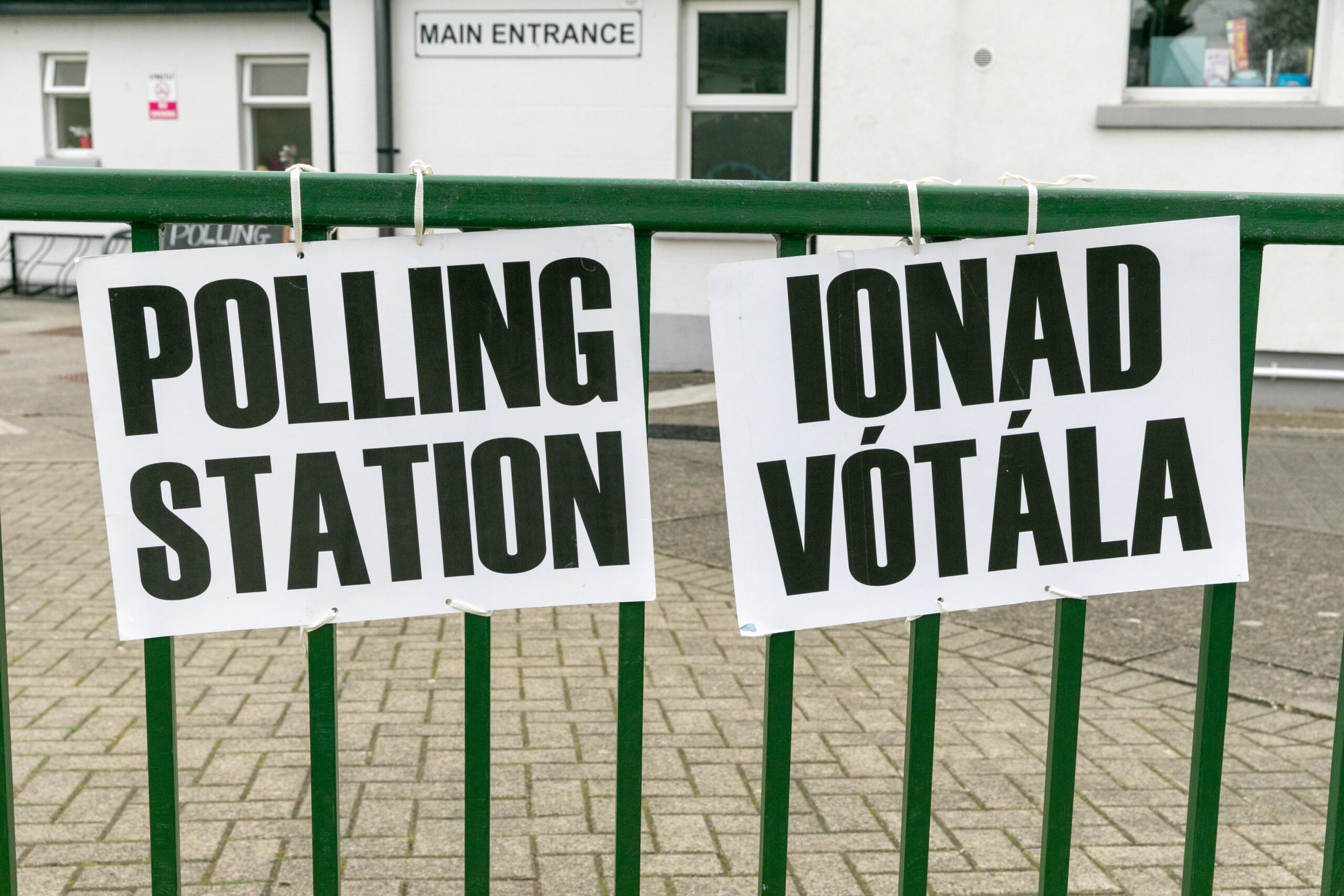
A continuation of the status quo is the result of the general election in the Irish state, with the two main capitalist parties, Fianna Fáil and Fine Gael, gaining 42.7% of the first preference vote.  Falling just short of the 88 seats needed for a majority there are enough independents, who are FF and FG in everything but name, to prop them up.  The only surprise is that Fianna Fáil topped the poll, the same party written off following it presiding over State bankruptcy and Troika vassalage after the crash in 2008.

Their main opposition, Sinn Fein, gained 19% and is more than willing to go into a coalition but ‘the left’ by which it might form an alternative one is too small and fragmented, and FF or FG will only consider it as a partner if they have to, and they don’t, so this route to government participation is also closed off to it.  It has pulled its familiar trick, practised to perfection in the North, of claiming victory, which is only possible if you accept the disastrous previous local and European results as the benchmark. At one point, in the summer of 2022, an opinion poll put it on 36% but in the election its vote fell by 5.5% on the previous general election.  Beyond the various figures, it will be staying in opposition, which is not at all where it wants to be.

The third leg of the existing government – the Green Party – collapsed from 12 to only 1 seat, that of its leader who now has no followers in the Dáil. Its previous participation in office led to its complete wipe out in 2011, following its collaboration in the bail-out of the banks and imposition of austerity.  Like its fellow Green parties across Europe, its ‘left’ alternative credentials are to be taken seriously only by the terminally naïve.

On what is called ‘the left’, two parties did reasonably well in terms of their expectations.  The vestal Social Democrats gained seats and 4.8% of the vote, while the shop-worn Labour Party staged its own return from near-death by gaining seats and a 4.7% share.  They too have no justifiable route into government since FF and FG don’t need them that much and they would have little leverage on policy. They know they would likely suffer the fate of the Greens for their inevitable disappointing of the hopes of their supporters, busting the illusion that they are in some way ‘an alternative’.   The unsullied Social Democrats are relative latecomers, which will be their major USP until they see their next career move as being junior ministers, while the problem with the Labour Party is that having nine lives as a junior partner in government has required suffering the same number of deaths. It could nevertheless still be a hard habit to break but this time probably just deferred.

The People before Profit – Solidarity alliance will continue to get state-funding with 2.8% of the vote, an increase of 0.2% but with a loss of two seats from 5 to 3.  The core objective of being part of a left-alternative government to Fianna Fáil and Fine Gael might be said to have been destroyed except that it never existed in the first place. Neither formally nor informally was it advanced and ‘failed’ not only because of the continuing success of the main capitalist parties, even if much reduced by historical standards, but also by the weakness and incoherence of what PbP-Sol thinks of as ‘the left’.  To its credit the Solidarity section of the alliance is less inclined to consider Sinn Fein as left but either way, the perspective of a left alternative government as a realistic alternative to the various permutations of the current bourgeois groupings has been exposed again.  State funding, speeches in the Dáil and political social-work by TDs and would-be TDs are not only not a socialist alternative but not even a credible means of achieving the PbP-Sol reformist project.

On the right, the Catholic Aontú party made an advance with two seats and 3.9% of the vote while the Independent Ireland grouping won 4 seats and 3.6%.  Beyond these more openly right-wing groups, a couple of independents made ground with anti-immigrant politics and the far-right also stood candidates in a coordinated attempt tom unite by not standing against each other.  None were elected but what was noteworthy was their presence.  They have not yet congealed into a movement with a leader and have been stymied by the absorption of the anti-immigrant message by the main bourgeois parties and independents to varying degrees.

The result then is a return to government in some form of the existing main capitalist parties and the continued exclusion of the fragmented opposition, which was always the most likely outcome and partly accounts for the reduced turnout –down from 62.9% in the 2020 election to 59.7%.  The lowest in the history of the state. Almost as many didn’t vote as will have supported the two parties dominating the government. Some commentators, and the opposition, have attempted to explain that there are bubbling undercurrents waiting to have their effect but it is better to start explaining the apparent stability before explaining that something very different is really going on.

Forward to part 2

A World going to War and the resistance (1 of 3) – Palestine and Lebanon

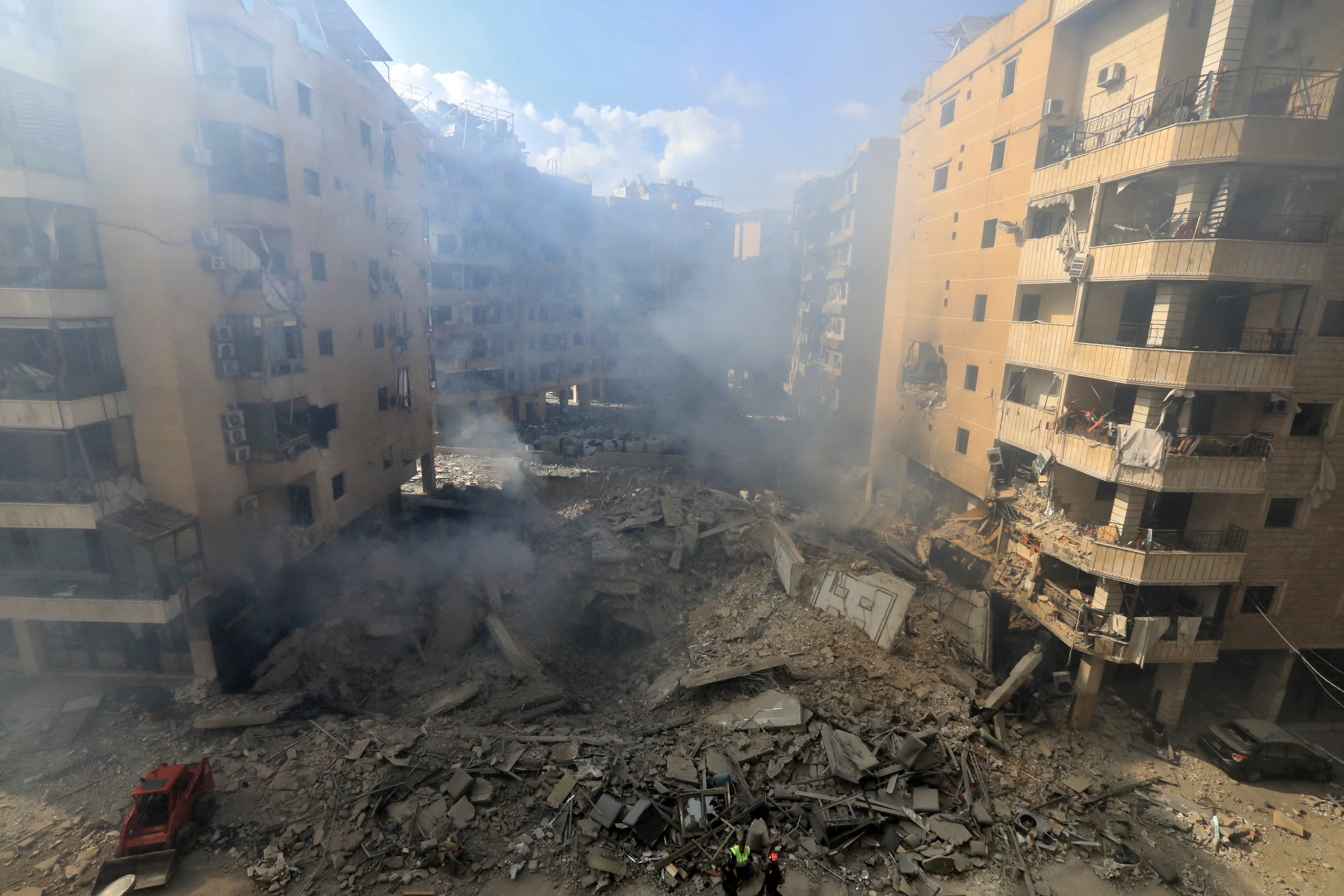
Beirut Photograph: AFP/Getty Images

Israel is reported to have killed more than a thousand people in its two weeks of bombing Lebanon and has now started a land invasion, which has caused a displacement of more than a million people, almost a fifth of the population.  It continues to murder hundreds of civilians in Gaza with the death toll approaching 42,000, not including many more buried under the rubble of destroyed buildings. One estimate, and not the highest, is 186,000!

After repeated provocations Iran attacked Israel with an unknown number of missiles that Israel says were mainly shot down, while video evidence claimed to show that many were successful, although it is not obvious that they hit their intended targets.  A main objective appears to have been to impact military airbases.

Iran reportedly gave notice to both the US and Israel that it was going to attack, allowing the Israelis to remove their aircraft from harm’s way, while it also said that its response to the provocations had finished.

Netanyahu shamelessly and offensively publicised his order to kill the leader of Hizbollah (and those unconnected who were near him) when he was at the UN in New York, straight after a speech in which he claimed that “Israel seeks peace. Israel yearns for peace. Israel has made peace and will make peace again.” After the Iranian missile strike he warned that Iran had made a “big mistake” and threatened that it “will pay for it”.

After the continuing genocide in Gaza, the more than thousand killed in Israeli bombing and now ground invasion of Lebanon, Keir Starmer declared that he and the country he claims to speak on behalf of, “stands with Israel” and recognises its right to self-defence.  The Labour Defence Secretary John Healey said that British forces had “played their part in attempts to prevent further escalation”, which must be his way of boasting that British aircraft helped the genocidal Israeli military to stop the Iranian missiles.  The US has already sent more military into the region and also boasted of its efforts against the missilles.

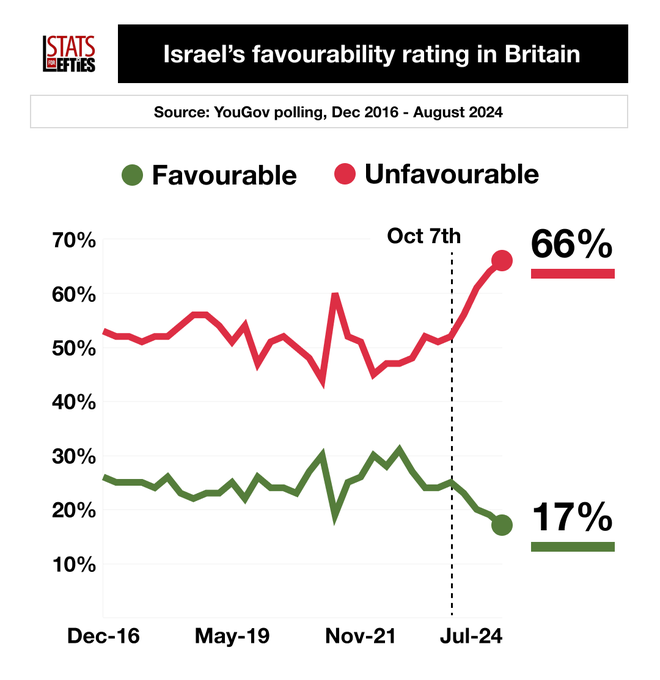
No one reading this will need an exposition of the lies and hypocrisy these statements involve, told by either the Zionist leaders or their Western backers: the selective condemnation of terrorism, selective endorsement of the right to self-defence, selective concern for civilian casualties and selective condemnation and sanctions against outside invasion.  All this is obvious.  Starmer’s support and defence of the genocidal Zionist regime has played a part in the collapse of his already low popularity and that of his government – his net approval number is now minus 30 and his government less popular than the one that has just been shredded:

More demonstrations are taking place and planned across the world, following the mass walk-out of delegates to the UN at the start of Netanyahu’s speech.  The pathetic role of the Irish delegation was clearly exposed by their staying in their seats to listen to the latest catalogue of lies that insults its listeners.

The Irish people have an opportunity to demonstrate their opposition to genocide and the attack on Lebanon through a march on Saturday.  The support declared for it reveals widespread support but also the depth of much of it. What is the purpose of this demonstration and the campaign generally? Is pointing out the hypocrisy of the government and its actions anywhere near enough?

The purpose, it would seem, can only be to put pressure on the government to take action but the repeated demands on the Government by some opposition TD’s have only been met by revelations that it will not even enforce its own laws that might somewhat inconvenience the transport of weapons to Israel – allowing flights over Irish airspace without any question.  The governing parties are riding high in the polls and are busy bribing the population with their own money in the budget – their money and that amassed as a tax haven for US multinationals. If putting pressure on it is the objective, the question must be asked – what pressure?

The political voices of these 160 civil society organisations supporting the demo have been demanding various actions from the Irish government for a year, with no success beyond its hypocritical statements that rival those of the other Western powers.  After a short time, this reveals not the power of public opinion but its weakness and that of the solidarity campaign that seeks to mobilise it.  It reveals the political poverty of demanding that the Irish bourgeoisie do something that is not in its interest.  If you expect they will do so you are naïve at best and if you don’t you are fooling your supporters and yourself.  

Look at the organisations supporting the demonstration! They include the trade unions and will probably include Sinn Fein; the party that partied with genocide Joe on St Patricks day.  Who could possibly feel pressure from such hypocrites?  The governing parties could easily turn round to the trade unions and ask – what have you done to boycott the Zionist state?

In other words, the Palestine solidarity campaign should be demanding that those who claim to support it do something, beyond supporting demonstrations that long ago revealed that bourgeois governments don’t care what their populations think as long as they can get away with it. If these governments will not take action, it needs to be taken for them, or rather – against them.

That means demanding that Sinn Fein boycott the genocidal US regime and the trade unions campaign to persuade their members to take direct action to boycott Israeli bound armaments etc. and defend them when they do.  If they don’t then their participation in solidarity demonstrations is a sham and by extension is a fraud on all the other participants who are genuinely opposed to the actions of the Zionist state and want to do something about it.

The Irish state is a very junior and subordinate partner in a Western imperialist alliance that supports the Zioinist state because this state is the West’s – primarily the US’s – instrument of power in the Arab world and beyond.  To expect that it will rebel against its dominant partners is delusional, and continual demands that it do so miseducates and misdirects everyone who doesn’t understand this. It must stop, and the campaign look to Irish workers as the means to put pressure on imperialism, starting by opposing their own state that is a part of it.

Forward to part 2

Bourgeois democracy in Ireland in two Acts (2) – Orwellian and Surreal

Bourgeois democracy can not only lie, it can also invent crimes for which you can be punished.  The Government is going ahead with the hate crime bill, shorn of its hate speech elements.  This follows its stinging defeat in the family and care referendum in which it also lied about the implications of what it was proposing when asked whether these had been raised within it as a concern.

The original proposals about ‘hate’ speech were particularly threatening but the retention of the definition of “protected characteristics” raises all sorts of questions that the government will again have to spin and lie about in order to defend.

These “protected characteristics” include ‘race, colour, nationality, religion, ethnic origin, descent, sex characteristics, sexual orientation, disability and gender’.  Beyond general issues about the wisdom of agreeing to greater repressive powers for the state, and the inclusion of essentially subjective considerations such as ‘hate’ in punishment, there are two questions – what is ‘sex characteristics?’  Is this just another term for sex, in which case what is the point of two words instead of just three letters?

The second is the definition of gender included in the legislation: “’gender” means the gender of a person or the gender which a person expresses as the person’s preferred gender, or with which the person identifies, and includes transgender and a gender other than those of male and female”.

This farrago of words is obviously not a definition of anything, certainly not of ‘gender’ or ‘transgender’, and as I have written before, it’s doubtful that one can be clearly stated.  It seeks to protect people who are ‘other than those of male and female.’  Who are they?  Where are they and how do they, or could they, exist?  In what way is this not putting into law the nonsensical ideas of gender identity ideology that the Government parties don’t have the courage to openly argue for?

When the right wing Senator Michael McDowell asked the Department of Justice what is intended by the term ‘transgender’ and ‘a gender other than those of male and female’ he got no response.  Instead, the department provided a statement that included this: 

“If someone is assaulted because they are transgender, that is a hate crime.”

“People identify as non-binary. That’s a fact. If someone follows a non-binary person after they leave a gay nightclub, and then assaults them while shouting homophobic abuse, they would likely be charged with assault causing harm aggravated by hatred (carrying a max sentence of 12 years, instead of 10 years because of the aggravating factor). If it’s not found that it has been aggravated by hatred, then the person could still be charged with assault causing harm,” it said. “A definition is required to protect that person. It has absolutely no implications outside of this law.” (Emphasis added – Sráid Marx)

The department also asked: “Does Michael McDowell believe that this person should be protected by this law, or does he believe this person should have to identify as male or female to be protected?”

There is so much that is simply stupid in this that it’s difficult to know where to start.

I am quite sure that Michael McDowell would respond that it does not require anyone to identify as anything in order to be protected, which is what the Department of Justice seems to imply. Or does the Department believe it must be proved that an assailant knows the inner thoughts of someone in order to secure conviction or aggravated punishment?  For that is what the department assumes when it wants to protect someone who is in some way not either male or female and walks out of a gay club.

How on earth could someone be attacked for being ‘non binary’ without the assailant having some prior knowledge of the person?  If a stranger was attacked for coming out of a gay club it is much more likely that any motive beyond purely violent intent would consist of homophobia, which is obviously what would be indicated by their “shouting homophobic abuse”.

It is indeed a fact that “people identify as non-binary” but it is also a fact, that the government wants to elide, that there is no such thing as a non-binary person (neither male nor female or both).  Assaulting someone for this reason is not an assault on someone because of what they are (e.g. gay) but an assault because of their (misconceived) ideas about what they are.  Since such ideas are as varied as there are ‘genders’, the state has opened up a panoply of grounds upon which to claim hate crime warranting additional punishment.

The state may have dropped attacks on free speech that might lead to criminal punishment arising from disagreement with the idea of the many ‘genders’ claimed by some activists, but this still leaves open the potential for punishment for those disputing such claims.  This may seem absurdly alarmist but it is already the case that the Department of Justice is implying that only inclusion of a gender identity in a victim ensures protection, something just as absurd.

The ability of the state to conjure up offences and therefore punishment on grounds that are non-existent is surreal.  The word Orwellian is overused but the Irish state is claiming that not only can it identify the inner thought crime of an accused but also that the inner thoughts of the victim can also be divined by the accused and in turn accessed by the state.

It is a feature of gender identity ideology that it throws up such idiocies that are easily dismissed, but these are a result of the foundational one that men can be women just by claiming to be one, and this is one nonsensical claim that is already being validated and legislated for.

McDowell has also noted that ‘the Bill suggests that there are genders (plural) other than male or female. It does not enumerate or describe such other genders”. He argues that unspecified genders beyond male and female would raise questions “over statutory provisions providing for gender balance in judicial appointments, board compositions, etc”.  “There is no case for legislating for an open-ended multiplicity of subjective genders the meaning of which is obscure,” he said.

The idea that the numerous legal and social provisions based on gender – understood as sex – will not be affected by the legal recognition in this Bill is naïve at best and does not accord with experience across the world.  I have argued elsewhere that these implications are reactionary.  They have included attacks on freedom of belief; freedom of speech and freedom of association; destroying women’s sex based rights; putting males in female spaces; attempting to obliterate sexual orientation and lying to children that they can change sex before they even have a full appreciation of what it is.

Those who think that because McDowell is right wing he cannot be quoted or we cannot agree with him on this should consider why a government and state that is complicit in genocide, as we pointed out in the previous post, should now be considered to be in the vanguard of social progress.  They might also consider that Genocide Joe Biden described trans rights as “the civil rights issue of our time. There is no room for compromise when it comes to basic human rights”. Tell that to the Palestinian people.

Back to part 1

Bourgeois democracy in Ireland in two Acts (1) – supporting the Palestinians

In June the Taoiseach Simon Harris assured the Dáil that “no airport in Ireland or Irish sovereign airspace is being used to transport weapons to the conflict in the Middle East or any other war”.  The Ditch web site in September began reporting that nine such flights had been made to Israel, although the site reported that there were, and no doubt still are, many more.  It noted that ‘Carrying munitions of war through Irish airspace without permission from the minister for transport is a criminal offence punishable by up to three years’ imprisonment.’   

Harris stated in June that “In relation to the overflights, the Government of Ireland has never provided any permission for such an overflight to take place in terms of carrying munitions and therefore the Government wouldn’t have been in a position to inform the Dáil of such a flight. That position is quite clear,” which means that unless the Government expressly permits the law to be broken, it hasn’t been.  It would appear that it is only broken when it has been admitted but since the Government is never going to ask to inspect aircraft overflying or landing, it is never going to be admitted, and we just have to accept that the law has not been broken and Irish neutrality policy has not been breached.

In response to the evidence that neither of these things are true the Government has called an investigation into its own actions, as if it doesn’t know what it has been doing. Meanwhile Harris accused his critic, Sinn Fein’s Mary Lou McDonald, of “misleading people” and of trying to “muddy the waters”, which would make more sense if it was self-criticism.

The Green Party Minister of Transport has claimed that “no airport in Ireland, or Irish sovereign airspace, has been used to transport weapons directly to Israel” while he has also claimed that he supports new legislation that would allow random checks.  The sponsors of separate legislation have pointed out that the government already has powers to carry out checks but it isn’t using them, while it’s opposing their own proposals. The Minister has promised to “sit down with my officials and with legal experts over the coming months to make sure that new legislation is developed that is watertight, is workable, and is compliant with international aviation law.” Sitting for months is as near an honest admission of what action it will take as the government is likely to provide.

The prospects of any further Government legislation that would be implemented can be gauged by the fate of the Occupied Territories Bill, which would ban and criminalise “trade with and economic support for illegal settlements in territories deemed occupied under international law”, most notably Israeli settlements in the occupied territories.

This was passed in both Houses of the Oireachtas but has been stymied for four years, with yet another statement by Harris that he would seek “fresh legal advice” to extend the never ending delay.  The message is that a majority in the legislature can vote for something that is undoubtedly approved by the majority of the people but this doesn’t mean the Government will do anything to implement it.  The Ditch again explained the precise mechanism employed in this particular case, one of the many in bourgeois democracies to ensure that what democracy there is is suited only for the bourgeoisie:

‘On 25 February, 2019 Hadie Cohen from the Israeli Ministry of Justice emailed colleagues.’

‘Cohen referred to a “confidential call” (emphasis Cohen’s own) with Paschal Donohoe. Cohen said Donohoe told Israeli finance minister Moshe Kahlon that the Irish government would “block” the bill.’

“We understand that during a confidential call on 13 February between the Irish Minister of Finance and his Israeli counterpart, the Irish minister confirmed that the Irish government will be using a procedure known as “money message” to seek to block the progress of the draft Irish legislation criminalising dealings with products and services from the settlements – the Control of Economic Activity (Occupied Territories) Bill 2018,” wrote Cohen.’

‘The “money message” was invoked by ‘then foreign minister SImon Coveny [who] said government would invoke article 17.2 of the constitution . . . Coveney said government had to do this, not to frustrate the democratic process as critics of the money message argue, but because government’s “view is that additional costs will also arise from voted funds for certain Irish diplomatic missions abroad should this bill be enacted. I should state clearly at this point that because of these costs across a wide range of areas, there can be no doubt that the bill will require a money message to proceed to committee stage.” More sitting down with legal experts perhaps to ensure nothing is done.

Paschal Donohoe has denied this call but only in the sort of non-denial denial manner, similar to the non-apology apology.  What all this demonstrates is that the Irish State is no different from every other capitalist state, which are committees to run the affairs of the bourgeoisie that inevitably involve conspiracies to lie to their own people.

The Irish State joins with the others in the West in having its fingerprints all over genocide in Palestine, laced with its own particular flavour of hypocrisy, all the more disgusting because it pretends to be the very opposite if what it claims – to be in support of the Palestinian people based on its own experience of colonialism. Its reputation as an ally of the Palestinian people is exposed as a fraud and its public spats with Israel a piece of theatre.

Given this exposure of gross hypocrisy we can clearly see the futility of repeated petitions and demands by many on the left that the Irish state take action against Israel in order to help bring an end to the genocide. It is simply not in its interest to do so. The state is in hock to US multinationals, something referenced every day in the media reports of the increase in corporation taxes received from them. When it looks like some gesture might be made the US has ensured that its client Israel is protected and the Irish told what it cannot do.

The only force in Ireland with the capacity to prevent the transportation of weapons, and this itself is limited, are Irish workers, but pointed questions, petitions and criticism is never levelled by the likes of People before Profit at the trade union leaders who refuse to organise and advocate such action. The various mechanisms employed by the state to avoid taking action will not be changed by speeches in the Dáil. Action must be taken outside it, advocated and encouraged through speeches at meetings and in workplaces of those we want to take the necessary direct action; against the wishes of the government and state and the genocidal governments it stands in support of.

Workers’ democracy is the alternative to the conspiracy and lies of bourgeois democracy, and no matter how weak workers’ democracy is, it is much, much stronger than reliance on the bourgeois kind.

Forward to part 2

A New Popular Front for Ireland? (3 of 3)

AFP

A final argument in support of the New Popular Front approach is to argue that the key task of the day in the class struggle is to stop the far right, and this the Nouveau Front Populaire (NFP) has done.  How else was it to be done in the circumstances?

One way this has been put is to say that:

‘If the left had not voted for Macron candidates in the second round, it would have meant an overall majority for Le Pen. Just listen to the relief expressed by ethnic minority people on TV in the Republic Square last night. They were terrified at a Le Pen government moving aggressively against so-called bi-nationals. Stopping a Le Pen government makes a real difference. Counter-posing mass struggles or street mobilisations as an immediate solution to defend black or Arab people is just demagogy.’

Let’s get some things out of the way first – ‘Just listen to the relief expressed by ethnic minority people on TV in the Republic Square last night’ is not enough, not nearly enough, to join that fear and then surrender political principle and independence.  If this is a guide to the rationale then it is woefully weak; the fight against the far right will be advanced by militant action based on socialist politics, not fear driving the working class into the arms of the main bourgeois parties and through them the French state. Were the far-right an immediate fascist danger it would be because this state, and its political class, had decided that fascism was required, in which case allying with this class in order to preserve the current state would be an obvious disaster. 

Let’s note the admission in this article of the price paid for this ‘success.’  First, that the NFP propped up the Macron bloc to the extent it could, and ‘we should not forget her (Marine le Pen) group topped the vote share, and the increase in her party’s seat tally is still historic.’  In other words the far right still gained and the main bourgeois parties that paved their way received protection by the intervention of a ‘united left’.  These are the circumstances that facilitated the rise of the far right previously, that precipitated the crisis, and which – despite the NFP ‘success’ – still. persist.  A ‘success’ which reproduces the threat at a potentially higher level is not a success.

So, what about the claim that the need for ‘mass struggles or street mobilisations as an immediate solution to defend black or Arab people is just demagogy’?  Well, since right now mobilisation and struggle will continue to be necessary, seeking these is clearly not demagogy and do not cease to be of primary importance because there is an election.  What about the NFP not being counterposed to these steps?

Well, since the NFP has failed to achieve a majority there will be no governmental programme that will offer an alternative to either the main bourgeois parties or far right and there will be no governmental endorsement of the physical or legal protection of black or Arab people.  The NFP is not going to mobilise workers to protect them as it isn’t going to organise workers defence groups to defend itself.

The failure to win governmental office may cause some demoralisation – or at least demobilisation – of NFP supporters, especially if the whole cobbled together alliance breaks up and erstwhile allies denounce each other for the failure. Even if this proves not to be the case the need for a robust alternative to be built will be no clearer or nearer to creation by it being asserted that forces like the SP, Communist Party and Greens will lead it.  They will not. An alternative to them will remain to be created but cannot if the priority becomes an alliance with them against the far right. Acceptance of the NFP argument would mean that the far right would have achieved the removal of an independent socialist left, one not wedded to defence of the French state and bourgeois democracy.

What about the claim: ‘Key point: Without the formation of the NFP, no defeat of Le Pen.’  The argument is that had the left decided not to unite it may have been unable to weaken the far right as much as it did, but the argument also entails the strengthening of the Macron bloc as just as necessary to this outcome.  It could therefore equally be argued that supporting this bloc from the start through an alliance in the first round of voting might have achieved the same result.

That this would obviously be rejected then as now can only be because this mainstream right was not and is not an alternative to the far right that could be supported – except that it then was supported.  Why not in the first round if was acceptable in the second?

Some appreciation that there would be a day after the election should have prevented support for the Macron bloc in the second round, a bloc that they now claim they do not support in power today; except this is precisely the argument against the whole NFP project.  The fancy that it is about stopping the far right, and that this is what matters, dissolves when the election is over and you’re back to square one. Short cuts do not take you to your destination.

In so far as the creation of left unity did evoke enthusiasm and activity it is an exercise in misleading and miseducating those who became active: that their activity on behalf of a cobbled together programme and alliance of forces without any real socialist alternative is a step forward.  Support for this alliance will not withstand its fracturing, and at worst lead to yet another round of claims that what is needed is left unity of those who are ultimately united only in acceptance of the French capitalist state and not to any working class alternative.  It is not enough to be ‘active’ – the political programme that you struggle for is decisive in whether it advances the working class cause.

The article referenced states that ‘this week the big issue is what next’; surely a question that should have occurred to the supporters of the NFP beforehand, but which then elicits the observations that the NFP is set for splits, and its left under Melenchon is not a democratic alternative.  One starts to wonder why it is necessary to argue against a ‘united left’/NFP when even those who support it admit it isn’t actually united and isn’t very left?  Why would socialists want to continually repeat this failure?

As for the far right itself, the article notes that: ‘although the RN has been pushed back, their position has still been strengthened compared to the previous parliament. An unstable period with no majority and various stitch-ups means they can frame it as the caste ganging up on the true defenders of French identity. So, it could still provide them with plenty of space to build their forces.’  In other words, the far right may continue to advance while the left fails to hold together because it substitutes opportunist electoral alliances for working class struggle – for the building of a stronger working class movement.

Building a stronger working class movement out of what exists and arming it with socialist politics – that recognises the independent interests of the working class – is the alternative.  This does not rule out agreements or temporary limited alliances with others opposed to the far right, but it rules out subordination of socialist politics to a cobbled together alliance that supports the main bourgeois parties and the state.  Agreement must be based on a refusal to do so, and if such agreement is not achievable then any other more limited agreement must be based on concrete actions.  Where no agreement can be reached this does not exclude participation in specific joint activity and mobilisations while retaining an independent policy.

*                  *                   *

If we return back to Ireland, we also return to the working class movement as it is, one that has been wedded to social partnership with the main bourgeois parties and Irish state for over a generation, for so long it is no longer discussed.  The trade unions are politically dead, and its bureaucracy is in bed with the state because it provides them with a comfortable home.  The massive growth of the working class has been driven by multinationals, but the leadership of the unions has a policy of not building the movement within them.  The Irish left has given up challenging this situation and while it will support individual strikes etc. it has no campaign against the bureaucracy.

Without a revitalisation of the working class movement the (genuine socialist) left in Ireland will remain weak, and while much of what exists of it is unusual in that it claims to be Marxist, the actual politics it argues is not very different from left social democracy.  What is broadly called the left hasn’t grown in twenty years as the table below, taken from this site, illustrates:

It could reasonably be argued that the Irish Labour party isn’t left because it has always allied with Fine Gael to get into office, but one could say something similar about the Greens and we know that Sinn Fein’s whole strategy is the same today.  Excluding them would not change the picture of a failure to grow, although what it would show is that the label ‘left’ is pretty meaningless.

Creating a working class alternative will not start by cobbling together any arrangement of these in an Irish New Popular Front that will be neither left nor very popular either.  As an electoralist initiative it fails on even electoralist grounds.  For the pragmatists these last three posts could have been ignored and only the table above provided to make the argument, but that’s the problem with the Irish left: it’s primary weakness today is political not electoral.

Back to part 2

A New Popular Front for Ireland? (1 of 3)

It’s not often that in politics you get to carry out an experiment that will tell you what will happen if you propose to take a certain course of action, but that is what we have with the proposal for the Irish Left to copy the creation of the New Popular Front in France.

People before Profit have proposed that a left pact that includes Sinn Fein should stand as an alternative alliance to the current Fianna Fail and Fine Gael government that will seek a new government mandate later in the year.  Its TD Paul Murphy has explained that a new mandate ‘would be a ‘disaster’, further ‘ratchet up’ the ‘scapegoating of asylum seekers’ and ‘embolden the far right even more.’   In this, the left should ‘take inspiration from the Nouveau Front Populaire (NFP) in France.’

There are so many issues with this it is difficult to know where to start; but let’s start with the most obvious.  In France the NFP was put forward as a way to stop the election of a far-right government of the Rassemblement National (RN).  This has involved an electoral alliance of the NFP with the main French bourgeois parties in which left voters were asked to vote for these parties where they were placed second in the second round of voting. Just like in Ireland, this alliance claims that it has been the policies of these parties that has helped incite and support the far right in the first place.

So, in Ireland, an alliance with the main bourgeois parties in France is held up as the example to follow in order to defeat the same main bourgeois parties in Ireland.  It might be claimed that this is not what is meant by copying the NFP example but that is only true if you ignore the politics involved, and politics is what it’s all about.

At a very basic level the proposal is all about what you are against and not what you are for, a common charge against the left by the right that the left continually confirms.  The far-right offer an alternative, even if it is reactionary and built on lies, while the main bourgeois parties offer the status quo, which includes all the powerful and hegemonic political, economic and ideological forces in Ireland and the world.

When faced with the slender possibility of presenting its own alternative government following the elections the hastily constructed joint platform of the NFP in France has been no help; the main point was purely negative – to allow the creation of a pact that would stymie the far right.  The NFP includes the very parties who led to the collapse and discrediting of previous left governments composed of the Communist Party and Socialist Party.  The former is now a shadow of its former self while the latter has been allowed to climb back up from its utterly discredited rule between 2012 to 2017 under President François Hollande, also back from the dead and part of the NFP.

With stopping the far-right as its prime and overriding purpose, there can be no objection to further capitulation to the main ‘centrist’ parties, which suffered the biggest defeat in the elections and to which the majority of the French public is bitterly opposed.  Now, along comes the united left to form an alliance to prop it up.  While the left in Ireland portrays the French elections as a victory for the left it ignores that this was a victory (of sorts) of an alliance with these discredited bourgeois parties, which have an effective veto over the formation of any new government.

What now remains to be determined is the exact configuration of the caretaker government cobbled together from the fragments of the NFP and bourgeois centrists before the next presidential election in which the far-right will then again claim to be the only real alternative to the rotten establishment.  Such are the fruits of short term surrender of principles, or opportunism as it has long been known as.

The relevance to Ireland is clear enough.   The left alliance proposed by People before Profit only has the remotest credibility because it must contain Sinn Fein, so this party must be called ‘left’ because it can’t be called socialist, which shows how this is a purely relative term, loaded with ambiguity and therefore dangerous in application.

The political experiment I alluded to at the start of the article also relates to the fact that Sinn Fein is already involved in a coalition government in Ireland, and with one of the most backward and reactionary parties in Europe.  What’s more, the DUP and Sinn Fein seem to get along famously, with differences not over fundamental policy but just how the sectarian pie is carved up between them.

The Stormont regime is a now a byword for disfunction and incompetency, but these are just expressions of its sectarianism.  This sectarianism has made it easy for Sinn Fein to join with the DUP in imposing austerity while trumpeting the fact that it is now the leading party in the whole rotten edifice.  Widespread acceptance of this arrangement has been possible mainly by portraying the North as a place apart with different rules that don’t apply in the rest of the country.

People before Profit thinks it can form an alliance with Sinn Fein in the South, telling it that its project of a coalition with Fianna Fail (FF) or Fine Gael (FG) would face a veto on any radical change.  It has sought to persuade SF that its attempts to make this work have failed, including its overtures to convince FF & FG that ‘you were not advocating a radical left programme’, and its ‘reluctance to clearly oppose the government’s scapegoating of asylum seekers.’  Yet this is the party that PbP portrays as ‘left’ and a vehicle for radical change!

It’s not even that PbP is promoting this with its eyes closed – blinkers maybe – but even the most blinkered can’t ignore the hypocrisy of Sinn Fein and its talking out of both sides of its mouth; one of the reasons its vote fell so far from expectations in the recent local and European elections.

Everyone knows that Sinn Fein was expecting to be in government after the next general election, with the prime candidate for partner being Fianna Fail, one of the evil twins that are the target of PbP and which it regards as the over-riding priority to defeat. If this strategy, its record in Stormont, its promise of good behaviour, and its failure to challenge the scapegoating of asylum seekers; if all this is not enough to expose the real character of Sinn Fein then we must ask the question – what compromises are PbP prepared to make for an alliance with it?

If there are none, is this because the joint platform will be so anaemic, the politics of SF and PbP are so similar, or because the priority is to get FF and FG out so it doesn’t matter?  If there are compromises to be made, what are they?

Forward to part 2

Irish Elections (1) – Sinn Fein was the future once?

For years Sinn Fein in the North was accused of acting as both government and opposition, enacting right wing policies in government while presenting itself as anti-establishment, pretending to oppose the sort of politics it was itself carrying out.  It talked out of both sides of its mouth and had more sides than the Albert Clock, as we say in Belfast.

It got, and still does to a lesser degree, get away with it because its dumping of traditional republicanism has been continually praised while its clinging to symbolic remembrance of its dead armed struggle is repeatedly damned.  More fundamentally, it succeeded because it is the most vigorous defender of Catholic rights in the ‘new’ political settlement that has been anointed saintly status by the powers that be, stretching from Washington and London to Dublin and Belfast, not to mention Brussels.

It has had lots of powerful friends on its journey from rebels to politicians, happy to indulge its self-ID as progressive radicals while it became the centrepiece of a regime of dysfunctional failure.  It could forever bask in the naked contempt of its unionist coalition partners, the best of enemies, while telling its supporters that a united Ireland was ‘within reach’. What made it repellant to some made it attractive to others.

*                   *                  *

During a walk-about with a Sinn Fein candidate in last weeks local elections an Irish Times journalist noted that some potential voters appeared to treat the party as if it was already in Government – part of the establishment – and part of the problem it was presenting itself as the solution to.  Waving Tricolours and singing rebel songs doesn’t exactly distinguish you in the South, which now routinely names itself Ireland, leaving the North to get along with Northern Ireland, the nomenclature that unionists goad Sinn Fein with its unwillingness to allow pass its lips.  Now Sinn Fein has found in ‘Ireland’ a new rival that claims to be even more nationalist than it and waves the flag even more vigorously.  The structural conditions applying in the North don’t exist south of the border so are no help to it.

The rise of the far-right and its opposition to immigration, especially in some working class areas of Dublin, is widely held to be a major reason for the apparently sudden and stunning setback to Sinn Fein in the local and European elections held last week.  In an opinion poll in June 2022 it was recording support at 36 per cent, by far the biggest party.  Last week it gained only 12 per cent of the first preference vote and would be the fourth largest if we count the bag of independents as a party.  In 2020 it suffered from standing too few candidates to maximise seats from 25 per cent of the vote while in 2024 it stood too many.

It isn’t Fine Gael or Fianna Fail who are labelled the traitors now, although Sinn Fein long ago found that approach would get them nowhere.  It is now Sinn Fein who are the traitors to the Irish nation, who support a ‘new plantation’ and who refuse to prevent immigration when ‘Ireland is full’.   It is Sinn Fein that is now accused by the assorted racists, far right and fascists as betrayers of the ordinary working class Irish.

All the anti-immigrant tropes that have been seen across Europe are now a ready currency in Ireland and Sinn Fein is the primary political target.  Within less than a couple of years a self-satisfied liberal view that Ireland was more or less immune from the rising tide of racism and xenophobia so prevalent elsewhere has been evaporated.

The growth of the population has largely been due to immigration while the keenness of the Irish bourgeoisie to show its support for Ukraine (in the absence of an ability to provide weapons or troops) has meant that over 100,000 Ukrainian refugees have been welcomed.  This has been followed by an increase in refugees from other countries, less welcome, not least because they aren’t white and no political capital is accrued by having them.

The Irish State was already undergoing a housing shortage when it decided to open its doors to these refugees; stumbling from one emergency measure to another in order to cope while offering welfare rates on a par with the natives.  As the number of those seeking international protection also grew local protests against the housing of these refugees developed in small towns and mainly working class areas of Dublin.

Numerous arson attacks prevented accommodation from being created for refugees while local people claiming not to be racist protested, claiming only to be concerned with the lack of local GP or other health services; an existing shortage of accommodation, or the turning of a local hotel that might have brought in tourists into a refuge for asylum seekers.  The localism of political activity in much of Ireland found it easier to mobilise against asylum seekers than against the failure of the state to keep health, education and housing in line with a growing population.  No doubt many of the local protesters are voters for the bourgeois parties responsible for the policies that led to the failure.

The governing parties decided to clamp down and the toughened rhetoric on immigration became one of control – ‘firm and fair’ – the same reactionary rhetoric employed elsewhere that everyone knows means an attack on the rights of refugees.  The governing parties had found a scapegoat for their failures and a handy weapon against its political rival in Sinn Fein: opinion polling claimed to show that part of its support was more opposed to immigration than that of other parties.

The party first tried to dampen this by arguing that the Government had failed to talk to or consult properly with local people about the accommodation of refugees in their areas but one of their TDs had to admit that “we were a bit all over the place.”  This has settled down to more or less aping the rhetoric of the Government and policies that are more or less the same.

None of this could appease those looking for a quick racist solution and who aren’t going to be convinced by the benefits of immigration, not least because they haven’t seen any.  The benefits of opposing anti-immigrant and racist solutions from a socialist point of view don’t exist for those who don’t have a socialist project and don’t see any utility in working class politics.  Sinn Fein can’t argue this way and even the left mainly presents liberal and human rights arguments that are no part of this politics.

Sinn Fein thus doesn’t escape blame from more backward and reactionary workers while its more liberal and vaguely progressive supporters won’t support it bowing too far in their direction.  Both have reason to doubt the party, with the recorded decline in its support preceding the more recent prominence of migration.

There is only so much complaining you can do before you’re asked to explain what you’re going to do about it, arising from doubts about exactly what you stand for.  U-turns have been public and obvious over a range of issues, including the price of housing, proposed hate legislation, support for the failed referendum proposals that were roundly defeated and then reversal of a promise to re-run the vote if they failed.  All these are small relative to the fundamental U-turns in the North, but this just illustrates the different environment it has to work in.

*                   *                  *

Sinn Fein is not yet the past, but it doesn’t look like the future now either.  That famous Irishman Oscar Wilde said that “there is only one thing in life worse than being talked about, and that is not being talked about.”  Sinn Fein has been much talked about leading up to the elections and especially about the results, including by the leader of the current Government coalition.  You’re not supposed to talk ill about the dead in Ireland so Sinn Fein isn’t dead, but it isn’t the main story and we’ll talk about that next.

Forward to part 2