The Irish President election

Irish Times columnist, Fintan O’Toole, described the election of Catherine Connolly as President of Ireland as winning “a hollow crown.”  “Connolly” he said “cannot be unaware that she was also soundly trounced by the real winner: indifference.”  He makes this call based on the low turnout and unprecedented number of spoiled ballots.  Let’s look at his case.

While Paul Murphy of People before Profit boasts that the turnout increased, and it did from 43.87% in 2018 to 45.83% this year, it is also true that the 2018 turnout was the worst on record.  Bragging about the turnout this year is not particularly convincing.

The number of spoiled votes was extraordinary: spoiled papers were 12.9% of the poll, and when you take account of the Fianna Fail candidate’s vote, who had withdrawn from the race but remained on the ballot, you can add a further 6.3%.  Approaching one fifth of the poll effectively spoiled their vote while over 54% didn’t vote at all.

So, a majority didn’t vote, and while Presidential elections have traditionally had a lower turnout than general elections, it is also true that it has declined in recent elections.  Some of this year’s decline will have resulted from dissatisfaction with the choice of candidates and will have come from the less motivated cohort of those who spoiled their vote.  In this respect we are not talking about indifference but opposition to the process.

Nevertheless, taking all this into account, it remains the case that Connolly got a huge majority: over 55% of the poll and over twice the Fine Gael candidate.  The result was a stinging rebuke to the Government parties, and while the vacant character of their campaigns may reflect the largely vacant powers of the post of President, Connolly put up a rhetorical challenge that these parties spectacularly failed to address.

She championed Palestinian rights, supported Irish neutrality (such as it is) and criticised growing militarism in the West, including that of the European Union.  The government parties couldn’t or wouldn’t defend their purely verbal support for the Palestinian people alongside their lack of action, or their effective complicity through this inaction in the genocidal crimes of the Zionist state.  They couldn’t defend their policy of destroying the already threadbare claims to neutrality and wouldn’t defend their increasing collaboration with Western imperialist militarisation.

Their poor candidates were faithful reflections of the poverty of their political record, and they lost because they reflected too clearly their failure to address the myriad problems that they have created despite economic success. This includes the housing crisis to which their main political response is now to blame immigration upon which the economic success at least partly depends.

O’Toole’s “hollow crown” is not therefore because the “real winner” was “indifference”; the real problem was not that Connolly’s win was insubstantial, but because, for all his regular gripes about the governing class, he doesn’t like the Connolly alternative on offer.  In particular, he doesn’t want to call into question the liberal credentials of the West and its war drive against Russia.  He wants fundamental change, but not the only fundamental change that could bring it about.

Where the “hollow crown” comment has some correlate in reality is his observation that ‘the left’, of which Connolly’s campaign was comprised, has “as yet no clear alternative programme for government; and a very wide and disparate constituency of the disillusioned, the disgruntled and the disengaged.”

The campaign and voters for Connolly clearly have illusions in the importance of their victory but they were not so “disillusioned” that they submitted to inactivity and abstention.  Their being “disgruntled” is just the author seeking an alliterative pirouette for his column when words like anger, outrage, sanguinity and hopefulness would be more apposite.  So “disengaged” were they that they campaigned and voted and had the temerity to win.

What is correct is that this left is “disparate” and has “no clear alternative programme for government.”  The completely “insipid, inarticulate, ineffectual” Fine Gael campaign (Pat Leahy) that sought “to make a harmless niceness all over Ireland” (O’Toole) might have made Connolly coherent and substantial by comparison, at least for the post of President, but it was not, and not intended to be, a coherent and substantial political programme. Nor is it a mandate to especially do anything since the post of President is not empowered to do anything. It is mainly a ceremonial part of the political establishment, an establishment the left is meant to oppose. If it is argued that this aspect is unimportant this raises more questions about the importance of the exercise that will not be asked or answered.

As I have elsewhere laid out, Sinn Fein and the Green party have been tested in governmental office repeatedly. You can call them ‘left’ if you want, but only to render the term pretty meaningless. They are not socialist, and neither are the Social Democrats or Labour Party.  That People before Profit wants this ‘movement’ to continue under one political platform is the very definition of opportunism – the pursuit of immediate gain at the expense of principle.  The campaign only shows that elections breed more electoralism, especially the successful ones.

The coalition of forces behind the Connolly campaign is not currently a coherent one although it might cohere around the leadership of Sinn Fein. If ‘the left’ is more genuinely identified as limited to People before Profit and Solidarity then this left is creating a trap for itself by putting forward a joint political movement and platform with these forces.  If it succeeds it too can surrender any genuine claim to be left, or again the word ‘left’ will be rendered meaningless, if it isn’t rendered as betrayal.

‘Fragments of Victory’: The Contemporary Irish Left’, book review (2 of 6)

In the book’s introduction we are informed that after the 2016 general election one in 20 members of the parliament was a Trotskyist”, which would, for example, translate to over 30 MPs at Westminster.  In the conclusion it notes that this election was ‘perhaps the greatest electoral success of Trotskyism in any western country ever’, ‘the development of one of the strongest electoral lefts in western Europe’ (p177)

Except this avoids the question of what manifesto – what political programme – did these ‘Trotskyists’ get elected on that was in some way supported?  Was it in any way a revolutionary socialist one and if not, in what sense was it a vote for Trotskyism or for Trotskyists? What wider movement, if any, did the vote reflect?  How isolated was it, or was it the vanguard of a much wider radicalisation?

Fragments initially appears to be organised around the concept that there is some identifiably coherent ‘left’, except reading it reveals that this is not the case.  There is however some commonality that we alluded to at the end of the previous post, but it is this commonality that is itself incoherent.

We are informed that the Irish were one of the ‘strongest electoral lefts in western Europe’ and that this ‘left’ not only includes the ‘Trotskyists’ but also Sinn Fein; so we know that however strong this left became in electoral terms its political unity is at the very least questionable. You can assemble the various parts but it becomes less an alternative the more it is put together.

On page1 we learn that the left ‘won some victories’ (a near unique achievement in western Europe during this period) that ‘other countries could learn from.’  Yet in this introduction we are also informed that the austerity following the economic crisis ‘created a collapse of living standards, experienced by many’ with emigration that exceeded ’even the highest rates . . . of the past’.(p 13) 

On page 3 we learn that apart from Sinn Fein other left wing parties and campaigns ‘have struggled in the face of the new political challenges’ while despite ‘widespread support for leftwing politics, the left has failed to build lasting political and social institutions . . . After a decade that saw the left win real victories, mobilise hundreds of thousands and transform the electoral landscape, in many ways the left finds itself in a strangely weak position.’  These judgements are all in one paragraph!

In the conclusion, after noting some successes, including electoral gains, it states that ‘despite these successes, the left is in many ways as weak as it was pre-2008.  No lasting form of working-class self-organisation has emerged.  Union density is lower now than it was in 2007.  No mass parties have emerged.’ (p177-8)

On the next page we learn that ‘These apparent advances by the left in Ireland contrast sharply with the decline of its counterparts in most of the West . . . the left in many countries is in a worse position than it was before the crisis.’ (p 178). ‘The advance of the left in Ireland is even more striking when the political situation in pre-crisis Ireland is compared with that of Western European states.’ (p179).

It notes the failure of Syriza in Greece and Irish hopes for it, although Ireland did not even produce a Syriza and, as the book acknowledges, its defeat led Sinn Fein to shift its rhetoric to the right, opening the door to junior partnership in government with one of the two main bourgeois parties.  Gerry Adams is quoted –“I have to say, I never really subscribed to that notion of a left-wing government, certainly not in the short term.  I mean, who are the left.” (p 171) A very good question, to which Adams gives one element of an answer – it doesn’t include Sinn Fein.

This favourable comparison with the rest of Europe sits uncomfortably with the observation that ‘Missing in Ireland, especially in the early years, were the massive explosions of protest seen in other countries during 2009–13’. (p 184). 

Nevertheless, we are told that ‘The material successes of the Irish left and its social movements have been unique . . .’ (p185) and ‘the achievements of the social movements since 2008 are striking.  There are some real, substantial victories. Hundreds of thousands were mobilised. And the political culture of Ireland was definitely changed.  The neoliberal consensus . . . is over.’  ‘Today the left in Ireland is no longer marginal. While in almost all of Europe the last few decades have witnessed the decline of the left. In Ireland it has grown in strength’ demonstrating ‘what can be achieved.’  ‘There is today in Ireland significant support for the left . . .’ (p191)

These advances were apparently based on an already well-positioned movement because ‘in some ways, the left in Ireland was well prepared for the crisis.’ (p185). By this is meant that it was not focused on identity politics and ‘cultural questions’ although in fact this is not the case.  It is just that the majority of the Irish left have swallowed gender identity politics for example with hardly a debate, mirroring the introduction of gender self-id recognition carried out by the state purposely also without debate.

The conclusion presents ‘two key findings’, including that ‘the 2008-18 period saw the emergence of major mass movements that have both fundamentally changed Ireland’s political life and can provide lessons for the left internationally.’ (p188)

‘Trickier to identify, but unquestionably real, Ireland is a more leftwing country than it was in 2007 . . . Between the summer of 2021 and the summer of 2024, the left consistently outpolled the right, whereas before 2008, the left only had a third of the support for rightwing parties.’  Also adduced as evidence is that there is now recognition of the need for state intervention to solve the housing crisis. (p184). The problem with the latter however is that this state intervention has largely been to incentivise private sector solutions, which the left has denounced.

The success is qualified – ‘looking forward, the achievements of the last 15 years seem rather more fragmented’ and even the ‘electoral gains arising from a period of struggle . . . is now very much in the rear-view mirror.’  In the same paragraph it notes that the campaign victories over abortion rights and water tax ‘failed to result in lasting organisations.’ (p191). The other ‘side of the coin’ as the book puts it. (p3)

Capitalist crisis did not see ‘the re-emergence of working-class self-organisation and provide a space for the activity of the radical left’ while ‘mass movements were less a story of mass organisation than mass mobilisation’ (p180-1,182)

The movements since 2008 were ‘large but ephemeral’, ‘failed to lay deep social roots’, ‘failed to identify an avenue through which society might be changed, and given this, they have failed to develop a mass political consciousness around the capitalist nature of our society or around what needs to be done to change it.’  While they apparently ‘frequently terrified the ruling elite’ ‘they have never presented a serious challenge to the existing order.’ (p183)

Despite the positive evaluation and even with the qualifications, which leave a rather confusing picture, the real damaging conclusion is contained in these comments:

‘In many ways, despite the victories of the left since 2008, the future looks bleak.’ (p190). ‘It is hard to believe Sinn Fein will deliver the change that many desire . . [and] It is unlikely the Trotskyist People before Profit will manage to articulate a viable alternative . . .’ (p191) So despite short-term victories’, ‘the steps between the current situation and the long-term goal of socialism are less clear than ever before.’ (p192)

The book’s last words are that ‘it is clear that fragments of victory are not enough.’ (p 192) with the fatal verdict that despite the ‘striking’ advance of the left and ‘the apparent success of the Irish left’, the radical left ‘were engaged in a form of politics incapable of realising its own aims.’  (p179 &181)

Back to part 1

Forward to part 3

First steps for the left in the new Dáil

When the Dáil met following the general election the order of business included the nomination of a new Taoiseach and the position of a new Ceann Comhairle (Speaker of the Dáil).  The latter became part of the horse-trading between Fianna Fáil and Fine Gael and the Independent group of TDs (who are FF/FG in all but name) so that the three of them could form a stable administration.  With no principled difference between any of them the issues were all about divvying up the spoils of office, which included the role of Ceann Comhairle.  This comes with a salary of €255,000 a year, which is greater than that of the Taoiseach.

The Independent group let it be known that this was one bauble that they wanted and the two main parties thought about it.  Their wish was granted and their nominee, Verona Murphy, was approved following, rather appropriately, the proposal of Michael Lowry.  Murphy had previously lost the support of Fine Gael as a candidate following remarks about asylum seekers needing to be “deprogrammed”, as they may have been “infiltrated by Isis”, and further comments claiming that Isis had “manipulated children as young as three or four”.  Lowry had long ago been removed as a candidate of the Fine Gael party following a number of scandals.

This has passed without much fuss as par for the course for bourgeois politics in Ireland. Unfortunately, the Socialist Party TD Ruth Coppinger missed the point by stating that “in rallying behind its selection for Ceann Comhairle, it could be the first and last rally for women that the next government is likely to do when it comes in.”  The point of Murphy being the first woman to be elected Ceann Comhairle was really beside the point, but pretending to make it so reflected the influence of identity politics on Coppinger and the Irish left.

More importantly, Coppinger registered her abstention on the more significant business of the nomination of Mary Lou McDonald of Sinn Fein as the new Taoiseach, “simply because we do not have a real prospect of an alternative government.”  It is beyond doubt that Coppinger will vote many times over her next few years in the Dáil on motions that will have no chance of being passed or against others she will have no chance of stopping. Why is this an obstacle now?

If her rationale was a cop-out, People before Profit’s support for a Sinn Fein Taoiseach made no sense at all.  Its leader, Richard Boyd Barrett, stated that “People Before Profit will be supporting the nomination of Deputy Mary Lou McDonald, not because we agree with Sinn Féin – we disagree with it on many things, not least its refusal to rule out coalition with Fianna Fáil and Fine Gael – but because we believe parties on the left have an obligation to end 100 years of Fianna Fáil and Fine Gael and put together the first left-wing government this State has ever seen.”

Besides the absurdity of supporting an alternative government based on a party you do not agree with, or doing so on the assumption that this is a ’party of the left’ – what exactly constitutes being left-wing? – how could this party ‘put together the first left-wing government this State has ever seen”? So focused and fixated is People before Profit on ‘ending 100 years of Fianna Fáil and Fine Gael government’ that what it is replaced with appears to be utterly secondary – even admitting Sinn Fein’s potential to go into coalition with either (or both?) of them anyway!

If Coppinger’s remarks were an admission of failure of the ‘left-wing government’ project, Richard Boyd Barrett’s were a judgement on the retrograde consequences of pretending to pursue it in circumstances in which it is impossible.  The only good thing in this case about writing a blank cheque for a Sinn Fein government is that it cannot cash it.  While Coppinger cops out on what is a question of principle – what sort of administration a Sinn Fein Taoiseach would preside over? – Boyd Barrett votes in principle for a principle he cannot possibly support – a Sinn Fein Taoiseach leading a government that is not committed to opposing either Fianna Fáil or Fine Gael participation within it.

The whole performance is political theatre, which – with the season that is in it – is a pantomime.  Grubby deals accompany political posturing that reflects no good on any of the participants and is of no educational value at all to workers looking in.

People before Profit’s Paul Murphy says “What should the left do now? Rule out coalition with Fianna Fáil and Fine Gael and put forward left-wing policies”; except the first has been determined irrelevant by the recent election while ‘putting forward left-wing policies’ begs the question of what is meant by ‘left-wing’ and what is meant by ‘policies’?

People before Profit stood on a manifesto saying that “The first step in bringing about fundamental change will be the formation of a Left Government – one that excludes FF and FG.”  That is now stuffed, with no elections likely for a few years, even were it the case that working class struggle should revolve round them, or that it need start with the actions of TDs in the Dáil.  Were we now to take them at their word we would have to wait to the next general election to take “the first step in bringing about fundamental change.”

Such change does not come from parliament, not from ‘left’ governments and not even from the state, which People before Profit seems to pretend is governed by the first two.  The first step is never the action of ‘left’ governments, parliaments or the capitalist state but from the independent action of the working class.

It is not the role of the ‘left’ to lead in the Dáil while the working class is a supporting act outside.  Some part of the People before Profit thought process knows all this but has not the first idea how to operationalise it.  Even were it only able to identify it at a very general level, it would be a good first step to doing the first thing about it, a good New Year’s resolution perhaps.

The Irish general election (2 of 2) – what lies beneath

When five political commentators were asked for the main moment of the election campaign, they all mentioned the TikTok Taoiseach’s snubbing of a disability care worker when he was on one of his many walkabouts.  It “cut through” to the public, as the saying goes, and probably did lower the Fine Gael vote a little.  However, in the grand scheme of things all it demonstrated was the irrelevance of the campaign, which has been described as a non-event.  Unlike recent general elections in many other countries, the incumbents were returned to office, providing evidence of political stability that does not exist elsewhere.  This stability rests on uncertain foundations.

The election was called following a large give-away budget of tax reductions and increased state spending, followed by a campaign where everyone promised even more tax cuts and increased spending.  This included the previous austerity-merchants in Fianna Fáil and Fine Gael. Halfway during the campaign, when Sinn Fein joined the club, Fine Gael launched hypocritical denunciations that it was about to break the “state piggy bank”.

On the surface, the only difference between the governing parties and the different varieties of opposition was how much they would spend. People before Profit claimed that their clothes were being stolen by everyone, at least for the election, while media commentators claimed that the widespread consensus on increased state intervention showed what an essentially leftwing country Ireland was.  Since PbP argues that such intervention is an expression of socialist politics these claims would be right – if PbP was also right, which it’s not.  The view of politics as a spectrum from left to right implies no fundamental difference between the government and opposition but only shades or degrees of difference.

If this didn’t provide the grounds for major change, and the existing alignment of party support made it unlikely, the most important reasons for continuity are the foundations of the state itself and the economic success that has satisfied a significant part of the population, if only on the grounds that it could be a lot worse and recently was.  The ‘left’ appeared as wanting to share the gains more equally.  Unfortunately, those seeking equality inside the Irish state have to reckon on the giant inequality outside on which it would have to be based and which determines it.

The largesse of recent budgets, and the promises of more during the election, rest on the existence of the Irish state as a tax haven where many US multinationals have decided to park their revenue for tax purposes alongside some of their real activities.  Over half of the burgeoning corporate tax receipts come from just ten companies, with the income taxes of their employees also significant.  Trump has threatened tariffs on the EU, which threatens the massive export by US pharmaceutical firms to the US, and has promised to reduce corporate taxes, which also reduces the attractiveness of the Irish state to multinational investment.  It is not so long since the shock of the Celtic Tiger crash, so very few will not be aware of the vulnerability of economic success and the finances of the state.

This vulnerability was ignored in recent budgets and election promises while the electorate is blamed for seeking short term gains that are all the political class can truthfully promise.  Failure to invest in infrastructure has weakened the state’s long term growth with the major shortfalls ranging wide, across housing, health, transport, childcare and other infrastructure such as energy and water.  This has led to calls for increased state expenditure as the existing policy of throwing money to incentivise private capital has fallen short even while the money thrown at it has mushroomed.  Bike sheds in Leinster House costing €336,000, and a new children’s hospital that had an estimated cost of €650m in 2015, but costed at €2.2 billion at the start of the year – apparently the most expensive in the world – are both examples of the results of a mixture of a booming capitalist economy and state incompetence.

The consequences are an electorate that wants change but doesn’t want or can’t conceive of anything fundamental changing.  Government and opposition differ on degree but avoid the thought of challenging the constraints their lack of an alternative binds them to.  Trump is only one of them; Irish subservience to the US has already destroyed all the blarney about Irish support for the Palestinian people.  Gestures like recognition of a corrupt Palestinian state are nauseating hypocrisy beside the secret calls to the Zionist state promising lack of real action; selling Israeli war bonds to finance genocide by the Irish central bank, and the three wise monkeys of the three government parties ignoring the use of Irish airspace to facilitate the supply of weapons employed in the genocide.

The Irish state is not in control of its destiny and its population is aware of its vulnerability.  For a left that bases itself on the capacity of the state this is a problem; involving not just the incompetence, the bottleneck constraints on real resources, and the international subservience to Western imperialism.  The fundamental problem is in seeing the state as the answer.  Were the Irish state stronger, it would have joined NATO and more directly involved itself in the war in Ukraine; it would have intensified its support to US multinationals, and perhaps been a bit better at building bike sheds and a children’s hospital.  

Parts of the left seems to think the current Irish state can oppose NATO, oppose war and perhaps tax US multinationals a bit more.  It is, however, currently on the road to effective NATO membership; is more or less unopposed in its support for Ukraine in its proxy war; and already taxes multinationals on a vastly greater scale than almost any other country I can think of. 

The left doesn’t have an alternative ‘model’ because its alternative isn’t socialist, but simply development of the state’s existing role, presided over by some sort of inchoate left government, the major distinguishing characteristic of which is that it doesn’t include Fianna Fáil and Fine Gael.  This is so anaemic a strategy it avoids all the above reasons why it has minority support.

The terms in which this is popularly understood do not go in the direction of a socialist programme because of the generally low level of class consciousness, but a genuinely socialist path requires rejection of the current statist approach of ‘the left’.  That this too is currently very far away reflects not only the very low level of class consciousness but also how the forces that are responsible for this have also debased the left itself, especially the part that thinks itself really socialist.  Instead, we have the stupidities arising from the commonality of increased state intervention among all the parties repeatedly declared to be proof that Ireland is a left wing country.

These constraints explain the difficulty in creation of a left alternative to a Fianna Fáil and Fine Gael government; the fragmentation of the left and its Oliver Twist policies of simply asking for more.  There are numerous permutations possible before any purported left government would arise, with Sinn Fein, Independents, Social Democrats, Labour Party, and others all willing to go into office with either (or both) of them.  About the least likely is a ‘left’ government (in any meaningful sense) that excludes them and is composed of Sinn Fein – the austerity party in the North – and the Labour Party and Social Democrats whose whole rationale (as the good bourgeois parties that they are) is to get into office – they don’t see the purpose of being involved in politics if you don’t.

All the calls for a ‘left’ government free of the two uglies is based on the same bourgeois conceptions.  Even if only on the grounds of the Chinese proverb – to be careful what you wish for, the failure in the election to achieve such a government is not grounds for mourning, even if the result invites it.

Back to part 1

The Irish general election (1 of 2) – As you were

A continuation of the status quo is the result of the general election in the Irish state, with the two main capitalist parties, Fianna Fáil and Fine Gael, gaining 42.7% of the first preference vote.  Falling just short of the 88 seats needed for a majority there are enough independents, who are FF and FG in everything but name, to prop them up.  The only surprise is that Fianna Fáil topped the poll, the same party written off following it presiding over State bankruptcy and Troika vassalage after the crash in 2008.

Their main opposition, Sinn Fein, gained 19% and is more than willing to go into a coalition but ‘the left’ by which it might form an alternative one is too small and fragmented, and FF or FG will only consider it as a partner if they have to, and they don’t, so this route to government participation is also closed off to it.  It has pulled its familiar trick, practised to perfection in the North, of claiming victory, which is only possible if you accept the disastrous previous local and European results as the benchmark. At one point, in the summer of 2022, an opinion poll put it on 36% but in the election its vote fell by 5.5% on the previous general election.  Beyond the various figures, it will be staying in opposition, which is not at all where it wants to be.

The third leg of the existing government – the Green Party – collapsed from 12 to only 1 seat, that of its leader who now has no followers in the Dáil. Its previous participation in office led to its complete wipe out in 2011, following its collaboration in the bail-out of the banks and imposition of austerity.  Like its fellow Green parties across Europe, its ‘left’ alternative credentials are to be taken seriously only by the terminally naïve.

On what is called ‘the left’, two parties did reasonably well in terms of their expectations.  The vestal Social Democrats gained seats and 4.8% of the vote, while the shop-worn Labour Party staged its own return from near-death by gaining seats and a 4.7% share.  They too have no justifiable route into government since FF and FG don’t need them that much and they would have little leverage on policy. They know they would likely suffer the fate of the Greens for their inevitable disappointing of the hopes of their supporters, busting the illusion that they are in some way ‘an alternative’.   The unsullied Social Democrats are relative latecomers, which will be their major USP until they see their next career move as being junior ministers, while the problem with the Labour Party is that having nine lives as a junior partner in government has required suffering the same number of deaths. It could nevertheless still be a hard habit to break but this time probably just deferred.

The People before Profit – Solidarity alliance will continue to get state-funding with 2.8% of the vote, an increase of 0.2% but with a loss of two seats from 5 to 3.  The core objective of being part of a left-alternative government to Fianna Fáil and Fine Gael might be said to have been destroyed except that it never existed in the first place. Neither formally nor informally was it advanced and ‘failed’ not only because of the continuing success of the main capitalist parties, even if much reduced by historical standards, but also by the weakness and incoherence of what PbP-Sol thinks of as ‘the left’.  To its credit the Solidarity section of the alliance is less inclined to consider Sinn Fein as left but either way, the perspective of a left alternative government as a realistic alternative to the various permutations of the current bourgeois groupings has been exposed again.  State funding, speeches in the Dáil and political social-work by TDs and would-be TDs are not only not a socialist alternative but not even a credible means of achieving the PbP-Sol reformist project.

On the right, the Catholic Aontú party made an advance with two seats and 3.9% of the vote while the Independent Ireland grouping won 4 seats and 3.6%.  Beyond these more openly right-wing groups, a couple of independents made ground with anti-immigrant politics and the far-right also stood candidates in a coordinated attempt tom unite by not standing against each other.  None were elected but what was noteworthy was their presence.  They have not yet congealed into a movement with a leader and have been stymied by the absorption of the anti-immigrant message by the main bourgeois parties and independents to varying degrees.

The result then is a return to government in some form of the existing main capitalist parties and the continued exclusion of the fragmented opposition, which was always the most likely outcome and partly accounts for the reduced turnout –down from 62.9% in the 2020 election to 59.7%.  The lowest in the history of the state. Almost as many didn’t vote as will have supported the two parties dominating the government. Some commentators, and the opposition, have attempted to explain that there are bubbling undercurrents waiting to have their effect but it is better to start explaining the apparent stability before explaining that something very different is really going on.

Forward to part 2

A New Popular Front for Ireland? (3 of 3)

AFP

A final argument in support of the New Popular Front approach is to argue that the key task of the day in the class struggle is to stop the far right, and this the Nouveau Front Populaire (NFP) has done.  How else was it to be done in the circumstances?

One way this has been put is to say that:

‘If the left had not voted for Macron candidates in the second round, it would have meant an overall majority for Le Pen. Just listen to the relief expressed by ethnic minority people on TV in the Republic Square last night. They were terrified at a Le Pen government moving aggressively against so-called bi-nationals. Stopping a Le Pen government makes a real difference. Counter-posing mass struggles or street mobilisations as an immediate solution to defend black or Arab people is just demagogy.’

Let’s get some things out of the way first – ‘Just listen to the relief expressed by ethnic minority people on TV in the Republic Square last night’ is not enough, not nearly enough, to join that fear and then surrender political principle and independence.  If this is a guide to the rationale then it is woefully weak; the fight against the far right will be advanced by militant action based on socialist politics, not fear driving the working class into the arms of the main bourgeois parties and through them the French state. Were the far-right an immediate fascist danger it would be because this state, and its political class, had decided that fascism was required, in which case allying with this class in order to preserve the current state would be an obvious disaster. 

Let’s note the admission in this article of the price paid for this ‘success.’  First, that the NFP propped up the Macron bloc to the extent it could, and ‘we should not forget her (Marine le Pen) group topped the vote share, and the increase in her party’s seat tally is still historic.’  In other words the far right still gained and the main bourgeois parties that paved their way received protection by the intervention of a ‘united left’.  These are the circumstances that facilitated the rise of the far right previously, that precipitated the crisis, and which – despite the NFP ‘success’ – still. persist.  A ‘success’ which reproduces the threat at a potentially higher level is not a success.

So, what about the claim that the need for ‘mass struggles or street mobilisations as an immediate solution to defend black or Arab people is just demagogy’?  Well, since right now mobilisation and struggle will continue to be necessary, seeking these is clearly not demagogy and do not cease to be of primary importance because there is an election.  What about the NFP not being counterposed to these steps?

Well, since the NFP has failed to achieve a majority there will be no governmental programme that will offer an alternative to either the main bourgeois parties or far right and there will be no governmental endorsement of the physical or legal protection of black or Arab people.  The NFP is not going to mobilise workers to protect them as it isn’t going to organise workers defence groups to defend itself.

The failure to win governmental office may cause some demoralisation – or at least demobilisation – of NFP supporters, especially if the whole cobbled together alliance breaks up and erstwhile allies denounce each other for the failure. Even if this proves not to be the case the need for a robust alternative to be built will be no clearer or nearer to creation by it being asserted that forces like the SP, Communist Party and Greens will lead it.  They will not. An alternative to them will remain to be created but cannot if the priority becomes an alliance with them against the far right. Acceptance of the NFP argument would mean that the far right would have achieved the removal of an independent socialist left, one not wedded to defence of the French state and bourgeois democracy.

What about the claim: ‘Key point: Without the formation of the NFP, no defeat of Le Pen.’  The argument is that had the left decided not to unite it may have been unable to weaken the far right as much as it did, but the argument also entails the strengthening of the Macron bloc as just as necessary to this outcome.  It could therefore equally be argued that supporting this bloc from the start through an alliance in the first round of voting might have achieved the same result.

That this would obviously be rejected then as now can only be because this mainstream right was not and is not an alternative to the far right that could be supported – except that it then was supported.  Why not in the first round if was acceptable in the second?

Some appreciation that there would be a day after the election should have prevented support for the Macron bloc in the second round, a bloc that they now claim they do not support in power today; except this is precisely the argument against the whole NFP project.  The fancy that it is about stopping the far right, and that this is what matters, dissolves when the election is over and you’re back to square one. Short cuts do not take you to your destination.

In so far as the creation of left unity did evoke enthusiasm and activity it is an exercise in misleading and miseducating those who became active: that their activity on behalf of a cobbled together programme and alliance of forces without any real socialist alternative is a step forward.  Support for this alliance will not withstand its fracturing, and at worst lead to yet another round of claims that what is needed is left unity of those who are ultimately united only in acceptance of the French capitalist state and not to any working class alternative.  It is not enough to be ‘active’ – the political programme that you struggle for is decisive in whether it advances the working class cause.

The article referenced states that ‘this week the big issue is what next’; surely a question that should have occurred to the supporters of the NFP beforehand, but which then elicits the observations that the NFP is set for splits, and its left under Melenchon is not a democratic alternative.  One starts to wonder why it is necessary to argue against a ‘united left’/NFP when even those who support it admit it isn’t actually united and isn’t very left?  Why would socialists want to continually repeat this failure?

As for the far right itself, the article notes that: ‘although the RN has been pushed back, their position has still been strengthened compared to the previous parliament. An unstable period with no majority and various stitch-ups means they can frame it as the caste ganging up on the true defenders of French identity. So, it could still provide them with plenty of space to build their forces.’  In other words, the far right may continue to advance while the left fails to hold together because it substitutes opportunist electoral alliances for working class struggle – for the building of a stronger working class movement.

Building a stronger working class movement out of what exists and arming it with socialist politics – that recognises the independent interests of the working class – is the alternative.  This does not rule out agreements or temporary limited alliances with others opposed to the far right, but it rules out subordination of socialist politics to a cobbled together alliance that supports the main bourgeois parties and the state.  Agreement must be based on a refusal to do so, and if such agreement is not achievable then any other more limited agreement must be based on concrete actions.  Where no agreement can be reached this does not exclude participation in specific joint activity and mobilisations while retaining an independent policy.

*                  *                   *

If we return back to Ireland, we also return to the working class movement as it is, one that has been wedded to social partnership with the main bourgeois parties and Irish state for over a generation, for so long it is no longer discussed.  The trade unions are politically dead, and its bureaucracy is in bed with the state because it provides them with a comfortable home.  The massive growth of the working class has been driven by multinationals, but the leadership of the unions has a policy of not building the movement within them.  The Irish left has given up challenging this situation and while it will support individual strikes etc. it has no campaign against the bureaucracy.

Without a revitalisation of the working class movement the (genuine socialist) left in Ireland will remain weak, and while much of what exists of it is unusual in that it claims to be Marxist, the actual politics it argues is not very different from left social democracy.  What is broadly called the left hasn’t grown in twenty years as the table below, taken from this site, illustrates:

It could reasonably be argued that the Irish Labour party isn’t left because it has always allied with Fine Gael to get into office, but one could say something similar about the Greens and we know that Sinn Fein’s whole strategy is the same today.  Excluding them would not change the picture of a failure to grow, although what it would show is that the label ‘left’ is pretty meaningless.

Creating a working class alternative will not start by cobbling together any arrangement of these in an Irish New Popular Front that will be neither left nor very popular either.  As an electoralist initiative it fails on even electoralist grounds.  For the pragmatists these last three posts could have been ignored and only the table above provided to make the argument, but that’s the problem with the Irish left: it’s primary weakness today is political not electoral.

Back to part 2

A New Popular Front for Ireland? (1 of 3)

It’s not often that in politics you get to carry out an experiment that will tell you what will happen if you propose to take a certain course of action, but that is what we have with the proposal for the Irish Left to copy the creation of the New Popular Front in France.

People before Profit have proposed that a left pact that includes Sinn Fein should stand as an alternative alliance to the current Fianna Fail and Fine Gael government that will seek a new government mandate later in the year.  Its TD Paul Murphy has explained that a new mandate ‘would be a ‘disaster’, further ‘ratchet up’ the ‘scapegoating of asylum seekers’ and ‘embolden the far right even more.’   In this, the left should ‘take inspiration from the Nouveau Front Populaire (NFP) in France.’

There are so many issues with this it is difficult to know where to start; but let’s start with the most obvious.  In France the NFP was put forward as a way to stop the election of a far-right government of the Rassemblement National (RN).  This has involved an electoral alliance of the NFP with the main French bourgeois parties in which left voters were asked to vote for these parties where they were placed second in the second round of voting. Just like in Ireland, this alliance claims that it has been the policies of these parties that has helped incite and support the far right in the first place.

So, in Ireland, an alliance with the main bourgeois parties in France is held up as the example to follow in order to defeat the same main bourgeois parties in Ireland.  It might be claimed that this is not what is meant by copying the NFP example but that is only true if you ignore the politics involved, and politics is what it’s all about.

At a very basic level the proposal is all about what you are against and not what you are for, a common charge against the left by the right that the left continually confirms.  The far-right offer an alternative, even if it is reactionary and built on lies, while the main bourgeois parties offer the status quo, which includes all the powerful and hegemonic political, economic and ideological forces in Ireland and the world.

When faced with the slender possibility of presenting its own alternative government following the elections the hastily constructed joint platform of the NFP in France has been no help; the main point was purely negative – to allow the creation of a pact that would stymie the far right.  The NFP includes the very parties who led to the collapse and discrediting of previous left governments composed of the Communist Party and Socialist Party.  The former is now a shadow of its former self while the latter has been allowed to climb back up from its utterly discredited rule between 2012 to 2017 under President François Hollande, also back from the dead and part of the NFP.

With stopping the far-right as its prime and overriding purpose, there can be no objection to further capitulation to the main ‘centrist’ parties, which suffered the biggest defeat in the elections and to which the majority of the French public is bitterly opposed.  Now, along comes the united left to form an alliance to prop it up.  While the left in Ireland portrays the French elections as a victory for the left it ignores that this was a victory (of sorts) of an alliance with these discredited bourgeois parties, which have an effective veto over the formation of any new government.

What now remains to be determined is the exact configuration of the caretaker government cobbled together from the fragments of the NFP and bourgeois centrists before the next presidential election in which the far-right will then again claim to be the only real alternative to the rotten establishment.  Such are the fruits of short term surrender of principles, or opportunism as it has long been known as.

The relevance to Ireland is clear enough.   The left alliance proposed by People before Profit only has the remotest credibility because it must contain Sinn Fein, so this party must be called ‘left’ because it can’t be called socialist, which shows how this is a purely relative term, loaded with ambiguity and therefore dangerous in application.

The political experiment I alluded to at the start of the article also relates to the fact that Sinn Fein is already involved in a coalition government in Ireland, and with one of the most backward and reactionary parties in Europe.  What’s more, the DUP and Sinn Fein seem to get along famously, with differences not over fundamental policy but just how the sectarian pie is carved up between them.

The Stormont regime is a now a byword for disfunction and incompetency, but these are just expressions of its sectarianism.  This sectarianism has made it easy for Sinn Fein to join with the DUP in imposing austerity while trumpeting the fact that it is now the leading party in the whole rotten edifice.  Widespread acceptance of this arrangement has been possible mainly by portraying the North as a place apart with different rules that don’t apply in the rest of the country.

People before Profit thinks it can form an alliance with Sinn Fein in the South, telling it that its project of a coalition with Fianna Fail (FF) or Fine Gael (FG) would face a veto on any radical change.  It has sought to persuade SF that its attempts to make this work have failed, including its overtures to convince FF & FG that ‘you were not advocating a radical left programme’, and its ‘reluctance to clearly oppose the government’s scapegoating of asylum seekers.’  Yet this is the party that PbP portrays as ‘left’ and a vehicle for radical change!

It’s not even that PbP is promoting this with its eyes closed – blinkers maybe – but even the most blinkered can’t ignore the hypocrisy of Sinn Fein and its talking out of both sides of its mouth; one of the reasons its vote fell so far from expectations in the recent local and European elections.

Everyone knows that Sinn Fein was expecting to be in government after the next general election, with the prime candidate for partner being Fianna Fail, one of the evil twins that are the target of PbP and which it regards as the over-riding priority to defeat. If this strategy, its record in Stormont, its promise of good behaviour, and its failure to challenge the scapegoating of asylum seekers; if all this is not enough to expose the real character of Sinn Fein then we must ask the question – what compromises are PbP prepared to make for an alliance with it?

If there are none, is this because the joint platform will be so anaemic, the politics of SF and PbP are so similar, or because the priority is to get FF and FG out so it doesn’t matter?  If there are compromises to be made, what are they?

Forward to part 2

Irish elections (2) – the main story?

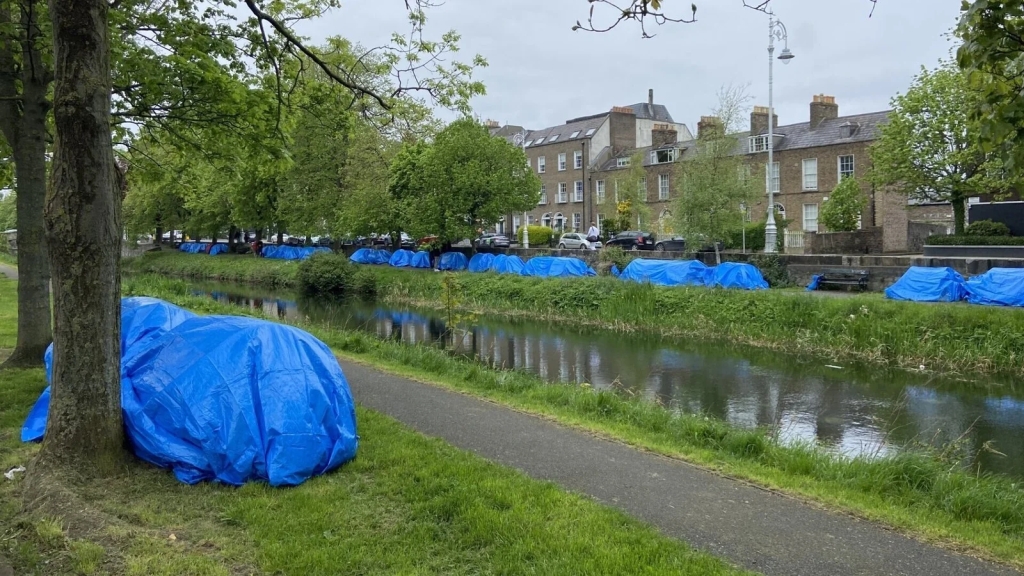
The government gives money to NGOs to help refugees. The refugees buy tents because the government won’t provide accommodation, so the government spends money to destroy the tents. Photo: RTE

The main story of the elections is that despite long-standing failures and some dissatisfaction the main governing parties, including the Greens, more or less held their own, illustrated in quick speculation that they will bring the date of the next general election forward.

Together they won around half the first preference vote in the local elections and 46 per cent in the European.  This is historically low for the two main parties (46 per cent and 41 per cent respectively) but these are now two cheeks of the same arse that are quite able to work together at the top while their voters are transferring to each other.  Even historically the previously minor party, Fine Gael, required a third party to represent an alternative, which the Green Party has, for now taken up, in the role previously performed by the Labour Party.

This has led once again to the obvious suggestion that they should merge, given the utter absence of any political differences.  At this point, however, one is reminded of the quote from the American comedian Bob Hope who said that “No one party can fool all of the people all of the time; that’s why we have two parties.”

The dissatisfaction that achieved expression was reflected in the 28 per cent vote for a variety of independents in the local election and 34 per cent in the European, while an independent won the Limerick mayoral contest.  Most of these have no fundamental political differences from the two main parties, in some cases merely being former members with no differences at all but availing of the possibilities for personal opportunism offered by the electoral system.

Despite the ups and downs the Irish state is politically stable, reflected in Fine Gael being in office for over 13 years.  This reflects the continuing recovery and growth from the financial crash.  Of course, this has a narrow foundation, resting on a limited number of US multinationals, but the threats are not yet immediate.

The problems of this growth – of income inequality and housing for example – are ones that ‘solve themselves’.  The poorest are atomised and prey to reactionary solutions or apathy while the inadequate infrastructure is partly a result of inadequate state capacity.  There is unanimous agreement that the solution lies in increasing this capacity – ranging from the governing parties themselves through to its liberal critics and its supposed left opposition. The precise role and scope of this increased state intervention is all that varies between them.  Not an inconsequential matter but not fundamental either.  The political origins of the left organisations as nominally Marxist gives its reformist programme nothing more than a radical tinge.

While Europe witnesses its biggest conflict since the Second World War, there is an Irish consensus that supports Western imperialism, which the left’s opportunism in also supporting Ukraine does nothing to challenge.  The gestures of the Government in supporting the Palestinian cause are enough to quell widespread opposition to what this imperialism does in its support for the Zionist state, while the position of the left on the war in Ukraine does nothing to clarify imperialism’s consistently reactionary and barbarous role.  Breaking the consensus on this is hard enough already given the dependence on US multinationals and EU membership, while the loss of Clare Daly in the elections is the loss of the most articulate and passionate opposition voice to this imperialism.  Again, the parliamentary left didn’t help by standing against her.

*                   *                  *

The final factor that is genuinely new is the electoral appearance of the far right, steeped in racism and xenophobia, flying the national flag and invoking Ireland’s colonial subjugation even while its most rancid elements collaborate with the British far-right.  Between it and the bourgeois parties lies various shades of reactionary nationalism; part of the stability of the ruling bloc of mainstream parties was their adoption of a harder rhetoric and tougher policies on immigration.  These parties have thus partially legitimised the more radical rhetoric to their right.

One commentator estimated that anti-immigrant candidates took 15 per cent of the vote in the Dublin European constituency and had three elected to Dublin City Council.  The naïve who think Irish nationalism is progressive because it is an expression of the oppressed should have cause to reflect, although if they have been able to ignore the character of the nationalism of Fine Gael, Fianna Fail, Sinn Fein and various republican militarists so far, it might not be a surprise if this is not revised by the far right becoming its latest expression.

It might also be estimated that about one third of the population of the Irish state still clings to its idea of this nationalism as that of holy Catholic Ireland.  In 2004 racism played no small part in an almost 80 per cent support for a referendum to limit the rights to Irish citizenship of children born in the State.

Since then, much has been made of the modernisation and progressive liberal development of the country but notwithstanding the mobilisations around referendums on divorce, abortion and gay marriage, much of these changes, including the support for change in these referenda, are due to the general secularisation of Irish society and not, unfortunately, to mass struggles of the working class, its movement or a mass women’s movement.  These changes received significant support from the main bourgeois parties and never called into question the political hegemony of these parties never mind the class foundations of the state.

All this is reflected, among other things, in the continued patronage by the state of the Catholic Church in education and health and the continued governance of the two main parties.  The growth of independents is a continuing tribute to the clientelism and parochialism of much of Irish politics.

There is therefore no crisis in the state that would provide the grounds for the mainstream parties to do more than give a certain legitimacy to anti-immigrant rhetoric.  It has no need to collaborate with outright racist forces even if they have been useful to put a squeeze on Sinn Fein through its more primitive support.  The far right is also handicapped by being very badly fragmented with no unifying figure appearing.  The far right is therefore not the primary problem but rather an expression of the weakness of an alternative.

*                   *                  *

I generally dislike blaming the successes of the right on the failure of the left since it often minimises our objective weakness, the strength of capitalist forces and their ideological hold, and the political resources of the bourgeoisie.  It is always necessary, however, to discuss what lessons we can learn.

Despite the relative success of the Governing parties there is general dissatisfaction and disaffection among many people.  That this was mainly expressed in votes for independents was a judgement on Sinn Fein.  That Sinn Fein failed to make the gains it expected while People before Profit/Solidarity stood still and didn’t increase its vote significantly is a judgement on it.

That PbP TD Paul Murphy indicated on RTE1 that a possible drop in votes was less important than a gain in seats indicates a left so mired in electoralism that its claimed ideological foundations are no guide to its actions.  It claims that it ‘sees elections as a way to build struggle’, but in reality it supports struggles in order to build itself and its primary goal in building itself is to win elections.

Its main strategy has thus been to work towards the creation of a ‘left Government’.  This only makes sense if Sinn Fein can be seen as a constituent part of this.  I have previously argued that the reformist programme of the left is no barrier to it being part of a ‘left’ government, which can be called ‘left’ because it isn’t going to be socialist or a workers’ government.  PbP/Solidarity is only on 2 – 3 per cent in opinion polls and elections so it very obviously needs something much bigger outside to make this remotely credible.

Enter Sinn Fein, and also exit Sinn Fein.  Just before the elections it was reported that the Party had travelled to London with financial firm Davy to give a briefing to ‘investors’.  Davy stated that ‘Sinn Fein does not plan to fundamentally change Ireland’s economic policy’ and noted that “overall, Sinn Fein’s approach from an economic standpoint is more ‘New Labour’ than ‘Corbyn Labour’.”  If this didn’t sink the credibility of a left Government as the way forward, then the recent election results certainly have.

These elections had a turnout of just over 50 per cent while the 2020 general election turnout was 63 per cent.  The next election will even on this basis be different, and some of the trends noted above will build up trouble if they continue.  What it will not be, however, is the opportunity to make the objective of a ‘left’ Government either credible or, more importantly, make it the central objective of those seeking to build a working class alternative.

Back to part 1

Irish Elections (1) – Sinn Fein was the future once?

For years Sinn Fein in the North was accused of acting as both government and opposition, enacting right wing policies in government while presenting itself as anti-establishment, pretending to oppose the sort of politics it was itself carrying out.  It talked out of both sides of its mouth and had more sides than the Albert Clock, as we say in Belfast.

It got, and still does to a lesser degree, get away with it because its dumping of traditional republicanism has been continually praised while its clinging to symbolic remembrance of its dead armed struggle is repeatedly damned.  More fundamentally, it succeeded because it is the most vigorous defender of Catholic rights in the ‘new’ political settlement that has been anointed saintly status by the powers that be, stretching from Washington and London to Dublin and Belfast, not to mention Brussels.

It has had lots of powerful friends on its journey from rebels to politicians, happy to indulge its self-ID as progressive radicals while it became the centrepiece of a regime of dysfunctional failure.  It could forever bask in the naked contempt of its unionist coalition partners, the best of enemies, while telling its supporters that a united Ireland was ‘within reach’. What made it repellant to some made it attractive to others.

*                   *                  *

During a walk-about with a Sinn Fein candidate in last weeks local elections an Irish Times journalist noted that some potential voters appeared to treat the party as if it was already in Government – part of the establishment – and part of the problem it was presenting itself as the solution to.  Waving Tricolours and singing rebel songs doesn’t exactly distinguish you in the South, which now routinely names itself Ireland, leaving the North to get along with Northern Ireland, the nomenclature that unionists goad Sinn Fein with its unwillingness to allow pass its lips.  Now Sinn Fein has found in ‘Ireland’ a new rival that claims to be even more nationalist than it and waves the flag even more vigorously.  The structural conditions applying in the North don’t exist south of the border so are no help to it.

The rise of the far-right and its opposition to immigration, especially in some working class areas of Dublin, is widely held to be a major reason for the apparently sudden and stunning setback to Sinn Fein in the local and European elections held last week.  In an opinion poll in June 2022 it was recording support at 36 per cent, by far the biggest party.  Last week it gained only 12 per cent of the first preference vote and would be the fourth largest if we count the bag of independents as a party.  In 2020 it suffered from standing too few candidates to maximise seats from 25 per cent of the vote while in 2024 it stood too many.

It isn’t Fine Gael or Fianna Fail who are labelled the traitors now, although Sinn Fein long ago found that approach would get them nowhere.  It is now Sinn Fein who are the traitors to the Irish nation, who support a ‘new plantation’ and who refuse to prevent immigration when ‘Ireland is full’.   It is Sinn Fein that is now accused by the assorted racists, far right and fascists as betrayers of the ordinary working class Irish.

All the anti-immigrant tropes that have been seen across Europe are now a ready currency in Ireland and Sinn Fein is the primary political target.  Within less than a couple of years a self-satisfied liberal view that Ireland was more or less immune from the rising tide of racism and xenophobia so prevalent elsewhere has been evaporated.

The growth of the population has largely been due to immigration while the keenness of the Irish bourgeoisie to show its support for Ukraine (in the absence of an ability to provide weapons or troops) has meant that over 100,000 Ukrainian refugees have been welcomed.  This has been followed by an increase in refugees from other countries, less welcome, not least because they aren’t white and no political capital is accrued by having them.

The Irish State was already undergoing a housing shortage when it decided to open its doors to these refugees; stumbling from one emergency measure to another in order to cope while offering welfare rates on a par with the natives.  As the number of those seeking international protection also grew local protests against the housing of these refugees developed in small towns and mainly working class areas of Dublin.

Numerous arson attacks prevented accommodation from being created for refugees while local people claiming not to be racist protested, claiming only to be concerned with the lack of local GP or other health services; an existing shortage of accommodation, or the turning of a local hotel that might have brought in tourists into a refuge for asylum seekers.  The localism of political activity in much of Ireland found it easier to mobilise against asylum seekers than against the failure of the state to keep health, education and housing in line with a growing population.  No doubt many of the local protesters are voters for the bourgeois parties responsible for the policies that led to the failure.

The governing parties decided to clamp down and the toughened rhetoric on immigration became one of control – ‘firm and fair’ – the same reactionary rhetoric employed elsewhere that everyone knows means an attack on the rights of refugees.  The governing parties had found a scapegoat for their failures and a handy weapon against its political rival in Sinn Fein: opinion polling claimed to show that part of its support was more opposed to immigration than that of other parties.

The party first tried to dampen this by arguing that the Government had failed to talk to or consult properly with local people about the accommodation of refugees in their areas but one of their TDs had to admit that “we were a bit all over the place.”  This has settled down to more or less aping the rhetoric of the Government and policies that are more or less the same.

None of this could appease those looking for a quick racist solution and who aren’t going to be convinced by the benefits of immigration, not least because they haven’t seen any.  The benefits of opposing anti-immigrant and racist solutions from a socialist point of view don’t exist for those who don’t have a socialist project and don’t see any utility in working class politics.  Sinn Fein can’t argue this way and even the left mainly presents liberal and human rights arguments that are no part of this politics.

Sinn Fein thus doesn’t escape blame from more backward and reactionary workers while its more liberal and vaguely progressive supporters won’t support it bowing too far in their direction.  Both have reason to doubt the party, with the recorded decline in its support preceding the more recent prominence of migration.

There is only so much complaining you can do before you’re asked to explain what you’re going to do about it, arising from doubts about exactly what you stand for.  U-turns have been public and obvious over a range of issues, including the price of housing, proposed hate legislation, support for the failed referendum proposals that were roundly defeated and then reversal of a promise to re-run the vote if they failed.  All these are small relative to the fundamental U-turns in the North, but this just illustrates the different environment it has to work in.

*                   *                  *

Sinn Fein is not yet the past, but it doesn’t look like the future now either.  That famous Irishman Oscar Wilde said that “there is only one thing in life worse than being talked about, and that is not being talked about.”  Sinn Fein has been much talked about leading up to the elections and especially about the results, including by the leader of the current Government coalition.  You’re not supposed to talk ill about the dead in Ireland so Sinn Fein isn’t dead, but it isn’t the main story and we’ll talk about that next.

Forward to part 2