Oppressor and Oppressed (7) – solving national oppression

in The Programme for Peace Trotsky states that:

‘The “deliverance” of Ukraine does not at all constitute the fundamental aim of the Allied governments. Both in the further progress of the war and after its conclusion, Ukraine will become but a pawn in the great game of the capitalist giants. Failing the intervention of the third power, Revolution, Ukraine may as a result of the war either remain in Western bondage, or fall under the yoke of Russia, or be divided between the powerful robbers of the two coalitions.’

Of course, Trotsky spoke of Belgium and not Ukraine, and of it being divided between Germany and Britain and not the West and Russia, but these are the only differences.  If some ‘socialists’ pretend that the victory of the US and NATO, or of Russia, will not witness the subjugation of the Ukrainian working class to the impositions of one or the other, or more likely both, they no longer understand how the world works.

Plans are already being advanced to sell off what is useful to the Western powers who have forked out so much money and weapons to ensure the Russians are defeated; the Russian main interest is that no sort of Ukraine is ever strong enough to be an effective ally of Western imperialism.  Of course, supporters of Russia see no harm in this but their concern for the working class is so subliminal they do not stop to consider the consequences of this for the Ukrainian working class. Heads they win and tails you lose, unless you stop playing the imperialist game.

As Trotsky put it ‘The independence of the Belgians, Serbians, Poles, Armenians and others is regarded by us not as part of the Allied war program . . .  but belongs to the program of the fight of the international proletariat against imperialism.’

The supporters of the capitalist state of Ukraine defend its reliance on Western imperialist weapons so their claims to stand for any sort of Ukrainian independence are something of a joke; while the supporters of Russia defend the destitution of that part of Ukraine not to be annexed on the grounds of the primacy of the security of the Russian capitalist state.  Their claim that the Russian intervention is some sort of protection of (part of) the Ukrainian population is also a joke, akin to the claims of many Western ‘humanitarian’ interventions of recent history.

In both cases the outcome of either policy is light years away from socialism or any move towards it.  Trotsky put forward three possible outcomes of war:

‘Theoretically, three typical possibilities may here be considered: (1) a decisive victory of one of the parties; (2) a general exhaustion of the opponents without decisive sway of one over the other; (3) the intervention of the revolutionary proletariat, which interrupts the “normal” development of military events.’

To work towards the last, to whatever extent possible, is the task of socialists.  At the very least they must understand that this is the alternative they must strive for:

‘As regards the third possible issue of the war, it seems to be the clearest. It presupposes that while the war is still on, the international proletariat rises with a force sufficient to paralyze and finally to stop the war from below. Obviously, in this most favourable case, the proletariat, having been powerful enough to stop the war, would not be likely to limit itself to that purely conservative program which goes no further than the renunciation of annexations.’

We have already seen that for Lenin the correct view on annexation is that it ‘is violation of the self-determination of a nation, it is the establishment of state frontiers contrary to the will of the population.’ (Lenin, The Discussion on Self-Determination Summed Up) while the correct approach is the ‘freedom to settle the question of secession by means of a referendum of the nation that desires to secede’ (The Socialist Revolution and the Right of Nations to Self-Determination)

Trotsky notes that the French “socialists” had approached the annexation of Alsace-Lorraine from Germany by reducing ‘the consultation of the population of Alsace-Lorraine to a shameful comedy: first occupying (that is, acquisition by force of arms) and then asking the population’s consent to be annexed. It is quite clear that a real consultation presupposes a state of revolution whereby the population can give their reply without being threatened by a revolver, be it German or French.’

He goes on: ‘The only acceptable content of the slogan “without annexations” is a protest against new violent acquisitions, which only amounts to the negation of the rights of nations to self-determination. But we have seen that this democratically unquestionable “right” is being and will necessarily be transformed into the right of strong nations to make acquisitions and impose oppression, whereas for the weak nations it will mean an impotent wish or a “scrap of paper.” Such will be the case as long as the political map of Europe forces nations and their fractions within the framework of states separated by tariff barriers and continually impinging upon one another in their imperialist fights.’

‘It is possible to overcome this regime only by means of a proletarian revolution. Thus, the centre of gravity lies in the union of the peace program of the proletariat with that of the social revolution.’

‘We saw above that socialism, in the solution of concrete questions in the field of national state groups, can make no step without the principle of national self-determination, which latter in its last instance appears as the recognition of the right of every national group to decide its national fate, hence as the right of peoples to sever themselves from a given state (as for instance from Russia or Austria). The only democratic way of getting to know the “will” of a nation is the referendum. This democratic obligatory reply will, however, in the manner described, remain purely formal. It does not enlighten us with regard to the real possibilities, ways and means of national self-determination under the present conditions of capitalist economy; and yet the crux of the matter lies in this.’

‘For many, if not for the majority of the oppressed nations, national groups and factions, the meaning of self-determination is the cancellation of the existing borders and the dismemberment of present states. In particular, this democratic principle leads to the deliverance of the colonies. Yet the whole policy of imperialism aims at the extension of state borders regardless of the national principle . . .’

‘ . . . the national-separatist movement very often finds support in the imperialist intrigue of the neighbouring state. This support, however, becomes decisive only in the application of war might. As soon as there is an armed conflict between two imperialist organisations, the new state boundaries will not be decided on the ground of the national principle, but on the basis of the relative military forces.’

‘. . . even if by a miracle Europe were divided by force of arms into fixed national states and small states, the national question would not thereby be in the least decided and, the very next day after the righteous national redistributions, capitalist expansion would resume its work. Conflicts would arise, wars and new acquisitions, in complete violation of the national principle in all cases where its preservation cannot be maintained by a sufficient number of bayonets. It would all give the impression of gamblers being forced to divide the gold justly among themselves in the middle of the game, in order to start the same game all over again with double rage.’

‘The right of national self-determination cannot be excluded from the proletarian peace program; neither can it claim absolute importance. On the contrary, it is, in our view, limited by deep, progressive, criss-crossing tendencies of historical development. If this “right” is by means of revolutionary power, set over against the imperialist methods of centralisation which place weak and backward peoples under the yoke and crush national culture, then on the other hand the proletariat cannot allow the “national principle” to get in the way of the inevitable and deeply progressive tendencies of the present industrial order towards a planned organisation throughout our continent, and further, all over the globe.’

The war in Ukraine is not the product of either the revolutionary power of the working class against narrow nationalist claims, or the international development of ‘the present industrial order towards a planned organisation throughout our continent’, and Ukraine is being destroyed not built up. Both the West and Russia are developing their industry for the purposes of increasing the means of destruction in a capitalist rivalry over how their respective developments are to weigh against each other in the current and future wars.  Were a war of ‘progressive tendencies of the present industrial order towards a planned organisation throughout our continent’ to occur it would not entail the incorporation of Ukraine into the European Union but would have the aim of also including Russia.

To contemplate this would involve two further considerations involving the breaking away of Europe from subordination to the United States, and the misgivings of China that a new European capitalist power might seek to exercise its power against it.

Liberals appear to labour under the illusion that, despite the whole history of nation states being one of revision of borders, the settlement since World War II is inviolable; except of course when it suits their purposes, such as the collapse of the Soviet Union, break-up of Yugoslavia and expansion of Israel.  The example of Ukraine demonstrates that there is no final and settled solution to the national question, or to the wars asserting national rights, within capitalism, which turn each claim to national rights into a claim for exploitation.

This does not, of course, absolve us from attempting to address each question concretely in its particularities to advance democratic measures in so far as we can, but it does indicate where the ultimate resolution lies.

Back to part 6

Forward to part 8
Oppressor and Oppressed (6) – the enemy of my enemy is also mine

In a previous post I noted that the Russian invasion of Ukraine with a relatively small army meant that it did not, and could not, hope to annex the whole country and that its limited claims of annexation in the east of the country demonstrated the intention not to annex the whole country.  And all this is true as far as it goes.

Russia, however, has expanded its mobilisation, increased its military budget, and made clear that its war aims include denazification and demilitarisation of Ukraine in order that it can no longer pose a threat to Russian security or be an accomplice of NATO in threatening it.  So, while its strategy and objective is not primarily one of territorial gains, its key objective is the attrition of the Ukrainian armed forces.  It has these aims because it would, as I have also said before, be no great victory for Russia if the Ukrainian state were to lose only the regions that could be controlled by a pro-Russian population while it remained free in the greater part of the country to rebuild its army and join NATO.

Leftist supporters of Russia think its war aims are justified, thereby making their idea of the interests of the working class synonymous in this case with the interests of the Russian State, just as leftist supporters of Ukraine do the same.  In the case of the latter, they ignore that this means supporting the project of US imperialism to weaken Russia as a step towards the encircling of China.  In other words, they claim to oppose the war by supporting the advance towards an even greater one.

By claiming that Russia’s invasion of Ukraine demonstrates that it is an aggressive imperialist power intent on taking over Ukraine it justifies that country’s armed defence by the US and NATO and gives carte blanche to acceptance of the same claims by other capitalist states in the Baltics and Poland etc.  In doing so the rest of the NATO alliance is thereby validated.  You can’t support imperialism just a little bit, only here and not there. You can’t tell the workers of Eastern Europe, In Poland or Baltics etc. that their enemy is their own ruling class and that they should oppose the aggressive NATO alliance if you have just rejected those claims next door in Ukraine.

But supporters of the Russian state must also accept the logic of their position.  In order to achieve the war aims that they have bought into they must accept the means necessary to achieve them, just as supporters of Ukraine have supported NATO intervention as an inevitable consequence of their defending that state.  The removal of any potential threat to the security of the Russian state from Ukraine means the crippling of that country and an effective Russian veto on its political leadership.  Genuine socialists will not fret over the weaknesses of any particular capitalist state, since we seek their overthrow and replacement by the rule of the workers through their own state, but the subordination of one capitalist state by another requires oppression that socialists do not support.

In the case of Ukraine it is necessary for Russian war aims that it lack the industrial capacity to create its own arms industry of the required size, and that it lack the human resources to effectively fight.  The attacks on industrial infrastructure and the massive decline in population is evidence of growing Russian achievement of these objectives.   The population of the country fell from 41.2 million in 2021 to 34.7 million in 2023.  In 1999 52.3m people lived in Ukraine; the dramatic fall in population has therefore not been mainly the result of the war but of the disastrous effects of the introduction of capitalism after the fall of the Soviet Union.  Once again, the main enemy of working people is proved to be its own ruling class, which now sends them into war or exile in pursuit of war aims that are to the benefit of Western imperialism.  The future looks even bleaker.  This does not however absolve the Russian state of its responsibility for the invasion and its consequences.

If it is alright to inflict this oppression on Ukrainian workers, then leftist supporters of Russia cannot claim to defend the interest of the working class in any general and universal sense, since Ukrainian workers are no less a part of the world working class than any other.  If the interests of the Russian state can permit this because of some primary objective of defeat of US hegemony, why would this not equally permit suppression of the Russian working class, as is currently the case?  And if this war is only part of a larger picture of preventing the US ultimately dominating China, why isn’t the Chinese capitalist state permitted to bolster itself by suppressing the Chinese working class as well?  Between them the so called socialist supporters of Ukraine and Russia can effectively justify the suppression of the working class of the whole world.

By supporting Ukraine in its maximalist demands, and US support for them, the pro-Ukraine Left has effectively signed off on the extension of Russian war aims to the more or less ruination of the country, as the only effective way to neutralise it when it has become a proxy for the US and NATO. They may believe that Ukraine is determining the nature of the war but by it being utterly dependent on Western imperialist support it is the objectives of this imperialism, and its capacities to deliver on them, that determines its nature and its outcome, and also the political character of this left’s support for it.

So what are the implications for those opposing the war and presenting negotiations as the means towards peace?  If the US seeks war in Ukraine it is not on behalf of Ukraine but itself, and if Russia seeks subordination of Ukraine to its security interests, what concern does either have for its people?  These are the competing interests that will frame any negotiations because these are why the war started, will ultimately determine its result and thereby the outcome of any negotiations.

In any event, Ukraine as a state and its people will be the plaything of greater powers.  Russia can have no interest in a ‘Minsk 3’ deal that leaves its war aims unachieved while Ukraine has also rejected a ‘Minsk 3’.   Russian proposals to the US before the war were not consistent with US policy of its substantial and definitive defeat and if implemented would have signalled acceptance of Russian regional influence.

To argue for negotiations that could only be concluded by these parties is to argue for some temporary pause in their mutual antagonism, which would have to involve removal of the antagonism itself to be any way permanent, which in turn would mean the end of great power rivalry and competition among the largest and strongest capitalist powers.  In other words the removal of capitalism itself.

The role of socialists is explain all this and to warn against the designs of both parties, including the Ukrainian state that has made itself a willing proxy of Western imperialism, before and after commencement of the war.  What you don’t do is pick one oppressor rather than another that therefore necessarily requires an oppressed.

Back to part 5

Forward to part 7

The enemies and friends of Palestinian Liberation (2)

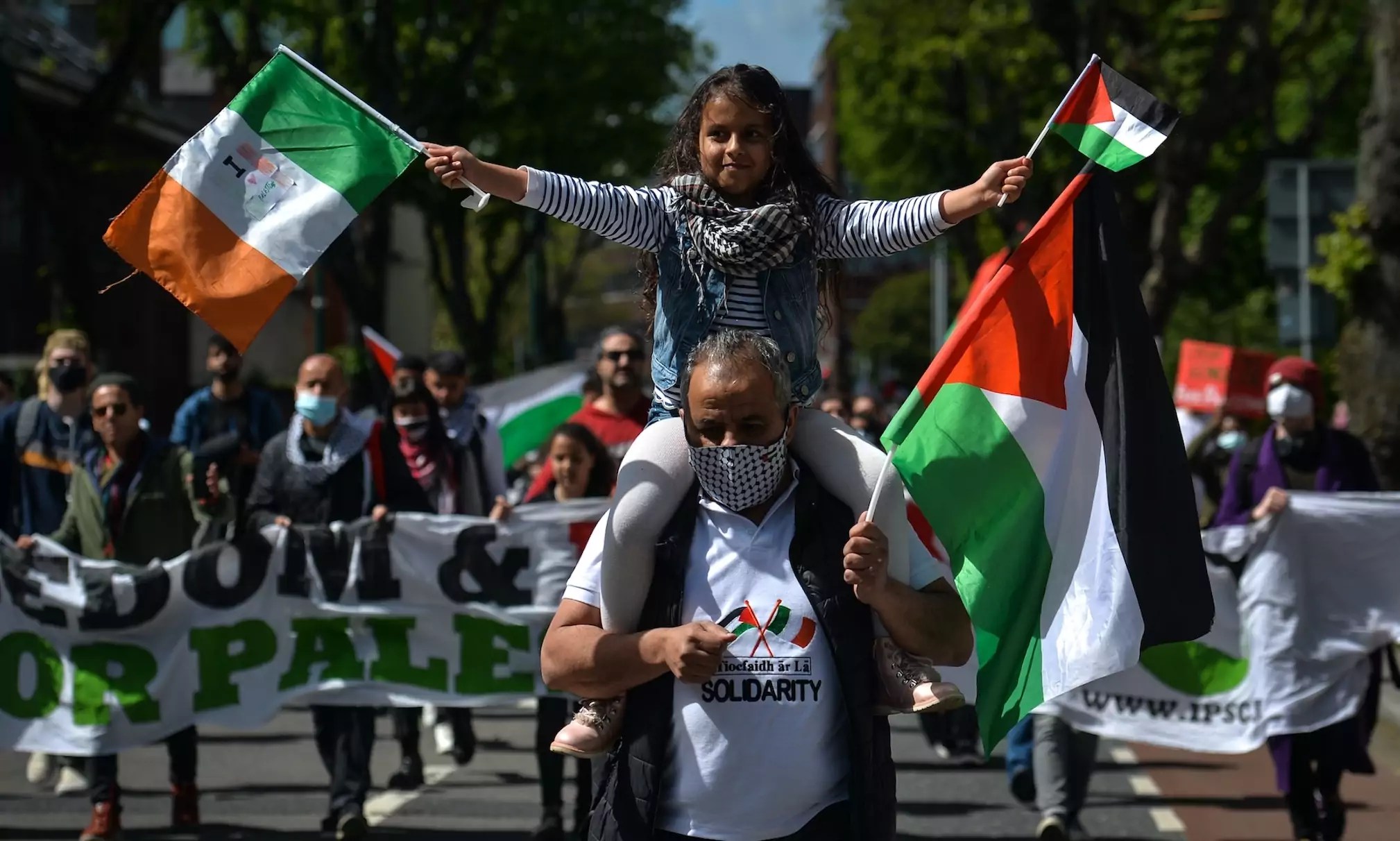
Demonstration in solidarity with the people of Palestine in Dublin, Ireland. (Photo: Artur Widak/NurPhoto via Getty Images)

US imperialism has made it clear that the Israeli cause is not just its cause but that of imperialism as a whole, encompassing its other proxy – Ukraine.  This country in turn has been happy to endorse this alignment, with Zelensky seeking a photo opportunity with Netanyahu but with Israel showing reticence only because its relations with Russia are not one of open antagonism.  An indication of the reactionary character of Russia and an embarrassment to everyone, including those leftists whose ‘anti-imperialism’ involves support for Russia.

On the other hand, many friends of the Palestinian people start sometimes from humanitarian concerns or some sort of more or less consistent and considered opposition to Western imperialism and its Zionist proxy. 

So who are the real friends of the Palestinian people might seem to be a reasonable question.  In answering it we have already seen from the previous post that we cannot identify who these are simply by accepting their word for it. We need to determine who might be expected to support the Palestinian people based on their own interests in doing so and what this support amounts to and its objectives might be.

So, just as every Arab country and people is composed of ruling classes, for whom the Palestinians are a problem, so too are there working classes and other subordinated sections of the people who genuinely support the Palestinians and have demonstrated this support.  But the Palestinian people themselves are also divided into classes, including a working class and other subordinated and marginalised people, for example in refugee camps, as well as a Palestinian middle class and bourgeoisie.

It has been the policy of the Arab states to turn the Palestinian movement into replicas of themselves, with a relatively privileged and corrupt leadership, which is why the Palestinian Authority lost Gaza and is now more and more discredited in the West Bank.  This has led to the growth of Islamic fundamentalist movements with their own state sponsors. A recent article in the ‘Financial Times‘ by a former British ambassador to Lebanon recommends that imperialism make its own attempt to fashion a Palestinian movement – “the US and Europeans have recog­nised that they need to rebuild main­stream Palestinian lead­er­ship, hav­ing cast them adrift.”

So, everyone wants to help the Palestinians, even the imperialists who are helping the Zionist regime murder thousands of them, or is happy to stand aside and parrot Israel’s ‘right to self-defence’, when what they actually mean is its right to commit mass murder and ethnic cleansing. Those who defend the democratic rights of the Palestinian people cannot therefore avoid the question of what sort of Palestine they want to solidarise with – an end to the current siege and offensive is only the most immediate task.

If we believe we can build a movement that can make a difference then it also needs to develop its own views and policy on the role of imperialism, the Arab states, Islamic fundamentalist regimes and movements, and the position of Jewish workers. This is what is meant by saying, as we did in the first post, that ‘the question of Palestine is not only about Palestine’. Even when it is about Palestine we should have a view on what sort of Palestine we want.

Arguing that it is none of our business is mistaken on two counts. First, it will not stop every other force, from imperialism to Islamic fundamentalism, seeking to create its own version of Palestine, and second, solidarity is a two way street. This means unless we think the Palestinians will always be purely victims we must allow their agency, and we want their actions to be in solidarity with the struggles of workers in the rest of the world who are, and will, come to their aid.

This means we need to consider what sort of Palestine solidarity we need. The same corruption, deceit and reactionary outlook that infects the Arab regimes, and the Palestinian movement itself ,exists among those in the West supporting Palestine, partly reflecting their class interests and partly, in some cases, awful politics.  Let us look at Ireland as an example.

The Irish state, and its people generally, are known to be the most pro-Palestinian in Europe, the Irish President, who has only symbolic powers in the main, voiced his opposition to von der Leyen’s declaration of unconditional support to Israel when she quickly visited it.  Yet who is stupid enough to believe that the Irish state, so dependent on the United States and its multinationals for its financing, will do anything effective to support the Palestinian cause and hinder Western imperialist support for it?

Or take the prominent participant in recent demonstrations supporting the Palestinian people – Sinn Fein.  It will most likely soon be a participant in Government in the Irish State. Is it going to use its position to effectively challenge Israel or its imperialist backer?  To ask the question is to answer it.  In the past it has had secret “below the radar” meetings with Likud, ‘explaining’ that it made its criticism of Israel’s policies in private, exactly the same boast of von der Leyen, Biden, Sunak etc. etc. More recently, it joined with the rest of the Irish establishment in welcoming Joe Biden to Ireland.

The only force that has an interest in solidarity with the Palestinian oppressed is the working class, and this is because their interests are aligned in opposing imperialism and the oppression that accompanies it.  Empathy with oppression is fine, but unless solidarity is a two-way street based on mutual interests it will not be strong or lasting.  Unfortunately some on then left are unable to express this solidarity consistently, because they either support western imperialism in Ukraine or also support the Zionist state itself.

Joe Biden has been congratulated by bourgeois media commentators for wrapping up the aid package for Israel with that for Ukraine, to out-manoeuvre Republicans in Congress, but it places a question in front of those on the left who oppose Israel but support Ukraine – do you support it?  Responding that you would wish to see the objects of this aid treated separately neither answers the question nor addresses the nub of the matter, which points to their inconsistent opposition to imperialism or in other words, inconsistent support.

If the Palestinian people are in the maelstrom of the world-wide imperialist conflict, the question to be put is how would it be possible to end their oppression without also ending this wider conflict, for as long as imperialism exists, so will war.  The eruption of the largest war in Europe since World War II and the renewed ethnic cleansing of the Palestinian people, with war also threatened in China and Taiwan, shows that this is not an idle or academic question.  It is one that requires and defines political movements and programmes.

It is not the first time the socialist movement and the working class has been placed with the choice.  In World War I the socialist movement split over ‘defence of the fatherland’ with most backing their own capitalist state in the war.  Today, much of the left has repeated the betrayal, mostly rallying to Ukraine and de facto Western imperialism, while another part supports Russia, ludicrously under the banner of ‘anti-imperialism’.

Neither has argued that the working class must maintain an independent position opposed to both, or argued that the only answer to capitalist war is socialism.  None of their various claims–for ‘self-determination’, ‘anti-imperialism’, or even ‘Free Palestine’ include any credible argument that these lead to socialism or are part of a socialist programme.  Nor could they– how could Western imperialist support for capitalist Ukraine, or support for Hamas, or other Arab states, or the Iranian state, lead to such an objective?  Yet many who support ‘Ukraine’ or the Palestinian cause claim to be socialists.

A socialism that is always deferred, to come to the fore at some future undefined point, while others in the meantime limit and define the political character of any solidarity, is blind to its own impotence.

The alternative programme is permanent revolution, which was first enunciated by Marx after the revolutions of 1848 and further elaborated by Trotsky after the Russian revolution in 1905 and put into practice in the revolution in 1917.  A future series of posts will look at how this has been, and should be, understood.

Back to part 1

The enemies and friends of Palestinian Liberation (1)

The hypocrisy and cynicism of Western imperialism is nauseating.  Biden, Sunak, Macron and Scholtz, not to mention von der Leyen all visited Israel to express their solidarity with the Zionist regime that over the last few decades has made it clear that the political solution these politicians claim to support is dead.  The seizure of land on the West Bank by settlers and killing of those getting in their way destroys any illusions that a two-state solution is remotely being considered.  This, and the increasing Zionist violence inflicted on the Palestinian population, is part of the explanation for the armed action of Hamas.

This was roundly condemned by these leaders whilst Israel had already begun to commit mass murder and destruction in Gaza.  The rest of the world is supposed to be brow-beaten into acceptance of this ethic cleansing through demands that they accept Israel’s ‘right to self-defence’, a right never invoked on behalf of the Palestinians.

As they became aware of mounting horror and opposition to the Zionist regime’s exercise of this ‘self-defence’, they called for humanitarian relief for the imprisoned population in Gaza, with Biden claiming he had won such a concession, before he cleared off back to the US to announce proposals for a $105 billion package of support for Ukraine’s war against Russia and Israel’s mass murder.

The cheque given to Israel, to ensure it could afford its mass killing, was underwritten by endorsement of its murderous siege, with the fig leaf of the opening of the border to Egypt of some relief from the blockade of food, medicine, water and fuel. The population of the north of Gaza was told to move south, as if this was a move to safety and access to humanitarian aid.

Moving south, they were bombed and have met with such pitiful amounts of help it is cynicism of extraordinary proportions.  The promise of relief by Biden was as much a part of the war on the Palestinians as the endorsement of ethnic cleansing.  The sending of aircraft carriers and other battleships by the US and Britain is a signal that the pogrom being carried out by Israel will receive their protection.  The mass protests, despite the propaganda of the capitalist media and threats of prohibition, demonstrate that in many imperialist countries working class people do not swallow the cynical policies of their leaders.

This demonstrates that the Zionist regime is increasingly no longer regarded as an innocent victim and that many want to express their support for a people subject to unimaginable oppression.  Opposition to the Zionist state is growing in the West but even this short resume of what has happened in the last few weeks reveals a bigger picture.

While the focus of many has understandably been on the immediate death and destruction meted out by the Zionist state, the actions and words of Western imperialism reminds us that the question of Palestine is not only about Palestine.  Israel is a settler colonial state sponsored by western imperialism, although also supported upon its creation by the Soviet Union, a testament to the reactionary nature of Stalinism.

The tyrannical Arab regimes are likewise creations of Western imperialism, which determined the borders of their countries for its own purposes.  Having just read some Marxist analysis of the Palestinian struggle from the early seventies, I was reminded that one such regime turned on the Palestinian movement and crushed it within its borders, in Jordan in 1970.  The recent recognition of Israel by the United Arab Emirates, Sudan, Morocco, and Bahrain, demonstrates again that these regimes are utterly reactionary.  Just before the latest events Israel was in negotiations to normalise relations with Saudi Arabia, which no doubt would have had some empty and worthless gestures towards the Palestinian ‘problem’ as part of the deal.

From the point of view of these regimes the Palestinian people are indeed a problem – that their populations are bitterly opposed to its oppression while they seek to advance their state interests, including through improved relations with the Zionist state.

In the past these Arab states were so weak, venal and corrupt that their subordination to Western imperialism was abject.  Their support for the Palestinians involved sponsoring their organisations as mirror images of themselves, cut down as in Jordan in 1970 when they became too big and powerful.  While these regimes have grown stronger and US imperialism has declined, so increasing their room for manoeuvre in protecting their own interests, these interests do not involve saving the Palestinians.

It is not a coincidence that the major opposition to Israel and immediate potential support to the Palestinians comes from a non-Arab regime–Iran–which is opposed by US imperialism and the Zionist state because it has asserted its own interests against them.  US imperialism has attempted to reverse its decline by provoking conflict, including marshalling its subordinate allies across the world in economic and military conflict with the enemies that might benefit most from its eclipse.

This has involved the proxy war in Ukraine against Russia, further expansion of its military alliance in Europe, and expanding economic sanctions against China.  The assertion of US authority in the Middle East through full commitment to Israel is part of the attempt to protect its imperial role in the region.  The opposition of Iran, the more muted opposition of the Arab regimes, and the increasing role attempted by China are all regional aspects of the ratcheting up of imperialist competition and conflict across the world.  The Palestinians in Gaza are currently in the maelstrom of all this, symbolised and made vital by Biden’s proposal for a $105 billion package to support Ukraine’s war and Israel’s mass murder.

Forward to part 2

Solidarity with Palestine

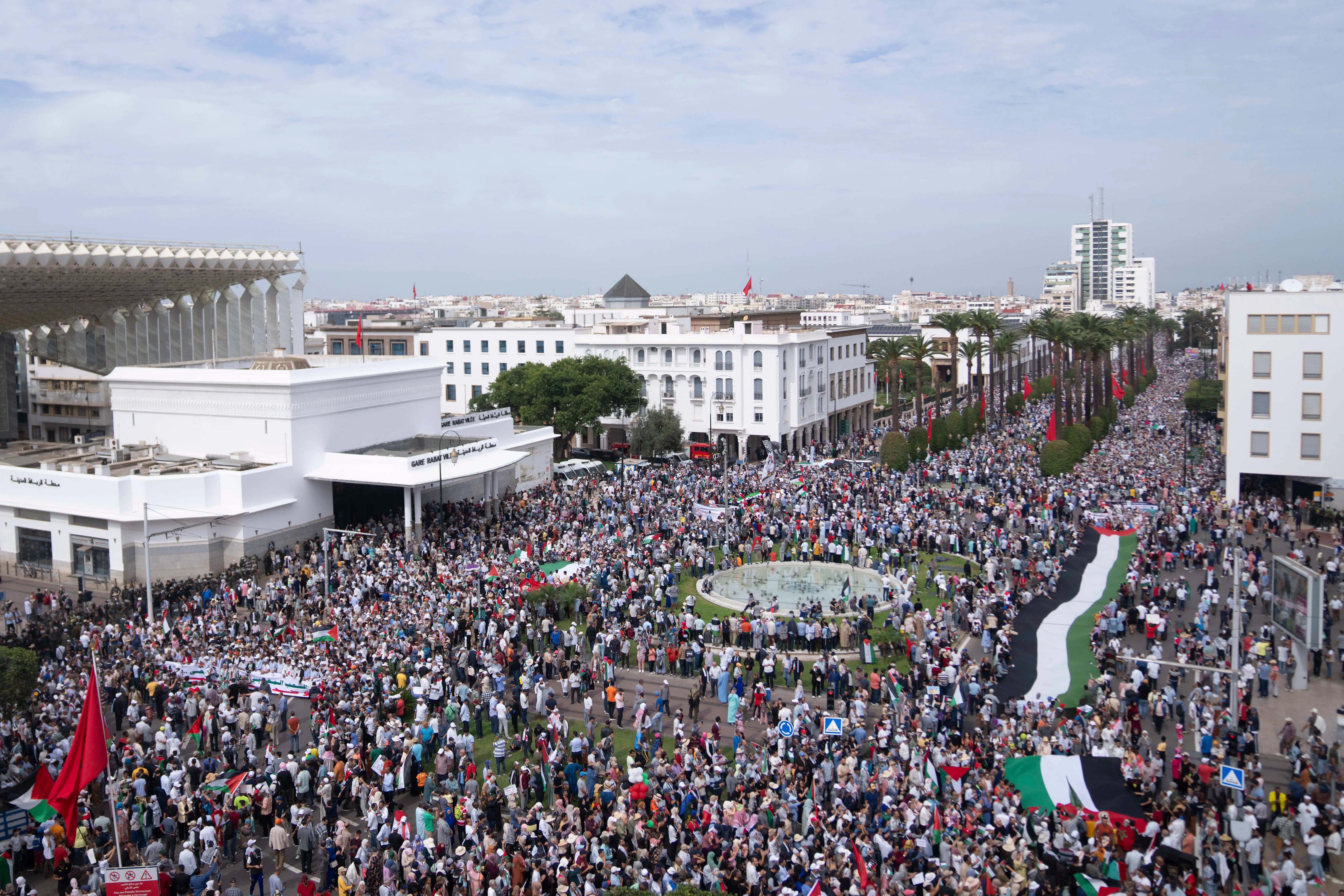
Thousands of Moroccans take part in a protest in solidarity with Palestinians in Gaza, in Rabat, Morocco on October 15, 2023. [Mosa’ab Elshamy/AP Photo]

Immediately after the Hamas attack the political leadership of the Israeli state made it clear that the rules of war were to be ‘abolished’ and their fight was against “human animals.”  The bombing of Gaza and the blockade on fuel and water entering it is a clear war crime, involving collective punishment on a whole population that can have only catastrophic results.

While Netanyahu threatened that “what we will do to our enemies in the coming days will reverberate with them for generations”, Western leaders sanctioned the unfolding ethnic cleansing by endorsing Israel’s ‘right to self-defence’, writing it a blank cheque that would be written in blood.  The language of the West was scarcely less uncompromising than that of Israel itself.

In the last couple of days these western leaders have recovered their composure and have reverted to their customary lies and hypocrisy, still supporting the Israeli offensive but calling for it to respect international law.  In doing so they still stand by the Israeli demand that half the Gaza population move south so that its army can occupy the North. Its fig leaf of concern is expressed in the call for Egypt to open up the border crossing into its territory to allow Palestinians to escape the pogrom.  There is no call for Israel to open up the border crossings into Israel itself, exposing their newly found humanitarianism as a cover for ethnic cleansing.

Their shift to sanctimonious and empty rhetoric from open and eager endorsement of war crimes does not stem from a sudden awareness of the scale of Zionist revenge but from the revulsion of many in the West and in the rest of the world to the Israeli pogrom.  They thought that abhorrence at the Hamas slaughter and the propaganda of the mainstream media would allow them to subdue and intimidate opposition to Israeli revenge, which many understand is simply an extension of the existing policy of destruction of the Palestinian population.

In Britain, Germany and especially France, governments took steps to threaten and ban demonstrations in support of the Palestinian cause, which over the weekend have failed.  Almost the whole spectrum of bourgeois political opinion showed itself out of touch with much of its population – open endorsement of the brutality of the Zionist state was not acceptable.  A too open display of hypocrisy could not be allowed to congeal and become hardened into real comprehension of their rulers’ policy and the bias of its propaganda vehicles.  European workers were already paying for the war against Russia in Ukraine and the promotion of support for the war and sacrifices imposed by it might be further weakened if the Israeli invasion was portrayed as legitimate and ‘good’ while the Russian was indefensible and ‘bad’.

The change of language however has not involved a change in policy, except in one respect.  A further reason for the row back from open endorsement of the Zionist pogrom is the fear expressed by some security figures in the West that the invasion of Gaza is a Hamas trap, one that the Israeli military is not prepared for.  However, the far-right Zionist government has a policy of destroying any threat posed by the Palestinian population and has rejected concessions or even negotiations.  It therefore has its own imperative to destroy all Palestinian independent capacity for resistance and will consider that the history of the Zionist state shows what it can get away with, while its current political credibility and integrity requires its own massive level of retribution.

Western imperialist interests undoubtedly align with the settler colonial Zionist state, but the US political leadership had also thought that it had achieved remarkable stability in the region because it had been making some success of the more open alignment of the reactionary Arab regimes with Israel.  The fear expressed by it now is that the war will escalate and spread if the Zionist state provokes resistance sufficient either to endanger a quick victory, or to encourage or involve other fronts in the war, in Lebanon or Syria for example.

The stability of imperialism in the region, including also of the Zionist state, requires the stability of the reactionary Arab regimes; the too open and violent destruction of the Palestinians in Gaza may provoke their populations to action and weaken the whole authoritarian structure across the Arab world.

The future of the legitimate rights of the Palestinian people does not therefore ultimately rest in the ‘Palestinian resistance’ (by which in today’s context means Hamas), but in the working classes of the whole Arab world plus Iran.  The Arab Spring and the mass demonstrations in Iran show the potential and the reality of their power.  They are the primary force that can destroy the reactionary Arab regimes that base their political stability on the subjugation of their own people and the quiescence and submission of the Palestinian population.

The Palestine solidarity movement should not politically endorse the ‘Palestinian resistance’, as code for Hamas or Fatah, but should oppose their own countries’ protection of the Zionist state and their threats to the Arab populations of other countries.  Not only should it oppose the blockade and invasion, but in the US and Britain it should demand that their escalation of the war-drive, under the hypocrisy of ‘de-escalation’, should be ended and that their war ships get out of the Mediterranean Sea.  Having exposed themselves for their too-open support for Zionist terror it should be understand that their purpose is to further support the Zionist state.

Solidarity with the plight of the Palestinians in Gaza and elsewhere requires support not simply with them, but with the working class in the whole region, the only force which has not collaborated with western imperialism and the Zionist state and which will have to overthrow its own states in the process of overthrowing the Zionist one.

Ukraine (6) – A proxy imperialist war

Photo: Ukrainian Presidential Press Office on Monday, April 25, 2022, from left; U.S. Secretary of Defense Lloyd Austin, Ukrainian President Volodymyr Zelenskyy and U.S. Secretary of State Antony Blinken, April 24, 2022,(Ukrainian Presidential Press Office via AP)

Covert action has been a favoured means of waging war since at least the start of the first Cold War, with such covert action often part of what has been variously termed vicarious or proxy warfare.  It has been used by Empires for a long time, employing the resources of their conquests, such as the British with Hindu Sepoys, Nepalese Gurkhas and the French with Algerian Berber Zouaves.  In the middle of the 19th century Britain ruled India with almost 278,000 troops of which only around 45,000 were European

From the Truman administration onwards the typical US intervention into other countries has also involved economic and financial sanctions, with the proxy element involving the demand that third countries implement these measures as well.  These are usually followed by clandestine or ‘special’ operations and then conventional war; the preferred agency of the CIA thus became involved in over 900 major covert actions between 1951 and 1975.

The supposed advantage of this approach is that it is less expensive in terms of money, troops and political capital.  The proxy war being waged by US imperialism today shows all these features except on a much larger scale.  Almost an entire, and relatively large, country is being employed as a proxy – unless one believes that the US is really concerned with the independence of the Ukrainian state and not the significant degrading of Russia.  The US has demanded that every other country impose its economic and financial sanctions even to the point of incurring massive damage to their own economies.

While proxy wars are supposed to be less expensive the sheer scale of this one involves massive cost, which however is incurred unequally.  The arms and energy industries, especially in the US are doing just fine.  Massive political propaganda has improved the political position of US imperialism, at least in the West, including the subordination of much of what passes for the Left in these countries, so that in this respect as well the proxy war has fulfilled its function. Whether this continues to hold good is another matter.

The first Cold War appeared to make direct war between the US and Russia unthinkable because of the risk of nuclear escalation, but the US has sought counterforce and nuclear primacy strategies that would supposedly make a nuclear war winnable in some meaningful sense.  The potential escalation involved in this proxy war is therefore greater than previous conflicts.

*                        *                           *

In a review of three books on proxy warfare In the London Review of Books Tom Stevenson notes that ‘America is the world’s most prolific sponsor of armed proxies’ and that it ‘has done most to develop the proxy war doctrine.  In January 2018 the US military introduced the ‘by-with-through’ approach. It was the work of J-2, the intelligence directorate of the Joint Chiefs of Staff: ‘the US military must organise, resource and train’ local forces and ‘operate by, with and through’ its ‘partners’ and ‘nations that share our interests’ (note that the word ‘proxy’ is avoided in favour of more anodyne terms). Using proxies has been common practice for the CIA for decades, but the J-2 doctrine describes an increasingly common style of war.’ 

He noted when writing (in the second half of 2020) that ‘around half the US troops in Afghanistan are technically mercenaries: they are deployed for private profit.’  In Iraq in 2008 the US had a proxy army of 103,000 ‘Sons of Iraq’ fighting in Anbar.  In Afghanistan the US trained over 50,000 mujahedeen, providing nearly $3bn in aid between 1979 and 1989.  As the CIA Director William Casey put it: ‘Here’s the beauty of the Afghan operation . . . Usually it looks like the big bad Americans are beating up on the little guys.  We don’t make it our war . . . All we have to do is give them help.” 

The current war has been precipitated by Ukraine seeking to formally join NATO while securing the approval of US imperialism for its security strategy aimed at the conquest of the Crimea, which Russia considers its own territory. Nancy Pelosi, before the provocative visit to Taiwan, said after a visit to Kyiv and a meeting with President Zelensky, that America stands “with Ukraine until victory is won.” US defence secretary Lloyd Austin said “we want to see Russia weakened to the degree that it can’t do the kinds of things that it has done in invading Ukraine.”

US objectives are therefore not limited to those internal to Ukraine but to requirements in relation to Russia, its economy and security, and the balance of power between it and both Russia and China, to which the US quickly turned its sights on the pretext of the Ukraine war.  There can be no doubt that the amount of military aid provided by western imperialism has materially affected the dynamics of the war with the effect of turning almost the whole of Ukraine into a proxy for its own interests.

Since these interests are truly world-wide the potential for a global conflict is obvious, even the pro-war left acknowledges this danger while cheerleading Ukrainian armed forces.  This awareness does not translate into opposition to the war itself but only to the imposition by the US and NATO of a no-fly zone over Ukraine and the open introduction of their troops on the ground.

It appears therefore that the only inter-imperialist war that can exist for this Left is one that creates the immediate potential for a nuclear exchange.  This currently has the effect of allowing an underestimation of the potential for this happening through anything short of direct kinetic combat.  Even the right-wing RAND corporation presents scenarios in which US intervention can trigger direct warfare with the potential use of nuclear weapons.  Others were noted in the previous post.

It has been argued that there has been no nuclear war between the United States and Russia because conventional war between them is also inconceivable.  Except that it has reasonably also been suggested that direct conventional war between them has not occurred because no conflict between them has occurred that has involved the vital interests of both, and from which therefore neither can retreat.

NATO membership of Ukraine, with the possibility of stationing long-range missiles within a short distance from Moscow, coupled with an avowed policy of a direct conventional attack on territory claimed to be part of Russia containing its Black Sea fleet, would obviously seem to involve vital strategic Russian interests.  That this scenario has precipitated aggressive Russian action can be a surprise to no one.  To pretend therefore that only Russia is responsible for this war lacks any credibility.

Russia has time and time again warned that Ukrainian membership of NATO is a red line. Putin in 2008 ,after the summit in which NATO declared Ukraine would become a member, said that “we view the appearance of a powerful military bloc on our borders . . . as a direct threat to the security of our country.”

It does not matter whether Russian action is morally reprehensible and should be condemned.  It is not the job of socialists to right the moral wrongs of world capitalism and the states that it comprises.  The job of socialists is to argue and fight for a new society in which such wrongs are abolished, and this means starting from current society and seeking how it can be changed.  This is the subject of the long series of posts on this blog on Marx’s alternative to capitalism (here for example), which relies on the independent social and political organisation of the working class across the world supported by other oppressed and exploited classes and layers of the population.

This will not be done by defending the prerogatives of capitalist states on the grounds that they have provoked invasion by other bigger capitalist powers, or the idiot view that we should defend their right to join imperialist military alliances.  We should oppose both the Russian invasion and the participation of western imperialism because only this identifies the sources of the war and the enemies of workers suffering from it directly and indirectly.

Gilbert Achcar of the Fourth International says that the war in Ukraine is not an inter-imperialist war because such a war ‘is a direct war, and not one by proxy, between two powers . . .’    In the last couple of decades the phenomenon of imperialist proxy wars has had a resurgence and the most significant wars of the last few decades have all been proxy wars of one variety or another, either originating or developing as such, including Iraq, Afghanistan, Syria, Libya and others.

It does indeed matter that US and NATO imperialism is not attempting to impose a no-fly zone or placing large numbers of troops on the front-line but refusal to call this an inter-imperialist proxy war has led to a position in which the actions of US/NATO imperialism is supported (through supply of arms) and the actions of the reactionary proxy (the Ukrainian state) are openly celebrated.

The war in Ukraine has brought the proxy mode of war increasingly adopted by imperialism to a new level, not only because of the scale of the war and the military support provided, not only because the proxy is a large state and is directly fighting Russia and not some Russian proxy, but because it involves the perceived vital interests of Russia.  We need only consider the response of US imperialism if Russia was pouring weapons into an anti-US Mexico that had declared its intention to reconquer Texas to appreciate the view of the Russian capitalist state. We can now see the provocation involved by successive reactionary Ukrainian governments including putting the objective of NATO membership into the constitution guided by an increasingly ultra-nationalist ideology.

Understanding that what we are seeing is an imperialist proxy war leads us to oppose both US imperialism and the Russian state and in doing so strengthens the independent political position of the working class.  If the road to freedom lies in appealing to the assistance of either US imperialism or Russia the working class will never learn to look to itself.

Back to part 5

Ukraine (5) – The role of Western Imperialism

http://www.voanews.com

In the debate between Gilbert Achcar of the Fourth International and Alex Callinicos of the International Socialist Tendency, Callinicos sets out what Achcar’s view is on what constitutes an anti-imperialist war – ‘a direct war, and not one by proxy, between two powers, each of which seeks to invade the territorial and (neo)colonial domain of the other, as was very clearly in the First World War. It is a ‘war of rapine’ on both sides, as Lenin liked to call it.”

He then criticises this view – ‘This definition, which requires an inter-imperialist war to be one where both sides are seeking to conquer each other’s territory, doesn’t even fit the Second World War. British and French imperialism weren’t interested in seizing German territory, but in hanging onto their already overstretched empires. And Hitler wasn’t particularly interested in these. It was eastern Europe and the Soviet Union he was after.’

Callinicos finishes by saying that ‘The properly Marxist approach is to recognise that the present situation involves both an inter-imperialist war by proxy and a war of national defence on Ukraine’s part.’  It is not clear whether his proposed fight for national defence includes reconquering Crimea or the already separated parts of the Donbas.

Achcar writes that ‘the Russian invasion of Ukraine is the second defining moment of the New Cold War in which the world has been plunged since the turn of the century as a result of the US decision to expand NATO.’  Yet this ‘defining moment’ of a new Cold Ward is held not to define the war in Ukraine, the veritable front-line within it.  Still, he does not shy away from stating its importance, even if he gets the nature of it completely wrong: ‘the fate of Russia’s invasion of Ukraine will determine the propensity of all other countries for aggression.’

He opposes NATO ‘boots on the ground or the imposition of a No-Fly Zone from a distance’ and states that as a matter of general principle, he is against direct military intervention by any imperialist force anywhere. Asking for one of them to clash with another is tantamount to wishing for a world war between nuclear powers, he says.  Indeed so, but are we not also opposed to indirect ‘military intervention by any imperialist force anywhere’?  Not according to Achcar.

In a further article Achcar answers the following question – ‘Wouldn’t Ukraine’s standing up against the Russian invasion benefit NATO?’ – by saying ‘“so what?” Our support to peoples fighting imperialism shouldn’t depend on which imperialist side is backing them.’  To which the only rational answer is – how can a people be said to be ‘fighting imperialism’ when it is backed by a rival imperialism? And here, to be specific, we are talking about an independent capitalist state seeking to join by far the largest imperialist alliance!

In reply to the further question ‘Isn’t the ongoing war an inter-imperialist war?’ he answers:

‘If any war where each side is supported by an imperialist rival were called an inter-imperialist war, then all the wars of our time would be inter-imperialist, since as a rule, it is enough for one of the rival imperialisms to support one side for the other to support the opposite side. An inter-imperialist war is not that. It is a direct war, and not one by proxy. . .’

Since he believes that only a direct war between the US/NATO and Russia (and presumably China) is an inter-imperialist war then he must believe we have not seen an inter-imperialist war since World War II, and not between these protagonists, also perhaps excluding the Korean War in which China could hardly be considered imperialist but Russia was involved, leaving aside the question whether this too could be seen as imperialist since it was part of the Soviet Union.  

Since indirect intervention in Ukraine is not an imperialist war then all the too numerous to mention indirect wars, not to mention covert actions, by the US and others must not be considered imperialist war either.  From concern that we label too many wars as imperialist, which is itself rather strange if we consider imperialism to dominate the world, he has arrived at his happy conclusion that very few wars can be characterised as imperialist.

His response might be that one-sided imperialist interventions may be cited as imperialist wars but his argument is about an inter-imperialist war, although in the case of the war in Ukraine such a response would fail his argument.

Of course, the scope and scale of indirect imperialist intervention is relevant to considering whether and to what extent a particular war can be considered imperialist and thereby its political salience.  But this applies to Ukraine in which it is impossible to argue that both Russia and the US/NATO are not involved.  The sheer scale of Western imperialist intervention in Ukraine does not permit its intervention to be considered secondary. 

The major Western powers have publicly supplied over $14 billion in military aid, which is over two times the defence budget of nearly $6 bn of Ukraine in 2021, and excludes other promised funding nearly three times this amount, and no doubt other military support that has not been openly revealed.  Since these words were written Biden has promised even more lethal aid.  In addition, unprecedented sanctions must be regarded as war by other means and have historically preceded open conventional warfare.

The military aid follows years of increasing cooperation with NATO including training of its armed forces, their participation in the NATO occupations of Iraq and Afghanistan, and military exercises with NATO forces within the country. The US has directly impacted on the war through intelligence and real-time targeting of Russian forces and assets while it would be naive to believe that Western special forces have not been inside the country during the war.

The view that we are not witnessing an imperialist proxy war can lead to blindness to the assistance already given, both visible and hidden, and to the real possibility of escalation, which is at increased risk given what has already been committed.  It should already be noted that the nature of the weapons delivered by the US and other NATO powers is increasing in power and sophistication with the potential for fighter aircraft to be provided now under consideration. The debate is therefore not simply about an academic political characterisation of the war.  

Unfortunately, it is to be expected that much of the pro-war left will follow Western imperialist escalation, as it already has, not only because this is the logic of their political position of prioritising support to the Ukrainian State but because of an acquired emotional commitment. One only has to note Facebook posts in which so-called Marxists proclaim their gloating over Ukrainian advances to realise what counts for those with this commitment.

A recent examination of the potential routes to further escalation notes the following:

‘A Ukrainian law recently signed by Ukrainian President Volodomyr Zelenskiy gives Polish citizens the rights similar to those of Ukrainian citizens. This could serve as legal cover for thousands of Polish soldiers to enter Ukraine, don Ukrainian uniforms, and using NATO-supplied Western equipment begin fighting against Russia’s forces. When proof of any such gambit emerges – as it inevitably will – Russia could decide to hit Polish targets in response, bringing NATO into the war more directly in one form or another.’

The writer notes that ‘The Kharkiv advance was organized on the basis of: NATO training of tens of thousands of Ukrainian forces; massive Western weapons supplies to Kiev (e.g., see https://www.ustranscom.mil/cmd/usp.cfm); the NATO Central Command’s and Western intelligence’s deep embeddedness into the Ukrainian forces; NATO-designed counteroffensive tactics, strategy, and plan; large numbers of former Western soldiers and officers participating in the operation; possible participation of Polish officers and troops . . .  Retired former U.S. Army Colonel Douglas Macgregor has asserted that NATO officers form a military staff that is directing much of the Ukrainian war strategy and tactics.’

Back to part 4

Forward to part 6

Ukraine (4) – Supporting Ukraine and Opposing NATO?

People before Profit protest outside Russian embassy in Dublin

There is a second set of errors in what I have called the pro-war left, involving not only those who explicitly support the capitalist Ukrainian state but those who claim that in addition to this it is necessary to also condemn and oppose NATO.

A previous series of posts have demonstrated that the arguments put forward by Gilbert Achcar of the Fourth International are not consistent with a socialist approach to the war.  He and Catherine Samary consistently understate the significance of the role of NATO and the US, and in the case of Samary reach for arguments that are the equivalent of a magician’s misdirection.

The latter, for example, insists that the primary issue in the original enlargement of NATO following the fall of the Berlin wall in 1989 was concern among rival imperialisms to retain some sort of control over Germany, and not opposition to Russia. (It is, by the way, relevant to note that Germany is now claiming its role is to take the lead in European security and what role other than opposition to Russia?)

This argument by Samary is not serious but inadvertently revealing.  The unity of Germany under NATO firstly required removal of massive numbers of Soviet troops, and the later enlargement of it across Eastern Europe nails any illusion that this was not an anti-Russian move.  A united Germany was a concern, but all the more reason to strengthen the European Union and further the project of a single currency.

NATO membership would further constrain the independent initiative of Germany as Samary appears to admit, which tells against any argument that Ukrainian self-determination, in the sense that she argues it, is compatible with the current embrace of that country by NATO; an issue she wishes to render scarcely relevant to the nature of the war.

Similarly, she claims that Russia was not under threat from NATO and that Putin’s main concern was with the colour revolutions against corruption, including potentially against himself.  For her, the actions of Russia must never be framed as defensive in any way or a reaction to western actions.  So, the possibility of taking control of Donbas and Crimea was primarily to boost his popularity while strengthening Russia’s international position.  This happened when it did because Putin was not previously in a position to be aggressive, while the earlier catastrophic collapse of the Russian economy in the 1990s and its diminished geopolitical power were the result of Boris Yeltsin and an act of Russian self-determination. The war in Ukraine today is not therefore a reactive one but an active aggressive war explicitly against Ukrainian independence.

Some of these points are correct in themselves, it is a question of how far they go in explaining the origin and nature of the war.

Once again the selection of relevant factors ignores the blatantly obvious anti-Russian nature of NATO and its increasingly threatening enlargement, all the more possible and unnecessary precisely because of the collapse of the Warsaw Pact; the collapse of the Russian economy due to Western imported shock therapy; US  interference in internal Russian politics in favour of Yeltsin, and following him the initial attempts by Putin to form some sort of partnership with Western imperialism rather than confront it as an enemy.

And once more the argument is revealing.  Apparently Russian shock therapy was an act of self-determination and since her false application of this principle supposedly adds legitimacy to it, we are left with the view that this was an internal Russian matter. Nowhere is it viewed as arising within and out of the class struggle within Russia, almost always implemented by internal forces, but often on behalf of outside imperialist powers and institutions such as the US, EU or IMF.

Yet nowhere is the loss of political sovereignty by Ukraine through the demands of these organisations given any consideration as impairing the ‘self-determination’ of Ukraine, nor are classes within that country assigned responsibility for the imposition of austerity, repression, and submission to the demands of the IMF, EU and NATO.  Neither is the development and growth of separatist tendencies in the east of the country granted any legitimacy through their resulting to a great degree from the repressive actions of the Kyiv government.

Instead, the growth over the years of support within Ukraine for NATO membership is blamed on Russian aggression, which is only partially true, but with no account taken of the reactionary Ukrainian regimes that have pushed membership even when the majority of the Ukrainian people opposed it, or been so divided that its pursuit could only lead to deepening division and exposure to long-standing Russian threats.

The Fourth International (FI) In the shape of Gilbert Achcar has debated Alex Callinicos on the nature of the war here and here.  The international Socialist Tendency (IST) to which Callinicos belongs and which is represented by the Socialist Workers Network in Ireland, the political leaders of People before Profit, published an early statement on the war.

The IST is strongly critical of the FI’s refusal to condemn the intervention of NATO and its general disregard for its role. This leads them to make many valid criticisms and take a stand against NATO’s provision of arms to ‘Ukraine’ as well as to western sanctions.

Unfortunately, they share other positions with the FI that makes their overall position something of a contradiction.  Similarly with their support for Brexit it has the flavour of having your cake and eating it.  So, they claim that ‘for Ukrainians it is a war of national self-defence’ while ‘at the same time from the side of Western imperialist powers led by the United States and organised through NATO it is a proxy war against Russia.’  One is immediately propelled to ask – so which is it?

What is it from the side of the international working class – from those in China, India, Africa, Europe etc?  It’s difficult not to keep on recalling that Alex Callinicos wrote a book about Postmodernism, from which the IST position seems to be inspired – the nature of the war depends on where you are, i.e. reality is dependent on your viewpoint.

The IST statement says that ‘the war is both an imperialist invasion of a former colony and part of an inter-imperialist conflict between the US and Russia with their allies. We are against both imperial powers. We express our solidarity with the Ukrainian people, supporting their right to resist the invasion.’  Elsewhere Callinicos has said that the war is one of national defence by Ukraine and therefore is justified, and that ‘it would indeed be good if the Ukrainian people were able to drive out the Russian invaders.’

The only way to reconcile this contradiction of being both a justified war of national defence and an inter-imperialist one (and even this would not justify support for the Ukrainian state) is to claim that the Ukrainian state is somehow independent of western imperialism.  We have already seen in this series of posts that this is not credible.  Indeed, the IST statement itself claims otherwise: ‘The inter-imperialist character of this conflict is confirmed by the policy of the Kyiv government, which is to draw the West into the shooting war.’

So, the policy of the Ukrainian state is actually more reactionary and dangerous than that of the US and NATO.  So where is this war of national defence?

When it comes down to it, the approach to the war is not so different between the IST and FI, with the IST saying that ‘The Russian invasion of Ukraine on 24 February was an act of imperialist aggression and a violation of the Ukrainian people’s right to self-determination.  . . . We express our solidarity with the Ukrainian people, supporting their right to resist the invasion.’  The IST thus have the same mistaken take on the demand for self-determination as the FI, from which all else seems to follow.  Except for the IST all else doesn’t follow, which is good, but only because that makes their position more contradictory, if better than that of the FI for it.

If the war really was one of justified national defence, if it were some sort of colonial possession, it wouldn’t matter from whom ‘Ukraine’ got the weapons to fight its war, providing it could retain its interests independently of western imperialism, but the IST doesn’t make this distinction.  Instead, Alex Callinicos says that ‘. . . the Western imperialist powers are instrumentalising the Ukrainian national struggle against Russian imperialism for their own interests.’

On this the FI is more consistent but at the price of complete capitulation to western imperialism.  The FI also proclaims its opposition to NATO, just as does the IST, but neither thinks its role therefore makes the war by Ukraine a proxy one fought on behalf of western imperialism, using its money, its weapons and for its political objectives.

Of course, opposition to NATO arming Ukraine allows the IST to avoid the charge that NATO must exist for it to play this ‘progressive’ role and that is no small thing.  But willing the end – a Ukrainian victory – without willing the means is deceitful.

What would be the result of a Ukrainian victory but a strengthened reactionary regime in Ukraine and a strengthened western imperialism threatening Russia even more immediately and closely?  And this assumes that the perceived vital security interests of Russia would not have beforehand led to the use of tactical nuclear weapons and the potential for nuclear conflagration.

The politics of the IST are not so different from that of the FI.  Both start from ‘anti-imperialism’ and the ‘right’ of independent capitalist countries to their own reactionary policies even if, as I have said before, it lands them in the shit.  Neither start from the independence of the working class, including from the capitalist state no matter what its form. Lenin long ago gave the answer to those who think they can combine an imperialist war with national liberation as we set out in a previous post. 

Back to part 3

Forward to part 5

What sort of Anti-War Campaign (1) – A question of tactics?

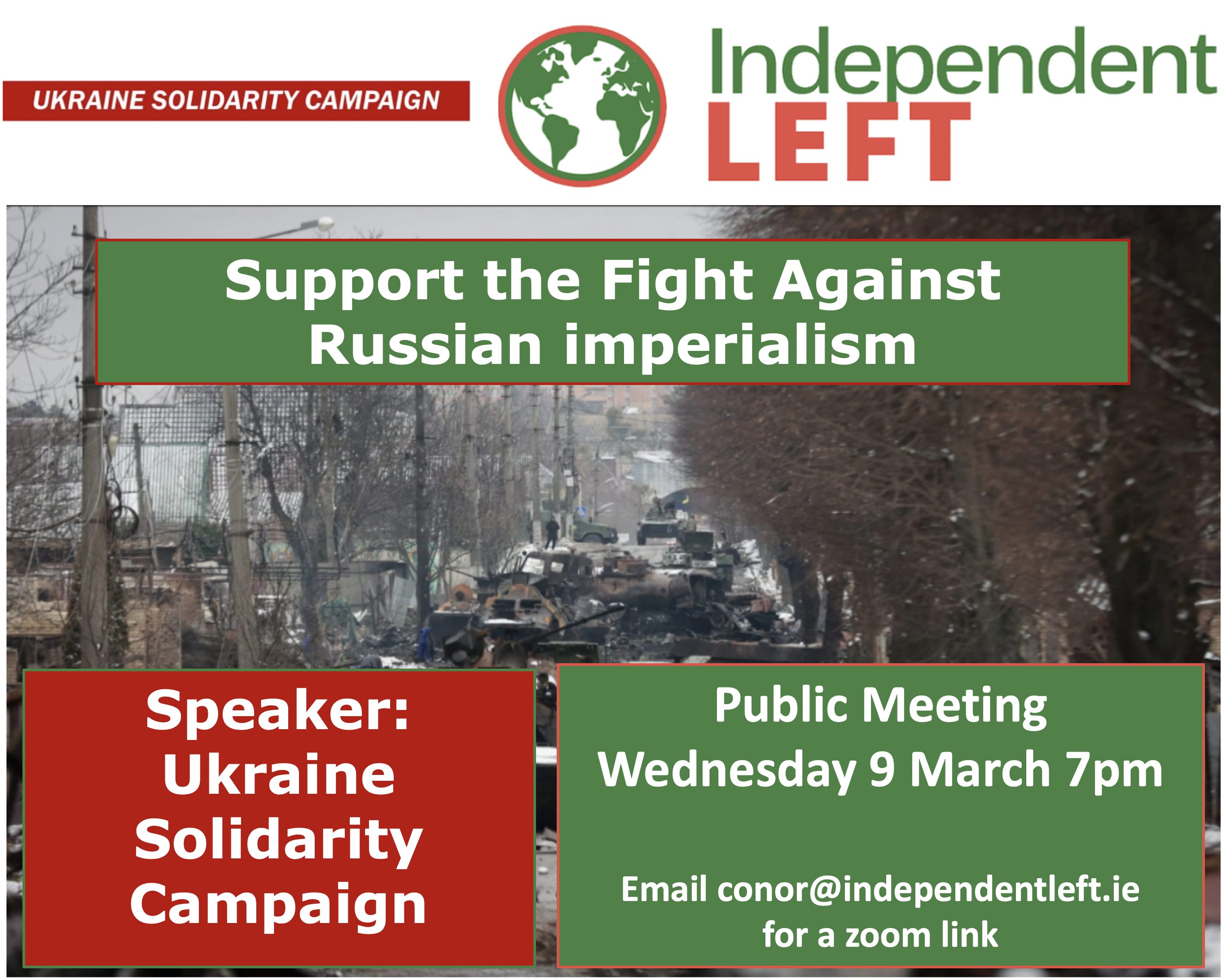
This image is an advertisement for a Ukraine Solidarity Campaign meeting in Ireland

The war in Ukraine has revealed deep divisions amongst those describing themselves as Marxists, with references to Lenin and Trotsky aplenty and rebuttals against them quoted from the same sources.  It is however necessary to study this debate and read the references if you want to make any pretence at being a Marxist, while those who are not may learn why the arguments are important to human emancipation and an end to war, and not just this war.

Unfortunately, for some ‘Marxists’ this debate is unnecessary, as argued here.

The authors write that they ‘started by outlining in some detail the differences on the left about Ukraine. We outlined the now well-rehearsed arguments about: relative importance of NATO expansion versus Putin’s imperial project, supporting the armed resistance or de-escalation/no arms from the West, [and] is it an inter imperialist war or a just war against an imperialist invader?’

All pretty important in determining one’s attitude to the war you might think.  But no: ‘the discussion about how to build a mass anti-war movement on Ukraine should not depend on this level of argument involving principles and political analyses about history and the current invasion. No, building a movement here is about tactics.’ (emphasis added – Sráid Marx)

There are two aspects to this.  One is sheer dishonesty.  The movement they want to build is built on political analysis and principles, or some might more accurately say on their abandonment, but this is the less interesting aspect.

The second are the questions around what principles – that they no longer want to forefront – are correct and how they should be fought for, because the nature of these principles determines the nature of any anti-war campaign; something that should be obvious.

It is not possible to divide these aspects except conceptually, so it is possible to argue with people who will respond to the charge of capitulation to imperialism (in the form of NATO); and the charge of refusal to support an independent working class position (through their support for the Ukrainian state, its armed forces and its reactionary leadership), that this is simply not true.  These people claim that they do oppose NATO and do support the interests of the Ukrainian working class. But first things first, might be their response.

Unfortunately, these people will then continue to parrot support for ‘Ukraine’, the ‘Ukrainian people’ and the ‘Ukrainian resistance’, as if Ukraine is not a state, a capitalist state, and a corrupt capitalist state that socialists would not defend or support in peace but are asked to do so in war.  Likewise, the ‘Ukrainian resistance’ is made up primarily of the Ukrainian state’s armed forces, incorporating fascist units, with mass support for these armed forces in Ukraine making as much difference to its class nature as mass support for the British army in 1914 did for its imperialist character and its defence of Empire.

As for the formulation of principles and political analysis based on the ‘Ukrainian people’: is this people uniquely undivided by class, with their separate class interests?  Where did all the oligarchs go?  Is there no working class in Ukraine?  Did Marx declare ‘people of the world unite!’; call for the self-emancipation of ‘the people’ and analyse the origin of surplus value in the exploitation of ‘people’?  Do Marxists today call for ‘people’s’ control of production? Or does all this stuff have no application anymore?

Perhaps we are now being asked to believe that the interest of the Ukrainian working class is currently aligned with that of its state, which is aligned to that of NATO and imperialism, in which case the primacy of class struggle disappears when these forces go to war.  Marxism is fine but in war it’s first things first and this means it’s a question of tactics – ‘building a movement here is about tactics.’

‘All those fine analyses will have no impact outside a narrow group of lefties if we are unable to build a mass audience’ says the article, so it is a question of ‘how do we mobilise the biggest number of people so that we have an audience where we can put forward our respective arguments about the nature of Putin’s Russia or the role of NATO?’

So, what is the problem with this approach? – apart from the fact that it dismisses the role of principles and political analysis, which should really determine the nature of the campaign, its demands and its objectives. These unfortunately are dismissed as ‘a shopping list of correct demands’.

But let’s leave this aside for the moment, because there isn’t a single problem with it, there are many.

It is based on the idea that the task is to build a campaign on the lowest political level; that this is politically adequate, and then – having enticed this ‘mass audience’ into the theatre – it will thank you for telling them that they will be entertained by a different show.

It forgets that the lowest political common denominator is still a denominator.

You think this is unfair? Well in the next post we will look at the statements that justify this judgement.

Forward to part 2

Imperialism and Ireland


In the last post Boffy alerted me to a debate he has had on imperialism, the last few comments of which brought up the question of Ireland and its relationship to imperialism, and it is on this I want to make a few remarks.

He asks – “Does Ireland today conform to the ideas portrayed in Lenin’s “Imperialism, of a colony? Has development in Ireland been held back, by foreign investment or has it been advanced?”

On the first question the answer is partly yes – at least the North-East of the country, Northern Ireland – is a colony.  It is a part of one country ruled by a larger foreign neighbour that has not been integrated into the larger conquering territory, witness the howls of rage at the DUP supporting a Tory Government when not the slightest notice is taken when this Party is lauded for peacemaking in Ireland by being in government.

A settler-colonial population has historically claimed superior social and political rights over the native population, including most importantly, the claim that it needs a separate state because the native Catholic Irish cannot be trusted not to discriminate against Protestants the way Unionist Protestants have discriminated against them.

Sectarian social and political practices have been carried out that have been variously allowed, sanctioned and enforced by the British rulers.  When resistance to this erupted, the British State employed its superior force, armed the local settler colonial population and facilitated some of the worst sectarian atrocities by paramilitary thugs based in this population.  In the worst period thousands of Catholics moved in order to escape potential pogroms.

Even today the marking of territorial conquest is expressed through segregated residential areas with flags flown and footpaths painted to denote sectarian control.

A lot of this is widely recognised but the label colony is avoided in order to legitimise the role of the British, the role of the colonialists and the role of the erstwhile resistance to this British rule which has now accepted the partitionist framework.  It is also less easily appreciated because the native population are white West Europeans and could not have been, and generally have not been, subject to the barbarity of darker skinned native populations in other parts of the world.  The Great Famine, an Gorta Mór, is a major exception.

An English leftist, working for a while in Belfast in the 1980s and attending a meeting, noted that the ‘war’ that was taking place was indeed ‘low intensity’ and comparatively few people had or were being killed.  It was noted by a comrade of mine that while this was true the conflict was remarkably prolonged and protracted.  The two are undoubtedly related, but it is also the case that the North of Ireland is a small place and scaled up the scope of the violence looks less meagre.

But for all the reasons that the North is a colony the Southern Irish state is not.  It is as independent a state as any small Irish state could be.  As I have noted before, the last trappings of foreign British rule, including the oath of allegiance to the British monarchy and ownership by Britain of certain Irish “treaty’ ports, is history.

Some ‘anti-imperialists’ reject this level of independence and want a ‘real’ independent Irish State, one that can only come from being what is called a Workers’ Republic.  In fact, behind this ideal of ‘real’ independence lies Stalinist notions of state socialism, which involves nationalist politics and nationalisation, in other words it is much more likely to involve state capitalism.

What it isn’t is socialism and a Workers’ Republic.  It’s also utopian because there can be no independence, in the sense of a self-determining autonomy, for an Irish State within globalised capitalism.  It also has no support, as the tiny level of support for the Irish State leaving the EU demonstrates.  As for a real Workers’ Republic, it will enjoy much greater integration and unity with its neighbours than the current Irish State, so if you’re supporting socialism in order to be a ‘real anti-imperialist’ and have ‘real independence’ you’re backing the wrong horse.

These considerations matter for the approach of Irish socialists to the fight for socialism.  Whoever thinks that anti-imperialism is the banner under which to organise the whole Irish working class has to explain what national liberation content there is for Southern workers who face their own state and not a British one.  On this score, the answer to Boffy’s second question – “Has development in Ireland been held back, by foreign investment or has it been advanced?” – is that it has been advanced.

In the debate, Phil remarks that “In Ireland the pro-Moscow Sticks (Workers Party) supported imperialist investment for precisely the reasons you give. But the choice was not imperialist investment or no investment. Completely missing from that approach is the overthrow of capitalism. Not waiting until some magical figure of output has been reached and the industrial working class has grown to be a certain percentage of the population. All thanks to imperialism.”

Ignoring the irrelevant flourish of the last two sentences, and the fact that we are nowhere near approaching socialist revolution in Ireland, as a real, concrete and practical proposal in the here and now, in the sentence before these, Phil will know that it’s not just the Workers’ Party that supports multinational investment in Ireland – everybody does!

As the political joke goes, the difference between the Official Republicans and the Provisionals is merely a matter of timing; Sinn Fein do not now oppose this investment.  And neither does the social-democratic left, in the guise of the small self-proclaimed Marxist organisations, who signal their acceptance of this investment by proposing only that the low corporate taxation especially set to attract this investment actually is 12.5%; that the tax rate does what it says on the tin and is not lower than this headline rate.

The real question at issue is whether the struggle for socialism must be prosecuted under the banner of national liberation.  Those who say yes have taken last years’ centenary anniversary of the founding blow for national liberation as the guide for future action.  As I pointed out in a series of posts beginning with this one, the 1916 Rising did not itself pose a solution to the division of Ireland and neither has any nationalist or republican struggle since.

A purely democratic struggle or revolution could on paper offer a solution to the undemocratic abomination that is partition and the sectarianism that passes both for the problem and the solution in the North.  A truly democratic platform would be enough to indict the colonial Northern state but what would it offer to Southern workers.  Even a classic capitalist democracy in Ireland would destroy sectarianism and destroy the power of reactionary unionism but it would offer little to Southern workers.

What is required in Ireland therefore is the strengthening of the working class, and the prominence today of foreign capital, and the country’s history and current reality of foreign state intervention, should make it blindingly obvious that the alternative is not any sort of nationalism, under the banner of ‘anti-imperialism’ or not, but the international unity of Irish workers with their class brothers and sisters across Europe.  The idea that Irish workers will overthrow Irish capitalism because they want to get rid of foreign imperialism is utter nonsense.  Southern workers won’t go to war to fight British imperialism in the North and they won’t go to war to drive out multinational companies.

The stages involved in increasing the strength of the Irish working class include building stronger and more active trade unions; cooperative production that visibly heralds the alternative to capitalism, and a working-class party that expresses the best impulses to political independence among Irish workers, no matter how under-developed that may currently be.  It also means clarity on the nature of Irish reality and the lessons to be learnt from the history of the Irish and international socialist movement.