Imperialist rivalry and the Left (2 of 2)

The Trump mantra of Making America Great Again is recognition of relative US decline and the need to arrest and reverse it, and in this he is no different from his recent predecessors. It is also recognition that this cannot be done in the old way – as during the short unipolar moment of US supremacy after the collapse of the Soviet Union. 

The US no longer reigns supreme because of a higher level of industrial productivity and is no longer able to militarily dominate the whole world unchallenged despite an enormous military. The right-wing historian Niall Ferguson seriously overstates the case when he asserts that the US currently resembles the Soviet Union in the 1980s although his observations are accurate. In both there was/is a geriatric political leadership; the population no longer bought/buys into the political regime; the rising level of state debt was/is unsustainable, and most dramatically there was/is a marked decline in life expectancy in major sectors of the population caused by deaths of despair – alcoholism, opioids and suicide.

Despair is food for reactionary petty bourgeois politics, not for socialism, although socialism is no longer put forward by much of the left as an alternative.  Other demands and policies and other movements have taken its place.  As we have noted, in Ukraine it is ‘self-determination’ of an independent capitalist state; anyone but Le Pen for French workers to defend French bourgeois democracy; and a ‘left’ Government in Ireland that isn’t left in any genuine sense to replace a hundred years of Fianna Fail and Fine Gael.

The new imperialist rivalry makes the pro-war left’s approach of opposing imperialism through a policy of self-determination of nations incoherent, although it probably thinks the opposite.  It forgets that the policy arose as a means of combatting nationalism, not supporting it.  That it applied to countries and peoples that existed in colonies and empires, not already existing independent states.  That the role of the policy was to propel bourgeois revolutions among these peoples as a way of advancing socialist revolution in the advanced imperialist countries.  Not as a means of supporting bourgeois forces in already capitalist countries that seek alliances with one or other imperialism. Not in pursuit of a bourgeois revolution – whether called ‘national liberation’ or self-determination – where capitalism has already been fully established and with a large working class the task of which is to win it to socialism – through opposition to its own bourgeoisie and imperialism.

A world of at least nominally independent states makes a policy of self-determination dependant on secondary characteristics that results in political opportunism because this self-determination for countries can only apply against others.  Such justification falls apart when one or other imperialist power becomes the sponsor of this ‘self-determination’.  This is clearly the case in Ukraine, which requires massive NATO intervention as the only means of achieving what is claimed to be national liberation.  This would necessarily involve the takeover by Western imperialism and would involve the pillaging of Ukrainian resources by the US and other multinationals, as various US media and politicians have made abundantly clear.

An article attempting to justify this position illustrates the problem of employing inane criteria to support capitalist war. Its “practical conclusions” are that “When an imperialist country is invading a poorer nation to try to carve up the world, advocating the latter’s right to resist and defending its right to self-determination is a basic democratic demand. Even saying you are in favour of the smaller nation winning is a principled and correct position.”

In this case the argument is that we must support a “poorer” or “smaller” nation against an imperialist one. Whatever about what is meant by “poorer” or “smaller,” what is missing is the need for a concrete class analysis of what the war involves – whether a “smaller” or “poorer” nation is sponsored and supported by a more powerful imperialist one or whether it is a capitalist state itself despite its poverty or size.

A world in which any significant war will involve support to one side or the other by an imperialist state in rivalry with another is ignored through moralistic claims about their size and wealth, ignoring that it is the working class who will fight and die in both. This is ignored because capitalist war is viewed as a war between nations and the class struggle is rendered irrelevant by choosing the most worthy and deserving capitalist state to support.

A policy of supporting self-determination and the independence of capitalist states is not a policy of supporting the right to self-determination of countries that are colonies or parts of former empires.  It amounts to endorsing the policies of independent states against others and involves the left drumming up support for these under the cloak of the same hypocritical phrases about freedom long ridiculed by socialists.

It is as easy to declare support for the poorer and smaller alliance of Russia and China against the United States and the West over Ukraine – or Taiwan – as it is to support the West and its Ukrainian proxy.  It is as stupid to declare one more democratic than the other, or to label one or the other as fascist, or define its capitalist character as non-imperialist, in order to justify support for it.  In all cases the subordination of the working class to the favoured ‘democratic’ or ‘non-imperialist’ state is concealed and rendered invisible.  Socialism cannot be put on the agenda by picking out what capitalist state to support, and the poverty of the arguments for it demonstrate it.

Back to part 1

Imperialist rivalry and the Left (1 of 2)

The widespread revulsion among many in the West at the genocide in Gaza explains the increasing clampdown by governments on protests against it.  These tend towards opposition against the Western states themselves, whose complicity is too obvious to hide, while the attempts to disguise and justify it by the likes of the BBC etc. reduces their influence.

This comes at a difficult time when Western political and military leaders and their propagandists in the media announce that the populations of the West should be preparing for war themselves.  The latest is a report stating that:

‘The European Commission should facilitate the prolongation of the conflict in Ukraine in order to contain Russia and prepare for war within the next five years. European Commissioner for Defence Andrius Kubilius made such a statement during the annual conference of the European Defence Agency in Brussels.’

“Every day that Ukraine continues to fight is another day for the EU and NATO to become stronger,” he said, calling on European countries to “prepare for war in the next five years” and to move the European economy to ” turbowarfare regime”.’

“We should spend more on weapons, produce more and have more weapons than Russia,” Kubilius added.’

This is the inescapable logic of all those, from the right to the pro-war left, who currently support the war.  It follows from their claims that Ukraine must be supported because it is fighting for democracy – for ‘us’ – against an aggressive imperialism. If it is acceptable for Ukraine to ally with NATO and for workers in the West to support it in doing so, then the same Russian threat exists not only to Ukraine but also to Eastern Europe.  After all, is this not the inevitable course of an aggressive imperialism?  If this imperialism threatens Eastern Europe only the stupid could deny that the same threat would then not also be posed to Western Europe.

So far, some groups like that promoted by  Anti-capitalist Resistance are committed to this view in relation to Eastern Europe; but a war they believe can spread from Ukraine to Eastern Europe has, for similar causes, no rationale not to spread from Eastern Europe to Western Europe.  This means that there is no reason not to support their own states in this future war and accept the preparations necessary to fight it, those demanded by the EU Commissioner for Defence.

Since most of the Western left has failed to oppose the war it is therefore politically disarmed against the bellicose demands for rearmament by their own capitalist states.  This is true both of those who pretend that the war by Ukraine is one of national liberation and of those who believe it is an imperialist proxy war and a war of national liberation at the same time.  The latter simply import into their position the contradiction that the real world outside damns in the former.

Now, along comes Donald Trump to make it clear that imperialist rivalry really is aggressive by its nature, including the Western variety.  The attempt therefore to claim that it is the Russian variety that is solely responsible for war must explain in what way it is not just one instance of a world-wide phenomenon; why the expansion of NATO to include Ukraine is not central to the cause of the war; why Ukraine should be supported when its criticism of Israel has been that it hasn’t provided it with weapons – something now being rectified; why support should be given to the Western variety of imperialism when it is participating in genocide in Palestine; and most importantly, why opposition to the invasion requires support for the alliance of Ukraine and Western imperialism.

Of course, the pro-war left opposes Trump, but more as an anomaly – rather like others in the bourgeoisie media – who will highlight the differences but ignore the continuities with the previous Biden administration.  However, some of these commentators have already admitted that what stands out about Trump is his open espousal of the same principles as his predecessors without the hypocritical rhetoric that has usually accompanied it.  He is as much a product of Western bourgeois democracy that the pro-war left defends as the Obamas and Bidens.

Trump’s threat of ethnic cleansing will compete against Biden’s genocide for barbarity.  Sanctions and creeping economic war against China started under Trump but were maintained and expanded by Biden.  Trump’s threat to make Europe pay for the war in Ukraine follows Biden’s existing imposition of its costs on Europe through sanctions, blowing up European infrastructure, and selling it more expensive energy and lots of US weapons.

Trump is evidence of there being more than one way to pursue US primacy.  Of course, this doesn’t mean there isn’t a difference, but it is necessary not to limit opposition only to them.  The petty bourgeois character of the left is exposed by its seizing on such differences to drop principled opposition to other bourgeois forces and ally with them in opposition to what is called the far-right or fascism.  This includes the same forces whose rule led to the growth of the far-right in the first place.  We see this process again and again in support for the Democrats in the US, Macron in France, and Starmer’s Labour Party in Britain.  In Ireland it is Sinn Fein that is supposed to be central to a left alternative despite its record in office in the North of the country.

All these have failed, or will fail, because these forces are not an alternative to what is called the far-right, which in many cases is just the further right.  These far-right formations represent, or are composed of, the reactionary sections of the petty bourgeoisie with their narrow nationalist ideas that must inevitably under current conditions gravitate to those they seek to replace, or shift their ground to achieve the same outcomes with different methods.  The accommodation that many so-called centrist bourgeois formations are making with the far-right should be all the evidence needed that the dividing line is not some notion of a more and more discredited bourgeois democracy against right wing populism and authoritarianism but between the working class and the bourgeoisie that is attempting to conscript it for war and get it to pay the price in money and blood.

Forward to part 2

Ukraine and imperialism after three years of war (2 of 2)

Credit: Julian Simmonds for The Telegraph

Western imperialism can keep providing war materiel for years, at greater or lesser amounts as it rebuilds its stocks and rearms, while continuing to encourage the Ukrainian state to hold out for maximalist demands it calls ‘justice’ but which promises only continued war.  This is called ‘fighting to the last Ukrainian’.  However, the problem with this is obvious – you eventually get to the last Ukrainian.

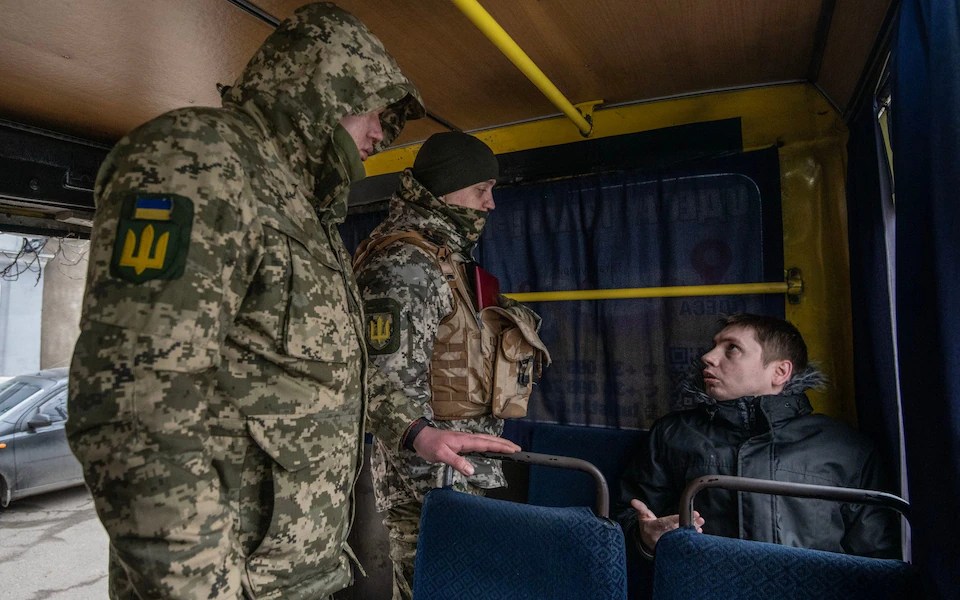
This is obviously not in the interests of the Ukrainian state, so if Western imperialism risks uncontrollable war if it further escalates its intervention, Ukraine risks complete devastation if it continues on its present course. Equally obviously, the war will not reach this stage because there will be too many Ukrainians who will have no intention of joining the queue to be the last one to die.  We already see this in the numbers of especially young men getting out of the country; in the number avoiding military recruitment and coming into conflict with the military recruiters, and the massively increased desertions from the army.

More and more Western politicians are calling for the age of mobilisation of men to be reduced from 25 to 18, which has been resisted by the Zelensky regime.  He claims that he needs more weapons for any mobilisation while the warmongers in the West say that more troops are necessary to wield them. Zelensky is acutely aware of the unpopularity of sending Ukraine’s youngest generation to their death: the previous mobilisation was not completely successful while the very need for another is proof of the massive number already killed.

The underlying problem is that Ukraine has relatively few under-25s due to the sharp decrease in birthrates in the 1990s, a consequence of the shock of the collapse of the Soviet Union and introduction of capitalism.  If all the other cohorts of men have been exhausted, the mobilisation of the youngest does not promise victory but future demographic collapse, caused by death and absence of the most fertile cohorts of the population.  Volodymyr Ishchenko, quoted in the previous post states that ‘according to the latest UN forecast, by the end of the century, the Ukrainian population is going to decrease to 15 million from the 52 million that Ukraine had in 1992 after the disintegration of USSR. This is not even the most pessimistic scenario.’  Demographic forecasts are uncertain but the probability of a greater number of war casualties than that admitted by the Ukrainian state makes it more likely the most pessimistic forecasts are the more accurate.

So what are we to make then of the repeated calls of the pro-war left that we should recognise Ukrainian ‘agency’?  What agency?  That of the Zelensky regime?  Does this left support his current refusal to draft the youngest or will it support his change of mind, or will it support whatever the regime decides to do, whatever that is?  In the latter case the demand for support for Ukrainian agency is actually a demand to deny one’s own; in the case of another mobilisation, to surrender it to the demands of Western imperialism.

In defending Ukrainian agency, this left in reality denies the agency of Western imperialism – of its own ruling class and its state. In this, the supporters of Ukraine and its Western sponsors make the same error (if you can call it that) as the supporters of Russia – they identify the interests of the working class with that of their state.  One or other of these states become the defender of the working class on the world stage, which condemns the working class of their particular saviour to complete subordination.

The consequence is that the working class is no longer a world class and socialism is no longer international, having in effect been subordinated to one or other nationalism.  Hence the prominence of ‘self-determination’ in the discourse of each – a nationalist demand unrelated to the policy of Lenin but a declaration of support to already independent capitalist states in an inter-imperialist war.

Volodymyr Ishchenko has interesting things to say about the power of this nationalism in Ukraine. He.states that ’There are multiple indications that the enthusiasm of 2022 was pretty fragile, and it is not the first time that we see this kind of dynamic. After the 2004 Orange revolution and the EuroMaidan revolution of 2014, people have had high expectations that quickly gave way to disappointment. A similar dynamic happened after the election of Zelensky in 2019 and then in 2022. One of the lines of interpretation is that those events were the manifestation of the rise of the Ukrainian Nation, according to a very linear teleological dynamic, as an ultimate culmination of the national liberation struggle.’  

He goes on to say – ‘the actual desire to sacrifice oneself for the state is very low’, introducing the key missing element by noting that ‘the class issue is very important because conscripts will come primarily from the lower classes, from the villages. Mainly, from among the poor people who could not bribe the recruitment officers . . . It is really difficult to argue that the war is still a kind of “people’s war” if the majority of Ukrainian men actually do not want to fight.’ 

Of the role of the working class, which is the agency that should concern socialists, he is much more honest than the pro-war left that avoids it – by substituting the agency of the state for it – ‘The working class cannot play a role in the current situation. The labor movement in Ukraine was weak well before the war. The last really massive political strike was by Donbas miners in 1993. They demanded the autonomy of Donbas and closer relations with Russia, ironically.’  So much for a Ukrainian take on Ukrainian agency.

In the previous episodes in 2004 and 2014 the Ukrainian people were lied to by all factions of the oligarchy and their foreign backers with the result that the drive towards NATO precipitated the current invasion.  Ukraine is losing and the longer the war continues the greater the loss – this is reality and not the bellicose propaganda of the British, whether from Starmer on his visit to Kyiv or from that county’s pro-war leftists.  Just as it was Boris Johnson who helped torpedo the early Istanbul negotiations that might had ended the war, so has Starmer turned up to make nonsensical promises of a 100 year partnership and £3bn a year in military aid “for as long as it takes.”  As a practised purveyor of untruth, we can be confident that this is another lie.

Russia too has good reason to seek an end to the conflict but too little reason to permit it to involve Western troops in unoccupied Ukraine, which would be both a permanent threat to it and incentive to whatever reactionary regime surfaces in Ukraine to provoke another war.  In such a case Western troops would immediately be involved, triggering a European-wide war that would quickly involve the US in defence of its European imperialist vassals.

Russia is also suffering from sanctions and the freezing of its assets, including $300bn in the EU, even if it has surprised the West by not collapsing and continuing to grow its economy.  However it is suffering from high inflation and high interest rates, which will hamper further growth.  It has survived as well as it has by measures it took following the first Western sanctions in 2014, which have involved increased state direction of the economy and diversification of markets, especially for its energy exports, some of which still go to the West through third parties such as India..

The change in the distribution of available productive resources through increased arms production creates its own disproportions. The part of constant capital – machinery, materials etc and labour power used to produce commodities the use value of which does not make possible either the reconstitution of this constant capital or the reconstitution of labour-power can slow down or even lead to the contraction of the economy’s reproduction if it leads to a reduced amount of this constant capital and labour-power.

It is thus not in the interests of any of the parties that the war continue indefinitely.  Its continuation promises a military defeat for Ukraine and thus for its Western imperialist sponsors that only unacceptable escalation could avoid at unpredictable cost for all involved.  Russia has interests to defend that the war damages, including its economy, and it is undoubtedly suffering significant losses, whatever its supporters on social media in the West like to pretend.

In all this the party with most interest in ending the war is the working class, particularly the sons and daughters of the working class dying and suffering as a result of it.  A working class organised to demand and compel an end to it should be the object of the socialist movement across the world.  Unfortunately too many on the left are tied to supporting either Ukraine and its imperialist allies or Russia, and are therefore also tied to whatever deal eventuates from their eventual negotiations, the terms of which will be determined by the interests of the respective capitalist states.

Back to part 1

Ukraine and imperialism after three years of war (1 of 2)

At the start of last year media in the West was still predicting Ukrainian victory, continuing the theme from early in the war by pointing to its invasion of Kursk and Zelensky’s ‘victory plan’. We were expected to forget the previous claims that accompanied the Ukrainian offensive in 2023, even when it was obviously failing; the repeated claims that Russia was running out of missiles, almost from the time it began using them in early 2022; that the Russian army was increasingly demoralised; that sanctions would turn the Ruble to rubble and the Russian economy would be cut in half, and repeated claims about Russian casualties while ignoring Ukrainian losses.

By the end of the year the media was speculating on how the West must avoid Ukrainian defeat and achieve stabilisation of the front in order to bolster its negotiating position.  Much ink has been spilt on what the West’s and Ukraine’s negotiating position should be, usually with no reference to what the Russians would find acceptable.  On occasions this has been taken into account it turns out that there is no basis for an agreement, on the grounds that Russia will not accept Ukrainian membership of NATO even if it is postponed for ten or twenty years, and no acceptance of a ceasefire that entails Ukrainian rejection of existing Russian territorial gains or limits to its future military capacity to recommence hostilities and recapture them.

Western imperialism is playing its part by continuing to supply weapons to Ukraine and to tighten sanctions but it has played almost all its hand of escalation, and its ability to supply more of the same weaponry is increasingly limited while escalatory risk in supplying new weaponry is considered unacceptable.  With daily advances by Russian forces it is clear that freezing the conflict is the preferred solution.  The point of the war from NATO’s point of view has been to weaken Russia and if possible reduce its capacity to stand against US  encroachment not only in Ukraine but also in Asia, all in order to press against China.

If Western imperialism really believed that the conquest of all of Ukraine is a prelude to Russian tanks driving through Eastern Europe (and consequently threatening Western Europe) it would have considered the risk of escalation of the war through more direct involvement one that already existed.  Despite current rearmament, the European NATO countries are in no position to fight a conventional war with Russia, not only because of military weakness but because of lack of domestic support.  Beside the cost in lives and in terms of living standards, the West’s support for Israeli genocide and repeated invasion of other countries, and potential war with Iran, means its credibility in selling sacrifices on humanitarian grounds is weak.  Already, the number of incumbent governments falling in elections is testament to widespread dissatisfaction to which the war is a major contributor.

The US is not prepared to make up for European imperialist weakness and is not in a position to engage in more direct war with Russia while supporting Israel, for example against Iran, and having a credible and increasing threat employed against China.  Trump’s threats against Canada, Greenland and Panama are testament that any continuing action he approves against Russia will not be for want of aggressive imperialist intentions but from recognition of these constraints on the projection of US power.  Liberals detest him most because he too openly reveals the naked imperialist interest behind the arrogant and hypocritical rhetoric about democracy.  One Financial Times columnist warned (Musk’s war on America’s allies) that if Musk’s support for the Alternative for Germany (AfD) is also that of Trump ‘the west is as good as dead.’ And this is without taking into account the threats to Canada and Denmark, in which even the most loyal lap dogs of the United States are treated with contempt, opening their leaders to justified criticism from their own populations.

Objectively then, Western imperialism faces challenges, not only from without – the failure of most of the population of the world and their governments to support its proxy war – but also from within, as the price of the war imposed by the US on Europe is further exposed by Trump’s threats.  While European NATO countries froth at the mouth at possible Russian and Chinese damaging of undersea cables in the Baltic and threaten direct action, we are supposed to forget the US destruction of the Nord Stream gas pipelines and these same countries looking the other way before calling off their ‘investigations.’

These contradictions should open possibilities for socialists to point out the real nature of US Imperialism and NATO, of the consequences of their governments’ support for the war, and the hypocrisy and fraud that is bourgeois democracy.

But then enter the pro-war left.  It declares that the occupation of Ukraine is a potential prelude to the invasion of Eastern Europe and that the war is one for democracy, forgetting that socialists oppose bourgeois democracy with that of the working class.  They pretend US imperialism can support the cause of democracy in Ukraine but not in Palestine, while we await without baited breath their reconciliation of this claim with Trump’s latest threats.  They support imperialism’s supply of weapons to Ukraine, which they portray as democratic even while it has banned opposition parties, censored opposition media, restricted workers’ rights and called off the scheduled Presidential election.

They do so while claiming that this does not require rearmament, even while European imperialism empties its arsenals, also claiming that no expansion of NATO is involved even while it supports Ukraine in a war that is all about its ability to join it.  It even complains that Western imperialism has been too reticent in supporting Ukraine – ‘the supply of arms to Ukraine has been insufficient and slow’ it says.  The demand is made that ‘Governments, including NATO countries, should provide the weapons necessary for Ukraine to win’ while it is claimed that ‘there is huge pressure on Ukraine by Western Imperialism to sue for peace and accept annexation.’

The article just quoted references the role of socialists in the First World War without having the faintest awareness that it is painting for Ukraine the same ‘stab in the back’ narrative that the Nazis employed in Germany after the war that helped advance their rise to power.  But of course, this left has already denied the role of the fascist forces in Ukraine that even the bourgeois media sometimes reports, and that one Ukrainian leftist has recently explained.

The Economist noted in its last issue that ‘the share of Ukrainians who view Bandera favourably reached 74% in 2022, up from only 22% ten years earlier.’  Volodymyr Ishchenko noted that ‘in France the far right, mainly the National Rally, Le Pen’s party, is way less extreme than those movements we discuss in Ukraine. Le Pen’s party probably doesn’t use Nazi symbols, and has a more sophisticated attitude towards the Vichy collaboration during the Second World War. They’re trying to detoxify themselves. It’s not like this in Ukraine and you mentioned Stephan Bandera, who is glorified openly; even more so, the Waffen SS is glorified, particularly by people in Azov. The scale of extremism of the Ukrainian far right is way higher than the western one . . . Unlike the major far-right parties in the west who are working on parliamentary status, the power of the far right in Ukraine has always been their capacity for street mobilization and the threat of violence . . . we need to think not only about the nominal far-right but also about the complicity of the Ukrainian and western elite in the whitewashing of Ukrainian far right and ethnonationalism.’  To this could be added the whitewashing of Ukrainian nationalism by the pro-war Western left.

Forward to part 2

A beautiful wonderful victory in Syria?

Photo: OMAR HAJ KADOUR/AFP/Getty Images

The sudden and ignominious collapse of Bashar al-Assad revealed an utterly bankrupt regime so hollowed out that its army would not fight for it, its Russian and Iranian supporters could not save it, and it prepared for its own collapse by reportedly transferring $250mn to Moscow. Its passing is no cause for mourning, but it is no cause for rapturous celebration either.

The overthrow was achieved mainly by the reactionary Islamist Hayat Tahrir Al-Sham (HTS) and other militia groups, including the Turkish-sponsored Syrian National Army (SNA).  HTS is the previous al-Qaeda affiliate in the country and its leader, Abu Mohammed al-Jolani, is still subject to a bounty of $10mn by the US while the HTS is considered a terrorist organisation.

This hasn’t stopped western imperialist governments from swiftly moving to recognise the regime.  Why wouldn’t they, since they did so much to enable its victory?  Unlike some simpletons on the left who have welcomed the fall of the Assad regime, the imperialist powers recognise that this involves putting someone else in his place.

Now the Western media is questioning the designation of HTS as terrorist and Abu Mohammed al-Jolani as a wanted man.  The BBC has carried articles – ‘From Syrian jihadist leader to rebel politician: How Abu Mohammed al-Jolani reinvented himself.’  In reality, reinvention is only possible with the connivance of the Western media, such as the BBC itself.

The state broadcaster was only following its government, which has promptly raised the possibility of taking HTS off the terrorism list.  The US also moved quickly to claim that it had made “direct contact” with HTS, as if this was something new, as a start to securing the stability of imperialist interests. The EU announced it would meet the new government to ensure “it goes in the right direction” while threatening Georgia (which has actually had elections) with possible sanctions. It appears some elections are bad and some terrorists are good.

The reported role of Ukraine in assisting the Islamist victory is a pertinent reminder of its role as an ally of Western imperialism, previously in Iraq, Afghanistan, Sudan and Mali.  This may seem unsurprising, but it hardly corresponds to the pretence of the country as an innocent bystander, forced into a purely defensive war.  If Russia is successfully expelled from Syria, how will this advance the particular interests of Ukraine? Where might all the expelled Russian forces be deployed to?

The role of Ukraine is also a reminder how quickly and successfully western imperialism kisses the frog and makes a handsome prince.  In Ukraine the neo-Nazi Azov movement, subject to US sanctions, became freedom fighters when they received US weapons.  HTS is well on the road to such beatification.

Most importantly, the role of Ukraine illustrates the overthrow of Assad as an episode in a wider inter-imperialist conflict that is setting light to different hot wars that threaten to escalate into a single world-wide catastrophe.  On one side, Western imperialism illustrates its ‘progressive’ credentials through support for Islamist reactionaries while, on the other, ‘anti-imperialist’ certificates are endorsed by support for a vile dictatorship, the establishment of military bases on the Mediterranean, and facilitating the robbing of the country by the fleeing dictator.

The left supporters of a ‘multipolar’ world have the inevitable results of this project thrown in their faces – a world of competing and antagonistic imperialist rivalries in which war is inescapable.  Syria is dramatic demolition of the illusions contained in support for a multipolar world within which there are unipolar states.  The multipolar dismemberment of Syria is the multipolar world writ small.

Yet somehow, compared to others on the left, even these illusions seem half sane.  For these others, this world-wide inter-imperialist conflict is so circumscribed and defined by their support for Ukraine that it becomes no more than background noise.  Their effective capitulation to Western imperialism arrives via the road of bourgeois democracy, or the claims made for it, that they extol even as its content is evacuated in reality.  This now reaches grotesque levels in their support for the overthrow of Assad that in linear fashion tail ends Western imperialism.

Even the ideologues of imperialism offer a more accurate and honest view of the HTS than this left.  Foreign Policy notes that they are “cut from the same cloth as Assad” and that protesters against their regime in Idlib who described Jolani as a “tyrant . . . were directed to mass graves of those killed inside prisons—eerily resembling allegations against the Assad government.”

“In Syria it is kind of a monster-versus-monster conflict,” said Aron Lund, fellow with Century International. “Ordinary Syrians don’t have any choice in regard to who rules them. Groups come to their area with guns, and people just have to get along. Depending on who you are and where you are, either Assad or HTS may have pockets of support, but neither side allows any real free expression or elections.”

HTS success was achieved with the assistance of its many foreign Jihadi fighters and was at least partly the result of Turkish and US sponsorship.  It was accompanied by and enabled another invasion by the Zionist state with massive destruction of the weapons and military facilities of the Syrian state.  All this leaves no room for repeating false phrases about ‘self-determination’ as employed in support for Ukraine.  Neither can Islamic fundamentalism be held up as some sort of democratic movement of any kind.

An interview with a Swiss Syrian, Joseph Daher, posted by this left, notes that “We have to face the hard fact that there is a glaring absence of an independent democratic and progressive bloc that is able to organize and clearly oppose the Syrian regime and Islamic fundamentalist forces.”

He goes no to say that “Looking at HTS and SNA’s policies in the past, they have not encouraged a democratic space to develop, but quite the opposite. They have been authoritarian.”

Yet on Facebook, two of the pro-war and pro-Ukraine left said this about the events in Syria:

“Assad is gone! Victory beautiful wonderful victory to see a tyrant crushed like that. Damascus is under the control of the rebels.” 

And:

“The butcher Assad’s departure to Moscow is a great day for the Syrian people and it is hard to conceive of a new government which could be more brutal, reactionary and corrupt. The hope is that the urban movement which nearly brought down the dictatorship is able to take power.”

A “beautiful wonderful victory” for Islamic fundamentalism, one sponsored by Western imperialism and accompanied by another invasion by Israel! 

“A great day for the Syrian people” –how more wonderful could it be?  How greater a day could the Syrian people enjoy than to be subject to the rule of Islamic fundamentalists?

In the interview, Joseph Daher says that ‘Only the self- organization of popular classes fighting for democratic and progressive demands will create that space and open a path toward actual liberation” but that “the main obstacle has been, is, and will be the authoritarian actors, previously the regime, but now many of the opposition forces, especially the HTS and SNA; their rule and the military clashes between them have suffocated the space for democratic and progressive forces to democratically determine their future.”

So where does the “hope” come from that “the urban movement which nearly brought down the dictatorship is able to take power” as a result of this new “main obstacle”?

Daher goes on to say something that the left supporters of Ukraine, and now Islamist rebels, have set themselves against: “To choose one imperialism over another is to guarantee the stability of the capitalist system and the exploitation of popular classes.”

There are many ways of arriving at this, but celebrating the victory of HTS throws all the light you need in order to see the even greater betrayal involved in supporting Ukraine and its war to join NATO.

Should we support the Ukrainian Left’s route to victory? (2 of 2)

As I noted at the start of the previous post, various leftists in the West have said that we should listen to the voices of Ukrainian socialists and follow their lead, except, as we have seen, they are following the lead of the Zelenskyy regime.  His ‘victory plan’, the part that is not a secret to the Ukrainian people and known only in Western imperialist capitals, is that Ukrainian resources should be made available to the corporations of these imperialist states; that Ukraine should be able to join their military alliance NATO, and that it fulfil this role by its troops being stationed in other European countries. No doubt these Ukrainian troops would include its far right and fascist units, which would allow the concentration of existing NATO troops against other targets.

These Ukrainian socialists excuse this policy of integration into Western imperialism as the appearance of a “sober approach”, regretting that it feels “humiliating” for it to be “turned down almost immediately”.  They presumably deny that the moves towards NATO membership were crucial to precipitating the Russian invasion and entertain the idea that the cause of the war can be its solution.

This position stems partly from material weakness – “there is no left-wing political force in Ukraine that would voice the issues inherent to working people” – but this can only begin to be rectified by developing an independent political programme that stands upon the interests of working people.  Sotsialnyi Rukh (Social Movement) is a social movement because it is not a socialist one.  It floats in Ukrainian society and reflects, through its liberal conscience, the reactionary nationalism of Ukrainian society and its state. It cannot therefore articulate a position separate from the ruling regime.

It notes that the regime is “singling out new internal enemies: Russian speakers, “victims of colonial thinking”, followers of Moscow priests, collaborators, Kremlin agents”; with “manifestations of linguistic chauvinism, justification of hostility towards national minorities . . . and fostering ideological uniformity”; but it doesn’t decisively break from the ideological dominance of Ukrainian nationalism and makes the same ultimatist demands in relation to the pro-Russian East as the most rabid fascist – “recognition of the annexation of occupied territories is obviously out of the question”.  Yet where is the attempt to reconcile this demand with claimed opposition to the view that the people of these regions are “internal enemies”?  It can only dribble that this “will complicate the reintegration of occupied territories.”

Calls for “uniting as many people as possible around ideas of justice, freedom, and solidarity” are only so much sanctimonious sermons without a relevant political programme, and without outright opposition to those opposed to anything meaningful these words might entail, which includes the Ukrainian state and its imperialist sponsors, on whom it is now totally reliant.  Where on earth is Western imperialism a force for “justice, freedom, and solidarity”?  This Social Movement declares its “support for victims of far-right violence” but has nothing to say about this far-right being an integral and leading component of the Ukrainian armed forces that it supports.

Sotsialnyi Rukh states that “people should have a stake in the country’s future and respect for human dignity must be at the core of a society that asks its members to risk their lives for it” – a disregarded acknowledgement that this is precisely what does not exist, and which renders its whole approach inadmissible.  The correct response, enunciated by Marx in similar circumstances in which it was claimed that a reactionary state can be of assistance – and promoted now as resulting from “a sincere dialogue from the government” – is to state that “the working class is revolutionary, or it is nothing.”  What does this mean for Ukrainian workers today?

It starts by discarding illusions in the Ukrainian state and that the purpose of “a political movement” is that it “ensures the voice of the people is heard in the corridors of power.”  The corridors of power are staffed by reactionaries beholden to Western imperialism, seeking a new mobilisation of Ukrainian workers for the cause of membership of its imperialist alliance – a blood sacrifice on behalf of those whose plan to is enrich themselves on Ukraine after the war.

Opposition to the Russian invasion does not require support for NATO or membership of it, and the Sotsialnyi Rukh view that without “security guarantees” from the West Ukraine faces “an open invitation for renewed aggression” ignores that Ukraine thereby becomes hostage to Western imperialism’s aggression and any Russian response.  “Security guarantees” will require assurances of “predatory exploitation” by “foreign investors” with all the “inequality, alienation and disenfranchisement” that will result.  The enemy of my enemy is not my friend.

The unity of the workers of Ukraine and with their opposite number in Russia requires opposition to national chauvinism, with its hostility to national minorities, and only on this basis can a peaceful reconciliation of any kind be proposed as an earnest and sincere promise of unity without oppression.  Sotsialnyi Rukh cannot promise this by condemning such things as the Israeli oppression of Palestinians while seeking support and alliance with the same US imperialism that is the sponsor and accomplice of this oppression.  It is not possible to run with the fox and hunt with the hounds’ as the old saying goes.

Sotsialnyi Rukh demands “the restoration of electoral rights, the right to peaceful assembly and workers’ strikes, and the abolition of all restrictions on labor and social rights” but proposes that a “sincere dialogue” with the government that took them away is the way to achieve them.  Only by relying on the strength of the working class movement itself can the prerogatives of the working class be defended and advanced.  If it is too weak to assert them itself, it will never gain the strength to do so by relying on those who took them away.

Spontaneous resistance has arisen in opposition to the street kidnapping of workers so that they can be sent to their deaths at the front.  This resistance should be organised with the demand that summary arrest be ended; corruption in mobilisation exposed; that all conscripts receive proper training; that they have the right to organise trade unions and the right to protect themselves, including from suicidal orders from the rear. None of this is possible through “demand(ing) full state control over the protection of lives and the well-being of workers.”

The Ukrainian state has declared, even in the words of Sotsialnyi Rukh, that it “owes nothing to its citizens” and that its appeals are “hollow”.  By refusing to break from it, Sotsialnyi Rukh demonstrates the same for itself.

The Ukrainian state has no theory of victory that does not involve massive escalation of direct NATO intervention; to endorse it or give it a left gloss does not alter this in any way.  For workers in the West, it would mean following a road to escalation with all the risks of a world war that this involves.  To do so would see them dragged towards the same subordination to their own state and ruling class – where its left pro-war supporters have already gone – and politically unarmed to prevent world war.

The last thing workers in the West should do is take their lead from such a ‘social movement’.  For both, the slogan ‘the main enemy is at home’ remains the road to victory.

Back to part 1

Should we support the Ukrainian Left’s route to victory? (1 of 2)

At the start of the war in Ukraine various leftists in the West said that we should listen to the voices of Ukrainian socialists, which might have made some sense were these people socialist. Except they are not.  Two recent statements by them confirm their reactionary character and have value only to illuminate their political bankruptcy and, by extension, those in the West who follow them and have called for others to do so.

The statements address what is necessary for Ukrainian victory and the tasks of the left in achieving it.  It is supposed to be a left alternative to Zelenskyy’s much trumpeted ‘victory plan’– touted round the various capitals of western imperialism – but reveals itself to be a plea for succour to the regime that has sought it itself from imperialism and failed.

It is not an alternative to it but a pathetic reflection of it.  It is useless even for its own purposes and worse than worthless as a guide for a working class alternative course out of the war.  It can be summed up by one sentence within it that shows that it pretends to no alternative to the current state, and therefore no possibility of an alternative way out of the catastrophe inflicted on the country.  It states that “We will demand full state control over the protection of lives and the well-being of workers . . .”  The same state that colluded in precipitating the disaster – that has delivered its people into a needless war that has wrought such death and destruction – is to be the protector of the lives of its workers.  This is both absurd and treacherous.

The statements themselves can’t help but note the current misdeeds of this state, its “corruption, censorship, and other abuses by officials”, and the reaction of Ukrainian workers – “civilians no longer queue at draft stations but actively evade mobilisation. Reported cases of draft dodging have tripled since 2023, and polls consistently show that nearly half of respondents view this as reasonable.”  They note “nearly 30,000 cases of AWOL have been registered in the first six months of 2024” and “the brutality and impunity of draft officers, who press-gang men off the streets . . . In the meantime, reports from the battlefield describe how unmotivated, untrained, and even unfit recruits endanger the rest, making the result of increasing coercion questionable.”   Questionable?, is that all it is?  Medically unfit men kidnapped off the street and sent to the front  – poorly trained and armed – to die in a war against a much more powerful enemy?

The result is that “after 970 days of war, 10,000s dead, 100,000s wounded, and millions displaced, the toll is immense. Few families remain untouched by this devastation.”  Yet it refuses to denounce the ridiculous tally of dead and injured quoted in the Western media, fed to them by the Ukrainian state and the Zelenskyy regime. Its statement is unwilling to challenge these lies about the devastating consequences of the war, while saying that they have “taken our people for granted”, yet refusing to acknowledge the human cost that repeats this.

“Under the realities of oligarchic capitalism, restrictions on freedoms often serve the interests of the elites”, one statement declares, in admission of the rotten nature of the society and state that commits these crimes.  It notes the statement of the minister of social policy Oksana Zholnovich, that  “we need to break everything that is social today and simply reformat from scratch the new social contract about social policy in our state.”

It sums up the hypocrisy and real policy of the state by saying that “appeals to civic duty ring hollow when the state openly declares that it owes nothing to its citizens”, yet its proposals are that “the government should start a dialogue with the people about the achievable goals of the war.”  It simply wants “to cooperate with other forces to build a political movement that ensures the voice of the people is heard in the corridors of power.  “Sotsialnyi Rukh (Social Movement) demands a sincere dialogue from the government with society on how we arrived here and what we can realistically expect.” A “sincere dialogue” with a regime that promised peace and an end to corruption that has instead walked its people into war with new opportunities for massively increased graft through it.

It would be possible to feel a little sorry for this movement were it not for its own hypocrisy and war policy.  It accuses the Zelenskyy regime of presiding over “a caricature of a war economy” that “makes it possible to prolong the war at the cost of significant human losses and constant mobilization.”  Yet its own policy is simply an extension of this through a state “subordinated to the priorities of defense . . . mobilising all resources for defence”, while simultaneously promising that it “defends the rights of conscripts and servicemen to dignified treatment” when many of these workers do not want to be conscripts at all.

Zelenskyy’s plan is criticised for “its disproportionate reliance on the West’, while acknowledging that “to fight against Russian aggression . . ., we need support from the global community, including humanitarian and military assistance.” It laments this reliance but then states that “this might appear to be a sober approach”, with the further complaint that it feels “more humiliating” to be “turned down almost immediately”.

It canvasses what would be an acceptable peace but includes proposals that shows it has no idea “how we arrived here”, i.e. why the war began, never mind how realistically it might end: “The only deal with a chance of being supported, by a slight margin, includes de-occupation of Zaporizhzhia and Kherson regions, combined with NATO and EU memberships. . . . Therefore, the greatest mistake would be to pit diplomatic efforts against military support. Without meaningful solidarity, Ukraine and its people will fall — if not now, then later.”

It complains of “a quite remarkable shift from the earlier emotional appeals for solidarity to luring support with access to natural resources and promises of outsourcing Ukrainian troops for the European Union’s security”, but its own dependence on what it euphemistically calls “the global community”, and peace involving NATO membership, shows that its alternative to Zelenskyy is no alternative at all. It doesn’t even ask the question: why it is only now – after over two and a half years – that a purported plan for victory has been drafted? Or did all the others fail too?

Forward to part 2

A World going to War and the resistance (3 of 3) – a multipolar alternative?

In the previous post I said that the results of the war in Ukraine would include the deaths of hundreds of thousands; massive physical destruction; a Ukrainian state more corrupt and more subject to imperialist predation; increased division within the working class; and both NATO and the reactionary Russian belligerents remaining in place.

Yet the pro-war Western left defends NATO because without it Ukrainian victory would be inconceivable and it is this victory that they prioritise above all else.  This is an inescapable consequence of their position.

Alternatively, some other leftists, in mirror image, support the victory of Russia but in doing so also bear responsibility for supporting the consequences of the war. They take this position on the grounds of opposition to US imperialist hegemony and for some, that a more multipolar or ‘pluripolar’ world is the pivotal objective.  They do not seem to appreciate that the wars in Ukraine and Middle East are the results of the developing of this multipolar world, which is another name for imperialist rivalry and conflict.  Only the historically ignorant could believe that the development of a multipolar capitalist world would not lead to imperialist conflict and war.

The idea that a more multipolar world will lead to equality of nations makes no sense to anyone who believes that capitalist states are political formations that compete with each other in an analogous way that capital itself competes – by destroying or expropriating rivals.  Socialists believe that workers should not side with their own capitalist state and should fight it, just as we call on workers to oppose their own capitalist exploiter; supporting your own capitalist state is analogous to supporting you own exploiter.

That many have come to this sorry end means that they have also ended any real connection with socialism, regardless of any subjective beliefs.  It’s not that they are stupid; it takes some intelligence to construct the respective arguments but the results above are the same whatever the rationale advanced.

It matters not if you think China is socialist and therefore you should support its ally Russia, because this means you desert the Chinese working class and Russian.  It matters not that you do so to defend colonial or semi-colonial countries, because the point about multipolarity is that many of these countries have advanced and developed so that they exploit the rivalry within the multipolar system to defend their own state and class interests.  The language of anti-imperialism, or anti-colonialism, is often employed by them to denounce other capitalists’ interests and power.

By coincidence, a friend sent me a link to an article that illustrates one consequence of the development of the multipolar world – the ability of some states to balance between US & Western imperialism on the one hand and China & Russia on the other.  The article points to this in terms of economic collaboration between many BRICS countries and the Zionist state of Israel, exploding the idea that there is emerging some state alignment of the good guys against the bad.  Not only are there no good guys but even pretence that there is a unified group doesn’t survive the obvious divisions within them, as the article illustrates.

One rationale for support for Russia was made on Facebook, which read: ‘In truth what will bring about a new revitalised working class movement is the fall of US imperialism. The world policeman will no longer be able to intervene throughout the world to suppress movements fighting for social equality. A big step forward for humanity.  For instance, if there was no US imperialism there would be no genocide of the Palestinians and Israeli would cease to exist as a settler and apartheid state.’

The article referenced above makes clear that, while the US is currently decisive in defending the Zionist state, there are no principled reasons why other imperialist and capitalist powers would not do so also, just as they currently hypocritically collaborate with it.  The principal reason that they do not, or cannot do so now, is because US imperialism is already doing it.   Israel would not be averse to being someone else’s imperialist enforcer if it had to; its history shows previous reliance on the British, German and French imperialism, not to mention the early approval of the Soviet Union.

None of the capitalist states that are rivals of the US have demonstrated that they would not carry out the same policy as the US, were they in the same hegemonic position.  Belief in a multipolar world seems to be under the illusion that such a world would involve the removal or amelioration of inter-imperialist rivalry and conflict, as opposed to the reality of its intensification, demonstrated in the current wars in Europe and Middle East.  In such a situation, support for one or other imperialist alliance is not a temporary tactical or strategic approach but a fundamental capitulation to never-ending support for imperialism, whatever its particular variety might be.

There are two ways in which ‘the fall of US imperialism’ could occur and ‘the world policeman . . .no longer be able to intervene throughout the world’.  The first is if a rival imperialist bloc defeated it, in which case there would be a new imperialist hegemon ‘able to intervene throughout the world’.  What reason, let’s call it success, would lead this hegemon to behave differently?  Would its current left supporters then withdraw their support or stick with it?

The second is if the US hegemon was overthrown by the working class.  Let’s say through a combination of military defeat and internal revolt.  The task of the working class in these circumstances, assuming for the sake of argument that only US imperialism ‘fell’, would be to defend itself against the rival hegemonic imperialist alliance.  This would be because this new hegemon would recognise what its current left supporters do not, that its real enemies are the working class.  In this case it is more likely that the rival imperialist alliance would seek to defend the newly subordinated US imperialism from overthrow by the working class and seek to crush it themselves.

What sense does it make to support this potential alternative imperialist hegemon unless one swallows the nonsense that China is either socialist, or is some sort of peaceful version of capitalism, which in either case would require ditching everything taught by Karl Marx about what capitalism is and what is involved in rule by the working class?  Or even if one doesn’t consider oneself a Marxist, how is such a view given any confirmation by the history of the world over the last 150 years?

Whatever the steps necessary to establish an independent working class force in the world, they will not be taken through supporting either Western imperialism or the China-Russia Axis, not least because each makes their working class a prisoner of its own state and thereby prevents their unity across their division.

Back to part 2

A World going to War and the resistance (2 of 3) – Two proxy wars

Western imperialist support for the Zionist state and its genocide in Gaza has exposed its hypocrisy to millions across the world but the developing war against Iran exposes what lies behind this support.

The repeated provocations against Iran, involving assassination of leading figures and terrorist attacks in Lebanon have in each case been designed to provoke an Iranian response that would justify further Israeli attacks and increased intervention by the US.  The US has been saying two things during this Israeli escalation: promoting a ceasefire that will release Israeli hostages but that will permit continued Zionist aggression thereafter, and repeated declarations of support for the Zionist state, backed up with more and more weapons plus financing for a deficit that is forecast to be almost three times that expected before the war but will turn out to be even greater. 

The Western media repeats ad nauseum that the US has been struggling to prevent regional war and that it has also struggled to rein in Zionist bellicosity.  What it also occasionally reports is that a new ‘reformist’ President in Iran is seeking to improve relations with Western imperialism in order to reduce sanctions against his country, and that this is why Iran is deliberately seeking to prevent escalation in its responses to provocation.

If the US wanted to rein in Israeli aggression, it would not supply the weapons that allows the Zionist state to carry out genocide, invade Lebanon and attack Iran.  It would not supply the finance that allows the Zionist state to finance “the longest and most expensive war’ in its history, according to its finance minister.  In other words the US is lying and the Western media parrots its lies, which are reported as news and then recycled by its talking heads and columnists as the truth.

Since the real enemy of the Zionist state and threat to its regional hegemony is Iran, the target of escalation in the war – through the invasion of Lebanon with the purpose of smashing Hizbollah – is the organisation’s patron.  Since the Zionist state is the projection of US/Western imperialist power in the region the main enemy of the US is Iran, because behind it is Russia. And behind it – China.

The invasion of Lebanon and attacks on Iran are not something the US opposes but is its proxy war against Iran and Russia.  Israel is thus playing the same role as Ukraine is playing in the war against Russia, which is why the US has supplied weapons and financing for both and why the Western media displays its bias in favour of both. 

However, even the Western media is increasingly reporting that Ukraine is losing the war while trying to determine what can retrieved from the defeat.  Anyone relying on this media would be surprised by this turn of events having been fed a diet of Russian failure and Ukrainian valour and success.  The story now is very different.

In the Financial Times its reporters quotes the head of the Washington office of the European Council on Foreign Relations thar “we are losing the war” while the rabidly pro-imperialist Economist editorialises that ‘If Ukraine and its Western backers are to win, they must first have the courage to admit that they are losing’; rich coming from that publication – given the lateness to recognise it themselves.  Even now it ventures a cunning plan for victory, of sorts, through yet more money to build up a Ukrainian arms industry, which is admission that Western imperialism can no longer supply Ukraine with their own weapons, not least because they are needed to kill Palestinians, Lebanese and Iranians.  

Having advocated and heralded previous escalation by imperialism, The Economist sees no need to explain its own failure but simply supports yet more escalation and a plan even less credible than the one concocted by Zelensky.  

Both publications provide ample evidence that Ukraine is failing and that the views of Ukrainians themselves are changing, making them less willing to fight the proxy war, never mind ‘fight to the last Ukrainian’.

“Most players want de-escalation here’ says a senior Ukrainian official, while one Ukrainian commander states his fear of a “forever war”, and another officer notes that “if the US turns off the spigot, we’re finished.”  In The Economist yet another drone commander states that “the West and the United States in particular have an unequivocal responsibility for the deaths of Ukrainians.”

Both publications note the increasing corruption of the Ukrainian state: the forced mobilisation “is perceived as abusive, worse than if you are a criminal” according to the director of the Kyiv Centre for Economic Strategy.  “It tears people apart.  The real enemy is Russia, but at the same time they fear a corrupt, abusive enrolment office doing the wrong thing.”  The effect on the front reported by The Economist is that ‘many of those drafted into service are ill-suited to fighting: too old, too ill, too drunk.’  It notes that there is no clear path out of the army, making ‘being mobilised seem like a one-way ticket to the morgue’.  It states that 5-10% are absent without leave despite prosecutions and that ‘fewer than 30% of Ukrainians consider draft-dodging shameful.’

The Economist also notes that ‘corruption and nationalism are on the rise’ while the Financial Times reports a governing party MP that ‘the biggest domestic problem for Zelenskyy might come from a nationalist minority opposed to any compromise, some of whom are now armed and trained to fight . . . The far right in Ukraine is growing.  The right wing is a danger to democracy.”

Thus, many Ukrainians understand the important role of Western imperialist intervention, even if the pro-war Western left professes not to.  They understand the rampant corruption of the state, the life and death consequences for themselves, and seek to avoid them, while this left champions the defence of the state and supports the supply of weapons to Ukrainian conscripts who simply do not want to die.  The importance and threat of the far right is recognised while this left, never slow to denounce the fascist threat everywhere else, has minimised, glossed over and treated it as inconsequential.  All these failures flowing from the initial failure to understand the war as an imperialist one in which socialists should support neither side.

Both publications proffer incomplete and confused plans for ending the war, both of which appear to treat the Russian view of how it should end as secondary to their own.

What they both do, is treat the question of NATO membership as central, yet another vital element the pro-imperialist warmongers have treated as some sort of Russian excuse.  “Land for [Nato] membership is the only game in town, everyone knows it”, says one senior western official quoted by the FT.  “Nobody will say it out loud . . . but it’s the only strategy on the table.”  On the other hand the FT quotes a senior Ukrainian official as stating that “I don’t think Russia would agree to our participation in Nato.”

The gung-ho Economist supports Ukrainian NATO membership but simply glosses over the acknowledged risk – ‘If Russia struck Ukraine again, America could face a terrible dilemma: to back Ukraine and risk war with a nuclear foe; or refuse and weaken its alliance around the world.”  It fails to notice that the US has made a choice on NATO membership already (refusing immediate admission) and simply elides the risk by claiming that a choice of not giving membership would entail Ukraine’s defeat, which ‘would be much worse.’  What could be worse than a world war between two states armed to the teeth with nuclear weapons is not explained, but this, apparently, is the future promised by the prominent publication of Western imperialism.

For the moment, The Economist and Financial Times still support the war, with the former seeking to redefine victory as less than before.  However it ends, the war will have resulted in the deaths of hundreds of thousands with many more wounded; much of Ukraine will have been destroyed; the Ukrainian rump state will be weaker, more corrupt and more subject to imperialist predation than before; the political division within the former Ukrainian working class will have been immeasurably strengthened; and both NATO and the reactionary Russian regime will remain.

These are the already known inevitable results of the war that those leftists who think victory for one band of capitalist robbers is better than the other have to justify. Socialists will remain implacably opposed to both and will not entertain the claims of these leftist pretenders that after the fighting is over they will go back to opposing NATO or Putin.

Back to part 1

Forward to part 3

A World going to War and the resistance (1 of 3) – Palestine and Lebanon

Beirut Photograph: AFP/Getty Images

Israel is reported to have killed more than a thousand people in its two weeks of bombing Lebanon and has now started a land invasion, which has caused a displacement of more than a million people, almost a fifth of the population.  It continues to murder hundreds of civilians in Gaza with the death toll approaching 42,000, not including many more buried under the rubble of destroyed buildings. One estimate, and not the highest, is 186,000!

After repeated provocations Iran attacked Israel with an unknown number of missiles that Israel says were mainly shot down, while video evidence claimed to show that many were successful, although it is not obvious that they hit their intended targets.  A main objective appears to have been to impact military airbases.

Iran reportedly gave notice to both the US and Israel that it was going to attack, allowing the Israelis to remove their aircraft from harm’s way, while it also said that its response to the provocations had finished.

Netanyahu shamelessly and offensively publicised his order to kill the leader of Hizbollah (and those unconnected who were near him) when he was at the UN in New York, straight after a speech in which he claimed that “Israel seeks peace. Israel yearns for peace. Israel has made peace and will make peace again.” After the Iranian missile strike he warned that Iran had made a “big mistake” and threatened that it “will pay for it”.

After the continuing genocide in Gaza, the more than thousand killed in Israeli bombing and now ground invasion of Lebanon, Keir Starmer declared that he and the country he claims to speak on behalf of, “stands with Israel” and recognises its right to self-defence.  The Labour Defence Secretary John Healey said that British forces had “played their part in attempts to prevent further escalation”, which must be his way of boasting that British aircraft helped the genocidal Israeli military to stop the Iranian missiles.  The US has already sent more military into the region and also boasted of its efforts against the missilles.

No one reading this will need an exposition of the lies and hypocrisy these statements involve, told by either the Zionist leaders or their Western backers: the selective condemnation of terrorism, selective endorsement of the right to self-defence, selective concern for civilian casualties and selective condemnation and sanctions against outside invasion.  All this is obvious.  Starmer’s support and defence of the genocidal Zionist regime has played a part in the collapse of his already low popularity and that of his government – his net approval number is now minus 30 and his government less popular than the one that has just been shredded:

More demonstrations are taking place and planned across the world, following the mass walk-out of delegates to the UN at the start of Netanyahu’s speech.  The pathetic role of the Irish delegation was clearly exposed by their staying in their seats to listen to the latest catalogue of lies that insults its listeners.

The Irish people have an opportunity to demonstrate their opposition to genocide and the attack on Lebanon through a march on Saturday.  The support declared for it reveals widespread support but also the depth of much of it. What is the purpose of this demonstration and the campaign generally? Is pointing out the hypocrisy of the government and its actions anywhere near enough?

The purpose, it would seem, can only be to put pressure on the government to take action but the repeated demands on the Government by some opposition TD’s have only been met by revelations that it will not even enforce its own laws that might somewhat inconvenience the transport of weapons to Israel – allowing flights over Irish airspace without any question.  The governing parties are riding high in the polls and are busy bribing the population with their own money in the budget – their money and that amassed as a tax haven for US multinationals. If putting pressure on it is the objective, the question must be asked – what pressure?

The political voices of these 160 civil society organisations supporting the demo have been demanding various actions from the Irish government for a year, with no success beyond its hypocritical statements that rival those of the other Western powers.  After a short time, this reveals not the power of public opinion but its weakness and that of the solidarity campaign that seeks to mobilise it.  It reveals the political poverty of demanding that the Irish bourgeoisie do something that is not in its interest.  If you expect they will do so you are naïve at best and if you don’t you are fooling your supporters and yourself.  

Look at the organisations supporting the demonstration! They include the trade unions and will probably include Sinn Fein; the party that partied with genocide Joe on St Patricks day.  Who could possibly feel pressure from such hypocrites?  The governing parties could easily turn round to the trade unions and ask – what have you done to boycott the Zionist state?

In other words, the Palestine solidarity campaign should be demanding that those who claim to support it do something, beyond supporting demonstrations that long ago revealed that bourgeois governments don’t care what their populations think as long as they can get away with it. If these governments will not take action, it needs to be taken for them, or rather – against them.

That means demanding that Sinn Fein boycott the genocidal US regime and the trade unions campaign to persuade their members to take direct action to boycott Israeli bound armaments etc. and defend them when they do.  If they don’t then their participation in solidarity demonstrations is a sham and by extension is a fraud on all the other participants who are genuinely opposed to the actions of the Zionist state and want to do something about it.

The Irish state is a very junior and subordinate partner in a Western imperialist alliance that supports the Zioinist state because this state is the West’s – primarily the US’s – instrument of power in the Arab world and beyond.  To expect that it will rebel against its dominant partners is delusional, and continual demands that it do so miseducates and misdirects everyone who doesn’t understand this. It must stop, and the campaign look to Irish workers as the means to put pressure on imperialism, starting by opposing their own state that is a part of it.

Forward to part 2