Carving up Ukraine

Two years ago, the Ukrainian Defence Minister Alexei Reznikov, admitted during an appearance on local television that “Today, Ukraine is addressing [the] threat (of Russia). We’re carrying out NATO’s mission today, without shedding their blood. We shed our blood, so we expect them to provide weapons.”  Nothing could be clearer – Ukraine was fighting a proxy war for Western imperialism against Russia.

In January this year, it was reported that in a closed-door meeting with the Ukrainian parliament, military intelligence chief Kyrylo Budanov, predicted “If there are no serious negotiations by the summer, then very dangerous processes for the very existence of Ukraine may begin.”

In other words, Ukraine was losing the proxy war.  Despite all the support from the West, it was running out of soldiers while its Western sponsors were running down their own stock of weapons and ammunition; it had either been destroyed by the Russians or had been expended to no avail.

Now, with Donald Trump’s proposals, there is some prospect of “serious negotiations by the summer” and an end to Ukrainians “shedding their blood”.  The US has other concerns and has torpedoed the declared purpose of the war by declaring that Ukraine will not be a member of NATO, will not return to its 2014 borders, and no US troops will be placed in Ukraine at any time, even after the end of hostilities. European NATO countries will have to take up the burden.  He announced that ceasefire negotiations with Russia would start and of course, Ukraine would be involved, although it was not even informed of Defence Secretary Hegseth’s statement about the radically changed objectives of the war.

Zelenskyy’s ‘Victory Plan’ is dead in the water, as is his statement that US troops are essential for Ukraine in the event of a deal.  Having declared that it would be ‘very difficult’ to survive without U.S. military support, and that he doesn’t “want to think about” not having it, he now declares the need for an “army of Europe.”  It is a form of denial.

So is the statement by the ‘High Representative for Foreign Affairs and Security Policy and Vice-President of the European Commission’ Kaja Kallas, who said that ‘we must help Ukraine to defend itself against aggression so that there is no wider conflict.   It will be a dirty deal, which we’ve seen before, for example in Minsk, and it just won’t work. It won’t stop the killing. It’s not going to stop the war.”  “Why are we giving them [Russia] everything they want even before the negotiations have started? It’s appeasement. It has never worked.” “It is clear that any deal behind our backs will not work. You need the Europeans, you need the Ukrainians.”

Of course, Russia hasn’t been given everything it wants, and what the US administration has accepted is something it does not have the power to deny. Pretending you can go into negotiations demanding the impossible as a bargaining chip undermines your position from the start and subverts credibility.  It is a recipe for continued and ‘wider conflict’, which is what the EU and the British are proposing.  All the sanctimonious snivelling about ‘stopping the killing’ and ‘stopping the war’ is just so much hypocritical and cynical lying.  It is also a form of denial because the European arm of NATO cannot impose its will on Russia and cannot even police an eventual settlement with any degree of certainty.  Neither can Ukraine continue the war without avoiding defeat and the longer it goes on the worse it will be.  The so-called friends of the Ukrainian people in European governments are happy to continue to shed their blood even when NATO’s mission is dead.

If the European ‘friends’ of the Ukrainian people are false, so they are also betrayed by their own political leaders who, having declared the need to shed blood in a war for NATO and need for US military support, are now determined to continue to shed more blood without the declared objective and without this support.  Meanwhile Zelenskyy fends off the US emissary seeking his signature to Trump’s deal for his takeover of 50% of Ukraine’s mineral deposits.

Any observer with any appreciation of the reality of the war has noted that the first impact of Trump’s initiative is to further demoralise Ukraine, already suffering from exhaustion, desertion and draft-dodging.  Many Ukrainian workers are voting with their feet and see no sense in following orders that risk their lives on behalf of NATO or to allow the plundering of the country’s natural resources.  On top of these we now have the glaring reality that they cannot win.

In the absence of working class political opposition, the proxy nature of the war has imposed itself anyway, and many Ukrainian workers will not fight and die for it.  Despite this political absence the resistance to the war has weakened the West’s project and that  of the Ukrainian state and this can now can only increase.

Some observers have already noted the repeated attempts by the Zelenskyy regime to escalate the war with the latest being the false flag attack on Chernobyl nuclear power station, blamed of course on the Russians, who could blow it up if they wanted, have no interest in doing so, and especially at this time when it suits only Ukrainian attempts to drum up support.

It is by no means obvious that the road to ending the war is clear.  Not only the Zelensky regime but also the far-right Banderite factions stand in the way.  The nonsense that the West is fighting for democracy has again been exposed by Zelenskyy sanctioning his political rivals in preparation for elections that will come sooner or later.  The Banderites are another obvious threat to his regime and any attempt by it to negotiate a less damaging and humiliating peace agreement.  

Kaja Kallas, has stated EU opposition to “a dirty deal . . . for example in Minsk” and that “you need the Europeans, you need the Ukrainians.”  Her and the EU’s demands are and will be unacceptable to Russia while the Minsk agreements failed not least because Ukraine had no intention of implementing them and Germany and France had no intention of making it.  What this means is that Russia will itself not accept an updated version of Western promises that might not last longer than a change in the US administration.

Russia therefore has its own problems in enforcing a deal that cannot be unravelled later, including the extent of its territorial acquisitions and the nature of the rump Ukrainian state; the scale of its armed forces and the need to exclude NATO troops from it under the pretence of being ‘peace-keepers’.  It also needs the removal of sanctions, which the EU can stymie.  These point to pursuit of a definitive Ukrainian defeat and Russian victory which is not yet imminent, but which endangers any arrangement with Trump and provides more opportunity for Ukrainian provocation and European intervention.

The task of socialists is clear – no support to Trump and whatever plans he has, which can radically change; opposition to the attempts of European imperialism and the Ukrainian state to continue the war, and advance its end by explaining its reactionary character to the workers of all the combatant states, including Russia.  If the pro-war left in the West is consistent with its existing policy it will row in behind Starmer, Scholtz and Macron etc. in seeking to continue the war and in doing so increase the risk of a wider conflict with Russia.  It will leave European workers politically disarmed in opposing rearmament, the militarisation of their society and the austerity and repression that will be required for its implementation.

One supporter of the Russian invasion has stated that “we need to organise a mass movement to demand a just and democratic peace in Ukraine”, as if any peace agreement arising out of negotiations involving Trump, Putin, Zelenskyy and von der Leyen could possibly embody a democratic solution.  The only possible democratic solution to this war and to capitalist war in general is a working class revolution but neither the social-imperialist left in the West, or the so-called ‘anti-imperialist’ left that supports Russia, will contribute to this.  Instead, they will look to their favoured reactionary state to triumph.

Politics of the Lesser Evil- Harris and Trump

In a two-horse race where you want both to lose, the crumb of comfort is that one of them will.  In this case the ‘lesser evil’ was an accomplice to genocide, which rather raises the question what the greater evil might possibly be?    Tested to destruction, the politics of the lesser evil failed spectacularly and all those US leftists who defend it have lost both the election and lost the argument.

Of course, this will be the beast that will not die and will raise its head again elsewhere, in, for example, the French Presidential elections.  We have already experienced it in Britain where Starmer’s Labour was the lesser evil alternative to the Tories; except that after a few months in office opinion polls show that its support has collapsed.

Trump now has the potential to control Congress as well as the Presidency, having packed the Supreme Court.  Only the permanent state apparatus lies between him and his implementation of policies most of the capitalist class opposes, and the US system already allows political appointments to the state bureaucracy.  The BBC quickly reported that he intends ‘an aggressive plan to restructure the federal bureaucracy, replacing senior career government employees with political appointments.’

An initial question arises – how did he win?  This is usually framed on the left as – how did she lose?  The answers overlap but are not the same.  The support base for Trump has been well enough analysed and includes the significant reservoir of racism that exists in the US, as well as the incorrigible reactionary petty bourgeoisie and other demoralised layers of the population.  It also includes many who are alienated from what they see as the rigged political system that the Democrats call democracy, and which they called upon voters to come out to defend by voting Kamala Harris.

This was a key part of their campaign after an initial tack to the left, as reported by the US publication Jacobin.  The magazine reported that, what they call ‘populist ‘ and ‘progressive’ policies, were more resonant and popular than calls to protect democracy from the threat of Donald Trump.  Yet Harris pulled back from them, confirming her as being as untrustworthy as the system she was defending.

The Democratic Party had already tried to foist a cognitively impaired candidate on the electorate before unceremoniously dumping him, but only after months of denying there was a problem.  The Party machine and big donors proved that they control the ‘democratic’ process, not the millions of members who voted for Biden in the primaries.  The origin of this problem goes back to their necessity to defeat Bernie Sanders, who might have raised expectations of some genuine progressive change had he been the candidate. 

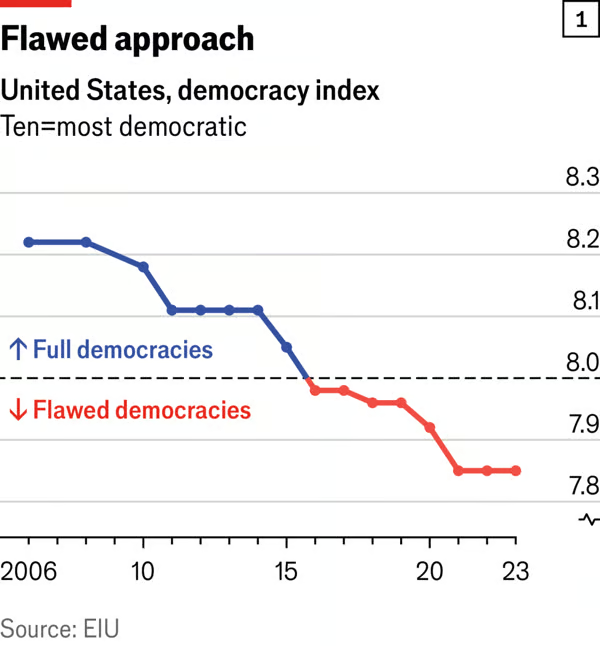
Not all of this will have registered with voters, but the alternatives were a false and lying claim to be the champion of ordinary Americans against the elite with its corrupt and rigged system; and a defender of the system on the equally false claim that it is democratic.  Of course, Trump will advance an attack on democratic rights but the US has already fallen from a ‘full’ to a ‘flawed democracy’, according to that shrill defender of US capitalism ‘The Economist’, and this fall didn’t just happen under Trump.

Having tried to hide Biden from the population, the Democratic party tried to do it again with Harris.  A US commentator in ‘The Irish Times’ noted that ‘after a month in which Kamala Harris was shot to the top of the ticket by her party elites, and in which she did no substantive interviews, she was clearly leading. She then spent a month introducing herself to the public. This was her big mistake. Thereby she fell backwards into a dead heat as Americans concluded she’d be better off not speaking.’

He summed it up by saying that ‘What we can say is that the 2024 election is between a man whom Americans know far too well and a woman Americans would rather not get to know.”

The top-down manipulation of the Democratic party’s traditional base failed, encapsulated in the failure of the leadership of the Teamsters Union to endorse Harris.  She didn’t give them any reason to do so.    Even the issue of abortion rights was not nearly enough to propel her to victory, while the identity politics so beloved of the Democratic party, especially parts of the left, also failed it.  

Trump targeted a lot of his media propaganda against the Democrats’ transgender agenda, which they then also retreated on.   Trans activists complained that ‘in a recent Gallup poll, transgender issues ranked dead last (out of 22 total areas) in importance to voters’, but don’t seem to realise that it is precisely its unimportance to many that meant that its previous prominence for the Democrat’s showed how out of touch they were.  This is only confirmed by the irrational and harmful demands previously championed; ranging from men in women’s sports to unproven or harmful medical interventions on vulnerable young people.

There is no reason to lament the defeat of Kamala Harris – the candidate of the war party and of genocide; of the biggest part of corporate United States; of a corrupt and rotten political system, and of fake progressive politics and truly reactionary identity politics. That a figure as repulsive as Donald Trump defeated her is testament to her and her party’s own abominable character.

The resistance to the Trump agenda will not advance through the politics or organisation he has just defeated, but through a critique of both, and working out how to break US workers from both Trump and the Democratic Party.  This involves bottom-up organisation and alternative politics to the fake claims of corporate-approved progressiveness.  The alternative is politics that puts forward what unites the working class, that opposes what divides it, and is clearly in their interest. This politics isn’t ‘populist’ or ‘progressive’. It’s socialist.

Jeremy Corbyn and Article 50 – part 2


HARLOW, ENGLAND - APRIL 05: Labour leader, Jeremy Corbyn, addresses supporters and members of the media as he launches his party's local election campaign on April 5, 2016 in Harlow, England. Mr Corbyn visited the Essex town to meet supporters and to officially launch the Labour Party's local election campaign ahead of voting on May 5th. (Photo by Carl Court/Getty Images)

The argument that we can do nothing about Brexit except make the best of it is presented in a lucid argument on this blog.  Three reasons are advanced in support of the view that for the Labour Party to oppose Brexit “would be disastrous”.

Firstly, it would fail.  The Tories will vote for it as will the early pioneers of Donald Trump – the Donald Unionist Party.  And so will those Labour MPs in Brexit-majority constituencies who show much more readiness to oppose their leadership than the disaster that awaits their working class constituents.

This may or may not be true, although it certainly will be true if the opposition to Brexit itself refuses to oppose it.  The mantra that “the people” have voted for Brexit will be made official if those MPs supposedly opposed join in making the slim majority in the referendum an overwhelming vote in parliament.

The typically arrogant and supremacist claim of the Brexit right will be confirmed, that the only people who matter are those led by bigots.  The loyalist slogan “we are the people”, to be understood in the sense that everyone else is a lesser being, sits perfectly with the declarations of Farage and Trump that they alone speak for the people, because those who do not support them do not count.  Not voting against Brexit confirms the strident demands of the bullying reactionaries that their vote based on lies, fantasy and prejudice is unimpeachable.

On the other hand a vigorous campaign led by Labour against Brexit, which explains the real effects that are already visible, could compel reluctant Labour MPs to vote against Brexit and provide the cover for Tories opposed to Brexit to do the same.  We have been ‘warned’ repeatedly that a majority of MPs oppose Brexit, what matters is the political environment to make this a reality; and while the vote in parliament will decide the matter, the combination of disastrous consequences and political mobilisation outside parliament can determine it.

And if we are talking about numbers – what about the 65% of Labour voters who voted to Remain or do concerns about losing support only apply when bowing down to the most reactionary segment of support?  In terms of sheer numbers it makes no sense to alienate 65% in order to placate 35%.  ‘We can’t neglect to take on board the concerns of our working class supporters’ doesn’t really cut it when you look at it this way, unless you accept the nonsense that Remain voters were the metropolitan elite who, guess what, are not part of ‘the people.’

The second argument is that Labour cannot be seen to be “gifting the Tories, UKIP and the majority right-wing media the narrative of it  ‘seeking to subvert the will of the people’.  Absolutely everything it had to say on Brexit after a vote against triggering Article 50 would be met by this message being hammered home again and again and again.”

This is no doubt true; it is also true, although I do not know to what extent, that some Labour voters supporting Brexit will vote against Labour or abstain if it seeks “to subvert the will of the people”.   But it must again be recalled that the majority of Labour voters voted Remain!  And it really is internalising defeat when you vote with the Tories against the wishes of a majority of your own supporters.  However true the argument is that the strident claims of the Brexiteers will gain traction if Labour doesn’t bow before their demands, the contrary argument put here is also true, true to our principles and true to our future:

“The Tory MP, Ken Clarke, is quite right when he says that he has supported membership of the Common Market, and EU for fifty years, and that it would be ludicrous to suggest that just because of the referendum vote, he now had to act as though he was an opponent of it. Or, if Trump were currently, to hold a referendum, in the US, to garner support for his ban on Muslims entering the country, Labour would say,“Oh well, we lost that vote, so we will have to tag along behind Trump’s racist and reactionary policies.”

The parallel drawn here is not merely similar to the Brexit vote; in the immediate sense it is identical.  The Trump measures against refugees and the citizens of seven countries is a clear attack on peoples’ ability to move and to seek a better life in another country.  The Brexit vote was led by just the same sort of xenophobic and racist politics that motivated the reactionary Trump campaign, even if not all who voted for Brexit were xenophobes or racists, just like Trump voters, who weren’t all bigots and racists either.

The parallel is identical because a core principle socialists are trying to defend by opposing Brexit is the freedom of movement of working people in the EU, just like the freedom of movement of refugees and citizens of mainly Muslim countries to the US.  Working class solidarity is hardly a credible proposition if you don’t defend the ability of workers of different nations to work together.  It is much harder to make it a reality if it is prevented.  We know this, amongst other reasosn, because we know that the Brexit vote did not succeed in areas with the largest number of immigrants but often in areas with low numbers.

The third argument is that the Labour strategy of seeking to amend the Brexit process “will seek to ensure parliament has oversight of and influence over the kind of Brexit we get” and “does not lend power to the idea that Labour is ‘opposed to democracy’ and actually offers the prospect of pro-EU Tories supporting amendments which could make a real difference in preventing what is being called ‘hard Brexit’.”

Aside from the strength of an opposition that ultimately promises to vote in favour of triggering Article 50 it is unfortunately the case that a hard Brexit is the only one on offer.  An end to the free movement of workers in the EU is already a given, as is the exit from existing free trade arrangements, the disruption of which will impact on British capitalism and thereby on British workers, not to mention those in the EU.

As I have already argued, the strategy of a low-tax, deregulated and low wage Britain is the most credible one for an isolated nation seeking to insert itself into an international system in which every other large economy is part of a free-trade arrangement.  The exposure that Britain will impose on itself was illustrated by an article in Monday’s ‘Financial Times’, which reported a study that 46% of goods and services exports from the UK’s 62 cities went to the EU.  In contrast China accounted for only 4%, so that in order to make up a drop of 10% in EU exports would require a doubling of them to China or an increase by nearly one-third to the US.

Given that we know that a hard Brexit is coming it makes no sense to pretend the Tories will deliver anything else.  Could anyone seriously believe the Tories want to exit the rules and regulations of the EU because they want to make the regulations governing working conditions and employment rights better?

To pretend they will do anything else is a stand-out illustration of the weakness of an approach that tail-ends the Tories confusion and incompetence and that has allowed them to get away with taking over six months before even giving the broadest of outlines of what they wanted.  Leaving opposition to some final vote that the Tories can ignore is to play parliamentary games with workers’ futures when you aren’t in control of the rules.  There appears no guarantee that even defeating a Tory Brexit deal will not allow them to exit with no deal, as they have threatened.  A movement that would make this outcome politically unacceptable might prevent employment of such a device.

The only honest approach is to explain that a hard Brexit is inevitable and to build opposition to it on this basis, not wait for it to happen.  Having (sometimes) stated that the Tories will deliver a hard Brexit, the Labour Party is open to increasing incredulity and anger that they are not now opposing it.  The shadow-Brexit secretary Kier Starmer has told everyone that it is now impossible to oppose Brexit, making it clear that a single consideration trumps every other concern, while it took the old Tory Ken Clarke to make the points Starmer would not:

“Let me give an analogy in explaining the position for members of parliament after this referendum. I have fought Lord knows how many elections over the past 50 years and I have always advocated voting Conservative. The British public in their wisdom have occasionally failed to take my advice and they have actually by a majority voted Labour. And I have found myself here facing a Labour government.”

“I do not recall an occasion where I was told it was now my democratic duty to support Labour policies under Labour governments on the other side of the House. That proposition would have been treated with ridicule and scorn. “

“We are combining withdrawal from the single market and the customs union with this great new globalised future, which offers tremendous opportunities for us. Apparently you follow the rabbit down the hole and you emerge in a wonderland where suddenly countries around the world are queuing up to give us trading advantages and access to their markets that previously we had never been able to achieve as part of the European Union. Nice men like President Trump and President Erdogan are just impatient to abandon their normal protectionism and give us access.”

“Don’t let me be too cynical – I hope that is right. I want the best outcome for the United Kingdom from this process. No doubt there is somewhere a Hatter holding a tea party with a dormouse.”

This third argument has been put most pithily by Labour’s former deputy leader Harriet Harman – “accept the result.”  Except the real result of the referendum is not yet in and it would be criminal to accept it.

The third argument on accepting Brexit relies on the undoubtedly true argument that the referendum result “has been decades in the making. Parties across the political spectrum have happily blamed the EU as an easy scapegoat for domestic decisions (even the SNP blamed the EU in the row over privatising Calmac) while politicians have at best ignored popular hostility towards immigration and at worst fanned it.  In my lifetime it has been common for politicians to use the rhetoric of the far right on immigration, push increasingly intolerant policies on asylum and immigration and engage in a perverse arms race on who can be ‘toughest‘ on the issue.”

However, while true, this can hardly be an argument not to fight back now and, as I mentioned at the end of the first post, “in some ways Brexit provides better ground to take up this fight against nationalism and racism than before.”  This is because the reactionary politics of nationalism and racism which has created Brexit will not benefit workers, and their continued pursuit of them will hurt them rather quickly and rather directly.

Brexit allows the reactionary import of nationalism and racism to be demonstrated through the attacks on workers’ rights, conditions and living standards that Brexit will inevitably involve.  It provides the grounds to clearly separate the hardened ideological bigots from workers mistakenly attracted to false and simple-minded solutions that are nor in their interest.  Now is not the time to entertain the idea that restrictions on immigration and deference to reactionary nationalism can be combined with protection of workers to produce a mildly progressive ‘soft’ Brexit.

There is no combination of nationalism and racism with state ‘national’ socialism that will be in the interests of workers.  By pointing this out and fighting for an alternative the Labour Party will be proved right if or when Brexit either becomes a reality, or its disastrous effects become visible and palpable before this happens.  To prepare for this means opposing Brexit now and being best placed to build the movement that stops it and inflicts a defeat on the forces of reaction behind it.  Which leads to a final argument put up against opposition to Brexit now.

“This brings us to probably the most profoundly scary reason why Labour (and indeed other politicians) trying to prevent Brexit in parliament is such a terrible idea. As we’ve seen, rhetoric around ‘elites’ trying to ‘subvert democracy’ has been common in the aftermath of the referendum and we’ve heard how bigotry has surged. Yet if politicians were to actually prevent the result of the referendum being implemented as the worst extremes of the right keep suggesting they want to, this would provide a founding myth for the far-right of the kind we have not seen in my lifetime. There is no doubt in my mind that not only would UKIP surge dramatically in this scenario but that less ‘respectable’ fascists like the EDL would explode in popularity, emboldened by the simple and powerful narrative that the ‘elite’ were ignoring ‘the people’.”

There is no doubt some truth in this as well but it is rather like the truth that Brexit will be shown to be the shitshow predicted when it comes to pass.  Will the working class and the socialist movement be better off for having been proved right or will we have suffered a bitter defeat from which we will have to struggle to recover?  And similarly, if we defeat Brexit – the right of the Tory party and UKIP plus their ‘respectable’ fascists – will they be stronger or weaker for their defeat? The right can have its myths and its narrative if the labour and socialist movement can have its victory.

Back to part 1

Learning from Trump? Don’t think so.

trump2Donald Trump was elected as the candidate of the Republican Party, one of the two main capitalist parties in the US.  He is a billionaire and could afford to self-finance his campaign.  He was also a TV celebrity before a politician so already had recognition.  His unpopularity with much of the press and media was beneficial, firstly because it gave him the coverage needed to make him a leading figure, and then was concentrated on individual attributes that did not fundamentally challenge his politics – he was not demonised.

His fame and money made him a credible candidate in the money and celebrity world that is US politics.  His capture of the Republican nomination made him electable.

He fought the election by picking up a minority of endorsements by leading Republican figures and rallying around him extreme racists and reactionaries, of which there is not an inconsiderable number.

He fought a campaign that tapped into deep and widespread reactionary views with a long tradition in the US, including racism, nativism, sexism and religious bigotry coagulated together by xenophobic nationalism – ‘making America great again’.

He faced a notorious political insider, an establishment figure detested by many and unpopular among more; one who personified the last thirty or so years of economic policies that has supported deindustrialisation, stagnant or falling living standards, urban decay, increasing inequality, obscene wealth growing beside desperate poverty, and racist repression by the state.

In her campaign Clinton was clearly the candidate of the party establishment and was exposed as talking out of both sides of her mouth in order to speak to the incompatible demands of different strands of the Democrat vote, which became stretched apart by the Bernie Sanders campaign for nomination.

Trump won the election but lost the popular vote, by over 1 million and rising last time I looked.  His election is bereft of democratic legitimacy exposing the sacrosanct US constitution for the travesty of democracy it has always been but whose legitimacy has survived the open domination of money and vote suppression.

trump1

Out of all this some people opposed to the Trump victory are telling us that “if there’s one thing that we can learn from the unexpected result on Tuesday night it is that Jeremy Corbyn can win here in the UK. This is not about left and right, as such; it is about a willingness to stand up to the status quo and call for a genuine change in the way we do politics.” Quoted and rightly ridiculed here.

An ultra-reactionary with all the benefits I’ve noted above wins in the US and we’re supposed to believe it means Jeremy Corbyn can win in Britain!

And Trump is an example of, or an invitation to, or in some way relates to “a genuine change in the way we do politics”!

Of course, this is all nonsense, except it’s a bit more widespread than it should be.  It’s the sort of nonsense that I’ve looked at before; an attempt to see some progressive resonance to Brexit for example.  No surprise then that before I came across the passage above I came across this statement from the People before Profit organisation in Ireland.

Their statement seems to present the Trump victory as primarily “a rage against ‘the establishment’” that will be betrayed.  It makes assessments of the nature of the vote that are one-sided and ignore the reactionary features of the Trump vote – its retention of the Republican party vote and its attraction to those who saw immigration and terrorism as the main issues, just to note two of its features.

Perhaps as an immediate assessment it can be given some latitude for inaccuracy but, coming from those still supporting Brexit, it wouldn’t be surprising is this approach persisted when it becomes even clearer (I suppose it actually can become clearer) that the vote is utterly reactionary.

Aside from saying that “Trump will instead turn on the people who have elected him and try to make them pay the price in the same way that Hillary Clinton would have done had she won”, which isn’t true; what took my eye was the conclusion – “Trump’s victory is also evidence in a perverse way that if we do seize the moment anything is possible.”

“Seizing the moment” is precisely the electoralist, short term, get-rich-quick, short-cut to success politics that has infected the so-called revolutionary left since I first got involved in Marxist politics in the mid-1970s, and it didn’t start then.  It directly contradicts the duty of socialists, that “in the movement of the present, they also represent and take care of the future of that movement.” It is close to being a definition of political opportunism which has failed the socialist movement.

It fails utterly to recognise the fundamental social change that socialists want and which is required and the preconditions that are necessary for it to come about, preconditions not reducible to a moment seized that make “anything possible.”  Electoral victories do not make “anything possible.”

A left electoral victory, built on similar misconceptions to those of many Trump supporters, not only makes genuine steps towards socialism not possible but is actually dangerous – exposing socialists to taking office in circumstances in which they simply cannot advance their cause, because socialism is working people emancipating themselves.  It’s not even people voting for someone else to free them.  If this is their idea of socialism they’re never going to see it.

It wasn’t “a moment” that led to Trump but a long history of working class political weakness and of reactionary ideas that suffuse wide sections of US society.  We simply cannot “seize the moment” in any way illustrated by the Trump victory.  From its political roots to its reliance on the inequality and venality of today’s US politics to its failure even to register an electoral majority – it’s nothing to emulate.

The Trump victory is illegitimate.  It lacks democratic validation.  It is built on racism, class prejudices and class oppression that no electoral mandate could render acceptable.  The reaction of many Americans who have demonstrated against Trump, who don’t want him as President, is much better than ‘hey, we can do that too.’

trump-a