Karl Marx’s alternative to capitalism part 72

In a previous post I noted Marx’s statement that 

‘Now as for myself, I do not claim to have discovered either the existence of classes in modern society or the struggle between them. Long before me, bourgeois historians had described the historical development of this struggle between the classes, as had bourgeois economists their economic anatomy. My own contribution was 1. to show that the existence of classes is merely bound up with certain historical phases in the development of production; 2. That the class struggle necessarily leads to the dictatorship of the proletariat; 3. that this dictatorship itself constitutes no more than a transition to the abolition of all classes and to a classless society.’ (Marx letter to Joseph Weydemeyer, Marx Collected Works Vol 39, p62 & 65)

If we quote Lenin on this, he puts it in his typically forthright way:

‘The question of the dictatorship of the proletariat is the fundamental question of the modern working-class movement in all capitalist countries without exception… Whoever has failed to understand that dictatorship is essential to the victory of any revolutionary class has no understanding of the history of revolutions, or else does not want to know anything in this field.’ – Lenin, “A Contribution to the History of the Question of the Dictatorship”.

‘Those who recognise only the class struggle are not yet Marxists; they may be found to be still within the boundaries of bourgeois thinking and bourgeois politics. To confine Marxism to the doctrine of the class struggle means curtailing Marxism, distorting it, reducing it to something which is acceptable to the bourgeoisie.’

‘Only he is a Marxist who extends the recognition of the class struggle to the recognition of the dictatorship of the proletariat. This is what constitutes the most profound difference between the Marxist and the ordinary petty (as well as big) bourgeois. This is the touchstone on which the real understanding and recognition of Marxism is to be tested’. (Lenin, The State and Revolution.)

It is almost universal that when introducing this question, it is felt necessary to explain what is meant by the word “dictatorship”.  The feeling is justified. The history of Stalinist regimes that repudiated the common understanding of (bourgeois) democracy has made these statements appear as early political endorsement of later practice. This explanation of its meaning is ahistorical, and it is necessary to present the very different understanding of the term as it was understood by Marx.

This usually starts by noting that the word ‘dictatorship’ has a long history, going back to the ancient Roman Republic, denoting various specific political ideas that are not the same as the current conception of it – as a form of government in which absolute power is exercised by a dictator, or as signifying absolute, imperious, or overbearing power or control.  Like so many other political or philosophical thinkers, terms routinely employed by Marx often have a specific meaning which it is necessary to know to correctly understand his work.  In Marx’s case the use of the word dictatorship during his time was not confined to him and was widely understood.

For Marx it denoted not the overthrown or denial of democracy but its achievement, as put forward in The Communist Manifesto, which he generally subscribed to for the rest of his life:

“We have seen above, that the first step in the revolution by the working class is to raise the proletariat to the position of ruling class to win the battle of democracy.” In doing so “the working class can not simply lay hold of the ready made state machinery, and wield its ubiquitous organs of standing army, police bureaucracy, and judicature for its own purposes.’

“The proletariat will use its political supremacy to wrest, by degree, all capital from the bourgeoisie, to centralise all instruments of production in the hands of the State, i.e., of the proletariat organised as the ruling class; and to increase the total productive forces as rapidly as possible.” (Marx and Engels, The Communist Manifesto)

The dictatorship of the proletariat therefore refers to the period after the working class achieves political power, so that this power becomes that of the majority.  At this time Marx set out that the state would lead this process, but he subsequently emphasised the working class itself carrying out this task, initially through the growth of workers cooperatives and then through their forming a national (and international) cooperative economy.  This would be distinguished not so much by its planning as by the governance and control by the working class. (See note below)

Subsequent history has demonstrated that without this working class control socialism cannot be built, which is in many ways a truism, since socialism is (loosely) the name for the working class becoming the ruling class.  History also confirms Marx’s analysis of the position of the state: ‘the government machine or the state insofar as it forms a special organism separated from society through division of labour.’ (Marx, Critique of the Gotha Programme, Collected Works Vol 24 p 96)

In creating this ‘dictatorship’, society is radically changed and the previous economic and political power of the capitalist class – through their ownership and control of the means of production defended by the instrument of the state – is replaced by that of cooperative ownership and a state machinery, composed of workers, and controlled by the working class as a whole.  

Note: ‘That the workers desire to establish the conditions for co-operative production on a social scale, and first of all on a national scale, in their own country, only means that they are working to revolutionise the present conditions of production, and it has nothing in common with the foundation of co-operative societies with state aid. But as far as the present cooperative societies are concerned, they are of value only insofar as they are the independent creations of the workers and not proteges either of the governments or of the bourgeois’. (Marx, Critique of the Gotha Programme, Collected Works Vol 24 p 93-4)

Back to part 71

Understanding ‘Citizen Marx’ 3 of 3

Engels once said that ‘Marx and I, for forty years, repeated ad nauseam that for us the democratic republic is the only, political form in which the struggle between the working class and the capitalist class can first be universalised and then culminate in the decisive victory of the proletariat.’

The context was a claim against him that when ‘the socialist party, will become the majority’ it will ‘then proceed to take power.’  Engels however stated that ‘For a start, I have never said the socialist party, will become the majority and then proceed to take power.  On the contrary, I have expressly said that the odds are ten to one that our rulers, well before that point arrives, will use violence against us, and this would shift us from the terrain of majority to the terrain of revolution . . .’

Responding to the question of what form this power would take – ‘Will it be monarchic, or republican, or will it go back to Weitling’s utopia’, Engels replied that of course the Reichstag deputies are republicans and revolutionaries, the question of a Republic being the most controversial political question in Imperial Germany at that time.

Engels goes on to ask whether it is implied ‘that the German socialists attribute no more importance to the social form than to the political form? Again he would be mistaken. He should be well enough acquainted with German socialism to know that it demands the socialisation of all the means of production. How can this economic revolution be accomplished? That will depend on the circumstances in which our party seizes power, on the moment at which and the manner in which that occurs.’ (Engels, Reply to the Honourable Giovanni Bovio MECW Vol 27 p271)

What Engels is making clear is that the fight for democracy is vital to the struggle of the working class to achieve political power not that it is necessary to have a republic as the first step to communism. Even where the question of a Republic was the unmentionable political issue, the objective was ‘the socialisation of all the means of production.’

On a separate occasion he said that ‘If one thing is certain it is that our party and the working class can only come to power in the form of the democratic republic. This is even the specific form for the dictatorship of the proletariat . .’ (emphasis added – SM) On the question of a Republic he explains the content of the demand, if it is not possible to employ the term itself: ‘But the fact that in Germany it is not permitted to advance even a republican party programme openly, proves how totally mistaken is the belief that a republic, and not only a republic, but also communist society, can be established in a cosy peaceful way’

‘However, the question of the republic could possibly be passed by. What, however, in my opinion should and could be included is the demand for the concentration of all political power in the hands of the people’s representatives. That would suffice for the time being if it is impossible to go any further.’ (Engels A critique of the draft Social-Democratic programme of 1891, MECW Vol 27 p227)

Engels in his postscript to Marx’s Civil War in France wrote ‘And people think they have taken quite an extraordinary bold step forward when they have rid themselves of belief in hereditary monarchy and swear by the democratic republic. In reality, however, the state is nothing but a machine for the oppression of one class by another, and indeed in the democratic republic no less than in the monarchy; and at best an evil inherited by the proletariat after its victorious struggle for class supremacy, whose worst sides the proletariat, just like the Commune, cannot avoid having to lop off at the earliest possible moment, until such time as a new generation, reared in new and free social conditions, will be able to throw the entire lumber of the state on the scrap-heap.’

‘From the outset the Commune was compelled to recognize that the working class, once come to power, could not manage with the old state machine . . .’  The bourgeois republic was not therefore the mechanism to advance towards communism.

Marx noted of the Paris Commune that ‘the political rule of the producer cannot co-exist with the perpetuation of his social slavery.’

Back to part 2

Understanding ‘Citizen Marx’ 2 of 3

In one review of Citizen MarxMike Macnair states that ‘the conception of the democratic republic as the necessary first step to communism was, in fact, Marx’s conception: comrade Leipold has, I think, shown this beyond rebuttal.’  If this is taken to mean that the struggle always and everywhere involves firstly a fight for a bourgeois republic then we see that this is not the case. In the Paris Commune the struggle went immediately beyond it and Leipold argues that Marx never looked at the struggle for bourgeois democracy – a bourgeois republic – in the same way after it (see the previous post).

It is not true today because in many countries, capitalism is ruled by states with a democratic and republican form.  There are all sorts of restrictions and qualifications to this bourgeois democracy, and Marx noted and opposed them in his day, but this did not transform the working class struggle – and communists bringing ‘to the front, as the leading question in each, the property question’ – into a struggle first for a bourgeois ‘democratic republic’.  This is simply old-fashioned Stalinism in which the working class struggle is always limited to a fight for bourgeois democracy, and only when successful, then a struggle for socialism.  This never comes because the bourgeois allies asserted as necessary in the first struggle betray not only the struggle of the working class for socialism but also any struggle for democracy that involves the working class as an independent force.

Macnair appears to accept grounds for rejecting this approach today, on the basis that ‘It is nonetheless arguable that the more advanced stage of the spread of capitalism across the whole globe, and its decline at its core, means that we should focus more on socialisation: the immediate need to move beyond markets and privately-owned concentrations of capital as the means of coordinating human productive activities. . .  . In this sense socialisation is more immediately posed than it was in the later 19th century.’

This means that the working class is the majority of society, with the existence of a much more developed capitalist system that brings to the fore the question of working class dissolution of capitalist private property through socialisation of the productive forces.  To defend this process requires a Commune type state and not a bourgeois republic that will, no matter how democratic or republican, stand upon and defend capitalist property relations.

Unfortunately, Macnair rejects this – ‘There are two problems with this line of argument’ he claims. ‘The first is the Soviet case’ in which economic planning failed.  He argues that ‘Democratic republicanism is essential to effective economic planning; and, because it is essential to effective economic planning, it is also essential to believable socialism/communism.’

In fact, the Soviet Union was not an example of an ‘advanced stage’ capitalism and the initial major problem with socialisation of production was the small size of the forces of production that could most easily be socialised, and thus the associated weakness of the working class that would carry it out. This experience is not therefore an argument against working class socialisation of the forces of production and a state form of the Commune type adequate to defend this process.

The second problem he identifies with a ‘focus more on socialisation: the immediate need to move beyond markets and privately-owned concentrations of capital’ is not so much a structural feature of the current stage of capitalism (that it rules out socialisation) but an obstacle to it.  What he poses is an obstacle to any and all independent political action by the working class, including reform of the capitalist state that Macnair poses as the ‘necessary first step to communism.’

He writes that it is ‘illusory to imagine that it is possible to fight for “workers’ democracy” against the bureaucracy, without simultaneously proposing a constitutional alternative to the regime of the capitalist state as such. Without challenging the capitalist constitutional order, it is impossible to render transparent the dictatorship of the labour bureaucracy in workers’ organisations.’  The capitalist state must be democratised before the working class movement can also be so transformed appears to be the argument.

Democratising the capitalist state requires a force to do it, which presumably is the working class, but as long as the workers’ movement is strangled by bureaucracy this is not going to be done.  In terms of voting, elections in most minimally democratic bourgeois republics involve a bigger turnout than elections within trade unions, which illustrates the necessity to politicise the working class movement.  The prior task to making changes to the capitalist state is to dissolve illusions in it, including that it can be ‘really’ democratic and that it can be made a (more?) neutral mechanism that can be employed by the working class for its own ends.

Any mass mobilisation of the working class will face the immediate task of sidelining or removing the labour bureaucracy because the organisations and mobilisations this bureaucracy stifles are the workers own.  This task will need to be both independent of any change to the ‘constitutional order of the capitalist state’ and go beyond it.  Constitutional forms can change but the essential nature of the state remains.  Prioritising changing this is to invest in the capitalist state the power of making changes that only the self-emancipation of the working class can accomplish.  Why would a capitalist state, again no matter how democratic or republican, help ‘render transparent the dictatorship of the labour bureaucracy in workers’ organisations?’

Removing or otherwise destroying the labour bureaucracy will undoubtedly be accompanied with the need to struggle for goals outside the workers’ organisations, but these struggles should not be under the misapprehension that what we need is reform of the capitalist state constitution in order to change the constitution of the workers own organisations.  In so far as we often seek to change the operation of the capitalist state it is often to remove its influence on workers’ organisations.  The functioning of this state is not an example to follow, or an aid to understanding working class interests, but an obstacle to overcome including the many illusions workers have in it.

Attempts to give a place to republican politics within socialism that it should not have ignores the class character of even the most radical republicanism and inevitably drags us back to accommodation with the capitalist state.  This is not a lesson Citizen Marx teaches.

Back to part 1

Forward to part 3

Understanding ‘Citizen Marx’ 1 of 3

The book Citizen Marx, which deals with Marx’s engagement with republicanism, has been favourably reviewed in a number of socialist publications.  In previous posts we have shown that this was an engagement coloured by competition for the allegiance of a radicalising working class.  This involved starting from a materialist analysis of the conditions facing workers and other classes, which brought to the fore the property question and involved a clear separation of socialist politics from even the most radical republicanism.

The book notes both Marx and Engels very brief alignment with anti-political communism that eschewed political struggles because of their claimed irrelevance to the over-riding social question, which resolved into the question of property.  For Marx and Engels this involved the socialisation of production by the working class that would lead to the abolition of all classes, including itself.

This required the conquering of political power by the working class and the book deals with Marx and Engels treatment of the Paris Commune as the first example of the capture of such power (with some qualifications).  Many of their tributes to it and the force of its example included elements of the democratic functioning of the Commune that were championed by republicanism, for example the direct election of workers’ delegates to state office and their being subject to recall.

This state however was to be a workers’ state, and qualitatively different to existing capitalist states, whether an absolute monarchy, constitutional monarchy or bourgeois republic.  It was to be a state not ‘superimposed upon society’ but ‘one completely subordinate to it.’ (Citizen Marx p 392)

‘It was essentially a working-class government, the produce of the struggle of the producing against the appropriating class, the political form at last discovered under which to work out the economical emancipation of Labour.’   (Marx and Engels Collected Works, Volume 22 p334)

The most famous lesson learned was that ‘the working class cannot simply lay hold on the ready-made state machinery and wield it for their own purpose. The political instrument of their enslavement cannot serve as the political instrument of their emancipation.’  (MECW Vol 22 p533)

This is not the bourgeois state democratised, à la radical republicanism, but the destruction of the bourgeois state and creation of one that would serve as a political instrument of working class emancipation.  And as the emancipation of the working class was to be achieved by the working class itself this meant not just creation of a workers’ state but the working class emancipating society from the state – a state not ‘superimposed upon society’ but ‘one completely subordinate to it.’  As Bruno Leipold notes in Citizen Marx, for Marx the Commune was a ’Revolution against the State itself . . . a resumption by the people for the people, of its own social life.’  It was “the people acting for itself by itself.’ (Citizen Marx p 389 & 366)

Leipold states that through the experience of the Commune Marx not only changed his understanding of what a ‘social republic’ was but that this also ‘went hand in hand with a new attitude to the bourgeois republic.  While his Commune writings contain similar condemnations of the emancipatory limits of the bourgeois republic that we find in his 1848 writings, we find no corresponding statements that the bourgeois republic still remains the terrain on which this emancipation is to be fought for.’ (Citizen Marx p 357)

Much of the book covers the period before the Paris Commune and deals with the role of the working class in a purely democratic revolution, i.e. a bourgeois revolution.  Marx and Engels set out the policy of communists, in which the working class, particularly in Germany, must fight for a democratic republic – as an independent force – alongside the bourgeoisie (if and when it does indeed fight) in circumstances where it cannot yet impose its own interests because of undeveloped material conditions.

Forward to part 2

Socialism and the inadequacy of republicanism

A photograph of the Great Chartist Meeting on Kennington Common, London, 1848

Marx supported the struggle for democratic rights because he believed that a bourgeois republic with political freedoms would make the class struggle between capitalists and workers arising from social inequality more transparent, less disguised by monarchical rule.  It would weaken the legitimacy of authority more generally and stimulate working class political development.  Without this freedom the working class would not develop the political capacity to become the ruling class.

Bruno Leipold, in his book Citizen Marx, notes that Marx adopted many of the democratic demands of republican revolutionaries that constituted these political freedoms, ensuring that implementation of democratic rights was not restricted by measures from the bourgeois state specifically designed to nullify them. (Citizen Marx p244). He notes that this enthusiasm led to what proved to be over-optimistic expectations of what would follow as a result.  So, Marx and Engels appeared to endorse the view in 1846 that the introduction of the Peoples Charter would mean that the working class “will become the ruling class of England” (Marx and Engles Collected Works Vo 6 p 58, ‘Address of German Democratic Communists of Brussels to O’Connor, quoted in Citizen Marx p245)

In The Communists and Karl Heinzen Engels stated that ‘the Communists for the time being rather take the field as democrats themselves in all practical party matters. In all civilised countries, democracy has as its necessary consequence the political rule of the proletariat, and the political rule of the proletariat is the first condition for all communist measures.’ (Marx and Engels Collected Works Vol 6 p 299)

Leipold discusses their optimistic expectations of universal (manhood) suffrage in his book (p 245-249) but he also notes Marx’s view of the experience of the French Second Republic, which originated in a democratic revolution but which was usurped by a coup d’état led by Louis-Napoléon Bonaparte, who later declared himself Emperor. This experience had shown that although “bourgeois rule as the outcome of universal suffrage . . . is the meaning of the bourgeois constitution” their democratic commitment crumbles the “moment that the content of this suffrage, of this sovereign will, is no longer bourgeois rule.” On “March 10 universal suffrage declared itself directly against the rule of the bourgeoisie; the bourgeoisie answered by outlawing universal suffrage.” (Citizen Marx p 246 and 247). Marx was therefore wrong when he claimed that “The classes whose social slavery the constitution is to perpetuate, proletariat, peasantry, petty bourgeoisie, it puts in possession of political power through universal suffrage.” (Marx The Class Struggles in France, Marx and Engels Collected Works Vol 10 p79)

In country after country, we can see the fraudulent character of bourgeois democracy.  In the United States measures to suppress voting are routinely employed while the constitution that is so revered contains significant undemocratic institutions and practices.  The political system is dominated by massive amounts of big business money and individual capitalist wealth.  The repression unleashed by Trump and the multiple law and order organs of the state has demonstrated its class nature and renders pretence of its hallowed democracy cynical.  In Europe, triumvirates of Starmer, Macron. Scholtz or Merz participate in a proxy war that no one voted for and are either deeply unpopular and/or elected on historically low votes but endowed nevertheless with full powers.

The defective features of bourgeois democracy are particular to each country but their universal existence in one form or another is due to the capitalist character of society and the social power this entails for the capitalist class and its retinue of helpers.

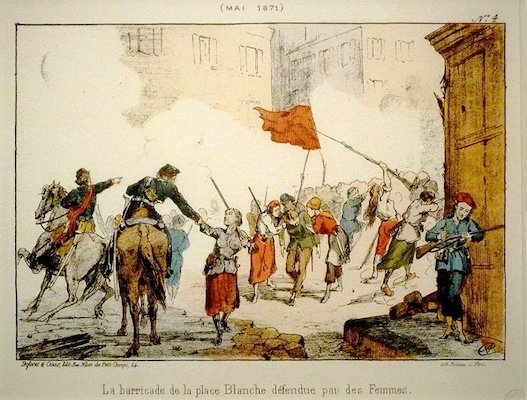
Marx was later to learn that a different form of state was required to break the power of these forces and embody real democracy.  This was discovered in the Paris Commune of 1871, when the working classes of that city overturned the ruling authorities and imposed their own rule.  Marx noted that:

‘The unity of the nation was not to be broken, but, on the contrary, to be organized by Communal Constitution, and to become a reality by the destruction of the state power which claimed to be the embodiment of that unity independent of, and superior to, the nation itself, from which it was but a parasitic excrescence.’

‘While the merely repressive organs of the old governmental power were to be amputated, its legitimate functions were to be wrested from an authority usurping pre-eminence over society itself and restored to the responsible agents of society. Instead of deciding once in three or six years which member of the ruling class was to misrepresent the people in Parliament, universal suffrage was to serve the people, constituted in Communes . . .’

‘It was essentially a working class government, the product of the struggle of the producing against the appropriating class, the political form at last discovered under which to work out the economical emancipation of labour.’

‘Except on this last condition, the Communal Constitution would have been an impossibility and a delusion. The political rule of the producer cannot co-exist with the perpetuation of his social slavery.’

Republicanism promised the right to ‘life, liberty and the pursuit of happiness’ but only social emancipation can deliver it.

Part 65 of Karl Marx’s alternative to capitalism

Back to part 64

Forward to part 66

Part 1


The domestication of the Irish Left

Marxists believe that power in society resides in capital, in the capitalist system and its property relations in which ownership and control of the means of production etc. are monopolised by one class.  In the form of money, capital can be otherwise employed to gain political influence through the media, buy politicians and discipline governments through speculation on the bond markets.  Capital strikes can disable economies just as individual capitals can close down workplaces overnight destroying the livelihoods of their workers.

On top of this are states that defend these property relations through a multitude of laws bolstered by assumptions about the primacy of bourgeois private property rights that are considered holy writ.  Should this be questioned the state is also composed of forces armed with the monopoly of violence to police and impose the requirements of these property relations.  Since such relations involve the exclusion of ownership and control by the majority there is nothing democratic about them and no bourgeois claims to democracy entertain the notion that there should be democratic ownership and control of the economy.

Instead such claims to be democratic rely on parliamentary institutions that are dignified with reverential rules and procedures, the better to elevate their status above their essential subordination to the real power in society.  Incantations about their sacred embodiment of democracy cover for this subordination while most people vaguely register their awareness of the sham through a view of all politicians as essentially liars.

This, however, is a purely cynical reaction and is not the ground for either an adequate understanding of what is going on or the envisioning of a genuine democratic alternative.  Nationalism provides additional glue to bind workers to their (nation) state and the claims it makes for itself on their behalf, but more and more decisions are taken at an international level where real democracy is even more obviously absent. It is generally considered in most of Europe that its people live in a ‘democracy’.  The job of socialists is to make them aware that this is bourgeois democracy and that it is a sham that they should seek to change.  Moreover they need to be convinced that the state they are invoked to give allegiance to does not defend their interests.

One very small example of the fraudulent character of bourgeois parliamentary democracy has erupted in Ireland as the governing parties have voted to restrict the speaking time of the opposition, reduced its own exposure to questioning, and allocated opposition time to a group of ‘independents’ who have all declared full support for the government and have a number of members as ministers within it.  As all the opposition parties have put it, you are either in the government or in the opposition – you cannot be in both.

Dáil sitting has been suspended before in much disorder but was suspended again yesterday when the change in Dáil standing orders was pushed through without debate by the Ceann Comhairle (the Speaker of the House). She is supposed to be independent but was elected as a member of the same ‘independent’ group and appointed as part of the secret deal that no doubt lies behind the speaking privileges now given to it.

This is no doubt a cynical political stoke that should be opposed. The up-its-backside liberal propaganda news sheet ‘The Irish Times’ opined that “normal Dáil business” must “resume immediately” so that a list of issues can be discussed. These include climate and health care that “normal Dáil business” has failed to successfully address for decades.  Even these relatively minor attacks on democratic functioning do not find this liberal mouthpiece defending it.

Of course, the government is committing much greater crimes against democracy than these latest shenanigans, including allowing planes delivering arms to Israel to pass through Irish air space.  Like governing party claims before the general election about the number of houses that were being built or support for the Occupied Territories Bill, this is a government that cannot be trusted to tell the truth.

The opposition parties, including People before Profit, have united to ‘stridently’ oppose this ‘alarming’, ‘outrageous’ and ‘unprecedented’ plan and to defend the ‘fundamentals of parliamentary democracy’.  There has been a lot of talk about the government’s changed procedures reducing their ability to ‘hold the government to account’ and to ‘represent their constituents’.

But this follows People before Profit centring their recent electoral campaign on ending 100 years of unbroken office by the two ugly twins who nevertheless won the recent general election.  When has either Fianna Fail or Fine Gael been held to account over this 100 years?  When has it been punished for its failures, lies, hypocrisy and previous much more authoritarian measures?  In what way do impassioned speeches by People before Profit TDs excoriating government ministers to an almost empty Dáil chamber – shown regularly on social media – embody holding these ministers to account?

The man in the centre of it all,’independent’ TD Michael Lowry, has been found by a state tribunal to be “profoundly corrupt” but here he was giving two fingers to the PbP TD Paul Murphy! Why is he not in jail, never mind inducing the government to tear up Dáil standing orders on his behalf?  Tribunal after tribunal has demonstrated that there is no justice from the state and the Dáil chamber is incapable of delivering it either.  More evidence of the sham that is bourgeois democracy!  Why not say this?

Rather than use the episode to demonstrate this to the Irish working class, to further explain the limits and hypocrisy of bourgeois democracy, and to call out the alternative, People before Profit has decided to become bourgeois democracy’s most vocal defender.  Rather than use it as support for the argument that the working class will not find real democracy within a bourgeois parliament, it declares the vital need to support its fraudulent claims that it can allow workers to hold the government to account’, i.e. criticise and punish it.  Instead of exposing the hot-air bloviating that passes for democracy it holds out the necessity for extra hours of fine speeches.

Illusions in bourgeois democracy run deep in Irish society, as in most advanced capitalist states, with the continued election of Lowry and the ugly party twins as plenty of evidence.  Every opportunity to expose it should be grabbed.  Ironically, a previous posture of doing this – of exposing the hollowness of bourgeois democracy evidenced again by this latest stroke – would have been more powerful in embarrassing the government than the strident claims that more time to ask questions and talk to an almost empty room is vital to democracy.

To go back where we started – with Marxist principles.  These declare that the emancipation of the working class will come from the activity of the working class itself, a principle precisely counterposed to the parliamentary illusions of much of the left.  Real power comes from outside, that of both the capitalist system and of the working class.  It is on the power of the working class and its organisations outside that socialists need to focus, and which could do with much greater democratic functioning. Illusions in the Dáil are only for those for whom these illusions are comforting and who seek a career within it.

Imperialist rivalry and the Left (1 of 2)

The widespread revulsion among many in the West at the genocide in Gaza explains the increasing clampdown by governments on protests against it.  These tend towards opposition against the Western states themselves, whose complicity is too obvious to hide, while the attempts to disguise and justify it by the likes of the BBC etc. reduces their influence.

This comes at a difficult time when Western political and military leaders and their propagandists in the media announce that the populations of the West should be preparing for war themselves.  The latest is a report stating that:

‘The European Commission should facilitate the prolongation of the conflict in Ukraine in order to contain Russia and prepare for war within the next five years. European Commissioner for Defence Andrius Kubilius made such a statement during the annual conference of the European Defence Agency in Brussels.’

“Every day that Ukraine continues to fight is another day for the EU and NATO to become stronger,” he said, calling on European countries to “prepare for war in the next five years” and to move the European economy to ” turbowarfare regime”.’

“We should spend more on weapons, produce more and have more weapons than Russia,” Kubilius added.’

This is the inescapable logic of all those, from the right to the pro-war left, who currently support the war.  It follows from their claims that Ukraine must be supported because it is fighting for democracy – for ‘us’ – against an aggressive imperialism. If it is acceptable for Ukraine to ally with NATO and for workers in the West to support it in doing so, then the same Russian threat exists not only to Ukraine but also to Eastern Europe.  After all, is this not the inevitable course of an aggressive imperialism?  If this imperialism threatens Eastern Europe only the stupid could deny that the same threat would then not also be posed to Western Europe.

So far, some groups like that promoted by  Anti-capitalist Resistance are committed to this view in relation to Eastern Europe; but a war they believe can spread from Ukraine to Eastern Europe has, for similar causes, no rationale not to spread from Eastern Europe to Western Europe.  This means that there is no reason not to support their own states in this future war and accept the preparations necessary to fight it, those demanded by the EU Commissioner for Defence.

Since most of the Western left has failed to oppose the war it is therefore politically disarmed against the bellicose demands for rearmament by their own capitalist states.  This is true both of those who pretend that the war by Ukraine is one of national liberation and of those who believe it is an imperialist proxy war and a war of national liberation at the same time.  The latter simply import into their position the contradiction that the real world outside damns in the former.

Now, along comes Donald Trump to make it clear that imperialist rivalry really is aggressive by its nature, including the Western variety.  The attempt therefore to claim that it is the Russian variety that is solely responsible for war must explain in what way it is not just one instance of a world-wide phenomenon; why the expansion of NATO to include Ukraine is not central to the cause of the war; why Ukraine should be supported when its criticism of Israel has been that it hasn’t provided it with weapons – something now being rectified; why support should be given to the Western variety of imperialism when it is participating in genocide in Palestine; and most importantly, why opposition to the invasion requires support for the alliance of Ukraine and Western imperialism.

Of course, the pro-war left opposes Trump, but more as an anomaly – rather like others in the bourgeoisie media – who will highlight the differences but ignore the continuities with the previous Biden administration.  However, some of these commentators have already admitted that what stands out about Trump is his open espousal of the same principles as his predecessors without the hypocritical rhetoric that has usually accompanied it.  He is as much a product of Western bourgeois democracy that the pro-war left defends as the Obamas and Bidens.

Trump’s threat of ethnic cleansing will compete against Biden’s genocide for barbarity.  Sanctions and creeping economic war against China started under Trump but were maintained and expanded by Biden.  Trump’s threat to make Europe pay for the war in Ukraine follows Biden’s existing imposition of its costs on Europe through sanctions, blowing up European infrastructure, and selling it more expensive energy and lots of US weapons.

Trump is evidence of there being more than one way to pursue US primacy.  Of course, this doesn’t mean there isn’t a difference, but it is necessary not to limit opposition only to them.  The petty bourgeois character of the left is exposed by its seizing on such differences to drop principled opposition to other bourgeois forces and ally with them in opposition to what is called the far-right or fascism.  This includes the same forces whose rule led to the growth of the far-right in the first place.  We see this process again and again in support for the Democrats in the US, Macron in France, and Starmer’s Labour Party in Britain.  In Ireland it is Sinn Fein that is supposed to be central to a left alternative despite its record in office in the North of the country.

All these have failed, or will fail, because these forces are not an alternative to what is called the far-right, which in many cases is just the further right.  These far-right formations represent, or are composed of, the reactionary sections of the petty bourgeoisie with their narrow nationalist ideas that must inevitably under current conditions gravitate to those they seek to replace, or shift their ground to achieve the same outcomes with different methods.  The accommodation that many so-called centrist bourgeois formations are making with the far-right should be all the evidence needed that the dividing line is not some notion of a more and more discredited bourgeois democracy against right wing populism and authoritarianism but between the working class and the bourgeoisie that is attempting to conscript it for war and get it to pay the price in money and blood.

Forward to part 2

Politics of the Lesser Evil- Harris and Trump

In a two-horse race where you want both to lose, the crumb of comfort is that one of them will.  In this case the ‘lesser evil’ was an accomplice to genocide, which rather raises the question what the greater evil might possibly be?    Tested to destruction, the politics of the lesser evil failed spectacularly and all those US leftists who defend it have lost both the election and lost the argument.

Of course, this will be the beast that will not die and will raise its head again elsewhere, in, for example, the French Presidential elections.  We have already experienced it in Britain where Starmer’s Labour was the lesser evil alternative to the Tories; except that after a few months in office opinion polls show that its support has collapsed.

Trump now has the potential to control Congress as well as the Presidency, having packed the Supreme Court.  Only the permanent state apparatus lies between him and his implementation of policies most of the capitalist class opposes, and the US system already allows political appointments to the state bureaucracy.  The BBC quickly reported that he intends ‘an aggressive plan to restructure the federal bureaucracy, replacing senior career government employees with political appointments.’

An initial question arises – how did he win?  This is usually framed on the left as – how did she lose?  The answers overlap but are not the same.  The support base for Trump has been well enough analysed and includes the significant reservoir of racism that exists in the US, as well as the incorrigible reactionary petty bourgeoisie and other demoralised layers of the population.  It also includes many who are alienated from what they see as the rigged political system that the Democrats call democracy, and which they called upon voters to come out to defend by voting Kamala Harris.

This was a key part of their campaign after an initial tack to the left, as reported by the US publication Jacobin.  The magazine reported that, what they call ‘populist ‘ and ‘progressive’ policies, were more resonant and popular than calls to protect democracy from the threat of Donald Trump.  Yet Harris pulled back from them, confirming her as being as untrustworthy as the system she was defending.

The Democratic Party had already tried to foist a cognitively impaired candidate on the electorate before unceremoniously dumping him, but only after months of denying there was a problem.  The Party machine and big donors proved that they control the ‘democratic’ process, not the millions of members who voted for Biden in the primaries.  The origin of this problem goes back to their necessity to defeat Bernie Sanders, who might have raised expectations of some genuine progressive change had he been the candidate. 

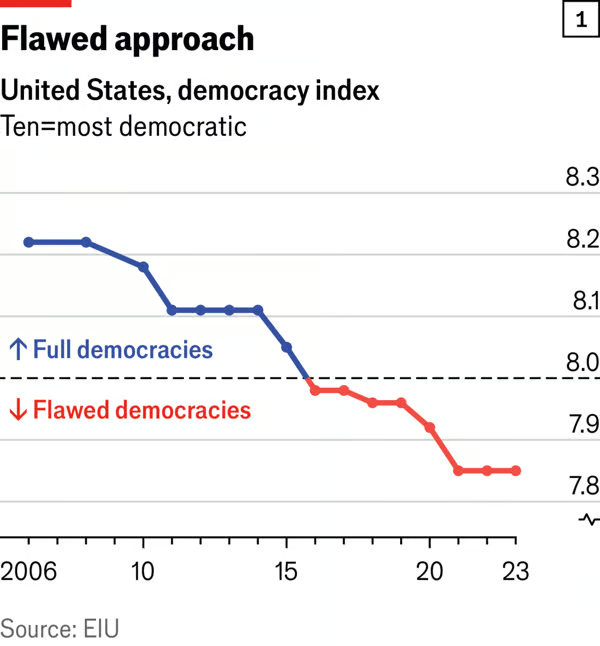
Not all of this will have registered with voters, but the alternatives were a false and lying claim to be the champion of ordinary Americans against the elite with its corrupt and rigged system; and a defender of the system on the equally false claim that it is democratic.  Of course, Trump will advance an attack on democratic rights but the US has already fallen from a ‘full’ to a ‘flawed democracy’, according to that shrill defender of US capitalism ‘The Economist’, and this fall didn’t just happen under Trump.

Having tried to hide Biden from the population, the Democratic party tried to do it again with Harris.  A US commentator in ‘The Irish Times’ noted that ‘after a month in which Kamala Harris was shot to the top of the ticket by her party elites, and in which she did no substantive interviews, she was clearly leading. She then spent a month introducing herself to the public. This was her big mistake. Thereby she fell backwards into a dead heat as Americans concluded she’d be better off not speaking.’

He summed it up by saying that ‘What we can say is that the 2024 election is between a man whom Americans know far too well and a woman Americans would rather not get to know.”

The top-down manipulation of the Democratic party’s traditional base failed, encapsulated in the failure of the leadership of the Teamsters Union to endorse Harris.  She didn’t give them any reason to do so.    Even the issue of abortion rights was not nearly enough to propel her to victory, while the identity politics so beloved of the Democratic party, especially parts of the left, also failed it.  

Trump targeted a lot of his media propaganda against the Democrats’ transgender agenda, which they then also retreated on.   Trans activists complained that ‘in a recent Gallup poll, transgender issues ranked dead last (out of 22 total areas) in importance to voters’, but don’t seem to realise that it is precisely its unimportance to many that meant that its previous prominence for the Democrat’s showed how out of touch they were.  This is only confirmed by the irrational and harmful demands previously championed; ranging from men in women’s sports to unproven or harmful medical interventions on vulnerable young people.

There is no reason to lament the defeat of Kamala Harris – the candidate of the war party and of genocide; of the biggest part of corporate United States; of a corrupt and rotten political system, and of fake progressive politics and truly reactionary identity politics. That a figure as repulsive as Donald Trump defeated her is testament to her and her party’s own abominable character.

The resistance to the Trump agenda will not advance through the politics or organisation he has just defeated, but through a critique of both, and working out how to break US workers from both Trump and the Democratic Party.  This involves bottom-up organisation and alternative politics to the fake claims of corporate-approved progressiveness.  The alternative is politics that puts forward what unites the working class, that opposes what divides it, and is clearly in their interest. This politics isn’t ‘populist’ or ‘progressive’. It’s socialist.

Bourgeois democracy – reply to a critical reader

In the previous post a reader of the blog expressed disagreement with my approach in a comment.

He stated that “I find it hard to fathom how you can heavily criticise bourgeois democracy like you did in a recent post and at the same time advocate for something you call democratic rights.”

The comment doesn’t reference the particular post and makes only general references that are difficult to identify, including reference to the views of Marx as quoted by Paul Cockshott. I agree with the comment by Boffy in response that:

“I am always rather suspicious of people who cite what Marx and/or Engels are supposed to have said about something, without actually giving the quote, and source of it, because I have frequently found that either the claim is false, altogether, or else, the context, and text of what they said completely changes the meaning of what is being claimed. Given what they say in the Communist Manifesto about workers having no country, and the fact that they were themselves refugees from Germany, makes me doubt what is being claimed for them, here.”

I can only add that it is not altogether clear what the comment Boffy responded to is claiming.

In relation to bourgeois democracy – this post being one example – it is one political form of the dictatorship of capital – the exploitation of the working class, which is separated from the means of production and subject to wage slavery, as its labour power becomes a commodity.  I don’t see how you can be a Marxist and not take this view.

Does this mean we cannot demand and fight for democratic rights within capitalism?  Only the most formal of formal logics could lead to such a view and someone who regularly quotes philosophical thinkers should know this.

The fight for democratic rights was recognised by Marx as necessary in order for the working class to develop itself politically so that it could have the freedom to identify its separate interests, organise around them and struggle for the realisation of the dictatorship of the proletariat.  The word ‘dictatorship’ has rather changed its meaning since it was used by Marx and does not refer to lack of freedom but to the economic and social domination of the working class – uniting the working class with the means of production through cooperative and common ownership, the ending over time of the wage relationship and thus ending of exploitation.

The struggle for this freedom includes the struggle for democratic rights which are not “abstract principles . . .like as a magician pulling rabbits out of a hat” but are concrete measures to be imposed on, or accepted by, the state through working class struggle.  One of the points I have made continually is not to base the struggle for these rights on appeals to the state but to be won by the workers themselves, in opposition to the state if necessary.

He asks “Are your democratic rights legal claims that somehow endure without the presence of a State”?

Marxists do not invent a world subsisting without a state; we recognise the real world that exists in which there is one.  It is why Marxism has no need to invent such things as natural law.  Rights are not worth much if they cannot be validated and this very often is done by the state: so often the democratic rights demanded are demanded from the state, to be accepted by or imposed on it, but always with the view that it is the power and activity of the working class that will ultimately protect and defend them, to whatever extent this can be done within capitalism.

Marxists believe that society can only be understood as it really is – and thereby changed –  by recognising that it is structured by classes with their irreconcilable interests. It is the writer of the comment who is guilty of proposing ‘abstract’ ‘principles’ and ‘morals’, which is why he states that he doesn’t understand what I have written.  It is why he says such things as “I can honestly say I don’t know what these things are” and that “I might not agree with humanitarian morality but at least I could say I understood what was going on.”

When he says that he “would be happier if you and others who speak up for and march out for the asylum seekers did so on the basis of some common humanitarian morality” he simply says that he would be happier if I lapsed into the “abstract principles” he denounces as akin to “pulling rabbits out of a hat.”

He provides me with the option of justifying my position by saying that “I can see how you might get around the problem by imputing an interest and not a morality to the working class.”  And this is roughly what I have done, although I would not put it in those terms.  This, however, is an option that he obviously rejects, yet also rejecting a general “humanitarian morality” as an alternative. Where that leaves him is not my problem.

He then states: “let’s us assume that the bulk of the working class misrecognises the interest you impute to them or consciously rejects that interest. Well you are back with your principles again, an undisclosed humanitarian morality. It turns out therefore that lurking behind the objective interest of the working class is an undisclosed humanitarian morality.”

This is a big, big assumption, and the history of the working class demonstrates that significant numbers have identified that they have a separate interest.  This is demonstrated objectively in the alienation of the working class; its distrust of its rulers and opposition to many of its actions – including those rulers support for the current genocide in Palestine. It is demonstrated in its separate organisations, and in its long history across the world of class struggles big and small – from strikes to revolutions.

Naturally the bourgeois media, culture industry and education system ignores or distorts all this, which makes its undeniable existence all the more necessary to recognise and appreciate.  But let us presume that the assumption is correct for the sake of argument.

If it were true that “the working class misrecognises the interest you impute to them or consciously rejects that interest”; i.e. that it never develops class consciousness; then yes, there would be no material interests that could be realised, and any such interest would be abstract, therefore general and “undisclosed.” The point of the blog is to disclose this interest and advance understanding of what it is so that it can be realised in the real world, through informing working class struggles that are going on quite independent of it.

This is where morality ceases to be abstract, is attached to material interests, where ‘what is’ meets ‘what should be’.  To understand this, it is necessary in some way to be part of the struggle to understand and change the world.  The commentator is not part of this, so appears incapable of understanding Marxism. It is this purely contemplative perspective that, it seems, means that he never gets the point. 

Bourgeois democracy in Ireland in two Acts (2) – Orwellian and Surreal

Bourgeois democracy can not only lie, it can also invent crimes for which you can be punished.  The Government is going ahead with the hate crime bill, shorn of its hate speech elements.  This follows its stinging defeat in the family and care referendum in which it also lied about the implications of what it was proposing when asked whether these had been raised within it as a concern.

The original proposals about ‘hate’ speech were particularly threatening but the retention of the definition of “protected characteristics” raises all sorts of questions that the government will again have to spin and lie about in order to defend.

These “protected characteristics” include ‘race, colour, nationality, religion, ethnic origin, descent, sex characteristics, sexual orientation, disability and gender’.  Beyond general issues about the wisdom of agreeing to greater repressive powers for the state, and the inclusion of essentially subjective considerations such as ‘hate’ in punishment, there are two questions – what is ‘sex characteristics?’  Is this just another term for sex, in which case what is the point of two words instead of just three letters?

The second is the definition of gender included in the legislation: “’gender” means the gender of a person or the gender which a person expresses as the person’s preferred gender, or with which the person identifies, and includes transgender and a gender other than those of male and female”.

This farrago of words is obviously not a definition of anything, certainly not of ‘gender’ or ‘transgender’, and as I have written before, it’s doubtful that one can be clearly stated.  It seeks to protect people who are ‘other than those of male and female.’  Who are they?  Where are they and how do they, or could they, exist?  In what way is this not putting into law the nonsensical ideas of gender identity ideology that the Government parties don’t have the courage to openly argue for?

When the right wing Senator Michael McDowell asked the Department of Justice what is intended by the term ‘transgender’ and ‘a gender other than those of male and female’ he got no response.  Instead, the department provided a statement that included this: 

“If someone is assaulted because they are transgender, that is a hate crime.”

“People identify as non-binary. That’s a fact. If someone follows a non-binary person after they leave a gay nightclub, and then assaults them while shouting homophobic abuse, they would likely be charged with assault causing harm aggravated by hatred (carrying a max sentence of 12 years, instead of 10 years because of the aggravating factor). If it’s not found that it has been aggravated by hatred, then the person could still be charged with assault causing harm,” it said. “A definition is required to protect that person. It has absolutely no implications outside of this law.” (Emphasis added – Sráid Marx)

The department also asked: “Does Michael McDowell believe that this person should be protected by this law, or does he believe this person should have to identify as male or female to be protected?”

There is so much that is simply stupid in this that it’s difficult to know where to start.

I am quite sure that Michael McDowell would respond that it does not require anyone to identify as anything in order to be protected, which is what the Department of Justice seems to imply. Or does the Department believe it must be proved that an assailant knows the inner thoughts of someone in order to secure conviction or aggravated punishment?  For that is what the department assumes when it wants to protect someone who is in some way not either male or female and walks out of a gay club.

How on earth could someone be attacked for being ‘non binary’ without the assailant having some prior knowledge of the person?  If a stranger was attacked for coming out of a gay club it is much more likely that any motive beyond purely violent intent would consist of homophobia, which is obviously what would be indicated by their “shouting homophobic abuse”.

It is indeed a fact that “people identify as non-binary” but it is also a fact, that the government wants to elide, that there is no such thing as a non-binary person (neither male nor female or both).  Assaulting someone for this reason is not an assault on someone because of what they are (e.g. gay) but an assault because of their (misconceived) ideas about what they are.  Since such ideas are as varied as there are ‘genders’, the state has opened up a panoply of grounds upon which to claim hate crime warranting additional punishment.

The state may have dropped attacks on free speech that might lead to criminal punishment arising from disagreement with the idea of the many ‘genders’ claimed by some activists, but this still leaves open the potential for punishment for those disputing such claims.  This may seem absurdly alarmist but it is already the case that the Department of Justice is implying that only inclusion of a gender identity in a victim ensures protection, something just as absurd.

The ability of the state to conjure up offences and therefore punishment on grounds that are non-existent is surreal.  The word Orwellian is overused but the Irish state is claiming that not only can it identify the inner thought crime of an accused but also that the inner thoughts of the victim can also be divined by the accused and in turn accessed by the state.

It is a feature of gender identity ideology that it throws up such idiocies that are easily dismissed, but these are a result of the foundational one that men can be women just by claiming to be one, and this is one nonsensical claim that is already being validated and legislated for.

McDowell has also noted that ‘the Bill suggests that there are genders (plural) other than male or female. It does not enumerate or describe such other genders”. He argues that unspecified genders beyond male and female would raise questions “over statutory provisions providing for gender balance in judicial appointments, board compositions, etc”.  “There is no case for legislating for an open-ended multiplicity of subjective genders the meaning of which is obscure,” he said.

The idea that the numerous legal and social provisions based on gender – understood as sex – will not be affected by the legal recognition in this Bill is naïve at best and does not accord with experience across the world.  I have argued elsewhere that these implications are reactionary.  They have included attacks on freedom of belief; freedom of speech and freedom of association; destroying women’s sex based rights; putting males in female spaces; attempting to obliterate sexual orientation and lying to children that they can change sex before they even have a full appreciation of what it is.

Those who think that because McDowell is right wing he cannot be quoted or we cannot agree with him on this should consider why a government and state that is complicit in genocide, as we pointed out in the previous post, should now be considered to be in the vanguard of social progress.  They might also consider that Genocide Joe Biden described trans rights as “the civil rights issue of our time. There is no room for compromise when it comes to basic human rights”. Tell that to the Palestinian people.

Back to part 1