What is bourgeois democracy?

Most of Europe is involved in a proxy war against Russia, costing billions of Euros and untold lives; untold because the personnel involved were not supposed to be in Ukraine in the first place.  Who voted for the war?

This question sums up bourgeois democracy.

This has not prevented many on the left enthusiastically supporting it.  This left, which normally would not dream of calling a strike without a ballot, has given a blank cheque to its ruling class and its state.  Rather than demand a vote in order to debate the purpose and objectives of the war, they have simply endorsed it and called for it to be supported more vigorously.  I doubt the idea of a debate and vote even crossed their minds, not least because they don’t have an alternative anyway.

The justification, ironically, is that Ukraine is a ‘democracy’ and Russia is not; even though the current president of Ukraine is no longer an elected leader, since his period of office has expired, while the President of Russia actually won an election, for what it’s worth.  In the last few days Zelensky has tried to concentrate even more power in his hands by sacking around half his cabinet.  That opposition parties and media are banned in Ukraine matters not a jot to these people while Russia’s elections are regarded as a sham.  Let’s think about that for a minute and consider recent elections in the ‘democratic’ West as a comparison.

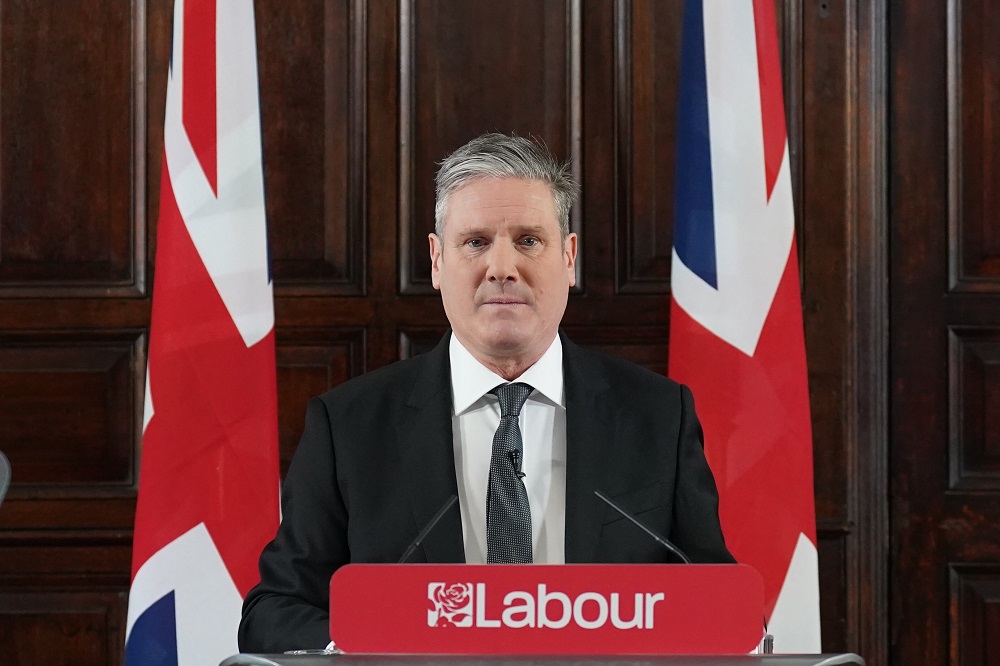
First, we have the new Labour government in Britain, elected with an enormous parliamentary majority by only 20% of the electorate on the basis of not much more than not being the Tories.  Starmer and his colleagues did their best not to commit to any specific policies and have quickly broken promises that they did make – on energy prices and austerity.  No doubt, further measures will confirm this course.  The widespread opposition to genocide in Gaza, reflected in support for some independent candidates, could find no reflection in the choice of government as both Labour and Tories support it.

Second, we have the most powerful bourgeois democracy in the world in which counting the money is a better guide to who will win than the polling of support for the various policies that the candidates claim to support.  The US is possibly even worse than Britain in terms of the vacuum of debate on what exactly parties will do when elected, whether anything they say can be believed and is not just a catalogue of lies.  For every Donald Trump and Kamala Harris we have a Boris Johnson and Keir Starmer.  The main appeal of each candidate is aversion for the other.

When the usual mechanisms for making sure the ‘right’ candidates are selected fail these are ditched and the men and women with money and political power step in to make the ‘right’ selection.  After months of primaries and the votes of millions – 14.5 million in fact – the Democratic grandees and apparatchiks stepped in to ensure that Genocide Joe would not be the Presidential candidate.  In this he was simply the subject of the same machinations that ensured he was the candidate in 2020 instead of Bernie Sanders, who was judged too left wing regardless of the popularity of his policies or of himself.

Even the proponents of bourgeois democracy worry that all this is not sustainable, while certain sections of the left cling to it all the more firmly the more rotten it becomes.  In an opinion piece in the Financial Times, a contributing editor noted that Kamala Harris has given only one media interview and even that not by herself – ‘she seems to think that if voters understand what she will do as president, they will be less likely to support her.’  It notes the irony that, while claiming to defend democracy against the “existential threat” to it posed by Trump, the failure to do what you say you are going to do means that ‘rather embarrassingly, you will be the one undermining the system of representative government.”

The argument of socialists is that bourgeois democracy – “representative government” – is a sham.  How could it be otherwise in a system in which the means of production are controlled by the capitalist class, including the means of communication – of producing ‘the news’ and disseminating it, and the state machinery through which government policies are implemented – thorough its top personnel and the economic structures through which policies can be allowed to work or alternatively are throttled.

A final example of bourgeois democracy in action is in France, where the defeated Emmanuel Macron, having prevaricated for two months, has announced that Michel Barnier has been chosen by him to be Prime Minister.  Despite the New Popular Front having won a plurality of the votes he has selected a leader from the right wing Les Républicans, which won only 6.57% of the first round vote.

The leader of France Insoumise, Jean-Luc Mélenchon has declared that “We’ve been robbed in this election”. It is normally the largest formation that is permitted to form an administration but such normalities are always disregarded when the political establishment thinks that it faces some sort of threat, especially from the left.

The real anti-democratic nature of this move by Macron is not so much the abuse of this Presidential mechanism but what the employment of this power signifies.  The elections were a decisive rejection of Macron and his policies, reflected in the vote for the New Popular Front and in the rise of the far right Rassemblement National.  Yet Barnier was selected preciously in order to confirm and continue these policies.

The front page of the Financial Times explained that the purpose of Macron’s choice was to ‘find a candidate . . . who would not seek to undo his pro-business reforms.’  The fraudulent nature of the far right alternative to mainstream capitalist policies was revealed by the response of Marien Le Pen who is quoted as ‘cautiously’ welcoming the appointment and saying that “Barnier seems at least to meet one of the criteria we’d demanded . . . and be able to speak with the Rassemblement National.  That will be useful as compromises will need to solve the budget situation.”

An analyst from one of the think tanks that litter the capitalist political environment stated that his appointment would ‘help in France’s bid to reassure markets over the economy and public spending’.  “He’s a safe pair of hands known to market participants, known to Europe and the domestic political elite within France”, adding that he would be expected to ensure that ‘Macron’s labour and pension reforms would remain intact.’

So, there we have it.  An overwhelming vote against Macron’s policies is turned, or is attempting to be turned, into an administration that will ensure their maintenance.  It is not the clear wishes of the electorate that must be counted but that of the ‘markets’ – national and international capitalism – and the ‘political elite’ that counts.

For all the hypocritical cant about ‘democracy’ we have yet another example of how bourgeois democracy is democracy for the bourgeoisie.  For the majority, including the working class, democracy does not extend beyond occasional visits to the polling booth in which meaningful choice has often been removed, or when it has not, constitutional devices are employed until these too are insufficient whereupon more forceful measures are employed.

Mélenchon is reported to have called for protests against this subversion of the popular will, demonstrating that, for the working class, democracy can only be enforced and guaranteed by its own actions.  What this action cannot do, however, is democratise the state itself, which is the instrument of the political elite and the markets – the bourgeoisie and capitalism.

The resort to protest is testament to where power for the working class arises and where it must be advanced – in the organisation and mobilisation of the workers themselves.  Elections can measure its strength and level of politicisation but only the workers own organisations can form a democratic alternative to the political elite, the bourgeois class and its state.  This in turn demands that the organisation of the working class movement itself must be democratic, but until some current socialists stop supporting capitalist war in defence of bourgeois democracy they will have nothing but a reactionary role to play in building up the workers own democracy.

UK elections – who needs a majority?

The Labour majority of over 170 seats with only 34% of the vote is the lowest-ever winning share.  With around one third of the vote it gained two thirds of the seats. The turnout of around 60% was a drop from 67% in 2019 and the second lowest since 1918, meaning around 80 per cent of those eligible to vote didn’t vote for Starmer, whose personal rating is a net minus of 6.  Even in his own constituency his vote fell dramatically, by 15.6%.

His victory is due to the Conservatives having their worst ever result.  Polling indicated that 48% of those intending to vote for Labour were going to do so mainly to get rid of the Tories.  Had the Reform Party not existed, and its reactionary support voted Conservative, it would have beaten Labour by around 38% to 34%.  Yet for receiving 14% of the vote Reform got around 1% of the seats.

From this, two things are obvious: the British electoral system is a fraud with scant claims to democratic legitimacy and Starmer’s Government has the same lack of popular foundation.  The bourgeois media can’t ignore all this completely but can be expected to move quickly on.  One only has to recall that Starmer’s Labour received less votes than the supposedly disastrous Jeremy Corbyn in 2019 and 2017 to appreciate the treatment the media would dish out to the lack of legitimacy Starmer’s result would be accorded had Corbyn still been leader. In 2024 Starmer’s Labour won 9.7m votes with 33.8% of the vote while in 2019, in Labour’s supposedly worst result ever, Corbyn’s party won 10.2m votes with a share of 32.1%.  In 2017 Corbyn’s Labour won over 3 million votes more than Starmer did today – 12.9m as against 9.7m.

It is estimated that a quarter of 2019 conservative voters switched to Reform while the Liberal Democrats achieved their best ever result by surfing the wave of getting the Tories out by targeting their seats in the south and south-west of England.  Labour also benefited by the collapse of the SNP vote in Scotland following 17 years of failed SNP rule and the scandals that have engulfed the leadership of the party.

The short-sighted and primitive call from some on the left who simply called for the Tories to be kicked out has been exposed for the worse than useless advice that it so obviously was.  Everybody was out to get the Tories , and the election revolved around their losing it rather than Labour winning.  As we have seen – the Labour vote went down.

*                   *                   *

The Labour slogan was the vapid and vacuous one-word ‘Change’.  The bourgeois commentariat has welcomed it as a change from the incompetence, chaos and instability of fourteen years of Tory rule and a return to the previous, apparently boring politics.

True to their superficial appreciation of events, or at least as they recycle them for the consumption of the population, this ignores the commitment of Starmer to essentially continue with Tory policies.  This includes a commitment to ‘growth’, to retention of the commitment to reducing the debt over five years; minimal increase in taxation; resolution of the problems of the NHS; commitment to increased defence spending, and a promise not to reverse Brexit in his lifetime.  He has also committed to come down hard on immigration and to do so more effectively than the Tories.

How growth can be achieved without investment (increased borrowing and therefore increased debt); without a larger workforce (while reducing immigration), and without expanding either the domestic market (through pay increases Starmer has vowed to oppose) or the export market (while never rejoining the EU), is left unexplained.  It all looks exactly like the situation created by the Tories but without smug incompetence of Cameron, the wooden hopelessness of Theresa May, the performative chaos of Johnson, ideological blinkers of Truss, and the MBA qualification in cluelessness of Sunak.  All Starmer brings personally is his own brand of dislikeability and penchant for lying on the scale of Boris Johnson.

Normally a new right wing government with a mandate would be able to wield their electoral victory as a weapon against workers, through restricting public sector pay, reducing public services and welfare, and increasing taxation.  Given Starmer’s short but filled-to-the-brim history of U-turns, it would not be a surprise to see him attempt to impose austerity on public sector pay, reduce the scope of state services such as the NHS, increase taxation, take yet more reactionary measures to be seen to reduce immigration, and attempt unsuccessfully to get something meaningful from the EU in terms of better market access.  None of this will lead to significant additional growth.

Brexit is an issue that will not go away even if all the parties try to ignore it as they did in the election; just as the proxy war against the biggest nuclear arms power in the world was also ignored.  The previous election that promised that Brexit would get done resulted in it not getting done, thus not addressing all the problems created.  The lack of strong support for Starmer’s government will matter when he is called upon to do so.

*                   *                   *

Starmer managed to maintain the support of most of Labour’s voters while pivoting to the right, to win over disenchanted Tories and others simply wanting rid of them without caring particularly over who replaced them. This having been achieved, there is no reason for any of them to offer his Government any continuing support.  Even his claim to introduce integrity into government after years of Tory sleaze looks like previous broken promises given his huge catalogue of gifts and the sponsorship of his party and colleagues by private corporate interests.

His support for Brexit will anger the majority of Labour members and supporters who oppose it and who will see more and more evidence of why they are right to do so.  A harder line on immigration will do nothing to improve growth, will antagonise some supporters and will legitimise those on the right, including the Reform party, which is in second place in almost 100 constituencies, the majority of which are held by Labour.  Reform has already demonstrated that its rabid xenophobia is more convincing and attractive to reactionaries than that of the Tories, and this will apply to Starmer’s reactionary nationalism.  Pursuing the same policies will engender the same problems that brought down the Tories and the same vulnerability to right wing competitors, who will always be able to out-bid its reactionary solutions.

The Liberal Democrats did not increase its share of the vote but had its best result because it targeted Tory seats.  An anti-Brexit policy could protect those gains while targeting Labour supporters opposed to Brexit and Starmer’s continuing demonstration of its failure.  The Green Party also increased its vote and became a more credible alternative, even if its gains in two Conservative seats demonstrates its essentially petty bourgeois character and opposition to any sort of socialism.

Unfortunately, the pro-Palestine candidates elected are not a coherent left alternative while fortunately the false and fraudulent alternative represented by George Galloway was defeated.  The battle for the socialist movement is not through creation of yet another electoral alternative but assisting in the working class resisting the policies of Starmer’s government and defending its interests.  Only by working class resistance and a movement created out of it could an electoral vehicle be constructed as a subsidiary part of the movement.

The Conservative Party has lost many of its most rabid pro-Brexiteers and will always come second in competition with Reform on the basis of opposition to the EU.  Just as with the Labour Party, sooner or later being a bourgeois party will mean having to represent its interests, which means reversing Brexit.  This applies to the Liberal Democrats as well so that a party realignment to achieve this will have to take place.

Only the rabid reactionary nature of the Reform membership can hobble its further development or blow it up. There is no point in the traditional conservative section of the Tory party seeking any sort of accommodation with it, yet there is no point in the reactionary petty bourgeois sections of the Conservative Party and the Reform Party remaining separate.

The results of the election; the economic challenges facing the new government and resistance to it; and the proliferation and confusion of party supports, all point to a political realignment.  A real socialist alternative cannot be declared or created out of the organisations that exist but likewise can only come to the fore as a result of developments in the class struggle, arising as a result of working class opposition to the the new government and its attempt to carry through the failed policies of the Tory government that has just been humiliated.  A cause for some optimism. 

The British General election – what lies beneath?

“Not only do the opinion polls say that Labour will win back working class areas in Northern England it lost in 2019, but it is also expected to do well in wealthy parts of the south that were once Tory heartlands.”  So read the full-page article in the Financial Times at the start of the week.  The reason?  “There’s only one answer to that: Brexit”, according to the Tory Chair of the House of Commons justice committee.

One section of the Tory base is leaving while the other in the so-called Northern ‘Red Wall’ is also departing, and since only one third of the electorate now still thinks Brexit was a good idea, the pool the Tories are fishing in – against the competition of the Reform party – is getting a lot smaller.  Since Starmer’s Labour Party also claims that it can get Brexit to work, and is also not talking about it, it is not a surprise that the share of the vote of the two main parties is now the lowest since 1918. Only 35 % of those polled think Starmer would make the best prime minister against 19% for Sunak, the former’s rating lower than all of the recent election winners.

It is obvious that the predicted Labour landslide victory has more to do with the unpopularity of the Tories than anything to do with Starmer, so that while Labour’s support has declined during the election so has that of the Tories.  The Financial Times reported that Tory support has fallen by a third since January and the view that the only issue that matters is getting rid of them has continued to dominate.

Both parties have embraced the politics of waffle with commitments that are as few and vague as the waffle is ubiquitous.  “Growth” is the answer to every problem yet the Brexit elephant in the room that squats on growth is ignored.  Starmer has followed Tory policy like its shadow while dropping every promise he ever made to become leader, parading his patriotism with “no time for those who flinch at displaying our flag”.

He has presented himself as a strong and tough leader –in such a way that his rating for being trustworthy has fallen from 38 to 29; his rating for honesty from 45 to 34; his rating for authenticity from 37 to 30 and, for all his posturing, his rating for charisma from 20 to 18.  What we don’t have therefore is popularity born of personality to explain why it’s not born of politics or principle.

The vacuousness of the politics of the election is covered up by trivia such as Sunak taking himself off early from commemorating the D-Day landings and the betting scandal, which shows that low-level corruption is always more easily exposed than the bigger stuff.  All this however is for the consumption of the masses.

The ‘get the Tories out’ mantra that also characterises the left is perfectly acceptable to the ruling class since the Tories have failed to govern properly, leading to Brexit and Truss’s unfunded tax cuts that briefly threatened the currency and suddenly raised interest rates.  Being anti-Tory is no longer a solely left-wing pursuit, which makes the primacy of getting them out (which is going to happen anyway) illustrative of the poverty and bankruptcy of many on the left.

Bourgeois commentators lament that the lack of honesty of the election ‘debate’ will lead voters to “distrust politicians and so our democracy itself” (Martin Wolf FT), while the more cynical shrug their shoulders and accept it.  “The UK is approaching a general election of vast importance for its future.  It just has to get next week’s one out of the way first” (Janan Ganesh FT).  The first worries that the British public will not be ready for the radical attacks that are coming their way while the second is concerned only that they learn to accept them next time.  Clearly both are more interested in what happens next, which doesn’t mean what happens to the Tories but what happens when we have Starmer.

One Irish commentator described him as “legendarily boring” and “resolutely moderate”, which fatuousness is what often passes for informed political commentary in the Irish press. The ruthlessness of Starmer’s dictatorship in the Labour Party and his pathological record of lying to become its leader should give even the dimmest observer pause to wonder what he will do with the exercise of real power.  What struck me ages ago was the unwillingness to wonder what decisions someone so innocent of due process in the Labour Party made when he was Director of Public Prosecutions.

The Starmer government is now the threat to the working class in Britain and to us in the north of Ireland, while the Tories are receding in the rear view mirror.  Preparing for this can best be done in the election by robbing this government of as much legitimacy as possible and using the election to organise potential opposition.  This means not voting for the Starmer’s Labour Party but only for those on the left of the party who might be considered as some sort of opposition, including those deselected and standing as independents.

The first-past-the-post electoral system is not designed to elicit people’s true preferences but incentivises many to vote against parties and not who they are for.  When there is widespread disenchantment with the major parties this can be muffled and stifled. Yet even with the current system we have seen support for the two main parties fall and ‘wasted’ votes for others may encourage further politicisation.

The Financial Times report that behind the steady gap between the Tories and Labour that will give Labour a ‘supermajority’ is a drop in Labour’s polling matching a fall in that of the Tories.  These trends may reverse as voting approaches but at the moment they show that their ‘competition’ is not strengthening either.  The FT claims that the Labour Party is experiencing high levels of turnover in its support, losing a quarter of those who had previously (January this year) said they were planning to vote for it.  Three per cent were undecided, 9 per cent were less  likely to vote, and 4 per cent were going to vote for the Lib Dems while potential Lib Dem voters were travelling in the opposite direction, perhaps for tactical reasons.

The proportion of voters who switched parties in elections used to be about 13 per cent in 1960 but is nearer 60 per cent now.  Some might lament that this illustrates a decline in class consciousness but since this was often an habitual Labourism it is not the loss that it may appear. What has suffered a greater loss is the coherence of the left that now mainly rallies behind its own ruling class, today in a war that has the potential to escalate catastrophically and which involves endorsement of all the hypocritical claims of the British state and ruling class it claims it oppose. The consensus on the war is something that the war itself may have to break.

Behind the call for a British ‘citizen army’

In my previous post I noted that the logic of supporting the Ukrainian State, and the British state’s support for it, was to support the British state itself; just as the Ukrainian state itself committed itself to this in their joint security agreement.

Further evidence of the unfolding logic of support for Ukraine was provided by the text of an agreement by leftist organisations in Eastern Europe published on International Viewpoint.  On top of vague anti-capitalist aspirations, this noted that among its ‘top priorities is countering Russian aggression, which is destroying Ukraine and threatening the entire region. “The only reason why Russian troops have not yet attacked Poland or Romania is because of the US troops deployed there. We are convinced that the countries of our region must jointly build their own subjectivity and strength,”

The statement thus endorses the view that Russia is an immediate threat, that the people of the region are being protected by US imperialism, and that the countries should strengthen the military power of their states. There was no critique of any of these positions by the hosts of this statement and it is not hard to understand why.

The ‘Fourth International’, whose publication International Viewpoint is, agrees that Russian imperialism is responsible for the war, that the Ukrainian state should be defended and that the support of US imperialism (and British) should also be defended.  This too, for them, is a top priority.  The statement of the Central Eastern European Green Left Alliance (CEEGLA) is consistent with the political line of the Fourth International, which prioritises opposition to aggressive Russian ‘imperialism’ and supports Western imperialism in this opposition.

The remilitarisation of the West has been accelerated and trumpeted with more and more bellicose rhetoric from Germany and Eastern European states on the need to face a coming Russian invasion.  Ukraine of course has been making this claim for two years, arguing that the best place to stop it is in Ukraine; in other words, the Western powers should directly join with Ukraine in the war. However, since Western powers are unprepared for this, including that they have not prepared their own populations, they have taken the route of proffering weapons to the Ukrainian state so that its workers can do the fighting and dying in the meantime.

Now the British state has upped this rhetoric by the head of its (supposedly non-political) Army calling for a “citizen army”, which implies the introduction of conscription, although this is denied, for what that’s worth.

In one way this is preparation for a replacement narrative to the one sold up to now that Ukraine must be supported because Western support is helping defeat the Russians, who are often portrayed as being as brutally incompetent as they are simply brutal.  Now that it is becoming clearer that the West does not have the means to ensure a Ukrainian victory and Russia is winning the war, previous escalation of the power of the weapons supplied cannot continue without such escalation increasing the risk of a qualitative change in its character, which again the West is not prepared for.

The call for a “citizen army” raises lots of issues, including the not irrelevant point that Britain including the bit of Ireland it controls, does not actually have citizens – it has subjects. It is also relevant that some parts of the UK will not provide many volunteers, one thinks of the North of Ireland and Scotland in particular; and while these two might find some more than willing, many in England and Wales might also not be so keen.

For the left supporters of the idea that Russian imperialism is a real threat, which must be opposed as a priority – even alongside and on behalf of capitalist states, it raises the question of how the British military is to be supported in the case of Ukraine but not otherwise.  (I assume that the pro-Ukraine left has not followed its own logic and gone so far down the road as to support the defence of its own capitalist state, although I have little doubt it would, should a war with Russia eventuate).

This left can maintain this inconsistent view because it refuses to consider everything from the position of the interests of the working class, the class as a whole.  Instead, it has a routine of political positions based on reforming capitalism through its state by way of a range of political formulations that hang together while appearing to hang apart, unacknowledged as reciprocal.  This includes self-determination for independent capitalist states; state removal of oppression of social groupings through laws against discrimination; capitalist state ownership of the means of production; capitalist state provision of welfare services, and capitalist state enlargement through appropriation of greater resources through increased taxation.  Bizarrely, it thinks that this is a road to smashing this state.

The most important failure then is not to see the capitalist world as a whole and recognise the consequences, So, for example, it supports Western imperialist intervention in Ukraine but not in Palestine.  It genuflects to the imperialist interest and objective in intervening in Ukraine but gives it no role in determining the nature of the war.  In fact it goes further and refuses the idea that this is a proxy war and would have us believe that Western imperialism is supporting an anti-imperialist war of national liberation.

When we simply add up the increasing military intervention of the West in Ukraine; Middle East, including Yemen; in economic sanctioning and forecast of war with China; mobilisation of the Russian armed forces and growth of its military-industrial complex; the growth of Chinese military power; and the increased fracturing and realignment of state alliances with the relative decline of US imperialism, what we have is a drift to war across the world.  In other words – World War III. The inevitability of war as a result of capitalist competition has in the past been well understood.

It must be obvious, to even the meanest intellect of those on the Left in the Western countries, that opposing the steps to this war by their own capitalist state cannot be done by claiming that in some parts of the world these states are defending the interests of the working class; against other capitalist states that are workers’ primary enemy.  By doing so you have already surrendered the foundations of any argument a socialist might have.

The calls for a citizen army by the General is part of the British state’s preparation of the working class for war on its behalf, so how does the pro-war left prepare the working class to resist the entreaties and demands of the state by validating its role in Ukraine?

Behind the war in Ukraine lies Russia, China, Iran and North Korea on one side and the United States/Europe etc. on the other, with other states negotiating a place between them.  A similar split arises in the war by Israel against the Palestinians and threats against Iran and some Arab countries.  War over Taiwan would involve China and the US with Europe dragooned into supporting the US and Russia having good reason to support China.  In other words these wars are conflicts between the same forces and their eruption signals their coming together.  The forces creating them are not for disappearing so hoping that they will dissipate and simply go away are forlorn.

As regards the proposal of a citizens’ army, Boffy has succinctly put forward the socialist view of such a proposal.  It is incompatible with the notion that workers should willingly join the armies of the capitalist state and defend its sovereignty, either with nominally separate workers battalions utterly subordinated to the Army command, or as individuals.  In the latter case, it would be the duty of socialists to still carry forward their arguments, in so far as individuals can, and not to put a shine on the patriotic lies of the capitalist state.

So, once again, the socialist alternative stands in opposition to those defending Ukraine in the war, as the Interview with a Ukrainian and a Russian ‘socialist’ previously mentioned, shows.

When the head of the British Army makes a political speech with such a far-reaching proposal, which assumes an approaching war, the proper reaction is not one of either complacency or dismissive of the inconsequential.  It is a political intervention of some purpose and socialists must explain what this purpose is and why it must be opposed.

The crisis in British politics (2) – the mess on the left

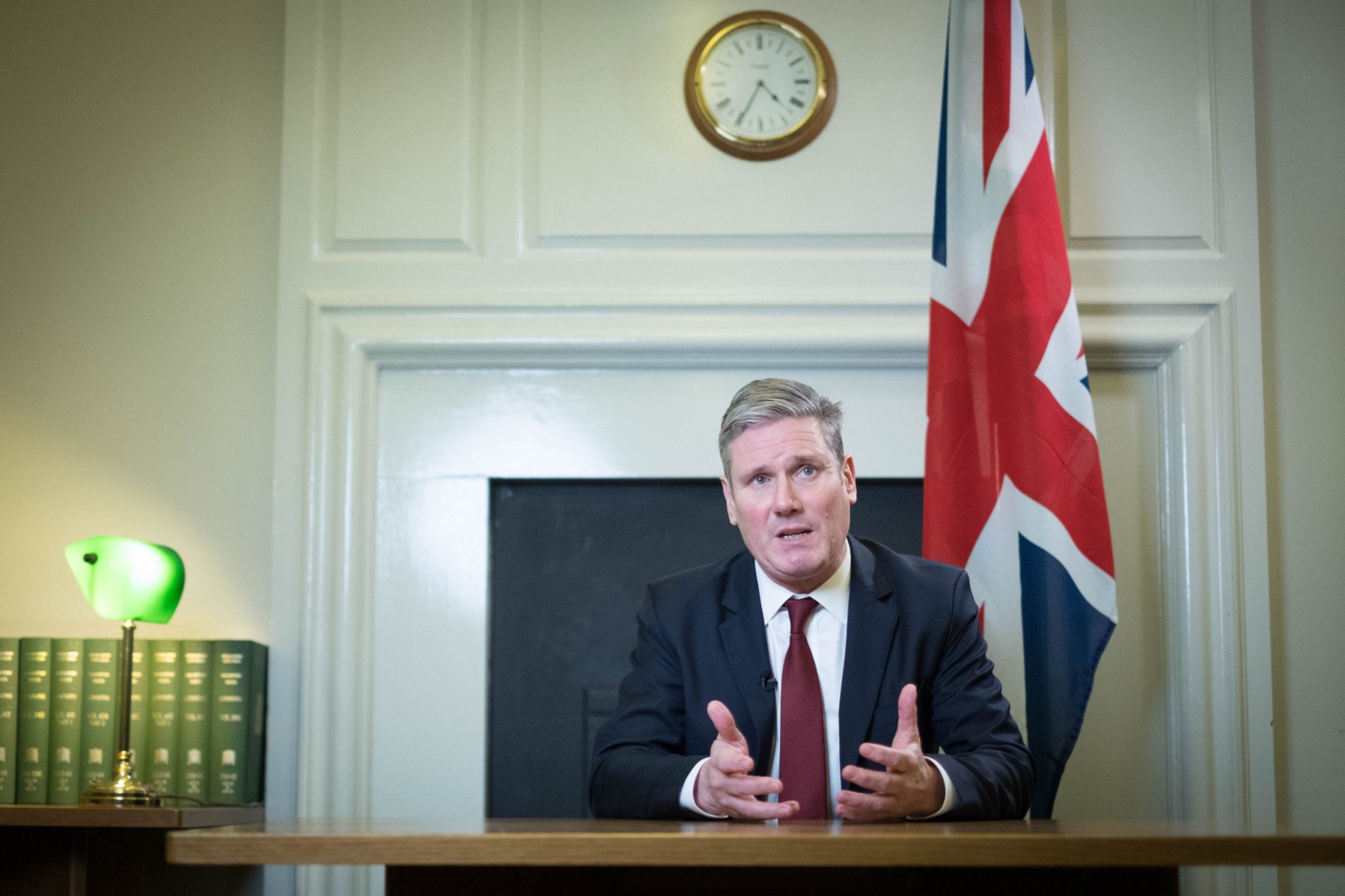
Kier Starter, leader of the British Labour Party, flagging his alterrnative (Photo: Stefan Rousseau/PA)

Where does the current political crisis put the left?  I can’t remember a time when it has been so divided, not only over the causes of a crisis but what to do about it.  Brexit, Covid lockdowns and the Ukraine war have all contributed, as have years of printing money.  Yet many on the left have supported Brexit, demanded more severe lockdowns, supported war and western sanctions, and it even has its fair share of proponents of Modern Monetary Theory.

Even the minimum of policies raises division: against austerity includes opposition to energy price increases, which can be solved by ending support for war and removing sanctions. Opposition to the threats to workers living standards, and attacks on democratic rights opened up by the threats of removing EU laws, can be advanced by opposing Brexit.  This means giving focus to the awareness of the majority that Brexit has failed, by explaining the purpose of re-joining the EU.  

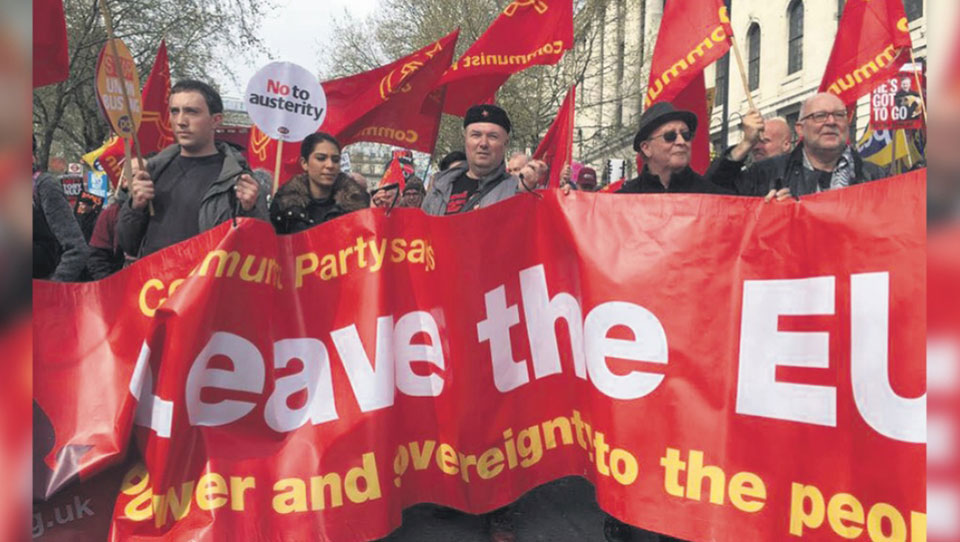
Photo: Morning Star

The Labour Party isn’t going to fight for these because it has, like some on the left, supported all the steps that got us here.  Some on the left have therefore said that it is better to face a weakened Tory government than a stronger Labour one committed to more or less the same agenda, so we shouldn’t call for a general election.

There are things wrong with this, although it has the merit of admitting that the left is chronically weak.  This should give it pause to recognise just how close, or rather how far away, it is to leading any revolutionary change, and to considering just what the preconditions for this would be.

Opposition to the call for a general election may reveal the belief that your alternative is weak but the weakness of your enemy will not make up for it.  Labour support for ‘balancing the books’, and therefore austerity, can easily permit their implementation by Sunak if he introduces the odd seemingly ‘fair’ implementation of pain, which would also prevent Labour from shouldering the blame. The effect of further Tory mistakes and division could either be to encourage opposition to austerity or usher in a Starmer government essentially wedded to the same project.

Calls for a general election to kick out the Tories should not be opposed but since we know that it’s not nearly enough the left should concentrate not on this but on what Marx would have called the momentary interests of the working class as well as its future.

This means supporting and generalising the strikes workers are taking to defend their living standards. It means politicising them, including with the demand to bring down the Tories with the purpose of also setting the expectations that will be placed on any alternative Government, including a Labour one.  It means organising in the trade unions to make them more democratic, which is easier to do when workers are engaged in union activity, and building the grounds for longer term rank and file activity.  It means similar activity in the Labour Party, and since this is mainly a defensive struggle against the leadership, it means defending existing rights and supporting the very few potential candidates who will get to stand in an election that support working class action.

If it is argued that the Labour Party is dead then such a view must be tested by the activity that can be organised within it; by the possibility of activating members and recruiting others through the strikes that are taking place, and some proof that the lessons of numerous attempts to organise a party outside it have been learnt.  It’s not enough to say that numerous battles have been lost if it is not clear to thousands of Labour members that the war inside it is over and definitively lost.  It’s not enough to propose some party that does not exist to something you claim is dead but will in some way have to be recognised as very much alive for millions who will vote for it.

Unity on the left is not enough.  There is no point blindfolding ourselves to Brexit, which cannot, like Starmer hopes, simply be parked, but has to be opposed.  Those who have supported it show no sign of recognising their mistake when it stares them in the face.  Likewise, what is the point of demanding protection from the enormous increase in energy prices while supporting war and the sanctions that make it inevitable?  The political struggle against these disastrous positions must continue.

The left, both in Britain and Ireland has put forward actions that the state must implement to address these problems: through nationalisation of energy companies, windfall taxes or price caps, increased state spending and taxation of the rich.  All of these rely on the state doing what the working class needs to do itself, and the state doesn’t exist for this purpose.  We have all just been given a huge lesson on who really controls society and what they are prepared to do even to a pro-capitalist Government that doesn’t play by its rules.

Nationalisation will not gain control over the supply of gas and oil so nationalising retail companies (known as suppliers in the industry) will not reduce prices; and you can’t nationalise companies in other countries.  This is also the case in Ireland, where much of the industry is already nationalised. You certainly can’t nationalise Russian gas, but you can pay a lower price for it, if you argue it’s generally good practice to buy from the cheapest supplier.

You can’t continue to increase workers income from state payments to make up for inflation when the financial markets won’t even support unfunded tax cuts for the rich.  While it’s an acceptable propaganda demand to increase taxation on the rich you won’t be able to make this the answer to the crisis. The underlying weakness of British capitalism is set to continue worsening, especially outside the EU, and redistribution of the tax burden isn’t going to change this.

The Tories have already overturned proposals to reverse corporation tax increases and there comes a point where significant increases would simply amount to a form of state capitalism, and one that is to the benefit of workers!  That’s not the society we live in, or one that could possibly exist.  Income taxes on the rich require a government to legislate it; require a capitalist class to accept it without shifting its incomes abroad, and a state willing to implement it.  The British tax authorities have proved time and time again their willingness to indulge tax avoidance and evasion by corporations and the rich. Tax incentives are as much a part of the code as levies and these always apply to the rich; workers don’t need an incentive to work since it’s the only way they can afford a tolerable or decent standard of living.

The recent crisis of the British state’s creditworthiness was caused not by proposed tax cuts for the rich but by increased debt caused by income payments during the pandemic, and early predictions of a £150 billion bill for energy supports to energy companies in lieu of consumers paying.  The idea that the financial markets will accept lending money to fill any gap left after screwing Britain’s rich, so that the incomes of the working class can be protected, ignores the political interests of the players involved in these markets. At the very least increased interest rates would be demanded if steps along this road were taken, which means they would get their pound of flesh one way or the other.

It makes no sense to offer alternatives that depend on actions by the state when you also argue any possible government won’t introduce them.  To paraphrase Marx again, the emancipation of the working class must be conquered by the working class itself.  So must the fight against austerity, the defence of living standards and against war.

Under capitalism the place of the working class is determined by its absence of property ownership – the means of producing goods and services.  If you create these by your labour but don’t own them, you can’t expect to receive the revenue arising from them, and especially from a state that is there to defend existing property rights.

This means that the income of the working class comes overwhelmingly from wages and if these are being reduced through inflation the correct response is to increase them, including through strikes.  The working class in many countries is now in the fortunate position of being in a period of low unemployment where it can take advantage of its position in the labour market to organise, demand wage increases and fight for them.  The longer term perspective is to take ownership of the means of production, and thus of the goods and services produced, so it can determine the distribution of the incomes derived from their use and sale.  In this it will obviously come up against the state determined to defend the rights of existing ownership.

It should be axiomatic for the left that the benevolence of the state is not the answer.  It takes the workers’ own money and then decides how much of it to give back, to whom and for what purpose.  It also borrows, then taxes workers to repay the borrowing.  In all this it buys the goodwill of workers with their own money, pretending it is that of the government.  The problem of lack of income then becomes one of demanding that the state gives you more, in the form of lower taxes, higher welfare and pensions, payments for not working (as in Covid) or subsidies to pay energy bills.

This analysis derives from very basic understandings derived from Marxism that many of its adherents accept in theory only to forget in practice.  The failure produces a phenomenon not unknown to Marx.

It produces an inverted reality in which workers seek salvation in actions by the instrument of their subordination.  It illustrates the grain of truth in accusations of the right that welfare dependency creates a culture of dependency, of which the politics of much of the left is a demonstration.  It is indeed ironic that the right often betrays a better appreciation of the role of the state than many self-described socialists.

This state-centred socialism has resulted in support for Brexit because it is believed that somehow the British state can be relied upon to be more progressive than any European one, and can become the vehicle to introduce socialism.

It fuelled demands for more stringent lockdowns during the pandemic because the state can miraculously give people money to buy goods and services it then prevents them from making and providing.

The Left’s “zero-COVID” strategy in operation in China (Chinatopix Via AP)

It now results in support for a notoriously corrupt capitalist state and its armed forces because it supposedly embodies the interests of Ukrainian workers; indeed the workers of the world, even while it acts on behalf of the most powerful states, together forming what is customarily called imperialism.

The Left joins supporters of the Ukrainian state who just happen to be fascists https://theintercept.com/2022/06/30/ukraine-azov-neo-nazi-foreign-fighter/ Photo:NurPhoto via Getty Images: veterans of the Azov volunteer battalion attend a rally in Kyiv, Ukraine, on March 14, 2020

From all this we can see that the task of the left in assisting the British working class in the current political crisis needs some work itself.  A lot of work.

Back to part 1

The crisis in British politics (1) – Brexit

For weeks my wife had complained about Johnson and his lies and wondered how on earth he had managed to survive.  How did he get away with it and when will we be rid of him?  

I explained that although he would go eventually I wanted the crisis caused by his repeated lying to continue as he was dragging the rest of the Tory Party down with him.  I also explained that his biggest lie was Brexit and Kier Starmer wasn’t calling him out on it.  In fact, he was repeating the lie by claiming he could get it to work.

When she wondered how long Liz Truss would last I ventured the opinion that the longer she stayed the more divided the Tory Party would become although I also said she was already toast.  Once again Brexit loomed large and about the only useful service she provided was to admit it in her very short, 89 seconds, resignation speech – ‘we set out a vision for a low-tax, high-growth economy that would take advantage of the freedoms of Brexit.’

Indeed she did.  She demonstrated that ‘taking back control’ was a fantasy and that attempting the national road to growth the Tories planned for Britain was deluded.  The Guardian columnist Polly Toynbee wrote that the Labour Party, Lib-Dems and ‘moderate’ Tories should now strike her ‘extreme brand of libertarian, state-destroying, Europe-baiting, austerity politics . . .  dead so it never resurrects, so no one ever tries it again any more than they would advocate Stalinism.’

Unfortunately, while she may prove correct about the Right, although I doubt it, she has already been proved wrong about similar nationalistic, Brexit-supporting ideas on the Left, which range from Starmerism to Stalinism, plus some ‘Trotskyism’, which spoils the alliteration, but that still makes for a strange unity of purpose. The opinion poll by Tony Blair’s think tank asked for one word that describes Brexit for its supporters and opponents.  For supporters it was the word ‘Freedom’. However, if such ‘freedom’ doesn’t make a nationalist capitalist programme possible how much more impossible is the idea of such freedom bringing about socialism?

The dominance of such a stupid idea arises not from the idea itself but from what it seems to allow – a much reduced role for the state or a much increased one; its reactionary character demonstrated by the fact it can succeed in neither.  Far from thinking it has been achieved by Johnson’s ‘Get Brexit Done’ Government, more believe it hasn’t that has, with only 6 per cent thinking it has been completely accomplished.  Sixty per cent think it has made the economy worse; in the North of Ireland its rating is negative 72 per cent and negative in parts of the so-called “red wall” in the north-east of England.

This doesn’t prevent about two-thirds expecting some benefits from Brexit, but since the most likely anticipated is new trade deals this has already been disappointed.  The prospect of ‘better UK laws’, ‘less immigration’, ‘better-funded public services’, ‘greater influence in the world’ and ‘lower prices’ are all being disproved.  No matter how blinkered its supporters may be, even with blinkers you can still see what is going on.

Where an alternative might come from explains a lot of the crisis in British politics.  Asked which option you would choose for the UK’s place within Europe in the next 10–15 years, only 23 per cent said inside the EU, while 36 per cent said some sort of new trading partnership outside, and 11 per cent said outside the EU but inside the single market.  In other words, almost half thought they could choose having your cake and eating it, or an arrangement that made Brexit pointless at best.  Only 45 per cent of Remain voters supported joining the EU.  That this is the case is suggestive of the role of political parties in setting out what appears possible; after all, if next to no one is saying it would even be a good idea then achieving it becomes, at best, something remote.

I informed my wife that the press were reporting some Tories saying that it would be better if the Labour Party took over; something that none of them would have claimed had Corbyn been leader, not altogether for rational reasons it must be said.  This told us that such a view was informed not just by the idea that the Tory Party needed a period in opposition to get their act together but by the view that the mess created would be better cleaned up by Labour.  Labour could then take the hit for all the unpopular decisions that the Tories are promising and still formulating.

Of course, allowing a general election when some opinion poll shows Tory support at 14 per cent means this is rather an unattractive position.  At this level they would seem to be justified in believing that the only way is up.  Instead, therefore, they will likely try to climb their way back with the new leader– the richest man in parliament, increasing taxes while his household has avoided a reported £20 million, and introducing austerity in which claiming ‘we are all in this together’ can only be seen as so much transparent nonsense.  Misguided attempts to suppress energy prices or reduce their impact will not so much be more targeted as just avoid aiming at most of them.  Inflation will continue and so will support for a war drummed up by unprecedented censorship and propaganda that has millions believing the righteousness of a state previously noteworthy for its corruption, internal division and endearment to fascists.

Having been trounced by the financial markets and the state, in the shape most obviously of the Bank of England, the new Tory leader will be on-side.  Despite being a supporter of Brexit, he will still be detested by the hard-right of the Party, although its traditionally good at hanging together instead of hanging apart.

Which brings us back to Keir Starmer’s Labour Party, which has to reckon on being the opposition, something it hasn’t been very good at.  Starmer’s Party has been characterised as a policy-free zone, but this does not mean policies will not, in the absence of an alternative, impose themselves.  In a longer time-frame, ‘making Brexit work’ will not work.  Immediately, calling for a general election only puts more pressure on it to set out an alternative, and the more we see of that the less alternative it looks.

We will look at that in the next post