Getting the ‘Red Tories’ out?

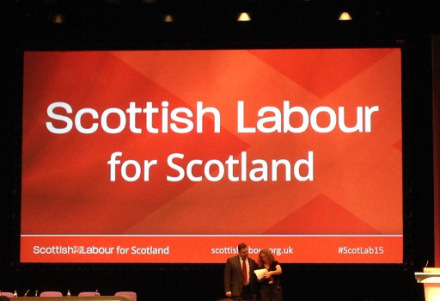
Sun Scotland England Tory SNP divide and conquerI was walking down Buchanan Street in Glasgow on Saturday afternoon when I came across a group that all had large red stickers on them saying ‘Red Tories Out’, which is Scottish nationalist-speak for the Labour Party.  The leaflets they were giving out called for a vote for the Scottish National Party so that it could ensure that a new Labour Government was socially just.  What on earth is going on?

‘Red Tories Out’?? The Labour Party is not in office in Holyrood in Edinburgh and equally obviously not in office in Westminster in London, so what exactly do this group of nationalists want Labour out of?  Since they assume (for the sake of their argument) that they are utterly opposed to the real Tories being in power and the only real alternative is the Labour Party, the only answer consistent with their proclaimed strategy is that of no Labour MPs in Scotland but a majority in England and Wales, one big enough to allow their favoured scenario of a Labour Government dependent (or so they want) on SNP support.

No matter how they dress it up the reactionary nationalist logic of division surfaces each time the left in Scotland trumpets its supposedly radical political credentials.  The Labour Party is shit; Scots need an alternative but Labour’s good enough for English workers, and we’ll just ignore the fact that we need it as well in order to defeat the hated Tories.  But just to show how this isn’t really our strategy we’ll support other parties in England and Wales standing against Labour.

‘Red Tories Out’ turns out to be not just out of Scotland but everywhere.  Except if successful this would let the real Tories in as Labour voters supported the Greens and Plaid Cymru, assisting the Conservative Party to capture marginal seats where Labour is the only conceivable alternative.

Of course this would mean that these nationalists wouldn’t be open to the charge of hoping to foist Labour on the English while it wasn’t good enough for them, but then they would have to explain to everyone what’s left of their supposed overriding priority in this election of getting rid of the Tories.

Something in their argument has to give and what gives is their proclaimed support for a Labour Government supported by the SNP.  What you see is what you get and when you see ‘Red Tories Out’ stickers it means what it says, no more and no less.  When you see aggressive heckling of Labour in a Glasgow street you’re seeing the real vitriolic hatred of the Labour Party.

It is the Labour Party that has stood in the way of the SNP objective of ‘speaking for Scotland’; the SNP having some time ago captured swathes of Scottish Tory support.  It is a Tory Government in Britain that strengthens their claims that only independence can rid Scotland of the Tories and it just such a Government that would provide the grounds upon which another tilt at separation might be launched.

So the ‘Scottish Sun’ newspaper calls for a vote for the SNP while the English version supports the Tories.  The Tories demonise the SNP, making their nationalism more attractive in Scotland in the process, and the SNP ride the wave of increased nationalist division by decrying opposition to their participation in government in England as anti-Scots while basing their whole rationale for existence on the baleful influence of the English.

So it turns out that it is the position of the Sun that is the most consistent of the publicly proclaimed stances – Tories in England and Wales and the Tartan variety dressed in ‘anti-austerity’ clothing in Scotland.

Both on the face of it (‘Red Tories Out’) and looking at underlying political calculation, it is clear that Tory little-Englandism and SNP nationalism is seeking to exploit nationalist division to their own benefit while undermining the causes they say they aspire to – unity of the UK in the case of the Conservative Party and anti-austerity in the case of the SNP.

Reading ‘The Herald’ newspaper on Saturday it reported from focus groups that voters have stopped listening to the political arguments and have bought into the narrative of empowerment, derived from the independence referendum, and the perceived possibility of standing up for Scotland in the General election. ‘No’ referendum voters are therefore voting SNP.

This doesn’t look like a simple unthinking or emotional vote to me but a buying into nationalist assumptions that don’t withstand political analysis and argument.  And the most fundamental of these is that there is a ‘Scottish’ interest oppose to that of ‘London’.  The conflation of nationalism with the interests of workers allows promotion of nationalism to appear as the promotion of workers’ interests even while it does exactly the opposite.

The double standards and scarcely conscious hypocrisy of the Scottish left are symptoms of this nationalism and an apparent disengagement from political argument an expression of the soporific effect of nationalist illusions.

But it would be wrong to blame the nationalists alone.  The Labour Party, that object of nationalist hatred, deserves its own fair share of blame.  For a long time it has channelled Scottish workers opposition to what is now called austerity into nationalist and constitutional demands in order to avoid a response based on workers’ own struggles and socialist policies.  In this way it could pioneer the conflation of workers’ interests with Scottish interests, when the latter might be seen to be reflected in their own political dominance in the country.

This could be seen in their impotent opposition to Thatcher and support for devolution and now in the appointment of Jim Murphy as Scottish Labour Leader and his proclaiming of the Labour Party as the party best based to fight for Scottish national interests.  When it comes to fighting for national interests it’s hard to out-do nationalism.  It has taken Ed Miliband to make the most prominent case for workers interests irrespective of nationality.
b_fimfswqaajkuk

While over in Glasgow I took in the Celtic match and logged on to a fans blog.  One poster derided concerns over the barracking of Jim Murphy while canvassing in Glasgow city centre, saying the guy was a Blairite and had responsibility for the wars in Iraq and Afghanistan. He had blood on his hands and deserved no sympathy.

Fair enough point you might think. As far as it goes. But where is it supposed to go?  A bit of shouting and obstruction hardly seems sufficient punishment for mass murder, does it?  But what would be appropriate punishment if that was the purpose of the barracking?

Well, for a socialist it is not this or that particular bourgeois politician that is the problem (and certainly not the answer).   So the SNP is opposed to ‘illegal’ wars?  Is legal mass murder any more acceptable?  Does a UN mandate legitimise imperialist murder? Just what sort of alternative is the SNP that the protestors against Murphy support? Just what sort of political mobilisation is it that rallies round a nationalist party whose fiscal manifesto is not essentially different from Labour’s yet considers itself self-righteously anti-austerity?

What matters for the future is building an alternative not only to bourgeois politicians but to the system itself that creates the social basis for these politicians, one which relies precisely on workers lack of engagement in political argument and analysis.

Right now such an alternative requires opposition to nationalist division.  It therefore means voting for the best option, given the choices available.  A vote for the Labour Party can be justified as one that will provide the best circumstances for fighting austerity, both by virtue of rejecting Scottish nationalist illusions and facing a reduced austerity offensive.

Nationalist separation on the other hand is a counsel of despair, one that asserts that British workers can never fight for an alternative.

  1. A friend has alerted me to an interview in Jacobin magazine with Neil Davidson, a supporter of Scottish separation, and I will take up the arguments raised by him in a future post.

The UK General election, the Labour Party and the SNP. Who’s calling the shots?

snpWhen the Independence referendum was lost by the nationalists I noted that this created something of a problem for left supporters of Scottish separation.  Their claim not to be nationalist looked threadbare when set aside rallies festooned with Saltires but now they had questions to answer.  Today the questions are even harder.

If the pro-independence campaign that they hailed as a genuine left-wing grass roots movement was not nationalist how do they explain that it is the nationalist Scottish National Party that has reportedly grown enormously since the referendum?  How do they explain that even within their ranks large chunks of their supporters are now members of the SNP?  How are they to explain that figures like Tommy Sheridan are calling for a vote for the SNP in the UK General election?  He wants to wipe out the ‘Blue, Yellow and Red Tories’ but not of course the Tartan ones.

The SNP are now regularly reported to be in position to wipe out the Labour Party in Scotland which would be quite a reversal.  In fact such a reversal that it overturns one of the claimed grounds for Scotland’s independence – that Scotland is more progressive because it elects predominantly Labour MPs.  Shortly it may predominantly elect a party that has gotten to this point by first taking over and assimilating a large part of the Scottish Tory vote, and it will be England and Wales upon which a Labour Government may be elected.

This is excused by the claim that the Labour Party of today is not the Labour Party of yesterday and indeed with the advent of new Labour this is to an extent true.  However, it is also true that the Labour Party of 2015 is not essentially different to that of 1975 or even 1945 and the view that it somehow is exhibits a flawed understanding of that party.

And there is another problem.  The SNP is making the claim, on the face of it ridiculous, that it will ensure that Ed MIliband becomes Prime Minister through Scottish voters voting not for the Labour Party but for the SNP.  How is Tommy Sheridan to justify opposition to the Labour Party, or ‘Red Tories’ as he prefers to call them, by voting SNP?  Perhaps it is because depriving the Labour Party of a majority might allow the real Tories into Government again, through some sort of new coalition with what’s left of the Liberal Democrats and support from the Democratic Unionist Party?

The SNP are making this type of claim because on their own they are incapable of offering any alternative effective opposition to the austerity that is the main issue in the campaign.  This has already been made clear by their imposition of austerity as the party of Government at Holyrood. Their projections for the financial position of an independent Scotland have already been blown out of the water by the collapse of the price of oil.   Their call for full fiscal autonomy is similarly exposed.  As I pointed out after the referendum result the only effective opposition to austerity can come from an all-British alternative but the ‘non-nationalist’ ‘left’ has seemed oblivious to this.

The SNP however being a serious bourgeois party is not.  That is why Nicola Sturgeon has moved the SNP to take up a UK-wide approach, at least rhetorically, projecting the SNP as a necessary part of a united front against austerity, for example in a possible alliance with the Greens and Plaid Cymru.

Knowing equally that this is not any sort of real alternative has forced her to make a virtue out of necessity and claim the need for the Labour Party to rely on SNP support.  It is backhanded recognition that only the Labour Party can blunt the Tory inspired austerity offensive and its intensification should they lead the next Government again.

So the SNP must claim opposition to Tory austerity as its priority when its real goal is to destroy the Labour Party in Scotland, so making continuation of Tory austerity that more likely.   That other serious bourgeois party, the red, white and blue Tories, also know this, which is why they have been bigging up the SNP and Labour’ so-called dependence on it, in order to undermine Labour.  They do this even while it also undermines the union they support; yet one more illustration of their incompetent character.  At least Thatcher’s strengthening of the forces of Scottish nationalism can claim it was unintended.

The two parties feed on each other, illustrating the divisive role of nationalism for the British working class. As this excellent post here points out, a plurality of SNP voters would rather have a Tory Government than a Labour one if it meant more SNP MPs.

The nationalist left’s opposition to ‘Blue, Yellow and Red Tories’ reduces to opposition to Labour since in Scotland the first has only one MP, the second is stuffed across Britain and the third is the single existing disproof of their claim that only nationalist separation offers an alternative to the Tories.  It is mightily embarrassing when an election comes long in which it is clear that this is patently untrue.  Except of course, as the post recommended above describes, the SNP is on such a roll that nothing will embarrass it, at least not at the minute.

The left nationalist case is that separation is necessary to defeat the Tories and that the UK state is unreformable, in the sense that it will never be social-democratic again.  Their enemy is therefore not the Tories, whose existence seems only to confirm this.  On the other hand, as even the mildly left approach of Ed Miliband threatens such claims, we can glimpse the fundamentally weak foundations upon which the great surge of Scottish nationalism currently rests and the totally spurious grounds on which left nationalism sits.

The actions of Sturgeon and the SNP demonstrate that in this General election the only alternative to Tory austerity, however weak and limited it is, is the Labour Party.

Two films: ‘Pride’ and ‘Tony Benn: Will and Testament’

JS45320465When Margaret Thatcher died my daughter asked me if I could recommend any books that would explain who she was and why she raised such strong views on her death.  I struggled to think of one that would convey the political issues and the raw emotion that she generated.  Even the youngest who are semi-interested in politics know that in some way that Thatcher helped shape politics today, not only in Britain but much more widely, and that at the very least she symbolises changes we are still living through.

In the last week I have watched two films that provide some way of appreciating Thatcher while also immersing one in the feelings generated at the time.  The first – ‘Pride’ – tells the story of a lesbian and gay group in London, which raised more money for miners in a South Wales valley than any other group, during the miners’ titanic strike in 1984-85 against Thatcher.  It’s rarely sentimental, the performances are wonderful and if you don’t walk out of it feeling proud that this is the side you are on then there’s no hope for you.

If you’re older then you’ll remember the struggle with pride and not a little bit of sadness.  If you were in any way involved in solidarity in this side of the Irish sea then you’ll now appreciate the importance of the struggle and perhaps realise you didn’t quite understand its importance then.  You’ll also appreciate the need for unity and solidarity of the oppressed and that only when we fight together do we make real the unity that underlies our oppression and our liberation.

Of course what you take out of any artistic creation partly depends on your own experience and you will only learn from a political film what your political understanding will allow.  Some things will stand out more than others – for me the performances of the actors, including Ben Schnetzer who plays Mark Ashton, the spokesperson for the gay and lesbian solidarity group and originally from the North of Ireland – brave and tender;  or Paddy Considine as the miners spokesperson Dai Donovan, who welcomes against opposition within his own ranks the support of the gay and lesbian group with understanding and appreciation for the bravery of the miners’ new supporters and the value of their own struggle.

Uplifting and inspiring as it is the significance of the miners’ struggle was illustrated for me by the miner’s banner that proclaimed their adherence to international workers unity and the struggle for socialism.  Of all the reference points that they had, as Welsh, as miners, workers and brothers they stated on their banner that what would always define them was international unity and socialism.  Through the strike they demonstrated in their solidarity with gay and lesbian activists from London a unity that went beyond nationality and sexual orientation to recognition of their shared and common interest in fighting oppression.

pride-2014-003-miners-march

And a miner’s banner also featured in another film – ‘Tony Benn Will and Testament’ – a documentary covering his life and political activity, including the miners’ strike and his inclusion on a new Miners’ banner.

It showed Benn narrate his personal and political life and his acceptance of his death that must have followed shortly after the film.  It shows his journey through politics and his affirmation that he moved to the left through joining government and not, as everyone else does, to the right.

He explained his determination to become an MP and change the world because of an encounter with one of the Americans involved in dropping the atomic bomb on Hiroshima, eventually becoming the minister responsible for the civil nuclear programme in Britain.  In this role he explained how he was completely kept in the dark about the fact that the plutonium waste used in this civil power generation was sent to supply the US nuclear weapons programme.   More widely he explains that he came to realise that while in Government he didn’t have any real control and that the Labour Party became simple managers of the system when it achieved office.

The film covers many of the class struggles in Britain over the latter half of the twentieth century, from the campaign against nuclear weapons, to  the Upper Clyde Shipbuilders sit-in, the ‘winter of discontent’ provoked by attacks on workers by the labour Government, the miners’ strike and the anti-Iraq war movement in our current century.

His bid for the Labour Party deputy leadership in 1981 against Denis Healy, which he very narrowly lost by barely 1%, does not get the attention it deserves but it does turn the spotlight on Neil Kinnock – the so-called left who abstained in the vote.  He later became leader and was leader during the miners’ strike, which he more or less also betrayed, later being rewarded with a place in the House of Lords.  A fighting leadership of the British labour movement could have made the difference between defeat and victory.  Watching the film I found myself getting angrier with him than with Thatcher, but isn’t that always the way with traitors?

He brings to attention the possibility, since the 1970s, of using North Sea oil to modernise Britain but identifies the failure to do so in the pro-big business policies of Thatcher.  Some on the left today see the possibility of modernising Scotland based on what’s left of North Sea oil. However they base this not on any lesson drawn from recent decades but on nationalist division.  The political leader they in effect followed, Alex Salmond, proclaimed that his SNP “didn’t mind the economic side so much” of Margaret Thatcher, while claiming that “the SNP has a strong social conscience, which is very Scottish in itself.”  So that puts the rest of us in our place.

I remember listening to Tony Benn speak and someone asked him about the idea that socialism could be brought about through parliament and whether the capitalist class and its system would allow such a transition without mounting a violent coup to prevent it.  Ah, he said, the Chile question, referring to exactly such an attempt to introduce reform in Chile at the beginning of the 1970s, which led to the least politically interfering military in South America mounting a coup, deposing the democratically elected government of Salvador Allende and murdering thousands and thousands of workers and socialists.

Unfortunately having identified the question he didn’t give an answer to it and this might seem to be the major point to highlight in a Marxist review of a film of his political testament.  And so it is.  But by his own experience and through his own words he demonstrates these lessons and the film is valuable for showing them.

Tony-Benn

After recounting how he wanted to become an MP the film a few minutes later shows him speaking in the House of Commons – to row upon row of empty green benches.   Having had the experience of Governmental office noted above he later announced, in a line provided by his wife, that he was leaving Parliament to spend more time in politics.  We then see him on the campaign trail at meetings and demonstrations until his death this year.

So whatever his reformist words his practice in this way became the opposite of the fetishism and ‘cretinism’ of parliamentary activity for which Marxists would criticise reformist politics.

images (7)

Unfortunately today , it is the so-called Marxist left who argue that the big question is the ‘crisis of working class representation’ and pursue one electoralist intervention after another, like a hamster on a wheel, going nowhere, fed on the most piss-poor politics that they otherwise condemn in other times or in other places.

So it is not just the young that could learn from these two films.  Very straightforward as they are in political terms, there are basic lessons to be learnt from them – the need for unity of the oppressed, workers internationalism, the futility of seeking fundamental change through capitalist parliaments or the capitalist state, and the need for class struggle.

The defeat of the miners’ strike and the experience of social-democratic politics cast a long shadow over the working class and socialist movement today.  We can learn vital lessons from them and their failure.  That we do not do so is partly because we cannot see the shadow, since it is overcast by an even darker one – that of Thatcherism and the rampage of what is now called neoliberalism.  To come out of the shadows we need to come out of both.  These two films can help us.

The Left against Europe 1

DSC_0122The failure of David Cameron to prevent Jean Claude Juncker becoming President of the European Commission drew widespread comment that it will now be harder for Britain to stay in the European Union (EU).  If the Tory Party wins the next British general election Cameron is committed to an in-out referendum by 2017.  Under pressure from The United Kingdom Independence Party (UKIP) and from within his own Eurosceptic ranks he has developed a policy that has temporarily settled the in-fighting within his Party.

In Ireland referenda on the development of the EU have been fairly frequent.  In 2001 Irish voters rejected the Treaty of Nice by 53.9% with only 34.8% of the electorate voting.  The vote was held again in 2002 and the Treaty was passed by 62.9%, with 49.5% of the electorate voting.

In 2008 53.4% voted against the Lisbon Treaty (on a turnout of 53.1%) so once again the vote was re-held to get the ‘right’ result. The next vote in October 2009 resulted 67.1% voting in favour of the treaty, once again on a higher turnout of 59%.

The Left in Ireland has been in the opposition within these EU referenda and opposed the original entry into the European Economic Community in 1972, which was decisively approved in a referendum by over 80% of those voting.  In Britain the Left also opposed British membership of the EEC in a 1975 referendum, which was passed by a majority of 67.2% in a turnout of 64.0%.

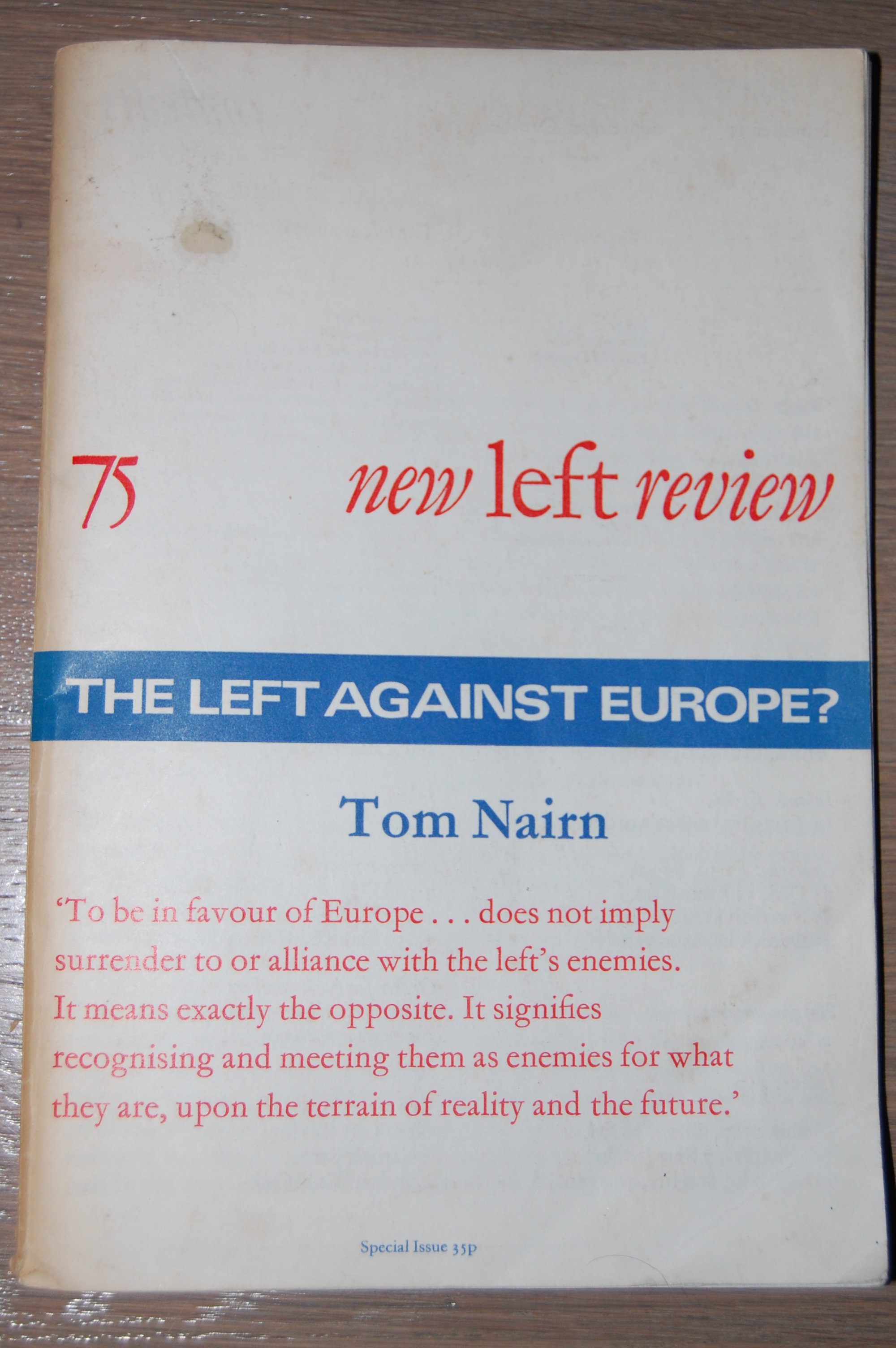
When I was in a second hand bookshop in Glasgow some weeks ago my attention was therefore drawn to an old copy of New Left Review from 1972, which was a special issue on ‘The Left Against Europe’.  The whole issue was devoted to one article written by Tom Nairn on the ‘great debate’ in Britain in the previous year whether Britain should join the Common Market, as the EEC was popularly called.  This debate eventually led to a vote in the Westminster Parliament to join and accession into membership in 1973, before the new Labour Government elected in 1974 held a referendum in 1975 to ratify staying in.

Nairn states that the debate was far from ‘great’ and that quotation marks enclosed the phrase from the outset.  It continued what he called a ‘stale and exasperated argument about the topic which had dragged on for years.’  The Cameron promise shows that it still continues.

The ‘great debate’ Nairn says “never at any moment approached ‘greatness, or even excitement.”  Nairn uses it however to examine the Left’s opposition to the EEC and this examination is worth looking at to see what lessons it provides for today.  The issue of the EU matters to the Left and working class as much as it still does for the Tory Party.

Whether Britain stays in or leaves also matters to the Irish State.  Its original membership was only viable if the British also joined and Britain leaving would create a real problem.  Only last week it was reported that a delegation from the German Parliament’s Finance Committee had issued a report – that the Irish tax regime “had failed to reach one of the goals of Irish economic promotion, namely to be less dependent on Britain.  Instead Ireland has moved from de facto full dependency on Britain to a shared dependency on Britain and the US in developing and securing employment.”

Nairn puts the British decision to join down to the hegemonic interests of finance in the City of London and the timing down to global monetary instability prompted by the dollar crisis that eventually forced the dollar off convertibility to gold in August 1971.  He quotes the Economist magazine stating that a future attempt at monetary union within the EEC will see Britain in the inside, with the strongest financial centre and having a dominant say in what gets done.

Not quite how things turned out but this story isn’t over and the choice to join the Euro is one that still faces the British capitalist class.

Nairn notes the virtual unity of the Conservative Party in seeking membership of the Common Market and the limited opposition of a marginalised rump led by the arch-bigot Enoch Powell, who by coincidence, has had the depths of his bigotry recalled by a flag supporting him going up in a loyalist area of Belfast.  Today the decline of the Tory Party into a backward, reactionary and ultimately self-defeating nationalism is evidenced by the ascendancy of Eurosceptics within that Party.

It is examination of the attitude of the Left however that is the purpose of this long 120 page article.  The opposition of the Labour Party to joining the Common Market in this ‘great debate’, or the vast majority of it at least, is put down to pure opportunism.  Under the leadership of Harold Wilson it opposed joining for purely party political purposes, Wilson having attempted to lead Britain into the EEC when in power between 1964 and 1970.

The ability of Labour to perform this U-turn is put down to the fundamentally nationalist character of the party.  For Nairn, the Labour Party is not fundamentally a class or popular Party but a nationalist Party and its reformism and ‘betrayals’ of the working class a result of its nationalism.  This nationalism is one shared in a basic sense by its supporters and voters, which explains why – despite the betrayals – they still support and vote for it.  Otherwise the phenomenon of continued support despite continued betrayal become inexplicable, unless workers are to be understood as fundamentally stupid – voting again and again for people who betray their beliefs and expectations.

Nairn records the opposition of the Left of the Labour Party in particular and its opposition to the Common Market on the basis of ‘internationalism’ and ‘socialism’.  In this respect the themes of the ‘great debate’ resonate today.

  • The Left in the Labour party presented Britain as more internationalist than the inward looking European States.  Open, free trading Britain was compared to the protectionist EEC.  Didn’t Britain look beyond the petty European states towards the countries of the Commonwealth and Britain’s wider role in international affairs and international bodies?  The latter providing the basis for a real socialist foreign policy.
  • Entry into the EEC would erect obstacles to the fight for socialism in Britain and prevent further socialist measures by a future Labour Government.  The EEC is a capitalist club and entry would mean the loss of the potential for socialism that does exist.
  • Refusal to enter this club would pose the question of an alternative, which would allow a socialist answer to be given.
  • The independence of Britain would allow the real popular character of the British nation to be revealed through its labour movement in a way that would be impossible within the rules of the EEC.

So what does this remind you of?

Well, swap Scotland for Britain and you have much of the Left nationalist case for Scottish independence today.

Just as the EEC is supposed to be more capitalist that the British state (God knows how) so Scotland is less reactionary than Britain (which is even less comprehensible).  London rule is capitalist but somehow Edinburgh rule is less capitalist!

Left nationalists proclaim the international potential of Scottish independence in the same self-refuting way the Labour Party did in the 1971 ‘great debate.’  Nationalist separation is somehow internationalist.  Why?  Because somehow, again unexplained or simply incredibly, there exists more potential for socialism in Edinburgh than London; just as the nations within the EEC and the EEC itself were assumed to be barriers to socialism that the British imperialist state wasn’t.

Today one part of the imperialist state – with a history of disproportionate participation in empire building – is again more socialist, or with the potential for it, than Britain as a whole.  Again while Scottish Left nationalists claim that the real Scottish nation is more left wing so did the Labour Party claim the real British nation was more socialist than the capitalist EEC, including such historical bastions of reaction as Paris and Rome.

Finally, even posing the nationalist question somehow gives rise to a socialist answer, or less extravagantly, gives rise to the potential for a socialist answer.  But it’s as if, if you ask the right question in the right way somehow socialism will pop up almost naturally as the answer.  And where is the evidence for this even when, as in Ireland for example, the capitalist crisis brought the Irish State to bankruptcy and exposed double standards that made working class people pay for the reckless gambling debts of the rich?

What more striking exposure of the rottenness of capitalism could be imagined?  Yet still there has been no alternative created and still in both Ireland and Britain there is no successful resistance to austerity – the most immediate question to which the socialist movement has been unable to provide an answer.

What this exposes, among many other things, is that the essence of socialism is not the displacement or even destruction of this or that aspect of capitalism or its state but the development of the working class.  Capitalism can only be superseded, at least progressively, by the development of something positive.  Unfortunately the Left thinks always in negative terms – of what it is against – and when it looks to achieve even this it posits the existing capitalist state or some configuration of it, usually its own nationalist version, as the mechanism of transformation.

It is ironic that Tom Nairn ridicules the claims that the the fight against the Tories, for national ‘independence’, against inflation and for socialism were, in 1971, ‘all the same thing’.  This is exactly the same claim made today in 2014, except we might replace inflation with austerity and support the claims of ‘Scotland’ instead of ‘Britain’.   He shows how Labourism rejuvenated itself and re-established unity within its own ranks by claiming to unite British workers in opposition to bureaucracy and international capitalism.  Except all this rested on the unity of British workers with the British state, shackled by the chain of nationalism.

But the question of Scottish separation is a derivative lesson to be drawn from reading ‘The Left Against Europe’.  The major lesson is the need to give real content to the socialist claim that it is international by its very nature.  Not an aspiration, not simply a goal to reach, an attitude to strike or an opinion to hold dearly but a practical and immediate part of its political programme.

What he says about this will be taken up in the next post.

Forward to part 2

Scotland is different II

Image


IMG_0333a

the-england-scotland-border-thornaby-on-tees


‘Is there a Scottish Road to Socialism?’, edited by Gregor Gall, Scottish Left Review press, 2007.

‘Scotland’s Road to Socialism: Time to Choose’, edited by Gregor Gall, Scottish Left Review press, 2013

My sister received a leaflet from the local Scottish Socialist Party branch opposing the bedroom tax and saying it would be abolished by independence.  It also announced a meeting which would show Ken Loach’s film ‘Spirit of ‘45’, which records the famous victory of the Labour Party in the 1945 election.

It is therefore ironic to note that the Labour vote in 1945 in Scotland was not very different from the rest of the UK. One observer noted that “The most Conservative of the big British cities is – Glasgow!  And it did so by staying as it was before.  London is far “redder” than Glasgow” (quoted in ‘The Strange Death of Labour Scotland’, p. 205).

When one considers that the only party ever to get an overall majority of the vote in a Scottish election is the Conservative Party in 1955 a claim for Scotland’s necessary or intrinsic progressiveness looks pretty weak.  At this time many Scottish workers voted Conservative, the party having a membership of 250,000, and many were infected by Orange, anti-Catholic sectarianism.  This strain in Scottish society has of course very much diminished but it has not at all disappeared.

Historically Scotland was a stronghold of the Liberal Party; in the19th century it won a majority of the vote in every of the 20 elections held between 1832 and 1910.  Trade unions developed earlier in England and Scottish workers were lower paid and considered more docile.  This may have built a head of steam for ‘Red Clydeside’ before, during and after World War 1, on which rests to a significant degree Scotland’s reputation for workers’ militancy.

However the main burden of the argument for a more left wing Scotland rests on the domination of the Labour Party in Scotland for most of the last 50 years.  In 1959 the Conservative Party was still ahead of Labour but in the 1966 election Labour won 49.9%, the highest it was to achieve.

Subsequently the dominance of the Party relied more and more on the first-past-the-post electoral system and the limitations of its support were masked somewhat by the decline in the Conservatives, with that party being negatively affected by the electoral system.   So in the 1992 Westminster election the Tories gained over one quarter of the vote but only 11 (15%) of the seats.  In the following 1997 election its vote was 17.5% but it won no seats.  The decline of Labour is reflected in the fact that its vote in Glasgow in 2011 was less than 24% of its vote in that city in 1951 and this is only partly explained by the decline of the city itself.

The Labour Party was never the ‘national’ party of Scotland not only because its strength was essentially regional, for example it only won Edinburgh for the first time in 1984, but because the country’s class differences meant that it would have been very difficult for any single party to play this role.  It is this role that the SNP now hopes to take up but it can only succeed if class distinctions are buried.  Victory in the referendum would help such a project.

Two authors put the strength of the Labour Party in Scotland down to the relatively large role of council housing, the size of the trade union movement in Scotland and the political patronage of the Labour Party in local government.  They contrast this with the relative low membership of the Scottish party, which has generally been on the decline since the 1950s; its weak organisation, limited resources and relative lack of ideological ferment.

The decline in the three pillars of Labour is pretty dramatic: council housing fell from 54.4% of all homes in 1979 to 15.1% in 2005.  Trade union membership fell from 55% of the Scottish workforce in 1980 to 39.2% in 1991 and 32.2% in 2010.

Its power base in local councils has also declined.  In 1980 it won 45.4% of the vote, getting 494 councillors elected out of 1,182 seats and winning 24 out of 53 district councils while in the proportional vote election in 2007 it won only 28.1% of the vote, only 348 out of 1,222 seats and only 2 councils.  This decline has run parallel with nepotism and corruption scandals damaging the party but revealing the rotten underbelly of municipal state ‘socialism’.

Some of these trends are not unique to Scotland.  English council housing fell from a peak of 29% of homes in 1975 to 18% in 1985.  Trade union membership across the UK fell from a density of 55.4% in 1979 to 23.5% in 2009.  In English local government Labour had 9,630 out of 20,380 councillors (47.3%) in 1979 falling to 3,743 out of 18,216 (20.5%) in 2009. It controlled 169 out of 386 councils in 1998 (43.8%) and only 33 out of 351 in 2009 (9.4%).

Scotland has a proud history of working class struggle from Red Clydeside to the 16 month Upper Clyde Shipbuilders occupation beginning in 1971, to the 103 day sit-in in the Caterpillar plant in Uddingston in 1987 and the occupation of Timex in Dundee in 1993.  All this is something to learn from and share with workers from every other country as part of the international struggle of the working class, not a claim to some special badge of righteousness on which to pin a nationalist programme.

These can be seen as proud episodes in working class struggle within Scotland and Britain but they should not be placed within some supposed innate Scottish empathy with the oppressed that contrasts a Scottish “desire for fairness and justice” to the English ”ideological base”. (‘Scotland’s Road to Socialism, Time to Choose’, p. 34)  The Scottish working class never developed, even at the height of its militancy, a separate mass working class party or an autonomous political programme.  The story of the Scottish working class movement is inextricably linked with that of the British working class movement as a whole.  Within this framework each nation’s socialists can be proud of the history of revolt against oppression in their own particular country.

So while Scottish socialists can be proud of Red Clydeside, so English socialists can be proud of the Peasants Revolt, the Putney Debates, the Peterloo massacre, the Tolpuddle Martyrs,  the General Strike in 1926, Saltley Gate, Grunwick and  the heroic miners strikes in England, Wales and Scotland.

This is the history of the fight against exploitation and oppression that socialists across Britain should see as reference points in the fight for working class unity across the three nations.

Such an appreciation of the British class struggle would allow comparisons to be drawn between today’s referendum and previous elections.  In February 1974 the Tory Party in Government called an election in the wake of the miners’ strike under the slogan ‘Who Governs Britain?’ and after another election in October it was clear that is wasn’t the Tories when a new Labour Government was elected.  Today the independence referendum does not arise on the cusp of working class struggle in Scotland but is timed more to coincide with the 700th anniversary of a medieval battle.

A final argument can be put that, even if Scotland is not materially more left wing or progressive, left leadership can make the independence movement a progressive agent of change.  This is supported by the fact that supporters of independence, it is argued, are disproportionately left wing: “. . . the vast majority of support for independence in Scotland comes from the most progressive sections of society – young people and workers in Scotland’s larger town and cities.  On the other hand, who do we find lined up to support the British state?  The elderly (!), the wealthy, and those whose business and political interests mean that they have most to lose from the break up of the British state – in other words, the most conservative and reactionary elements of Scottish society.” (Is there a Scottish Road to socialism? p 53)

All three independent Scottish parties are on the political left and “believe in Scottish democracy” and Scottish nationalism now plays “a much more progressive role in recent decades”. (Is there a Scottish Road to socialism? p 48 & 52).  The SNP election programme contains “anti-imperialist pledges” it is claimed. (Time to Choose p. 36)

On the other hand even some supporters of independence would presumably regard this latter remark as nonsense, as the SNP “are a pro-capitalist party who favour neoliberal corporate control.” (Time to Choose p. 89)

Against the claim that the pro-independence support is relatively more left-wing others have argued that “only a minority of working people in Scotland currently support independence and most independence supporters do not have strongly socialist perspectives”.  The “programmatic demands and slogans of the main pro-independence party, the SNP, are likely to weaken rather than strengthen attitudes of working class solidarity in the process of any independence struggle.” (p 92)  Another author records an opinion poll which shows that of those supporting independence in 2002 46% were ‘left’ and 48% ‘centre/right’. (Is there a Scottish Road to socialism? P. 35)

Irrespective of left hopes of political leadership of the independence movement, it is the SNP which dominates in the real world.  Those claiming that a left leadership can make all the difference need to explain how this works in reverse when this is not the case. Does right wing leadership not rob the demand for independence of progressive content if left leadership is necessary?

It is also the base of the SNP which is the bedrock  of the independence vote – “elements of the new middle class, small businesses, unorganised sections of the working class, and nouveau riche ‘entrepreneurs’”. (Time to Choose p. 16)

Use of rather nebulous descriptions such as ‘left’, ‘right’ and ‘centre’ allows all sorts of violence to political principle to be perpetrated.  What matters is the objective significance of a political programme and practice. A demand becomes socialist not because a left wing movement takes it up.  It is equally logically possible that the Scottish left is less socialist for its championing of nationalism.

It is not what people think they are that matters but the objective meaning of their political programme.  Many women will be familiar with the guy who walks into a bar thinking he’s god’s gift to the opposite sex . . . Because parts of the left take up a cause it must therefore be progressive or correct needs to be demonstrated; it does not by itself stand as proof of anything.

The British working class – including its Scottish component – has suffered from ‘Thatcherism’ and the political retreat that this has engendered.  The rise of nationalism amongst much of the Scottish left is the product of this defeat as its rise is hardly conceivable without it.

This is not at all surprising.  What would be surprising would be that Scottish workers somehow resisted this shift, not by sticking to their traditional politics, but by embracing nationalism.

Were Scottish workers really so different, more radical and militant, this would be reflected in their ability to lead the rest of the British working class in resisting what is called neoliberalism.  The left case for independence has arisen because it has been unable to do so not because it is – uniquely within these islands – in a position to play this role.

This failure has led to, for some, a collapse into narrow nationalism while pretending that somehow Scotland is more left wing.  We will come to the proposed strategy that arises from this in the next post on the independence referendum.