Hate is useful?

Raju Das, in an article on ‘The Communist Manifesto’ noted that:

‘Interest in anti-capitalism as well as socialism is growing in many parts of the world.  According to a poll conducted in 28 countries, including the United States, France, China, and Russia, 56% agree that “capitalism as it exists today does more harm than good in the world”. A June 2021 poll indicates that 36% of Americans have a negative view of capitalism; this number is much higher among the youth: 46% of 18–34-year-olds and 54% of those aged 18–24 view capitalism negatively. Conversely, and interestingly, 41% of respondents from all ages have a positive view of socialism. This number is higher for the younger people: 52% of 18–24-year-olds and 50% of young adults aged 25–34 have a positive view of socialism. An October 2021 poll shows that 53% of Americans have a negative view of big business . . . The situation outside of the United States within the advanced capitalist world is similar.’

A more recent opinion poll by the magazine Jacobin also recorded promising results on the advance of the idea of socialism in the US. Believing these views can be advanced further by more hate, as we have reviewed in previous posts, is a mistake, not least because it already exists is copious amounts. What is required is clarification and direction, not a greater emotional charge which is unlikely to provide either.

Anger and hatred at the iniquities of capitalism on their own, or even fore-grounded, invite moralistic evaluations that do not in themselves form an understanding of how capitalism can be replaced or the nature of the alternative.  The influence of capitalism on the working class, in terms of illusions, pessimism, demoralisation, passivity, and backward ideas, can cause those opposed to it to look for an alternative in various ideas and movements that ignore or reject the working class as the force that can bring about the alternative.

Historically, revolts based on hatred have been the province of peasant rebellions that fail to achieve any lasting change, even in circumstances where they appear to be successful.  Provocations by the capitalist state rely on hatred of their regimes in order to suppress developing movements before their time has come; something only clear-headed judgement can hope to determine. Hate is not therefore a distinguishing mark of successful movements and while extreme subjectivism may have become more prominent it is not an answer to objectively unfavourable circumstances or contributory to the working out of strategy.

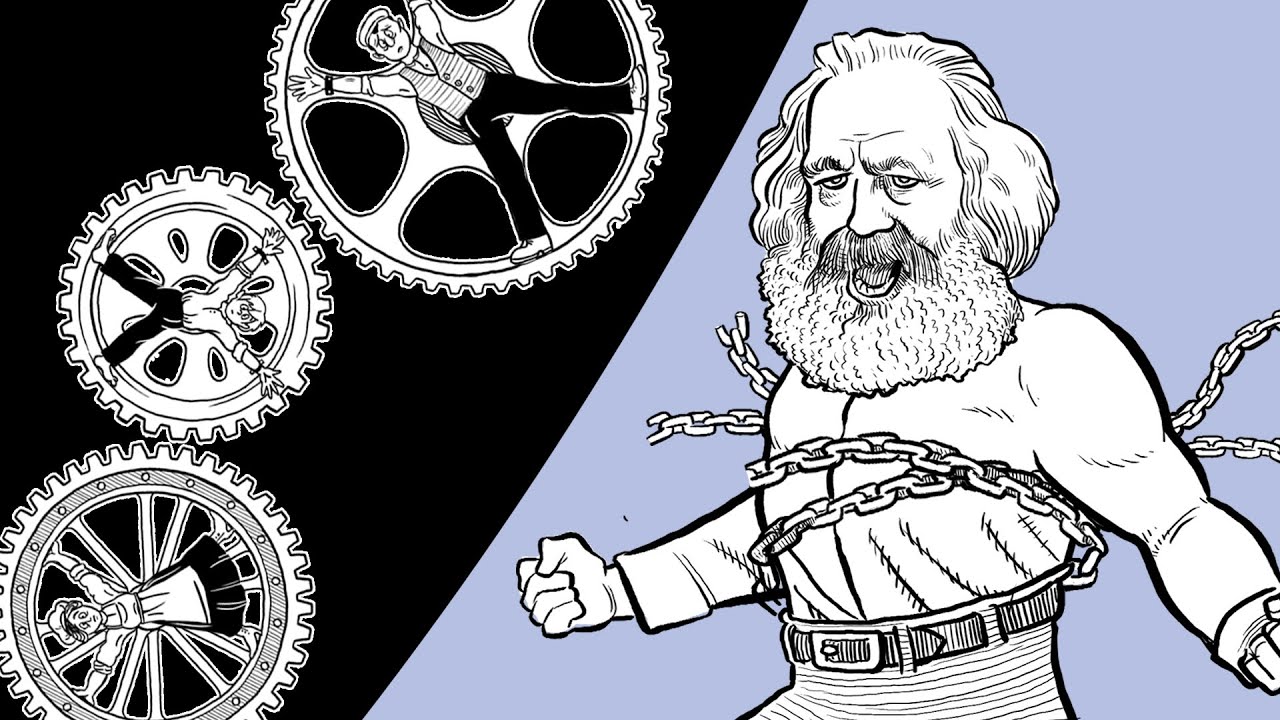
For Marx the primary need for socialist revolution is not so much to overthrow capitalism as to make the working class fit for its own rule – the transformation of the working class so that the economic, social and political system can be transformed.  This involves opposition to ideas and practices that divide the working class such as nationalism, racism and sexism but hatred of these should not lead to the belief that these can and must first be completely eradicated within the working class before the building of a working class movement can be commenced or continued.                                           

Marx and Engels stated in ‘The German Ideology’ that ‘Communism is for us not a state of affairs which is to be established, an ideal to which reality [will] have to adjust itself. We call communism the real movement which abolishes the present state of things’.  This includes the existing working class that must make itself capable of creating this movement, which is only possible through struggle, not the assumption that it can come when the class has first purified itself.

Marx had no illusions about the shortcomings of the working class and refused to simply follow it when its actions were antithetical to its long term interests.  In the Critique of the Gotha Programme’ written in 1875, he explained the character of society following the capturing of political power by the working class:

‘What we have to deal with here is a communist society, not as it has developed on its own foundations, but, on the contrary, just as it emerges from capitalist society, which is thus in every respect, economically, morally and intellectually, still stamped with the birthmarks of the old society from whose womb it emerges.’ The working class will itself still be stamped with this birthmark, both ‘morally’ and ‘intellectually’, something that intensifying hatred will do nothing to remedy.

Even alienation, which we looked at before, through which the workings of capitalism disorients and oppresses the working class while also acting to suppress and hide its true nature, has its positive as well as negative character, which more hatred would do nothing to illuminate. As Sean Sayers set out in an article:

Alienated labour ‘is also the process by which the producers transform themselves. Through alienated labour and the relations it creates, people’s activities are expanded, their needs and expectations are widened, their relations and horizons are extended. Alienated labour thus also creates the subjective factors – the agents – who will abolish capitalism and bring about a new society.’

‘Seen in this light, alienated labour plays a positive role in the process of human development; it is not a purely negative phenomenon. It should not be judged as simply and solely negative by the universal and unhistorical standards invoked by the moral approach. Rather it must be assessed in a relative and historical way. Relative to earlier forms of society – strange as this may at first sound – alienation constitutes an achievement and a positive development. However, as conditions for its overcoming are created, it becomes something negative and a hindrance to further development. In this situation, it can be criticized, not by universal moral standards but in this relative way.’ (Sean Sayers 2011, ‘Alienation as a critical concept’, International Critical Thought, 1:3, 287-304).

Advocating greater hatred in order for workers to advance towards greater awareness of their class position assumes it is a pedagogical aid for a politics that is already sufficient for its task. It is not such an aid and the politics sufficient to its objective is still in the process of elaboration.

Karl Marx’s alternative to capitalism part 70

Back to part 69

Karl Marx’s alternative to capitalism (61) Alienation and abolition of private property

Hudis claims that in those countries where capitalism had been overthrown the statist ‘socialism’ that existed ‘eliminated private property and the ‘free market’ by bringing the process of distribution and circulation under the control of the state. But they did little or nothing to transform production-relations. Concrete labour was still reduced to a monotonous, routinised activity through the dominance of abstract labour. Abstract labour continued to serve as the substance of value.’ (p104)

By this is meant that social labour was fragmented and produced commodities that exchanged with each other based on the abstract labour contained within them, which was determined by the labour time necessary to produce them and not by the conscious decision on the distribution of social labour according to a preconceived conception of need and human development.  Almost immediately he states that ‘instead of a surplus of products that cannot be consumed (which characterises traditional capitalism), there is a shortage of products that cannot be produced.’ (p 104).

However, this eventuality demonstrates that these societies, while not abolishing alienation – far from it – had abolished the market to the degree that meant all commodities were not produced according to the socially necessary abstract labour required to produce them and not under capitalist relations of production with a labour market producing a free working class employed by capital, either private or state. Even the creation of healthy worker’s states will not immediately end alienation, by definition the continuation of any state denotes the continuation of classes, however much their antagonism is attenuated.

Further, as Marx explained in Critique of the Gotha Programme: ‘What we have to deal with here is a communist society, not as it has developed on its own foundations, but, on the contrary, just as it emerges from capitalist society; which is thus in every respect, economically, morally, and intellectually, still stamped with the birthmarks of the old society from whose womb it emerges. Accordingly, the individual producer receives back from society – after the deductions have been made – exactly what he gives to it. . . .’

‘But one man is superior to another physically, or mentally, and supplies more labour in the same time, or can labour for a longer time; and labour, to serve as a measure, must be defined by its duration or intensity, otherwise it ceases to be a standard of measurement. This equal right is an unequal right for unequal labour. It recognizes no class differences, because everyone is only a worker like everyone else; but it tacitly recognizes unequal individual endowment, and thus productive capacity, as a natural privilege. It is, therefore, a right of inequality, in its content, like every right.’

‘Further, one worker is married, another is not; one has more children than another, and so on and so forth. Thus, with an equal performance of labor, and hence an equal in the social consumption fund, one will in fact receive more than another, one will be richer than another, and so on. To avoid all these defects, right, instead of being equal, would have to be unequal.’

‘But these defects are inevitable in the first phase of communist society as it is when it has just emerged after prolonged birth pangs from capitalist society. Right can never be higher than the economic structure of society and its cultural development conditioned thereby.’

Hudis is correct that it is the active role of labour that creates private property, but when he quotes Marx saying that ‘though private property appears to be the reason, the cause of alienated labour, it is rather its consequence, just as the gods are originally not the cause but the effect of man’s intellectual confusion. Later this relationship becomes reciprocal’, he leaves out the last sentence, which makes (bourgeois) private property constitutive of this alienated labour.  (Marx quoted in Hudis p 61) Unlike ‘the gods’, this private property is real.

Marx says: ‘It is only at the culminating point of the development of private property that this its secret re-emerges, namely, that on the one hand it is the product of alienated labour, and on the other it is the means through which labour alienates itself, the realization of this alienation.’ C.W.3, 280;(Economic and Philosophical Manuscripts, Early Writings, p 392)

“Communism is the positive supersession of private property as human self- estrangement, and hence the true appropriation of the human essence through and for man; it is the complete restoration of man to himself . . . which takes place within the entire wealth of previous periods of development. (Marx and Engels Collected Works Vol..3, p 296; Early Writings p 348).

Elsewhere Hudis quotes Marx that ‘[P]rivate property, for instance, is not a simple relation or even an abstract concept, a principle, but consists in the totality of the bourgeois relations of production…a change in, or even the abolition of, these relations can only follow from a change in these classes and their relationships with each other, and a change in the relationship of classes is a historical change, a product of social activity as a whole’ (p83 -84)

‘Marx grasps the situation as one of labour’s self-alienation in and through private property. Only if labour is grasped as the overriding moment in the alienated labour/private property complex can the conditions of a real transcendence of estrangement be established. Grounded in the alienation of labour, the immanent movement of private property necessarily produces ‘its own grave diggers’ (in the famous phrase of the Communist Manifesto). But in the dialectical opposition of private property and alienated labour the principal aspect of the contradiction then becomes the latter; hence Marx says that the fall of wage-labour and private property – ‘identical’ expressions of estrangement – takes place ‘in the political form of the emancipation of the workers’. Marx and Engels Collected Works Vol 3 p280).

Private property in its capitalist form entails the capital-wage labour relationship – the relations of production between capital and working class – from which class struggle arises, which struggle must eventuate in social revolution that makes the working class collective owners of the means of production and whose political emancipation entails overturing the capitalist state and creation of its own. 

As Hudis himself notes: ‘Communism does not deprive man of the power to appropriate the products of society; all that it does is to deprive him of the power to subjugate the labour of others by means of such appropriation’.

Hudis continues: ‘In the Manifesto, Marx also writes that ‘the theory of the Communists may be summed up in the single sentence: Abolition of private property’. It may seem that Marx has muted, if not moved away from, his perspective of 1844, in that the abolition of private property here seems to be posed not just as a mediatory stage, but as the ultimate goal. However, this would be too facile a reading. Marx focuses on the need to negate private property because it is the most immediate expression of the power of bourgeois society over the worker. Through the bourgeois property-relation, the workers are forced to sell themselves for a wage to the owners of capital, who appropriate the products of their productive activity. Without the abolition of this property-relation, the economic and political domination of the bourgeoisie remains unchallenged.’ (Hudis p82-3)

The abolition of bourgeois private property means the overthrow of the capital-wage relationship and exploitation, which are the grounds for the abolition of all classes.  This objective is therefore not just required because ‘it is the most immediate expression of the power of bourgeois society over the worker’ but because, to put it in its active sense, it is thereby the most immediate expression of the power of the workers to overcome the exploitation and oppression of bourgeois society.

It is why Marx also said in The Communist Manifesto that “The distinguishing feature of Communism is not the abolition of property generally, but the abolition of bourgeois property . . . In short, the Communists everywhere support every revolutionary movement against the existing social and political order of things.  In all these movements, they bring to the front, as the leading question in each, the property question, no matter what its degree of development at the time.’

Back to part 60

Forward to part 62

Part 1 is here

Karl Marx’s alternative to capitalism (60) Alienated labour and private property

In his book Marx’s Concept of the Alternative to Capitalism, Peter Hudis lays emphasis on the statement by Marx that ‘ it becomes clear that though private property appears to be the reason, the cause of alienated labour, it is rather its consequence, just as the gods are originally not the cause but the effect of man’s intellectual confusion.’

He argues that private property is not the key to the emancipation of the working class but rather alienated – estranged – labour.  He quotes Marx: ‘when one speaks of private property, one thinks of dealing with something external to man’ but Hudis goes on to point out that ‘Property is, after all, the product of human activity. Classical-political economy reverses matters, by presenting the predicate – property-relations – as the determining factor while ignoring the alienated nature of the workers’ activity.’ (p62)

For Hudis, this has implications for the centrality of the abolition of private property to those seeking this emancipation: ‘since private property is an objectified product of human activity, the critique of private property does not satisfy the requirement of reducing all emancipation to ‘relationships to man himself’. [quoting Marx] The critique of private property still deals with what is ‘external to man’. Marx’s normative principle of human emancipation – which he reiterates in 1844 as ‘man’s relation to himself only becomes for him objective and actual through his relation to the other man’ – drives him to look deeper than the property-relation. This takes him to his theory of alienated labour.’

As noted in the previous post, he quotes Marx ‘When one speaks of labour, one is directly dealing with man himself. This new formulation of the question already contains its solution.’  For Hudis, the solution is put this way:

‘It follows from the analysis that, while private property must be abolished – since it separates workers from the conditions of production – that alone does not get to the heart of the problem. The heart of the problem is abolishing capital itself, by ending the estrangement in the very activity of labouring. We have reached the conceptual pivot of what Marx sees as the alternative to capitalism.’ (p63). He later concludes that ‘In contrast to how Marx was understood by much of twentieth-century ‘Marxism’, our exploration indicates that his real object of critique was not the market or private property, but rather the social relations that underpin them.’ (p92)

Hudis continues: “Two points are worth noting from this. First, wages, like property, are results of human activity. They are made necessary by the existence of alienated labour. To ignore alienated labour while altering wage- and property- relations through the elimination of private capitalists does not undermine the necessity for a ruling class to impose forced labour on the workers. Society as a whole now becomes the ‘abstract capitalist’.”  Hudis states this in referring to those socialists who think higher wages are socialist or that the existence of wages in itself is compatible with socialism, since ‘they are paid to the worker on the basis of the capitalist’s ownership of the products of labour.’ (p 64) Specifically, his reference to society becoming ‘the abstract capitalist’ refers to Marx’s view of this as a necessary concept arising from Proudhon when the latter conceives of the equality of wages.

In relation to ‘society’ becoming the ‘abstract capitalist’, Marx is quoted as saying that ‘‘above all we must avoid again postulating “society” as an abstraction vis-à-vis the individual. The individual is the social being.” Hudis says that ‘Marx is not trying to wall humanity into the ‘social’; he rather seeks a mutual compatibility between individual and general interests.  Yet exactly how does the present mode of production compel civil society to assume an abstract form? The answer is the social division of labour. By forcing individuals to adhere to a social division of labour, individuals become radically separated from one other. This separation takes on a fixed form, regardless of their actual talents and abilities. Society becomes an abstraction that governs the lives of individuals, instead of the other way around.’  Quoting Marx: ‘As long as man remains in naturally evolved society, that is, as long as the cleavage exists between the particular and the common interest, so long, therefore, as activity is not voluntary, but naturally, divided, man’s own deed becomes an alien power opposed to him, which enslaves him instead of being controlled by him.’ (p 77 – 78)

How is this situation to be overcome?  ‘By abolishing the social division of labour’, says Hudis, (p78). He makes the point that Marx ‘sees the process of revolutionary transformation not as a singular act, as the negation of private property and political overthrow of the bourgeoisie, necessary as that is, but as a consistently self-critical social revolution, that is, as a process of permanent revolution. Crude communism – the abolition of private property – is only the first negation. It is a necessary but insufficient step towards liberation. To achieve ‘positive humanism, beginning from itself’ much more is needed – the negation of the negation.’ (p73)

The end of alienated labour entails the end of the social division of labour but the overthrow of capitalism will not immediately end this division or the alienation arising from it.  It will not immediately, or even rapidly, align individual interests with those of others or of ‘society’ as a whole: ‘History will lead to it; and this movement, which in theory we already know to be a self-transcending movement, will constitute in actual fact a very rough and protracted process.’ (Hudis, quoting Marx emphasis added, p 75). In this statement Marx is not talking about the end of the social division of labour but of abolishing ‘actual private property.’

The overthrow of capitalism and the beginnings of a new society will not instantly realise these aims; alienated labour will not immediately end.  Private property relations of production entail alienation but alienation does not immediately disappear with them, so that alienated labour will still exist upon the overthrow of capitalist property relations.  Capitalism is not therefore defined by alienated labour but by a particular form social relations that give rise to a specific form of alienated labour; it will still, ‘after the revolution’, be necessary to develop the forces of production, as Marx stated in The Communist Manifesto and still require that much labour remains necessary, understood in Marx’s terms as required to meet the needs of the working population and those dependent on them, while surplus labour, required to develop and meet new higher needs, including more time free of labour, will grow but not yet predominate.  While this is the case the division of labour will entail alienation as will the continuing, although reducing, social inequalities.

A certain compulsion of labour remains, albeit more and more voluntary and collective as the forces of production develop to the degree that the time required for necessary labour declines and the choice over the extent of surplus labour increases.  Just as the state withers away after the capitalist state is overthrown and a workers’ state created, so does estranged, alienated labour also shrink and fade.  The continuation of a (worker’s) state and the continuation of alienated labour does not indicate the continued existence of capitalism, whether called ‘state capitalism’ or not, but the continuation of ‘a very rough and protracted process’, as Marx outlined.

Hudis quotes Marx saying that ‘man’s relation to himself only becomes for him objective and actual through his relation to the other man’ but it is through the relations of production that are entailed by bourgeois private property, and the society upon which is developed from it, that relations to other men and women and thus to him and herself are formed and within which alienated labour exists.  The centrality of these relations of production and bourgeois private property entailed in them is repeatedly advanced by Marx and Engels in their political writings and programme as we shall note in the next post.

This, as we have noted, is also advanced by Hudis, that Marx’s ‘real object of critique was not the market or private property, but rather the social relations that underpin them.’

Back to part 59

Part 1

Forward to part 61

Karl Marx’s alternative to capitalism (59) – Alienated labour

The early Marx sought to understand the new capitalist society through a study of political economy as expounded by its disciples and critics.  In doing so he faced multiple phenomena, seeking ‘to grasp the intrinsic connection between private property, greed, the separation of labour, capital and landed property; the connection of exchange and competition, of value and the devaluation of man, of monopoly and competition, etc. – the connection between this whole estrangement and the money system.’ (Marx Economic and Philosophical Manuscripts 1844)

In doing so he considered that ‘Political economy conceals the estrangement inherent in the nature of labour by not considering the direct relationship between the worker (labour) and production.’

Marx goes on to put forward the idea that in ‘our departure from a fact of political economy – the estrangement of the worker and his production . . . We have formulated this fact in conceptual terms as estranged, alienated labour.’

‘If the product of labour does not belong to the worker, if it confronts him as an alien power, then this can only be because it belongs to some other man than the worker. If the worker’s activity is a torment to him, to another it must give satisfaction and pleasure. . . . Thus, if the product of his labour, his labour objectified, is for him an alien, hostile, powerful object independent of him, then his position towards it is such that someone else is master of this object, someone who is alien, hostile, powerful, and independent of him. If he treats his own activity as an unfree activity, then he treats it as an activity performed in the service, under the dominion, the coercion, and the yoke of another man.’

‘Through estranged, alienated labour, then, the worker produces the relationship to this labour of a man alien to labour and standing outside it. The relationship of the worker to labour creates the relationship to it of the capitalist (or whatever one chooses to call the master of labour). Private property is thus the product, the result, the necessary consequence, of alienated labour, of the external relation of the worker to nature and to himself.’

Private property thus results by analysis from the concept of alienated labour, i.e., of alienated man, of estranged labour, of estranged life, of estranged man.’

‘True, it is as a result of the movement of private property that we have obtained the concept of alienated labour (of alienated life) in political economy. But on analysis of this concept it becomes clear that though private property appears to be the reason, the cause of alienated labour, it is rather its consequence, just as the gods are originally not the cause but the effect of man’s intellectual confusion. Later this relationship becomes reciprocal.’

‘Only at the culmination of the development of private property does this, its secret, appear again, namely, that on the one hand it is the product of alienated labour, and that on the other it is the means by which labour alienates itself, the realisation of this alienation.’

The alternative to capitalism for Marx is not simply the abolition of private property but the ending of alienation: of workers from their work (as it is imposed as a necessity in order to live while not under their control as to its nature or purpose); of workers from their product (which includes products they would choose not to make with workplaces and technology that subjects them to control and determines the nature of their work); alienation from each other (they compete for resources, including employment, and are atomised by lack of collective control of the means of providing for their needs); and through all this, alienated from their essential nature as social animals working in cooperation to develop their humanity in all its richness through and with other people, who are regarded not as constraints on their freedom, as in bourgeois theory, but only through whom their freedom can be realised.

‘From the relationship of estranged labour to private property it follows further that the emancipation of society from private property, etc., from servitude, is expressed in the political form of the emancipation of the workers; not that their emancipation alone is at stake, but because the emancipation of the workers contains universal human emancipation – and it contains this because the whole of human servitude is involved in the relation of the worker to production, and all relations of servitude are but modifications and consequences of this relation.’

‘We have accepted the estrangement of labour, its alienation, as a fact, and we have analysed this fact. How, we now ask, does man come to alienate, to estrange, his labour? How is this estrangement rooted in the nature of human development? We have already gone a long way to the solution of this problem by transforming the question of the origin of private property into the question of the relation of alienated labour to the course of humanity’s development. For when one speaks of private property, one thinks of dealing with something external to man. When one speaks of labour, one is directly dealing with man himself. This new formulation of the question already contains its solution.’

Marx’s critique of political economy, and the conditions of estranged labour in capitalism, included the concepts of the forces of production and relations of production and the potential to overthrow the capital-wage relationship upon which they were based.  Labour power is the main force of production and the relations of production are more and more dominated by the capital-wage relationship. It therefore becomes clear that the social revolution that is necessary is one not just for the working class but by it:

‘Both for the production on a mass scale of this communist consciousness, and for the success of the cause itself, the alteration of men on a mass scale is necessary, an alteration which can only take place in a practical movement, a revolution; this revolution is necessary, therefore, not only because the ruling class cannot be overthrown in any other way, but also because the class overthrowing it can only in a revolution succeed in ridding itself of all the muck of ages and become fitted to found society anew.’ (Marx and Engels, The German Ideology)

The alienation that thwarts the exercise of human powers and potentialities is the product of these forces and relations, which also provide the potential to free humanity from such alienation and allow the further development of human powers and potentialities. Bourgeois private property and alienated labour condition each other and reflect aspects of the same social relation of wage labour and capital. The overthrow of this form of social labour is not therefore something external to humanity (‘man’) but deals directly with its social relationships and therefore directly to humanity itself, as its nature for Marx is the ensemble of these relationships.

The forces and relations of production in feudal society created classes within which an individual’s identity is fixed and determined in a hierarchy by birth. As Marx puts it: ‘a nobleman always remains a nobleman, a commoner always a commoner’.  (Marx and Engels, The German Ideology) Capitalism involves capitalists and workers and while there must always be capitalists and workers within it, the individuals personifying this class relationship are not always necessarily fixed.  An individual may not always be a worker if she then employs labour, and a capitalist may be reduced to a member of the working class if she becomes bankrupt.

More importantly, while the peasants of precapitalist society were socially and geographically isolated as virtually self-sufficient economic units, producing almost everything they needed, the working class is part of a cooperative division of labour spanning the world (with the organisation of society corresponding to it) and organised by capitalism in such a way that, while alienated from the very powers it has created, has the potential to appropriate these powers and dispel their alienation.

This is what the abolition of bourgeois private property begins to do, with the creation of a cooperative economy and a workers’ state that defends it, together developing the forces of production and dissolving the exploitation of labour by capital.

Back to part 58

Part 1

Forward to part 60