Visiting Dachau

Some years ago I read a book ‘Against all Hope’, by Hermann Langbein, an Austrian who had fought in the Spanish civil war against the fascists.  It was the story of resistance in the Nazi concentration camps by one who had been prisoner, including in Dachau and Auschwitz.  I had anticipated being inspired by stories of this resistance but was instead humbled by the most common of all resistance activities – the struggle to survive.  So when I went on holiday to Germany I wanted to visit a concentration camp and did so by going on a guided tour to Dachau, just a short trip outside Munich.

There it was driven home that such was the indescribable oppression, for some survival was not the form of resistance taken.  Instead a number of prisoners ran onto the grass at the perimeter of the camp and were literally cut to pieces by heavy machine guns from the guard towers.  As our guide explained, this was not so much suicide as the one and only act of self-affirmation some prisoners felt they could take.  In every other respect they were crushed; ripped of dignity and of control of every aspect of their lives.  Every part of existence conspired against all hope.  For survivors this choice of their fellow captives was not an act of cowardice but an assertion of the only freedom they felt that they had left.

Our guide was a young Irishman who was serious and perceptive and through the numerous answers to our questions demonstrated a deep knowledge of not only the Dachau camp but the associated history, including that after liberation.  His intelligence was demonstrated not only in the questions he answered but those he did not.

He pointed out that the pictures on display were taken by the SS guards.  In these the viewer looks down on the prisoners who are in regular rows with adequate clothing.  We cannot see their eyes which are in shadow.  We see shaven heads.  As he later explained; when prisoners first arrived they took their clothes off, were doused in  often searing pesticide, had their hair cut by blunt shears so ineffective the prisoners doing the cutting often simply ripped the hair off.  Then they were shaved.  If they did not work quickly enough their hands would be tied behind their back and they would be hung from beams in the shower room. Only the location of the beams’ insertion into the wall is now still visible.  In this position their shoulders, elbows, wrists and arms would often break.  In a camp dedicated to work or death this, I imagine, could only have one outcome.

The new prisoners would then have to rush to grab clothing and clogs before leaving this area.  Our guide gave the example of one young prisoner who grabbed a jacket so small only one button could be closed, trousers too short by a distance and two clogs, one which was half the size of the correctly fitting one.  This prisoner described his clothing as continued torture throughout his captivity.  Worse, such circumstances increased the danger.  Anyone that stood out in any way; who attracted the notice of an SS man for any reason – an unfastened button or a new high number – risked the danger of deadly attention. This could, for example, mean an SS guard throwing a prisoner’s cap onto the grass and being ordered to retrieve it.  Stepping onto the grass meant machine-gunning from the guard tower while refusal to follow an order meant death.

He explained that we could not go into the guard towers because the survivors of the camp, responsible for its existence today, require that visitors cannot go anywhere prisoners could not go.  It would not be possible to view the camp from the viewpoint of the guards, not because the experience of prisoners in some way was to be recreated, but because no facility that would allow neo-Nazis to seek some sick thrill would be provided.

He told the story of the three hundred Luxembourg policemen who refused to swear allegiance to Adolf Hitler and who were sent to Dachau as punishment.  When they arrived they were ordered to do so again in the main square.  When they again refused seventeen were selected at random and executed.  The same ritual was held every year.

He told the story of Hans Beimler, the Communist Party member, who became a special prisoner held in the ‘Bunker’, one of the few remaining original buildings in the camp.  He escaped by killing his SA guard, putting on his uniform and walking out of the camp.  A few years later he died in the battle for Madrid during the Spanish Civil War.

He told the story Johann Georg Elser, a religious worker who was a keen defender of workers’ rights who had voted for the Communist Party until 1933. In 1939 he planted a bomb in a Munich beer hall where Hitler was due to speak.  Hitler was due to fly back to Berlin that night but because of fog it was thought he should take the train so he left earlier than planned.  The bomb missed Hitler by 13 minutes.  Elser was caught, severely tortured by the Gestapo, and incarcerated in Dachau.  Hitler planned that when the war was won he would be put in front of a show trial and executed.  Just a few short weeks before the end of the war Hitler ordered the killing of Elser and he was shot in the bunker at Dachau.

Our guide did not sentimentalise the camp or its prisoners. He pointed out the hierarchy within the camp and the persistent policy of dividing the prisoners.  What was most new, to me at least, was the history of the camp since the end of the war.

This was symbolised by an art work in the camp showing the different symbols – pink , red or green triangles or two different coloured triangles overlapping each other so that they looked like the star of David, used to identify and mark the different categories of prisoner.  Our guide cautioned us not to regard the prisoners in this way or to take the view that this was in many ways an accurate categorisation, even in its own degenerate terms.  Unfortunately this art work has some missing coloured triangles because of current objections to their inclusion in the memorial.  I can’t claim to have a confident recollection of what these were but they may have included the black and green triangles of ‘asocial’ and criminal prisoners.

Our guide pointed out that the concentration camp was only a relatively small part of the whole and the much larger part was the SS training camp.  Today it is a training camp for the German police.  In 1972, for the Munich Olympic Games and because of the widespread media attention this would bring, the authorities knocked down parts of the site and built a mound between this training camp and the concentration camp.  In this way it would not be possible to view the training camp and it would perhaps not arouse questions.  This is now covered in grass and trees today.  A campaign involving survivors succeeded in getting part of this removed so that today you can see, but not enter, this camp, and see one of the original but otherwise unremarkable buildings still in existence.

At the far end of the concentration camp lie three churches as memorials to the victims.  Due to cold war politics the thousands of Soviet Union soldiers possibly murdered at the camp are represented by a Russian Orthodox church outside the perimeter.  The Jewish religious site is smallest and situated in the farthest corner from the entrance.  The Protestant one is in the other corner to the left, larger but low level and of a similar grey concrete colour as the foundations of the barracks in their two rows, which are all that is left of the original buildings.  The Catholic church is by far the largest, siting in the middle of the other two in a grass site with trees.  Our guide pointed out that plans were afoot at one time to cover the rest of the site with grass and trees but again campaigners stopped this.  While not explicitly expressing this, the contempt for this attempted simultaneous appropriation and erasure was clear.

The final part of the visit was to the new crematorium which contained a gas chamber.  Our guide stated that historians disagreed whether this chamber was actually used but that survivors affirm that is was used on a number of prisoners.  What is not in doubt is that so many were murdered in Dachau that the original policy of carrying many of the dead in trucks into Munich for burning could not be continued and new crematoria needed to be built to destroy the thousands killed.

Beside the gas chamber and crematoria was a memorial in three languages vowing never again.  As our guide thanked everyone for coming to visit Dachau he noted that in Bosnia it happened again.  For me the danger of it happening again is an inescapable potential within capitalism.

Holidays are a time to recharge the batteries.  There is more than one way of renewing the energy to continue the struggle for socialism and forever making never again a reality.
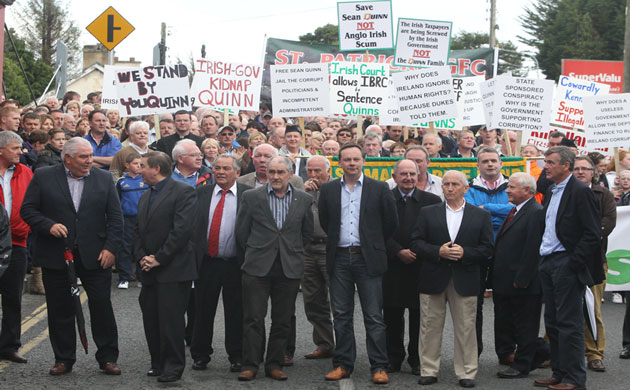
Workers rally in support of Millionaire Quinn

Ireland is in the throes of an economic slump with official unemployment at nearly 15 per cent despite emigration.  Severe cuts are being inflicted on essential public services; there are large cuts in take home pay and glaring inequality as the wealth of the richest in society has actually risen in the last few years.  So how do we explain that in one corner of Ireland four thousand of the plain people of Ireland demonstrated in support of a man who was very recently the richest man in the country and who was at the centre of a disastrous attempt to buy the most rotten of Ireland’s very rotten banks?

In a small corner of County Cavan thousands demonstrated in support of Sean Quinn as he dodges and dives to keep large bits of his foreign property empire out of the hands of the successor to the Anglo-Irish Bank from which he took out loans to buy the property but is now unable to pay back.  The property was security for the loans and now that he can’t repay the loans the State, through the Irish Bank Resolution Corporation (IBRC), wants the property.  In effect the local population was demonstrating in favour of Quinn holding on to this empire by underhand and devious means ,to keep it out of the hands of a state bankrupt and making huge cuts that affect those demonstrating as much as anyone.

In this he was supported by a local and high-profile priest, by a local Sinn Fein MP and by a number of senior and well-known figures within the Gaelic Athletic Association.  The columnist Kevin Myers once wrote that he could imagine Ireland without Fianna Fail, without the Irish language and without the Catholic Church but he could not imagine it without the GAA.  Especially in most of rural Ireland that is how important the GAA is to local society.  It is such a huge and varied organisation that it cannot be said that the GAA as a body supports Quinn but the members present were too numerous and prominent for the relationship to be simply dismissed.  Sean Quinn’s brother Peter is an ex-President of the Association and a further ex-President Sean Kelly, a Fine Gael MEP, also issued a statement in support.

I was having a conversation in the car with my other half when she said that they all had one thing in common – they were all men for whom it is always about them.  When I also pointed out that it could be said they were also all quite well off, Catholic or ‘culchies’, she thought for a moment and said – no, it’s all about them being men with their masculine egos.  Then I said that the worst aspect of all this was that so many ordinary people had come out to support him but she disagreed with this as well and said they were demonstrating because he had given them work.

Quinn is by far the biggest employer in the area with cement and glass businesses, a large hotel and latterly branching out into insurance.  It was his €2.3 billion gamble on buying Anglo-Irish Bank that brought this business empire down.  There seems little recognition locally however that not only has he sought to deprive the state of much needed funds and caused an increase in everyone’s insurance premiums required to pay for his mistake but he gambled with people’s jobs to enrich himself when he was already filthy rich.

Now, while claiming through tears, that he is a victim, a man with plain needs and modest life style he has ensured that his relatives have been paid hundreds of thousands of Euros from the Russian property companies that he is trying to keep hold of. The wife of his son has, for example, been paid €320,297 after tax by a Russian company owned by the Irish State while being a part time receptionist at a motor dealership in north Dublin.  Yet people on a fraction of this came out to declare that he has been hard done by!

For some the demonstration of support is but the latest expression of a long lived Irish slavish mentality that has much in common with peasant attitudes of supine deference to a local feudal Lord. The great and the good declare the Lord one of us and the serfs oblivious to their real interests blindly obey their masters and betters.  Such a view however is only possible from outside.

Cavan and Fermanagh are not some atavistic backwater with ignorant peasants innocent of the sophisticated ways of the modern world.  What is in evidence is not some centuries-old peasant tradition of subservience.  The rural location gives some apparent justification to such views but the industries they work in are modern, few make money directly from the land and they are as educated as anyone in the country.  What is expressed is a particularly personal and local phenomenon of dependency which characterises the whole country and which is only particularly noticeable because of the scale of the local dependency.

The obvious power of the Quinn family in economic terms has been extended naturally into an ideological and social power over the local community and become repulsive to many only because it is so personal and accentuated by the local circumstances.  Expressed in a rural idiom it is easy and tempting for others to ridicule and mock but such acerbic criticism has much bigger targets if it were only to look.

In what way is the subservience of some of Cavan people any different to the subservience of all the people of the Irish State to an unholy trinity of State, banks and property developers   who have placed on their shoulders a debt so huge that their children will be paying for it for decades to come?  In what way is the willingness to support the local Lord any different from the near universal political agreement across the State that the richest multinationals, including speculative financial institutions, should shape economic and social policy, despite the economic disaster they are so closely associated with, while the poorest and most vulnerable must suffer?  If the slavish dependency of some people in Cavan offends so much why doesn’t the much greater dependency of the whole country not also?

The exhibition of subservience witnessed in one part of rural Ireland is not to be excused.  It must be understood and above all recognised as simply a particularly obvious reflection of the exploitation and oppression of the working people of Ireland.  In this respect it is fundamentally no different from the position of workers anywhere.  The notion that Quinn gave people work is accepted as fact just as capitalists employ workers while workers are employed.  But Quinn didn’t give people work, the people gave work to Quinn and he gave them back an amount of money worth less than the work they provided.

Under a system of private ownership by capitalists of the means of production it is nearly always the case that it appears that the capitalist gives work to the workers, and it is not that this is a pure illusion.  In a very real sense workers do depend on capitalists for jobs, which they create and destroy regularly.  This dependency and its results become obscene in some circumstances but it exists everywhere.

It’s time that working people, some of them, started to put forward an alternative, starting with the left and not one that presents the state as the fountainhead of this alternative.  The alienation of people in Cavan from this state (and the banks it supported), easily pictured as a remote Dublin cabal, is a distorted reflection of what would otherwise be a healthy impulse.

After all, for socialists the alternative to Quinn is not the Irish Bank Resolution Corporation, is it?

Back to the Future? – the State to deliver jobs?

Before it went on holiday the government announced the stimulus package for the economy that many in opposition had demanded. An additional €2.25 billion is to be spent over the seven years to 2018 on roads, schools, a new college site in north Dublin, primary health care centres and Garda headquarters. The government claimed it will create 13,000 new jobs and is designed as a stimulus to the economy that will promote growth.  Green Party leader Eamon Ryan got it right when he said the “plan is a throw-back to the last century when the only way Irish politicians knew of stimulating the economy was to pump money into the construction industry.”

Unemployment is 309,000 or over 440,000 if you include part time, seasonal and casual workers entitled to Jobseeker’s benefits or allowances.  The stimulus will therefore not stimulate very much.  The chief Economist for the Irish Congress of Trade Unions (ICTU) nevertheless said it was “an important step in Ireland’s recovery.”  The Irish Business and Employer’s Confederation (IBEC) welcomed it in almost identical words saying it was “an important first step in helping to restore domestic demand in the Irish economy.”

The feeling of déjà vu became overpowering when the Minister announcing it, Labour’s Brendan Howlin, had to ‘explain’ why road projects were going ahead in his own constituency.  His Department was also unable to provide a journalist with any cost/benefit analyses for individual projects, which are always nice to see even when they begin ‘once upon a time’.  A commentator described one road project as “largely a vanity project” and that it “never added up even at the height of the boom.”

The money will come from what’s left of the National Pension Reserve Fund, so workers will know their future pension money is being craftily spent.  Some will come from the European Investment Bank but it’s not clear how much.  Some will come from the sale of state assets.  This is where the state buys duff things from the private sector – like banks – which cost it a lot of money and sells good stuff – like companies that make profits – which also cost it money.

No spanking new construction project would be complete without the involvement of the banks and they too will be involved, although again it isn’t known by how much, but since these are funded by the State this doesn’t really matter that much.  Finally, to complete the story, much use will be made of Public Private Partnerships, a partnership where one partner gives money to the other, for example when roads don’t have the traffic that was predicted but one partner gets paid anyway.  Again we don’t know the figures but we’re not expected to get much exercised over this because it’s all for a good cause, although it’s the usual story of being bribed by your own money.

Fianna Fail complained that many of the announcements would have no effect for six years, which might have been a good thing had it applied to their own policies.  They complained that some of the announcements were bringing back projects that the government had just cancelled, such as the Grangegorman project, which inspires confidence that planning by the capitalist state will continue to be used as a weapon to discredit socialist planning. The word planning might however be going a bit too far since Howlin said it would be nice to give the new jobs to people from the Live Register and also to apprentices who haven’t finished their training, but “I don’t want to promise  that that can be done.”   It’s wonderful how governments can promise to spend billions of workers’ pension and tax money while saying that they can’t promise that it will deliver what it’s supposed to deliver.  The sense of building new health facilities while preparing to get rid of health staff and of building new college facilities while cutting the number of lecturers seemed not to have been questioned by many.

The Irish State doesn’t have a great record when it comes to investment.  It bought 700 electronic voting machines for €55 million and they didn’t work.  It wasted money on hospital co-location, decentralisation and €100 million on the ‘Bertie Bowl’.  It commissioned a PPARS IT system for the health service with an original budget of €9 million in 1997 which ballooned to €120millin in 2004 before being pulled in 2007.  The Auditor General reported that the roads programme which was supposed to cost €5 billion ended up costing €20 billion.  The high-technology Media Lab Europe set up jointly with the Massachusetts Institute of Technology was to focus on the development of digital technology but went into liquidation within five years with consultants describing its output as “mediocre, “surprisingly weak” and “dismal”.

The United Left Alliance’s budget statement stated that “the current crisis cannot be resolved without a state led programme of investment.”  It proposes a reversal of cuts in capital spending and an emergency state programme of infrastructure investment costing €26 billion to get 150,000 back to work.  If we assume unemployment at around 310,000 this would still leave 150,000 unemployed. What happens to them?  The programme is to last “for at least five years”.  What happens after that? The economic contraction has already been going nearly five years and the slump could continue five more.

The ULA wants to employ workers’ private pension funds just like the government wants to use the pension funds of public sector workers.  The ULA wants the latter money, €5.3 billion, to fund investment in modern industry and it rejects privatisation.  Instead it wants state companies to carry out this investment.  If successful this might make some further dent in the unemployment total and at the cost of job creation estimated in its infrastructure programme this would reduce unemployment by perhaps 30,000. Of course there would be further multiplier effects but this depends on the overall performance of the economy.

It is the assumption around this performance that motivates both the proposals of the government and the ULA.  As we have seen, the bosses organisation IBEC, and also ICTU, see the problem as one of insufficiency of demand and the government’s stimulus “an important first step in helping to restore domestic demand in the Irish economy.”  The ULA say “direct government job creation through public works is necessary to promote effective demand and halt the deepening crisis.”  The government, bosses, trade unions and the left offers a similar analysis of the problem and a rather similar remedy.  Of course the trade unions and left oppose privatisation but state ownership in itself is not socialist. What we have, as in the sphere of taxation, is a difference of quantity in the measures being proposed, not a difference of quality.

What the ULA proposes, based apparently on a Keynesian analysis of the problem, is not socialist although, if successful, would have a big impact on defending workers’ living standards by reducing unemployment and defending its welfare entitlement, take home pay and public services.  Were its proposals to succeed they would go some way to providing a capitalist alternative to the policies of austerity although they would do little to prevent the regular future occurrence of capitalist crises.

Lest it be thought this judgement too harsh let’s go back to just one proposal of the ULA, that of using workers’ pension funds.  This is a proposal that the capitalist state that has saddled the working class with an unsupportable debt and denuded its state pension fund, imperilling the pensions of future workers, should also take a chunk of workers’ private pensions, and it with its sterling record of investment and economic management.  In effect it’s a capitalist expropriation of workers funds with no more than a promise from a politician for comfort, and a few Irish workers have had letters of comfort from the Irish State before.

The workers should take over management of their own pension fund?  They should promote worker owned firms to address the problem of unemployment?  Heaven forbid!  That sounds like socialism.

Taxing Capitalism

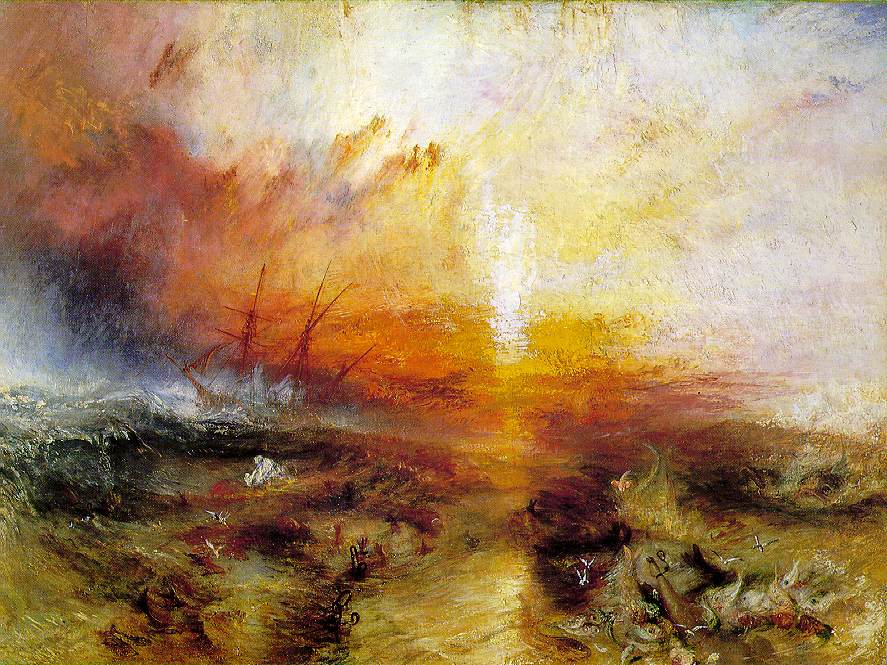
Turner’s ‘The Slave Ship’

A press statement by the United Left Alliance last week, just before the Dail went on its long summer holiday, reported on Richard Boyd Barrett of the ULA who  ‘challenged Taoiseach Enda Kenny during leaders questions over the “gross inequality and unfairness” in the manner in which “the pain of austerity policies has been imposed on the least well-off and most vulnerable sections of Irish society, while the wealthiest people in the country have been protected and in some cases have actually increased their incomes.   All the promises in the programme for government about “protecting the vulnerable and to burden sharing on an equitable basis” have now been fully exposed as hollow. The government have constantly claimed they have no choices, that austerity and pain for ordinary people was a tragic necessity.  Only people power, protests and strikes can challenge this obscene injustice.’

Boyd Barrett is correct to tear into the policies of the government, which favour the rich and places the burden of austerity on the rest of us.  He is absolutely right that this is not inevitable and that there are choices.  Above all he is right to demand taxation of the rich in order to press this home so that workers should not meekly accept that they suffer while the rich escape.

In my last post I criticised the ULA’s tax proposals but not for any of these reasons.  They were criticised for the idea that they could really take the wealth off the rich, that this could fund real protection against austerity, that the rich would not fight back and that the state would not help them do so.  Above all they were criticised because they were put forward as being practical, realistic and reasonable because they could be implemented by the state, when in reality all these things are determined by class struggle against the rich and the state. All the points made by Richard Boyd Barrett can be supported precisely because they are all arguments for and within the class struggle.  While I may disagree that “only people power, protests and strikes can challenge this obscene injustice” this difference is one of strategy to be adopted by workers, which is of a different character than criticism of a policy based on explicit reliance on the state.

In such strategy the excuses that the rich will evade tax would be turned against the state to demonstrate its incapacity to enforce a fair and just tax system as perceive by the majority.  The evasion by the rich would then be held up as a reason to demand expropriation of the source of their wealth and for refusing to pay for austerity in their place.

The policy of taxing the rich is not however what really stands out in the ULA taxation policy.  What stands out is the dog that does not bark, for what is most distinctive about tax policy in the Irish State is not its protection of the wealthy but its policy of minimal taxation of corporate profits.  This is such an article of faith of the political system that there appears almost universal agreement that while children, the sick, elderly and disabled should suffer from austerity the richest corporations in the world should be protected from even the most modest changes to their taxation.  The result is that the taxes paid by them have become voluntary contributions to facilitate the pretence that they are subject to rules and laws like everyone else.  Yet the ULA budget proposals simply note that the policy of taxing multinationals at an effective rate of 4 – 7 per cent has failed to develop a sustainable economy.

Some US multinationals pay even less than this.  Two years ago it was reported that Google paid only 2.4 per cent on non-US earnings that were routed through Ireland to Bermuda.  Apple is a pioneer of a tax strategy called ‘Double Irish with a Dutch Sandwich’ which routes profits through Ireland, the Netherlands and onto the Caribbean.  The deliberate lack of controlled foreign company legislation allows the Irish State to collaborate with notorious tax havens to produce such results.  Microsoft was reported in 2005 to have made a profit of over €682m on its Irish subsidiary and paid no corporation tax at all (as did Symantec between 2004 and 2005).  The company at the heart of this tax structure was based in a solicitor’s office in Dublin.  Facebook has five subsidiaries here but only two are required to publish accounts.

These tax structures and systems are not only used by big corporations but also by the world’s corrupt dictators, its non-resident multimillionaires and its international criminal organisations.  The offshore tax system, which should include the tax-dodging activities in Dublin’s International Financial Services Centre, has been described by Raymond Baker of the Washington Global Financial Integrity organisation as “the ugliest chapter in global economic affairs since slavery.”

This massive tax avoidance is central to the Irish taxation system yet it is ignored.  There are no proposals to raise the headline tax rate, not even for Irish companies many of whom pay no corporation tax either.  No proposals for controlled foreign company legislation, steps to tackle transfer pricing or suggestions to close tax breaks for holding companies.  All the ULA proposals are aimed at individuals not business or corporations. Why?  Why is there no proposal to increase taxation of multinationals?  Or proposals to tax the IFSC through which billions are routed in speculation every year, the sort closely associated with the recent global financial crash?

Perhaps the reason is revealed by the justification given by the Revenue Commissioners for continuing with a policy of encouraging corporations to set up their Headquarters in Ireland even though they recognise many pay no tax.  They justify it on the basis that these companies may increase real investment later.  It is therefore not just fiscal policy that is predicated on minimal corporate taxation but what is laughably called industrial policy, in fact the whole hope of economic growth to get out of the current slump. In essence the reliance on foreign investment is a testament to the continuing failure of native capitalism and a profound expression of its weakness.  On this weakness has rested a weak working class and on it sits a weak left, unable to present a convincing policy of taxing multinationals lest they pack up and leave and add perhaps another 100,000 or so to the ranks of the unemployed.

Would this be the result of an increase in corporate taxation?  The truthful answer is that this would probably depend on how much it increased.  Multinationals locate in Ireland for many reasons including market access to the EU, a relatively skilled and compliant workforce which speaks English and a general pro-business environment.  The left can hardly claim that increased tax will not endanger the location of these multinationals because it cannot credibly claim that it would support the continuation of a pro-business political environment which, among other things, ensures the exclusion of union organisation in most multinational plants.

Instead the ULA concentrates on income taxation and in doing so proposes measures that are radical only quantitatively but not qualitatively, in other words they are not in themselves socialist measures.  Proposals for increased taxation of the rich have to some degree gone mainstream, supported even by millionaires, conscious of the need to fund their state.  A financial transaction tax has been supported by Bill Gates and increased income tax by billionaires Warren Buffett and George Soros.  Of course the support of the rich for increased taxation goes nowhere near where the ULA would go.  It should however also not be forgotten that in Ireland as recently as the 1980s there was a marginal tax rate including PRSI of 72.5 per cent. In the US during the cold war a tax rate for income ranged up to 92 per cent and was still as high as 70 per cent in 1980.

In other words taxation does not get to the heart of the matter and the way in which it does not was explained by Karl Marx in his ‘Critique of the Gotha Programme’:

“it was in general a mistake to make a fuss about so-called distribution and put the principal stress on it.  Any distribution whatever of the means of consumption is only a consequence of the distribution of the conditions of production themselves. The latter distribution, however, is a feature of the mode of production itself. The capitalist mode of production, for example, rests on the fact that the material conditions of production are in the hands of nonworkers in the form of property in capital and land, while the masses are only owners of the personal condition of production, of labour power. If the elements of production are so distributed, then the present-day distribution of the means of consumption results automatically. If the material conditions of production are the co-operative property of the workers themselves, then there likewise results a distribution of the means of consumption different from the present one. Vulgar socialism (and from it in turn a section of the democrats) has taken over from the bourgeois economists the consideration and treatment of distribution as independent of the mode of production and hence the presentation of socialism as turning principally on distribution. After the real relation has long been made clear, why retrogress again?”

What matters fundamentally then is the mode of production.  The ULA concentrated in its budget statement on measures purely to do with distribution.  It did however raise the question of production and the way it did it will be looked at in the next post.


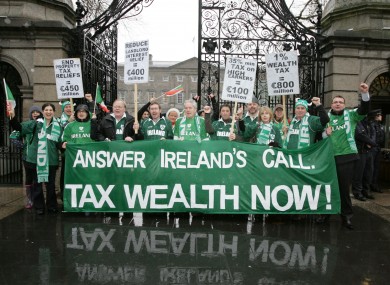
Taxing the Rich

In its 2011 budget statement the United Left Alliance (ULA) pointed out that while unemployment and taxation of workers had gone up, net financial assets of households had increased by €45 billion between 2008 and 2010, which meant that while many workers’ living standards were taking a hammering the wealthy in society were actually getting richer.  They therefore called “for a radical shift in taxation policy so that those with the real wealth pay according to their ability to pay.”

We all know the arguments against such a policy – higher tax rates, especially for those at the top, will discourage work, investment and business creation.  It would be tempting to dismiss such arguments except that Marxists believe that it is profits that regulate the operation and performance of the economy.  Surely reducing the returns to profitability would reduce capital accumulation and economic growth?

Research has shown however that the massive reduction in top tax rates in the English speaking world has not led to improved economic grow compared to countries without similar tax cuts.  The reduction of top tax rates, which were over 70 per cent in the 1970s, by over 40 percentage points in the US and UK has not witnessed any more impressive growth there than countries which have not reduced the rates by such enormous amounts.

This could be because high tax rates are not  the disincentive claimed, that those affected are often not capitalists, that most profits are reinvested and not subject to income tax anyway, and that profits are determined by much stronger and more fundamental forces than taxation of individuals or taxation in general.  Many people believe that those earning astronomical amounts of money simply want more of it because they are greedy, obscenely status conscious and engaged in grotesque exhibitions of conspicuous consumption.

The ULA has put forward plans to raise taxation on the rich in order to “use the money for a state funded programme of job creation.”  They state that the top 5 per cent hold 46.8 per cent of all wealth and have total net financial assets of €219.3 billion.  These figures are taken from Credit Suisse ‘Global Wealth Report’ in November 2011.  Elsewhere they quote a figure from the Central Statistics Office which estimates total net financial assets of €117 billion in 2010. If we assume non-financial assets (property) as 53 per cent of the total this would give a total wealth of €249 billion and that of the top 5 per cent at around €117 billion, over €100 billion less than they calculate from the Credit Suisse report.

It should be kept in mind that all economic statistics are estimates and subject to all sorts of errors.  One thing they are not is exactly right.  The Central Statistics Office has revised its GDP figure for last year by €2.6 billion while the Department of Finance double counted and found itself €3 billion better off.  How much more is this the case when the very rich seek to hide as much of their wealth as possible, which varies as the various markets go up and down, including the stock markets and currency markets. Looking at the Credit Suisse report I calculate the wealth of the top 5 per cent at ‘only’ €185.7 billion instead of €219.3 billion.

One more check available that I am aware of is to look at the ‘Wealth of Ireland’ report published in 2007 which recorded it at the height of the boom.  If we assume a fall in property prices of 50 per cent and its estimate of the share of the top 5 per cent at 40 per cent we arrive at a figure of almost €206 billion.  This however excludes the fall in value of shares, which dropped by 47 per cent between September 2007 and November 2010.  If we assume that equities were 40 per cent of financial assets the value of wealth becomes €188 billion.  This discussion only goes to show the uncertainty involved.  We will therefore go with the ULA budget statement number of €219.3 billion without any illusion that it is exactly right.

The ULA proposes an annual wealth tax of 5 per cent which would bring in roughly €10 billion a year (219.3 times 5%).  It also proposes that those earning over €100,000 should have their taxes increased.  These people, it says, have a total income of €20 billion and paid €4.86 billion in income tax.  This should be increased by a further €5 billion.  The ULA also sets a target of an additional €2 billion to be taken from the super-rich tax exiles.  Thus an extra €17 billion would be raised per year which, allied with refusal to pay for the bank debt, would be used to reverse cuts in social welfare, abolish the Universal Social Charge, increase tax credits for workers and reverse cuts in health and education etc.

There are five reasons why this won’t work

Firstly the sums involved.  The proposals above, where they to come in on plan, would raise €17 billion yet the budget deficit in 2010 excluding the bank bailout costs was €17.4 billion.  There would therefore be no room for closing this deficit while also funding the state-led investment programme of over €5 billion per year, which the ULA statement said was to be partly funded by tax increases. This also ignores reversing the €12 billion of cuts etc. which took place before and during 2010 in order to arrive at a deficit of ‘only’ €17.4 billion at its end.

The second is the nature of the wealth. Roughly half the wealth is in financial assets and half in property.  The financial assets will be in cash and bits of paper like shares which can be sold for cash.  To turn this wealth into money that can be used to pay workers to provide services, reverse workers’ tax increases and procure services it will be necessary to sell these bits of paper after the wealth held as cash is exhausted.  The value of these bits of paper, such as shares, may very well fall if a lot are sold at one time or it is known that they cannot be held and sold at what might be considered by their owners as the most favourable time.  The value they are held and valued at may therefore be greater than what could be got in a sale.  Everyone is familiar with this because of NAMA and the property collapse.  How much more of a problem is this for that half of assets which is property?

And there is an additional issue.  Who would the State sell these assets to?  Workers, self-employed, farmers and small businesses are in no position to buy these assets.  In fact only Irish and foreign rich would be in a position to buy.  But when we consider this for a moment, how would the Irish rich afford to buy these assets when these assets are being taken off them in the first place?  This leaves only foreign capitalists.  Putting it like this, selling off Irish assets to foreign capitalists to finance State expenditure doesn’t look too much different from what the Governing parties want to do.  Perhaps it is proposed that they too are taxed on Irish assets, in line with the policy on taxation of Irish assets held by tax exiles, but this then only puts them in the same position as the Irish rich.  Why buy assets that are going to be taken off you in tax?

Making the most simple assumption that a wealth tax would remove an equal amount of the wealth each year, with a wealth tax of 5 per cent the total wealth of the rich would be cut in half in ten years.  Ten years later it would be gone.  Even with wealth growing at say 2.5 per cent a year, and a wealth tax that took 5 per cent of what was left from the previous year, the wealth of the rich would still be halved in less than 23 years.

In other words this is not sustainable and anything not sustainable collapses long before the final step is taken.  An unsustainable tax base based on property is replaced by an unsustainable tax base constructed on wealth taxation.  The ULA proposes that those earning over €100,000 pay an additional €5 billion in taxes above the €4.86 they are currently paying, on a total income of €20billion, doubling their taxes and moving to an effective tax rate of half of income.  The ULA give the example of the top 0.5 per cent who have a current average after tax income of €400,000 each, which after the implementation of the ULA proposals would reduce to €166,000 each.  This is a reduction of 58.5 per cent in income.  This won’t work because of reason four.

The ‘Sunday Independent’ rich list published in March this year records that the richest man in Ireland is Pallonji Mistry, an Indian tycoon with Irish citizenship, worth €7.4 billion. How long does anyone think he would hang around if he thought the Irish State was going to take half his wealth off him within ten years and reduce his income by nearly 60 per cent?  How many others of his fellow rich would do exactly the same as him?

The ULA have said they have plans to get €2 billion extra out of Irish tax exiles and propose various measures to get this €2 billion.  Unfortunately they have said that “it is impossible to predict the revenue which would be generated by the above measures” which is tacit acknowledgement that they have little confidence that these measures could be effective.  They refer to the US and its expectations that its citizens will pay US income tax on earnings abroad but the Irish state is not the US state.  It says that its demands are reasonable but whether workers believe them to be or not, the rich do not and become tax exiles to avoid tax.  They will not be swayed by ‘reasonable’ demands that they pay up and the ULA knows this.

The ULA has said that even if such people move liquid assets out of the country, as will non-exile tax payers, the tax can be taken from the value of their fixed assets in Ireland.  But this leads us to the problems involved in reason two above.  The idea that the wealth of the rich can be taken by taxation is fine only if one believes that they will not resist with every weapon in their armoury.  The budget statement mentions that there is an investment strike by private investors as if it were some wilful act and not a perfectly rational response to the recession.  Yet serious attempts at taxation of the rich really would produce wilful acts and private investors would use their ownership of assets to reverse investment and sabotage the economy.

Marxists have always been aware that in the class struggle the capitalist class have usually demonstrated much higher levels of class consciousness than workers and their superior organisation will see them able to avoid a great deal of taxation, especially when it becomes worth it.  Their success in this is guaranteed by reason five.

The ULA have stated that “it is a matter for government which has Department of Finance, Revenue Commissioners, Central Statistics Office etc at its disposal to devise legislation to reach the target revenue of 10 billion from the top 5 % and that, in particular that the homes, farms and pension funds of those outside the top 5% be exempt.”  But this is the State that has given rich tax fraudsters two tax amnesties on top of all the various tax incentives and loopholes!

As a Marxist I believe that the state is an instrument to defend and protect the capitalist class, that it is therefore a capitalist state.  I believe that the bail out of the banks even at the cost of bankrupting the state itself is testament to how far it will go to do this.  The recent history of attacks on the working class in order to spare the rich are further examples and are the result not of a policy whim that can be changed but a result of the structure of the state, economy and society.  The proposals of the ULA rely on all this being mistaken.

I remember listening to Today FM and an American writer on financial affairs, whose name I did not hear, being interviewed about the situation in Ireland.  He remarked that Ireland was no more corrupt than many other countries but that what really set it apart was that no one ever seemed to get punished for all the corruption.  Yet the tax plans, and others, of the ULA depend not only on the Irish State not defending the rich but instead actually defending the working class.

The taxation proposals of the ULA are clearly presented as eminently reasonable and practical.  However what is reasonable is decided by class struggle and class struggle means they are not practical.

Default on the debt – part 3

How would a policy of default be implemented?  There might appear to be two ways for this to be achieved.  The left could demand it as part of a manifesto to win a majority in the Dail whereupon this majority would implement the policy.  This is however neither immediately realistic, practical nor will the Irish State allow workers to use the machinery of the State to challenge the capitalist system, which is what a left default would represent.

The second is that we think pressure can be put on the existing State to repudiate at least part of the debt and lessen the demands for austerity.  The Irish State already wishes to get concessions from the EU and ECB but on a very limited scale and with all the strength of a beggar asking for change.  However no amount of pressure will get the Irish State to break with the EU, IMF or the US.  If any significant concessions are ever offered it will only be in response to either recognition that the interests of European capitalism as a whole, or the Euro project, is threatened (which is why we now have the latest deal)or if a socialist movement threatens to do more than repudiate the debt. We are nowhere near the latter situation and it is not the current perspective of the left, which is the subject of these posts.

From a Marxist perspective repudiation should not be sought in order that the existing capitalist economy should grow, although that is a better capitalist alternative for workers than the existing policy – if it could work.  It should be part of a strategy of assisting the creation of a working class alternative that will ultimately overthrow this economic system and the state that defends it.  We should not seek salvation from a Keynesian alternative that seeks to grow the capitalist economy because Keynesianism seeks only to postpone austerity and to effect wage reductions through inflation.

The role and place of the demand for repudiation must therefore be dependent on the stage of development of the creation of this workers alternative.  We are neither at a point where the majority of the population actively seeks repudiation of the debt or even believes it a necessity and nor are we at a stage where a large movement is building up support for such a demand.  Most importantly we are not at the point where the working class in in a position to reject the necessary laws of capitalism and present itself to society with a new alternative.  By alternative I mean not absence of debt through repudiation but an alternative to the capitalist system, of which debt is a symptom.  And by ‘present itself’ I mean not promises that things will be better under socialism, but be in a position to show actual examples of workers power in the economy and society. The demand to repudiate the debt is therefore currently limited to an educational role, a propaganda role.

This does not mean that it is unimportant. The argument on debt is important in supporting opposition to austerity, which is the only way at present that workers can actually counter the effects of the debt and in effect seek their own means of repudiating it.  It plays a role in persuading workers that ending austerity is not only desirable but possible.  The wider and deeper the opposition to austerity the more convincing this argument will have to be.  The wider and more successful opposition becomes the more other elements of the programme become important, but we will take these up one by one as we proceed.

In relation to debt repudiation socialists are regularly challenged on the effects their proposals would have on the workings of the capitalist economy.  It has already been claimed that repudiation of the debt would lead to a flight of capital and virtual collapse of the banking and credit system and that, absent outside help from those just told to take their losses, it would lead to severe economic dislocation.  The crisis would intensify across Europe and beyond and lengthen and deepen the recession.  The reputation of the Irish State as a haven for multinational business and as a site for financial speculation would be in tatters.  The loss of capitalist confidence on its own would increase unemployment.  This of course does not affect in the least the purpose of our demand for debt repudiation, which is to win workers away from acceptance of payment for the crisis and for the debts of the State.  As we have seen above, we do not actually currently control any mechanism to repudiate the debt.

Nevertheless the arguments against repudiation of the debt and the effects such repudiation would cause are not false, they are not a lie, or a simple blackmail because in large measure they are true.  Repudiation of debt by a Russian or Argentinian government determined to get back into the markets by assaulting working class living standards do not provide the model for a working class default beyond countering arguments that it is in itself simply impossible.  While for socialists they do not outweigh the necessity to persuade workers to take no responsibility for the crisis they do expose the need not just for a socialist opposition but for a socialist alternative.

For Marxists, as we have said, the achievement of socialism is based not on sound and logical argument but on necessity.  If the socialist alternative is not practical then it will not succeed and will certainly not win the working class to take it up as its own programme.  This is the underlying reason we pointed to for the defeat in the referendum – that we are as yet far from having a real alternative – practical ,immediate, in place right now, contesting for hegemony because it is widely if not yet universally recognised as a real, potential, living alternative.

Sine this alternative is the working class taking ownership and control of the economy, the state and society as a whole we have to answer a very simple question today, right now: is the working class poised to take ownership and control of the economy to counter the sabotage of the capitalist class as we repudiate the debts to its big cousins in the European Banks?

That is the working class as it presently exists in reality; not an idealised one that resides in books or in abstract slogans, but the working people in your street, your neighbourhood and your workplace?  Have they been readying themselves to take over the running of the economy and the state; have they already taken over, or are in control of some workplaces?  Are they perfecting their organisation?  Have they been debating the necessity to do so, the requirements of doing so, the burning necessity to do so – to carry out a veritable revolution?  If not then we currently have no answer, or no practical answer, to the capitalist charge that what we propose, if implemented right now, would simply cause chaos.

That we, the working class, are not yet ready to take over society is obvious because we can see this every day if we live within working class communities and work alongside other workers.

A fatal answer to this current weakness is to seek salvation through a non-working class solution which at first glance might look more ‘practical’ or ‘realistic’: calling on the State to do what can only be done by workers.  Calling for nationalisation when what we stand for is ownership and control by the workers, not the capitalist state.

Instead of such ‘short cuts’ to a different destination Marxists recognise that we need to put forward a comprehensive programme that addresses the needs and interests of the working class and that repudiation of the debt, which is not even a specifically socialist measure, is only one element of this.  It is necessary to place any specific demand within an overall programme that represents a real alternative.  This does not mean that we need always to proclaim a veritable shopping list of demands or that specific and often very limited struggles and demands are not where we really are at.  It is to understand and be able to explain how any particular struggle fits within a global alternative.  As we have said, this alternative must assume a living corporeal reality to count as a real alternative and not simply a logically coherent programme.  The beginning of a living alternative based on a coherent programme is defending the working class by supporting its resistance to austerity and renouncing its responsibility for the causes of the austerity.  Only on such resistance can an alternative be built.

In addressing the austerity inflicted to pay off the State’s debt the left has recognised the necessity for a wider alternative by calling for the continuing budget deficit to be made whole by progressive taxation of the rich.  In our next post we will look at this part of the left alternative.

One more issue merits being addressed in the context of the Marxist approach to the state’s debt.  This is the call for an audit of the debt.  The burden of the bank debt was placed on the workers’ shoulders in order to pay bondholders, but who are or were these bondholders?  Who got paid in full or is awaiting payment that is a hedge fund used by the fabulously wealthy who bought the bonds at a huge discount or who already had insurance for default?  Who is the recipient of this huge transfer of wealth from working people? This is an elementary demand and is not an alternative to repudiation.

For example, what if we found that it was a workers pension fund that held the debt?  Then we could say to them – let’s talk about what effect it would have on your pensions of us not paying this debt.  What arrangements could we come to which would recognise the legitimate claims of both sides?  What if this pension fund was privately managed and subject to the normal charges by its managers which excluded the control of its members or even knowledge of what mangers were doing? Then we might say – ok, we recognise that we should not deprive you of your pensions but we have no obligation to fund the huge charges that allow the financial services industry to pay its managers and bosses salaries and bonuses that are counted in the millions.  We will take ownership of our debt if you, the workers of this pension fund, take ownership of this fund and do not use it to speculate against the living standards of other workers.

Such a debt audit is thus not a call for justification of the debt but becomes a call to action – a workers’ enquiry to determine its ownership and its beneficiaries now and in the past.  A call to action to repudiate what is not legitimate in our eyes and accept what we believe is legitimate by demanding the actions that make it so.

The argument will come back that this debt is subject to rules of confidentiality that are imposed by market exchanges in foreign countries.  Ok then, the debt we still owe should not be paid until we know who we are paying, that it is the appropriate amount and does not involve an unfair redistribution of wealth from workers to international spivs.  If the bondholders have already been repaid we still want to know who walked off with our money since we are still paying for it and we weren’t asked for permission in the first place.

The demand for an audit is a demand for the books to be opened on international finance and is the first step to taking it over.  The very first step in this would be bank workers doing a ‘Wikileaks’ and releasing all the emails and documents relating to the debt guarantee and repayment.  What an education that would be, especially the howls of condemnation from the powers that be – despite this being our money that is being paid over, our banks that we are supposed to own and our Government and State which are supposed to be defending our interests.

The demand for an audit is entirely legitimate; it is the first step to control and to demonstrating the legitimacy of repudiation.

Following the Beautiful Game

Capitalist ideology tells us that the consumer is king and that the decisions of millions of consumers decide what production takes place. If companies fail it is because they don’t sell goods or services that people want or at a price they are prepared to pay.

There is just enough truth in this to give it the credibility to make it widely accepted. What it leaves out, among other things, is that production also has to make a profit and that indeed this is the main reason any production takes place at all. Given the ownership of the means of production in the hands of only one group of people, these people thereby being called capitalists, and the exclusion of others, who must be required to provide workers for these owners, it is the relations of this production that, more than anything else, determines the wealth and income of the respective classes. This in turn determines to a large degree the pattern of consumption, which is further conditioned by advertising and monopoly suppliers etc.

The idea of consumer as king appears as a joke set beside the experience of recent bank failures to process even the simplest transactions on behalf of their customers, mis-selling of insurance and pension products, multiple products with safety problems, food that is positively harmful, the bottled water scam and simple, homogenous products like gas and electricity, which is sold in such a bewildering array of ‘choices’ that you can switch supplier and end up paying more. No wonder there also exists a consumer rights industry, which one could hardly imagine if what is claimed for capitalism were true.

The clash of human need with the demands of profit was analysed in detail, starting in its most simple commodity form, in Karl Marx’s Capital. Commodification and all its contradictions have since spread over an increasing variety of human activities. Sport has for some time become a global industry, more and more determined by the demand for profit.  Since the competition demanded in sport is not that trumpeted by capitalist ideology the clash is all the more ironic. Sport must have room for chance, accident, unexpected triumph and unexpected failure while sporting contest subject to the requirement for profitability more and more implies certainty and the elimination of the possibility of monetary loss.

In the recent Euro 2012 championship some things didn’t change, like England going out on penalties. But we also saw commercialisation right from the off with the child escorts entering the pitch dressed in the colours of McDonalds. How long before the kids are asked to hold a Big Mac in one hand while holding on to the player with the other?  We also saw the hypocrisy on display that goes with the increased politicisation of the game as team captains read out statements in support of diversity, opposition to racism and homophobia, support for the environment, world peace, healthy eating and helping old ladies across the road. (OK, I made some of this up.) The real priorities of UEFA were revealed when it fined the Croatian Football Federation €30,000 for the display of racist banners by their supporters at one game while imposing a fine of €100,000 on a Danish player for revealing the name of a bookmaker on his underpants while celebrating a goal.

Apart from the Euros the biggest football story of the summer has been the impending liquidation of Glasgow Rangers, claimed by its supporters to be the most successful club in the world, although I expect Real Madrid and about a couple of dozen others might find decent grounds to demure. This is not just a sporting story but involves many of the failings that have been played out in the wider economy. The collapse of Rangers is not so much analogous to the collapse of the banking system in 2008 as an integral part of it, as it boomed and bust propelled by the reckless lending of Bank of Scotland.

Allied to this was massive tax evasion and failure to stick by the rules of the national football association, which requires that the details of all payments to players for playing football are registered by the club with the Scottish Football Association (SFA). It is more or less clear that this did not happen. Failure to do so potentially renders most of the games involving these players 3 – 0 defeats. Cue potential loss of all those trophies achieved by cheating.

Regulatory failure, just like the banks, is on display as the footballing authorities, often headed by ex-Rangers Directors, failed to notice all this even though some had been responsible for it in their previous career with the club. Now one of these individuals, as President of the SFA, is nominally at the head of the organisation responsible for investigating these potential misdeeds and applying the appropriate punishment, though he availed of the tax scheme himself!

Corporate failure, greed, arrogance , criminality and cheating now join a long list of accusations against a club renowned for sectarian discrimination and violence, but which according to the Scottish First Minister is part of the fabric of Scottish society and should be saved.  At the end of the day however Rangers is just a football club. The State will not intervene to save it despite some of its supporters inflated sense of entitlement expecting and demanding it.  The Chairman of one club described it as a dead parrot or in the words of Monty Python – it is not resting or stunned, pining or sleeping, tired or shagged out; it is deceased, ex, finished, gone, and shuffled off its mortal coil.  Such is the ridicule now heaped upon the club.

Despite this Rangers were a huge club in Scotland and central to the whole professional game and to the money to be made from televising it by Sky and others.  The regulatory authorities thus threatened all other clubs with financial Armageddon if the new ‘Rangers’ company, which has apparently bought over the assets of Rangers, was not allowed to go straight into the Scottish Premier League, avoiding all those minor technicalities like winning football matches to get there.  The mainstream media, which feeds like a frenzy on the rivalry between Celtic and Rangers and the like of which simply does not exist in Ireland, dismissed the prospect of anything else as the ravings of ‘bampots’.

Then something extraordinary happened.  The requirement of ‘commercial reality’, of profit and the iron laws of capitalism came up against the force of sporting integrity, in other words football is a game where 22 men or women kick a ball and the team that scores the most goals wins.  It is not a consumer product in which the clubs that generate the biggest TV audiences get to dispense with this inconvenient requirement.  This force was embodied in the vast majority of ordinary fans of all the other clubs in the SPL who didn’t want to watch a version of wrestling, didn’t want to watch a rigged game and at bottom didn’t want to be treated as mugs.  A little respect for them was required when the footballing authorities, the old Rangers and the new company were displaying quite the opposite.

Through well informed blogs, such as The Guardian’s Orwell Prize winning Rangers Tax Case, the truth about what was happening at Rangers was revealed, and through on-line polls organised by fans, polls by clubs themselves, newspaper polls, supporters associations’ meetings and other consultations by the clubs made it clear that the vast majority of football supporters simply would not accept the new company in the SPL.  The way had looked clear for the new company to be voted in by the other clubs’ Chairmen but by the time the vote was taken on Wednesday this week all but the new company voted yes, with ten voting no and only one abstaining, much to the anger of its own supporters.  Not only had the authorities been thwarted but Sky and its owner had been told that there is something more important than its profits.

All this has been an almighty shock to the remnants of the establishment club, the authorities, mainstream media and many commentators.  It has been achieved by the spontaneous action of supporters across Scotland and beyond but the battle is not yet over.  Having failed to shoe-horn the new company into the SPL the footballing authorities are trying the same strong-arm tactics on the clubs in the 2nd, 3rd and 4th tiers of the league structure, organised in the Scottish Football League, in order to put the successor to the disgraced club into the 1st Division of the SFL.  Will the fans of these clubs prevent this as well? We shall see.

This display of power by fans has given everyone a glimpse of what can be achieved but so much more can be done.  The various supporters associations of all the clubs must find a way of meeting, discussing and acting together to continue to exert their collective will.  A permanent vehicle for their organisation must be created to develop the game in the future to the benefit of everyone involved.  The demise of Rangers has demonstrated the current bankruptcy of the whole organisation of the game in Scotland.

Clubs such as Motherwell and St. Mirren are moving to refound themselves as community clubs owned at least partly by their supporters.  At the end of the day this is the only way that the fans can assure themselves that the game they love will retain its integrity and not become the plaything of rich tycoons from the other side of the world.

Coincidentally the ‘Financial Times’ this week had a pull-out section on Co-operatives and employee-owned businesses.  This is just the alternative required so that the working people who support and participate in football can run their own sport.  The FT pull out demonstrates the practicality and benefits of such a model.  It reports that the UK has 5,900 co-operative businesses; compared to 4,800 three years ago and these businesses are more resilient, with 98 per cent still in operation after three years compared to 65 per cent of others.

It gives the example of how such companies can be run, by reinvesting into the business, sharing revenue and helping other co-operatives.  It reports on one company in the North of England in which there is no Chief Executive – “big jobs are split into teams of people”, there is a good pension, job security and flexible hours and plans for regular pay increases.  The books are open to all (which would have prevented the Rangers disaster).  “The general secretary can get to every Blackburn Rovers game.  He works in credit control two days a week, drives a forklift on Thursdays and catches up on paperwork on Fridays.  Everyone has stints in manual and office work.”  This company has been around for 35 years and the model could be easily adapted to involve fans in the ownership and running of the clubs and of the league.

Behind all the threats of financial collapse lies the reality that Scottish Football must change.  This does not require selling out on the vey fundamentals of the game but nor does it mean turning inwards.  One football blog has proposed that Scottish teams join the English league and that each club finds its level within it.  This at first sight might seem the very antithesis of the alternative above.  I believe it is not.  The rebuilding of Scottish Football on the foundations of worker and supporter ownership and control could seek to export and demonstrate this model to fans in England and further afield.

The late, great Scottish manager Jock Stein said that “football without fans is nothing” and the fans have just proved it.  That other great Scottish manager Bill Shankly, who plied his trade in England, said that “the socialism I believe in is everyone working for each other, everyone having a share of the rewards. It’s the way I see football, the way I see life.”  The ordinary fan in Scotland has set a tremendous example of challenging authority and winning; a small battle in a very large war, but most importantly – a victory!

Default on the debt – part 2

This post was largely written before the latest initiative of the EU, which has been hailed by Government parties as a major breakthrough for Ireland although we can be confident there will be no slacking in the austerity programme.

The devil in these deals is always in the detail, or so the cliché goes, but this is only partially correct.  The deal will also do little to reverse the austerity agenda in Europe, which is the big picture, and without this the crisis in the Eurozone will not be resolved.

The plan appears to involve the funds in the European Stability Mechanism going straight to the banks instead of the National State beforehand, thus avoiding the immediate burden on the State through increased sovereign debt and pressure on interest rates.  This was demanded by Spain and Italy and Germany has backed down.

The Irish now hope to piggy-back on this to get similar treatment, except this approach would have to be applied retrospectively as the EU demanded exactly the opposite in the Irish deal.  Since the Irish State owns the banks the debts of the banks are the debts of the State, which workers are expected to pay.  Michael Noonan has claimed that when the EU takes over lending to the Irish banks it will take over the asset side of the banks as well, in other words it will own them.  Whether this would involve the EU owning the shipwreck that is Anglo-Irish and Irish Nationwide is an open question and the deal may mean no more than extending the repayments and a little lower interest rate.

In any case socialists must exploit any concession to demand more, as the post below argues, and should draw attention to the concern in the EU statement about the sustainability of the Irish debt to demand that it be repudiated.  The post below is mostly about the tactical way this may be put forward and is therefore timely.

———————————————————————————–

So what should socialists demand now?  Should we demand repudiation of all the debt even that incurred before the economic crash?  What would be the rationale for this?  Should this include the debt currently being piled up to pay for day to day expenditure on public services?  Should we limit our call to repudiation of that part of the debt that is a result of the bank bailout, or add to this the pension savings wasted on buying the banks?  Who do we take this latter money from since it involves an arbitrary decision on who the state would otherwise have borrowed from instead of using the pension reserve?  In other words default on a sum of money that wasn’t actually borrowed!

It might be that some socialists believe that it is a betrayal of the working class if we do not always demand repudiation of all the debt, although these socialists would still be ignoring costs of bailing out the banks that didn’t result in debt creation while including repudiation of debt that had nothing to do with the banks.

But this brings us back to our point about socialists more or less ignoring the private debts bearing down on workers while not demanding that they be defaulted on. Is this a betrayal of the working class also?  One possible answer to such a charge is that to seek this as well would be to conflate two questions, that of the burden of debt generally and of the specific austerity drive resulting from the explosion of State debt in particular.  This would seem to me to be a valid argument.   It has to be recognised however that in making this argument we are making a political judgement.  It is not primarily about the absolute effect of debt on workers.  It is not a moral argument.

It should therefore be accepted that it may also be permissible to demand repudiation of the bankers’ debt while not believing that it is politically best at all times and in all places to call for rejection of all the debt.  This might be because doing so might no longer allow particular emphasis to be placed on the argument about acceptance of the bankers’ debt.  While it may be claimed that the huge deficits incurred, and to be incurred over the next number of years, are more or less a direct result of the bankers and developers crash we would be obliged, if we accepted this logic, to still accept payment of the debt that was not the result of the financial crisis.

In the end however the left must accept that whatever the advantages of propaganda in opposition to the debt of the bankers, or specifically on the promissory notes, this can really only be a matter of presentation for propaganda or educational purposes.  It cannot represent a deeper policy or strategy.  If successful this approach would anyway have to recede and give way to stronger arguments if it proved successful in winning workers to reject paying the debt.

To agree that the debt created by the budget deficits are simply an indirect result of the banking crash, if not the direct result of assuming banks’ gambling debts, means not explaining what has just happened.  This crisis is not ultimately the result of gambling debts but an abnormally large crisis of overproduction which is a form of crisis that is anything but abnormal in capitalism.  In other words the deficits are the result of a capitalist crisis and socialists should not be diverting workers from this fundamental truth by claiming it is the result of individual bankers or individual banks.

This is also true of the direct debts of the banks themselves that the left has prioritised.  In the last analysis the irrationality of the behaviour of Anglo-Irish and Nationwide banks etc is simply an expression of the irrationality of the system as a whole and it is this we want workers to learn.  The obvious greed, recklessness and stupidity of the individuals and banks involved must be held up as typical examples of the whole rotten and bankrupt system not particularly egregious exceptions.

So if we highlight the direct debt of the banks as the centre of a campaign to repudiate the debt this in no way means acceptance that workers have a duty to pay any of it, any more than we think workers should take responsibility for any other result of a capitalist economic crisis.  It is a matter of what we think are the political demands that will allow workers to come to an understanding of the causes of the crisis and mobilise in their own defence.  This is the decisive criteria for determining the demands that socialist should raise in respect of the debt. It is a tactical decision how we raise the question of debt repudiation, although it’s only a question of tactics if we reject responsibility for any of it.  It is rather like prioritising resistance against some particular item of austerity while not thereby accepting any of it.

We are not at the point where we can realistically hope to build a movement on the basis that workers do not accept any responsibility for the actions of the Irish State.  Identification with this state is derived in no small way from nationalist and bourgeois illusions in its legitimacy.  So the point is to break these illusions, not engage in political projects that assume they have already been erased.

If we believe that the debt is still so large after repudiation or amelioration of the bankers’ debts that the austerity demanded to repay it, or to narrow the State’s budget deficit, will still cripple workers then it would be wrong to accept this debt.  In this case it might be necessary to use the fight over the bankers’ debt as only one step to challenging payment of any of the debt.  (This might be the opportunity provided by the latest putative deal)  We would then be making clear that workers face a choice – acceptance of the legitimacy of the state’s demands or the legitimacy of their own needs.

Arguments around the origin of some of the debt arising from the banks would then play a subsidiary role to the contention that we simply can’t afford to pay these debts and will not pay them.  These arguments however might greatly assist this larger purpose.

This is the situation we are now in.  The level of debt is simply not supportable and the word restructuring will be applied where the word default would be more accurate.  When this happens it should be exploited to discredit the whole exercise, especially the bank bailout, and to push forward the demand for further debt repudiation.

This brings us to what the status of this demand is: why do we demand it and what role does it play in our socialist alternative?  After all, repudiation of the debt is not in itself a socialist demand.  Two of the most recent defaults have been by Argentina and Russia and neither of these were part of a socialist project but rather part of a policy that inflicted deep suffering on millions of workers.

We demand repudiation because of the suffering it inflicts and because if it is accepted workers cannot be in a position to create their own alternative.  We demand it because it puts the needs of workers before the demands of the capitalist system.  We demand it to give workers the opportunity to break with their illusions in ‘their’ State, whether derived from nationalist beliefs in the legitimacy of the nation state or illusions that the state is democratic and legitimate.  If this can best be approached today by putting to the fore the debts being paid on behalf of the banks then this is legitimate and appropriate.

handshake and reconciliation

The handshake between the British Queen and Sinn Fein leader Martin McGuinness is something significant even though most people in the North of Ireland have shrugged their shoulders and have only at the last minute really taken it under their notice because of the hype from the media.  Both the British State and Sinn Fein wanted it to happen for their own reasons and were more than happy that it got the media blitz that it did.

Every commentator aware of the history has remarked on the sea-change that has taken place at this diamond jubilee visit compared to that during the Queen’s silver jubilee in 1977.  At that time republicans demonstrated and rioted against her visit while today the hand of friendship has been extended.  However beneath this difference the purpose of the visit has been exactly the same on both occasions although much more successful on this one.

The veteran journalist Peter Taylor has an item on the BBC news recalling his reporting on the visit for ITV in 1977 and the authorities in that station pulling his report ten minutes before it was due to be broadcast because it exposed the reaction to the visit.  The British government was engaged in a huge propaganda effort to treat the political conflict as simply one of criminality arising from sectarian communal conflict over which the State was an impartial enforcer of peace and order.  The purpose of the Queen’s visit, Taylor says, was to present her as a “great healer of the division between the two communities”.  His report of opposition to the visit exposed this as nonsense.

It did not, and does not today, matter that everyone knew it was nonsense.  The point was to set a public agenda behind which the real strategy of repression and political intrigue could be realised.  This strategy was ultimately successful, although it took over two decades to bear fruit through the ‘peace process’, in the cause of which almost anything is justified.

Today the visit of the Queen and Sinn Fein’s very public welcome is designed to prove the aims of the 1977 visit have now been achieved.  Both she and Martin McGuinness are the bearers of reconciliation and their handshake the equivalent of signing off on an agreement that the conflict that existed in 1977 is never going to return.  The Queen can visit Ireland and there is no reason in the world to object to her presence or protest at the assertion of imperialist rule that these visits represent.

Such claims are acceptable because such acceptance betokens reconciliation.  Of course this is presented as reconciliation of a divided community, of Protestant and Catholic, and who could oppose this?  Certainly not socialists for whom the unity of Protestant and Catholic workers is a fundamental objective and which cannot happen without reconciliation.  But the reconciliation on display yesterday was not between Protestants and Catholics but between the high representatives of their current political leaderships: the Queen as head of State of the imperial power and Martin McGuinness as the highest ranking nationalist minister in a sectarian administration of this imperial rule.  What is involved is not erasing of the division but acceptance of it and promise of continuation in perpetuity.  What has been reconciled is Sinn Fein with British rule.

What events this week have shown is that far from ending sectarianism this reconciliation promises its continuation.  For this week the rotten sectarian heart of the new political arrangements in the North has been shamelessly exposed.

Conor Murphy, the recent Sinn Fein Minister for the Department for Regional Development (DRD), was found by a Fair Employment Tribunal to have engaged in unlawful religious discrimination in appointing a Catholic to Chairman of Northern Ireland Water in a case taken by one of the Protestant applicants.

The Tribunal’s judgement was scathing of Murphy.  Both the successful Catholic candidate and Murphy claimed not to have met each other before the appointment and Murphy was “quite firm” in the view he had not met the applicant.  Murphy however had previously appointed him to two public bodies while claiming not to know where he lived, although he was from Murphy’s constituency and had also been Chairman of the local Health and Social Services Trust.   The tribunal nevertheless asserted that it “is satisfied, on the balance of probabilities, that the Minister did have contact with Sean Hogan, and met him when he was Chairman of the Health Trust in Newry, and that they knew one another.  The Tribunal finds that both Sean Hogan’s and the Minister’s evidence in these respects lacks credibility.”

The Tribunal also found that “for a four year period between 2007-2011, when the Minister was in charge of DRD, there was a significant disparity between the success rates of Protestant applicants and Catholic applicants within DRD, and that a Catholic applicant was at least twice as likely to be appointed than a Protestant applicant.  Statistics for other Government Departments show a ratio at or close to 1:1.  The Tribunal is satisfied that there was a material bias against the appointment of candidates from a Protestant background within DRD.  The Tribunal is concerned that Dr McKibbin, as Permanent Secretary within DRD at the material time, and currently Head of the Northern Ireland Civil Service, was not more aware of the situation.”

Even in the dark days of Unionist discrimination during the previous Stormont regime pre-1972 I can recall no case of a Minister and senior civil servant being implicated through exposure of such high profile discrimination.  It was actions like these that led to the civil rights movement and the fall of the old Stormont.  Yet there have been no words of criticism from the rest of Sinn Fein and in fact two Sinn Fein Ministerial colleagues of Murphy’s were consulted by him in making the appointment.  Murphy has continued to deny his guilt although it is impossible to believe that the evidence and judgement of the Tribunal would not be accepted by Sinn Fein if it involved Unionist discrimination against Catholics.

Sinn Fein’s claims to oppose sectarianism are badly damaged and their hypocrisy exposed.  Meet the new boss, same as the old boss.  The new Stormont promises sectarian discrimination just like the old one except that both sides will now be at it. The silence of the representatives of Unionism is deafening.  They knew that this is what they were agreeing to by accepting Sinn Fein in office because that is what being ‘in government’ is all about.  Small and relatively powerless local administrations do nothing but administer bureaucracy and distribute the spoils of office.  By their silence it is quite clear that Unionists will view the actions of Sinn Fein as licence to do the same.  The benefit to Catholics of Sinn Fein discrimination will be licence for Unionism to discriminate against them.

Sectarianism is to be more secure because everyone will be at it except of course that the whole point of discrimination is to arrive at an unfair and unbalanced outcome.  Equality of discrimination makes no sense at all and will be proved in the attempt to achieve it.  It is not an inherently stable proposition.  However the attempt to achieve it means that if there is to be real opposition to sectarianism and discrimination the unity of the working class becomes a more obvious need because both stand immediately to benefit.  Let Sinn Fein and the British State become reconciled to the current arrangements; the true cause of reconciliation belongs to those opposed to religious discrimination. By becoming ‘friends’ it must be made clear to working people of both religions that the Queen and the Minister are both on the other side.

Default on the Debt – part 1

The key argument of the Yes side in the Austerity referendum was that if there wasn’t a yes vote the state would lose access to the European Stability Mechanism (ESM) needed for a potential second bail out and the ATMs would run dry.  Much of the No campaign responded by saying that we could get access to the ESM, especially if the Government made this a condition of supporting the Treaty changes necessary to allow it to come into force; that the EU had promised to continue to support the Irish State; that anyway it could get money from the existing European Financial Stability Facility until June 2013 or it could access funding from the IMF.

You should know you’re in trouble when you’re putting forward the IMF as a solution.  Just what would the IMF or the EU, or anyone else in a position to do so, ask for in return for a new loan but more austerity?  As an alternative to austerity a new loan made about as much sense as another pub crawl for an alcoholic.

The alternative put forward by the left, which did not feature enough in the campaign, was defaulting on the debt so that the necessity for getting a new loan and suffering austerity to repay the existing ones was reduced.  The argument put forward for this was clear, logical and appealing.  We, the workers, should not pay these debts because these debts were not ours to repay.  We didn’t take out the loans so why should we pay them back?  The gambling debts of the bankers and property developers are theirs to repay.  If European banks were stupid enough to lend money to stupid and reckless Irish banks that lent to stupid and reckless developers then the rules of capitalism say that you take the downside of the risk which you claim justifies your reward.

But there is a problem.  Actually there are two problems.  The first we dealt with in our post on the referendum result.  Most Irish workers knew these arguments and enough of them either discounted them for what they thought were stronger ones or didn’t think they could challenge the forces gaining from paying off the debt – the bankers, developers, Irish State, EU, IMF, US etc.  In our article we stated that in an important way they are correct.

Marxists believe that it is not ideas that fundamentally shape the world but the economic and social forces that shape peoples’ lives and also shape their world view.  No matter how good a Marxist argument or idea is, if the capitalist reality is not challenged by a stronger reality the Marxist argument or idea will not prevail.  This is what the referendum result taught us.  The lesson is that we must create a new reality, one based on working class economic, social and political power if we are to hope to win battles like the austerity referendum and ultimately overcome capitalism.

But this also has implications for the Marxist argument itself.  For if political ideas and arguments are   ultimately only as good as their correspondence to reality and this reality does not currently allow victory for the working class then in what way is the argument presented above deficient?  We should want to know this so that we can clarify our arguments and our programme the better to fight for our ideas inside the working class and help create this new reality.

This does not mean we abandon our ideas but rather understand that to the extent that they do not engage the working class they lack power and to the extent that they do not represent the interests of the working class they will never represent their power.

When we call for repudiation of the debt, what do we mean?  In 2011 total debt equalled 494 per cent of national income, which at the end of the 2010 was roughly €129 billion, so that the debt was roughly €637 billion.  Paying off all this debt, even over 25 years, would lead to a depression which would make the 1930s look like the Celtic Tiger.  No one is seriously suggesting it.  In fact no one would even think of it.  This obvious inconsistency of treatment between public and private debt is a question not just for the ideological advocates of austerity but also for us.

I recently attended a meeting at which I asked why Marxists saw public debt as so very different from other debt, as do the ideologues of the right.  The best answer I got was that there was an assault on working people and their social wage as a result of the government’s austerity agenda which focussed the fight to defend working class interests.   And all this is true.  But it is also true that the financial crisis is not just one of the insolvency of the State but also of the banks which have lent to workers and to businesses.  It is a generalised economic crisis in which the debts of the state are smaller than private debt held by households and businesses.  The share of debt belonging to the State last year was roughly 28 per cent of the total, that of households 30 per cent and of businesses 42 per cent.

Such is the level of indebtedness of the Irish economy that ‘deleveraging’, or paying down these debts, is a necessary part of the system returning to some sort of normality (whatever that is).  There has therefore been a credit crunch and businesses have complained of difficulty in getting loans and those wishing to buy houses, even in seemingly sound financial circumstances, have also found it extremely difficult.  The austerity imposed on households and businesses, just like that imposed to solve the State’s debt crisis, has led to unemployment, reduced incomes and the very real threat of repossession of homes.  These are consequences every bit as severe as many of the measures required to reduce the public debt.  Yet are there calls to repudiate the debt of households, the self-employed and small businesses?  Why not?  The consequences for working people, as I have said, can be equally dramatic.

This may seem an abstruse, pedantic or simply irrelevant point in the context of a political campaign against austerity imposed by the government but I want to make a point which is relevant to it, even ignoring for the moment the issues raised by the exploitation of working people by their entanglement in private debt.

The argument that has been employed by the left has been that workers should not pay for the debts of the gambling banks.  This is a powerful argument that has robbed many of illusions in the current arrangements, albeit they do not see it as being the result of a fundamental flaw of the capitalist system and as yet see no alternative, certainly not one that rests in their own hands.

When the crisis exploded in September 2008 the left denounced the proposed bail out of the banks with workers’ money given with the blanket guarantee.  Even capitalist commentators were simply astounded at its generosity to the banks.  But it went ahead.  So what part of the existing debt is now a direct result of bailing out the banks?

There are different figures for the debt quoted by different authorities at different points in time and having very accurate figures depends on the assumptions made, for example whether to include potential losses in NAMA or whether there are further losses coming down the track from the banks.  All this is very important but not for our purposes where tolerably accurate amounts are only required to make the point.  Before the crisis the debt was €47 billion.  Annual budget deficits between 2008 and 2015 will have generated around €99 billion of borrowings and further borrowings of €13 billion were held in cash at the end of the year.  On top of this the bank bailout will have cost €47billion, making a total debt of €206 billion. (Figures from Seamus Coffey in ‘What if Ireland Defaults?’, Orpen Press 2012)

On the other hand the economist Karl Whelan on his blog has stated that the total outlay and commitments to the bank bailout will be €63 billion.  It is not necessary to try to reconcile the two amounts since they are not measuring the same thing.  For example Whelan’s total includes €20.7 billion invested in acquiring ownership of the banks using money from the National Pension Reserve Fund.  It is a cost of the bank bailout but it did not in itself result in creation of debt.  The state spent €28.1 billion buying shares that Whelan believes are scarcely worth €9 billion now, which will be a loss to the taxpayer but also not a debt.  This underscores the reality that while socialists opposed the bank bailout of September 2008, its implementation  has resulted in losses which have already been paid by workers but do not sit as debt on the State’s balance sheet.

Some of the cost is still in the process of being foisted on the working class taxpayer, such as the €31 billion of promissory notes to ‘save’ a dead bank, Anglo-Irish, now renamed the Irish Bank Resolution Corporation.  In reality the only people saved have been its bondholders.  We now have to pay the money back through tax increases and expenditure cuts which will generate the money to fund payment of the promissory notes to the local branch of the European Central Bank, the Central Bank of Ireland (CBI).  The CBI lent the money to the State to save these bondholders in the first place and will, when it is paid back to them, ‘retire’ the money, or burn it (figuratively speaking).  So much for the rationality of capitalism.

So when socialists say repudiate the debt of the bankers this neither includes all the debt nor all the cost of the bailout.  When it is demanded that the bondholders be ‘burned’ the boat has really been missed on this one.  The bondholders have been saved and the working class of Ireland has had its pension savings robbed and been saddled with enormous debt.