
Standing Firm with Western Imperialism

There comes a point in political argument in which the least effective argument is the most appropriate – that you quote the opponent’s own words as admissions.  However, given it’s their own words they are unlikely to revoke them. We have long since past this point in dealing with the supporters of Ukraine and its alliance with Western imperialism.  It’s doubtful that even while calling for it they will admit its existence.

The existence of a proxy imperialist war might also seem obvious given the hundreds of billions of dollars given to Ukraine in the shape of weapons and financing, with unprecedented sanctions, not to mention intelligence support and special forces on the ground, and much else besides.  Yet this too is denied, despite the repeated declarations of both Western leaders and Ukraine that they are fighting for each other – what do they know?

Instead, it is declared that this unprecedented level of support to Ukraine is less than ‘the full international assistance they deserve’, despite the stocks of western arms running embarrassingly low and exposing its military weakness.  It speaks of a ‘Trump-Putin axis’, but is Trump selling weapons to Russia or Ukraine and is he imposing sanctions on Ukraine or Russia?  Who does the US provide military intelligence to?  Does it allow its satellites to spy on Ukrainian positions for the Russians, or on Russian positions for the Ukrainians?

The Ukraine Solidarity Campaign denounces what it calls ‘neo-colonial plunder’ by this axis.  But who supported the intervention of western imperialism in the first place?  Who said this was a good idea? Who said it knew that western imperialist intervention was for its ‘own interests’.  What on earth did it think these interests were?  And still it calls for its yet greater intervention!

Now it seems to think European imperialism is the alternative to US imperialism, which used to be the alternative to Russian imperialism.  Unfortunately, it believes that European imperialism has fallen for ‘Trump’s deception’ and ‘delayed autonomous European action that could effectively help Ukraine . . .’  But if Starmer, Macron and Merz are not the answer, who is?  Who’s more anti-Russian than this lot?

What about the Ukrainians themselves?  We have been told repeatedly to respect their ‘agency’, except it is Trump that is now blamed for the ‘neo-colonial plunder disguised as sovereignty [that] entrenches Russian occupation, excludes the occupied from governance, and blocks any possibility of reversing Russia’s conquests.’  Not much room for Ukrainian agency there it would seem.

And this is not the only example of the supporters of Ukraine overlooking Ukrainian agency (consciously or unconsciously).  The hundreds of thousands of deserters, who don’t want to die, are routinely ignored, as are the hundreds of thousands of young men avoiding forced conscription by emigrating, or by running away, or fighting with army recruitment teams that try to snatch them off the street.

What do they think of the Ukrainian agency of those who fight with the Russians?  Or about the millions (variously estimated) who have moved to Russia?  Do they really believe everyone in the Russian occupied areas of the Donbas and Crimea are loyal citizens of Ukraine who wish to return to the tender embraces of the regime in Kyiv?

And what of other Ukrainian agency expressed in the growing role of ethno-nationalism, with its suppression of the Russian language and Russia-aligned Orthodox church?  Or the rampant corruption that they, along with the western media, purposely downplay?  Are these too not expressions of ‘Ukrainian agency’?  Or does the sanctity of Ukraine not involve this messy reality of the real world?

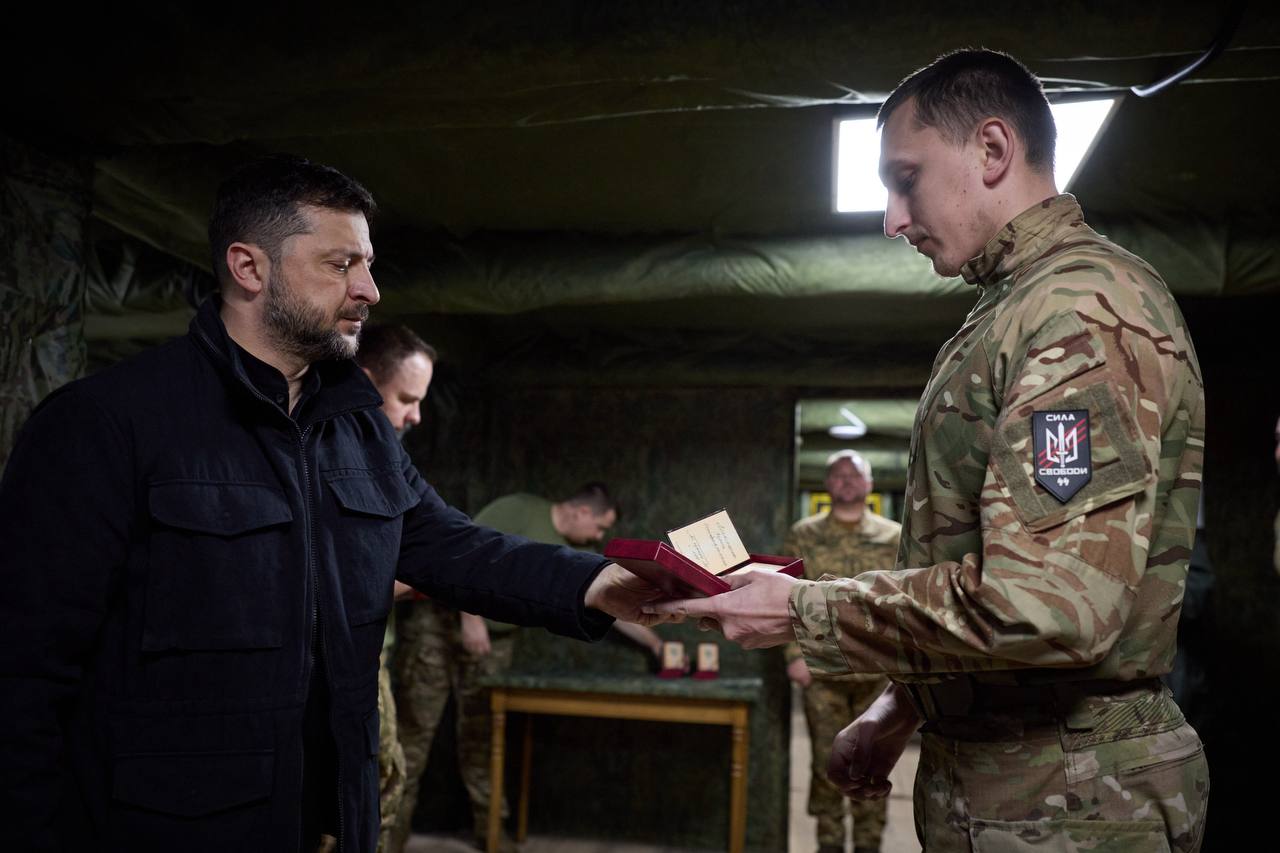
The pro-war left is incapable of integrating all this into its simple story of support for the fight against Russian aggression because its cause is that of the Ukrainian state itself, and it is precisely the Ukrainian state that deserters do not want to die for.  It is the state that many emigrants want to leave behind and many young men dread being beaten up by and sent to the front to become meat for first person drones.  It is the Ukrainian state that is rotten with corruption; that seeks to suppress the rights of Russian speakers and adherents of the church.  It is the Ukrainian armed forces that is full of neo-Nazi units to whom the Jewish President presents medals, absolved by the pro-war left in the West because he’s Jewish and these things can’t actually be happening.

Yet Ukrainian agency miraculously returns when it comes to the possibility that Ukraine can win the war – ‘we reject Trump and Putin’s lie of inevitable Ukrainian defeat or imminent frontline collapse. The difficulties Ukraine faces are manufactured by the failure of others to provide necessary aid.’  Presumably yet more arms must be sent to Ukraine even while the state finds it more and more difficult to find Ukrainians to use them and much of the aid goes missing.  Why doesn’t the Ukraine Solidarity Campaign not support Starmer’s and Macron’s plans to get British and French troops into the country? Or is that too obviously imperialist?

The left distinguishes itself not by its proclaiming an independent working class position but by trumpeting the cause of the Ukrainian state louder than anyone else.  In doing so it abandons everything it thought it stood for.  It makes clear its objective of defending the ‘sovereignty’ of the Ukrainian state, forgetting that sovereignty of the capitalist state is what must be opposed and that this principle of ‘national sovereignty’ brings it full circle back to the pro-Russian left that also proclaims national sovereignty as its first concern.

Ukraine is an independent capitalist state: not a colony and not an oppressed nation.  If there is a national question it is the Russian-aligned population that the Ukrainian state has considered a problem of terrorism since 2014.  And if there is a national question the war has demonstrated that no variety of nationalism is the solution – Ukrainian or Russian.

‘Self-determination’ for Ukraine, championed by the pro-Ukraine left, is simply the demand that the decisions of the regime in Kyiv be enacted – the ‘sovereignty’ of the state to be respected. The restoration of ‘freedom of choice’ can only mean defence of the Kyiv regime’s policy of joining NATO and rebuilding its armed forces to 800,000, bigger than it currently has and impossible for the bankrupt country to afford..

This has nothing to do with socialism and directs the Ukrainian working class into the hands of the increasingly corrupt Kyiv regime; a choice more and more Ukrainians are voting against with their feet.  The Western left parrots the demands of the most rabid neocons in Washington and discredited leaders in Europe, pushing an agenda that can only mean fighting to the last Ukrainian.

The pro-war left has created a world in which Western imperialism (now shorn of the United States because Trump is in charge) is fighting ‘against authoritarianism and fascism’ in opposition to Russia and China, which between them is supposedly leading the threat to ‘global democracy’, whatever that is.

Forget about the world being divided into classes.  Forget about class struggle and the fight for socialism.  The war in Ukraine is presented as a struggle for ‘global democracy’ and supporting the Ukrainian state is the litmus test.  Forget that this democracy is a capitalist democracy and that Ukraine is a debased example of it.  Forget that only now, with Trump, is the US its enemy, and forget that presumably Genocide Joe was on the right side of the struggle before him.

Forget that even if all of this was true, the response of socialists would not be to unite with one imperialism against the other but to seek a workers’ united front against both.  Forget the lessons of the Popular fronts of the 1930s; they look progressive compared to a putative alliance with Zelenskyy, Starmer, Macron, von der Leyen and Lindsay Graham etc. 

As the US has demonstrated, imperialism can shift from ‘democratic’ to authoritarian forms quickly and with relative ease, especially when part of its ‘opposition’ claims it can play a progressive role.  The character of the state, and workers’ opposition to it, is not determined fundamentally by its form but by its nature.  Not its governmental style or model ,but by its essential class character. The idea that Starmer, von der Leyen and assorted US neocons are democratic alternatives that the working class must stand beside is to have surrendered all understanding gained by being a socialist.  In the midst of a genocide in Palestine – that all of them have supported – such a view is criminal and unforgivable.

As Trotsky once said: “I can give counsel only to the workers. My counsel to them is not to believe for a single instant that the war of the two imperialist camps can bring anything else but oppression and reaction in both camps. It will be the war of the slave-owners who cover themselves with various masks: “democracy,” “civilization,” on the one hand, “race,” “honour,” on the other. Only the overthrow of all slave-owners can once for all end the war and open an epoch of true civilization.”

Karl Marx’s alternative to capitalism part 71

Marx states in ‘The Communist Manifesto’: ‘In proportion as the bourgeoisie, i.e., capital, is developed, in the same proportion is the proletariat, the modern working class, developed . . . Modern Industry has converted the little workshop of the patriarchal master into the great factory of the industrial capitalist. Masses of labourers, crowded into the factory, are organised like soldiers. As privates of the industrial army they are placed under the command of a perfect hierarchy of officers and sergeants . . . The more openly this despotism proclaims gain to be its end and aim, the more petty, the more hateful and the more embittering it is.’

‘The proletariat goes through various stages of development. With its birth begins its struggle with the bourgeoisie . . . At this stage, the labourers still form an incoherent mass scattered over the whole country, and broken up by their mutual competition. If anywhere they unite to form more compact bodies, this is not yet the consequence of their own active union, but of the union of the bourgeoisie, which class, in order to attain its own political ends, is compelled to set the whole proletariat in motion, and is moreover yet, for a time, able to do so.’

‘. . . but with the development of industry, the proletariat not only increases in number; it becomes concentrated in greater masses, its strength grows, and it feels that strength more . . .  The growing competition among the bourgeois, and the resulting commercial crises, make the wages of the workers ever more fluctuating. The increasing improvement of machinery, ever more rapidly developing, makes their livelihood more and more precarious; the collisions between individual workmen and individual bourgeois take more and more the character of collisions between two classes. Thereupon, the workers begin to form combinations (Trades’ Unions) against the bourgeois; they club together in order to keep up the rate of wages; they found permanent associations in order to make provision beforehand for these occasional revolts.’

‘Now and then the workers are victorious, but only for a time. The real fruit of their battles lies, not in the immediate result, but in the ever expanding union of the workers. This union is helped on by the improved means of communication that are created by modern industry, and that place the workers of different localities in contact with one another. It was just this contact that was needed to centralise the numerous local struggles, all of the same character, into one national struggle between classes. But every class struggle is a political struggle.’

‘This organisation of the proletarians into a class, and, consequently into a political party, is continually being upset again by the competition between the workers themselves. But it ever rises up again, stronger, firmer, mightier.’ 

‘Altogether collisions between the classes of the old society further, in many ways, the course of development of the proletariat. The bourgeoisie finds itself involved in a constant battle. At first with the aristocracy; later on, with those portions of the bourgeoisie itself, whose interests have become antagonistic to the progress of industry; at all time with the bourgeoisie of foreign countries. In all these battles, it sees itself compelled to appeal to the proletariat, to ask for help, and thus, to drag it into the political arena. The bourgeoisie itself, therefore, supplies the proletariat with its own elements of political and general education, in other words, it furnishes the proletariat with weapons for fighting the bourgeoisie.’

‘Of all the classes that stand face to face with the bourgeoisie today, the proletariat alone is a really revolutionary class.’

‘The advance of industry, whose involuntary promoter is the bourgeoisie, replaces the isolation of the labourers, due to competition, by the revolutionary combination, due to association. The development of Modern Industry, therefore, cuts from under its feet the very foundation on which the bourgeoisie produces and appropriates products. What the bourgeoisie therefore produces, above all, are its own grave-diggers.’

Marx goes on to set out the tasks of the working class revolution, which involves ‘the proletariat organised as the ruling class; and to increase the total productive forces as rapidly as possible.’ This revolution is not an eschatological thunderstrike out of the blue that suddenly transforms the world but a juncture arising within existing society through the development of its contradictions.

As a conscious process of real people, it cannot be the outcome of impetuous and spontaneous apprehension, but must arise from the considered and passionate commitment of the vast majority of the working class, arising from the history and development of their struggles as a class.

We can note at least three aspects of what Marx said that has obvious relevance to today.  The first is ‘the growing competition among the bourgeois’, which now takes place between previously inconceivably large corporations that span the globe that makes this competition an international phenomenon.  This both unites the interests of the world working class and divides it according to the strength of the capitalist system and political weakness of the working class.

The second is the the improved means of communication that can help ‘in the ever expanding union of the workers.’ We no longer need to merely read about wars but have daily, if not hourly, video coverage of its barbarity in Gaza and Ukraine.  What the working class movement has failed abysmally to do is to create its own international media, which remains in Lilliputian proportions in comparison to that of the bourgeoisie.

Through this media the bourgeoisie is compelled to appeal to the proletariat, to ask for help, and thus, to drag it into the political arena.  Hence the bias in coverage of the genocide in Gaza and the war in Ukraine.  Unfortunately again, we see the weakness of the working class movement that is happy to wallow in the lies about the imperialist character of the proxy war in Ukraine and line up behind its own ruling class.  The very saturation of the media allows those comfortable in this position to have their deception confirmed again and again.  A working class media would at least allow a wider source of information and debate, although again, such is the degeneration of much of the current left that petty bourgeois moralism is employed to silence critical voices.

In previous posts, we noted one result of such moralism in the call to hate capitalism more as a spur and guide to action.  We argued in response that a revolution conceived out of ‘negativity’ and ‘hate’, even if it is born out of oppression and exploitation, is utterly insufficient.  Such a view faces the problem of how such a social revolution could become the long-term goal of the working class and could be achieved by it.

Miéville, for example, can say that ‘capitalism is unbearable and yet, mostly, it’s borne’, resulting from the success of ‘capitalist-realist common sense that it’s impossible, even laughable, to struggle or hope for change.’  In part he puts this down ‘to a deliberate ruling-class propaganda strategy to discourage any belief in any such possibility’, but ‘also, at a base level, because it’s so difficult to think beyond the reality in which one has been created, lives and thinks now . . . conditioned as we are by existing reality, we cannot prefigure or simply ‘imagine’ such radical alterity.’

The result is that ‘it’s beyond our ken – we can only yearn for it, glimpse some sense of betterness out of the corner of the eye.’ (A Spectre Haunting: On the Communist Manifesto, p 89)

Such is the idealist view of the possibility of social revolution that cannot ground the future society from the current one but sees the current in purely, or at least mainly, decisively and definitively, in negative terms for which the appropriate emotion is hate.  This is why he states that ‘it’s so difficult to think beyond the reality’ when it is precisely this reality, clearly seen – not out of the corner of the eye – that provides the grounds for the social revolution, giving rise to the appropriate emotions of hope and courage derived from passionate belief in the cause, with hatred of oppression as a motivation but not determining the struggle.

This reality, according to Marx, includes the development of the forces of capitalist production and the associated relations of production that include the creation, expansion, development, organisation and growing consciousness of the working class.  The prosecution of this class struggle involves the creation of a mass, political working class movement that demonstrates not only its power to increasingly defend the interests of the working class but its potential to lead to the creation of a new society ruled by it.

This alternative is built upon the conditions and circumstances of the real world and not by thinking a prefigured ‘radical alterity’ – some largely imagined future alternative – but by changing this reality through prosecuting the class struggle, ranging from the creation of democratic and militant trade unions, to workers’ cooperatives and their association with each other, to the creation of mass working class parties committed to socialism.  The forces recognised by Marx that governed the development of the working class still exist today and are the grounds for the concomitant development of socialist politics.

Back to part 70

Forward to part 72

Fragments of Victory’: The Contemporary Irish Left’, book review (6 of 6)

The most damning judgements in Fragments are that the movements since 2008 ‘failed to identify an avenue through which society might be changed’; ‘it is unlikely the Trotskyist People before Profit will manage to articulate a viable alternative . . . and the steps between the current situation and the long-term goal of socialism are less clear than ever before. The radical left ‘were engaged in a form of politics incapable of realising its own aims.’  (p183, 191, 192 & 181)

The left made gains during the years covered by the book, expressed in some relatively modest electoral successes, but this was achieved though pursuit of a strategy and practice that might be considered as one of least resistance, which had inevitable shortcomings and meant these ‘steps’ were not an ‘avenue through which society might be changed’; entailed a lack of articulation of ‘a viable alternative’; lacked clarity over how to achieve ‘the long-term goal of socialism’ and gave rise to the perception that its politics was ‘incapable of realising its own aims.’

This is not only a question of an absence of a revolutionary socialist programme, which we have already noted in previous posts.  The left has worked under the assumption that achievement of  its objectives requires a revolutionary party, which alone would understand the necessity for revolution and how it may be achieved, and that in its various forms it is the nucleus of this party, which is considered to be revolutionary because its leaders truly believe in revolution (regardless of how it looks from outside).  This obviously means that its own activity and building its own organisations are the absolute priority.

I am reminded of the slogan that the duty of a revolutionary is to make the revolution, except socialist revolutions are not primarily made by revolutionaries but by the working class in its great majority.  The emancipation of the working class can be the work only of the working class itself, as someone famous once said.  This is one of many principles widely acknowledged but without understanding what it entails.  Revolutionaries are ‘the most advanced and resolute section of the working-class . . . which pushes forward all others [with] the advantage of clearly understanding the line of march, the conditions, and the ultimate general results of the proletarian movement.’ (Marx and Engels, The Communist Manifesto).

The working class party is built not solely or even mainly by the activists of the left but mainly by the working class itself, with the socialist movement playing the role just mentioned.  Instead, the mantra of building the party is reduced to building the existing left organisations not as a consequence of the development of mass working class movements but separate from them.  Revolutionary organisations can only develop if they find within the working class this growth of socialist consciousness, which is itself partly a result of their own activity but only as an integral part of the struggles of the working class itself.

We have noted the need to challenge the existing leadership of the trade union movement as an example of what is needed to begin addressing these tasks. We have noted that the limits of single issue campaigns means that they were not a substitute, however useful they may be otherwise, and that the political education that was given was the failed statist politics that subordinates the class’s own activity to that of the capitalist state. This view has come to dominate understanding of what ‘socialism’ is and reflects the historical domination of social-democracy and Stalinism.

This was rudely demonstrated by the left’s customary call for nationalisation being appropriated by the state in relation to the banking system when it faced collapse; which was carried out to protect both capitalist ownership and itself, while dumping the cost on the working class.  I have seen it defended on the grounds that this was not ‘socialist’ nationalisation, but this complaint just admits its unavoidably capitalist character.  Could capitalist state ownership be anything other than capitalist? How could the capitalist state introduce working class control and ownership when it was its own ownership that was asserted?

Progress through the lines of least resistance does not necessarily involve conscious opportunism, precisely because it does involve progress, but like all opportunism it sacrifices long term principle for short term gains. Gains which can more readily dissolve as circumstances change and change they always do.  The approach of appearing more ‘practical’ and attuned to workers’ existing consciousness by declaring that one can leverage the state to do what the workers movement itself must do, through a ‘left government’ for example, does not educate, in fact miseducates, the working class.

This does not invalidate the struggle for reforms that of necessity are under the purview of the state, but these are of benefit not only, or so much, for their direct effects but for their arising from the agency of the working class through the struggle to impose its will on the state and capitalist class.  Reforms are ultimately required to create the best conditions for a strong workers’ movement, and not as solutions to their problems that act to co-opt workers to dependence on the state.  Handed down from above they can primarily be seen as performing the latter role. 

The alternative of seeking to mobilise workers when their organisations are bureaucratised and the majority are either apathetic or antipathetic, is often seen as less practical, less advised, and ‘ultra-left’.  However, the point of socialist argument and agitation is often not with the expectation of eliciting immediate action but to advance political consciousness, which sometimes might be seen as widening what is called the ‘Overton window’.

This approach addresses the argument that only in revolutionary times or circumstances can one advance revolutionary demands.  All independent action by the working class is a step towards its own emancipation, no matter how small, just as reliance on the state is not.  Reforms won from the state are significant such steps if they involve independent organisation of the workers’ movement to achieve them.  As Marx said in the Communist Manifesto in relation to workers’ struggles: ‘Now and then the workers are victorious, but only for a time. The real fruit of their battles lies not in the immediate result, but in the ever expanding union of the workers.’

Something similar was pointed out by James Connolly, who knew that temporary victories would not yield permanent peace until permanent victory was achieved, and that for such victories ‘the spirit, the character, the militant spirit, the fighting character of the organisation, was of the first importance.’ Fragments’ statements that the left ‘failed to lay deep social roots’ and ‘failed to develop a mass political consciousness’ is the authors judgement that this didn’t happen.

It is banal and trite to acknowledge that demands need to be appropriate to their circumstances, but this must also encompass two considerations.  First, that even in situations in which it is almost impossible to achieve the working class mobilisation that is required, it may still also be necessary to say what must be done in order to achieve the desired outcome.

Second, only by always putting forward an independent working class position, which most often does not involve any call to more or less immediate revolutionary overthrow, is it possible for workers to begin to realise that an independent working class politics exists that has something to say about all the immediate and fundamental issues of the day.  As I have previously noted, this begins by instilling in workers the conception of their own position and power as a class, not that of an amorphous ‘people’.  What this involves in any particular circumstance is a political question and the subject of polemical differences that are unfortunately unavoidable.

The fall of the Celtic Tiger demonstrated that such crises on their own will not bring about the development of socialist consciousness – that capitalism is crisis-ridden and must be replaced by a society ruled by the working class.  One of the earliest posts on this blog noted evidence that these crises most often do not.  In order that they deliver such object lessons it is necessary for a critical mass of the working class to already be convinced that their power is the alternative to capitalism and its crises.  This requires a prior significant socialist movement integral to working class life and its organisations.

We are a long way away from this, with one reviewer of the book in The Irish Times noting that its editors had excessive optimism about the experience of the Irish Left over the period.  The reviewer makes other comments that are apposite.  The argument of this review is that the book records enough experience to show that optimism is unjustified, at least on the basis of continuation of the political approach recorded by it.

The project of a left government that would be dominated by Sinn Fein, with secondary roles for the Labour Party, Social Democrats and Greens is not the road to address the failures noted at the top of the post.  The project is a chimera that is incoherent and cannot work.  In (un)certain circumstances it might spur a further development of consciousness and independent working class organisation and activity, but this is by far the less likely outcome and is not, in any case, what is being argued by the projects’ left supporters.

The left is always in a hurry, partly because of the preponderance of young people involved but more decisively because of the project itself, which is not based on building the strength and consciousness of the class as a whole but of building the left organisations themselves, particularly through elections.  The next one is always the most vital.  The former is the work of years and decades to which the project of ‘party building’ and ‘the immediacy of revolution’, understood as insurrection, does not lend itself.  These are outcomes that cannot be willed by socialists but determined ultimately by the wider class struggle and the decisions of countless workers as well as by their enemies.

Elections allow socialists ‘a gauge for proportioning our action such as cannot be duplicated, restraining us from untimely hesitation as well as from untimely daring’, and ‘a means, such as there is no other, of getting in touch with the masses of the people that are still far removed from us, of forcing all parties to defend their views and actions.’  It is not a means to arrive at a government that is ‘left’ of the current bourgeois duopoly but right of socialism, and that peddles illusions that the current capitalist form of democracy can deliver fundamental change.

Back to part 5