Marxism and Gender Identity Ideology (8) – Identity politics on steroids

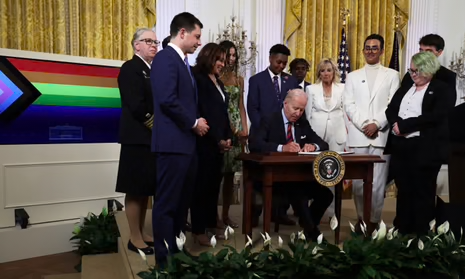
For some on the left the executive order by Donald Trump that the Federal Government will recognise only two sexes – that gender identity “cannot be recognized as a replacement for sex’, and that it will not replace ‘the biological category of sex with an ever-shifting concept of self-assessed gender identity, permitting the false claim that males can identify as and thus become women and vice versa’ – will be seen as confirming their support for these views.  His decision, it will be said, is one from an arch-reactionary who is only being consistent with his other reactionary views.

It is a pity for the holders of such views that their perspective on consistency should lead them to celebrate the progressiveness of the previous Presidential champion of gender ideology, Joe Biden – the sponsor of war in Ukraine and accomplice in the carrying out of genocide in Gaza.  The ability of Trump to weaponise simple truths is as much a feature of identity politics as its pernicious role in undermining socialist politics and the primacy of working class unity.  The role it has played in the Presidential election and in Western media reports demonstrates the salience of the issue for the health of socialist politics, quite apart from the threat the ideology poses to women’s rights.

I remember, when I was a young teenager and had joined the International Marxist Group, an older gay man telling me that there was nothing inherently left-wing or socialist about being gay and that this was also true of the gay movement. Socialists may have been heavily involved in the fight for gay and lesbian rights, but this has not prevented their incorporation by capitalism into questions of individual identities and attitudes, with no question of structural oppression.  In seeking acceptance and equality, capitalist society in many countries has accepted their demands through incorporation on its terms by commodifying them.

The constraints on this incorporation are strict.  The UK may have had three women Prime Ministers, but the names Thatcher, May and Truss are hardly symbolic or symptomatic of progress for anything but the most miserable form of feminism.  The rotten character of this liberal feminism is demonstrated in its willingness to erase the essential nature of women altogether by prioritising the demands of men who claim to be women.  Ireland has had a right-wing gay Taoiseach, and the sectarian arrangement in the North is headed by two women, but belonging to a social group that suffers some form of oppression does not by that fact entail resistance or opposition to the social system that generates it.

Moves to equal representation under capitalism get you closer to equality, but only equality of exploitation and oppression, which affects the working class, including in its ranks the majority of women, black people, gays, and lesbians.  It doesn’t get you anywhere near emancipation or liberation from exploitation and oppression.   Identity politics creates division that breeds competition, undermining the grounds for the unity required to remove capitalist exploitation as well as sexual oppression and homophobia.

Gender identity ideology is an extreme example of this sort of politics that has commodified sex by pretending that it can be changed while simultaneously denying its centrality. This, for example, removes coherence to any claim to same sex attraction.  Ironically, it has done this through attaching its letter to LGB alongside an expanding set of letters – LGBTQQIP2SAA+ – that bear no relation to the initial three, except to cannibalise them, with a + for whatever can be imagined next.

One feminist has described it as akin to religious belief, ‘that trans ideology’s appeal rests on a metaphysical salvation fantasy, that would help explain why it functions far more like a religious cult than a political discourse—and why true believers are so impervious to rational argument and so fond of denouncing heretics and apostates’, ‘the primacy of gender identity would then express the drive to transcend bodily limitation analogous to the thought of The Resurrection’. (Jones, Jane Clare. The Annals of the TERF-Wars and Other Writing (p. 351-2). Kindle Edition.)

While this may be true of some adherents and provides clear parallels of the ideology with religious belief – based on faith and not material reality – it does not explain its attraction to the left in more secular western societies.  Ironically, the more religious, with traditional views of sexuality, are less prone to swallow it because they recognise that their conservative sexual norms apply to real sexes.

Instead, the vulnerability of certain sections of the left to gender identity ideology is due to their abandonment of socialist politics based on the material world and their flight into a more congenial and comforting world of moralistic claims, of good and bad, to be addressed through the assertion of rights to be imposed by the state.  The liberal left now dominates as its natural home is the state, which provides the environment of NGOs and other state-funded organisations that substitute for the working class movement as the agent of radical change.  The long-standing view that the state can embody socialism eases the journey to this destination even of it does not make it inevitable.

Identity politics is a world of the sanctity of self-identity (no matter how detached from reality); of self-determination of the individual (how is this possible and what does it permit or not permit?); of the claims of the oppressed and their ‘lived experience’ (what other kind is there?); with an absolute value placed on ‘inclusion’ and absolute exclusion of ‘exclusion’.  The solipsism involved prevents the liberal left responding in the standard way to the claims of the religious – that extraordinary claims demand commensurate explanations – and instead pronounce the empty and ignorant mantra of ‘no debate’.  It forgets that freedom of religion also requires freedom from religion just as the freedom to associate requires the freedom not to associate.  The freedom for women to associate also requires their freedom not to associate with men, those ‘identifying’ themselves as women or not.

Politics based on moral values free from actual struggle can find its grounding on the claims of oppressed groups, irrespective of their politics, based simply on the fact that they are oppressed, or claim to be.  No need to elaborate theories or political programmes that analyse oppression, ground it on an analysis of material conditions, seek to learn from historical struggles and test alternatives in debate.

When these struggles do not exist, or have not existed for some time, or have been defeated, and thus do not impose their requirements on participants, all this is unknown – especially to generations in which mass working class struggle is largely history. Hence the attraction to youth, highlighted by the generational divide over gender identity ideology, and the noteworthy fact that this ideology has flourished especially, although no longer solely, in English speaking Western countries where working class struggle has suffered long term defeats.  In such reactionary periods reactionary ideas take hold, and this is one.

Unfortunately, the experience of some countries in Latin America illustrates its compatibility with left presenting regimes accommodating reactionary policies, such as gender ideology in the constitution of Ecuador and Bolivia and legislated in Argentina and Brazil, while in all except Argentina legal abortion is not allowed.  In the latter it was introduced in 2020 for ‘pregnant people’, while women became a ‘gestating person’. (Women’s Rights, Gender Wrongs p66 and 68)

That the left is identified with this ideology is one more piece of alien baggage it will have to discard and to do so not by ignoring it but by exposing and defeating it. 

Back to part 7
Ukraine and imperialism after three years of war (2 of 2)

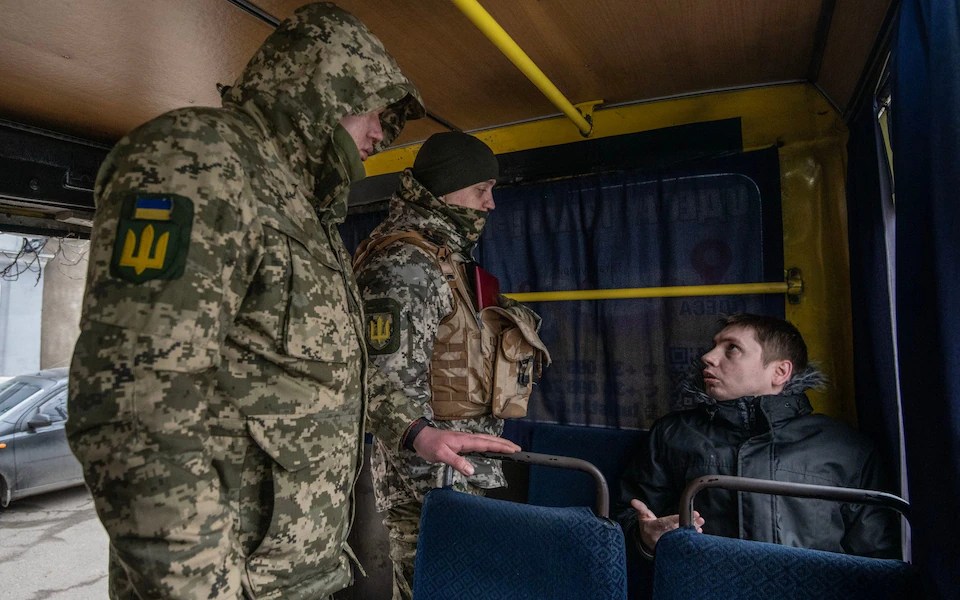
Credit: Julian Simmonds for The Telegraph

Western imperialism can keep providing war materiel for years, at greater or lesser amounts as it rebuilds its stocks and rearms, while continuing to encourage the Ukrainian state to hold out for maximalist demands it calls ‘justice’ but which promises only continued war.  This is called ‘fighting to the last Ukrainian’.  However, the problem with this is obvious – you eventually get to the last Ukrainian.

This is obviously not in the interests of the Ukrainian state, so if Western imperialism risks uncontrollable war if it further escalates its intervention, Ukraine risks complete devastation if it continues on its present course. Equally obviously, the war will not reach this stage because there will be too many Ukrainians who will have no intention of joining the queue to be the last one to die.  We already see this in the numbers of especially young men getting out of the country; in the number avoiding military recruitment and coming into conflict with the military recruiters, and the massively increased desertions from the army.

More and more Western politicians are calling for the age of mobilisation of men to be reduced from 25 to 18, which has been resisted by the Zelensky regime.  He claims that he needs more weapons for any mobilisation while the warmongers in the West say that more troops are necessary to wield them. Zelensky is acutely aware of the unpopularity of sending Ukraine’s youngest generation to their death: the previous mobilisation was not completely successful while the very need for another is proof of the massive number already killed.

The underlying problem is that Ukraine has relatively few under-25s due to the sharp decrease in birthrates in the 1990s, a consequence of the shock of the collapse of the Soviet Union and introduction of capitalism.  If all the other cohorts of men have been exhausted, the mobilisation of the youngest does not promise victory but future demographic collapse, caused by death and absence of the most fertile cohorts of the population.  Volodymyr Ishchenko, quoted in the previous post states that ‘according to the latest UN forecast, by the end of the century, the Ukrainian population is going to decrease to 15 million from the 52 million that Ukraine had in 1992 after the disintegration of USSR. This is not even the most pessimistic scenario.’  Demographic forecasts are uncertain but the probability of a greater number of war casualties than that admitted by the Ukrainian state makes it more likely the most pessimistic forecasts are the more accurate.

So what are we to make then of the repeated calls of the pro-war left that we should recognise Ukrainian ‘agency’?  What agency?  That of the Zelensky regime?  Does this left support his current refusal to draft the youngest or will it support his change of mind, or will it support whatever the regime decides to do, whatever that is?  In the latter case the demand for support for Ukrainian agency is actually a demand to deny one’s own; in the case of another mobilisation, to surrender it to the demands of Western imperialism.

In defending Ukrainian agency, this left in reality denies the agency of Western imperialism – of its own ruling class and its state. In this, the supporters of Ukraine and its Western sponsors make the same error (if you can call it that) as the supporters of Russia – they identify the interests of the working class with that of their state.  One or other of these states become the defender of the working class on the world stage, which condemns the working class of their particular saviour to complete subordination.

The consequence is that the working class is no longer a world class and socialism is no longer international, having in effect been subordinated to one or other nationalism.  Hence the prominence of ‘self-determination’ in the discourse of each – a nationalist demand unrelated to the policy of Lenin but a declaration of support to already independent capitalist states in an inter-imperialist war.

Volodymyr Ishchenko has interesting things to say about the power of this nationalism in Ukraine. He.states that ’There are multiple indications that the enthusiasm of 2022 was pretty fragile, and it is not the first time that we see this kind of dynamic. After the 2004 Orange revolution and the EuroMaidan revolution of 2014, people have had high expectations that quickly gave way to disappointment. A similar dynamic happened after the election of Zelensky in 2019 and then in 2022. One of the lines of interpretation is that those events were the manifestation of the rise of the Ukrainian Nation, according to a very linear teleological dynamic, as an ultimate culmination of the national liberation struggle.’  

He goes on to say – ‘the actual desire to sacrifice oneself for the state is very low’, introducing the key missing element by noting that ‘the class issue is very important because conscripts will come primarily from the lower classes, from the villages. Mainly, from among the poor people who could not bribe the recruitment officers . . . It is really difficult to argue that the war is still a kind of “people’s war” if the majority of Ukrainian men actually do not want to fight.’ 

Of the role of the working class, which is the agency that should concern socialists, he is much more honest than the pro-war left that avoids it – by substituting the agency of the state for it – ‘The working class cannot play a role in the current situation. The labor movement in Ukraine was weak well before the war. The last really massive political strike was by Donbas miners in 1993. They demanded the autonomy of Donbas and closer relations with Russia, ironically.’  So much for a Ukrainian take on Ukrainian agency.

In the previous episodes in 2004 and 2014 the Ukrainian people were lied to by all factions of the oligarchy and their foreign backers with the result that the drive towards NATO precipitated the current invasion.  Ukraine is losing and the longer the war continues the greater the loss – this is reality and not the bellicose propaganda of the British, whether from Starmer on his visit to Kyiv or from that county’s pro-war leftists.  Just as it was Boris Johnson who helped torpedo the early Istanbul negotiations that might had ended the war, so has Starmer turned up to make nonsensical promises of a 100 year partnership and £3bn a year in military aid “for as long as it takes.”  As a practised purveyor of untruth, we can be confident that this is another lie.

Russia too has good reason to seek an end to the conflict but too little reason to permit it to involve Western troops in unoccupied Ukraine, which would be both a permanent threat to it and incentive to whatever reactionary regime surfaces in Ukraine to provoke another war.  In such a case Western troops would immediately be involved, triggering a European-wide war that would quickly involve the US in defence of its European imperialist vassals.

Russia is also suffering from sanctions and the freezing of its assets, including $300bn in the EU, even if it has surprised the West by not collapsing and continuing to grow its economy.  However it is suffering from high inflation and high interest rates, which will hamper further growth.  It has survived as well as it has by measures it took following the first Western sanctions in 2014, which have involved increased state direction of the economy and diversification of markets, especially for its energy exports, some of which still go to the West through third parties such as India..

The change in the distribution of available productive resources through increased arms production creates its own disproportions. The part of constant capital – machinery, materials etc and labour power used to produce commodities the use value of which does not make possible either the reconstitution of this constant capital or the reconstitution of labour-power can slow down or even lead to the contraction of the economy’s reproduction if it leads to a reduced amount of this constant capital and labour-power.

It is thus not in the interests of any of the parties that the war continue indefinitely.  Its continuation promises a military defeat for Ukraine and thus for its Western imperialist sponsors that only unacceptable escalation could avoid at unpredictable cost for all involved.  Russia has interests to defend that the war damages, including its economy, and it is undoubtedly suffering significant losses, whatever its supporters on social media in the West like to pretend.

In all this the party with most interest in ending the war is the working class, particularly the sons and daughters of the working class dying and suffering as a result of it.  A working class organised to demand and compel an end to it should be the object of the socialist movement across the world.  Unfortunately too many on the left are tied to supporting either Ukraine and its imperialist allies or Russia, and are therefore also tied to whatever deal eventuates from their eventual negotiations, the terms of which will be determined by the interests of the respective capitalist states.

Back to part 1

Ukraine and imperialism after three years of war (1 of 2)

At the start of last year media in the West was still predicting Ukrainian victory, continuing the theme from early in the war by pointing to its invasion of Kursk and Zelensky’s ‘victory plan’. We were expected to forget the previous claims that accompanied the Ukrainian offensive in 2023, even when it was obviously failing; the repeated claims that Russia was running out of missiles, almost from the time it began using them in early 2022; that the Russian army was increasingly demoralised; that sanctions would turn the Ruble to rubble and the Russian economy would be cut in half, and repeated claims about Russian casualties while ignoring Ukrainian losses.

By the end of the year the media was speculating on how the West must avoid Ukrainian defeat and achieve stabilisation of the front in order to bolster its negotiating position.  Much ink has been spilt on what the West’s and Ukraine’s negotiating position should be, usually with no reference to what the Russians would find acceptable.  On occasions this has been taken into account it turns out that there is no basis for an agreement, on the grounds that Russia will not accept Ukrainian membership of NATO even if it is postponed for ten or twenty years, and no acceptance of a ceasefire that entails Ukrainian rejection of existing Russian territorial gains or limits to its future military capacity to recommence hostilities and recapture them.

Western imperialism is playing its part by continuing to supply weapons to Ukraine and to tighten sanctions but it has played almost all its hand of escalation, and its ability to supply more of the same weaponry is increasingly limited while escalatory risk in supplying new weaponry is considered unacceptable.  With daily advances by Russian forces it is clear that freezing the conflict is the preferred solution.  The point of the war from NATO’s point of view has been to weaken Russia and if possible reduce its capacity to stand against US  encroachment not only in Ukraine but also in Asia, all in order to press against China.

If Western imperialism really believed that the conquest of all of Ukraine is a prelude to Russian tanks driving through Eastern Europe (and consequently threatening Western Europe) it would have considered the risk of escalation of the war through more direct involvement one that already existed.  Despite current rearmament, the European NATO countries are in no position to fight a conventional war with Russia, not only because of military weakness but because of lack of domestic support.  Beside the cost in lives and in terms of living standards, the West’s support for Israeli genocide and repeated invasion of other countries, and potential war with Iran, means its credibility in selling sacrifices on humanitarian grounds is weak.  Already, the number of incumbent governments falling in elections is testament to widespread dissatisfaction to which the war is a major contributor.

The US is not prepared to make up for European imperialist weakness and is not in a position to engage in more direct war with Russia while supporting Israel, for example against Iran, and having a credible and increasing threat employed against China.  Trump’s threats against Canada, Greenland and Panama are testament that any continuing action he approves against Russia will not be for want of aggressive imperialist intentions but from recognition of these constraints on the projection of US power.  Liberals detest him most because he too openly reveals the naked imperialist interest behind the arrogant and hypocritical rhetoric about democracy.  One Financial Times columnist warned (Musk’s war on America’s allies) that if Musk’s support for the Alternative for Germany (AfD) is also that of Trump ‘the west is as good as dead.’ And this is without taking into account the threats to Canada and Denmark, in which even the most loyal lap dogs of the United States are treated with contempt, opening their leaders to justified criticism from their own populations.

Objectively then, Western imperialism faces challenges, not only from without – the failure of most of the population of the world and their governments to support its proxy war – but also from within, as the price of the war imposed by the US on Europe is further exposed by Trump’s threats.  While European NATO countries froth at the mouth at possible Russian and Chinese damaging of undersea cables in the Baltic and threaten direct action, we are supposed to forget the US destruction of the Nord Stream gas pipelines and these same countries looking the other way before calling off their ‘investigations.’

These contradictions should open possibilities for socialists to point out the real nature of US Imperialism and NATO, of the consequences of their governments’ support for the war, and the hypocrisy and fraud that is bourgeois democracy.

But then enter the pro-war left.  It declares that the occupation of Ukraine is a potential prelude to the invasion of Eastern Europe and that the war is one for democracy, forgetting that socialists oppose bourgeois democracy with that of the working class.  They pretend US imperialism can support the cause of democracy in Ukraine but not in Palestine, while we await without baited breath their reconciliation of this claim with Trump’s latest threats.  They support imperialism’s supply of weapons to Ukraine, which they portray as democratic even while it has banned opposition parties, censored opposition media, restricted workers’ rights and called off the scheduled Presidential election.

They do so while claiming that this does not require rearmament, even while European imperialism empties its arsenals, also claiming that no expansion of NATO is involved even while it supports Ukraine in a war that is all about its ability to join it.  It even complains that Western imperialism has been too reticent in supporting Ukraine – ‘the supply of arms to Ukraine has been insufficient and slow’ it says.  The demand is made that ‘Governments, including NATO countries, should provide the weapons necessary for Ukraine to win’ while it is claimed that ‘there is huge pressure on Ukraine by Western Imperialism to sue for peace and accept annexation.’

The article just quoted references the role of socialists in the First World War without having the faintest awareness that it is painting for Ukraine the same ‘stab in the back’ narrative that the Nazis employed in Germany after the war that helped advance their rise to power.  But of course, this left has already denied the role of the fascist forces in Ukraine that even the bourgeois media sometimes reports, and that one Ukrainian leftist has recently explained.

The Economist noted in its last issue that ‘the share of Ukrainians who view Bandera favourably reached 74% in 2022, up from only 22% ten years earlier.’  Volodymyr Ishchenko noted that ‘in France the far right, mainly the National Rally, Le Pen’s party, is way less extreme than those movements we discuss in Ukraine. Le Pen’s party probably doesn’t use Nazi symbols, and has a more sophisticated attitude towards the Vichy collaboration during the Second World War. They’re trying to detoxify themselves. It’s not like this in Ukraine and you mentioned Stephan Bandera, who is glorified openly; even more so, the Waffen SS is glorified, particularly by people in Azov. The scale of extremism of the Ukrainian far right is way higher than the western one . . . Unlike the major far-right parties in the west who are working on parliamentary status, the power of the far right in Ukraine has always been their capacity for street mobilization and the threat of violence . . . we need to think not only about the nominal far-right but also about the complicity of the Ukrainian and western elite in the whitewashing of Ukrainian far right and ethnonationalism.’  To this could be added the whitewashing of Ukrainian nationalism by the pro-war Western left.

Forward to part 2

Karl Marx’s alternative to capitalism (58) – Marx’s claim to originality

‘The capitalist mode of appropriation, the result of the capitalist mode of production, produces capitalist private property. This is the first negation of individual private property, as founded on the labour of the proprietor. But capitalist production begets, with the inexorability of a law of Nature, its own negation. It is the negation of negation. This does not re-establish private property for the producer, but gives him individual property based on the acquisition of the capitalist era: i.e., on co-operation and the possession in common of the land and of the means of production.’

‘The transformation of scattered private property, arising from individual labour, into capitalist private property is, naturally, a process, incomparably more protracted, violent, and difficult, than the transformation of capitalistic private property, already practically resting on socialised production, into socialised property. In the former case, we had the expropriation of the mass of the people by a few usurpers; in the latter, we have the expropriation of a few usurpers by the mass of the people. (Marx, Capital Volume 1, Chapter 32 p. )

Marx explains ‘how the development of the social productivity of labour presupposes cooperation on a large scale; how the division and combination of labour can only be organized on that basis, and the means of production economized by concentration on a vast scale; how instruments of labour which, by their very nature, can only be used in common, such as systems of machinery, can be called into existence; how gigantic natural forces can be pressed into the service of production; and how the production process can be transformed into a process of the technological application of scientific knowledge.’

The development of the forces and relations of capitalist production through the socialisation of labour, necessarily includes the development of the working class, the decline of petty bourgeois (including peasant) production, and the redundancy of the capitalist class (as set out previously) and are the basis of the contradictions of capitalism that are expressed in class struggle.

This is what Marx claimed, against others, was his distinctive contribution:

‘Now as for myself, I do not claim to have discovered either the existence of classes in modern society or the struggle between them. Long before me, bourgeois historians had described the historical development of this struggle between the classes, as had bourgeois economists their economic anatomy. My own contribution was 1. to show that the existence of classes is merely bound up with certain historical phases in the development of production; 2. That the class struggle necessarily leads to the dictatorship of the proletariat; 3. that this dictatorship itself constitutes no more than a transition to the abolition of all classes and to a classless society.’ (Marx letter to Joseph Weydemeyer, Marx Collected Works Vol 39, p62 & 65)

Through this class struggle the working class is the agency by which the cooperation created by capitalism is made fully conscious, organised and reaches towards completion, through conscious planning of the instruments of production that are of such a scale that they can only be used in common.  Through this cooperation production is developed to address the needs of the producers, the working class, in the activity of their production, consumption, and the all-round development of human capacities.  The application of scientific knowledge will be carried out by the working class in the interests of the majority and not for the benefit of a narrow class of capitalists.

The redundancy of the capitalist class is consummated, the working class itself is abolished and with it class itself.  Since the new society can only realise the interests and wishes of its majority, it is clear that the creation of such a society can only be a conscious process; it cannot as for capitalism, be the outcome of a mainly unconscious process of largely elemental economic developments.  It needs a conscious historical agent, conscious of its task and how it might be achieved, collectively and freely in an egalitarian manner. How could a whole class, the vast majority within a capitalist society, do it in any other way?

In the Preface to the 1888 English edition of ‘The Communist Manifesto’, by which time Marx had died, Frederick Engels explained why it was not ‘The Socialist Manifesto’:

‘By Socialists, in 1847, were understood, on the one hand the adherents of the various Utopian systems: Owenites in England, Fourierists in France, both of them already reduced  to the  position of mere sects, and gradually dying out; on the other hand, the most multifarious social quacks, who by all manner of tinkering professed to redress, without any danger to capital  and profit,  all  sorts  of social grievances, in both cases men outside the working class movement, and looking rather to the ‘educated’ classes for support.’

‘Whatever portion of the working class had become convinced of the insufficiency of mere political revolutions, and had proclaimed the necessity of a total change, called itself Communist.  It was a crude, rough-hewn, purely instinctive sort of communism; still it touched the cardinal point and was powerful enough amongst the working class to produce the Utopian communism of Cabet in France, and of Weitling in Germany.  Thus, in 1847, socialism was a middle class movement, communism a working class movement.   Socialism was, on the Continent at least, ‘respectable’; communism was the very opposite.  And as our notion, from the very beginning, was that ‘the emancipation of the working class must be the act of the working class itself, there could be no doubt as to which of the two names we must take. Moreover, we have, ever since, been far from repudiating it.’

Back to part 57

Forward to part 59

Karl Marx’s alternative to capitalism part 57 – towards ‘Aufheben’

We see from the previous post that capitalism, as a transitional mode of production to socialism, is a progressive development, recognition of which is one of the hallmarks of Marxism.  This, however, is not how Marxism is normally understood by its enemies, by those unfamiliar with it and even by some of its friends and self-styled adherents.

Certainly, some of these will accept that this is true in relation to previous societies, whether understood as feudalism, some form of Asiatic mode of production, or older tribal societies, but, it is argued, this is no longer the case.  Capitalism has conquered the world, is now in decline and/or in its ‘death agony’, as declared by Leon Trotsky.  Marx lived when only a small number of countries were capitalist in any developed sense and today it is the irrationality and barbarity of capitalism that predominates.

There are a number of problems with such a view but in this post we will mention only three.  First, Marx’s view is that capitalist progress is not a serene, tranquil and untroubled process.  It is not one of harmony and uniformity but one of antagonism, generated by contradictions that are often expressed in palpable horrors.  It was ever thus, and today’s horrors engendered by the system are neither new nor preclude progress in the sense set out in the previous post.

Secondly, capitalism continues – albeit with its waste and degradation of humanity and the planet – to develop the forces of production and therefore the foundations for socialism.  This includes massive expansion of the working class, without which capitalism does not exist.  The sense of progress set out by Marx therefore continues even as it lays waste to nature and humanity, not least because these forces can be developed in such a way to further the protection of both.  The alternative view is that the new society must start from somewhere very far away from being able to address these tasks and can only begin to develop the forces necessary after capitalism is overthrown, which ironically calls into question the current possibility and imperative to do so that is so much a part of this view.

Thirdly, a one-dimensional understanding of modern capitalism as regressive can easily elicit appeals to the past, to older models of society or more primitive capitalist forms, which Marx had to reject in his own day, but that are continually proffered, becoming obstacles to the replacement of capitalism by socialism.  These include opposition to the centralisation and concentration of productive forces in the name of ‘anti-monopoly’ capitalism; to the growth and development of these forces on the grounds of planetary limits, or to the internationalisation of capitalism on the grounds of the protection of ‘national sovereignty’, against ‘globalisation’ etc.  There are many other examples.

Opposition boils down to opposition to the socialisation of the forces of production, to the progress that capitalism has involved, and upon which future socialism depends.  In this view, opposition to capitalism cannot rest on what capitalism has achieved but on its purely negative aspects, such as its exploitation and oppression.  We have seen that it is precisely in the expansion of surplus labour, on exploitation as a result of the socialisation of labour, that socialism is possible.  It is not capitalist crises, or its inhuman oppression or its tendency to war and destruction that will give rise to socialism but to the contradictions of the system of which these are expressions.  Capitalism is essentially still the antagonistic system riven by contradictions analysed by Marx in the middle of the nineteenth century.  Were it not, we would not be expounding his alternative as still relevant.

Marx did not in the least minimise the horrors of capitalism but did not reduce his opposition to capitalism to its deleterious effects, as the sole grounds for creation of a new society or the incentive to do so.  To maintain a belief in socialism while abandoning his analysis necessarily involves invoking some other grounds, and since this means abandoning the material premiss of the world as it exists, it usually involves invoking principles or ‘values’ – moral claims – that cannot support it.

In 1849 Engels wrote that: “Justice”, “humanity”, “freedom”, “equality”, “fraternity”, “independence”—so far we have found nothing in the pan-Slavist manifesto but these more or less ethical categories, which sound very fine, it is true, but prove absolutely nothing in historical and political questions. “Justice”, “humanity”, “freedom” etc. may demand this or that a thousand times over; but if the thing is impossible, it does not take place and in spite of everything remains an “empty figment of a dream”. (K Marx and F Engels, Democratic Pan-Slavism, Collected Works Vol 8 p 365)

What Marx and Engels demonstrated was that ‘the thing’ – socialism – is possible because it is based on the development of existing society itself and can unfold out of it.  This does not make it inevitable in the sense that this unfolding is an unconscious, inescapable process, but that it is precisely a conscious process, derived from a consciousness of what exists and its evolution.

This was expressed very early in Marx’s political development when he wrote that he did not want to ‘dogmatically anticipate’ the new world but wanted ‘to find the new world through criticism of the old one’.  The task was to ‘develop new principles for the world out of the world’s own principles’ and wanted to ‘merely show the world what it is really fighting for, and consciousness is something that it has to acquire, even if it does not want to’.  In a letter in 1843 he wrote that ‘It is not a question of what this or that proletarian, or even the whole proletariat, at the moment regards as its aim. It is a question of what the proletariat is, and what, according to this being, it will historically be compelled to do’.

This consciousness cannot not stop at the obvious iniquity of capitalism, which Marx didn’t fail to note; the bourgeoisie, he noted, had never ‘effected a progress without dragging individuals and people through blood and dirt, through misery and degradation’, but that through its ‘development of the productive powers of man and the transformation of material production into a scientific domination of natural agencies. Bourgeois industry and commerce create these material conditions of a new world . . .‘  (K Marx, The Future results of British rule in India, Collected Works Vol 12 p 221 and 222)

He states in Capital Vol I that ‘within the capitalist system all methods for raising the social productiveness of labour are brought about at the cost of the individual labourer; all means for the development of production transform themselves into means of domination over, and exploitation of, the producers; they mutilate the labourer into a fragment of a man, degrade him to the level of an appendage of a machine, destroy every remnant of charm in his work and turn it into a hated toil; they estrange from him the intellectual potentialities of the labour process in the same proportion as science is incorporated in it as an independent power; they distort the conditions under which he works, subject him during the labour process to a despotism the more hateful for its meanness; they transform his life-time into working-time, and drag his wife and child beneath the wheels of the Juggernaut of capital.’

‘But all methods for the production of surplus-value are at the same time methods of accumulation; and every extension of accumulation becomes again a means for the development of those methods. It follows therefore that in proportion as capital accumulates, the lot of the labourer, be his payment high or low, must grow worse. The law, finally, that always equilibrates the relative surplus population, or industrial reserve army, to the extent and energy of accumulation, this law rivets the labourer to capital more firmly than the wedges of Vulcan did Prometheus to the rock.’

‘It establishes an accumulation of misery, corresponding with accumulation of capital. Accumulation of wealth at one pole is, therefore, at the same time accumulation of misery, agony of toil slavery, ignorance, brutality, mental degradation, at the opposite pole, i.e., on the side of the class that produces its own product in the form of capital.’ (Marx, Capital Vol I chapter 25 section 4)

Marx damns the capitalist system for its exploitation and mutilation, for its domination and stultifying effects on the worker and family, and for its gross inequality, but still ‘the social productiveness of labour’ is raised.

Back to part 56

Forward to part 58

Part 1