Karl Marx’s alternative to capitalism part 56 – the conditions for emancipation

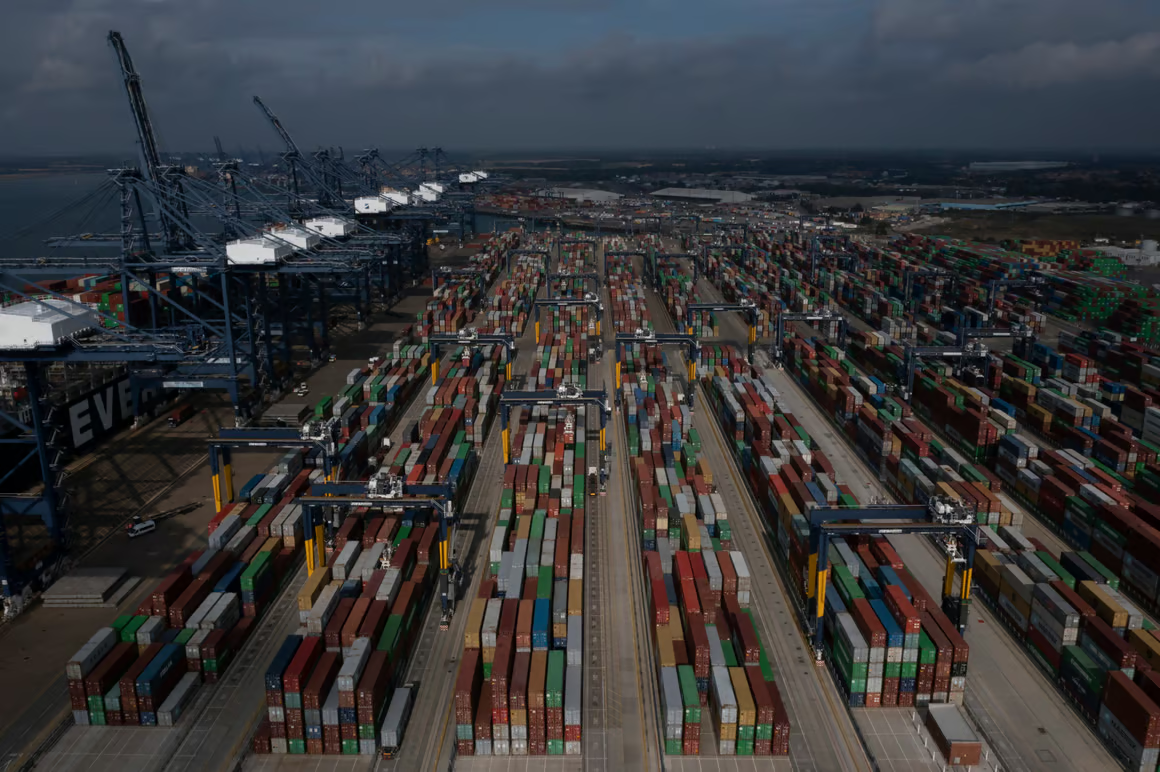
Containers sit on the tarmac at Felixstowe Port | Dan Kitwood/Getty Images

At the end of a lecture to workers in Brussels written in 1847, Karl Marx stated that:

‘Before we conclude, let us draw attention to the positive aspect of wage labour . .  . I do not need to explain to you in detail how without these production relations neither the means of production—the material means for the emancipation of the proletariat and the foundation of a new society—would have been created, nor would the proletariat itself have taken to the unification and development through which it is really capable of revolutionising the old society and itself.’

(Marx, “Wages”, Marx and Engels Collected Works, vol. 6, p 436.)

For him, capitalism had already so revolutionised society that it provided the conditions for the creation of a new one and the means to achieve the emancipation of the working class – ‘material conditions . . . that could be produced by the impending bourgeois epoch alone’ (Marx and Engels, Manifesto of the Communist Party. Collected Works, vol. 6, p 514)

Today, one very rarely reads a positive analysis of material conditions for working class emancipation created by capitalism, even though these have massively developed since Marx wrote these words, when they were really only becoming evident in one country and were too undeveloped even then.   They provide the most striking proof of the potential for the development of socialism out of present society.  In many respects however they are no longer recognised as such and rarely considered; in other respects they are rejected, but we will come to that later.

In Volume I of Capital Marx describes the creation of these conditions:

‘As soon as this process of transformation has sufficiently decomposed the old society from top to bottom, as soon as the labourers are turned into proletarians, their means of labour into capital, as soon as the capitalist mode of production stands on its own feet, then the further socialisation of labour and further transformation of the land and other means of production into socially exploited and, therefore, common means of production, as well as the further expropriation of private proprietors, takes a new form.’

‘That which is now to be expropriated is no longer the labourer working for himself, but the capitalist exploiting many labourers. This expropriation is accomplished by the action of the immanent laws of capitalistic production itself, by the centralisation of capital. One capitalist always kills many.’

‘Hand in hand with this centralisation, or this expropriation of many capitalists by few, develop, on an ever-extending scale, the co-operative form of the labour process, the conscious technical application of science, the methodical cultivation of the soil, the transformation of the instruments of labour into instruments of labour only usable in common, the economising of all means of production by their use as means of production of combined, socialised labour, the entanglement of all peoples in the net of the world market, and with this, the international character of the capitalistic regime.’ (Marx, Capital Volume I p929)

In earlier posts on Marx’s alternative to capitalism we outlined many of these and how the contradictions within this development, including that between the forces and relations of production, would lead to social revolution.  We outlined the increasing socialisation of production through the colossal expansion of capitalism across the world, turning more and more activities into commodities to be sold for profit, through a massive increase in the division of labour – within and between workplaces – that involves the the creation and enabling of new, previously undreamed of, technologies.

This massive ‘development of the forces of production is the historical task and justification of capital.  This is just the way in which it unconsciously creates the material requirement of a higher mode of production.’ (Capital Volume 3 p 181)

This is elaborated in the Grundrisse:

‘The great historic quality of capital is to create this surplus labour, superfluous labour from the standpoint of mere use value, mere subsistence; and its historic destiny is fulfilled as soon as, on one side, there has been such a development of needs that surplus labour above and beyond necessity has itself become a general need arising out of individual needs themselves – and, on the other side, when the severe discipline of capital, acting on succeeding generations, has developed general industriousness as the general property of the new species – and, finally, when the development of the productive powers of labour, which capital incessantly whips onward with its unlimited mania for wealth, and of the sole conditions in which this mania can be realized, have flourished to the stage where the possession and preservation of general wealth require a lesser labour time of society as a whole, and where the labouring society relates scientifically to the process of its progressive reproduction, its reproduction in a constantly greater abundance; hence where labour in which a human being does what a thing could do has ceased.’

‘Capital’s ceaseless striving towards the general form of wealth drives labour beyond the limits of its natural paltriness, and thus creates the material elements for the development of the rich individuality which is as all-sided in its production as in its consumption, and whose labour also therefore appears no longer as labour, but as the full development of activity itself, in which natural necessity in its direct form has disappeared; because a historically created need has taken the place of the natural one. This is why capital is productive; i.e. an essential relation for the development of the social productive forces. It ceases to exist as such only where the development of these productive forces themselves encounters its barrier in capital itself.’ (Marx, Grundrisse p 409-410)

The passages above, which might appear difficult – the first paragraph is comprised of only one sentence! – demonstrates capitalism’s contradictions, with its laying of the foundation for its supersession.  So, the drive for capitalism to ever greater exploitation of workers – by their giving up more and more of their time labouring for the capitalist that is not recompensed in wages – is indeed their intensified exploitation.  However, this very development of production, beyond what is required to simply maintain the working class at some minimum level of existence, expands productive powers in such a way that greater and higher needs can be satisfied – of course for the benefit of the capitalist class initially and to the utmost extent – but also increasingly for workers by increasing what they can consume; in their whole mode of living, and how they can further their personal interests and development.  Above all, this expansion can allow this development by potentially reducing the time necessary for work, permitting time to take part in the running of society while also pursuing other collective and individual interests.  The massive increase in the productivity of labour forced by capital in ruthless competition can be turned from a means of capitalist exploitation to working class emancipation.

Capitalist expansion of exploitation is ceaseless because it seeks the accumulation of wealth in the form of money, for which there is no limit, but at the same time must do this in the form of the creation of real objects and services which address genuine needs, even if capitalist society distorts and degrades their development and expression.  The potential freedom from want, insecurity, inequality and from the subordination of everyone subject to the imperatives of capitalist accumulation, is the foundation for the belief that the ending of the class system will herald the end of all social domination and oppression.

The capitalist has only a ‘transitory existence implied in the transitory necessity for the capitalist mode of production’ who ‘ruthlessly forces the human race to produce for production’s sake; he thus forces the development of the productive powers of society, and creates those material conditions, which alone can form the real basis of a higher form of society, a society in which the full and free development of every individual forms the ruling principle.’ (Marx Capital Volume 1 p 739)

Consequently, ‘from the moment that the bourgeois mode of production and the conditions of production and distribution which correspond to it are recognised as historical, the delusion of regarding them as natural laws of production vanishes and the prospect opens up of a new society, [a new] economic formation of society, to which the bourgeois mode of production is only the transition.’ (Marx, Theories of Surplus `value MECW Vo 33 p 346.) Capitalism is therefore just a transitional phase in the evolution of human society and its development of productive powers through which it shapes itself and its environment.

* * *

This post is the continuation of a series, the previous one of which is linked here, and the first of which can be found here.

Back to part 55

Forward to part 57

Who will follow the road to World War III?

It is reported that the US has approved the use of long range missiles against Russia and that the first missiles have been fired.  This requires that US personnel participate directly in identifying the targets and programming the attacks, authorised by a President who is mentally decrepit.

It’s something like a nightmare scenario that the United States is going to attack Russia with its missiles using willing proxies.  Who can possibly think that this is a good idea?

Over two years ago the left supporters of Ukraine vehemently denied that the war was an inter-imperialist one, on the basis that ‘to describe the ongoing conflict in Ukraine, in which the latter country has no ambition, let alone intention, of seizing Russian territory . . . to call this conflict inter-imperialist, rather than an imperialist war of invasion, is an extreme distortion of reality.’  Now we are apparently told that the US will provide its missiles, programme them, and employ its ISR (Intelligence, Surveillance and Reconnaissance) in support only of the Ukrainian invasion of Russia in Kursk.  Does this make the idea any better?

Two years ago the left supporters of NATO intervention were claiming that ‘we must also oppose the delivery of air fighters to Ukraine that Zelensky has been demanding. Fighters are not strictly defensive weaponry, and their supply to Ukraine would actually risk significantly aggravating Russian bombing.’  These fighters have been provided and are in operation.

A year later the same supporters were stating that ‘NATO is not waging an all-out proxy war against Russia proper’, citing as evidence of this ‘Washington’s refusal to green-light Ukraine’s bombing of Russia’s territory or even Crimea, and to provide Kyiv with adequate means for that purpose. Joe Biden’s refusal to deliver the F-16 fighter jets that the Ukrainian government is requesting is a case in point.’

This month the same pro-imperialist left is stating that ‘the supply of arms to Ukraine has been insufficient and slow’ and ‘Governments, including NATO countries, should provide the weapons necessary for Ukraine to win.’  Since it is widely accepted by imperialist experts and commentators that even the long-range missiles now approved will not allow Ukraine to win, this pro-imperialist left is not just trailing behind US imperialism but is now in advance of it – in supporting provision of whatever weapons that ‘are necessary for Ukraine to win.’

They have written a blank cheque for imperialist intervention, one year after their previous article was entitled ‘Supporting Ukraine—without writing a blank check’!   Have they even noticed the shift, or does the righteousness of the Ukrainian cause lead them to ignore or dismiss or otherwise justify the risk of World War III?

In this article it is admitted that the aim of retaking Crimea is ‘an escalation by NATO . . . [that] would be reckless and should be opposed.’  It states that ‘the recovery of those parts of Eastern Ukraine identified by the 2015 Minsk II agreement or of the Crimean Peninsula cannot for that matter be regarded as Ukrainian war goals that should be supported.’  It says that ‘the only acceptable solution of such quarrels is by letting the original populations of the disputed territories vote freely and democratically for their self-determination.’  Presumably the forced reintegration of these by Ukraine would therefore be unacceptable?  Why then are they supporting a war which has precisely this aim?

There are now no limits set to supporting Ukrainian and Western imperialist war aims.  The previous claims about their objectives have been exposed as nonsense, having previously stated that imperialism ‘has not even agreed to help Ukraine recover all the territory that it lost since 2014, which includes parts of Donetsk and Luhansk as well as the whole of Crimea. There is no serious indication until now that this has been or has become Washington’s goal, while there are plenty of indications to the contrary. . .’  The much heralded Ukrainian counter-offensive in 2023, prepared and planned with NATO, had precisely these objectives. Did the pro-war left not notice?

On the other hand, it is still claimed that the war is ‘a struggle for national liberation and self-determination’ and ‘for independence’, even though it is admitted that Ukraine was and is already an ‘independent country’ and that the self-determination on offer from the West is a cynical pretence.

Their latest statement says that ‘NATO countries, should provide the weapons necessary for Ukraine to win. It should not entail an increase in their military expenditure, the promotion of militarism or the expansion NATO and other military blocs – which should be disbanded . . .’

Yet its previous statement argued that ‘short of benefiting from NATO’s Article 5, Ukraine has become a NATO member in all other respects and for all intents and purposes . . . NATO will certainly further build up Ukraine’s military capabilities after the ongoing war, so that Ukraine’s future deterrence of potential Russian aggression will be considerably enhanced. The country will hence become a precious de facto auxiliary to NATO in confronting Russia.’  The statement further admits that Zelenskyy ‘is inviting private venture capitalists such as Blackrock to invest and buy up Ukraine’s assets. For his government, the message is clear: Ukraine is for sale.’

How subordination within NATO and selling its productive assets is ‘national liberation’, ‘self-determination’ and ‘independence’ is anyone’s guess.  The invasion of the ‘territorial and (neo)colonial domain of another country’ that this pro-war left first denounced is now evident not just in the invasion by Russia, but also through the actions of the Ukrainian capitalist state and its alliance with Western imperialism, primarily the US, on which Ukraine is now utterly dependent.

Again and again the actions that are claimed would confirm the war as an inter-imperialist one have come to pass, to the point that the United States is employing Ukraine to attack Russia with its missiles.  Yet still it is denied. The cognitive confusion and degeneration of the titular leader of Western imperialism has its analogue in the confusion and political degeneration of large swathes of the Western left that criticises him for not being aggressive and bellicose enough.

Is it possible that it will find a reverse gear and admit that it has got it all wrong?

That might be true if all we had was confusion, but this confusion is a result of political degeneration.  The confirmation that Russian nuclear doctrine now entails the possible use of nuclear weapons upon attack by a non-nuclear power that is supported by a nuclear one makes clear the stakes involved in the recent US escalation. That Trump is now the promise of an end to the war, while most of the left supports its continuation, even while saying that it believes that “Ukraine cannot win the war’, is a criminal betrayal of both the working class, including the Ukrainian working class, and of socialism.

This left stupidly compares its support for war to support for a workers’ strike that is judged unwinnable.  Besides the fact that socialists, in certain circumstances, may seek to draw to a close a strike that will result in a greater defeat if it continues, the comparison of a workers’ struggle with that of a rotten and corrupt capitalist state, in alliance with western imperialism, shows a complete inability to understand class politics.  The repeated conflation of the Ukrainian working class, its separate interests and the need to oppose the NATO imperialist alliance on the one hand, with ‘Ukraine’, the capitalist Ukrainian state and its imperialist war, on the other, demonstrates that it has no way out of its capitulation.

A left that cannot oppose the drift to world war, in fact supporting the dynamic towards it, while surrendering the claim to prevent it to the reactionary right, is one utterly lost.  The ‘lesser evil’ Democratic Party has just demonstrated the poverty of this sort of politics.  Only among the most rabid imperialist neocons is support for intensified and unlimited war popular; them and the pro-war left.  The struggle against the war is a struggle against both.

Politics of the Lesser Evil- Harris and Trump

In a two-horse race where you want both to lose, the crumb of comfort is that one of them will.  In this case the ‘lesser evil’ was an accomplice to genocide, which rather raises the question what the greater evil might possibly be?    Tested to destruction, the politics of the lesser evil failed spectacularly and all those US leftists who defend it have lost both the election and lost the argument.

Of course, this will be the beast that will not die and will raise its head again elsewhere, in, for example, the French Presidential elections.  We have already experienced it in Britain where Starmer’s Labour was the lesser evil alternative to the Tories; except that after a few months in office opinion polls show that its support has collapsed.

Trump now has the potential to control Congress as well as the Presidency, having packed the Supreme Court.  Only the permanent state apparatus lies between him and his implementation of policies most of the capitalist class opposes, and the US system already allows political appointments to the state bureaucracy.  The BBC quickly reported that he intends ‘an aggressive plan to restructure the federal bureaucracy, replacing senior career government employees with political appointments.’

An initial question arises – how did he win?  This is usually framed on the left as – how did she lose?  The answers overlap but are not the same.  The support base for Trump has been well enough analysed and includes the significant reservoir of racism that exists in the US, as well as the incorrigible reactionary petty bourgeoisie and other demoralised layers of the population.  It also includes many who are alienated from what they see as the rigged political system that the Democrats call democracy, and which they called upon voters to come out to defend by voting Kamala Harris.

This was a key part of their campaign after an initial tack to the left, as reported by the US publication Jacobin.  The magazine reported that, what they call ‘populist ‘ and ‘progressive’ policies, were more resonant and popular than calls to protect democracy from the threat of Donald Trump.  Yet Harris pulled back from them, confirming her as being as untrustworthy as the system she was defending.

The Democratic Party had already tried to foist a cognitively impaired candidate on the electorate before unceremoniously dumping him, but only after months of denying there was a problem.  The Party machine and big donors proved that they control the ‘democratic’ process, not the millions of members who voted for Biden in the primaries.  The origin of this problem goes back to their necessity to defeat Bernie Sanders, who might have raised expectations of some genuine progressive change had he been the candidate. 

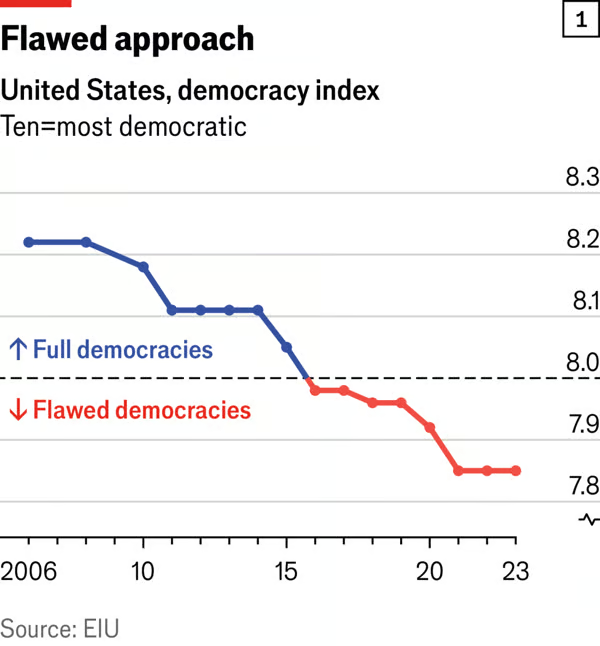
Not all of this will have registered with voters, but the alternatives were a false and lying claim to be the champion of ordinary Americans against the elite with its corrupt and rigged system; and a defender of the system on the equally false claim that it is democratic.  Of course, Trump will advance an attack on democratic rights but the US has already fallen from a ‘full’ to a ‘flawed democracy’, according to that shrill defender of US capitalism ‘The Economist’, and this fall didn’t just happen under Trump.

Having tried to hide Biden from the population, the Democratic party tried to do it again with Harris.  A US commentator in ‘The Irish Times’ noted that ‘after a month in which Kamala Harris was shot to the top of the ticket by her party elites, and in which she did no substantive interviews, she was clearly leading. She then spent a month introducing herself to the public. This was her big mistake. Thereby she fell backwards into a dead heat as Americans concluded she’d be better off not speaking.’

He summed it up by saying that ‘What we can say is that the 2024 election is between a man whom Americans know far too well and a woman Americans would rather not get to know.”

The top-down manipulation of the Democratic party’s traditional base failed, encapsulated in the failure of the leadership of the Teamsters Union to endorse Harris.  She didn’t give them any reason to do so.    Even the issue of abortion rights was not nearly enough to propel her to victory, while the identity politics so beloved of the Democratic party, especially parts of the left, also failed it.  

Trump targeted a lot of his media propaganda against the Democrats’ transgender agenda, which they then also retreated on.   Trans activists complained that ‘in a recent Gallup poll, transgender issues ranked dead last (out of 22 total areas) in importance to voters’, but don’t seem to realise that it is precisely its unimportance to many that meant that its previous prominence for the Democrat’s showed how out of touch they were.  This is only confirmed by the irrational and harmful demands previously championed; ranging from men in women’s sports to unproven or harmful medical interventions on vulnerable young people.

There is no reason to lament the defeat of Kamala Harris – the candidate of the war party and of genocide; of the biggest part of corporate United States; of a corrupt and rotten political system, and of fake progressive politics and truly reactionary identity politics. That a figure as repulsive as Donald Trump defeated her is testament to her and her party’s own abominable character.

The resistance to the Trump agenda will not advance through the politics or organisation he has just defeated, but through a critique of both, and working out how to break US workers from both Trump and the Democratic Party.  This involves bottom-up organisation and alternative politics to the fake claims of corporate-approved progressiveness.  The alternative is politics that puts forward what unites the working class, that opposes what divides it, and is clearly in their interest. This politics isn’t ‘populist’ or ‘progressive’. It’s socialist.

Should we support the Ukrainian Left’s route to victory? (2 of 2)

As I noted at the start of the previous post, various leftists in the West have said that we should listen to the voices of Ukrainian socialists and follow their lead, except, as we have seen, they are following the lead of the Zelenskyy regime.  His ‘victory plan’, the part that is not a secret to the Ukrainian people and known only in Western imperialist capitals, is that Ukrainian resources should be made available to the corporations of these imperialist states; that Ukraine should be able to join their military alliance NATO, and that it fulfil this role by its troops being stationed in other European countries. No doubt these Ukrainian troops would include its far right and fascist units, which would allow the concentration of existing NATO troops against other targets.

These Ukrainian socialists excuse this policy of integration into Western imperialism as the appearance of a “sober approach”, regretting that it feels “humiliating” for it to be “turned down almost immediately”.  They presumably deny that the moves towards NATO membership were crucial to precipitating the Russian invasion and entertain the idea that the cause of the war can be its solution.

This position stems partly from material weakness – “there is no left-wing political force in Ukraine that would voice the issues inherent to working people” – but this can only begin to be rectified by developing an independent political programme that stands upon the interests of working people.  Sotsialnyi Rukh (Social Movement) is a social movement because it is not a socialist one.  It floats in Ukrainian society and reflects, through its liberal conscience, the reactionary nationalism of Ukrainian society and its state. It cannot therefore articulate a position separate from the ruling regime.

It notes that the regime is “singling out new internal enemies: Russian speakers, “victims of colonial thinking”, followers of Moscow priests, collaborators, Kremlin agents”; with “manifestations of linguistic chauvinism, justification of hostility towards national minorities . . . and fostering ideological uniformity”; but it doesn’t decisively break from the ideological dominance of Ukrainian nationalism and makes the same ultimatist demands in relation to the pro-Russian East as the most rabid fascist – “recognition of the annexation of occupied territories is obviously out of the question”.  Yet where is the attempt to reconcile this demand with claimed opposition to the view that the people of these regions are “internal enemies”?  It can only dribble that this “will complicate the reintegration of occupied territories.”

Calls for “uniting as many people as possible around ideas of justice, freedom, and solidarity” are only so much sanctimonious sermons without a relevant political programme, and without outright opposition to those opposed to anything meaningful these words might entail, which includes the Ukrainian state and its imperialist sponsors, on whom it is now totally reliant.  Where on earth is Western imperialism a force for “justice, freedom, and solidarity”?  This Social Movement declares its “support for victims of far-right violence” but has nothing to say about this far-right being an integral and leading component of the Ukrainian armed forces that it supports.

Sotsialnyi Rukh states that “people should have a stake in the country’s future and respect for human dignity must be at the core of a society that asks its members to risk their lives for it” – a disregarded acknowledgement that this is precisely what does not exist, and which renders its whole approach inadmissible.  The correct response, enunciated by Marx in similar circumstances in which it was claimed that a reactionary state can be of assistance – and promoted now as resulting from “a sincere dialogue from the government” – is to state that “the working class is revolutionary, or it is nothing.”  What does this mean for Ukrainian workers today?

It starts by discarding illusions in the Ukrainian state and that the purpose of “a political movement” is that it “ensures the voice of the people is heard in the corridors of power.”  The corridors of power are staffed by reactionaries beholden to Western imperialism, seeking a new mobilisation of Ukrainian workers for the cause of membership of its imperialist alliance – a blood sacrifice on behalf of those whose plan to is enrich themselves on Ukraine after the war.

Opposition to the Russian invasion does not require support for NATO or membership of it, and the Sotsialnyi Rukh view that without “security guarantees” from the West Ukraine faces “an open invitation for renewed aggression” ignores that Ukraine thereby becomes hostage to Western imperialism’s aggression and any Russian response.  “Security guarantees” will require assurances of “predatory exploitation” by “foreign investors” with all the “inequality, alienation and disenfranchisement” that will result.  The enemy of my enemy is not my friend.

The unity of the workers of Ukraine and with their opposite number in Russia requires opposition to national chauvinism, with its hostility to national minorities, and only on this basis can a peaceful reconciliation of any kind be proposed as an earnest and sincere promise of unity without oppression.  Sotsialnyi Rukh cannot promise this by condemning such things as the Israeli oppression of Palestinians while seeking support and alliance with the same US imperialism that is the sponsor and accomplice of this oppression.  It is not possible to run with the fox and hunt with the hounds’ as the old saying goes.

Sotsialnyi Rukh demands “the restoration of electoral rights, the right to peaceful assembly and workers’ strikes, and the abolition of all restrictions on labor and social rights” but proposes that a “sincere dialogue” with the government that took them away is the way to achieve them.  Only by relying on the strength of the working class movement itself can the prerogatives of the working class be defended and advanced.  If it is too weak to assert them itself, it will never gain the strength to do so by relying on those who took them away.

Spontaneous resistance has arisen in opposition to the street kidnapping of workers so that they can be sent to their deaths at the front.  This resistance should be organised with the demand that summary arrest be ended; corruption in mobilisation exposed; that all conscripts receive proper training; that they have the right to organise trade unions and the right to protect themselves, including from suicidal orders from the rear. None of this is possible through “demand(ing) full state control over the protection of lives and the well-being of workers.”

The Ukrainian state has declared, even in the words of Sotsialnyi Rukh, that it “owes nothing to its citizens” and that its appeals are “hollow”.  By refusing to break from it, Sotsialnyi Rukh demonstrates the same for itself.

The Ukrainian state has no theory of victory that does not involve massive escalation of direct NATO intervention; to endorse it or give it a left gloss does not alter this in any way.  For workers in the West, it would mean following a road to escalation with all the risks of a world war that this involves.  To do so would see them dragged towards the same subordination to their own state and ruling class – where its left pro-war supporters have already gone – and politically unarmed to prevent world war.

The last thing workers in the West should do is take their lead from such a ‘social movement’.  For both, the slogan ‘the main enemy is at home’ remains the road to victory.

Back to part 1

Should we support the Ukrainian Left’s route to victory? (1 of 2)

At the start of the war in Ukraine various leftists in the West said that we should listen to the voices of Ukrainian socialists, which might have made some sense were these people socialist. Except they are not.  Two recent statements by them confirm their reactionary character and have value only to illuminate their political bankruptcy and, by extension, those in the West who follow them and have called for others to do so.

The statements address what is necessary for Ukrainian victory and the tasks of the left in achieving it.  It is supposed to be a left alternative to Zelenskyy’s much trumpeted ‘victory plan’– touted round the various capitals of western imperialism – but reveals itself to be a plea for succour to the regime that has sought it itself from imperialism and failed.

It is not an alternative to it but a pathetic reflection of it.  It is useless even for its own purposes and worse than worthless as a guide for a working class alternative course out of the war.  It can be summed up by one sentence within it that shows that it pretends to no alternative to the current state, and therefore no possibility of an alternative way out of the catastrophe inflicted on the country.  It states that “We will demand full state control over the protection of lives and the well-being of workers . . .”  The same state that colluded in precipitating the disaster – that has delivered its people into a needless war that has wrought such death and destruction – is to be the protector of the lives of its workers.  This is both absurd and treacherous.

The statements themselves can’t help but note the current misdeeds of this state, its “corruption, censorship, and other abuses by officials”, and the reaction of Ukrainian workers – “civilians no longer queue at draft stations but actively evade mobilisation. Reported cases of draft dodging have tripled since 2023, and polls consistently show that nearly half of respondents view this as reasonable.”  They note “nearly 30,000 cases of AWOL have been registered in the first six months of 2024” and “the brutality and impunity of draft officers, who press-gang men off the streets . . . In the meantime, reports from the battlefield describe how unmotivated, untrained, and even unfit recruits endanger the rest, making the result of increasing coercion questionable.”   Questionable?, is that all it is?  Medically unfit men kidnapped off the street and sent to the front  – poorly trained and armed – to die in a war against a much more powerful enemy?

The result is that “after 970 days of war, 10,000s dead, 100,000s wounded, and millions displaced, the toll is immense. Few families remain untouched by this devastation.”  Yet it refuses to denounce the ridiculous tally of dead and injured quoted in the Western media, fed to them by the Ukrainian state and the Zelenskyy regime. Its statement is unwilling to challenge these lies about the devastating consequences of the war, while saying that they have “taken our people for granted”, yet refusing to acknowledge the human cost that repeats this.

“Under the realities of oligarchic capitalism, restrictions on freedoms often serve the interests of the elites”, one statement declares, in admission of the rotten nature of the society and state that commits these crimes.  It notes the statement of the minister of social policy Oksana Zholnovich, that  “we need to break everything that is social today and simply reformat from scratch the new social contract about social policy in our state.”

It sums up the hypocrisy and real policy of the state by saying that “appeals to civic duty ring hollow when the state openly declares that it owes nothing to its citizens”, yet its proposals are that “the government should start a dialogue with the people about the achievable goals of the war.”  It simply wants “to cooperate with other forces to build a political movement that ensures the voice of the people is heard in the corridors of power.  “Sotsialnyi Rukh (Social Movement) demands a sincere dialogue from the government with society on how we arrived here and what we can realistically expect.” A “sincere dialogue” with a regime that promised peace and an end to corruption that has instead walked its people into war with new opportunities for massively increased graft through it.

It would be possible to feel a little sorry for this movement were it not for its own hypocrisy and war policy.  It accuses the Zelenskyy regime of presiding over “a caricature of a war economy” that “makes it possible to prolong the war at the cost of significant human losses and constant mobilization.”  Yet its own policy is simply an extension of this through a state “subordinated to the priorities of defense . . . mobilising all resources for defence”, while simultaneously promising that it “defends the rights of conscripts and servicemen to dignified treatment” when many of these workers do not want to be conscripts at all.

Zelenskyy’s plan is criticised for “its disproportionate reliance on the West’, while acknowledging that “to fight against Russian aggression . . ., we need support from the global community, including humanitarian and military assistance.” It laments this reliance but then states that “this might appear to be a sober approach”, with the further complaint that it feels “more humiliating” to be “turned down almost immediately”.

It canvasses what would be an acceptable peace but includes proposals that shows it has no idea “how we arrived here”, i.e. why the war began, never mind how realistically it might end: “The only deal with a chance of being supported, by a slight margin, includes de-occupation of Zaporizhzhia and Kherson regions, combined with NATO and EU memberships. . . . Therefore, the greatest mistake would be to pit diplomatic efforts against military support. Without meaningful solidarity, Ukraine and its people will fall — if not now, then later.”

It complains of “a quite remarkable shift from the earlier emotional appeals for solidarity to luring support with access to natural resources and promises of outsourcing Ukrainian troops for the European Union’s security”, but its own dependence on what it euphemistically calls “the global community”, and peace involving NATO membership, shows that its alternative to Zelenskyy is no alternative at all. It doesn’t even ask the question: why it is only now – after over two and a half years – that a purported plan for victory has been drafted? Or did all the others fail too?

Forward to part 2