Marxism and Gender Identity Ideology (6) – what it demands

EPA source BBC

Yesterday I listened to part of a podcast that discussed the view that the gender critical movement was over because the gender identity ideology had peaked.  The claim wasn’t convincing and today I woke up to an Australian judge deciding that sex is “changeable and not necessarily binary” with the BBC pointing to its worldwide implications.  In Australia the Prime Minister has claimed that there is an “epidemic” of violence against women, something akin, then, to the reported levels of violence against women in Ireland.

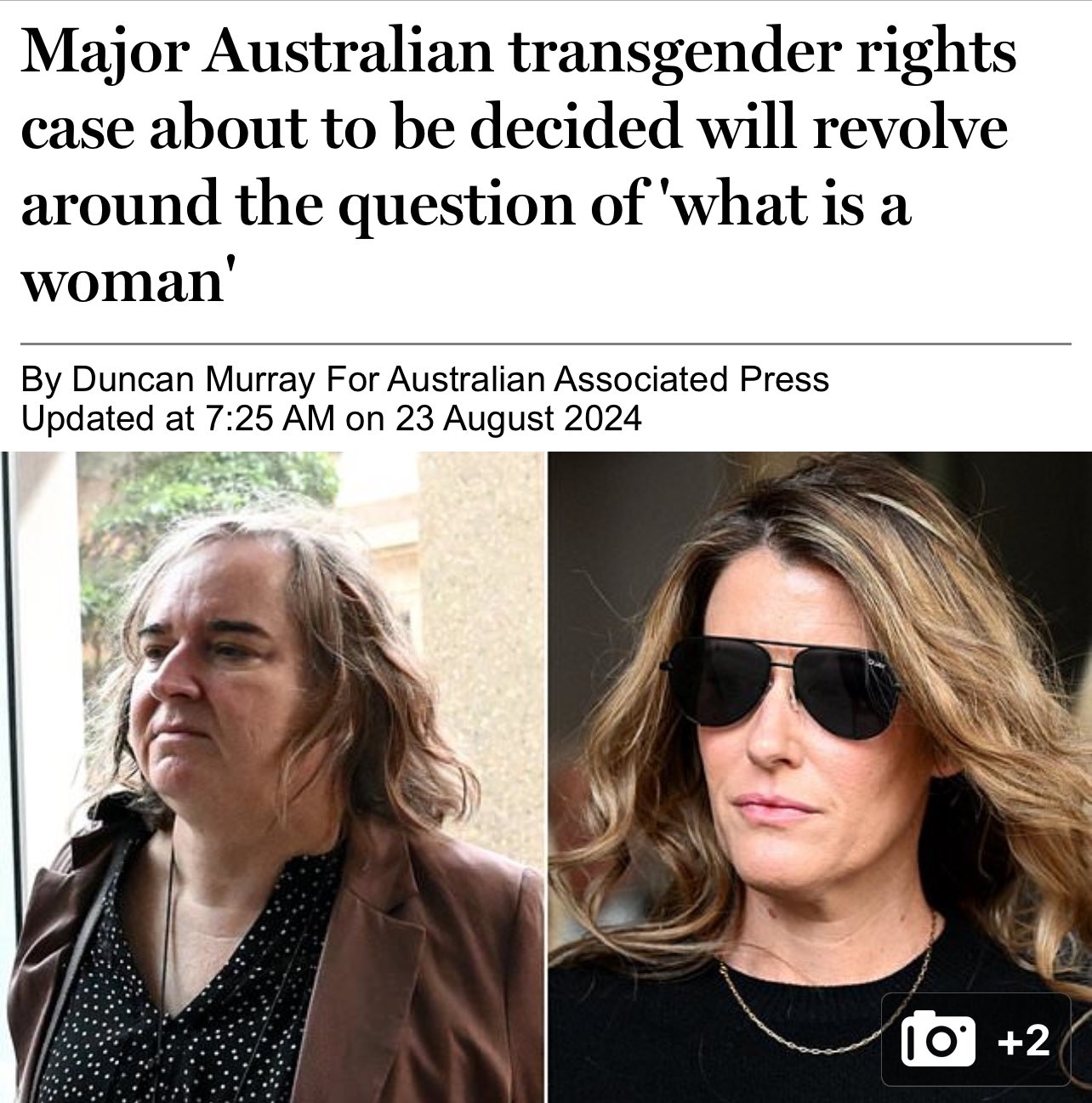
It is wryly amusing to look at the number of changes to the photographs used in the BBC article, illustrating the old proverb that a picture paints a thousand words.  While this post was mainly written long before the court decision, I can’t help noting a couple of things about the photographs used above and other media material on Roxanne Tickle.

First, Tickle is clearly a man. Second he would appear to have women supporters. That some women are happy to undermine their own sex-based rights is not exactly news but it does reinforce the view that the struggle for women’s rights doesn’t pit women against men but is one critical part of a general struggle against all oppression and for a new society that this blog argues is socialism.
Gender Identity ideology has some bizarre consequences, as we noted in previous posts and I wrote before this recent event, including that the intimidation of women defending their sex-based rights is somehow progressive.  Rejection of the idea that men can become women and entitled to the rights of women is claimed to constitute oppression, with the consequence that women can thus become the oppressors of certain types of men.  Discrimination against women cannot be measured, in fact cannot even be conceived since gender identity is everyone’s ‘true self’, whatever that is, something outside our material reality and social interaction as we noted when we tried to work out exactly what gender is.

Feminists who oppose gender identity ideology are criticised for focusing on body parts, such as the male genitalia of transwomen, even as this ideology leads to women becoming ‘menstruators’ or ‘cervix owners’.  When not so described, they are totally erased and described as ‘pregnant people.’  Even the British medical journal The Lancet referred to ‘bodies with vaginas’, ‘birthing parents’ instead of mothers, and breast milk as ‘human milk’, before having to apologise.  Johns Hopkins University in the US defined a lesbian as ‘a non-man’ attracted to a non-man’ before again having to retract.

Despite the insults, censorship and objectification of women into body parts, the assertion of the impossible – that ‘transwomen are women’ – is often accompanied with the demand to ‘be kind’, in other words accept the ideology because the feelings of a group of men, many with a sexual fetish, have their feelings hurt.  Diverse groups with little in common but an irrational ideology defend it and ignore the fetishism of many men claiming to be women.

It is instructive to note part of the Australian court proceedings that held out the criteria by which it appears we can decide that some men are actually women. Tickles’ lawyer asked the woman who was CEO of the women-only social media app the following:

“Even where a person who was assigned male at birth transitions to a woman by having surgery, hormones, gets rid of facial hair, undergoes facial reconstruction, grows their hair long, wears make up, wears female clothes, describes themselves as a woman, introduces themselves as a woman, uses female changing rooms, changes their birth certificate – you don’t accept that is a woman?” 

Since no amount of surgical or medical treatment, including cosmetic surgery; dressing up, wearing lip stick and dresses; self-description, using women’s spaces or changing the text of a piece of paper, changes one’s sex, the answer was ”No.”

It has often been noted that the gender ideology movement has achieved success rapidly, coming to public consciousness relatively recently and without the long struggle engaged in by gay men and lesbians.  Trans people are held up to be particularly oppressed, vulnerable, and marginalised and politicians who are asked to explain their support for the ideology’s demands often fail to answer questions by immediately stating their unique vulnerability and marginalisation as if this covers all the issues.

This movement is portrayed as a ground-up, grass-roots movement for liberation yet it has powerful support and achieved its success in part because of support from some who are very definitely not oppressed.  This includes the corporate executives of some very large companies, and their HR departments and Diversity and Inclusion policies, employed to burnish their PR and boost the bottom line.  (Becoming less popular precisely because it doesn’t).

It has had the support of prominent politicians such as the Joe Biden who, in his first day in office as President of the United States, stated that ‘transgender equality is the civil rights issue of our time’, issuing an executive order instructing federal agencies not to discriminate on the basis of gender identity.

State bureaucracies such as the NHS now pretend women inhabit men’s bodies, which is an impossible way to consider human health.  A whole book has been written on how the pretence that there is no difference between male and female bodies (making the male one the default) has affected many areas of women’s lives, including most obviously their heath.  

Well-funded NGOs such as Stonewall spread the message through awards to businesses and organisations that adhere and implement the ideology, including awards to such progressive organisations as MI5.

It has achieved it successes not through mass demonstrations and civil disobedience but through lobbying the powerful and through policy capture.  In other words, through bureaucratic means, for which shutting down questions through the mantra ‘no debate’ is perfectly suited.  It has inspired legislative changes erasing the importance of sex and imposing gender identity that have been introduced under the radar with most people unaware of it happening or innocent of the consequences.

The British National Health Service is a good example of the consequences of the intrusion of this ideology and its regressive consequences.  The Cass Report into the treatment of young people with difficulties attributed to gender identity was a stinging rebuke of gender identity ideology, recording many of the damaging consequences of its intrusion into health care.  These include the lack of evidence for puberty blockers and opposite sex hormone treatment, which may have permanently damaging and irreversible effects that vulnerable young people may easily be unable to fully appreciate.  Cass noted the fear of some clinicians of working in the area and the lack of evidence for the ‘gender affirming’ approach.

Six of the seven gender clinics involved refused to cooperate with the inquiry in supplying data and information on their patients and treatment, raising suspicions that what was being practised had more to do with ideology than best treatment for the “various combinations of confusion about sexuality, psychosis, neurodevelopmental disorders, trauma and deprivation, forensic issues and a range of other undiagnosed conditions” (Transgender Trend). Without shame, the supporters of the ideology have attempted to discredit the evidence behind the report, without success.

Finally, in the ’Weekly Worker’ series of articles on transgender rights that we have occasionally referenced, the author notes that a socialist response will have to be one that is not grounded on ‘trans’ as an independent single issue and/or on the politics of anti-discrimination and ‘rights’.

He states that “I think that the political nature of this positive approach has to be one which stresses the commonality of the oppression of trans people with other experiences of oppression and exploitation, rather than stressing the difference.’  Yet, even with that approach, the claims of Gender Identity ideology must be assessed and challenged.  When it impacts on the rights of women to their detriment, even this mistaken approach must look at what commonality of oppression exists – how does defending the reality of sex against a false and spurious claim that men are oppressed by not being recognised as women constitute any sort of oppression?

The ‘Weekly Worker‘ articles repeat again and again the paucity of the distinct demands from the ideology’s movement that socialists can support or that are not already common currency, such as against discrimination for anyone diverging from sexist stereotypes.

Others are explicitly rejected: ‘Trans rights activists have identified doctors’ ‘gatekeeping’ access to drugs and surgery as an aspect of their oppression. But self-diagnosis is not always the right answer.’  (An unacknowledged hole below the waterline for the whole ideology since it rests totally on acceptance of the word of those making claims to belong to the other sex).  In relation to the Tavistock gender clinic, it notes ‘some evidence of belief by some children and parents, shared by some staff, that a trans outcome for the children involved would be preferable to self-acceptance as gay or lesbian.’

The demand for adequate health care by trans activists is a common need for all working class people unable to pay directly for satisfactory services, while the particular and specific demands of gender identity ideology are reactionary.  These demands involve access to women’s places in society including toilets, changing rooms, rape crisis centres and refuges, hospital wards, women’s prison estate, and participation in women’s sports where men’s physique gives them an advantage.

In all these cases women’s comfort, privacy and safety are compromised and considered irrelevant to the demands of men identifying as women, justified on the grounds that not all men are violent predators.

This simply ignores that violent and sexual crime is overwhelmingly carried out by men and that women are unable to identify which men are not disposed to carrying it out.  Since there is no evidence that transwomen are any different to the general male population in this respect, it cannot be claimed that transwomen are not a potential threat.  The argument for transwomen in women’s spaces is therefore one that applies to all men. The view that men and women should ideally be able to share all public spaces might be made a reality when the reality of this pattern of criminal behaviour is changed.

These demands also include opposition to ‘conversion’ therapy for children reporting their belief that they are trans.  These young people have many other difficulties that might explain their symptoms of unhappiness, stress and depression etc. These include puberty and the accompanying anxiety arising out of their sexual development, or their autism, eating disorders, or simply finding their attraction to the same sex. Instead it is demanded that their claims to be trans are immediately affirmed without consideration of the potential for this self-diagnosis by immature young people to be the result of social contagion, peer pressure from friends or social media, or arising from any of their other comorbidity conditions.

Once again, the world is turned upside down.  The therapeutic approach of watching, waiting, and talking over young people’s feelings of alienation – to get to the root of their distress, whatever it might be – is damned as ‘conversion’ therapy.  Yet the radical medical and surgical treatment that can involve the removal of perfectly healthy tissue; consumption of puberty blockers and opposite sex hormones, which have known significant risks to long term health and fertility – this is supposedly not conversion treatment but ‘affirmative’ treatment when what is really being affirmed is gender identity ideology.

There is nothing progressive about any of this.   We have gone from men claiming to be woman, claiming and replacing their places in society, to the idea that it is impossible even to tell the difference between a man and a woman (courtesy of the head of the International Olympic Committee).  Despite this we have a left captured by identity politics, or influenced by liberal and hollow claims to oppression, that defends this nonsense and attacks the rights and essential existence of half the human race. When challenged it often responds with angry and empty insults. It is a big part of the problem.

Back to part 5

Forward tom part 7
Sticking it to the Russians

When the Ukrainian regime first accepted responsibility for the invasion of the Kursk region of Russia the justification was that it was simply giving it to the Russians as the Russians had given it to them.  And this, as far as it goes, is perfectly true.  This will not give its supporters in the West any pause for thought that this equality might mean that both sides are equally reactionary.  When one of the early apologists for the Ukrainian state justified support for it and its alliance with Western imperialism and NATO, he said that:

‘To describe the ongoing conflict in Ukraine, in which the latter country has no ambition, let alone intention, of seizing Russian territory, and in which Russia has the stated intention of subjugating Ukraine and seizing much of its territory – to call this conflict inter-imperialist, rather than an imperialist war of invasion, is an extreme distortion of reality.’

He went on to justify the supply of western weapons to Ukraine with the argument that:

‘Since the Ukrainians’ fight against the Russian invasion is just, it is quite right to help them defend themselves against an enemy far superior in numbers and armament. That is why we are without hesitation in favour of the delivery of defensive weapons to the Ukrainian resistance.’

“Defensive weapons” became the loophole through which this support for western imperialist intervention was smuggled in – ‘we must also oppose the delivery of air fighters to Ukraine that Zelensky has been demanding. Fighters are not strictly defensive weaponry, and their supply to Ukraine would actually risk significantly aggravating Russian bombing.’

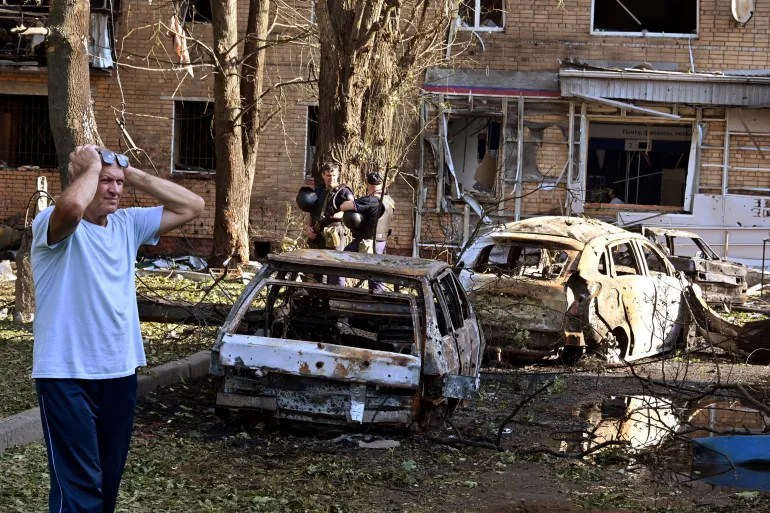
This loophole has now been ripped apart to reveal wholehearted support for western imperialism, with the provision of main battle tanks spearheading the invasion of Russian territory; ATACMS /HIMARS/ storm shadow missiles hitting targets inside Russia; special forces troops on the ground ensuring their successful operation; attacks on Russian territory including on radar stations that warn of nuclear attack from the West; and now the F16 fighter planes that were claimed to typify a non-defensive weapon.  By its own admission Ukraine and Western imperialism is on the offensive

The British Ukraine Solidarity Campaign has been urging its government to supply more military material than it has, in effect criticising one of the most hawkish western imperialist powers from the right – for not being aggressive enough! According to its earlier analysis the war is an imperialist proxy war and they should now be opposing the Ukrainian state and western imperialism.

They cannot because they will not, and they will not because they have decisively placed themselves as the ‘left’ of a pro-imperialist alliance.  This formal and informal coalition has far, far stronger partners than them, from the imperialist states it calls on to arm Ukraine to the reformist left that is reformist precisely because it will never break from its own imperialist state.  It does not have the political tools to explain its capitulation and navigate its way out of it.  It can currently damn this imperialism for its role in perpetrating genocide in Palestine while urging it to greater action in Ukraine, as if it had a Jekyll-and-Hyde personality, a good side and a bad side, that will sometimes play a progressive role in advancing the interests of the working class.

It has hooked itself up to Western imperialism with excuses that by supporting the Ukrainian state it is supporting the Ukrainian people, while it disregards altogether the class nature of the state and of the different classes within it.  By this logic we are now witnessing the invasion of Russia by the Ukrainian people.  Given that the invasion is led by the most effective units of the Ukrainian armed forces, which are also among the most rabidly nationalistic and reactionary, we should also be hearing its support for the working class Russian conscripts fighting them.

We don’t because the reality of Ukraine has exposed the hollowness of its claims to victim status.  It chose to build a large army trained by NATO and to allow the CIA to camp in its territory in order to assist its covert actions against Russia.  It chose to seek NATO membership and float the idea of stationing nuclear weapons on its territory. 

Whenever it is not urging increased intervention by its own imperialism the pro-war left is dispensing analysis oblivious to its meaning.  Even in the paragraph quoted above, it is noted that Russia is ‘an enemy far superior in numbers and armament’.  Left to itself, Ukraine would have already sued for peace.  That it has not is because of the support of Western imperialism, and just as the war continues because of imperialism so is the nature of the war determined by it.

The Western media portrays the Kursk invasion as an ‘incursion’ even as it celebrates the magnitude of the territory conquered as much larger than that won by Russia over many months in the Donbas.  It claims that the Western powers that finance and plan its war; that trains its army; provides the weapons, targeting and intelligence for its attacks on Crimea and Russia, had no knowledge of the invasion.  Only the ignorant or stupid could swallow this nonsense. We are expected to believe that Ukraine has not told the US and NATO of its invasion when it is supposedly required to tell them how far it can fire its missiles. NATO helped plan its 2023 offensive, so the idea it has not done so now – peddled by the Western media – simply exposes its output as propaganda.

A western-planned invasion of Russia using US and German armoured vehicles, and British main battle tanks has crossed another Russian red line, just as many earlier ones have been erased.  There is no reason to believe that this is the last, while such a course leads to a world war and a descent into hell.

The pro-war left feigns concern for the Ukrainian people while more of its young men try to escape from being sent to the front, recruiter’s vehicles are burned, and it faces into a freezing winter with a power system mostly destroyed.  Instead of supporting the end of the war it rows in behind its own imperialism’s increasingly belligerent prosecution of it, using Ukraine as its proxy.

This support for continuation of the war is in the interest of neither the Ukrainian or Russian working class.  It is not even in the interest of the Ukrainian state that is now bankrupt, in hock to western imperialism, and denuded of people and territory it will not get back.  The Russian state has no interest in a forever war on its doorstep, or any peace deal that sees NATO camped in whatever is left of Ukraine and that is only a temporary respite before another NATO inspired conflict is provoked.  Just like the previous Minsk Accords experience.

The only player that has an interest in continuation of the war is Western imperialism, which has no concern to end the bloodshed, as it has demonstrated in its support for the Zionist state in Palestine. But as we have argued, one other minor performer has evinced no interest in an end to the war without Ukrainian victory.  Why would its position be any different, having hitched itself to Western imperialism?

The Ukrainian regime is now claiming that its invasion is intended to encourage negotiations, which Russia has said are impossible while its territory has been invaded. The invasion is an initiative born of approaching Ukrainian defeat that it cannot escape, from ‘an enemy far superior in numbers and armament.’  Either Western imperialism accepts this prospect and tries to extract something from it or it escalates and crosses more red lines and brings hell closer.

Socialists should be supporting the end of this war and opposing the supply of weapons and troops to Ukraine and Eastern Europe as a whole.  If they continue to support it, their claims to socialism will be a case, not of wearing the emperor’s new clothes, but of wearing the uniforms of the armed forces of western imperialism.

Anti-racists in Belfast push back against the fascists

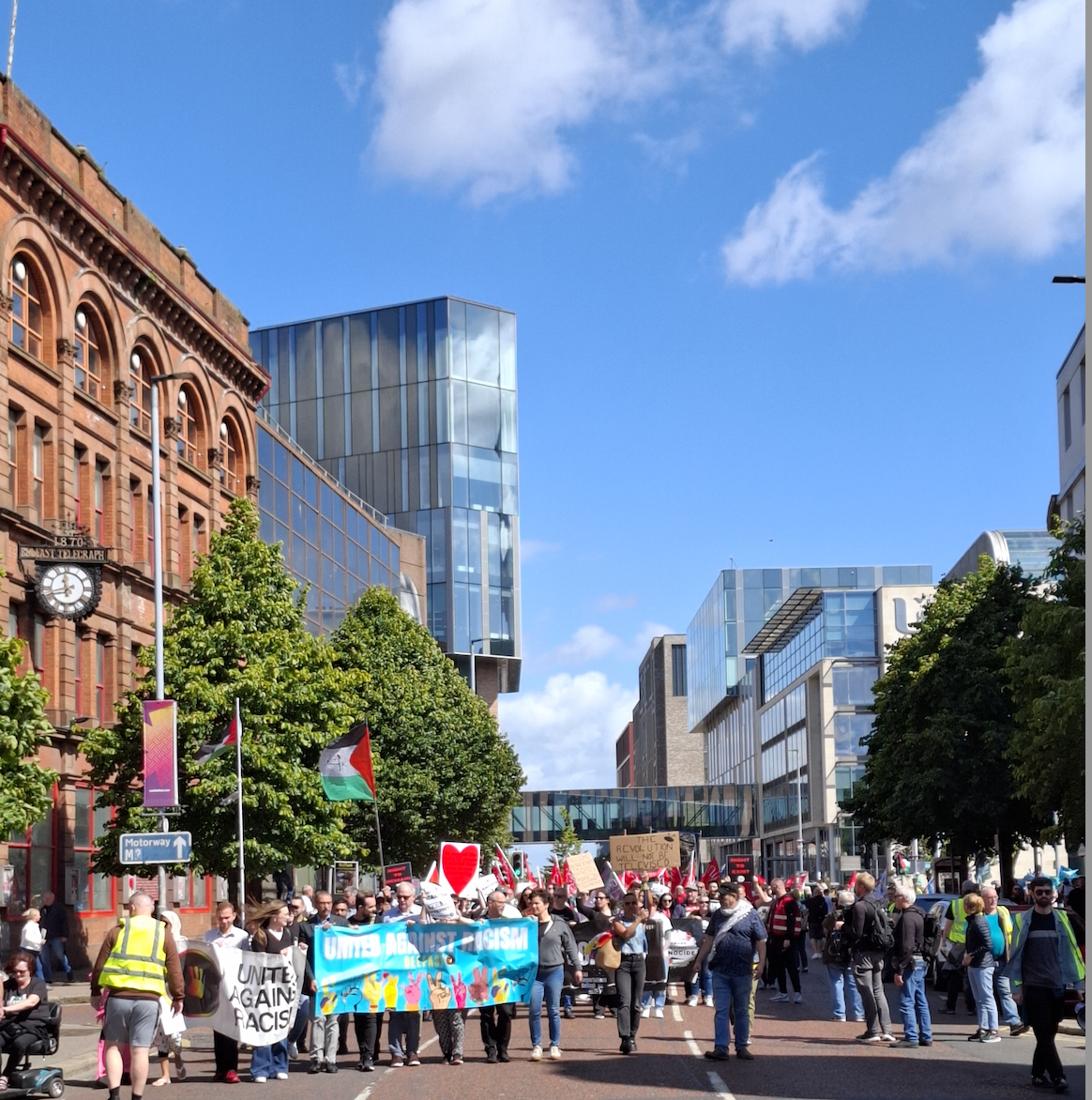
A week after a far right rally in the city centre led to an impromptu march to South Belfast, and attacks on ethnic minorities, the far right thought that it could cement their success with a rally in the same place the following Friday night.

Their initial Saturday rally was already small but grew when it passed through some working class loyalist areas and headed for the areas with a more prominent ethic minority presence.  They were eventually stopped, not by the police, who limited themselves to a stationary presence, mainly to defend the Islamic Centre, but by residents of the lower Ormeau Road, a mainly working class nationalist area.

The following week there were numerous attacks on ethnic minority businesses and individuals, mainly in Belfast and mainly in loyalist areas, but not exclusively so.  The far-right rally drew some attention world-wide with pictures of racists waving British Union flags and Irish tricolours, with comments about how the infamous religious division in Ireland had been overcome.  In fact, the appearance together of Irish fascists and Irish loyalists is not something to write home about, but media pundits couldn’t resist commenting and far right bloggers around the world couldn’t help claiming an historic success.

The Belfast racist’s attempt to repeat their success on Friday night was an ignominious embarrassment.  An acquaintance of mine mentioned that he had gone into Marks & Spencer for a cut-price sandwich and had gone out the back door to have a look at the racist/fascist/loyalist admixture, only to find twenty or so guys, some with Glasgow Rangers football tops, wondering why they were so few.  In the end there were less than 100 facing a counter-demonstration of around 1,000. 

The counter-demonstrators had much fun chanting:

We are Many

You are Few 

We are Belfast

Who are You?

and

There are many, many more of us than you

There are many, many more of us than you

There are many, many more

Many, many more

Many, many, more of us than you

The following day thousands of demonstrators took to the streets for a demonstration to the same site in the front of the City Hall.

The actions of the residents of the lower Ormeau Road and the mass anti-racist demonstration has gone a long way to putting the racists and fascists back in their box, but there are many reasons not to think that this particular struggle has been won.

First, the Belfast events were part of a series alongside far right attacks in Britain and follow similar attacks in Dublin and across the Irish state.  In both of these the scale of attacks were much larger and broader.  The killing of three young girls blamed by far right rumours on a Muslim immigrant was the occasion for the attacks in Britain and these in. turn were the catalyst for the Belfast attacks.

The Belfast demonstration was attended by some far right protestors from Dublin, including from the Coolock group that had rioted to prevent the creation of accommodation for asylum seekers in the area.  Dozens of arson attacks across the Irish state have been made on such prospective sites and a major riot in Dublin in November followed an attack on young children by a man originally from Algeria.

Just as the attacks in Britain and the south are not new, neither are attacks on ethnic minorities across the North of Ireland, which became more frequent recently.   Most of these are in unionist or loyalist areas because demographic decline has meant that accommodation is more available and less expensive, while property for new ethnic shops is also cheaper.

For many older people the sight of significant (but still tiny) numbers of ethnic minority people is still in some ways remarkable.  It’s a bit like seeing young people wearing GAA (Gaelic Athletic Association) tops in places where previously even someone suspected of being a Catholic would have been in mortal danger.  It is visual confirmation of the relative decline in the unionist population and increase in the nationalist one, alongside their greater political and social prominence.

These working class Protestant areas would once have been full to the brim of a monocultural population which considered itself the rightful subjects of the state who could look down on the Catholics as second class citizens.  Against this, a significant number of Protestant workers were consciously non-sectarian and anti-sectarian but they did not define the tone of the neighbourhoods, especially during the Orange marching season.

Racism therefore has two reasons to be more prevalent in loyalist areas – ethnic minorities are more prominent, and loyalism has always been based on supremacism – expressed in sectarianism – for whom racism is not exactly a distant cousin.  Nationalists have in the past looked to the black civil rights movement in the US as analogous to their own discrimination and resistance and have looked upon racism among loyalists as confirmation of their own world view.

So, no one on the counter demonstration or the following day’s anti-racist march was wearing a Rangers top whereas there were many GAA tops and a few Glasgow Celtic shirts.  There were many Palestine flags and at least one Irish tricolour, while at one point a large part of the crowd was singing a song in Irish.  There was also a noteworthy republican presence on the Friday night counter demonstration.

This is not at all to suggest that the counter demonstration was a purely nationalist one or that the Saturday demonstration was either, even if the political speeches were by Sinn Fein, the SDLP and the People before Profit MLA from west Belfast.  No one on either demonstration would have considered it to be a nationalist one and it identified itself repeatedly in chanting that it was anti-racist and anti-fascist. No one, however, is blind to the obvious facts, including that the racist demonstrators waved union flags and posters and the previous Saturday’s racist march was made up of loyalists that the fascists from Dublin could ‘unite’ with.  The PSNI (Police Service of Northern Ireland) has stated that loyalist paramilitaries have been involved in the recent racist attacks.

There is thus some irony in the numerous placards and repeated declarations on the Saturday demonstration that it was in support of ‘diversity’ with one placard saying that Belfast itself was built on it. I doubt that any of the demonstrators expected their diversity to include their fellow demonstrators to be wearing Rangers or Linfield tops or waving Union and Ulster flags, or politicians from the DUP to be speaking from the back of the lorry.

Of course, when demonstrators talk about diversity they mean opposition to discrimination on grounds of race or sex or sexual orientation etc. and not politics, but this shows that politics is central and focusing on diversity erases this centrality.

One example was a young woman holding up a home-made placard telling the racist demo ‘check your privilege’.  If she had checked the racist demonstrators herself she might have noted that there wasn’t much evidence of privilege.  In general the rioters have been poor, ignorant and frequently quite stupid.  Of course they have been white, but so were the vast majority of the anti-racists.

A number of speakers pointed out that the racists are scapegoating asylum seekers and refugees for the failure of governments and their austerity policies.  They pointed to years of Tory austerity and to Starmer’s promised continuation of it, but these are not the only offenders.

These culprits are now offering their own law and order solution to racist violence and the main Muslim speaker at the Saturday rally, Raied al-Wazzan, Vice-chairman of the Northern Ireland Council for Racial Equality, called on everyone to support the police – the police that had just failed the previous week.

In Britain various police forces have been proved again and again to be racist and misogynistic while they have been embroiled in scandal after scandal including corruption and spying on left wing organisations.   In the North of Ireland they have an even worse history, including collusion with the loyalists that are now behind the racist attacks.

The call for the police to protect ethnic minorities from racism at least reveals that the immediate question is one of physical self-defence and the solution to that was demonstrated by the lower Ormeau Road residents.  Workers should organise to protect their own communities and by involving the targets of racism themselves.

This was something that wasn’t argued for at the rallies despite repeated chanting and invocations that “When migrants’ rights are under attack, what do we do? Stand up, fight back.”  Lots of slogans about fighting back but zero calls or steps at the rallies to begin organising it.  Instead, there were a number of calls for Hate Crime legislation to be introduced, which is a call for increased police powers, a step to close down free speech and a weapon that will be employed against the left and defenders of women’s rights.

While we had many pointing the finger at politicians who had sowed the seeds of racism by blaming refugees for poor public services that they had been responsible for reducing, there was not a murmur at Sinn Fein who had a speaker at the Saturday rally.  Not only has Sinn Fein imposed austerity in the North, while washing its hands of responsibility by blaming ‘London’, it has formed a partnership with the DUP that jointly dispenses little more than slush funds between republican supported and loyalist ‘community’ organisations that provide power and prestige to loyalist groups.

In the southern Irish state Sinn Fein has followed the example of the Tories and Labour in Britain, and Fine Gael and Fianna Fail in Ireland, in presenting refugees and immigrants as a problem, as something to be reduced and a population of the undeserving that must be expelled as soon as possible.

Sinn Fein’s new policy of an audit of services etc. in working class areas so that a rationale can be provided to prevent accommodating refugees within them is further pandering to racist opposition.  Applied in the North, the current areas of highest refugee populations would likely fall foul of a Sinn Fein ‘audit’.  You will not be surprised that this new great policy of Sinn Fein was not proposed at the Saturday rally.

There was only one discordant note from a speaker at the rally, when the NIPSA union leader and Socialist Party member Patrick Mulholland, noted that racists had waved both union flags and tricolours while they carried out their actions.  This resulted in a few grumbles from some in the crowd but has the unfortunate quality of being true.  Irish politicians and some left nationalists have complained that this is a misuse of the national flag and the racists and fascists have no right to it. Their problem is that the racists and fascists have as much reason to claim to be nationalists as any of the other nationalist organisations.

The strength of the anti-racist and anti-fascist movement was on display in Belfast over the weekend – its numbers, its enthusiasm and its determined opposition.  Also on display was its weakness – its reliance on the state and police, the hypocrisy of many of its adherents, the poverty of its immediate organisational objectives and weakness of overall political alternative.

The answer to racism and fascism is not ‘diversity’. Like gravity, such diversity exists anyway and will continue to exist whether celebrated or not. What matters is not that we are different in many ways but that we have cause to unite; the grounds for this unity is where our interests lie and that must be our central concern.

A New Popular Front for Ireland? (3 of 3)

AFP

A final argument in support of the New Popular Front approach is to argue that the key task of the day in the class struggle is to stop the far right, and this the Nouveau Front Populaire (NFP) has done.  How else was it to be done in the circumstances?

One way this has been put is to say that:

‘If the left had not voted for Macron candidates in the second round, it would have meant an overall majority for Le Pen. Just listen to the relief expressed by ethnic minority people on TV in the Republic Square last night. They were terrified at a Le Pen government moving aggressively against so-called bi-nationals. Stopping a Le Pen government makes a real difference. Counter-posing mass struggles or street mobilisations as an immediate solution to defend black or Arab people is just demagogy.’

Let’s get some things out of the way first – ‘Just listen to the relief expressed by ethnic minority people on TV in the Republic Square last night’ is not enough, not nearly enough, to join that fear and then surrender political principle and independence.  If this is a guide to the rationale then it is woefully weak; the fight against the far right will be advanced by militant action based on socialist politics, not fear driving the working class into the arms of the main bourgeois parties and through them the French state. Were the far-right an immediate fascist danger it would be because this state, and its political class, had decided that fascism was required, in which case allying with this class in order to preserve the current state would be an obvious disaster. 

Let’s note the admission in this article of the price paid for this ‘success.’  First, that the NFP propped up the Macron bloc to the extent it could, and ‘we should not forget her (Marine le Pen) group topped the vote share, and the increase in her party’s seat tally is still historic.’  In other words the far right still gained and the main bourgeois parties that paved their way received protection by the intervention of a ‘united left’.  These are the circumstances that facilitated the rise of the far right previously, that precipitated the crisis, and which – despite the NFP ‘success’ – still. persist.  A ‘success’ which reproduces the threat at a potentially higher level is not a success.

So, what about the claim that the need for ‘mass struggles or street mobilisations as an immediate solution to defend black or Arab people is just demagogy’?  Well, since right now mobilisation and struggle will continue to be necessary, seeking these is clearly not demagogy and do not cease to be of primary importance because there is an election.  What about the NFP not being counterposed to these steps?

Well, since the NFP has failed to achieve a majority there will be no governmental programme that will offer an alternative to either the main bourgeois parties or far right and there will be no governmental endorsement of the physical or legal protection of black or Arab people.  The NFP is not going to mobilise workers to protect them as it isn’t going to organise workers defence groups to defend itself.

The failure to win governmental office may cause some demoralisation – or at least demobilisation – of NFP supporters, especially if the whole cobbled together alliance breaks up and erstwhile allies denounce each other for the failure. Even if this proves not to be the case the need for a robust alternative to be built will be no clearer or nearer to creation by it being asserted that forces like the SP, Communist Party and Greens will lead it.  They will not. An alternative to them will remain to be created but cannot if the priority becomes an alliance with them against the far right. Acceptance of the NFP argument would mean that the far right would have achieved the removal of an independent socialist left, one not wedded to defence of the French state and bourgeois democracy.

What about the claim: ‘Key point: Without the formation of the NFP, no defeat of Le Pen.’  The argument is that had the left decided not to unite it may have been unable to weaken the far right as much as it did, but the argument also entails the strengthening of the Macron bloc as just as necessary to this outcome.  It could therefore equally be argued that supporting this bloc from the start through an alliance in the first round of voting might have achieved the same result.

That this would obviously be rejected then as now can only be because this mainstream right was not and is not an alternative to the far right that could be supported – except that it then was supported.  Why not in the first round if was acceptable in the second?

Some appreciation that there would be a day after the election should have prevented support for the Macron bloc in the second round, a bloc that they now claim they do not support in power today; except this is precisely the argument against the whole NFP project.  The fancy that it is about stopping the far right, and that this is what matters, dissolves when the election is over and you’re back to square one. Short cuts do not take you to your destination.

In so far as the creation of left unity did evoke enthusiasm and activity it is an exercise in misleading and miseducating those who became active: that their activity on behalf of a cobbled together programme and alliance of forces without any real socialist alternative is a step forward.  Support for this alliance will not withstand its fracturing, and at worst lead to yet another round of claims that what is needed is left unity of those who are ultimately united only in acceptance of the French capitalist state and not to any working class alternative.  It is not enough to be ‘active’ – the political programme that you struggle for is decisive in whether it advances the working class cause.

The article referenced states that ‘this week the big issue is what next’; surely a question that should have occurred to the supporters of the NFP beforehand, but which then elicits the observations that the NFP is set for splits, and its left under Melenchon is not a democratic alternative.  One starts to wonder why it is necessary to argue against a ‘united left’/NFP when even those who support it admit it isn’t actually united and isn’t very left?  Why would socialists want to continually repeat this failure?

As for the far right itself, the article notes that: ‘although the RN has been pushed back, their position has still been strengthened compared to the previous parliament. An unstable period with no majority and various stitch-ups means they can frame it as the caste ganging up on the true defenders of French identity. So, it could still provide them with plenty of space to build their forces.’  In other words, the far right may continue to advance while the left fails to hold together because it substitutes opportunist electoral alliances for working class struggle – for the building of a stronger working class movement.

Building a stronger working class movement out of what exists and arming it with socialist politics – that recognises the independent interests of the working class – is the alternative.  This does not rule out agreements or temporary limited alliances with others opposed to the far right, but it rules out subordination of socialist politics to a cobbled together alliance that supports the main bourgeois parties and the state.  Agreement must be based on a refusal to do so, and if such agreement is not achievable then any other more limited agreement must be based on concrete actions.  Where no agreement can be reached this does not exclude participation in specific joint activity and mobilisations while retaining an independent policy.

*                  *                   *

If we return back to Ireland, we also return to the working class movement as it is, one that has been wedded to social partnership with the main bourgeois parties and Irish state for over a generation, for so long it is no longer discussed.  The trade unions are politically dead, and its bureaucracy is in bed with the state because it provides them with a comfortable home.  The massive growth of the working class has been driven by multinationals, but the leadership of the unions has a policy of not building the movement within them.  The Irish left has given up challenging this situation and while it will support individual strikes etc. it has no campaign against the bureaucracy.

Without a revitalisation of the working class movement the (genuine socialist) left in Ireland will remain weak, and while much of what exists of it is unusual in that it claims to be Marxist, the actual politics it argues is not very different from left social democracy.  What is broadly called the left hasn’t grown in twenty years as the table below, taken from this site, illustrates:

It could reasonably be argued that the Irish Labour party isn’t left because it has always allied with Fine Gael to get into office, but one could say something similar about the Greens and we know that Sinn Fein’s whole strategy is the same today.  Excluding them would not change the picture of a failure to grow, although what it would show is that the label ‘left’ is pretty meaningless.

Creating a working class alternative will not start by cobbling together any arrangement of these in an Irish New Popular Front that will be neither left nor very popular either.  As an electoralist initiative it fails on even electoralist grounds.  For the pragmatists these last three posts could have been ignored and only the table above provided to make the argument, but that’s the problem with the Irish left: it’s primary weakness today is political not electoral.

Back to part 2