Permanent Revolution (3) – basic principles

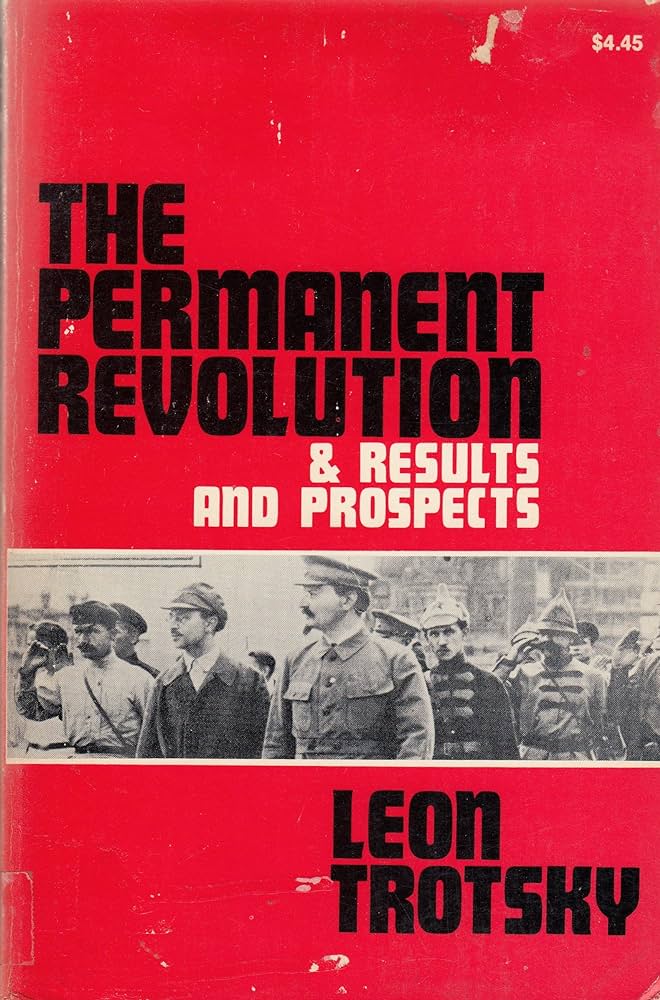
Trotsky, in his booklet The Permanent Revolution, set out a number of its ‘Basic Postulates’.  These include the following:

‘2. With regard to countries with a belated bourgeois development, especially the colonial and semi-colonial countries, the theory of the permanent revolution signifies that the complete and genuine solution of their tasks of achieving democracy and national emancipation is conceivable only through the dictatorship of the proletariat as the leader of the subjugated nation, above all of its peasant masses.’

‘3. Not only the agrarian, but also the national question assigns to the peasantry – the overwhelming majority of the population in backward countries – an exceptional place in the democratic revolution. Without an alliance of the proletariat with the peasantry the tasks of the democratic revolution cannot be solved, nor even seriously posed. But the alliance of these two classes can be realized in no other way than through an irreconcilable struggle against the influence of the national-liberal bourgeoisie.’

‘4. No matter what the first episodic stages of the revolution may be in the individual countries, the realization of the revolutionary alliance between the proletariat and the peasantry is conceivable only under the political leadership of the proletariat vanguard, organized in the Communist Party. This in turn means that the victory of the democratic revolution is conceivable only through the dictatorship of the proletariat which bases itself upon the alliance with the peasantry and solves first of all the tasks of the democratic revolution.’

‘8. The dictatorship of the proletariat which has risen to power as the leader of the democratic revolution is inevitably and very quickly confronted with tasks, the fulfilment of which is bound up with deep inroads into the rights of bourgeois property. The democratic revolution grows over directly into the socialist revolution and thereby becomes a permanent revolution.’

‘9. The conquest of power by the proletariat does not complete the revolution, but only opens it. Socialist construction is conceivable only on the foundation of the class struggle, on a national and international scale.’

‘10. The completion of the socialist revolution within national limits is unthinkable . . . The socialist revolution begins on the national arena, it unfolds on the international arena, and is completed on the world arena . . .’

‘11. The above-outlined sketch of the development of the world revolution eliminates the question of countries that are ‘mature’ or ‘immature’ for socialism in the spirit of that pedantic, lifeless classification given by the present programme of the Comintern. Insofar as capitalism has created a world market, a world division of labour and world productive forces, it has also prepared world economy as a whole for socialist transformation.’

‘13. The theory of Stalin and Bukharin, running counter to the entire experience of the Russian revolution, not only sets up the democratic revolution mechanically in contrast to the socialist revolution, but also makes a breach between the national revolution and the international revolution.’

        *         *          *

The number of ‘countries with a belated bourgeois development, especially the colonial and semi-colonial countries’ has decreased dramatically in the last one hundred years, most obviously with the massive growth of the working class, relative decline of the peasanty and the disappearance of most colonies.  Many of the semi-colonies are now important capitalist states, including those in the expanding BRICS collaboration.

It might therefore be considered that the theory of the permanent revolution, which ‘signifies that the complete and genuine solution of their tasks of achieving democracy and national emancipation is conceivable only through the dictatorship of the proletariat as the leader of the subjugated nation, above all of its peasant masses’ is of limited relevance today.

After all, how true is it that ‘the agrarian, but also the national question assigns to the peasantry – the overwhelming majority of the population in backward countries – an exceptional place in the democratic revolution’? Does this no longer apply in many countries?  We no longer consider that the question is one of democratic revolution but of socialist revolution in countries with widespread industrialisation and a large working class.  Even when Trotsky set out the basic ideas of Permanent Revolution, he was stating that his ‘sketch of the development of the world revolution eliminates the question of countries that are ‘mature’ or ‘immature’ for socialism.’

He went further to say, in the Transitional Programme in 1938 that ‘the economic prerequisite for the proletarian revolution has already in general achieved the highest point of fruition that can be reached under capitalism . . . All talk to the effect that historical conditions have not yet “ripened” for socialism is the product of ignorance or conscious deception . . . The objective prerequisites for the proletarian revolution have not only “ripened”; they have begun to get somewhat rotten . . .  The turn is now to the proletariat, i.e., chiefly to its revolutionary vanguard. The historical crisis of mankind is reduced to the crisis of the revolutionary leadership.’

Many who claim to be Trotskyist accept that the theory of Permanent Revolution applies today and also continue to argue that humanity’s crisis ‘is reduced to the crisis of the revolutionary leadership.’

We have seen, however, that despite this, many – if not most – agree to the theory but abandon it in practice.  They avoid cognitive dissonance by employing a different set of assumptions that enable the adoption of a different set of outwardly Marxist formulas to the actual struggles that arise and which previously would have been considered to come under the purview of the permanent revolution strategy.  Let’s take a look at Ukraine and Palestine.

In Ukraine, the supporters of that state who demand self-determination for Ukraine must presumably believe that the national question is key, and that therefore that the ‘democratic revolution’ is on the agenda, even if this no longer requires an alliance with the peasantry. But if this is so, where is the fight for the view that ‘the complete and genuine solution of their tasks of achieving democracy and national emancipation is conceivable only through the dictatorship of the proletariat?’  Why is support given to a bourgeois political regime and capitalist state when what is required is an ‘irreconcilable struggle against the influence of the national-liberal bourgeoisie’, with the need for ‘the political leadership of the proletariat vanguard, organised in the Communist Party?’

When have the supporters of ‘Ukraine’ ever put forward this argument to Ukrainian workers or those in their own country?  When has permanent revolution even been mentioned? Why do they defend the intervention of Western imperialism when ‘the democratic revolution grows over directly into the socialist revolution and thereby becomes a permanent revolution?’  How could Western imperialism fail to be a barrier to such an outcome? Why then do they support it?

The only political explanation is that they do not believe that permanent revolution is relevant, which means that socialism is not relevant and socialist revolution inconceivable and not in any way be a guide to longer term strategy. However, if this is so, the theory of permanent revolution states that there can’t be a democratic revolution either. They can’t believe the statement that in ‘the colonial and semi-colonial countries, the theory of the permanent revolution signifies that the complete and genuine solution of their tasks of achieving democracy and national emancipation is conceivable only through the dictatorship of the proletariat as the leader of the subjugated nation.’

They therefore cannot believe that ‘the objective prerequisites for the proletarian revolution have not only “ripened”; they have begun to get somewhat rotten . . .  The turn is now to the proletariat, i.e., chiefly to its revolutionary vanguard. The historical crisis of mankind is reduced to the crisis of the revolutionary leadership.’  If the problem was simply one of revolutionary leadership, why wouldn’t they be offering revolutionary politics?

In so far as the supporters of the Russian invasion advance the same arguments in relation to the democratic tasks supposedly devolving to the Putin regime and Russian state, purportedly justified by the rights of the Donetsk and Luhansk People’s  Republics, the same questions are posed to them!

If we turn our attention to Palestine, which is a question of (settler) colonialism, the genocide of the Palestinian people and the role of Western imperialism demonstrate that a revolution is required for their liberation.  Why is Western imperialism not their saviour as it is claimed it is for the ‘people of Ukraine’?  Why do the bourgeois Arab states not perform the same revolutionary democratic role played by the Ukrainian one?  Again, where are the arguments above advanced that this liberation can only come through permanent revolution?  A struggle that needs to be fought by the working class, under socialist leadership, ‘on the foundation of the class struggle, on a national and international scale’?

Instead, the debate revolves around a one state or two state solution, with neither having any particular class content, which, in effect, means that they are both proposals for a capitalist state and with no indication that a wider socialist revolution is necessary, in the Arab region or wider afield.

How are we to make sense of this à la carte Trotskyism – ‘God make me a Communist, but not just yet’?

Back to part 2

Forward to part 4

Permanent Revolution (2) – beginning with Marx

The theory of Permanent Revolution is associated with Leon Trotsky, although Marx is well known to have originated the term in his Address of the Central Committee to the Communist League in March 1850.  In this address he proclaimed that for German workers ‘their battle-cry must be: The Permanent Revolution.’

Marx called for this revolutionary strategy even though he noted that the situation was one in which ‘the German workers cannot come to power and achieve the realization of their class interests without passing through a protracted revolutionary development.’  They were to be comforted by the knowledge that ‘this time they can at least be certain that the first act of the approaching revolutionary drama will coincide with the direct victory of their own class in France and will thereby be accelerated.’

Their task was not one of immediate revolt but ‘must contribute most to their final victory, by informing themselves of their own class interests, by taking up their independent political position as soon as possible, by not allowing themselves to be misled by the hypocritical phrases of the democratic petty bourgeoisie into doubting for one minute the necessity of an independently organised party of the proletariat.’

Today, we are not in a situation in which the German or any other section of the working class is going to come to power, and ‘a protracted revolutionary development’ is required.  This is not admitted by many calling themselves Marxist but is imposed on them anyway.  The price paid is that they can’t consciously adjust their theoretical or strategic framework to adapt appropriately.

Today, we are again called upon to support ‘democracy’: for a ‘democratic’ Ukraine against autocratic Russia and to ‘defend the right of self-defence’ of the ‘only democracy in the Middle East’. The protests by students in US universities against the genocide carried out by this democracy is said by Antony Blinken to be a ‘hallmark of our democracy’ just as the students are attacked and locked up.  The ‘hypocritical phrases’ of the democratic bourgeoisie and petty bourgeoisie are thus louder now than they were when Marx called for their rejection 175 years ago, making his remarks as apposite now as they were then.

Unfortunately, much of the left has forgotten what it means to inform workers ‘of their own class interests, by taking up their independent political position as soon as possible’ and ‘by not allowing themselves to be misled by the hypocritical phrases’ of democracy.  Calls for national self-determination of Ukraine or Donbass simply become the hypocritical phrases by which to justify rallying behind Ukraine, because it is a ‘democratic’ capitalist state, or behind Russia, because it is fighting Western imperialism.

The capitalist character of both is rendered irrelevant by talking about ‘Ukraine’ or ‘Russia’ or the ‘people of Ukraine’ etc. while ignoring the need for the working class to ‘achieve the realisation’ of its ‘own class interests’ by ‘taking up their independent political position as soon as possible.’

On one side the Ukrainian capitalist state and Western imperialism are supported as defenders of these interests and on the other the Russian capitalist state is supposed to play the same role.  Neither can point to any independent role for the working class itself or even the existence of its own organisations that are not totally subordinated to, or in support of, their respective states.  In doing so it almost becomes superfluous to accuse them of abandoning Marxism.

The cognitive dissonance involved in defending a corrupt capitalist state, defending the massive intervention of western imperialism, and a war that continues only because of this intervention, can be seen in three defence mechanisms often employed to avoid accepting the patent contradictions: avoiding, delegitimising and belittling.

So, we get the avoidance of the implications of the points just raised and the commitment to a more straightforward campaign in support of the Palestinian people.  The arguments against support for the Ukrainian state are delegitimised by aping the propaganda of the mainstream media for whom opposition to Western imperialism and its proxy war can only equate to support for Russia.  Since this Left starts from opposition to the Russian invasion, its inability not to default immediately to support for Ukraine and the West reveals the utter irrelevance of any declared adherence to socialist politics separate and opposed to both.

Finally, the cognitive dissonance is limited through the importance of the war also being strictly circumscribed.  So, opposition to Russia becomes opposition to Russian imperialism while support for Western imperialist intervention is dismissed as the latter doing the right thing for its own reasons – without this having any significance for what it is actually doing.  The existence of a proxy war that defines a global conflict is also rendered irrelevant by the primary and over-riding issue being argued as the right to self-determination – of an independent capitalist state that had already determined its own future by allying with Western imperialism against its rival next door: not a very clever thing to do and a very reckless one for the interests of the Ukrainian working class.  The obvious danger of escalation of the conflict to a world war is also minimised but is implicit in the absolute priority given to the victory of the Ukrainian state and thereby, necessarily, of Western imperialism.

To claim that the invasion should not have taken place and is wrong.  That it should be opposed and the invaders blamed for the actions they have carried out, and for which they are responsible, is all very well but hardly constitutes an understanding of why it happened, what should be done about it, and by whom.  If you are a socialist, this socialism should have some role in answering these questions.  As has been stated many times on this blog, if you find yourself coming up with the same explanations and same policy as Western imperialism you need to deal with a lot of dissonance.  How could you start from a socialist position and end up with a policy indistinguishable in all essential and practical respects from Western imperialism? 

It is therefore relevant to look again at the ideas involved in permanent revolution to see how these should guide a socialist view of the current conflicts. 

Back tom part 1

Forward to part 3

Permanent Revolution (1) – Introduction

The world is facing a Zeitenwende, an epochal tectonic shift, according to the German Chancellor Olaf Scholz, which he claims means that Germany and the rest of the EU, United States and NATO needs to protect “our open societies” and “stand up for our democratic values”.

The US Government-backed National Endowment for Democracy has reported the view that there are three possible outcomes of this Zeitenwende, or inflection point, as Joe Biden put it:

‘1. a reinvigoration and reinvention of our existing international liberal order.’

‘2. Chinese-led illiberal order.’

‘3. or the breakdown of world order on the model of Putin’s “law of the jungle”.’

The first primarily involves ensuring the strategic defeat of the second, while the second requires the failure of the first, and the third involves in various forms the results of both of these failing.

This is portrayed as a battle between democratic and autocratic systems, so while recognising that “we might all have become capitalists (with the possible exception of North Korea and a tiny handful of other countries) . . . it makes a huge difference whether capitalism is organized in a liberal, democratic way or along authoritarian lines.”

The realpolitik involved in these sonorous pronouncements is admitted by noting that in the ‘democratic’ alliance against autocracy “What’s crucial in the year ahead is for democracies to unify in a common cause to shape the global future alongside moderate, modern non-democracies that seek a more secure, prosperous, and just world.”

What we have then is not a battle of democracy against autocracy but competition between shifting capitalist alliances sharply exposed by the war in Ukraine, which the genocide of the Palestinian people has demonstrated has nothing to do with democracy of even the most diluted capitalist kind.  Far from democracy being advanced by the war in Ukraine and support for the Zionist state, the former has been employed to justify shrill predictions of war across Europe and the need for massive rearmament, while the latter has involved damning those who oppose genocide as violent antic-semitic extremists who must be violently prevented from exercising their right to march and protest.

While for many new generations this is something new, it is far too familiar to anyone with any historical understanding not to recognise.  When the world is described as turning upon competition between rival capitalist blocs, with the eruption of regional wars and threats of a much greater conflagration, we would have to be suffering from amnesia not to recall the precedents.

In World War I a rising German industrial power sought its own colonial outlets, which required domination of Europe and defeat of the existing British and French Empires.  In Asia Japan sided with these old colonial powers and the United States but then itself sought its own Empire that brought it into conflict with the old European Empires and the US in the next war.  It is uncontroversial to note that World War II was the continuation of World War I because both had the same fundamental causes even if the latter is more commonly retold as a war against fascism and Japanese barbarism.

The same dynamics lie behind the war in Ukraine and the defence of the Zionist state by its Western sponsors; also accompanied with the same ideological garbage of defending democracy against autocratic China and a barbaric Vladimir Putin.  In turn China claims only to seek its own freedom for development as a new centre of expanding capitalist accumulation, while Russia claims simply its right to its own sphere of influence, which can only come up against that of its Western imperialist rivals.  Or vice versa, if you prefer.  Having sought alliance with Western imperialism through NATO membership, Russia, like Japan before WWII, has decided that this alliance is fundamentally anti-Russian and is now in a war against its Ukrainian proxy.

Democratic capitalism in World War II did not cease to demonstrate the hypocrisy of its liberal regime through its determination to hold on to its Empires regardless of the local desire for independence. So, the end of the war witnessed the French and the Dutch etc. – following their own occupation – fight to impose their own on their colonial possessions. Today, the claims of democratic capitalism against the Russian Bear and Chinese Dragon are similarly fraudulent as the West supports a genocidal Zionist state and uses its mass media to claim that this State is really the victim.

The Second World War was facilitated by the defeat of the revolutionary uprisings of the working class in Germany and Central Europe and the defeat of mass struggles in Italy, France and Britain etc. in the inter-war period.  In Spain the democratic revolution was defeated by fascism because the struggle was led by forces that demanded that the workers go no further than support a democratic capitalism that would rather see the victory of fascism than open the door to socialist revolution.  The same calls are made today to rally round the more ‘progressive’ capitalist parties in order to defeat Le Pen, Trump and Sunak etc. except that we have already gotten Macron and Biden to show that if you vote for the ‘lesser’ evil you do indeed get evil.  In Britain the Labour Party leadership has demonstrated that democracy in its own party is to be strangled and Brexit made ‘to work’ while no promise of genuine reform is too mild not to be betrayed.

The dynamics of war are therefore the same now as they were prior to the First World War and prior to the Second.  What is very different is the absence of a working class movement able to challenge the prospect of capitalist war and promise a socialist alternative.  There is no working class alternative Zeitenwende, so no fourth alternative to the triumph of one capitalist hegemon or the other, or the mutual destruction of both.

The small left that claims to be the inheritor of the old revolutionary working class movement has swallowed the lie that Western imperialism is defending democracy in Ukraine and that the Ukrainian state should be defended because it is a capitalist democracy.  It therefore supports one of the imperialist blocs.  A smaller section within Europe supports Russia simply because it opposes the current imperialist hegemon, even though this policy simply means support to the rivals for such a status.

Competition between rival imperialist blocs cannot lead to some sort of accommodation that respects the interests of all of them in a ‘multi-polar’ world, for that is not the purpose of capitalist economic or state competition.  The bloody history of the last 150 years demonstrates that this competition rejects any limits, and that even with only a single imperialist superpower war is ever present.  Now, with the relative decline of that superpower we are returning to circumstances akin to World War I and II, so that what is at stake is not a new accommodation of regional alliances, or limited regional wars, but a global conflict.

If the fourth alternative is to be rebuilt those that are still Marxist in more than just name must set out what this is, which brings us to the ideas contained in permanent revolution.  These began with the struggle for democracy by the working class, was made famous by the requirements of the revolutions in Russia in the first decades of the twentieth century, and now stand as the banner of the camp opposed to imperialist rivalry and to the ruination of the world that it threatens, already signposted in Ukraine and Palestine.

Forward to part 2