Marxism and Gender Ideology (3) – Nothing without our body

In reaction to the Cass Report in Britain there has been widespread denunciation of the ‘toxic’ debate around the transgender issue without specifying why this is.  There has also apparently been wide agreement that there needs to be better data to find out the effects of treatment of children and young people.. 

The second link above shows that the apparent agreement is a fiction and that the supporters of gender ideology, within and outside the NHS, have both no need for data and no need for a debate.  The report itself reveals that most of the NHS’s gender identity development service (Gids) refused to cooperate with the inquiry in providing evidence and that this was ideologically driven, i.e. they accepted gender identity ideology.

It is abundantly clear that the toxic debate is not going away any time soon because the supporters of gender identity ideology have made it plain that there is no debate to be had, and that data on clinical outcomes of those young people who have had puberty blockers, or cross-sex hormones or other surgical intervention is impermissible.  This, however, is only one reason for the toxic ‘debate’.

As we saw in the previous post, the shifting, imprecise and downright misleading use of definitions means that you get routine claims about the ‘right to change gender’ when what is meant is the ‘right to change sex’ which does not exist because it cannot be done.

The issue is not therefore about a ‘right to change sex’ but the social and political rights to be acquired from claiming to have one’s ‘true’ sex recognised, which is to be established not by any sort of health care, such as hormonal treatment or surgical intervention, but by accepting the view that one knows one’s identity better than anyone else and being a woman, for example, is just such an identity.  Something that a man can be if he puts his mind to it.

This requires the belief that one can be ‘born in the wrong body’, meaning that the ‘real’ and essential person exists as something separate from the body, which is akin to the religious idea of a soul, also separate from the body. In this way the claims of gender identity ideology are a religion for which data, or any other scientific evidence, is irrelevant.  For this ideology, denial of the quasi-religious nature of its claims means that the pretence must be made to objective validity but this must then involve denial of the means of validation.  Irrational claims give rise to irrational discourse which gives rise to the toxicity.

The shifting, imprecise and downright misleading use of words, including the word ‘gender’ adds a twist to the non-debate by making it impossible to consistently identify what is being claimed or denied.

Gender can, as well as meaning sex, also be understood as the expression of social norms associated with and based on one’s sex, such as the characteristic stereotyped attributes of femininity to be expressed by women and of masculinity to be expressed by men.  We have looked at some problems with this is the previous post but let us park these for the sake of this discussion.

Effeminate expression by men, by some gay men for example , has historically been disapproved of in many countries, with patterns of socialisation generally working to impose those characteristics considered masculine that would prevent or negate such expression.  Similarly, the phenomenon of masculinised women, such as in some lesbians, has also been frowned upon.  Regardless of the advances in gay and lesbian rights in some counties, this socialisation process continues and is still considered ‘normal’ with deviations from it being ‘abnormal’.

In real life, no one fits the pure stereotyped norms of femininity and masculinity.  It therefore makes no sense to use the term gender in the way employed by one socialist: that trans means ‘people who wish to live permanently in the gender identity polar opposite to that ascribed to the biological sex’.   No one’s gender is the polar opposite of their sex, while the free expression of one’s personality is a part of what socialism is about.  Gender norms are restricting, stifling and enforce rigid stereotypes that are regressive for both sexes and for the relations between them.  

Everyone expresses some combination of the characteristics that may be said to make up the ‘polar opposites’ of the social expression of one’s sex.  To claim that one is a ‘polar opposite’ in identity to one’s sex is therefore to define oneself in stereotypical and reactionary terms, so that to assert political claims on such grounds is also reactionary.

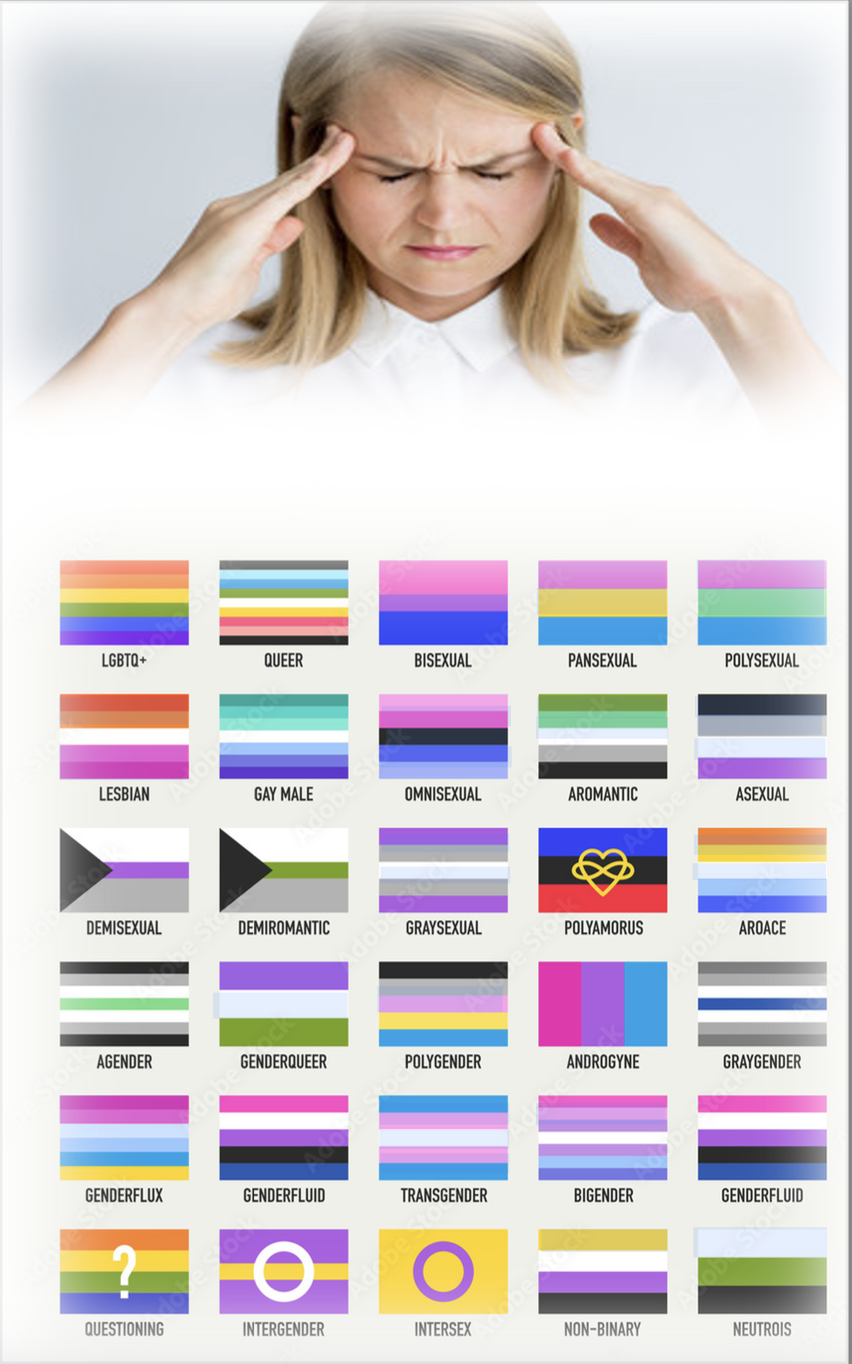
Gender identity ideology might think it avoids this by positing the idea of numerous genders, so that ‘polar opposite’ is not the only alternative to female and male, woman and man.  This involves the creation of multiple genders, and different sources will provide different numbers of them.  If you Google ‘how many genders are there’ you might find that there are either 3 or 4 or 68 nor 72 or the number is undefined.  The BBC once claimed to children that there were over 100.

Since one’s gender is determined by one’s sense of oneself there can be any number of self-definitions, each of which must be considered to be valid by this ideology, precisely because it is self-determined.  But purely subjective identities are paraded because they crave social recognition, validation and acceptance, (otherwise they remain in a private domain without validation etc.) so the assertion of such identities is a political question.

This ideology thereby becomes the only political position that asserts its legitimacy and authority on the basis of an unchallengeable declaration demanding immediate acceptance. However, this ‘first-person authority’ championed by gender identity ideologists (trans people know themselves better than anyone else so we should all accept what they say) excludes those who disagree (for example women who deny that they have any sort of gender identity).

Whatever about such claims to novel ‘genders’, the majority are either male or female, and since women are most vulnerable to the consequent results, claims that men can become (or always ‘really’ have been) women are the most contentious.  Transmen in some male-only settings are at greater risk than the men they will encounter but this cannot be said for transwomen (men) entering women-only spaces.

This also means that while many transactivists supporting gender identity ideology think of themselves as left wing and progressive, their ideology is simply a mirror of the conservative and right-wing view of women that they claim to oppose.  While the most conservative view regards the proper expression of a woman’s sex as stereotypical femininity, trans activists often define what it is to be a woman through stereotypical expression.  The causal direction is simply reversed. For one, women should be feminine and for the other being feminine, in so far as they can make it, is to be a woman.  

Since ‘gender’ can be understood as sex, or as the expression of norms of socialisation of the sexes, we confront claims to be able to change sex, which is impossible, or claims to be able to change gender through having a sense of one’s sex being different from what it actually is. In the latter case gender is then conflated with sex.  Through identification with (or through) the social norms that are supposedly rejected the claim is made that one has changed sex.

The ‘explanation’ is to claim that to be a woman is to have some innate sense of being one.  This innate sense, in order not to be something contingent and open to challenge, is held to be common to everyone; everyone has a gender identity, whether admitted or not. We thus end up with the mantra that ‘transwomen are women’.  It is claimed by some supporters of gender identity ideology that everyone’s gender identity is expressed in terms of behaviour, appearance, including clothing, make-up, etc and is evidenced by it.

This ‘argument’ has its own problems. If a transwoman wears high heels, pretty pink dresses, lots of make-up and effects a flighty and skittish air they may be accused of believing that being a woman is existence as a crude stereotype that is insulting.  Not doing any of these things might leave the transwoman looking like a man and putting immediate and impossible-to-ignore obstacles to acceptance of their claims.  How recognition of all the other genders is to be accomplished, even by their bearers, is a moot point, including the idea of gender fluid, non-binary, non-gender, agender, third-gender etc.

More generally, what particular norms of behaviour, dress etc must be included in ‘gender identity’ and what is not, and how the mélange of social factors come together to instantiate and constitute a coherent sex status, is impossible to define.  A transwoman may seek acceptance as a woman, but fundamentally rejection or qualified non-acceptance will not be because of any presentation etc. but will be based on knowledge of the person’s sex; the real transphobe will be the one who rejects a transwomen fundamentally for their failure to represent masculinity.

What these point to are the limitations of subjective claims over objective reality, illustrated in other ways.   A person’s sex exists before it is ‘assigned’ (as the ideologists put it) and will exist whether it is ‘assigned’ at all, for example if no doctor is present ‘to do it’.  A baby girl and an old woman are still females; the first does not identify as anything and will, bar accidental factors such as death, develop into a woman, and the latter is still a woman whether she is, because of dementia, no longer able to be conscious of this fact or not.  When she is dead, she will be a dead woman.

It is claimed that because these subjective senses are unverifiable, we cannot test them – we cannot reach inside someone’s head to see how they really feel, process these feelings into thoughts and see how they are then formulated into claims to objective reality.  We cannot know the motivation behind a claim to a gender identity for example.  How do we know that a transwoman actually feels or thinks like a woman (leaving aside what this actually means) when they are a biological male?  In fact, the assertion would have to be to feel and think as a woman, although this lexical formulation is immediately less plausible.

How is it known that their ideas of their identity, arising (sometimes) as the result of psychological distress caused by various factors, conform to and constitute essential ‘womanhood’?  Since Gender identification is sometimes described by transgender activism as a political act, or that ‘there’s no one way to be transgender, and no one way for transgender people to look or feel about themselves’, or ‘there is no right or wrong way to be trans’, their claim is effectively denied.

Children come to know themselves through observing others and comparing themselves to others, including observing that there are two sexes and that they fit to one of them.  They learn that this cannot be changed.  In this, the sense of one’s sex is learned and not innate, even though it cannot be changed, so that for the vast majority of people it comes with the territory.  Distress caused by a perceived discrepancy between the idea of one’s sex, misnamed gender identity, and sex characteristics of one’s body can lead to what is termed gender dysphoria, but this does not allow one to change sex.  Even if medical and surgical interventions may help, that is relieve the distress to a greater or lesser degree, these will not change a person’s sex. They cannot therefore be a ‘cure’ for the claim that their condition requires a change of sex.

Such dysphoria evidences an awareness that one’s sex is different from one’s identity, from the claim to a fixed and innate identity as the opposite, or more accurately, other, sex.  Further, it is often asserted that this identity warrants the claim that despite natal sex, for example as a male, the transwoman was ‘always’ a woman.

In effect, the sexed body is rendered both relevant and irrelevant to the construction of all of humanity since trans people are still to be included under the classification of the two sexes that encompasses everyone. (We leave aside the many other ‘identities’ that render the whole ideology even more incoherent).  The claims about the meaning and importance of sex are therefore not just about trans people but about everyone and thus involve sweeping claims about the nature of the non-trans population that they are blissfully unaware of – that gender identity and not biological sex defines them and is definitive. Everyone is to be roped into the ideology whether they like it or not and the subjective claims of some become the objective claims on others.

In other words, if gender identity defines sex and everyone has a gender identity, everyone is defined by this phenomenon of gender identity with the social and political consequences demanded by the ideology.  ‘Transwomen are women’ can thus be read backwards.

If transwomen claim that they feel like women and have the same sense of themselves as a biological woman has, it implies that the feelings that biological women have, and their sense of themselves as a sex, is the same as that of transwomen.  I doubt very much whether the vast majority of women would endorse such a claim.  Not least because their understanding and feelings about being a woman are based on their female body, its functioning and the social experiences that this necessarily entails. None of these considerations involve ‘biological determinism’ in the sense that women’s social and political roles are biologically determined.

Many women therefore, as we have said, deny having any gender identity of the kind expressed by trans activism.  Their statements on their sense of themselves and the sexed bodies that they have will be more persuasive than the claims of men who do not inhabit female bodies, have not experienced life as a woman, and who cannot know how women feel about being a woman but can really only imagine or profess some idea of it.  

Women will do so with much stronger objective grounds to make such statements.  That they are often not called upon to do so makes it hard to avoid the view that a well-known hierarchy of authority between the sexes is being adopted.  In any case, regardless of any supposed authority, identifying as a woman does not make you one.

To sum up: you cannot change sex, you cannot become a different one by behaviour or appearance or other cultural attribute, and you cannot identify yourself into one.  Since we are most interested in the politics of gender identity ideology, we are left with the conclusion that any claims it makes are not based on reality.  For Marxism, if they are not, they are reactionary.

We will look at whether this conclusion can be explained further in the next post.

Back to part 2

Forward to part 4

Iran falls into the trap?

A couple of weeks ago at an anti-war meeting in Belfast a number of speakers remarked that the state of Israel had exposed itself through its open espousal of genocidal intentions and that the Western powers were similarly damned through their support for it.  And this is true as far as it goes, which isn’t nearly far enough.

I made the observation that the open threat of genocide was a double-edged sword.  The point I made was that the ability to openly threaten such a thing was dangerous and particularly when it is then carried out! The full-blooded support of the Western powers has not even been dented either.

The renewed threat of a wider regional war has now come to the fore following Iran’s attack on Israel with hundreds of drones and missiles.  The immediate action of the US, Britain, France and a number of Arab countries has been to come to the aid of the genocidal state.  The large number of drones and missiles has reportedly not killed anyone and it is pretty clear that this was not far from the Iranian intention, given that their attack was hardly a surprise and most of the weapons used were unlikely to breach Israeli defences.

Previously, I agreed with a large number of observers that Iran would be falling into a trap by reacting to Israel’s provocations, but it obviously believes that the repeated attacks on leading figures were going to continue; that this was damaging to its standing and that sooner or later some provocation would be too damaging to pass over.  However, none of this is enough to explain its attack, while its statement that it has concluded its actions and will stop there is designed to draw a line under the exchange.  Whether it believes this, given the purpose of the Israeli provocations, must be open to some doubt.  It must therefore believe that it can weather a war with Israel or its action is a better alternative to continuous offences and accumulation of injuries.

On the Israeli side, the attack on the Iranian diplomatic facility in Syria was a clear provocation, or an invitation to attack it, to put it another way.  It must be assumed that this is because a war with Iran will serve its purposes and it believes it can win, which is the common view of most commentators. The claimed 99% success in downing the drones and missiles is held up as evidence of Israeli military superiority, which needed only a casus belli for the Zionists to seek to impose it, one which its western imperialist supporters would immediately endorse regardless of the hypocrisy in defending the right of the genocidal state to self-defence while denying the same to Iran.

Supporters of Russia in their on-line channels have raised doubts about the more or less complete blocking claimed by both the Israeli state and Western media and have pointed to the success of the most advanced Iranian missiles in penetrating Israeli defences, while also arguing that the Iranians did not obviously seek to maximise casualties but to demonstrate intent and capability.  They argue that this explains to some degree the weakness of the impact while also pointing out the benefit of the intelligence gained in observing the response to the attack and the huge cost of Israeli success.  They also note the contribution of the Zionist state’s imperialist allies, which they claim is not certain to continue.

Whether Iran has greater offensive capacities is something that will be demonstrated should the conflict escalate.  What almost all the commentary has claimed is that Western imperialist support is conditional and that its contribution to the attack by Iran is leverage for the widespread calls to Israel by Western leaders that there should be no escalation.  And this is where the narrative stops making sense.

The Western imperialists, foremost the US, is supposed to be trying to pull Israel back from too aggressive a response to a regime it wants to overthrow.   The same US that has armed and defended Israeli genocide is suddenly resisting its attack on Iran.  Haven’t all the Western powers spent the last six months claiming to be deploring or holding back Zionist genocide?  To what effect?

We are to believe that repeated Israeli provocations have not been approved by the US.  How credible is this?  Israel is more dependent on the US now than it has almost ever been but we are supposed to believe that it went ahead and triggered a potential war with Iran without getting the ok from the US?

Is the immediate defence against the Iranian attack not evidence of support for the Israeli stance, and is the failure to denounce its provocations only the result of embarrassment at Israeli actions?  When the Biden regime once again declared its four-square support for Israel, was this a lie?   Why would the US support provocations that can only lead to war if it was not going to back Israel when it would arrive?  

The argument in response is that the US does not want another ‘forever war’ and that Biden will not want another one as he seeks re-election. But have those putting forward this argument not noted that the US has already provoked a war in Ukraine and is desperately seeking to keep Ukraine in the game, to keep the war going, and have they not also noted that a war by Israel against Iran will be more popular domestically than genocidal slaughter in Gaza, from which it might serve to divert attention?  It may seem perverse that the US, with Israel, may seek to claim the moral high ground by commencing another war but they have already done so in Ukraine and Gaza.

It is impossible to ignore that just as Ukraine is a proxy for US imperialism in its rivalry with Russia and China so is Israel a proxy in its rivalry against Russia’s Iranian ally.  The prospect of war between Israel and Iran has immediately involved Western imperialism directly and such continued support would make more obvious the reality of a world heading to a conflict between the old imperialist hegemonic alliance led by the United States, with its mostly European satraps, and the new capitalist rivals headed by China and Russia, supported by Iran and North Korea.

The duty of socialists is to oppose these wars and oppose the dynamic to a world conflagration. We should therefore oppose the drive to war by Israel and its imperialist sponsors and point out their prime responsibility for the current escalation.  In doing so we must oppose the old imperialist hegemonic alliance and also oppose the claims of its rivals. These claims are not those of liberation but of their right to carve out their own ‘fair share’ of the wealth of the world created by its workers, who they both compete in exploiting.

This is a lesson forgotten by those ‘leftists’ who either support Ukraine or Israel and, on the other side, those who think themselves ‘anti-imperialist’ for supporting the new upstart capitalist powers in the shape of China and Russia. There is no ‘fair sharing’ involved in capitalist competition, not with the workers exploited or with rivals.  What there is is permanent instability and conflict that inevitably erupts in war that working people pay for with their lives.  Such are the lessons of history.

What future for Palestine?

What is going to happen to Palestine?  The sense that the catastrophic situation is almost hopeless and that nothing can be done is reflected in the short video by the Scottish blogger Craig Murray. The question was addressed from a Marxist viewpoint in Boffy’s Blog and we are obliged to consider whether he is he right about the future of the Palestinian cause.  We can start to do this by looking at what is currently happening and what the past has to tell us about how we got here.

The invasion of Gaza was for months defended as ‘Israel’s right to self-defence’, with no one appearing on television being allowed to open their mouth before it being demanded that they agree and condemn Hamas.  This ‘right’ was said to involve targeted strikes against Hamas and avoidance of civilian casualties, still claimed today by Zionist apologists but now with zero credibility.

It took no time at all before it became clear that the Israeli Defence Force (IDF) invasion was an exercise in mass murder, with the specific targeting of journalists who could report on it, aid workers who could feed the besieged population and medical staff who could treat the sick and wounded.  It was claimed that hospitals were not being attacked and were not going to be attacked until now there are effectively none left.  The targeting of journalists, aid workers and medical staff had its rationale in defending lies, starving the population and targeting the sick and injured so that nothing was out of bounds and no hope would remain.

Civilians, particularly children and women, became the main casualties in the ‘war against Hamas’. Advised by the IDF to move to ‘safe’ areas, they were then bombed.  Millions were forced to leave their homes that had been totally destroyed and made to move further and further south in what had all the appearance of ethnic cleansing.  Each atrocity merged into the next and the intensification of the viciousness of the IDF was made more cynical by the lies that accompanied each one of them.

The International Court of Justice found that there was a plausible case of genocide although the majority of world opinion had already arrived at this conclusion some time before and had demonstrated this though thousands of protests across the world.  The speed of the killing and the callousness of the Zionist state left no room for illusions as to what was being carried out.  

There was incredulity and horror when the death toll rose and rose to dwarf that of the Hamas attack on October 7th, while no crime seemed too atrocious for it not to be followed by something worse.  Liberal illusions that an ICJ judgment might stop or even moderate the killing were swiftly dashed as were vague expectations that the pogrom might expend itself. Many hoped that there would be some sign of it ending but such hopes were repeatedly dashed by each new greater atrocity.

The reaction of Western governments was to repeat Zionist lies about forty beheaded babies and systematic rape etc. and continue to plead ‘Israel’s right to self-defence’.  Biden went out in front by claiming to have seen the evidence and calling into question the number of dead Palestinians, the total of which is now many times the number he denied.  The Western media sought to sow distrust of the scale of the killing through mandatory reference to the source of the numbers coming from the ‘Hamas-run’ Health Ministry.

The Zionist state was clearly breaking international law, as is all Western state support for it.  This includes not only political cover but continued supply of weapons and ammunition; posting a naval armada around Gaza and beyond to defend it, and attacks on those such as the Houthis who carried out armed actions against Western shipping going to and from the Suez canal.

Far from attacking the forces that were committing genocide, a course of action no one in the world remotely expected, the US and British attacked those trying to stop it,  Upon unproven allegations by the Israeli state, already repeatedly shown as pathological liars , a dozen Western powers stopped their aid going into Gaza.  Now the inevitable famine is accelerating, food aid is blocked by the IDF and this week seven aid workers have been killed.  The acme of cynicism can be seen by the US dropping tiny amounts of aid from aircraft while supplying the bombs that the IDF drops to kill the same people. 

Each atrocity causes more dismay and outrage and each Zionist lie more anger and frustration as they are propagated by the Western media.  The majority of the world knows that what is happening in Gaza is genocide and that each atrocity leads not to a step back but to a new level of barbarity so that the word is no exaggeration.

No step has been too barbaric for the western powers to row back and sanction the Zionist state while ‘international law’ is exposed to be whatever these powers decide.  Reliance on the UN, always a liberal illusion, is exposed as so much handwringing. Who is going to impose sanctions and punishment?

The Arab regimes that were set to come to terms with the state of Israel before October 7th are dogs that have barely barked with no intention to bite.  Iran is keen to stay out of war and for its own state interests is wise to do so; its conflict with the US has been subject to agreed limits but Israel increasingly shows that these are not theirs and is attempting to provoke a wider conflict. Those with the mistaken belief that the Israeli state is somehow losing the existing ‘war’ might consider all this.

So, who else is going to stop the genocide because it is not over yet, and any pause–like every other Zionist imposed ‘peace’–will simply set the scene for the next war.  Even the declared objective of destroying Hamas is a project to destroy the Palestinians in Gaza as in any way politically relevant, leaving nothing to prevent whatever next steps the Zionist state decides to take.  In the West Bank the repression of the Palestinians has accelerated as more land is expropriated and the Zionist settlers are allowed to do the IDF job for it, egged on by a Government of rabid racists and fascists.  The remaining Palestinians within Israel will suffer more discrimination and oppression. 

Knowing this, the answer to the question – what is going to happen to Palestine? – is that the objective of politically crushing Palestinian resistance of any sort will continue and all and every measure will be employed as the Zionist state, supported by the US, to achieve this objective.  The population of Israel has moved sharply to the right and is now dominated by rabid racism, leaving even ‘liberal’ Zionism and those calling for peace small and isolated.

With the continued support of Western imperialism the Zionist state will continue its policy of erasure of the Palestinian people so that no state of their own can be realistically conceived. The so-called ‘two-state’ solution has been dead since it was first proposed by the United Nations in 1947 and then buried by the Zionist movement alongside the occupations by Egypt and Transjordan. The current genocide is perfectly consistent with the Zionist project and its enactment going back to this time and before.  The extreme brutality and targeting of civilians is nothing new, as is the disproportionate violence inflicted following any form of Palestinian resistance.  The supremely cruel and brutal response after October 7th could not be unexpected.  It has stretched the previous murderous violence of the Zionist state but it is not qualitatively different from the policy of ethnic cleansing upon which the Zionist state was first constructed.

That this state has been able to so openly flout the pretences of the Western powers to defend human rights and lawful behaviour is because the Zionist state is an outpost of Western imperialism itself; it is its son of a bitch.  Israel relies on this imperialism, especially the US.  Who can the Palestinians rely on that can weigh against the overpowering position of the Zionist state when it has this support?

It is obvious that by themselves the Palestinians cannot win an independent state and that the solidarity movement cannot make the difference unless it were able to neuter the intervention of the Western powers. This might allow the workers and poor of the Arab world to join together to overthrow their own regimes and the Zionist state. Is there any sign that the support of Western imperialism has been in any way significantly damaged?

Let’s take the example of our own county: Ireland is supposed to be a beacon of support for the Palestinian cause but what is its contribution to the prevention of genocide?  The UN special rapporteur Francesca Albanese put it plainly and honestly:

‘There’s this tendency to be very supportive with rhetoric, as Ireland has, but when it comes to taking concrete actions, there is zero. Not a little. Zero. The countries that have been most outspoken, like Ireland, what have they done in practice? Nothing. And this is shameful. It is disgraceful.’

Talk is cheap and the talk from many political forces in Ireland is very cheap, and they have not been challenged.  Without challenge the cheap talk will continue until it is realised that those speaking it are part of the problem, not simply some inadequate or unsatisfactory opposition.

Socialists have an aphorism that the main enemy is at home, and this applies to those in solidarity with the Palestinian people, because the states that ensure Zionism can get away with genocide are the same states in which they live.  The task therefore is not to plead with these states to stop Israel or to believe that some sort of pressure will do the job but to oppose their own states and build towards their own revolution.

If the solidarity movement really believes that genocide is being carried out, then it must face the reality of what has happened and accept all the consequences the word entails for its victims: ‘the deliberate and systematic extermination of a national, racial, political, or cultural group’.  In the West the potential alternatives to two of the main supporters of this genocide are President Trump and Prime Minister Starmer, just as rabidly pro-Zionist, if not more so, than Genocide Joe and Sunak.  This is more or less the case across the Western capitalist world.  

In Ireland Sinn Fein sups with the devil on St Patricks day while being treated as part of the solidarity movement. Everyone is to boycott Israel but Sinn Fein is permitted to party with those providing the weapons through which the massacre is carried out. A solidarity movement that accepts such actions is not a solidarity movement at all. We don’t need a movement that accepts the hypocritical claims of concern from those responsible for genocide and excuses those who similarly express weasel words of sympathy while being careful not to challenge those behind the slaughter.

If a genocide supported by every bourgeois political force in Western capitalism does not teach the movement that this alliance as a whole is the enemy then expressions of solidarity will go no further than demonstrating opposition and an inability to do anything about it. What is required is not pressure, because what is the price to be paid for ignoring it? it is not simply disavowal of the current leaders, because the alternatives standing by as replacement are no better. And it is not BDS, because imperialism has made it clear that far from boycotting Israel it is supporting it and will continue to do so. It is not the working class that controls the societies and economies of imperialism, its investment and trade, so it is not we who will determine what relationships imperialism will have with the Zionist state. Such victories as the BDS movement might have can only be steps towards the organisation of something more fundamental that points towards taking control out of the hands of the capitalist class.

Building a working class alternative to all these forces is required in order for pressure to be threatening, for displacement of current political leaders to be meaningful, and for actions against links with the Zionist state to become an instrument towards the working class taking control.

All the liberal institutions of this world have been exposed, and so have the spurious claims on behalf of an alternative capitalist alliance formed around China and Russia; as if they represent something radically different that will stop what is happening.

If there is another road besides organising a working class movement for socialism that defeats imperialism and its allies then what is it? And if it does not yet exist do we build it or accept the consequences of genocide?

Marxism and Gender Identity ideology (2) – What is it?

If we look at the UK government’s 2018 consultation paper on reform of the Gender Recognition Act we see that gender is defined as ‘often expressed in terms of masculinity and femininity, gender refers to socially constructed characteristics, and is often assumed from the sex people are registered as at birth.’  Thus, do we immediately enter the world of indefinite definitions that create uncertainty as to their meaning and a tortuous journey to understand how it all is supposed to hang together in some coherent way.

In the document, a legally recognised gender is meant to allow replacement of a supposedly erroneous recording of sex on the birth certificate, although it cannot be the ‘right’ one because gender is not sex and is not defined as sex. The individual is entitled ‘to a new birth certificate issued with an updated sex marker’, and according to the definition of the Full Gender Recognition Certificate, this ‘shows that the holder has satisfied the criteria for legal recognition in their acquired gender.’  So, although it is a ‘sex marker’ it is not the actual sex of the individual, which is observed at birth.

Like so many other aspects of this question, as we shall see, sex is both central and to be displaced.

What it is displaced by is not clear, and certainly not by the above definition.  We are told that ‘gender’ is sometimes expressed in particular terms but not what it is that is being expressed.  This invites the question, what other expressions does it have that might lead us to understand what it is?  Perhaps this is explained by the definition of ‘Gender expression’, which is ‘a person’s outward expression of their gender. This may differ from their gender identity or it may reflect it.’  In which case the expression of gender that is supposed to be core to the definition of gender may not actually be a person’s ‘gender identity.’ 

The definition of gender goes on to say that ‘it refers to socially constructed characteristics’, which tells us that this is not a natural entity, like sex, which is biological, but is a social construction, but again does not tell us what it is that has been constructed.  What social constructions are we being referred to?  If it is ‘femininity’ and ‘masculinity’, why is this not stated, although it can’t be these because these are just some expressions of it and these, we have been told, may not reflect a person’s gender identity.  If conceived as social norms, of behaviour, presentation etc., it doesn’t make much sense to refer to individuals in terms of a social norm, which is a feature of society and not of individuals.

In any case, we are not told what ‘femininity’ and ‘masculinity’ are.  These might be understood to refer to the characteristics of males and females, not to their natural attributes but to social ones that have been attached.  Could there be references to some notions of what ‘femininity’ and ‘masculinity’ are or to concrete social practices?  Both, however, vary by time and place and are not like sex, from which we are told we might assume a person’s gender, which is immutable.  Gender, therefore, is something very different from sex, considered on even the most minimum basis, and gives rise to doubts as to how it could be a substitute for it.

Of course, these questions are easily answered if it asserted that ‘femininity’ and ‘masculinity’ are often seen as expressions of one’s sex but not its substance and that socially constructed characteristics are often placed on the sexes, which is why we can often assume them from a person’s sex.  This however would not assist the project of replacing sex with gender.

The definition of Gender identity is ‘a person’s internal sense of their own gender. This does not have to be man or woman. It could be, for example, non-binary.’  So, if gender refers to socially constructed characteristics and gender identity is an internal sense of these, gender identity must derive from social characteristics that have been internalised.  If this is the case, gender identity cannot be innate and cannot exist at birth since at this stage of human development such characteristics as masculinity and femininity have not been perceived.  Since they vary by time and place, this also raises the question how something claimed to be innate, being inherent in the essential nature of someone, and from birth, can vary by time and place (unlike someone’s sex).

Nevertheless, this is the ground upon which the designation of one’s sex through a new ‘sex marker’ based on ‘gender’ is made, and of the political demands made by Gender Identity ideology. 

The uncertainty is increased when we are told that a gender can not just be either a man or a woman but ‘non-binary’, which is further defined as; ‘an umbrella term for a person who identifies as in some way outside of the man-woman gender binary. They may regard themselves as neither exclusively a man nor a woman, or as both, or take another approach to gender entirely. Different people may use different words to describe their individual gender identity, such as genderfluid, agender or genderqueer.

What is meant by ‘identifies as’?  Is it a way of stating that a person is, for example, saying I am “neither a man nor a woman” or saying, “I am both a man and a woman’’?   If it is more or less the same as this, how does this make sense? 

How can gender identity, which refers to someone’s internal sense of their gender, which refers to socially constructed characteristics, refer to entities that do not exist, such as a person that is not a man or a woman?  Does this then mean that ‘socially constructed characteristics’ are, or can include, ideas or conceptions that have no material reality?  Are there any limits to the ideas constructed?  In what sense, and in what way, can someone saying they are, for example agender, be considered, and therefore treated, differently to someone claiming to be of the other sex (if these different genders are to be taken as socially significant)?

And what if the claim to be non-binary is really a political statement, in what way can the concept of gender and gender identity suppliant that of sex and its corporeal reality if such statements are also, or really, statements of political belief –  a political identity?

We are told that the Gender Recognition Act 2004: is’ an Act of Parliament that allows transgender people to gain legal recognition of their acquired gender, so long as that gender is a man or woman’, which lets us know that the law will not recognise something which does not exist, i.e. a person that is neither a man or a woman or a person that is both.  And we also don’t need to seek guidance on what the legal status is of the other genders.  This, however, leaves open the question what sort of thing ‘gender’ is, that can include things that cannot exist but is also something that can legally replace sex, which obviously does exist, for some purposes. 

We are not told what is meant by a ‘person’s internal sense of their own gender’.  What is meant by ‘sense’; is it feeling, belief, understanding, perception or knowledge?  Why should a person’s expression or statement of these be legislated as true, and subject to legal obligation by the state?  What other claims by a person of belief etc. are unequivocally accepted and acted upon by the state? Particularly when this ‘sense’ can also include things that do not make sense – like not being either a woman or a man or being both at the same time?

The definition of Gender Identity as a person’s internal sense of their own gender, is the basis of an ‘Acquired gender’, and ‘ The Gender Recognition Act 2004 describes this as the gender in which an applicant is living and seeking legal recognition. It is different from the sex recorded at birth and is instead, the gender the individual identifies with. It could be man or woman.’  Since both ‘gender’ and ‘gender identity’ do not require gender presentation or gender expression it is unclear how the ‘gender the individual identifies with’ could always be verified.  To identify ‘with’ something is not the same as identifying ‘as’ something (ignoring what exactly identifying as something can actually accomplish or entail).

In any case, what does it even mean to live ‘in’ a gender that is in some way different from your sex?  How can anyone live outside of or in some way different from what their body dictates, a body which is sexed and which determines so much of life and existence, even whether you are able to exist at all?  It is an elementary fact, understood by everyone, that life cannot exist outside the body because the functioning body is life.  To live ‘in’ some thing, and through this thing, is to live in a (sexed) body.

One does not live in femininity, for example, or in socially constructed characteristics, and social norms might be lived within society by a person but are not, as we have noted, a sort of internal identity.  Proof of having a collection of documents, such as driving licence, passport or utility bill, as set out in the Gender Recognition Act 2004, is a bureaucratic, simulated substitute. Those with a non-binary identity might struggle.

Other inconsistencies can be noted.  While gender and gender identity refer to social constructions and internal senses, ‘gender reassignment’ refers to ‘reassigning the person’s sex by changing physiological or other attributes of sex.’  Since sex can be replaced by a ‘sex marker’ that recognises a person’s ‘gender’, it would also appear that gender changes (or reassigns) a person’s sex by a physical process (that does not have to be completed).  Gender identity as an internal sense can replace sex while gender reassigned involves a physical process.  These involve two very different operations, and it is not explained in what way they are able to involve and accomplish the same task.

Finally, the British Government document states that it wants to know the implications of ‘recognising a gender that is neither male nor female’, which are, of course, the two sexes and I don’t know of any other.  At this point it is tempting to repeat philosopher Alex Byrnes’ remark in his book (Trouble with Gender, p107) that “what ‘gender’ is supposed to mean is anyone’s guess.”  The labyrinthine series of definitions examined above form the basic structure, such as it is, of an ideology that is supposed to sustain certain political claims, and it is this ideology that further occasional posts will examine

Back to part 1

Forward to part 3