Hopes that a new democratic and corruption-free Ukraine will arise out of the ashes of the conflict have been publicised by its supporters on the left by pointing to the popular mobilisation of many Ukrainians in support of the war effort.
Once again, however, this is not a new phenomenon and does not sustain the argument that a different, more democratic and less corrupt state will arise. Already there is mounting evidence of this enthusiasm waning; understandable given the effects of the war but still damning for the hopes of the war’s supporters. For the purposes of our longer perspective, it is confirmation of previous experience.
Ukrainians have participated before in a number of very large mobilisations against their exiting political regimes in favour of democracy and against corruption. This was the case in the Orange revolution in 2004 and the Maidan uprising in 2014. In the first case the new regime installed proved to be more corrupt than the one it took over from, and the new regime installed in 2014 quickly became more unpopular than the one it replaced.
In both cases popular participation did not mean popular leadership, never mind one led by any sort of working class formation. In 2014 it was far-right forces that formed the vanguard of its organisation, with western supported NGOs providing much of the veneer of a progressive movement. The United States helped fund these NGOs and the Maidan protests that year provided the occasion for exposure of its political interference, through recordings its officials discussing who should, should not, and subsequently would be in the government. This interference continued at the highest levels thereafter, so that Joe Biden, as US Vice President, boasted of his having more phone calls with the Ukrainian President than with his wife. The war, and reliance on western arms, has simply made clear to even the meanest intellect the client relationship that developed.
Top-down manipulation, involving popular support and mobilisation often with progressive illusions in their enterprise–yet with oligarchic and imperialist objectives–have now taken the form of a war provoked by prospective membership of NATO. Just like the previous mobilisations, except much more quickly and with much greater effect, these popular movements have led to bitter disappointment. Today this results in military offensives that cannot succeed, except in killing and mutilating hundreds of thousands of Ukrainians in uniform.
Just as the working class was exploited by oligarchs before the war, protected by the Ukrainian state that was often their direct instrument, so it is working class men, in the main, who are dying and being mutilated in the war, although increasingly women are being recruited. Just as before the war, the repeated hopes of many Ukrainians and desire for a more democratic and prosperous future is being dashed.
There is mounting evidence of the Ukrainian state having to press-gang men into the army and of many attempting to avoid it by leaving the country, joining millions who have already fled. More Ukrainian soldiers are refusing to carry out suicidal orders or deserting. Reports from many countries indicate that the refugees that have left may decide to stay away, rather than return to a war ravaged country and to a state once again promising probity and democracy. There is particular concern about the demographic future of the country, with so many women and children having left, so that the pre-war population decline now threatens to become a ‘catastrophe‘.
The current offensive pushed by western imperialism and agreed by the Zelensky regime has little chance of succeeding in any significant way, admitted in secret US documents placed on the internet. This calls into question the whole initiative and the sacrifice of lives it is requiring, although not for western imperialism whose prime objective is not to take territory but attrition of the Russian forces and weakening of the Russian state. It is openly admitted and reported, that the objective of some NATO members is to ‘break Russian power and to bring Ukraine into NATO’ with Poland hoping ‘that Russia might eventually break apart’. (Financial Times 11 July)
Just as Ukraine was used, with the willing support of much of its ruling class, to support western imperialism by pushing for NATO membership, precipitating the war, so it continues to be propelled forward by Western arms and hollow promises of victory from the Ukrainian regime. Just as the Ukrainian state lied about the security to be won by pursuing membership so its people are being fed lies about NATO weapons delivering victory. Lies that the pro-war western ‘left’ endorses through its support for the war, support for the objectives of the Ukrainian state, and support for the western provision of arms that facilitate continuation of the war with all its casualties, but which will not bring the promised triumph.
Since the west has run out of conventional artillery shells of the required calibre it is now supplying cluster bombs and long range missiles, which again this ‘left’ must endorse or, like its ruling classes, have to admit that its policy has been an utter failure, one that hundreds of thousands have paid for with their lives.
This ‘left’ cannot admit it supports a proxy war by western imperialism even as both Ukraine and imperialism admits that western weapons are vital to the war effort. Support for an imperialist war in which millions of workers have been casualties in one way or another is not something that can be admitted as a ‘mistake’, perhaps something to be forgotten or worse, rationalised and theorised for future such wars. Just as the seeds of its capitulation were planted in previous errors, so the weeds they have sprouted have grown and taken over whatever was once worthwhile.
What are we to make of an article from a left web site that starts like this:
‘The supply of cluster munitions by the US to Ukraine must be opposed. Anti-capitalists and internationalists support unconditionally the people of Ukraine in their armed resistance to liberate their country from the Russian genocidal invasion. But the support for Ukraine is not necessarily uncritical. We have been critical of the Zelensky government attack on labour rights in the country and its embracing of neoliberal policies. Now we have to criticise its use of cluster munitions.’
The first sentence might seem to require no comment, but even this is not the case, what does opposition entail?
The second declares that the Russian invasion is ‘genocidal’, which is simply untrue. However bad it is, the point of the invasion is not to destroy the Ukrainian people, and such claims only promote the war: after all, if this is the point of the invasion then there is no point in not fighting to the death, and, given such stakes, the use of old cluster bombs hardly looks excessive.
The truth, however, is that the purpose of the Russian invasion, as the article later acknowledges, is not this, but ‘Ukraine’s de-Nazification and demilitarization and implicitly integration into Russia’s orbit.’ However one understands this, it is far from the destruction of the Ukrainian people, and the employment of the term not only belittles the history the word does apply to, but also shows scant regard to the real nature of the war, what approach should thereby be taken to it, and therefore how it might be ended.
We have been over many times the deception of describing the war as one of ‘the people of Ukraine in their armed resistance to liberate their country’, when the war is waged by the Ukrainian state and the liberation sought includes areas that wouldn’t welcome it. What matters here is the assertion that ‘Anti-capitalists and internationalists support unconditionally’ Ukraine in its war. In other words, all the words of condemnation of the use of cluster munitions will not dent their support for ‘Ukraine’, so simply dissolve into moral handwringing.
How do we know that this condemnation is worthless? Well, because it involves no change in approach, as the article acknowledges. It says that ‘support for Ukraine is not necessarily uncritical. We have been critical of the Zelensky government attack on labour rights in the country and its embracing of neoliberal policies. Now we have to criticise its use of cluster munitions’. So, previous criticism has not dented support and neither will the use of cluster munitions; just as previous claims that the supply of offensive weapons would not be supported, so this red line of the pro-war left breaks exactly at the same time as western imperialism crosses it, in perfect sequence.
If this ‘left’ can support a capitalist state when it attacks workers’ rights and imposes ‘neoliberalism’, by which is presumably meant rabidly pro-capitalist policies, what barriers remain? What could the Ukrainian state do that would lead this ‘left’ to oppose it when its support is ‘unconditional’? In the major geopolitical struggle in the world today, what role does this left play that is in any meaningful way different from western imperialism itself? If ‘unconditional’ means what it says, then there can be no conditions placed on imperialist support for its ally. This ‘left’ has bound itself in a tight embrace not only with the rotten and corrupt Ukrainian state and its ruling class but with their own states and their own ruling classes.
‘It is understandable that Ukraine wants to get all the arms necessary to get a quick and decisive victory against the Russian army’, says the article! Has the author not noted that the war has been going on for 18 months; that the much anticipated Ukrainian counter-offensive is stalling and was never expected to achieve much anyway; that the Russians are now advancing as much as the Ukrainians? Does this left accept every stupid statement of the Ukrainian state at face value; and if it does, how does this not invalidate its own qualms about cluster munitions if the possibility of ‘a quick and decisive victory’ is not a reasonable thing to anticipate?
Their lofty and high-minded approach departs further from the real world as it states that ‘whatever the military arguments, opposing the precepts of the Convention on Cluster Munitions will make it harder for Ukraine to argue for the international rule of law. If Ukraine gets weapons that most UN member states (including the UK) are seeking a ban on, it will affect its ability to win solidarity and condemnation of Russia’s illegal occupation by these states.’
What exactly is the ‘international rule of law’, perhaps their ‘left’ version of the imperialist ‘international rules-based order? ‘ Both equally fictitious and utterly irrelevant when conflict becomes a test of strength and power. Who will be affected by the claimed reduced Ukrainian ability to ‘win solidarity’ when this left itself will not be impacted in its own support? Does it believe western imperialism gives a shit about the impact of cluster munitions?
Perhaps it believes that there are sections of the world’s population who will oppose cluster munitions and not hold a position of ‘unconditional’ support to Ukraine; who might then question the virtue of this state and the justness of its war, and might then go on to draw conclusions about it–that it should be opposed, and the cluster munitions-wielding Ukraine should not be supported?
What then for the loyal left, which supports Ukraine ‘unconditionally?’ Surely it would be honour bound to redouble its defence of Ukraine against any possible wavering of support. That, anyway, is the logic of its position, the logic of its ‘opposition’ to cluster munitions.
Of course, in mealy-mouthed fashion it notes that ‘Ukraine has also used cluster munitions, albeit on a much smaller scale. While not used on cities, they nevertheless did cause death and injuries to civilians.’
At this point one might wonder what the point of the article is; this boat has already sailed, so why the advice that ‘If Ukraine wants to maintain the solidarity around the world, it should not break the ban on cluster munitions by over 100 countries’?
Ukraine has not signed the Convention on Cluster Munitions, so has not and is not breaking from its policy, or previous practice (as in 2014-2015 in Donetsk city for example) and has repeatedly asked to be supplied by them.[i] The pro-war left makes no distinction between solidarity with Ukraine as a state, as a people, or a working class, but in this case it is clearly only the state that can decide not to use cluster bombs. So, it either has to appeal to this state to forego their use, which is hardly likely, or to its population or working class, although this would open up recognition of the difference and invite the conclusion that they are not synonymous and even have separate interests.
It is also a bit absent to dismiss the ‘military arguments’ with a ‘whatever.’ The pro-war left have pointed to the absolute necessity for military support–‘Ukraine also needs a mass solidarity internationalist movement that supports its armed resistance’–and since Ukraine is running out of ammunition, the US has stated it has no choice but to supply cluster munition because it doesn’t have any other.
The whole article is blind to its deception. It reads as the necessity to maintain the reputation of the Ukrainian state, with opposition to cluster munitions entirely secondary. Where, for example, is the appeal for the Russian state not to deploy them, or to the international working class to demand this? But of course, on the coat tails of western states and their mass media, Russia, its people and its working class are beyond the pale.
Human Rights Watch is quoted as documenting their use, but that ‘Ukraine used cluster munitions, albeit on a much smaller scale. While not used on cities, they nevertheless did cause death and injuries to civilians.’ But this is not quite what the report, and one referenced by it, says:
‘Ukrainian cluster munition rocket attacks in the city of Izium in 2022 killed at least eight civilians and wounded 15 more, Human Rights Watch said. . . . The total number of civilians killed and wounded in the cluster munition attacks that Human Rights Watch examined is most likely greater. Russian forces took many injured civilians to Russia for medical care and many had not returned when Human Rights Watch visited.’
‘Ukrainian armed forces reportedly used cluster munitions in attacks on Izium city, Kharkivska region, between March and September 2022, when it was controlled by Russian armed forces, according to the Independent Commission of Inquiry on Ukraine. The commission provided three examples illustrating this use of cluster munitions in Izium..’
‘Anti-Capitalist Resistance’, that stands over this article, is blind to the reality of this war because it has abandoned a Marxist understanding of what is going on. That is why the article is incoherent. Nothing provides a better example of this than the statement that ‘Reconstruction after the war must be for another Ukraine with economic and social justice, not one where the country’s assets are handed over to western capitalism.’
How this is to be achieved through the arms of western imperialism wielded by a corrupt capitalist Ukrainian state is unexplained. No explanation is possible.
Marx said of his politics that it did not appeal to “an ideal to which reality [will] have to adjust itself” but was based on “the real movement which abolishes the present state of things”. The reality of the war in Ukraine will not adjust itself, during or after, to the otherworldly moralising of Anti-Capitalist Resistance, and the movement that will abolish war is that of the working class, not ‘the Ukrainian resistance’, not ‘a mass solidarity internationalist movement that supports its armed resistance’, and not the supply of only ‘good’ weapons by Western imperialism so that the blushes of ACR can be spared.
[i] These requests follow (according to a report) that ‘Ukraine in 2011 . . . cluster munitions constituted 35 percent of its stocks of conventional weapons, which totaled two million tons of ammunition.’
Marxists do not support or defend the capitalist state because we see it as an instrument that defends bourgeois private property, which exists only in so far as the working class is exploited and oppressed by capital and this capital accumulated to ensure further exploitation. We do not do so in peacetime and there is no reason why we would do so in war, which has often been the product of the rivalry of competing capitalist powers, and amounts to their struggle over the relative shares of the resources for, and fruits of, exploitation. Why would we want to defend the structures of the system that ensures our exploitation?
Even when it comes to ensuring the most advantageous circumstances for our struggle against this exploitation and subjugation–through defending general civil and democratic rights that we sometimes have, we do not thereby either consciously or objectively support or defend the state within which we avail of them. In fact, these struggles often involve struggles against the state and its efforts to restrict our rights and freedoms.
In anti-colonial struggles or against annexation within a larger empire these struggles are against the particular capitalist state. They have, when successful, almost invariably led to the creation of new capitalist states but it is precisely socialists who will also oppose these new states and attempt through a strategy of permanent revolution to destroy them and create a new state based on the power of the working class. Of course, for nationalists, it’s all about the creation of a new capitalist state, so that for them self-determination of nations equates to their creation. For Marxists there is no reason to seek the creation of newer instruments that ensure exploitation of the working class.
For us, the struggle continues within the new state–as a class struggle with the objective of destroying it–because for us the objective is the self-determination of the working class and against any new state that will subordinate the working class to itself. For us, support for the right to self-determination does not equate to support for separation or independence; support for the right to create one does not entail automatic support for its actual creation.
We are in general opposed to the splintering of larger states into smaller ones, which are usually the projects of petty bourgeois forces seeking to advance their social position through the offices and rewards to be garnered from creation of a new state apparatus. The creation of new state borders increases divisions within the working class and obstacles to their organisation across them.
So, for example, Scottish nationalism seeks the division of the British working class, and instead of even uniting Scotland it has divided it down the middle–all in the name of the unity of the Scottish people. Even in Ireland, with many years of prior unity, the partition of the island has deepened the divisions that already existed.
War itself causes bitterness and division and the war in Ukraine is no exception. Not only has it deepened the division between Ukrainian and Russian workers, it has deepened the existing division within Ukraine, with a significant minority living in the east of the country seeking unity with Russia. Internationally it has created deep and lasting divisions within the socialist movement, with many rejecting some or all of the arguments that will be made in this and the following post.
As part of the attempt by the US to reassert its world hegemony it has deepened division in the world with many countries seeking to avoid their subordination, and to develop their resilience to US demands and its existing military and financial power. The war has precipitated bellicose demands for rearmament and accelerated preparations for war, which are products of relative US economic decline and that has allowed developing countries more latitude in manoeuvring to protect their own state interests. Widespread rearmament and increased scope for assertion of state interests opens up the potential for yet more war.
* * *
That the onset of war doesn’t change the policy of Marxists should not be a surprise and is in accordance with the oft quoted observation of Carl von Clausewitz that “war is not merely a political act but a real political instrument, a continuation of political intercourse, a carrying out of the same by other means.” This has profound implications for those self-styled Marxists who support either of the two warring states and the two largest capitalist states that stand behind them.
If they defend these capitalist states now there is no reason that they should not have done so before the war and should not continue to do so when it ends. Their ‘Marxism’ is therefore fraudulent and worthless.
This ‘political continuation’ has had a long maturation, with the expansion of NATO across Eastern Europe eventually threatening to include Ukraine, and the crossing of the reddest of Russian red lines being the major casus belli for the Russian invasion. It explains preceding events and the immediate prominent role of the US and NATO in supporting the Ukrainian state.
The ’continuation of political intercourse’ is further demonstrated by the features of the warring parties becoming clearer through war. While western imperialism claims Ukraine is involved in a war for democracy and will be transformed by it, including by the eradication of corruption, all the developments since it erupted point to the intensification of all its previous features.
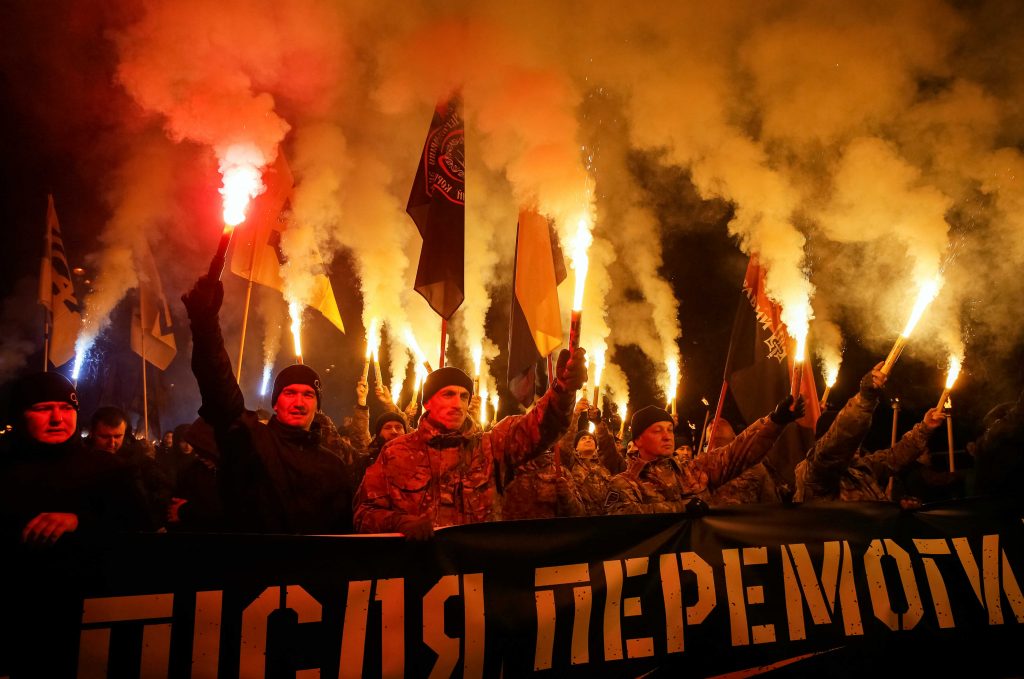
The divisions in Ukrainian society have become a chasm as the Russian leaning population will cleave to Russia even more as they become citizens of that state. Rampant anti-Russian Ukrainian nationalism has intensified further with attacks on Russian culture and celebration of the most reactionary aspects of Ukrainian nationalist history, including its collaboration with fascism during the Second World War. The trajectory of the pro-war left, determined by the objective logic of their pro-Ukraine position, and regardless of subjective intentions, has seen them prettify and decorate this reactionary movement through the disguise of ‘decolonialism’.
Far from corruption reducing as a result of war there are no indications of it falling: Transparency International records the score for Ukraine in 2022 being the same (at 33 out of 100) as the 2020 score, with even the BBC reporting on the corruption of payments by young Ukrainians in order to avoid conscription to the front. As the by-line of a Guardian article puts it ‘As the UK is set to hold a conference on how to rebuild post-war Ukraine, many worry what will happen to funds sent through a system where money disappears.’
It quotes Joe Biden in 2015 saying that “the corruption is so endemic and so deep and so consequential, it’s really, really, really, really hard to get it out of the system.” The Guardian article reads not that the war has solved the problem but that it still exists and there is concern about what to do about it. The article reports that Ukrainians don’t trust their own government to deal with the problem while some have faith that the EU might. At the same time a board member of the ‘Ukraine Anti-corruption Action Center’ blames Russia!
The article states that ‘many say checking the rise of a new oligarch class has been hampered by the abandonment under martial law of many of Ukraine’s extraordinary transparency measures, including registries of the property and income of public officials.’ The article then mentions that ‘one western lawyer closely involved in Ukrainian extradition cases over the past decade says he is still not sure European politicians quite understand how deeply corruption is ingrained in the political culture’, and notes that the court system is s big problem, and that ‘Zelenskiy has refused to accept the full recommendations from the Venice Commission to give a majority to the international judges that screen applicants for the constitutional court.’
The war has accelerated austerity, privatisation, attacks on workers’ rights, censorship, and attacks on media and opposition political parties by the Zelensky regime. It has saddled the country with more debt and complete dependence on Western imperialism, with conferences openly discussing how money can be made out of it when the war ends. It should be noted that many of the same measures in Ukraine are reflected in those western countries supporting it, including attacks on workers’ living standards through increased inflation; a media on a propaganda spree unprecedented for many years, and a threatened massive increase in arms spending.
The article from the rabidly pro-Ukraine Guardian is admission that the concentration of power in existing institutions combined with massive restrictions on democratic rights, alongside provision of huge resources (totalling $170bn) by the West to an already corrupt state is not a recipe to reduce corruption. Foreign mercenaries fighting for Ukraine who have returned home have noted the graft involving weapon supplies, even at the front. The western powers have decided to accept this on the grounds of the greater objective of weakening their geopolitical rivals but aren’t buying their own message that Ukraine is a beacon of democracy.
The imperialist project for Ukraine is no different than it is for their own working classes but somehow some on the ‘left’ in the west see one as being progressive. Unfortunately or not, they cannot be separated.
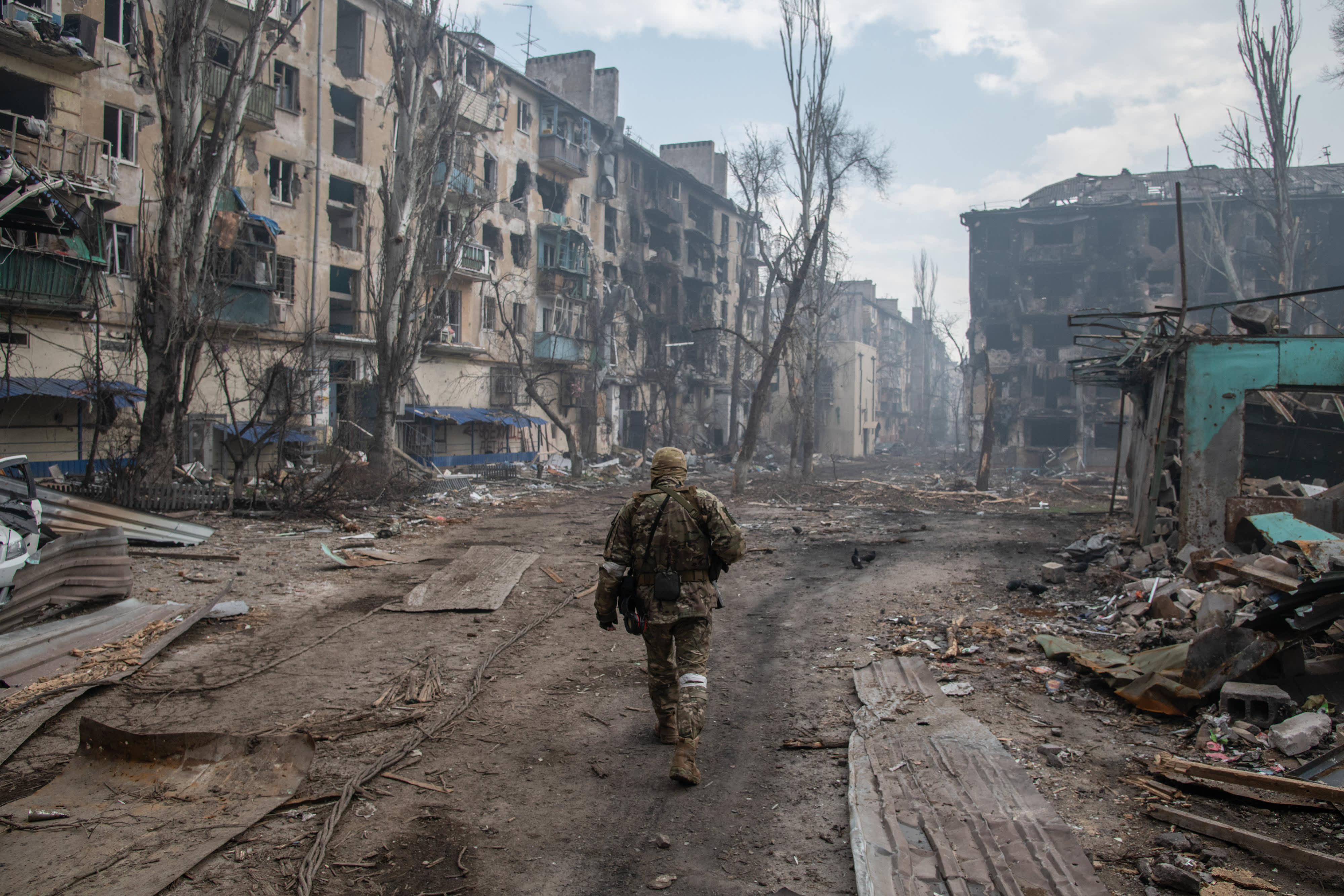
A Russian soldier walks in the rubble in Mariupol’s eastern side, where fierce fighting takes place between Russian and pro-Russia forces and Ukraine on March 15, 2022.
Maximilian Clarke | SOPA Images | Lightrocket | Getty Images
This is a joint statement, by the authors of Sráid Marx and Boffy’s Blog, on the global crisis of Marxism, which has become manifest in the collapse of many “Marxist” organisations into social-imperialism, in relation to the Ukraine-Russia War. Those organisations have abandoned the independent third camp of the international proletariat, and, instead, lined up behind one of the contending imperialist camps of NATO/Ukraine or Russia/China. They have sought to place the world labour movement back to the position prior to World War I (WWI), which led to the split in the Second International and formation of the Third International, although such a development is not possible, today, if only because no real International exists, making the situation similar to that prior to Marx and Engels establishing the First International.
This crisis of Marxism has been a long time coming. Its roots lie in the nature of what passed for Marxism in the post-war period, a ‘Marxism’ that was, in fact, a form of petty-bourgeois socialism, manifest in its attitude to the state as the means of historical change, rather than the independent self-activity, and self-government of the working-class, and, concomitantly, in its attitude to the national question and nation state. Both of us, with a combined experience of nearly a century in the labour movement, were recruited, in our youth, into different Trotskyist organisations – the International Marxist Group (IMG)/Peoples Democracy in Ireland, and International Communist League (I-CL), respectively – of which we were members for many years, and yet, freed from the barriers to critical thinking imposed by membership of such sects, we have, independently of each other, arrived at almost identical conclusions about the nature of the Left, and on the critical issues of the day for the labour movement.
We have set out below a statement on the fundamental issues we believe lie behind the recent failure of many groups and individuals to develop an independent working class position on the war in Ukraine, and how this very open betrayal is a result of previous errors now compounded into an outright defence of the capitalist state. While both of us have been activists in Western Europe, and our arguments are derived directly from this experience, the issues raised are relevant to Marxists everywhere and the experience of others across the world will confirm this experience and the lessons drawn that we have set out below.
The State
This ‘Marxism’ is fundamentally distinguished from other forms of socialism by its attitude to the state. Not only did Marx and Engels talk about the state withering away under communism, both were intensely hostile to the capitalist state, as the state of the class enemy. In “State and Revolution”, Lenin points out that Marx’s attitude to it was the same as the anarchists.
“… it was Marx who taught that the proletariat cannot simply win state power in the sense that the old state apparatus passes into new hands, but must smash this apparatus, must break it and replace it by a new one.”
It is only in this latter sense that Marxists differ from the anarchists, i.e. in the need for the proletariat, after it has become the ruling-class, to establish its own semi-state, to put down any slave-holder revolt by the bourgeoisie. The idea that Marxists can call upon the existing capitalist state to act in its interest is, then, absurd. That opportunist attitude to the state was promoted by the Lassalleans, and Fabians, in Marx and Engel’s generation, and, as Hal Draper sets out, in The Two Souls of Socialism, became the ideology of The Second International. Marx opposed it in The Critique of The Gotha Programme, and Engels followed that with many letters, and also in his own Critique of The Erfurt Programme, in which he opposed the idea of a welfare state, National Insurance, and other forms of “state socialism”.
As Lenin says,
“Far from inculcating in the workers’ minds the idea that the time is nearing when they must act to smash the old state machine, replace it by a new one, and in this way make their political rule the foundation for the socialist reorganization of society, they have actually preached to the masses the very opposite and have depicted the “conquest of power” in a way that has left thousands of loopholes for opportunism.”
(ibid)
Stalinism adopted this opportunist attitude to the state. In the post-war period, it was taken on by organisations claiming the mantle of Trotskyism. In Britain, for example, the Revolutionary Socialist League, better known as The Militant Tendency, talked about a Labour Government nationalising the 200 top monopolies, but all these organisations raised demands for the capitalist state to nationalise this or that industry, usually to avoid bankruptcy, and they continue to do so. Even more ludicrously, they combine these utopian demands to the capitalist state with the further demand that it also then grant, to the workers in the industry, “workers’ control”, as though such a request would ever likely succeed, other than in conditions of dual power in society, i.e. conditions in which workers have established their own alternative centres of power, in the form of workers’ councils, enabling them to impose workers’ control, arms in hand.
What such demands also illustrate is a dangerous failure to distinguish the difference between government and state. Governments of different complexions come and go at frequent intervals, as does the bourgeois political regime, appearing as either “democracy” or “fascism”, which are simply masks which the bourgeoisie adopt according to their needs, but the state itself remains as the real power in society, permanently organised as the defender of the ruling class, including against the government if required.
Authentic Marxism, therefore, rejects these opportunist appeals to the state to act in the interests of the working-class. Our method is that of the self-activity and self-government of the working-class, which must organise itself to become the ruling class, and, in so doing, bring about its own liberation. We look to the advice of Marx and Engels and The First International to develop its own cooperative production, rather than to the capitalist state and we advise it, at all times, to take its own initiative in addressing its needs within capitalism. This includes organising its own social insurance, to cover unemployment, sickness and retirement, rather than relying upon the vagaries of state provision, which is geared to the fluctuating interests of capital, and its economic cycles, not the interests of workers.
Of course, as Marx sets out in Political Indifferentism, if the capitalist state does provide such services, we do not advocate a sectarian boycott of them, out of a sense of purity. As Marx sets out in The Poverty of Philosophy, what makes the working-class the agent of progressive historical change is precisely its struggle against the conditions imposed upon it, which results from the limits of capitalism, and to breach those limits by replacing capitalism. Capitalism is progressive in developing the forces of production, via the accumulation of capital. This has led it to maximise the exploitation of labour/rate of surplus value but does not mean that we advocate no resistance to its demands for wage cuts, or lower conditions. We point to the limited ability of capitalism to maximise the rate of surplus value, and so develop productive forces, as well as the limited ability of workers to raise wages, within the constraints of capitalism, and consequently, the need to abolish the wages system itself.
Nor do we advocate a boycott of socialised healthcare, education and social care systems, but point out their limited capitalist nature, the lack of democratic control and so on. We oppose any regression to less mature capitalist forms of private provision, not by defending the existing state forms, but by arguing the need to move forward to new forms directly owned and controlled by workers themselves. Whilst we offer support to workers’ struggles for improvements in existing provision, and for democratic control, we do so all the better to demonstrate to workers that so long as capitalism exists, no such permanent improvement and no real democratic control is possible.
All large scale industrial capital is now, socialised capital, be it state capital or that of corporations, and so properly the collective property of the “associated producers”, as Marx describes it in Capital III. Unlike the socialised capital of worker cooperatives, it is not, however, under the control of the associated producers, of the working class, but of shareholders and their Directors. Short of a revolutionary situation, and condition of dual power, workers cannot force the state to concede control over that capital to them. Even the social-democratic measures, such as those in Germany, providing for “co-determination” of enterprises, are a sham that retains control for shareholders, and simply incorporate the workers in the process of their own exploitation.
Similarly, we do not support the sham of bourgeois-democracy, which is merely a facade for the social dictatorship of the bourgeoisie, and its state, a facade they will drop in favour of fascism if their rule is challenged by workers. We defend the democratic rights afforded to workers – to organise and to advance their class interests – but we do not confuse defence of those rights, which the working class can use, with defence of the bourgeois democratic state that continually seeks to limit, erode and threaten them outright.
We recognise, however, that millions of workers do continue to harbour illusions in bourgeois democracy, and, so long as they do, we must try to break them from it. That is not done by a sectarian abstention, but by utilising it, and demanding it be consistent democracy. For example, abolition of Monarchy and hereditary positions and titles, election of judges and military top brass, abolition of the standing army, and creation of a popular militia under democratic control. We support the workers in any such mobilisation and demands for consistent democracy, but we offer support only as the means of demonstrating the limits to such democracy and the possibility of a higher alternative, so enabling them to shed their illusions in that democracy.
The means by which we seek to mobilise the workers, in all such struggles, are not those of bourgeois society, but those of the encroaching socialist society of the future. We advocate the creation of workplace committees of workers that extend across the limited boundaries of existing trades unions; we advocate, as and when the conditions permit, the linking up of such committees into elected workers’ councils, and the joining together of this network of workers councils on a national and international basis. We reject the idea of reliance on the capitalist state and its police to “maintain order”, or of its military to provide defence of workers, and instead look to democratically controlled Workers’ Defence Squads and Workers Militia to defend workers’ interests, including against the armies of foreign powers, terrorists and so on.
The National Question and The Nation State
The opportunist view of the state differs from the Marxist view, by presenting the state as some kind of non-class, supra-class, or class neutral body, standing above society, whereas Marxists define it as what it is, the state of the bourgeois ruling class. The opportunist view of the state is a petty-bourgeois view, reflecting the social position of the petty-bourgeoisie as an intermediate class, standing between the bourgeoisie and the proletariat, and which sees its role as mediating between these two great class camps.
It denies the class division of society. The symbol of this denial is the use of phrases such as “the nation”,“society”, “the people” and so on, which subsume the antagonistic classes, in each society, into one “nation”, and then transforms the state into being the state of “the nation”, or “the people”, rather than of the ruling class. This used to be the ABC of Marxism, and yet the Ukraine-Russia War, has seen a large part of the Left collapse into these opportunist and nationalist, as opposed to socialist, ideas.
The logic of this opportunist position flows inevitably from their view of the state as the agent of social change, as against the role of the working-class itself. It is necessarily a petty-bourgeois, nationalist view, as against a proletarian, internationalist view. It demurs from class struggle, in order to privilege and promote the combined interests of all classes within the nation, as a “national interest”, which necessarily sets that “national interest” against the “national interest” of other nations. The interests of workers of different nations are, thereby, brought into an antagonistic relation with each other, rather than with their own ruling class. Again, this used to be the ABC of Marxism, symbolised by Marx’s statement that the workers have no country, and appeal, in The Communist Manifesto, “Workers of The World Unite”.
In WWI, the opportunists in the Second International, continued to repeat these statements, but only as mantras, whilst, in practice, abandoning class struggle, and lining up under the banner of their particular capitalist state, in alliance with their own bourgeoisie. This characterises the positions of much of the Left, in relation to the Ukraine-Russia war, whether they have lined up in support of the camp of NATO/Ukraine on the one side, or Russia/China on the other, under claims of an “anti-imperialist” struggle, or war of national independence/national self-determination.
Marx argued that the workers of no nation could themselves be free, whilst that nation held others in chains. That is why it is the duty of socialists, in each nation, to oppose their own ruling class in its attempts to colonise, occupy, or in any other way oppress other nations. While the formation of nation states was historically progressive, as it was necessary for the free development of capitalist production and its development of the productive forces, the subsequent destruction of nation states, and formation into multinational states, is also historically progressive, for the same reason. But, just as Marxists’ recognition of the historically progressive role of capitalism, in developing the productive forces, which involves it exploiting workers, does not require us to acquiesce in that exploitation, so too the historically progressive role of imperialism, in demolishing the nation state, and national borders, does not require us to acquiesce in its methods of achieving that goal. (See: Trotsky – The Programme of Peace).
In both cases, we seek to achieve historically progressive goals, but without the limitations that capitalism imposes on their achievement, by moving beyond capitalism/imperialism to international socialism and communism. The struggle against militarism and imperialist war is fundamental to presenting the case, and mobilising that struggle for, the overthrow of capitalism, and its replacement by international socialism. We carry out these struggles on the basis of the political and organisational independence of workers from the bourgeoisie and its state, on the basis of Permanent Revolution. (See Marx’s Address to the Communist League, 1850)
This was the basis of the position set forward by Lenin in relation to The National Question. The task of Marxists, in oppressor states, is to oppose that oppression by their own ruling class and to emphasise the right to free secession, whilst the task of Marxists in oppressed states is also to oppose their own ruling class, pointing to its exploitation of the workers, and unreliable and duplicitous nature, and emphasising not the right to free secession, but the right to voluntary association. It is what determines the Marxist position of opposing, for example, Scottish nationalism, Brexit, or other such forms of separatism across the globe. As Lenin put it, we are in favour of the self-determination of workers, not the self-determination of nations.
In 1917, following the February Revolution, in Russia, the Mensheviks, and some of the Bolsheviks, such as Stalin, Kamenev and Zinoviev, also changed their position of opposing the war, and argued that the Russian state had become “revolutionary democratic”, i.e. a non-class state, overseeing a non-class form of democracy. Lenin vehemently opposed that social-patriotism, and threatened to split the party unless it was rejected. However, this position was never abandoned by Stalin, who resumed it after Lenin’s death, making it the foundation of his strategy of the Popular Front, applied in relation to national liberation struggles, for example “the bloc of four classes”, in China, in 1925-7, and in opposing fascism, as applied in France (1934-9), and in Spain (1934-6), and subsequently, in Stalinism’s collapse into what Trotsky called “communo-patriotism” in WWII.
In the post-war period, it was not only social-democrats, reformists and Stalinists that adopted this class collaborationist Popular Front approach. In place of the Marxist principle of the self-determination of the working-class, the petty-bourgeois Left, including those that described themselves as “Trotskyist”, threw themselves into supporting struggles for national self-determination and did so, not on the basis of simply opposing the role of their own ruling-class, but of actively supporting the bourgeois and petty-bourgeois nationalist forces engaged in those struggles.
Indeed, not only were the forces involved the bourgeois class enemy of the proletariat, but, in many cases, as in, for example, Korea, Vietnam, Algeria and so on, they were aggressively anti-working-class forces with which Marxists should have had no truck whatsoever, and against which Marxists should have been warning the workers, and against which they should have been aiding workers to defend themselves. (See: The Theses On The National and Colonial Questions). Again, the petty-bourgeois socialists had adopted the mantra of “My enemy’s enemy is my friend”, identifying imperialism as the enemy, and so the bourgeois and petty-bourgeois nationalists fighting that imperialism, as their friend. This was even the case where these forces violently suppressed Trotskyists within their own country. Today these forces have presided over or opened the door not to workers’ power but to capitalism.
This was never the position of Marxism, as set out, for example, in the Comintern’s Theses On The National and Colonial Questions. It is a perversion of that position introduced by Stalinism, and later adopted by the petty-bourgeois Left, in part under pressure from Stalinism, but also from peer pressure in the petty-bourgeois, student milieu in which it became embedded, and from which came much of the movement in support of these national liberation struggles, and from which it sought to recruit new members. In line with the principles of Permanent Revolution, first set out by Marx in his 1850 Address, not only was it necessary to ensure the political and organisational independence of the proletariat, and to arm it to defend itself against the national bourgeoisie, but, in so far as the proletariat was led to form any temporary tactical alliance with the peasantry and petty-bourgeoisie, it was on the basis of an alliance with those masses, and not with the parties representing those classes, and certainly not with the bourgeois state.
“Lenin, it is understood, recognized the necessity of a temporary alliance with the bourgeois-democratic movement, but he understood by this, of course, not an alliance with the bourgeois parties, duping and betraying the petty-bourgeois revolutionary democracy (the peasants and the small city folk), but an alliance with the organizations and groupings of the masses themselves – against the national bourgeoisie.”
This is in stark contrast to the position of the Left, in all national liberation struggles, in the post-war period, and in its position in relation, now, to the Ukraine-Russia war.
The Russia-Ukraine War
Like WWI, the Russia-Ukraine war has become an acid test of the Left. As with WWI, most of that Left has failed the test. That the Left social-democrats, the reformist socialists, and Stalinists should fail only repeats their failures going back to WWI, but for those that claim the mantle of Trotskyism to fail it indicates the crisis of Marxism, and that the nature of that Left, as described above, is actually petty-bourgeois.
It is no surprise that those that have collapsed into becoming cheerleaders for one or other of the two contending imperialist camps have done so by using the arguments that opportunists used in WWI, and in WWII, based upon arguments of national self-determination, and “anti-imperialism”. But, nor is it a surprise that the Stop The War Coalition, which opposes the war on both sides, does so not on the basis of Marxism and Leninism, and the principles of class struggle and revolutionary defeatism, but on the basis of opportunism and social-pacifism.
The Marxist position is not only that the war is reactionary on both sides, and so we oppose the war; it is also a recognition that such wars are not inexplicable events, or caused by fascist megalomaniacs, but flow from the nature of imperialism, its drive to create a global single market, dictated by the needs of large-scale capital itself. It is inevitably led to do this by the violent competition of nation states (and alliances of such states), each seeking to assert their dominant position in any new international formation. Simply appealing for peace is therefore utopian, and ultimately reactionary, just as much as appealing for capitalist enterprises to stop competing against each other or forming larger monopolies and cartels.
We do not argue for an end to capitalist competition or monopolies, but for workers to take over those monopolies, and, thereby, to be able to replace competition with increasing cooperation between them, as part of a planned organisation of production and distribution. That is the real basis of class struggle, not economistic, distributional struggles for higher wages within a continuation of capitalism. Similarly, we do not argue for an end to wars between capitalist states, or the destruction of nation states and formation of larger multinational states, such as the EU, as part of forming a world state, but for workers to overthrow the existing capitalist states and establish workers’ states, as the only permanent means of ending wars, and rationally constructing a single global state, based upon voluntarily association. That is the basis of class struggle at an international level, of the concept of revolutionary defeatism, as against utopian demands for peace, the demands of social-pacifism.
The Marxist position of revolutionary-defeatism, in relation to the Russia-Ukraine War, as with any such war, is not simply about opposing the war, but about explaining to workers that these wars are fought using their blood, but not for their interests, and that they will continue to suck their blood so long as capitalism continues to exist. In the same way that Marxists intervene in strikes to explain that workers will continue to have to strike for decent wages, so long as capitalism exists, and that such strikes will not, ultimately, prevent their condition in relation to capital deteriorating; so they intervene in imperialist wars to explain that they will continue so long as capitalism/imperialism exists, and so the answer is not a utopian demand for peace, but a class struggle for the overthrow of capitalism/imperialism itself, to turn the imperialist war into civil war!
In the post-war period, the petty-bourgeois Left became engrossed in the rash of “anti-imperialist” and national liberation struggles that erupted as the old European colonial empires collapsed, in part under pressure from US imperialism that sought to break open all of the monopolies and protected markets of those colonial empires, in order to give free access to US multinational corporations to exploit vast reserves of labour. At the same time, Stalinism encouraged the development of support for such movements, as agents of the global strategic interests of the USSR, in competition with US imperialism. As in China, in 1925-7, it sought to ally itself with the national bourgeoisie, and subordinate the interests of workers and poor peasants in these former colonies to that of the national bourgeoisie, which it sought to draw into its orbit, as symbolised by the Third World Movement. This same, class collaborationist, Popular Front approach, was adopted by the Stalinists in the formation of the various Solidarity campaigns established to support these “anti-imperialist”, national liberation struggles.
Whilst the “Trotskyist” Left continued to repeat the mantra of opposition to Popular Fronts, in practice, and seeing large numbers of students drawn to the campaigns of solidarity with this or that national liberation movement, nearly all of which were bourgeois in nature, and many of which were particularly authoritarian and anti-working-class, as with the Algerian NLF and Viet Cong, it joined in, and promoted these kinds of cross-class, popular frontist organisations. It did so for fear of isolation and losing out in the potential for expanding its contact lists of possible new members in its rivalry with competing sects.
The Ukraine Solidarity Committee is just the latest in a long list of such cross-class, Popular Frontist organisations that throws their support behind, and so acts as useful idiots for, some reactionary national bourgeoisie, which is the enemy of the workers of the given state. In the past, these Popular Front organisations often gave a pass to the USSR and its allies, whereas, today, the USC gives a pass to, and allies with, NATO imperialism and its associates in the EU, G7 and so on. On the other side, those social-imperialists that have thrown themselves into a cross-class alliance in support of Putin’s Russia and Xi’s China, on the basis that they are being threatened by NATO/US imperialism, are simply the mirror image of the USC.
What Is To Be Done?
As two individuals, we do not suffer the hubris of thinking that we have the answers to this modern crisis of Marxism, but we do believe that such a crisis exists when self-proclaimed Marxists openly support one capitalist state in war against another, each backed by one or the other of the two largest capitalist states in the world A similar condition exists today as that in the early days of Marxism, with only a handful of authentic Marxists, amidst a sea of petty-bourgeois sects that portray themselves as Marxists while peddling reformist programmes; a still not insignificant number of Stalinists and other Left reformists; and with mass workers parties that have reverted to being simply openly bourgeois parties, much as with the British Liberals and German Democrats of 1848.
Indeed, the British Labour Party, under Starmer, has declined even more than that, becoming dominated by the reactionary, petty-bourgeois nationalism promulgated by the Tory party. Yet, in the absence of mass socialist workers parties, the working-class continues to engage in its own struggles, for increased wages to counter inflation, for example, but also to look to these bourgeois workers’ parties (or simple bourgeois parties) as their political representatives, and Marxists cannot ignore this reality. Our task is to work alongside the working-class, in and out of struggle, and break it from the current delusions in those parties, and in bourgeois-democracy itself.
Appeals to create yet another Marxist sect, or to create some new Workers Party have proven to be pointless. Engels advised US socialists to work with the existing workers parties, and, likewise, prior to the creation of the Labour Party, advised Eleanor Marx and her associates to work with the Liberal Clubs, rather than the existing sects such as the SDF or ILP. As he noted, in 1848, he and Marx and their supporters had joined the German Democrats, and operated inside it, as its organised Left-Wing.
Our fundamental principle, as set out by Marx in his 1850 Address, is to maintain the political and organisational independence of the working-class as it seeks its self-emancipation. But, as Marx and Engels showed, that is not incompatible with working inside existing mass workers parties. Whether that is done openly or covertly is only a question of tactics, determined by what is possible at the given time. The existence of the Internet to produce online publications and networks makes that much easier today than it was even 25 years ago.
In the 1930’s, when the forces congregating around him and his supporters were very small, Trotsky advised them to join the various socialist parties, so as to operate within them, as an organised Left-Wing, and, thereby, to begin to build the required numbers for the creation of new mass revolutionary parties. It was the formation of an undeclared United Front with those rank and file workers. It is again forced upon us given the tiny forces of authentic Marxism. Our goal is not some Quixotic attempt to capture those parties, but simply to build the required numbers of authentic Marxists to be able to create effective revolutionary workers parties as alternatives to them, and, then, to move from an undeclared United Front with the rank and file of those parties to an open and declared proposal for a United Front, exposing the leaders of those parties and drawing ever larger numbers of workers to the banner of international socialism.
That is in the future, but the first step is to establish a network of authentic Marxists, much as Marx and Engels did with the Communist Correspondence Committees, and as Lenin and Plekhanov did with the Marxist discussion circles that over time laid the basis for the creation of the RSDLP.
If you are in agreement with the principles set out above, in this joint statement, whether you are an individual or organisation, we ask you to contact either of the authors via the comments sections of these statements on our respective blogs. If you have a social media presence, then give us the details so that we can share it with our readers, and we would ask that you do the same, for everyone else as part of an expanding global network of authentic Marxists, each supporting, in whatever way they can, the work of the others, and facilitating a discussion and development of authentic Marxist ideas.
In 2013 the President of the US National Endowment for Democracy (NED) wrote in the Washington Post that ‘Ukraine is the biggest prize’ and its ‘choice to join Europe will accelerate the demise of the ideology of Russian imperialism that Putin represents’, and therefore a critical step toward regime change in Russia. NED is an Non Governmental Organisation funded largely by the US government and intended, as its name suggests, to promote ‘democracy’ around the world. Democracy, that is, only when it is subservient to US interests and supported only in so far as these are respected.
So, we have a non-governmental organisation funded by government, claiming to be independent of it but boasting of leading the way in its foreign policy. In 2018 its National Defence Strategy defined ‘the re-emergence of long-term strategic competition’ with Russia and China as the ‘central challenge to US prosperity and security.’
As we have repeatedly noted, the position of the Left that supports Ukraine, not coincidentally, is almost identical to the position and even arguments of the governments and mass media of Western capitalist states.
Both justify their position on the basis that Ukraine is defending democracy, for itself and for others. The pro-war Left highlights ‘Russian imperialism’ and the role of Putin (but then, so does the NED), and it also supports regime change, without seeming to wonder what sort of regime change would be effected by the victory of western imperialism.
Of course, this left also claims to oppose western imperialism and will claim that it seeks a different sort of regime change. Except it has supported western imperialist intervention in support of Ukraine and in doing so has objectively supported exactly the sort of regime change that western imperialism wants. It thinks irrelevant to the cause of the war that NATO was to be enlarged so that Ukraine could potentially be the site of missiles only 5 minutes from Moscow, and wonders not what this implies for the possibility of nuclear war.
This expansion means nothing to them in understanding the motivations and objectives of any of the actors and therefore the nature of the war. No consideration of this is allowed to question why socialists should support the self determination of a state that has eagerly sought this position. Instead, the foreseeable and foreseen consequences are made irrelevant by free-floating moral concerns that Marxists reject precisely because they are divorced from the real world. Whatever ideas populate their heads, with whatever motivations, are irrelevant, and it does not matter what people call themselves or what they think they are.
Political programmes have objective effects independent of intention, which is precisely the point of seeking their implementation. It matters not only to state what you are opposed to (e.g. Russian ‘imperialism’) but what you are for (workers liberation) because this determines what means are excluded (NATO arms to Ukraine) and what objectives are to be opposed (including Ukrainian and NATO victory). Only the belief that some moral case stands above such considerations can justify support for Ukraine and of western imperialist backing for it; but if this is the case we have far departed from a materialist and Marxist understanding of politics and war.
How far we have was revealed in a Facebook exchange of views with a supporter of Ukraine who asked rhetorically ‘do people seriously believe that if Ukraine did not get weapons from NATO then the war would be brought to a peaceful end?’ As if with weapons to Ukraine it would! He states that ‘the people of Ukraine need and deserve our support and reveal a level of empathy, of basic humanity that appears sadly lacking in those who see the main problem as Ukraine receiving the means for the continuing existence of their independent state.’
We are asked for ‘empathy’ and ‘basic humanity’ so that weapons can be supplied that will wound and kill humans who must, it seems, not be deserving of empathy or considerations of ‘basic humanity’. And all this because we must support the provision of weapons so that the people of Ukraine receive ’the means for the continuing existence of their independent state.’
But since when did capitalist states belong to their people? Who is the ‘their’ in ‘their independent state’? What sort of state is the state of Ukraine? The same one that walked its people into a war through its pursuit of NATO membership against the wishes often of a majority of its people? How independent is Ukraine now, when it relies completely on western imperialism in order to continue the war? How ‘independent’ will it be when the war is over and it becomes subsumed under the imperialist alliance with an economy destroyed, millions of its people in exile and up to its neck in debt to western countries and their vulture financial institutions?
The only explanation for such stupidity is the belief in vacuous moralistic claims divorced from the real world that none of the parties at war are themselves stupid enough to believe.
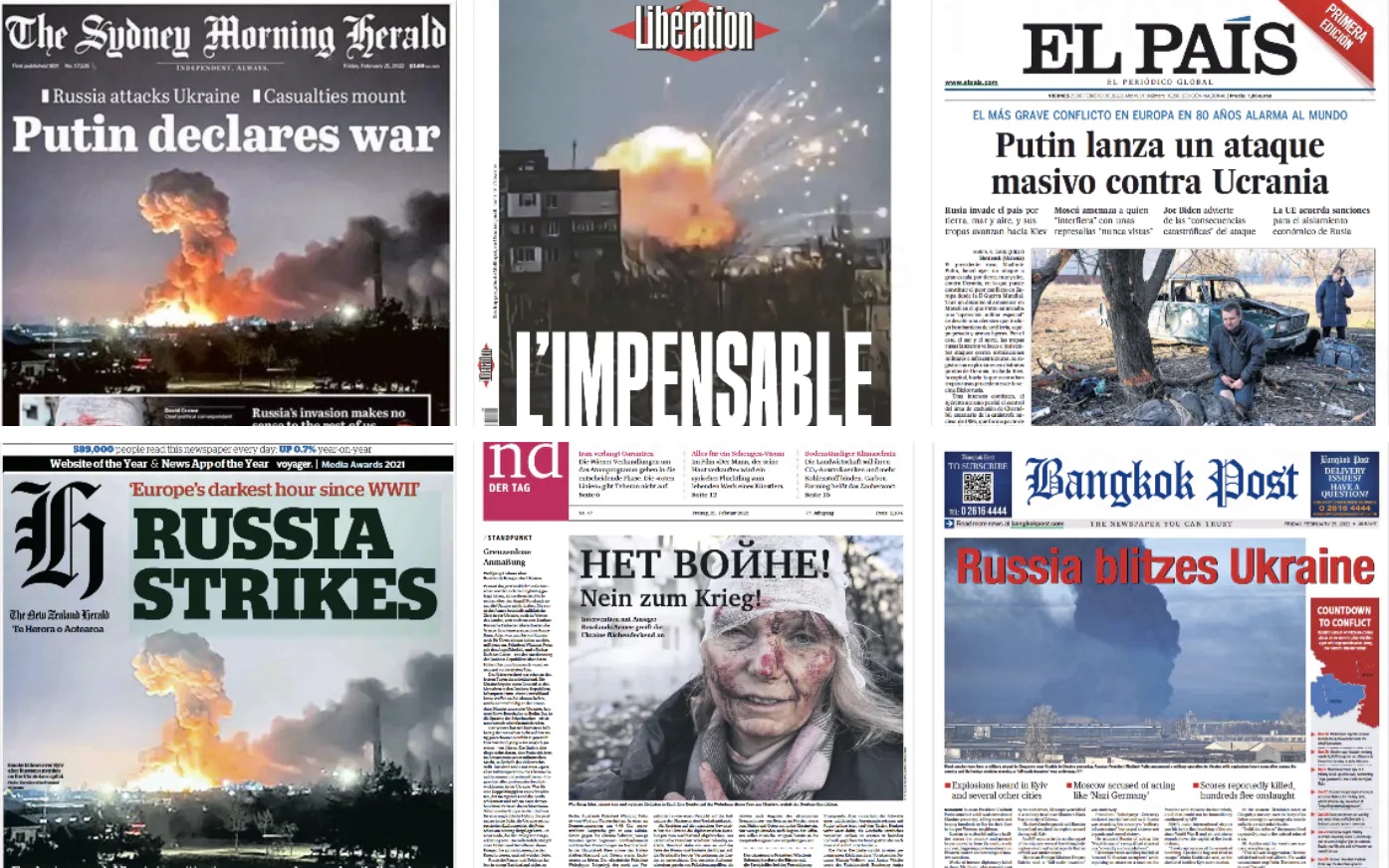
These moralistic illusions rest on one event–the Russian invasion on 24 February last year. This is meant to be not only the grounds to explain everything but also the explanation itself, and by itself the imperative to support the Ukrainian state. But of course, one event explains nothing, requiring explanation itself, never mind mandating the correct socialist response. Even a series of events are in themselves no explanation of anything, but simply a series of happenings.
The pro-war left is compelled to go beyond this event themselves by insisting that the issue is one of Russian imperialism and self-determination of Ukraine, although by deriving their understanding solely from the Russian invasion they are unable even to account for this event, previous Ukrainian actions, or the subsequent actions of Western imperialism. And this is before we even consider just what is meant by Russian imperialism; the nature of the Ukrainian state and its actions and policy; and the strategy and actions of western imperialism before the invasion.
These latter issues have been dealt with before; it should be enough to note here that we face a proxy war by western imperialism, through the Ukrainian capitalist state against the Russian capitalist state, for us to determine that the working class has no interest in supporting either. The actions of all these actors are selectively presented by the pro-war left in order to bolster their pre-determined support for Ukraine, with the emphasis on the mental state and ideological declarations of Putin filling in for the lack of empirical support for the victimhood of the Ukrainian state, the progressive role of western imperialism and just why the Russians decided they needed to invade when they hadn’t done so before when it might have been easier to do so.
The point then of this series of posts has been, not to argue that the facts and events enumerated in themselves determine the correct approach to the war, but that they rebut the pro-war left’s support for Ukraine and western imperialism. This support is based not on Marxist analysis of the political forces but a litany of events that are meant to present a tidy narrative that comfortably brings one to express sympathy and solidarity with the ‘Ukrainian people’; without real life complications of people being divided into classes and ‘Ukraine’ being constituted by a state that, being a state, is actually separate from its people.
Along the road of this narrative the character of the Ukrainian state does not appear on the stage, and its manipulation of the Ukrainian people is absent. The character that is on stage is of the Ukrainian ‘people’, which substitutes for the many characters of the classes that inhabit Ukraine, including the Ukrainian working class, that might, if given the floor, express its own interests. The character of western imperialism simply arrives at the climax with sword and shield to defend the actor called ‘Ukraine’, although this role too is largely hidden. The Western saviour simply gives his sword and shield to the Ukrainian with the implication that they are to fight to the death, either theirs, the Russians or both.
This type of dramatic theatre, descended from the ancient Greeks, takes the audience from point A to point B, from invasion to support for ‘the resistance’, along the way filling it with emotions and sensations, of sympathy and outrage, earnestly hoping for a purgative resolution, a sort of happy ending for those suffering, in so far as one can be envisaged.
To paraphrase Bertolt Brecht; when asking whether one should feel the torment of someone suffering, he had his character respond that to do so ‘I must know why he is suffering’. Knowing why requires more than awareness that there was an invasion; that people are dying; that a perverted version of Lenin’s slogan of self-determination is the right answer, and that the biggest warmongers on the planet–out of character–are somehow doing the right thing.


 Sráid Marx