War as the continuation of politics by other means – the case of Ukraine 2 of 3

Hopes that a new democratic and corruption-free Ukraine will arise out of the ashes of the conflict have been publicised by its supporters on the left by pointing to the popular mobilisation of many Ukrainians in support of the war effort.

Once again, however, this is not a new phenomenon and does not sustain the argument that a different, more democratic and less corrupt state will arise.  Already there is mounting evidence of this enthusiasm waning; understandable given the effects of the war but still damning for the hopes of the war’s supporters.  For the purposes of our longer perspective, it is confirmation of previous experience.

Ukrainians have participated before in a number of very large mobilisations against their exiting political regimes in favour of democracy and against corruption.  This was the case in the Orange revolution in 2004 and the Maidan uprising in 2014.  In the first case the new regime installed proved to be more corrupt than the one it took over from, and the new regime installed in 2014 quickly became more unpopular than the one it replaced.

In both cases popular participation did not mean popular leadership, never mind one led by any sort of working class formation.  In 2014 it was far-right forces that formed the vanguard of its organisation, with western supported NGOs providing much of the veneer of a progressive movement.  The United States helped fund these NGOs and the Maidan protests that year provided the occasion for exposure of its political interference, through recordings its officials discussing who should, should not, and subsequently would be in the government.  This interference continued at the highest levels thereafter, so that Joe Biden, as US Vice President, boasted of his having more phone calls with the Ukrainian President than with his wife.  The war, and reliance on western arms, has simply made clear to even the meanest intellect the client relationship that developed.

Top-down manipulation, involving popular support and mobilisation often with progressive illusions in their enterprise–yet with oligarchic and imperialist objectives–have now taken the form of a war provoked by prospective membership of NATO.  Just like the previous mobilisations, except much more quickly and with much greater effect, these popular movements have led to bitter disappointment.  Today this results in military offensives that cannot succeed, except in killing and mutilating hundreds of thousands of Ukrainians in uniform.

Just as the working class was exploited by oligarchs before the war, protected by the Ukrainian state that was often their direct instrument, so it is working class men, in the main, who are dying and being mutilated in the war, although increasingly women are being recruited.  Just as before the war, the repeated hopes of many Ukrainians and desire for a more democratic and prosperous future is being dashed.

There is mounting evidence of the Ukrainian state having to press-gang men into the army and of many attempting to avoid it by leaving the country, joining millions who have already fled.  More Ukrainian soldiers are refusing to carry out suicidal orders or deserting.  Reports from many countries indicate that the refugees that have left may decide to stay away, rather than return to a war ravaged country and to a state once again promising probity and democracy.  There is particular concern about the demographic future of the country, with so many women and children having left, so that the pre-war population decline now threatens to become a ‘catastrophe‘.

The current offensive pushed by western imperialism and agreed by the Zelensky regime has little chance of succeeding in any significant way, admitted in secret US documents placed on the internet. This calls into question the whole initiative and the sacrifice of lives it is requiring, although not for western imperialism whose prime objective is not to take territory but attrition of the Russian forces and weakening of the Russian state.  It is openly admitted and reported, that the objective of some NATO members is to ‘break Russian power and to bring Ukraine into NATO’ with Poland hoping ‘that Rus­sia might even­tu­ally break apart’. (Financial Times 11 July)

Just as Ukraine was used, with the willing support of much of its ruling class, to support western imperialism by pushing for NATO membership, precipitating the war, so it continues to be propelled forward by Western arms and hollow promises of victory from the Ukrainian regime.  Just as the Ukrainian state lied about the security to be won by pursuing membership so its people are being fed lies about NATO weapons delivering victory.  Lies that the pro-war western ‘left’ endorses through its support for the war, support for the objectives of the Ukrainian state, and support for the western provision of arms that facilitate continuation of the war with all its casualties, but which will not bring the promised triumph.

Since the west has run out of conventional artillery shells of the required calibre it is now supplying cluster bombs and long range missiles, which again this ‘left’ must endorse or, like its ruling classes, have to admit that its policy has been an utter failure, one that hundreds of thousands have paid for with their lives.

This ‘left’ cannot admit it supports a proxy war by western imperialism even as both Ukraine and imperialism admits that western weapons are vital to the war effort.  Support for an imperialist war in which millions of workers have been casualties in one way or another is not something that can be admitted as a ‘mistake’, perhaps something to be forgotten or worse, rationalised and theorised for future such wars.  Just as the seeds of its capitulation were planted in previous errors, so the weeds they have sprouted have grown and taken over whatever was once worthwhile.

Back to part 1

Forward to part 3

Opposition to cluster bombs . . . whatever

source: A Jazeera

What are we to make of an article from a left web site that starts like this:

‘The supply of cluster munitions by the US to Ukraine must be opposed. Anti-capitalists and internationalists support unconditionally the people of Ukraine in their armed resistance to liberate their country from the Russian genocidal invasion. But the support for Ukraine is not necessarily uncritical. We have been critical of the Zelensky government attack on labour rights in the country and its embracing of neoliberal policies. Now we have to criticise its use of cluster munitions.’

The first sentence might seem to require no comment, but even this is not the case, what does opposition entail?

The second declares that the Russian invasion is ‘genocidal’, which is simply untrue.  However bad it is, the point of the invasion is not to destroy the Ukrainian people, and such claims only promote the war: after all, if this is the point of the invasion then there is no point in not fighting to the death, and, given such stakes, the use of old cluster bombs hardly looks excessive. 

The truth, however, is that the purpose of the Russian invasion, as the article later acknowledges, is not this, but ‘Ukraine’s de-Nazification and demilitarization and implicitly integration into Russia’s orbit.’  However one understands this, it is far from the destruction of the Ukrainian people, and the employment of the term not only belittles the history the word does apply to, but also shows scant regard to the real nature of the war, what approach should thereby be taken to it, and therefore how it might be ended.

We have been over many times the deception of describing the war as one of ‘the people of Ukraine in their armed resistance to liberate their country’, when the war is waged by the Ukrainian state and the liberation sought includes areas that wouldn’t welcome it.  What matters here is the assertion that ‘Anti-capitalists and internationalists support unconditionally’ Ukraine in its war.  In other words, all the words of condemnation of the use of cluster munitions will not dent their support for ‘Ukraine’, so simply dissolve into moral handwringing. 

How do we know that this condemnation is worthless?  Well, because it involves no change in approach, as the article acknowledges.  It says that ‘support for Ukraine is not necessarily uncritical. We have been critical of the Zelensky government attack on labour rights in the country and its embracing of neoliberal policies. Now we have to criticise its use of cluster munitions’.  So, previous criticism has not dented support and neither will the use of cluster munitions; just as previous claims that the supply of offensive weapons would not be supported, so this red line of the pro-war left breaks exactly at the same time as western imperialism crosses it, in perfect sequence.

If this ‘left’ can support a capitalist state when it attacks workers’ rights and imposes ‘neoliberalism’, by which is presumably meant rabidly pro-capitalist policies, what barriers remain?  What could the Ukrainian state do that would lead this ‘left’ to oppose it when its support is ‘unconditional’?  In the major geopolitical struggle in the world today, what role does this left play that is in any meaningful way different from western imperialism itself?  If ‘unconditional’ means what it says, then there can be no conditions placed on imperialist support for its ally.  This ‘left’ has bound itself in a tight embrace not only with the rotten and corrupt Ukrainian state and its ruling class but with their own states and their own ruling classes.

‘It is understandable that Ukraine wants to get all the arms necessary to get a quick and decisive victory against the Russian army’, says the article!  Has the author not noted that the war has been going on for 18 months; that the much anticipated Ukrainian counter-offensive is stalling and was never expected to achieve much anyway; that the Russians are now advancing as much as the Ukrainians?  Does this left accept every stupid statement of the Ukrainian state at face value; and if it does, how does this not invalidate its own qualms about cluster munitions if the possibility of ‘a quick and decisive victory’ is not a reasonable thing to anticipate?

Their lofty and high-minded approach departs further from the real world as it states that ‘whatever the military arguments, opposing the precepts of the Convention on Cluster Munitions will make it harder for Ukraine to argue for the international rule of law. If Ukraine gets weapons that most UN member states (including the UK) are seeking a ban on, it will affect its ability to win solidarity and condemnation of Russia’s illegal occupation by these states.’

What exactly is the ‘international rule of law’, perhaps their ‘left’ version of the imperialist ‘international rules-based order? ‘ Both equally fictitious and utterly irrelevant when conflict becomes a test of strength and power.  Who will be affected by the claimed reduced Ukrainian ability to ‘win solidarity’ when this left itself will not be impacted in its own support?  Does it believe western imperialism gives a shit about the impact of cluster munitions?

Perhaps it believes that there are sections of the world’s population who will oppose cluster munitions and not hold a position of ‘unconditional’ support to Ukraine; who might then question the virtue of this state and the justness of its war, and might then go on to draw conclusions about it–that it should be opposed, and the cluster munitions-wielding Ukraine should not be supported?

What then for the loyal left, which supports Ukraine ‘unconditionally?’  Surely it would be honour bound to redouble its defence of Ukraine against any possible wavering of support.  That, anyway, is the logic of its position, the logic of its ‘opposition’ to cluster munitions.

Of course, in mealy-mouthed fashion it notes that ‘Ukraine has also used cluster munitions, albeit on a much smaller scale. While not used on cities, they nevertheless did cause death and injuries to civilians.’

At this point one might wonder what the point of the article is; this boat has already sailed, so why the advice that ‘If Ukraine wants to maintain the solidarity around the world, it should not break the ban on cluster munitions by over 100 countries’?

Ukraine has not signed the Convention on Cluster Munitions, so has not and is not breaking from its policy, or previous practice (as in 2014-2015 in Donetsk city for example) and has repeatedly asked to be supplied by them.[i]  The pro-war left makes no distinction between solidarity with Ukraine as a state, as a people, or a working class, but in this case it is clearly only the state that can decide not to use cluster bombs.  So, it either has to appeal to this state to forego their use, which is hardly likely, or to its population or working class, although this would open up recognition of the difference and invite the conclusion that they are not synonymous and even have separate interests.

It is also a bit absent to dismiss the ‘military arguments’ with a ‘whatever.’  The pro-war left have pointed to the absolute necessity for military support–‘Ukraine also needs a mass solidarity internationalist movement that supports its armed resistance’–and since Ukraine is running out of ammunition, the US has stated it has no choice but to supply cluster munition because it doesn’t have any other.

The whole article is blind to its deception.  It reads as the necessity to maintain the reputation of the Ukrainian state, with opposition to cluster munitions entirely secondary.  Where, for example, is the appeal for the Russian state not to deploy them, or to the international working class to demand this?  But of course, on the coat tails of western states and their mass media, Russia, its people and its working class are beyond the pale.

Human Rights Watch is quoted as documenting their use, but that ‘Ukraine used cluster munitions, albeit on a much smaller scale. While not used on cities, they nevertheless did cause death and injuries to civilians.’  But this is not quite what the report, and one referenced by it, says:

‘Ukrainian cluster munition rocket attacks in the city of Izium in 2022 killed at least eight civilians and wounded 15 more, Human Rights Watch said. . . . The total number of civilians killed and wounded in the cluster munition attacks that Human Rights Watch examined is most likely greater. Russian forces took many injured civilians to Russia for medical care and many had not returned when Human Rights Watch visited.’

‘Ukrainian armed forces reportedly used cluster munitions in attacks on Izium city, Kharkivska region, between March and September 2022, when it was controlled by Russian armed forces, according to the Independent Commission of Inquiry on Ukraine. The commission provided three examples illustrating this use of cluster munitions in Izium..’

‘Anti-Capitalist Resistance’, that stands over this article, is blind to the reality of this war because it has abandoned a Marxist understanding of what is going on.  That is why the article is incoherent.   Nothing provides a better example of this than the statement that ‘Reconstruction after the war must be for another Ukraine with economic and social justice, not one where the country’s assets are handed over to western capitalism.’

How this is to be achieved through the arms of western imperialism wielded by a corrupt capitalist Ukrainian state is unexplained.  No explanation is possible.

Marx said of his politics that it did not appeal to “an ideal to which reality [will] have to adjust itself” but was based on “the real movement which abolishes the present state of things”.  The reality of the war in Ukraine will not adjust itself, during or after, to the otherworldly moralising of Anti-Capitalist Resistance, and the movement that will abolish war is that of the working class, not ‘the Ukrainian resistance’, not ‘a mass solidarity internationalist movement that supports its armed resistance’, and not the supply of only ‘good’ weapons by Western imperialism so that the blushes of ACR can be spared.


[i] These requests follow (according to a report) that ‘Ukraine in 2011 . . . cluster munitions constituted 35 percent of its stocks of conventional weapons, which totaled two million tons of ammunition.’

War as the continuation of politics by other means – the case of Ukraine 1 of 3

Marxists do not support or defend the capitalist state because we see it as an instrument that defends bourgeois private property, which exists only in so far as the working class is exploited and oppressed by capital and this capital accumulated to ensure further exploitation.  We do not do so in peacetime and there is no reason why we would do so in war, which has often been the product of the rivalry of competing capitalist powers, and amounts to their struggle over the relative shares of the resources for, and fruits of, exploitation. Why would we want to defend the structures of the system that ensures our exploitation?

Even when it comes to ensuring the most advantageous circumstances for our struggle against this exploitation and subjugation–through defending general civil and democratic rights that we sometimes have, we do not thereby either consciously or objectively support or defend the state within which we avail of them.  In fact, these struggles often involve struggles against the state and its efforts to restrict our rights and freedoms.

In anti-colonial struggles or against annexation within a larger empire these struggles are against the particular capitalist state.  They have, when successful, almost invariably led to the creation of new capitalist states but it is precisely socialists who will also oppose these new states and attempt through a strategy of permanent revolution to destroy them and create a new state based on the power of the working class.  Of course, for nationalists, it’s all about the creation of a new capitalist state, so that for them self-determination of nations equates to their creation.  For Marxists there is no reason to seek the creation of newer instruments that ensure exploitation of the working class.

For us, the struggle continues within the new state–as a class struggle with the objective of destroying it–because for us the objective is the self-determination of the working class and against any new state that will subordinate the working class to itself.  For us, support for the right to self-determination does not equate to support for separation or independence; support for the right to create one does not entail automatic support for its actual creation.

We are in general opposed to the splintering of larger states into smaller ones, which are usually the projects of petty bourgeois forces seeking to advance their social position through the offices and rewards to be garnered from creation of a new state apparatus.  The creation of new state borders increases divisions within the working class and obstacles to their organisation across them.

So, for example, Scottish nationalism seeks the division of the British working class, and instead of even uniting Scotland it has divided it down the middle–all in the name of the unity of the Scottish people.  Even in Ireland, with many years of prior unity, the partition of the island has deepened the divisions that already existed.

War itself causes bitterness and division and the war in Ukraine is no exception.  Not only has it deepened the division between Ukrainian and Russian workers, it has deepened the existing division within Ukraine, with a significant minority living in the east of the country seeking unity with Russia.  Internationally it has created deep and lasting divisions within the socialist movement, with many rejecting some or all of the arguments that will be made in this and the following post.

As part of the attempt by the US to reassert its world hegemony it has deepened division in the world with many countries seeking to avoid their subordination, and to develop their resilience to US demands and its existing military and financial power. The war has precipitated bellicose demands for rearmament and accelerated preparations for war, which are products of relative US economic decline and that has allowed developing countries more latitude in manoeuvring to protect their own state interests. Widespread rearmament and increased scope for assertion of state interests opens up the potential for yet more war.

*                     *                     *

That the onset of war doesn’t change the policy of Marxists should not be a surprise and is in accordance with the oft quoted observation of Carl von Clausewitz that “war is not merely a political act but a real political instrument, a continuation of political intercourse, a carrying out of the same by other means.”  This has profound implications for those self-styled Marxists who support either of the two warring states and the two largest capitalist states that stand behind them.

If they defend these capitalist states now there is no reason that they should not have done so before the war and should not continue to do so when it ends.  Their ‘Marxism’ is therefore fraudulent and worthless.

This ‘political continuation’ has had a long maturation, with the expansion of NATO across Eastern Europe eventually threatening to include Ukraine, and the crossing of the reddest of Russian red lines being the major casus belli for the Russian invasion.  It explains preceding events and the immediate prominent role of the US and NATO in supporting the Ukrainian state.

The ’continuation of political intercourse’ is further demonstrated by the features of the warring parties becoming clearer through war.  While western imperialism claims Ukraine is involved in a war for democracy and will be transformed by it, including by the eradication of corruption, all the developments since it erupted point to the intensification of all its previous features.

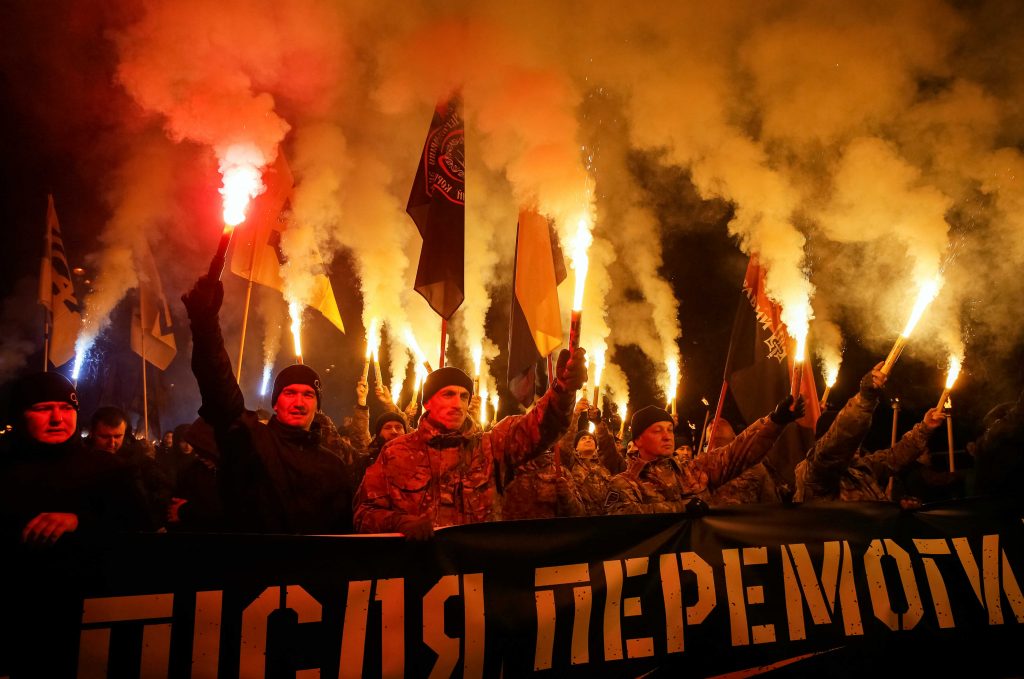
The divisions in Ukrainian society have become a chasm as the Russian leaning population will cleave to Russia even more as they become citizens of that state.  Rampant anti-Russian Ukrainian nationalism has intensified further with attacks on Russian culture and celebration of the most reactionary aspects of Ukrainian nationalist history, including its collaboration with fascism during the Second World War.  The trajectory of the pro-war left, determined by the objective logic of their pro-Ukraine position, and regardless of subjective intentions, has seen them prettify and decorate this reactionary movement through the disguise of ‘decolonialism’.

Far from corruption reducing as a result of war there are no indications of it falling: Transparency International records the score for Ukraine in 2022 being the same (at 33 out of 100) as the 2020 score, with even the BBC reporting on the corruption of payments by young Ukrainians in order to avoid conscription to the front. As the by-line of a Guardian article puts it ‘As the UK is set to hold a conference on how to rebuild post-war Ukraine, many worry what will happen to funds sent through a system where money disappears.’

It quotes Joe Biden in 2015 saying that “the corruption is so endemic and so deep and so consequential, it’s really, really, really, really hard to get it out of the system.”  The Guardian article reads not that the war has solved the problem but that it still exists and there is concern about what to do about it.  The article reports that Ukrainians don’t trust their own government to deal with the problem while some have faith that the EU might. At the same time a board member of the ‘Ukraine Anti-corruption Action Center’ blames Russia!

The article states that ‘many say checking the rise of a new oligarch class has been hampered by the abandonment under martial law of many of Ukraine’s extraordinary transparency measures, including registries of the property and income of public officials.’  The article then mentions that ‘one western lawyer closely involved in Ukrainian extradition cases over the past decade says he is still not sure European politicians quite understand how deeply corruption is ingrained in the political culture’, and notes that the court system is s big problem, and that ‘Zelenskiy has refused to accept the full recommendations from the Venice Commission to give a majority to the international judges that screen applicants for the constitutional court.’

The war has accelerated austerity, privatisation, attacks on workers’ rights, censorship, and attacks on media and opposition political parties by the Zelensky regime.  It has saddled the country with more debt and complete dependence on Western imperialism, with conferences openly discussing how money can be made out of it when the war ends.  It should be noted that many of the same measures in Ukraine are reflected in those western countries supporting it, including attacks on workers’ living standards through increased inflation; a media on a propaganda spree unprecedented for many years, and a threatened massive increase in arms spending.

The article from the rabidly pro-Ukraine Guardian is admission that the concentration of power in existing institutions combined with massive restrictions on democratic rights, alongside provision of huge resources (totalling $170bn) by the West to an already corrupt state is not a recipe to reduce corruption.  Foreign mercenaries fighting for Ukraine who have returned home have noted the graft involving weapon supplies, even at the front. The western powers have decided to accept this on the grounds of the greater objective of weakening their geopolitical rivals but aren’t buying their own message that Ukraine is a beacon of democracy.

The imperialist project for Ukraine is no different than it is for their own working classes but somehow some on the ‘left’ in the west see one as being progressive. Unfortunately or not, they cannot be separated.

Forward to part 2

The war in Ukraine (15) – war as a morality play

In 2013 the President of the US National Endowment for Democracy (NED) wrote in the Washington Post that ‘Ukraine is the biggest prize’ and its ‘choice to join Europe will accelerate the demise of the ideology of Russian imperialism that Putin represents’, and therefore a critical step toward regime change in Russia.  NED is an Non Governmental Organisation funded largely by the US government and intended, as its name suggests, to promote ‘democracy’ around the world.  Democracy, that is, only when it is subservient to US interests and supported only in so far as these are respected.

So, we have a non-governmental organisation funded by government, claiming to be independent of it but boasting of leading the way in its foreign policy.  In 2018 its National Defence Strategy defined ‘the re-emergence of long-term strategic competition’ with Russia and China as the ‘central challenge to US prosperity and security.’

As we have repeatedly noted, the position of the Left that supports Ukraine, not coincidentally, is almost identical to the position and even arguments of the governments and mass media of Western capitalist states.

Both justify their position on the basis that Ukraine is defending democracy, for itself and for others.  The pro-war Left highlights ‘Russian imperialism’ and the role of Putin (but then, so does the NED), and it also supports regime change, without seeming to wonder what sort of regime change would be effected by the victory of western imperialism.

Of course, this left also claims to oppose western imperialism and will claim that it seeks a different sort of regime change.  Except it has supported western imperialist intervention in support of Ukraine and in doing so has objectively supported exactly the sort of regime change that western imperialism wants. It thinks irrelevant to the cause of the war that NATO was to be enlarged so that Ukraine could potentially be the site of missiles only 5 minutes from Moscow, and wonders not what this implies for the possibility of nuclear war.

This expansion means nothing to them in understanding the motivations and objectives of any of the actors and therefore the nature of the war.  No consideration of this is allowed to question why socialists should support the self determination of a state that has eagerly sought this position.  Instead, the foreseeable and foreseen consequences are made irrelevant by free-floating moral concerns that Marxists reject precisely because they are divorced from the real world.  Whatever ideas populate their heads, with whatever motivations, are irrelevant, and it does not matter what people call themselves or what they think they are.

Political programmes have objective effects independent of intention, which is precisely the point of seeking their implementation.  It matters not only to state what you are opposed to (e.g. Russian ‘imperialism’) but what you are for (workers liberation) because this determines what means are excluded (NATO arms to Ukraine) and what objectives are to be opposed (including Ukrainian and NATO victory).  Only the belief that some moral case stands above such considerations can justify support for Ukraine and of western imperialist backing for it; but if this is the case we have far departed from a materialist and Marxist understanding of politics and war.

How far we have was revealed in a Facebook exchange of views with a supporter of Ukraine who asked rhetorically ‘do people seriously believe that if Ukraine did not get weapons from NATO then the war would be brought to a peaceful end?’  As if with weapons to Ukraine it would!  He states that ‘the people of Ukraine need and deserve our support and reveal a level of empathy, of basic humanity that appears sadly lacking in those who see the main problem as Ukraine receiving the means for the continuing existence of their independent state.’

We are asked for ‘empathy’ and ‘basic humanity’ so that weapons can be supplied that will wound and kill humans who must, it seems, not be deserving of empathy or considerations of ‘basic humanity’.  And all this because we must support the provision of weapons so that the people of Ukraine receive ’the means for the continuing existence of their independent state.’

But since when did capitalist states belong to their people?  Who is the ‘their’ in ‘their independent state’? What sort of state is the state of Ukraine? The same one that walked its people into a war through its pursuit of NATO membership against the wishes often of a majority of its people?  How independent is Ukraine now, when it relies completely on western imperialism in order to continue the war?  How ‘independent’ will it be when the war is over and it becomes subsumed under the imperialist alliance with an economy destroyed, millions of its people in exile and up to its neck in debt to western countries and their vulture financial institutions?

The only explanation for such stupidity is the belief in vacuous moralistic claims divorced from the real world that none of the parties at war are themselves stupid enough to believe.

These moralistic illusions rest on one event–the Russian invasion on 24 February last year.  This is meant to be not only the grounds to explain everything but also the explanation itself, and by itself the imperative to support the Ukrainian state.  But of course, one event explains nothing, requiring explanation itself, never mind mandating the correct socialist response.  Even a series of events are in themselves no explanation of anything, but simply a series of happenings.

The pro-war left is compelled to go beyond this event themselves by insisting that the issue is one of Russian imperialism and self-determination of Ukraine, although by deriving their understanding solely from the Russian invasion they are unable even to account for this event, previous Ukrainian actions, or the subsequent actions of Western imperialism.  And this is before we even consider just what is meant by Russian imperialism; the nature of the Ukrainian state and its actions and policy; and the strategy and actions of western imperialism before the invasion.

These latter issues have been dealt with before; it should be enough to note here that we face a proxy war by western imperialism, through the Ukrainian capitalist state against the Russian capitalist state, for us to determine that the working class has no interest in supporting either.   The actions of all these actors are selectively presented by the pro-war left in order to bolster their pre-determined support for Ukraine, with the emphasis on the mental state and ideological declarations of Putin filling in for the lack of empirical support for the victimhood of the Ukrainian state, the progressive role of western imperialism and just why the Russians decided they needed to invade when they hadn’t done so before when it might have been easier to do so.

The point then of this series of posts has been, not to argue that the facts and events enumerated in themselves determine the correct approach to the war, but that they rebut the pro-war left’s support for Ukraine and western imperialism.  This support is based not on Marxist analysis of the political forces but a litany of events that are meant to present a tidy narrative that comfortably brings one to express sympathy and solidarity with the ‘Ukrainian people’; without real life complications of people being divided into classes and ‘Ukraine’ being constituted by a state that, being a state, is actually separate from its people.

Along the road of this narrative the character of the Ukrainian state does not appear on the stage, and its manipulation of the Ukrainian people is absent.  The character that is on stage is of the Ukrainian ‘people’, which substitutes for the many characters of the classes that inhabit Ukraine, including the Ukrainian working class, that might, if given the floor, express its own interests.  The character of western imperialism simply arrives at the climax with sword and shield to defend the actor called ‘Ukraine’, although this role too is largely hidden.  The Western saviour simply gives his sword and shield to the Ukrainian with the implication that they are to fight to the death, either theirs, the Russians or both.

This type of dramatic theatre, descended from the ancient Greeks, takes the audience from point A to point B, from invasion to support for ‘the resistance’, along the way filling it with emotions and sensations, of sympathy and outrage, earnestly hoping for a purgative resolution, a sort of happy ending for those suffering, in so far as one can be envisaged.

To paraphrase Bertolt Brecht; when asking whether one should feel the torment of someone suffering, he had his character respond that to do so ‘I must know why he is suffering’.  Knowing why requires more than awareness that there was an invasion; that people are dying; that a perverted version of Lenin’s slogan of self-determination is the right answer, and that the biggest warmongers on the planet–out of character–are somehow doing the right thing.

Series Concluded

Back to part 14

A reactionary war throws up more reaction

The ‘mutiny’ by Yevgeny Prigozhin and at least some of his mercenary army is a bolt from the blue, at least for those not in security circles in the Russian Federation, and like all bolts from the blue both confuses and illuminates.  As I write it is impossible to determine the precise cause or their exact future course but it is possible to reflect on it politically, if only because it confirms the arguments and analysis of this blog–that we are witness to a reactionary war on both sides that the working class must oppose.

But let’s take a step back first.  In the last few weeks the Ukrainian state launched its much heralded offensive even while hesitating to declare it itself.  While this offensive is not exhausted, and the Ukrainian armed forces (UAF) still have the majority of its prepared forces available, it is clear that they cannot be assembled in such a way as to achieve the necessary mass and force to make significant advances.  Instead, it would appear that they have suffered many casualties with reports of some surrendering rather than take part in what they have called suicide missions, with prisoners condemning their commanding officers.

Supporters of the Ukrainian state and its war with is allies in western imperialism will either bury their heads in the sand or decry these actions; this is, after all, a war of national liberation for them, and there is no point here pointing out the absurdity of such a war being fought at the urging of the United States, Britain, France and Germany etc. with their own long record of involvement in war.  They should, instead, be welcoming these Ukrainian workers in uniform deciding that they do not think this war is worth dying for.

The pro-war left which exclaims the necessity for Ukrainians to defend themselves will have to explain why doing so is necessary when it only leads to their death.  But then perhaps for them it’s not really about the lives of ordinary Ukrainians but the necessity for the Ukrainian state to win regardless of the cost.  As this blog has pointed out, this would simply be the continuing identity of the politics of this left with the policy of western imperialism–from its explanation of the cause of the war to its political character and its ultimate objective.

For socialists, the refusal to fight for their respective capitalist states, both Ukrainian and Russian, is precisely the way forward for the working class of both countries, as a first necessary step to asserting their own interest over both.  It is, after all, how the Russian revolution came about, which some of this left might want to recall.

The internal conflict between Prigozhin and Russian authorities also exposes the equal stupidity of those on the left who think the Russian state is fighting a progressive war. Where is the popular mobilisation of the Russian working class and which side should it be called upon to support were it to exist?

For the pro-war supporters of Russia this is must be the Russian armed forces loyal to Putin and his regime, a regime that suppresses any independent activity of the working class and presents as progress a more equal division of the world between the largest capitalist powers.  A policy variously labelled as pluripolarity or multipolarity but which simply rearranges the vectors of power of the various capitalist states under the pretence of ‘anti-imperialism’.

True to the simple-mindedness of the pro-war left, the twitter-sphere is replete with supporters of Ukraine deriding those opposed to the war, asking if will they organise a march to demand Putin lay down his weapons and enter peace talks with Prigozhin; asking is it only against some wars?  They mock this opposition by saying it should urge Putin to cede territory to Prigozhin, while stating that it seeks desperately to find a way to blame western imperialism.

It says something for the mindset of this left that it misses no opportunity to claim how blameless western imperialism is, as if the continued existence of NATO, its escalation of the proxy war in Ukraine and its very existence as a system of oppression and exploitation matters not a jot. A default position that comes to the defence of western imperialism is not in any sense left wing, even taking account of the purely relative and imprecise nature of such a description.

For those of us opposed to both reactionary forces in Russia, we might ask this pro-war ‘left’ what side it proposes to support, since it believes that this is obligatory, or has it discovered that this is not necessarily the case? Has it discovered that not all those opposed to Putin are progressive and that not all those getting in the way of great Russian imperialism should be supported?

Perhaps it might be considered unfair to pick up on glib remarks on twitter, if only because it provokes a response that does no more than expose the shallowness of their position.  But this is precisely the point. Their child-like school playground remarks are a faithful reflection of the political arguments of the ‘left’ supporters of Ukraine, who can go no further than invoking Lenin’s policy of self-determination of nations that they obviously don’t understand, and which, if they were serious about, would attempt to explain how they avoid the criticism of Lenin in his writings of the position they now support.

Both the Ukrainian offensive and the internecine conflict within the Russian state, are clear illustration of the panoply of reactionary forces engaged in the war out of which only even more reactionary events will come if it is allowed to continue.  Over the last sixteen months the war has escalated with its supporters on both sides oblivious to their (minor) role in assisting this escalation through their support for it, even while they warn of the future disaster potentially arising from further escalation.

They have turned Marxism into a hollow series of formulas and slogans that are evacuated of any working class content and become vessels that support western imperialism through demanding ‘self-determination’ (of already independent capitalist states) or support for ‘anti-imperialism’ (on behalf of some of the most powerful capitalist states on the planet).

The longer it goes on the more these ‘lefts’ become useful idiots of the various capitalist powers and an obstacle to the creation of a movement that knows that it can be socialist only if it opposes capitalist war.  

Debating the war (3 of 3) – the analogy with Ireland

A recurring analogy made is with the Irish nationalist struggle against British imperialism and I have addressed this before.

Supporters of Ukraine have told us that ‘when internationalists support the Ukrainians right to resist militarily the Russian invasion and obtain arms from NATO countries, it is not an endorsement of NATO. There have been many movements of national liberation in the past which have called upon imperialist countries for arms without being condemned by socialists: Irish nationalists in 1917, the Spanish republic in 1936, the communist resistance in World War Two, to name a few.’

I wrote in reply –‘Let’s just take the Irish example. Was Ireland an independent state in 1916 or a British colony? Were the Irish rebels in 1916 seeking to join the German imperialist alliance, or did they claim ‘We serve neither King nor Kaiser’? Did the Irish workers movement participate as a separate political and armed force from the bourgeois nationalists, and did not James Connolly repeatedly declare the political independence of the Irish working class? Was his anti-imperialism the anti-imperialism of opposition to foreign rule or opposition also to capitalism and for the creation of a Socialist Republic? Where does the capitalist Ukrainian state and the ‘Ukrainian resistance’ stand on all these questions today?’

‘But let’s not leave the Irish analogy there. What happened to the Irish national struggle when the forces of the working class proved to be too weak and the movement became a purely bourgeois one? ‘Labour’ was told to wait, just as in Ukraine today, and the forces of bourgeois nationalism accepted a settlement with imperialism that left the working class more divided than before, subject to two reactionary regimes that inflicted years of austerity, unemployment and emigration built upon Catholic Church abuse of women and children and Protestant sectarianism and discrimination. Today the capitalist Irish state supports the Ukrainian capitalist state and imperialism, particularly that of the US, upon which its current success depends . . .’

I could have gone on to reference the policy of Marxists in Ireland over the last 50 or so years, which, despite many mistakes, never collapsed into support for Irish republicanism, never ceased to organise separately, never sought alliance with or peddled illusions in the Irish bourgeoisie and never looked, unlike republicans, to right-wing or establishment forces in the United States.  The nature of that struggle meant that the idea of support from any western imperialist power would have been considered ridiculous.

In the Tendance Coatsey debate, one comment proclaims ‘I wonder if “Irish Marxism” would be in favour of someone arguing that Irish self-determination was of no interest to Irish workers since all it led to was a “bourgeois” republic. And after all, Irish nationalism enjoyed the support of imperialist Germany in both world wars.’

This is answered in the paragraphs above, but let’s carry out a thought experiment, which is obviously purely theoretical, to see how much the self-determination of independent capitalist states matters to Marxists.

Imagine that Britain had decided to go for the hardest of Brexits, with the ambition of setting itself up as a strategic geopolitical competitor to the European Union.  This involved the hardest of hard borders within the island and severe disruption to trade between the Irish State and the rest of the European Union as transit through Britain became impossible.  This precipitated armed republican attacks along the border on various institutions of the Northern State which were answered by the arrival of British troops to suppress the attacks.

Within the North of Ireland the arrival of these troops and armed clashes raised political tension enormously with riots and deaths in Belfast, Derry and other smaller towns.  Republican groups hailed these circumstances as another example of ‘Nuair a bhíonn deacracht ag Sasana, bíonn deis ag Éirinn’ – ‘England’s difficulty is Ireland’s opportunity’ and launched an armed campaign against British rule.  In the Irish State the ruling parties called upon the Irish people to resist British imperialism.

The conflict between Britain and the EU cannot be confined to Ireland and the English Channel is closed to trade while there are clashes between the Royal Navy and French vessels.  To signal their full support to the Irish member state and prevent it buckling to British demands the EU sends its own troops to bolster the meagre Irish Army confronting the British.

What would be the attitude of socialists to such a march towards war?  Would we support the self-determination of Ireland and its historically justified struggle against British imperialism and partition?  Would we welcome the intervention of the EU as temporary allies in a morally justified struggle alongside the Irish capitalist state?  Certainly republicans in the North would hail the new anti-imperialist struggle and the opportunity to fight for a ‘Socialist Republic’ and commend their renewed role as defenders of the Catholic people in the North, pretty much regardless of its effectiveness.

Well, this would be an extraordinary turn of events, but Irish socialists would begin by interrogating the claims of its own rulers and state, especially its claims to be defending the democratic rights of the Irish people.  We would recall that it had viciously repressed previous armed revolts against partition and had opposed any progressive movement towards Irish unity while allying with British imperialism.

This previous collaboration would be held up as proof that there was no fundamental conflict, and certainly no fundamental difference, between British imperialism and the alliance of the Irish state with the rest of the European Union.  There would therefore be no grounds upon which the Irish working class should follow its own state in a war against Britain on behalf of one side of the imperialist rivalry between Britain and the EU, which would determine the nature of the war.

The same interests would be true for workers in Britain, who would have no interest in supporting British imperialist antagonism to the EU.  In the North of Ireland socialists would fight sectarian division, which the British state would use to bolster its own position on the island, while the Irish state would be compelled to base itself on the other side of the sectarian divide.

In summary, there are no circumstances in which Irish socialists would give up their independent organisation to support the Irish capitalist state, in or out of alliance with outside imperialist powers, for the sake of a struggle under a banner of self determination, in which neither of these has any interest.  A war that saw the European working classes kill each other for the sake of a capitalist state that has always been content with the partition of the country, while selling itself as a tax haven for US multinationals, is one that only someone lost to socialism could consider supporting.

For many years radicals in Britain confused opposition to British imperialism in Ireland and support for Irish democracy with support for the Irish republican movement.  This movement has now given up any serious pretence at struggle against British rule and accepted its role as partners in office with one of the most reactionary sectarian parties in Europe.  Some of the British and European left have learned nothing from this experience but are stupid enough to point to Ireland as justification for their support for a different capitalist state but the same imperialism they once opposed.

Back to part 2

Debating the war (2 of 3) – lessons from the past

The debate on the war on the Tendance Coatesy blog has given rise to lots of references to other past conflicts that the supporters of Ukraine spin to argue that we should now support it today.  A typical one includes the following:

‘The arguments to support Vietnam against the US and the Spanish Republic against the fascists were not that the forces leading these struggles were good. It is that expelling the US from Vietnam, and preventing the victory of Spanish fascism, were very far from a matter of indifference from a working-class, socialist point of view.’

The first problem with this is that the poster (a better word would be imposter) has argued that the forces leading the struggle in Ukraine are good and this includes the Ukrainian capitalist state and western imperialism.  As we noted in the previous post, he argues that imperialism is defending the working class.

That is the first point.

The second point is that, yes indeed, Marxists were not indifferent to the struggle against US imperialism in Vietnam or the Spanish civil war against fascism, but these show how far away his position in support of ‘Ukraine’ is from the Marxist position on these wars and the current one.

Marxists opposed US imperialism in Vietnam and worked for its defeat and opposed fascism in Spain with the same objective.  In the former, Vietnam was a colony fighting for independence, and no matter how many times supporters of Ukraine claim it was a colony they cannot claim that it still is, although one poster on Tendance Coatsey didn’t appear to understand the difference between the past and present tense.  Ukraine was and is an independent capitalist state and it is not the job of socialists to defend independent capitalist states in whatever wars they engage. Would, for example, the pro-Ukraine left still be supporting it if it still had its armed forces occupying Iraq alongside the United States?

In Spain a bourgeois democratic government was being challenged by a mass workers movement that had the potential to overthrow this government and create a workers’ state.  Supporters of Ukraine can’t point to an independent working class movement in that country, and far from wanting to overthrow the Ukrainian capitalist state they want us all to join imperialism in supporting it and ensuring it is armed to the teeth.  The difference is very clear and, absent malign motives, it is difficult to see why this is always missed and ignored.  In Spain the obvious task was to defeat the fascist insurrection, not as an alternative to overthrowing the bourgeois Republican government but as part of the same process of permanent revolution.

What Marxists did not do (or should not have done) was politically support either the bourgeois Republican Government in Spain or the Stalinist Viet Cong in Vietnam. What was necessary then and necessary now is the independent organisation of the working class that will fight against its enemies both foreign and domestic. What left supporters of Russia fail to appreciate is that if there was an independent working class movement in Ukraine it would not be supporting the Russian invasion but fighting it and it own capitalist state. The invasion by the Russian state is not about the liberation of Ukrainian workers, as its treatment of its own amply demonstrates. How this would be done would be a question of tactics but absolutely excluded is support for one’s own capitalist state and failure to organise against it on the grounds that it is doing what you want it to do already.

In Spain, it was support for the bourgeois government that ensured that the fight against fascism would not succeed, while in Vietnam the Stalinists repressed the Marxist movement and you can now visit the country as a tourist to view its capitalist society, although perhaps without seeing the sweatshops.

Vietnam was fighting a war against colonialism while in Spain the fight against fascism was to open up the possibility of socialist revolution.  In Ukraine the war was provoked by the moves by that state to join the world’s premier imperialist military alliance, and there is nothing progressive about this.  In so far as Ukrainian workers have needed to defend themselves they have needed to do so to prevent their state taking this course before the war; they need now to oppose the war in whatever way they can, and either in ‘victory’ or defeat they will need to resist the predations of western imperialism once the war is over.  The reactionary character of the Russian invasion is illustrated by the fact that winning Ukrainian workers to the second and third tasks is now immeasurably harder because of it.

‘Ukraine’ is so far away from any notion that it is involved in a progressive war that we have hundreds, if not thousands, of far right Russians fighting for it against Russia because, it appears, Russia isn’t reactionary enough for them!  And this is the ‘Ukraine’ socialists are supposed to support!

That such repugnant outcomes are advanced is the result of the lack of any class analysis by the supporters of ‘Ukraine’ who wrap the interests of the working class within its capitalist state, which itself is embraced by western imperialism, leaving the pro-Ukrainian Left supporting western imperialism and searching for spurious and fraudulent  arguments to defend themselves.

So, we get such comments that there aren’t enough imperialist troops in Ukraine to justify calling it a proxy war, when everyone and their dog knows Ukraine would have ended the war long before now without imperialist intervention.  And we get the apologetics for the prominent role of fascism by saying that they really only get a small vote, which reminds me of all the loyalist paramilitaries in the north of Ireland who don’t bother to vote for they own political fronts but for the DUP because this mainstream party adequately reflects their reactionary views.  In this, as in so much else, the pro-war left is protected by the bourgeois media, which censors the many indicators of fascist sympathies within the Ukrainian armed forces, and regurgitates the moral outrage that feeds the war and imperialist interests.

Back to part 1

Forward to part 3

Debating the war (1 of 3) – imperialism defending the workers?

‘We are Making a New World’: The fields of World War I. Copyright: © IWM. Original Source: http://www.iwm.org.uk/collections/item/object/20070

Over on the Tendance Coatesy blog a debate on the war has been taking place.  After over 90 comments Andrew, the host, made a short comment that finished with:

‘The whole thing is simple: they invaded. They are wrong. We should do everything to stand with Ukraine.’

So there you go. The whole argument that supporting ‘Ukraine’ does not follow inescapably from opposing the Russian invasion has passed Andrew by.  The argument about why the invasion took place, its causes, results and consequences are ignored.

What is this ‘Ukraine’ we are asked to support, and should workers support capitalist states, are questions likewise ignored, as is why the imperative to support ‘Ukraine’ also requires support for intervention by western imperialism.

Why are they wrong?  What is the harm caused and what use, if any, does Marxism have in determining this, and setting out what should be done about it?  Is there any class analysis that would distinguish our determining what is wrong from the wall to wall blitz of the capitalist media and its nauseating hypocrisy?  Or is it really so ‘simple’ that there are no differences between the socialist view and the propaganda of Western capitalism, so that supporting ‘Ukraine’ is so simple a thing that it requires no interrogation?

All these questions are avoided by ignoring the debate in the previous 90 odd comments; but the attempt to simplify things fails because it is simply a device for avoidance.  Like the bourgeois media it attempts to compel us to forget how we got here, the nature of the warring parties and their objectives; leaving us with the impression that the consequences of supporting the Ukrainian state and western imperialism will be their claims to bring about ‘freedom’.  As I have repeatedly pointed out: only one fact matters for those who proclaim support for ‘Ukraine’–there has been an invasion and we should oppose it beside everyone else who does.

One other contributor, Jim Denham, shows no fear in stating more clearly what this means in political terms, in the process showing that the emperor is naked and certainly wearing no socialist arguments.  In a comment, I accused him of believing that ‘the Ukrainian capitalist state and imperialism are defending the Ukrainian working class”.  To which he replies – “OF COURSE they effin’ well are – for their own reasons – right now. WE warn that this will not last, but the Ukranian workers are right to make use of it. What sort of fantasy world do you live in?”

Well, to answer his last point first–the sort of fantasy world in which capitalist states and imperialism doesn’t defend the working class but sends it out to fight and die on their behalf. To believe that on this question, in the midst of the largest war since 1945, involving dozens of countries and threatening to escalate into a world conflagration; that in these circumstances imperialism is defending the working class of the world is not simply very unlikely, it is impossible. Extraordinary claims require extraordinary evidence but there’s been plenty of the former and a dearth of the latter.

It is always admitted that western imperialism is doing the right thing for its ‘own reasons’ but its supporters who think that the stars of imperialism and the working class have simply aligned are like believers in astrology who divine from this alignment that everything will be alright.  They don’t say what these interests of imperialism are; in other words, they don’t say what imperialism will do if it wins. Nor do they allow into their consciousness the reality that victory for imperialism will mean it will be free to enjoy the fruits of its victory, achieve its purposes, satisfy its ‘reasons’, and impose its interests.

The idea that the Ukrainian working class, which is not even independently politically organised, would, upon ‘victory’, then drop its support for the Ukrainian capitalist state and shed its nationalism is too ludicrous to believe; which is why it is never explained how it would happen.  The war and the support for it is already being employed to destroy general democratic rights, workers rights, and impose privatisation and austerity.  War is sending thousands upon thousands of working class Ukrainians to their deaths, and opposition to all this can only come from opposing it.  In this, they will face the opposition of the western pro-war Left, for whom nothing is more important, and everything is subordinated to, the ‘simple’ task of helping Ukraine win the war.

So, if imperialism was victorious, as this pro-war Left earnestly desires, what would the results be?  What reason is it fighting that apparently can accommodate, and not conflict with, the interests of the working class?

This is easy to answer, because we have history to guide us and US imperialism has been quite open about why it is spending so much money supporting Ukraine–“because Russians are dying . . . the best money we’ve spent”.  Defeat for Russia would bring forward regime change that would allow the placing of another Yeltsin stooge and subordination of Russia to western imperialism.  It would reintroduce the shock therapy that previously devastated the country, causing catastrophic levels of poverty and reduced life expectancy.

In Ukraine it would boost western imperialist interests and continue the subordination of the country that had suffered, by 2021, a reduction in Gross Domestic Product of 38 per cent from the 1990 level, when the country became independent.  This calamitous fall compares with a corresponding increase for world GDP of 75 per cent; so by 2021 the per capita GDP of Ukraine was roughly equal to that of Paraguay, Guatemala and Indonesia.

It would then mean that the real target of imperialism–China–would be surrounded and more easily isolated and vulnerable to the subordination that Russia had previously suffered and would suffer again in defeat.  All this would mean the continuation of war and devastation of the lives of the millions affected.

Opposition to this imperialist project owes nothing to sympathy or solidarity with the Russian or Chinese capitalist states but to the working classes of both countries, to the workers of others who would also suffer from the subordination of their countries, and the working class within the western imperialist countries who would be tied more firmly to their own exploitation, with the suppression of freedom that comes from imperialist oppression abroad.

Opposition to the imperialist intervention in Ukraine is not therefore on behalf of the Ukrainian state, or the Russian state, or the Chinese state.  It is for the working class of each of these countries, providing a basis for their future unity. Support for war can only promote their division.

Karl Marx, in the Communist Manifesto, argued that  ‘Communists fight for the attainment of the immediate aims, for the enforcement of the momentary interests of the working class; but in the movement of the present, they also represent and take care of the future of that movement.’ 

The momentary interests of the working class require an end to the war, while taking care of the future requires we don’t cheerlead imperialism.

But if none of this matters, if matters are simple, and if the workers of the world can rely on imperialism until perhaps they can’t, then knock yourself out and support ‘Ukraine’.

Forward to part 2

The war in Ukraine (14) – for a democratic Ukraine?

The Irish TD Paul Murphy describes Ukraine as ‘a capitalist democracy’ while the Fourth International (FI) declares that ‘Ukraine is an independent country which has preserved a regime of formal democracy. Russia has an authoritarian, repressive parliamentary system with far-right members in the Duma.’

We will ignore the significant role of fascism in Ukraine for the moment, covered up by the western media and whitewashed by the pro-war Left, while we have already noted the similarity of the political regimes in both countries.  Most importantly, we will postpone further consideration of the claimed imperative for socialists to rally to the defence of ‘democratic’ capitalist states in war, except to note that this blog is written from the north of Ireland, a part of the territory of the United Kingdom, widely regarded, and not inaccurately, as one of the premier bourgeois democracies.

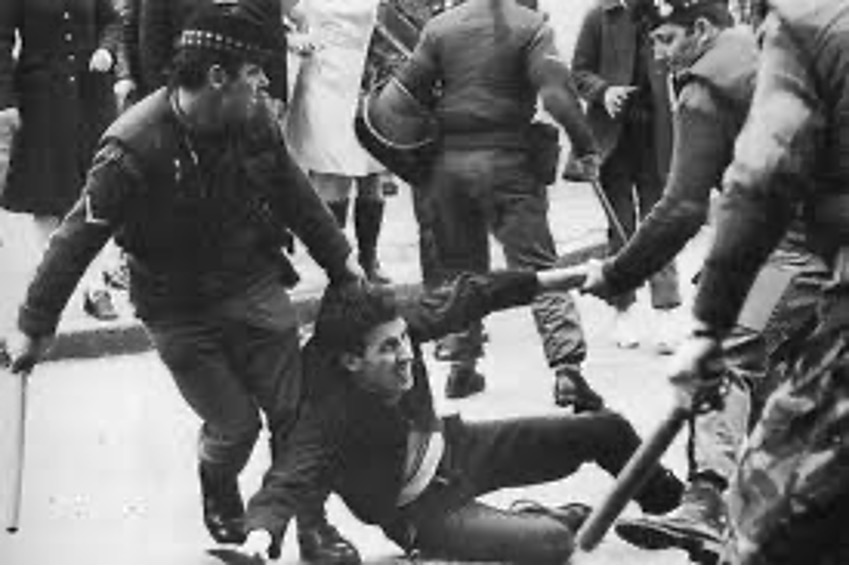
During my lifetime this ‘democratic’ state has imprisoned hundreds of suspected political opponents without trial for several years while torturing a number of them.  Its armed forces have opened fire and murdered 14 peaceful civil rights demonstrators and organised right wing terrorist groups to kill political opponents, the families of political opponents and random members of the communities within which they lived.  Leon Trotsky warned against support for ‘democratic’ capitalist sates in war against their enemies as they can easily put on another mask, and it’s one reason socialists determine their position in capitalist wars not on democratic forms but on the essential class nature of the state.

Ukraine is supported by the UK, which places itself to the vanguard of supplying weapons to Ukraine.  This should immediately have rung alarm bells among British socialists that the state they sometimes claim to oppose is such a prominent supporter of the Ukrainian cause.  Britain has taken part in 83 military interventions around the world since 1945, including Kenya, Malaya, Egypt, Iraq and Libya etc. etc. According to a study reported by the New York Times on 17 February 2018, the US government ran 81 ‘overt and covert election influence operations’ in foreign countries from 1946 to 2000’ while Soviet and post-Soviet Russia ran 36 during this time.  Does the pro-Ukraine left really believe that the intervention of the UK and US in Ukraine is uniquely progressive because the Russian is uniquely reactionary?

Russia is dammed for its authoritarian regime and its brutal aggression.  But who introduced the singularly powerful Presidential system into Russia in the first place and who did not object to its first incumbent shelling the Russian parliament in October 1993 as that parliament was dissolved?  It was Boris Yeltsin that arrogated power to the President and who the United States supported in help rig subsequent elections in 1996, as we have noted before.  Russian brutal aggression in Chechnya in 1994-96 was ignored when carried out by Yeltsin, with the US supporting his re-election while the war continued.

So much for the democratic credentials of Western imperialist powers and their opposition to Russian authoritarianism and aggression!  The pro-Ukraine left attempt to separate their support for Ukraine from the Western imperialist intervention, but we have already noted the identity of their political justifications.  This Left not only explicitly refuses to oppose Western imperialist intervention, so cannot even disassociate itself from their own ruling classes hypocritically, but actually supports its armed intervention. The well-known history of western imperialism is simply ignored and given no significance, and many of the posts in this series have pointed out how preposterous this is.  But what of Ukraine itself?

Over a number of posts we have pointed to the corruption of political life in Ukraine, both at the level of the centralised state and the daily corruption faced by many of its citizens, reflected in a number of indices of the low level of (bourgeois) democracy published by Western sources.  There is no justification for the view that any of this warrants defence or support for the Ukrainian state or all the apologetics for it that the pro-war left has indulged in, even were the fundamental capitalist character of the state to be wrongly ignored.

This does not mean that the political systems in Ukraine and Russia are exactly the same, although war has made both more repressive.  The state in Russia has stood over its various oligarchs, protecting its ill-gotten gains in general, while in Ukraine the various oligarchs have competed for ‘ownership’ of the state machinery so that they can protect and expand their particular interests.  While the latter has appeared to lead to more political competition, with the outward signs of bourgeois democracy as practised in western Europe, this competition has been determined by oligarchic factions and by the growing political division between those looking west and those looking towards Russia.

The eruption of mass protests in Ukraine, particularly the Orange ‘revolution’ in 2004 and Euromaidan in 2014, have been hailed as demonstrating widespread political participation and imposition of popular sovereignty in a way that the less frequent or significant events in Russia, such as the protests against electoral malpractice between 2011 and 2013, have not.  This has been accentuated by regular electoral reversals to the incumbent President in Ukraine as opposed to the long reign of Vladimir Putin.

In fact, these developments are illustrations of the weakness and limits of popular mobilisation and the continuing power of the oligarchs throughout all these upheavals. It is they who have alternated in office, often sponsored protests and benefited from them, and who have, for example, created their own private armies to make up for the weakness of the Ukrainian state in defending their interests.  The western media is full of forecasts that the strengthening of the Ukrainian state in the war will lead to the impartial rule of law and reduction of corruption, but the incorporation of fascist units into the armed forces and the continuation of corruption in the middle of war give the lie to their rosy predictions.

So, the ‘Orange revolution’ in 2004 against corruption led to a new even more corrupt regime while the liberal support for democracy and the EU in the Maidan protests in 2013-2014 led to another oligarchic government, even containing some fascists, with Its Prime minister hand-picked by the United States. This governmnet brought the country closer to NATO despite the opposition of many ordinary Ukrainians, so that the end result was the unconstitutional overthrow of one rotten government and replacement by another that quickly became even more unpopular than the one it replaced.

In other words, the Ukrainian state and the political regimes that have presided over it have not been expressions of the popular will, with the current regime walking the country into a war having been elected to deliver peace.  The country is now irretrievably divided, yet the only response from the Zelensky regime is further anti-Russian nationalism that signals the determination to deepen the division.  Much of the pro-Ukrainian left has endorsed this with the camouflage of ‘decolonisation’, as if ethno-nationalism is something progressive, demonstrating that when the rot sets in it spreads.

Time after time the Ukrainian people voted and protested against the corruption of their state and the direction it has taken society only for these to continue under a new form and new regime. By 2019 a Gallup poll had recorded that just 9 per cent of the citizens of the country had confidence in governmental agencies, the lowest level of trust in the world. Yet this is the state that, with help from a Russian invasion, workers in Ukraine are compelled to fight for while the pro-war left in the West supports its arming to the teeth by Western imperialism. The old and disreputable lie that war will purify the country is peddled again by the bourgeoise and imperialism and once again wide sections of the Left have swallowed it whole.

In Ukraine virulent nationalism has been mobilised to cover up for the repeated failure of successive regimes to deliver on their promises, with war always the most extreme way of achieving this and often successful, at least in the short term.  The ignorant misuse of the policy of self-determination of nations argued by Lenin has been brandished by some of the western left so that it effectively joins in the defence of this rotten nationalism and the capitalist state it vindicates.

Some supporters of the British section of this movement have recently taken to boasting of their success in uniting disparate forces on the left in support of this policy but they are really far too modest, for their alliance stretches way beyond the ranks of small left groups and left social democrats. It includes the whole Starmer Labour Party, prominent ex-left supporters of NATO such as Paul Mason, and more importantly–all the western capitalist states and their bourgeois political leaderships.  For the purposes of any alternative to these capitalist states and these leaderships they are worse than useless. The rot will kill.

Back to part 13

Forward to part 15

The war in Ukraine (13) – the unity for democracy

Extraordinary Summit of NATO Heads of State and Government held in Brussels, Belgium on March 24, 2022. (Photo by NATO Pool/Anadolu Agency via Getty Images)

In the previous post we repeated an earlier review of two of the many indices of democracy in the world and the ranking of Russia and Ukraine.  These indices are, of course, ideological constructs that compare the real world with a bourgeois ideal that excludes what Marxists consider real human freedom. For these bourgeois indices freedom includes ‘economic freedom’, which Marx described as the freedom to exploit.  The freedom to own capital is also the freedom to exclude ownership to the vast majority, which without their own capital have to work for those that do, and without which those that do have capital would be able to do nothing with it.  A society in which the working class collectively owns and controls the means of production and has ended private capitalist ownership does not exist but would be one that would really be on the road to freedom.

There is therefore no point to a Marxist index that reported that in no country does the mass of the people, especially the working class, control its own destiny and impose its own will through its economic and social power, with whatever state organisation is still required to defend its collective ownership of the productive powers of society.  The left supporters of Ukraine however claim that there is something qualitatively different to ‘democracy’ in Ukraine in comparison to ‘authoritarianism’ in Russia.  The indices that we have quoted are simply a demonstration that there isn’t.

The point is not only that both are capitalist societies defended by capitalist states, which is the difference that socialists consider determinant, but that there is little difference between them in terms of the functioning of bourgeois democracy.  For socialists such democracy is mainly of value in order for the working class to develop its political consciousness and its organisation more freely.  For the pro-war left this is irrelevant, for while it complains about the attacks on workers’ rights and organisation by the Zelensky regime it nevertheless defends this regime and the state it sits upon. It betrays the cause of the working class at both the level of principle and immediate practice.

Its rationale for this has been argued against repeatedly on this blog, as we have noted the identity of its argument to that of the western capitalist powers, recited endlessly by their state and corporate media.  We see this again with a third index of ‘democracy.’ 

This third index is that of The Economist Intelligence Unit, which reported in its 2021 index that ‘Ukraine’s score declined from 5.81 in 2020 to 5.57 in 2021, taking it further below the threshold of 6.00, above which countries are classified as a “flawed democracy”. Russia’s score, already a lowly 3.31 in 2020, fell further to 3.24 in 2021.’  This meant that Ukraine was 86 out of 167 countries while Russia came in at 124.  The report stated that ‘Ukraine’s score registered the steepest decline among the four east European countries in this category’, (Hybrid regimes in Eastern Europe), and ‘declined in part as a result of increased tensions with Russia. Government functioning under a direct military threat usually restricts democratic processes in favour of the centralisation of power in the hands of the executive and the security or military apparatus with the aim of guaranteeing public safety. In Ukraine, the military played a more prominent role in 2021 and exerted more influence over political decision-making; government policy also became less transparent.’ In the 2022 report Ukraine has dropped only one place to 87 out of 167 countries while Russia falls to 146 place from 124.

’The Economist’ is a virulently opinionated ‘newspaper’ that champions capitalism and Western imperialist ‘values’ so its rationale for its open support for Ukraine is striking for its more or less perfect alignment with the justification of support for Ukraine by the pro-war left.  One is almost tempted to say that one of them hasn’t quite understood what is going on, but it is too easy to identity the mistaken party.

’The Economist’ reports that ‘Ukraine’s score in the 2022 Democracy Index declines compared with 2021, from 5.57 to 5.42. . . . Despite the overall decline in Ukraine’s Democracy Index score in 2022, there were also many positive developments, not least in the way in which the war has given rise to a sense of nationhood and national solidarity. Ukraine’s resistance to the Russian invasion is a demonstration of how ordinary people are prepared to fight to defend the principles of national sovereignty and self-determination.’  

It goes on to say that ‘Russia’s invasion led to a strong “rally-around-the-flag” effect, after which trust in the country’s president, government and armed forces surged to all-time highs. Citizens’ engagement with politics and the news also increased. In response to the invasion, the Ukrainian government imposed martial law, which curtailed freedom of movement and placed sweeping emergency powers in the hands of the president, Volodymyr Zelenskyi. Checks and balances on Mr Zelenskyi’s authority were effectively suspended as normal political processes assumed a lower priority in the face of an existential external threat. The banning of pro-Russian political parties, such as Opposition Platform—For Life, as well as media outlets reporting pro-Russian views, is understandable in the context of the invasion and amid Ukraine’s attempts to consolidate and defend its national identity.’

‘However, in fighting a war that is widely understood to be existential, Ukraine’s leaders have sometimes curtailed the rights and freedoms of citizens, political parties and the media. Much of this is par for the course in wartime, but such extraordinary measures have inevitably resulted in downgrades in various indicators in the Democracy Index.’

‘The Economist’ index thus reports the continuing reduction in democracy with more sorrow than anger and reduces its impact on Ukraine’s overall score by increasing the score of the sub-category of ‘political participation’, which is not actually independent popular action but, as it says, a “rally-around-the-flag” mobilisation that subordinates the Ukrainian working class to its state.  That much of this has been voluntary simply emphasises the subservience.  It is no accident that this ‘political participation’ has been enthusiastically supported by the pro-war left as an example of working class mobilisation, another indication that it cannot distinguish between the power of the Ukrainian state and the power of the Ukrainian working class.

On one thing the magazine may appear obviously correct: ‘Every so often in history something happens that requires people to take sides as a matter of principle. In 2022 Russia’s invasion of Ukraine posed such a choice.’  The pro-war left has demonstrated that it agrees that it must ‘take sides’.

Boffy has ridiculed this idea, as if we must accept one of the alternatives presented by capitalism and the competition between its rival states; but the pro-war left has accepted this choice and in doing so has accepted the principles advanced by one of the alternatives, in its case the policy of the Western capitalist powers.  So, just like this pro-war left, ‘The Economist’ champions the centrality of ‘self-determination’, ironically also asserted by Russia and China in their own singing of the praises of national sovereignty: ‘Sovereignty and democracy are indivisible. Ukraine’s fight to defend its sovereignty has drawn attention to the importance of a principle that has been much denigrated . . .’

It then goes on to note, with total lack of self-awareness, that ‘Ukraine’s elections were marred by substantial irregularities that prevented them from being free and fair. There were serious constitutional flaws, with power being concentrated in the presidency rather than the legislature. The judiciary was far from being independent. Corruption was rife under a system dominated by oligarchs, who exercised huge influence over the main institutions of power. There was a pluralist media, but many outlets were owned by wealthy businessmen or controlled by vested interests. Public trust in government, political parties and the electoral process was very low.’

This however is blamed mainly on the influence of Russia, with the wishful thinking claim that the war ‘may have provided the shock that will ensure no return to the status quo ante in Ukraine. Russia’s war of aggression has raised the level of national consciousness and will amplify expectations of change afterwards.’

In fact, the opposite has already been the case, with nationalist radicalisation after 2014 being used as cover for the lack of economic and social progress and thorough democratisation.  Instead, national consciousness has amplified the worst parts of Ukraine’s past with its celebration of fascist predecessors who now play the most honoured role in Ukraine’s new nationalist revival.  Just like the pro-war left, this far-right is accorded no importance and the growth of nationalism celebrated.  Ethnic nationalism is endorsed through steps to erase Russian culture and define what is really Ukrainian, given a gloss on the left through stupid or dishonest claims that this is some sort of progressive decolonial project.

The pro-war left has therefore no essential difference with the ideological standard bearer of capitalism when the latter declares its verdict that:

‘Nothing that the Western powers did forced Russia to go to war in Ukraine. Russia had in late 2021 listed its grievances and concerns about NATO expansion, arms control and other matters, and the US’s door remained open for further discussion and diplomacy. The US made clear that it was ready to pursue negotiations with Russia. That Russia went to war in Ukraine is all down to the Kremlin.’

This Left holds this same view because its political conceptions are based on the same vacuous moralistic grounds declared by ‘The Economist’, which can be filled with whatever reactionary content is currently prevalent:

‘Democracy is a moral system as well as a system of government, and it is moral in the sense that it expresses an attitude towards people. The basic moral premise of democracy is the idea that all people are equal. Democracy is made for people, not the people for democracy.  From the idea of the equality of people follows the idea of the equality of nations: the principle of national sovereignty also has a moral dimension and is a bedrock of democracy.’ 

In expressing these political conceptions ‘The Economist’ faithfully grounds itself on the class interests of Western capitalism and can really only be charged with hypocrisy.  On the other hand, in basing itself on the same moral arguments and resulting political positions, the pro-war left betrays the class interests of those it claims to represent.

Back to part 12

Forward to part 14