What does “Don’t betray Ukraine?” mean (3 of 3)

In a Facebook discussion on why socialists should oppose the war I received a reply that stated:

‘In ninety cases out of a hundred the workers actually place a minus sign where the bourgeoisie places a plus sign. In ten cases however they are forced to fix the same sign as the bourgeoisie but with their own seal, in which is expressed their mistrust of the bourgeoisie. The policy of the proletariat is not at all automatically derived from the policy of the bourgeoisie, bearing only the opposite sign – this would make every sectarian a master strategist; no, the revolutionary party must each time orient itself independently in the internal as well as the external situation, arriving at those decisions which correspond best to the interests of the proletariat. This rule applies just as much to the war period as to the period of peace.’

This of course is a quote from Trotsky.  The problem is not to quote this as if this explains left support for the Ukrainian/Western imperialist alliance, but why this combination requires socialists to place a plus sign when the chances are only one in ten of that being correct.

If we look at the examples in the article from which the quote is taken, we see the sort of circumstances in which this would be correct.  These include when a ‘rebellion breaks out tomorrow in the French colony of Algeria’ and receives help from a rival imperialism such as Italy.  The second is when ‘the Belgian proletariat conquers power . . . Hitler will try to crush the proletarian Belgium’ and’ the French bourgeois government might find itself compelled to help the Belgian workers’ government with arms.’

In a footnote, Trotsky says that: ‘We can leave aside then the question of the class character of the USSR. We are interested in the question of policy in relation to a workers’ state in general or to a colonial country fighting for its independence.’

The Ukrainian working class has not come to power; Ukraine is not a workers’ state and has just celebrated Independence Day, so it is not a colony.  Some have tried to squeeze in the ridiculous idea that it is an oppressed country, but this is false.  It is a country backed by the whole of Western imperialism; is in an open alliance with it, and the war was provoked by both parties to this de facto alliance which sought to make it formal.

Ukraine will most likely lose territory but will not be totally occupied, unless Russia does something stupid, which it has not signalled it will do.  At least part of the territory occupied is pro-Russian so that it is not possible to see either sides’ occupation as being unambiguously liberating.  In other words, thinking in terms of oppressor and oppressed states does not provide a solution; more fundamentally because this is an imperialist war in which Ukraine is on one of the sides, and cloaking it with oppression does not explain either the origin and nature of the war or the approach that socialists should take to it. 

Victory for Ukraine, it is claimed, would be a victory against Russian imperialism, but it would also be a victory for Western imperialism with which Ukraine is now an ally. Claims that this is any sort of anti-imperialist war are therefore obviously spurious.  Only from a campist position can it be claimed that a victory for the camp of western imperialism is preferable to a victory of the Russian.  Complete disorientation and political degeneration explains why supporters of this position regularly accuse those opposed to it of ‘campism’ and describe themselves as ‘internationalist.’ 

It is irrelevant who fired the first shot, as Trotsky noted elsewhere:

‘Imperialism camouflages its own peculiar aims – seizure of colonies, markets, sources of raw material, spheres of influence – with such ideas as “safeguarding peace against the aggressors,” “defence of the fatherland,” “defence of democracy,” etc. These ideas are false through and through. It is the duty of every socialist not to support them but, on the contrary, to unmask them before the people.’

“The question of which group delivered the first military blow or first declare war,” wrote Lenin in March 1915, “has no importance whatever in determining the tactics of socialists. Phrases about the defence of the fatherland, repelling invasion by the enemy, conducting a defensive war, etc., are on both sides a complete deception of the people.”

He goes on: ‘The objective historical meaning of the war is of decisive importance for the proletariat: What class is conducting it? and for the sake of what? This is decisive, and not the subterfuges of diplomacy by means of which the enemy can always be successfully portrayed to the people as an aggressor. Just as false are the references by imperialists to the slogans of democracy and culture.’

Trotsky makes the following summary judgement: ‘If a quarter of a century ago Lenin branded as social chauvinism and as social treachery the desertion of socialists to the side of their nationalist imperialism under the pretext of defending culture and democracy, then from the standpoint of Lenin’s principles the very same policy today is all the more criminal.’  Over one hundred years has passed since Lenin’s judgement, how much more does this criminal treachery deserve condemnation today?

The depths of disorientation can be gleaned from one article reviewing the latest film documentary on the war, in which the author states that the film 2000 Meters to Andriivka is ‘the Ukrainian working class at war.’

‘The young men we see in this documentary about the capture of a village called Andriivka by the 3rd Assault Brigade of the Ukrainian army are a snapshot of the country’s working class. One is a lorry driver, their commander previously worked in a warehouse and a third is a polytechnic student studying electronics. They are virtually all in their early twenties and all volunteered to fight the Russian invasion.’ 

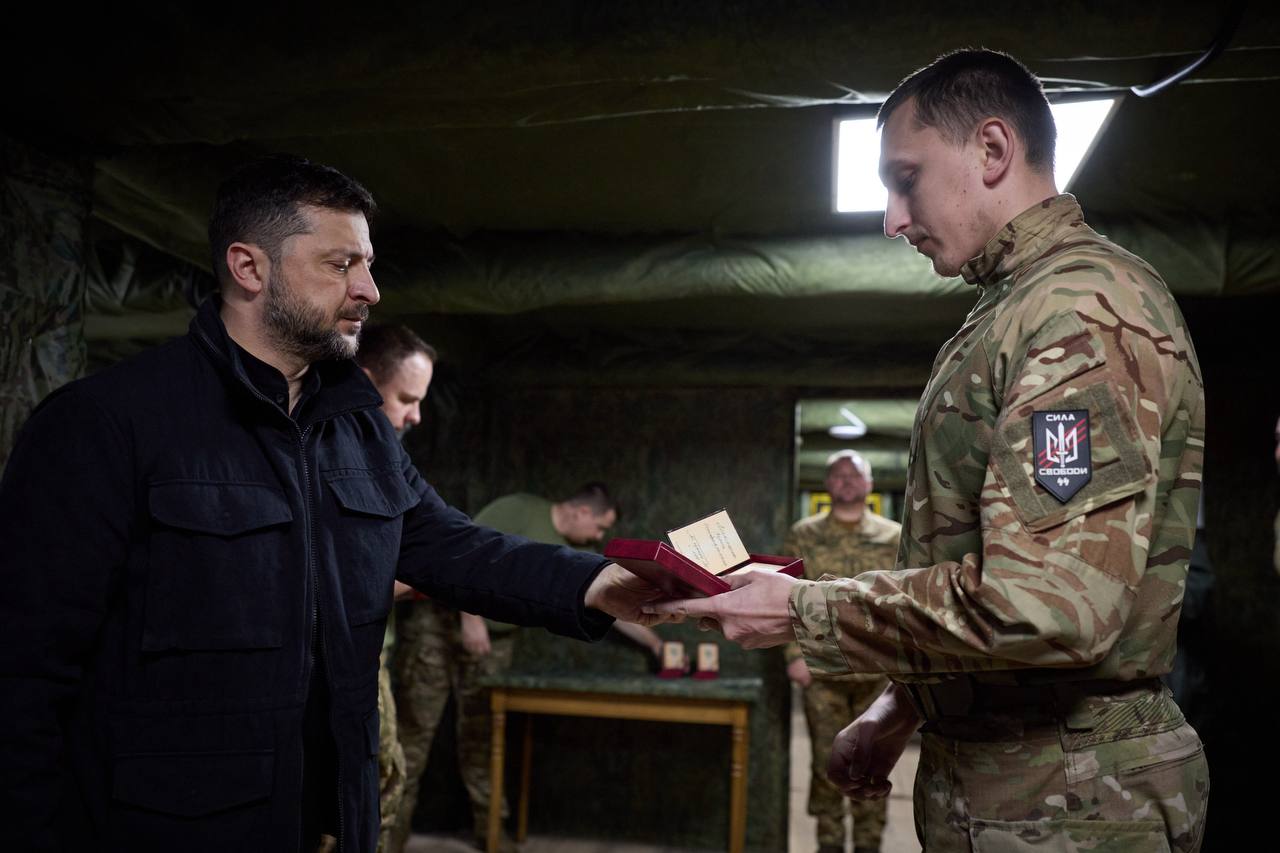
‘Ukraine continues to resist against overwhelming odds at the price of losing its bravest and most self-sacrificing young people’, while telling us why they are fighting, reminding him of the Soviet ‘partisans fighting Nazi invaders.’  What a pity for such a claim that it is the 3rd Assault Brigade of the Ukrainian army that the author lauds, which is composed of today’s Nazis, and hails as its historic heroes the Ukrainian fascists who collaborated with the Nazis in World War II and who fought Soviet partizans.

Aleksei ‘Kolovrat’ Kozhemyakin looks at a photo of himself. Exhibition opening in Kyiv, September 27, 2023. Source: Vechirnii Kyiv

The author, like me, will have been stopped in the streets of Belfast many times by soldiers of the British army who may have previously been lorry drivers or worked in a warehouse; certainly more or less all of them would have been working class.  This would not in the slightest have determined the nature of the British army or answered Lenin’s questions ‘What class is conducting it? and for the sake of what?’  Nor would – who fired the first shot? – have defined the conflict in the North of Ireland.

The working class British squaddies were fighting for an imperialist army in the interests of their imperialist state just as the Ukrainian workers in the 3rd Assault Brigade are fighting for the capitalist Ukrainian state in its alliance with western imperialism, from whom it will have received its funding, training, weapons and intelligence.  That the neo-Nazis within it are not the least bit interested in ‘democracy’ and are bitter enemies of anything remotely resembling socialism just puts the tin hat on the preposterous claims of the social imperialist supporters of Ukraine.

Quotes from Trotsky won’t therefore exculpate today’s social-imperialists who support imperialism while proclaiming socialism.  Even the isolated passage quoted at the start of this post assumes an independent working class movement to apply its own seal, but no such movement exists in Ukraine.  In raising the demand “Don’t betray Ukraine” the Ukraine Solidarity Campaign has fixed a plus sign to the actions of imperialism where no independent working class movement exists in Ukraine to place its own.

The demand “Don’t Betray Ukraine” is not therefore a call to take advantage of a contradiction within imperialism but to take one side of it instead of opposing both.   It is a demand for capitalist solidarity; that one section of it remain united in its struggle against the other. It is a call for Western imperialism to be united in full commitment to a particularly rotten capitalist state, signalling the total abasement of those declaring it.

Back to part 2

What does “Don’t betray Ukraine” mean? (2 of 3)

In a Democracy Now programme, US professor John Mearsheimer told the Ukrainian ‘democratic socialist’ Denys Pilash  that “the best outcome would be to settle this war now” since it will otherwise  be “settled on the battlefield.’  Pilash could only respond that there were still measures such as sanctions that could be taken by the West to pressure Russia into a ceasefire.  This is not a proposal to end the war but to allow Ukraine to regroup and the West to put itself in a better position to support it when it is recommenced.  Ukraine has not tried to disguise this intention and has not modified its maximal objectives.

The British and French have threatened to put their own troops into Ukraine and want the US to protect them under the formula of ‘security guarantees’.  They hope that this would dissuade Russia from taking the offensive again following any ceasefire, at least to the point that Ukraine thinks itself in a position to take the initiative.  It is not a solution but a transparent attempt to achieve the goals of Ukraine and the West later since they cannot be achieved now.  It promises not the end of the war but its resumption.  This is the position of the Ukrainian state, western imperialism and the ‘democratic socialist’ of Sotsialnyi Rukh interviewed by Democracy Now.

Trump has already moved to enact what Pilash proposed by raising tariffs on India for its purchase of Russian oil, although it has failed to do so on China.  This is a sign of weakness while India has signalled that it will continue buying from Russia.  So this proposal hasn’t worked, just as all the previous sanctions and previous financing, weapons, logistics, intelligence, planning and Western ‘volunteers’ haven’t delivered on their hopes.

Thus, the Sotsialnyi Rukh programme has already failed and promises only to prolong the war with its attendant death and destruction.  The objective for socialists should be to end it as quickly as possible while the policy of the Ukraine Solidarity Campaign and that of Sotsialnyi Rukh is to continue it to victory, apparently regardless of the cost.

Millions of Ukrainians have voted with their feet and have left the country while Trump is trying to send them back, which would only result in the men being conscripted, sent to the front and then killed.  A lot of Ukrainian soldiers have already voted with their feet and deserted, while those seeking to avoid conscription are voting with their feet by running away from recruitment press-gangs or attempting to escape the country.

Sotsialnyi Rukh could give a political voice to this instinctive opposition, born out of healthy suspicion and distrust of many Ukrainians for their state, but this is a road they will not take.  Instead, it champions a war its own state played a major role in creating, and a political and military alliance that subordinates the country to imperialism.  Its view of the war means it can do nothing other than tail-end a corrupt and ethno-nationalist state, its alliance with imperialism and a political regime that is responsible for both.

In Pilash’s fabricated reality Trump is supporting Putin; a view which requires ignoring the sanctions against Russia and the continuation of US military support.  Such a stupid statement so at odds with reality only confirms the reactionary character of the whole Sotsialnyi Rukh programme.

NATO is not the issue, says Pilash, but did he think repeated Russian warnings about Ukrainian membership were so much hot air?  Does its huge role in the war today not tell him something about its centrality to its origin and purpose, and does his enthusiasm for Western ‘security guarantees’ not confirm it?

Pilash thinks that Putin himself is the cause of the expansion of NATO – to Finland and Sweden – and look Russia hasn’t invaded them!  The problem, of course, is that he must assume the importance of NATO expansion for the argument to matter, while pretending that Russian warnings about Ukrainian membership are empty, even while his country is in the process of being devastated because of it.

His support for ‘security guarantees’, which means willingness to go to war against Russia, shows that the purported irrelevance of NATO is absurd, and his attempt to cover his ass by calling on the ‘global south’ to join western powers as guarantors is political camouflage.

Not even all the European NATO powers are prepared to put their troops into Ukraine, or at least to admit to it, including those in Eastern Europe; why would the ‘global south’?  And what, anyway, is the ‘global south’?  Does he want China, India, Brazil or South Africa to put troops into Ukraine?  Would they do it without Russian agreement, and would they want to be made hostage to the good intentions and behaviour of a Ukraine determined to get all its 1991 territory back?

The proposal for a ceasefire is thus not a promise to end the war, and not a resolution to it, but to put into Ukraine the exact forces that Russia invaded to keep out.  It is an incentive to Russia to continue hostilities in order to prevent it happening, and is a statement by the West that any end or even pause to the war will, absent an overall agreement, entail a NATO win. The cries for a ceasefire and peace are thus the habitual imperialist lies now trumpeted by some on the ‘left’.

Pilash states that Washington is about dividing the world into spheres of influence, as if this is something invented by Trump, and will not be the case in the form of the ‘security guarantees’ that he seeks.  Occupation of Ukraine by Western troops would be a fitting end to the claim to be fighting imperialism, colonialism and for independence.  And that’s if WWIII is avoided in the process.

He claims that there is a new axis of authoritarian regimes being created that includes Russia and calls for all the oppressed to unite against all the oppressors, mentioning Palestine as an example.  Who does he think was sitting in the White House with Trump while they discussed the possibility of guarantees; the prime candidates for providing and enforcing them?

Ursula Von der Leyen, who gave Israel a blank cheque to do what it wanted after October 7.  Keir Stamer, who announced on radio that Israel had the right to commit war crimes?  And Donald Trump the main provider of weapons and financing for the genocide.  Where does that leave his notion of uniting the ‘democratic’ countries against the authoritarian regimes in a fight against oppression?

The US, British and French states have a blood-soaked history of imperialist war and the German variety an unrivalled reputation for barbarity.  Their foreign expeditions have never stopped.   Today these states parade their democratic credentials while their foreign policy reverberates at home with threats of an approaching war with Russia and repression of domestic dissent.  

The christening of Ukraine as a beacon of democracy while its regime enforces martial law, refuses new elections, celebrates its fascist history and closes opposition media and political parties is testament to what Western states consider is democratic. 

The pro-war left always advises opponents of the war to follow the lead of the Ukrainian ‘socialists’ but these ‘socialists’ approve and flatter the actions of the imperialist states and encourage their aggression.  In following their lead their Western friends encourage the bellicosity of their own states and their movement to a war against Russia. It leads to them holding up as a beacon of democracy a state renowned as one of the most corrupt in Europe that the Ukrainian people themselves have made repeated attempts to change. 

The policy of supporting their own imperialism through its de facto military alliance with Ukraine is summed up in a few words – “Don’t Betray Ukraine”.

Back to part 1

Forward to part 3

What does “Don’t betray Ukraine” mean? (1 of 3)

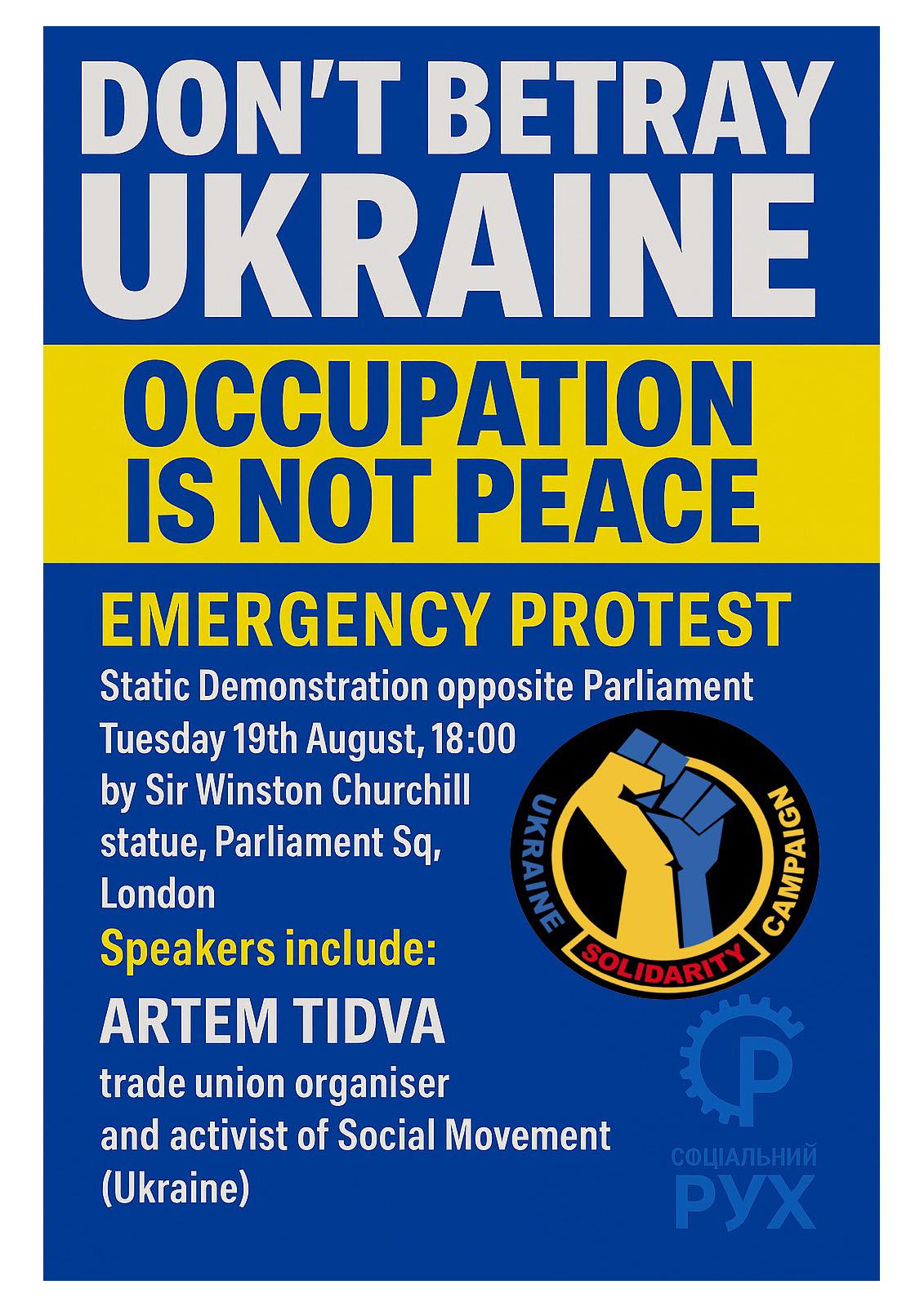
The British Ukraine Solidarity Campaign publicised a rally under the slogans Don’t Betray Ukraine and Occupation is not Peace.  What do these slogans mean?

The demand not to ‘betray’ Ukraine was raised as Western leaders met to discuss the possibility of negotiations with Russia.  The call not to ‘betray’ is obviously directed to them.  So, let’s pause there for a moment.

When the Russian invasion was launched sections of the Western left stated that Ukraine had the right to get armed help from western imperialism (as if the Ukrainian army was not already being armed and trained by the West). While recognising that the West had its own selfish interests in doing so it affected to believe that this would not incur any political cost and would not determine the nature of the war.  Apparently, the selfishness of the west would somehow disappear; it would impose no demands on Ukraine and seek not to impose any of its interests.  A case of selfish imperialism becoming unselfish.

Today’s slogans go much further and it is now this left itself which is calling on their own imperialism to intervene and arm Ukraine.  The bedrock socialist belief that the state is a weapon of the ruling class and that it should be disarmed and abolished has been transformed into the need for it to use its armed forces to do good in the world, or at least in Ukraine.  This is apparently necessary because Russia is imperialist and must be defeated, although this doesn’t apply to the western variety; despite the watchword that the main enemy is at home there is no call for Russian imperialism to defeat their own. Not when it can do good.

The slogan Occupation is not Peace implies that the West must keep arming Ukraine and otherwise supporting it as long as any part of Ukraine is occupied.  In other words the call by the USC is for the war to continue until complete victory.  The implications and consequences of such a victory are many, but it is rarely stated what they are.  In fact, off the top of my head I can’t think of any time this has been explained. There have, of course, been many warnings about the consequences of Ukrainian defeat but that is not, quite obviously, the same thing.

At the moment Russia is winning the war.  Ukraine is increasingly stretched and suffers mainly from a shortage of people to fight for it.  Given what this implies for the number of casualties that the Ukrainian forces must have suffered, this in itself should give pause for thought.  I have read time and time again claims about the scale of Russian losses but a studied ignorance on the scale of Ukrainian deaths (when they are not being falsified).

Like the consequences of victory, left supporters of the war are both keen to proclaim its deathly consequences but seemingly reluctant to demand of Ukraine that it reveal its losses.  No doubt, this is because they believe this will demoralise Ukrainian society and set back the war effort, but this only reveals yet another aspect of the conflicting interests of the Ukrainian state and its western allies on one side and the Ukrainian people and its working class on the other.  The latter are paying the price, they should know exactly what it is.

The slogan Occupation is not Peace is therefore a call to continue a war that cannot be won.  There may be a belief that yet more western (unselfish!) intervention can turn the tide, but even the moron Donald Trump understands that this can only mean escalation that points towards World War III.  Zelensky thinks he can entice Trump by promising that he will buy $100bn of weapons from the US, paid for by ‘Europe’, which means European workers, but even this is an illusion.

Repeated injections of Western arms have been destroyed in the war, along with the Ukrainian troops using them; so much so that stocks in Western armouries have been sorely depleted.  The weapons are not there, and you can’t kill people with dollar bills.  The pro-war left says that the remaining weapons stored in the West should be sent to Ukraine, but this is just another illustration of the stupidity of pretending that western imperialist intervention is unselfish.  They want these weapons for themselves because they might want to fight other (unselfish?) wars, or perhaps ultimately in Ukraine itself

The US and European powers have said that they will build up their military-industrial complex to help produce the arms that can go to Ukraine, which leaves the pro-war left supporting the militarisation of their own countries.  But this will take time, and meanwhile the death and destruction will continue.

The negotiating positions of Ukraine and Russia are not miles apart, but light years, so the war is going to continue with all its disastrous consequences. If the pro-war left insists on complete victory it needs to spell out exactly the imperialist intervention that will be necessary to achieve it.

Don’t hold your breath.

Forward to part 2

Should we support the Ukrainian Left’s route to victory? (1 of 2)

At the start of the war in Ukraine various leftists in the West said that we should listen to the voices of Ukrainian socialists, which might have made some sense were these people socialist. Except they are not.  Two recent statements by them confirm their reactionary character and have value only to illuminate their political bankruptcy and, by extension, those in the West who follow them and have called for others to do so.

The statements address what is necessary for Ukrainian victory and the tasks of the left in achieving it.  It is supposed to be a left alternative to Zelenskyy’s much trumpeted ‘victory plan’– touted round the various capitals of western imperialism – but reveals itself to be a plea for succour to the regime that has sought it itself from imperialism and failed.

It is not an alternative to it but a pathetic reflection of it.  It is useless even for its own purposes and worse than worthless as a guide for a working class alternative course out of the war.  It can be summed up by one sentence within it that shows that it pretends to no alternative to the current state, and therefore no possibility of an alternative way out of the catastrophe inflicted on the country.  It states that “We will demand full state control over the protection of lives and the well-being of workers . . .”  The same state that colluded in precipitating the disaster – that has delivered its people into a needless war that has wrought such death and destruction – is to be the protector of the lives of its workers.  This is both absurd and treacherous.

The statements themselves can’t help but note the current misdeeds of this state, its “corruption, censorship, and other abuses by officials”, and the reaction of Ukrainian workers – “civilians no longer queue at draft stations but actively evade mobilisation. Reported cases of draft dodging have tripled since 2023, and polls consistently show that nearly half of respondents view this as reasonable.”  They note “nearly 30,000 cases of AWOL have been registered in the first six months of 2024” and “the brutality and impunity of draft officers, who press-gang men off the streets . . . In the meantime, reports from the battlefield describe how unmotivated, untrained, and even unfit recruits endanger the rest, making the result of increasing coercion questionable.”   Questionable?, is that all it is?  Medically unfit men kidnapped off the street and sent to the front  – poorly trained and armed – to die in a war against a much more powerful enemy?

The result is that “after 970 days of war, 10,000s dead, 100,000s wounded, and millions displaced, the toll is immense. Few families remain untouched by this devastation.”  Yet it refuses to denounce the ridiculous tally of dead and injured quoted in the Western media, fed to them by the Ukrainian state and the Zelenskyy regime. Its statement is unwilling to challenge these lies about the devastating consequences of the war, while saying that they have “taken our people for granted”, yet refusing to acknowledge the human cost that repeats this.

“Under the realities of oligarchic capitalism, restrictions on freedoms often serve the interests of the elites”, one statement declares, in admission of the rotten nature of the society and state that commits these crimes.  It notes the statement of the minister of social policy Oksana Zholnovich, that  “we need to break everything that is social today and simply reformat from scratch the new social contract about social policy in our state.”

It sums up the hypocrisy and real policy of the state by saying that “appeals to civic duty ring hollow when the state openly declares that it owes nothing to its citizens”, yet its proposals are that “the government should start a dialogue with the people about the achievable goals of the war.”  It simply wants “to cooperate with other forces to build a political movement that ensures the voice of the people is heard in the corridors of power.  “Sotsialnyi Rukh (Social Movement) demands a sincere dialogue from the government with society on how we arrived here and what we can realistically expect.” A “sincere dialogue” with a regime that promised peace and an end to corruption that has instead walked its people into war with new opportunities for massively increased graft through it.

It would be possible to feel a little sorry for this movement were it not for its own hypocrisy and war policy.  It accuses the Zelenskyy regime of presiding over “a caricature of a war economy” that “makes it possible to prolong the war at the cost of significant human losses and constant mobilization.”  Yet its own policy is simply an extension of this through a state “subordinated to the priorities of defense . . . mobilising all resources for defence”, while simultaneously promising that it “defends the rights of conscripts and servicemen to dignified treatment” when many of these workers do not want to be conscripts at all.

Zelenskyy’s plan is criticised for “its disproportionate reliance on the West’, while acknowledging that “to fight against Russian aggression . . ., we need support from the global community, including humanitarian and military assistance.” It laments this reliance but then states that “this might appear to be a sober approach”, with the further complaint that it feels “more humiliating” to be “turned down almost immediately”.

It canvasses what would be an acceptable peace but includes proposals that shows it has no idea “how we arrived here”, i.e. why the war began, never mind how realistically it might end: “The only deal with a chance of being supported, by a slight margin, includes de-occupation of Zaporizhzhia and Kherson regions, combined with NATO and EU memberships. . . . Therefore, the greatest mistake would be to pit diplomatic efforts against military support. Without meaningful solidarity, Ukraine and its people will fall — if not now, then later.”

It complains of “a quite remarkable shift from the earlier emotional appeals for solidarity to luring support with access to natural resources and promises of outsourcing Ukrainian troops for the European Union’s security”, but its own dependence on what it euphemistically calls “the global community”, and peace involving NATO membership, shows that its alternative to Zelenskyy is no alternative at all. It doesn’t even ask the question: why it is only now – after over two and a half years – that a purported plan for victory has been drafted? Or did all the others fail too?

Forward to part 2

The Third Year of War (3 of 3)

Arms-length second-hand imperialism from the British Ukraine Solidarity Campaign: https://ukrainesolidaritycampaign.org/

Just as political programmes have a logic of their own irrespective of intentions, and war is the continuation of politics by other means, so does war impose its logic on those who politically support it.  The pro-war left has defended support for Ukraine and the intervention of Western imperialism, but as the war has developed it has been admitted by the leaders of both Ukraine and Western imperialism that for the war to continue Western imperialism must decisively increase its intervention.

One obvious consequence is that those who initially supported Ukraine on the grounds of self-determination can no longer honestly do so, given complete reliance on the West for its success. The only way out of this lack of self-determination (that is supposed to achieve self-determination) is to argue that, ultimately, Western imperialism is a benevolent ally with no interests of its own that might conflict with those of the Ukrainian people.

Such an argument would up-end everything socialists believe about capitalism, its imperialist form, and the interests of the working class. Whatever way you look at it there is no way to avoid this consequence. You can, however, avoid admitting it, but this can only be attempted by trying to cover it up and war is very unforgiving of attempts to deny reality.

Reliance on Western imperialism has revealed the conflict as a proxy war against Russia in which the role of Ukraine is to fight and die for NATO, justified by the Ukrainian state on the grounds that membership will provide its people with security!  As we have explained in many posts, NATO powers provoked the war, with the complicity of the Ukrainian state, on the understanding that it would result in Russian defeat. The build-up of the Ukrainian armed forces with the assistance of Western powers, alongside unprecedented economic sanctions, would result at worst in the crippling of Russian power and at best a return to a subservient Russian regime à la Boris Yeltsin.

The pro-war left rejected the characterisation of the war as a proxy conflict but its continuation being possible only on the basis of Western intervention means that this is not credible. The evolution of the war has meant that the position of this left is now exposed: as the saying goes, when the tide goes out you find out those who are swimming naked.  To mix the metaphors, standing still with the existing justification for supporting the war will not do and it is necessary to find a reverse gear.  It appears the pro-war left don’t have one.

A recent article by a leader of the Fourth InternationalCatherine Samary, indicates that instead of either revising its view of the war to one of opposition, or even of attempting to substantiate the claim that there is no proxy war in place, it has decided to justify the proxy war! 

Samary now admits that Ukraine ‘had a vital need for its [Western] financial and military aid in the face of Russian power’ and that ‘the war consolidated NATO and favoured the militarization of budgets.’  In addition to the ‘vital’ role of Western imperialism, the directly regressive consequence of the war for the Western working class is admitted; as is the reactionary nature of the Ukrainian regime, characterised by the ‘social attacks of Zelensky’s neoliberal regime and its ideological positions’, including its apologetics for the “values” of the West.

So, the hypocritical claims of the West are highlighted, although not in relation to the war: the claims about Russian imperialism and sole responsibility for the war, its intention to threaten the rest of Europe, and absolute necessity for its defeat – all this is shared by this left.

* * *

The first reason given for rejecting the proxy nature of the war, and the irrelevance of the reactionary nature of the Kyiv regime and progressive character of Western intervention, is the ‘popular resistance to a Russian imperial invasion.’  This, it is claimed, is the ‘essential characteristic ignored by many left-wing movements’ – ‘the massive popular mobilization . . . in the face of the Russian invasion,’ which means that we must support ‘the reality of armed and unarmed popular resistance.’  

Unfortunately the armed popular resistance she claims does not exist–there are no independent working class militias, and the unarmed resistance equally has no political independent organisation since opposition parties have been proscribed. Even popular enthusiasm for the war amongst the Ukrainian population opposed to the Russian invasion is draining away, as it inevitably does in capitalist wars. She quotes an article stating that ‘at the start of the invasion, citizens from all walks of life lined up in front of the recruitment centres. Nearly two years later, that is no longer the case . . .’

She quotes another article that ‘the fragilities of the popular resistance are real after two years, analyses Oksana Dutchak, member of the editorial board of the Ukrainian journal Common. She evokes a feeling of ‘injustice in relation to the mobilization process, where questions of wealth and/or corruption lead to the mobilization of the majority (but not exclusively) of the popular classes, which goes against the ideal image of the “people’s war” in which the whole of society participates.’

Samary states that ‘while the majority opposes and may even dislike many of the government’s actions (a traditional attitude in Ukraine’s political reality for decades), opposition to the Russian invasion and distrust of any possible “peace” agreement with the Russian government . . . are stronger and there is very little chance this will change in the future.’ With these words Samary does not appear to realise that she admits the lack of any popular control of the war and it lying in the hands of the ‘neoliberal’ regime that she professes to oppose, ‘and there is very little chance this will change.’ The choice of many Ukrainians has been to flee abroad while increasing numbers of soldiers are choosing to surrender rather than die. Some have even done so on condition that they are not sent back to Ukraine in any prisoner swap.

Even the Western media, at least sections of it in the United States, demolish the ‘ideal image’ that Samary wishes to project. The Washington Post (behind a paywall ), reports that:

‘Civilians here say that means military recruiters are grabbing everyone they can. In the west, the mobilization drive has steadily sown panic and resentment in small agricultural towns and villages like Makiv, where residents said soldiers working for draft offices roam the near-empty streets searching for any remaining men.’

The report goes on:

A close up of a text

Description automatically generated

A screenshot of a text

Description automatically generated

The Ukrainian state is not offering people ‘the opportunity to participate in defining the future of the country’ that she says is necessary for victory.  Why would a ‘neoliberal’ regime do that?  Many don’t want to take part in what Samary calls the ‘popular resistance’ because they don’t want to die and don’t trust their authorities not to throw their lives away. 

She acknowledges the problem that ‘the majority opposes and may even dislike many of the government’s actions’ and are also in ‘opposition to the Russian invasion’ but calls on them to swallow their doubts and fight on the basis of a political perspective composed of fairy tale illusions. These include ‘a socially just view of wartime policies and post-war reconstruction’; ‘for social and environmental justice, for democracy and solidarity in the management of the “commons”, and the defeat of any relationship of neocolonial domination.’ How would an alliance of a neoliberal regime, a congenitally corrupt state and Western imperialism deliver any of that?

She says that those opposed to the war are ‘blind to the relations of neocolonial and imperial domination of Russia’ but she is oblivious to her own blindness to Western imperialist domination, which is now able to decide whether to dump its support to Ukraine or promise more escalation, with the former promising more death and destruction and the latter involving another step towards world war.

Under what political perspective would it be possible to both oppose oppression by Russia and avoid submission to being cannon fodder for the Ukrainian state and Western imperialism?  Only a socialist policy could uphold commitment to this, the first practical steps of which would be opposition to the war, opposition to the Russian invasion and NATO expansion and organisation of resistance to the demands of the Ukrainian state.

Samary has no perspective of a socialist road out of the war so has no role for the Ukrainian working class except to fight and die for a ‘national liberation’ and a ‘self-determination’ that seeks to preserve the integrity of the capitalist state but condemns many of its workers to destruction.

The first rationale for supporting the proxy war is thus becoming less and less credible as it grinds on.  The Western powers are not disturbed by the loss of Ukrainian lives; so we hear more calls by British and American politicians for the age of mobilisation to be dropped so that its youth can join the roll call of death – ‘young blood’, as it is quite accurately called. But what sort of socialist supports dying for a capitalist state fighting a proxy war for imperialism?

* * *

The second rationale from Samary is expressed succinctly in one sentence as she asks – ‘was the defence of Ukrainianness “reactionary” or “petty-bourgeois” in essence?’  To which the only socialist answer is Yes

What is ‘Ukrainness’ but a nationalist confection to be put to use by the Ukrainian ruling classes?  What is the democratic content of nationalist exclusiveness encapsulated in this word, especially in a country with historically very different conceptions of what is involved in being a Ukrainian?  For what reason was the right to national self-determination historically supported by Marxists, except as a democratic demand for the right of an oppressed people to break its colonial chains and create a separate state?  How could this apply to Ukraine, which had already become an independent state but decided that it would employ this independence to seek a military alliance with imperialism against a rival capitalist power? And now wishes to defend itself through nationalist ideological garbage! How can all this be called socialist?

Samary has a response to these objections, if not a credible reply – the Western military alliance is not a problem!   Having signed up to support for the war and the Ukrainian capitalist state she has been compelled to find reasons to also support its imperialist backers.  What are they?

She states– ‘As regards NATO, the European left missed the moment of a campaign for its dissolution when this was on the agenda, in 1991.’  So no more chance of opposing NATO!  This organisation has no anti-Russian agenda, she says, blaming Russia itself–in the shape of Boris Yeltsin–for dismantling the USSR, ignoring that it was the United States who did its best to keep him in power, subsequently rebuffing Russia even when it wanted to join NATO and helped NATO in Afghanistan.  She even admits that :

‘Putin hoped to consolidate the Eurasian Union with Ukraine’s participation in trade with the EU, on the one hand; and, on the other hand, he intended to offer the West the services of the CSTO (Collective Security Treaty Organization) after the collapse of the United States and NATO in Afghanistan.’  Yet the West refused this cooperation.

She states that this was because of ‘the consolidation of a strong Russian state, both internally and externally’. But why, if the West sought a strong alliance, did NATO not welcome Russia as a strong ally?  

It can only be that being a strong state, Russia would have its own interests that it would want accommodated, which the West was not prepared to accept.  Unfortunately, this then makes the West co-perpetrators of the conflict that Samary wants to pin blame solely on Russia.  In fact, given the Russian offer of cooperation, it looks like it is the Western capitalist powers who are primarily responsible for the increased rivalry between Russia and the Western capitalist powers that has led to the war. This, however, is somewhere that Samary doesn’t want to go, because it is Ukraine and its NATO sponsors that she wants to defend.

She states that ‘NATO, led by the US, was . . . “brain dead” and not threatening on the eve of the Russian invasion;’ a view that ignores its nuclear posture, its expansion into Eastern Europe, its wars in Afghanistan and Libya, its support for the end of Ukrainian neutrality, its policy of supporting Ukraine re-taking Crimea, and its assistance in building up the Ukrainian armed forces to enable it to do so. The war, she claims, ‘gave back a “raison d’être” to NATO and the arms industries’, presumably because they didn’t have a reason to exist beforehand? Who can seriously believe such nonsense?  And from someone claiming to be on the ‘left’!

If we sum up, support for the war now involves a new mobilisation in Ukraine while demoting its increasing unpopularity and the stench of corruption surrounding it.  It means defending the role of the Western powers against Russia, despite the consequences of militarisation on workers in the West, including its impact on working class living standards.

It involves whitewashing the role of NATO while dismissing opposition to it as a bus that has been missed.  It argues instead for ‘general socialized control over the production and use of armaments’, that is, workers control of militarisation and imperialist war!  Impossible to conceive as something real and utterly reactionary as a mere concept.

The policy of support for the current war thus inevitably entails alliances with reactionary forces in the West: ‘broad fronts of solidarity with Ukraine can include – and this is important – an “anti-Russian” Ukrainian immigration supporting neoliberal policies like those of Zelensky, and uncritical of the EU and NATO. It is essential to work towards respecting pluralism within these fronts . . .’

The circle of a reactionary pact is completed.  And all this under an article entitled Arguments for a “left agenda”.  Whoever pretends such an agenda has anything ‘left’ about it is either an idiot or is seeking to recruit one.

At some point the war in Ukraine will end but the rationale for the pro-war left to continue to defend Western imperialism will remain.  It will, in other words, continue an agenda best described, in Marxist terms, as social-imperialist – socialism in words (although Samary doesn’t even manage this!) and pro-imperialist in action.

Back to part 2

Supporting the UK-Ukraine Security Co-operation Agreement

Stefan Rousseau/Pool via REUTERS

The Ukrainian and British Governments have just signed a security agreement that is supposed to be the first of many to follow with other Western countries.  What attitude should the supporters of Ukraine take to this agreement?  Should they support it?  After all, it promises an increase in military commitment from £2.3bn in 2021 and 2022 to £2.5bn in 2024, and the pro-Ukrainian left supports the provision of arms to Ukraine because it knows that without it the country would already have lost the war.

The main objective of the Agreement is ‘to ensure Ukrainian Armed Forces and security forces are able to fully restore Ukraine’s territorial integrity within its internationally recognised borders,’ which is precisely the objective of the Ukraine supporting left.

Of course, the agreement is also ‘committed to implementing the full set of policy requirements as set out in the IMF programme’, with Ukraine being able to ‘attract private finance, boost investor confidence, tackle corruption and create a fair and level playing field for all parties, including through a reform of state-owned enterprises (SOEs).’  This is all to be ‘underpinned by a strong private sector-led economy. The UK will seek to build a modern, resilient and sustainable Ukrainian economy that is integrated into global markets, is not susceptible to hostile Russian influence . . . ‘

This is obviously an imperialist charter but the intervention of the Western powers is usually dismissed as ‘of course’ the West is intervening ‘in its own interests’, which is taken to effectively bat away the problem, although how it does so outside the world of the pro-Ukraine left remains a mystery.  Would not NATO membership, as supported in the Agreement, swiftly follow ‘victory’?  Not to mention widespread privatisation and exploitation?  This is after all, what we mean by the West intervening ‘in its own interests’. In what way then is this a victory for the working class, unless the continued integrity of the Ukrainian state is paramount to this Left as it is to the Ukrainian ruling capitalist class and Western backers?

This left is keen that Ukraine is not saddled with onerous debt and the Agreement has an answer to this – ‘the Participants reaffirm that the Russian Federation must pay for the long-term reconstruction of Ukraine’, so that’s sorted?  Well, the idea that Western countries such as the US and Britain will pay to restore Ukraine and scrub its debt, when the debt of these countries themselves has exploded, is another mysterious eventuality of the pro-Ukraine left.

Since military victory against the Russian invasion is the absolute priority, it is hard to see how this Left, including its British component, cannot support this Agreement.  Since they advocate that everything else must wait until this success there can be no reason for it not to be welcomed.  Besides, stating support for some of it and not for others is a bit like saying that I want the chocolate from the chocolate cake but not the sugar, butter, eggs and flour – good luck with that!

In fact, opposing it because of the clear imperialist intentions of Britain within the Agreement implies that Ukraine also cannot be supported because these intentions are agreed and shared.  Unfortunately, prioritising support to Ukraine then means endorsing British imperialism, its partner in agreeing all the measures promised.  In fact the Agreement declares that Ukraine will defend the British state should it be attacked! And why not? (section 5.7) By supporting the capitalist Ukrainian state which in turn supports the British imperialist state, by one remove, so does this British Left. 

The Agreement caused some apprehension because it said that ‘in the event of future Russian armed attack against Ukraine, at the request of either of the Participants, the Participants will consult within 24 hours to determine measures needed to counter or deter the aggression.  The UK undertakes that, in those circumstances . . .  it would: provide Ukraine with swift and sustained security assistance, modern military equipment across all domains as necessary. . .’

It was thought that this might mean any new incursion by Russia into Ukraine, such as around Kharkiv or from Belarus, would cause direct British troop involvement, but this seems not to be the case.  This would entail war between Britain and Russia. The British would need the US on-side and the US to believe that NATO would not fracture in such a situation with some European states perhaps considering that it was not in their interests to suffer the costs of fighting for Ukraine.

The Agreement also implies the threat to confiscate the estimated $300bn in assets of Russia currently frozen in the West, mainly in Europe; the latest wheeze that could save Western countries from an expense it is more and more unwilling to bear.  The Russians have called this piracy, and it is difficult not to accept this description.

The pro-war Left might point to Western hypocrisy, especially its current support to Israel, but again, in the circumstances of absolute (that is unqualified) support to Ukraine, pointing to hypocrisy would be the height of their opposition.  They could, I guess, say that two wrongs do not make a right and that therefore Russian ‘imperialism’ should be made to pay.  What they can’t do is damn all the capitalist pirates and villains in the conflict because that again would include the West and its Ukrainian proxy.

Ukraine might not actually see much, if any, of this $300bn as much of it would go to the US (primarily) and other Western arms manufacturers to pay for past, current and future arms purchases.  What isn’t military hardware would go to Western contractors in Ukraine, with no doubt something for the local oligarchs and some reduction of the burgeoning Ukrainian state debt.

The Agreement’s objective to ‘fully restore Ukraine’s territorial integrity within its internationally recognised borders’ is a recipe for slaughter and bloodshed on a massive scale.  The summer 2023 Ukrainian offensive led to the massacre of tens of thousands of Ukrainian soldiers, and they didn’t even reach the first of three defensive lines.  The offensive was called off because of the losses.  To think that a new offensive can succeed is to support the press-gang of hundreds of thousands Ukrainian workers, men and women, many of whom have either fled the country, hope to escape, or hide in their homes out of fear of being apprehended on the streets by the recruiting commissars of the Ukrainian army. Even with this conscripted-against-their-will army Ukraine cannot succeed.

An interview with two supporters of this objective, who believe it can be achieved – one from Ukraine and one from Russia – declare that ‘we have to end the Russian invasion as a priority.  They state that ‘the government’s stance is clear about fighting for the sovereignty of Ukraine’, and that the war ‘is, first and foremost, a people’s war for national liberation’.  ‘The key priorities of the state should be based on the protection of people’s interests, fostering social cohesion, and promoting global solidarity against oppression.’

They repeat the maxim that ‘the Ukrainians have the right to defend themselves; they are the main victims in this conflict. This label of ‘proxy war’ doesn’t give any agency to the Ukrainians themselves.’  Yet it is acknowledged that, for the working class ‘there are not really other viable options in terms of separate fighting militias and units at the moment.’

The objectives and conduct of the war are thus in the hands of the Ukrainian state, in so far as it is not in the hands of its Western sponsors.  Thus, the ‘agency’ we are to bow down to is that of this state, including its conscription of workers to be flung onto the front in meat-grinder assaults. The agency of Ukrainian workers does not stretch to having their own militias, never mind determining the objectives of the war and how it is to be conducted.

This is not considered a problem because ‘the sovereignty of Ukraine’, that is, the sovereignty of the Ukrainian capitalist state is what must be defended for these ‘socialists’; not that of the working class.  They believe that the Ukrainian capitalist state can be made to base itself ‘on the protection of people’s interests, fostering social cohesion, and promoting global solidarity against oppression.’ What capitalist state has ever displayed these features?

The Agreement is further evidence that the Ukrainian state is basing itself on Western imperialism and that such lofty and fanciful views are preposterous and unbelievable, including its aspiration to ‘a hundred-year partnership.’

The Ukrainian interviewed believes that ‘some on the left . . . put an ideological lens on the war that obscures rather than clarifies, but actually obscures the situation for real people on the ground.’  Except hundreds of thousands of dead are not just ‘on the ground’ but underneath it, while tens of thousands more are disfigured and disabled above it.  The coerced conscription of the unwilling, who are not prepared to die for their state, is forcing many to hide while hundreds of thousands of refugees will not go home. It is the supporters of Ukraine who give no evidence of appreciating the bloody consequences of the war while displaying total innocence of any understanding of its capitalist character.

The interviewee, Vasylyna, asserts that the war ‘is, first and foremost, a people’s war for national liberation’, while she admits the workers cannot even organise themselves in their own defence: since when did British imperialism ever support ‘a people’s war for national liberation’?

Oppressor and Oppressed (10) – separating nations or uniting workers?

1920: M.N. Roy (centre, with black tie) with Vladimir Lenin (left) and Maxim Gorky (behind Lenin). An émigré communist party emerged in October 1920 in Soviet Tashkent under Roy’s guidance.

All the arguments employed against Lenin are claims on behalf of a national solution to national oppression.  The USC article asserts that Lenin believed that ‘the separation of an oppressed people and its creation of an independent state divided the proletariats of various nations, while a bourgeois multinational state with a ruling nation in command united them.’  But this makes no sense.

If Lenin believed that bourgeois empires united workers, why did he oppose great Russian chauvinism, or even place such importance on the right to self-determination if the former did not divide workers and the latter was required in order to unite them?  The article goes on to say that ‘state boundaries do not hinder the international drawing together of the workers of various nations. On the contrary, boundaries signify a respect for equal rights, and a real drawing together is only possible among equals.’

The world has by and large witnessed the end of multinational empires but where is the equality of nations?  How does the imposition of different laws, rules and regulations of labour; the creation of separate national labour organisations; the creation of separate economic, social and political circumstances in general – giving rise to different struggles – lead to drawing workers together?  Is not the point of the creation of such nations, from the nationalist point of view, that the different classes of the nation are ‘naturally’ to be separate from other nationalities and united within – workers with capitalists etc?

Since when was it possible for unequal nation states to achieve equality, and when did larger states stop imposing their interests on smaller ones, through political interference, economic coercion and war?  Is Ukraine not dramatic proof of all of these, by the West as well as Russia?  The author appears to recognise this when he writes that ‘modern American capitalism, which is not weighed down by feudal traditions, does not require the incorporation of other peoples into its state borders in order to dominate them.’  As we know, this hasn’t prevented repeated direct military invasion and occupation by it.  

The socialist demand for the equality of nations means only the right to independence and not belief in the possibility of real equality between vastly different states.   Their drawing together does indeed require the right to separation but rejection of the exercise of such a right can evidence that that this has already happened, to a greater or lesser extent.  Ultimately only the removal of the capitalist imperative to accumulate capital can remove the dynamic of antagonism between capitalist states.

In the Draft Theses on National and Colonial Questions for the Second Congress Of The Communist International, Lenin wrote that the 1914-18 war and the imperialists’ actions after it ‘are hastening the collapse of the petty-bourgeois nationalist illusions that nations can live together in peace and equality under capitalism.’

It is claimed in the USC article that the demise of the Tsarist multinational state after the First World War demonstrated the progressiveness of purely national formations, but the Second World War rather exposed the very restricted limits to this.  Cold War conflict muted direct war in Europe after World War 2, but even the success of the European Union in muting conflict between the major powers within Europe has not made all states within it equal.  The collapse of multinational Yugoslavia was not a progressive event, entailing war, ethnic cleansing and lasting bitterness and conflict.  Again, the war in Ukraine demonstrates that nation state independence is no obstacle to the intrusion of the more powerful.

The author opposes what Marx, and subsequently Lenin, considered as progressive tasks: ‘it was unfitting for a workers’ social-democratic party to support even the “progressive” tasks of capitalism on the eve of the First World War, because these tasks were accomplished with steel and blood.’   As Marx said, capitalism had never ‘effected a progress without dragging individuals and people through blood and dirt, through misery and degradation’, but that through its ‘development of the productive powers of man . . .  bourgeois industry and commerce create these material conditions of a new world . . .’  K Marx, The Future results of British rule in India, Collected Works Vol 12 p 221 and 222)

The author argues that Lenin’s concept of imperialism meant that ‘capitalism was decaying and that the only way out was through a socialist revolution and the disintegration of multinational and colonial empires. . . In this second period Lenin linked the resolution of the national question in Russia to the victory of the proletarian revolution’ and ‘considered that the peoples of Russia could unite again only in a union of republics with equal rights.’

In the Draft Theses on National and Colonial Questions Lenin wrote at its beginning that ‘In conformity with its fundamental task of combating bourgeois democracy and exposing its falseness and hypocrisy, the Communist Party, as the avowed champion of the proletarian struggle to overthrow the bourgeois yoke, must base its policy, in the national question too, not on abstract and formal principles but, first, on a precise appraisal of the specific historical situation and, primarily, of economic conditions.’

In this document he noted that ‘from these fundamental premises it follows that the Communist International’s entire policy on the national and the colonial questions should rest primarily on a closer union of the proletarians and the working masses of all nations and countries for a joint revolutionary struggle to overthrow the landowners and the bourgeoisie. This union alone will guarantee victory over capitalism, without which the abolition of national oppression and inequality is impossible.’

In 1916, after writing his brochure on imperialism, he wrote against a political opponent – in A Caricature of Marxism – that ‘every sensible worker will “think”: here we have P. Kievsky telling us workers to shout “get out of the colonies”. In other words, we Great-Russian workers must demand from our government that it get out of Mongolia, Turkestan, Persia; English workers must demand that the English Government get out of Egypt, India, Persia, etc.’

‘But does this mean that we proletarians wish to separate ourselves from the Egyptian workers and fellahs, from the Mongolian, Turkestan or Indian workers and peasants? Does it mean that we advise the labouring masses of the colonies to “separate” from the class-conscious European proletariat? Nothing of the kind. Now, as always, we stand and shall continue to stand for the closest association and merging of the class-conscious workers of the advanced countries with the workers, peasants and slaves of all the oppressed countries. We have always advised and shall continue to advise all the oppressed classes in all the oppressed countries, the colonies included, not to separate from us, but to form the closest possible ties and merge with us.’

‘We demand from our governments that they quit the colonies, or, to put it in precise political terms rather than in agitational outcries—that they grant the colonies full freedom of secession, the genuine right to self-determination, and we ourselves are sure to implement this right, and grant this freedom as soon as we capture power. We demand this from existing governments, and will do this when we are the government, not in order to “recommend” secession, but, on the contrary, in order to facilitate and accelerate the democratic association and merging of nations. We shall exert every effort to foster association and merger with the Mongolians, Persians, Indians, Egyptians.’

In June 1920 ‘a precise appraisal of the specific historical situation’ meant that ‘world political developments are of necessity concentrated on a single focus—the struggle of the world bourgeoisie against the Soviet Russian Republic, around which are inevitably grouped, on the one hand, the Soviet movements of the advanced workers in all countries, and, on the other, all the national liberation movements in the colonies and among the oppressed nationalities, who are learning from bitter experience that their only salvation lies in the Soviet system’s victory over world imperialism.’

‘Consequently, one cannot at present confine oneself to a bare recognition or proclamation of the need for closer union between the working people of the various nations; a policy must be pursued that will achieve the closest alliance, with Soviet Russia, of all the national and colonial liberation movements. The form of this alliance should be determined by the degree of development of the communist movement in the proletariat of each country, or of the bourgeois-democratic liberation movement of the workers and peasants in backward countries or among backward nationalities.’

‘Federation is a transitional form to the complete unity of the working people of different nations. The feasibility of federation has already been demonstrated in practice both by the relations between the R.S.F.S.R. and other Soviet Republics . .  . In this respect, it is the task of the Communist International to further develop and also to study and test by experience these new federations, which are arising on the basis of the Soviet system and the Soviet movement. In recognising that federation is a transitional form to complete unity, it is necessary to strive for ever closer federal unity . . . ; second, that a close economic alliance between the Soviet republics is necessary, otherwise the productive forces which have been ruined by imperialism cannot be restored and the well-being of the working people cannot be ensured; third, that there is a tendency towards the creation of a single world economy, regulated by the proletariat of all nations as an integral whole and according to a common plan. This tendency has already revealed itself quite clearly under capitalism and is bound to be further developed and consummated under socialism.’

He finishes the draft theses with the statement, that ‘complete victory over capitalism cannot be won unless the proletariat and, following it, the mass of working people in all countries and nations throughout the world voluntarily strive for alliance and unity.’  From all this it is clear that Lenin never departed from the view that the purpose of socialists, including in its national policy, was to create the maximum unity of the working class in its struggle for socialism. 

The Ukraine Solidarity Campaign has published an article that usurps the purpose of the demand for national self-determination as argued by Lenin, from one of strengthening the unity of the working class across and between countries to one of supporting the creation of new capitalist states in order to create an (impossible) equality of states; one that somehow leads to working class unity.  Internationalism as the unity of the working class regardless of nation has become the equality of nations, the solidarity of nationalisms with the retention of separate states and, by implication, the rights arrogated by them based on claims for the necessity of their existence.

The purpose is clear: to justify the war in Ukraine and the claims of the capitalist Ukrainian state on the subterfuge that these encompass the interests of its workers, which ‘Lenin’s contradictions’ have supposedly helped prevent from being appreciated.  It has the merit of recognising that Lenin cannot be summoned in support of Ukraine in the war, thereby undermining the arguments of others who think he can.

Series concluded

Back to part 9

Oppressor and Oppressed (9) – Lenin’s contradictions

The article published by the Ukraine Solidarity Campaign (USC) tells us that:


‘In another place Lenin stated that “large states can accomplish the task of economic progress and the tasks of proletarian struggle against the bourgeoisie more successfully than can small ones.” But Lenin also wrote the following: “In 1905 Norway separated from Sweden… What does this mean? Did the people lose? Did the interests of culture lose? Or the interest of democracy? Or the interests of the working class from such a separation? Not at all!… The unity and closeness of the Swedish and Norwegian peoples in fact gained from the separation.” This contradiction in Lenin (the progressive nature of multinational states and the progressive nature of the dissolution of multinational states).’

Lenin, however, says no more here than when larger states separate it is better that they do so without conflict, if unity does not have the necessary support, in order that the primary unity sought – that of the working classes of the various nations – is less impaired. Whether Lenin got this right in this particular case is secondary to the general argument.


The article goes on to say that ‘Most of Lenin’s statements, nevertheless, were in support of preserving the integrity of the Russian Empire, in 1903 he considered its disintegration “an empty phrase as long as its economic development continued to bind its various parts more closely into one political whole.” The break-up of Russia, according to Lenin, would be a step backwards, “in contrast to our aim of overthrowing autocracy,” In 1913 Lenin wrote:

“Autonomy is our plan for the organization of a democratic state. Separation is not our plan at all… On the whole we are opposed to separation. But we support the right to separation.”
This, indeed, was Lenin’s position. Both from the necessary, and much to be desired, purposes of development of the productive forces and the unity of the workers’ movement within the Tsarist Empire, the Bolsheviks were opposed to disintegration. As the article goes on to say, “The aim of socialism is not only to destroy the division of humanity into small states and all national aloofness, not only the rapprochement of nations, but also their merging,”


The author of the USC article criticises the idea of multinational states: ‘History has not yet provided us with the example of nations in one state enjoying complete equality, because a state is not only class coercion, but also national coercion. The stronger nation in a multinational state always wishes to be the ruling one.’[1]


Other lessons from history are, however, ignored; such as nation states often being the creation of nationalism, upon which national antagonisms have facilitated wars based on capitalist competition. Nation states often contain national minorities and attempts to create single-nation states often result in odious oppression of national minorities. Nationalism is not the answer to the disease of national oppression that it itself engenders.


It might therefore also be said that History has not yet provided us with the example of nation states enjoying complete equality, because a state is not only an instrument of class coercion, but also of national coercion of one against another. Instruments of class oppression will not be equal when there is competition between them to increase the resources that they can exploit.
The article appears to agree with this but seems to see it as relevant only within multinational states, in which it says that ‘as long as the state — violence — exists, equal rights for nations will be impossible, no matter how democratic the state might be.’


The USC article quotes from a ‘Ukrainian Marxist’ in 1916 ‘disagreeing with Lenin’s statement that a democratic Russian republic would make the realisation of the national right of separation a possibility’:


‘It is ridiculous to speak of the possibility of the ruler of a capitalist state “safeguarding rights of nations to self-determination,” Every state, even the most democratic, and especially today in the age of imperialism, would not only never agree to the separation of oppressed peoples but would always aspire towards new territorial gains, to a further oppression of nations. Capitalist governments have always looked upon the “rights of nations to self-determination” as treason to the fatherland and have punished the guilty with the death penalty… A blind faith in the democratic and socialist advantages of Russia…is in no way an expression —as is often thought — of the Great Russian socialism. On the contrary…the national program of Russian revolutionary social democrats is nothing other than the repetition of Great-Russian liberal patriotic programs.’


This argument contains some measure of truth – that capitalist governments cannot be relied upon not to oppress smaller national groups within their Empire, and is even true against Lenin who believed at this time that only a bourgeois democratic and not a working class revolution was possible. It ignores, however, that national minorities within nation states separated from Empires will also often be oppressed.


In terms of the class nature of the revolution that Lenin at that time believed would occur, he foresaw the working class taking the lead in this bourgeois democratic revolution, ensuring its thoroughly democratic character. Above all, as we have seen from the earlier post, the purpose of the demand for self-determination of nations by Lenin was the unity of the working class; not a presumed higher unity among different classes within a separating nation, with such unity always being that of the working class united with its ruling classes in its subordination. It is precisely this ‘solution’ to national oppression that the USC article attempts to assert.


It is claimed that the greater number of Lenin’s contradictions come from the period of the First World War and Russian 1917 revolutions, attacking what it sees as the cultural implications of Lenin’s policy:


‘Lenin wrote, on the one hand, that it was impermissible to force the Russian language upon the peoples of Russia: “you cannot drive people to heaven with an oak-wood club.” But, on the other hand, he wrote that in Ukraine in the Donbas region ‘the assimilation of the Great Russian and Ukrainian proletariat is an incontestable fact, and this fact is undoubtedly a progressive thing,” even though Tsarist assimilation was precisely the “oak-wood club” that Lenin condemned. For the Tsarist regime forbade the Ukrainian proletariat its own schools and compelled the Ukrainians to learn only in Russian. In another place Lenin wrote that he was for assimilation as long as it was not forced. But where in history does one see an uncompelled, voluntary assimilation?!’


Let’s start at the end – it is exactly the objective of socialist revolution to remove all oppression. That the chronicle of oppression, including national oppression, continues to exist is not at all surprising, given the heretofore failure of socialism. It is also possible, and what matters most, is that what is meant by assimilation is that the political unity of the different national proletariats is not prevented by national cultural, ethnic or racial differences.


‘Assimilation’ does not in itself entail oppression of cultural differences, including in language, but it is not the role of socialism to push against voluntary cultural assimilation, rather to allow those who wish to retain or develop cultural distinctions not to be forced by the state to disavow their cultural practices or to suffer discrimination against them. The example of the Donbas region quoted by Lenin is instructive: Ukrainian independence and Ukrainian nationalism have now, very obviously, failed to unite the different proletariats of the region and only Ukrainian nationalists can claim that ‘decolonisation’, that is the suppression of the Russian language and culture, is now the solution.

[1] We will leave aside such cases as the United States (are these states separate nationalities?) or the UK, where claims for the oppression of Scotland are false, with this country playing an equal, even outsized role, in creation of an Empire. There are other cases such a Belgium and Switzerland where the existence of two and several nationalities within one state has been the case.

Back to part 8

Forward to part 10

Oppressor and Oppressed (8) – where Lenin went wrong?

Lenin, in the National question in our programme (July 1903), stated that :

‘The Social-Democrats will always combat every attempt to influence national self-determination from without by violence or by any injustice. However, our unreserved recognition of the struggle for freedom of self-determination does not in any way commit us to supporting every demand for national self-determination. As the party of the proletariat, the Social-Democratic Party considers it to be its positive and principal task to further the self-determination of the proletariat in each nationality rather than that of peoples or nations. We must always and unreservedly work for the very closest unity of the proletariat of all nationalities, and it is only in isolated and exceptional cases that we can advance and actively support demands conducive to the establishment of a new class state or to the substitution of a looser federal unity, etc., for the complete political unity of a state.’

Further, in his Theses on the National Question in June 1913, ten years later, he wrote that:

‘The Social-Democratic Party’s recognition of the right of all nationalities to self-determination most certainly does not mean that Social-Democrats reject an independent appraisal of the advisability of the state secession of any nation in each separate case. Social-Democracy should, on the contrary, give its independent appraisal, taking into consideration the conditions of capitalist development and the oppression of the proletarians of various nations by the united bourgeoisie of all nationalities, as well as the general tasks of democracy, first of all and most of all the interests of the proletarian class struggle for socialism.’

‘Social-Democracy, therefore, must give most emphatic warning to the proletariat and other working people of all nationalities against direct deception by the nationalistic slogans of “their own” bourgeoisie, who with their saccharine or fiery speeches about “our native land” try to divide the proletariat and divert its attention from their bourgeois intrigues while they enter into an economic and political alliance with the bourgeoisie of other nations and with the tsarist monarchy.’

In Critical Remarks on the national question at the end of 1913 Lenin wrote that:

‘The principle of nationality is historically inevitable in bourgeois society and, taking this society into due account, the Marxist fully recognises the historical legitimacy of national movements. But to prevent this recognition from becoming an apologia of nationalism, it must be strictly limited to what is progressive in such movements, in order that this recognition may not lead to bourgeois ideology obscuring proletarian consciousness.’

In 1916, in The Discussion On Self-Determination Summed Up, he wrote that:

‘The several demands of democracy, including self-determination, are not an absolute, but only a small part of the general-democratic (now: general-socialist) world movement. In individual concrete casts, the part may contradict the whole; if so, it must be rejected. It is possible that the republican movement in one country may be merely an instrument of the clerical or financial-monarchist intrigues of other countries; if so, we must not support this particular, concrete movement, but it would be ridiculous to delete the demand for a republic from the programme of international Social-Democracy on these grounds.’

He goes on to say that no ‘democratic demand can fail to give rise to abuses, unless the specific is subordinated to the general; we are not obliged to support either “any” struggle for independence or “any” republican or anti-clerical movement.’

Supporters of the Ukrainian state in its war against the Russian state and in its alliance with Western imperialism have often held up the words of Lenin on self-determination of nations to justify their support.  In doing so they empty the policy of its purpose, its relevance to the circumstances, its required programmatic context, and break from all the conditions necessary to it that are contained in the various quotations above.

Having taken this historic red flag of out of the cupboard they have made it ready by washing all the colour out of it so that now the flag they wave is white.

An article dug up from the past and published by the Ukraine Solidarity Campaign has done everyone a favour and decided that Lenin’s ‘contradictions’ should be led bare.

The article does two things.  It firstly points out the failures of Bolshevik policy in the smaller and less developed countries of the Tsarist Empire, with a failure to live up to their declared aims.  In this regard, there is nothing exceptional to the less developed counties that did not also apply to the heartlands of the revolution in St Petersburg and Moscow; the underdevelopment of the grounds for socialism in these countries was just more pronounced than in Russia itself.  The contradictions in Bolshevik words and actions created by material circumstances were therefore real.

This, however, is subsidiary to the real purpose of the article, which is not to damn Lenin’s policy for its failure due largely to these circumstances, but to damn the policy itself.

This is divided into three periods with different emphases.  So: ‘in the first period Lenin clearly supported the idea of the progressive nature of multinational large-scale states. He considered that such states were more suitable for the workers’ movement and lead to the fusion of nations, which Lenin considered to be the ideal of socialism.’

‘In 1913 he wrote: The wide-ranging and rapid development of productive forces under capitalism demands territories unified and enclosed by large states, in which the bourgeois class alone will be able, together with its antipode, the proletarian class, to concentrate, destroying all the old, medieval, sexual, narrowly local, religious and other obstacles… As long as and insofar as various nations comprise one state, Marxists will in no case propagate either a federalist principle or decentralization. A centralized large state is a great historical step forward from medieval divisions towards a future of socialist unity of the whole world; and other than through such a state (indissolubly tied to capitalism) there is not and cannot be any path to socialism.’

This development carried forward by capitalism continues today, for example, in the creation of the European Union.  The attempts to reverse it are reactionary and have been demonstrated to be so, even to many of its supporters – we need only think of Brexit.  The failure of nation states to accommodate the international development of capitalism led to two world wars and today the development of the world capitalist system – characterised by rivalry between large states – threatens a third.  Neither the contradictions of the current system nor their solution by socialism will be resolved by attempting to go back to purely national development, which never in any case fully existed.  Today, smaller nations become proxies for the largest powers, such as Ukraine is for the US, and their nationalism becomes window dressing for the ‘intrigues . . . and political alliance(s) with the bourgeoisie of other nations’, as Lenin described.

In other words, the analysis of Lenin is valid today.

Back to part 7

Forward to part 9

The Ukrainian Solidarity Campaign and Palestine- bankrupt opposition to imperialism

How often have we heard from the supporters of Ukraine that we should listen to the words of the Ukrainian left, as if their nationality or proximity to the war privileged their political views and pre-empted our own?  Should we contract-out our politics to every nationality?  What is this other than identity politics gone mad?

The Ukraine Solidarity Campaign (USC) has one such author we should apparently listen to, writing not about Ukraine but about Palestine (is this not a breach of the decree?)  Or do the Ukrainian leftists who support their own state have some special insight into all struggles that claim to be ‘anti-imperialist’?

Let’s look at what this article says: ‘Side with progressive forces in Israel and Palestine for a lasting peace’.

It declares that:

‘On October 7 a new round of the Palestinian-Israeli confrontation began with rocket fire by Hamas. The whole world turned its attention with horror to the atrocities of terrorists against peaceful citizens of Israel and other countries. However, for now, while everyone is debating the need to strike back as hard as possible, progressive forces around the world should focus on a plan to achieve lasting peace.’

Just as the war in Ukraine did not start on 24 February 2022, so did the conflict in Israel and Gaza not start on October 7 2023, as everyone knows, or should know, because it is literally impossible to understand either by reference to these dates, by regarding them as providing the context for comprehension of what is going on.

The whole world did not turn ‘its attention with horror to the atrocities of terrorists against peaceful citizens of Israel and other countries’; for a start the attack by Hamas also included attacks on the Israeli military.  This is not to ignore or excuse or support or defend the killing of Israeli civilians.  Among many people there is an understanding of where these desperate (in every sense of the word) attacks came from.

Neither is ‘everyone . . . debating the need to strike back as hard as possible’.  Certainly not the targets of this ‘strike back’, not those who are genuine socialists, and not those hundreds of millions who understand the circumstances of the Palestinians in Gaza and who sympathise and solidarise with them and their struggle.  Only from the point of view of Zionism and western imperialism is there a debate about how hard to strike back.

‘For now’, the progressive forces around the world should not ‘focus on a plan to achieve lasting peace’ but should focus on how they might stop the pogrom and ethnic cleansing of Gaza that can only entail a murderous catastrophe.  To think that right now we need a plan for lasting peace is to indulge in cynical pretence, putting one’s head down while death is dealt all around.

The article states that ‘Israel has the right to self-defence and can retaliate against terrorists’, while Its concern with Israeli tactics seems mainly to lie in their being counter-productive, not their purpose or consequences. Even the failure of previous negotiations is blamed mainly on the Palestinians.

It declares that ‘the international community should support progressive forces willing to make concessions for the sake of peace’, the same international community that has sat back while Israel has expanded while ensuring the expansion through massive financial and military support.  The same ‘international community’ that any self-regarding socialist would immediately recognise as imperialism.

It states that ‘the international community should promote the creation of new progressive political movements in Palestine that would not involve either the corrupt Fatah or the Iranian-backed Hamas terrorists.’  Imperialism is called upon to intervene to ensure that the Palestinians get the leaders and representation that they deserve – what imperialism thinks is appropriate.

No such exclusions are put on the far right, racist and fascist representatives of the Israeli state.  These so-called ‘new progressive political movements in Palestine’ should then ‘be willing to make concessions for the sake of peace.’  One has to wonder just what more concessions the Palestinians are expected to make to remedy their exile, their poverty, prevent their ethnic cleansing and make themselves acceptable both to imperialism and Zionism. 

What is the point of a solidarity campaign that claims to be anti-imperialist but cannot agree what imperialism is and so cannot agree on when or why or how it should be opposed?

A separate article on the USC site denounces ‘the anti-social ferocity of Ukrainian neo-liberals’ and states that ‘the recent statements of Minister of Social Policy Oksana Zholnovych about “destroying everything social” and “taking Ukrainians out of their comfort zone” have caused significant public outcry and a wave of criticism.’  But this is the same government and state that the Ukraine Solidarity Campaign supports, that defends its right to determine the future of its population!  The State and regime it wants to see armed to the teeth and have its writ run over millions more citizens.

The pro-Israel article is probably inspired by the Alliance for Workers Liberty (AWL) component of the USC, while its Anti-Capitalist Resistance (ACR) ally has stated that ‘The root cause of the violence is the occupation of Palestine by the Israeli state. Palestinians have borne the brunt of the death and destruction of the last 75 years.’  Yet this organisation supports the western powers without which its favourite capitalist state would already have been defeated.  It supports the intervention of these powers that have for the ‘last 75 years’ helped ensure the continuing destruction of the Palestinian people.  It needs the military support of the United States that is also siting off the coast of Gaza. No doubt the AWL, in turn, thinks the ACR is defending reactionary terrorism.

While the pro-imperialism of the AWL is more consistent this hardly makes the inconsistency of the ACR any better and neither is capable of a principled socialist approach.  How they can maintain a united campaign against ‘imperialism’ is not really hard to understand. If articles defending the Zionist state are acceptable for the USC then this is entirely appropriate to the politics of such a campaign and both components.

They deserve each other.