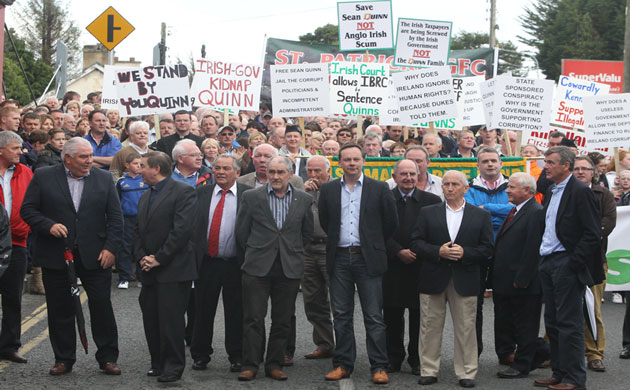
 Ireland is in the throes of an economic slump with official unemployment at nearly 15 per cent despite emigration. Severe cuts are being inflicted on essential public services; there are large cuts in take home pay and glaring inequality as the wealth of the richest in society has actually risen in the last few years. So how do we explain that in one corner of Ireland four thousand of the plain people of Ireland demonstrated in support of a man who was very recently the richest man in the country and who was at the centre of a disastrous attempt to buy the most rotten of Ireland’s very rotten banks?
In a small corner of County Cavan thousands demonstrated in support of Sean Quinn as he dodges and dives to keep large bits of his foreign property empire out of the hands of the successor to the Anglo-Irish Bank from which he took out loans to buy the property but is now unable to pay back. The property was security for the loans and now that he can’t repay the loans the State, through the Irish Bank Resolution Corporation (IBRC), wants the property. In effect the local population was demonstrating in favour of Quinn holding on to this empire by underhand and devious means ,to keep it out of the hands of a state bankrupt and making huge cuts that affect those demonstrating as much as anyone.
In this he was supported by a local and high-profile priest, by a local Sinn Fein MP and by a number of senior and well-known figures within the Gaelic Athletic Association. The columnist Kevin Myers once wrote that he could imagine Ireland without Fianna Fail, without the Irish language and without the Catholic Church but he could not imagine it without the GAA. Especially in most of rural Ireland that is how important the GAA is to local society. It is such a huge and varied organisation that it cannot be said that the GAA as a body supports Quinn but the members present were too numerous and prominent for the relationship to be simply dismissed. Sean Quinn’s brother Peter is an ex-President of the Association and a further ex-President Sean Kelly, a Fine Gael MEP, also issued a statement in support.
I was having a conversation in the car with my other half when she said that they all had one thing in common – they were all men for whom it is always about them. When I also pointed out that it could be said they were also all quite well off, Catholic or ‘culchies’, she thought for a moment and said – no, it’s all about them being men with their masculine egos. Then I said that the worst aspect of all this was that so many ordinary people had come out to support him but she disagreed with this as well and said they were demonstrating because he had given them work.
Quinn is by far the biggest employer in the area with cement and glass businesses, a large hotel and latterly branching out into insurance. It was his €2.3 billion gamble on buying Anglo-Irish Bank that brought this business empire down. There seems little recognition locally however that not only has he sought to deprive the state of much needed funds and caused an increase in everyone’s insurance premiums required to pay for his mistake but he gambled with people’s jobs to enrich himself when he was already filthy rich.
Now, while claiming through tears, that he is a victim, a man with plain needs and modest life style he has ensured that his relatives have been paid hundreds of thousands of Euros from the Russian property companies that he is trying to keep hold of. The wife of his son has, for example, been paid €320,297 after tax by a Russian company owned by the Irish State while being a part time receptionist at a motor dealership in north Dublin. Yet people on a fraction of this came out to declare that he has been hard done by!
For some the demonstration of support is but the latest expression of a long lived Irish slavish mentality that has much in common with peasant attitudes of supine deference to a local feudal Lord. The great and the good declare the Lord one of us and the serfs oblivious to their real interests blindly obey their masters and betters. Such a view however is only possible from outside.
Cavan and Fermanagh are not some atavistic backwater with ignorant peasants innocent of the sophisticated ways of the modern world. What is in evidence is not some centuries-old peasant tradition of subservience. The rural location gives some apparent justification to such views but the industries they work in are modern, few make money directly from the land and they are as educated as anyone in the country. What is expressed is a particularly personal and local phenomenon of dependency which characterises the whole country and which is only particularly noticeable because of the scale of the local dependency.
The obvious power of the Quinn family in economic terms has been extended naturally into an ideological and social power over the local community and become repulsive to many only because it is so personal and accentuated by the local circumstances. Expressed in a rural idiom it is easy and tempting for others to ridicule and mock but such acerbic criticism has much bigger targets if it were only to look.
In what way is the subservience of some of Cavan people any different to the subservience of all the people of the Irish State to an unholy trinity of State, banks and property developers who have placed on their shoulders a debt so huge that their children will be paying for it for decades to come? In what way is the willingness to support the local Lord any different from the near universal political agreement across the State that the richest multinationals, including speculative financial institutions, should shape economic and social policy, despite the economic disaster they are so closely associated with, while the poorest and most vulnerable must suffer? If the slavish dependency of some people in Cavan offends so much why doesn’t the much greater dependency of the whole country not also?
The exhibition of subservience witnessed in one part of rural Ireland is not to be excused. It must be understood and above all recognised as simply a particularly obvious reflection of the exploitation and oppression of the working people of Ireland. In this respect it is fundamentally no different from the position of workers anywhere. The notion that Quinn gave people work is accepted as fact just as capitalists employ workers while workers are employed. But Quinn didn’t give people work, the people gave work to Quinn and he gave them back an amount of money worth less than the work they provided.
Under a system of private ownership by capitalists of the means of production it is nearly always the case that it appears that the capitalist gives work to the workers, and it is not that this is a pure illusion. In a very real sense workers do depend on capitalists for jobs, which they create and destroy regularly. This dependency and its results become obscene in some circumstances but it exists everywhere.
It’s time that working people, some of them, started to put forward an alternative, starting with the left and not one that presents the state as the fountainhead of this alternative. The alienation of people in Cavan from this state (and the banks it supported), easily pictured as a remote Dublin cabal, is a distorted reflection of what would otherwise be a healthy impulse.
After all, for socialists the alternative to Quinn is not the Irish Bank Resolution Corporation, is it?

 Sráid Marx