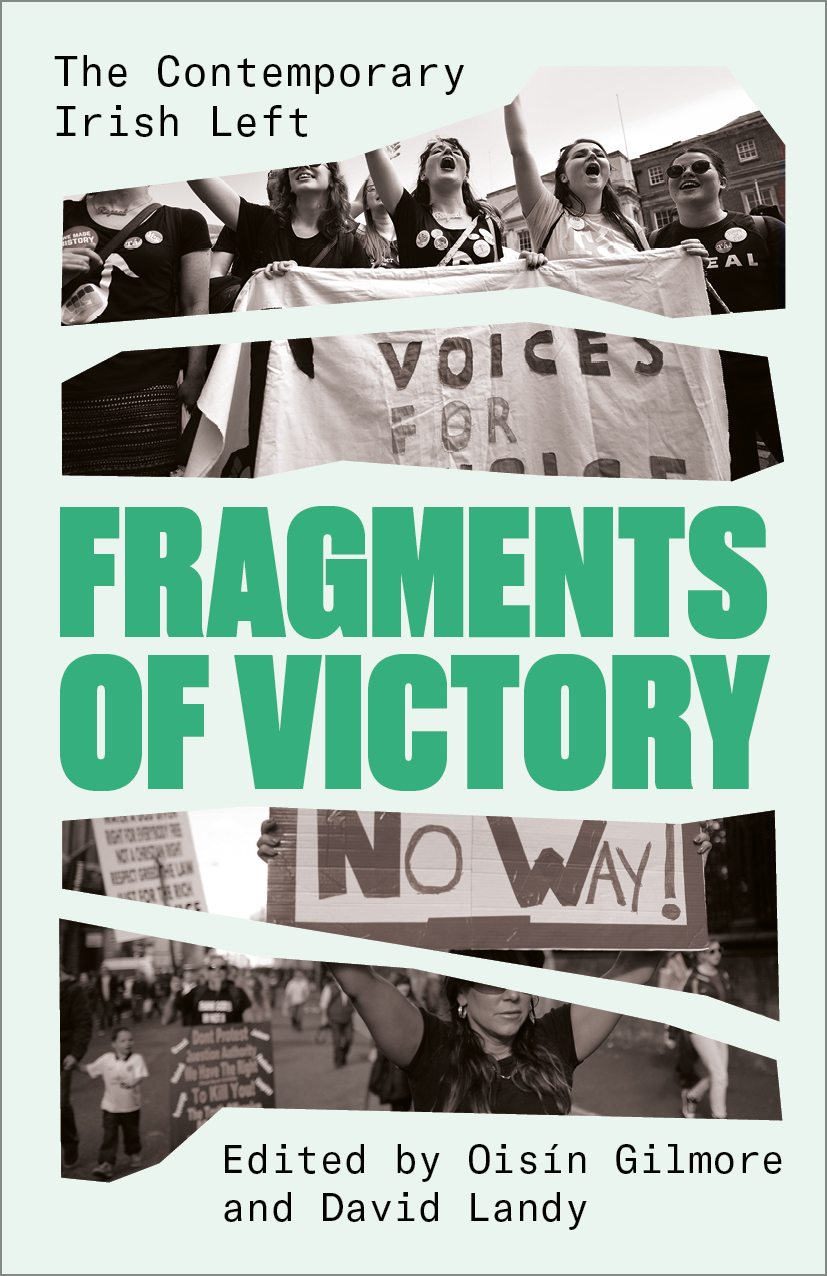
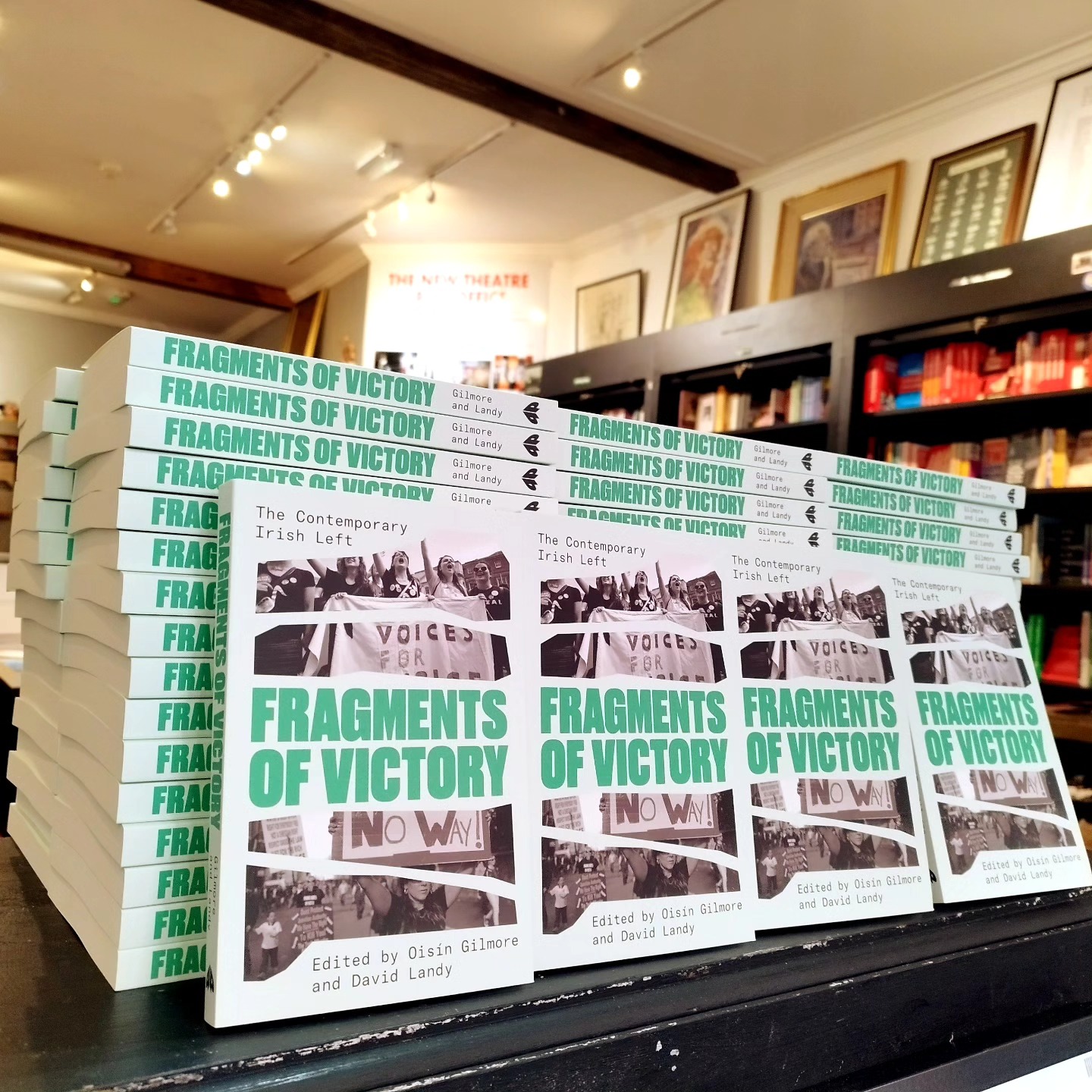
Fragments of Victory’: The Contemporary Irish Left’, book review (6 of 6)

The most damning judgements in Fragments are that the movements since 2008 ‘failed to identify an avenue through which society might be changed’; ‘it is unlikely the Trotskyist People before Profit will manage to articulate a viable alternative . . . and the steps between the current situation and the long-term goal of socialism are less clear than ever before. The radical left ‘were engaged in a form of politics incapable of realising its own aims.’  (p183, 191, 192 & 181)

The left made gains during the years covered by the book, expressed in some relatively modest electoral successes, but this was achieved though pursuit of a strategy and practice that might be considered as one of least resistance, which had inevitable shortcomings and meant these ‘steps’ were not an ‘avenue through which society might be changed’; entailed a lack of articulation of ‘a viable alternative’; lacked clarity over how to achieve ‘the long-term goal of socialism’ and gave rise to the perception that its politics was ‘incapable of realising its own aims.’

This is not only a question of an absence of a revolutionary socialist programme, which we have already noted in previous posts.  The left has worked under the assumption that achievement of  its objectives requires a revolutionary party, which alone would understand the necessity for revolution and how it may be achieved, and that in its various forms it is the nucleus of this party, which is considered to be revolutionary because its leaders truly believe in revolution (regardless of how it looks from outside).  This obviously means that its own activity and building its own organisations are the absolute priority.

I am reminded of the slogan that the duty of a revolutionary is to make the revolution, except socialist revolutions are not primarily made by revolutionaries but by the working class in its great majority.  The emancipation of the working class can be the work only of the working class itself, as someone famous once said.  This is one of many principles widely acknowledged but without understanding what it entails.  Revolutionaries are ‘the most advanced and resolute section of the working-class . . . which pushes forward all others [with] the advantage of clearly understanding the line of march, the conditions, and the ultimate general results of the proletarian movement.’ (Marx and Engels, The Communist Manifesto).

The working class party is built not solely or even mainly by the activists of the left but mainly by the working class itself, with the socialist movement playing the role just mentioned.  Instead, the mantra of building the party is reduced to building the existing left organisations not as a consequence of the development of mass working class movements but separate from them.  Revolutionary organisations can only develop if they find within the working class this growth of socialist consciousness, which is itself partly a result of their own activity but only as an integral part of the struggles of the working class itself.

We have noted the need to challenge the existing leadership of the trade union movement as an example of what is needed to begin addressing these tasks. We have noted that the limits of single issue campaigns means that they were not a substitute, however useful they may be otherwise, and that the political education that was given was the failed statist politics that subordinates the class’s own activity to that of the capitalist state. This view has come to dominate understanding of what ‘socialism’ is and reflects the historical domination of social-democracy and Stalinism.

This was rudely demonstrated by the left’s customary call for nationalisation being appropriated by the state in relation to the banking system when it faced collapse; which was carried out to protect both capitalist ownership and itself, while dumping the cost on the working class.  I have seen it defended on the grounds that this was not ‘socialist’ nationalisation, but this complaint just admits its unavoidably capitalist character.  Could capitalist state ownership be anything other than capitalist? How could the capitalist state introduce working class control and ownership when it was its own ownership that was asserted?

Progress through the lines of least resistance does not necessarily involve conscious opportunism, precisely because it does involve progress, but like all opportunism it sacrifices long term principle for short term gains. Gains which can more readily dissolve as circumstances change and change they always do.  The approach of appearing more ‘practical’ and attuned to workers’ existing consciousness by declaring that one can leverage the state to do what the workers movement itself must do, through a ‘left government’ for example, does not educate, in fact miseducates, the working class.

This does not invalidate the struggle for reforms that of necessity are under the purview of the state, but these are of benefit not only, or so much, for their direct effects but for their arising from the agency of the working class through the struggle to impose its will on the state and capitalist class.  Reforms are ultimately required to create the best conditions for a strong workers’ movement, and not as solutions to their problems that act to co-opt workers to dependence on the state.  Handed down from above they can primarily be seen as performing the latter role. 

The alternative of seeking to mobilise workers when their organisations are bureaucratised and the majority are either apathetic or antipathetic, is often seen as less practical, less advised, and ‘ultra-left’.  However, the point of socialist argument and agitation is often not with the expectation of eliciting immediate action but to advance political consciousness, which sometimes might be seen as widening what is called the ‘Overton window’.

This approach addresses the argument that only in revolutionary times or circumstances can one advance revolutionary demands.  All independent action by the working class is a step towards its own emancipation, no matter how small, just as reliance on the state is not.  Reforms won from the state are significant such steps if they involve independent organisation of the workers’ movement to achieve them.  As Marx said in the Communist Manifesto in relation to workers’ struggles: ‘Now and then the workers are victorious, but only for a time. The real fruit of their battles lies not in the immediate result, but in the ever expanding union of the workers.’

Something similar was pointed out by James Connolly, who knew that temporary victories would not yield permanent peace until permanent victory was achieved, and that for such victories ‘the spirit, the character, the militant spirit, the fighting character of the organisation, was of the first importance.’ Fragments’ statements that the left ‘failed to lay deep social roots’ and ‘failed to develop a mass political consciousness’ is the authors judgement that this didn’t happen.

It is banal and trite to acknowledge that demands need to be appropriate to their circumstances, but this must also encompass two considerations.  First, that even in situations in which it is almost impossible to achieve the working class mobilisation that is required, it may still also be necessary to say what must be done in order to achieve the desired outcome.

Second, only by always putting forward an independent working class position, which most often does not involve any call to more or less immediate revolutionary overthrow, is it possible for workers to begin to realise that an independent working class politics exists that has something to say about all the immediate and fundamental issues of the day.  As I have previously noted, this begins by instilling in workers the conception of their own position and power as a class, not that of an amorphous ‘people’.  What this involves in any particular circumstance is a political question and the subject of polemical differences that are unfortunately unavoidable.

The fall of the Celtic Tiger demonstrated that such crises on their own will not bring about the development of socialist consciousness – that capitalism is crisis-ridden and must be replaced by a society ruled by the working class.  One of the earliest posts on this blog noted evidence that these crises most often do not.  In order that they deliver such object lessons it is necessary for a critical mass of the working class to already be convinced that their power is the alternative to capitalism and its crises.  This requires a prior significant socialist movement integral to working class life and its organisations.

We are a long way away from this, with one reviewer of the book in The Irish Times noting that its editors had excessive optimism about the experience of the Irish Left over the period.  The reviewer makes other comments that are apposite.  The argument of this review is that the book records enough experience to show that optimism is unjustified, at least on the basis of continuation of the political approach recorded by it.

The project of a left government that would be dominated by Sinn Fein, with secondary roles for the Labour Party, Social Democrats and Greens is not the road to address the failures noted at the top of the post.  The project is a chimera that is incoherent and cannot work.  In (un)certain circumstances it might spur a further development of consciousness and independent working class organisation and activity, but this is by far the less likely outcome and is not, in any case, what is being argued by the projects’ left supporters.

The left is always in a hurry, partly because of the preponderance of young people involved but more decisively because of the project itself, which is not based on building the strength and consciousness of the class as a whole but of building the left organisations themselves, particularly through elections.  The next one is always the most vital.  The former is the work of years and decades to which the project of ‘party building’ and ‘the immediacy of revolution’, understood as insurrection, does not lend itself.  These are outcomes that cannot be willed by socialists but determined ultimately by the wider class struggle and the decisions of countless workers as well as by their enemies.

Elections allow socialists ‘a gauge for proportioning our action such as cannot be duplicated, restraining us from untimely hesitation as well as from untimely daring’, and ‘a means, such as there is no other, of getting in touch with the masses of the people that are still far removed from us, of forcing all parties to defend their views and actions.’  It is not a means to arrive at a government that is ‘left’ of the current bourgeois duopoly but right of socialism, and that peddles illusions that the current capitalist form of democracy can deliver fundamental change.

Back to part 5
Fragments of Victory’: The Contemporary Irish Left’, book review (4 of 6)

In the previous post I argued that the leadership of the trade unions were unable and unwilling to challenge austerity because it would involve a political challenge to the state it had decades of ingratiating itself with it as its ‘social partner’.  However, I also noted that ‘the undeveloped and inadequate political consciousness of the working class itself [was] also a major factor’ in the union movement being unable to successfully resist austerity.

The socialist critique of the bureaucratic leadership of the trade unions is not that its passivity never reflects the views of its members but that the occasions in which members are prepared to take action are often betrayed and their passivity reinforced through ensuing demoralisation.

Protests and demonstrations (called by trade unions early in the economic crisis and also later) are only useful in so far as they are necessary steps to more effective action: by rallying the troops and persuading others that there are alternative courses of action and the means to achieve them.  Otherwise, they are what they are defined as, simply public expressions of objection, disapproval, or dissent, and public exhibitions of the attitude of a group toward an issue.

There is currently no other rival union leadership that believes in independent working class politics that is separate from and opposed to the state and seeks to increase the class’s political consciousness.  Bureaucratic organisation stifles any democratic control that might permit episodic bouts of struggle to advance and accumulate an understanding of class politics.  Lack of democracy and low participation are both causes and effects of political weakness.

Both the leadership and membership are wedded to the view that fundamental change can come only through the state as the only (legitimate) agent capable of achieving it.  All sections of ‘the left’, from Sinn Fein to supposed ‘Trotskyists’, have a political programme that hold that achievement of governmental office will enact this social transformation, and campaign on this basis.  How a capitalist state will permit this is never explained.

Of course, People before Profit and Socialist Party pay obeisance to the view that the capitalist state will have to be overthrown but this plays a role analogous to republicans’ view that the legitimate government of Ireland resides within the IRA.

During the crisis there was little to no awareness of the possibility of an independent working class political force as more than perhaps a vehicle to pressurise the state, or with a view to having its representatives occupy positions in its parliament so that they could legislate sought after policies and adopt necessary measures.

This reflects the widespread support for the democratic credentials of the state and its political system, further legitimised by the country’s colonial history and the struggle against it.  This gives the nationalism that is the express ideology of almost all political parties a progressive veneer and a reactionary essence.

Accompanying this is an acute awareness of the weakness of the small Irish state and its dependence on US investment and EU membership, where most power resides in the much larger European states.  There are some illusions in the independent sovereignty of the state but also awareness of its constraints.  When the Irish state became bankrupt the view that it could not resist the demands of the EU and US that it bailout the banks was reluctantly accepted because there appeared no alternative.

When your politics is based on winning concessions from the state, and/or the perspective of being the official government of the state, it is difficult to present these as possible when that state is bankrupt and your proposed actions are opposed by much more powerful states.  Not only does it look unconvincing, it actually is.  Hence the comment in the book, in relation to the Dáil, of the ‘futility of marching to an institution that was taking its own marching orders from elsewhere.’

One contributor to Fragments, writing about the trade union input into the one anti-austerity campaign that was successful – against water charges – reports that ‘political economy training . . . was the most impactful part of the campaign’. (p57) Except this training appears to have been peddling the same mistaken conception that state ownership is the answer that the whole crisis, and the response to it from the Irish state, should have utterly dispelled.

This campaign morphed into the Rights2Change movement that on paper united much of the left and some trade unions.  Its programme of rights, which went beyond the question of water, made sense only if the state had an obligation to satisfy them, and it didn’t begin to address the claims by the government about the lack of state resources to do so.  A programme based on the supposed moral obligations of the state was as weak as the commitment of the various organisations to the project. It demonstrated only that this spectrum of organisations was united in illusions in, and subservience to, the capitalist state.

Two aspects mentioned in the book illustrate these weaknesses: ‘throughout the period of Right2Water’s existence, nobody was working on the campaign full time. The bulk of the work on the union side was done by two or three trade union officials who also had their day jobs.’ (p61)

As to the unions role as a ‘pillar’ of the campaign, it was to ‘bring organisational skills . . . politically neutral; provide economic and political research; have activists in workplaces all over the country and bring financial assistance.’  (p 55) Nothing about workers action in the workplace and what sort of action its ‘activists’ should fight for.

The role of political parties was equally somnolent – to ‘bring political knowledge; an ability to raise issues in the Dail and have activists in communities all over Ireland.’  (p55) Again, without an acceptance that political debate over aims and strategy was absolutely required, as opposed to already accepted, there was no specifically political input sanctioned for political parties.

Like so many left campaigns, broadness was confused for depth, and political shallowness for agreement and unity.  One ridiculous outcome was that at one demonstration ‘we ended up with 36 speakers or acts.’ (p53) One unambiguously positive legacy of the campaign claimed by the writer is that the ‘unions and progressive political forces were in place to prevent the movement from being co-opted by the far right.’ (p60). Not a high bar.

If the original platform for the campaign was weak (that water was a human right), there remained differences on appropriate tactics, so it could be no surprise that this attempt at turning a ‘mass movements’ into a’ story of mass organisation’ rather than simply mass mobilisation’ was a failure (p180-1 &182). This meant that it was ‘large but ephemeral’, ‘failed to lay deep social roots’, ‘failed to identify an avenue through which society might be changed, and given this, . . .  failed to develop a mass political consciousness around the capitalist nature of our society or around what needs to be done to change it.’ (p183)

Sowing illusions in the state and failing to educate those mobilised on its unreformable class nature is guaranteed not to ‘develop a mass political consciousness around the capitalist nature of our society.’  The major success of resistance to austerity set out in the book came nowhere near this because it didn’t try, and it didn’t try because the left didn’t know what this would have to involve.

Back to part 3

‘Fragments of Victory’: The Contemporary Irish Left’, book review (2 of 6)

In the book’s introduction we are informed that after the 2016 general election one in 20 members of the parliament was a Trotskyist”, which would, for example, translate to over 30 MPs at Westminster.  In the conclusion it notes that this election was ‘perhaps the greatest electoral success of Trotskyism in any western country ever’, ‘the development of one of the strongest electoral lefts in western Europe’ (p177)

Except this avoids the question of what manifesto – what political programme – did these ‘Trotskyists’ get elected on that was in some way supported?  Was it in any way a revolutionary socialist one and if not, in what sense was it a vote for Trotskyism or for Trotskyists? What wider movement, if any, did the vote reflect?  How isolated was it, or was it the vanguard of a much wider radicalisation?

Fragments initially appears to be organised around the concept that there is some identifiably coherent ‘left’, except reading it reveals that this is not the case.  There is however some commonality that we alluded to at the end of the previous post, but it is this commonality that is itself incoherent.

We are informed that the Irish were one of the ‘strongest electoral lefts in western Europe’ and that this ‘left’ not only includes the ‘Trotskyists’ but also Sinn Fein; so we know that however strong this left became in electoral terms its political unity is at the very least questionable. You can assemble the various parts but it becomes less an alternative the more it is put together.

On page1 we learn that the left ‘won some victories’ (a near unique achievement in western Europe during this period) that ‘other countries could learn from.’  Yet in this introduction we are also informed that the austerity following the economic crisis ‘created a collapse of living standards, experienced by many’ with emigration that exceeded ’even the highest rates . . . of the past’.(p 13) 

On page 3 we learn that apart from Sinn Fein other left wing parties and campaigns ‘have struggled in the face of the new political challenges’ while despite ‘widespread support for leftwing politics, the left has failed to build lasting political and social institutions . . . After a decade that saw the left win real victories, mobilise hundreds of thousands and transform the electoral landscape, in many ways the left finds itself in a strangely weak position.’  These judgements are all in one paragraph!

In the conclusion, after noting some successes, including electoral gains, it states that ‘despite these successes, the left is in many ways as weak as it was pre-2008.  No lasting form of working-class self-organisation has emerged.  Union density is lower now than it was in 2007.  No mass parties have emerged.’ (p177-8)

On the next page we learn that ‘These apparent advances by the left in Ireland contrast sharply with the decline of its counterparts in most of the West . . . the left in many countries is in a worse position than it was before the crisis.’ (p 178). ‘The advance of the left in Ireland is even more striking when the political situation in pre-crisis Ireland is compared with that of Western European states.’ (p179).

It notes the failure of Syriza in Greece and Irish hopes for it, although Ireland did not even produce a Syriza and, as the book acknowledges, its defeat led Sinn Fein to shift its rhetoric to the right, opening the door to junior partnership in government with one of the two main bourgeois parties.  Gerry Adams is quoted –“I have to say, I never really subscribed to that notion of a left-wing government, certainly not in the short term.  I mean, who are the left.” (p 171) A very good question, to which Adams gives one element of an answer – it doesn’t include Sinn Fein.

This favourable comparison with the rest of Europe sits uncomfortably with the observation that ‘Missing in Ireland, especially in the early years, were the massive explosions of protest seen in other countries during 2009–13’. (p 184). 

Nevertheless, we are told that ‘The material successes of the Irish left and its social movements have been unique . . .’ (p185) and ‘the achievements of the social movements since 2008 are striking.  There are some real, substantial victories. Hundreds of thousands were mobilised. And the political culture of Ireland was definitely changed.  The neoliberal consensus . . . is over.’  ‘Today the left in Ireland is no longer marginal. While in almost all of Europe the last few decades have witnessed the decline of the left. In Ireland it has grown in strength’ demonstrating ‘what can be achieved.’  ‘There is today in Ireland significant support for the left . . .’ (p191)

These advances were apparently based on an already well-positioned movement because ‘in some ways, the left in Ireland was well prepared for the crisis.’ (p185). By this is meant that it was not focused on identity politics and ‘cultural questions’ although in fact this is not the case.  It is just that the majority of the Irish left have swallowed gender identity politics for example with hardly a debate, mirroring the introduction of gender self-id recognition carried out by the state purposely also without debate.

The conclusion presents ‘two key findings’, including that ‘the 2008-18 period saw the emergence of major mass movements that have both fundamentally changed Ireland’s political life and can provide lessons for the left internationally.’ (p188)

‘Trickier to identify, but unquestionably real, Ireland is a more leftwing country than it was in 2007 . . . Between the summer of 2021 and the summer of 2024, the left consistently outpolled the right, whereas before 2008, the left only had a third of the support for rightwing parties.’  Also adduced as evidence is that there is now recognition of the need for state intervention to solve the housing crisis. (p184). The problem with the latter however is that this state intervention has largely been to incentivise private sector solutions, which the left has denounced.

The success is qualified – ‘looking forward, the achievements of the last 15 years seem rather more fragmented’ and even the ‘electoral gains arising from a period of struggle . . . is now very much in the rear-view mirror.’  In the same paragraph it notes that the campaign victories over abortion rights and water tax ‘failed to result in lasting organisations.’ (p191). The other ‘side of the coin’ as the book puts it. (p3)

Capitalist crisis did not see ‘the re-emergence of working-class self-organisation and provide a space for the activity of the radical left’ while ‘mass movements were less a story of mass organisation than mass mobilisation’ (p180-1,182)

The movements since 2008 were ‘large but ephemeral’, ‘failed to lay deep social roots’, ‘failed to identify an avenue through which society might be changed, and given this, they have failed to develop a mass political consciousness around the capitalist nature of our society or around what needs to be done to change it.’  While they apparently ‘frequently terrified the ruling elite’ ‘they have never presented a serious challenge to the existing order.’ (p183)

Despite the positive evaluation and even with the qualifications, which leave a rather confusing picture, the real damaging conclusion is contained in these comments:

‘In many ways, despite the victories of the left since 2008, the future looks bleak.’ (p190). ‘It is hard to believe Sinn Fein will deliver the change that many desire . . [and] It is unlikely the Trotskyist People before Profit will manage to articulate a viable alternative . . .’ (p191) So despite short-term victories’, ‘the steps between the current situation and the long-term goal of socialism are less clear than ever before.’ (p192)

The book’s last words are that ‘it is clear that fragments of victory are not enough.’ (p 192) with the fatal verdict that despite the ‘striking’ advance of the left and ‘the apparent success of the Irish left’, the radical left ‘were engaged in a form of politics incapable of realising its own aims.’  (p179 &181)

Back to part 1

Forward to part 3

‘Fragments of Victory’: The Contemporary Irish Left’, book review (1 of 6)

Reading ‘Fragments’ I was reminded of the statement by Marx that ‘We develop new principles for the world out of the world’s own principles. We do not say to the world: cease your struggles, they are foolish; we will give you the true slogan of struggle. We merely show the world what it is really fighting for, and consciousness is something that it has to acquire, even if it does not want to.’

Fragments sets out to record the struggles of the Irish left (in the Irish state) over the past few decades so that the reader can form a view on its successes and failures.  In doing so we can apply Marx’s prescription and determine to what extent it shows the left ‘what it is really fighting for’ so that it can be conscious of the lessons that should be learned.

There are some obstacles in the way, including the variety of authors with different viewpoints although an introduction and conclusion is meant to summarise the results.  The major problem is the definition of what it means to be ‘left’.  In the introduction Sinn Fein and the Green Party are listed as left even though the major theme of the book is the response to the implementation of austerity following the collapse of the Celtic Tiger and the consequent bankruptcy of the State.

During this period Sinn Fein presided over austerity while in a coalition government with the DUP in the North, while the Green Party entered into a coalition with Fianna Fáil in 2007 that bailed out the banks and inaugurated widespread cuts in social welfare and wages.

As part of the relaunch of Stormont in 2015 the ‘Fresh Start’ agreement committed the parties, including Sinn Fein, to reducing NI civil service staff numbers: ‘Between April 2014 and March 2016, the NICS is set to reduce headcount by approximately 5,210 and between April 2015 and March 2016 a further 2,200 will exit from the wider public sector.’ The Green Party supported the bank bailout that the state could not afford, which resulted in the intervention of the Troika of the European Commission, European Central Bank and IMF, along with the huge austerity necessary to satisfy their demands.

Even taking account of the elastic possibilities permitted by employing a relative term such as ‘left’, it is difficult to sustain any claim that these parties are in any substantial or verifiable way left-wing.  Sinn Fein was described by a comrade of mine a long time ago as containing members with left-wing opinions and right-wing politics.  The party has, in the meantime, fully confirmed this judgement while in government.  The Green Party began life as The Ecology Party promising ‘a radical alternative to both Capitalism and Socialism’ but in office twice it has displayed no alternative to capitalism and therefore no alternative to socialism.

Looking at political struggle through the lens of ‘left’ versus ‘right’ has therefore the potential to obfuscate as much as it clarifies.  A more illuminating approach is to set out the class nature of the politics of a political party and to explain why different parties with generally similar class natures have the politics that they do, even if they have different colouration.

Thus, as a nationalist party, Sinn Fein is a petty bourgeois party that considers the Irish people as one, with any class distinctions completely secondary and subordinate to the interest of the nation and its state, which can represent the true interests of all the people simply because of their nationality.  The Green Party claimed at its birth to have a radical alternative but also rejected a class approach through its largely petty bourgeois base and ideology.  It confirmed its class character by its members enthusiastically joining Fianna Fáil in government (voting 86% in favour) and by its commitment to the banks and austerity.

It might appear difficult to assign a class identity to some parties, and any classification has to be justified, but this is precisely the point of identifying the class nature of the forces involved.  As petty bourgeois parties, both Sinn Fein and the Greens have imposed austerity on workers while espousing radical rhetoric.  Calling them left is an attempt to obscure this and works to introduce doubt that they will not always fall on the side of the capitalist class in a struggle.

Fragments demonstrates this repeatedly, even when making secondary observations, for example that individual members of Sinn Fein were active in the Campaign Against the Household and Water Taxes but that the party was not: ’This form of partial (non-)commitment proved to be the defining feature of Sinn Fein’s approach to most political struggles of the time.’ (p37)

Approaching politics this way allows us to make judgements of other ‘left’ parties such as the Labour Party and Social Democrats etc. and permits an understanding of their behaviour during this period.  While the Labour Party paraded its ‘Labour’s Way’ as resistance to ‘Frankfurt’s Way’ while in opposition, it had no alternative to austerity when in government.  The doubling of its vote in the 2011 general election was a prelude to its consequent decimation in the next one.  ‘Labour’s Way’ didn’t become Frankfurt’s Way’, not having an alternative meant it always was.

Was the 2011 vote for Labour therefore a victory for the ‘left’ and was its subsequent decimation a defeat?  Did those who voted Labour in 2011 make an advance in consciousness or do so by deserting it in 2016? Or were they just registering disappointment and resignation?

Fragments offers the view that despite Labour delivering austerity when in office ‘the new government retained a huge amount of goodwill . . . the crisis was clearly not their fault and . . . the harsh austerity measures they took were seen as both forced by the Troika and, while painful, necessary’, while ‘the ‘honeymoon lasted for much of 2011 . . .’  (p31) So, were these views completely discarded when the Labour Party was dumped out of office? Was there any real advance in consciousness of an alternative when it happened?  Is roping the Labour Party into ‘the Left’ clarifying either history or the future?

Today, all these parties are allied in supporting Catherine Connolly for the post of President with the additional enthusiastic support of People before Profit and Solidarity.  The latter’s politics are supposed to be based on the view that existing power in capitalist society does not come from parliament but from the permanent state apparatus and the economic and social power of the capitalist system, yet they promote the idea that election to a post that is admitted not only to be without power, but forbidden to exercise any, would be a major advance.

Paul Murphy, People before Profit TD, states on Facebook that ‘this is a rare opportunity for the left to come together, and elect a voice for workers, for women and for neutrality.  Change starts here.’ This is a left that includes all the parties above that have been tried and tested.

In doing so all sorts of illusions in the role of bourgeois politics and institutions; about the ability of one person to represent the nation, and all the people within it; because of a one-off vote, and of the way ‘change’ can be made, are strengthened against an alternative view that real change comes from the organisation and struggles of the working class itself.

Are such views ‘Trotskyist’, as Paul Murphy’s organisation is called in the book? Or is this term used because that is just how it is usually described, or should such a designation not require some comparison of its political practice to a reasonable account of what Trotskyism is?  The umbrella term of ‘left’ addresses these questions by rendering them unimportant, and this is a problem.

To anticipate one message of this review; Fragments provides enough testimony to show that a different approach is necessary and that an alternative is required to the illusion that there is a ‘left’ that should be united to advance the cause of the working class.

It demonstrates, in its own way, that only a class analysis can explain events, including the actions of the state, why it succeeded in imposing austerity and why the resistance to it was unable to rise to the challenge.  Explaining all this in terms of whether certain actors, institutions or policies were ‘left’ or ‘right’ is hopeless not only because of the vagueness of the terms but because all of these acted out of material interests, as they perceived them, and these in turn were based on objective factors that were fundamentally determined by class relations.

Forward to part 2

An exchange of views on Palestinian solidarity and Hamas

Sráid Marx has received a comment on the series of posts that were written on solidarity with Palestine from Socialist Democracy, having linked to one of its articles in my second post. I include their comment below and a brief reply.

* * *

A critique of our position on Gaza solidarity.
Are the politics of Hamas a defining issue?

Over the course of the ongoing genocide in Gaza Socialist Democracy has distributed thousands of leaflets and newsletters commenting on the struggle and the movement in solidarity in Ireland. The aim of that work has been to provoke a response and to support a debate in the movement about it’s future direction.


While we have had a number of interesting conversations, there has been no organised response, so it is with some pleasure that we read a commentary by Sraid Marx on their blogspot, especially as we are given a C‐ for our most recent publication.


However we have some difficulties in responding. The comrade does not mention our name or give a full account of our position, so we are being invited to reverse engineer to understand the comrades own position.


Essentially we feel that the Sraid Marx position is too formalistic, whereas our approach is more contextual.


A chief point in the ongoing offensive is the constant demand that we condemn Hamas. We are familiar with this approach from the troubles and constant demands to condemn the Republicans. The demand now is that we blame Hamas for the violence, ignore the Israeli and US previous drives towards genocide and agree that history started with the Hamas breakout.


We can’t agree, because that concedes to the imperialists. We can’t endorse the action because that would tie us to the strategy of Hamas. The answer is: What do you expect when you imprison millions in an open air concentration camp and constantly humiliate and murder them?


Much of the critique is given over to the nature of Hamas. We think that beside the point. The source of the violence rests with the US and Israel. The UK is a willing participant in genocide and Ireland a consistent facilitator and opposition must start from there.


A useful criticism of Hamas lies in the context of the Gaza outbreak. That was the Abraham accords, drafted by the first Trump regime and aimed at erasing discussion of Palestinian rights and winning endorsement of Israel by the Arab regimes. When Hamas launched the Al-Aqsa flood it was appealing to the Arab regimes on the basis of nationalism and to the Muslim world on the basis of religion. An immediate tactical aim was to do what they had done in the past – seize prisoners to use as bargaining chips and win concessions from Israel.


They were profoundly mistaken. Arab nationalism no longer has a progressive content. Imperialism is poised to establish complete control of West Asia, founded on establishing the absolute military primacy of the US and Israeli axis and the capitulation of the Arab regimes. Genocide is an acceptable cost of victory and dissent is to be crushed. The imperialists have scored remarkable but still incomplete victories. The final task is to crush Iran, but there are doubts about the military capacity of the US alliance and its failures in Yemen which are holding it back from regional war.


The Irish movement does not discuss politics. It remains fixed on Free Palestine and individual acts of BDS. Demands for government action do not lead to a consistent campaign against the government.


This political weakness has a material base. Much of the leadership is the decayed remnant of the anti-imperialist left. It is in alliance with Sinn Féin, who wanted to suggest anti-imperialist positions without breaking with imperialism. Sections of the trade union movement pose as defenders of Palestine without breaking their partnership with Irish capitalism. The core of the Palestinian diaspora are linked to the collaborationist Palestinian Authority and their ambassador to Ireland and are hostile to Hamas.


A new inflection came with a current associated with the group Rebel Breeze. They criticised the solidarity campaign for inaction and failure to target the US, Israel and the Irish government. We supported the criticism but did not support their position of uncritical support for the Palestinian resistance. We attempted to engage with them but they did not reply. So the current situation is that the solidarity movement is weak and has no mechanisms for national debate.


In relation to Sraid Marx we would be critical of the formalism which led to the analysis of the CounterPunch position. We see no reason to give credence to their analysis of Hamas and their Irish solution of a Palestinian Good Friday Agreement is risible.

These positions arise less from political theory than from a long tradition of opportunism. They are not a serious attempt to plot out a revolutionary position, more an attempt to align with a relatively non-political base.

Changes are taking place. The genocide in Gaza is related to the drive to war in Europe and the trade war with China. The UK is to the fore in urging warfare not welfare. The Irish government is every day taking measures to integrate with NATO and with European militarism. This feeds a growing outlawing of protest and use of state force.

The liberal virtue signalling of Irish leftism and of the NGO world will fade away like snow from a ditch. A genuine socialist and anti-imperialist movement will arise from recognising the role of local ruling classes as representatives of the imperialist world order.

* * *

You ask the question “Are the politics of Hamas a defining issue?’” to which the answer you give is presumably ‘no’ although that depends on what the issue is to be defined.  I was careful to define the issue of solidarity with Palestine in terms of the responsibility of the Irish state in collaborating with imperialism and the Zionist state in the first part of my series of posts; the general approach of socialists to solidarity in the second part and in relation to Hamas in particular in the third part.

This means that in order to rebut the legitimacy of criticism of Hamas you need to engage with the arguments of the second post and you have not.

Progress has been made, however, in that you are no longer claiming that ‘denunciation of HAMAS is simply a mechanism for supporting genocide’, which I pointed out in my second post.  Instead, you indicate that although you cannot endorse the actions of Hamas the correct response is to say “What do you expect when you imprison millions in an open air concentration camp and constantly humiliate and murder them?”  This may be a point to make in response to imperialist calls to condemn Hamas but it is woeful as a position in relation to how imperialism is to be defeated.

It would appear however that you do believe that criticism of Hamas is valid – “A useful criticism of Hamas lies in the context of the Gaza outbreak.”  This criticism includes Hamas’s reliance on reactionary Arab regimes “on the basis of nationalism and to the Muslim world on the basis of religion.”  You also concede that its tactical plan was a strategic disaster, so that “the imperialists have scored remarkable but still incomplete victories.”  As you say, Hamas “were profoundly mistaken” and “Arab nationalism no longer has a progressive content.”

You have therefore moved considerably but remain still a bit confused.  You argue that the critique of Hamas, specifically its nature that would account for and explain ,for example, all the criticism you make yourself, is “beside the point.” You are keen to argue that the political weakness of the Irish solidarity movement “has a material base” but do you not also believe that this is true of Hamas?

If you take your critique seriously you are obliged to advance the arguments that a working class alternative armed with socialist politics is required to help advance not only the solidarity movement but also the struggle of the Palestinian people against genocide.  This is what I attempted in the second post.

A penultimate point about trying to further debate in the solidarity movement.  You state of my posts, and their reference to the analysis of two authors in Counterpunch, that you see “no reason to give credence to their analysis of Hamas and their Irish solution of a Palestinian Good Friday Agreement is risible.”  

I make my own criticism of the authors references to Ireland clear, while it gets you nowhere to claim that their criticisms of Hamas should not be discussed because I should not “give credence to their analysis.”  If you think they are categorically wrong, you need to say why and where they go wrong.  Otherwise, dismissive comments are but another example of the refusal to engage in debate for which you criticise others.

A final point. You write that a “genuine socialist and anti-imperialist movement will arise from recognising the role of local ruling classes as representatives of the imperialist world order.” It will also require a political struggle against nationalism and fundamentalism and rejection of the petty bourgeois moralism that preaches that the leaders of oppressed groups are beyond criticism.

Irish elections (2) – the main story?

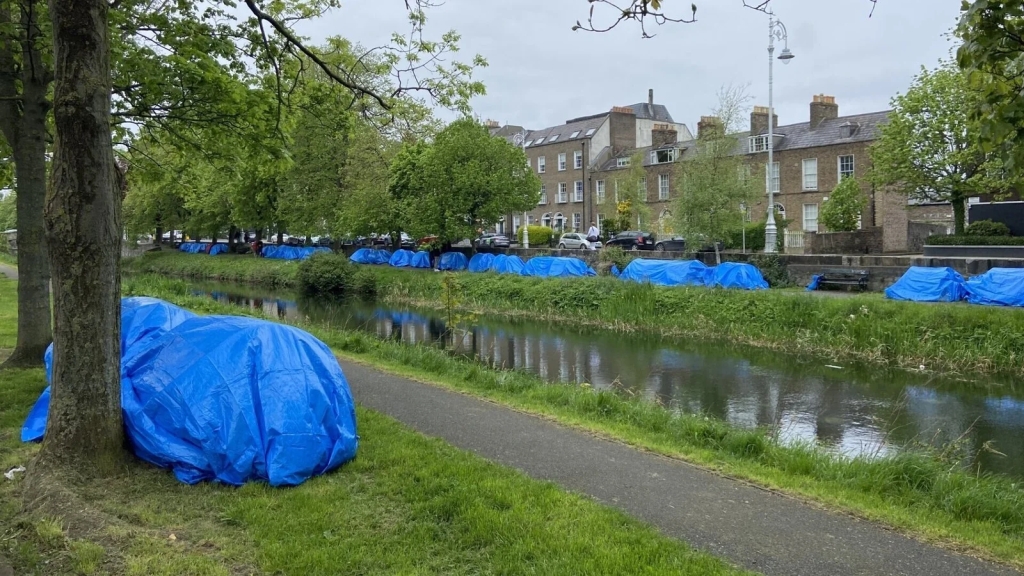
The government gives money to NGOs to help refugees. The refugees buy tents because the government won’t provide accommodation, so the government spends money to destroy the tents. Photo: RTE

The main story of the elections is that despite long-standing failures and some dissatisfaction the main governing parties, including the Greens, more or less held their own, illustrated in quick speculation that they will bring the date of the next general election forward.

Together they won around half the first preference vote in the local elections and 46 per cent in the European.  This is historically low for the two main parties (46 per cent and 41 per cent respectively) but these are now two cheeks of the same arse that are quite able to work together at the top while their voters are transferring to each other.  Even historically the previously minor party, Fine Gael, required a third party to represent an alternative, which the Green Party has, for now taken up, in the role previously performed by the Labour Party.

This has led once again to the obvious suggestion that they should merge, given the utter absence of any political differences.  At this point, however, one is reminded of the quote from the American comedian Bob Hope who said that “No one party can fool all of the people all of the time; that’s why we have two parties.”

The dissatisfaction that achieved expression was reflected in the 28 per cent vote for a variety of independents in the local election and 34 per cent in the European, while an independent won the Limerick mayoral contest.  Most of these have no fundamental political differences from the two main parties, in some cases merely being former members with no differences at all but availing of the possibilities for personal opportunism offered by the electoral system.

Despite the ups and downs the Irish state is politically stable, reflected in Fine Gael being in office for over 13 years.  This reflects the continuing recovery and growth from the financial crash.  Of course, this has a narrow foundation, resting on a limited number of US multinationals, but the threats are not yet immediate.

The problems of this growth – of income inequality and housing for example – are ones that ‘solve themselves’.  The poorest are atomised and prey to reactionary solutions or apathy while the inadequate infrastructure is partly a result of inadequate state capacity.  There is unanimous agreement that the solution lies in increasing this capacity – ranging from the governing parties themselves through to its liberal critics and its supposed left opposition. The precise role and scope of this increased state intervention is all that varies between them.  Not an inconsequential matter but not fundamental either.  The political origins of the left organisations as nominally Marxist gives its reformist programme nothing more than a radical tinge.

While Europe witnesses its biggest conflict since the Second World War, there is an Irish consensus that supports Western imperialism, which the left’s opportunism in also supporting Ukraine does nothing to challenge.  The gestures of the Government in supporting the Palestinian cause are enough to quell widespread opposition to what this imperialism does in its support for the Zionist state, while the position of the left on the war in Ukraine does nothing to clarify imperialism’s consistently reactionary and barbarous role.  Breaking the consensus on this is hard enough already given the dependence on US multinationals and EU membership, while the loss of Clare Daly in the elections is the loss of the most articulate and passionate opposition voice to this imperialism.  Again, the parliamentary left didn’t help by standing against her.

*                   *                  *

The final factor that is genuinely new is the electoral appearance of the far right, steeped in racism and xenophobia, flying the national flag and invoking Ireland’s colonial subjugation even while its most rancid elements collaborate with the British far-right.  Between it and the bourgeois parties lies various shades of reactionary nationalism; part of the stability of the ruling bloc of mainstream parties was their adoption of a harder rhetoric and tougher policies on immigration.  These parties have thus partially legitimised the more radical rhetoric to their right.

One commentator estimated that anti-immigrant candidates took 15 per cent of the vote in the Dublin European constituency and had three elected to Dublin City Council.  The naïve who think Irish nationalism is progressive because it is an expression of the oppressed should have cause to reflect, although if they have been able to ignore the character of the nationalism of Fine Gael, Fianna Fail, Sinn Fein and various republican militarists so far, it might not be a surprise if this is not revised by the far right becoming its latest expression.

It might also be estimated that about one third of the population of the Irish state still clings to its idea of this nationalism as that of holy Catholic Ireland.  In 2004 racism played no small part in an almost 80 per cent support for a referendum to limit the rights to Irish citizenship of children born in the State.

Since then, much has been made of the modernisation and progressive liberal development of the country but notwithstanding the mobilisations around referendums on divorce, abortion and gay marriage, much of these changes, including the support for change in these referenda, are due to the general secularisation of Irish society and not, unfortunately, to mass struggles of the working class, its movement or a mass women’s movement.  These changes received significant support from the main bourgeois parties and never called into question the political hegemony of these parties never mind the class foundations of the state.

All this is reflected, among other things, in the continued patronage by the state of the Catholic Church in education and health and the continued governance of the two main parties.  The growth of independents is a continuing tribute to the clientelism and parochialism of much of Irish politics.

There is therefore no crisis in the state that would provide the grounds for the mainstream parties to do more than give a certain legitimacy to anti-immigrant rhetoric.  It has no need to collaborate with outright racist forces even if they have been useful to put a squeeze on Sinn Fein through its more primitive support.  The far right is also handicapped by being very badly fragmented with no unifying figure appearing.  The far right is therefore not the primary problem but rather an expression of the weakness of an alternative.

*                   *                  *

I generally dislike blaming the successes of the right on the failure of the left since it often minimises our objective weakness, the strength of capitalist forces and their ideological hold, and the political resources of the bourgeoisie.  It is always necessary, however, to discuss what lessons we can learn.

Despite the relative success of the Governing parties there is general dissatisfaction and disaffection among many people.  That this was mainly expressed in votes for independents was a judgement on Sinn Fein.  That Sinn Fein failed to make the gains it expected while People before Profit/Solidarity stood still and didn’t increase its vote significantly is a judgement on it.

That PbP TD Paul Murphy indicated on RTE1 that a possible drop in votes was less important than a gain in seats indicates a left so mired in electoralism that its claimed ideological foundations are no guide to its actions.  It claims that it ‘sees elections as a way to build struggle’, but in reality it supports struggles in order to build itself and its primary goal in building itself is to win elections.

Its main strategy has thus been to work towards the creation of a ‘left Government’.  This only makes sense if Sinn Fein can be seen as a constituent part of this.  I have previously argued that the reformist programme of the left is no barrier to it being part of a ‘left’ government, which can be called ‘left’ because it isn’t going to be socialist or a workers’ government.  PbP/Solidarity is only on 2 – 3 per cent in opinion polls and elections so it very obviously needs something much bigger outside to make this remotely credible.

Enter Sinn Fein, and also exit Sinn Fein.  Just before the elections it was reported that the Party had travelled to London with financial firm Davy to give a briefing to ‘investors’.  Davy stated that ‘Sinn Fein does not plan to fundamentally change Ireland’s economic policy’ and noted that “overall, Sinn Fein’s approach from an economic standpoint is more ‘New Labour’ than ‘Corbyn Labour’.”  If this didn’t sink the credibility of a left Government as the way forward, then the recent election results certainly have.

These elections had a turnout of just over 50 per cent while the 2020 general election turnout was 63 per cent.  The next election will even on this basis be different, and some of the trends noted above will build up trouble if they continue.  What it will not be, however, is the opportunity to make the objective of a ‘left’ Government either credible or, more importantly, make it the central objective of those seeking to build a working class alternative.

Back to part 1

The Third Year of War (3 of 3)

Arms-length second-hand imperialism from the British Ukraine Solidarity Campaign: https://ukrainesolidaritycampaign.org/

Just as political programmes have a logic of their own irrespective of intentions, and war is the continuation of politics by other means, so does war impose its logic on those who politically support it.  The pro-war left has defended support for Ukraine and the intervention of Western imperialism, but as the war has developed it has been admitted by the leaders of both Ukraine and Western imperialism that for the war to continue Western imperialism must decisively increase its intervention.

One obvious consequence is that those who initially supported Ukraine on the grounds of self-determination can no longer honestly do so, given complete reliance on the West for its success. The only way out of this lack of self-determination (that is supposed to achieve self-determination) is to argue that, ultimately, Western imperialism is a benevolent ally with no interests of its own that might conflict with those of the Ukrainian people.

Such an argument would up-end everything socialists believe about capitalism, its imperialist form, and the interests of the working class. Whatever way you look at it there is no way to avoid this consequence. You can, however, avoid admitting it, but this can only be attempted by trying to cover it up and war is very unforgiving of attempts to deny reality.

Reliance on Western imperialism has revealed the conflict as a proxy war against Russia in which the role of Ukraine is to fight and die for NATO, justified by the Ukrainian state on the grounds that membership will provide its people with security!  As we have explained in many posts, NATO powers provoked the war, with the complicity of the Ukrainian state, on the understanding that it would result in Russian defeat. The build-up of the Ukrainian armed forces with the assistance of Western powers, alongside unprecedented economic sanctions, would result at worst in the crippling of Russian power and at best a return to a subservient Russian regime à la Boris Yeltsin.

The pro-war left rejected the characterisation of the war as a proxy conflict but its continuation being possible only on the basis of Western intervention means that this is not credible. The evolution of the war has meant that the position of this left is now exposed: as the saying goes, when the tide goes out you find out those who are swimming naked.  To mix the metaphors, standing still with the existing justification for supporting the war will not do and it is necessary to find a reverse gear.  It appears the pro-war left don’t have one.

A recent article by a leader of the Fourth InternationalCatherine Samary, indicates that instead of either revising its view of the war to one of opposition, or even of attempting to substantiate the claim that there is no proxy war in place, it has decided to justify the proxy war! 

Samary now admits that Ukraine ‘had a vital need for its [Western] financial and military aid in the face of Russian power’ and that ‘the war consolidated NATO and favoured the militarization of budgets.’  In addition to the ‘vital’ role of Western imperialism, the directly regressive consequence of the war for the Western working class is admitted; as is the reactionary nature of the Ukrainian regime, characterised by the ‘social attacks of Zelensky’s neoliberal regime and its ideological positions’, including its apologetics for the “values” of the West.

So, the hypocritical claims of the West are highlighted, although not in relation to the war: the claims about Russian imperialism and sole responsibility for the war, its intention to threaten the rest of Europe, and absolute necessity for its defeat – all this is shared by this left.

* * *

The first reason given for rejecting the proxy nature of the war, and the irrelevance of the reactionary nature of the Kyiv regime and progressive character of Western intervention, is the ‘popular resistance to a Russian imperial invasion.’  This, it is claimed, is the ‘essential characteristic ignored by many left-wing movements’ – ‘the massive popular mobilization . . . in the face of the Russian invasion,’ which means that we must support ‘the reality of armed and unarmed popular resistance.’  

Unfortunately the armed popular resistance she claims does not exist–there are no independent working class militias, and the unarmed resistance equally has no political independent organisation since opposition parties have been proscribed. Even popular enthusiasm for the war amongst the Ukrainian population opposed to the Russian invasion is draining away, as it inevitably does in capitalist wars. She quotes an article stating that ‘at the start of the invasion, citizens from all walks of life lined up in front of the recruitment centres. Nearly two years later, that is no longer the case . . .’

She quotes another article that ‘the fragilities of the popular resistance are real after two years, analyses Oksana Dutchak, member of the editorial board of the Ukrainian journal Common. She evokes a feeling of ‘injustice in relation to the mobilization process, where questions of wealth and/or corruption lead to the mobilization of the majority (but not exclusively) of the popular classes, which goes against the ideal image of the “people’s war” in which the whole of society participates.’

Samary states that ‘while the majority opposes and may even dislike many of the government’s actions (a traditional attitude in Ukraine’s political reality for decades), opposition to the Russian invasion and distrust of any possible “peace” agreement with the Russian government . . . are stronger and there is very little chance this will change in the future.’ With these words Samary does not appear to realise that she admits the lack of any popular control of the war and it lying in the hands of the ‘neoliberal’ regime that she professes to oppose, ‘and there is very little chance this will change.’ The choice of many Ukrainians has been to flee abroad while increasing numbers of soldiers are choosing to surrender rather than die. Some have even done so on condition that they are not sent back to Ukraine in any prisoner swap.

Even the Western media, at least sections of it in the United States, demolish the ‘ideal image’ that Samary wishes to project. The Washington Post (behind a paywall ), reports that:

‘Civilians here say that means military recruiters are grabbing everyone they can. In the west, the mobilization drive has steadily sown panic and resentment in small agricultural towns and villages like Makiv, where residents said soldiers working for draft offices roam the near-empty streets searching for any remaining men.’

The report goes on:

A close up of a text

Description automatically generated

A screenshot of a text

Description automatically generated

The Ukrainian state is not offering people ‘the opportunity to participate in defining the future of the country’ that she says is necessary for victory.  Why would a ‘neoliberal’ regime do that?  Many don’t want to take part in what Samary calls the ‘popular resistance’ because they don’t want to die and don’t trust their authorities not to throw their lives away. 

She acknowledges the problem that ‘the majority opposes and may even dislike many of the government’s actions’ and are also in ‘opposition to the Russian invasion’ but calls on them to swallow their doubts and fight on the basis of a political perspective composed of fairy tale illusions. These include ‘a socially just view of wartime policies and post-war reconstruction’; ‘for social and environmental justice, for democracy and solidarity in the management of the “commons”, and the defeat of any relationship of neocolonial domination.’ How would an alliance of a neoliberal regime, a congenitally corrupt state and Western imperialism deliver any of that?

She says that those opposed to the war are ‘blind to the relations of neocolonial and imperial domination of Russia’ but she is oblivious to her own blindness to Western imperialist domination, which is now able to decide whether to dump its support to Ukraine or promise more escalation, with the former promising more death and destruction and the latter involving another step towards world war.

Under what political perspective would it be possible to both oppose oppression by Russia and avoid submission to being cannon fodder for the Ukrainian state and Western imperialism?  Only a socialist policy could uphold commitment to this, the first practical steps of which would be opposition to the war, opposition to the Russian invasion and NATO expansion and organisation of resistance to the demands of the Ukrainian state.

Samary has no perspective of a socialist road out of the war so has no role for the Ukrainian working class except to fight and die for a ‘national liberation’ and a ‘self-determination’ that seeks to preserve the integrity of the capitalist state but condemns many of its workers to destruction.

The first rationale for supporting the proxy war is thus becoming less and less credible as it grinds on.  The Western powers are not disturbed by the loss of Ukrainian lives; so we hear more calls by British and American politicians for the age of mobilisation to be dropped so that its youth can join the roll call of death – ‘young blood’, as it is quite accurately called. But what sort of socialist supports dying for a capitalist state fighting a proxy war for imperialism?

* * *

The second rationale from Samary is expressed succinctly in one sentence as she asks – ‘was the defence of Ukrainianness “reactionary” or “petty-bourgeois” in essence?’  To which the only socialist answer is Yes

What is ‘Ukrainness’ but a nationalist confection to be put to use by the Ukrainian ruling classes?  What is the democratic content of nationalist exclusiveness encapsulated in this word, especially in a country with historically very different conceptions of what is involved in being a Ukrainian?  For what reason was the right to national self-determination historically supported by Marxists, except as a democratic demand for the right of an oppressed people to break its colonial chains and create a separate state?  How could this apply to Ukraine, which had already become an independent state but decided that it would employ this independence to seek a military alliance with imperialism against a rival capitalist power? And now wishes to defend itself through nationalist ideological garbage! How can all this be called socialist?

Samary has a response to these objections, if not a credible reply – the Western military alliance is not a problem!   Having signed up to support for the war and the Ukrainian capitalist state she has been compelled to find reasons to also support its imperialist backers.  What are they?

She states– ‘As regards NATO, the European left missed the moment of a campaign for its dissolution when this was on the agenda, in 1991.’  So no more chance of opposing NATO!  This organisation has no anti-Russian agenda, she says, blaming Russia itself–in the shape of Boris Yeltsin–for dismantling the USSR, ignoring that it was the United States who did its best to keep him in power, subsequently rebuffing Russia even when it wanted to join NATO and helped NATO in Afghanistan.  She even admits that :

‘Putin hoped to consolidate the Eurasian Union with Ukraine’s participation in trade with the EU, on the one hand; and, on the other hand, he intended to offer the West the services of the CSTO (Collective Security Treaty Organization) after the collapse of the United States and NATO in Afghanistan.’  Yet the West refused this cooperation.

She states that this was because of ‘the consolidation of a strong Russian state, both internally and externally’. But why, if the West sought a strong alliance, did NATO not welcome Russia as a strong ally?  

It can only be that being a strong state, Russia would have its own interests that it would want accommodated, which the West was not prepared to accept.  Unfortunately, this then makes the West co-perpetrators of the conflict that Samary wants to pin blame solely on Russia.  In fact, given the Russian offer of cooperation, it looks like it is the Western capitalist powers who are primarily responsible for the increased rivalry between Russia and the Western capitalist powers that has led to the war. This, however, is somewhere that Samary doesn’t want to go, because it is Ukraine and its NATO sponsors that she wants to defend.

She states that ‘NATO, led by the US, was . . . “brain dead” and not threatening on the eve of the Russian invasion;’ a view that ignores its nuclear posture, its expansion into Eastern Europe, its wars in Afghanistan and Libya, its support for the end of Ukrainian neutrality, its policy of supporting Ukraine re-taking Crimea, and its assistance in building up the Ukrainian armed forces to enable it to do so. The war, she claims, ‘gave back a “raison d’être” to NATO and the arms industries’, presumably because they didn’t have a reason to exist beforehand? Who can seriously believe such nonsense?  And from someone claiming to be on the ‘left’!

If we sum up, support for the war now involves a new mobilisation in Ukraine while demoting its increasing unpopularity and the stench of corruption surrounding it.  It means defending the role of the Western powers against Russia, despite the consequences of militarisation on workers in the West, including its impact on working class living standards.

It involves whitewashing the role of NATO while dismissing opposition to it as a bus that has been missed.  It argues instead for ‘general socialized control over the production and use of armaments’, that is, workers control of militarisation and imperialist war!  Impossible to conceive as something real and utterly reactionary as a mere concept.

The policy of support for the current war thus inevitably entails alliances with reactionary forces in the West: ‘broad fronts of solidarity with Ukraine can include – and this is important – an “anti-Russian” Ukrainian immigration supporting neoliberal policies like those of Zelensky, and uncritical of the EU and NATO. It is essential to work towards respecting pluralism within these fronts . . .’

The circle of a reactionary pact is completed.  And all this under an article entitled Arguments for a “left agenda”.  Whoever pretends such an agenda has anything ‘left’ about it is either an idiot or is seeking to recruit one.

At some point the war in Ukraine will end but the rationale for the pro-war left to continue to defend Western imperialism will remain.  It will, in other words, continue an agenda best described, in Marxist terms, as social-imperialist – socialism in words (although Samary doesn’t even manage this!) and pro-imperialist in action.

Back to part 2

The Ukrainian Solidarity Campaign and Palestine- bankrupt opposition to imperialism

How often have we heard from the supporters of Ukraine that we should listen to the words of the Ukrainian left, as if their nationality or proximity to the war privileged their political views and pre-empted our own?  Should we contract-out our politics to every nationality?  What is this other than identity politics gone mad?

The Ukraine Solidarity Campaign (USC) has one such author we should apparently listen to, writing not about Ukraine but about Palestine (is this not a breach of the decree?)  Or do the Ukrainian leftists who support their own state have some special insight into all struggles that claim to be ‘anti-imperialist’?

Let’s look at what this article says: ‘Side with progressive forces in Israel and Palestine for a lasting peace’.

It declares that:

‘On October 7 a new round of the Palestinian-Israeli confrontation began with rocket fire by Hamas. The whole world turned its attention with horror to the atrocities of terrorists against peaceful citizens of Israel and other countries. However, for now, while everyone is debating the need to strike back as hard as possible, progressive forces around the world should focus on a plan to achieve lasting peace.’

Just as the war in Ukraine did not start on 24 February 2022, so did the conflict in Israel and Gaza not start on October 7 2023, as everyone knows, or should know, because it is literally impossible to understand either by reference to these dates, by regarding them as providing the context for comprehension of what is going on.

The whole world did not turn ‘its attention with horror to the atrocities of terrorists against peaceful citizens of Israel and other countries’; for a start the attack by Hamas also included attacks on the Israeli military.  This is not to ignore or excuse or support or defend the killing of Israeli civilians.  Among many people there is an understanding of where these desperate (in every sense of the word) attacks came from.

Neither is ‘everyone . . . debating the need to strike back as hard as possible’.  Certainly not the targets of this ‘strike back’, not those who are genuine socialists, and not those hundreds of millions who understand the circumstances of the Palestinians in Gaza and who sympathise and solidarise with them and their struggle.  Only from the point of view of Zionism and western imperialism is there a debate about how hard to strike back.

‘For now’, the progressive forces around the world should not ‘focus on a plan to achieve lasting peace’ but should focus on how they might stop the pogrom and ethnic cleansing of Gaza that can only entail a murderous catastrophe.  To think that right now we need a plan for lasting peace is to indulge in cynical pretence, putting one’s head down while death is dealt all around.

The article states that ‘Israel has the right to self-defence and can retaliate against terrorists’, while Its concern with Israeli tactics seems mainly to lie in their being counter-productive, not their purpose or consequences. Even the failure of previous negotiations is blamed mainly on the Palestinians.

It declares that ‘the international community should support progressive forces willing to make concessions for the sake of peace’, the same international community that has sat back while Israel has expanded while ensuring the expansion through massive financial and military support.  The same ‘international community’ that any self-regarding socialist would immediately recognise as imperialism.

It states that ‘the international community should promote the creation of new progressive political movements in Palestine that would not involve either the corrupt Fatah or the Iranian-backed Hamas terrorists.’  Imperialism is called upon to intervene to ensure that the Palestinians get the leaders and representation that they deserve – what imperialism thinks is appropriate.

No such exclusions are put on the far right, racist and fascist representatives of the Israeli state.  These so-called ‘new progressive political movements in Palestine’ should then ‘be willing to make concessions for the sake of peace.’  One has to wonder just what more concessions the Palestinians are expected to make to remedy their exile, their poverty, prevent their ethnic cleansing and make themselves acceptable both to imperialism and Zionism. 

What is the point of a solidarity campaign that claims to be anti-imperialist but cannot agree what imperialism is and so cannot agree on when or why or how it should be opposed?

A separate article on the USC site denounces ‘the anti-social ferocity of Ukrainian neo-liberals’ and states that ‘the recent statements of Minister of Social Policy Oksana Zholnovych about “destroying everything social” and “taking Ukrainians out of their comfort zone” have caused significant public outcry and a wave of criticism.’  But this is the same government and state that the Ukraine Solidarity Campaign supports, that defends its right to determine the future of its population!  The State and regime it wants to see armed to the teeth and have its writ run over millions more citizens.

The pro-Israel article is probably inspired by the Alliance for Workers Liberty (AWL) component of the USC, while its Anti-Capitalist Resistance (ACR) ally has stated that ‘The root cause of the violence is the occupation of Palestine by the Israeli state. Palestinians have borne the brunt of the death and destruction of the last 75 years.’  Yet this organisation supports the western powers without which its favourite capitalist state would already have been defeated.  It supports the intervention of these powers that have for the ‘last 75 years’ helped ensure the continuing destruction of the Palestinian people.  It needs the military support of the United States that is also siting off the coast of Gaza. No doubt the AWL, in turn, thinks the ACR is defending reactionary terrorism.

While the pro-imperialism of the AWL is more consistent this hardly makes the inconsistency of the ACR any better and neither is capable of a principled socialist approach.  How they can maintain a united campaign against ‘imperialism’ is not really hard to understand. If articles defending the Zionist state are acceptable for the USC then this is entirely appropriate to the politics of such a campaign and both components.

They deserve each other.

Irish neutrality and Left confusion

Much of the Irish Left seems to have a strange fascination with the Irish State’s declared policy of neutrality, wanting to defend it while also seeming to deny that it actually exists.

A report of a recent meeting in Belfast on the Socialist Democracy website records the confusion.  It was organised by the Communist Party of Ireland calling for neutrality to be put into the constitution.  Not all the speakers appear to have agreed.

‘Vijay Prashad pointed out that Ireland had only “nominal neutrality” and ‘Patricia McKenna made a similar point about the nominal nature of Irish neutrality . . . A campaign to include neutrality in the constitution would have no effect.’  The Socialist Democracy speaker stated that currently ‘essentially Ireland was acting as part of NATO.’  However, the article asserted that ‘even if the CPI’s campaign is restricted to neutrality, it would be a step forward from the silence and submission in the face of the open integration to NATO, and opportunities will arise to argue for an anti-imperialist campaign led by the working class.’

This ambiguity, if not confusion, also appeared in a statement the organisation put out earlier.  It stated that ‘neutrality is not enough!’, implying that it existed.  It argued that ‘political groups are right to petition for the retention of neutrality and we support these campaigns and petitions’, at the same time as saying that ‘simply setting the bar around the issue of neutrality is to chase a chimaera’, and that such campaigns are ‘not enough. Ireland is not a neutral country.’

The confusion is not confined to this organisation.  A good article in the ‘Weekly Worker’ pointed out – ‘what are so-called socialists doing upholding the foreign policy of their ‘own’ bourgeois state?’ It references the People before Profit TD Richard Boyd Barrett who, in his own article, argues that:

‘the Irish political establishment, and especially Fine Gael, have been trying, stealthily, to undermine Irish neutrality for many decades. And in practice they have succeeded in ensuring that in terms of actual policy Ireland has always operated firmly in the camp of US imperialism.’

However, he too argues that the present policy should be defended: ‘There are also strong positive reasons for defending Irish neutrality’, he says. And argues for ‘the real potential that lies in Irish neutrality if we defend it and make real use of it’, such as expelling the Saudi and Russian ambassadors.  He argues that this ‘would send an immensely powerful statement against imperialist occupation and oppression round the world.’  A more striking and powerful statement would be the expulsion of the US and Ukrainian ambassadors, but he doesn’t argue that!

He says that not only does neutrality exist, but that it should be defended, and takes to task those that deny both:

‘There is a kind of weary cynical argument you sometimes hear on the left which runs, “Irish neutrality has already been so eroded that it is not worth defending any more”. But this misses the point. Even the fig leaf of neutrality that still exists does constrain our political establishment to some degree, which is why they would like to get rid of it. Moreover, a successful people power campaign to defend it would offer the potential to make the neutrality much more real.’

However, such an argument isn’t cynical but starts from reality, and since when did socialists defend fig leaves?  Do we not call them out for the lies and hypocrisy they are?  Is the socialist argument that we should make the Irish State ‘really’ neutral?

In principle, socialists are not neutral between the various capitalist powers and their variable alliances – we oppose all of them, whether bundled up under US leadership in NATO or the alliance of Russia with China.  These are all components of the world imperialist system and to fall into supporting one against the other is to betray the working class not only of the countries supported but the interest of the working class of the world as a whole.  

Opposition to neutrality is therefore derived from our not being neutral to the capitalist state within our own countries. Not wishing to take sides in the wars between them is a result of this opposition to all of them and does not entail a policy of neutrality but of seeking to turn wars between them into a class war against them–all of them.

Opposition to joining NATO has been conflated with support for the Irish State’s claim of neutrality as if this was genuine and as if, if it were, we should support it.  Of course, it would be better if it did have some more substance but it doesn’t and we should not pretend that it does; just as, while it is also better that the Irish State is not a formal member of NATO, we should not defend a policy of neutrality that does not even make a claim to political neutrality.  And we should beware of formalities: Ukraine is not a formal member of NATO but is fighting the biggest war in Europe since World War II against Russia on its behalf.

We should support the majority of people in the State who oppose NATO membership but explain why it is that this alliance should itself be opposed. This includes its provocations leading to the Russian invasion of Ukraine, with all its horrific consequences for the Ukrainian people; a result of their political leadership walking them into the war through advancing the cause of NATO membership.  Such membership is not a guarantee of security but signs a country up to its policy of defence of US hegemony, leading recently to wars in Iraq, Afghanistan, and Libya.

We are opposed to Irish soldiers fighting imperialist wars not because we have any illusion that the Irish State is not also part of the world imperialist system.  It is a large tax haven for mainly US multinationals and the home of opaque financial flows in the International Financial Services Centre in Dublin.  It is also the site of a lot of US direct investment.  To think that this State could be ‘really’ neutral, as People before Profit argues, is to believe that the interests of the Irish capitalist state can align or be compatible with neutrality, and that ‘real’ neutrality would be accepted by the United States and the rest of Western imperialism.

For Socialist Democracy the Irish State ‘is a satrap of imperialism. The current drive to militarisation is not a spontaneous decision by the Irish government, but is the result of demands by the US’; it argues that ‘the fight against military adventures is also a fight for our own self-determination. How can we mobilise around claims for self-determination in other lands while ignoring the continued British military presence in Ireland . . .’

In reality the interests of the Irish capitalist state and of Irish capitalism are fully subordinated to Western imperialism and both have as much ‘self-determination’ as any capitalist state in Ireland will ever achieve.  The addition of the Northern six counties will not change these fundamentals.  The problem isn’t mobilising around ‘self determination for the Irish people’ but building an international workers’ movement to overthrow capitalism and create new states based on the working class.

The organisation complains that in the meeting its contribution was not accepted – ‘the issue of class did not arise’ – but pretending that the question of imperialism is one of self-determination is misleading on the same point.  Defeat of imperialism in Ireland is co-terminus with overthrowing the Irish capitalist state and this requires a working class movement under the banner of socialism and not appeals to ‘the Irish people’ to determine its own future. Neither do appeals to ‘people power’ by People before Profit represent any class alternative, but a populist cry that deliberately avoids the question of class.

This is why it is wrong to absolve the Irish bourgeoisie of responsibility for the drive to NATO membership by saying that ‘the current drive to militarisation is not a spontaneous decision by the Irish government, but is the result of demands by the US.’  The Irish capitalist class is not being forced against its interests to pursue NATO membership and imperialism is not simply some foreign domination.

The Socialist Democracy web site quotes another speaker at the CPI meeting approvingly:‘Fearghal MacBhloscaidh made an important point when he pointed out that the battle against colonialism had led to a current of assimilation and a current for democracy. Modern Ireland was not based on the democratic impulse but on the counterrevolution that came to the fore after the war of independence.’

A similar, though not identical, idea is advanced by People before Profit in Boyd Barrett’s article:‘Ireland’s neutrality is a legacy of the Irish Revolution of the struggle against the British Empire, which made the new nation reject the idea of lining up with an empire. ‘For neither King nor Kaiser,’ as James Connolly and the Citizen Army put it in 1916. Fine Gael was born out of the counter revolution which aimed in the Civil War to crush the Irish Revolution. Visceral hatred of Irish republicanism and all it stood for, including Irish neutrality, is in their political DNA.’

It is true that ‘Ireland’s neutrality is a legacy of the Irish Revolution of the struggle against the British Empire’ but the Irish revolution was not led by James Connolly and the Citizen Army.  It was not led by the working class and labour was infamously told to wait.  The leadership of the Irish revolution was bourgeois and the revolution was a bourgeois revolution.  In other words, it was not an anti-capitalist revolution but an ‘anti-imperialist’ one that was anti-Empire but pro-capitalist.  Its objective was the creation of a separate capitalist state and this was as true of the ‘revolution’ as of the ‘counter-revolution’ on which so much is blamed, without thinking what difference victory for the anti-Treaty side would have made?

In fact we already know the answer to this because the leadership of the anti-Treaty revolutionaries came into government a decade later and nothing fundamentally changed.  Ignoring this is to ignore the class nature that opposition to imperialism must take now, as it needed to do in the Irish revolution of a hundred years ago but failed to do so.  The task is not to complete the Irish Revolution but to make a completely new one. 

So it is true that ‘Ireland’s neutrality is a legacy of the Irish Revolution . . .’ but the limitations and nature of that revolution, compounded but not radically changed by the ‘counter-revolution’, are reflected in the current policy of ‘neutrality’, with its bourgeois character and its sterile protection against capitalist war.

Some on the left think that the Irish State can have a neutral foreign policy, but it can no more do that than have a neutral domestic policy.  Since some of the left have abandoned Marxism this is indeed the road they are following.  Fine words about Marx in print and a thoroughly reformist practice in the Dáil; or if you are from a Stalinist background, belief that there is a progressive Irish bourgeoisie, or section of it, ready to declare neutrality.

But if you can’t see the policy or progressive bourgeoisie, it’s because they’re not there.

Irish neutrality does not exist and since the class war is international it cannot exist.

Trusting the State (4) – Irish ‘neutrality’

The neutrality of the Irish state, that most of its people support, is a myth.  The Irish government has repeatedly stated that the state is militarily neutral but not politically.  Since its armed forces are tiny it might be said that its military neutrality doesn’t matter but its politics does.  It is also often said that its policy of neutrality is whatever its government decides it is.

Already the so-called policy of neutrality is variously referred to as ‘not clear’ and ‘flexible’, while the anti-communism of the cold war period was clear, and before that its neutrality in the Second World War was flexible in favour of the Allied powers.  Before that, the sympathies of Catholic Ireland with the nationalist and fascist forces of Franco was widespread.

At the minute the Government hides behind a ‘triple lock’ which mandates that more than twelve members of the armed forces can be sent overseas on operations only if the operation has been approved by the UN, the Government, and a resolution of Dáil Éireann.  It is now complaining about “the illegal and brutal full scale invasion of Ukraine by a permanent member of the UN Security Council”, and that because of the Russian and Chinese veto on the Council no sanction on Russia can be approved.  No such calls were made when the US or British engaged in recent “illegal and brutal” invasions, and the contrast with the approach of other countries such as India and South Africa at the recent G20 meeting is glaring.

The political practice of the Irish state has been to allow US troops to stop-over at Shannon airport on their way to its various wars and to have a deal with the British Royal Air Force to police its airspace. It has refused to assert its sovereignty by checking suspected US rendition flights and has always made clear its support for ‘the West’.  To think that a state so dependent on US investment and financial flows, plus its integration into the European Union, would be in any meaningful way neutral in the conflicts these various states are involved in is for the birds.

The claim to any sort of neutrality is not only bogus but also hypocritical and malevolent.  Hypocritical, because in the Irish State’s recent application to join the UN Security Council it made much of its non-membership of NATO while flying kites domestically in order to facilitate the first steps to joining it.  Leo Varadkar stated that trading on its former status as a colony had helped it gather support for Ukraine and oppose ‘Russian imperialism’.  The level of hypocrisy would be astonishing were it not so common; it claimed its privileged victim status in alliance with all the Western powers that are members of NATO, are former colonial powers, and currently comprise the biggest imperialist alliance in the world. All very ‘anti-imperialist’.

It is malevolent because it has combined lying with efforts to support the war in as strong a way as it can, without eliciting opposition from its own people.  So, it has ignored its own housing and homeless problem by welcoming one of the highest levels of Ukrainian refugees in order to demonstrate its political support.  Should anyone fall for the idea that this is the expression of some sort of (welcome) humanitarian concern, the previous and continuing policy on asylum seekers of direct provision should be noted, as should the second class status applied to refugees who aren’t Ukrainian.  Even with regard to Ukrainian refugees, Varadkar has made it clear on a number of occasions that while the door is open there’s nowhere to stay: the not so subtle message is ‘stay away’.

Implementation of the welcome has therefore stumbled from crisis measure to crisis measure with an eagerness the state did not previously display.  The self-image of ‘Cead Mile fáilte’ (“a hundred thousand welcomes”) does not withstand historical examination, including the referendum on the right of children born in Ireland to citizenship, which was targeted at excluding the children of non-EU nationals born in the Irish State.

The recent government sponsored ‘Consultative Forum on International Security Policy’, which was no more than an obvious attempt to advance the cause of NATO membership, majored on the threats to Irish security, while commentary has often focused on the vulnerability of undersea cabling off the Irish coast linking the US to Europe.  No one was so impolitic at this Forum to mention the threat to underwater infrastructure from the Americans, responsible for blowing up the new Nordstream gas pipeline to Germany.

The deceitful nature of the Forum was indirectly exposed by the Dame of the British Empire who was invited to oversee the proceedings.  She remarked that “I really don’t know any other country where they’ve done something like this, really tried to engage the entire population in an open conversation about a county’s role in the world, – national security is variably restricted to small groups of senior officials and decision makers.”

In fact, the Irish State is no different in this respect from other capitalist states, as the example of US military flights through Shannon airport demonstrates, and now the support given to Ukraine.  The Forum was not an exercise in conversing with the people of Ireland but an occasion to lecture them about the necessity to get on board with the rest of the West, led by the US, in its increasing polarisation of the world and aggression against its competitors – Russia and China.

The Irish government claimed that its support for Ukraine was only going to involve provision of ‘non-lethal’ training to its armed forces, which included training in clearing mines and equipping it with two de-mining vehicles. Its ministers repeatedly emphasised the humanitarian nature of the training being provided. This claim was already something of a joke, given that clearing minefields was a crucial element of the Ukrainian offensive in which its armed forces have been thrown into a headlong assault against long-prepared Russian defences, only to be slaughtered in their tens of thousands.  All for the sake of complying with the United States and the Zelensky regime, with the miserable result of the uncertain capture of small settlements that have been utterly destroyed in the process. Lives exchanged for a few kilometres of bloody ruins.

The revelation that the ‘non-lethal’ training also includes weapons training and military tactics has exposed the government as liars.  Even the correspondent from the rabidly pro-war ‘Irish Times’ was compelled to admit that this was ‘a significant departure from the Government’s public position that Ireland is providing only non-lethal support.  Weapons training was not included in public announcements by the Government of the Defence Forces participation in the EU training mission. It contrasts with a statement by Tánaiste and Minister for Defence Micheál Martin earlier this year that the training would be in “non-lethal” areas.’

There was no reference to weapons training in any Government statements in the Dáil during debates on Irish involvement, yet in July the Cabinet had authorised this extension of support.  Just like other capitalist states, in Ireland “national security is variably restricted to small groups of senior officials and decision makers.”  The policy of neutrality is indeed whatever the government decides it is.  

The Department of Defence stated that the training presented “no conflict” with Irish military neutrality and denied any attempt to mislead the public on the nature of the training. It also said the training previously announced, which did not include any mention of weapons training, “was always intended to be indicative rather than exhaustive”.  It was, it said, only a “modest step-up”.  

What this “modest step-up” demonstrates is that the Irish State, through its participation in the EU’s Military Assistance Mission Ukraine (Eumam), is participating in a proxy war against Russia. It therefore also appropriates its own share of responsibility for its horrific results.

Back to part 3