Sectarianism in the North of Ireland and Republicanism

the-triumpth-of-deathThe dysfunctional nature of the Stormont regime is widely acknowledged.  The two leading parties exclude the others in decision making while being unable to make decisions themselves; except not to expose each other’s most sectarian actions – employment discrimination by Sinn Fein minister Conor Murphy and moves to sectarianise housing by the DUP’s Nelson McCausland.

Other parts of the settlement are also exposed. The PSNI have lost much credibility with their facilitation of illegal loyalist flag protests while the Parades Commission, set up to solve the parades issue, is now part of the problem.  It is ignored even by the police, as during the flags protests, or has its determinations on how parades are to behave brazenly flouted by loyalist marchers, who the Commission then allows to parade again, with the same results.

Meanwhile spokesmen for the DUP partners of Sinn Fein in government blame the Sinn Fein Lord Mayor of Belfast for being physically assaulted by loyalists while visiting a park in a unionist area (DUP leaders were not attacked in the nationalist park earlier in the day) and a DUP member of the Stormont Assembly tweets her support for the killing of Sinn Fein leaders.

The DUP decision, announced by the First Minister from a holiday in Florida which appeared to last forever, that there will be no ‘peace centre’ at the site of the prison where the IRA hunger strikers died exposes the weakness of Sinn Fein.  A settlement that makes any change to the status quo dependent on the defenders of that status quo has been exposed once again.

In this situation it is not one religious group that primarily loses out, although the evidence in the first post shows that disadvantage remains unequal, but the lowest section of each working class that suffers most.  The old socialist maxim that sectarianism hits workers most, and the poorest at that, is demonstrated in the ways the new sharing of sectarianism works, or rather how it operates in its own dysfunctional manner.

The exposure that a homeless man in East Belfast on the housing waiting list with a points total of 330 (indicating level of need) was passed over in favour of a person with only 26 points caused a minor scandal (all scandals in the North are minor).  This flagrant breach of ‘rights’ was carried out by a housing association whose member includes a former Sinn Fein councillor.  Two of his nieces were allocated housing by the association, which is why, when the case appeared in court, the judge referred to nepotism.

A friend of mine has also reminded me that while he is recommended to go for a job interview with Shorts in East Belfast the social security staff tell him they won’t bother sending him for an interview in West Belfast, where he lives, because a job there is for ‘Shinners’.

In many Protestant areas the indulgence of loyalist paramilitaries by the state has made them more attractive to young Protestants who then end up with a career in violent sectarianism as opposed to a career on the dole or in part time and poorly paid employment.  These paramilitaries then feed off the local population in a wholly parasitic fashion – extorting protection money from small businesses; selling drugs and then claiming to be protectors against dealers; engaging in general criminality then ‘dealing’ with (other) criminals; and finally parading the reactionary politics of the local population while hiding their criminality behind their politics.  This reactionary politics in working class areas acts as another barrier to Protestant workers being able to escape the loyalist gangsters.

The situation is therefore complicated.  A political settlement exists that has the support of the State and Sinn Fein but which is more and more clearly just a stepping stone for unionism to return to unrestricted unionist rule.  At the moment this is simply not possible.  The reversal of the previous struggle against unionist and British misrule does not mean that history has gone backwards.

At the same time the sectarian demands of loyalism set the agenda.  Once more nationalist commentators call for loyalists to be ‘brought in from the cold’ despite their being treated as legitimate political representatives and special slush funds being created for their benefit.  It is vainly hoped that there is just one more Orange parade that is causing trouble and that if only it is sorted the other 3,000 odd will never cause a problem.

As this article is written the loyalists that everyone is invited to save from their supposed marginalisation by the peace process has, through a nomme de guerre, threatened everyone connected with three Catholic schools in North Belfast with ‘military action’.  In a throwback to sectarian assaults on Catholic primary school children in Ardoyne, primary school children are threatened because if loyalists can’t parade Catholics can’t go to school.

With such a mass of contradictions it appears that the whole edifice must crumble, and it is indeed crumbling.  But this could take some time – a decay that brings mutual ruination presided over by the British State but with no progressive force or alternative emerging.

In his eye-witness report of the republican anti-internment march Belfast Plebeian speculates on the revival of republicanism.  Not the new partitionism of Sinn Fein but a genuine movement committed to a united Ireland.  This anti-internment demonstration and relatively small electoral victories demonstrates that the movement has a small base of support.  But whether it has a progressive and realistic alternative is a different matter.

The support of a marginalised section of the Catholic population is one thing.  A programme that might promise an alternative to this population must go beyond gaining support from it to advancing solutions to wider society.  It is self-evident that there is no solution at the local level nor at the level of the Northern State and not, as recent events have so clearly shown, at the level of the island.

Republicans have to answer the question how they can unite the Irish people in order to unite the country.  Poor Catholics in Belfast would benefit from an ending of partition but workers in Dublin might want some alternative to the problems brought about by a capitalist economic crisis and political domination by a state in cahoots with imperialism – right now obviously subordinated by the Troika of European Union, International Monetary Fund and European Central Bank.

The challenges to the creation of this alternative even in the North are more complicated than those faced by the movement created in the 1960s.  While Catholic disadvantage persists the inclusion, even at a secondary level, of Catholic parties in the political administration, means, as has been argued, that it is not simply a matter of discrimination but of sectarian competition.  That Catholics lose out more than Protestants means the simple equation of their respective position and of the political expressions of the two sectarian groups is wrong.  That it is the workers and poorest of both that pay most does not mean that the sectarian division, and the political issues around it, can be ignored or treated as something without need of a particular political intervention that gives specific answers.

Despite their small base of support the republicans are not well placed to face up to and address these difficulties.

Firstly, and most obviously, but most importantly, this movement is confined to the Catholic population.  A strategy of seeking unity across the sectarian division is rendered particularly difficult.  These forces are weak among the rest of the Irish working class in the southern state so the mobilisation of the latter in a political alternative that can practically demonstrate to Protestant, and to other workers, the possibilities of their programme is itself presented with formidable obstacles.

All this assumes in the first place that these republicans, who are divided into a number of groups, regard the political contradictions of the peace process as the primary challenge and political task that they face.  Many in this movement have not broken from the militarism that so demonstratively failed in the 1970s, 1980s and 1990s.

The re-creation of a military campaign even approaching that of the Provisionals at its height in 1972, when the Official IRA also participated (‘ceasefire’ or not), is simply not going to happen.  This campaign fed off an elemental upsurge, British repression and extreme loyalist reaction.  The British learnt lessons in their counter-insurgency, which is one reason they won, although given the relative military resources they couldn’t really lose.

Some republican attempts to recreate a crisis, including British repression and loyalist reaction, through armed action (in the hope of sparking the third element of Catholic upsurge) might produce two out of three.  It is and will therefore be a reactionary project.

Some republicans clearly recognise this but no coherent, comprehensive or convincing critique of their previous military strategy has come from this movement.  Without this the option will remain open to large sections of it and with such an option failure is guaranteed.  Marxists do not favour premature armed action by revolutionary socialist forces never mind the action of republicans with no credible socialist credentials.

The character of the armed struggle was of an armed revolt by a minority of an oppressed Catholic population that was solely Catholic because the sectarian character of the State made it so. Nevertheless this situation meat that a premature armed campaign with no prospect of military victory was wide open and susceptible to political degeneration, which is what happened.  From mass gun battles lasting hours against the British army the armed struggle moved to blowing things up, like shops, bus depots, restaurants and hotels etc. without any rationale for doing so.

It meant the pursuit of soft targets and a wider and wider definition of ‘legitimate targets’; all to avoid the hard fact that the IRA could no longer engage the British Army, the army of occupation, in a serious guerrilla struggle.  The failure of the armed struggle and the impossibility of it succeeding against the military power of Britain were denied in word while accepted in deed.

This meant that the sectarian weakness of the republican resistance, its wholly Catholic character, was impressed on it through actions that more and more conflicted with its declared non-sectarian objectives.  Bombings were targeted at groups of Protestants seemingly without any regard to their political impact as if some spurious military logic was of primary importance.

So, for example, the IRA complained that the British caused unnecessary civilian casualties by not acting on bomb warnings.  The fact that the British had devised a way of discrediting republicans through exploiting one weakness of their bombing tactic did not prevent the IRA walking into this trap again and again for which many civilians paid the price.  This blindness to the requirements of a political struggle betrayed the undeveloped nature of the movement; one that still characterises those that would continue armed action today.

So we can say that while the republican struggle involved a progressive objective, fought for by an oppressed section of the population, it involved elements of sectarian practice that conflicted with this objective.  This may be contrasted with the armed actions of loyalists whose programme and actions didn’t contradict one another. Their programme didn’t occasionally involve sectarian murder but was sectarian murder.

I have never checked, but if the argument by John Hume – that more Catholics died at the hands of the IRA than British and loyalists – was even close to being true it would demonstrate the hopelessly misguided nature of the republican armed struggle.  This lesson needs to be learnt or many Irish workers will not trust today’s republicans with political leadership.  It has been said many times by many people that it is the threat of renewed armed struggle that has been one of the strongest arguments used to support the peace process and the current political settlement.

Today’s republicans are therefore an expression of the contradictions of imperialist rule and, in so far as they understand this and oppose this rule, they understand something important.  However the fact that this movement is so old in historical terms, going back to the late 18th century shows two other things.

One, is that its historical task has not therefore been achieved and two, that history has developed more fundamental tasks than the creation of an independent nation state within which an Irish capitalist system can develop and grow.

The development of capitalism around the world and creation of a world working class means that political programmes that put forward new independent states as the fundamental and first step to wider and deeper liberation are now backward looking.

The latest expressions of republicanism are old in another sense.  It is nearly 20 years since the first IRA ceasefire and the definitive surrender of the republican programme.  It is 15 years since the leadership and majority of the membership accepted partition and the Good Friday Agreement.  Time enough for those opposed to both to develop a programme that has learnt the lessons of this defeat and begun to construct an alternative.  It is not encouraging that this has yet to be done.
Nationalism, Sectarianism and Democracy in the North of Ireland

castledergMarxists have regarded the struggle against British rule in the North of Ireland as a legitimate one in the sense that it is a fight against an imperialist state and its political rule in a country in which it has no democratic right to exercise its powers.  This is reflected in the undemocratic partition of the country and its reliance on a colonial movement which has proven incapable of providing or allowing basic democratic rights to its neighbours of a different religion. The legitimate democratic rights of this population have never been advanced but have always been subsumed under a bigoted and triumphalist programme of support for sectarian privilege and for the most reactionary characteristics of the British State.

Imperialist rule has thus always involved promotion and pandering to the worst aspects of sectarianism.  During ‘the troubles’ this involved repeated attempts to give coherence and effectiveness to loyalist gangs who were often more interested in pure criminality than their reactionary political programme.  This included planting security services agents into the loyalist paramilitaries, arming these gangs, providing them with intelligence on targeting, facilitating their actions and preventing other arms of the police from apprehending their killers.

What has often struck commentators on loyalist violence has been its sheer frenzied brutality and savagery, a feature of extreme reactionary violence everywhere.

This year the British State has once again indulged loyalist violence – during the flags protests – and the more honest local journalists have reported the patronage by the state and politicians of the loyalist paramilitary group, the Ulster Volunteer Force, especially in East Belfast.

This organisation has gained confidence and power in Protestant working class areas through State acceptance of its nefarious activities.  Rather than attempt to completely destroy the most vicious supporters of British rule the British State has attempted to tame it and make it amenable to its own more measured policies.  The riot in July in the Woodvale area after a local Orange parade was prevented going past a Catholic area, and the riot in Belfast City Centre to prevent a Republican demonstration, show how limited the success of such a policy has been.

The claims of loyalism that it is simply defending its culture and traditions are without any merit.  Its culture is one of sectarian practices, made-up of borrowings from others and simple invention.

Attending a loyalist parade made up of bowler hated men declaring temperance and loyalty to the British monarchy, as long as it remains Protestant, led by aggressive flute bands sometimes named after sectarian killers and followed by drunken and hate filled followers will tell you most of what you need to know about the nature of Ulster unionism.

The Marxist opposition to British rule and loyalism and attendant defence of Irish nationalist claims is therefore mainly a negative one.  It is a positive one to the extent that this Irish nationalism puts forward and advances real democratic demands.

It is therefore possible to imagine (but only imagine!) a situation in which Protestant workers opposed a united Ireland because Irish nationalism wished to foist a catholic clerical regime on a genuine outpost of the British State, which was integrated into that State, was part of its on-going political development and in which this outpost of Irish workers were fully integrated into the British class struggle.  In such a situation it might be the case that the demand s of Irish nationalism would be reactionary – a call to disrupt a united working class which had overcome sectarian division and which was moving instead to a programme of independent working class politics.

To present such a scenario is to demonstrate how far reality is from the real situation and why Marxists adopt the programme for Ireland that they do. The scenario above is put forward purely to illustrate the approach which Marxist take and to distinguish it from all varieties of Irish nationalism.  Marxists are primarily concerned with the unity and independent struggle of the working class irrespective of nationality.  The programme of the socialist movement can only be successful if the disunity caused by nationalist division is overcome.

This means that there is no automatic support for the activities of Irish nationalists and republicans.  Marxists defend the democratic content of the struggle of those oppressed but this does not mean support for its expression in nationalist politics.  Marxists do indeed distinguish between the nationalism of the oppressed and the nationalism of the oppressor but that does not mean they support the former.

In the recent dispute over parading Sinn Fein has more and more shifted its political position to one of recognising that the Protestant population of the North of Ireland is British and can therefore claim rights that are equivalent, but not greater, than those of the Catholic Irish.  Marxists accept neither of these arguments – that the Protestant population is British or that even if it was its political claims therefore have to be supported.  For the loyalists their demands continue to mean the assertion of sectarian privilege.

The acceptance of the political legitimacy of unionism, defined by itself in sectarian terms, means that Sinn Fein’s own claims become judged by the same measure.  This is indeed why Sinn Fein has moved to this position.  It is the logic of the peace process, its ‘parity of esteem’, ‘reconciliation between the two traditions’, mutual understanding, respect and equality of rights and all the other honeyed phrases behind which lie behind poisonous sectarianism.

The logic of the political settlement in the North is sectarian competition where once it was purely sectarian domination and Sinn Fein has bought into this.  Thus it declares its interests in the concepts appropriate to this sectarian competition.

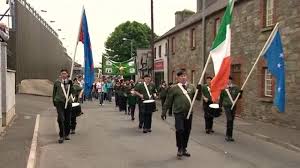
The statement by it on the recent IRA commemoration in Castlederg shows all this. The local Sinn Fein councillor said

‘This parade is organised to show respect for those who gave their lives for this community. It should never have been an issue of controversy- it has been ‘made’ controversial by unionist politicians. We have proposed this initiative to take the controversy out of it while reducing tension.

“Our initiative will consist of choosing to go along John Street which avoids passing the cenotaph and the Methodist church.

“On the back of this initiative, we wish to engage with all key stakeholders in relation to the issue of the town center being designated as a shared space for all traditions, in this mainly nationalist town.

“There has been around 20 unionist parades through the town centre in 2013 so far without objection, we understand and accept peoples Britishness- others need to understand and accept our Irishness.”

So the IRA fought for Catholic freedom not Irish freedom unless Sinn Fein now equates the latter with the former, which appears to be the case.  At the same time it now recognises the legitimacy of the claims of Irish Protestants to be British so there appears no reason why one sectarian groups’ claims should have priority over the other.

What we have is endless competition with no reason to judge any particular outcome fair or appropriate, except that it exists and it exist only as a result of struggle between the groups, presided over by the British State.

What this means is that where the civil rights struggle once demanded an end to sectarian domination, essentially discrimination against Catholics by unionism, now the necessary democratic struggle would appear to be against sectarian competition, essentially discrimination by unionists against Catholics and nationalists against Protestants.

Sectarian competition is however unstable.  Unionism wants sectarian privilege while Sinn Fein claims it wants equality but it has demonstrated that it seeks equality not through unity, which is the only way it could exist or be brought about, but through sectarian claims on behalf of Catholics, because they are Catholics and because they are claiming Catholic rights.

It is now lost on a whole generation that the demands for civil rights and equality were demands for democratic rights irrespective of religious beliefs not because of them.  It is lost on this generation that claiming Catholic rights is not the same as claiming civil rights.

The civil rights’ demand for equality required unity because civil rights were disconnected from religious belief.   Now rights are claimed by virtue of religion.  Equality now means the equality of resources to sectarian groups, which can only be achieved by ensuring the continued existence and political priority of these groups.  Demands are made that those not designating themselves in sectarian terms must do so or someone must label them on their behalf.  In other words equality now requires sectarianism.

If sectarian domination was unstable this sectarian competition is even more so.  The current political situation is unstable because not only is it impossible to have stable agreement on the equitable sharing of sectarian rights but such equality does not yet exist.

Despite decades of Sinn Fein ‘leadership’ in West Belfast the social and economic problems of the constituency are among the worst.  Unemployment among Catholics is still worse than among Protestants.  Thousands of Orange parades still proclaim their sectarian superiority except everyone is now called upon to be tolerant, seek reconciliation with the participants and show non-sectarianism by accepting the displays of bigotry.

In such an Orwellian world sectarianism is to be eradicated by support for sectarianism.  And then we are to be amazed how on earth the problem hasn’t disappeared and often appears to be getting worse.

To be continued.

BBC Spotlight and the Housing Executive – what sort of scandal? Part 2

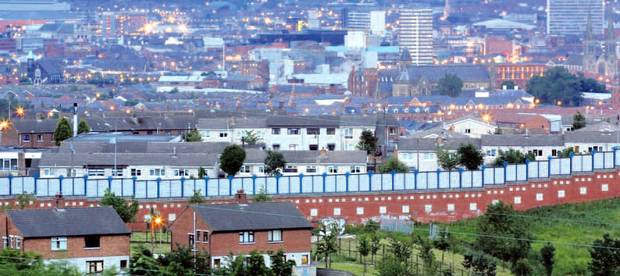
Belfast Peace Wall (Belfast Telegraph)

Belfast Peace Wall (Belfast Telegraph)

By Belfast Plebian

Episode two commenced after the Assembly was recalled for a one-day public debate on the developing scandal on July 8th.Once more it was down to Jim Allister to make most of the running, alleging that Red Sky had carried out work on the homes and offices of DUP members and that they even had the gall to charge some of the costs to the Assembly.  He tried to arrange for a motion calling for McCausland’s to be put up for vote but was rebuffed by Sinn Fein who wanted a less severe motion to be voted on.

It was also alleged that Nelson McCausland had an improper relationship with Turkington Holdings, a Portadown based firm that specialises in windows, doors and conservatory installations. The allegation was that he had agreed to delay the ongoing work by other rival firms with a view to favouring Turkington on the grounds of cost.  Before making his suspension order it was alleged that he met with Turkington, the chair of witch is a DUP member. But the heart of the second episode came down to final the motion and vote.

The motion asked that Mr McCausland step aside while the inquiry into the matter by the DSD committee was being carried out.  It also noted that the Minister may have purposely misled both the Assembly and the committee. The motion drawn up by Sinn Fein was supported by the Ulster Unionists, the SDLP and Allaince  plus the Greens and the new Unionist Party NI21. The motion collapsed even though 54 members voted for it and 32 voted against. This outcome was possible due to a safeguard inserted into the Belfast Agreement known as the petition of concern. It allows any 30 members to effectively veto a motion or law they feel is discriminatory, the DUP with 38 MLAs is the only party that can do this without votes from others.   

The reaction to the petition of concern in the press was interesting because for the first time there was a feeling of genuine alarm about the Stormont settlement that had been strongly endorsed from day one of the ‘peace process’. The political analysis in ‘The Irish News’ was pessimistic; the headline banner on the day after the DUP move to block the censure motion read ‘It was a bad day for democracy.

The writer feared that the clause that was supposed to prevent sectarian majority rule was now being used to further it: ‘ Power sharing may be the concept the devolved institutions are built on but it seems power ultimately resides with the party that can consistently muster 30 signatures and lodge a petition of concern whenever it is unhappy with a particular assembly motion. The upshot is therefore not democracy but an inverted form of majoritarianism. It’s a system that leaves the majority party in a position where it can overrule the rest of the assembly even when outnumbered two-to-one.’

‘The Irish News’ editorial was a little less stark but still pessimistic, the final paragraph read ‘Many observers will have concluded that standards at Stormont have declined to a stage where basic democratic values have been largely abandoned in the interests of expediency. There will be little public confidence that the truth over Red Sky will ever be established property but it is the wider reputation of our key intuitions that is increasingly under the spotlight.’    

As for the ‘Belfast Telegraph’, their next day front page stated; ‘This was a bad day for democracy’ the three sub headings were ‘debate on Red Sky scandal ends with no action’, ‘parties in the pockets of big business-claim’and ‘Assembly rules misused by DUP to stifle debate.’ The editorial was less pessimistic making the argument that the petition of concern could be fixed: ‘Although the motion gained cross-party and cross-community support in the Assembly it was defeated by a petition of concern, a piece of political trickery which is meant to stop minorities being ridden roughshod over, which is increasingly is used by all parties if they find themselves in trouble. It is clear that thisparticular manoeuvre will have to be rethought as it is now being misused.’

The job of expressing the fears and frustrations of the small group of reformers who had hoped for a gradual transformation out of a sectarian conflict was left to Robin Wilson the one time editor of Fortnight Magazine ; ‘The Red Sky  episode is a flashing red light that something is very rotten in the mini-state that is Northern Ireland. It encapsulates a toxic cocktail of conservatism, clientelism and corruption, which, if notaddressed, will further discredit the pursuit of democratic politics as the public service it should be.’

At least Robin Wilson acknowledged in his article that the outrageous behaviour had a lot more to do with sectarian partisanship than with corruption, the last paragraph of his article stated: ‘the minister intends to dismantle the Executive, rolling back that four-decades-old victory of the civil rights movement against the old unionist order. The new one looks dispiritingly similar.’  

We should not pass by the media reaction without mentioning one other perspective on the Red Sky affair; three days after the Stormont travesty the Belfast Telegraph carried an analysis by trade union socialist Eamonn McCann, presumably to get an alternative viewpoint. The banner of his article was ‘Red Sky, red faces and the nightmare of privatisation.’

Mr McCann stated the proposition he was out to prove in his opening paragraph ‘None of the issues which brought MLAs hotfoot back to Stormont on Monday would have arisen if the repair and maintenance of public sector housing hadn’t been privatised. No privatisation, no meeting with Red Sky representatives in Nelson McCausland,s office, no Stephen Brimstone/Jenny Palmer  phone call, no dubiety about the stop-start progress of a double contract, no reason for MLAs to be recalled just days into their nine week summer holiday

Little thought is required to refute Mr McCann’s proposition, having public control over a central Housing Authority is a good thing provided at least one condition is fulfilled, namely that those in control are socialists.  If those in charge are sectarians, racists or state capitalists then if anything it is a worse arrangement than having it in many private hands.  Unfortunately those taking charge in this case are not socialists and may even be sectarian.

Comment and Explanation

We can certainly say that the Red Sky scandal represents something more than a scandal and something less than a political crisis. It is a mini crisis of the peace process, something that is hard to disguise. The first instinct of all of those in thrall to the peace process was to disguise it as a corruption scandal, a case of one party, the DUP seeking to do financial favours for the owners of a couple of small firms that happen to back the party.  The pro-agreement media was therefore content to run behind Jim Allister for he seemed to have enough inside information to make the corruption charge stick. The sectarian substance was reduced to a secondary quality

What might have come out of this allegation was a routine resignation of a wayward politician in an otherwise stable Executive. One small problem was that another DUP minister would have replaced the sacked one and we would have merely carried on from the point we had left i.e. the programme of dismantling the Housing Executive. Then the realisation dawned on some people that the minister had no intention of resigning because his party had no intention of letting little things like democratic norms get in the way of staying in charge of the big spending departments of government. The DUP standpoint was No Surrender to our critics!

The pro-agreement media began to wonder if the current political arrangements might make it impossible to address wrongdoing not only by the odd maniacal politician but entire maniacal political parties. It was kind of expected that an exposed politico would be cut loose by his own party. One step behind the fear of unaccountable financial corruption lurks of course the longer and deeper fear of sectarian competition over the spoils of government

Pro-agreement nationalist political opinion now realised that the safeguards they had long thought they had secured against bad government were not as sound as they had believed. They now had to face up to the fact that it is an anti-power sharing sectarian party they have to deal with in government and not some reformed unionist party. On the other side, the pro-agreement unionists had to confront the fact that you only need 30 votes to carry on like the DUP does when in government and Sinn Fein have 29 votes and destined to get past the magic number in the near future.

Pro-agreement unionists, who are in fact a minority within unionism, have zero confidence in Sinn Fein not doing the same thing as the DUP. Sinn Fein have been less strident about the scandal over procurement contracts than others expected; the party refused to accept an amendment to their own weak motion of censure as phrased by Jim Allistar calling for the resignation of McCausland.  Knowing what one knows about the building trade in nationalist political constituencies it is easy to conclude that they would not be too keen on a thorough going inspection and clean up themselves. They are up for an inquiry all right so all as it is confined to Red Sky.

We predict the two big political parties will continue on much as before, jockeying for position and biting into sectarian patronage and running down the public purse to no good end. The Orange Order, to give one example, is now subsidised like it wasn’t in the halcyon days of one party Orange rule; it receives money for its decorous band uniforms, to buy musical instruments, to pay for music lessons and there are more bands than ever. The local government even funds the bonfires, which used to be stuck up by nothing-to-do summer youths – now they are professional affairs put together by men using heavy machinery,  The mural painting of walls is also funded.

The Orange Order is renovating itself and building up a heritage with European Peace money to the tune of £7 million.  As for the paymaster of sectarianism in London, the real government has so far kept shtum and if things come to a breakdown they will invite in a prominent American to recommend some institutional changes probably along the line suggestion by the Belfast Telegraph i.e. make it harder for the main political parties to draw on a petition of concern to block a cross community majority vote. 

There is a mini crisis of confidence facing many of those well-educated professionals currently staffing the Public Sector. These people like to think of themselves as untouched by low-down sectarian squabbles. The Spotlight programme threw up a number of side issues that point in this direction.

It was pointed out in the programme that the first people to come under pressure was not the Housing Executive Chairman but the housing inspectors who had refused to give a pass to Red Sky’s shoddy work . The group development manager of Red Sky, one Pauline Gazzard, felt confident enough to write a letter to a senior Housing Executive manager with the expectation that the inspectors’ reports against Red Sky, put together by a conscientious district officer Gary Ballentine, an elder in the Presbyterian church, would be brushed aside: ‘It is also considered necessary to re-iterate our deep concern in relation to certain personalities who remain working in the West Belfast District Office and we trust appropriate actions will be taken to address this in the near future.’

The letter is address to a senior Housing Executive manager but was never seen by the Board or the Chairman when they were investigating the matter; the three West Belfast inspectors were in fact removed and sent elsewhere. What is abundantly clear is that senior managers at the Housing Executive were depriving the Board and the chairman of very relevant information.

The report that the chairman commissioned and delivered in 2011 discovered that 80% of the charging made by Red Sky was questionable. The upshot was that 8 managers were disciplined and some others retired early for allowing the overcharging to go on. The question to be pondered – were they in receipt of bribes or were they making a calculation that it would not be wise to rock the sectarian boat

If we next move on to the police, they have been asked three times to investigate matters pertaining to Red Sky.  Once in 2006 when several lesser Housing Executive workers were found to be taking gifts from Red Sky, no charges were preferred then.  The second time when Chairman Rowntree provided them with the evidence of criminal wrong doing in 2011, the evidence that was used to terminate the £7 million annual contract, and again the police sat on their hands.  Finally the Spotlight team asked the police were they thinking of opening up a new investigation; they replied not without evidence.

But if there was no evidence how come the Comptroller and Auditor General Kieran Donnelly says that ‘ a sample of 20 kitchen replacement schemes (out of a total of 242 schemes undertaken to date) found overpayments of £1.3 million out of a total cost for all schemes examined of £6.2 million. The potential total contractor overpayment since 2008 is estimated at around £18 million’

And there was other evidence; it came from Pauline Gazzard who no longer works for Red Sky/Totalis. When the administrator took over the running of Red Sky she wrote a 13-page letter to BDO explaining that she knew for a fact that the company she formerly worked for had bribed at least three procurement officers from the Housing Executive. The Spotlight reporter said ‘We asked the police ifthey had the letter now would they act on it now-they refused to comment.’

The Spotlight reporter then asked the Housing Executive Chairman, who had been keen to have the police involved, about the seeming lethargy of the police investigation and his reply was ‘I am absolutely gobsmacked’.   Then we have the administrators at BDO; Pauline Gazzard told Spotlight that she was surprised BDO showed no interest in her letter or her allegations. Not only that, BDO did not pass the information she gave them on to the Board of the Housing Executive or the police. When asked about the matter BDO claimed client confidentially meant they could not comment.

Here’s the rub. Did one small building firm have so much sway, over senior Housing Executive managers, over the police, over accountants and insolvency professionals, over politicians and then over the Head of the Government because of its economic weight, after all it was hardly BP or Shell Oil or is there another explanation?

The other explanation is a bit crude and may even sound offensive to some ears. The firm’s managers knew how to play the sectarian playbook to make other people quake a little.  The firm was quick to blame the Catholic residents for making false complaints, and then they said the inspectors were bigots even though this was patently untrue.  They then attacked the chairman of the Housing Executive indicating he was a dodgy nationalist, then they encouraged their work force to picket the offices of the Housing Executive, carrying banners with slogans like the Housing Executive is anti-Protestant, and finally they told the DUP that the firm had done no wrong and was being starved of work contracts because it was believed to be Protestant.

All those who stepped aside for Red Sky did so because they were conscious of the sectarian clouds that sit low and heavy over society. The politics is sectarian because the society is sectarian. What is more the sectarian cloud cover is thickening rather than dispersing due to the fact that sectarian politicians are taking over the basic departments of government. As for those working under the new dispensation, things are about to get a bit more complicated and choking.

In the more recent past, if you were a public sector professional you only had to contend with a subdued sectarianism, the police and the Northern Office of course was something different, now it is back and it is naked and outspoken.  What is even more disconcerting, the really green nationalists want you to bend in their direction too, overlook this misdemeanour, override a professional service protocol when instructed to do so by somebody with political connections.  How the hell do you bend in two sectarian directions at once?  Do you decide to bend with the Orange 60 per cent of the time and then bend with the Green the other 40 per cent?

The relationship between the relatively privileged professional classes who number a fair number and the sectarian society is about to get a bit more fraught. We can see clear evidence of this emerging from this case.  McCausland decided to wage a vendetta against the Chairman of the Housing Executive, so he asked for some evidence to get at his target.  Two senior DSD civil servants accompanied him to the infamous meeting with the Red Sky management at Stormont; the minutes of that meeting read like a party political conspiracy.  Is this what civil servants should be doing?

The DSD permanent secretary is busy trying to get Brian Rowntree removed from his other public service job with the civil service commissioners’ according to Spotlight he got his staff to trawl through thousands of e-mails hoping to find incriminating evidence against Rowntree.  What a truly poisonous atmosphere.

If a government department supervised by a political Orangeman hounds a career civil servant out of his post, will a department run by a Nationalist respond in kind, if you take out one of ours we will take out one of yours?  Legal threats are flying about left, right and centre.  No wonder the Spotlight programme began by saying that many people ‘we spoke to were scared to speak on the record.’ Most of these people were of the professional class. Welcome to the future sectarian society!  Mandy McAuley the girl that kicked the hornet’s nest.

BBC Spotlight and the Housing Executive – what sort of scandal?

Housing Executive 2.jpg

BY Bellfast Plebian 

A little while ago (Jan 2013) this blog singled out Nelson MaCausland, a Minister in the stored Northern Ireland Executive, as a target for criticism.  This was no random selection of a minister in an improbable regional government that we happen to have little respect for. Nelson was a bit of a special case because he was the minister most likely to cause a commotion.

It was asserted that this neo-conservative Orangeman is about the least preferable person you could hope for in charge of managing the socially damaging CON-DEM policy of comprehensive welfare reform. We were sure his approach would be to offer minimum resistance to the drastic changes being proposed.  We were especially worried that he had been given overarching control over the Northern Ireland Housing Executive: the publicly funded organisation specifically mandated to allocate social housing on the basis of objective need rather than community and religious patronage.  The Minister we said was so ardent an evangelic Protestant and a strident Orangeman that he would be inclined to put the interest of promoting his own religious community above the important non-sectarian consideration that pertains to the neutral role required of a housing minister. Well it didn’t take very long for our worries about Nelson to be confirmed – the bomb exploded earlier than we anticipated – and a few days after we posted our account he began his political assault on the very existence of the Housing Executive.

At first Nelson’s spat with the Housing Executive was carefully phrased in the all too familiar neo-liberal one of saving the taxpayer money. The Housing Executive is managed and funded on the model of a department of the British Civil Service and because it is not classified as belonging to the private sector economy it is therefore almost by definition deemed to be inefficient and wasteful of taxpayer money by the major accountancy firms that aspire to set the standards for every social service. The new Housing Executive will work all the better if it is broken up and placed in the hands of Housing Associations that know the realities of private sector finance, so claimed Nelson.

Hardly anyone of influence objected to Nelson’s declared programme of privatisation barring a few union leaders that voiced worries over potential redundancies. To most tender minded folk (folk is the favoured term used by Nelson) the reasoning if not impeccable was at least normative for our current economic condition. More tough-minded types wondered if Nelson’s impeccable reasoning was merely a convenient cover to pursue an old style Orange vendetta against the Housing Executive. In certain quarters the Housing Executive is still thought of as an anti-Orange institution, something that was imposed on Orange society against its interest, a concession made in the past by a nervous Labour government running scared of the Northern Ireland civil rights campaign.

There is a certain type of Orangeman who resents the very existence of the Housing Executive, who would like to see it done too death.  I am certainly one of those dwindling number of suspicious types who still believe that there are plenty of unreformed Orangeman around, dreaming of taking back the little victories of the civil rights movement.  I suspected that Nelson was one of those unreformed Orangeman who was bent on returning to a long standing sectarian battle over the political control of social housing and I was aroused by the fact that Nelson was only into the job a few weeks when he began asking for the religious make up of the workforce, right down to the numbers in individual offices. Was he of the viewpoint that the Housing Executive had a pinko-management and a Catholic majority work force representing an earlier victory for the sectarian enemy?  Was he out to knock it of its previously set course?  I felt that he was one government minister that needed watching.

Last week the BBC Spotlight programme (3/7/2013) provided us with an insight into what Nelson’s real agenda had been since he became the social development minister.  Before the Spotlight programme was broadcast you could see the aura of hubris already taking shape around Nelson’s head.  On June 10 he had given the management of the Housing Executive a real roasting on the floor of the Assembly; all sorts of charges were flung against the former chairman Brian Rowntree.  He accused the Housing Executive of overspending on repair contracts to the tune of £18 MILLION on four contracts. He also said that one contractor Red Sky had been singled out by the Chairman for retribution for overcharging solely because it was perceived to be a Protestant firm. The unionist benches erupted with shouts of shame on the sectarian Housing Executive. What was also striking about Nelson’s performance was the pleasure he took in laying into the management of the Housing Executive and the satisfaction he got from seeing that the non-unionist parties offering only palliative opposition to his new plan to break up and privatise the public housing body.

Just four weeks later Nelson’s confidence took a punishing blow at the hands of a BBC television expose on what he had been doing out of plain sight.  It turns out that almost everything he said in the Assembly that day was so false that it might rightly called the opposite of the truth. He and his political adviser backed by his party leader had it seems been running a hate campaign against the ousted Chairman of the Housing Executive that smacked of venomous sectarianism. The BBC reporters provided more than enough evidence to allow for other Assembly members to demand his immediate resignation.

The story begins in April 2011 and a building maintenance company situated in the constituency of Peter Robinson goes into administration after a Housing Executive investigation into allegations of low standard work and overpayments. The Board of the Housing Executive felt it had no other option but to cancel the contract with Red Sky due to the facts put before them by inspectors pertaining to the poor quality of the work undertaken by the firm and also by the firms fraudulent charging of tasks not undertaken at all, estimated to be about £1.5 million. The decision of the cross community board was unanimous.

The management of Red Sky decided not to go quietly. In the middle of the April 2011 Assembly Election campaign they approached the leader of the DUP and First Minister Peter Robinson and informed him that the Housing Executive held a sectarian i.e. anti-Protestant bias against the company. Peter was furious about what he had been told about the Housing Executive decision and nine days later led a delegation to meet with its chairman Brian Rowntree to lobby on behalf of the firm. The minutes of that meeting record the First Minister stating that the decision to terminate the contract ‘reflected a sectarian bias on behalf of the Housing Executive.’ He also warned the Chairman that he could expect an enquiry into the Housing Executive after the election of May 2011.

After the Assembly election he appointed his own sectarian attack dog Nelson MaCausland to the post of minister in charge of Social Development, which covers supervision over social housing. A strategy meeting was held in Stormont building on 27 June to find out what could be done to get Red Sky back in the contract game. In attendance where the First Minister Peter Robinson, the Minister of DSD Nelson MaCausland, his political adviser Stephen Brimstone and the DUP MLA Robert Newton.  Crucially, neither the Housing Executive nor the Administrator for Red Sky was invited to the meeting. Three days later Nelson McCausland met with the Chairman of the Housing Executive to insist that the termination of the Red Sky contract be suspended for at least six months.

A letter from Housing Executive chairman Mr Rowntree to DSD Permanent Secretary Will Haire dated July 1, expressed ‘serious concerns and misgivings’ about the way Mr McCausland and his department were attempting to overturn the Board’s decision. Expressing the thought that both Mr Robinson and Mr McCausland may have broken the ministerial code of office by lobbying in support of Red Sky, Mr Rowntree added ‘We understand that meetings have taken place with the senior management of Red Sky in administration and the minister, first minister and other DUP representatives…. This raises the question of did these meetings constitute canvassing and lobbying for government contracts and in breach, not only of public procurement principles but basic codes of conduct in public life.’

Nelson McCausland later said that he took the letter to be like a declaration of war. Having failed to pressure the Chairman of the Housing Executive into overturning the Red Sky decision once, the DUP turned to one of its own councillors who sat on the board of the Housing Executive for a second go. The minister’s special political adviser, one Stephen Brimstone, made an eight-minute phone call to DUP councillor Jenny Palmer and more or less commanded her to change her vote at the next Board meeting called in July 2011 to re-examine the Red Sky decision.

Just ahead of the board meeting Jenny Palmer told the Chairman of the Housing Board about the DUP attempt to make her change her vote and he advised her to declare an interest and absent herself from the vote, which she did. When he failed to get the vote overturned Nelson McCausland carried out Peter Robinson’s original threat and ordered a comprehensive review into how the Housing Executive awards contracts to be carried out by chartered accountants ASM Howarth.  Four days before the ASM report is due to be delivered the Chairman of the Housing Executive resigned citing personal stress and a challenging relationship with the DSD and the minister.  At this point Nelson sensed a retreat, and then went on the offensive accusing the Housing Executive of failing its tenants across many fronts. In January 2013 he announced he intended breaking up the Housing Executive and passing on the ownership of the housing stock to privately run Housing Associations.

Public Reaction:

We will cover this in two episodes. In the first episode we got a party political reaction and a media assessment of a similar temper. Sinn Fein was in the best position to drive the questioning of the credibility of Nelson McCausland and his party boss. Their leader at Stormont is Martin McGuiness the joint first minister with Peter Robinson and their senior policy maker Alex Maskey just happens to be the chairman of the Social Development committee that is supposed to make the Minister accountable.  The first thing to note about Sinn Fein is the party did not call for any immediate resignations from the DUP led government. Some starry-eyed pundits in the media praised this restraint as showing their newfound political maturity.

Martin McGuiness made just two points; that the ‘statutory inquiry led by the DSD under Alex Maskey needs to begiven full support in its work’ and that it was necessary for the Parliamentary Standards Commissioner ‘to investigate the relevant matters raised in the programme as a matter of urgency, these allegationshave the potential to undermine public confidence in the public institutions.’ Two days after the Spotlight programme was broadcast Alex Maskey convened his investigative committee and Nelson duly appeared to face the music. It was the failure of the DSD committee to pursue Nelson that provoked the first episode of widespread negative media reaction.

‘The Irish News’, the main morning newspaper read by nationalists, headlined the report on the committee meeting as; Minister shrugged off Teletubbie Mauling. The chief reporter wrote ‘Chairman Alex Maskey seemed at pains to highlight the good relationship the Minister enjoyed with his scrutiny committee and beyond asserting that the public would be demanding answers said little to cause the DUP rep any concern.’ He concluded the report by stating that ‘all round it was an opportunity missed not so much a grilling as a friendly invitation to the minister to come and warm his toes by the fire.’ 

The Belfast Telegraph, a newspaper traditionally supportive of Unionism, was equally dismissive of the DSD questioning of the DUP minister.  The headline it ran on the 5/7/2013 was ‘Watchdog lets McCausland off the hook.’  The Telegraph reporter was struck by the deference shown to McCausland – ‘He spoke for 54 minutes without one interruption’, something that rarely happens in the equivalent British committees.  He suggested the members were discouraged by Nelson’s verbal dexterity in comparison to their own lack of education. Nelson walked away from the committee asserting that the BBC Spotlight broadcast was just a ‘hotchpotch of speculation, insinuation andinnuendo.’ He threatened the BBC with legal action, as did his boss Peter Robinson, and it should be said that we referred to Nelson’s animus against the local BBC news reporting in our previous blog – Nelson reckons it is moved by a strong anti-British bias.

Because of the general negative media reaction, Sinn Fein decided to take another step and asked for a summer recall of the Stormont Assembly for a one day debate.  It looked as if they felt they needed to perform a bit better than they did at the DSD committee meeting.  However there was still no demand for resignations, only for an investigation about standards of conduct.

It is important to note at this stage what the press and assorted pundits were saying was potentially wrong with what the DUP had been doing. One view was that there was a potential ‘corruption charge’ being levelled at the minister.  What this actually amounted to was difficult to pin down, there was no suggestion that Nelson had sought to make any personal financial gain from the Red Sky advocacy.  Then there was the Sinn Fein procedural charge of breaching the ministerial code of office by lobbying on behalf of a private firm for business contracts.  Peter Robinson felt able to dodge the ministerial code charge by a nimble use of procedural semantics.

On the 5th July he gave an interview to the Irish News claiming that he had attended the strategy meeting with Red Sky in his capacity as elected MP for East Belfast and not in his capacity as the First Minister ; ‘Could anybody expect that the elected representative of east Belfast would do anything other than get exercised about the loss of jobs andseek to do something about it’.  He also declared his annoyance at the BBC saying ‘ I’m no longer going to tolerate this kind of accusations that Spotlight throw out in the hope that nobody takes any action against them for it.’

So within two days of the programme the BBC Spotlight team were facing four legal threats, one from the First Minister, one from Social Development minister Nelson McCausland, one from the management of Red Sky and one from special adviser Stephen Brimstone. A couple of media pundits pointed out that the Executive had recently rejected British Government proposals to change the libel and defamation laws to lessen restrictions and now we know why.

The third area for media concern was about bullying – the attempted bullying of Jenny Palmer by male thugs.  Jenny Palmer was talked about in terms of being a whistleblower, a heroine in the making and she became the must have interviewee.  This was the theme of  ‘The Irish News’ political column by Fionnuala O’Connor – ‘DUP’s whistleblower gives cause for cheer’. The opposition Unionist party in particular made the bullying charge the big issue and their Ross Hussey appeared on the original Spotlight programme to decry the bullying.  Then in the DSD committee meeting Michael Copeland, another Unionist Party member, made the terrible treatment of Jenny Palmer the core of the issue.    

What was remarkable at this point was the fact that the elephant in the room of the evidently sectarian inspired onslaught on the Housing Executive went largely unspoken. This was so much the case that the critics of the media elevated the ultra right wing TUV leader Jim Allister to the role of champion of public morals.  Every time the media wanted a quote about the ‘scandal’ they looked first for one from Jim Allister.

‘The Irish News’ ran the next big story on the Red Sky affair on the 9th July under the front-page banner ‘Allister rounds on the DUP’ accompanied with a picture of him.  On the same day the ‘Belfast Telegraph’ ran their lead with ‘Corruption claims rock Assembly.’  Jim Allister had framed the criticism solely in terms of financial corruption and party political favouritism, and for now most of the political class and media were happy to let it all rest at that.  Jim Allister was afforded a guest column in the Telegraph on July 11th to present us with the heart of the matter: ‘while the party ‘s treatment of Jenny Palmer  is shocking, the most  damning portion of the programme was that which dealt with the glazing contracts after representations from a DUP-friendly contractor, Mr McCausland put on hold the glazing contracts.’

He also argued for a judge led inquiry under the 2005 Inquires Act because 10 of the 11 members of the DSD committee belonged to parties of the Executive.  Another media pundit Alec Kane actually found some comfort in the scandal writing in the Telegraph; ‘This is also the first major political story which hasn’t centred on a spat between unionism and republicanism or between the DUP/Sinn Fein and the smaller Executive parties. And again that is what makes it interesting, because it’s as close as we have come to a normal so called scandal.’ (5/7/2013)

to be continued.

Sectarianism in Belfast. What’s new?

On July 12 this year a loyalist flute band marched past St. Patrick’s Catholic Church in Donegall Street near Belfast city centre.  They stopped at that particular point by “pure chance” and started walking round in circles playing a tune known as the Famine Song, which contains the line “the famine is over, why don’t you go home?”  This song is sung by supporters of Rangers Football club in Scotland and refers to the large Irish and predominantly Catholic immigration into Scotland from the 19th century onwards.  It has been found to be both sectarian and illegal by the Scottish courts.  According to the band and their political apologists they were merely playing a pop song.  Perhaps it was again mere chance it doubles as a sectarian anthem.  Perhaps also those allegations of an attack on a cameraman filming this Orange version of the X Factor are also mistaken.

On this basis the Parades Commission, a quango established by the British government to adjudicate on contentious parades, decided the band could not take part in the loyalist parade last Saturday, which was to pass the same church.  The other bands were also only allowed to march by a single drum beat past the church.

Unionist politicians were outraged and issued a statement, along with assorted flute bands, denouncing the Parades Commission, saying they were running out of adjectives to describe it , so they gave some nouns instead – “arrogance”, “incompetence” and “general ignorance”. This statement was signed by prominent members of the Stormont Government who claimed that they could no longer let the Parades Commission do untold damage to the peace process. “Violence” would potentially ensue, they said.

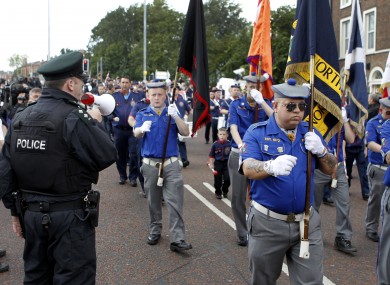
So on Saturday the loyalist flute band at the centre of events marched as normal and played the normal sectarian tunes that are the staple of these ‘kick the pope’ bands, as did many of the rest. The normal sectarian insults were hurled, which are surprising only to those terminally stupid or naive.   The police did nothing that anyone could notice to prevent this.  Well, not exactly nothing: there is a picture of one policeman using a loudhailer to tell the passing bands that they were really not allowed to do what they were doing.  This robust action will no doubt be followed by the police warning burglars by megaphone that they are breaking the law when they are seen to break into someone else’s house in broad daylight. Through the Police Federation the police later complained of being caught in the crossfire, presumably between those intent on breaking the law and those who were, well, how shall we say it, wanting it upheld?

There were minor scuffles and one apparent loyalist from Scotland was arrested for running through a nationalist protest, although this was blamed by one unionist politician on a republican.

So we have a loyalist coat-trailing exercise in bigotry, defended by the most senior unionist politicians who warn of violence, which stokes up the adrenaline of the street level bigot but allows the unionist politician to deny any responsibility when the lighted match touches the blue touch paper.  The police wring their hands and the nationalist politicians talk about getting it all sorted out through talking.  You have to be very, very young not be aware that this record has been played a thousand times before.  So what’s new then?

Well what is new is supposed to be – everything!  We have a new peace process, a new political settlement, a new Government and a new coalition between the “two sides”.  Belfast has a new skyline with lots of new visitor attractions welcoming tourists, which is still a relatively new concept to Belfast.  We have new cafes and restaurants and art galleries and a new generation too young to remember ‘the troubles’ and which just wants to live in peace and has no time for this sectarian stuff.

But we have been here before.  Belfast in the 1960s was also a ‘happening’ city with a burgeoning night-life whose young generation was hailed as no longer interested in the sectarianism of the past.  The sixties brought new life, hope and light even to Belfast and not just the streets of London or San Francisco.  New housing was being created that was demolishing the slums that had no inside toilet and entries that doubled as permanent rubbish tips.  Some of this new corporation housing promised mixed estates and a new Unity Flats was built at the bottom of the Shankill Road only a couple of hundred yards, if that, from St. Patrick’s church.  Unity Flats was so called because it was to contain both Protestant and Catholic tenants, sharing the one space in harmony.

We all know, or at least have some vague idea, what happened at the end of the sixties.  That swinging decade that even moved in Belfast was very new and modern but Belfast was incapable of accepting civil rights, including fair allocation of housing and jobs and equal voting rights.  Instead it burst into violence, with Orange parades which were hyped up by unionist politicians and a police force that could not subject violent bigots to the normal restrictions of the ordinary law.  Of course this violent explosion hasn’t happened yet and in my view isn’t going to happen, not yet at least.

The mutual exhaustion of the contending political forces has not yet ended and been reversed.  The unionist leaders are attempting to exert pressure that might eventually usher in their preferred model of unionist-only rule but they are not in a position to force a confrontation that would see the British Government accede to their demands. It is not impossible that a violent eruption might occur that goes beyond unionist plans but it needs a realistic objective and the aim of getting Sinn Fein out of government has not yet become the unifying campaign theme within unionism and loyalist organisations that is required.

Instead the provocative and vitriolic sectarianism endorsed by unionist politicians in the highest offices of the Stormont administration erodes the faith of nationalists in the new deal. The approach of Sinn Fein to the recent events has been relatively muted and resembles nothing so much as the old SDLP approach which so many nationalists rejected by supporting the old (republican) Sinn Fein.  Here too however there is no unified project beyond staying in office and doing nothing to jeopardise the electoral prospects of Sinn Fein in the South.

The real republicans can attempt to take advantage of the disillusionment with the Sinn Fein reaction to the sectarian provocation and can build up their support base but what is their political project?  In so far as it simply involves a renewed armed campaign it only strengthens the ideological hold of the peace process even while more and more people, subconsciously at first, begin to wonder when exactly this process, like every other, is going to end.  The traditional republican policy isn’t credible except as a form of protest but outside of an overarching strategy this republicanism isn’t in a position yet to mobilise a large political opposition.

A large scale sectarian provocation might accelerate these trends and the planned large loyalist parade on 29 September past the same church certainly has the potential to be such a provocation.  It might at the least drive home the lessons of last Saturday if it goes ahead as the parade did then.

The condemnation by two Protestant church leaders of the sectarian behaviour of the loyalist bands shows how vulnerable the loyalists are to criticism.  It is their solutions and that of the Catholic Church that is the problem.  They both want to set the rulings of the Parades Commission as inviolable.  The Catholic Church is worse because it calls for special measures to apply when the parades pass a place of worship conveniently setting themselves up as victim, potentially privileged  protection in future while turning a blind eye to the fact that a sectarian march is a sectarian march no matter where it passes. Its vitriolic bigotry is no more acceptable a hundred yards from a church than right in front of it.

What is needed is an anti-sectarian campaign that is unafraid to name sectarianism when it sees it and is not seduced by the siren calls for equality of traditions, including mutual respect for each other’s culture.  There can be no equality for a tradition based on sectarian supremacy or respect for a culture soaked in bigotry.  Such a campaign would target not just loyalist parades but the sectarian policy creeping into housing policy and the recent discriminatory employment practices of Sinn Fein.  It would challenge the trade unions to take a principled stand and, at least in principle, should be capable of uniting much of the small left. The ULA could take the lead on this in the South by making it an issue on the floor of the Dail as the clarion call for an all-island campaign.  To do otherwise is to turn one’s back on sectarianism while claiming this as the means of opposing it.

The main task would be to rip away the protection of the current sectarian arrangements that are more and more revealing their true colours by refusing to subordinate anti-sectarianism to the demands of the peace process, however this is defined.  What sort of peace is it that allows, even sanctions, the displays of sectarian bigotry on display in Donegall Street on Saturday?

handshake and reconciliation

The handshake between the British Queen and Sinn Fein leader Martin McGuinness is something significant even though most people in the North of Ireland have shrugged their shoulders and have only at the last minute really taken it under their notice because of the hype from the media.  Both the British State and Sinn Fein wanted it to happen for their own reasons and were more than happy that it got the media blitz that it did.

Every commentator aware of the history has remarked on the sea-change that has taken place at this diamond jubilee visit compared to that during the Queen’s silver jubilee in 1977.  At that time republicans demonstrated and rioted against her visit while today the hand of friendship has been extended.  However beneath this difference the purpose of the visit has been exactly the same on both occasions although much more successful on this one.

The veteran journalist Peter Taylor has an item on the BBC news recalling his reporting on the visit for ITV in 1977 and the authorities in that station pulling his report ten minutes before it was due to be broadcast because it exposed the reaction to the visit.  The British government was engaged in a huge propaganda effort to treat the political conflict as simply one of criminality arising from sectarian communal conflict over which the State was an impartial enforcer of peace and order.  The purpose of the Queen’s visit, Taylor says, was to present her as a “great healer of the division between the two communities”.  His report of opposition to the visit exposed this as nonsense.

It did not, and does not today, matter that everyone knew it was nonsense.  The point was to set a public agenda behind which the real strategy of repression and political intrigue could be realised.  This strategy was ultimately successful, although it took over two decades to bear fruit through the ‘peace process’, in the cause of which almost anything is justified.

Today the visit of the Queen and Sinn Fein’s very public welcome is designed to prove the aims of the 1977 visit have now been achieved.  Both she and Martin McGuinness are the bearers of reconciliation and their handshake the equivalent of signing off on an agreement that the conflict that existed in 1977 is never going to return.  The Queen can visit Ireland and there is no reason in the world to object to her presence or protest at the assertion of imperialist rule that these visits represent.

Such claims are acceptable because such acceptance betokens reconciliation.  Of course this is presented as reconciliation of a divided community, of Protestant and Catholic, and who could oppose this?  Certainly not socialists for whom the unity of Protestant and Catholic workers is a fundamental objective and which cannot happen without reconciliation.  But the reconciliation on display yesterday was not between Protestants and Catholics but between the high representatives of their current political leaderships: the Queen as head of State of the imperial power and Martin McGuinness as the highest ranking nationalist minister in a sectarian administration of this imperial rule.  What is involved is not erasing of the division but acceptance of it and promise of continuation in perpetuity.  What has been reconciled is Sinn Fein with British rule.

What events this week have shown is that far from ending sectarianism this reconciliation promises its continuation.  For this week the rotten sectarian heart of the new political arrangements in the North has been shamelessly exposed.

Conor Murphy, the recent Sinn Fein Minister for the Department for Regional Development (DRD), was found by a Fair Employment Tribunal to have engaged in unlawful religious discrimination in appointing a Catholic to Chairman of Northern Ireland Water in a case taken by one of the Protestant applicants.

The Tribunal’s judgement was scathing of Murphy.  Both the successful Catholic candidate and Murphy claimed not to have met each other before the appointment and Murphy was “quite firm” in the view he had not met the applicant.  Murphy however had previously appointed him to two public bodies while claiming not to know where he lived, although he was from Murphy’s constituency and had also been Chairman of the local Health and Social Services Trust.   The tribunal nevertheless asserted that it “is satisfied, on the balance of probabilities, that the Minister did have contact with Sean Hogan, and met him when he was Chairman of the Health Trust in Newry, and that they knew one another.  The Tribunal finds that both Sean Hogan’s and the Minister’s evidence in these respects lacks credibility.”

The Tribunal also found that “for a four year period between 2007-2011, when the Minister was in charge of DRD, there was a significant disparity between the success rates of Protestant applicants and Catholic applicants within DRD, and that a Catholic applicant was at least twice as likely to be appointed than a Protestant applicant.  Statistics for other Government Departments show a ratio at or close to 1:1.  The Tribunal is satisfied that there was a material bias against the appointment of candidates from a Protestant background within DRD.  The Tribunal is concerned that Dr McKibbin, as Permanent Secretary within DRD at the material time, and currently Head of the Northern Ireland Civil Service, was not more aware of the situation.”

Even in the dark days of Unionist discrimination during the previous Stormont regime pre-1972 I can recall no case of a Minister and senior civil servant being implicated through exposure of such high profile discrimination.  It was actions like these that led to the civil rights movement and the fall of the old Stormont.  Yet there have been no words of criticism from the rest of Sinn Fein and in fact two Sinn Fein Ministerial colleagues of Murphy’s were consulted by him in making the appointment.  Murphy has continued to deny his guilt although it is impossible to believe that the evidence and judgement of the Tribunal would not be accepted by Sinn Fein if it involved Unionist discrimination against Catholics.

Sinn Fein’s claims to oppose sectarianism are badly damaged and their hypocrisy exposed.  Meet the new boss, same as the old boss.  The new Stormont promises sectarian discrimination just like the old one except that both sides will now be at it. The silence of the representatives of Unionism is deafening.  They knew that this is what they were agreeing to by accepting Sinn Fein in office because that is what being ‘in government’ is all about.  Small and relatively powerless local administrations do nothing but administer bureaucracy and distribute the spoils of office.  By their silence it is quite clear that Unionists will view the actions of Sinn Fein as licence to do the same.  The benefit to Catholics of Sinn Fein discrimination will be licence for Unionism to discriminate against them.

Sectarianism is to be more secure because everyone will be at it except of course that the whole point of discrimination is to arrive at an unfair and unbalanced outcome.  Equality of discrimination makes no sense at all and will be proved in the attempt to achieve it.  It is not an inherently stable proposition.  However the attempt to achieve it means that if there is to be real opposition to sectarianism and discrimination the unity of the working class becomes a more obvious need because both stand immediately to benefit.  Let Sinn Fein and the British State become reconciled to the current arrangements; the true cause of reconciliation belongs to those opposed to religious discrimination. By becoming ‘friends’ it must be made clear to working people of both religions that the Queen and the Minister are both on the other side.