Oppressor and Oppressed (3) – Ukraine and Oppression

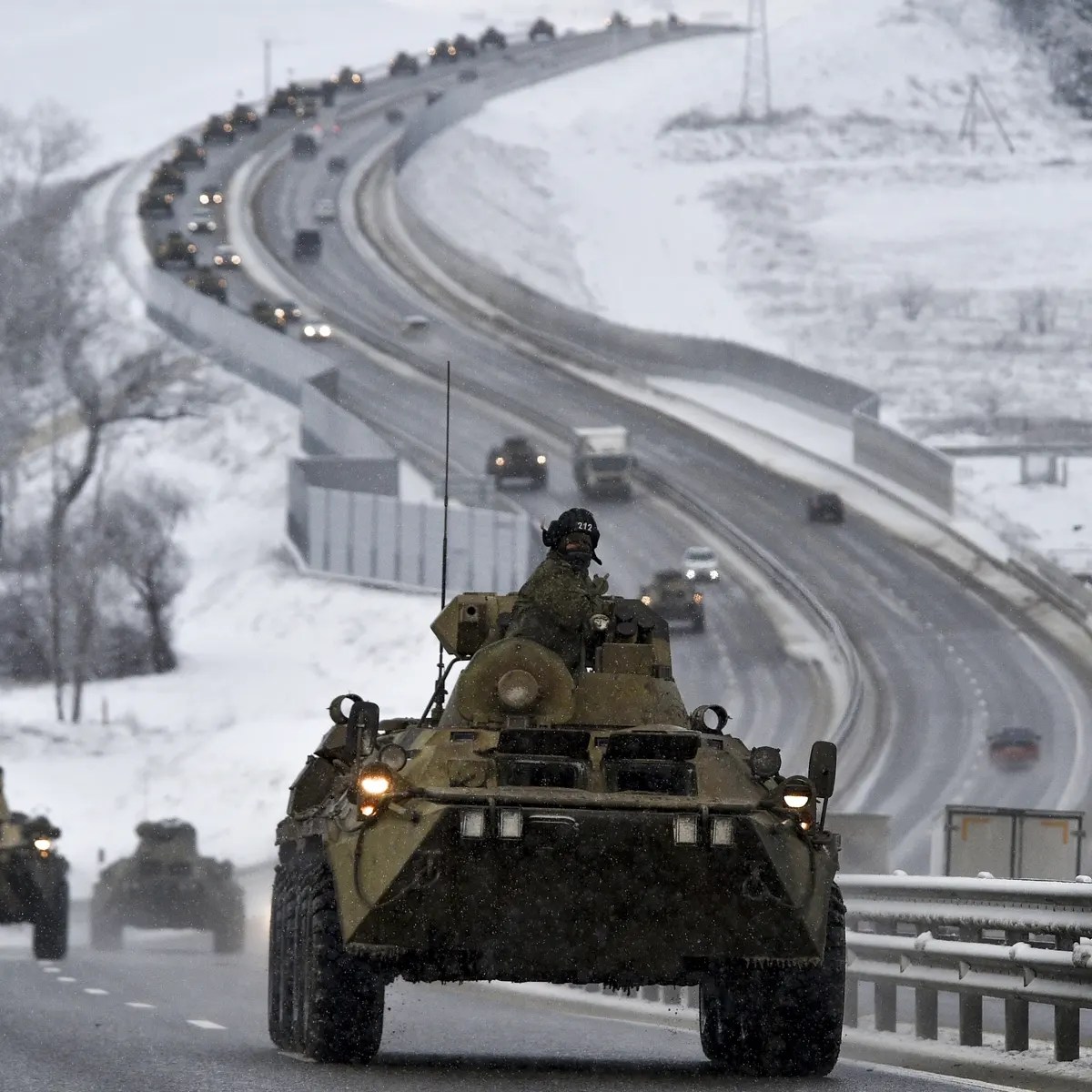
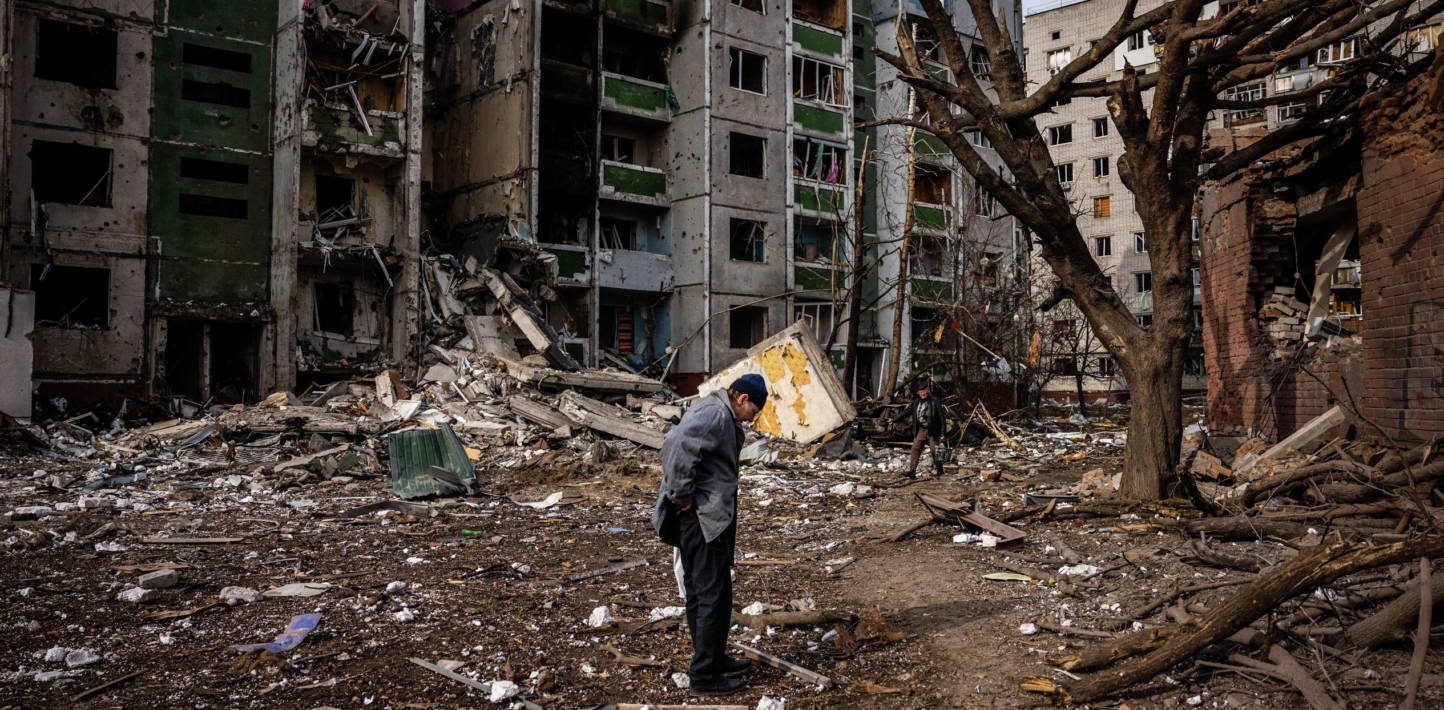
©DIMITAR DILKOFF/AFP via Getty Images

On the first day of the Russian invasion of Ukraine my first words were that ‘the invasion of Ukraine by Russian forces should be opposed by all socialists.  It will deliver death and destruction and strengthen division between the workers of each country . . . ‘

The subsequent war has certainly led to many deaths and massive destruction and the division between the workers of each country has certainly deepened. I have written around 60 articles on the war from the view that the working class and socialists should support neither Ukraine nor Russia but should oppose both by taking an independent position against the war.

If you read no more than the first few sentences of the original article you may be prompted to ask yourself the question – why, if you opposed the Russian invasion, do you not support Ukraine whose people are oppressed because of it?

Within this question are two issues: are the Ukrainian people oppressed by the war and why do you not support Ukraine? 

It might be thought that I have surreptitiously changed the question from one of the Russian invasion to one of the war.  Over the many sixty posts I have explained that who fired the first shot does not determine the nature of the war and since Marxists are not pacifists it may come to pass that the working class will ‘fire the first shot’ in a war against capitalism.

I have explained that the war was provoked, contrary to the many claims otherwise, by Western imperialism using Ukraine as the willing proxy for its war against Russia. Ukraine had already built up a very large army with the help of NATO, had committed itself to joining it, and had also committed itself to reoccupy regions already taken by Russia that could reasonably be thought to oppose such Ukrainian occupation.  In other words, war was inevitable given the objectives and policies of both states.  Being inevitable does not mean we oppose it less but rather oppose it more strongly for it is thereby not an accident or mistake but derives the character of the warring states.

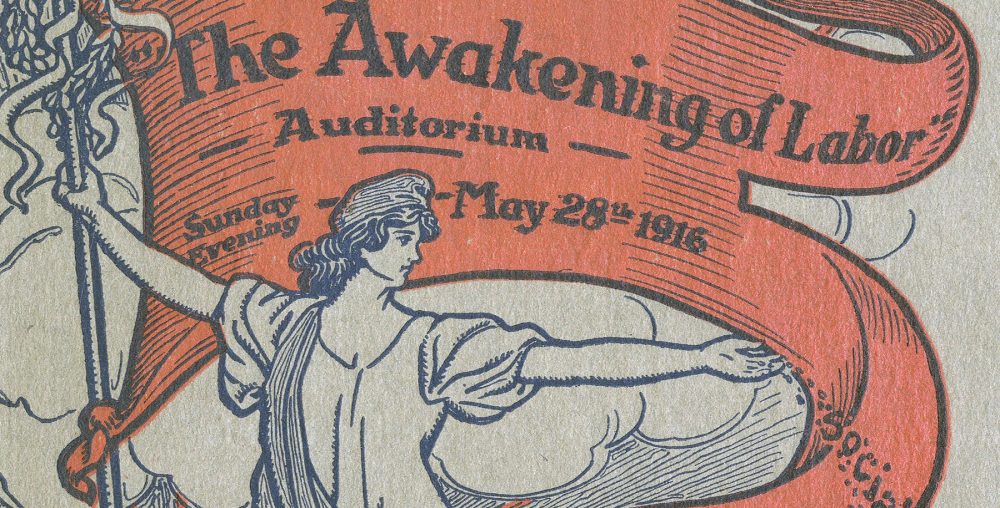
It might be argued that it matters that Russia occupies parts of Ukraine and by virtue of this imposes oppression on its population, so that this should determine support for Ukraine.  In searching for the correct approach, we might refer to Lenin on national oppression, where we will read the following, written in 1916:

‘  . . . hardly anybody would risk denying that annexed Belgium, Serbia, Galicia and Armenia would call their “revolt” against those who annexed them “defence of the fatherland” and would do so in all justice. It looks as if the Polish comrades are against this type of revolt on the grounds that there is also a bourgeoisie in these annexed countries which also oppresses foreign peoples or, more exactly, could oppress them, since the question is one of the “right to oppress”. Consequently, the given war or revolt is not assessed on the strength of its real social content (the struggle of an oppressed nation for its liberation from the oppressor nation) but the possible exercise of the “right to oppress” by a bourgeoisie which is at present itself oppressed. If Belgium, let us say, is annexed by Germany in 1917, and in 1918 revolts to secure her liberation, the Polish comrades will be against her revolt on the grounds that the Belgian bourgeoisie possess “the right to oppress foreign peoples”!’

‘There is nothing Marxist or even revolutionary in this argument. If we do not want to betray socialism we must support every revolt against our chief enemy, the bourgeoisie of the big states, provided it is not the revolt of a reactionary class. By refusing to support the revolt of annexed regions we become, objectively, annexationists. It is precisely in the “era of imperialism”, which is the era of nascent social revolution, that the proletariat will today give especially vigorous support to any revolt of the annexed regions so that tomorrow, or simultaneously, it may attack the bourgeoisie of the “great” power that is weakened by the revolt.’ (Lenin, The Discussion on Self-Determination Summed Up)

When Lenin was writing these lines during World War I Belgium was an imperialist power with an appalling record of brutal oppression in the Congo, yet Lenin opposed its annexation.  Ukraine is not an imperialist power but it has contributed to imperialist adventures in Iraq and Afghanistan and has pursued membership of the major imperialist military alliance.  It is not some colonial victim.

If it is claimed that this example of Belgium warrants support for Ukraine today then we need to understand exactly what Lenin was saying and take relevant factors into account, including that already mentioned – that Ukraine was making ready to escalate the existing low-level war.

Lenin referred to the annexation of Belgium, not to its defeat.  In fact, at that time, Lenin was in favour of the defeat of all the imperialist powers.  He also refers to the need to ‘support every revolt against our chief enemy, the bourgeoisie of the big states, provided it is not the revolt of a reactionary class.’ The alliance of Ukraine is with precisely the largest of imperialist ‘big states’ – the United States – so supporting Ukraine would hardly be consistent with his analysis.

The Ukrainian war is a ‘revolt of a reactionary class’, which we cannot support; we cannot support war by this class carried out by its state that is precisely the instrument everywhere of subordinating and repressing the working class and oppressed.  This state and the Governments that sat upon it promised its people peace and delivered it into war.

It is utterly stupid, however, to then do what some self-proclaimed Marxists have done, which is to support Russia fighting ‘our chief enemy, the bourgeoisie of the big states.’  This ignores that Russia has its own bourgeoisie and is a big state itself, and involved in an alliance with another even bigger big capitalist state called China.  Some of these socialists think it progressive if US hegemony is weakened or overturned by the growing power of this alternative capitalist alliance, forgetting that if this happened this alliance would then be ‘our chief enemy’ that they would have supported climbing into the saddle of world imperialism.

So, was Lenin wrong to say that ‘If we do not want to betray socialism we must support every revolt against our chief enemy, the bourgeoisie of the big states, provided it is not the revolt of a reactionary class’?  Not at all, for we have to remember that the world he was referring to was made up of a small number of imperialist powers and a large number of colonies, and that even though these colonies were fighting for independence and not for socialism their struggle against the imperialist powers was justified and to be supported.  He was decidedly not in favour of supporting one capitalist alliance against another and damned every self-proclaimed socialist who did so.  Just as today we should damn as betrayers of socialism those that would support Ukraine and its imperialist backers or, alternatively, Russia. 

It is therefore necessary to do what Lenin and Trotsky always advised, to treat reality as it is, concretely, and not schematically or to some pre-determined purpose alien to real conditions.  So, it is not irrelevant that far from support for Ukraine being an example, as Lenin put it, of ‘support [for] every revolt against our chief enemy, the bourgeoisie of the big states’; support for Ukraine would place us on the same side, in support of, ‘the bourgeoisie of the big states’, including the US and its NATO allies.

The Ukrainian state and Armed Forces are utterly reliant on Western imperialism for money and weapons and could not continue the war without them.  When we are called upon to support ‘Ukraine’ we should remember that ‘Ukraine’ is a capitalist state and definitely not to be identified with its people, which it has driven into war against their interests and on its behalf.  It wages war for its own reasons and like every other capitalist state, these involve the subordination and exploitation of its working class who today are drafted into a war in which they are being slaughtered.  To a very great extent this state has become a proxy and extension of US imperialism and NATO.  This cannot credibly be denied even by those supporters of ‘Ukraine’ (i.e. the Ukrainian state), who must therefore rest this support on some moral claim that, because it cannot rest upon reality or any understanding of the class forces involved, is worse than useless.

The fundamental cause of the war and of the Russian invasion was, and is, the extension of the military alliance of ‘the bourgeoisie of the big states’ into Ukraine in its attempts to subordinate Russia.  As we must repeat, this does not mandate support for Russia, but the character of the war is determined by this capitalist competition.  We can no more support Russia because of some possible oppression by the United States than Lenin could support annexation of Belgium because of some future possible imperialist oppression by it.  Our opposition to an existing capitalist war cannot be based on the possible future baleful consequences of defeat for one of the warring states.  So, what of Ukrainian oppression?

Some on the left have claimed there are two wars going on, one of which is a proxy war between the US and NATO against Russia, and one of Ukrainian national liberation.  I have dealt with this argument before so will not repeat it now.  There is only one war and support for Ukraine by socialists will not change the outcome should it win with the support of the US and NATO – they will determine the character of any ‘victory’.

Back to part 2

Forward to part 4

A reactionary war throws up more reaction

The ‘mutiny’ by Yevgeny Prigozhin and at least some of his mercenary army is a bolt from the blue, at least for those not in security circles in the Russian Federation, and like all bolts from the blue both confuses and illuminates.  As I write it is impossible to determine the precise cause or their exact future course but it is possible to reflect on it politically, if only because it confirms the arguments and analysis of this blog–that we are witness to a reactionary war on both sides that the working class must oppose.

But let’s take a step back first.  In the last few weeks the Ukrainian state launched its much heralded offensive even while hesitating to declare it itself.  While this offensive is not exhausted, and the Ukrainian armed forces (UAF) still have the majority of its prepared forces available, it is clear that they cannot be assembled in such a way as to achieve the necessary mass and force to make significant advances.  Instead, it would appear that they have suffered many casualties with reports of some surrendering rather than take part in what they have called suicide missions, with prisoners condemning their commanding officers.

Supporters of the Ukrainian state and its war with is allies in western imperialism will either bury their heads in the sand or decry these actions; this is, after all, a war of national liberation for them, and there is no point here pointing out the absurdity of such a war being fought at the urging of the United States, Britain, France and Germany etc. with their own long record of involvement in war.  They should, instead, be welcoming these Ukrainian workers in uniform deciding that they do not think this war is worth dying for.

The pro-war left which exclaims the necessity for Ukrainians to defend themselves will have to explain why doing so is necessary when it only leads to their death.  But then perhaps for them it’s not really about the lives of ordinary Ukrainians but the necessity for the Ukrainian state to win regardless of the cost.  As this blog has pointed out, this would simply be the continuing identity of the politics of this left with the policy of western imperialism–from its explanation of the cause of the war to its political character and its ultimate objective.

For socialists, the refusal to fight for their respective capitalist states, both Ukrainian and Russian, is precisely the way forward for the working class of both countries, as a first necessary step to asserting their own interest over both.  It is, after all, how the Russian revolution came about, which some of this left might want to recall.

The internal conflict between Prigozhin and Russian authorities also exposes the equal stupidity of those on the left who think the Russian state is fighting a progressive war. Where is the popular mobilisation of the Russian working class and which side should it be called upon to support were it to exist?

For the pro-war supporters of Russia this is must be the Russian armed forces loyal to Putin and his regime, a regime that suppresses any independent activity of the working class and presents as progress a more equal division of the world between the largest capitalist powers.  A policy variously labelled as pluripolarity or multipolarity but which simply rearranges the vectors of power of the various capitalist states under the pretence of ‘anti-imperialism’.

True to the simple-mindedness of the pro-war left, the twitter-sphere is replete with supporters of Ukraine deriding those opposed to the war, asking if will they organise a march to demand Putin lay down his weapons and enter peace talks with Prigozhin; asking is it only against some wars?  They mock this opposition by saying it should urge Putin to cede territory to Prigozhin, while stating that it seeks desperately to find a way to blame western imperialism.

It says something for the mindset of this left that it misses no opportunity to claim how blameless western imperialism is, as if the continued existence of NATO, its escalation of the proxy war in Ukraine and its very existence as a system of oppression and exploitation matters not a jot. A default position that comes to the defence of western imperialism is not in any sense left wing, even taking account of the purely relative and imprecise nature of such a description.

For those of us opposed to both reactionary forces in Russia, we might ask this pro-war ‘left’ what side it proposes to support, since it believes that this is obligatory, or has it discovered that this is not necessarily the case? Has it discovered that not all those opposed to Putin are progressive and that not all those getting in the way of great Russian imperialism should be supported?

Perhaps it might be considered unfair to pick up on glib remarks on twitter, if only because it provokes a response that does no more than expose the shallowness of their position.  But this is precisely the point. Their child-like school playground remarks are a faithful reflection of the political arguments of the ‘left’ supporters of Ukraine, who can go no further than invoking Lenin’s policy of self-determination of nations that they obviously don’t understand, and which, if they were serious about, would attempt to explain how they avoid the criticism of Lenin in his writings of the position they now support.

Both the Ukrainian offensive and the internecine conflict within the Russian state, are clear illustration of the panoply of reactionary forces engaged in the war out of which only even more reactionary events will come if it is allowed to continue.  Over the last sixteen months the war has escalated with its supporters on both sides oblivious to their (minor) role in assisting this escalation through their support for it, even while they warn of the future disaster potentially arising from further escalation.

They have turned Marxism into a hollow series of formulas and slogans that are evacuated of any working class content and become vessels that support western imperialism through demanding ‘self-determination’ (of already independent capitalist states) or support for ‘anti-imperialism’ (on behalf of some of the most powerful capitalist states on the planet).

The longer it goes on the more these ‘lefts’ become useful idiots of the various capitalist powers and an obstacle to the creation of a movement that knows that it can be socialist only if it opposes capitalist war.  

The war in Ukraine (13) – the unity for democracy

Extraordinary Summit of NATO Heads of State and Government held in Brussels, Belgium on March 24, 2022. (Photo by NATO Pool/Anadolu Agency via Getty Images)

In the previous post we repeated an earlier review of two of the many indices of democracy in the world and the ranking of Russia and Ukraine.  These indices are, of course, ideological constructs that compare the real world with a bourgeois ideal that excludes what Marxists consider real human freedom. For these bourgeois indices freedom includes ‘economic freedom’, which Marx described as the freedom to exploit.  The freedom to own capital is also the freedom to exclude ownership to the vast majority, which without their own capital have to work for those that do, and without which those that do have capital would be able to do nothing with it.  A society in which the working class collectively owns and controls the means of production and has ended private capitalist ownership does not exist but would be one that would really be on the road to freedom.

There is therefore no point to a Marxist index that reported that in no country does the mass of the people, especially the working class, control its own destiny and impose its own will through its economic and social power, with whatever state organisation is still required to defend its collective ownership of the productive powers of society.  The left supporters of Ukraine however claim that there is something qualitatively different to ‘democracy’ in Ukraine in comparison to ‘authoritarianism’ in Russia.  The indices that we have quoted are simply a demonstration that there isn’t.

The point is not only that both are capitalist societies defended by capitalist states, which is the difference that socialists consider determinant, but that there is little difference between them in terms of the functioning of bourgeois democracy.  For socialists such democracy is mainly of value in order for the working class to develop its political consciousness and its organisation more freely.  For the pro-war left this is irrelevant, for while it complains about the attacks on workers’ rights and organisation by the Zelensky regime it nevertheless defends this regime and the state it sits upon. It betrays the cause of the working class at both the level of principle and immediate practice.

Its rationale for this has been argued against repeatedly on this blog, as we have noted the identity of its argument to that of the western capitalist powers, recited endlessly by their state and corporate media.  We see this again with a third index of ‘democracy.’ 

This third index is that of The Economist Intelligence Unit, which reported in its 2021 index that ‘Ukraine’s score declined from 5.81 in 2020 to 5.57 in 2021, taking it further below the threshold of 6.00, above which countries are classified as a “flawed democracy”. Russia’s score, already a lowly 3.31 in 2020, fell further to 3.24 in 2021.’  This meant that Ukraine was 86 out of 167 countries while Russia came in at 124.  The report stated that ‘Ukraine’s score registered the steepest decline among the four east European countries in this category’, (Hybrid regimes in Eastern Europe), and ‘declined in part as a result of increased tensions with Russia. Government functioning under a direct military threat usually restricts democratic processes in favour of the centralisation of power in the hands of the executive and the security or military apparatus with the aim of guaranteeing public safety. In Ukraine, the military played a more prominent role in 2021 and exerted more influence over political decision-making; government policy also became less transparent.’ In the 2022 report Ukraine has dropped only one place to 87 out of 167 countries while Russia falls to 146 place from 124.

’The Economist’ is a virulently opinionated ‘newspaper’ that champions capitalism and Western imperialist ‘values’ so its rationale for its open support for Ukraine is striking for its more or less perfect alignment with the justification of support for Ukraine by the pro-war left.  One is almost tempted to say that one of them hasn’t quite understood what is going on, but it is too easy to identity the mistaken party.

’The Economist’ reports that ‘Ukraine’s score in the 2022 Democracy Index declines compared with 2021, from 5.57 to 5.42. . . . Despite the overall decline in Ukraine’s Democracy Index score in 2022, there were also many positive developments, not least in the way in which the war has given rise to a sense of nationhood and national solidarity. Ukraine’s resistance to the Russian invasion is a demonstration of how ordinary people are prepared to fight to defend the principles of national sovereignty and self-determination.’  

It goes on to say that ‘Russia’s invasion led to a strong “rally-around-the-flag” effect, after which trust in the country’s president, government and armed forces surged to all-time highs. Citizens’ engagement with politics and the news also increased. In response to the invasion, the Ukrainian government imposed martial law, which curtailed freedom of movement and placed sweeping emergency powers in the hands of the president, Volodymyr Zelenskyi. Checks and balances on Mr Zelenskyi’s authority were effectively suspended as normal political processes assumed a lower priority in the face of an existential external threat. The banning of pro-Russian political parties, such as Opposition Platform—For Life, as well as media outlets reporting pro-Russian views, is understandable in the context of the invasion and amid Ukraine’s attempts to consolidate and defend its national identity.’

‘However, in fighting a war that is widely understood to be existential, Ukraine’s leaders have sometimes curtailed the rights and freedoms of citizens, political parties and the media. Much of this is par for the course in wartime, but such extraordinary measures have inevitably resulted in downgrades in various indicators in the Democracy Index.’

‘The Economist’ index thus reports the continuing reduction in democracy with more sorrow than anger and reduces its impact on Ukraine’s overall score by increasing the score of the sub-category of ‘political participation’, which is not actually independent popular action but, as it says, a “rally-around-the-flag” mobilisation that subordinates the Ukrainian working class to its state.  That much of this has been voluntary simply emphasises the subservience.  It is no accident that this ‘political participation’ has been enthusiastically supported by the pro-war left as an example of working class mobilisation, another indication that it cannot distinguish between the power of the Ukrainian state and the power of the Ukrainian working class.

On one thing the magazine may appear obviously correct: ‘Every so often in history something happens that requires people to take sides as a matter of principle. In 2022 Russia’s invasion of Ukraine posed such a choice.’  The pro-war left has demonstrated that it agrees that it must ‘take sides’.

Boffy has ridiculed this idea, as if we must accept one of the alternatives presented by capitalism and the competition between its rival states; but the pro-war left has accepted this choice and in doing so has accepted the principles advanced by one of the alternatives, in its case the policy of the Western capitalist powers.  So, just like this pro-war left, ‘The Economist’ champions the centrality of ‘self-determination’, ironically also asserted by Russia and China in their own singing of the praises of national sovereignty: ‘Sovereignty and democracy are indivisible. Ukraine’s fight to defend its sovereignty has drawn attention to the importance of a principle that has been much denigrated . . .’

It then goes on to note, with total lack of self-awareness, that ‘Ukraine’s elections were marred by substantial irregularities that prevented them from being free and fair. There were serious constitutional flaws, with power being concentrated in the presidency rather than the legislature. The judiciary was far from being independent. Corruption was rife under a system dominated by oligarchs, who exercised huge influence over the main institutions of power. There was a pluralist media, but many outlets were owned by wealthy businessmen or controlled by vested interests. Public trust in government, political parties and the electoral process was very low.’

This however is blamed mainly on the influence of Russia, with the wishful thinking claim that the war ‘may have provided the shock that will ensure no return to the status quo ante in Ukraine. Russia’s war of aggression has raised the level of national consciousness and will amplify expectations of change afterwards.’

In fact, the opposite has already been the case, with nationalist radicalisation after 2014 being used as cover for the lack of economic and social progress and thorough democratisation.  Instead, national consciousness has amplified the worst parts of Ukraine’s past with its celebration of fascist predecessors who now play the most honoured role in Ukraine’s new nationalist revival.  Just like the pro-war left, this far-right is accorded no importance and the growth of nationalism celebrated.  Ethnic nationalism is endorsed through steps to erase Russian culture and define what is really Ukrainian, given a gloss on the left through stupid or dishonest claims that this is some sort of progressive decolonial project.

The pro-war left has therefore no essential difference with the ideological standard bearer of capitalism when the latter declares its verdict that:

‘Nothing that the Western powers did forced Russia to go to war in Ukraine. Russia had in late 2021 listed its grievances and concerns about NATO expansion, arms control and other matters, and the US’s door remained open for further discussion and diplomacy. The US made clear that it was ready to pursue negotiations with Russia. That Russia went to war in Ukraine is all down to the Kremlin.’

This Left holds this same view because its political conceptions are based on the same vacuous moralistic grounds declared by ‘The Economist’, which can be filled with whatever reactionary content is currently prevalent:

‘Democracy is a moral system as well as a system of government, and it is moral in the sense that it expresses an attitude towards people. The basic moral premise of democracy is the idea that all people are equal. Democracy is made for people, not the people for democracy.  From the idea of the equality of people follows the idea of the equality of nations: the principle of national sovereignty also has a moral dimension and is a bedrock of democracy.’ 

In expressing these political conceptions ‘The Economist’ faithfully grounds itself on the class interests of Western capitalism and can really only be charged with hypocrisy.  On the other hand, in basing itself on the same moral arguments and resulting political positions, the pro-war left betrays the class interests of those it claims to represent.

Back to part 12

Forward to part 14

The war in Ukraine (12) – democracy and authoritarianism?

The war is supported by the Western powers, its media and its pro-war left, and justified as a war of democracy against authoritarianism.  In several Facebook debates I engaged in with this left a version of Godwin’s law kicked in quite quickly as Russia was denounced as fascist, and everyone knows you can’t support fascism.  It appears that the logic is that you must then support Ukraine.  And if it turns out that supporting Ukraine also involves support for their significant fascist armed units, well, these apparently aren’t significant enough to matter.

None of this prevents the supporters of Ukraine also claiming that support for Ukrainian self-determination doesn’t depend on the nature of its regime!  The supporters of Russia take very much the same approach, on the grounds that US imperialism is the main enemy.  The nature of the Putin regime is entirely secondary to their support for a multi-polar world, although that did not really work out very well in the last century; particularly between the years 1914 to 1918 and 1939 to 1945, never mind the numerous smaller wars that have continued over the past number of decades.

Any attempt to present Russia as any sort of democracy, as supporters of Ukraine have pretended with their favourite capitalist state, faces the difficulty that Western propaganda has enough raw material to advance the case that it isn’t.  For a capitalist country Russia is not a very democratic bourgeois democracy; ‘The Economist’ magazine democracy index classifies it as ‘authoritarian’ while Ukraine is classified as a ‘hybrid regime,’ which sits below the categories of ‘democracy’ and ‘flawed democracy’.

One way the lack of democracy reveals itself is at ground level, where it impacts most on the most vulnerable, who became even more economically insecure because of the mass privatisations following the fall of the Soviet Union. This left many people more dependent on local political and economic elites, who were often the same people.  These elites were then able to engage in vote buying and coerced participation in demonstrations in support of favoured candidates etc., achieved through threats to the payment of wages; threats of unemployment; and threats to access to benefits, health and education services and to infrastructure, for example to gas supplies and public transport.

In areas with large facilities such as factories, agricultural enterprises, hospitals and schools and universities, political officials could demand political support from their workers and even relatives, with the open or veiled threat that the factory might close, the hospital staff might lose their jobs, or the school might not get the funds to maintain ageing infrastructure etc.  In one region the intervention of local officials had become so reliable and acute that in 2017 upon the expected visit of such officials on the first day of school the parents formally begged that the visit might happen on the second day.

In rural areas targeting voters has been carried out on a more individualistic basis with what might appear relatively minor figures wielding significant influence, often under pressure themselves, and so on up the tree of vertical command.  In one village, the mayor’s secretary worked on her homestead while also having a second job.  In her secretarial role she had lists of young men eligible for drafting into the army, which many avoided through payment at a widely known price.  This price went up from 200 in 2010 to 1,000 in 2019, although because of currency devaluation there was actually no significant increase.  During the war however the price shot up ten or twelve times the normal level.  During an electoral campaign this power could be put to good use to ensure a high turnout, with the implication that if you didn’t participate “we’ll take your son into the army.”  In small towns and villages, the political operatives would seek to ensure their instructions were followed by demanding that people bring their mobile phones and take a picture of their ballot paper.

These threats to withhold rights and benefits, which should be entitlements but became privileges, could be withheld if votes were not cast as required. Achieving compliance became easier using state resources, including databases of those receiving a pension or other government assistance. State employees were expected to see themselves as working for the current political leadership.  When one chief physician at a district hospital, whose wife was head midwife, was challenged by activists over his wife’s poor record in new-born mortality and his vote buying, he replied “I am not a public servant! I am not a public servant!”

While this is how political corruption operates at the lower level, it could not work so easily on those with some personal independence and therefore not so vulnerable, or with those so poor they might have nothing to lose.  At a higher level, political support has been wrought through increasing nationalism, which conveniently would play the role of diverting attention from the economic and social conditions that facilitated such corrupt political practices in the first place.

These individual stories and description of the general landscape of corruption are taken from a book ‘Staging Democracy, political performance in Ukraine, Russia and beyond’.  The author states that ‘Russia and Ukraine are widely viewed as occupying different places in regime-type taxonomies.  Yet key instruments of explicit political manipulation and control over most people’s everyday lives, if not the frequency of their use, are similar in the two countries.’  The examples quoted are all from Ukraine.

 *                    *                   *

In a previous post I noted the narrow differences in the political complexion of Ukraine and Russia:

‘The right wing US think-tank The CATO Institute has an annual ‘Human Freedom’ index, a combination of separate indices for personal and economic freedom.  Its 2021 report shows that Ukraine is the third worst country out of 22 in Eastern Europe while the Russian Federation is the worst.  Over 165 countries Ukraine is number 98 while Russia is 126.  The freest country at number 1 is Switzerland, which scores 9.11 for human freedom while Ukraine scores 6.86 (75% of the Swiss score) and Russia scores 6.23 (or 68% of the Swiss score).  We are expected to support the war of Ukraine with 75% of the ‘human freedom’ of the freest against Russia with 68%.  The war of 7%. It is relevant to note that while in 2021 Ukraine ranked 98th, it ranked higher at 82nd in 2008, so that relatively it has gotten worse, but so has Russia from 112th to 126th.’

‘The second index is that of ‘Transparency International’ which reports the perceived levels of public sector corruption in 180 countries/territories around the world. It scores these countries out of 100, with the lower the score the more corrupt a country is perceived to be.  The 2021 publication reports that the least corrupt countries included Denmark, Finland and New Zealand, scoring 88 each.  Ukraine is 123rd on the list while Russia is 139th. A better indication of the difference is that Ukraine scores 32 out of 100 while Russia scores 29, meaning that the former scores 36% of Denmark etc. while Russia scores 33%.  Not a pile of difference; 3 to be exact.’

In both countries the degree of political freedom has shrunk even further over the past year, at exactly the same time some from the pro-war Left have invited us to support one or the other capitalist state. While socialists should not do so in peacetime, we have even less reason to do so in war.

Back to part 11

Forward to part 13

The war in Ukraine (11) – the final steps

In the diplomatic engagement two months before the invasion of Ukraine, Russia published its proposals on security guarantees on 17 December 2021. These demanded a formal end to NATO expansion and restrictions on western deployments of troops and weaponry in Eastern Europe.  Putin stated that it was “extremely alarming that elements of the US global defence system are being deployed near Russia . . . If this infrastructure continues to move forward, and if US and NATO military systems are deployed in Ukraine, their flight time to Moscow will be only 7-10 minutes, or even five minutes for hypersonic systems.”

He stated that Russia required legal guarantees, not verbal assurances that NATO expansion would stop, because “fine words and promises” had not stopped this expansion. If western states persisted, Russia would “take appropriate military-technical measures and will have a tough response to their unfriendly steps.” 

According to Russian sources Joe Biden expressed a willingness ‘to engage in a serious and substantive dialogue’ at negotiations in Geneva in January 2022, although by the end of the month Russia’s central demand for a written guarantee that Ukraine would not join NATO had been rejected.

Putin responded in a press conference:

‘Listen attentively to what I am saying. It is written into Ukraine’s doctrines that it wants to take Crimea back, by force if necessary. This is not what Ukrainian officials say in public. This is written in their documents.’

‘Suppose Ukraine is a NATO member. It will be filled with weapons, modern offensive weapons will be deployed on its territory just like in Poland and Romania – who is going to prevent this? Suppose it starts operations in Crimea, not to mention Donbass. Crimea is sovereign Russian territory. We consider this matter settled. Imagine that Ukraine is a NATO country and starts these military operations. What are we supposed to do? Fight against the NATO bloc? Has anyone given at least some thought to this? Apparently not.’ 

‘The United States is not that concerned about Ukraine’s security. Its main goal is to contain Russia’s development. This is the whole point. In this sense, Ukraine is simply a tool to reach this goal.’

On the last point he is correct, which no doubt scandalises the pro-war left–that anyone would agree with Putin on anything, but their alternative is to claim that the United States is only interested in Ukraine’s welfare and not in Russian power, which is patent nonsense.

For them to accept that the US continues to act as the imperialist hegemon would mean accepting the last part of Putin’s statement–that Ukraine is simply a tool and that it is waging a proxy war.  Since the pro-war left supports Ukraine it too would become a proxy for US imperialism just as, in the old children’s rhyme – the thigh bone’s connected to the hip bone, the hip bone’s connected to the backbone, the backbone’s connected to the neck bone . . .  All separate but effectively joined as one.

Putin went on to say:

‘This can be done in different ways: by drawing us into some armed conflict, or compelling US allies in Europe to impose tough sanctions on us . . . or by drawing Ukraine into NATO, deploying attack weapons there and encouraging some Banderites to resolve the issues of Donbass or Crimea by force . . .’

In the past year this is what has happened. The provision of NATO weapons to Ukraine, along with intelligence resources, has drawn the country further into the alliance itself; Europe has been persuaded and bullied into sanctions; NATO weapons supplied have become more powerful and, of course, Ukraine’s fascists have employed them; all with the support of the pro-war left, showing, in other words, that they have become extensions of imperialism as well.

A year ago a leading spokesperson for this left declared that only the supply of defensive weapons could be supported and stated that ‘we must also oppose the delivery of air fighters to Ukraine.’ He swallowed the nonsense that ‘for now, NATO members are declaring that they will not cross the red line of sending troops to fight the Russian armed forces on Ukrainian soil’, and he parroted these imperialist lies with all the appearance of a rookie amateur while his followers inhaled the illusions like naïfs.

Since there is no real distinction between defensive and offensive weapons the reason for such delicate distinctions is only the brutal appearance of the real nature of the war that these steps would reveal.  Their position on the war has always relied on the superficial, with a studied disregard for its real and essential nature, but to accept the word of imperialism has opened these leftists to ridicule.

But now there is no hiding the proxy nature of the war for anyone except those who place their hands over their eyes.  Main battle tanks and fighter aircraft are being supplied by NATO and ‘the red line of sending troops to fight the Russian armed forces on Ukrainian soil’ has been crossed.  Over a year later all this is forgotten as the war proceeds, so that since the real character of the war must be ignored so also must the significance of the triumphant provision of imperialist weapons.  However, just as the road that brought us to war received no opposition neither has its results.

The much awaited Ukrainian offensive against Crimea threatens massive escalation should it look like succeeding and massive destruction of Ukrainian lives if it fails, and once again the degenerate pro-war left is on board.

*                 *                  *

When Macron visited Putin on 7 February 2022 he asked if he intended to invade Ukraine, Putin replied that ‘“We are categorically opposed to NATO’s eastward expansion…It is not us moving towards NATO but NATO moving towards us.” He also reiterated the point that Ukraine’s membership of NATO was dangerous because at some point in the future it might attempt to reoccupy Crimea and the Donbass by force and thereby spark a broader Russian-Western conflict.’ A few days later he complained that his proposals had not received a substantive response and stressed “the reluctance of the leading western powers to prompt the Kiev authorities to implement the Minsk agreements.”

In response to Western counter-proposals, the Russian foreign minister Sergei Lavrov warned that in the absence of legally binding security guarantees Russia would resort to ‘military-technical means’.

Hindsight is a wonderful thing, but what is not wonderful is ignoring it. The Russian invasion was a surprise to many, including this author, and it immediately needed to be opposed. With hindsight however it could have been more readily anticipated.  The US and British intelligence services were more on the mark, but then the policy of both states was to provoke an invasion and they knew what the Russian red lines were.  The Ukrainians simply became fodder for western strategy to weaken Russia and thereby more easily isolate and neuter China.  The story of US policy regarding China would explain the progress to war much more than nonsense about it being Russian imperial ambition to change the borders of Ukraine etc.

Geoffrey Roberts argues that:

‘The final trigger for war might have been President Zelensky’s defiant speech to the Munich Security Conference on 19 February, in which he threatened Ukrainian re-acquisition of nuclear weapons. As Gordon Hahn has pointed out, there were no western protests at Zelensky’s threat to abrogate both the 1994 Budapest Memorandum on Ukraine’s nuclear status and the Nuclear Non-Proliferation Treaty to which Ukraine was also a signatory.’ 

‘Another crucial contingency was a significant uptick in ceasefire violations along the border between Kyiv-controlled Ukraine and Donetsk and Luhansk.’

On 21 February Putin stated that:

‘The information we have gives us good reason to believe that Ukraine’s accession to NATO and the subsequent deployment of NATO facilities has already been discussed and is only a matter of time. Given this scenario, the level of military threats to Russia will increase dramatically. At this point the risks of a sudden strike on our country will multiply.’ 

Seven months into the ‘special military operation’ Putin stated that Western states ‘have always been seeking the dissolution of our country – this is very true. It is unfortunate that at some point they decided to use Ukraine for these purposes. In effect . . . we launched our special military operation to prevent events from taking this turn.’

The following month he said that ‘What is happening today is unpleasant, to put it mildly, but we would have got the same thing a bit later but in worse conditions for us, that’s all.’ 

As long as Ukraine sought NATO membership and NATO was prepared to award it; as long as it strengthened its armed forces and was armed with a policy of regaining lost territory in Donbas, the leadership of the Russian state believed that war was inevitable, and it was better to have it before both Ukraine became more powerful and it had joined NATO.  To wait for the former would make a Russian invasion harder, just as it was much harder in 2022 than it would have been in 2014, and if it waited until Ukraine joined NATO it would have signalled war against the whole of Western imperialism.

This is of some consequence today.  The execrable Guardian columnist Simon Tisdall forecasts that the Ukrainian offensive will cause lots of casualties but may fail to expel the Russians, at which time Russia might agree a conditional ceasefire, while ‘Volodymyr Zelenskiy is obliged to temporarily postpone his drive to restore his country’s pre-2014 borders . . . The US and its west European Nato allies declare that democratic Ukraine’s sovereign independence, and the global rules-based order, are saved . . . Richard Haass, an influential former senior US diplomat, and Georgetown professor Charles Kupchan noted last week [that] “the west should do more now to help Ukraine advance on the battlefield, putting it in the best position possible at the negotiating table later this year. Ending the war while deferring the ultimate disposition of land still under Russian occupation is the solution” while a truce on this basis “could prevent renewed conflict and . . . set the stage for a lasting peace.”

Do the western powers really believe that they can pull another Minsk agreement that promised peace but was put in place to buy time to strengthen the Ukrainian armed forces for a renewed war? This time it is proposed that a ceasefire would involve NATO membership, as NATO powers have promised when the war is over.  After all that has happened why on earth would Russia agree to a ceasefire after it has defeated a Ukrainian offensive?

Undoubtedly if or when the Western powers believe there is nothing more to be gained from Ukrainian deaths, they will don the mantle of peacemakers and condemn continued Russian aggression, but Russia will be more interested in ensuring that Ukraine with NATO membership is unable to pose a threat.  By promising membership to Ukraine, the NATO powers have condemned Ukraine to further devastation, just as its history of intervention with this objective brought about the current war.

The workers of Ukraine will continue to be victims of rivalry among the biggest capitalist powers and their ruling class will continue to be complicit.  The only alternative is to oppose all these capitalist forces and the only solution to their war is socialism, as one other famous Russian called Vladimir put it.

Back to part 10

Forward to part 12

The war in Ukraine (9) – Russian ‘talking points’ and the blue pill

DIMITAR DILKOFF, AFP VIA GETTY IMAGES

Supporters of the Ukrainian state repeatedly refer to Vladimir Putin’s responsibility for the war and frequently cite his speeches as a guide to Russian motivation, often around the creation of Ukraine as part of the Soviet Union in 1922 or the essential unity of Russians and Ukrainians.   In doing so they not so much contradict Putin as ape him in holding up a distraction that is obviously incapable of explaining why the invasion happened.  An invasion to right the wrongs of 1922? Why now?  Ukrainians will be persuaded that they are really little Russians through an invasion?  Who could be that stupid?

It’s not that looking at what Putin or others say is not some guide to the actions of the Russian state but the leftists don’t quote those words of Putin that do most explain his decision–as one in defence of the interests of the Russian capitalist state.

As one of a number of previous posts explain, repeated warnings were made by Russia that Ukraine joining NATO was a red line, with many others predicting conflict if this line was crossed.  Suddenly, however, for supporters of Ukraine these words from Russia are irrelevant and have nothing to do with its motivation and intentions or cause of the war, because if this was the case then their favourite capitalist state would bear some responsibility for it and so would NATO.  This would then leave them looking like suckers in traipsing behind both, as minor camp followers of the Western war caravan pouring what it can afford into Ukraine.

Having failed to pay attention to what Putin said before the invasion ignorance now is not so much bliss as necessary to maintain their illusions in Ukraine and the West, on just about everything.  The massive propaganda campaign of the Western state and corporate media evokes not a single rebuke as this left is perfectly happy to have swallowed the blue pill.

But there is really no excuse.  It is unforgiveable to support one capitalist state in war with another, especially when this state is a proxy for the most powerful imperialist alliance in the world.  Unfortunately, when you are plugged into this western imperialist matrix you see and hear what you want and justify your position by quoting Putin, except when he says something that indicates his articulation of the vital interests of the Russian state and that might explain its actions.

In this situation this pro-war left becomes an echo chamber of the bourgeois media in which we have repeated denunciation of Russian ‘talking points’, even when these ‘points’ relate to why the war actually started.  So let’s look at some of what Putin said before the invasion; if any of the pro-war left is reading this they can scroll away now and click on something else, like ‘The Guardian’ maybe or the BBC, New York Times, CNN or any of the capitalist media outlets selling the same story and damning Russian ‘talking points’.

The historian Geoffrey Roberts states that ‘the first public sign that Putin was getting seriously concerned about the Ukraine situation were these remarks to his Security Council in May 2021’ when he said that:

‘It appears, and this is highly regrettable, Ukraine is being turned, slowly but steadily, into an antipode of Russia, an anti-Russia, a territory from which, judging by all appearances, we will never stop receiving news that requires special attention in regard to protecting the national security of the Russian Federation.’

Putin maintained support for the Minsk agreements, stating that ‘We have no other tool to achieve peace, and I believe they should be treated very carefully and with respect…’  This was, of course, before the other Western parties to these agreements revealed that they were purely to give time for Ukraine to build up its military capability.

This it did through growing western military support from 2014, mainly from the United States, which became more open and with clearer purpose:

‘In 2017 the Trump Administration began selling lethal weapons to Ukraine. Western states began to train Ukraine’s armed forces and allow their participation in military exercises. In February 2019, Ukraine’s constitution was amended to make NATO membership a compulsory government goal. Zelensky . . .  in March 2021 . . adopted the Crimean Platform – a programme to secure the return of Crimea to Ukraine by any means necessary, including unspecified military measures.’

‘In April, there was a confrontation between Russian and Ukrainian naval forces in the sea of Azov, which ended without violence, but in June the United Kingdom agreed to enhance Ukraine’s seaborne capabilities. That same month NATO reaffirmed its commitment to Ukraine’s eventual membership of the alliance. In July, the United States and Ukraine co-hosted a naval exercise in the Black Sea that involved 32 countries and in August signed a US-Ukraine Strategic Defense Framework, followed a couple of months later by a Charter on Strategic Partnership. Between March and June, NATO conducted Defender 21, a multinational military exercise focussed on defending Europe from Russian attack.’

‘Russia responded to these developments by staging its own military exercises and by deploying more and more troops to areas bordering Ukraine. Estimates vary, but these certainly numbered tens of thousands by the autumn and increased rapidly during the ensuing war threat crisis. Ukraine responded by substantially increasing its forces in the Donbass area. According to Russian claims, half of Ukraine’s regular army was deployed there by the end of 2021.’

Putin said of Ukraine in November 2021 that “it is imperative to push for serious, long-term guarantees that safeguard Russia’s security in this direction because Russia can’t be constantly thinking about what could happen there tomorrow.”  On 1st December he said that:

‘The threat on our western border is really growing, and we have mentioned it many times. It is enough to see how close NATO military infrastructure has moved to Russia’s borders. This is more than serious for us. In this situation, we are taking appropriate military-technical measures… ‘

‘While engaging in dialogue with the United States and its allies, we will insist on the elaboration of concrete agreements that would rule out any further eastward expansion of NATO and the deployment of weapons systems posing a threat to us in close proximity to Russia’s territory. We suggest that substantive talks on this topic should be started.’

‘I would like to note in particular that we need precisely legal, juridical guarantees, because our Western colleagues have failed to deliver on verbal commitments, Specifically, everyone is aware of assurances they gave verbally that NATO would not expand to the east. But they did absolutely the opposite. In effect, Russia’s legitimate security concerns were ignored and they continue to be ignored in the same manner.’

The next day the Russian foreign minister Lavrov stated: “Absolutely unacceptable is the transformation of our neighbouring countries into a bridgehead for confrontation with Russia and the deployment of NATO forces in the immediate vicinity of areas of strategic importance to our security.’

Only the most stupid or mendacious could possibly claim that noting these remarks excuses Russia, are irrelevant or need not be heard, or that they are diversions away from the real reasons behind the invasion. These purported reasons are, after all, other points quoted from Russians. The leaders of western imperialism are not stupid and I presume to believe that the majority of the pro-war left are not mendacious.

Back to part 8

Forward to part 10

The war in Ukraine (6) – NATO expansion against the Russian threat?

At the end of 1991 a plan was put together to determine how NATO would relate to the newly independent states in Eastern Europe through creating a new organisation, the North Atlantic Cooperation Council (NACC), open to all former Soviet Union republics as well as former Warsaw Pact members.  One country, however stood out from the rest–Ukraine.  The US ambassador to Russia stated that loss of Ukraine was a more revolutionary event than the fall of communism.  Gorbachev was furiously opposed to US communication with Kiev, pointing out its large Russian population and its artificial borders that included Donbas and Crimea.  The US “Draft Options Paper” thus recommended “the possibility of Ukraine joining the NATO liaison program at a later time.”

At this time the US was concerned with Ukraine’s possession of nuclear weapons and its policy that this was unacceptable, although some US officials argued that the problem would disappear if Ukraine joined NATO.  Clearly, they believed that the nuclear weapons that would be kept would be pointing at Moscow and not at Washington.

The view that won out was one of a step-by-step NATO expansion that was not too obvious but that “will, when it occurs, by definition be punishment, or ‘neo-containment,’ of the bad Bear.”  Even Yeltsin was compelled to complain of the creation of a “cold peace” while Bill Clinton believed “Russia can be bought off.”  Ukraine’s Deputy Foreign Minister Borys Tarayuk told the US that “No matter what we say publicly. I can tell you that we absolutely want to join NATO.’

Under the Clinton administration the US became Russia’s largest foreign investor but this did not prevent it going ahead with new missile deployment–the Theatre or Terminal High Altitude Area Defence system–reversing the previous view that it violated the Anti-Ballistic Missile Treaty, thus slowing down agreement over arms control.  Later, in 1997, fifty former US senators, cabinet secretaries, ambassadors, and others signed a letter demanding that “the NATO expansion process be suspended.”

Russian policy proposed collaboration in the defence industry, with legal prohibitions on nuclear weapons in new NATO states and stationing of foreign troops, but neither got anywhere while Clinton approved the testing of new nuclear weapons systems.  Promises from Yeltsin to potential NATO members of a security guarantee and complaints of Russian humiliation achieved nothing.  In any case, Yeltsin was Washington’s man with Clinton stating that “Yeltsin drunk is better than most alternatives sober.”

Supporting ‘Yeltsin drunk’ meant helping procure condition-free loans of $10.2 billion from the IMF to ensure Yeltsin’s re-election as President in 1996, while Russian oligarchs met privately at Davos to ensure a victory that would assist their procurement of state assets.  Despite suffering his second heart attack and virtually disappearing from public view he won the election.  Yeltsin had used the money to travel the country dispensing it to buy votes in what his campaign staff in night-time planning sessions called ‘what-shall-we-hand-out-tomorrow’ meetings.  As Clinton said, “If the Russian people knew how much I wanted him re-elected, it might actually hurt his chances.’  Time magazine hailed their intervention as “Yanks to the Rescue’ (July 15 1996.)

In effect, the US had interfered big time in the election to get its favoured candidate elected in a vote that involved “widespread voter fraud” according to a member of the OSCE election-observation team.  This observer also claimed that he was pressured to keep quiet about the irregularities, including that in Chechnya fewer than 500,000 adults remained but more than a million had voted, 70 per cent for Yeltsin.  All this puts into perspective more recent US Democrat complaints about purported Russian interference in Trump’s victory over Hilary Clinton. 

A new a NATO-Russia agreement in 1997 was sealed by yet more money from the US along with lots of promises, including that NATO had “no intention, no plan, and no reason to deploy nuclear weapons” or substantial combat forces.  Privately Clinton was assured that his early assessment was correct that no absolute commitments had actually been made, the only real one being simply a commitment to meet. By the end of the year Madeline Albright was already telling the Russians that the US “would not consult on future infrastructure including on the territories of the three invitees’–the newly invited Central and East European members of NATO.

In 1998 Yeltsin asked Clinton for more help with IMF loans but the money flowed out of the country almost as quickly as it flowed in, prompting US officials to note that “the infamous oligarchs continue to put their personal interests above the common good.” They seemed not to consider that this was a result of the introduction of capitalism into Russia that they had promoted, or that putting ‘personal interests above the common good’ was one description of what capitalism is all about.

Some US officials were wary of being too openly antagonistic to Russia and its long-term consequences, while French President Jacques Chirac told the US National Security Advisor Tony Lake that “we have humiliated them too much” and that “one day there will be dangerous nationalist backlash.”  Chancellor Kohl also worried about the long-term reaction to NATO expansion, and even the British worried about the Article 5 guarantee being too strong and risky to offer too widely.  The American proposer of the original post World War II American containment strategy, George Kennan, argued in 1997 that NATO’s expansion was “the most fateful error of American policy in the entire post-war era.”  

None of this advice for a more cautious approach prevented the US and NATO bombing Serbia without a UN Security Council resolution, without invoking an Article 5 guarantee and without aggression by another state.  To Russia this proved that NATO expansion was not about bringing peace to Europe and claims it was doing so were a lie, with Yeltsin’s critics saying ‘Belgrade today, Moscow tomorrow.’  The example of Kosovo and the justification for war was subsequently employed by Russia itself. The New York Times then reported that Russia had resumed “targeting NATO states with nuclear warheads.”

Looking back in 2015 Bill Clinton’s defence secretary Bill Perry concluded that arms control became “a casualty of NATO expansion” and that “the downsides of early NATO membership for Eastern European nations were even worse than I had feared.”  The CIA noted in 1999 that Vladimir Putin was concerned over the capabilities of its conventional forces, the increased threat from NATO, the need for new nuclear capability and the fear “that a future conflict could be waged on Russian soil.” 

NATO expansion was thus not a result of Russian aggression or threats, or of the need for NATO to establish peace in Europe, but a product of Russian weakness and US determination to impose the fruits of its victory in the Cold War.  Bourgeois figures in many countries noted the provocations involved and the future risks entailed.  Even Joe Biden admitted in 1997 that, rather than NATO membership, “continuing the Partnership for Peace . . . may arguably have been a better way to go.”  Yet now we are to believe that none of this is relevant to the war in Ukraine, with its constitutional imperative to join NATO.

Today’s leaders of these countries deny that the expansion of NATO and the steps towards Ukrainian membership have anything to do with current Russian policy and actions. How incredible is it then that certain parties on the Left agree with them, going so far as to support Ukraine and defend NATO and in doing so further, in so far as they can, membership of the former within the latter? And all this under the flag of ‘anti-imperialism’ and a war of national liberation!

Back to part 5

Forward to part 7

The war in Ukraine – support Russia?

A debate has been taking place on the nature of the war in Ukraine on the post put up immediately after it started.  Those familiar with this blog will be aware of the various arguments against those who would support the Ukrainian capitalist state and its western imperialist backers against the Russian invasion.

The supporters of Ukraine variously claim that it is a colony or simply a victim of invasion by a predatory imperialist power.  They demand that the working class stand with the Ukrainian capitalist state and excuse its alliance with western imperialism.  They are usually too embarrassed to argue direct support for US and NATO although they could claim that they are providing no political support to western imperialism but simply some acceptance of military commitment that can be distinguished from it.  This of course is nonsense.

The argument has been joined by the mirror opposite of this and it is claimed that because Russia is not an imperialist power in a ‘Marxist’ sense, and it faces an undoubted imperialist alliance that is imperialist in this sense, socialists must support Russia.

A number of questions are raised, including is the so-called ‘Marxist’ definition of imperialism employed correct and if it is, does Russia actually fall within it?

I am not going to address these questions which I have in other places argued are secondary.  I have contended that the support of one capitalist power against another in this war is a betrayal of the interests of the working class and of socialist principles.  It involves workers sacrificing themselves for either western imperialist interests or for Russian capitalism and it is nonsense to claim that because Russian capitalism is less advanced than western imperialism it should be supported!

It has been claimed that Russia is in some way analogous to Ethiopia in 1935 when Trotsky opposed the Italian imperialist invasion of that country and supported Ethiopia. However, Russia is not some underdeveloped country with a feudal monarchical regime being invaded by western imperialism in an attempt to colonise it; this argument will no more fly than the argument that Ukraine is a Russian colony, so there is no great point in attempting to shoot it down.   

The argument to support Russia is supported by appeals to Lenin and Trotsky but as it has been pointed out, they didn’t support Russia in the First World War.  At that time Russia was not an imperialist power by this ‘Marxist’ definition (in so far as it has been explained) and it faced in Germany an exemplar of finance-capital imperialism.  It is perhaps implied that they opposed Russia in the war because of its broader alliance with capitalist imperialist powers but Lenin repeatedly emphasised that Russian ‘imperialism’ was in respects worse than the others!

Far from supporting the argument that we should support the ‘non-imperialist’ capitalist states, they did the opposite and opposed both the imperialist and non-imperialist capitalist states (that is non-imperialist in the sense that it is employed to support Russia today).

The general approach of supporting less developed capitalisms against more developed forms is not only wrong politically but totally un-Marxist.  For Marx, socialism arises on the advances and development of capitalism and not from its backward forms.  It is what makes socialism possible.  The many posts on this blog on Marx’s alternative to capitalism explain this in detail.  It is the very definition of reactionary to believe that the road to socialism comes through defence and support for the most undeveloped and backward forms of capitalism.  Having stood Hegel on his head some want to turn Marx upside-down.

This relates to another problem reflected in both the appeal to Lenin and to the belief that opposition to imperialism today means support for non-imperialist capitalist states, just as previous socialists defended the right of nations to self-determination in the colonies and where nations were annexed to empires.

It was queried whether ‘anything qualitative has changed in the last hundred years to justify changing that approach’ to supporting non-imperialist states fighting imperialist ones.  I argued in return that:

‘When Lenin wrote on imperialism he said that capitalism had become characterised by monopolies and just as national economies were so dominated, so the world was divided up by imperialistic countries who turned each colony into their own property. The world was therefore divided into imperialist countries and colonies, between oppressor and oppressed nations.’

‘However, in the past one hundred years the Austro-Hungarian empire has disappeared, along with the Ottoman empire and by and large the European empires of Britain, France and Belgium etc. Almost all their colonies are politically independent capitalist states so the policy of self-determination does not apply, just as it is inapplicable to Ukraine today. It too is already an independent capitalist state and now with the backing of western imperialism.’

‘Many of these former colonies or dependencies are major capitalist powers in their own right including, for example, two of the biggest countries in the world – India and China. Capitalism has developed in leaps and bounds in many of these countries and with it the development of significant working classes. The role of socialists in these countries is not, as it was before, to seek to overthrow foreign imperialist rule so as to weaken the imperialist countries and thus advance the cause of socialism within them, but rather to advance the struggle of their own working classes to overthrow their own capitalism in unity with other previous colonies and the workers of the old imperialist countries.’

It was then queried whether the fact that ‘the colonies have achieved formal national independence?’ meant ‘subsequently that the political approach outlined in Permanent Revolution is also now invalid?’

Well, it must be obvious that if political independence has been achieved, and many of these former colonies have developed capitalisms with significant working classes, the scope of permanent revolution has in some respects changed.  For a start the bourgeois democratic tasks of the revolution – national independence, removal of feudal restrictions and classes – that were so prominent in permanent revolution are no longer so prominent.  To claim that they are, that in such developed capitalist societies the immediate tasks of the working class involve national independence etc. in some sort of joint struggle with native bourgeois forces would turn permanent revolution into its opposite and Trotskyism into Stalinism.

The argument to support Russia invites us to consider the big picture of what defeat for it would mean, presumably so that workers must rally to support it and prevent such defeat:

‘I think you might want to consider what is at stake for Russia in this conflict and what a victory for US/NATO imperialism in this conflict would mean for them. At the very least it is regime change in the Kremlin to install a compliant pro-imperialist puppet if not the actual dismembering of Russia into 3 or 4 smaller compliant states to better allow direct imperialist plunder of its resources.’

The same argument has been presented in favour of Ukraine and I have argued that it is not the job of socialists to come to the aid of capitalist powers just because they are losing.  Defeat undoubtedly inflicts misery and suffering and encouragement for the victor, but these are grounds to oppose the war, not to take sides in it.

Were the scenario above to transpire this would involve the dismemberment of the Russian state.  Russian military doctrine affirms that it could use nuclear weapons in response to a nuclear attack or an aggression involving conventional weapons that “threatens the very existence of the state”, which dismemberment would constitute.

The issue would then not simply be the subjugation of Russia but the immediate threat of nuclear war and the end of human civilisation as we know it.  I do not know at what point, if any, it would not become an issue of supporting the Russian capitalist state but ending the war through the activity of the working class.

Support for Russia is also argued for what might be seen as ‘positive’ reasons but personally I find this the most repulsive of all the arguments.

In arguing that Russia today is in some way comparable to Ethiopia in the 1930s the supporter of the Russian state inserts into the writings of Trotsky at that time the names of today’s combatants:

“If US/NATO and their Ukraine puppet triumphs, it means the reinforcement of fascism, the strengthening of imperialism, and the discouragement of the colonial peoples in Africa and elsewhere. The victory of Putin, however, would mean a mighty blow not only at Western imperialism but at imperialism as a whole, and would lend a powerful impulsion to the rebellious forces of the oppressed peoples. One must really be completely blind not to see this.”

We are asked to believe that the victory of Vladimir Putin would act as a beacon for the oppressed people of the world and be a blow against imperialism as a whole!  Does the writer really believe that Putin will inspire the workers of Europe and Americas to overthrow their oppression?  That is overthrow capitalism?  Will he inspire Russian and Ukrainian workers to overthrow their oppression?  Does he believe that millions of other workers and oppressed in Asia and Africa do not just see Western imperialism as murderous and hypocritical but also see Russia as their leader in a fight against their oppression?  And what if many did?  Would that be a cause for celebration, something to earnestly seek and support?

For Marxists, the emancipation of the working class will be achieved by the working class itself and not on the coat-tails of kleptocratic capitalist leaders.

The arguments in favour of supporting Russia in the war in Ukraine involve claiming Lenin and Trotsky would support the opposite of what they actually did; involves turning Marx upside-down; ignoring the effects of one hundred years of capitalist development, and the elevation of Vladimir Putin to the inspirer of the world’s oppressed. As one group of so-called socialists trail behind Zelensky and NATO another follows Putin and Russia.

The Russian invasion of Ukraine

The invasion of Ukraine by Russian forces should be opposed by all socialists.  It will deliver death and destruction and strengthen division between the workers of each country; not to mention division within Ukraine between its majority and Russian-speaking populations, and within Russia and its millions of Ukrainian residents.

Initial reports are of opposition by many Russians to the invasion and this must be supported by workers everywhere.  If we seek to support these voices we must not rally to our own ruling classes and states in their aggression towards Russia, which will inevitably hit ordinary Russians most rather than the oligarchs who have been so royally entertained in the West for so long.

We must oppose NATO and its expansionism and demand no Western involvement in the war.  The future of Russia must lie in its workers opposing the repression of Ukraine, which will be a foil to resistance to their repression from their own state.  They will bear the cost of the war in the lives of their fathers, sons and brothers and the cost of bombs, shells and missiles as well as incurring the wider enmity created.

Similarly in Ukraine, while the Ukrainian people have the right to defend themselves and to seek support from Russian workers and workers in the West, they need to ask what sort of state and Government it is that has led them into this war.  The higher living standards of the West have understandably attracted many in Ukraine, but the route to economic and social unity with the West does not lie through an alliance with NATO, which has demonstrated its aggressive and war-like nature in Afghanistan, in Libya and previously in Europe.

The promise of independence of Ukraine within NATO was a promise that could not be kept and could exist only as an increasing threat to Russia.  NATO membership would simply make Ukraine a hostage to NATO – in reality US – foreign policy and its intentions. This does not excuse the Russian invasion but damns the policy of the Ukrainian Government and the lies of Western powers.

Self-determination for Ukraine today means opposition to the war and to NATO.  At some point the fighting will stop but it will not be the Ukrainian people who will determine their future, just as the prelude to war has involved the US, EU and China arguing over their fate.  Real self-determination can only be accomplished by the unity of the peoples of the region, of Russia, Ukraine, Eastern Europe and Europe as a whole.  Who will achieve this?

Only the working people of Ukraine and Russia have an interest in denying the territorial ambitions of their respective states and ruling classes.  Only they have a joint purpose in removing their own corrupt governments from power and denying their wider geo-political ambitions.  The so-called end of the cold war and the Soviet Union has demonstrated that war is intrinsic to the existing regimes in both Russia and the West, and of most benefit to its strongest power the United States. The demand for peace will be hollow if it does not recognise this glaring fact of recent history.

In Ireland we are asked to join the hypocrisy of Western powers with blood on their own hands, to oppose Russia in its copying their own actions in Iraq, Afghanistan and Serbia etc.  The call to join NATO is getting louder and the demand for a bigger Irish military is now prominent.  Ukraine has demonstrated that neither of these is a contribution to peace or security.

The unity of the peoples of Eurasia can only be achieved over the body of capitalist state rivalry and the billionaires and oligarchs who have benefited from the existing political and economic system. The working class movement of each country must reject the aggressive policies of its own states and leaders and seek to build real unity of its working people.

Against the War! Against the invasion! For immediate withdrawal of Russian troops from Ukraine!  No to NATO! For the unity of working class people – Workers of the World Unite!

see also here