UK elections – who needs a majority?

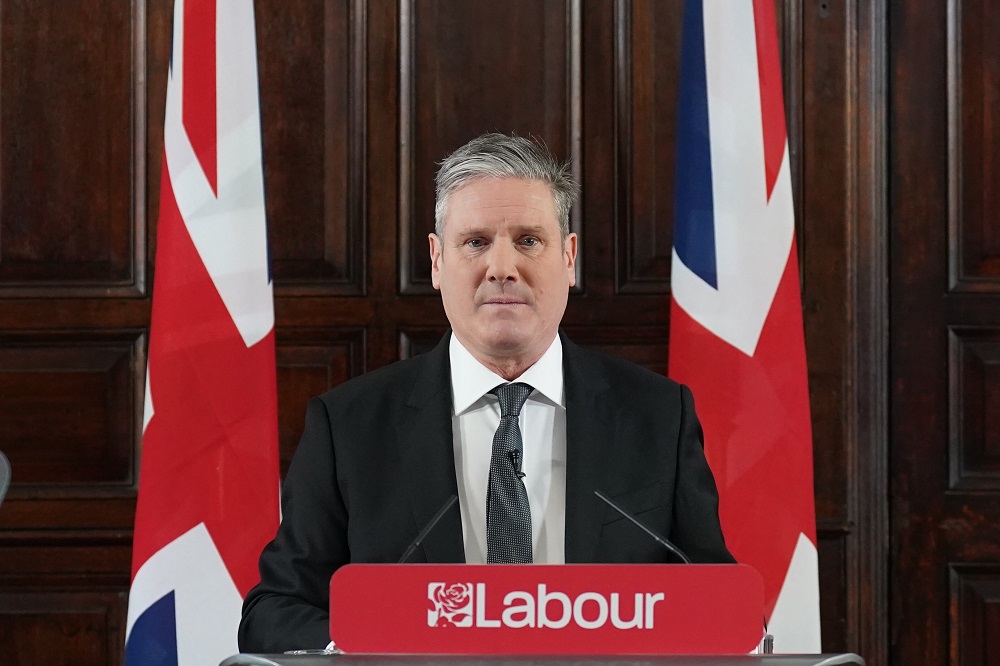
The Labour majority of over 170 seats with only 34% of the vote is the lowest-ever winning share.  With around one third of the vote it gained two thirds of the seats. The turnout of around 60% was a drop from 67% in 2019 and the second lowest since 1918, meaning around 80 per cent of those eligible to vote didn’t vote for Starmer, whose personal rating is a net minus of 6.  Even in his own constituency his vote fell dramatically, by 15.6%.

His victory is due to the Conservatives having their worst ever result.  Polling indicated that 48% of those intending to vote for Labour were going to do so mainly to get rid of the Tories.  Had the Reform Party not existed, and its reactionary support voted Conservative, it would have beaten Labour by around 38% to 34%.  Yet for receiving 14% of the vote Reform got around 1% of the seats.

From this, two things are obvious: the British electoral system is a fraud with scant claims to democratic legitimacy and Starmer’s Government has the same lack of popular foundation.  The bourgeois media can’t ignore all this completely but can be expected to move quickly on.  One only has to recall that Starmer’s Labour received less votes than the supposedly disastrous Jeremy Corbyn in 2019 and 2017 to appreciate the treatment the media would dish out to the lack of legitimacy Starmer’s result would be accorded had Corbyn still been leader. In 2024 Starmer’s Labour won 9.7m votes with 33.8% of the vote while in 2019, in Labour’s supposedly worst result ever, Corbyn’s party won 10.2m votes with a share of 32.1%.  In 2017 Corbyn’s Labour won over 3 million votes more than Starmer did today – 12.9m as against 9.7m.

It is estimated that a quarter of 2019 conservative voters switched to Reform while the Liberal Democrats achieved their best ever result by surfing the wave of getting the Tories out by targeting their seats in the south and south-west of England.  Labour also benefited by the collapse of the SNP vote in Scotland following 17 years of failed SNP rule and the scandals that have engulfed the leadership of the party.

The short-sighted and primitive call from some on the left who simply called for the Tories to be kicked out has been exposed for the worse than useless advice that it so obviously was.  Everybody was out to get the Tories , and the election revolved around their losing it rather than Labour winning.  As we have seen – the Labour vote went down.

*                   *                   *

The Labour slogan was the vapid and vacuous one-word ‘Change’.  The bourgeois commentariat has welcomed it as a change from the incompetence, chaos and instability of fourteen years of Tory rule and a return to the previous, apparently boring politics.

True to their superficial appreciation of events, or at least as they recycle them for the consumption of the population, this ignores the commitment of Starmer to essentially continue with Tory policies.  This includes a commitment to ‘growth’, to retention of the commitment to reducing the debt over five years; minimal increase in taxation; resolution of the problems of the NHS; commitment to increased defence spending, and a promise not to reverse Brexit in his lifetime.  He has also committed to come down hard on immigration and to do so more effectively than the Tories.

How growth can be achieved without investment (increased borrowing and therefore increased debt); without a larger workforce (while reducing immigration), and without expanding either the domestic market (through pay increases Starmer has vowed to oppose) or the export market (while never rejoining the EU), is left unexplained.  It all looks exactly like the situation created by the Tories but without smug incompetence of Cameron, the wooden hopelessness of Theresa May, the performative chaos of Johnson, ideological blinkers of Truss, and the MBA qualification in cluelessness of Sunak.  All Starmer brings personally is his own brand of dislikeability and penchant for lying on the scale of Boris Johnson.

Normally a new right wing government with a mandate would be able to wield their electoral victory as a weapon against workers, through restricting public sector pay, reducing public services and welfare, and increasing taxation.  Given Starmer’s short but filled-to-the-brim history of U-turns, it would not be a surprise to see him attempt to impose austerity on public sector pay, reduce the scope of state services such as the NHS, increase taxation, take yet more reactionary measures to be seen to reduce immigration, and attempt unsuccessfully to get something meaningful from the EU in terms of better market access.  None of this will lead to significant additional growth.

Brexit is an issue that will not go away even if all the parties try to ignore it as they did in the election; just as the proxy war against the biggest nuclear arms power in the world was also ignored.  The previous election that promised that Brexit would get done resulted in it not getting done, thus not addressing all the problems created.  The lack of strong support for Starmer’s government will matter when he is called upon to do so.

*                   *                   *

Starmer managed to maintain the support of most of Labour’s voters while pivoting to the right, to win over disenchanted Tories and others simply wanting rid of them without caring particularly over who replaced them. This having been achieved, there is no reason for any of them to offer his Government any continuing support.  Even his claim to introduce integrity into government after years of Tory sleaze looks like previous broken promises given his huge catalogue of gifts and the sponsorship of his party and colleagues by private corporate interests.

His support for Brexit will anger the majority of Labour members and supporters who oppose it and who will see more and more evidence of why they are right to do so.  A harder line on immigration will do nothing to improve growth, will antagonise some supporters and will legitimise those on the right, including the Reform party, which is in second place in almost 100 constituencies, the majority of which are held by Labour.  Reform has already demonstrated that its rabid xenophobia is more convincing and attractive to reactionaries than that of the Tories, and this will apply to Starmer’s reactionary nationalism.  Pursuing the same policies will engender the same problems that brought down the Tories and the same vulnerability to right wing competitors, who will always be able to out-bid its reactionary solutions.

The Liberal Democrats did not increase its share of the vote but had its best result because it targeted Tory seats.  An anti-Brexit policy could protect those gains while targeting Labour supporters opposed to Brexit and Starmer’s continuing demonstration of its failure.  The Green Party also increased its vote and became a more credible alternative, even if its gains in two Conservative seats demonstrates its essentially petty bourgeois character and opposition to any sort of socialism.

Unfortunately, the pro-Palestine candidates elected are not a coherent left alternative while fortunately the false and fraudulent alternative represented by George Galloway was defeated.  The battle for the socialist movement is not through creation of yet another electoral alternative but assisting in the working class resisting the policies of Starmer’s government and defending its interests.  Only by working class resistance and a movement created out of it could an electoral vehicle be constructed as a subsidiary part of the movement.

The Conservative Party has lost many of its most rabid pro-Brexiteers and will always come second in competition with Reform on the basis of opposition to the EU.  Just as with the Labour Party, sooner or later being a bourgeois party will mean having to represent its interests, which means reversing Brexit.  This applies to the Liberal Democrats as well so that a party realignment to achieve this will have to take place.

Only the rabid reactionary nature of the Reform membership can hobble its further development or blow it up. There is no point in the traditional conservative section of the Tory party seeking any sort of accommodation with it, yet there is no point in the reactionary petty bourgeois sections of the Conservative Party and the Reform Party remaining separate.

The results of the election; the economic challenges facing the new government and resistance to it; and the proliferation and confusion of party supports, all point to a political realignment.  A real socialist alternative cannot be declared or created out of the organisations that exist but likewise can only come to the fore as a result of developments in the class struggle, arising as a result of working class opposition to the the new government and its attempt to carry through the failed policies of the Tory government that has just been humiliated.  A cause for some optimism. 
The British General election – what lies beneath?

“Not only do the opinion polls say that Labour will win back working class areas in Northern England it lost in 2019, but it is also expected to do well in wealthy parts of the south that were once Tory heartlands.”  So read the full-page article in the Financial Times at the start of the week.  The reason?  “There’s only one answer to that: Brexit”, according to the Tory Chair of the House of Commons justice committee.

One section of the Tory base is leaving while the other in the so-called Northern ‘Red Wall’ is also departing, and since only one third of the electorate now still thinks Brexit was a good idea, the pool the Tories are fishing in – against the competition of the Reform party – is getting a lot smaller.  Since Starmer’s Labour Party also claims that it can get Brexit to work, and is also not talking about it, it is not a surprise that the share of the vote of the two main parties is now the lowest since 1918. Only 35 % of those polled think Starmer would make the best prime minister against 19% for Sunak, the former’s rating lower than all of the recent election winners.

It is obvious that the predicted Labour landslide victory has more to do with the unpopularity of the Tories than anything to do with Starmer, so that while Labour’s support has declined during the election so has that of the Tories.  The Financial Times reported that Tory support has fallen by a third since January and the view that the only issue that matters is getting rid of them has continued to dominate.

Both parties have embraced the politics of waffle with commitments that are as few and vague as the waffle is ubiquitous.  “Growth” is the answer to every problem yet the Brexit elephant in the room that squats on growth is ignored.  Starmer has followed Tory policy like its shadow while dropping every promise he ever made to become leader, parading his patriotism with “no time for those who flinch at displaying our flag”.

He has presented himself as a strong and tough leader –in such a way that his rating for being trustworthy has fallen from 38 to 29; his rating for honesty from 45 to 34; his rating for authenticity from 37 to 30 and, for all his posturing, his rating for charisma from 20 to 18.  What we don’t have therefore is popularity born of personality to explain why it’s not born of politics or principle.

The vacuousness of the politics of the election is covered up by trivia such as Sunak taking himself off early from commemorating the D-Day landings and the betting scandal, which shows that low-level corruption is always more easily exposed than the bigger stuff.  All this however is for the consumption of the masses.

The ‘get the Tories out’ mantra that also characterises the left is perfectly acceptable to the ruling class since the Tories have failed to govern properly, leading to Brexit and Truss’s unfunded tax cuts that briefly threatened the currency and suddenly raised interest rates.  Being anti-Tory is no longer a solely left-wing pursuit, which makes the primacy of getting them out (which is going to happen anyway) illustrative of the poverty and bankruptcy of many on the left.

Bourgeois commentators lament that the lack of honesty of the election ‘debate’ will lead voters to “distrust politicians and so our democracy itself” (Martin Wolf FT), while the more cynical shrug their shoulders and accept it.  “The UK is approaching a general election of vast importance for its future.  It just has to get next week’s one out of the way first” (Janan Ganesh FT).  The first worries that the British public will not be ready for the radical attacks that are coming their way while the second is concerned only that they learn to accept them next time.  Clearly both are more interested in what happens next, which doesn’t mean what happens to the Tories but what happens when we have Starmer.

One Irish commentator described him as “legendarily boring” and “resolutely moderate”, which fatuousness is what often passes for informed political commentary in the Irish press. The ruthlessness of Starmer’s dictatorship in the Labour Party and his pathological record of lying to become its leader should give even the dimmest observer pause to wonder what he will do with the exercise of real power.  What struck me ages ago was the unwillingness to wonder what decisions someone so innocent of due process in the Labour Party made when he was Director of Public Prosecutions.

The Starmer government is now the threat to the working class in Britain and to us in the north of Ireland, while the Tories are receding in the rear view mirror.  Preparing for this can best be done in the election by robbing this government of as much legitimacy as possible and using the election to organise potential opposition.  This means not voting for the Starmer’s Labour Party but only for those on the left of the party who might be considered as some sort of opposition, including those deselected and standing as independents.

The first-past-the-post electoral system is not designed to elicit people’s true preferences but incentivises many to vote against parties and not who they are for.  When there is widespread disenchantment with the major parties this can be muffled and stifled. Yet even with the current system we have seen support for the two main parties fall and ‘wasted’ votes for others may encourage further politicisation.

The Financial Times report that behind the steady gap between the Tories and Labour that will give Labour a ‘supermajority’ is a drop in Labour’s polling matching a fall in that of the Tories.  These trends may reverse as voting approaches but at the moment they show that their ‘competition’ is not strengthening either.  The FT claims that the Labour Party is experiencing high levels of turnover in its support, losing a quarter of those who had previously (January this year) said they were planning to vote for it.  Three per cent were undecided, 9 per cent were less  likely to vote, and 4 per cent were going to vote for the Lib Dems while potential Lib Dem voters were travelling in the opposite direction, perhaps for tactical reasons.

The proportion of voters who switched parties in elections used to be about 13 per cent in 1960 but is nearer 60 per cent now.  Some might lament that this illustrates a decline in class consciousness but since this was often an habitual Labourism it is not the loss that it may appear. What has suffered a greater loss is the coherence of the left that now mainly rallies behind its own ruling class, today in a war that has the potential to escalate catastrophically and which involves endorsement of all the hypocritical claims of the British state and ruling class it claims it oppose. The consensus on the war is something that the war itself may have to break.

Socialists in the Labour Party – should I stay or should I go?

The suspension of Jeremy Corbyn for daring to state an opinion, and one that accords with the facts, is a provocation by the right of the Party.  Corbyn is obviously a much diminished figure since he ceased being leader, and the very limited revolt of left MPs in opposition to Kier Starmer’s support for the right of agents of the State to murder and torture show that his failure to democratise the Party has weakened the Left.

What this implies is that the target of the disciplinary action is not so much Corbyn as the mass membership who were inspired by him becoming leader and promoting the policies that he did.  That you can be suspended for simply expressing an opinion that happens to be the truth is obviously a weapon that can be used against anyone who thinks the truth is important.  It’s ironic that it is a former Director of Public Prosecutions who is leading the witch hunt, not perhaps surprising to those of us who consider the State he served in such a senior position is a weapon of the ruling class.

Opposition to this State comes naturally to socialists from the North of Ireland who have long ago been accustomed to agents of the State getting away with murder; but it does make a difference that they are actually sanctioned to do it by law, and important also that the so-called Party of the working class in Britain votes in favour of it.

So if the right wing of the Labour Party decides to provoke the left – what is it provoking it to do and what is the objective if Corbyn and left MPs are clearly too weak to be of any real obstacle to its plans?

This can only be the defeat and expulsion of the left membership inside the Party.  The election of Corbyn to the leadership obviously came as a shock to it and to the British establishment more generally, and both don’t want it in place in any strength with the potential to do it again.  In fact, even if there are other methods to neuter the membership, the right wing of the Party is as opposed to socialism as the Tories and since the largest grouping of socialists in Britain is within the Labour Party a key objective is to shatter this potential base of socialist opposition.

So if this is the plan, what should the response of the membership be?  Should it be to stay and fight?  And what would be the objective of such a fight?  Or should it be to leave and set up another organisation?

Support from the second alternative comes from those who have always said that the Labour Party can never be reformed and will always defend the fundamental interests of capitalism.

In this case the question has to be put to them, at least to those who are members of the Party, what are you doing in it now?  Why, if this is true, did it not exclude you permanently from membership before now?  Does this not mean that there are some other grounds for membership?  And what would these be except that revolutionary socialists can be part of a mass phenomenon that has the potential to be organised and radicalised in a much more significant way than creation of yet another small radical left organisation?  Given past experience, one that will only parrot left reformist politics while failing to garner enough support to be relevant to the mass of the working class?

Some members will no doubt be demoralised by this turn of events, having rallied to the Labour Party because of Jeremy Corbyn becoming leader and the possibility of him leading a left Government.  But these people have just had an object lesson that significant progress and socialism will not be delivered to them from on-high, or from anywhere else, but only from their own organisation and activity.

They have been taught that the Labour Party is not democratic and a fight is needed to make it so, which can only come from the inside.  They have learnt that the right-wing of the Party is not on the same side as them and that appeals for unity that were ignored when Corbyn was leader will similarly get nowhere now Starmer is pulling the strings.  They will realise that it is the intention of the right of the Party that they should no longer be in the same movement.  The purpose of the provocation is to shatter the left by silencing and expelling it.  If this is the objective what purpose – whose purpose – does it serve by leaving the party or even making it easy to be expelled?

So, to return to the first alternative – should the left in the party stay and fight and what should be the objective of remaining in the Party in the current situation?

Given the accumulation of a mass membership it should be clear that the objective must be to defend its current position and oppose resignation and expulsion.  This should be the first task.  The alternative is to leave and set up an alternative and rival organisation.  The history of such organisations is not a good one and those that exist are by and large sects that have proved incapable of containing even a narrow spectrum of opinion within their ranks, never mind the current political heterogeneity of the left membership of the Labour Party.

Whatever can be said about the political weakness of much of the left membership from a Marxist point of view, there is no reason to believe that it does not faithfully reflect the leftist working class support outside the Party.  The so-called revolutionary left usually acknowledges this, without acknowledging it, by presenting itself as left reformist when it organises in its unity projects or goes before workers in elections.  Thinking that, alternatively, this failure can be overcome by adopting a revolutionary programme will leave any organisation small and fixated on getting their programme right, which translates into splits.

More fundamentally, a programme without the working class is an idea searching for a reality; in this case a small number of revolutionary militants searching for a working class membership that ignored, if it was even aware of, its previous left projects and joined the Labour Party.  This membership was right to do so, so there is no reason to expect it to rally to their banner now.

So the objective of this fight is to resist attempts at expulsion and to remain alongside the hundreds of thousands of members in the fight to learn the lessons of what is going on – the lessons as set out above.  This means the left must organise to resist the expulsion of Jeremy Corbyn and any other member – success will be preventing this from happening.

How this is done is for the members themselves and those much more in tune with what is possible than I am, but at a general level what it means is that socialists have to know how to retreat and how to defend their position in the Party by defending their membership.  If they think it’s about an opportunity to create a genuine mass socialist party then they have misread the situation completely and will play into the hands of the right.

Lenin said that it ‘is an incontestable truth’ that ‘communists must exert every effort to direct the working-class movement and social development in general along the straightest and shortest road to the victory of Soviet power . . . but it is enough to take one little step farther – a step that might seem to be in the same direction – and truth turns into error.’’  As he goes on to say, sometimes it is necessary to take conciliatory manoeuvres and make compromises.

If this sounds like selling out then those thinking this must not be able to conceive how in current circumstances it is possible to take this sort of action, how to take a step back, how to make a retreat that prepares for future advances.  Those who reject this approach may sound very revolutionary but what they are proposing is anything but.  Corbyn made an absolute blunder by accepting the slanders about anti-semitism in the Labour Party and he, and we, are paying the price for it.  So, now that the going has gotten very tough the tough have to stay and fight.