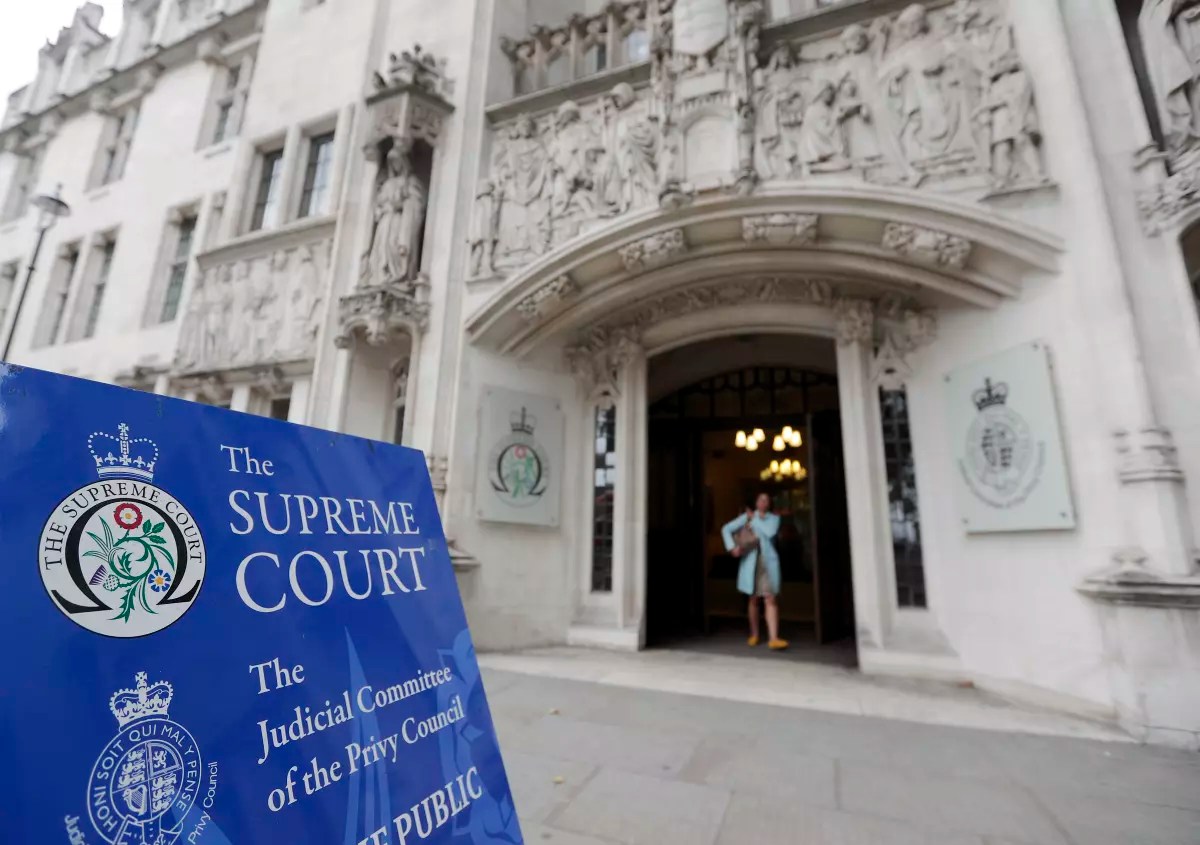
UK Supreme Court decides a woman is an adult human female

Although this is how the decision of the supreme court has been interpreted, the actual decision is the narrower one of what the GB Equality Act (EA) of 2010 means by ‘sex’, which it has decided means biological and not certified sex.  It has therefore been hailed by ‘gender critical’ activists as a victory for common sense and by certain trans activists as an attack on their human rights.

An alternative potential judgment – that the term ‘sex’ and thus sex itself – is determined by a certificate demonstrates how bizarre an alternative decision would have been.  In effect, it would mean one’s sex as far as the state is concerned was determined through its award of a certificate.  This would not have represented the continuation of the status quo, with the advances already achieved by the gender identity movement, but would have provided the grounds for a further attack on the rights of women, and then men.  If sex was certified, what obstacle would exist to certification being required?

The judgement of the court dealt with the problem of pretending that there were two types of women with all the incoherence that this would involve. Anyone from the left lamenting the judgment, and state interference in matters that do not belong to it, should consider how we got to this position through gender recognition certificates and how the scope for its massive inflation would have been prepared by the alternative decision some seem to have wanted.

The court ruled that ‘Any other interpretation would render the EA 2010 incoherent and impracticable to operate’, and rejected ‘the suggestion . . . that the words can bear a variable meaning so that in the provisions relating to pregnancy and maternity the EA 2010 is referring to biological sex only, while elsewhere it refers to certificated sex as well.’  (para 265) In doing so the court rejected the deliberate ambiguity and confusion of trans arguments presented by the lawyers for the Scottish government in which use of the words ‘sex’ and ‘gender’ can alternatively be employed as synonyms and as different concepts as suited their purposes.  I have looked at this sort of confusion before by what, for example, is meant by the word ‘gender’?

The court judgement stated that in getting a gender recognition certificate ‘there is nothing to suggest that undergoing such a process changes a person’s sex as a matter of law. It does not. Indeed, a full process of medical transition to the opposite gender without obtaining a GRC has no effect on the person’s sex as a matter of law.’ (para 200) It is also the case that this is true as a matter of fact, while the gender identity movement obviously thought the imprimatur of the law would allow them to claim this.

However, as the judgement stated: ‘a strong indicator that the words “sex”, “man” and “woman” in the EA 2010 have their biological meaning (and not a certificated sex meaning) is provided by sections 13(6), 17 and 18 (which relate to sex, pregnancy and maternity discrimination) and the related provisions. The protection afforded by these provisions is predicated on the fact of pregnancy or the fact of having given birth to a child and the taking of leave in consequence. Since as a matter of biology, only biological women can become pregnant, the protection is necessarily restricted to biological women.’ (para 177)

As the court notes ‘Put another way, if the acquisition of a certificate pursuant to section 9(1) of the Gender Recognition Act 2004 applies to these words, so that biological women living as trans men (with a GRC in the male gender) are male, they would nonetheless be excluded from protection when pregnant notwithstanding a continued capacity to become pregnant . . .’   So, some women (identifying as men) would lose the rights that come with pregnancy were sex to be defined by the gender recognition certificate they might have.

The court ruled that ‘We can identify no good reason why the legislature should have intended that sex-based rights and protections under the EA 2010 should apply to these complex, heterogenous groupings, rather than to the distinct group of (biological) women and girls (or men and boys) with their shared biology leading to shared disadvantage and discrimination faced by them as a distinct group.’ (para 172)  ‘Moreover, it makes no sense for conduct under the EA 2010 in relation to sex- based rights and protections to be regulated on a practical day-to-day basis by reference to categories that can only be ascertained by knowledge of who possesses a (confidential) certificate.’ (para 173).

Media reaction, and almost all previous media attention to the issue, has framed the judgement as one primarily impacting on trans women, much less on trans men (i.e. biological women), while some on the left that we have addressed before have repeatedly referred to the ‘small numbers’ (of trans people) involved, as if this meant that their feelings could be accommodated by any ‘solution’ regardless of any changed meaning to the word ‘women’, and thus the rights of half of humanity.

For all the faux left denunciations of a reactionary court by gender identity supporters, its recognition of the material reality of the sex class of women and of the shared ‘disadvantage, and discrimination faced by them as a distinct group’ shows it has a better grasp of reality and how to address it than some self-identified Marxists.

I am reminded of a tweet by the bête noir of the supporters of gender identity ideology, JK Rowling, who noted that she doubted Marx would have supported them:

‘Ironically, I can’t see Marx having any truck with gender ideology at all. He believed women were oppressed on the basis of their sex and I doubt he’d embrace a highly individualistic ideology that offers fertile new marketing opportunities for the capitalists of Big Pharma.’

The court seemed impressed by another argument that left supporters of gender identity ideology have failed to understand:

“Arguments concerning the definition of a protected characteristic are never simply  manifestations of individual claims. They are always group orientated. The claim that one is a woman is a claim to be included within a particular category of persons and to be excluded from another. It is also a claim to include some persons and to exclude other persons within the group that one is a part of. This matters especially for aspects of the Equality Act 2010 which require duty-bearers to be cognisant of how their conduct might affect those who share a protected characteristic or where there is an obligation to account for the distinct needs and interests of those who share a particular characteristic.” (para 142)

This blog has repeatedly criticised the moralistic politics of much of the left, which has departed from class analysis based on an understanding of objective reality to moralistic claims divorced from this reality.  So, their support for the supposed moral value of ‘inclusion’ means the inclusion of men in the category of women along with appropriation of their specific rights and prerogatives, regardless of women’s own views.  In fact, if challenged some of these men claim that as women they are the best defenders of such rights!

All this is based on purportedly unverifiable subjective claims that this left makes no attempt to verify or validate.  It thus accepts or acquiesces in all the most outlandish nonsense the radical trans movement throws out.  The claim to the impossible – to be, or to be able to change to, the other sex – defies reality and thus rational debate but becomes an assertion that is to be accepted without question or to be asserted and imposed.

This is the significance of the compelled use of the ‘right’ pronouns on others and the ‘crime’ of ‘misgendering’, which can demonstrate acceptance of, if not agreement to, the tenets of this ideology.  What is involved is not the exercise of rights but compulsion to unagreed social norms.  In capitalist society the state stands over the boundaries and content of many social norms and this defeat for gender identity ideology not only sets duties and responsibilities on state institutions and private bodies but frees up restrictions on social intercourse that the gender identity movement has been so successful in imposing.

The court noted the argument of Sex Matters that ‘many organisations feel pressured into accepting de facto self-identification for the purposes of identifying whom to treat as a woman or girl when seeking to apply the group-based rights and protections of the EA 2010 in relation to the protected characteristic of sex. The result in some cases is that certain women-only groups, organisations, and charities have come under pressure (including from funders and commissioners) to include trans women and policy decisions have been taken simply to accept members or users of the opposite biological sex . . .’ (para 203)

Judge Lord Hodge from the court said the ruling should not be seen as a triumph of one side over the other, but it is.
Marxism and Gender Identity Ideology (8) – Identity politics on steroids

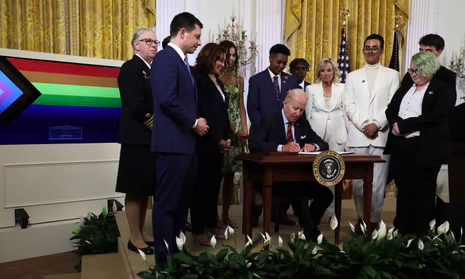
For some on the left the executive order by Donald Trump that the Federal Government will recognise only two sexes – that gender identity “cannot be recognized as a replacement for sex’, and that it will not replace ‘the biological category of sex with an ever-shifting concept of self-assessed gender identity, permitting the false claim that males can identify as and thus become women and vice versa’ – will be seen as confirming their support for these views.  His decision, it will be said, is one from an arch-reactionary who is only being consistent with his other reactionary views.

It is a pity for the holders of such views that their perspective on consistency should lead them to celebrate the progressiveness of the previous Presidential champion of gender ideology, Joe Biden – the sponsor of war in Ukraine and accomplice in the carrying out of genocide in Gaza.  The ability of Trump to weaponise simple truths is as much a feature of identity politics as its pernicious role in undermining socialist politics and the primacy of working class unity.  The role it has played in the Presidential election and in Western media reports demonstrates the salience of the issue for the health of socialist politics, quite apart from the threat the ideology poses to women’s rights.

I remember, when I was a young teenager and had joined the International Marxist Group, an older gay man telling me that there was nothing inherently left-wing or socialist about being gay and that this was also true of the gay movement. Socialists may have been heavily involved in the fight for gay and lesbian rights, but this has not prevented their incorporation by capitalism into questions of individual identities and attitudes, with no question of structural oppression.  In seeking acceptance and equality, capitalist society in many countries has accepted their demands through incorporation on its terms by commodifying them.

The constraints on this incorporation are strict.  The UK may have had three women Prime Ministers, but the names Thatcher, May and Truss are hardly symbolic or symptomatic of progress for anything but the most miserable form of feminism.  The rotten character of this liberal feminism is demonstrated in its willingness to erase the essential nature of women altogether by prioritising the demands of men who claim to be women.  Ireland has had a right-wing gay Taoiseach, and the sectarian arrangement in the North is headed by two women, but belonging to a social group that suffers some form of oppression does not by that fact entail resistance or opposition to the social system that generates it.

Moves to equal representation under capitalism get you closer to equality, but only equality of exploitation and oppression, which affects the working class, including in its ranks the majority of women, black people, gays, and lesbians.  It doesn’t get you anywhere near emancipation or liberation from exploitation and oppression.   Identity politics creates division that breeds competition, undermining the grounds for the unity required to remove capitalist exploitation as well as sexual oppression and homophobia.

Gender identity ideology is an extreme example of this sort of politics that has commodified sex by pretending that it can be changed while simultaneously denying its centrality. This, for example, removes coherence to any claim to same sex attraction.  Ironically, it has done this through attaching its letter to LGB alongside an expanding set of letters – LGBTQQIP2SAA+ – that bear no relation to the initial three, except to cannibalise them, with a + for whatever can be imagined next.

One feminist has described it as akin to religious belief, ‘that trans ideology’s appeal rests on a metaphysical salvation fantasy, that would help explain why it functions far more like a religious cult than a political discourse—and why true believers are so impervious to rational argument and so fond of denouncing heretics and apostates’, ‘the primacy of gender identity would then express the drive to transcend bodily limitation analogous to the thought of The Resurrection’. (Jones, Jane Clare. The Annals of the TERF-Wars and Other Writing (p. 351-2). Kindle Edition.)

While this may be true of some adherents and provides clear parallels of the ideology with religious belief – based on faith and not material reality – it does not explain its attraction to the left in more secular western societies.  Ironically, the more religious, with traditional views of sexuality, are less prone to swallow it because they recognise that their conservative sexual norms apply to real sexes.

Instead, the vulnerability of certain sections of the left to gender identity ideology is due to their abandonment of socialist politics based on the material world and their flight into a more congenial and comforting world of moralistic claims, of good and bad, to be addressed through the assertion of rights to be imposed by the state.  The liberal left now dominates as its natural home is the state, which provides the environment of NGOs and other state-funded organisations that substitute for the working class movement as the agent of radical change.  The long-standing view that the state can embody socialism eases the journey to this destination even of it does not make it inevitable.

Identity politics is a world of the sanctity of self-identity (no matter how detached from reality); of self-determination of the individual (how is this possible and what does it permit or not permit?); of the claims of the oppressed and their ‘lived experience’ (what other kind is there?); with an absolute value placed on ‘inclusion’ and absolute exclusion of ‘exclusion’.  The solipsism involved prevents the liberal left responding in the standard way to the claims of the religious – that extraordinary claims demand commensurate explanations – and instead pronounce the empty and ignorant mantra of ‘no debate’.  It forgets that freedom of religion also requires freedom from religion just as the freedom to associate requires the freedom not to associate.  The freedom for women to associate also requires their freedom not to associate with men, those ‘identifying’ themselves as women or not.

Politics based on moral values free from actual struggle can find its grounding on the claims of oppressed groups, irrespective of their politics, based simply on the fact that they are oppressed, or claim to be.  No need to elaborate theories or political programmes that analyse oppression, ground it on an analysis of material conditions, seek to learn from historical struggles and test alternatives in debate.

When these struggles do not exist, or have not existed for some time, or have been defeated, and thus do not impose their requirements on participants, all this is unknown – especially to generations in which mass working class struggle is largely history. Hence the attraction to youth, highlighted by the generational divide over gender identity ideology, and the noteworthy fact that this ideology has flourished especially, although no longer solely, in English speaking Western countries where working class struggle has suffered long term defeats.  In such reactionary periods reactionary ideas take hold, and this is one.

Unfortunately, the experience of some countries in Latin America illustrates its compatibility with left presenting regimes accommodating reactionary policies, such as gender ideology in the constitution of Ecuador and Bolivia and legislated in Argentina and Brazil, while in all except Argentina legal abortion is not allowed.  In the latter it was introduced in 2020 for ‘pregnant people’, while women became a ‘gestating person’. (Women’s Rights, Gender Wrongs p66 and 68)

That the left is identified with this ideology is one more piece of alien baggage it will have to discard and to do so not by ignoring it but by exposing and defeating it. 

Back to part 7

Marxism and Gender Identity Ideology (1) – Introduction

Last year during a break in the local anti-war meeting there was a short disagreement about the transgender issue.  The woman could barely conceal her disdain for the idea that men could claim to be women by wearing a dress and lipstick (as she put it).  The man thought that it was an important issue that had to be addressed.

The woman was primarily a Palestine solidarity activist but recognised the war in Ukraine as one in which hundreds of thousands of people were being killed and that had the potential to escalate with catastrophic results for the world.  The man thought the issue had important implications for women’s rights and should be taken up by socialists.

This brought to mind the passage in ‘What is to be Done’ by Lenin ‘that the Social-Democrat’s ideal should not be the trade union secretary, but the tribune of the people, who is able to react to every manifestation of tyranny and oppression, no matter where it appears, no matter what stratum or class of the people it affects…’ 

So, the questions that naturally arise are about the demands that are raised by the trans activist movement and whether socialists should support them. We can start by looking at the Gender Identity ideology that grounds the politics of the movement and their ‘allies’.

Not all trans people support the same demands or Gender Identity ideology, and this ideology has various features and makes dissimilar claims.  What is hardly in dispute however, is that trans people should not be subject to unjustified discrimination or violence, and deserve respect based on our common humanity.  The specific claims of Gender Identity ideology are particular to a certain strain of trans political activism and make claims which go beyond this response.

In a series of articles in the British ‘Weekly Worker’ these issues are addressed, and in the fourth part the author writes–‘I use ‘trans people’ for the present purposes to mean people who wish to live permanently in the gender identity polar opposite to that ascribed to the biological sex in which they were born.’

At first reading this can be taken to mean that the issue is men, for example, who wish to live as women. Except, if this were the issue there would hardly be a dispute.  Few are going to object to men wearing women’s’ clothes, make-up etc. and presenting themselves as women, in so far as they are able, in their everyday lives.

Gender identity ideology asserts much more than this; it asserts, for example, that men are women if they consider – ‘identify’– as women.  As the mantra goes – ‘transwomen are women’.  This is stated, not as a metaphor, but as a literal truth.

This is the main problem with the definition as presented in the ‘Weekly Worker’; if we must assume that the word gender in ‘gender identity’ means something other than what it has (until this controversy) been traditionally regarded to mean – as simply another word for sex.  Instead, it is a word that is employed to substitute for sex and thereby erase it. In the next few occasional posts I will look at the ideology and the claims of the movement, beginning by asking what ‘gender’ and ‘gender identity’ mean.

Forward to part 2