
Employee ownership and capitalism

{3E6643C4-0E2F-4C4C-B00C-DB42B68D2316}Img100Beyond the Corporation: Humanity Working, David Erdal, The Bodley Head, London, 2011.

The author of this book has an unusual pedigree.  He was born into a family which owned its own business from the year Charles Darwin was born, in 1809.  As a child he did not lack for money and joined the firm in 1977, at which time 1,500 people were employed in the company.  In 1985 he became its effective Chief Executive Officer.  In between he had led a rather different life, getting a job as an unskilled labourer on a London building site after leaving university

Through this real life experience he leant what thousands of Professors of economics are not – that it is employee’s work that creates wealth – and that the key to a company’s performance is leadership and commitment; leadership and commitment from everyone in the organisation.  That leadership is important should be readily understood by socialists.

He is therefore a strong advocate of employee ownership and the book presents his own experience of turning his family business into a workers’ cooperative and his own views on the benefits of such ownership.  He notes that because workers are so used to being ignored and exploited even the most minimal change, such as being allowed to own shares in the company, have positive effects in boosting productivity and performance.  He also notes however that such schemes transfer no real influence.  He is therefore clear that what is necessary is ownership because without ownership there is no real control.

Employee owned businesses do better because their workers are better trained, contribute more to the business and are more adaptable to change.  They generally do not suffer from underinvestment, do not lack ‘entrepreneurial’ spirit and do not exhibit shirking as workers monitor each other’s work effort.  Academic studies show them to be more productive and, while business problems are not solved by employee ownership in itself, or prevent strategic mistakes that may threaten the company’s existence, employee ownership will help the company survive longer.  If you own something you will look after it better.

He contrasts this with the views of traditional economists who, with no evidence, in fact against the evidence, claim that employee ownership will witness workers extract cash at the expense of the long term health of the business, take too long to make decisions, will see them avoid difficult decisions and witness the performance of  their business decline

In contrast he claims that the participation of everyone in decision making, and everyone being equally affected by the decisions made, makes for better decisions.

In his quest to turn the family company into a workers’ cooperative he was repeatedly told by finance advisors and other professionals that this was not a good idea.  The Market is always right – by definition.

He quotes one supporter of employee ownership who complains that workers normally have none of the rights associated with ownership, such as information, participation and control, and that while capitalism is good at creating capital, it is lousy at creating capitalists.

The view that cooperatives make capitalists of workers is one also heard from trade unions and argued as a reason to oppose workers’ ownership.  The author provides many examples of real employee ownership where workers have struggled with issues of productivity and competitiveness and where jobs have had to be cut because of threats of wholesale closure.

However the view that the Market is inimical to workers’ cooperatives is interesting because  in strict logic this is obviously not the case while it is also not the view most widespread on the Left, which is that workers’ cooperatives are simply not an alternative to capitalism because the market does not disappear and therefore capitalism does not disappear.

But it is not at all that simple and the hostility of some defenders of the market to worker owned companies is perfectly rational.

Irrespective of this the author notes that every generation throws up experiments with workers’ ownership but that most often this is not the result of the initiative of the workers themselves but arises from existing owners, from unusual individuals who stand against prevailing orthodoxy.  Who, from ideals of fairness, from appreciation of the contribution made to the company by workers, or realisation that the company can do better under their ownership, seek to transform ownership of their business.

Among the many issues arising from the idea of employee ownership, access to finance is often held up as the insuperable barrier to a business owned by those who work in it.  However the author notes that millions of small businesses do get access to finance, that most companies finance themselves from their own resources or can get started on the basis of the business itself, with funding based on sound business plans or backed by existing assets.  Or, in the case of the Mondragon cooperative in the Basque country, the workers can set up their own bank to finance their other cooperative initiatives.

This he contrasts favourably with the massive funding of mergers and acquisitions by private companies, which have a consistent record of failure, and the funding of property and other asset bubbles.  Mainstream dismissals of the viability and efficiency of workers’ cooperatives ignore the actual history and experience of capitalism as opposed to the mythical equilibrium properties of mathematical models of the market that exist nowhere outside of the models.

The massive increase of executive pay is ridiculed as an example that explodes the glib justifications of the market – that high pay for those at the top is simply the outcome of the interplay of supply and demand.  The demand for executives has not increased exponentially in line with pay but demand, fuelled by the cult of the capitalist exhibited in the growth of business schools and the MBA, alongside TV programmes such as ‘Dragon’s Den’ and ‘The Apprentice’, has seen supply multiply.  So why has the price risen?

Even if it could be argued that the demand for executives lies behind massive increased remuneration (to use the prevailing argot) the market is then supposed to increase supply to drive down prices to an efficient level.  Why hasn’t it?  Is it not working or is it rather that this is not how it actually works?

In the race to justify the rampant growth of inequality we now read about the ‘winner-takes-all’ society, which states baldly that market competition rewards those who win not those who come second or third or the rest.  The problem with this of course is that it is contradicted by the reality in which executive failure is still handsomely rewarded.  More worryingly for its proponents it contradicts the claim that the market rewards efficiency and is fair even minimally.

The author rejects many of the fashionable corporate claims.  For him employee ownership makes companies work better and their workers lead happier lives.  The contract of employment, which a worker signs, removes his right to his own product and pretends that he or she is a thing that can be rented.  Through case studies he argues that ownership make workers feel different – just as capitalism says it is supposed to!  But, he asks, why should such an effect be restricted to a few?

He has had enough experience to acknowledge the difficulties, not just of creating cooperatives but of running them.  How do you ensure workers’ actual as opposed to nominal participation and how do you deal with sometimes unrealistic expectations?  How do you overcome apathy among the workers?  After all, it is necessary not just to limit and control power exercised at the top but also necessary to ensure that it is wielded to effect at the bottom.

He addresses these questions and gives some practical answers, such as ownership being held collectively and not individually by particular workers.  This, he claims, has been the mechanism that ensures longevity of cooperative enterprises and obstructs private capital inserting itself and gaining control.  He acknowledges however that there is no obvious answer to what he calls the corporate governance problem.

It is exactly this question that is addressed by this recent blog post.  It is also only a Marxist approach that can address some of the apparently incongruous workings of capitalism that the author points up, such as why does it limit ownership of capital and not spread it around?

For a Marxist the obvious reason that capitalism does not encourage workers’ ownership is that by restricting such ownership capital compels workers to sell their labour power to those that do own capital and impels them to work on their behalf.  If all production was owned by workers then clearly an individual capitalist would be unable to compel anyone to work for them.

If all production was owned by the workers then equally clearly such production would be geared to what the workers wanted to produce and not to what capitalists believe would make them the most profit.  On both accounts production for profit would end.  Capitalists could find no one to provide the unpaid labour on which profit is based and the enterprises owned by the workers would have no incentive to pursue wasteful or aggressive competition aimed at forcing other enterprises out of business.  In fact they would have every incentive to collaborate in order produce in a way that met their collective needs.

When ownership becomes collective workers will feel differently but this simply demonstrates the truth of Marx’s claim that capital is not a thing but a relationship between capitalists and workers in which the unpaid labour of the latter expands the capital belonging to the former.  When workers own all the so-called capital it ceases to be a relationship between an owner and a worker, between an exploiter and exploited, and ceases to be capital.  When ‘capital’ is owned by everyone it ceases to be owned by anyone in particular so ceases to be capital.  This is why, unrealised by the author, the extension of workers ownership would spell not the expansion of capitalism but its ending.

Again and again the author reflects on how difficult it can sometimes be to get workers to think and act as owners of the enterprises they work in.   For Marxists this is indeed a big problem and is what we mean by saying that we need a revolution to change things, including changing the workers themselves.  Because a revolution is about transforming the lives of the working majority, which they can only do themselves, this includes transforming the vast amount of their lives they spend at work.  Probably unlike the author, we believe there are all sorts of obstacles and impediments put in workers way to gaining control of production, impediments that require workers taking political action to remove.

Production is only one aspect of how society works and attempting to take control of it requires ultimately taking control of the rest of society as well.  Taking control of society as a whole also reinforces the activity of workers control within the workplace.  It is also the Marxist case that ultimately no permanent and stable workers ownership or control can succeed unless the workers also control the state to defend such ownership.

There is therefore a real contradiction between workers cooperatives and capitalism, pace the author of this book, and equally no contradiction between cooperative production and revolution, pace the left opponents of workers’ ownership.

To be continued
Russell Brand and Revolution

F5A3478A79C182CD67445A6E8E4B8_h498_w598_m2

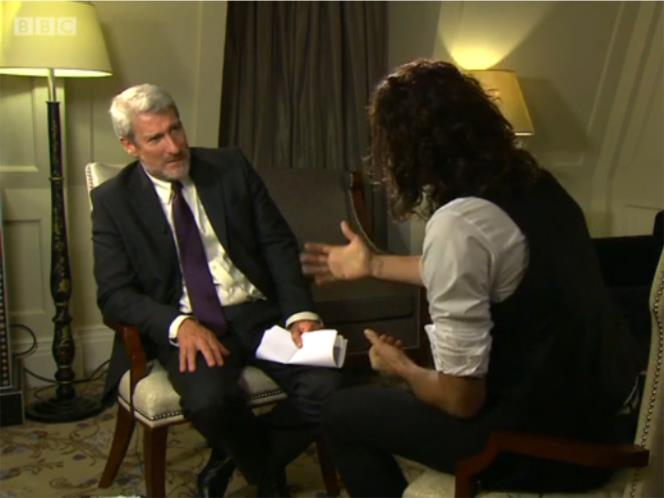
I was listening to BBC Radio 4 on the headphones on my way home from work last night when three Westminster politicians were asked about Russell Brand’s interview with Jeremy Paxman.  The link shows it has had nearly 9 million hits, just a few million more than this blog.  This is why Radio 4 was covering it and why it is important.

Is it another illustration of the celebrity culture that colonises everything?  This is the claim of some of the derisive dismissal of Brand’s rantings by the rest of the media who, at least the ones I’ve read, have slagged him off as a hypocrite.  An obvious example of ad hominem argument or shooting the messenger, not that it’s always wrong to shoot the messenger when the message is intolerable.  In this respect I’m reminded of the opening scene of Gladiator when the Germanic tribes respond to the demand to surrender by the Roman legions by throwing the severed head of the messenger on the ground in front of their massed ranks.

The problem of course is that shooting the messenger doesn’t deal with the message as the Germanic tribes discovered.  It might be claimed Brand doesn’t have an argument.  But read his New Statesman article and he does.

It might be dismissed as primitive or naïve but a better word is elemental and he does have more than a few good lines.  He makes a case.  It’s not the sort you will read on this blog but this blog doesn’t pretend to have the only or the best or the most effective voice for revolutionary change.  It aspires to encourage the recovery of Marxism and its application to the practical political programme of socialists.  It hopes that whoever thinks this is a reasonable objective to pursue will contribute to it and write their own posts.

So what if Brand’s surprising political commitment lights up the sky like a meteor and crashes and burns to earth?  What if he is a one-hit wonder?  When the rest of us are unable to get a gig a one-hit wonder is something to be.

Has his outburst reduced the credibility of our cause?  Or given it a little more light? Perhaps one more point of departure to argue for it and to advance it?

He is obviously very aware of the brickbats he would get for his ‘champagne socialist’ position and his trenchant, and in some ways reasonable, response to this is itself rather honest compared to the carefully constructed insincerity of politician’s continual hypocrisy.  It’s not as if he’s a champagne socialist in the way that that other celebrity in the new is – ‘Sir’ Alex Ferguson – with his Icumfigovan sign in his office, his hobnobbing with millionaires and his advice on man management to Tony Bliar. Nevertheless Brand has a brand problem – for example my partner thinks he’s a prat and she is very rarely wrong in such judgements.

russell brand revolution header

Brand can be criticised as anti-political, with his calls for people not to vote, but he is not stupid and he puts forward a case why we ‘should not encourage them’.  He also puts well the idea that apathy is more accessible than anger to all the shit that people have to put up with from politicians and the system they pimp.  Compared to many on the left, who claim there is a crisis of working class representation, that is we don’t have the right politicians in parliament to represent us, the radical critique of all politicians who do represent us is refreshing.

Not because we haven’t heard it before, in fact as Marxists we invented the revolutionary critique of bureaucratic ‘representation’ of the working class, but because we never see it on television.  We are extremists who never get heard but a little bit of a hearing for revolution makes us a little bit less extreme in the sense we are able to register in political debate a little bit more.

Listening to the feeble and self-serving helpings of cant from the Tory, Labour and Liberal politicians last night on the radio shows how even such a minor assault on their system from someone with a shred of credibility can so easily expose the defenders of the status quo.  Now Radio 4 reports the disillusionment of Paxman himself with the politics on offer in Britain. For Ireland multiply that lack of alternative by the number of Euros given to bailout the banks.

Above all, when pressed for what he wants as an alternative Brand calls for socialism and for revolution.  This is a darned sight more than some on the left do when faced with such a question.  The next question is that of the child – but how do we get a revolution?  You can ague all you like that Brand hasn’t much to say about this that seems practical but what is the message of the so-called revolutionary left?

As I have posted many times, the left that claims to be Marxist asks the state to extend its power through extra spending, taxation and through nationalisation while simultaneously believing, but not having the courage to say so in front of the workers, that this same state should be smashed in a revolution.

Let’s not pretend Brand is an advanced political thinker whose views we should instantly embrace.  He may be on a ‘messiah world tour’ but he’s still more a very naughty boy than a genuine Messiah.

Brandism is hardly going to succeed Marxism, Leninism and Trotskyism.  It’s not a practical guide but an emotional and reasoned outburst.  It’s not even an inarticulate expression of youth rebellion.  He’s 38 and very articulate.  We’re not obliged to defend his every word or even every tenth one but his avalanche of words creates an impression – there is something radically wrong with the world we inhabit.  Very, very wrong.

It would be easy to criticise what he says for all sorts of reasons, from his apparent attitude to women to his lack of political strategy.  But it is precisely his political limits that creates a focus on the key message that he is held to be delivering – opposition to the venality of the present system, the need for a revolution.

I’ve just finished reading a book – ‘A Marxist History of the World’, written by a member of a British left organisation.  It also makes the argument that what is needed is a socialist revolution.  The French revolution of 1789, the revolutions of 1830 and 1848; the 1917 revolution in Russia and revolutionary wave in Europe up to 1923, the Spanish revolution in 1936, the Hungarian revolution of 1956; the French general strike in 1968; the Iranian revolution of 1979; the overthrow of Stalinism after 1989 and the recent Arab revolutions, are all held up to show its possibility.  The last 100 years has been ‘pregnant with revolution’ readers are told.  We face Armageddon reminiscent of that foretold by the bible –with the appearance of the four horsemen of the apocalypse.  The stakes have never been higher with a crisis of capitalism the deepest and most intractable ever.

This to me is no more coherent than Russell Brand’s interview but without a few of the redeeming features of the latter.

The list of revolutions includes only one successful socialist one – 1917 – and it was strangled into Stalinism relatively quickly.  We will, rather shortly, be commemorating the 100th anniversary of this revolution.

The point is not that the objective of revolution should be abandoned.  Revolution is not required to achieve a certain state of affairs – socialism – revolution is that state of affairs, which is the ruling of society by its majority.

Revolution on the other hand is seen by many on the left as one strategy to achieve something as opposed to alternative reformist ones – such as voting and elections to parliament – which are said not to be realistic.  Revolution is therefore seen as a cataclysmic single event rather than as a process, one that begins and grows and that moves towards a qualitative rupture that destroys the old state and creates a new one based on the working majority of society.

The road to socialism is not growing state control but increasing workers’ control of every aspect of their lives through incrementally reducing the power of the capitalist class and its state in preparation for the final battle.  I have tried to explain this a little bit on this blog.

When a public intervention leads to Radio 4 interviewers pursuing their politician guests with the question “but why not revolution?” this intervention deserves some support.

Why have the Irish not Revolted? Part III

1913_LOCKOUT_ADVERT-1

The weakness of Irish workers resistance to austerity cannot be explained as a supposed result of this austerity having less effect than in other countries.  We have just witnessed the eighth austerity budget, the previous seven having cumulatively accounted for 17 per cent of current Gross Domestic Product.

The budget deficit in 2013 is higher than that of Spain, Portugal or Greece; there is at least another austerity budget pencilled in and the State debt is continuing to rise.  Next to nothing of the debt taken on in order to bail out the banks has been paid back and these banks are still saddled with mortgage customers who can’t pay their loans back.  Were the much trumpeted rebound of the property market to be anything substantial the banks would be repossessing and selling the vacated properties.  They’re not.

In other words the crisis isn’t over and neither is austerity, although faint hope that it is coming to an end plays one part in explaining latterly the weakness of protest and resistance.

The answer to the problem lies in the weakness of the Irish working class itself.  For Marx capitalism, in creating the working class, created its grave digger.  The nature of a particular capitalism goes a long way to explaining the nature of a particular working class and the weakness of the Irish working class is a reflection of the weakness of Irish capitalism.

An objection might be made to this that the Russian working class was the most ideologically advanced working class a century ago while Russian capitalism was weak. On the other hand capitalism in the United States has been the most advanced for a century or more but its working class is a byword for exceptional weakness.

The uneven and combined development of both societies has gone a long way to explaining this apparent anomaly and it is beyond the scope of this post to compare and contrast the development of the US and Russian socialist movements.  Over 100 years ago Karl Kautsky wrote on this question in ‘The American Worker’, relatively recently republished as part of a symposium in the journal ‘Historical Materialism’.

What we can say here in respect of Ireland is that its uneven historical development both inside the country, and as a region within the wider British economy, mainly as a reserve of agricultural production and labour power, has accounted for its historical weakness.

I was reminded of this nearly a year ago when I received a United Left Alliance (ULA) email newsletter what presented a series of proposed meetings to be organised by the ULA against austerity.  These meetings were to deal with different aspects of the issue such as the economy, health services etc.  In Russia a noteworthy feature of political and intellectual life a hundred years ago was the strength, vibrancy and hegemony of Marxism such that it dominated even the thinking of Russian liberals.

How different a situation from Ireland!  The speakers proposed for the ULA list of meetings demonstrated the reverse – the domination of Irish socialism by liberalism.  We can see this in everything from the Left’s opportunist search for unity with organisations that are far from working class in political character, from the Greens to Sinn Fein and populist independents, to their Keynesian economic alternative that relies on the goodness of the liberal capitalist state –taxing the rich and nationalising industry.

This of course feeds into the mis-education of workers who, while they may not reject the ULA’s state-reformism from a revolutionary perspective, have a healthy distrust of the really existing bureaucratic state they know.  And they have a healthy scepticism that this state will create a new economy and tax the rich when the most widespread view of politics and government is that the politicians and the state mandarins are only in it for themselves.

Acquaintance with the occupational training by FÁS and the decades-long state attitude to tax dodging by the elite has convinced workers that the state is rotten; a source of corruption, incompetence and of patronage which moves according to who you know or who you can lobby or to whom you can provide supplication.  Meanwhile Irish liberals bemoan the population’s lack of civic virtue and the Left feeds it nonsense about the capitalist state as the solution to austerity and poverty.

Lack of a response to austerity is in small part a result of this but more significantly a long result of Irish economic development and the working class and its movement, which it has produced.  The weakness of the working class movement is therefore of long vintage in Ireland.  The outstanding figure of Connolly, who remains a giant of working class history, and the courage of the 1913 lock-out, are today appropriated by the bureaucrats of ICTU and the Labour Party wielders of the austerity knife.  Where is the movement that can legitimately claim this heritage?

Connolly and 1913 shine so brightly because the working class movement has for most of Irish history been subordinated to other forces.  While capitalist relations developed early in Ireland and industrialisation grew beside that in Britain it was much reduced by its greater development in the latter so that by and large it became limited to the north-east of the country.  There a relatively compact and developed working class developed but the fatal disease affecting it has long been known.  It could therefore play no wider progressive leadership role for the rest of the country

There the creation of a reserve of agricultural production for Britain created the conditions for the famine in the middle of the 19th century that devastated the country and led to reactionary social and political consequences everywhere.

First were the direct effects of death and emigration which robbed the country of a growing domestic market on which capitalist production could grow.

Then there was its effect on the land question that provided the social basis of Irish nationalism but which, because of the famine and its effects, including emigration, could be solved without a wider popular alliance of forces that included the working class.  The Irish nationalist movement was thus alternately dominated by reactionary bourgeois forces heavily influenced by the Catholic Church or a republican tradition that had its most democratic leadership in the United Irishmen ripped from it at the end of the 18th century through severe repression and sectarianism.  Republicanism became a petty bourgeois movement largely indifferent if not hostile to working class politics when at its strongest.

It did develop a wing which looked at the working class as ‘the men of no property’ but only so that they would help win national freedom.  This grew into a socialist republican tradition but this has also looked to the working class as the force for national freedom.  Where in other countries the socialist movement has grown through leading a fight for democracy, in Ireland this has never happened.  The left wing of the democratic movement has on the other hand appropriated radicalism that might in different circumstances have flowed into the working class movement.

Instead of a socialist movement that has taken on board the tasks highlighted by republicanism we have had a republican movement with left wing views tagged on but which has more often than not simply not understood what a socialist programme is, although sadly they are not alone in this.  Thus left wing opinions have abounded in this part of the republican movement but opinions have substituted for programme.  Marxism, genuine Marxism, and not its bastard imitation Stalinism, has been almost non-existent.  So many of the most radical spirits in Ireland have left the country or been absorbed in the dead end of republican politics.

The famine also resulted in the growth of the enormous power of the Catholic Church.  It is commonplace to at least partly account for the weakness of the working class movement in Ireland by pointing to the sectarian division of the class.  This division was hardened and strengthened tremendously by partition, creating an additional divide between workers in the North and those in the South, on top of the religious divide.

What is more and more apparent however is not simply the effects of the division itself, in preventing unity across state jurisdictions or in spite of sectarian identification, but the paralysing influence of the resulting political forces within the separate parts of the working class.

Sectarian division allowed the Catholic Church to engage in social repression involving sexual abuse, censorship and imposition of a reactionary ideological environment that was consciously and vehemently anti-socialist.  The more that is learned about this repression the more its class aspects become apparent.

The extreme reactionary monarchist ideology is perhaps less important in the North among some Protestant workers than the sheer ideology of division itself, i.e. sectarianism.

The strength of both Catholic and Orange movements have in no small part been due to the creation of the two states issuing from the division of the country.  Again and again even today we see the state protect the most reactionary elements in society both North and South – the Northern state facilitate loyalist paramilitaries and the Southern State finance the organisations found guilty of systematic child abuse.

National oppression has prevented the Irish working class from being an organic part of the growth of the British working class movement which means it has never availed of its strengths while it has on the other hand imported and copied all its weaknesses, including economism and trade union type politics.

Upon this weakness of the working class has been built its political subordination; its domination in the South until recently by the bourgeois Fianna Fail and its saturation by sectarian politics in the North.  Without a strong socialist tradition the periodic shifts away from the traditional parties can go in almost any direction.

In the last election the Left captured the vote of a small bit of this but the apolitical and clientelistic character of Irish politics affects the Left.  This and the state-centred nature of its politics is the basis for the chronic sectarianism that has shattered the alliance the Left had formed.

As Marx said the growth of sectarianism is in inverse proportion to the development of the class as a whole and the weakness of the class is the fertile ground on which the narrow and blinkered outlook of much of the Left has been established.

So what we have had is an historically weak working class.  During the key episode of political struggle around and after the First World War it was subordinated and subordinated itself to bourgeois nationalist or sectarian forces.  The victory of the most reactionary of these forces combined with retarded economic development prevented the growth of a strong working class movement thereafter. The Irish state did not participate in the Second World War so its working class missed out in the radicalisation that accompanied it in many countries.

Marx however called capitalism a revolutionary mode of production that continually creates and recreates the working class.  While this historic political weakness weighs on today’s generations the system throws up new industries, new work relations, new circumstances enabling economic growth and new forms of working class development.  The historical development of the Irish working class during the 19th and much of the twentieth centuries cannot explain the current lack of combativity of the Irish working class because this combativity is capable of being changed and transformed.

The Irish working class continued to develop after the Second World War but this subsequent development did not create a break from its historic political weakness and to the extent it has not done so the weight of history continues to oppress.


Why have the Irish not revolted? Part II

imagesausterityIn my first post I qualified the view that there was something particularly weak in the resistance of Irish workers to austerity but argued that nevertheless an explanation is needed.  To develop this further we need to ask what this austerity has involved.

Some commentators would have a ready explanation.  In terms of the share of taxation in Gross Domestic Product (GDP), in terms of the share of Government spending in GDP and overall deficit as a percentage of annual value added there has not been ‘savage austerity’ so there has been nothing to rebel against.

Here unfortunately we have no choice but to enter the world of economic statistics where only the naive can expect clear objectivity and accuracy.

A post on the Irish Economy blog records that (adjusting the statistics for the well-known effect of foreign multinationals in the Irish State significantly overstating economic performance) living standards measured in GDP per person (in Purchasing Power Parity values) declined by 14 per cent from 2007 to 2011.  This is a bigger decline in living standards than in Portugal where the fall was only 1.6 per cent, in Spain where it was 4.9 per cent and Greece where it was 8 per cent.  In terms of national income (another measure) the drop was bigger – 20 per cent – and it will have fallen further since then.  It would appear that the relative quiescence of Irish workers needs additional explaining.

But does it?

Any Irish statistic that uses GDP is immediately suspect for the reason above but not only because of this.  GDP is a measure of value added which means the 2007 figure will include property produced at vastly over-inflated values.  Houses and offices built and priced at one value will have been shown subsequently to have been worth 50, 60 or 70 per cent less, or sometimes to be completely worthless.  A moment’s thought reveals that this is not a characteristic simply of Irish statistics but of measures of capitalist production everywhere.

When we think of the effects of the banking industry on measures of economic growth we again see that this measure is seriously distorting, not only because of the difficulties of capturing accurately what is happening, but because of the nature of capitalist production.  This takes place through the production of commodities whose real value is only realised after production. The value of these commodities is elaborated through the workings of the market which reveals the socially necessary value of output in a cyclical fashion.

For economists wedded to capitalism recessions are always the result of exogenous shocks outside the system or of purely irrational behaviour within it, which amount to the same thing.  For Marxists the cycle of boom and bust is how the values of commodities are established and then re-established in a constant process.  By nature therefore there can be no precise measure of value produced at any one point in time or over any one period.

In figures for GDP the distinction between use value and exchange value is absent never mind any accounting for how really ‘socially useful’ the use values produced are – ghost estates and weapons compared to commodities actually consumed by workers. This is to be considered on top of the well-known criticisms of measuring living standards by GDP.

There are alternative measures we can review but before we leave behind this discussion we should appreciate that what we have been looking at is not simple mismeasurement of economic activity but one form of the appearance of real contradictions within the system.

From the point of view of our particular investigation we can make two points.  That a critical review of some of the figures means the boom was not as boomier (to quote Bertie Ahern) as some statistics might appear to show and the recession not as sudden and complete a reversal as might first appear.  The expectation of more or less immediate revolt might therefore be less justified?  Other evidence however might suggest that such a view should be considered a relatively minor factor.

Secondly, the constant reporting of such economic statistics plays an ideological role such that workers must accept real changes to their lives on the basis of these statistics.  Workers are subject to such pressures not just in the recession but also in the boom – encouraged to get into unsustainable debt for example.  To the extent that they do the latter they are then under ideological assault to accept that they, along with everyone else, ‘partied’ and went on a ‘mad borrowing’ frenzy, as Taoiseach Enda Kenny has put it.

Some commentators might argue that a recognition of ‘guilt’ has played a role in short-circuiting resistance but the existence of such undoubted views is as much a result of demoralisation as a cause of the lack of resistance.

There are other statistics we can look at to see if there are material reasons for the lack of opposition apart from this particular ideological one.

What appears a more relevant statistic is called Actual Individual Consumption which encompasses goods and services consumed by households including government services such as education and health provision.  This would appear to show that between 2008 and 2011 living standards in the Irish State fell more than in Spain and in Portugal but less than in Greece or Iceland.

Actual Individual Consumption

State

2008 index

2011 index

Percentage fall

Ireland

109

100

8.3

Spain

99

94

5.1

Greece

104

94

9.6

Portugal

84

82

2.4

UK

123

118

4.1

Iceland

122

107

12.3


This measure is made up of a component of GDP so is subject to some of the criticism above.  We have already seen that three different measurements of living standards result in reductions in living standards of 20 per cent, 14 per cent and over 8 per cent, depending on dates and the measurement adopted.

What we can say with certainty is that living standards fell abruptly and significantly due to the crisis and it is not obvious that the severity of the fall in any country determined the relative extent of opposition to austerity.  It is necessary before drawing any conclusions to look at what might be at least some of the components of the fall in living standards, not by any means only a result of the effects of Government austerity policies.

By one measure unemployment in the Irish State increased from 3.4 per cent in 2007 to 10.4 per cent in 2012, a tripling of the rate in only five years.  The economically inactive, which must contain many who have given up hope of getting a job, increased from 27.5 per cent of the population aged 15 to 64 to 30.8 per cent.

Using a different measurement unemployment in the Irish state was 13.5 per cent in January 2013 compared to 17.8 per cent in Portugal, 26.8 per cent in Spain and 27 per cent in Greece.  Clearly the crisis has hit the latter countries much harder than Ireland.  It is by no means clear that higher unemployment breeds resistance since its function under capitalism is to facilitate increased exploitation of the working class.  The mobilisation of the unemployed is not always for progressive reasons, which is one reason we have noted before that economic crises often breed reactionary movements.

Once unemployed some workers face the prospect of hardship and one measure of this defined as deprivation, or being without two or more basic items, has increased from 11.8 per cent of the population to 24.5 per cent in 2012.  The possibility of this is affected by the level of welfare an unemployed personmight rely upon and this is measured by the net replacement rate, or the payments due to the unemployed as a percentage of previous net income.  This obviously depends on whether the person has children or is married etc.

Net Replacement rates 2011


No children

2 children

Country Single person One earner

Married couple

Two-earner Married couple Lone Parent One-earner married couple Two-earner married couple
Republic of Ireland 50 81 75 64 75 81
Greece 49 54 75 58 63 80
Spain 79 76 90 77 75 89
Portugal 75 75 92 77 76 91


The table shows that Greece has significantly lower replacement rates than the other selected countries for most categories but that the Irish state’s is generally lower than Spain’s and Portugal’s.  It would not appear that the prospect of a more significant loss of income as a result of unemployment has spurred opposition in Ireland relative to that in Spain or Portugal.

The other obvious way workers cope with periods of unemployment is falling back on any savings that they have accumulated.  The following table shows the movement in net financial assets per person (€) in the various countries:

Country

2007

2011

Republic of Ireland

23,634

26,279

Spain

21,698

16,328

Portugal

19,950

19,750

Greece

19,681

10,105

Euro area (17 countries)

37,289

36,201


The table shows the Irish State to have the highest level of financial assets (though much below the Euro area average) and that this even increased between 2007 and 2011!  Since these figures say nothing about the unequal distribution of wealth and we know that many have suffered unemployment, cuts in wages or tax increases, it is clear that certain sections of Irish society are bearing up quite well.  In the other countries financial wealth fell and in Spain, but particularly in Greece, fell quite dramatically.

Such average figures hide as much as they reveal.  Average household disposable income in the Irish state fell from €49,043 in 2008 to €41,819 in 2011 but this was still significantly higher than in 2004 when it was €38,631.  Right wing commentators have often made the observation that incomes have often just gone back to such and such a date and we are all much better off than before the boom kicked off in the first half of the 1990s.  This is undoubtedly true for many but doesn’t provide an answer why as a class Irish workers have resisted austerity so weakly, unless the argument is that expectations have very quickly reduced.  Is this however another result of defeat or a contributing factor to it, or both?

Averages can obscure because it is precisely the unequal incidence of the effects of capitalist crisis that can have decisive political effects.

Unemployment has increased dramatically but its incidence is not uniform.  Employment in construction has collapsed, from 258,000 at the start of 2008 to 102,000 at the end of 2012, a fall of over 60 per cent.  Over the same period employment in the state sector fell from 417,000 to 381,000, a fall of 8.6 per cent.  The pitting of private sector workers against those in the public sector was a clear strategy of the Government, the employers and the media and it was quite successful.

But this has not been the only divisive effect of the crisis.  Rates of unemployment among young people in Ireland, just like other countries, have been much higher than the general rate.  In the Irish state the rate of unemployment among those less than 25 years old was 26.6 per cent in April this year while it was 42.5 per cent in Portugal, 56.4 per cent in Spain and 62.5 per cent in Greece.  These are truly staggering figures.  The rate of long term unemployment has increased from 29.2 per cent of total unemployment at the start of 2007 to 45.5 per cent at the end of 2012.  What this should remind us, is that unemployment is a divisive imposition of the effects of capitalist crisis that impacts not only on those without a job but also those in employment.  Emigration has returned and is continuing to increase, up from 87,100 in the year to April 2012 to 89,000 in the year to April 2013.

None of these figures illustrates the hardship caused by tax increases and public expenditure cuts that can affect the most vulnerable the most.  They do not include the effects on people’s experience of negative equity, the full effects of which have yet to hit home.  Here again it is younger people who are more likely to be in negative equity and to be in arrears in their mortgage payments.  And of course the figures do not tell us that the results of the crisis and austerity are to be here for a long time.

Over 32 people were unemployed for each job vacancy in 2012, while the figures for Spain and Portugal were 72.6 and 90.4 respectively.  The General Government Debt as a percentage of GDP was 117.6 per cent in 2012 while the 2012 EU Fiscal Compact stipulates that where this is above 60 per cent it must reduce by 1/20th per year.  In 2012 the in-year Government deficit was 7.5 per cent which means the debt was not getting smaller but getting bigger.  Normally optimistic forecasters are predicting that unemployment, as measured by the International Labour Organisation methodology, was only to reduce from 14.7 per cent in 2012 to 13.9 per cent in 2014.

So what are we to make of all these figures?

The fall in living standards has been significant even if not so sudden or large for some sectors of society as others and not on the same scale as some other countries such as Greece.  Certainly the disproportionate effects on young people and rise in emigration have blunted resistance but these factors exist on the same or greater scale in some other countries in Southern Europe where resistance has been greater.

It is not therefore the effects of the crisis themselves that explain the response even if these act to weaken certain social and political reactions.  The left wing economist Michael Taft has claimed that the ‘squeezed middle’, the 4th to 8th deciles of income earners, suffered declines in direct income in the five years leading up to the crash, gaining only as a result of social transfers.

During the boom the level of trade union organisation fell relatively as union density dropped from 46 per cent of the workforce in 1994 to less than a third in 2007, and only 16 per cent in the private sector.

Thus even during the most favourable circumstances, when workers are best placed to protect and advance their living standards, they were unable to do so with their own strength.  During recession such weakness is exposed.

Now they are subject to the vicious laws of the capitalist market and, as we said in the first post, short of overturning the system there is a limited amount workers can do about this without challenging the system itself.

During this post I have said that workers have not resisted austerity but in truth the great mass of unemployment, insecurity caused by mortgage arrears and negative equity, and the drop in personal consumption are not so much the result of the austerity policies of the Government, which of course have made things worse, but of the capitalist crisis.  This crisis can in certain circumstances be postponed or ameliorated by the State but it cannot be suppressed and certainly not by a State in bankruptcy.

When even during the boom large number of workers dependency on this state increased rather reduced and rather than their developing their own independent power, it can be little surprise that when the state turns round and kicks them in the teeth they are unprepared.

Some socialists argued again and again during the boom that social partnership, the vehicle by which the Irish trade unions hitched themselves to the State, was to be opposed not mainly because it prevented workers making gains in their living standards that they should but because it rotted away their independent organisation.  This has not just organisational consequences but political and ideological ones and it is to these that I need to look at next.

Why have the Irish not revolted?

Public-service-workers-st-006The defeat of the opposition to the property tax and the ability of the Government to impose a second Croke Park austerity deal might lead many to conclude that resistance to austerity has been defeated.  Even before this many have commented that while Greece has witnessed violent protests and numerous general strikes the absence of such events from Ireland is notable and remarkable.  General strikes have also taken place in Spain and Portugal but not in the Irish State.

The relative electoral success of the United Left Alliance appeared to blind some to this but the collapse of the ULA has simply confirmed what is more generally understood to be the case.  More and more it is acknowledged on the Left that we have to face the reality as opposed to perennial false claims that an upsurge is taking place or is just around the corner.

Realistic assessments of the state of workers’ action have often been drowned out by childish claims that this shows one is insufficiently revolutionary, underestimates the workers , their ability to change their ideas quickly or that such views will not encourage workers to take action.  Not in front of the children appears to be the motto.  Workers are always ‘angry’ and all it needs is the right campaign, so long as it is active enough, to stir them into action.

Reality is imposing itself and no sound bites along the lines of ‘the darkest hour is just before dawn’ can hide the fact that the economic crisis has resulted in the imposition of austerity on workers without effective resistance.  Why is this?

First we must qualify the judgement that Irish workers are peculiarly useless.  Commentators have remarked in similar terms about the countries in southern Europe.  We have noted before that more or less spontaneous social explosions have not resulted in great advances by the working class.  Greek workers have been by far the most combative in terms of general strike action but in hardly anywhere has living standards plummeted so much.  I have also noted in one of my first posts that economic crises spurs growth in extreme reactionary forces and we have seen this is in Greece with the rise of the Golden Dawn movement.  So Greece is no model to seek to copy.

Secondly Irish workers have fought back albeit within very strict limits.  I can still remember the very large demonstration in November 2009 in Dublin, which had many working class people from outside the ranks of the trade unions taking part.  The following year public sector trade unions organised a successful strike.  At a local level in certain places and at certain times strong campaigns have developed against tax increases or hospital closures.  All this and more was reflected in the vote for ULA.

There is however an over-estimation about what workers can achieve within the limits of the capitalist system – a general misconception that workers’ struggles can overturn the laws of capitalism.    For example, if a company goes bust and attempts to close down, making all its workers redundant, it is pretty obvious that strike action will not achieve very much.

At this point many on the left propose that the capitalist state protect workers even though these same people have a part of their brain that tells them that the state is a weapon of the capitalist class that cannot be reformed and must be smashed.  They also believe that the emancipation of the working class must be achieved by workers themselves but usually object to the idea that, instead of the state, the workers should take over and own and run these workplaces as workers cooperatives.

It is a similar situation at the level of society as a whole and at an international level.  The Irish state was and still is bankrupt.  It needed a massive injection of money to save the banks and put itself in a position to start reducing its mushrooming debt.  Austerity is a means of doing this.  Again the Left argues that the state can adopt policies of taxing the rich and spending money on investment that will restore the capitalist economy to economic growth, which will then deal with the problem of the debt.

This is not however the view of socialists.  The socialist view, confirmed once again by recent events, is that capitalism inescapably produces economic crises which are dealt with and resolved by the laws by which the system works, including through unemployment and destruction of unsuccessful capital whose markets and sometimes businesses are picked up on the cheap by those remaining.  It is not possible for the capitalist system to prevent such crises by adopting policies of more investment, as for example argued by left followers of Keynes.

It is not therefore possible for workers no matter how well organised to prevent the laws of capitalism from working.  This at least was the view of Marx and the evidence of history would again confirm this.  So workers resistance against austerity may be able to ameliorate austerity but, in so far as they are necessary to lay the foundations of a new upturn, it is not possible for workers to prevent unemployment or wage cuts or tax increases in their entirety or even to a significant degree.  In other words it is not possible within the system to prevent capitalism periodically disrupting workers’ lives.  That’s why we oppose the system and why we propose a different one called socialism.  If we thought capitalism could work better without its nasty effects we wouldn’t be socialists would we?

Yet the left presents austerity as simply one policy option of the Government which it could choose to reject and replace with their own proposals.  But even the Keynesian alternative requires ‘counter cyclical’ state action.  In other words the austerity measures are simply postponed.  All the left’s proposals involve actions by the capitalist state in one way or another – tax changes, public investment, nationalisation etc.

The point in terms of the current argument is not that the Left is misleading workers into accepting reformist solutions that won’t work and this is a reason why resistance to austerity has been such a failure in Ireland.  These ideas are more widespread in southern Europe than they are here.  No, the issue is that, absent a socialist alternative being created, as long as capitalism exists the laws of capitalism will continue to work and impose themselves.  Resistance to austerity will therefore fail and this failure is bound in turn to lead to weakening of the resistance.

We must be careful however not to qualify the problem out of existence when it contains more than a grain of truth.  When Greek workers chanted “we are not Irish” on their May Day demonstration in Athens in 2010 they weren’t imagining the relative weakness of resistance in Ireland.

Nor can the question be dismissed by saying Irish workers did fight back – they did, but nowhere near to the extent required for success.

Nor is it credible to blame the poor politics or organisation of the Irish Left.

It is also not adequate to simply say that capitalism wins unless we create socialism. This is obviously true, although its logical implications for reformist strategies and policies are often ignored.  But it doesn’t come near explaining why the reformist strategies for resistance have elicited such weak workers’ action.  It’s hardly that Irish workers can see through such strategies and are ready for something more radical.

Socialism is not an event or a situation but a movement. Workers will only become capable of building a socialist movement and carrying out revolutionary change if they are also capable of mounting strong resistance to the ravages of capitalism.  In Ireland this hasn’t happened and there has been a retrogression of the small socialist movement, although this in itself is not particularly new.

So in Ireland the state has been able to pursue austerity policies that increase unemployment and wage restraint in order to restore its solvency in very much the same way capitalist crises work to   restore profitability in the private sector.  It has been able to do so without much of the resistance shown in other countries in a very similar situation.  This remains to be explained.

To be continued.

Anglo-Irish bank tapes – a rotten bank in a rotten State

swf+Anglo-Irish-BankRevelations by the ‘Irish Independent’ newspaper of taped telephone conversations between two senior Executives in the recently deceased Anglo-Irish Bank have aroused rage amongst a population already angry with bankers.

The expletive strewn – “we have to get the money in . . . get the fuckin’ money in, get it in” – and sometimes juvenile conversation – singing a comedy version of Deutschland Uber Allies – appears to show the two Executives planning to rope the Irish State, through the Central Bank, into bailing out Anglo to the tune of €7 billion, a number “picked out of my arse” as one Executive put it.  (The real figure proved to be over four times this amount!)

The cynicism and arrogance on display is summed up by their bragging that their losses are greater but that,  once hooked, the state will have to keep on paying  – “The reality is that, actually, we need more than that. But you know the strategy here is you pull them in, you get them to write a big cheque and they have to keep, they have to support their money” – while boasting that they would never pay it back.

On last nights’ ‘The Last Word’ radio programme the presenter Matt Cooper asked,in a tone of utter exasperation, whether this was a tipping point in the Irish population’s restrained reaction to the crisis, a crisis that has caused riots in other countries.   Would it lead to them . . . demanding a real inquiry into the banking crisis . . . because they needed someone to BLAME.  One of the interviewees however explained that inquiries are about finding out the facts.

The Government and opposition politicians have now rallied round a demand for another inquiry and the debate now will focus on what sort of inquiry will result.  Already however the call for an inquiry is being predicated on the view that the taped conversations demonstrate that the State was hoodwinked into bailing out the banks, particularly the exceptionally rotten Anglo-Irish.

I’m reminded of the words of the song from Alanis Morissette – “It’s the good advice that you just didn’t take. Who would’ve thought… it figures”.  That is because the State was not hoodwinked.  The State may well have been lied to, but the State turned round and lied to the Irish people.  Now the Irish State wants an inquiry, perhaps, all of five years afterwards so it can blame those already reviled and hated. This, so that it can continue to play the lead role in defending the banks and the economic system they sit upon.

The Irish State, its politicians and bureaucrats, claimed in September 2008 that the banking crisis was simply one of liquidity – the banks weren’t bust, they simply needed some cash to tide them over and then everything would be alright.  Basically the banks were solvent.

I claim no great powers of insight or clairvoyance when I say that I knew at the time that this was crap.  There were numerous voices, with no inside information, who knew it was crap and said so.  The inside information known to everyone that mattered would have proved it.  The Irish State was lying to save the bankers, the banks and the system.  This should not be a surprise for this is what the State is for.

And not just the local State, because the last five years have revealed that not only was it in support of bailing out banks that could not be saved but this was also the view of the European Union and the US Treasury.

Certainly, blame the banks for reckless and stupid lending but it was not the banks who made their debts the crippling burden on the people.  It took the State to do that.   Blaming the banks is a way of avoiding this, much harder to accept, reality.  Much harder to accept because we have just proved that you can change the government at the top of the State but you won’t change its role.  For the bleeding-heart liberals, and I include the leaders of the trade unions in this, this is especially a problem because the State is their only hope of making things better.

But there is an even more important reason to agree with the interviewee in the Today FM programme: that the point is to understand.  And what we have to understand is that the Irish bankers were not the only bankers to indulge in reckless lending.  It happened in the US, in Spain, in the UK and many other places right across the world.  It is happening in China today.  Criminal speculation is an inevitable part of economic booms under capitalism and cycles of boom and bust are an inevitable part of capitalism.

Blaming excessive credit expansion is fine, except that such expansion is inevitable in a boom – the bigger the boom the bigger the expansion of credit.  The problem is the system that makes credit expansion necessary.  No amount of regulation in a boom will prevent it.  New financial products, such as derivatives, or new institutions, such as a shadow banking system, are inevitable in a system defined by private property in the means of producing the wherewithal to live.   Blame greed – ok, but what other social pathology makes sense in the current economic system?  Blame the politicians – but how is the state to function without funding from the finance system?

In any new inquiry we will be invited to blame individuals, to which the implied answer is – ‘lock them up’, more power to the state, and individual banks, to which the answer is – ‘close them down’, when the real solution is to dismantle the economic system that makes such events inevitable.  Anglo will be made the focus of attention and held up as a rogue bank but Allied Irish cost almost as much and Irish Nationwide appears to have been even more rotten, however hard that may be to believe.

This view that the core and fundamental problem is the economic system and that the financial crisis and all its consequences are a result of it is not widely shared.  Yet the crisis demonstrates this dramatically.  Understanding this is an important and vital step to putting things right.  It is obvious that no State-backed inquiry could arrive at such conclusions.  We have had inquiries already which have been more soporific than enlightening.  That means the opportunity and necessity exists for the working class, or part of its movement, to launch their own inquiry to demonstrate the truthfulness of these claims.

Trade unionists should demand the unions launch their own inquiry.  The Left should campaign for this and if this fails it should launch its own inquiry, inviting evidence from workers in the banks and from left economists who can set out the mechanisms by which capitalism inevitably produces such crises.  An open forum of hearings and invitations to give evidence could provide the platform to educate workers and ourselves.  It might also invite proposals for alternatives.

In this respect the Left would do well to ponder the lessons to be derived from one part of the taped conversations.  In one recording, a Mr Bowe and another senior executive of Anglo, Peter Fitzgerald, are heard laughing about the prospect of nationalisation. They see it as “fantastic” and are delighted at the prospect of becoming civil servants.  This, of course, is exactly what happened. Why then would nationalisation be proposed by people calling themselves socialist?

BBC ‘Masters of Money’ considers Karl Marx (Part 1)

BBC Karl MarxAs part of its ‘Masters of Money’ series the BBC 2 programme, which looked at the ideas of John Maynard Keynes and Friedrich Hayek, finished by looking at the economic ideas of Karl Marx.  The overall verdict?  It could have been a lot worse.

There were of course huge simplifications that erased exactly what Marx was saying.  These could have been avoided, and the dismissal of communism and what Marx had to say about it was on a par with cold war contempt, but despite this there was a coherent argument through the programme.

It was very much the creature of a mainstream bourgeois economist albeit one who thought there were important insights to be found in Marx, particularly his perspective on the inequality of capitalism and its instability.  It avoided some cheap shots and pointed out that Marx appreciated the revolutionising of production achieved by capitalism and its dynamic development across the world.  The presenter Stephanie Flanders repeated the often made observation that Marx’s description of capitalism is more true now than when it was first made.  She also correctly observed that profit is the soul of capitalism and made some correct remarks about the compulsive nature of the drive for profit within the system.

There were some strange observations which tried to tie the relevance of Marx’s views to particular periods which excluded the post war boom and included the 19th century but excluded the great depression of the thirties.  The whole point of the programme however was to assert the relevance of his views today and if it did no more than this then it must be judged positively.

There were some problems that, had they been addressed, would have made for a much better exposition of Marx’s ideas.  The first is that the programme avoided what Marx thought was his greatest economic discovery – the nature of surplus value.  This is the discovery that the economic value created by capitalism is the result of human labour and can be measured by the labour time necessary for its production.  The source of capitalist profit is the result of the difference between what the capitalist pays for this capacity to labour and what this labour actually produces.  This explains how a surplus can be produced and a profit arise when the exchange of commodities, including labour power, is the exchange of equivalents. It is not a question of workers being cheated when they receive a wage in return for their labour power or of unequal exchange of commodities.

This is not a particularly difficult concept to explain but it does very clearly reveal the exploitation of the working class and exposes all the hypocritical justifications of the system.

The second problem is not what was left out but what was included, that Marx held that the absolute level of wages would be held down under capitalism.  This doesn’t sit well with the programme’s acknowledgment of Marx’s view that capitalism develops the forces of production.  Who did Marx believe would buy the goods created by the development of these productive forces?  This of course was the central tenet of the programme: that for Marx this was precisely the problem.

Marx’s argument was held to be that the tendency to lower wages reduced the ability of workers to buy the goods they produced.  Increasing wages would only reduce profits, the objective of the system, so this is not a solution.  As a temporary ‘fix’ the system expanded credit to make up the shortfall in wages and allow all the goods produced to be purchased.  The explosion of credit therefore explains the current economic crisis emanating within the financial services industry.  The programme was actually quite good when it cut to the right-wing talking heads who pooh-poohed the idea that low wages contributed in any way to the crisis.  They looked neither comfortable nor convincing, or maybe that was just me.

The programme argued that Marx’s criticism went much deeper than any other but actually the programme didn’t go deep enough.  Not altogether its fault since there is widespread debate among Marxists about the causes of the current crisis and even about the fundamental mechanisms of what might be called ‘classic’ capitalist crises.

What can be said however is that the description of the crisis given in the programme and the role of credit and wages is only how the crisis manifests itself, not how it is caused.  To explain the latter would require one to start with the idea ignored – surplus value.

If low wages restricting the market were merely the problem the question would not be so acute.  The capitalists who had diddled the workers could simply purchase what the workers did not.  Everything would then be sold.  The problem is worse because the workers create added value over and above what they are paid, over and above what is required to maintain production and also above the conspicuous consumption of the capitalists, and this additional value produced must find a market.  Why can’t this too be solved by the capitalists buying the difference?

The answer is that it can but the question then is what is the result of this?  Additional value appropriated by capitalists can expand their luxurious lifestyles but the driving force of the system is not this but profit.  To increase this means expanding production both to garner extra profit and destroy competitors.  This means the capitalist must employ the additional value produced by the workers to further invest in more workers and also machinery, raw materials etc to expand output.  The problem is intensified as production increases, new markets are sought for the things that are produced and the amount of surplus value (unpaid labour) created is expanded.

In the longer term the rate of profit comes under pressure as the capitalists replace workers with machines in order to produce more cheaply or even to produce some goods at all (some high-tech ones for example).  However because profit comes from workers the value of production comprised of workers labour declines and so does the proportion made up of surplus value, from which profit comes.  Fewer workers will create proportionately less surplus value while the cost of machines and raw materials etc increases relatively, so reducing the rate of profit.  The capitalists with the lowest productivity and lowest profitability can be forced into bankruptcy.  Of course to some extent this too can be offset by lower wages but the increasing sophistication of production means that paying peanuts will not allow the ‘monkeys’ to engage in the skilled labour required.  This is a long term tendency but one we can see in operation through the economic history of the west and in the rapid economic development of Asia.  It implies that profit plays a smaller and smaller relative role in production which calls into question a system in which this is the whole purpose of its existence.

The regular periodic crisis, including the current crisis, is the route by which this longer term tendency operates.  The compulsion to produce more and more surplus value also produces these more regular booms and busts.  The drive to expand the creation of surplus value means increased accumulation of workers, machines and materials and the expansion of markets to purchase the additional production.  In an economy dedicated to the needs of the population such increased production can be consciously planned and coordinated and its limits set by society as a whole.  Under capitalism no such limits are acceptable.

The limits on production of surplus value are therefore not set by the needs of society or by the limits of the purchasing capacity of workers and capitalists.  To break from these limits credit is expanded to bridge the limitations on consumption that are the result of the limits of production.  Through credit capitalism seeks to satisfy the capitalist desire to expand production through the accumulation of more and more surplus value.  Credit expands the market for increased surplus value production.

This can produce fantastic economic booms of the sort we have seen in the last decade or so in Ireland and across much of the globe, from China to Brazil.  The attempt to expand real production and to create an even larger market for it must at some point necessarily collapse for the same reason that credit is originally introduced.  Just as increased credit is an attempt to increase profit so the collapse of credit is the result of credit no longer being able to expand profitable production.

Workers must pay back debt at some level and beyond a certain point this becomes impossible because of the limits to their real incomes determined by real production.  The same is true of the capitalists.  Ever more convoluted attempts to expand credit beyond the capacity to pay it back – through creation of yet more credit – is doomed to collapse as the ever expanding amount of debt requires greater and greater repayments to keep it going.  The fantastic expansion of the financial services industry is testament to how big such an exercise can become. A glance at the size of the balance sheets of the Irish banks in comparison to the size of the whole economy reveals the scale of the overproduction and credit expansion that can arise.

In Ireland and the US the limits were reached when workers could no longer pay for inflated housing or capitalists pay for inflated office and other building construction.  A surplus of such properties is eventually created, overproduction appears, prices collapse, capitalists cannot sell except at a loss and those who built the houses and offices go bankrupt, workers in construction are made unemployed and the banks which financed it all go bust.  At such points it can appear that the problem is that workers wages are not big enough to buy all that has been produced and that this is the problem.  Solutions are proffered by Keynesians who say that what is need is yet more investment to take the place of that which has just collapsed.  But as we see, these solutions do not address the underlying problem and provide a ‘solution’ only by postponing the collapse and stoking up a bigger tsunami when the boom busts later.

In these circumstances blame is also placed on the institutions which created the massive credit explosion – the banks – especially since such booms inevitably involve hugely speculative, criminal and stupid behaviour during a time when everyone thinks they should be getting rich quick.   No one needs regulation during a boom when money is being made and afterwards the call is made that we have to have stricter regulation when again, but for opposite reasons, no one needs regulation.  Regulation becomes the alibi for the systematic failures of the system.  Left wing critiques which focus on the banks play into the hands of those who want to ignore or are simply ignorant of the system itself being responsible for the bust.  That the bust is so spectacular is simply a result of earlier failure to burst the bubble.  For a longer and bigger boom the price paid has been a longer and bigger bust but either way capitalismproduces booms and crashes.  Keynesian solutions to extend the boom can simply create bigger crashes.

Forward to Part 2