Jeremy Corbyn’s economics 1

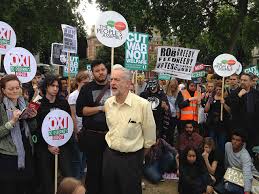
corbynimages (12)I hadn’t even gotten out of my scratcher yesterday morning when I looked at my mobile and the BBC news web site to see what was happening in the world, only to see yet another attack on Jeremy Corbyn’s campaign for Labour party leader.  This time the Brlairite was Blair himself, looking skull-like and definitely not very well – all that chasing after money mustn’t be good for his health.  “Labour must come to its senses” he apparently said.  I didn’t read any more.

Corbyn has been criticised in just about every way imaginable, from the Mail prophesying a return to the “dark ages”, riots and intervention by international peace keepers, to the oh so condescending approach of Janen Ganesh of the ‘Financial Times’: that Corbyn’s policies, “eccentric” and a “joke” as they are, are not really the problem, it’s the “soft left” and Andy Burnham and Yvette Cooper who are the ultimate problem.  Poor Jeremy, he’s either responsible for a new dark ages or he’s such a joke he doesn’t deserve consideration, even as a problem.

At the centre of all this dismissal is contempt and ridicule of Corbyn’s economic proposals for “quantitative easing for people instead of banks.”  Our local biggest daily ‘The Irish News’ had its own columnist to hurl his own critique, this time mixing both dire prediction and condescending ridicule.

The author, Newton Emerson, thinks that fewer than 1% of the population will understand “why Corbynomics is ridiculous” even though “it takes little more than an A-level to understand why.”

Emerson is normally an acute commentator on politics in the North of Ireland, frequently exposing the hypocrisy of political culture here and the rottenness of the political arrangements.  Unfortunately he has two problems.  First, when it comes down to it he actually supports the rotten political arrangements, and secondly, he gives every indication of having been educated in the dismal science of economics as taught in the universities.

He is undoubtedly correct that the general population is seriously under-educated in economics and this is a real problem for them identifying their interests in any debate.  On the other hand I don’t believe that Corbyn’s ideas are very radical and certainly not ridiculous, so going to university or doing an A-level really isn’t the answer.

So let’s see if we can understand what the issues are in this case.

Quantitative easing as practiced by the Bank of England involves the bank loaning newly created money (created as an electronic entry in the bank’s accounts) to a fund which has to pay it back, so theoretically it’s a loan and not just giving away newly created money.  This fund then uses these loans to buy government issued bonds (IOUs payable by the Government) that are held by pension funds.  These pension funds now have money instead of these bonds.

The theory is that these pension funds will then want to use the money to buy other assets from banks such as bonds to replace the ones just sold back to the government or buy other sorts of securities such as private debt instruments (IOUs issued by private corporations to raise money for investment).

The end result is that money has been created electronically by the Bank of England and it now rests in the banks which, it is hoped, will use the new money to buy debt issued by private firms that will in turn help them invest directly through the money just received.  This investment will create jobs and economic growth.   That’s roughly the theory anyway.

However, once the banks have the money they can do what they want with it.  They could buy bonds or securities issued by other countries; they could buy existing shares or securities which would give no more money to firms to invest but simply increase the price of these pieces of paper; they could buy commodities or property and cause inflation in these assets or they could simply sit on the cash.  In each case there would be no increased employment or contribution to economic growth.

Even if they bought newly issued debt from private companies, these too could decide not to invest the money in new factories, offices or equipment and instead do any of the above and join in the great speculative boom in property or share prices etc.  Many banks and companies appear to have done just this, which has made them richer but not helped economic growth.

In other words the ‘money printing’ that has been carried out has helped the banks and made the rich who hold financial assets richer by increasing their price.

Hence the alternative proposed by Jeremy Corbyn in which the newly created money, which is also in the form of a loan, is given to a State investment bank who then loan it out to state agencies which would invest in state-owned infrastructure such as “housing, transport , digital and energy networks.”  The objective would not only be to create jobs in the short term and promote economic growth, so reducing the debt burden, but also contribute to the longer term productivity of the economy, which is recognised as going through something of a productivity crisis.

To be continued.

The UK general election part 2: DIY austerity

8841963_origDuring the election, instead of selling themselves as a vote for independence the SNP presented themselves as the leaders of Scotland’s opposition to austerity who would make the new Labour Government keep true to its word of opposing austerity.  As I have and others have said, this was a lie.  The SNP opposed a vote for Labour in England and Wales since they supported the Greens and Plaid Cymru.  So where was this Labour Government to come from?

The SNP vote cannot therefore be characterised as any sort of left vote except in the sense I mentioned earlier: that workers often express their interests in very distorted form.  In this case in the form of nationalism that put forward the idea that Scots are uniquely opposed to austerity and the English not.  The SNP vote can also be said to be a nationalist one because a nationalist solution to austerity was proposed, even if it was supported by some who would not want to go as far as independence.

If the Scots were uniquely opposed to austerity they would also have demonstrated opposition to the cuts transmitted by their own Scottish parliament led by the SNP.

This party has slipped seamlessly from standing in order to put a backbone into a new Labour Government to the election being “a vote to make Scotland’s voice heard loudly” in Westminster.  Those who think there isn’t really any difference should read the last sentence again.  They should also consider if the SNP in any way contributed to getting the Tories out.  As I have also said before the only Tories they wanted out was the ‘red’ variety.

The absence of Labour in Government, which they said would be reliant on them, now means their real reliance on those in power in London is exposed.  Like the nationalists that they are the SNP demands privileges that they would not even consider for others.  So the new Tory Government has to listen to the ‘voice of Scotland’ even though they are 50 per cent of Scottish voices with 1.45 million votes.  UKIP on the other hand won 3.88 million votes, over two and half times the SNP vote. Should their voice not be louder?

However, now that the Conservatives are in Government the SNP will be seeking to cut a deal with them to increase devolved powers – so much for excoriating Labour and their promises not to do deals with the hated Tories.  The Guardian on Saturday reported an SNP advisor saying that Sturgeon will now negotiate with the Tories and that all the repeated promises that the party would never work with the Tories were based on the Conservatives forming a minority coalition government – not an outright majority.

Perhaps this approach seems obvious to SNP supporters but it isn’t at all obvious to anyone else.  If, as it claimed, it stood in this election against austerity why isn’t it trying to cut a deal on reducing austerity instead of more constitutional powers?

The election demonstrated that the SNP and Conservative Party were good for each other.  The inherently anti-English message of independence produced an anti-Scottish response led by the Tories and UKIP who were able to argue that a Labour Government in hock to a party bent on destruction of their nation was a mortal danger.  Both the Tories and SNP knew what they were doing in this mutual loathing.

Now, as the mutually beneficial conflict between the rival nationalisms continues to play itself out, it will become clear that English nationalism is bigger and uglier – because England is bigger and nationalism throwing its weight about is always ugly.

Boris Johnson has advocated giving the SNP greater devolved powers for the Scottish parliament – “some kind of federal offer”.  This is not such a novel departure since the Tories were already more radical than Labour before the referendum in what they promised as devolution in place of separation.

An offer by the Tories of full fiscal autonomy would call the SNP’s bluff since they know full well that Scotland could not afford such an arrangement given the fall in oil prices.  In effect it would be DIY austerity.

The SNP will argue that it wants any new arrangement to maintain current levels of financing.  In other words a settlement that allows Scotland the benefit of higher oil prices should they return but no down side when they don’t.  The English oppressors in the meantime will have to subsidise higher levels of public expenditure in Scotland.

When the Tories make mincemeat of these demands the SNP can then make the case that the dastardly anti-Scottish Tories are at it again and only independence will allow them to borrow more, make savings on Trident and make the independence sums add up again irrespective of the oil price.  Something they haven’t been very convincing at doing so far.

In the meantime increased tax and spending powers may allow the SNP led Scottish parliament to cut corporation tax, as will the Stormont administration in Belfast with the new tax varying powers that the Tories have already promised.  They can then unite with their Celtic cousins in the Irish State in a joint project of cutting each other’s throat.

The debate has begun on what the lessons are for Labour with the Blairites already dominating the media agenda that Ed Miliband was too left wing.

Such an argument hardly squares with the Labour rout in Scotland and nor with Labour gains in London.  It was obvious when Miliband became leader that he had to distance himself from the Blair legacy of the Iraq war and the obsequious defence to the city of London and the financial interests behind the crash.  We’re now asked to believe that a return to this politics is the way back.

Such a policy would have led the Labour Party into an even more confused message than it already had and would have left it with little or nothing to distinguish itself from a Tory Party promising deficit reduction, tax cuts and more money for the health service.

Even the rise of UKIP and the part of its vote that was taken from Labour cannot be seen as an endorsement of a move right.  In this case just how far right would you have to move to rival the xenophobic policies of that lot?

I remember two weeks ago listening to a vox pop on radio 4 from a constituency in the North of England.  A young man was saying he was voting UKIP as a protest against Labour even though he did not at all agree with UKIP policies because he wanted Labour to be more left wing!  I’m not for a moment suggesting that the working class UKIP vote is a left wing protest but some of it is a working class vote that is Labour’s to win.  These voters are not all irredeemably reactionary.  It is rather another example of some workers expressing their class interests as they see them, in a very distorted and disfigured way.

They are demoralised workers who blame immigrants, foreigners or Europe, or simply the establishment understood in some vague way, for the precarious position they find themselves in.

These people did not vote Tory and they did not do so because demoralised or not they don’t confuse their interest with those of the Tory classes and their smarmy representatives.  They just can’t identify their position with an uninhibited and robust defence of their class interests from a socialist perspective.  Perhaps because they haven’t been presented with it or because they have grown cynical with promises of it in the past that haven’t been delivered on.

There is no Blairite answer to workers who blame immigrants for lack of affordable housing, low wages, unemployment and failing health and education services.  There is a left wing answer and however weak it may be from a Marxist perspective it certainly makes more sense than voting UKIP.

The parliamentary arithmetic looks very bad for Labour, behind the Tories by almost 100 seats and suffering almost complete wipe-out in Scotland.  But that is only half the story.

Their vote increased by more than the Tories, and that despite the losses in Scotland.  They may trail by 99 seats but they lag only by 6.5 percentage points of the vote.  The Tories are not in as strong a position as they appear.

First they have a small majority and second they are about to go through a debate about Europe that has the potential to split them extremely badly.  This will take place most likely against the backdrop of gloomy economic news and growing unpopularity as the reality of their election promises come home to roost.  Cameron may seek to provide raw meat to the most Thatcherite elements of his party in order to provide himself with some room to keep the UK inside the EU.

Right now the opportunity exists to have a debate in front of working people about the wide range of policies that they need to advance their interests.  This arises from the debate on who will be the replacement leadership of the Labour Party.  It will not of course be a debate pitting a pure revolutionary programme (however understood) against a cowardly watered down Keynesianism.  But what could ever lead anyone to expect that?  This is where the working class is at and no amount of wishful thinking will make it otherwise.

Will those organisations claiming to be Marxist be able to place themselves in the middle of this debate?  Will they even want to? The debate will happen anyway and many will look to it for a new way forward beyond the despair that the new Tory regime will inevitably create.

The UK general election – part 1: ‘they’re all the same’

images (9)“Were you watching the election last night?” the doorman asked me when I walked into work on Friday morning.

“Yeah, five more years of Tory cuts”, I answered disconsolately.

“They’re all the same”, he said.

A common enough view.  Certainly the view of the left who stood for election, hoping for a vote while realistically knowing that they had no chance of being elected and discounting the effect of taking votes away from the Labour Party.

But not the view of others.

‘The Guardian’ reported that once the result became clear bank shares went up as the threat of more restrictive regulation receded and higher taxes on bankers’ bonuses loomed less large.

Around £1billion was added to the value of the energy company Centrica with the disappearance of the prospect of tougher rules in the energy sector.  The share value of companies that provide outsourced services (privatisation to you and me) also rose, as did those of Sports Direct, whose shares rose by £95m without a Labour threat to their use of zero hours contracts.

“Enquiries came in just after midnight” said one London estate agent, from prospective clients who no longer had to ‘worry’ about Labour’s ghastly mansion tax.  Even bookmakers did well, with Ladbrokes share value rising as the plan to crack down on fixed odds betting terminals, the ‘crack cocaine’ of the industry, disappeared, as Labour’s promise of a crackdown became a ripped up betting slip.

But the report in the ‘Financial Times’ on Saturday put it best, beginning its article like this. .

“. . as the surprise exit poll results came in shortly after 10pm on Thursday night, the mood in the Cavalry and Guards club on Piccadilly turned from funereal to one of incredulous celebration.”

“Earlier in the evening , diners at the Mayfair gentlemen’s club had wallowed in gallows humour as they declared that the election result could mark a fin d’époque for the wealthy in London. . . This stiff upper lip turned to genuine joy as it transpired that the fortunes of the Conservative party had exceeded both the opinion polls and the party’s wildest dreams.”

“This could turn into the biggest celebration ever”, said one Tory supporter. . “We can cancel the removal vans. Non-doms watching the exit polls are unpacking their bags”, said his friend.”

All overstated of course, but those who won’t acknowledge any truth in the report are blowing out of the wrong end.

In some ways I find such reports reassuring.  The super-rich, the real capitalist class, are daily invisible and even the reports of their reaction to the result are through their minions who sell their shares for them or sell them houses or advise them and the rest of us that higher taxes for the rich are a jolly bad thing.

These reports reveal the existence and power of those behind the system, who benefit most from its inequality, and provide glimpses of the class structure within the capitalist mode of production.

While the thought of champagne-popping celebrations in London gentlemen’s’ clubs are valuable because they provide an instinctive and visceral view of what the election victory means it really is no more than that.  The existence and power of the capitalist class, which can appear rather abstract and esoteric in Marxist analysis, is impersonal and largely invisible not only because we don’t run across the mega-rich every day but because it is the system itself which is the problem.  The super-rich are just the personalised expression of the social relations of the system, just as the rich hangers-on of these people such as the estate agents, city dealers and tax advisors represent themselves as the appearance of their mega-rich clients.

Understanding the system and how it works and what the alternative to it is are therefore fundamental.  Understanding the class nature of society and what side you’re on is what’s called class consciousness and it is oddly reassuring that at least one section of society understands theirs.

However the impersonal and systematic nature of capitalism makes this difficult for workers and in so far as they do recognise their own interests this is often expressed in distorted ways. Sometimes very distorted ways, as shown in the election results.

So a lot of the explaining of the election result takes off from the appearance that, for example, Miliband was a bit of a geek and Cameron much more Prime Ministerial.  While Sturgeon, a career politician in the Scottish parliament since 1999, is genuine and sincere and not like the other career politicians; one who could be trusted not so much despite the record of the SNP in Government but sometimes in more or less total ignorance of it.

At only a slightly more sophisticated level of analysis it is claimed that the election was lost because Labour did not have a coherent narrative.  They allowed the Tories to get away with lying that the recession was a ‘Labour recession’ caused by excessive Government spending instead of a financial crisis that affected the world.  They had a confused message that promised to reduce the deficit but also to protect public services and they appeared to both stand for and not stand for robust social-democratic politics.  All very true of course but hardly convincing by itself.

After all, if Labour sent mixed messages the Tory story was beyond belief. They waved the big scary deficit monster in everyone’s faces while promising to pass a law that appeared to prevent them from putting up taxes.

They were going to cut welfare, and not in a nice way either, but nobody would really get hurt, or rather they refused to say who would get hurt.  They had done it before they said and therefore could be relied upon to do it again.  Their record spoke for itself they said, except their record on welfare cuts didn’t at all support their claims.

While the deficit was their number one priority and hard choices had to be made they were still going to cut taxes and give the NHS an increase of £8 billion!  Was anyone supposed to believe this rubbish?

If they looked like they were confident of winning, while almost no one believed they would, it had to be because Eton and all the other posh schools they go to teach smarmy self-confidence and born to rule self-belief, while their management of the economy would appear to reflect that PPE at Oxford now means a piss poor education.

At a more persuasive level it has been argued that the improving economy allowed the Tories to claim that their austerity policies were working, and Labour appeared to have no convincing rebuttal to such claims.  In some respects therefore the Tories got lucky.  The recent upturn is very likely to be very temporary as the most recent figures for economic growth herald the downturn to come.  The recent upturn has therefore been based on short-term cyclical movements and one-off factors.

To really be able to rebut the Tories on this point would therefore have required a more advanced understanding of economic development than Labour was ever going to argue for, and frankly a more advanced understanding than many workers show themselves ready for at the moment.

It is nevertheless true, that despite these problems, the fact is that for many austerity has not ‘worked’ and has still led to the longest period of falling living standards for a very long time regardless of the latest limited improvement.

Finally it has been argued that the Labour party was caught between competing nationalisms in Scotland and England.  This would appear obvious but if you really believed the claims of the SNP it’s not.  This is because the SNP stated that the general election was not about independence.  They stated this because despite all the hype, the SNP lost the referendum, they might lose it again if they tried to have another one soon and they know they have perhaps only one more chance.  The sharp drop in the price of oil since the last one means the independence sums don’t add up.

Getting the ‘Red Tories’ out?

Sun Scotland England Tory SNP divide and conquerI was walking down Buchanan Street in Glasgow on Saturday afternoon when I came across a group that all had large red stickers on them saying ‘Red Tories Out’, which is Scottish nationalist-speak for the Labour Party.  The leaflets they were giving out called for a vote for the Scottish National Party so that it could ensure that a new Labour Government was socially just.  What on earth is going on?

‘Red Tories Out’?? The Labour Party is not in office in Holyrood in Edinburgh and equally obviously not in office in Westminster in London, so what exactly do this group of nationalists want Labour out of?  Since they assume (for the sake of their argument) that they are utterly opposed to the real Tories being in power and the only real alternative is the Labour Party, the only answer consistent with their proclaimed strategy is that of no Labour MPs in Scotland but a majority in England and Wales, one big enough to allow their favoured scenario of a Labour Government dependent (or so they want) on SNP support.

No matter how they dress it up the reactionary nationalist logic of division surfaces each time the left in Scotland trumpets its supposedly radical political credentials.  The Labour Party is shit; Scots need an alternative but Labour’s good enough for English workers, and we’ll just ignore the fact that we need it as well in order to defeat the hated Tories.  But just to show how this isn’t really our strategy we’ll support other parties in England and Wales standing against Labour.

‘Red Tories Out’ turns out to be not just out of Scotland but everywhere.  Except if successful this would let the real Tories in as Labour voters supported the Greens and Plaid Cymru, assisting the Conservative Party to capture marginal seats where Labour is the only conceivable alternative.

Of course this would mean that these nationalists wouldn’t be open to the charge of hoping to foist Labour on the English while it wasn’t good enough for them, but then they would have to explain to everyone what’s left of their supposed overriding priority in this election of getting rid of the Tories.

Something in their argument has to give and what gives is their proclaimed support for a Labour Government supported by the SNP.  What you see is what you get and when you see ‘Red Tories Out’ stickers it means what it says, no more and no less.  When you see aggressive heckling of Labour in a Glasgow street you’re seeing the real vitriolic hatred of the Labour Party.

It is the Labour Party that has stood in the way of the SNP objective of ‘speaking for Scotland’; the SNP having some time ago captured swathes of Scottish Tory support.  It is a Tory Government in Britain that strengthens their claims that only independence can rid Scotland of the Tories and it just such a Government that would provide the grounds upon which another tilt at separation might be launched.

So the ‘Scottish Sun’ newspaper calls for a vote for the SNP while the English version supports the Tories.  The Tories demonise the SNP, making their nationalism more attractive in Scotland in the process, and the SNP ride the wave of increased nationalist division by decrying opposition to their participation in government in England as anti-Scots while basing their whole rationale for existence on the baleful influence of the English.

So it turns out that it is the position of the Sun that is the most consistent of the publicly proclaimed stances – Tories in England and Wales and the Tartan variety dressed in ‘anti-austerity’ clothing in Scotland.

Both on the face of it (‘Red Tories Out’) and looking at underlying political calculation, it is clear that Tory little-Englandism and SNP nationalism is seeking to exploit nationalist division to their own benefit while undermining the causes they say they aspire to – unity of the UK in the case of the Conservative Party and anti-austerity in the case of the SNP.

Reading ‘The Herald’ newspaper on Saturday it reported from focus groups that voters have stopped listening to the political arguments and have bought into the narrative of empowerment, derived from the independence referendum, and the perceived possibility of standing up for Scotland in the General election. ‘No’ referendum voters are therefore voting SNP.

This doesn’t look like a simple unthinking or emotional vote to me but a buying into nationalist assumptions that don’t withstand political analysis and argument.  And the most fundamental of these is that there is a ‘Scottish’ interest oppose to that of ‘London’.  The conflation of nationalism with the interests of workers allows promotion of nationalism to appear as the promotion of workers’ interests even while it does exactly the opposite.

The double standards and scarcely conscious hypocrisy of the Scottish left are symptoms of this nationalism and an apparent disengagement from political argument an expression of the soporific effect of nationalist illusions.

But it would be wrong to blame the nationalists alone.  The Labour Party, that object of nationalist hatred, deserves its own fair share of blame.  For a long time it has channelled Scottish workers opposition to what is now called austerity into nationalist and constitutional demands in order to avoid a response based on workers’ own struggles and socialist policies.  In this way it could pioneer the conflation of workers’ interests with Scottish interests, when the latter might be seen to be reflected in their own political dominance in the country.

This could be seen in their impotent opposition to Thatcher and support for devolution and now in the appointment of Jim Murphy as Scottish Labour Leader and his proclaiming of the Labour Party as the party best based to fight for Scottish national interests.  When it comes to fighting for national interests it’s hard to out-do nationalism.  It has taken Ed Miliband to make the most prominent case for workers interests irrespective of nationality.

b_fimfswqaajkuk

While over in Glasgow I took in the Celtic match and logged on to a fans blog.  One poster derided concerns over the barracking of Jim Murphy while canvassing in Glasgow city centre, saying the guy was a Blairite and had responsibility for the wars in Iraq and Afghanistan. He had blood on his hands and deserved no sympathy.

Fair enough point you might think. As far as it goes. But where is it supposed to go?  A bit of shouting and obstruction hardly seems sufficient punishment for mass murder, does it?  But what would be appropriate punishment if that was the purpose of the barracking?

Well, for a socialist it is not this or that particular bourgeois politician that is the problem (and certainly not the answer).   So the SNP is opposed to ‘illegal’ wars?  Is legal mass murder any more acceptable?  Does a UN mandate legitimise imperialist murder? Just what sort of alternative is the SNP that the protestors against Murphy support? Just what sort of political mobilisation is it that rallies round a nationalist party whose fiscal manifesto is not essentially different from Labour’s yet considers itself self-righteously anti-austerity?

What matters for the future is building an alternative not only to bourgeois politicians but to the system itself that creates the social basis for these politicians, one which relies precisely on workers lack of engagement in political argument and analysis.

Right now such an alternative requires opposition to nationalist division.  It therefore means voting for the best option, given the choices available.  A vote for the Labour Party can be justified as one that will provide the best circumstances for fighting austerity, both by virtue of rejecting Scottish nationalist illusions and facing a reduced austerity offensive.

Nationalist separation on the other hand is a counsel of despair, one that asserts that British workers can never fight for an alternative.

  1. A friend has alerted me to an interview in Jacobin magazine with Neil Davidson, a supporter of Scottish separation, and I will take up the arguments raised by him in a future post.

The UK General election, the Labour Party and the SNP. Who’s calling the shots?

snpWhen the Independence referendum was lost by the nationalists I noted that this created something of a problem for left supporters of Scottish separation.  Their claim not to be nationalist looked threadbare when set aside rallies festooned with Saltires but now they had questions to answer.  Today the questions are even harder.

If the pro-independence campaign that they hailed as a genuine left-wing grass roots movement was not nationalist how do they explain that it is the nationalist Scottish National Party that has reportedly grown enormously since the referendum?  How do they explain that even within their ranks large chunks of their supporters are now members of the SNP?  How are they to explain that figures like Tommy Sheridan are calling for a vote for the SNP in the UK General election?  He wants to wipe out the ‘Blue, Yellow and Red Tories’ but not of course the Tartan ones.

The SNP are now regularly reported to be in position to wipe out the Labour Party in Scotland which would be quite a reversal.  In fact such a reversal that it overturns one of the claimed grounds for Scotland’s independence – that Scotland is more progressive because it elects predominantly Labour MPs.  Shortly it may predominantly elect a party that has gotten to this point by first taking over and assimilating a large part of the Scottish Tory vote, and it will be England and Wales upon which a Labour Government may be elected.

This is excused by the claim that the Labour Party of today is not the Labour Party of yesterday and indeed with the advent of new Labour this is to an extent true.  However, it is also true that the Labour Party of 2015 is not essentially different to that of 1975 or even 1945 and the view that it somehow is exhibits a flawed understanding of that party.

And there is another problem.  The SNP is making the claim, on the face of it ridiculous, that it will ensure that Ed MIliband becomes Prime Minister through Scottish voters voting not for the Labour Party but for the SNP.  How is Tommy Sheridan to justify opposition to the Labour Party, or ‘Red Tories’ as he prefers to call them, by voting SNP?  Perhaps it is because depriving the Labour Party of a majority might allow the real Tories into Government again, through some sort of new coalition with what’s left of the Liberal Democrats and support from the Democratic Unionist Party?

The SNP are making this type of claim because on their own they are incapable of offering any alternative effective opposition to the austerity that is the main issue in the campaign.  This has already been made clear by their imposition of austerity as the party of Government at Holyrood. Their projections for the financial position of an independent Scotland have already been blown out of the water by the collapse of the price of oil.   Their call for full fiscal autonomy is similarly exposed.  As I pointed out after the referendum result the only effective opposition to austerity can come from an all-British alternative but the ‘non-nationalist’ ‘left’ has seemed oblivious to this.

The SNP however being a serious bourgeois party is not.  That is why Nicola Sturgeon has moved the SNP to take up a UK-wide approach, at least rhetorically, projecting the SNP as a necessary part of a united front against austerity, for example in a possible alliance with the Greens and Plaid Cymru.

Knowing equally that this is not any sort of real alternative has forced her to make a virtue out of necessity and claim the need for the Labour Party to rely on SNP support.  It is backhanded recognition that only the Labour Party can blunt the Tory inspired austerity offensive and its intensification should they lead the next Government again.

So the SNP must claim opposition to Tory austerity as its priority when its real goal is to destroy the Labour Party in Scotland, so making continuation of Tory austerity that more likely.   That other serious bourgeois party, the red, white and blue Tories, also know this, which is why they have been bigging up the SNP and Labour’ so-called dependence on it, in order to undermine Labour.  They do this even while it also undermines the union they support; yet one more illustration of their incompetent character.  At least Thatcher’s strengthening of the forces of Scottish nationalism can claim it was unintended.

The two parties feed on each other, illustrating the divisive role of nationalism for the British working class. As this excellent post here points out, a plurality of SNP voters would rather have a Tory Government than a Labour one if it meant more SNP MPs.

The nationalist left’s opposition to ‘Blue, Yellow and Red Tories’ reduces to opposition to Labour since in Scotland the first has only one MP, the second is stuffed across Britain and the third is the single existing disproof of their claim that only nationalist separation offers an alternative to the Tories.  It is mightily embarrassing when an election comes long in which it is clear that this is patently untrue.  Except of course, as the post recommended above describes, the SNP is on such a roll that nothing will embarrass it, at least not at the minute.

The left nationalist case is that separation is necessary to defeat the Tories and that the UK state is unreformable, in the sense that it will never be social-democratic again.  Their enemy is therefore not the Tories, whose existence seems only to confirm this.  On the other hand, as even the mildly left approach of Ed Miliband threatens such claims, we can glimpse the fundamentally weak foundations upon which the great surge of Scottish nationalism currently rests and the totally spurious grounds on which left nationalism sits.

The actions of Sturgeon and the SNP demonstrate that in this General election the only alternative to Tory austerity, however weak and limited it is, is the Labour Party.

The Left against Europe 2

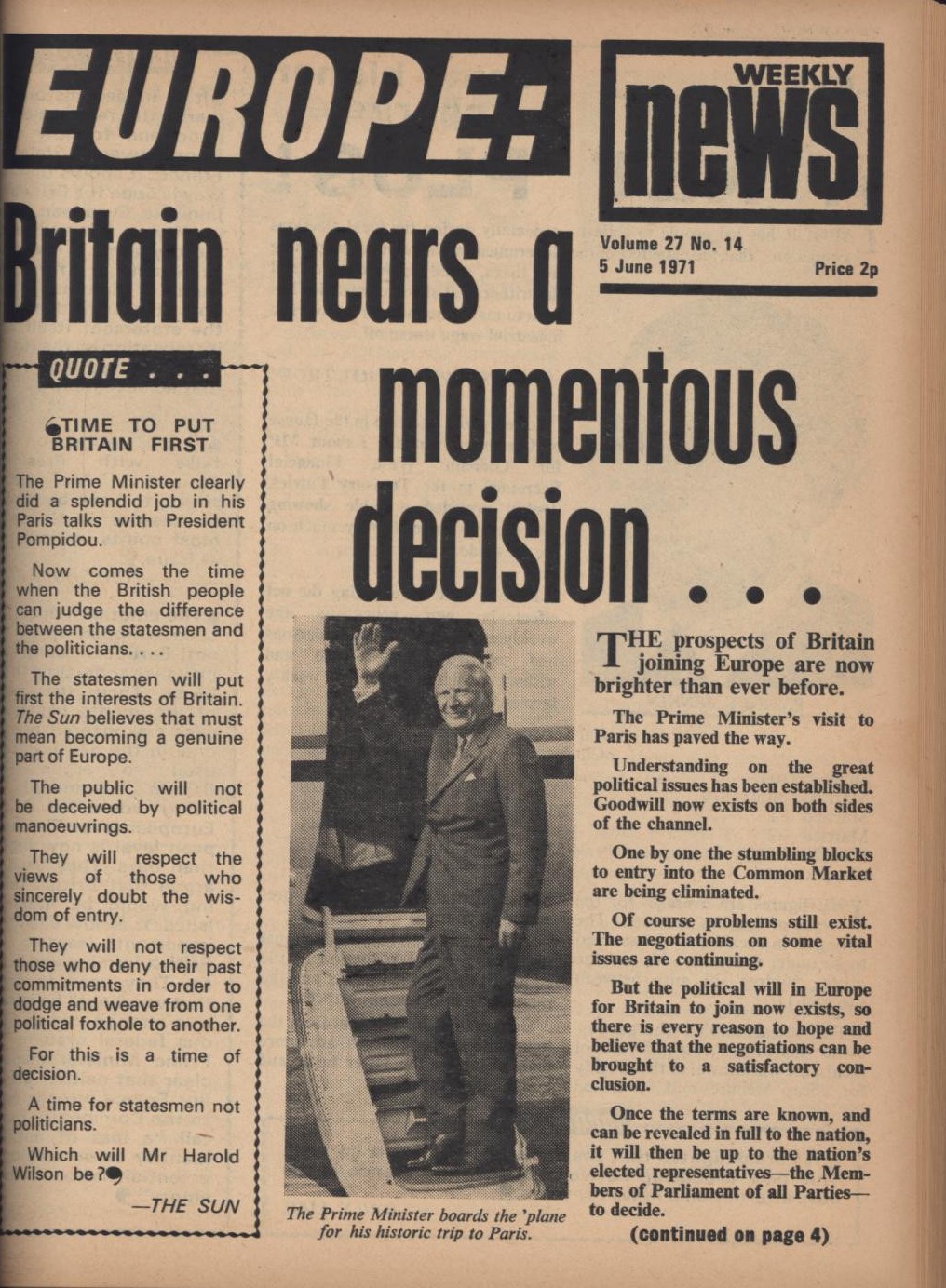
PUB 193-23 - EuropeIn explaining the opposition of the left in Britain to joining the Common Market in 1971 Tom Nairn argues that the working class had succumbed to nationalism long before and that nationalism had successfully corralled the rising working class movement in the 19th century. This of course eventually led to the mass socialist parties of Europe dropping their internationalist stance and supporting their own state in the slaughter that receives its centenary this year.

Having fixed the class struggle within national limits, within which it “acquired great inertia and the natural conservatism of hard-won reforms”, the bourgeoisie was able to seek new international or multi-national forms more appropriate to the expansion and development of the capitalist mode of production.  “It does so very cautiously, amid great confusion and contradiction.”  However in this movement “the principal asset of the western European bourgeoisies is a simple one: the absence of the left.”

The margin for manoeuvre afforded the leaders of capitalism is relatively large because the class struggle in Europe long ago lost any concrete international dimension.  They are able to pose “questions to which the socialist and communist left simply have no answer . . . that is, except futile opposition, evasion of the issue, or a harmless rhetoric of abstract internationalism.”  Nairn then sets forth how he sees the left’s intervention within the ‘great debate’ in 1971 exhibiting all these characteristics.

Just like today, opposition to the Common Market was de rigueur and taken for granted.  It was opposition to a super-state – one bigger and further away, built in support of the biggest capitalist monopolies.  As we noted in the first of these posts Europe was “somehow more capitalist in nature than Great Britain and the British State.  The Common Market nations are either more capitalist than Britain, or they are capitalist in a more sinister sense; while the Community’s Brussels institutions represent the bureaucratic heart of darkness.”

“It would hardly be correct to call this a theory” remarks Nairn.  He quotes the British Communist Party (CP) stating that the Common Market is ‘anti-planning, anti-socialist, anti-working class’. National governments and their elected Parliaments have no control over its gigantic bureaucracy and the British would be merely represented in the same proportion as the Italians ‘as one sixth of the population of 300 millions involved.’  ‘We would be virtually sunk without trace’ and parliament would no longer be supreme.

The nationalist and statist conception of socialism exhibited here by the CP is hardly a surprise but it is remarkable, despite the categorical collapse of the Stalinist states, how much of this Stalinism is alive today under the banner of many of the supposed Trotskyist organisations – from their bureaucratic and undemocratic internal functioning to their reliance on nationalisation as a socialist measure, their support for popular front types of campaign organisation and electoralism.  And here: their opposition to the EEC.

What this illustrates is the good old Marxist dictum that being determines consciousness, that the material factors at play in society, the power of the capitalist mode of production and its state and the political movements supported and ideologies promoted by it, are more powerful than the purported political theories and programmes of small and isolated revolutionary organisations.  So the revolutionary left organisations in Britain in 1971 opposed entry into the EEC while today there is no campaign to leave it despite the question arising now as a live issue, yet in between there has been no reassessment.

Nairn looks at some of the left objections to the EEC, which are still around today.  On the Brussels bureaucracy Nairn points out that the employees of the Common Market Commission were approximately one fifteenth of the number working in one British Ministry, the Department of Health and Social Security.  On whether the Common Market is capitalist or not he asks the question “how could a union of six or ten capitalist national states be anything else?”   But the rational question for any socialist is “which of these two sets of capitalist conditions, the national or the Common Market, offers the best future environment for revolutionary thought and activity?”

Nairn remarks that, of the left in the anti-EEC campaign, “none of them – with the possible exception of the CP – looked happy inside it.  On every hand one found doubts, qualifications, and reservations.”  Nairn then looks at the arguments of various organisations on the revolutionary left, including the International Marxist Group (IMG).

The IMG opposed entry because “the Common Market is opposed to both the immediate and the long-term class interests of the labour movement.”  “The EEC is a capitalist solution to capitalist problems.”  However it lamented the lack of any scrap of socialist internationalism within the left of the Labour Party and argued that “chauvinism is a vicious enemy which must be destroyed.”  The unity of the Labour and trade union leaders and the mass of trade union members in opposition to entry is a unity that “holds no future for the working class, and one which must be rejected and fought against.”

The IMG posit that millions of workers are discussing the issue and into this debate revolutionaries can insert the alternative of working class unity “and the strategy of a red Europe against the capitalist EEC.”  This would involve “creating living links between workers’ struggles in the countries of Western Europe.”

In the same issue of the IMG paper ‘Red Mole’ Nairn quotes from an article by Ernest Mandel which looks at the EEC as an economic and political mechanism reflecting the internationalisation of monopoly companies and the need for British capital to join their competitors because it cannot beat them from outside.

Mandel concludes by stating that the most important factor in assessing the situation is “the dynamic of the class struggle.”  Joining the EEC would cause immediate material losses to workers but they could compensate for this because entry would not reduce economic class struggle but would exacerbate it. Political radicalisation would be reinforced (although entry was still opposed).

So how could the statement that “the Common Market (is) opposed to both the immediate and the long-term class interests of the labour movement” and the one stating that an increase in economic class struggle and reinforced political radicalisation will arise from joining both be true?

Nairn records the isolation of the revolutionary left in the debate but that they protected themselves from being camp-followers of left nationalist opposition through “a certain degree of intelligent half-heartedness.”  “Honour was saved, mainly by looking both ways at once and saying two different things at once.”  For Nairn this position arose partly from the void where some sense of what internationalism meant practically should have been.

So what was the reason for this lack of socialist internationalism?  Nairn quotes the IMG author: “  It is not the objective conditions that have been responsible for a lack of socialist internationalism in Europe but a failure on the part of the bureaucratically led labour movement to live up to its responsibilities.”  So the alternative is then to build a revolutionary party.

Whatever about the truth of the latter as a definition of the solution there are problems with the explanation of the problem.

For small Marxist organisations of hundreds or thousands the nationalist consciousness of millions of workers is not a subjective factor.  While betrayal of particular struggles on particular occasions has undoubtedly taken place it is hardly adequate to say that workers’ consciousness arises from having been betrayed repeatedly for decades otherwise the working class is essentially stupid.

What is the objective basis of workers consciousness over decades in all the most developed capitalist countries?  A Marxist would look for causes as long-lasting and as deep seated and profound as the phenomenon which is in need of explanation and ‘betrayal’ doesn’t meet this requirement.

It makes no sense to say that reformist and nationalist leaders betray reformist and nationalist workers.  The often contradictory character of workers’ consciousness can see their most radical and militant notions and impulses betrayed by their leaders but what has to be explained is why this radical consciousness does not predominate and why it can be betrayed, repeatedly.

Why is the lack of internationalist consciousness so pervasive among workers?

I will look at how the left has come to these questions in a future post but the next one will continue to look at how the question of the EEC was addressed by the revolutionary left in 1971 through looking at the debate within the International Socialists, forerunner of todays’ Socialist Workers Party.

Back to part 1

Forward to part 3

Scotland is different II

Image


IMG_0333a

the-england-scotland-border-thornaby-on-tees


‘Is there a Scottish Road to Socialism?’, edited by Gregor Gall, Scottish Left Review press, 2007.

‘Scotland’s Road to Socialism: Time to Choose’, edited by Gregor Gall, Scottish Left Review press, 2013

My sister received a leaflet from the local Scottish Socialist Party branch opposing the bedroom tax and saying it would be abolished by independence.  It also announced a meeting which would show Ken Loach’s film ‘Spirit of ‘45’, which records the famous victory of the Labour Party in the 1945 election.

It is therefore ironic to note that the Labour vote in 1945 in Scotland was not very different from the rest of the UK. One observer noted that “The most Conservative of the big British cities is – Glasgow!  And it did so by staying as it was before.  London is far “redder” than Glasgow” (quoted in ‘The Strange Death of Labour Scotland’, p. 205).

When one considers that the only party ever to get an overall majority of the vote in a Scottish election is the Conservative Party in 1955 a claim for Scotland’s necessary or intrinsic progressiveness looks pretty weak.  At this time many Scottish workers voted Conservative, the party having a membership of 250,000, and many were infected by Orange, anti-Catholic sectarianism.  This strain in Scottish society has of course very much diminished but it has not at all disappeared.

Historically Scotland was a stronghold of the Liberal Party; in the19th century it won a majority of the vote in every of the 20 elections held between 1832 and 1910.  Trade unions developed earlier in England and Scottish workers were lower paid and considered more docile.  This may have built a head of steam for ‘Red Clydeside’ before, during and after World War 1, on which rests to a significant degree Scotland’s reputation for workers’ militancy.

However the main burden of the argument for a more left wing Scotland rests on the domination of the Labour Party in Scotland for most of the last 50 years.  In 1959 the Conservative Party was still ahead of Labour but in the 1966 election Labour won 49.9%, the highest it was to achieve.

Subsequently the dominance of the Party relied more and more on the first-past-the-post electoral system and the limitations of its support were masked somewhat by the decline in the Conservatives, with that party being negatively affected by the electoral system.   So in the 1992 Westminster election the Tories gained over one quarter of the vote but only 11 (15%) of the seats.  In the following 1997 election its vote was 17.5% but it won no seats.  The decline of Labour is reflected in the fact that its vote in Glasgow in 2011 was less than 24% of its vote in that city in 1951 and this is only partly explained by the decline of the city itself.

The Labour Party was never the ‘national’ party of Scotland not only because its strength was essentially regional, for example it only won Edinburgh for the first time in 1984, but because the country’s class differences meant that it would have been very difficult for any single party to play this role.  It is this role that the SNP now hopes to take up but it can only succeed if class distinctions are buried.  Victory in the referendum would help such a project.

Two authors put the strength of the Labour Party in Scotland down to the relatively large role of council housing, the size of the trade union movement in Scotland and the political patronage of the Labour Party in local government.  They contrast this with the relative low membership of the Scottish party, which has generally been on the decline since the 1950s; its weak organisation, limited resources and relative lack of ideological ferment.

The decline in the three pillars of Labour is pretty dramatic: council housing fell from 54.4% of all homes in 1979 to 15.1% in 2005.  Trade union membership fell from 55% of the Scottish workforce in 1980 to 39.2% in 1991 and 32.2% in 2010.

Its power base in local councils has also declined.  In 1980 it won 45.4% of the vote, getting 494 councillors elected out of 1,182 seats and winning 24 out of 53 district councils while in the proportional vote election in 2007 it won only 28.1% of the vote, only 348 out of 1,222 seats and only 2 councils.  This decline has run parallel with nepotism and corruption scandals damaging the party but revealing the rotten underbelly of municipal state ‘socialism’.

Some of these trends are not unique to Scotland.  English council housing fell from a peak of 29% of homes in 1975 to 18% in 1985.  Trade union membership across the UK fell from a density of 55.4% in 1979 to 23.5% in 2009.  In English local government Labour had 9,630 out of 20,380 councillors (47.3%) in 1979 falling to 3,743 out of 18,216 (20.5%) in 2009. It controlled 169 out of 386 councils in 1998 (43.8%) and only 33 out of 351 in 2009 (9.4%).

Scotland has a proud history of working class struggle from Red Clydeside to the 16 month Upper Clyde Shipbuilders occupation beginning in 1971, to the 103 day sit-in in the Caterpillar plant in Uddingston in 1987 and the occupation of Timex in Dundee in 1993.  All this is something to learn from and share with workers from every other country as part of the international struggle of the working class, not a claim to some special badge of righteousness on which to pin a nationalist programme.

These can be seen as proud episodes in working class struggle within Scotland and Britain but they should not be placed within some supposed innate Scottish empathy with the oppressed that contrasts a Scottish “desire for fairness and justice” to the English ”ideological base”. (‘Scotland’s Road to Socialism, Time to Choose’, p. 34)  The Scottish working class never developed, even at the height of its militancy, a separate mass working class party or an autonomous political programme.  The story of the Scottish working class movement is inextricably linked with that of the British working class movement as a whole.  Within this framework each nation’s socialists can be proud of the history of revolt against oppression in their own particular country.

So while Scottish socialists can be proud of Red Clydeside, so English socialists can be proud of the Peasants Revolt, the Putney Debates, the Peterloo massacre, the Tolpuddle Martyrs,  the General Strike in 1926, Saltley Gate, Grunwick and  the heroic miners strikes in England, Wales and Scotland.

This is the history of the fight against exploitation and oppression that socialists across Britain should see as reference points in the fight for working class unity across the three nations.

Such an appreciation of the British class struggle would allow comparisons to be drawn between today’s referendum and previous elections.  In February 1974 the Tory Party in Government called an election in the wake of the miners’ strike under the slogan ‘Who Governs Britain?’ and after another election in October it was clear that is wasn’t the Tories when a new Labour Government was elected.  Today the independence referendum does not arise on the cusp of working class struggle in Scotland but is timed more to coincide with the 700th anniversary of a medieval battle.

A final argument can be put that, even if Scotland is not materially more left wing or progressive, left leadership can make the independence movement a progressive agent of change.  This is supported by the fact that supporters of independence, it is argued, are disproportionately left wing: “. . . the vast majority of support for independence in Scotland comes from the most progressive sections of society – young people and workers in Scotland’s larger town and cities.  On the other hand, who do we find lined up to support the British state?  The elderly (!), the wealthy, and those whose business and political interests mean that they have most to lose from the break up of the British state – in other words, the most conservative and reactionary elements of Scottish society.” (Is there a Scottish Road to socialism? p 53)

All three independent Scottish parties are on the political left and “believe in Scottish democracy” and Scottish nationalism now plays “a much more progressive role in recent decades”. (Is there a Scottish Road to socialism? p 48 & 52).  The SNP election programme contains “anti-imperialist pledges” it is claimed. (Time to Choose p. 36)

On the other hand even some supporters of independence would presumably regard this latter remark as nonsense, as the SNP “are a pro-capitalist party who favour neoliberal corporate control.” (Time to Choose p. 89)

Against the claim that the pro-independence support is relatively more left-wing others have argued that “only a minority of working people in Scotland currently support independence and most independence supporters do not have strongly socialist perspectives”.  The “programmatic demands and slogans of the main pro-independence party, the SNP, are likely to weaken rather than strengthen attitudes of working class solidarity in the process of any independence struggle.” (p 92)  Another author records an opinion poll which shows that of those supporting independence in 2002 46% were ‘left’ and 48% ‘centre/right’. (Is there a Scottish Road to socialism? P. 35)

Irrespective of left hopes of political leadership of the independence movement, it is the SNP which dominates in the real world.  Those claiming that a left leadership can make all the difference need to explain how this works in reverse when this is not the case. Does right wing leadership not rob the demand for independence of progressive content if left leadership is necessary?

It is also the base of the SNP which is the bedrock  of the independence vote – “elements of the new middle class, small businesses, unorganised sections of the working class, and nouveau riche ‘entrepreneurs’”. (Time to Choose p. 16)

Use of rather nebulous descriptions such as ‘left’, ‘right’ and ‘centre’ allows all sorts of violence to political principle to be perpetrated.  What matters is the objective significance of a political programme and practice. A demand becomes socialist not because a left wing movement takes it up.  It is equally logically possible that the Scottish left is less socialist for its championing of nationalism.

It is not what people think they are that matters but the objective meaning of their political programme.  Many women will be familiar with the guy who walks into a bar thinking he’s god’s gift to the opposite sex . . . Because parts of the left take up a cause it must therefore be progressive or correct needs to be demonstrated; it does not by itself stand as proof of anything.

The British working class – including its Scottish component – has suffered from ‘Thatcherism’ and the political retreat that this has engendered.  The rise of nationalism amongst much of the Scottish left is the product of this defeat as its rise is hardly conceivable without it.

This is not at all surprising.  What would be surprising would be that Scottish workers somehow resisted this shift, not by sticking to their traditional politics, but by embracing nationalism.

Were Scottish workers really so different, more radical and militant, this would be reflected in their ability to lead the rest of the British working class in resisting what is called neoliberalism.  The left case for independence has arisen because it has been unable to do so not because it is – uniquely within these islands – in a position to play this role.

This failure has led to, for some, a collapse into narrow nationalism while pretending that somehow Scotland is more left wing.  We will come to the proposed strategy that arises from this in the next post on the independence referendum.