Jeremy Corbyn and Article 50 – part 2


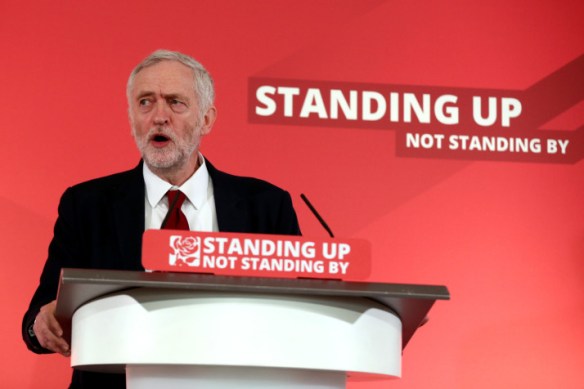
HARLOW, ENGLAND - APRIL 05: Labour leader, Jeremy Corbyn, addresses supporters and members of the media as he launches his party's local election campaign on April 5, 2016 in Harlow, England. Mr Corbyn visited the Essex town to meet supporters and to officially launch the Labour Party's local election campaign ahead of voting on May 5th. (Photo by Carl Court/Getty Images)

The argument that we can do nothing about Brexit except make the best of it is presented in a lucid argument on this blog.  Three reasons are advanced in support of the view that for the Labour Party to oppose Brexit “would be disastrous”.

Firstly, it would fail.  The Tories will vote for it as will the early pioneers of Donald Trump – the Donald Unionist Party.  And so will those Labour MPs in Brexit-majority constituencies who show much more readiness to oppose their leadership than the disaster that awaits their working class constituents.

This may or may not be true, although it certainly will be true if the opposition to Brexit itself refuses to oppose it.  The mantra that “the people” have voted for Brexit will be made official if those MPs supposedly opposed join in making the slim majority in the referendum an overwhelming vote in parliament.

The typically arrogant and supremacist claim of the Brexit right will be confirmed, that the only people who matter are those led by bigots.  The loyalist slogan “we are the people”, to be understood in the sense that everyone else is a lesser being, sits perfectly with the declarations of Farage and Trump that they alone speak for the people, because those who do not support them do not count.  Not voting against Brexit confirms the strident demands of the bullying reactionaries that their vote based on lies, fantasy and prejudice is unimpeachable.

On the other hand a vigorous campaign led by Labour against Brexit, which explains the real effects that are already visible, could compel reluctant Labour MPs to vote against Brexit and provide the cover for Tories opposed to Brexit to do the same.  We have been ‘warned’ repeatedly that a majority of MPs oppose Brexit, what matters is the political environment to make this a reality; and while the vote in parliament will decide the matter, the combination of disastrous consequences and political mobilisation outside parliament can determine it.

And if we are talking about numbers – what about the 65% of Labour voters who voted to Remain or do concerns about losing support only apply when bowing down to the most reactionary segment of support?  In terms of sheer numbers it makes no sense to alienate 65% in order to placate 35%.  ‘We can’t neglect to take on board the concerns of our working class supporters’ doesn’t really cut it when you look at it this way, unless you accept the nonsense that Remain voters were the metropolitan elite who, guess what, are not part of ‘the people.’

The second argument is that Labour cannot be seen to be “gifting the Tories, UKIP and the majority right-wing media the narrative of it  ‘seeking to subvert the will of the people’.  Absolutely everything it had to say on Brexit after a vote against triggering Article 50 would be met by this message being hammered home again and again and again.”

This is no doubt true; it is also true, although I do not know to what extent, that some Labour voters supporting Brexit will vote against Labour or abstain if it seeks “to subvert the will of the people”.   But it must again be recalled that the majority of Labour voters voted Remain!  And it really is internalising defeat when you vote with the Tories against the wishes of a majority of your own supporters.  However true the argument is that the strident claims of the Brexiteers will gain traction if Labour doesn’t bow before their demands, the contrary argument put here is also true, true to our principles and true to our future:

“The Tory MP, Ken Clarke, is quite right when he says that he has supported membership of the Common Market, and EU for fifty years, and that it would be ludicrous to suggest that just because of the referendum vote, he now had to act as though he was an opponent of it. Or, if Trump were currently, to hold a referendum, in the US, to garner support for his ban on Muslims entering the country, Labour would say,“Oh well, we lost that vote, so we will have to tag along behind Trump’s racist and reactionary policies.”

The parallel drawn here is not merely similar to the Brexit vote; in the immediate sense it is identical.  The Trump measures against refugees and the citizens of seven countries is a clear attack on peoples’ ability to move and to seek a better life in another country.  The Brexit vote was led by just the same sort of xenophobic and racist politics that motivated the reactionary Trump campaign, even if not all who voted for Brexit were xenophobes or racists, just like Trump voters, who weren’t all bigots and racists either.

The parallel is identical because a core principle socialists are trying to defend by opposing Brexit is the freedom of movement of working people in the EU, just like the freedom of movement of refugees and citizens of mainly Muslim countries to the US.  Working class solidarity is hardly a credible proposition if you don’t defend the ability of workers of different nations to work together.  It is much harder to make it a reality if it is prevented.  We know this, amongst other reasosn, because we know that the Brexit vote did not succeed in areas with the largest number of immigrants but often in areas with low numbers.

The third argument is that the Labour strategy of seeking to amend the Brexit process “will seek to ensure parliament has oversight of and influence over the kind of Brexit we get” and “does not lend power to the idea that Labour is ‘opposed to democracy’ and actually offers the prospect of pro-EU Tories supporting amendments which could make a real difference in preventing what is being called ‘hard Brexit’.”

Aside from the strength of an opposition that ultimately promises to vote in favour of triggering Article 50 it is unfortunately the case that a hard Brexit is the only one on offer.  An end to the free movement of workers in the EU is already a given, as is the exit from existing free trade arrangements, the disruption of which will impact on British capitalism and thereby on British workers, not to mention those in the EU.

As I have already argued, the strategy of a low-tax, deregulated and low wage Britain is the most credible one for an isolated nation seeking to insert itself into an international system in which every other large economy is part of a free-trade arrangement.  The exposure that Britain will impose on itself was illustrated by an article in Monday’s ‘Financial Times’, which reported a study that 46% of goods and services exports from the UK’s 62 cities went to the EU.  In contrast China accounted for only 4%, so that in order to make up a drop of 10% in EU exports would require a doubling of them to China or an increase by nearly one-third to the US.

Given that we know that a hard Brexit is coming it makes no sense to pretend the Tories will deliver anything else.  Could anyone seriously believe the Tories want to exit the rules and regulations of the EU because they want to make the regulations governing working conditions and employment rights better?

To pretend they will do anything else is a stand-out illustration of the weakness of an approach that tail-ends the Tories confusion and incompetence and that has allowed them to get away with taking over six months before even giving the broadest of outlines of what they wanted.  Leaving opposition to some final vote that the Tories can ignore is to play parliamentary games with workers’ futures when you aren’t in control of the rules.  There appears no guarantee that even defeating a Tory Brexit deal will not allow them to exit with no deal, as they have threatened.  A movement that would make this outcome politically unacceptable might prevent employment of such a device.

The only honest approach is to explain that a hard Brexit is inevitable and to build opposition to it on this basis, not wait for it to happen.  Having (sometimes) stated that the Tories will deliver a hard Brexit, the Labour Party is open to increasing incredulity and anger that they are not now opposing it.  The shadow-Brexit secretary Kier Starmer has told everyone that it is now impossible to oppose Brexit, making it clear that a single consideration trumps every other concern, while it took the old Tory Ken Clarke to make the points Starmer would not:

“Let me give an analogy in explaining the position for members of parliament after this referendum. I have fought Lord knows how many elections over the past 50 years and I have always advocated voting Conservative. The British public in their wisdom have occasionally failed to take my advice and they have actually by a majority voted Labour. And I have found myself here facing a Labour government.”

“I do not recall an occasion where I was told it was now my democratic duty to support Labour policies under Labour governments on the other side of the House. That proposition would have been treated with ridicule and scorn. “

“We are combining withdrawal from the single market and the customs union with this great new globalised future, which offers tremendous opportunities for us. Apparently you follow the rabbit down the hole and you emerge in a wonderland where suddenly countries around the world are queuing up to give us trading advantages and access to their markets that previously we had never been able to achieve as part of the European Union. Nice men like President Trump and President Erdogan are just impatient to abandon their normal protectionism and give us access.”

“Don’t let me be too cynical – I hope that is right. I want the best outcome for the United Kingdom from this process. No doubt there is somewhere a Hatter holding a tea party with a dormouse.”

This third argument has been put most pithily by Labour’s former deputy leader Harriet Harman – “accept the result.”  Except the real result of the referendum is not yet in and it would be criminal to accept it.

The third argument on accepting Brexit relies on the undoubtedly true argument that the referendum result “has been decades in the making. Parties across the political spectrum have happily blamed the EU as an easy scapegoat for domestic decisions (even the SNP blamed the EU in the row over privatising Calmac) while politicians have at best ignored popular hostility towards immigration and at worst fanned it.  In my lifetime it has been common for politicians to use the rhetoric of the far right on immigration, push increasingly intolerant policies on asylum and immigration and engage in a perverse arms race on who can be ‘toughest‘ on the issue.”

However, while true, this can hardly be an argument not to fight back now and, as I mentioned at the end of the first post, “in some ways Brexit provides better ground to take up this fight against nationalism and racism than before.”  This is because the reactionary politics of nationalism and racism which has created Brexit will not benefit workers, and their continued pursuit of them will hurt them rather quickly and rather directly.

Brexit allows the reactionary import of nationalism and racism to be demonstrated through the attacks on workers’ rights, conditions and living standards that Brexit will inevitably involve.  It provides the grounds to clearly separate the hardened ideological bigots from workers mistakenly attracted to false and simple-minded solutions that are nor in their interest.  Now is not the time to entertain the idea that restrictions on immigration and deference to reactionary nationalism can be combined with protection of workers to produce a mildly progressive ‘soft’ Brexit.

There is no combination of nationalism and racism with state ‘national’ socialism that will be in the interests of workers.  By pointing this out and fighting for an alternative the Labour Party will be proved right if or when Brexit either becomes a reality, or its disastrous effects become visible and palpable before this happens.  To prepare for this means opposing Brexit now and being best placed to build the movement that stops it and inflicts a defeat on the forces of reaction behind it.  Which leads to a final argument put up against opposition to Brexit now.

“This brings us to probably the most profoundly scary reason why Labour (and indeed other politicians) trying to prevent Brexit in parliament is such a terrible idea. As we’ve seen, rhetoric around ‘elites’ trying to ‘subvert democracy’ has been common in the aftermath of the referendum and we’ve heard how bigotry has surged. Yet if politicians were to actually prevent the result of the referendum being implemented as the worst extremes of the right keep suggesting they want to, this would provide a founding myth for the far-right of the kind we have not seen in my lifetime. There is no doubt in my mind that not only would UKIP surge dramatically in this scenario but that less ‘respectable’ fascists like the EDL would explode in popularity, emboldened by the simple and powerful narrative that the ‘elite’ were ignoring ‘the people’.”

There is no doubt some truth in this as well but it is rather like the truth that Brexit will be shown to be the shitshow predicted when it comes to pass.  Will the working class and the socialist movement be better off for having been proved right or will we have suffered a bitter defeat from which we will have to struggle to recover?  And similarly, if we defeat Brexit – the right of the Tory party and UKIP plus their ‘respectable’ fascists – will they be stronger or weaker for their defeat? The right can have its myths and its narrative if the labour and socialist movement can have its victory.

Back to part 1

Jeremy Corbyn and Article 50 – part 1

gettyimages-628009410-e1485368657171-640x481In an interview last November Jeremey Corbyn was reported to have set out his “bottom lines”, without which he would vote against Article 50, which included access to the 500 million customers of the single market; no watering down of employee rights, currently guaranteed by EU law; consumer and environmental safeguards and pledges on the Government making up any shortfalls of EU investment.

However in January he said that “Britain can be better off after Brexit.  “Only a Labour government, determined to reshape the economy so that it works for all, in every part of the country, can make Brexit work for Britain.”

As he went on to say: “as far as Labour is concerned, the referendum result delivered a clear message.  First, that Britain must leave the EU and bring control of our democracy and our economy closer to home.  Second, that people would get the resources they were promised to rebuild the NHS.  Third, that people have had their fill of an economic system and an establishment that works only for the few, not for the many.  And finally, that their concerns about immigration policy would be addressed.”

“Labour accepts those challenges that you, the voters, gave us.  Unlike the Tories, Labour will insist on a Brexit that works not just for City interests but in the interests of us all.”

“We will push to maintain full access to the European single market to protect living standards and jobs.”

“Labour is not wedded to freedom of movement for EU citizens as a point of principle, but I don’t want that to be misinterpreted, nor do we rule it out.”

Meanwhile John McDonnell stated that Labour will help deliver a “sensible British compromise” over Brexit, but also said that Labour would not back a “kamikaze” departure from the EU which hit the economy.

Shadow Brexit minister Keir Starmer then claimed a partial victory for Labour in the aftermath of Theresa May’s big speech on Brexit saying that the government had “accepted” many of the Opposition’s proposals, was heading away from a “hard Brexit” and that May will “fall far short of the hard Brexit that many businesses and trade unions have feared”.

This is straight after May admitted the UK couldn’t remain inside the Single Market and limit freedom of movement at the same time, instead proposing uncertain ideas of staying inside some of the customs union and hinting at special deals for certain industries.  Unfortunately the World Trade Organisation rules on such deals would mean that if the EU agreed them with the UK it would have to agree such deals with other countries as well.  We are expected to believe that the UK will succeed in getting the EU to agree a deal not only to its benefit but potentially to the benefit of a host of other countries as well.

May’s speech came days after the chancellor Philip Hammond delivered a threat to EU nations that Britain could cut its corporate tax rates yet again as part of its post-Brexit restructuring.  But as the Tories are doing this anyway we should be clear among all the confusion that Tory threats of a low-tax, low-regulation bargain-basement polity is not a policy consequent on failure to agree a good Brexit deal but will be a consequence of any Brexit deal.

Outside the EU lies tortuous negotiations with those paragons of all things fair, the Chinese State, and the consistently fair-minded, dispassionate and unprejudiced Donald Trump, who has promised to take personal charge of a trade deal with the UK.  May’s grovelling to one Japanese car company; her swift retreat on second thoughts on buying a ridiculously expensive and unproven nuclear power plant partly from the Chinese; and her assault backwards up the alimentary canal of Donald Trump, even pre-empting the Irish in the process, all testify to what “taking back control’ means for the newly to-be-isolated British State.  What both Trump and May now openly share are threats to the EU, even though Britain states its desire for its success.

So what are we to make of Jeremy Corbyn’s current position – that you can have a good Brexit that is good for workers?

As I posted a while ago – there isn’t a progressive Brexit, not on offer and not remotely possible.  Only the national reformist conceptions of the old Labour Party Left can sustain illusions that there is.  That, and the nonsense of some people who call themselves Marxist who supported and still support something called Lexit.  These left organisations, which had the project of replacing New Labour with their very own version of Old Labour, have also adopted wholesale the nationalist illusions of this old left.

Supporters of Lexit will claim that Lexit is not Brexit; that they voted against the EU for other reasons and/or that what they voted for is not exactly what they wanted – they wanted not capitalist unity in the EU but workers’ unity outside it.  But of course what they voted for was what was on offer – capitalist separation – because that was the only conceivable result of their vote being successful.  Their reasons for voting for it are neither here nor there.  If what they and the rest of us now face were sufficiently different from what they say they wanted then they would now be campaigning to stop Brexit, recanting their previous view and with an admission that they had made a mistake.  But they’re not doing any of these things, so what we all face must be sufficiently close to what they consider they voted for them not to oppose it now.

In comparison Jeremy Corbyn stands on a more progressive platform since there is still some, albeit very unclear and very indefinite, claim that he will oppose a Brexit that is bad for workers at some time in the future if that is necessary, but not now.  Or I think that’s his position.

It isn’t very clear what it is, or what could possibly take precedence and transcend his support for triggering Article 50 on the grounds that the “will of the people” should not be obstructed.  Under what circumstances will the Labour Party oppose the disaster for workers that is Brexit and with what arguments that don’t apply just as forcibly now?

Of course it has been the case that the choice between British capitalism seeking an isolated role in the world or as part of the EU is not one socialists would seek.  But we have enough accumulated knowledge of how to progress the interest of the working class and socialism not to get the answer wrong.

The second problem however is that we were defeated and defeat always imposes a cost.  We should of course seek to minimise this cost but more importantly we should seek to continue the struggle on the new, unfortunately more unfavourable, terrain.  For the Labour Party the problem is posed to them by the fact that an estimated 65% of Labour voters backed remaining in the EU while roughly two-thirds of the constituencies with Labour MPs in place voted to leave.  For a Party wedded to electoralism this creates an obvious dilemma while for socialists the need to take a longer-term view means the opportunist and unprincipled, even blinkered, approach that appears to be determined by purely short-term electoral considerations must be rejected.

The third problem was aptly posed on this blog – the defeat has been a long time coming and rests on long standing weaknesses that exist because of the incapacity and unwillingness of the labour movement to oppose British nationalism.  For Labour this has led to collapse in Scotland as a different nationalism has fed off the ideas that British nationalism and all nationalisms take for granted and usurped its leading role.  In England and Wales British/English nationalism also hurt the Labour Party where it had not had to confront it before, including the failure to tackle the worst excesses of this nationalism in the form of anti-immigrant prejudice and racism.

The media reports that despite the obvious confused incompetence of the Tories they are far ahead in the polls and that many Remainers have reluctantly become reconciled to Brexit.  Some strong Remainers believe there is no case for fighting Brexit and that for the Labour Party to try to do so would be utterly disastrous.  But this is a mistake and one that will have greater consequences the longer we refuse to take up a fight that should have been taken up long ago.  In some ways Brexit provides better ground to take up this fight against nationalism and racism than before.  Why give up when it hasn’t happened yet?

Forward to part 2

Crisis? What Crisis? part 6 – Corbynism and the Labour Party

1bioeqbho4-1oqnvp3ulwqaOne very minor up-side to the election of Trump, which I will post on as soon as I get the time, is that it should be easier for those left supporters of a progressive exit – ‘Lexit’ – to see their errors, although to be honest I’m not going to hold my breath.

With every development of Brexit it becomes clearer and clearer that this is a reactionary project that fully lives up to those who predicted this prior to the vote.  The vicious diatribes from the Tory press have been ratcheted up by Nigel Farage complaining about Brexit being betrayed by judges, predicting that “we will see political anger, the likes of which none of us in our lifetimes have ever witnessed.”  When asked if there was a danger of disturbances in the street, he said “Yes, I think that’s right. . . the temperature of this is very, very high. I’m going to say to everyone who was on the Brexit side, ‘Let’s try and get even.”

This is the authentic voice of Brexit.  No wondering, as we are with Trump, whether the reactionary zealots who led Brexit really mean what they said before the vote.  It is reactionaries such as Farage and the Tory right who are leading the process.  It is clear it could not happen without them although it may still not happen with them.  The idea of a left-led progressive exit is even more fanciful now than when ‘Lexit’ was proposed during the referendum.

There is no competition to turn Brexit into anything progressive and the idea that the small left forces who supported Brexit can either present what is happening as a step forward or that they should still continue to support Brexit (under the banner of ‘Lexit’!) is at first laughable and then atrocious.  Any attempt to make gains for workers out of the Brexit negotiations could only come through agreement from the rest of the EU, which the left supporters of Brexit see as the primary enemy that must be escaped from – so how do they think this can come about?

In the most recent International Socialism Journal the SWP are now scrambling to be relevant; so while they continue to support Brexit they also cling to the Labour Party as the other major factor defining British politics today.  But their arguments around this are not much better.

They characterise the supporters of Jeremy Corbyn as “diffuse and atomised” and state that real organisation has to be built on struggle.  They then outline two possible ways forward for these supporters.

The first is “to pursue the weary, highly bureaucratic struggle against the right in constituency and branch meetings.”

The “alternative is a more outward looking orientation towards resistance to austerity, racism and war . . . this approach is far more likely to transform Corbynism into a real mass movement.”  The SWP author argues that having to face down Labour councils and their implementing cuts requires Corbynism to have a “more defined ideological profile.”

The article then goes on to speculate what Corbyn’s Labour would do if it got into office; criticising its “timid programme” and preoccupation with “credibility” and “electability”; condemning it for being “an electoral party” and therefore one that “will be judged, like any other, by its success in winning votes.”

It then raises the spectre of a betrayal, like Syriza in Greece, and the need to avoid the same fate in Britain by developing a mass movement behind Corbyn and “defiance of the rules of the parliamentary game.”  It claims that “the Corbyn phenomenon – like Syriza before it – has not suspended the classic dilemmas of reform and revolution” and that this “truth” “underlines the need to maintain an independent revolutionary organisation that is free from the compromises imposed by constitutional convention and intra-party manoeuvring.”  However, it says “the real test for revolutionary socialists will lie in the degree to which they are able to unite with all those who’ve rallied to Labour under Corbyn”.

One can therefore say with some confidence that this is a test that the SWP has and will fail, if only because they will not join the Labour party and “unite with all those who’ve rallied to Labour.”  Instead it will emphasise the importance of its “ideological profile” by maintaining “an independent revolutionary organisation” that will be “free from the compromises imposed by constitutional convention and intra-party manoeuvring.” In other words it will refuse to get its hand dirty and will refuse to join a struggle in which compromises are “imposed” on it, most likely because it would fail itself to maintain its revolutionary purity in such a situation, much like the Militant Tendency did during its long existence in the Labour Party.

Its counter-position of revolutionary politics to reformism is therefore indeed purely ideological with little material basis, not even a revolutionary programme by which it could ground its practice and gauge its fidelity to a revolutionary perspective and policy.  This counter-position is therefore useless for it cannot be a real guide to action.  In the case of the SWP worse than useless since it leads to supporting Brexit even while acknowledging at the end of its article that the referendum result has “given racists more confidence” in a period of a “rising tide of racism”!  While it presents the struggle against racism as the most important struggle there is no hesitation to ponder its own contribution to the referendum result that predictably set the scene and encouraged this “rising tide.”

This absence of the SWP from the struggle inside the Labour Party is to be welcomed, since it belittles the struggle to win votes; its own alternative to Labour’s economic programme is simply greater ‘public ownership’ that is not significantly different in nature from the Left of the Labour Party, and it utterly fails to appreciate the importance of the fight to democratise the party, which it characterises purely as a “weary, highly bureaucratic struggle.”  It utterly fails to understand the importance of creating a democratic mass party of the working class that can be both a site for democratic debate and a forum to determine the politics and struggles of the working class.  This failure is no doubt due to the notorious absence of democracy in its own ranks.  In this respect, as in so many, it is no example to anyone, least of all the mass membership of the Labour Party.

This party doesn’t need another cohort of recruits, however small, who believe that, because they have the predetermined answers, all that is need is more activity without a democratic machinery to decide policy and priorities for activity.

Coverage in the left press in Britain reports disagreements not only about the lack of democratic functioning inside the Party but within the Momentum group that is supposed to be fighting for this democracy.

The radical journalist Paul Mason has announced that he has joined Momentum and given some arguments why he has done so and some ideas on how it should be organised.  Whether he is right to do so is not for me to say – I am not involved in this struggle and am too far away from it to make any half-definitive judgements. He seems correct to say that Momentum should affiliate to the Labour party and work in activity within the party and also on its own account.

However, he has a rather too sweeping dismissal of the experience of the 20th century left that appears to recognise no lessons except negative ones.  This goes with an uncritical acceptance of what he sees as 21st century means of organisation.  He may be referring to particular features or experiences of bureaucratic organisation but he should make this clear and also reference the long struggles against bureaucracy in the workers’ movement, both practical and theoretical.

He dismisses hierarchies in favour of networks without recognising that hierarchy is just one example of a network; the lesson being that you have to be a lot more specific about what you mean by networked organisations.

Likewise he is of course correct when he says that we want to “empower masses of people to take their own decisions through direct democracy” but he says this involves “respecting diversity, proportionality, restraint and the democratic institutions of the UK.”  Having lived through the miners’ strike he should know just how limited the democracy of the institutions of the UK are and needs again to explain what he means by this phrase, as also what he means by “restraint” and “proportionality”, which are relative and contextual and not much use baldly stated outside of this.  Respect for diversity also has its limits – where I live respecting diversity means respecting bigotry, on account of their being so many bigots.  In the context of Brexit this is not a distant analogy to the current situation in Britain.

He says that “today I think the most revolutionary thing we can achieve is to put a left labour government in power: to switch off the neoliberal privatisation machine, to end expeditionary warfare and the arming of dictators, to redistribute both wealth and power to the people.”  This seems to me to have some truth, except that we need to rely on a mass active movement to bring this about and to develop beyond its limitations, including that power is, in the end, taken by the people themselves and not handed down from above.

He recommends “decision making in Momentum should be taken by consensus, using electronic democracy to engage every dues-paying member.  Local branches of Momentum should be free to act as they wish – to focus on caucusing before Labour branches and CLPs, or to do activism under their own banner that the Labour bureaucracy refuses to do – for example defending libraries being closed down by Labour-run councils.”

The use of electronic means to involve members voting is a good one in certain circumstances, but not all, although the current Ken Loach film ‘I, Daniel Blake’ shows that everyone’s ability to do so can’t be taken for granted.  But voting means majorities and minorities so it’s not clear to me what limits are imposed by a requirement for consensus.  Local Momentum groups should have wide autonomy to determine priorities for activity but once again there will be national priorities, such as selection of MPs, conference motions etc that require some coordination and guidance on overall direction.

Mason argues that the basic political programme should be the 10 pledges outlined by Jeremey Corbyn and notes that nuclear disarmament is not one of them.  So as a start it may be more or less fine but there should be nothing sacrosanct about it and if the movement develops the political foundations for it will as well.  In fact it is already inadequate – it does not mention Brexit.  Campaigning against Brexit should be a priority for Momentum and it should not be afraid to take the lead.

concluded

Back to part 5

Crisis? What Crisis? – part 5 Brexit? What Brexit?

supertrampGeorge Monbiot wrote an article on Brexit for The Guardian that was subsequently reprinted in Village magazine.  In it he says that we should not only accept the Brexit referendum vote but “should embrace it.”

Yes, the Brexit campaign was ‘led by a political elite, funded by an economic elite and fuelled by a media elite.  Popular anger was channelled against immigrants but the vote was also a howl of rage against exclusion, alienation and remote authority.’ That is why the Brexit slogan “take back control” resonated.  “If the left can’t work with this, what are we for?” he said.

But, like the old Irish story of the response to someone who was lost and needed directions to a particular place – if I was going to there I wouldn’t start from here.

What the left is for, hopefully, is not to pretend that we can work with reactionary politics to sugar the pill, which is altogether different from having to deal with a reactionary situation and trying to make the best of it.

‘Working with it’ first of all means understanding that the “howl of rage against exclusion” was captured by those seeking their own exclusion of foreigners.  Alienation is of no use unless it can be overcome and not displaced onto the wrong target, and blaming a remote authority in Brussels just gets us back to the “rage against exclusion” and blaming foreigners.  As for “take back control”, this was a reactionary nationalist response that showed incredible levels of ignorance of the power, position and role of the British State.  Even if this power were not severely diminished; even if its position of weakness were not more and more exposed, and even if its supplicant role is not becoming more pronounced, it would still be a reactionary commitment to nationalism that we ‘cannot work with’ except in the sense of attempting to undermine and defeat.

Monbiot presents Brexit as a land of opportunity – “If it is true that Britain will have to renegotiate its trade treaties, is this not the best chance we’ve had in decades to contain corporate power – of insisting that companies that operate here must offer proper contracts, share their profits, cut their emissions and pay their taxes? Is it not a chance to regain control of the public services slipping from our grasp?”

But who exactly is going to exert control in this way, assuming for the moment it’s possible?  We can be sure that, in any Brexit negotiations, containing corporate power will not be an objective of Theresa May.  We can even be confident that, in negotiations between the greater capitalist power wielded by the EU and the lesser power of Britain, the weaknesses of the latter will be exploited by the former.  And this balance of forces would weigh to an even greater extent on any sort of left Government in Britain facing a much more powerful EU.

Only with allies in the EU, primarily in the shape of a European-wide workers’ movement, would it be possible for the balance of forces to tilt towards the workers.  But this obviously points in the direction of staying in the EU.  As part of the EU there would at least be the beginnings of a political unity within which the workers’ movements of the various European countries could achieve some measure of unity and seek to exercise power at an international level.

But such a perspective would mean rejecting Brexit and continuing to fight it.

I looked at the arguments surrounding such an approach before and said that “there is no principled reason why there could not be a new vote.  What matters is how this might come about. Brexit is reactionary and its implementation will provide repeated evidence of it.  In fighting against its effects such a fight should not renounce fighting their immediate cause.”

I further said that “it could be claimed that there is little point in observing that the Brexit campaign lied through its teeth and has immediately retracted pretty much all its biggest claims – about money saved going to the NHS or of a future large reduction in immigration.  If telling the truth was a prerequisite for maintaining the results of a vote the Tories would not still be in office.”

Except of course unlike a general election, in which the winning party takes office immediately, we do not have Brexit immediately and it has become increasingly obvious that the Brexit campaign has no idea how it will deliver on promises it is still making, promises that become ever less credible.

There are some steps to limit the damage that the Tories have taken, such as the secret deal with Nissan, but this exposes any notion of taking back control.  We don’t know the cost or even whether it involves state support the EU could sooner or later simply nullify, whether Britain were in or out.

But there have been and will be consequences which no Government can do much about; such as the depreciation of the currency, inflation and rising interest rates.  When the Governor of the Bank of England says that he will let inflation overshoot the target of 2% to save jobs that’s really very good of him, because there’s nothing short of cratering the economy that he can do about it.

So to give up on fighting Brexit is to put British workers at the mercy of the most reactionary and frankly stupid sections of the Tory party.  It is to accept their risible promises and seek simply to expose them through their failure, a failure whose heaviest price will be paid by workers.  It is to accept the drastic fall in living standards that has already begun and it is to accept the secrecy necessary to cover up the unfolding disaster.

In this respect the demand for parliamentary scrutiny of the Government’s plans and their progress, including sweetheart deals, is important.  Not just to expose the policy of Brexit but also the nationalist alternatives that will flourish in the twilight of Brexit failure. Such nationalist intervention will come from the SNP pointing to a betrayal of Scotland or a UKIP narrative that accumulating failures of Brexit come from an insufficiently committed Brexit Government.  So far it has been the Treasury mandarins who have led the fight against Brexit and we can expect further leaks if, or rather when, the current trio of Brexit ministers demonstrate the failure of their policy.

However, the perspective of the Labour Party is not opposition to Brexit but to fight for a “people’s Brexit” as opposed to a “bankers’ Brexit.”  John McDonnell has argued that:

“Britain voted to leave the EU, and that decision should be and must be respected.

We should not pretend that the referendum result can be undone.  If we do that, and walk off the field, we will simply be allowing other forces to give their own answers to those questions it has posed

The simple truth is that the Tory establishment cannot be trusted to make a success of Brexit. Labour in government is the only party that would be prepared to take the necessary measures to make a success of Brexit

We are also committed to making sure that Brexit works for everyone not an elite few. Labour would work with our European neighbours to protect our key industries like steel, and negotiate deals with the EU to make sure big multinationals like Google pay their fair share in tax.”

On the other hand –

  • If the vote for Brexit means severe cuts to working class living standards, why should a vote based on lies and deception be respected?
  • The Labour Party is assuming that there are progressive answers possible to the questions posed through accepting Brexit.
  • It assumes that there can be a “successful” Brexit.
  • It assumes that the protection of industry and jobs and fair taxation of multinationals is possible in Brexitland.

But Brexit puts up barriers to trade and it puts up barriers to effective taxation of the wealthy and international companies.  Were a Labour Government outside the EU how could they enlist the support of other European countries to increase taxation of the rich?

When France increased its taxation in 2012 to 75% on those earning above €100,000 the number moving abroad jumped 40 per cent.  Between 2000 and 2014 42,000 millionaires left France, many of them moving to London, and particularly to South Kensington, referred to by some as Paris’s 21st arrondissement.  Many of its banks and its bankers also moved, although thanks to Brexit this has now stopped.

Inside the EU such tax increases have a greater chance of being coordinated.  Outside, the competitive position of weaker countries often drives them to lower taxation on multinationals and the wealthy. And as we have seen, there are economic effects which are largely outside the control of Governments to prevent.  What they can do is take offsetting measures such as increased public expenditure and investment, and this is what Labour promises, but this can only be offsetting and the weakening of Britain’s capitalist economy also weakens the capacity to do this.

Of course Labour’s model of Brexit is very different from the declared objective of the Tories.  John McDonnell declares that “Labour will insist that any deal with the EU includes, at least as an interim, tariff-free Single Market access. Full Single Market access implies freedom of movement, as in Norway’s European Economic Area deal.”

Without the xenophobic hang-ups of the Tories Labour is happy to see free movement alongside as much access to the EU single market as the EU is prepared to allow.  This is one possible transitional deal that the advisors to big business, in the shape of ‘The Economist’ and “Financial Times’ are pointing to.  A transition that might, like those of Norway and Switzerland that were initially temporary, prove more permanent than first intended and that might be open as much to a transition back to full membership as complete exit.

However, once again all this will be in the gift of the EU.  All the calculations involved in a permanent divorce apply to such a separation – whether the interests of the remaining EU are better protected and advanced by accepting a relationship with Britain on these terms or whether a clean break is preferable.  Once again it is necessary to note that given its size, Britain is not Norway or Switzerland and it makes no sense for it to pay into the EU and be subject to its rules without any say in those rules.  Such a transitional arrangement is the very opposite of ‘taking back control’.

Whenever we look at the relatively weak position that Britain is in we can also see the weakness of the Tory Brexit policy – when even speeches at Conservative party conferences occasion steep declines in the currency.  The pound has hit a 168-year low and this is before Article 50 is triggered, the lousy terms of the exit start to be revealed and the two-year exit timetable has been exhausted.

This weakness is also reflected in the political weakness of those seeking Brexit.  UKIP, which spearheaded this policy, is in disarray.  The political leadership of Brexit in the Tory party includes someone who was considered a star before imploding and heading for obscurity before being given a plum job at the Foreign Office; another who was already discredited and already in obscurity before being given a job in Trade, and a third who was also a twice loser in contests to lead the Tory party.  The majority of MPs are opposed to Brexit but they have no idea of how to make popular a campaign against Brexit that would make its reversal legitimate.  That task lies with others.

The referendum was largely portrayed in the media as an inter-Tory dispute and the struggle that big business will put up to resist Brexit and/or to deliver a ‘soft’ Brexit may also seek to do so primarily through that parry.  Once again the struggle could come to be seen as primarily an inter-Tory argument.

Considerations that this may severely damage the Tory party are secondary to the necessity that the struggle against Brexit is open, clear and honest.  In this sense the instincts of the primarily young Remain Voters who demonstrated and signed petitions immediately after the referendum were all these things, which an inter-Tory dispute will not be.

In order for the Labour Party to truly defend working people it is necessary for Brexit to be stopped – to nullify the dire effects that no amount of negotiation for a ‘soft’ Brexit may put right.  If this is to be done it must be done openly or charges that democracy is being subverted will appear to have some truth.  The defeat of Brexit is still possible but it should be done openly and on a progressive basis of defending the living standards of working people; defending EU workers and other immigrants who live in Britain; defending those British people who live in other EU countries and in defence of international unity.  A lying, xenophobic referendum result with reactionary consequences deserves no respect and should be reversed.

Back to part 4

Forward to part 6

Crisis? What Crisis? part 4 – a progressive unity against Brexit

brexit market imageIn response to Brexit a call has gone up for a progressive alliance of the Labour Party, Greens, Liberals, SNP and Plaid Cymru.  However, not only is such a call fixated on parliamentary numbers, which after all isn’t an inconsequential consideration, but more importantly it is politically illiterate and dangerous.

The Liberal Democrats are fresh from giving a leg up to the Tories through the ConDem coalition and partook in the harshest imposition of austerity that almost everyone seems to believe contributed much to the Brexit vote among workers.

The Greens are in open competition with Labour and cause many people no end of confusion about their apparently more radical policies on certain issues.  This confusion arises in those who have no understanding of politics as fundamentally constructed by class and by some on the radical left who have no organic relationship to the working class but substitute a series of single issue campaigns for this in order to give them a milieu in which to operate.  So long have they been doing this that some then come to judge the Greens on their purported position on these single issues they spend their political lives pursuing.

Marxists may call the Green movement petty bourgeois, which may seem insulting or simply untrue of the class background of many Green members and supporters but there is no reason for believing that they are any different than, for example, the Irish Greens.  When the Irish Green Party voted at their conference to enter Government with the main capitalist party Fianna Fail they cried, and then they cried again when they got hammered at the following election.  In between they bailed out the bankers when the banking system went bust, shifted the banks debts on to the Irish people for a couple of generations and inflicted damaging austerity on the Irish people to pay for it.  When it comes to more than single issues – when it comes to the state and the whole of society – the class nature of a party’s politics matters.

The SNP and Plaid Cymru are nationalists, and lest we forget it, it is nationalism which was and is the overarching ideology of Brexit.  Of course Scottish and Welsh nationalists will claim that their nationalism is not like that of the Tories or UKIP but then everyone thinks their nationalism is different from everyone else’s.  In the last analysis the only justification for opposing Brexit is that of workers unity across nations, of which the EU is the capitalist version but which forms the existing framework within which such unity is best advanced.  Nationalism inevitably puts forward the view that there is a national interest that comes first.  Such a view is compatible with membership of the EU but not with the interests and policies socialists seek to pursue.

The strength of nationalism in Scotland weakens the Labour Party and has strengthened the Tories who face a reduced threat from Labour without its phalanx of Scottish MPs.  This is as much a result of the rottenness of Labour as it is of nationalist strength but much of the Scottish left has run away from the task of fighting the former in order to facilitate building the latter.  Now that the Labour Party cannot be slagged off as ‘red Tories’ the role of nationalism is clearer and the role of left nationalism in preventing workers’ unity more evident and also more reprehensible.

This Left, which includes its English based supporters, has not stopped to ponder why a so-called move to the left in Scotland has led to an SNP administration supported by Rupert Murdoch while Jeremy Corbyn receives ridicule and scorn from Murdoch’s newspapers.  Yet, having just read the free book from Verso press, some of the New Left Review cheerleaders of this nationalist left are calling for Corbyn to follow the Scottish example!  In this they compare the SNP’s opposition to Trident favourably with the split in the Labour Party (mostly in parliament) but ignore the fact that the SNP want to shift Trident doon the road and Corbyn wants to scrap it.

The current case for unity amongst all British workers against Brexit and the xenophobia it entails could not be stronger and any left case for nationalist division could hardly be weaker.  From being in some sort of progressive vanguard even some nationalist supporters now seem to be saying the opposite – that Scottish independence is justified by it lagging behind English radicalisation (see Cat Boyd in the latest issue of ‘Red Pepper’).  It would appear, sitting from Ireland, that some would rather be failed Scottish radicals than part of a more successful British movement.  But this again is perfectly in tune with the left nationalist view that workers in Scotland and those in England & Wales have separate interests that cannot be reconciled, except perhaps with a good border between them.

A second approach to the Brexit vote is, in effect, to say – who cares about the answer, what’s more important is the pain.  So the alienation of marginalised and excluded working class communities typically placed in North-East England has to be understood and not condemned and we must seek to relate to these workers.  In anything I’ve read it’s never very clear what it is that is different in what socialists should be saying to these voters to what it should be saying to the millions of workers who voted Remain.  The latter have been pilloried as belonging to some sort of cosmopolitan elite cosseted in decent jobs who can’t be identified as an object of a sympathy that verges on pity.  In fact the only part of the labour movement calling for a different approach to these workers is the Labour Party right wing who hypocritically castigated Corbyn for not giving 10 out of 10 to the EU but now want increased immigration controls that panders to the worst prejudices of Brexit voters.

Supporters of this approach, who call on socialists not to condemn workers who voted for Brexit, take their own moralistic view, seeing them as somehow more authentic than others.  It is on occasions like this that the Marxist approach of not moralising about politics at all means you don’t fall into either condemning or feeling sorry for them.  It should of course be easier to do this when it is appreciated that these workers are not solely to blame for voting Brexit and their role has generally been exaggerated.

Using the definition of class that categories us into A,B C1, C2, D and E one blogger has calculated that the majority of Leave voters were A, B C1 and while C2, D and E were more likely than others to vote Leave they were also more likely not to vote at all.  This writer also argues that if C2, D and E working class EU citizens had been allowed to vote the result could easily have been different.

This blog here makes the same case – that “while C2, D and E voters (or the poorest classification of respondents) voted in greater numbers in favour of Leave than their ABC1 counterparts – 64% to 47% – so-called ‘middle and upper class’ (or ABC1) voters provided 10,349,804 (59.4%) of the final 17,427,384 votes for Leave.”  In other words “a huge amount of C2DE voters very likely did not even show up at the poll, whether from disbelief or indifference—upwards of 48%, according to the projections. And when weighted for equalised proportional turnout (72%) for all social ‘grades’, the numbers seem to “confirm these two realities at once—with 46.35% of ABC1 and 53.7% C2DE voting for Leave, we see both the greater number of ‘working class’ votes for Leave and their incredible proximity to votes from higher echelons .  . . That is to say, while there has been much hemming and hawing about the retrogression of ‘working class values’, all things considered, the result actually owed itself to a cross-class alliance for the ages.”

And this is true whether one accepts, or more accurately, does not accept the objectivity and truthfulness of this way of categorising the population.  Of course the argument that the Remain vote was also “a cross-class alliance” can be made.  But the starting point for determining one’s position on the referendum is, what is the nature of the issue and how can working class interests best be defended?  Taking an independent view of the question doesn’t mean ignoring what other forces are doing but it does mean identifying the working class’s independent interests.

There is also the rather more obvious fact that the cross-class alliance of the Leave campaign was led by UKIP and the most right wing elements of the Tory party who were behind a xenophobic, racist and anti-immigrant campaign.  On the other hand Jeremy Corbyn explicitly refused to become part of an inclusive campaign for Remain consisting of Tories and Liberal Democrats.  For his trouble he was variously ignored or pilloried by the media and slaughtered by the majority of Labour MPs when defeat gave them an opportunity to use this as an excuse for their coup against him.

The essential point that has been made however is firstly that many workers did vote for Brexit, from reactionary motives, and this is a problem.  If like me you come from the North of Ireland you will have absolutely no difficulty in accepting and recognising that many workers are reactionary. The problem in Britain isn’t new there either.  Secondly, the question is, with what social force do you address this?  And the answer is by building upon those opposed to xenophobia and racism who have rejected appeals to nationalism.  In other words the working class component of the Remain voters.

Unfortunately some on the left have decided that Brexit is not so much a problem as an opportunity and believe that what matters is not the reactionary politics that motivated workers to vote on xenophobic lines but that these workers are alienated and oppressed.  In other words, the problem is more important than the solution and the question is more important than the answer.  Their saving grace, if this is actually the case, is that this doesn’t seem to mean very much in terms of their political approach – they continue to peddle the same politics as before.

In the next post I will identify some mistaken views that seek to relate to those workers who voted Brexit – as if they should be the starting point of an alternative.

Back to part 3

Forward to part 5

Crisis? What Crisis? part 3 – down, down, deeper and down

Sterling as a picture of the future

Sterling as a picture of the future

Tory lies over Brexit and the sunlit vistas of UK sovereignty that lie ahead are nothing new.  Uncriticised by the Tory press and a BBC that is both scared of them and shares their broad establishment understanding of society, they have been able to present themselves as the only trusted stewards of a successful economy, with only its fruits perhaps needing some fairer distribution, now that they are the workers’ friend.

But the Tories have lied to themselves and everyone else that the British economy is in rude health, especially when compared to the sclerosis of the rest of Europe.  They quote statistics showing that real Gross Domestic Product has grown faster in Britain than in the bigger EU economies such as Germany, France and Italy.  What they don’t say is that GDP per person was no higher in 2014 than 2007 and that the British are no richer compared to the EU 15 average now than they were 15 years ago.  In fact Britain lags behind Spain and France on this measure.

In order for Britain to grow it has needed to increase its population and workforce, including through immigration, and make the working class work longer hours while reducing their wages, which declined by 10% between 2008 and 2014.  Productivity relative to the EU average has fallen to 90% so that output per hour is 25% below French or German levels.  In only one other region apart from London is GDP per head in excess of the EU average.  This means only 27% of Britons are wealthier than the EU average; but we are expected to believe that the EU is holding Britain back.

The Tories (and Blair before them) have relied on a high debt, low wage and low skilled economy that compensated for poor productivity by increased exploitation, symbolised by zero hours contracts on the one hand and long working hours on the other.  Such a model has no need for a comprehensive education system that can provide a highly educated and skilled workforce for employment across a wide number of economic sectors.

Increased exploitation of labour substitutes for increased capitalist investment in technology, which is mirrored in less state investment in infrastructure.   One example of the result of this is the threat of the lights going out because of a shrinking margin of spare power generation capacity.  This in turn leads to huge subsidies to foreign states to supply nuclear power that may keep the lights on – in the shape of Hinkley Point C and the French and Chinese state companies involved in its development. The lack of infrastructure puts a further drag on the development of productivity and the growth of living standards.

Brexit is being sold as the opportunity to improve this far from outstanding economy but leaving the EU will discourage the foreign investment that helps bail out Britain’s chronic deficit in trade.  Exit from the EU will diminish the financial sector and its acquisition of profits from around the world as bankers already threaten to pull out.  Trade will face new barriers and even old Tories like Michael Heseltine have laughed that there are new markets that no one has so far spotted to replace those that will be lost in Europe.

Devaluation of sterling will hit peoples’ living standards, reducing the domestic market just as foreign markets become harder to enter, while lower economic activity will reduce the capacity of the state to spend on infrastructure. A poorer Britain with reduced foreign earnings will have pressure placed on its interest rates, which will rise to cover the cost of financing a state whose currency is falling.

This risk was made clear by a market analyst quoted in the ‘Financial Times’ as saying that sterling is behaving more like an emerging markets currency and that there is no idea what its true level is. If a foreigner lent £100 to Britain, costing them say $120 in their own currency, it will mean that when she’s paid back the pounds she receives could be worth only $100.  So how much more interest on the loan would she require to protect herself against this risk?  And what sort of investment could warrant borrowing at this rate of interest?

Britain has created an economic model based on sweating its workforce.  Karl Marx noted the limits to exploitation by lengthening the working day 150 years ago, limits again being exposed today by Britain’s declining productivity.  And anyone believing that the Tories will move to create a high wage economy that involves upgrading the skills and talents of the workforce will have to explain the latest genius idea of promoting grammar schools, which relies on improving the education of a few by shiting on the rest.

An economic logic will apply to Brexit regardless of whether the Tory party realises it or not just as we have already seen its political logic unfold despite what some might have believed it was all about.  In last Monday’s ‘Financial Times’ some ‘liberal’ Brexit supports complained that they wanted an ‘open’ Brexit and not the nasty Tory variety.  But this is just as innocent of reality as the supporters of a ‘left’ exit – Lexit – thinking that a decisive move to national capitalism could be anything other than reactionary.

The economic logic of Brexit suggests increased unequal competition with other much larger state formations, such as the EU and the US, not to mention China, a la Hinkley Point C.  One weapon of the smaller and weaker is a race to the bottom with reduced corporate taxation as one example, already signalled by the late chancellor George Osborne, but this is not a credible strategy away from the current model.

There are therefore no grounds for believing that an interventionist state acting on behalf of workers will arise from any change in approach by the Tories.  However it is not excluded that the inevitable crisis that Brexit will induce could give rise to a change in direction to a more interventionist approach in order, as we have said in the previous post, to allow “a Tory government (to) save capitalism from itself.”

Unfortunately the Tories have tied themselves to those sections of the electorate least supportive of this approach; those who support lower taxes and a less interventionist state, unless its intervention is into other peoples’ countries.  The best hope of such an outcome is the influence of those sections of British big business that are tied to the Tories who do provide a constituency for such an approach.

However the weakness of a stand-alone Britain doesn’t help such change.  So for example, it is reported that the Tories may be thinking of devising restrictions on foreign investment, which had more potential within the EU than outside, but this idea will conflict with Britain’s more isolated situation and greater need for outside funding.  Their idea of increased state intervention will also be restricted by budgetary pressures arising from the weakened tax base of an ‘independent’ Britain.

As Boffy’s comment to my last post made clear, state intervention in the economy is not by definition left wing, despite much of the left’s identification of Keynesianism with socialism.  There are all manner of right wing Keynesian interventions so a Tory lurch to increased state intervention in the economy is perfectly compatible with increased authoritarian intervention by the same state with both masquerading as the workers’ friend; or more pointedly as the British workers’ friend.

The Tories newly found working class agenda, such as it is, cannot accommodate any sort of workers’ identification with their brothers and sisters beyond their own nation.   Xenophobia thus unavoidably defines the anti-working class core of the new Tory ‘left’ agenda.  This rabid xenophobia is perfectly compatible with false concerns for British workers but utterly incompatible with workers’ real interests, British or otherwise.  The Tories can feign sympathy with all sorts of working class concerns but not with its interest in solidarity across nations.  This appears most immediately in the shape of immigrant workers and, as a member of the EU, in the shape of all those workers who have moved from the EU who have now almost become hostage to the wilder delusions of the Tory right.

The centrality of workers unity was recognised by Marx long ago when he noted the two principles separating the socialists of his day from others:

“The Communists are distinguished from the other working-class parties by this only: 1. In the national struggles of the proletarians of the different countries, they point out and bring to the front the common interests of the entire proletariat, independently of all nationality. 2. In the various stages of development which the struggle of the working class against the bourgeoisie has to pass through, they always and everywhere represent the interests of the movement as a whole.”

No matter how any right wing force attempts to portray itself as the workers’ friend this is always the one area in which they can make no pretence and, in this failure, expose their true character – that they cannot accept never mind promote the identity of the interests of the workers of their own country with the interests of the workers of others.

The nationalists in Scotland in the shape of the SNP have at least temporarily succeeded in fooling many that the interests of Scottish workers are somehow radically different from those in England and Wales, although the rise of Corbynism has demonstrated that in the rest of Britain there might be more of a fight against nationalist division.  It is noteworthy that this blog draws to our attention the SNP’s approach to immigration set out in its White Paper for independence, which was a points based system, rather like that of those British nationalists like Boris Johnson.  But then nationalism is nationalism, innit?

Back to part 2

Forward to part 4

Crisis? What Crisis? part 2 – the Tories become the workers’ friend

theresaSome people might object to the view expressed in the previous post that the Tories are intent on even more drastic austerity – after all hasn’t the new Chancellor scrapped the target for achieving a budget surplus by 2020?  And as one Tory official is reported to have said – “perhaps only a Tory government can save capitalism from itself.”

And hasn’t Theresa May gone even further than this?  Hasn’t she said she will make capitalism fairer for workers, crack down on corporate greed, promote state intervention, provide for more workers’ rights and put “the power of government squarely at the service of ordinary working-class people.”  Hasn’t she criticised uncaring bosses, tax-avoiding multinationals and directors who took out “massive dividends while knowing the company pension is about to go bust”?

Yes of course, she has gone further, but none of these steps are necessary for a Tory government “to save capitalism from itself” and the chances of a Tory government putting “the power of government squarely at the service of ordinary working-class people” is zero.  So what is going on?  Is it just a case of ideology being employed, not to unconsciously blind the beholder, but consciously to blind those naive enough to believe Tory lies?

Before I answer this it is useful to make two observations. First, the language of the Tories shows how bankrupt the anti-Corbyn forces in the Labour Party are – afraid to mention class while the Tories outflank them from the left.  Just how much of a future would the Labour Party have if it stood permanently exposed on the left by a Thatcher Mark II?  What future would it have to endlessly repeat an approach symbolised by allowing cuts to disability benefits to go through only for the Tories to then scrap them?  Would the Labour right have wanted to abstain on scrapping them as well?

The second point is that this Tory rhetoric is described, by the same political commentators who got Brexit wrong, as the Tories moving against the Labour Party by ‘moving to the centre ground’.  This is almost as funny as their voting for Cameron while opposing Brexit.  Since when did promoting workers’ rights and cracking down on corporate greed, even if only verbally, been the centre ground – surely this is moving to the left?

And to answer the question – of course it’s moving to the left, and its only became the centre ground since Jeremy Corbyn arrived from Mars to become leader of that part of the British people regarded as swivel-eyed-mad-lefties by the media.  But of course it is also claimed he leads an ineffective opposition – despite him causing the ‘centre ground’ to shift leftwards.

It’s difficult to know whether this ridiculous view of the Tories’ approach is unconscious ideological self-deception – that the political battle is always fought on the centre ground –  without pausing to think just where this ground might be; but I tend to think that it’s more likely to be cover for the fact that the political commentators who write such rubbish know that it’s all Tory rhetoric without any chance of being implemented.  If the Tories have moderated austerity it is only because they fear they have to because, as we have seen, a Tory government is necessary “to save capitalism from itself”, or rather a new Tory government is necessary to save the country from the last Tory government.  But then, even the last Tory government carefully implemented austerity and extolled its virtues only to ensure it could continue as a political weapon and as an economic policy option that fitted an ideological agenda.  They were well aware, or at least some of them were, of the limits of a policy that involved bleeding the patient to death.

The case for this new Tory tilt to the left being a conscious attempt to blind those naive enough to believe Tory lies is supported for two reasons.  First, a ‘sovereign’ UK outside the EU will slip down the global power rankings like a stone.  It will be too big to ignore but too small to decisively shift its environment to its benefit.  The EU cannot afford to indulge its delusions of greatness because it’s big enough to matter but not big enough to influence the EU to submit to its claims or demands.  Some Tories might believe it can trade with the rest of the world while turning its back on those next door – that it already has almost half its trade with – but it requires outside investment to pay its way and this can only come through modelling itself as an attractive centre for foreign investment.

To do this will not entail the reassertion of British sovereignty but will expose its weakness and expose its lack of sovereignty.  The inability of relatively small and even medium sized states to interact in the world mainly to their benefit is precisely why larger economic blocs like the EU were formed.  The world will not change its rules because the British don’t like them.  The British state will therefore become weaker with less capacity to intervene and the economy it has to intervene into will be even more in need of assistance.

to be continued

Back to part 1

Forward to part 3

Crisis? What Crisis? part 1 – blinded by ideology

cameronOne of the very few things that has made me smile in the whole Brexit debacle has been the leader writers and columnists of the financial press, including the ‘Financial Times’ and ‘The Economist’.  Brexit is almost universally regarded by these people as a disaster and some have blamed David Cameron for being a reckless gambler and bringing them to their current predicament.

Yet it is these same commentators, who represent some of the most class conscious spokespeople for capitalism, who supported the Tories in the last election and who, when they did so, supported the only people who could make this whole disaster for them possible.  It is normal for these self-regarding experts, who prize their analytical capacity and steely objectivity, to damn the Left in any of its forms for being ideologically driven but in this case it is abundantly clear that they have been blinded by the own ideology.  If Cameron gambled, they gambled on the gambler – one derivative they shouldn’t have bought.

These commentators and the markets they service are now being dragged kicking and screaming to a ‘hard’ Brexit while their Tory favourites declare, in complete stupidity, that there is no such thing as a ‘hard’ or ‘soft’ Brexit.  Not only are the Tories not pushing for as open a trade relationship as possible and selling the importance of this to their electorate, while making vaguer and vaguer promises on limiting immigration; they are doing the opposite – signalling the primary importance of halting free movement of people and acceptance of worse trade terms from the EU as a result.  The drastic restrictions on immigration floated by some Tories are also not in the interests of big capitalists, who want as wide a labour market as possible from which to hire and fire.

One of Cameron’s allies in Cabinet is supposed to have said of the referendum that “it will be all about jobs and the economy and it won’t even be close.”  Now it’s all about immigration.  Except of course that beneath the political fog lies a reality that will bite regardless – and it will still include jobs and the economy.

Not that this reality is understood by everyone on the left.  In a monumental tribute to how ideology can also blind some ‘Marxists’ to reality we can turn to the most recent considerations on Brexit from the Socialist Workers Party.

This organisation supported Brexit and thought that, if it was all for the best possible reasons, changing one letter and calling it Lexit would make a difference.

It defends, if that is actually the right word, its support for Brexit by saying this was for two reasons – “first, and as a matter of principle, we oppose the EU as an engine for imposing neoliberalism. . .” – although it doesn’t then go on to explain just how this ‘principle’ did any good.  Or how one of the most neoliberal states in the EU – Great Britain – was an alternative.

The second reason is that “Brexit would cause a major crisis for British and, to a lesser degree, world capitalism.  This latter judgement has been vindicated.”  So it would appear that the SWP is happy it called Brexit right.

Regular readers of the blog will note that this view of crisis is one that I have criticised over a number of posts, starting with this one.  It is based on a view that since capitalism will be weakened and exposed by crises, and crises provides the opportunity to overthrow capitalism, we should be all in favour of such crises because we can demonstrate that we are right to condemn capitalism and right that it must be overthrown.  Such a view starts from what is bad for the system, not what is good for the working class; from what you are against and not from what you are for; does not understand that we have had plenty of capitalist crises and will have plenty more and none of them have so far brought about socialist revolution; that for crises to be the catalyst for socialism there must be some prior conditions in existence, including the level of the working class’s social power and class consciousness.  Failing all this, the desire for capitalist crisis is just light-minded political vandalism, a million miles from working class people who do not want to be the victims of such crises.

But the SWP can’t even get this story right.  They claim that Brexit will cause a major crisis for the British and also, to a lesser extent, for world capitalism but believe that this may or may not have an impact on economic growth; in other words on the accumulation of capital and everything that goes with it – profits, wages, jobs and standard of living etc.  So we are expected to believe that Brexit will cause a major crisis but it may not have any economic impacts!

It’s as if they don’t want to admit to the consequences of their actions, in so far as they bear a tiny responsibility for Brexit, but don’t want to appear as delusional as the Tory xenophobes who claim there will be no bad economic results.  For the SWP, their light-mindedness sticks out a mile when they simply state that “the truth is that one can argue the toss about this.”  Well maybe they should have argued the toss before Brexit and told their supports just what the economic consequences of Brexit might be.

Denying reality now involves ignoring falls in the value of sterling, which increases the cost of living for workers.  The external current account deficit is running at 6 per cent, the largest since the second world war, illustrating the impact of higher import costs on workers and also the funding needs to cover it that might drive up interest rates.  On top of this we can consider the effects on jobs of disruption to trade and investment arising from reduced access to exports, dearer imported inputs and reduced foreign investment.

Once again it’s important to state that there is no point ignoring the realities of capitalism and the harmful effects on workers of its difficulties if you don’t have an alternative to defend workers’ interests when these difficulties occur.  Socialists do not declare ‘bring it on’ to capitalist crises, not least because capitalism has never lost the knack of ‘bringing it on’ all by itself.

If the working class had strong, militant union organisation ready to challenge companies making pay cuts or ready to sponsor the take-over of companies declaring redundancies then it would be in a better position to defend itself.  If the working class had developed its own cooperative, worker-owned sector and was in a position to extend its scale when capitalism suffered a setback then a major crisis might herald radical change.  But it isn’t and it faces economic dislocation with a capitalist state headed by a governing party hell-bent on increasing neoliberal policies.

to be continued

A Progressive Brexit?

The Brexit campaign won with the slogan – “take back control”, the rallying cry of right wing Tories and UKIP.  Much more than ironic then that its successful leaders were left totally without control – Boris, Gove and Farage. Except of course Boris has bizarrely been give the job of Foreign Secretary, but then maybe it’s because he’s not even in favour of it but will still be made to share the rap for the Brexit disaster that awaits.

As one writer has pointed out, while the Tory Government didn’t have a plan B this lot didn’t even have a plan A.

It was enough for the Brexiteers that the nationalist argument that UK laws should be made in the UK was won.  There was no plan how they could then put their objectives into effect; for example many have noted that reducing immigration on the scale demanded is not compatible with their demand for single market access.  Johnson’s after-referendum article in the ‘Sunday Telegraph’ promised that everything would now change, with a reassurance that nothing would change – reminiscent of that other nationalist campaign for separation in Scotland.

Despite pretence to the contrary the Lexit campaign – the call for a progressive exit from the EU – made exactly the same call with exactly the same disregard for how the purported objectives behind it could be brought about.

Both Right and Left made exactly the same argument that the UK should be free of the restrictions of the EU with the Lexit Left claiming that this was, and presumably still is, necessary to end austerity.  The EU, it said, was a capitalist club that the UK should leave.  It would appear that the argument here was that this capitalist member should leave the club because somehow it would then be easier to make it less capitalist, ignoring the fact that the UK state is already itself a capitalist club for the capitalist firms within it.

That the capitalist state is already a capitalist club escapes the advocates of Lexit because they start from the perspective that the nation state can be the instrument for socialism while a collective of such states cannot.

The accusation that the EU imposes austerity is correct as far as it goes but it doesn’t go far for the UK; the Tories needed no one to tell them to impose austerity and it would be a cover-up to claim it has not been their responsibility.  In fact it is the UK alongside the US which has spearheaded the neoliberal ideological revolution in Europe and across the world.

Certainly we know Greece has suffered and continues to suffer from Eurozone austerity but Greece is a small and weak country in comparison to the UK.  We have enough evidence that the rules apply differently to bigger countries such as France and Germany.  In any case, just how would leaving the EU assist the Greeks fight the EU’s austerity?

It is argued that the way this might be achieved is through a mass anti-austerity campaign, but just like the Boris’s and Gove’s of this world the Lexit game plan makes no sense and it was obvious from the start it made no sense.  Everyone knew the Brexit campaign would be led and dominated by the most vicious right wing political forces and that a victory for such forces would be a victory for reaction in general.  That doesn’t change with the leading figures screwing up their victory – the announcement of the potential for even greater corporation tax cuts and the increase in racism and xenophobia are two illustrations of this. The assault on Jeremy Corbyn’s leadership of the Labour Party is another.  The make-up of the new Tory cabinet yet another.

Which brings us to the Lexit campaign’s alibi for failure.  You see it’s not their fault that this strategy is such obvious mince, it’s the fault of Jeremy Corbyn and his failure to campaign for Brexit. Apparently had he done so it would have made Brexit progressive, it would miraculously have made all the little-Englanders (and Little Great Brits in the rest of the UK) a progressive force.  It would have made them, including large numbers of alienated workers, less racist and xenophobic.  By agreeing with them that the British state would be better off alone it would have made them less nationalistic and would have won them to an anti-austerity message.  Instead of being ignored by the mass media and press in his campaign for Remain, Corbyn would have been propelled by this media to the front row in place of Boris, Gove and Farage.  Wouldn’t he?

No doubt all those workers who voted to Remain, including the majority of young people, would just have followed a Brexit/Lexit call by Corbyn.  Why wouldn’t they?  Wouldn’t this just be an example of what these so-called vanguard organisations call leadership?  People have no ideas of their own, they just follow slogans and ‘leaders’ and would be happy to be on the same side as UKIP. No doubt they would have found it easy to combine support for leaving the EU with support for less vindictive immigration controls, alongside those supporting Brexit who are unhappy that the controls are not vindictive enough.

In the real world, had Corbyn attempted to rally to the Brexit/Lexit cause the Labour Party would have been thrown into chaos and his support in Momentum and the trade unions would have collapsed in demoralisation.  The coup by the Blairite MPs would have been executed before the referendum campaign had even officially began and John McDonnell wouldn’t now be in a position to call them “fucking useless”.

All this might seem to be about re-fighting the last war again, after all the political landscape has radically changed in only a few weeks.  But this is not the case, because the Lexit campaigners have got what they wanted – a vote to exit the EU – so how do they substantiate the claim that where we are now will help the fight against austerity?  How will the legitimation of racism and anti-immigrant prejudice help unite workers?

The Left organisations supporting Lexit are now dependent on the labour Party Remain leadership to be even remotely relevant because the immediate struggle that dominates politics will be the fight to retain Corbyn’s leadership of the Labour Party.  Only by and through achieving this can an anti-austerity movement be created.

However, because of the referendum result we are now presented with the task of having to fight for a progressive Brexit.  How can we achieve it and is it even possible?  Are there any alternatives?

Brexit will mean the gutting of the UK legal system of legislation either reliant on, or possibly dictated by, the EU or by EU law that is not transposed but directly effective.  Huge gaps will emerge where new purely UK law does not replace EU laws and regulations.  What laws to keep, replace or leave out will be a paradise of anti-worker butchery for the Tory Government.

Jeremy Corbyn has presented the line that the Labour Party must fight to defend workers’ rights in the Brexit negotiations and presumably it is in identifying and campaigning against this opportunity for the Tories that he is referring to.  Going on the offensive it isn’t.

As I have posted before, a Left exit would still require negotiations with the remaining EU on trade and investment and the free movement of people.  In such negotiations not only would the leaders of the EU not be inclined to be generous to the UK, it having just threatened and damaged its project, but it would be doubly antagonistic to demands put forward that were to be in the best interests of British workers.  First, because they would not be interested in the rights of Britain and secondly because they would not be interested in the rights of British workers.

For European workers the British would have been seen to seek their own interests separate from those of the rest of the EU who otherwise could be its allies in fighting their own conservative Governments.  These Governments are therefore under less pressure from their own working classes to accommodate any demands arising from a ‘progressive’ Brexit.

By definition the UK Government, even a left one, could only negotiate a Brexit on behalf of British workers, so immediately the logic of nationalist division weakens a working class approach based on the unity of all workers regardless of nationality.  Why would the EU succumb to the demands of a left British Government that’s leaving?

Perhaps the supporters of a progressive Brexit think that they could simultaneously ride the Remain view of freedom of movement and the reactionary anti-immigrant attitude of Brexit and negotiate more open and liberal migration rules.  But how would they sell this to the Brexit majority and how would they sell more liberal UK immigration laws relating the wider world if these were more open than those allowed by the EU itself, which is what the proponents of Lexit claim they support?

Because while the UK could have more open borders to the rest of the world than the EU the EU would not be obliged to accept entry to it of any additional migration allowed to the UK.  Yet another example of the necessity for international action and the utter blindness of national roads to socialism, or whatever else Brexit/Lexit could more accurately be described as.

So even a Left exit would end up in the same position as Brexit – the EU would set limiting rules of access while the UK would have no voice in setting these rules.  How does this assist British workers uniting with their brothers and sisters in the rest of Europe?  How does this assist opening the borders between workers of different countries?

Of course much of this is speculation – we don’t know how future arrangements may be arrived at but this is an entirely plausible scenario that illustrates that there is no progressive ‘Lexit’ on offer.  It isn’t going to happen.

So are there alternatives?  What about a second referendum?  Or would this not be anti-democratic?  What would the Irish who have been here before say?  Well, I think they would say – yes it would be undemocratic!

It could be claimed that there is little point in observing that the Brexit campaign lied through its teeth and has immediately retracted pretty much all its biggest claims; about money saved going to the NHS or of a future large reduction in immigration.  If telling the truth was a prerequisite for maintaining the results of a vote the Tories would not still be in office.  So there is nothing unique about a vote being based on lies.  Neither is there mileage in numerous anecdotes that many Brexit voters have changed their minds.  Being serious about politics is not a necessary qualification for the franchise.

On the other hand it cannot be argued that these things don’t matter, because they reflect the fact that Brexit is a big delusion and mistake.  You don’t get petitions signed by millions of people if there isn’t some dispute about the legitimacy of the outcome, although reversing it is not a matter of simply running it again to get a different result.

Nevertheless for socialists the first thing to say about such a proposal is that there is no principled reason why there could not be a new vote.  What matters is how this might come about.

Socialists do not regard any particular vote under the terms set by capitalist democracy as sacrosanct because all such exercises are predicated on the majority not being able to implement any decision arrived at.  Instead a political machine called the state carries out all such decisions, to a degree and in a manner that it sees fit, through political parties that carry out the job of filtering what will and what won’t ultimately be carried out.  In other words capitalist democracy is part sham, part neutered and part a necessary requirement for the working class movement to organise and advance its interests.  And it is advancing these interests, the interests of the vast majority, which is paramount.

It is thus not the sovereignty of the state, not the legitimacy of Parliament and not the authority of the Government that is decisive but the struggle of classes; in this struggle it is the advancement of the working class, its sovereignty, its legitimacy and its authority which must be foremost.  It is not one particular exercise in capitalist democracy that is sacrosanct but that of the democracy of working people struggling against the power of a capitalist system which is anything but democratic.

The lies of the Brexit campaign and the inability of those disillusioned millions who voted for Brexit to execute their vote as they intended are all testament to the limitations of capitalist democracy.  The threats of job losses and cuts in living standards resulting from a depreciating currency show how little the majority have control over the society in which they live.  Capitalism makes a mockery of the reactionary and Lexit vanities about taking back control.

In these circumstances negotiations on Brexit and the fight to ensure that the rights of workers are not sacrificed on the altar of a ‘popular’ vote will reveal the realities of the referendum vote even further than the swift events that followed the vote.  A rejection of Brexit however could only be legitimated or accomplished to the benefit of workers and young people if there is a struggle to defend their rights that leads to a vote or election that clearly signals a rejection of the referendum result.

An election engineered to reverse Brexit by the deceitful and debased methods of the referendum would increase the potency of the most bitter and reactionary elements of the Brexit campaign.

The struggle to defend working class interests and reverse the result must be fought in the open if progress is to be made in reducing and substantially defeating the reactionary impulses and prejudices within the British working class.   This can only be done by mobilising its best and progressive forces.  These are currently grouped around Jeremy Corbyn and it is no accident that even those on the Left who supported Brexit find themselves supporting and dependent on these Remain campaigners.

Brexit is reactionary and its implementation will provide repeated evidence of it.  In fighting against its effects such a fight should not renounce fighting their immediate cause.

Reflections on Brexit

EU referendumMy daughter wrote in her Facebook page that “I’ve attempted to write how disappointed and shocked I am over the results and I just can’t put it into words.”

My partner said she struggled to get to sleep because she was worried about Brexit, while earlier in the day she had long text conversations with her English cousins who were apologising for the result and (jokingly?) asking if they could come and live in Ireland.

In my office I signed an application for an Irish passport for someone who wants to retain EU citizenship and the freedom of movement it brings, while my partner says she’s going to stop calling herself Northern Irish and will also apply for an Irish passport.  Even in unionist areas applications for them have risen dramatically.

These personal responses to the Brexit vote are instinctive, since we don’t know exactly the changes coming down the line.  None of them are in themselves a political response in any real sense although they are healthy personal reactions.  However they aren’t answers.

Will the EU allow citizenship to those who are citizens of a state, the UK, that is not a member of the EU so that they could be both a citizen and non-citizen of the European Union?

Even assuming you wanted and were able to move to the Irish State the issues of nationalism, the EU and austerity would follow you.  The EU sent the Troika to impose austerity but thinking the Irish state can be some sort of protector is insane when you recall it would rather bankrupt itself than let down the gambling French and German bank bondholders.

And consider this: how fair is it that just because your parents were Irish you are entitled to Irish citizenship while children actually born in the Irish State are denied such citizenship?

The lovable and cosmopolitan Irish had their own referendum in 2004 in which they voted not to allow automatic Irish citizenship to children born in Ireland of foreign migrant (read – black) parents who were ‘obviously’ coming to Ireland to gain citizenship and residency for their whole family.  It was brutal and it was racist and the Irish voted almost 80 per cent in favour of it.

Today, after the Brexit vote, we have faced the smug and reactionary mug of Nigel Farage boasting that “real” and “decent” people have won “without a shot being fired” while these decent people are now emboldened to repeat xenophobic and racist comments to reporters, where previously they repeated them only in private.  The family and friends of the Labour MP murdered by a right wing zealot declaring ‘Britain First’, a rallying cry of the Brexit campaign, may stand shocked and horrified at the claim that not a shot has been fired.

Last night a TV reporter stated how difficult it has always been to get people on the streets to respond to political questions but that now in this Brexit town everyone was prepared to speak.  But of course now nationalist prejudice has been validated; it is now legitimate to repeat bigotry because the Brexit campaign won, it is the majority, its campaign was successful and it will now govern.

That this was a victory for the most reactionary forces is understood by many, and understood in the responses recounted at the start of the post, even by people who aren’t particularly political.  Not only was the campaign reactionary but so also are its consequences, including an invigorated Tory Party, soon under an even more reactionary leader; a rancorous exit procedure that will stir up xenophobic feeling even more; and further accommodation to racist attitudes by Blairite MPs who are plotting against Jeremy Corbyn.

So while the motives for the Brexit campaign have been reactionary and its campaign became even more so as it went along for some, despite all this, it must be considered  as some sort of workers’ revolt against austerity and denial of democracy.  Even Farage has claimed it was a campaign against the establishment, “against the multinationals” and “against the big merchant banks”. This, from an ex-City trader!  But it is no truer when mouthed by the left than it is when claimed by Farage.

Some on the Left have looked on the Brexit majorities in some working class towns and hailed this alienation from the political system as progressive, merely distorted somewhat by anti-immigrant attitudes but nevertheless a healthy revolt.  Since many of the same people also hailed the nationalist illusions of many Scottish workers in the Scottish referendum this creates something of a problem for their view of the world. I have yet to see a rationale for both a vote to remain by Scots and a vote to exit by the English both being valid expressions of opposition to the establishment.

I have also yet to hear what these left nationalists have to say about the millions of workers – including two thirds of Labour Party voters, in London, Manchester, Liverpool and Scotland who voted to remain, who obviously also oppose austerity but who refused to blame immigrants for their problems.  I doubt very much they have many great illusions in the EU either, certainly their leader Jeremy Corbyn gave them no reason to have any, and I don’t recall anyone saying the EU was wholly progressive.  Except of course the Blairite MPs who want to get closer to the one-third of Labour voters who endorsed the bigoted Leave campaign and get further away from the two-thirds who rejected its reactionary appeal to nationalism.

Which brings us to yet another reactionary consequence of the referendum – the renewed, but not entirely confident, demand for another Scottish referendum: a case of maybees aye, maybees naw.  After all, even the most wilfully blind Scottish nationalist is going to wonder how the Scottish state will finance state services with the price of oil through the floor.  Another Scottish nationalist vote against austerity that inevitably inflicts austerity is exactly the same sort of non-solution English workers voting Brexit have just embraced.

So Scottish nationalists, having played the nationalist card and lost, see English nationalists play their own and have responded in kind.  Like the Irish who have forgotten their own shameful racist referendum, Scots nationalists regard other peoples’ nationalism as ugly and their own always attractive.  Except for some really lost people on the left who now seem to regard all these nationalisms as healthy, at least underneath it all, and sometimes not even underneath.  Like most left nationalists they have left wing opinions and right wing politics.

Returning from work on Friday evening I had my MP3 player on, listening to the media show on Radio 4 in which some BBC editor was making a poor show of defending himself against the charge of one listener/viewer who said the BBC unduly emphasised the Tory versus Tory argument in its referendum coverage. Five minutes later the PM news programme headlines carried statements from Cameron, Sturgeon, Boris Johnson and a couple of others but not Jeremy Corbyn.  No wonder BBC pundits claim Corbyn didn’t do enough!

Like some on the Left they have an outsiders view of what is going on in the real world, where some workers are voting for racism but somehow are never themselves racist while workers who reject scapegoating are written out of the picture, swallowed up in categories such as youth, metropolitan elites or middle class because some of them have a good job.  Only voters against immigration apparently express genuine alienation while the others have uncomplicated pro-EU views.

But they, and the near 50 per cent who voted Remain, are the hope for the immediate future in this bleak hour.  The left that supported Brexit can get lost chasing an ‘anti-austerity’ vote consumed by reaction while the former is the basis for stemming the tide of reaction.  The anger expressed on social media, the barracking of Johnson as he travelled to his victory press conference, signal that though there has been initial despair this can translate into anger that can transform into action.

That the campaign was portrayed primarily as a Blue on Bluey fight, which of course was its catalyst, reflects deep divisions in the Tory party, although this is no time for purveying false confidence on this count.  The Tories heightened class consciousness has given them a keen sense of self-preservation and understanding of the need for unity.  Now that UKIP has achieved its programme many of these reactionaries may return to their Tory home.

However precisely because it is the Tories who wrought this overturning of the existing arrangements it is they who will have to account for it and all its looming failure to deliver on its promises.  Already the £350bn to the NHS has been dropped.  The reaction of EU leaders to the hope for a slow exit negotiation process is a warning that the other EU states have no incentive to pander to the requirements of a party that has threatened their project.  The arrogance of British nationalism will clash against the reality of Britain’s much reduced power in the world that has been reduced further by the vote.  Now more than ever the British state is reliant on “the kindness of strangers”, as the Governor of the Bank of England put it, in particular the US. The latter has no reason to disrupt the UK economy, particularly now, but now less reason to give it any privileged protection.

So if the Tories have the potential to split, and will be under stress for their responsibility for Brexit and all it will entail, it is the Labour Party and wider British labour movement that alone offers hope to the nearly half the voters who voted Remain, and even to those who opposed austerity by blaming immigration. Most unions supported Remain and in my own little part of the world, my own union NIPSA, which voted Brexit, got some considerable grief from many members who first heard of the debate after the decision was publicised.  In this decision it aligned itself with that bastion of progressive thought in Ireland – the Democratic Unionist Party.

The centrality of Corbyn to this fight is illustrated by that steadfast and trusted friend of the labour movement, Polly Toynbee in ‘The Guardian’ today:

“Jeremy Corbyn faces an immediate leadership challenge after a performance that was dismally inadequate, lifeless and spineless, displaying an inability to lead anyone anywhere. What absence of mind to emphasise support for free migration on the eve of a poll where Labour was haemorrhaging support for precisely those metropolitan views.”

These ‘metropolitan’ views are socialist views, it’s called freedom. Like all liberals, Toynbee will defend it except when it’s under attack.  Corbyn, to his eternal credit, defended it when every other leading politician was uttering weasel words of exclusion and discrimination.  Having defended these principles it is up to all those who voted Remain to defend him from the blinkered and opportunist attacks of Blairite MPs who would rather see a Tory victory than a Labour victory under Corbyn.

It is speculated that a general election will arise when the new righter-than-right Tory leader takes over, supposedly to give him or her a mandate but equally to protect them from the developing failure of a Brexit project that will breed disappointment and anger.  It is also speculated that this failure, and the anger that will flow from it, will not rebound on the promoters of this crazed project but will intensify antagonism to the already identified scapegoat – immigrants, ethnic minorities and foreigners.  But this is not inevitable, or at least the scale of it certainly is not.  But to ensure it is minimised and defeated requires a working class alternative based on those workers who have already rejected it, as many as possible of whom should be organised into the labour movement.

The underlying weakness of the Brexit project is revealed in its reliance on xenophobia and prejudice because it has no strong rationale of its own.  It will fail to make good its promises, which is why some have been deserted so quickly.  This weakness is reflected in the incredulity of some Leave voters that they actually won. More than one has revealed that they doubt they have made the correct decision.

The evening before the vote I heard an interview with two intending Leave voters who said they were ‘voting with their heart and not their head’; an admission that they couldn’t defend their decision.  This is not to say that the majority who voted leave are unsure, many are dyed-in-the-wool nationalists or even racists but many will not be.  But what will not convince them that they are wrong is the proposal from Toynbee, Blair, Mandelson and all the other career politicians that actually they are right!

The majority of young people voted Remain, another reason for hope.  The millions of EU citizens in the UK are also a reservoir of support.  Claims by the Leave campaign that their rights will be protected are exposed by the fact that they weren’t allowed to vote.

There are therefore some grounds for hope in what is an otherwise depressing situation.  But I am reasonably sure that my grounds for hope are stronger than the optimism that it must be assumed is felt by those lefties who ‘won’ through supporting Brexit.  Lexit was a failure.  The left case for Brexit or whatever you want to call it was and is miserable.

The Socialist Party (SP) in Ireland has claimed that the creation of an EU border in the middle of Ireland will not mean a “hard border” because the common travel area between the UK and the Irish State pre-dates EU membership.  They fail to recognise that both jurisdictions were then outside the EU; they were then both in and shortly one will be out. The only chances that there will not be a hard border is if the EU doesn’t care about its borders, the Brexit campaigners don’t care about immigration or they decide to keep all the Paddies at arms lengthy by putting the hard border at Holyhead, Stranraer, Glasgow airport or Heathrow etc.

The SP make the frankly nonsensical statement that “there is nothing genuinely internationalist about the EU.”  Where do you start with this?

Well you start with capitalism as it exists and fight to make a socialist society based on capitalism’s already international development, not try to wind the clock back to an earlier period that actually never existed.  In this the supporters of Lexit are the same as Brexit – pining for a mythical national development that, even were you to attempt to return to it, would lead forward again to internationalism.  The fact that the EU is an international  political arrangement of international capitalism makes the statement that the EU is not internationalist simply a stupid thing to say.

It may not be our internationalism but the nationalist socialism of the SP is not genuine internationalism either.  The failure of the Lexit campaign means that they may have been on the right side of the result but were on the wrong side of the campaign.  They too, just like the Tories, can look forward to telling us how the evolving exit from the EU is such a great step forward, for them supposedly for working people and for socialism.  Both promised money for the NHS and not the EU and that promise is as worthless from both.

What those disappointed by the result should do now is not simply put down in words how gutted they are but think for a while and put down what they think could be done to make things better.  Even working to understand the issues better is a contribution because out of understanding comes a realisation that there is an alternative and knowing this is an invitation to make it happen.