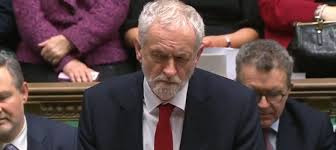
 It was entirely appropriate that it was the votes of the DUP that saved Theresa May’s Government in the vote of no confidence. A reactionary Government was saved by the most reactionary and bigoted collection of MPs in parliament. It is clear that whatever the DUP’s differences over May’s Brexit deal, it did not want to risk a Corbyn alternative.
This illustrates a question for the left in the Labour Party – does it too place Corbyn before taking a position on Brexit? In the previous few hours before setting to write this post I came across two examples of this question being posed.
The first was a Facebook post which noted that in a Labour party branch, which I think was in London, the Corbyn supporters were moving to drop, or at least lessen, their opposition to Brexit since they considered it was weakening Corbyn’s position.
The second was in another Facebook exchange in which an old comrade of mine from Glasgow argued that “For me ending austerity by removing the Tories is the most important thing. I oppose Brexit within that context. I don’t support remain if austerity is to continue. I oppose Brexit as part of a working-class fightback so don’t have common cause with remain Tories or the labour right or the SNP.”
A third exchange posts an article which makes the claim that the argument over Lexit is irrelevant and that the only possible Brexit now is a reactionary one. The first two Facebook exchanges shows that this is not the case.
The first – to support Corbyn by accepting his policy of a Labour “jobs Brexit” – is to support Corbyn by ditching ‘Corbynism”, or rather to support Corbyn by ditching what is best in Corbynism; accepting the worst of his national reformist politics that will destroy the potential of his better policies.
Outside the EU large numbers of businesses will close, re-locate to mainland Europe and reduce their presence in Britain. Those that remain will find the costs of trading with their biggest trading partner increase and their competitiveness reduce. The value of the currency will fall, living standards will decline and the potential for the state to deliver redistributive policies and provide a satisfactory welfare state will be reduced. The British economy will be set back and then probably stagnate or grow more slowly. At the very least it will decline relatively to its European neighbours.
All this of course will be a thousand times worse if there is no deal at all.
This leaves out the reactionary political effects of withdrawal, which is predicated on foreigners being responsible for British problems. This is the common analysis of both left and right opposition to membership of the EU.
The left blames a supposedly unreformable neoliberal EU, with its laws against state aid etc. and the right blames immigration and Brussels for undermining British freedom. In effect they both stand up for the independence and sovereignty of the British State and its parliament against a supposed Brussels bureaucracy. In the shape of Stalinism the language is often identical. It gets ludicrous when there are claims that Lexit means self-determination for Britain, as if it were an oppressed nation, which of course is precisely the logic of the Lexit case.
It would therefore appear that the only way to save Corbynism is to save the man from himself, and since such a thing is very rarely possible it means facing the question of saving ourselves from his Brexit policy.
Confused political events are often accompanied by confused ideas and nothing illustrates this more than Corbyn standing by the principle that any Brexit deal must involve a permanent customs union with the EU.
Unfortunately this makes no sense. The current trading arrangements that exist in the EU, and which Corbyn says must be maintained, owe a lot more to the existence of the Single Market than to the customs union. Corbyn says he wants Britain to be part of a Single Market but there is only one Single Market and leaving the EU, as Corbyn wants, will mean leaving it and leaving the free trading arrangements the benefits of which he wants to maintain.
Remaining in a customs union with the EU will not remove the need to negotiate trade agreements with the EU or with all the other countries with which Britain now trades through deals negotiated with the EU.
No doubt Corbyn would want these deals to continue to apply to Britain, just as he wants the benefits of the Single Market and just as he wants Britain to have a say in how the EU negotiates its trade arrangements; but this simply shows the have-cake-and-eat-it delusional character of the proposed Labour Brexit.
The attempt to strike such a deal would be an ignominious failure and be just as humiliating as the repeated embarrassing episodes of Theresa May’s European adventures. My friend in Glasgow is therefore wrong when he says that “a Corbyn renegotiation could be useful if he highlighted anti-working class aspects of the present set up.” If Corbyn highlighted them he would only put the spotlight on his own failure to remove them.
More importantly, it is wrong because reforming the EU will not come from the British State getting the rules changed, but from British workers – with the help of a Corbyn Government – uniting with other EU workers and their political parties in getting the rules changed for the whole EU, not pursuing exemptions for one member state.
To be fair to my Glasgow comrade, he knows that such an attempt to negotiate a Labour Brexit will fail, but he does not factor in the consequences of such a failure, which is to weaken any Corbyn administration that attempted it. Here we will leave to one side what he might then decide to do when he did fail.
And this brings us to the second way in which a correct policy of utmost opposition to Brexit is the only correct socialist policy, for the comrade says that “for me ending austerity by removing the Tories is the most important thing. I oppose Brexit within that context. I don’t support remain if austerity is to continue. I oppose Brexit as part of a working-class fightback so don’t’ have common cause with remain Tories or the labour right or the SNP.”
Opposing Brexit as a principle does not entail automatic common cause with remain Tories or the labour right or the SNP. As an opponent of Scottish independence the comrade will know that it was possible to take this position without joining with the Tories in the ’Better Together’ campaign. Similarly, it is possible also to support a second EU referendum without forming an alliance with the Peoples Vote movement. In fact a Labour Party socialist campaign for such a vote and a campaign to Remain would transform this demand, making it a potential rallying point for millions of Labour supporters and voters opposed to Brexit and austerity.
Saying that “I don’t support remain if austerity is to continue” is pointless since if Remain does not win the current austerity can only increase.
In this respect it is vital to understand that Brexit can only damage the interests of the working class.
Consider this. The hard-right of the Tory party want to leave the EU in order to impose a low wage, low tax, deregulated sweat shop off the coast of mainland Europe and the EU is afraid of this competition. The Withdrawal Agreement repeatedly sets out the steps that the EU wants in place to prevent this from happening. As socialists we want to prevent it as well, so we agree with the EU on preventing such a project – one very concrete illustration of why Remain is the correct policy for socialists.
The next question is whether such a deregulated Brexit policy is the only one possible. Apart from the obvious fact that it is the only one on offer, and no collaboration between the Labour Party and Theresa May will change this, the answer lies in considering what could be the potential alternatives to such a Brexit.
The reason why Corbyn wants to leave, but wants nothing related to trade to change, is because all trade related changes that must inevitably result from Brexit will weaken the British economy and weaken any potential for a social-democratic Britain. Outside the EU a Britain with a similar regulatory framework as the EU will find it harder to compete, not just because of trade barriers that would have to rise up, but because production restricted within the UK, within one country (as necessarily must be the case to a greater extent when outside the EU) will be less efficient than the continental scale production within the EU.
Outside the EU Britain will more and more become a competitor to the EU if it is not to become simply a satellite of it. This will be the inevitable result of a reactively small Britain seeking trade deals with more powerful nations such as the US and China. Such competition will not drive regulatory standards up; it must be obvious that it will be quite the opposite.
The view of the Stalinist supporters of Brexit that the British state can take over production to create a state-led economic development that will compete with the EU, US and China etc. simply ignores the failure of such a project in the Soviet Union. How many times does it need to be proved that there can be no socialism in one country, and no social democracy in one country either? Only on an international basis would it be possible to lift corporate taxes, or taxes on the richest billionaires, to raise the cost of welfare services through extended provision or significantly raise the terms and conditions of workers. Only on an international basis is it possible to have the most efficient production upon which a new economy can be developed. The looming collapse of the car industry in Britain is negative proof of this.
In a further comment the comrade says that “In effect, Corbyn is using the threat of no deal to win a GE (General Election). Quite right too. That is what I am saying. If faced with the certainty of a no deal Brexit remain Tories will vote for a GE.”
The problem with this of course is that the Tory Remainers have been exposed as spineless. More importantly, the threat of no deal comes from the Tory Government. Both it and Labour pursuing a similar bluff could end up with both delivering a busted flush.
In less than a day we have seen May’s call for all-party talks to be a sham. Her spokespeople have said that she will make no significant changes to her Withdrawal Agreement.
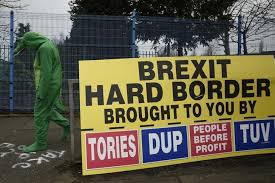
As we have noted above, accommodating Corbyn’s demand for membership of a customs union will not even achieve the objectives of its sponsor. Only Single Market membership will do that and neither the EU nor Tory Brexiteers will swallow this and the latter will not accept a customs union. On its own a customs union will not do away with the need for an Irish back-stop so neither the DUP or Tory Brexit ultras will accept it. Were Theresa May to attempt a deal with the Labour Party on this basis the Tories would most likely split.
Pivoting to the ultra-Brexiteers in her own Party by ditching the backstop would fall foul of the EU and expose May’s promise as an outrageous lie. This sort of Brexit would also fail in Westminster. It would not be enough for the Brexiteers as the transitional deal involving all-UK customs union membership would still remain and still be unacceptable to the ultras. This too would have to go but this, even where the EU to agree, would raise problems of implementation similar to no deal.
Since the issues haven’t changed the favoured solution of Theresa May cannot be expected to change much either. And neither can her strategy of threatening no deal in order to get her own agreement accepted.
But this is really a threat to blow one’s own brains out. It hasn’t been credible, which is why May lost the vote on her deal so heavily, but now that more people are beginning to think that it may be, the Tory Chancellor has been telling business not to worry, it’s not going to happen.
Just as Theresa May previously threatened Brexiteers with no-Brexit and Remainers with no deal, now she is in effect threatening parliament with no deal while promising the capitalists that it won’t happen. She needs to do this because if the latter start to believe that no deal is a real possibility they will take direct action to stop it. The pound will fall and major announcements of disinvestment will follow.
In such a situation, in which no successful move seems possible for any of the parties, the strains between them will cause something to break.
The EU has no reason to strike a new deal with any British party when none can guarantee to deliver. There is no reason for them to offer any compromise to anyone. A collection of MPs from all the parties would not have the capacity or authority (in any sense of that term) to offer an alternative deal to the EU.
Any significant shift by May from her existing deal in any direction would destabilise the Tory Party and lead to the defection of the ultras or even some Remainers. It is unlikely enough MPs will be scared enough to pass her deal.
In these circumstances no deal or no Brexit is most likely, although not inevitable. Extending the timescale of Article 50 simply extends the problem and would in itself intensify the crisis. In such circumstances it is necessary to oppose no deal and fight for no Brexit. And that is why it matters that socialists prioritise the battle against it.
For socialists inside the Labour Party the fight starts within the Party so that the views of the vast majority of the membership are imposed on the leadership. In these circumstances the membership cannot allow Corbyn to place himself in the way. They must reject any potential blackmail in the same way that they have rejected the blackmail threat of no deal. In my younger days certain political questions were called ‘the acid test’. Brexit is that test for socialists today.

 Opportunism is by definition to seek short term gain while sacrificing long term principle. The short term gain often doesn’t arise and the long term loss is long term. I thought of this when I read
  Supporters of Brexit claimed it would ‘bring back control’ and allow Britain to agree more favourable trade deals with the rest of the world. It was also argued by some that a trade deal with the EU would be the easiest to agree and that the EU would rush to conclude it, such was the importance of Britain to the rest of Europe.
 In my last
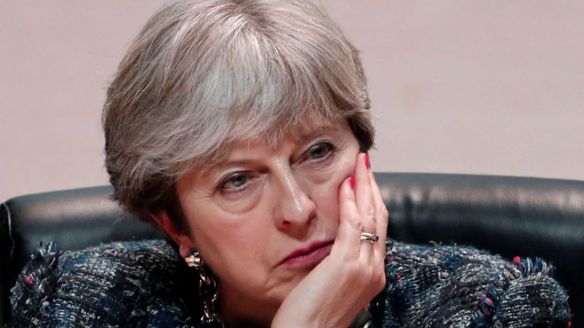
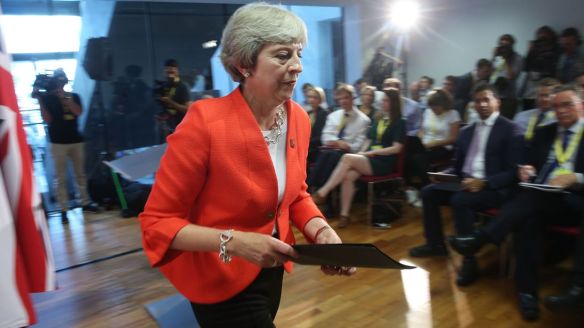 The humiliation of Theresa May at the Salzburg EU meeting came as a shock not just to her but to the British media. They had obsessed with stories, largely an invention of themselves, that foretold a story of the EU having problems with the Chequers plan but needing May as someone from the British side with whom they could negotiate. The alternative was ultra-Tories like Johnson and Rees-Mogg. Coming up to the Tory Party conference, the EU would see the need to help her deal with her fractious party so that a deal could eventually be struck.

 It seems like an age since the Chequers Agreement, which failed even to result in an agreement inside the Tory party. When first revealed, Theresa May was hailed as having achieved a great victory in uniting the warring Tory ranks around a softer Brexit, and it was possible to see how this might have been seen to be the case.
 Sráid Marx