
Trade Unionists march against Austerity
As part of the trade union campaign against austerity across the UK the trade union movement in the North of Ireland organised a demonstration in Belfast to coincide with those in London and Glasgow. It is difficult to estimate the size of the demonstration which appeared significant as it snaked its way through Belfast’s city centre but didn’t look impressive as it assembled and looked even less so at the final rally. The latter however is a feature of trade union demonstrations. The notion that the purpose of a rally at the end is to explain what to do next and get everyone involved is as alien to most people at these things as little green men from Mars. What happens next always depends on the decisions of the union leaders. It is not for deciding by those involved.
Supporters of the United Left Alliance in the North correctly made this the subject of their leaflet and put forward the key task of the demonstration as one of creating a real permanent campaign against austerity:
“Last November saw 40,000 mobilised in Belfast in a general public sector strike – but it was a one-off event and everyone went home again. No further action was taken, there was no continuing campaign and the next public sector strike was much less successful.
Everyone is no less opposed to austerity and the Tories and Labour plans show the issue isn’t going away.
At the end of this demonstration we must make sure we don’t go away either. To ensure that this doesn’t happen we need to come together to create an on-going cross-union permanent campaign that will oppose austerity. Not one that pops up every six months but one that continues every week to campaign inside the trade unions, inside workplaces and inside communities to unite them all in a way that each of them cannot do by themselves.”
I overheard one of the trade union leaders responsible for the demonstration express her delight at the size of the turnout. The demonstration was successful in so far as it confirmed that a basis exists for starting to build a wider and potentially successful campaign but one should not underestimate the obstacles.
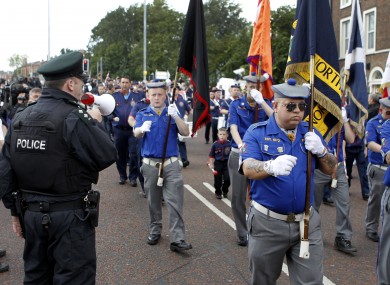
The first is that the demonstration was no more than a few thousand at the very, very most. It was dwarfed by the very, very large sectarian demonstration three weeks before, which commemorated the signing of the Ulster Covenant that led to partition. This was celebrated by the participation of dozens of ‘kick the pope’ flute bands. A prominent organiser of it was Nelson McCausland of the Democratic Unionist Party who has led the introduction of the Welfare Reform Bill in the Stormont Assembly, which imposes in Northern Ireland the cuts decided by the Tory Government in London. It is ironic that many of the marchers in the Ulster Covenant commemoration will be shafted by these cuts.
The welfare changes introduce the biggest assault on entitlement in decades and were also supported by Sinn Fein. The latter bring their own ironic aspect to its passage. The back bone of Sinn Fein’s political machine is a network of advice centres at which Sinn Fein activists help those on welfare get as much as they can. It is what they called ‘screwing the system’ when they first started doing it. Now of course Sinn Fein has joined the system and the only people getting screwed are their constituents. The first many of them will know about the changes will be when their benefits get cut. They will then run to the advice centres where Sinn Fein will tell them ‘sorry but these are the new rules’. What they won’t tell them is that Sinn Fein voted for them and had the power to stop them but didn’t. While welfare is cut along with public sector pay Martin McGuinness will continue to complain that the British won’t let Sinn Fein and the DUP cut corporation tax. Sinn Fein posturing has been particularly vacuous – they have said they ‘might’ make an issue of monthly payments of benefits and demand that they are paid fortnightly instead.
The third obstacle is reflected by the fact that so many walked away from the demonstration with no demand to those on the platform that they provide them with a strategy promising success. The demonstrators were activists in their various trade unions and community groups but there is no understanding of the need for wider organisation. They were there to protest and no more.
A protest is an expression of disapproval, summed up in the slogan ‘not in my name’. It is not an alternative and it ultimately receives the following answer by the Government and State – ‘yeah, so what?’ Sinn Fein and the DUP live and breathe as defenders of their respective community against the other even as together they fillet both. The limits of the trade union leaders’ challenge can be seen in the statement released before the demonstration:
“The devolved administrations must build a robust joint defence of the people who elected them. Let this rally today send a message to our MLAs and our MPs from all political parties that we the people are firmly opposed to the failed policy of austerity which destroys lives and futures.”
An appeal to the political parties at Stormont and to Stormont itself is not a strategy. It amounts to an appeal to the enemy. The financial crisis exploded because of a property boom and the well-reported antics of the Developers’ Unionist Party and hidden ‘let’s get rich’ antics of the leaders of the Provisional Movement mean these people ae personally tied up with the system that is demanding the cuts.
The political sectarianism of the left means that it too is not an alternative. It is unable to unite its tiny forces in an attempt to make a difference, although this is not the biggest problem. The Left’s inability to organise in an open and democratic way means it cannot include the wider forces needed to create a real movement. Were it to attempt to do so the Left group concerned would no longer retain control. Since their absolute need for control is not just a rather unfortunate sectarian aberration in their practice but a foundation in principle of their existence- they all believe that they are the sole essential nucleus of the mass working class party of the future because of their particular approach to socialist politics -they are both practically and in theory sectarian.
The leaflet of the supporters of the United Left Alliance correctly put forward the next step – creation of a permanent campaign that is organised across unions by rank and file members, in workplaces and in communities and their community campaigns. This is not just the next step in a campaign against austerity. Just as socialism is the creation of working people themselves so is the resistance to capitalism, one of the means by which the capitalist system will be superseded by the power of a new ruling class, made up for the first time by the vast majority of society.
 Sráid Marx