Karl Marx’s alternative to capitalism (61) Alienation and abolition of private property

Hudis claims that in those countries where capitalism had been overthrown the statist ‘socialism’ that existed ‘eliminated private property and the ‘free market’ by bringing the process of distribution and circulation under the control of the state. But they did little or nothing to transform production-relations. Concrete labour was still reduced to a monotonous, routinised activity through the dominance of abstract labour. Abstract labour continued to serve as the substance of value.’ (p104)

By this is meant that social labour was fragmented and produced commodities that exchanged with each other based on the abstract labour contained within them, which was determined by the labour time necessary to produce them and not by the conscious decision on the distribution of social labour according to a preconceived conception of need and human development.  Almost immediately he states that ‘instead of a surplus of products that cannot be consumed (which characterises traditional capitalism), there is a shortage of products that cannot be produced.’ (p 104).

However, this eventuality demonstrates that these societies, while not abolishing alienation – far from it – had abolished the market to the degree that meant all commodities were not produced according to the socially necessary abstract labour required to produce them and not under capitalist relations of production with a labour market producing a free working class employed by capital, either private or state. Even the creation of healthy worker’s states will not immediately end alienation, by definition the continuation of any state denotes the continuation of classes, however much their antagonism is attenuated.

Further, as Marx explained in Critique of the Gotha Programme: ‘What we have to deal with here is a communist society, not as it has developed on its own foundations, but, on the contrary, just as it emerges from capitalist society; which is thus in every respect, economically, morally, and intellectually, still stamped with the birthmarks of the old society from whose womb it emerges. Accordingly, the individual producer receives back from society – after the deductions have been made – exactly what he gives to it. . . .’

‘But one man is superior to another physically, or mentally, and supplies more labour in the same time, or can labour for a longer time; and labour, to serve as a measure, must be defined by its duration or intensity, otherwise it ceases to be a standard of measurement. This equal right is an unequal right for unequal labour. It recognizes no class differences, because everyone is only a worker like everyone else; but it tacitly recognizes unequal individual endowment, and thus productive capacity, as a natural privilege. It is, therefore, a right of inequality, in its content, like every right.’

‘Further, one worker is married, another is not; one has more children than another, and so on and so forth. Thus, with an equal performance of labor, and hence an equal in the social consumption fund, one will in fact receive more than another, one will be richer than another, and so on. To avoid all these defects, right, instead of being equal, would have to be unequal.’

‘But these defects are inevitable in the first phase of communist society as it is when it has just emerged after prolonged birth pangs from capitalist society. Right can never be higher than the economic structure of society and its cultural development conditioned thereby.’

Hudis is correct that it is the active role of labour that creates private property, but when he quotes Marx saying that ‘though private property appears to be the reason, the cause of alienated labour, it is rather its consequence, just as the gods are originally not the cause but the effect of man’s intellectual confusion. Later this relationship becomes reciprocal’, he leaves out the last sentence, which makes (bourgeois) private property constitutive of this alienated labour.  (Marx quoted in Hudis p 61) Unlike ‘the gods’, this private property is real.

Marx says: ‘It is only at the culminating point of the development of private property that this its secret re-emerges, namely, that on the one hand it is the product of alienated labour, and on the other it is the means through which labour alienates itself, the realization of this alienation.’ C.W.3, 280;(Economic and Philosophical Manuscripts, Early Writings, p 392)

“Communism is the positive supersession of private property as human self- estrangement, and hence the true appropriation of the human essence through and for man; it is the complete restoration of man to himself . . . which takes place within the entire wealth of previous periods of development. (Marx and Engels Collected Works Vol..3, p 296; Early Writings p 348).

Elsewhere Hudis quotes Marx that ‘[P]rivate property, for instance, is not a simple relation or even an abstract concept, a principle, but consists in the totality of the bourgeois relations of production…a change in, or even the abolition of, these relations can only follow from a change in these classes and their relationships with each other, and a change in the relationship of classes is a historical change, a product of social activity as a whole’ (p83 -84)

‘Marx grasps the situation as one of labour’s self-alienation in and through private property. Only if labour is grasped as the overriding moment in the alienated labour/private property complex can the conditions of a real transcendence of estrangement be established. Grounded in the alienation of labour, the immanent movement of private property necessarily produces ‘its own grave diggers’ (in the famous phrase of the Communist Manifesto). But in the dialectical opposition of private property and alienated labour the principal aspect of the contradiction then becomes the latter; hence Marx says that the fall of wage-labour and private property – ‘identical’ expressions of estrangement – takes place ‘in the political form of the emancipation of the workers’. Marx and Engels Collected Works Vol 3 p280).

Private property in its capitalist form entails the capital-wage labour relationship – the relations of production between capital and working class – from which class struggle arises, which struggle must eventuate in social revolution that makes the working class collective owners of the means of production and whose political emancipation entails overturing the capitalist state and creation of its own. 

As Hudis himself notes: ‘Communism does not deprive man of the power to appropriate the products of society; all that it does is to deprive him of the power to subjugate the labour of others by means of such appropriation’.

Hudis continues: ‘In the Manifesto, Marx also writes that ‘the theory of the Communists may be summed up in the single sentence: Abolition of private property’. It may seem that Marx has muted, if not moved away from, his perspective of 1844, in that the abolition of private property here seems to be posed not just as a mediatory stage, but as the ultimate goal. However, this would be too facile a reading. Marx focuses on the need to negate private property because it is the most immediate expression of the power of bourgeois society over the worker. Through the bourgeois property-relation, the workers are forced to sell themselves for a wage to the owners of capital, who appropriate the products of their productive activity. Without the abolition of this property-relation, the economic and political domination of the bourgeoisie remains unchallenged.’ (Hudis p82-3)

The abolition of bourgeois private property means the overthrow of the capital-wage relationship and exploitation, which are the grounds for the abolition of all classes.  This objective is therefore not just required because ‘it is the most immediate expression of the power of bourgeois society over the worker’ but because, to put it in its active sense, it is thereby the most immediate expression of the power of the workers to overcome the exploitation and oppression of bourgeois society.

It is why Marx also said in The Communist Manifesto that “The distinguishing feature of Communism is not the abolition of property generally, but the abolition of bourgeois property . . . In short, the Communists everywhere support every revolutionary movement against the existing social and political order of things.  In all these movements, they bring to the front, as the leading question in each, the property question, no matter what its degree of development at the time.’

Back to part 60

Forward to part 62

Part 1 is here

Karl Marx’s alternative to capitalism (60) Alienated labour and private property

In his book Marx’s Concept of the Alternative to Capitalism, Peter Hudis lays emphasis on the statement by Marx that ‘ it becomes clear that though private property appears to be the reason, the cause of alienated labour, it is rather its consequence, just as the gods are originally not the cause but the effect of man’s intellectual confusion.’

He argues that private property is not the key to the emancipation of the working class but rather alienated – estranged – labour.  He quotes Marx: ‘when one speaks of private property, one thinks of dealing with something external to man’ but Hudis goes on to point out that ‘Property is, after all, the product of human activity. Classical-political economy reverses matters, by presenting the predicate – property-relations – as the determining factor while ignoring the alienated nature of the workers’ activity.’ (p62)

For Hudis, this has implications for the centrality of the abolition of private property to those seeking this emancipation: ‘since private property is an objectified product of human activity, the critique of private property does not satisfy the requirement of reducing all emancipation to ‘relationships to man himself’. [quoting Marx] The critique of private property still deals with what is ‘external to man’. Marx’s normative principle of human emancipation – which he reiterates in 1844 as ‘man’s relation to himself only becomes for him objective and actual through his relation to the other man’ – drives him to look deeper than the property-relation. This takes him to his theory of alienated labour.’

As noted in the previous post, he quotes Marx ‘When one speaks of labour, one is directly dealing with man himself. This new formulation of the question already contains its solution.’  For Hudis, the solution is put this way:

‘It follows from the analysis that, while private property must be abolished – since it separates workers from the conditions of production – that alone does not get to the heart of the problem. The heart of the problem is abolishing capital itself, by ending the estrangement in the very activity of labouring. We have reached the conceptual pivot of what Marx sees as the alternative to capitalism.’ (p63). He later concludes that ‘In contrast to how Marx was understood by much of twentieth-century ‘Marxism’, our exploration indicates that his real object of critique was not the market or private property, but rather the social relations that underpin them.’ (p92)

Hudis continues: “Two points are worth noting from this. First, wages, like property, are results of human activity. They are made necessary by the existence of alienated labour. To ignore alienated labour while altering wage- and property- relations through the elimination of private capitalists does not undermine the necessity for a ruling class to impose forced labour on the workers. Society as a whole now becomes the ‘abstract capitalist’.”  Hudis states this in referring to those socialists who think higher wages are socialist or that the existence of wages in itself is compatible with socialism, since ‘they are paid to the worker on the basis of the capitalist’s ownership of the products of labour.’ (p 64) Specifically, his reference to society becoming ‘the abstract capitalist’ refers to Marx’s view of this as a necessary concept arising from Proudhon when the latter conceives of the equality of wages.

In relation to ‘society’ becoming the ‘abstract capitalist’, Marx is quoted as saying that ‘‘above all we must avoid again postulating “society” as an abstraction vis-à-vis the individual. The individual is the social being.” Hudis says that ‘Marx is not trying to wall humanity into the ‘social’; he rather seeks a mutual compatibility between individual and general interests.  Yet exactly how does the present mode of production compel civil society to assume an abstract form? The answer is the social division of labour. By forcing individuals to adhere to a social division of labour, individuals become radically separated from one other. This separation takes on a fixed form, regardless of their actual talents and abilities. Society becomes an abstraction that governs the lives of individuals, instead of the other way around.’  Quoting Marx: ‘As long as man remains in naturally evolved society, that is, as long as the cleavage exists between the particular and the common interest, so long, therefore, as activity is not voluntary, but naturally, divided, man’s own deed becomes an alien power opposed to him, which enslaves him instead of being controlled by him.’ (p 77 – 78)

How is this situation to be overcome?  ‘By abolishing the social division of labour’, says Hudis, (p78). He makes the point that Marx ‘sees the process of revolutionary transformation not as a singular act, as the negation of private property and political overthrow of the bourgeoisie, necessary as that is, but as a consistently self-critical social revolution, that is, as a process of permanent revolution. Crude communism – the abolition of private property – is only the first negation. It is a necessary but insufficient step towards liberation. To achieve ‘positive humanism, beginning from itself’ much more is needed – the negation of the negation.’ (p73)

The end of alienated labour entails the end of the social division of labour but the overthrow of capitalism will not immediately end this division or the alienation arising from it.  It will not immediately, or even rapidly, align individual interests with those of others or of ‘society’ as a whole: ‘History will lead to it; and this movement, which in theory we already know to be a self-transcending movement, will constitute in actual fact a very rough and protracted process.’ (Hudis, quoting Marx emphasis added, p 75). In this statement Marx is not talking about the end of the social division of labour but of abolishing ‘actual private property.’

The overthrow of capitalism and the beginnings of a new society will not instantly realise these aims; alienated labour will not immediately end.  Private property relations of production entail alienation but alienation does not immediately disappear with them, so that alienated labour will still exist upon the overthrow of capitalist property relations.  Capitalism is not therefore defined by alienated labour but by a particular form social relations that give rise to a specific form of alienated labour; it will still, ‘after the revolution’, be necessary to develop the forces of production, as Marx stated in The Communist Manifesto and still require that much labour remains necessary, understood in Marx’s terms as required to meet the needs of the working population and those dependent on them, while surplus labour, required to develop and meet new higher needs, including more time free of labour, will grow but not yet predominate.  While this is the case the division of labour will entail alienation as will the continuing, although reducing, social inequalities.

A certain compulsion of labour remains, albeit more and more voluntary and collective as the forces of production develop to the degree that the time required for necessary labour declines and the choice over the extent of surplus labour increases.  Just as the state withers away after the capitalist state is overthrown and a workers’ state created, so does estranged, alienated labour also shrink and fade.  The continuation of a (worker’s) state and the continuation of alienated labour does not indicate the continued existence of capitalism, whether called ‘state capitalism’ or not, but the continuation of ‘a very rough and protracted process’, as Marx outlined.

Hudis quotes Marx saying that ‘man’s relation to himself only becomes for him objective and actual through his relation to the other man’ but it is through the relations of production that are entailed by bourgeois private property, and the society upon which is developed from it, that relations to other men and women and thus to him and herself are formed and within which alienated labour exists.  The centrality of these relations of production and bourgeois private property entailed in them is repeatedly advanced by Marx and Engels in their political writings and programme as we shall note in the next post.

This, as we have noted, is also advanced by Hudis, that Marx’s ‘real object of critique was not the market or private property, but rather the social relations that underpin them.’

Back to part 59

Part 1

Forward to part 61

Karl Marx’s alternative to capitalism (59) – Alienated labour

The early Marx sought to understand the new capitalist society through a study of political economy as expounded by its disciples and critics.  In doing so he faced multiple phenomena, seeking ‘to grasp the intrinsic connection between private property, greed, the separation of labour, capital and landed property; the connection of exchange and competition, of value and the devaluation of man, of monopoly and competition, etc. – the connection between this whole estrangement and the money system.’ (Marx Economic and Philosophical Manuscripts 1844)

In doing so he considered that ‘Political economy conceals the estrangement inherent in the nature of labour by not considering the direct relationship between the worker (labour) and production.’

Marx goes on to put forward the idea that in ‘our departure from a fact of political economy – the estrangement of the worker and his production . . . We have formulated this fact in conceptual terms as estranged, alienated labour.’

‘If the product of labour does not belong to the worker, if it confronts him as an alien power, then this can only be because it belongs to some other man than the worker. If the worker’s activity is a torment to him, to another it must give satisfaction and pleasure. . . . Thus, if the product of his labour, his labour objectified, is for him an alien, hostile, powerful object independent of him, then his position towards it is such that someone else is master of this object, someone who is alien, hostile, powerful, and independent of him. If he treats his own activity as an unfree activity, then he treats it as an activity performed in the service, under the dominion, the coercion, and the yoke of another man.’

‘Through estranged, alienated labour, then, the worker produces the relationship to this labour of a man alien to labour and standing outside it. The relationship of the worker to labour creates the relationship to it of the capitalist (or whatever one chooses to call the master of labour). Private property is thus the product, the result, the necessary consequence, of alienated labour, of the external relation of the worker to nature and to himself.’

Private property thus results by analysis from the concept of alienated labour, i.e., of alienated man, of estranged labour, of estranged life, of estranged man.’

‘True, it is as a result of the movement of private property that we have obtained the concept of alienated labour (of alienated life) in political economy. But on analysis of this concept it becomes clear that though private property appears to be the reason, the cause of alienated labour, it is rather its consequence, just as the gods are originally not the cause but the effect of man’s intellectual confusion. Later this relationship becomes reciprocal.’

‘Only at the culmination of the development of private property does this, its secret, appear again, namely, that on the one hand it is the product of alienated labour, and that on the other it is the means by which labour alienates itself, the realisation of this alienation.’

The alternative to capitalism for Marx is not simply the abolition of private property but the ending of alienation: of workers from their work (as it is imposed as a necessity in order to live while not under their control as to its nature or purpose); of workers from their product (which includes products they would choose not to make with workplaces and technology that subjects them to control and determines the nature of their work); alienation from each other (they compete for resources, including employment, and are atomised by lack of collective control of the means of providing for their needs); and through all this, alienated from their essential nature as social animals working in cooperation to develop their humanity in all its richness through and with other people, who are regarded not as constraints on their freedom, as in bourgeois theory, but only through whom their freedom can be realised.

‘From the relationship of estranged labour to private property it follows further that the emancipation of society from private property, etc., from servitude, is expressed in the political form of the emancipation of the workers; not that their emancipation alone is at stake, but because the emancipation of the workers contains universal human emancipation – and it contains this because the whole of human servitude is involved in the relation of the worker to production, and all relations of servitude are but modifications and consequences of this relation.’

‘We have accepted the estrangement of labour, its alienation, as a fact, and we have analysed this fact. How, we now ask, does man come to alienate, to estrange, his labour? How is this estrangement rooted in the nature of human development? We have already gone a long way to the solution of this problem by transforming the question of the origin of private property into the question of the relation of alienated labour to the course of humanity’s development. For when one speaks of private property, one thinks of dealing with something external to man. When one speaks of labour, one is directly dealing with man himself. This new formulation of the question already contains its solution.’

Marx’s critique of political economy, and the conditions of estranged labour in capitalism, included the concepts of the forces of production and relations of production and the potential to overthrow the capital-wage relationship upon which they were based.  Labour power is the main force of production and the relations of production are more and more dominated by the capital-wage relationship. It therefore becomes clear that the social revolution that is necessary is one not just for the working class but by it:

‘Both for the production on a mass scale of this communist consciousness, and for the success of the cause itself, the alteration of men on a mass scale is necessary, an alteration which can only take place in a practical movement, a revolution; this revolution is necessary, therefore, not only because the ruling class cannot be overthrown in any other way, but also because the class overthrowing it can only in a revolution succeed in ridding itself of all the muck of ages and become fitted to found society anew.’ (Marx and Engels, The German Ideology)

The alienation that thwarts the exercise of human powers and potentialities is the product of these forces and relations, which also provide the potential to free humanity from such alienation and allow the further development of human powers and potentialities. Bourgeois private property and alienated labour condition each other and reflect aspects of the same social relation of wage labour and capital. The overthrow of this form of social labour is not therefore something external to humanity (‘man’) but deals directly with its social relationships and therefore directly to humanity itself, as its nature for Marx is the ensemble of these relationships.

The forces and relations of production in feudal society created classes within which an individual’s identity is fixed and determined in a hierarchy by birth. As Marx puts it: ‘a nobleman always remains a nobleman, a commoner always a commoner’.  (Marx and Engels, The German Ideology) Capitalism involves capitalists and workers and while there must always be capitalists and workers within it, the individuals personifying this class relationship are not always necessarily fixed.  An individual may not always be a worker if she then employs labour, and a capitalist may be reduced to a member of the working class if she becomes bankrupt.

More importantly, while the peasants of precapitalist society were socially and geographically isolated as virtually self-sufficient economic units, producing almost everything they needed, the working class is part of a cooperative division of labour spanning the world (with the organisation of society corresponding to it) and organised by capitalism in such a way that, while alienated from the very powers it has created, has the potential to appropriate these powers and dispel their alienation.

This is what the abolition of bourgeois private property begins to do, with the creation of a cooperative economy and a workers’ state that defends it, together developing the forces of production and dissolving the exploitation of labour by capital.

Back to part 58

Part 1

Forward to part 60

Carving up Ukraine

Two years ago, the Ukrainian Defence Minister Alexei Reznikov, admitted during an appearance on local television that “Today, Ukraine is addressing [the] threat (of Russia). We’re carrying out NATO’s mission today, without shedding their blood. We shed our blood, so we expect them to provide weapons.”  Nothing could be clearer – Ukraine was fighting a proxy war for Western imperialism against Russia.

In January this year, it was reported that in a closed-door meeting with the Ukrainian parliament, military intelligence chief Kyrylo Budanov, predicted “If there are no serious negotiations by the summer, then very dangerous processes for the very existence of Ukraine may begin.”

In other words, Ukraine was losing the proxy war.  Despite all the support from the West, it was running out of soldiers while its Western sponsors were running down their own stock of weapons and ammunition; it had either been destroyed by the Russians or had been expended to no avail.

Now, with Donald Trump’s proposals, there is some prospect of “serious negotiations by the summer” and an end to Ukrainians “shedding their blood”.  The US has other concerns and has torpedoed the declared purpose of the war by declaring that Ukraine will not be a member of NATO, will not return to its 2014 borders, and no US troops will be placed in Ukraine at any time, even after the end of hostilities. European NATO countries will have to take up the burden.  He announced that ceasefire negotiations with Russia would start and of course, Ukraine would be involved, although it was not even informed of Defence Secretary Hegseth’s statement about the radically changed objectives of the war.

Zelenskyy’s ‘Victory Plan’ is dead in the water, as is his statement that US troops are essential for Ukraine in the event of a deal.  Having declared that it would be ‘very difficult’ to survive without U.S. military support, and that he doesn’t “want to think about” not having it, he now declares the need for an “army of Europe.”  It is a form of denial.

So is the statement by the ‘High Representative for Foreign Affairs and Security Policy and Vice-President of the European Commission’ Kaja Kallas, who said that ‘we must help Ukraine to defend itself against aggression so that there is no wider conflict.   It will be a dirty deal, which we’ve seen before, for example in Minsk, and it just won’t work. It won’t stop the killing. It’s not going to stop the war.”  “Why are we giving them [Russia] everything they want even before the negotiations have started? It’s appeasement. It has never worked.” “It is clear that any deal behind our backs will not work. You need the Europeans, you need the Ukrainians.”

Of course, Russia hasn’t been given everything it wants, and what the US administration has accepted is something it does not have the power to deny. Pretending you can go into negotiations demanding the impossible as a bargaining chip undermines your position from the start and subverts credibility.  It is a recipe for continued and ‘wider conflict’, which is what the EU and the British are proposing.  All the sanctimonious snivelling about ‘stopping the killing’ and ‘stopping the war’ is just so much hypocritical and cynical lying.  It is also a form of denial because the European arm of NATO cannot impose its will on Russia and cannot even police an eventual settlement with any degree of certainty.  Neither can Ukraine continue the war without avoiding defeat and the longer it goes on the worse it will be.  The so-called friends of the Ukrainian people in European governments are happy to continue to shed their blood even when NATO’s mission is dead.

If the European ‘friends’ of the Ukrainian people are false, so they are also betrayed by their own political leaders who, having declared the need to shed blood in a war for NATO and need for US military support, are now determined to continue to shed more blood without the declared objective and without this support.  Meanwhile Zelenskyy fends off the US emissary seeking his signature to Trump’s deal for his takeover of 50% of Ukraine’s mineral deposits.

Any observer with any appreciation of the reality of the war has noted that the first impact of Trump’s initiative is to further demoralise Ukraine, already suffering from exhaustion, desertion and draft-dodging.  Many Ukrainian workers are voting with their feet and see no sense in following orders that risk their lives on behalf of NATO or to allow the plundering of the country’s natural resources.  On top of these we now have the glaring reality that they cannot win.

In the absence of working class political opposition, the proxy nature of the war has imposed itself anyway, and many Ukrainian workers will not fight and die for it.  Despite this political absence the resistance to the war has weakened the West’s project and that  of the Ukrainian state and this can now can only increase.

Some observers have already noted the repeated attempts by the Zelenskyy regime to escalate the war with the latest being the false flag attack on Chernobyl nuclear power station, blamed of course on the Russians, who could blow it up if they wanted, have no interest in doing so, and especially at this time when it suits only Ukrainian attempts to drum up support.

It is by no means obvious that the road to ending the war is clear.  Not only the Zelensky regime but also the far-right Banderite factions stand in the way.  The nonsense that the West is fighting for democracy has again been exposed by Zelenskyy sanctioning his political rivals in preparation for elections that will come sooner or later.  The Banderites are another obvious threat to his regime and any attempt by it to negotiate a less damaging and humiliating peace agreement.  

Kaja Kallas, has stated EU opposition to “a dirty deal . . . for example in Minsk” and that “you need the Europeans, you need the Ukrainians.”  Her and the EU’s demands are and will be unacceptable to Russia while the Minsk agreements failed not least because Ukraine had no intention of implementing them and Germany and France had no intention of making it.  What this means is that Russia will itself not accept an updated version of Western promises that might not last longer than a change in the US administration.

Russia therefore has its own problems in enforcing a deal that cannot be unravelled later, including the extent of its territorial acquisitions and the nature of the rump Ukrainian state; the scale of its armed forces and the need to exclude NATO troops from it under the pretence of being ‘peace-keepers’.  It also needs the removal of sanctions, which the EU can stymie.  These point to pursuit of a definitive Ukrainian defeat and Russian victory which is not yet imminent, but which endangers any arrangement with Trump and provides more opportunity for Ukrainian provocation and European intervention.

The task of socialists is clear – no support to Trump and whatever plans he has, which can radically change; opposition to the attempts of European imperialism and the Ukrainian state to continue the war, and advance its end by explaining its reactionary character to the workers of all the combatant states, including Russia.  If the pro-war left in the West is consistent with its existing policy it will row in behind Starmer, Scholtz and Macron etc. in seeking to continue the war and in doing so increase the risk of a wider conflict with Russia.  It will leave European workers politically disarmed in opposing rearmament, the militarisation of their society and the austerity and repression that will be required for its implementation.

One supporter of the Russian invasion has stated that “we need to organise a mass movement to demand a just and democratic peace in Ukraine”, as if any peace agreement arising out of negotiations involving Trump, Putin, Zelenskyy and von der Leyen could possibly embody a democratic solution.  The only possible democratic solution to this war and to capitalist war in general is a working class revolution but neither the social-imperialist left in the West, or the so-called ‘anti-imperialist’ left that supports Russia, will contribute to this.  Instead, they will look to their favoured reactionary state to triumph.

Imperialist rivalry and the Left (2 of 2)

The Trump mantra of Making America Great Again is recognition of relative US decline and the need to arrest and reverse it, and in this he is no different from his recent predecessors. It is also recognition that this cannot be done in the old way – as during the short unipolar moment of US supremacy after the collapse of the Soviet Union. 

The US no longer reigns supreme because of a higher level of industrial productivity and is no longer able to militarily dominate the whole world unchallenged despite an enormous military. The right-wing historian Niall Ferguson seriously overstates the case when he asserts that the US currently resembles the Soviet Union in the 1980s although his observations are accurate. In both there was/is a geriatric political leadership; the population no longer bought/buys into the political regime; the rising level of state debt was/is unsustainable, and most dramatically there was/is a marked decline in life expectancy in major sectors of the population caused by deaths of despair – alcoholism, opioids and suicide.

Despair is food for reactionary petty bourgeois politics, not for socialism, although socialism is no longer put forward by much of the left as an alternative.  Other demands and policies and other movements have taken its place.  As we have noted, in Ukraine it is ‘self-determination’ of an independent capitalist state; anyone but Le Pen for French workers to defend French bourgeois democracy; and a ‘left’ Government in Ireland that isn’t left in any genuine sense to replace a hundred years of Fianna Fail and Fine Gael.

The new imperialist rivalry makes the pro-war left’s approach of opposing imperialism through a policy of self-determination of nations incoherent, although it probably thinks the opposite.  It forgets that the policy arose as a means of combatting nationalism, not supporting it.  That it applied to countries and peoples that existed in colonies and empires, not already existing independent states.  That the role of the policy was to propel bourgeois revolutions among these peoples as a way of advancing socialist revolution in the advanced imperialist countries.  Not as a means of supporting bourgeois forces in already capitalist countries that seek alliances with one or other imperialism. Not in pursuit of a bourgeois revolution – whether called ‘national liberation’ or self-determination – where capitalism has already been fully established and with a large working class the task of which is to win it to socialism – through opposition to its own bourgeoisie and imperialism.

A world of at least nominally independent states makes a policy of self-determination dependant on secondary characteristics that results in political opportunism because this self-determination for countries can only apply against others.  Such justification falls apart when one or other imperialist power becomes the sponsor of this ‘self-determination’.  This is clearly the case in Ukraine, which requires massive NATO intervention as the only means of achieving what is claimed to be national liberation.  This would necessarily involve the takeover by Western imperialism and would involve the pillaging of Ukrainian resources by the US and other multinationals, as various US media and politicians have made abundantly clear.

An article attempting to justify this position illustrates the problem of employing inane criteria to support capitalist war. Its “practical conclusions” are that “When an imperialist country is invading a poorer nation to try to carve up the world, advocating the latter’s right to resist and defending its right to self-determination is a basic democratic demand. Even saying you are in favour of the smaller nation winning is a principled and correct position.”

In this case the argument is that we must support a “poorer” or “smaller” nation against an imperialist one. Whatever about what is meant by “poorer” or “smaller,” what is missing is the need for a concrete class analysis of what the war involves – whether a “smaller” or “poorer” nation is sponsored and supported by a more powerful imperialist one or whether it is a capitalist state itself despite its poverty or size.

A world in which any significant war will involve support to one side or the other by an imperialist state in rivalry with another is ignored through moralistic claims about their size and wealth, ignoring that it is the working class who will fight and die in both. This is ignored because capitalist war is viewed as a war between nations and the class struggle is rendered irrelevant by choosing the most worthy and deserving capitalist state to support.

A policy of supporting self-determination and the independence of capitalist states is not a policy of supporting the right to self-determination of countries that are colonies or parts of former empires.  It amounts to endorsing the policies of independent states against others and involves the left drumming up support for these under the cloak of the same hypocritical phrases about freedom long ridiculed by socialists.

It is as easy to declare support for the poorer and smaller alliance of Russia and China against the United States and the West over Ukraine – or Taiwan – as it is to support the West and its Ukrainian proxy.  It is as stupid to declare one more democratic than the other, or to label one or the other as fascist, or define its capitalist character as non-imperialist, in order to justify support for it.  In all cases the subordination of the working class to the favoured ‘democratic’ or ‘non-imperialist’ state is concealed and rendered invisible.  Socialism cannot be put on the agenda by picking out what capitalist state to support, and the poverty of the arguments for it demonstrate it.

Back to part 1

Imperialist rivalry and the Left (1 of 2)

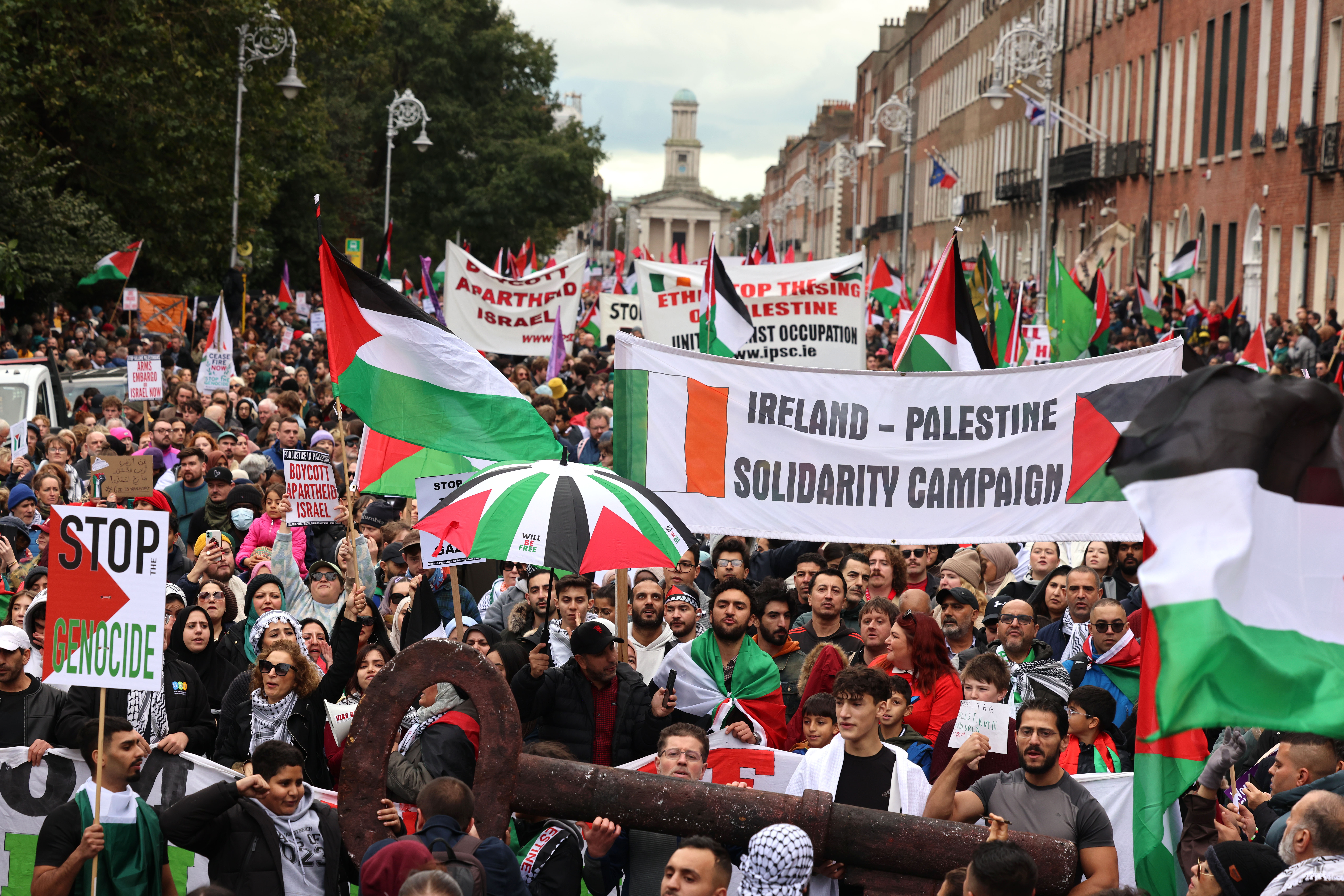
The widespread revulsion among many in the West at the genocide in Gaza explains the increasing clampdown by governments on protests against it.  These tend towards opposition against the Western states themselves, whose complicity is too obvious to hide, while the attempts to disguise and justify it by the likes of the BBC etc. reduces their influence.

This comes at a difficult time when Western political and military leaders and their propagandists in the media announce that the populations of the West should be preparing for war themselves.  The latest is a report stating that:

‘The European Commission should facilitate the prolongation of the conflict in Ukraine in order to contain Russia and prepare for war within the next five years. European Commissioner for Defence Andrius Kubilius made such a statement during the annual conference of the European Defence Agency in Brussels.’

“Every day that Ukraine continues to fight is another day for the EU and NATO to become stronger,” he said, calling on European countries to “prepare for war in the next five years” and to move the European economy to ” turbowarfare regime”.’

“We should spend more on weapons, produce more and have more weapons than Russia,” Kubilius added.’

This is the inescapable logic of all those, from the right to the pro-war left, who currently support the war.  It follows from their claims that Ukraine must be supported because it is fighting for democracy – for ‘us’ – against an aggressive imperialism. If it is acceptable for Ukraine to ally with NATO and for workers in the West to support it in doing so, then the same Russian threat exists not only to Ukraine but also to Eastern Europe.  After all, is this not the inevitable course of an aggressive imperialism?  If this imperialism threatens Eastern Europe only the stupid could deny that the same threat would then not also be posed to Western Europe.

So far, some groups like that promoted by  Anti-capitalist Resistance are committed to this view in relation to Eastern Europe; but a war they believe can spread from Ukraine to Eastern Europe has, for similar causes, no rationale not to spread from Eastern Europe to Western Europe.  This means that there is no reason not to support their own states in this future war and accept the preparations necessary to fight it, those demanded by the EU Commissioner for Defence.

Since most of the Western left has failed to oppose the war it is therefore politically disarmed against the bellicose demands for rearmament by their own capitalist states.  This is true both of those who pretend that the war by Ukraine is one of national liberation and of those who believe it is an imperialist proxy war and a war of national liberation at the same time.  The latter simply import into their position the contradiction that the real world outside damns in the former.

Now, along comes Donald Trump to make it clear that imperialist rivalry really is aggressive by its nature, including the Western variety.  The attempt therefore to claim that it is the Russian variety that is solely responsible for war must explain in what way it is not just one instance of a world-wide phenomenon; why the expansion of NATO to include Ukraine is not central to the cause of the war; why Ukraine should be supported when its criticism of Israel has been that it hasn’t provided it with weapons – something now being rectified; why support should be given to the Western variety of imperialism when it is participating in genocide in Palestine; and most importantly, why opposition to the invasion requires support for the alliance of Ukraine and Western imperialism.

Of course, the pro-war left opposes Trump, but more as an anomaly – rather like others in the bourgeoisie media – who will highlight the differences but ignore the continuities with the previous Biden administration.  However, some of these commentators have already admitted that what stands out about Trump is his open espousal of the same principles as his predecessors without the hypocritical rhetoric that has usually accompanied it.  He is as much a product of Western bourgeois democracy that the pro-war left defends as the Obamas and Bidens.

Trump’s threat of ethnic cleansing will compete against Biden’s genocide for barbarity.  Sanctions and creeping economic war against China started under Trump but were maintained and expanded by Biden.  Trump’s threat to make Europe pay for the war in Ukraine follows Biden’s existing imposition of its costs on Europe through sanctions, blowing up European infrastructure, and selling it more expensive energy and lots of US weapons.

Trump is evidence of there being more than one way to pursue US primacy.  Of course, this doesn’t mean there isn’t a difference, but it is necessary not to limit opposition only to them.  The petty bourgeois character of the left is exposed by its seizing on such differences to drop principled opposition to other bourgeois forces and ally with them in opposition to what is called the far-right or fascism.  This includes the same forces whose rule led to the growth of the far-right in the first place.  We see this process again and again in support for the Democrats in the US, Macron in France, and Starmer’s Labour Party in Britain.  In Ireland it is Sinn Fein that is supposed to be central to a left alternative despite its record in office in the North of the country.

All these have failed, or will fail, because these forces are not an alternative to what is called the far-right, which in many cases is just the further right.  These far-right formations represent, or are composed of, the reactionary sections of the petty bourgeoisie with their narrow nationalist ideas that must inevitably under current conditions gravitate to those they seek to replace, or shift their ground to achieve the same outcomes with different methods.  The accommodation that many so-called centrist bourgeois formations are making with the far-right should be all the evidence needed that the dividing line is not some notion of a more and more discredited bourgeois democracy against right wing populism and authoritarianism but between the working class and the bourgeoisie that is attempting to conscript it for war and get it to pay the price in money and blood.

Forward to part 2

Marxism and Gender Identity Ideology (8) – Identity politics on steroids

For some on the left the executive order by Donald Trump that the Federal Government will recognise only two sexes – that gender identity “cannot be recognized as a replacement for sex’, and that it will not replace ‘the biological category of sex with an ever-shifting concept of self-assessed gender identity, permitting the false claim that males can identify as and thus become women and vice versa’ – will be seen as confirming their support for these views.  His decision, it will be said, is one from an arch-reactionary who is only being consistent with his other reactionary views.

It is a pity for the holders of such views that their perspective on consistency should lead them to celebrate the progressiveness of the previous Presidential champion of gender ideology, Joe Biden – the sponsor of war in Ukraine and accomplice in the carrying out of genocide in Gaza.  The ability of Trump to weaponise simple truths is as much a feature of identity politics as its pernicious role in undermining socialist politics and the primacy of working class unity.  The role it has played in the Presidential election and in Western media reports demonstrates the salience of the issue for the health of socialist politics, quite apart from the threat the ideology poses to women’s rights.

I remember, when I was a young teenager and had joined the International Marxist Group, an older gay man telling me that there was nothing inherently left-wing or socialist about being gay and that this was also true of the gay movement. Socialists may have been heavily involved in the fight for gay and lesbian rights, but this has not prevented their incorporation by capitalism into questions of individual identities and attitudes, with no question of structural oppression.  In seeking acceptance and equality, capitalist society in many countries has accepted their demands through incorporation on its terms by commodifying them.

The constraints on this incorporation are strict.  The UK may have had three women Prime Ministers, but the names Thatcher, May and Truss are hardly symbolic or symptomatic of progress for anything but the most miserable form of feminism.  The rotten character of this liberal feminism is demonstrated in its willingness to erase the essential nature of women altogether by prioritising the demands of men who claim to be women.  Ireland has had a right-wing gay Taoiseach, and the sectarian arrangement in the North is headed by two women, but belonging to a social group that suffers some form of oppression does not by that fact entail resistance or opposition to the social system that generates it.

Moves to equal representation under capitalism get you closer to equality, but only equality of exploitation and oppression, which affects the working class, including in its ranks the majority of women, black people, gays, and lesbians.  It doesn’t get you anywhere near emancipation or liberation from exploitation and oppression.   Identity politics creates division that breeds competition, undermining the grounds for the unity required to remove capitalist exploitation as well as sexual oppression and homophobia.

Gender identity ideology is an extreme example of this sort of politics that has commodified sex by pretending that it can be changed while simultaneously denying its centrality. This, for example, removes coherence to any claim to same sex attraction.  Ironically, it has done this through attaching its letter to LGB alongside an expanding set of letters – LGBTQQIP2SAA+ – that bear no relation to the initial three, except to cannibalise them, with a + for whatever can be imagined next.

One feminist has described it as akin to religious belief, ‘that trans ideology’s appeal rests on a metaphysical salvation fantasy, that would help explain why it functions far more like a religious cult than a political discourse—and why true believers are so impervious to rational argument and so fond of denouncing heretics and apostates’, ‘the primacy of gender identity would then express the drive to transcend bodily limitation analogous to the thought of The Resurrection’. (Jones, Jane Clare. The Annals of the TERF-Wars and Other Writing (p. 351-2). Kindle Edition.)

While this may be true of some adherents and provides clear parallels of the ideology with religious belief – based on faith and not material reality – it does not explain its attraction to the left in more secular western societies.  Ironically, the more religious, with traditional views of sexuality, are less prone to swallow it because they recognise that their conservative sexual norms apply to real sexes.

Instead, the vulnerability of certain sections of the left to gender identity ideology is due to their abandonment of socialist politics based on the material world and their flight into a more congenial and comforting world of moralistic claims, of good and bad, to be addressed through the assertion of rights to be imposed by the state.  The liberal left now dominates as its natural home is the state, which provides the environment of NGOs and other state-funded organisations that substitute for the working class movement as the agent of radical change.  The long-standing view that the state can embody socialism eases the journey to this destination even of it does not make it inevitable.

Identity politics is a world of the sanctity of self-identity (no matter how detached from reality); of self-determination of the individual (how is this possible and what does it permit or not permit?); of the claims of the oppressed and their ‘lived experience’ (what other kind is there?); with an absolute value placed on ‘inclusion’ and absolute exclusion of ‘exclusion’.  The solipsism involved prevents the liberal left responding in the standard way to the claims of the religious – that extraordinary claims demand commensurate explanations – and instead pronounce the empty and ignorant mantra of ‘no debate’.  It forgets that freedom of religion also requires freedom from religion just as the freedom to associate requires the freedom not to associate.  The freedom for women to associate also requires their freedom not to associate with men, those ‘identifying’ themselves as women or not.

Politics based on moral values free from actual struggle can find its grounding on the claims of oppressed groups, irrespective of their politics, based simply on the fact that they are oppressed, or claim to be.  No need to elaborate theories or political programmes that analyse oppression, ground it on an analysis of material conditions, seek to learn from historical struggles and test alternatives in debate.

When these struggles do not exist, or have not existed for some time, or have been defeated, and thus do not impose their requirements on participants, all this is unknown – especially to generations in which mass working class struggle is largely history. Hence the attraction to youth, highlighted by the generational divide over gender identity ideology, and the noteworthy fact that this ideology has flourished especially, although no longer solely, in English speaking Western countries where working class struggle has suffered long term defeats.  In such reactionary periods reactionary ideas take hold, and this is one.

Unfortunately, the experience of some countries in Latin America illustrates its compatibility with left presenting regimes accommodating reactionary policies, such as gender ideology in the constitution of Ecuador and Bolivia and legislated in Argentina and Brazil, while in all except Argentina legal abortion is not allowed.  In the latter it was introduced in 2020 for ‘pregnant people’, while women became a ‘gestating person’. (Women’s Rights, Gender Wrongs p66 and 68)

That the left is identified with this ideology is one more piece of alien baggage it will have to discard and to do so not by ignoring it but by exposing and defeating it. 

Back to part 7

Ukraine and imperialism after three years of war (2 of 2)

Credit: Julian Simmonds for The Telegraph

Western imperialism can keep providing war materiel for years, at greater or lesser amounts as it rebuilds its stocks and rearms, while continuing to encourage the Ukrainian state to hold out for maximalist demands it calls ‘justice’ but which promises only continued war.  This is called ‘fighting to the last Ukrainian’.  However, the problem with this is obvious – you eventually get to the last Ukrainian.

This is obviously not in the interests of the Ukrainian state, so if Western imperialism risks uncontrollable war if it further escalates its intervention, Ukraine risks complete devastation if it continues on its present course. Equally obviously, the war will not reach this stage because there will be too many Ukrainians who will have no intention of joining the queue to be the last one to die.  We already see this in the numbers of especially young men getting out of the country; in the number avoiding military recruitment and coming into conflict with the military recruiters, and the massively increased desertions from the army.

More and more Western politicians are calling for the age of mobilisation of men to be reduced from 25 to 18, which has been resisted by the Zelensky regime.  He claims that he needs more weapons for any mobilisation while the warmongers in the West say that more troops are necessary to wield them. Zelensky is acutely aware of the unpopularity of sending Ukraine’s youngest generation to their death: the previous mobilisation was not completely successful while the very need for another is proof of the massive number already killed.

The underlying problem is that Ukraine has relatively few under-25s due to the sharp decrease in birthrates in the 1990s, a consequence of the shock of the collapse of the Soviet Union and introduction of capitalism.  If all the other cohorts of men have been exhausted, the mobilisation of the youngest does not promise victory but future demographic collapse, caused by death and absence of the most fertile cohorts of the population.  Volodymyr Ishchenko, quoted in the previous post states that ‘according to the latest UN forecast, by the end of the century, the Ukrainian population is going to decrease to 15 million from the 52 million that Ukraine had in 1992 after the disintegration of USSR. This is not even the most pessimistic scenario.’  Demographic forecasts are uncertain but the probability of a greater number of war casualties than that admitted by the Ukrainian state makes it more likely the most pessimistic forecasts are the more accurate.

So what are we to make then of the repeated calls of the pro-war left that we should recognise Ukrainian ‘agency’?  What agency?  That of the Zelensky regime?  Does this left support his current refusal to draft the youngest or will it support his change of mind, or will it support whatever the regime decides to do, whatever that is?  In the latter case the demand for support for Ukrainian agency is actually a demand to deny one’s own; in the case of another mobilisation, to surrender it to the demands of Western imperialism.

In defending Ukrainian agency, this left in reality denies the agency of Western imperialism – of its own ruling class and its state. In this, the supporters of Ukraine and its Western sponsors make the same error (if you can call it that) as the supporters of Russia – they identify the interests of the working class with that of their state.  One or other of these states become the defender of the working class on the world stage, which condemns the working class of their particular saviour to complete subordination.

The consequence is that the working class is no longer a world class and socialism is no longer international, having in effect been subordinated to one or other nationalism.  Hence the prominence of ‘self-determination’ in the discourse of each – a nationalist demand unrelated to the policy of Lenin but a declaration of support to already independent capitalist states in an inter-imperialist war.

Volodymyr Ishchenko has interesting things to say about the power of this nationalism in Ukraine. He.states that ’There are multiple indications that the enthusiasm of 2022 was pretty fragile, and it is not the first time that we see this kind of dynamic. After the 2004 Orange revolution and the EuroMaidan revolution of 2014, people have had high expectations that quickly gave way to disappointment. A similar dynamic happened after the election of Zelensky in 2019 and then in 2022. One of the lines of interpretation is that those events were the manifestation of the rise of the Ukrainian Nation, according to a very linear teleological dynamic, as an ultimate culmination of the national liberation struggle.’  

He goes on to say – ‘the actual desire to sacrifice oneself for the state is very low’, introducing the key missing element by noting that ‘the class issue is very important because conscripts will come primarily from the lower classes, from the villages. Mainly, from among the poor people who could not bribe the recruitment officers . . . It is really difficult to argue that the war is still a kind of “people’s war” if the majority of Ukrainian men actually do not want to fight.’ 

Of the role of the working class, which is the agency that should concern socialists, he is much more honest than the pro-war left that avoids it – by substituting the agency of the state for it – ‘The working class cannot play a role in the current situation. The labor movement in Ukraine was weak well before the war. The last really massive political strike was by Donbas miners in 1993. They demanded the autonomy of Donbas and closer relations with Russia, ironically.’  So much for a Ukrainian take on Ukrainian agency.

In the previous episodes in 2004 and 2014 the Ukrainian people were lied to by all factions of the oligarchy and their foreign backers with the result that the drive towards NATO precipitated the current invasion.  Ukraine is losing and the longer the war continues the greater the loss – this is reality and not the bellicose propaganda of the British, whether from Starmer on his visit to Kyiv or from that county’s pro-war leftists.  Just as it was Boris Johnson who helped torpedo the early Istanbul negotiations that might had ended the war, so has Starmer turned up to make nonsensical promises of a 100 year partnership and £3bn a year in military aid “for as long as it takes.”  As a practised purveyor of untruth, we can be confident that this is another lie.

Russia too has good reason to seek an end to the conflict but too little reason to permit it to involve Western troops in unoccupied Ukraine, which would be both a permanent threat to it and incentive to whatever reactionary regime surfaces in Ukraine to provoke another war.  In such a case Western troops would immediately be involved, triggering a European-wide war that would quickly involve the US in defence of its European imperialist vassals.

Russia is also suffering from sanctions and the freezing of its assets, including $300bn in the EU, even if it has surprised the West by not collapsing and continuing to grow its economy.  However it is suffering from high inflation and high interest rates, which will hamper further growth.  It has survived as well as it has by measures it took following the first Western sanctions in 2014, which have involved increased state direction of the economy and diversification of markets, especially for its energy exports, some of which still go to the West through third parties such as India..

The change in the distribution of available productive resources through increased arms production creates its own disproportions. The part of constant capital – machinery, materials etc and labour power used to produce commodities the use value of which does not make possible either the reconstitution of this constant capital or the reconstitution of labour-power can slow down or even lead to the contraction of the economy’s reproduction if it leads to a reduced amount of this constant capital and labour-power.

It is thus not in the interests of any of the parties that the war continue indefinitely.  Its continuation promises a military defeat for Ukraine and thus for its Western imperialist sponsors that only unacceptable escalation could avoid at unpredictable cost for all involved.  Russia has interests to defend that the war damages, including its economy, and it is undoubtedly suffering significant losses, whatever its supporters on social media in the West like to pretend.

In all this the party with most interest in ending the war is the working class, particularly the sons and daughters of the working class dying and suffering as a result of it.  A working class organised to demand and compel an end to it should be the object of the socialist movement across the world.  Unfortunately too many on the left are tied to supporting either Ukraine and its imperialist allies or Russia, and are therefore also tied to whatever deal eventuates from their eventual negotiations, the terms of which will be determined by the interests of the respective capitalist states.

Back to part 1

Ukraine and imperialism after three years of war (1 of 2)

At the start of last year media in the West was still predicting Ukrainian victory, continuing the theme from early in the war by pointing to its invasion of Kursk and Zelensky’s ‘victory plan’. We were expected to forget the previous claims that accompanied the Ukrainian offensive in 2023, even when it was obviously failing; the repeated claims that Russia was running out of missiles, almost from the time it began using them in early 2022; that the Russian army was increasingly demoralised; that sanctions would turn the Ruble to rubble and the Russian economy would be cut in half, and repeated claims about Russian casualties while ignoring Ukrainian losses.

By the end of the year the media was speculating on how the West must avoid Ukrainian defeat and achieve stabilisation of the front in order to bolster its negotiating position.  Much ink has been spilt on what the West’s and Ukraine’s negotiating position should be, usually with no reference to what the Russians would find acceptable.  On occasions this has been taken into account it turns out that there is no basis for an agreement, on the grounds that Russia will not accept Ukrainian membership of NATO even if it is postponed for ten or twenty years, and no acceptance of a ceasefire that entails Ukrainian rejection of existing Russian territorial gains or limits to its future military capacity to recommence hostilities and recapture them.

Western imperialism is playing its part by continuing to supply weapons to Ukraine and to tighten sanctions but it has played almost all its hand of escalation, and its ability to supply more of the same weaponry is increasingly limited while escalatory risk in supplying new weaponry is considered unacceptable.  With daily advances by Russian forces it is clear that freezing the conflict is the preferred solution.  The point of the war from NATO’s point of view has been to weaken Russia and if possible reduce its capacity to stand against US  encroachment not only in Ukraine but also in Asia, all in order to press against China.

If Western imperialism really believed that the conquest of all of Ukraine is a prelude to Russian tanks driving through Eastern Europe (and consequently threatening Western Europe) it would have considered the risk of escalation of the war through more direct involvement one that already existed.  Despite current rearmament, the European NATO countries are in no position to fight a conventional war with Russia, not only because of military weakness but because of lack of domestic support.  Beside the cost in lives and in terms of living standards, the West’s support for Israeli genocide and repeated invasion of other countries, and potential war with Iran, means its credibility in selling sacrifices on humanitarian grounds is weak.  Already, the number of incumbent governments falling in elections is testament to widespread dissatisfaction to which the war is a major contributor.

The US is not prepared to make up for European imperialist weakness and is not in a position to engage in more direct war with Russia while supporting Israel, for example against Iran, and having a credible and increasing threat employed against China.  Trump’s threats against Canada, Greenland and Panama are testament that any continuing action he approves against Russia will not be for want of aggressive imperialist intentions but from recognition of these constraints on the projection of US power.  Liberals detest him most because he too openly reveals the naked imperialist interest behind the arrogant and hypocritical rhetoric about democracy.  One Financial Times columnist warned (Musk’s war on America’s allies) that if Musk’s support for the Alternative for Germany (AfD) is also that of Trump ‘the west is as good as dead.’ And this is without taking into account the threats to Canada and Denmark, in which even the most loyal lap dogs of the United States are treated with contempt, opening their leaders to justified criticism from their own populations.

Objectively then, Western imperialism faces challenges, not only from without – the failure of most of the population of the world and their governments to support its proxy war – but also from within, as the price of the war imposed by the US on Europe is further exposed by Trump’s threats.  While European NATO countries froth at the mouth at possible Russian and Chinese damaging of undersea cables in the Baltic and threaten direct action, we are supposed to forget the US destruction of the Nord Stream gas pipelines and these same countries looking the other way before calling off their ‘investigations.’

These contradictions should open possibilities for socialists to point out the real nature of US Imperialism and NATO, of the consequences of their governments’ support for the war, and the hypocrisy and fraud that is bourgeois democracy.

But then enter the pro-war left.  It declares that the occupation of Ukraine is a potential prelude to the invasion of Eastern Europe and that the war is one for democracy, forgetting that socialists oppose bourgeois democracy with that of the working class.  They pretend US imperialism can support the cause of democracy in Ukraine but not in Palestine, while we await without baited breath their reconciliation of this claim with Trump’s latest threats.  They support imperialism’s supply of weapons to Ukraine, which they portray as democratic even while it has banned opposition parties, censored opposition media, restricted workers’ rights and called off the scheduled Presidential election.

They do so while claiming that this does not require rearmament, even while European imperialism empties its arsenals, also claiming that no expansion of NATO is involved even while it supports Ukraine in a war that is all about its ability to join it.  It even complains that Western imperialism has been too reticent in supporting Ukraine – ‘the supply of arms to Ukraine has been insufficient and slow’ it says.  The demand is made that ‘Governments, including NATO countries, should provide the weapons necessary for Ukraine to win’ while it is claimed that ‘there is huge pressure on Ukraine by Western Imperialism to sue for peace and accept annexation.’

The article just quoted references the role of socialists in the First World War without having the faintest awareness that it is painting for Ukraine the same ‘stab in the back’ narrative that the Nazis employed in Germany after the war that helped advance their rise to power.  But of course, this left has already denied the role of the fascist forces in Ukraine that even the bourgeois media sometimes reports, and that one Ukrainian leftist has recently explained.

The Economist noted in its last issue that ‘the share of Ukrainians who view Bandera favourably reached 74% in 2022, up from only 22% ten years earlier.’  Volodymyr Ishchenko noted that ‘in France the far right, mainly the National Rally, Le Pen’s party, is way less extreme than those movements we discuss in Ukraine. Le Pen’s party probably doesn’t use Nazi symbols, and has a more sophisticated attitude towards the Vichy collaboration during the Second World War. They’re trying to detoxify themselves. It’s not like this in Ukraine and you mentioned Stephan Bandera, who is glorified openly; even more so, the Waffen SS is glorified, particularly by people in Azov. The scale of extremism of the Ukrainian far right is way higher than the western one . . . Unlike the major far-right parties in the west who are working on parliamentary status, the power of the far right in Ukraine has always been their capacity for street mobilization and the threat of violence . . . we need to think not only about the nominal far-right but also about the complicity of the Ukrainian and western elite in the whitewashing of Ukrainian far right and ethnonationalism.’  To this could be added the whitewashing of Ukrainian nationalism by the pro-war Western left.

Forward to part 2

Karl Marx’s alternative to capitalism (58) – Marx’s claim to originality

‘The capitalist mode of appropriation, the result of the capitalist mode of production, produces capitalist private property. This is the first negation of individual private property, as founded on the labour of the proprietor. But capitalist production begets, with the inexorability of a law of Nature, its own negation. It is the negation of negation. This does not re-establish private property for the producer, but gives him individual property based on the acquisition of the capitalist era: i.e., on co-operation and the possession in common of the land and of the means of production.’

‘The transformation of scattered private property, arising from individual labour, into capitalist private property is, naturally, a process, incomparably more protracted, violent, and difficult, than the transformation of capitalistic private property, already practically resting on socialised production, into socialised property. In the former case, we had the expropriation of the mass of the people by a few usurpers; in the latter, we have the expropriation of a few usurpers by the mass of the people. (Marx, Capital Volume 1, Chapter 32 p. )

Marx explains ‘how the development of the social productivity of labour presupposes cooperation on a large scale; how the division and combination of labour can only be organized on that basis, and the means of production economized by concentration on a vast scale; how instruments of labour which, by their very nature, can only be used in common, such as systems of machinery, can be called into existence; how gigantic natural forces can be pressed into the service of production; and how the production process can be transformed into a process of the technological application of scientific knowledge.’

The development of the forces and relations of capitalist production through the socialisation of labour, necessarily includes the development of the working class, the decline of petty bourgeois (including peasant) production, and the redundancy of the capitalist class (as set out previously) and are the basis of the contradictions of capitalism that are expressed in class struggle.

This is what Marx claimed, against others, was his distinctive contribution:

‘Now as for myself, I do not claim to have discovered either the existence of classes in modern society or the struggle between them. Long before me, bourgeois historians had described the historical development of this struggle between the classes, as had bourgeois economists their economic anatomy. My own contribution was 1. to show that the existence of classes is merely bound up with certain historical phases in the development of production; 2. That the class struggle necessarily leads to the dictatorship of the proletariat; 3. that this dictatorship itself constitutes no more than a transition to the abolition of all classes and to a classless society.’ (Marx letter to Joseph Weydemeyer, Marx Collected Works Vol 39, p62 & 65)

Through this class struggle the working class is the agency by which the cooperation created by capitalism is made fully conscious, organised and reaches towards completion, through conscious planning of the instruments of production that are of such a scale that they can only be used in common.  Through this cooperation production is developed to address the needs of the producers, the working class, in the activity of their production, consumption, and the all-round development of human capacities.  The application of scientific knowledge will be carried out by the working class in the interests of the majority and not for the benefit of a narrow class of capitalists.

The redundancy of the capitalist class is consummated, the working class itself is abolished and with it class itself.  Since the new society can only realise the interests and wishes of its majority, it is clear that the creation of such a society can only be a conscious process; it cannot as for capitalism, be the outcome of a mainly unconscious process of largely elemental economic developments.  It needs a conscious historical agent, conscious of its task and how it might be achieved, collectively and freely in an egalitarian manner. How could a whole class, the vast majority within a capitalist society, do it in any other way?

In the Preface to the 1888 English edition of ‘The Communist Manifesto’, by which time Marx had died, Frederick Engels explained why it was not ‘The Socialist Manifesto’:

‘By Socialists, in 1847, were understood, on the one hand the adherents of the various Utopian systems: Owenites in England, Fourierists in France, both of them already reduced  to the  position of mere sects, and gradually dying out; on the other hand, the most multifarious social quacks, who by all manner of tinkering professed to redress, without any danger to capital  and profit,  all  sorts  of social grievances, in both cases men outside the working class movement, and looking rather to the ‘educated’ classes for support.’

‘Whatever portion of the working class had become convinced of the insufficiency of mere political revolutions, and had proclaimed the necessity of a total change, called itself Communist.  It was a crude, rough-hewn, purely instinctive sort of communism; still it touched the cardinal point and was powerful enough amongst the working class to produce the Utopian communism of Cabet in France, and of Weitling in Germany.  Thus, in 1847, socialism was a middle class movement, communism a working class movement.   Socialism was, on the Continent at least, ‘respectable’; communism was the very opposite.  And as our notion, from the very beginning, was that ‘the emancipation of the working class must be the act of the working class itself, there could be no doubt as to which of the two names we must take. Moreover, we have, ever since, been far from repudiating it.’

Back to part 57

Forward to part 59