Reflections on Brexit

EU referendumMy daughter wrote in her Facebook page that “I’ve attempted to write how disappointed and shocked I am over the results and I just can’t put it into words.”

My partner said she struggled to get to sleep because she was worried about Brexit, while earlier in the day she had long text conversations with her English cousins who were apologising for the result and (jokingly?) asking if they could come and live in Ireland.

In my office I signed an application for an Irish passport for someone who wants to retain EU citizenship and the freedom of movement it brings, while my partner says she’s going to stop calling herself Northern Irish and will also apply for an Irish passport.  Even in unionist areas applications for them have risen dramatically.

These personal responses to the Brexit vote are instinctive, since we don’t know exactly the changes coming down the line.  None of them are in themselves a political response in any real sense although they are healthy personal reactions.  However they aren’t answers.

Will the EU allow citizenship to those who are citizens of a state, the UK, that is not a member of the EU so that they could be both a citizen and non-citizen of the European Union?

Even assuming you wanted and were able to move to the Irish State the issues of nationalism, the EU and austerity would follow you.  The EU sent the Troika to impose austerity but thinking the Irish state can be some sort of protector is insane when you recall it would rather bankrupt itself than let down the gambling French and German bank bondholders.

And consider this: how fair is it that just because your parents were Irish you are entitled to Irish citizenship while children actually born in the Irish State are denied such citizenship?

The lovable and cosmopolitan Irish had their own referendum in 2004 in which they voted not to allow automatic Irish citizenship to children born in Ireland of foreign migrant (read – black) parents who were ‘obviously’ coming to Ireland to gain citizenship and residency for their whole family.  It was brutal and it was racist and the Irish voted almost 80 per cent in favour of it.

Today, after the Brexit vote, we have faced the smug and reactionary mug of Nigel Farage boasting that “real” and “decent” people have won “without a shot being fired” while these decent people are now emboldened to repeat xenophobic and racist comments to reporters, where previously they repeated them only in private.  The family and friends of the Labour MP murdered by a right wing zealot declaring ‘Britain First’, a rallying cry of the Brexit campaign, may stand shocked and horrified at the claim that not a shot has been fired.

Last night a TV reporter stated how difficult it has always been to get people on the streets to respond to political questions but that now in this Brexit town everyone was prepared to speak.  But of course now nationalist prejudice has been validated; it is now legitimate to repeat bigotry because the Brexit campaign won, it is the majority, its campaign was successful and it will now govern.

That this was a victory for the most reactionary forces is understood by many, and understood in the responses recounted at the start of the post, even by people who aren’t particularly political.  Not only was the campaign reactionary but so also are its consequences, including an invigorated Tory Party, soon under an even more reactionary leader; a rancorous exit procedure that will stir up xenophobic feeling even more; and further accommodation to racist attitudes by Blairite MPs who are plotting against Jeremy Corbyn.

So while the motives for the Brexit campaign have been reactionary and its campaign became even more so as it went along for some, despite all this, it must be considered  as some sort of workers’ revolt against austerity and denial of democracy.  Even Farage has claimed it was a campaign against the establishment, “against the multinationals” and “against the big merchant banks”. This, from an ex-City trader!  But it is no truer when mouthed by the left than it is when claimed by Farage.

Some on the Left have looked on the Brexit majorities in some working class towns and hailed this alienation from the political system as progressive, merely distorted somewhat by anti-immigrant attitudes but nevertheless a healthy revolt.  Since many of the same people also hailed the nationalist illusions of many Scottish workers in the Scottish referendum this creates something of a problem for their view of the world. I have yet to see a rationale for both a vote to remain by Scots and a vote to exit by the English both being valid expressions of opposition to the establishment.

I have also yet to hear what these left nationalists have to say about the millions of workers – including two thirds of Labour Party voters, in London, Manchester, Liverpool and Scotland who voted to remain, who obviously also oppose austerity but who refused to blame immigrants for their problems.  I doubt very much they have many great illusions in the EU either, certainly their leader Jeremy Corbyn gave them no reason to have any, and I don’t recall anyone saying the EU was wholly progressive.  Except of course the Blairite MPs who want to get closer to the one-third of Labour voters who endorsed the bigoted Leave campaign and get further away from the two-thirds who rejected its reactionary appeal to nationalism.

Which brings us to yet another reactionary consequence of the referendum – the renewed, but not entirely confident, demand for another Scottish referendum: a case of maybees aye, maybees naw.  After all, even the most wilfully blind Scottish nationalist is going to wonder how the Scottish state will finance state services with the price of oil through the floor.  Another Scottish nationalist vote against austerity that inevitably inflicts austerity is exactly the same sort of non-solution English workers voting Brexit have just embraced.

So Scottish nationalists, having played the nationalist card and lost, see English nationalists play their own and have responded in kind.  Like the Irish who have forgotten their own shameful racist referendum, Scots nationalists regard other peoples’ nationalism as ugly and their own always attractive.  Except for some really lost people on the left who now seem to regard all these nationalisms as healthy, at least underneath it all, and sometimes not even underneath.  Like most left nationalists they have left wing opinions and right wing politics.

Returning from work on Friday evening I had my MP3 player on, listening to the media show on Radio 4 in which some BBC editor was making a poor show of defending himself against the charge of one listener/viewer who said the BBC unduly emphasised the Tory versus Tory argument in its referendum coverage. Five minutes later the PM news programme headlines carried statements from Cameron, Sturgeon, Boris Johnson and a couple of others but not Jeremy Corbyn.  No wonder BBC pundits claim Corbyn didn’t do enough!

Like some on the Left they have an outsiders view of what is going on in the real world, where some workers are voting for racism but somehow are never themselves racist while workers who reject scapegoating are written out of the picture, swallowed up in categories such as youth, metropolitan elites or middle class because some of them have a good job.  Only voters against immigration apparently express genuine alienation while the others have uncomplicated pro-EU views.

But they, and the near 50 per cent who voted Remain, are the hope for the immediate future in this bleak hour.  The left that supported Brexit can get lost chasing an ‘anti-austerity’ vote consumed by reaction while the former is the basis for stemming the tide of reaction.  The anger expressed on social media, the barracking of Johnson as he travelled to his victory press conference, signal that though there has been initial despair this can translate into anger that can transform into action.

That the campaign was portrayed primarily as a Blue on Bluey fight, which of course was its catalyst, reflects deep divisions in the Tory party, although this is no time for purveying false confidence on this count.  The Tories heightened class consciousness has given them a keen sense of self-preservation and understanding of the need for unity.  Now that UKIP has achieved its programme many of these reactionaries may return to their Tory home.

However precisely because it is the Tories who wrought this overturning of the existing arrangements it is they who will have to account for it and all its looming failure to deliver on its promises.  Already the £350bn to the NHS has been dropped.  The reaction of EU leaders to the hope for a slow exit negotiation process is a warning that the other EU states have no incentive to pander to the requirements of a party that has threatened their project.  The arrogance of British nationalism will clash against the reality of Britain’s much reduced power in the world that has been reduced further by the vote.  Now more than ever the British state is reliant on “the kindness of strangers”, as the Governor of the Bank of England put it, in particular the US. The latter has no reason to disrupt the UK economy, particularly now, but now less reason to give it any privileged protection.

So if the Tories have the potential to split, and will be under stress for their responsibility for Brexit and all it will entail, it is the Labour Party and wider British labour movement that alone offers hope to the nearly half the voters who voted Remain, and even to those who opposed austerity by blaming immigration. Most unions supported Remain and in my own little part of the world, my own union NIPSA, which voted Brexit, got some considerable grief from many members who first heard of the debate after the decision was publicised.  In this decision it aligned itself with that bastion of progressive thought in Ireland – the Democratic Unionist Party.

The centrality of Corbyn to this fight is illustrated by that steadfast and trusted friend of the labour movement, Polly Toynbee in ‘The Guardian’ today:

“Jeremy Corbyn faces an immediate leadership challenge after a performance that was dismally inadequate, lifeless and spineless, displaying an inability to lead anyone anywhere. What absence of mind to emphasise support for free migration on the eve of a poll where Labour was haemorrhaging support for precisely those metropolitan views.”

These ‘metropolitan’ views are socialist views, it’s called freedom. Like all liberals, Toynbee will defend it except when it’s under attack.  Corbyn, to his eternal credit, defended it when every other leading politician was uttering weasel words of exclusion and discrimination.  Having defended these principles it is up to all those who voted Remain to defend him from the blinkered and opportunist attacks of Blairite MPs who would rather see a Tory victory than a Labour victory under Corbyn.

It is speculated that a general election will arise when the new righter-than-right Tory leader takes over, supposedly to give him or her a mandate but equally to protect them from the developing failure of a Brexit project that will breed disappointment and anger.  It is also speculated that this failure, and the anger that will flow from it, will not rebound on the promoters of this crazed project but will intensify antagonism to the already identified scapegoat – immigrants, ethnic minorities and foreigners.  But this is not inevitable, or at least the scale of it certainly is not.  But to ensure it is minimised and defeated requires a working class alternative based on those workers who have already rejected it, as many as possible of whom should be organised into the labour movement.

The underlying weakness of the Brexit project is revealed in its reliance on xenophobia and prejudice because it has no strong rationale of its own.  It will fail to make good its promises, which is why some have been deserted so quickly.  This weakness is reflected in the incredulity of some Leave voters that they actually won. More than one has revealed that they doubt they have made the correct decision.

The evening before the vote I heard an interview with two intending Leave voters who said they were ‘voting with their heart and not their head’; an admission that they couldn’t defend their decision.  This is not to say that the majority who voted leave are unsure, many are dyed-in-the-wool nationalists or even racists but many will not be.  But what will not convince them that they are wrong is the proposal from Toynbee, Blair, Mandelson and all the other career politicians that actually they are right!

The majority of young people voted Remain, another reason for hope.  The millions of EU citizens in the UK are also a reservoir of support.  Claims by the Leave campaign that their rights will be protected are exposed by the fact that they weren’t allowed to vote.

There are therefore some grounds for hope in what is an otherwise depressing situation.  But I am reasonably sure that my grounds for hope are stronger than the optimism that it must be assumed is felt by those lefties who ‘won’ through supporting Brexit.  Lexit was a failure.  The left case for Brexit or whatever you want to call it was and is miserable.

The Socialist Party (SP) in Ireland has claimed that the creation of an EU border in the middle of Ireland will not mean a “hard border” because the common travel area between the UK and the Irish State pre-dates EU membership.  They fail to recognise that both jurisdictions were then outside the EU; they were then both in and shortly one will be out. The only chances that there will not be a hard border is if the EU doesn’t care about its borders, the Brexit campaigners don’t care about immigration or they decide to keep all the Paddies at arms lengthy by putting the hard border at Holyhead, Stranraer, Glasgow airport or Heathrow etc.

The SP make the frankly nonsensical statement that “there is nothing genuinely internationalist about the EU.”  Where do you start with this?

Well you start with capitalism as it exists and fight to make a socialist society based on capitalism’s already international development, not try to wind the clock back to an earlier period that actually never existed.  In this the supporters of Lexit are the same as Brexit – pining for a mythical national development that, even were you to attempt to return to it, would lead forward again to internationalism.  The fact that the EU is an international  political arrangement of international capitalism makes the statement that the EU is not internationalist simply a stupid thing to say.

It may not be our internationalism but the nationalist socialism of the SP is not genuine internationalism either.  The failure of the Lexit campaign means that they may have been on the right side of the result but were on the wrong side of the campaign.  They too, just like the Tories, can look forward to telling us how the evolving exit from the EU is such a great step forward, for them supposedly for working people and for socialism.  Both promised money for the NHS and not the EU and that promise is as worthless from both.

What those disappointed by the result should do now is not simply put down in words how gutted they are but think for a while and put down what they think could be done to make things better.  Even working to understand the issues better is a contribution because out of understanding comes a realisation that there is an alternative and knowing this is an invitation to make it happen.

The EU: neoliberalism and democracy – part 2

images (10)An argument was made a long time ago by right wing ideologue Frederick Hayek that Europe could only be united on the basis of the free market.  Generally speaking, unity by state power can be achieved by conquest, or diplomatic alliance and compromise which would be slow, messy and prone to threats of resort to the former method. The Left supporters of Brexit also pose the unity being attempted by the EU as one underpinned by, in fact essentially and intrinsically comprised of, neoliberalism and its child austerity.  This approach is presented as a policy choice at the national level but essential to the EU, which doesn’t add up.

The imposition of austerity in the Eurozone for example is a policy choice determined by the conservative leadership of Germany and some other Northern European countries. In large part this is a reflection of the interests of their particular national capitalism, or its perceived interests, so not an inevitable feature of European capitalist integration.

The imposition of this particular national capitalist regime across Europe cannot work so it involves the subordination of weaker capitalisms such as the Greek etc.  The ultimate subordination is expulsion from the Euro club, whereupon the Greek state is free to reflect its weakness through devaluation, have greater freedom to preserve or expand crony state ownership and decide which sections of its population it wants to throw to the wolves and which to protect. What it could not do on its own is reverse austerity and develop a strong capitalist economy.  A separate Greek socialism is out of the question.

The refusal of the strongest national states within the EU to seek an alternative to austerity that addresses the needs of all member states is grounded on refusal to implement fiscal transfers between states, common and pooled debt and greater regulation.  This would involve not less but more European integration but will not be accepted by the conservative led national states without their much greater control of the EU.  The question then becomes one of democracy.

For the nationalist opponents of the EU, on the right and left, democracy can only be national.  The Irish People’s Movement repeats this again and again:

“The EU is most accurately seen as a supranational anti-democratic system that deprives Europe’s diverse living peoples of their democracy while serving the interests of its big state members, as mediated through their ruling politico-economic elite, interacting with the Brussels bureaucracy. The project of EU and euro-zone integration is at bottom an attempt to overturn throughout much of Europe the democratic heritage of the French Revolution: the right of nations to self-determination, national independence, and national democracy.”

“. . . This right to national self-determination is the foundational value of all modern democracies and of democratic politics within them. But it is anathema to the EU elite. . . . The core illusion of the EU elite is that the peoples of the euro zone will consent to abandon their national independence and democracy, reversing centuries of European history . . .”

Today the increasing lack of democracy across Europe is sometimes put down to a lack of accountability of the governing elites in Brussels to the electorate, but it is notable that this complaint is widely expressed at national level as well.  The Irish State for example has long had two major parties periodically alternating in office that have had no ideological differences and which have provided no meaningful political choice.  In the last election the electorate voted against the incumbent main party and got it back in government.  In some other counties there has been more appearance of choice but it has been obvious for years that even social democratic parties have embraced neoliberalism, so it is not an EU only phenomenon.

It is argued however that it is worse in the EU and, unlike at the level of the individual state, nothing can be done.  It must be noted however that this malaise at the EU is partially a result of the processes at national level and made worse by being filtered here first. If pressure from below is stifled by the national political system there is much less to transmit upwards to the EU’s bureaucratic machinery.  At this EU level there are no European political parties, the trade unions at a European level are a shell and there are no other vehicles for protest except protest itself and its campaigns that put pressure on institutions but fundamentally do not threaten them.

The organisation, or rather the lack of organisation, of workers at the European level is not something that can be rectified by more democratic arrangements at the EU, although this would obviously help.  It is a task for workers themselves and seeking the nationalist way out is not a solution but rather running away from a problem that cannot be escaped.

The nationalist nonsense that posits democracy rising from the nation ignores the existence of nations that have had precious little democracy and ignores the process of struggle that imposed on ruling elites what democracy there is.  The idea that centuries of European history were devoted to the development of national democracy is as fatuous as the idea that these nations were generally independent states. War and subjugation has been a feature of the history of European states as much, if not more, than any sort of mythical independence, which no longer exists even for large European states never mind the smaller ones.

What is true is that the development of capitalism took place at the national level and that this involved the creation of classes which had a material interest in forms of bourgeois democracy and which fought for them as a result.   The state form within which this development took place has been elevated into the development itself but it is capitalist economic development and the political struggles that it generated that are the real foundations of bourgeois democracy.

That capitalist economic development has burst the bounds of nation states has created problems in relation to the forms of democracy that have taken root at the national level.  At this level the machinery of the state has legitimised capitalism through nationalist ideology and the exercise of state power that has educated, subordinated and reformed the society in which everyone has grown up in; making nothing more natural than the idea of belonging to a nation.  From this ideology and the state’s power to mould society has come the view that rights, freedoms and politics in general can only be framed at the national level with anything above this simply being political relations between the states and therefore not actually above them.

History is further perverted in this nationalist version by declaring that the ideals of the French revolution were purely national, ignoring the proclamations within it relating to the rights of individuals, the freedom of individuals and the equality of individuals.  In the first part of these two posts it was noted that for some Irish nationalists these “are not unequivocal concepts. There is no Union-wide consensus on what constitutes a higher or lower standard of protection of rights; there is no consensus on the source of human rights, such as the theory of natural law, whether secularly or religiously based, that would permit a rational analysis and evaluation of conflicting positions.”  But we are expected to believe such problems of unequivocal definition, consensus on source and application of rights, disappear within the nation, with all its minorities subservient to whatever the national ideal of these happens to be.  Most important of all, the national definition of these non-unequivocal concepts is assumed to be superior to the different understandings of these concepts that arise from the class divisions within society.  Instead these are assumed to be erased by unity behind a mythical ‘national interest’.

This understanding of the world as fundamentally structured by nations within which coherent, consistent and valid interests are formed and expressed reaches its height when we are told that:

“Although the EU has most of the formal features of a state, and Euro-federalists aspire to it becoming a United States of Europe, comparable to the United States of America, outsiders hesitate to regard it as a state in its own right. They think that if it were such it must surely have its own people, who would identify with it and insist on endowing it with some meaningful democratic life. But such a people does not exist.”

If this means anything it means that democracy can only exist for a relatively homogenous people, defined by nationality, which is the worst sort of ethnic-centred nonsense to which all nationalism is prone to fall into. It condemns those states that are multi-national in composition, which must presumably not expect to have any sort of democratic political arrangements.  This also of course absolves the EU, because it too cannot be expected to be democratic.  In fact no future unity of peoples can be expected to be democratic either. The more one reads this short paragraph the worse it gets.

But for a socialist it is precisely the identity of interests within the nation that must be exposed and rejected a false.  In contrast it is the identity of the interests of working people regardless of nationality that is the essential socialist argument and historically the nation state that has been the last barrier to the creation of the new society that expresses these common interests.  Workers of the world unite! is the clarion call of socialism.  If capitalism seeks to unite Europe on its own terms it is not the job of socialists to seek to reverse its progress but to fight for creation of the socialist society on these foundations.

If the nationalist left does not know how democracy, workers unity and a socialist future can be fought for except within the realm of separated national states then it should step aside because whatever the problems posed to socialists by the EU they will continue to exist, in fact worsen, in the nationalist rat race that implementation of their policies would involve.

concluded

Back to part 1


The EU: neoliberalism and democracy – part 1

EU-TWEET-2Both right and left supporters of leaving the EU see it as some sort of emerging Super State, a bureaucratic Leviathan sitting on top of a population of so many Joseph Ks, captured by its labyrinthine rules, in a state of helpless and woeful ignorance of the malevolent plans to which they are subject.

Within its confines there is no way out, there is no solution.  Nothing is familiar.   It is foreign in every respect.  There is no democracy and you can do nothing to change it.  For the Left it cannot be reformed – its essential character is neoliberal – although it can be defeated, or rather it can be escaped from.  And this is what Brexit offers.

It offers release from a putative empire and its recognisable emperor – Germany.  The very breadth of the alternatives presented as possibilities outside its walls is testament to the potential freedom existing beyond its bewildering restrictions, its Treaties, Guidelines, Regulations and Directives. The natural territory of democracy is the nation and the return of national democracy will free Europe’s very different peoples to make their own decisions.

The differences between the British, the Finns, Bulgarians, Greeks and Italians etc. are simply too great.  No cultural commonality or elements of unity can be found and therefore no common political architecture can accommodate their different views, aspirations, values and demands.  Lack of democracy within any project that attempts it is therefore inevitable.

The ‘Peoples Movement’ in Ireland, which opposes the EU and supports Brexit puts it like this:

“The supposition in the EU Treaty that member-states already share a common value system is, moreover, a disingenuous fiction. The principles of “liberty, democracy, respect for human rights and fundamental freedoms and the rule of law” which are stated in article 2 of the Treaty on European Union to be the foundation of the EU, are not unequivocal concepts. There is no Union-wide consensus on what constitutes a higher or lower standard of protection of rights; there is no consensus on the source of human rights, such as the theory of natural law, whether secularly or religiously based, that would permit a rational analysis and evaluation of conflicting positions.”

——

Such an analysis is not one that any socialist can endorse or support.  In fact socialism rejects every substantive claim made above.

The EU is not even a State never mind a Super State.  If we begin with the understanding that the state consists above all of armed bodies of men and women then the EU has no army and no police with which to assert the class interests of European capitalism.  It often cannot unite politically even if it did have a single and coherent state apparatus to command. It had no such view when Yugoslavia disintegrated and it was NATO that went to war.  That it is not a Super State became clear in its failed intervention in the Ukraine, where it lacked the economic power, political unity of purpose and military prowess to counter Russia.

The illusion of a united, efficient and increasingly powerful bureaucratic apparatus reveals a view of bureaucracy as a predominantly rational and rules bound organisation that is internally coherent.  But not only is this not the case with any bureaucracy it is certainly not true of the EU.  Even its critics, or at least some of them, are not so much forced to acknowledge this but see it as a primary feature of the EU – that its rules are as often observed in the breech as in the observance.

There is apparently a remarkable level of non-compliance within the EU and its member states, in which EU Directives are not transposed into national law, rules are not adhered to, decisions at summits are not respected and European Court of Justice rulings are not enforced.  In other words the state machinery necessary to impose laws is not in place.

So the Maastricht rules dealing with debt and deficits were first broken by Germany and France while such rule breaking by Greece is anathema.  Much has been made of the Greeks fiddling statistics to get into the Euro but what they did was simply to follow what the Italians had done before, and everyone looks the other way when this is mentioned.  Bank stress tests are taken seriously by no one. The Eurogroup, the body that decides on these economic matters, that determines the economic policy in the Eurozone, has no legal standing and therefore doesn’t legally exist.

The incoherence of much of the bureaucratic machinery is illustrated in the inefficiency and corruption that besets the EU.  It lacks effective financial controls so that it has failed its own Court of Auditors for over twenty years.  In 2003 only 10 per cent of payments by the European Commission “faithfully reflected budgets and expenditure”, while the rest could not be accounted for and over 10,000 cases of larceny were uncovered in the year before. When the Chief Accountant reported that the EU budget “was an open till waiting to be robbed”, Neil Kinnock fired her. He also smeared another whistle-blower after she reported improprieties at Eurostat, a statistics agency whose figures were employed in allocating the EU budget. It has been investigated six times, during which shell companies, slush funds and “rake-offs” were all uncovered.

In his latest Book – ‘And the weak suffer what they must’ –the ex-Greek Finance Minister Yanis Varoufakis, rips into the failed design of the Euro and the rules it is based upon but admits that these rules are often in large part made up by the EU as it goes along.  This includes as a result of the struggle between the Bundesbank, its German ordo-liberals and the Draghi-led European Central Bank and its commitment to ‘do whatever it takes’ to save the Euro.

This is not some sort of all powerful juggernaut or all-powerful emerging German empire.  The GDP of Germany in 2015 was over €3 trillion while that of the EU as a whole was over €14.6 trillion, so the German share was around 20%.  Germany also lags behind Britain and France in terms of military capacity so whatever about its economic strength this is not basis for a fourth Reich.  Germany can lead but it cannot on its own determine the future of the EU.

The EU therefore lacks the scope and depth of function required of a state while aspiring to both, the difference for its critics often obscured by its declarations of intent and its bombastic and arrogant approach to what it does control.  It is not therefore easily identified, categorised and summed up so, when its more obviously nationalist critics denounce it, the simplicity of their analysis is often embarrassing. So the People’s Movement can’t help but notice that the EU has no army and police but “Their absence makes it all the easier to hide from ordinary citizens the reality of Europe’s hollowed-out nation-states and the failure of their own mainstream politicians to defend their national democracies.”  The People’s Movement declaration of hollowed out national states fails to register its admission that the EU proto-state is also empty of crucial functions.

The simple story of EU power also includes the declaration that the EU cannot be reformed as it is intrinsically a neo-liberal construct, one that enforces this economic policy on its members.  But as we have noted, such enforcement is not uniform.  The progenitor of the EU, the European Coal and Steel Community, was not a vehicle for the free market but a cartel arrangement for oligopolies. The EEC/EU was part and parcel of Europe-wide Keynesian policies in the 1960s and is now part of the neoliberal turn that was to be consolidated in the European Constitution but became part of the Lisbon Treaty when this constitution was rejected.  It is also strongly in evidence in the austerity agenda mandated by the Maastricht Treaty and enforced during the Eurozone crisis.  It has not therefore always been part of the EU and there is good reason why it may not remain part, including that it is not working, for example irrecoverable debt cannot be repaid.

While the EU has introduced state aid rules that restrict state subvention of private capital it does not prohibit it.  The Lisbon Strategy of 2000 called for it to be phased out but the reality became more rules that explain how it may be permitted.  In the years 2000 to 2011 its level didn’t change, amounting to 0.7 per cent of GDP, so argument continues as to whether public procurement in the EU is more or less open than its competitors in the US or Japan.

The EU is made up of states, which jealously guard not only the interests of their national capitals but also their own interests as states. This includes protection of state owned capital.  For example in the field of energy, where the EU has some competence i.e. it has some control, many components of this industry are still state owned. Even in the Irish State, at the depths of the crisis and diktats from the Troika of European Commission, European Central Bank and IMF, the state retained ownership of much of power generation through ESB and the electricity transmission and distribution system through EirGrid.

Those on the Left who regard the interests of nation states, and their powers of discretion, as the alternative to the neoliberalism of free markets have a lot of explaining to do, in particular how these states that barter and trade off the perceived benefits of trade to themselves, and the big capitalist businesses they seek to protect, are any sort of alternative.  The seeming obsession of the EU with competition rules is in part an inevitable result of any inter-state cooperation, which is undoubtedly more involved in the EU, but which would not disappear outside of it, that is if progress on trade and investment deals is to be made.

The emphasis on free markets and competition arises not just from a general and obvious commitment to capitalism by all the European capitalist states but from the desire to create a free trade area across Europe in the same way that there is generally free trade within the national states themselves.  This is not because the individual states do not want to intervene to bolster the position of national champions but because they must have rules and mechanisms that limit the same intervention by the other states that may be to the detriment of their own capitals.

The developing logic is to create not national champions but European ones, which leads to a similar process at the world level.  The US and Japan etc., like the EU, seek trade and investment deals that will allow the growth of their capitals without discriminatory barriers put in their way by other states.  Each therefore has to strike deals that limit such practices, not only between but also within their borders, and which protect their own big capitalist businesses. The confidence to exploit and exchange commodities that exists at the national level is sought at the European and world level through a single European market and world trade and investment deals.  To see these deals as the problem and not the system of exploitation and commodity exchange that is taken for granted at the national level is to forsake a socialist for a purely nationalist perspective and fail to understand the roots of what is going on.

A contradiction thus exists between the rhetoric of free competition and the state and EU interventions that seek to strengthen particular capitalist concerns.  From this also arises the repulsive system of lobbying by big business that is such a feature of the Brussels scene.  It brings to light the crony and corrupt interface between politicians and capitalists which has grown organically at nation state level and because of this is much better hidden from public view.

The contradiction is also expressed through the fact that the state at a national level not only provides for a level playing field that privileges the workings of capitalist competition, which finds expression through the market, but also intervenes positively to support groups of, or individual, capitalist concerns.

This not only involves what might be considered purely economic measures, such as grants, subsidies, and taxation arrangements but also purely political interventions that for example provide for or foreclose market access.  The rules and the wrangling in the EU are the outcome of the attempts to do this at a supra-national level.  Such activities would continue were Europe to revert to a world of separate nation states – the world beloved of nationalists and a left no longer confident of the future but hankering for a supposed golden age of social democracy, i.e. a particular form of capitalism.

What does change in the EU framework is acknowledgment that the state’s intervention in support of capitalism is no longer adequate if confined to the national level and that the political interventions required also have to take place at the European level.  The logic is creation of a political vehicle that can do this adequately, a European State.  If you don’t like this the answer is not to attempt to turn back the clock to an earlier form of capitalism that the development of the system has outgrown but to make the alternative to capitalism also international.

Forward to part 2

Brexit or Lexit?

CjC9SHcXAAAU8OOWhen the campaign over Brexit kicked off it appeared as an internal Tory argument over just how tough Cameron’s deal with the EU would be in hitting the welfare entitlement of migrant workers.  Two cheeks of one arse, as my granny would have said.
Socialists are against restrictions on the movement of workers and against cuts in welfare that are simply a means of hitting not only migrants but putting pressure on workers further up the ladder.  So socialists were on neither side of this particular argument.

The debate moved on to the economic impact of Brexit, with dire warnings of the impact on living standards of the UK leaving.  House prices will fall 18% says George Osborne, as if this were the worst nightmare of every civilised human being. The IMF also predicts drastic consequences while the OECD says it will cost UK households £2,200 by 2020 if we leave.  PricewaterhouseCoopers states that “by 2030 . . . EU exit could result in total UK GDP in 2030 being between 1.2% and 3.5% lower in our two exit scenarios”.  The UK Government brochure put through my door says “voting to leave the EU would . . . reduce investment and cost jobs.”

The ‘Northern Ireland Better in Europe’ leaflet that has sat about my house before I read it for this article lays it on thick – “leaving Europe is a leap in the dark for you and your family” – “NI Jobs AT RISK”; “Investment AT RISK”; “NI Security AT RISK”; “NI Farming AT RISK” and “NI Trade AT RISK”, at which point the author ran out of paper or things to put on the risk register.

In my work I get an email every morning, which is a digest of the local economic stories in the press and invariably over the last few weeks it has consisted of warnings of job losses and reductions in living standards if Brexit takes place.

Socialists don’t take kindly to such warnings as they usually greet any demand by workers for higher pay or better terms and conditions.  We are told that a major change like Brexit will create uncertainty and involve a leap in the dark, while socialists are of course in favour of even more fundamental change (though it cannot be a leap in the dark), so instant or unreflective rejection of such claims might be an instinctive reaction.

But such a reaction would be misplaced.  Going further, to conscious rejection, would be an example of taking one’s cue from the enemy and putting a minus sign where the establishment puts a plus.   In other words it would be a failure to form an independent view.

Similar warnings of disinvestment and threats to living standards surfaced in the Scottish independence referendum and I wrote at the time that there was no point in crying foul if you didn’t have a sound argument that either the threats were invented or that their effect could easily be countered.  Neither response could be said to be true in the Scottish referendum nor can they be said to be true now.

Whatever the exaggeration there is no doubt that a UK economy torn from the EU would witness increased barriers to trade and to domestic and foreign investment and that this would lead to job reductions and reduced living standards.  Since socialists are the most consistent defenders of workers and their conditions, and if we know that Brexit will have these effects, on what grounds could it possibly be supported?

Not caring for the good health of capitalism, which is a healthy socialist attitude, is not the same as basing one’s politics on seeking its malfunction and disintegration.  After all, we don’t advance policies to screw up capitalism, capitalist crises arise from its own contradictions – it screws itself up.  We advance a movement to replace it.

There are many people who claim to be anti-capitalist, but socialists don’t start from this but from the contradictions within capitalism, which show in what way the system contains an alternative, the replacement that is socialism.  We are not therefore in the business of seeking to prevent the development of capitalism, including its internationalisation, but in favour of building the alternative that will replace it as it develops.  It is this development that increasingly provides the grounds for the socialist alternative.

So on the two issues dominating the debate – on migration and economic consequences – socialists take a view.  We are not bystanders in this debate and when we look at the issues it should be clear on which side we stand.  We should know how this position not only informs our view of wider questions but how our wider view informs how we can understand the role of particular issues.

The left that supports Brexit have their own wider view of socialism, heavily reliant on action by the capitalist state as the vehicle for income and wealth redistribution and state ownership of the economy etc.  This nation-state centred view is revealed in their approach to Brexit.  They propose a different term -‘Lexit’, one with little currency that has even less purchase on either the debate or on the reality it purports to describe.  “Leaving the EU will be part of a process of creating a different Ireland which puts people before profit,” says one organisation, but what is this process?

People before Profit, from whom the statement above is taken, mention five grounds for leaving the EU and we will come to these in a moment.  But first, the essential socialist case for remaining in the EU is that it creates better grounds for fighting to create the international unity of workers than their separation into multiple nation states.

Those who propose Brexit base themselves in one way or another on nationalist solutions.  With the right wing of the Tory party this is obvious in what it says; when it comes to the left it is obvious in what it doesn’t say.

So we have a proposal that “leaving the EU is part of a process” but where is the international element of this process?  People before Profit believe that socialism is international so just where is the international aspect of this strategy?  In its statement on ‘Lexit’ it says nothing.  In its 2016 general election manifesto it also says nothing. (Opposition to war and to Israel do not constitute a strategy by which socialism may come about).

This stems from no serious consideration of how socialism can come about, aside from a moralistic opposition to an evil capitalism that culminates in a revolution that itself is just an accumulation of anger arising from this opposition. It’s a failure to understand that the alternative does not arise ex nihilo on the day of revolution but is built upon and arises out of the existing system and its development.  This is how the existing labour movement has been created; it could arise in no other way. The growth of People before Profit (PbP) itself is an illustration of this, being created out of the electoral system of the Irish state’s political structure. Whatever the limitations of this, and there are many, this is how People before Profit presents a strategy to Irish workers, so how does it think the socialist alternative can grow internationally?

As I said, it gives five grounds for a ‘No’ vote:

Neoliberal policies have been sealed into the EU – but the EU is a creation of nation states and so is its neoliberal policy but PbP wants to go back to these individual states.  It calls the EU a ‘bosses club’.  But who are the members of this club but the member states who in or out of the club will still be the bosses?  How does going back to separate bosses take us forward in defeating either particularly right wing policies or creating an alternative?

The EU is developing military structures to fight ‘resource wars’ – this is possibly the most patently weak argument because the EU is noted for not having an army, not having an armed force capable of asserting its collective capitalist interests and not being able to punch its weight in world affairs.  Again it is the individual states that have armies and that deploy these in capitalist wars.

The EU is fundamentally undemocratic – and so it is and so are the individual member states which are responsible for the EU’s undemocratic structure and functioning.  However it is not the job of socialists to exaggerate the democratic opportunities offered to the working class by the democratic features of capitalist states.  While these are important it is the democratic content of the working class’s own movement that will be decisive in the fight for socialism and the division of this movement by nationalism is one of the key fractures that has historically divided it and disfigured its development.

The EU legitimises racism though fortress Europe – the EU has indeed acted scandalously in its treatment of the refugee crisis but the actions of many individual states has been just as bad if not worse, including the British.  The refugee crisis is a particular example of a crisis that can only be addressed at a European level and hardly even on this scale.  It certainly cannot be solved at the level of the individual states.  How does Brexit or Lexit help?  How does Brexit help the common travel area within the EU or will this be sacrificed because it does not go far enough for those outside?  Will we go backward because we’re told we can’t go forwards?

Finally it is argued that claims that the EU protects workers’ rights are false – PbP argue that these came about during the boom times and capitalism is no longer booming.  In fact this isn’t even true and can British workers expect better working conditions arising from a right wing Tory Government?  One doesn’t need to dress up the EU to see this.  People before Profit say workers can defend existing gains, which draws attention to the real motor of advancement, but it should be obvious that separate states in competition to lower conditions is not advantageous to workers in defending legal rights and working terms and conditions.

The policies of People before Profit are themselves a good example of the difficulty of resisting this sort of capitalist state competition.  The Irish state’s 12.5% corporate tax rate is a central part of the state’s competitive strategy and has gained widespread acceptance in the process.  People before Profit also support it but just demand that 12.5% equals 12.5%.  It has accepted this race to lower taxation on corporate profits.  If there were a common EU-wide tax rate the grounds for such a strategy would be removed.  Why then would this not be supported rather than creating more grounds for state competition that impact negatively on workers?

The arguments for ‘Lexit’ do not add up.  We are debating Brexit, not the fantasy of a left exit, which is so fantastical that it cannot even be hypothesised how workers would be better off the day after exit and what the second step is to follow this first one.

The establishment say that Brexit is a leap in the dark and should be avoided.  In fact a vote to stay in the EU is more a vote for an unknown future than is voting to leave.  The political consequences, and onerous tasks, facing the British state for example, are known to a degree –   joining “the back of the queue in seeking a new trade deal” according to Obama, or making “the UK a less attractive destination for Japanese investment” according Japanese Prime Minister Shinzo Abe.

Staying in the EU on the other hand is not a vote for history to stop.  The EU will either move forward to further integration or it will start to move backwards; the Euro crisis and the treatment of Greece and the breakdown of the free movement of people within the EU are examples of this. Do we want to be part of this fight or declare that it is worthless because the EU cannot be changed?

The fundamentally conservative approach of People before Profit is illustrated when we consider how it would answer this question.  This conservatism appears everywhere, assuming bad things would change and good things not.  It assumes that border controls would not return within Ireland or between Ireland and Britain.  But why, when trade treaties are being torn up, would we have any reason to assume this to be the case?  Why would a common travel area continue when preventing unwanted migration is the major impetus behind Brexit?  Why would the Irish state be allowed to become the back door to entry into Britain from the EU?  It assumes the world will not essentially change for Ireland from a Brexit vote and that partition will not be strengthened.

It assumes that voting to exit is a ‘No’ vote to bad things it cannot possibly believe that it will be interpreted positively as a vote for workers and refugee rights, a vote against imperialist war, against neoliberalism or for a different national democracy.  But it is not even a negative vote, it implies something affirmative.  But what it affirms is nationalist – that in their separate little national states workers will be in a better position.

The Norn Iron Elections – a few rays shine a light on the darkness

PbP imageIt may seem odd at first but the second most significant outcome of the Stormont Assembly election is the turnout, which fell from 55.71 per cent in 2011 to 54.91 per cent in 2016.  And even if the number of votes cast actually increased by nearly 30,000 it’s hard to overlook the fact that nearly half the population don’t bother to vote.  But this disenchantment with the political outcome of a world-renowned  peace process is a faithful reflection of the utter and complete inability of many to identify anything in the current political arrangements that they want to support.

Of course history has been rewritten, even as it was being made, to explain that this political agreement brought an end to political violence, and is still necessary for this to continue, but many (without thinking) are not buying the lie in practice.  While some will never vote, a greater proportion are disillusioned or have never bought into the sectarianism that saturates Northern Ireland politics.  The Stormont Assembly, its Trumpton Government and its third-rate politicians have been so utterly useless in even the most mundane of political terms that their unchallenged corruption is the stand-out feature of the regime.  Or it would be if the sectarianism that is the foundation of the regime and overlays every aspect of it were not primary, sometimes missed only because it is so taken for granted.

The turnout went down by under 1 per cent but this masks a fall in the combined DUP and Unionist Party share of the vote of 1.5 per cent and a fall in the nationalist vote of over 5 per cent; with the SDLP vote-share falling by 2.2 per cent and that of Sinn Fein by even more – 2.9 per cent.  The combined nationalist vote is now back to where it was in the early 1990s.  A majority for a United Ireland is not only a long way off but it’s getting further away.

Even the not very bright political commentators who had previously put this decline down to nationalist contentment with the new political arrangements are now forced to recognise that nationalist abstention is a result of precisely the opposite, and is a protest against the rotten Stormont regime.  Nationalists know they can not look to a united Ireland but the tolerable Northern Ireland is barely tolerable.

It is therefore the continuation of the sectarian regime which is the most significant outcome, despite its abysmal track record.  The largest unionist party, the DUP, has been validated in its nakedly tribal campaign to prevent election of a Sinn Fein First Minister, even when this was never a realistic possibility.  The sectarian card is played no matter what the game.

We now have another five years of sectarian dog-fighting, periodically interrupting a shared implementation of reactionary austerity policies.  It matters not that barely half the population took part in the election never mind the smaller number who voted for the two parties leading this austerity – the DUP and Sinn Fein.  This marriage made in hell is sold every five years based on one party claiming the greatest threat to hearth and home comes from the spouse.  The spouse continues to sell it as a progressive example to the world.

The sectarian gloom is never lifted.  There appears no alternative.  The trade unions first oppose the austerity policies but then welcome and support the political agreement, the ‘Fresh Start’, that saved the regime that now implements the austerity, the austerity that is codified in the political agreement now supported.  The other political parties oppose the big two Parties that dominate but are also in ‘Government’ and also support all the big two’s policies in all essentials and in almost every detail.

Opposition exists in the same way it exists inside the Stormont Assembly – it is assumed not to exist and no provision was made for it to exist.   Sectarian division means that all conflict must be contained lest in go down this cleavage so no real opposition to the sectarian agreement can be conceived.  The setbacks, conflicts and struggles are thus all internal to the arrangements which can brook no alternative.  We have an arrangement that seems rigid but at the expense of little flexibility.  Opposition within it is thus no threat as long as the political framework is accepted by that opposition at which point no real opposition can exist.

In other words a real opposition would oppose the very foundations of the Stormont regime.  It would however be the wildest dreams to believe that right now such an opposition can set itself the immediate task of bringing it down – any putative opposition is too weak and there is currently no alternative.

This however brings us to the third, but most dramatic, outcome of the election.  And that is the election of two self-declared revolutionary socialists from the People before Profit (PbP) organisation.

In the heart of Sinn Fein – West Belfast – the PbP candidate Gerry Carroll topped the poll with 8,229 votes, a stinging rejection of Sinn Fein by many and a rejection all the more cutting for not being unexpected.  The cronyism of the organisation has disgusted many and its disregard for its base illustrated by its support for building a new GAA ground with safety concerns in the heart of the constituency.  This will have particularly resonated in the last few weeks given media coverage of the victorious campaign by the relatives of those who died in the Hillsborough disaster.  This rejection has grown following complete capitulation to Tory welfare changes which Sinn Fein swore to oppose but eventually facilitated the implementation of.

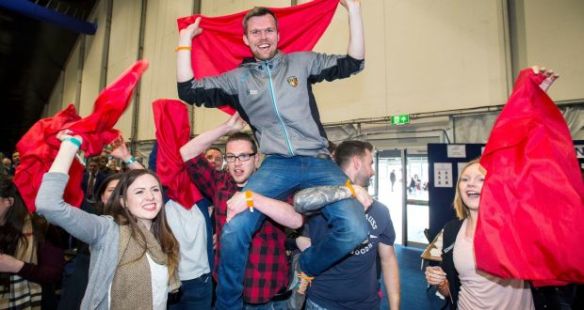
While Gerry Carroll is pictured carried aloft by supporters all waving the red flag the other victorious left candidate, Eamonn McCann from Derry, was to be heard on BBC Radio Ulster singing the Internationale.  Eamonn explained that he was surprised by how many during his canvassing expressed their opposition to being labelled ‘Orange’ or ‘Green’, as is required by the Stormont rules, but said they were ‘Other’, the only alternative designation allowed.  How fitting a sectarian designation’s only alternative is ‘Other’ rather than ‘Anti-Sectarian’ or even ‘Non-Sectarian’.

PbP success represents a dramatic rejection of Sinn Fein but if it is to represent something more it must not just declare an alternative but create one.  Two successful candidates allows PbP to present itself as more than a protest but how much more will depend on how it thinks its revolutionary socialism can be applied outside the Assembly.  As we have seen, what happens inside it is not taken seriously even by those who support it, especially by the DUP and Sinn Fein who carve up the jobs and the decisions between them.

A light can now be shone on the darkness through the election of two socialists but to begin to dispel the darkness will require an alternative labour movement that can offer practical alternatives to sectarian division.  What role will PbP play in that task?


Remembering the Rising part 4 – revolution and counter-revolution?

NGI 1236

NGI 1236

In the last post I stated the view of the Irish establishment that the 1916 Rising was the foundational act of the formation of the current Irish State.  This is not the view of many on the Left:

“The current Irish state is not a product of the Rising – it owes its existence to the counter-revolution of 1923. . .  . The current Irish state, therefore, has little in common with those who staged an uprising in 1916. . .  and has absolutely no intention of cherishing ‘all of the children equally’.  A new massive popular uprising will be required to establish even this limited ideal.  That should be the real lesson of the centenary.” (Kieran Allen)

There is a historical question whether the revolution that followed the 1916 rising would have occurred without it but that isn’t the real point here.  There is a claim that both the Rising and the War of Independence were not responsible (in any way?) for the current Irish state and those involved in 1916 have little in common with the personification of Irish independence today.

Unfortunately for such a claim the personalities who forged the counter-revolution, as it is called, in 1923 and later leaders of the state were prominently involved in the 1916 Rising and in the first post in this series we named some of them – William Cosgrave, Richard Mulcahy, Michael Collins, Éamon de Valera and his successor as Taoiseach Sean Lemass.  These are among the foremost founders and architects of the current Irish state and they all fought in 1916.

The claim that there was a counter-revolution in 1923 refers to the acceptance of the Treaty that established the Free State with its oath of allegiance to the King, membership of the Commonwealth, the post of Governor General, retention of the Treaty ports by the British and a deal on partition that quickly preserved it.  The Treaty was signed under a British threat of ‘immediate and terrible war’ and was followed by a civil war when the Irish Republican movement split over acceptance of British terms.  For anti-Treaty republicans the new state was illegitimate, as therefore were its police, armed forces and political institutions, including the new Dáil.

As we saw in the first post the new Free State Government was a reactionary one dedicated to policies of low taxation, balanced budgets, free trade and an illiberal social policy that included heavy censorship of films and literature and legislation to outlaw divorce.  It brutally repressed its anti-Treaty opponents with imprisonment, torture and murder.

Its most prominent architect was William Cosgrave, a supporter of the monarchist Sinn Fein from its foundation.  As one historian has put it (John M Regan) “his concept of government prior to independence was essentially theocratic.   In suggesting an upper house for the Dáil in 1921, he advocated a ‘theological board which would decide whether any enactments of the Dáil were contrary to [Roman Catholic] faith and morals or not’.”

By some contrast the inspiration for the new Free State and pro-Treaty icon was Michael Collins, who another historian (Peter Hart) has described as having “a deep dislike of exploitation and poverty.”    “What set Collins apart was his secularism. . . . He was actively anti-clerical for much of his life, and blamed the Catholic Church for many of Ireland’s problems.”

When the pro-Treaty regime fell to the anti-Treaty Fianna Fail, policies of free trade, acceptance of the post of Governor General and oath of allegiance were rejected; the British left the Treaty ports; an ‘economic war’ with Britain was embarked upon and then resolved; and the new Government introduced a new constitution in 1937, which proclaimed the special position of the Catholic Church, the subordinate role of women in society and a constitutional protection of the prerogatives of private property that stands as a barrier to action by the state to this day. It also brutally repressed its republican opponents.   In 1948, under the leadership of the pro-Treaty Fine Gael the Irish State declared itself a Republic.  In effect the anti-Treaty side accepted the legitimacy of the new state and of the Michael Collins’ view that the Treaty provided a stepping stone to freedom.

In the aftermath of the civil war between pro and anti-Treaty republicans the latter had dedicated themselves to a ‘second round’ against the traitorous Free State and its illegitimate institutions.  Today no one in the spectrum of republicanism holds to such a position: I know of no one, and have never heard anyone, say that a renewed armed struggle should make the existing Irish State its primary target.  This is now uncontroversial, reflecting the legitimacy of the State in the eyes of the overwhelming number of its citizens.

The Irish state today is a Republic and the anti-Treaty side in its subsequent development, from Fianna Fail in the 1920s to Clann na Poblachta in the 1940s to Provisional Sinn Fein today, has accepted this and sought to become its governing party.

In other words the vast majority of the revolutionary movement of 1919 to 1921 accepted the Treaty, or the counter-revolution as it has been described above, leaving the question – what exactly was the revolution that was reversed or prevented?

An argument exists that the British proxy-war fought by the pro-Treaty forces succeeded in imposing the British terms demanded for the ending of hostilities.  What the vastly superior forces of the British could have unleashed in a renewed war was instead leveraged in the Treaty negotiations.  This might therefore be characterised as the counter-revolution; except of course that, as we have seen, the new state gradually dispensed with the trappings of Empire and colonial status.  It even eventually got a degree of economic separation from the British when it got itself a new currency – the Euro.  But perhaps this too can be seen as the continuation under a new guise of the counter-revolution, but if it was it was not part of any counter-revolution in 1923 and linking the Troika to the civil war is a bit of a stretch.

In opposition to such a view the historian Diarmaid Ferriter quotes a ‘veteran Irish political correspondent’ James Downey (very recently deceased) in 2012:

“It’s tempting to say that our ancestors won it and that our own generation has thrown it away. Not only tempting, but in important respects true. Undoubtedly we have lost our economic independence and will take a very long time to regain it.

But some of the aspirations of the 1916 Proclamation were never feasible anyway. No country, even the biggest and most powerful, has “unfettered” control of its destinies.

Independent Irish governments did not set out to make Ireland either a Marxist paradise or a dreamy medieval vision on the de Valera model. They set out to make it a normal liberal-democratic, capitalist state.

To a considerable extent they succeeded. They managed the transition from a peasant society to an industrial country reasonably well.

Where they went wrong was not so much in the excesses of the Tiger years — although these have brought us, and will continue to bring us, much suffering — as in the failure, and worse than failure, to curb corruption and what we like to call ‘gombeenism’.

We all know this word and use it constantly, but it is dreadfully hard to define.

It can cover almost anything from dramatic strokes and deals to improper political and business practices to the trading of small favours and abuse of petty power.

It was endemic before independence. It is still endemic. In some ways it is worse than before. Virtually all the measures aimed at putting it down have been insincere or misdirected, ruined by political and official inertia or subverted by the cynical Irish belief that nothing can ever change for the better.

We don’t have to go back 100 years, or 100 days, to watch it in operation. Who believes the Mahon Report will produce any good results? Who thinks the Fine Gael-Labour coalition will eradicate the cronyism that tarnished its predecessors?

We won’t find answers to such sad questions in commemorations. We have to seek them in the here and now.”

In the last two posts we have seen that the revolutionary generation set out to create a separate Irish state, free from British rule, a nationalist objective that they succeeded in achieving – where then is the counter-revolution?  It was from among the survivors of the 1916 Rising that the leadership of the succeeding Irish State arose – so from whom did the counter-revolution arise?

Perhaps it may be claimed that these leaders betrayed their earlier beliefs or at least their earlier declarations of the objectives of the Rising?  But in the second post we explained that the 1916 Proclamation made no grander claims to social and economic revolution upon which it might be possible to condemn the current Irish state as a betrayal of. So again, where is the counter-revolution?

Let us take the politics of the revolutionary nationalist movement during its revolutionary period.

In his recent book ‘A Nation and not a Rabble, the Irish Revolution 1916-1923’ the historian Diarmaid Ferriter, hardly one of the pro-imperialist revisionist historians, records the lack of ideology guiding the political struggle during the revolution.

He states “those looking for evidence of broad, sophisticated ideological debates during the decade may be disappointed”- contrast this with the experience of the Russian revolution!  “Those who propelled the republican revolution were more focussed on the idea of separation from Britain ‘rather than implementing any concrete political programme.’  He quotes one fellow historian that ‘the new nationalist leaders did not see it as necessary to analyse the “self” that was to exercise self-determination’”, and a second historian noting that “the republican leaders ‘do not appear to have debated what may have appeared to be potentially dividing abstractions’.”

Discussing the many statements given by participants to the Bureau of Military History on their motivation and experience of the struggle, Fearghal McGarry states that “there is little discussion of ideology in the statements . . . Volunteering did not popularise republicanism.”  Ferriter quotes from a prominent republican and chronicler of his experience in the revolution: “as Ernie O’Malley saw it ‘fighting was so easy compared with that soul-numbing, uphill fight against one people’s ignorance and prejudice’, his tortured description of politics.”

This does not mean that politics did not exist within the revolutionary movement.  The nationalism of Irish republicanism, as to most nationalists everywhere, seemed uncomplicated and simple, self-evident and pure, nevertheless had a definite political content, even if it was unconscious and sublimated other real societal divisions such as class.  As de Valera and others insisted – patriotism was to rise above all class interests.

The republican paper Irish Freedom put it succinctly in 1911: “The interests of Ireland as a whole are greater than the interests of any class in Ireland, and so long as labour accepts the nation, Labour must subordinate its class interests to the interests of the nation.”

The republican movement was prepared to eject strikers from their place of work while de Valera would say that he felt “confident that the common patriotism of all sections will prove superior to all special class interests.”   Even the radical Constance Markievicz, who became Minister of Labour in the revolutionary government, complained that “the trade unions’ appeal always seems to me to be so very sordid and selfish.  Till something suddenly makes them realise the value of self-sacrifice they will never be much use to humanity.”  And they were not the only ones to suffer disapproval: Cosgrave complained that those unfortunate enough to end up in the workhouse “are no great acquisition to the community . . .  As a rule their highest aim is to live at the expense of the ratepayers.  Consequently it would be a decided gain if they all took it into their heads to emigrate.”

Leading republican Austin Stack “warned of the dangers of agrarian agitation subverting patriotic opinion and pointed to the importance of the republican courts in undermining such revolutionary sentiment.”  In 1921 the republican Irish Bulletin warned that “the mind of the people was being diverted from the struggle for freedom into a class war and there was even a possibility that the IRA, itself largely composed of farmers’ sons, might be affected.”  However it went on to state that this “proved wholly groundless” as “agrarian lawlessness was steadily suppressed, cattle-driving and boundary-breaking punished and ruffianly elements brought to book.”  (Ferriter)

And all this happened before 1923 when the counter-revolution is supposed to have occurred.

But, it might still be claimed, the Irish State is corrupt and its venality exposed by its loss of sovereignty while under the diktats of the Troika of European Union, European Central Bank and International Monetary Fund.  But when did the Irish revolution ever set itself the tasks of creating conditions that would prevent this?  And if it did not, where was the need for any counter-revolution to reverse or prevent a socially revolutionary regime that would have done so?

At the level of the personalities involved – when and how did the leaders who survived the Rising radically change their political views, that made their participation in the Rising revolutionary but later actions counter-revolutionary?

Perhaps it is claimed that the Irish working class took independent action that threatened not only the contemporary political arrangements that involved direct British rule but also the capitalist economic and social structure of society.  What about the strikes, occupations and events such as the Limerick Soviet?

But when did such actions have an independent dynamic separate from the national struggle, with its own objective, own separate movement and separate leadership?  Not only separate but necessarily counter-posed to the revolutionary nationalist movement (if it were to prevent counter-revolution).

The fear of such a task and appreciation of weakness in even contemplating it has been noted by Ferriter during the Limerick Soviet episode –“ The Irish Labour Party and Trade Union Congress feared that any escalation in support for Limerick ‘would be entirely on their own heads and lack the enthusiastic national support of Sinn Fein” (even though the Limerick action was against the proclamation of the area as a special military area by the British).

With an agricultural population in the last spasms of land agitation; an industrial sector cut off by partition and its working class divided by sectarianism, the larger part of which was politically reactionary and the remainder industrially weak and politically dominated by nationalism and a soft labourism – how could it be otherwise?

As for the revolutionary nationalists, with their difficulty with politics compared to fighting and their opposition to debating “what may have appeared to be potentially dividing abstractions”, how ironic that this lack of politics led them not only to a debate over abstractions when the Treaty was signed – the oath of allegiance and the existence of an established Republic that was being betrayed  –  but also led them to a vicious civil war over these abstractions.

On only one count is it possible to argue that there was a counter-revolution that betrayed the goals of 1916, even if it was carried out by those who fought in it. And this is the imposition of partition, although this is often the least mentioned and most ignored.

Even a purely nationalist revolution seeks the unity of the country.  Indeed intrinsic to nationalism is the indivisibility of the nation.  So 1916 opposed partition and promised religious equality in the Republic as the alternative to it.  But 1916 could not deliver on its objective and admitted as much.  The Rising that might deliver national freedom was circumscribed by its leaders through their recognition that the Rising could not even carry out a strike against partition.

The organisers of the Rising explicitly prohibited fighting in Ulster, instead planning that Volunteers in the province assemble together in Tyrone and march to Connaught to join the rebellion there.  Even the foolishness of this ill-considered plan revealed the lack of adequacy to addressing the real task of defeating an imperialist-backed mass unionist opposition to the project of a national democracy.

Objectively the 1916 Rising was unable to strike against the coming of partition, which was imposed not during the retreat of the national revolution but at its height of military struggle.  In other words neither 1916 nor the following national revolution could hold out the promise of a defeat of partition and the ‘carnival of reaction’ that would follow it, which was foretold so acutely by Connolly.

So in what respect was there a counter-revolution when that revolution never actually set itself the task of preventing partition in any objective sense?  The revolution could not seriously make the promise of a united nation; that it did not result in one can hardly be put down to the actions of a counter-revolution.

Postscript:

I spoke at a small meeting of socialists in Glasgow just over a week ago and I was asked whether my analysis did not contradict the traditional socialist view that the 1916 Rising was to be defended as a blow against imperialism?

I answered that the Rising was indeed to be defended as a blow against imperialism but that what was important now was to understand its limits, the limits of any politics defined simply  as ‘anti-imperialist’ and any nationalism no matter how ‘left-wing’.

So yes, I agreed with Lenin, 1916 was not a putsch and we should not expect to see a “pure” social revolution, but we should understand that 1916 wasn’t a social revolution of any kind.  In any case if any socialist could be described as seeking the maximum clarity in the struggle for socialism, the maximum ‘purity’ so to speak, it is Lenin, so not expecting to see a pure revolution and doing absolutely everything you can to get one are not in contradiction.

I was also asked the question whether Connolly was correct to take part in the Rising.  I have deliberately avoided this question in my series of posts because I’m not very interested in it.  What I did say was that if Connolly was going to take part he should have had his own Proclamation, his and the Citizen Army’s own declaration of what they were fighting for – a ‘Socialist 1916 Proclamation’.

We might then at the very least have avoided reading into the existing one progressive content that isn’t there and we would have had greater grounds for stating that today’s Irish establishment would be put in a position of some embarrassment in the centenary commemoration.  I would have liked to have seen an Irish Army officer read a declaration of socialist revolution outside the GPO!

Then also we would have had stronger grounds to say that the promise of the 1916 Rising has been betrayed.

Of course the other signatories would not have signed it.  It would have divided the Rising at least politically but then, as we have seen, the republicans divided the revolution to the benefit of certain social classes anyway.

And would Connolly have made the Workers’ Proclamation one of socialist revolution in any case?

What this alternative Proclamation should have said is for socialists the real historical (and contemporary) question not the non-existent promises of a nationalist revolution that socialists are supposed to make good now.

Back to Part 3

Remembering the Rising part 3 – Who’s afraid of 1916?

easter 1There is a view of the world and its history that what matters most is not what it is or what it has been but how it is perceived and understood; first having recognised that the two are not the same.  There is a different view that the world may be misconceived and misunderstood but its true reality matters more and ‘will out’.  The misconceptions are themselves part of the real world and are themselves a reflection of it and often contain a grain or more of truth, while still being wrong.
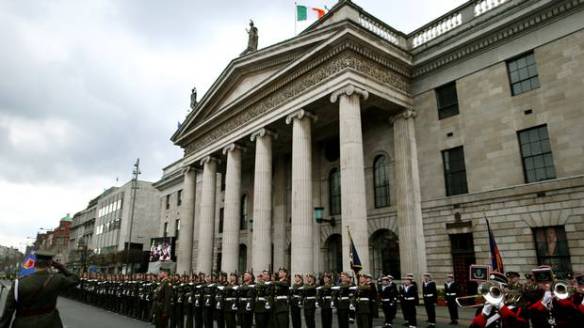
We can thus learn and appreciate the Easter Rising in 1916 by looking at how it is variously understood.

In the January 15 copy of ‘The Irish News’ the Sinn Fein leader Martin McGuinness states:

“The Rising wasn’t simply a rebellion against British rule.  It was an insurrection against injustice, oppression and inequality.  It was a social as well as a political and national revolution.”

We have seen in the previous post that the Proclamation did not rail against imperial oppression and injustice but condemned British rule as illegitimate.  Its claims for equality were limited and were made in relation to the particular context of foreign fostered religious division.  The Proclamation does indeed talk of welfare and freedom and of the common good but it is the nation’s welfare and national freedom that is extoled and the common good is for the people to sacrifice themselves for. And even if these clear meanings are ignored there is no statement as to how any different sort of freedom, welfare or the common good can be defined and its promise made good.

The Proclamation is a nationalist declaration and did not and could not explain how it could deliver any promises that its readers may mistakenly or otherwise have read into it.  A century of national liberation struggles across the world against British and other colonial powers, often inspired by the Easter Rising, have failed to demonstrate how the most radical understandings of such promises, such as those stated by McGuinness,  can be made good by any sort of nationalism.

But perhaps McGuinness is claiming that the words of the Proclamation do not matter, it is the reality of the Rising that is important, although I doubt he would make such a claim.  So perhaps he is saying that there is more to the Rising than the Proclamation that the Proclamation did not announce.

So the Rising was indeed a political revolution and a national one in so far as its aims were concerned although, by deliberate design, not national in scope – there was to be no Rising in Ulster.   However it was not a social revolution; it certainly didn’t pretend to be a socialist revolution.  We know what one of them might look like because we saw one the year after in 1917. And it wasn’t a social revolution of the land question.  If anyone deserves credit for the revolution in the transfer of land ownership from largely alien landlords to native tenant farmers it is the British who must stand first in line.  It must be said that in this they were helped by the massive loss caused by the famine for which they should also stand first in line, and were subject to agrarian agitation to force them.

So even in three very short sentences that are easily passed over as received wisdom the understanding of Martin McGuinness is inaccurate, just as 100 years ago the British and many others were wrong to see the Easter Rising as a Sinn Fein rebellion.  Sinn Fein had nothing to do with it and the party was led by a man who was not in favour of a Republic.

Does it matter that McGuinness’s understanding is so wrong?  Such misconceptions have been legion. The embers of the Rising were still warm before it was widely condemned as a ‘German plot’, all the better to damn it as a disloyal stab in the back in the middle of a real war.  The fiftieth anniversary celebrations have been blamed by Unionists for sparking ‘the Troubles’ in Northern Ireland, absolving the demands of Ian Paisley that the Tricolour be removed from the Falls Road for the trouble that erupted there in 1966, and later unionist attempts to attack demonstrations for civil rights for the eruption of violence in 1968 and 1969.

So yes, getting history wrong does matter because it will not explain why the Troubles broke out in the North of Ireland and it doesn’t explain why the 1916 Rising failed to achieve a truly national revolution never mind a social revolution.  If we dispense with incorrect explanations of the world and its history we are much better placed to seek better ones and in doing so better able to understand what is happening today.

For many what has happened during the centenary celebrations today is an “Irish capitalist class .  . overcome with embarrassment and revulsion, forced to commemorate something they despise”, according to one left wing leaflet handed out at a meeting in Belfast a few weeks ago.

For another left wing author “the notion that Enda Kenny owes his position as Taoiseach to republican guerrillas who stormed the GPO is, to put it mildly, deeply unsettling.  The political elite is therefore  approaching the centenary commemorations of the rising with profoundly ambivalent feelings and not a little trepidation”.

Two other authors have written a short book, ‘Who’s afraid of the Easter Rising? 1919 – 2016’.  They note the opposition to the Rising from those who think Ireland could have won its independence without the violence unleashed in 1916 and who therefore condemn it for the example it set to later generations of violent republicans.  They also characterise the attitude of the Irish Government to the commemoration of the Rising as one of “bad faith.  They talk in doublespeak  and clichés. Their energy is not directed at genuinely exploring or celebrating the legacy of the Rising but rather in controlling it.” In this desire for control however they are hardly alone.

“This political class is embarrassed by 1916 but most are afraid to say so publically, hence they practice the politics of ambiguity and dishonest historical revisionism as a way of avoiding the truth and real debate.”

But if the Irish establishment has been variously “uncomfortable”, embarrassed”, “afraid” and “nervous” they hid it well during the commemoration and scored a significant success, all the more significant depending on how much they were exposed to the emotions attributed to them by some left wing authors.

Far from ambiguity they presented a coherent narrative – we commemorate those gallant men and women who gave us our freedom today, a freedom expressed by the existence and independence of the Irish State which put its back bone on display through the military parade of its armed forces.  This is the State to which we owe loyalty and we celebrate the foundational act of that state – the Easter 1916 Rising. No one among the broadest ranks of Irish nationalism seeks to attack the institutions of this State, not even ‘dissident’ republicanism centred the North.

Easter 3

The celebrations were therefore a celebration not only of the Rising but of the legitimacy of the State and its institutions.  The highlighting of descendants of the 1916 rebels and later revolutionary heroes in the parade of today’s Armed Forces on Easter Sunday and the reading out of the Proclamation by an officer of the Irish Army was a coherent message that there is only one legitimate Óglaigh na hÉireann.  Loyalty to the state is mandated by the sacrifice of the men and women of 1916 whose creation it is.

And is this not at least partly true?  And if it is not by any means the whole story are we not then into more ambiguous territory and far from a simple story of misappropriation of a risen people by an elite?  Or, recalling our first post on remembering 1916; were Cosgrave, Collins and de Valera etc. not part of this risen people or, recalling the second post, did the Proclamation not address itself to national freedom and not any wider set of promises?

It is not that the Irish establishment finds nothing in the history of the Rising that it finds objectionable.  Who does not?  But among the emotions listed above there has also been indifference in the past, in commemorating the Rising and, for example, in maintaining and giving access to the historical records upon which its story can more truthfully be told.  In 1971 Garrett Fitzgerald stated that “this country will look very odd indeed in international eyes if Britain continues to release information about Irish matters before we do – as has already happened.  We will have to stop being afraid of our own history.”  His view reversed the previous Fianna Fail view of the late 1960s that access to state papers could result in “injury . . . to national unity and harmony.”  Taoiseach Jack Lynch said that even if the British opened papers the Irish Government would not because it “might well stir domestic controversies that best lie buried.”

In any case attempts to emulate the rebellious attitude of 1916 will not depend on seeking to emulate the Volunteers of 1916 but will come from the nature of the oppression and exploitation faced today and more importantly by the goals and strategies that channel this rebelliousness.  This is what makes the release of historical state papers possible – the historical controversies they relate to are relevant but  will not of themselves stir struggle today and are not amenable to a simple repetition of rebellion – what for, by whom, with what objectives and for what alternative?

We are called upon to commemorate those who fought in 1916 and to remember the Proclamation of the Republic they fought for, but on what grounds are we called upon to remember?  Who is asking us to commemorate and do we celebrate the same thing if we do?  Does this now matter, for will there now be any future anniversary with such resonance?

Easter 2

Back to part 2

Forward to part 4

Remembering the Rising part 2 – the 1916 Proclamation

1916-ProclamationThe central reference point of the Easter Rising, of its commemoration and for understanding its meaning is the Proclamation read outside the GPO by Patrick Pearse.  Copies of the Proclamation and the national flag have been distributed to schools by the Irish Army and it was read out by an officer of the Army at the celebrations in Dublin on Easter Sunday.

Acres of newsprint over the years and in this centenary have been devoted to the relevance of the Proclamation to contemporary society, usually framed around the question of whether its promises have been realised and usually answered in the negative.  This is almost universally the case among liberal commentators and by many on the Left.

The purpose is to damn the failures of the existing Irish State by the imprimatur of its venerated foundational certificate, restated and ratified by the first independent Dail (parliament) established by the revolutionary movement in January 1919.  What is invited is the completion of an original process more or less universally honoured and exalted by nationalist Ireland.

Examples abound so let’s take a fairly typical illustration from last week’s Northern nationalist newspaper ‘The Irish News’ in a column entitled “Those who came after Rising have failed Ireland’.

It starts off “The Rising did not fail. It was failed by those who came after it. For 100 years, the Irish people including up to two million who emigrated) have watched as governments, political parties and armed groups paid homage to 1916, while abandoning the Rising’s social, economic and political principles. . . we can only marvel at the widening gap between the Proclamation’s ideals and the sad state of modern Ireland”

“The Rising aimed to achieve independence, social and economic equality and cultural maturity for the Irish nation.  Selected events exemplify how these aims were washed away.”  The author then recalls such events as the failure to create a welfare state, the strong role in society of a censorious Catholic Church, state repression and the evils of sectarianism associated with partition.

The following week the President of Ireland spoke at a commemorative event at the trade union headquarters at Liberty Hall on the Republic James Connolly and the Irish Citizen Army fought for:

“Their vision of a people free from want, free from impoverishment and free from exploitation remains the wellspring of inspiration for us as we seek to respond to the situation of too many  workers who, in Ireland today, earn a wage that guarantees neither a life free from poverty, nor access to decent housing, adequate childcare and health services.”

“Land and private property, a restrictive religiosity and a repressive pursuit of respectability, affecting women in particular” followed the Rising while “their objective was to transform Ireland’s social, economic and cultural hierarchies.  But their radical ideas of redistribution were staunchly opposed by many nationalists . . .”

*                             *                             *

The Proclamation was written by the radical nationalist Patrick Pearse with additions by James Connolly and Thomas MacDonagh and approved by the seven signatories made up of advanced nationalists and James Connolly, all of whom were to be shot by firing squad after the Rising.  It proclaimed an Irish Republic that was eventually to be recognised by its foe Great Britain over 30 years later in 1949.

It is short, exhortary, was not the subject of long deliberation by its writers or by those who signed it and is today held in regard in almost inverse proportion to its detailed examination, except perhaps by today’s Irish schoolchildren, for whom it has become a subject of study and updating.

The Proclamation is well entitled for this is what it is: a declaration of an independent Irish State – a Republic.  It is not a manifesto, not a political programme to any extent and hardly a strategy.  It is a certificate of a birth already taken place so that unlike the American Declaration of Independence, there is no date of Ireland’s independence because Ireland is already an ancient nation that itself, through its Provisional Government, “strikes for her freedom.”  It is therefore a declaration of war, symbolised in the centenary celebrations by the biggest public demonstration by the armed forces of the Irish State in its history, while sanctified in the normal hypocritical fashion by a sermon from the forces’ chaplain.

The thunderbolt that was the 1916 Rising gained its impact partly because there had been no substantial national rebellion for over 100 years, and while the proclamation speaks of an “old tradition of nationhood”, it is the newness of the events that was most striking but which is now, not unnaturally, largely unnoticed.  This novelty translated, or rather did not readily translate, into the language of the Proclamation.  The word for Republic chosen in Irish – ‘poblacht’ – was not in any of its variants current in the Irish language before 1916 – there was no direct translation for the word Republic.

When Eamon de Valera travelled to London in 1919 to negotiate a truce with the British he handed Lloyd George a document in Irish, which had an English translation, headed ‘Saorstat Eireann’ and Lloyd George asked for a literal translation, saying that ‘Saorstat’ did not strike the ear as Irish.   Eamon de Valera replied ‘Free State’. ‘Yes’ retorted Lloyd George ‘but what is the Irish word for Republic?’  While the Irish pondered the reply with some discomfort Lloyd George talked to his colleagues in Welsh and when de Valera could get no further than Saorstat and Free State, Lloyd George remarked that ‘Must we not admit that the Celts never were Republicans and have no native word for such an idea’.

The beginning of the Proclamation is modelled on the similar proclamation of Robert Emmet in 1803, in that other failed rebellion.  It is the nation itself which appeals to God’s authority and its people to declare its freedom while the Proclamation appeals to both ‘Irishmen and Irishwomen’ in pointing to an equality of gender but only to the Irish – there is no wider international appeal for recognition or solidarity, although it thanks it “gallant allies”, Germany, and its American diaspora.

The nation’s independence is required because British rule is illegitimate not because it is oppressive; Ireland was therefore not being disloyal to the Empire because it had never been loyal, there were no grounds for loyalty in the first place.

The national freedom of the Irish people has been asserted ‘six times in the last three hundred years . . . in arms’, referring to 1641, 1689, 1798, 1803, 1848 and 1867, although only the last four can really be said to involve claims to national freedom and on the last two occasions rebellion was effectively aborted.

In this strike for freedom the Proclamation ends by placing its faith in God and demanding that the people be ready to sacrifice themselves so that the Irish nation prove itself worthy of its destiny.  The people must prove themselves to the nation.

The fourth paragraph of the Proclamation is in effect the nationalist response to the threat to the unity of this nation posed by Unionism, particularly that centred in the North-East of the country. ‘The Irish Republic is entitled to, and hereby claims, the allegiance of every Irishman and Irishwoman.’ Just as the Irish Volunteers were a response to the formation of the Ulster Volunteers, just as the gunrunning at Larne was emulated by the gun running at Howth and the failure to acquire German guns at Easter 1916, so the Proclamation here is the nationalist reply to the Ulster Covenant that signalled Ulster Unionist opposition to Home Rule.

This opposition rested on the view that “Home Rule would be disastrous to the material well-being of Ulster as well as of the whole of Ireland, subversive of our civil and religious freedom, destructive of our citizenship, and perilous to the unity of the Empire.”  The Unionists pledged “to stand by one another in defending, for ourselves and our children, our cherished position of equal citizenship in the United Kingdom.”

The Proclamation stated that “The Republic guarantees religious and civil liberty, equal rights and equal opportunities to all its citizens, and declares its resolve to pursue the happiness and prosperity of the whole nation and of all its parts, cherishing all of the children of the nation equally, and oblivious of the differences carefully fostered by an alien Government, which have divided a minority from the majority in the past.”

The authors and signatories to the Proclamation had, and could not have had, any expectation that their appeal would have any material impact on Unionist opposition to Irish independence.  By 1916 the British had agreed partition with the Northern Unionists and the ‘Ulster Solemn League and Covenant’ signed in blood to oppose Home Rule for all of Ireland became a badge of honour for Unionism in six counties and a piece of hypocrisy for those Unionists in the rest of the island.  Soon the Northern unionists, or some of them, would not even be Irish.

In testament to the division created by partition and in unconscious repudiation of its centrality to the Proclamation’s signatories, the promise to ‘cherish all of the children of the nation equally’ has come to be understood as a commitment to some sort of social and economic equality  or even a commitment to children as such; the latter a response to the independent  Irish State’s history of privileging defence of the Catholic Church despite its abominable physical and sexual abuse of children.

The Proclamation states that the principle on which independence is based is ‘the right of the people of Ireland to the ownership of Ireland’ which itself is based on Pearse’s ‘The Sovereign People’ in which he states that:

“The right and privilege to make laws or to administer laws does not reside in any class within the nation; it resides in the whole nation, that is, in the whole people, and can be lawfully exercised only by those to whom it is delegated by the whole people.  The right to the control of the material resources of the nation does not reside in any individual or in any class of individuals; it resides in the whole people and in the manner in which the whole people ordains.”  For Pearse this is based on the teachings of the founder of Irish Republicanism, Wolfe Tone, who led the 1798 rebellion of the United Irishmen.

“To insist upon the sovereign control of the nation over all the property within the nation is not to disallow the right to private property.  It is for the nation to determine to what extent private property may be held by its members, and in what items of the nation’s material resources private property may be allowed.”

In the history of the Irish working class movement it is a Workers Republic that is the goal; power derives from the nature of the contending classes within society and all talk of the nation obscures the power of the capitalist class to determine the nature of society.  Private property, what the socialist tradition calls bourgeois property, is the basis of exploitation of the working class, and contrary to the implicit assumption of the President of Ireland, the Proclamation and the Rising made no claims to end exploitation and no claims to upset the hierarchies of class rule.

As a nationalist document the Proclamation upheld the view that the nation stands above classes, a view that always upholds private bourgeois property.  For socialists the material resources that are the content of property must be owned by that class which collectively through its cooperative labour creates and recreates these material resources. The Proclamation upheld the priority of the nation, where socialists uphold the priority of the working class to determine the nature of property relations.

Today, in fact since it was first written, the Proclamation has been interpreted for its meaning for the struggles of today.  This is as it should be.  What is not as it should be is to interpret the words of the Proclamation anachronistically and give of them a meaning that they did not have.  In trying thus to demonstrate the relevance of the Proclamation those doing so inadvertently subvert its true relevance.

When we remember those who fought in the Rising we should remember all who fought.  When we evoke the words of their Proclamation we should recall what those words meant to those who led down their lives fighting that they be given effect.

Back to part 1

Forward to part 3

Remembering the Rising part 1- the men of 1916

brendanrebels1916


When British Army reinforcements arrived in Kingstown to put down the Easter Rising in 1916 many of the soldiers thought they had been sent to France and one Cockney soldier ‘wondered how everyone he met spoke such good English.’  On Wednesday morning, on day three of the Rising, hundreds of these soldiers marched into South Dublin along Northumberland Road where Eamon De Valera, who was commandant of the 3rd Battalion of the Irish Volunteers, had anticipated this approach and had placed two outposts along the Road approaching Mount Street Bridge.

The Volunteers here waited until the advance detachment of the British had passed before opening fire: ‘those who came in our direction were completely wiped out’, said one Volunteer.  “Isn’t this a great day for Ireland” said Volunteer Paddy Doyle.  The engagement that followed at Mount Street Bridge accounted for almost half British Army casualties in the Rising and only sheer weight of numbers and superior firepower allowed the British forces to eventually push through.  Volunteer James Doyle, who had been knocked unconscious during the fighting, woke up to find that his outpost had been ripped apart by bullets and explosions and that his comrade Paddy Doyle was dead.

The 4th Battalion, ordered to take over the South Dublin Union -, the largest poorhouse in the country with three thousand inmates – included William Cosgrave who was quartermaster to Eamonn Ceannt, a signatory to the Proclamation of the Republic.  Cosgrave later took over command from Cathal Brugha after Brugha was so badly wounded by a grenade that he was not expected to survive.

Brugha “was a hard hater of everything British” and “knew nothing of fear and had little sympathy for anyone who did.”  When the Volunteers were forced to vacate their position in the nurse’s home  one asked Cosgrave if they would take Brugha with them even though Brugha, thinking he was done for, had told the volunteers to leave.  Cosgrave replied that “a soldier’s duty was to obey and pointed the way with a .45 revolver swinging on his finger.”  Nevertheless Brugha was later to say that he remembered Cosgrave’s “extreme kindness” when he was wounded and would not forget it.

Cosgrave had been at the inaugural meeting of the Volunteers at the Rotunda in Dublin and took part in the gun running at Howth. His brother also participated in the Rising and was shot dead by a British sniper during the fighting.  Though his garrison was complimented by one of the British commanders for having fought against great odds his court martial, lasting only ten to fifteen minutes, declared a sentence of “guilty, death by being shot.”  However, like many others receiving the same verdict he escaped the death penalty.

Commandant De Valera, who was responsible for the Volunteers at Mount Street Bridge and for the extent of the British losses inflicted there, also escaped execution by the British, the only commandant not to be shot by a British firing squad.

Cosgrave later became a leader of the pro-Treaty faction of the republican movement and became head of the Free State after the death of Michael Collins.  The split in the movement over the Treaty led to civil war, amongst the first casualties of which was Cathal Brugha.

In pursuit of this civil war Cosgrave introduced military courts, saying that “we are not going to treat rebels as prisoners of war.” This included the execution of four prominent members of the anti-Treaty movement in retaliation for the killing of a pro-Treaty TD, Cosgrave stating that “terror meets terror.”  One of the four was Rory O’Connor, who was wounded in the Rising, and another the radical republican Liam Mellows who in 1916 had led the biggest mobilisation of Volunteers outside Dublin in attacks in County Galway.

‘The Irish Times’ noted that this action “eclipses in sudden and tragic severity the sternest measures of the British Crown” and even Catholic Archbishop Byrne expressed dismay.  Seventy more anti-Treaty republicans were executed in the next five months, including Erskine Childers who had been on board the Asgard when it landed guns in Howth.

As later head of the new Free State Government Cosgrave introduced a conservative policy of low taxation, balanced budgets and free trade, leading for example to a cut in the pension for the blind and a particularly unpopular cut in the old age pension of 10 per cent in 1924.  Social policy included heavy censorship of films and literature, including a Committee on Evil Literature, plus legislation to outlaw divorce and “the unnatural prevention of conception”.

In 1932 the Cosgrave led Cumann na nGaedheal party failed to convince the electorate that the Fianna Fail party was communist, beginning decades of domination of that party led by De Valera before the reins of Taoiseach passed to fellow 1916 veteran Sean Lemass in 1959.  His economic policy was less centred on agriculture and during the protectionist 1930s he was willing to promote national industrial development behind tariffs.  His new constitution of the Irish State in 1937 recognised the special position of the Catholic Church and the position of women in the home.

He kept the Irish State out of and officially neutral during the Second World War and also used hated Cumann na nGaedheal laws to drag members of the remaining IRA before military tribunals, introducing internment of republicans and letting prisoners die on hunger strike. He also, like the Free State forces during the civil war and indeed the British, carried out executions of IRA members by firing squad.  These included Patrick McGrath, another veteran of 1916.

While Liam Mellows had led the largest mobilisation of Volunteers outside Dublin in 1916 it was the Volunteers of the 5th Battalion led by Thomas Ashe in North Dublin and Meath that inflicted the most casualties.  These forces led by Ashe were joined by another smaller group of Volunteers led by Richard Mulcahy, a future chief of staff of the Irish Republican Army.

Mulcahy’s plans for Easter originally involved a three-day religious retreat and a holiday with his family and while he got away on the first the second had to wait.  Suffering from the same confusion of many volunteers who had seen the countermanding order against mobilisation by the leader of the Volunteers, Eoin Mac Neill, he went out uniformed ready to take part in the Rising if one was to take place.

After bumping into James Connolly, who didn’t confirm any plans to him, he later met Thomas MacDonagh, who told him to be ready to “strike at twelve”.  This involved destruction of cables at Howth railway junction and with two other Volunteers he set off to carry out his orders, only to find out that one of his comrades had left his gun at home!  Having got the errant revolutionary to go home and get his weapon the group came across two members of the Royal Irish Constabulary (RIC), who fortunately were so used to Volunteers marching about that they passed them by with hardly a glance.  The Volunteers then carried out their orders and cut the Howth communication cables.

Having met up with Ashe, Mulcahy was made second-in-command, together leading the attack on two RIC barracks at Swords and Donabate.  It was the attack on the barracks at Ashbourne however that was to be most dramatic and testified to the leadership qualities of Mulcahy.

Realising that the Rising had not gone to plan a number of the 5th Battalion Volunteers questioned the legitimacy of their actions and continuation of their attacks.  In response Mulcahy gave a lecture on their duty to their country and after calling a vote only a handful failed to take the step forward that indicated their willingness to continue the fight.

The next day the Battalion attacked the Ashbourne barracks, defended by only ten RIC men.  Just as the RIC inside were about to surrender a seventeen –strong column of cars containing at least fifty-four police appeared, threatening to reverse the outcome of the engagement and provoke a panicked rout.

Mulcahy prevented the panic and led the outnumbered Volunteers in holding their ground against the new RIC column, surrounding it and subjecting it to relentless fire from all angles – one volunteer Bernard McAllister recalled that “we had a clear view and decimated them with our fire. Some took cover under the cars but were visible to us there. . . our fellows were making bets as to who would shoot the most.”

Pressing home the advantage in an engagement that lasted over five hours the Volunteers led by Mulcahy pushed forward, resulting in fierce close-quarters fighting:

“John Crinigan of Swords looked through a gap in the ditch to locate any police, he was seen by D.I. Smith [Smyth] who fired at and shot him through the head with a revolver.  Vice-Commandant Frank Lawless who was immediately behind joined fire on the D.I. with a Howth Mauser rifle at a distance of about 6 yards and shot him through the head.”

Richard Mulcahy then led a bayonet charge against the RIC who surrendered by throwing their rifles out on the road.

The victory was possible for a number of reasons, including that Mulcahy was able to convince Ashe not to retreat when the RIC column stumbled on the original attack.  In many ways this action was significant because it prefigured republican military tactics during the later War of Independence in which Mulcahy was to play a major role.  One of Mulcahy’s colleagues was to remark that he was the only one to come out of 1916 with a military reputation.

In the history of the later struggle however Mulcahy was very much overshadowed by the figure of Michael Collins, Minister of Finance in the Republican Government, Adjutant-General of the War of Independence Volunteers and Director of Intelligence, often portrayed as the tragic hero of the war against the British, comparable to those who were to be executed at the end of the Rising.

Collins too had taken part in the 1916 rebellion and though not then the renowned figure he was to become it has been noted that he stood out in a number of atypical ways.  Before and during the Rising Volunteers showed remarkable piety and religious observance.  This was a reflection of the strength of Catholicism in Irish society at the time, a strength which captured many later popular perceptions of the Rising as enshrining a Catholic ethos, leading to portrayal of the Rising in quasi-religious terms.

There are many reports of the Volunteers praying, holding rosary beads along with their guns, attending confession and receiving Holy Communion before and during the Rising.  But this was not true everyone.  Near the end of the week’s fighting as the morale of some began to falter Collins rounded on a fellow Volunteer for neglecting to focus on fighting by saying “Are you fucking praying too?”

Collins and Mulcahy were to become leading figures in the guerrilla war against Britain and then in the pro-Treaty regime that arose from acceptance of the peace terms dictated by the British.   During the war Collins became the celebrated organiser of a special assassination unit called ‘The Squad’ formed to kill British agents and informers.  Although criticised for his apparently ruthless approach he cited the universal war-time practise of executing enemy spies who were, in his words, “hunting victims for execution.”

In 1920 a bounty of £10,000 (equivalent in 2010 to £300,000/€360,000) was offered for information leading to his capture or death.   One of his operatives in the Squad was Vinnie Byrne who had also ‘fought’ in the Rising as a fifteen year old, although he later admitted he never fired a shot and was released when the Rising was over after a stern lecture by a British officer.

Collins shared the leadership of the military campaign against the British with Mulcahy who also supported the Treaty, serving as Defence Minister in the new Free State Government from January 1922 until March 1924.  During the civil war that followed the signing of the Treaty Mulcahy earned notoriety through his order that anti-Treaty activists captured carrying arms were liable for execution and a total of 77 anti-Treaty prisoners suffered this fate.

Another of Collins’ associates in the War against the British was Joseph McGrath who had taken part in fierce fighting in Marrowbone Lane in 1916 under the command of Eamonn Ceantt.   He also supported the Treaty and as head of the Criminal Investigation Unit was responsible for abducting and killing Anti-Treaty republicans during the civil war.  A policy of repression was also used against the regime’s first striking workers in September 1922 when the Free State Government opposed the right of postal workers to withdraw their labour.  One of the workers’ pickets was shot, surviving only because the bullet deflected off her suspender buckle.

Collins had fought in the Rising as Joseph Plunkett’s aide-de-camp at the GPO alongside Patrick Pearse and James Connolly.  Despite Pearse being commander-in-chief it was Connolly who was made Commandant-General of the Dublin Division, in effect leading the forces in the GPO, which was the headquarters of the Rising.  One Volunteer remembered that “his physical energy and strength were amazing.  He was always on the move”.  His principal weakness as a leader according to Oscar Traynor was his indifference to his own safety, which was characterised by other Volunteers as “remarkable coolness.”

William Whelan noted that when some of his number were shaken by crowds looting shops and began firing wildly “Connolly came out of the Post Office and marched up and down in front of it.  He said “Steady, we are going to have a good fight”.  He quelled the panic”.

Connolly was wounded twice, the second more seriously, ending his effective leadership of the Rising.  This also resulted in one of the most poignant episodes in the Rising – Connolly being carried on a stretcher to his execution as two members of the firing squad were ordered to aim at his head.  He died without any movement, the bullets shattering the back of his chair.

In his last meeting with his daughter Nora she recalled her Mother’s lament “But your beautiful life, James’.  “Hasn’t it been a full life?  Isn’t this a good end?” he said.  ‘Then they took us away.’

This full and beautiful life included founding the Irish Socialist Republican Party and the Irish Transport and General Workers Union; membership and organisation of socialist parties and the militant ‘Wobblies’ union in the United States; numerous Marxist writings on socialism, politics and Irish history and leadership of the Irish Citizens Army, which fought in the Rising.

In the centenary anniversary of the Rising we are called upon to remember those who fought.  Let us remember them all.

Forward to part 2

Unity all round after the election

tajzhg
Speculation continues about the formation of a new Government and that Fianna Fail and Fine Gael will collaborate to ensure that it will be more or less stable for however long.  It would be a disturbing thing for many if the ship of State were to sail too long without what is considered to be the captain.  The Left repeats that there are no differences between the two parties and that they should unite, making it easier to present the opposition as the Left.   In doing so they remind me of regular sermons from Catholic and Protestant Churches in the North that its politicians should get over their differences, to which the latter’s reply should be – “ok, you go first.”

It is not that the Left are wrong, they are correct.  The historian Diarmaid Ferriter quoted Seán O’Faoláin in 1945 saying that “Irish politics today are not politics; our two main parties are indistinguishable not because their political ideas are alike but because neither has any political idea at all – warriors of destiny and race of the Gaels – silly romantic titles that confess a complete intellectual vacancy as far as the reality of political ideas are concerned.”

This is something of an exaggeration – he’s wrong to say that the two parties’ ideas are not the same.  There are no ideological differences between them and this is only partly due to their respective ignorant assumptions that they don’t have any ideology in the first place; they do, and it’s called nationalism, which is very good at hiding and accommodating reactionary ideological views, often under the cover of left wing opinions.

But the long dominance of the two parties, with meagre ideological convictions to motivate them and stunted political ideas, rests on a population reared on a similar basis.  Of course the parties have gone a long way to create the lack of political development in the population but both have deeper roots borne out of the country’s lack of economic and social development for much of its history and the resulting political weakness of its working class.  This in turn has resulted in a politically weak labour movement.  An examination of this was written some time ago and I don’t intend to repeat it here.

The point is that the two civil war parties are both creations and creators of the population that supports them and that they have governed.  The rebound of Fianna Fail despite its calamitous performance as the previous Government only arises because of its continuing deep roots in society, roots that give it a permanence, which while not invariable and everlasting, nevertheless gives it a strength that can sustain major blows.  This reflects the nature of class society in Ireland and the social structure that grants endurance to the Fianna Fail clientelist machine and its nationalist ideology.

The Left would normally be built on similar permanent features of class society such as trade unions and other political movements but these are themselves politically weak and do not involve the majority of the members in regular joint activity.  This only takes place among union members when at work and mainly in their role as employees and not as trade unionists.  The roots of the union movement have particularly atrophied, as with social partnership there is little need for shop-floor or office activism when the relationship between low and high level reps and management and State sorts out everything important.  The Left has grown but mainly in localities through electoralism, not in the unions and not through rebuilding an active labour movement.  Ephemeral campaigns are no substitute for the permanent structures on which the right wing parties are based.

One mechanism that lies wholly within the Left’s power to build is a real political party; as we noted at the start the fragments could unite and stop throwing stones at Fianna Fail and Fine Gael while still in the greenhouse.  An obvious lesson of the elections, which shouldn’t need an election to be discovered, is the need for unity.

Unfortunately the AAA/PbP grouping showcases a left that comes together for the purposes of elections while tolerating and defending disunity outside them on the basis of tactics in campaigns and dogmatic political traditions and theories that they often don’t even adhere to.  The AAA/PbP is not only based on unity but also on a split within the previous United Left Alliance.

So even attempting unity is a major task that threatens the component parts because they may lose control.  But any attempt to maintain control would only frustrate the potential, the creation of which a united party is meant to release.  The point would be lost.

As I have said before, the capacity of the component organisations in a united working class party to contain large numbers of workers is very much open to doubt and in my view could only be successful if their dogmatic and undemocratic culture was dissolved, shattered or whatever simile is best applied to the process that would see it disappear.

Part of this ought also to include rejection of ideological assumptions that rest on unquestioned parroting of political views that should burn in the mouths of anyone claiming to be Marxist.  The day before the election I was listening to Today FM and Richard Boyd Barrett of People before Profit telling listeners that even those not on the Left regard the AAA/PbP as “good for the Dail”, as if it were ever any job of Marxists to be good for the institutions of the capitalist state.

Here was me thinking their duty was to expose the hollowness and pretence of capitalist democracy, not to pretty it up and sell it better than its real owners.

A further example was provided by an ‘Irish Times’ interview with the retiring (as a TD only) Joe Higgins of the Anti-Austerity Alliance, who stated his faith in statist ‘socialism’ by saying that the solution to the financial crisis in 2008 was to take the banks into (democratic) public ownership, which was more or less what was done with their effective nationalisation, but which also meant taking ownership of their unpayable debts.  The idea that the socialist answer is working class, cooperative ownership was not mentioned.

No wonder so many commentators have felt able to allege that Fianna Fail “stole the left’s clothes”; a reflection of the grubby character of the clothes rather than the daring of Fianna Fail.  A promise by the latter to legislate for workers’ rights to ownership of their place of work would really have been a bold and brave step, one the Left itself hasn’t contemplated.

A left that claims to be Marxist believes that it can and has held out against the world wide right wing trend of the last decades and the even longer period of absence of revolutionary circumstances in the most advanced capitalist countries.   Of course it has not and had it done so it would, ironically, disprove Marxism, which believes that social consciousness is determined by social being, including political consciousness being conditioned by material economic, social and political circumstances.   Not simply by ideological fealty to a particular set of theories.

It would be strange if, this being the case, small and weak political formations were not subject to such forces and extraordinary if there were no examples of its effects.  Once again, ironically, the disparagement of the need for ideological debate is one such example.

While the divisions on the right are built upon denial of common ideological views that are actually there, the divisions on the Left are due to presumed ideological divisions that aren’t.  This presumption helps prevent the required political debate necessary to develop the politics of the Left beyond reformist politics that facilitate allegations of theft.

Back to part 1