Left reaction to the ‘discovery’ that a woman is an adult human female (3) –  a far-right victory?

Alex Callinicos from the Socialist Workers Party writes that the ‘latest attack on trans people in Britain is part of a global offensive driven by the far right.’  Having created the narrative that only the far right opposes gender identity ideology he starts off his attack on the supreme court decision by claiming that For Women Scotland is a far right movement!  I suppose if your whole position rests on a refusal to recognise reality you find it easier to just keep on going.  Where would the gender identity left be without the claim that the recognition of the reality of being a woman is a far right programme? 

But this is just the first fiction in what is a very short article.  The most amusing is when Callinicos states that ‘Judith Butler puts it very well’! – apparently when she says that the transphobes seek “the restoration of a patriarchal dream-order”.  So, the erasure of the separate identity and reality of women, with all their rights and claims, by men is a strike against patriarchy!

The most becoming fiction for a professor who has written many books on Marxism is the following slippery circumlocution: 

‘The intellectual core of Marxism is historical materialism. It doesn’t in the slightest ignore our variable biological constitution but integrates this into the broader historical process through which human beings form and are formed by their societies.”

This involves a reference to a Marxist term, including the word “materialism”, followed by a sentence that doesn’t have the courage to say what it means – that men can become, or already are, women.  So instead, we are to swallow that our biology is “variable” and we are integrated into history and “formed” by it.  All very true, except our biology is not so variable that it means men are or can become women, or is it the case that “the broader historical process” has or can (trans)form men into women.

It is not necessary to believe that “women’s oppression” can be “reduced . .  to biology” to recognise that it is biology that makes women separate from men (and vice versa) in the first place.  Without these biological differences there would not exist the grounds upon which oppression could be built.  Women’s liberation will not remove biological differences, but Callinicos presents a view that oppression can exist without them.

His article is testament to Brandolini’s law that the amount of energy (and words) needed to refute bullshit is an order of magnitude bigger than that needed to produce it. He repeats, for example, the nonsense that the supreme court decision fails to bring “clarity and confidence.”  He has both forgotten the previous ease by which men and women could find the appropriate facilities, such as toilets, while also forgetting about the confidence the ruling gives women who might enter a facility to find a man who may or may not be trans (since she cannot read minds) and may be apprehensive about their presence whether trans or not.

As I mentioned in the first post, the rights of women are invisible to the left that adheres to gender identity ideology.  Even if every woman somehow identified as a man, they would still be prey to sexual assault, still experience childbearing and still face sexism despite some new name for it having to be invented.  Whatever new name would need to reflect reality and to exclude men identifying as women since they would not experience it.  But then, even this would be seen by the gender identity movement as discriminatory and lessening the ‘womanhood’ of transwomen. 

In an example of a recurring characteristic of the movement – that the allegations of gender identity ideology are actually admissions, Callinicos argues that “the far-right drive against “gender ideology” is aimed at reinstating the traditional heteronormative family.’” This charge is one he would presumably level at everyone who denies the veracity of gender identity ideology, including socialists who recognise the centrality of human biology to human existence and potential.  In fact, this argument against heteronormativity rebounds on the supporters of gender identity ideology.

In so far as the term has any positive content – that it privileges heterosexuality by denigrating same sex attraction – it is gender identity ideology that turns sexual stereotypes into the measure of humanity through self-identification and through, for example, permitting men identifying as women to claim to be lesbians.  In effect, same sex attraction is abolished to the extent that sex is rendered irrelevant or subsidiary to gender identity.

In a final example, he claims that “supporting trans+ liberation therefore has nothing to do with “identity politics”.  As I noted before, if gender identity ideology, self-identification, and men becoming women by identifying as one is not identity politics, nothing is.

Back to part 2

Forward to part 4

Left reaction to the ‘discovery’ that a woman is an adult human female (2) – the ‘usurpation of Parliament’

After accounting for all the explanations for the success of gender identity ideology on the left – opportunism, moralistic politics, petty bourgeois influences etc. – it is still difficult to fully comprehend its success.  It is one thing to make a mistake and to find it uncomfortable to reconsider and change one’s view, partly because of the censorious culture of tans activism summed up in the demand “no debate.”  It is quite another to come out with the nonsense polemics that characterise the attempts to defend it.

It invites the thought that if some left groups can justify this (including to themselves) they can justify anything.  Mistakes are common, refusing to learn from them is fatal, and the series of factors that are explanations for the mistake are revealed as permanently conditioning.

If we look at some of the reactions to the UK supreme court decision, we can see evidence of gender critical feminists’ repeated observation that for some, contact with this issue seems to turn their brains to mush.

One ideologue of the British Weekly Worker made a presentation in opposition to the supreme court decision in which he essentially says that the court usurped the prerogatives of parliament when it interpreted the meaning of sex in biological terms, in effect re-interpreting the conscious decision of parliament when it passed the 2004 Gender Recognition Act.  Sex, in legislation, has different meanings depending on its purpose and does not require a single ‘coherent’ definition as argued by the supreme court, or so he says.

While he recognises sex as biology, for example in relation to the difference in the incidence of breast cancer in men compared to women, and in women compared to men in prostate cancer (in women’s Skene’s glands), he disagrees that sex is defined by biology or that there are only two sexes. In justification he points to intersex people, ignoring that differences/disorders in sexual development (DSDs) are a biological phenomenon and people with DSDs are either male or female and not a third sex.

He also fails to notice that intersex is irrelevant to the issue because no one is self-identifying as intersex but as a woman or man; even as they deny the biological nature of these terms men identifying as women fetishise elements of female biology.  It cannot be escaped that to identify as a woman is to identify with their biological character, often in stereotypes of secondary sex characteristics; through delusional ‘experience’ of menstruation or menopause, or artificially replicating female functions such as breast feeding.

He is left with the problem of justifying self-identification with any of the other innumerable genders invented by the ideology, which can only have one ‘definition’, and it isn’t biological sex.  What purposes are these to be legitimately legislated for, and if none, what does this imply for the validity of gender self-identification in toto?

In relation to the question of usurpation of parliament by the reinterpretation of the meaning of sex, he ridicules the view that the word ‘sex’ can be subject to interpretation based on its ‘ordinary meaning’.  He claims that this leads only to an “arbitrary and unsatisfactory decision” (a “dodgy” decision) and is precisely what is to be decided, not assumed. 

It is, however, the case that the word ’sex’ does have an ordinary meaning and that it would be extraordinary that it should have a another one so radically different yet dependent and parasitic upon it. Given, on top of this, the novelty of self-identification as a route to defining a woman, and that it would therefore have an unstable meaning such that it could include men as a particular sort of women – a transwoman – it is difficult to claim that an interpretation based on the age-old ordinary meaning is “arbitrary” or “dodgy”, even if supporters of gender identity ideology think it is “unsatisfactory.”

In this case “unsatisfactory” pertains to the consequences of the decision, which involves the surrendering of claims by men so as to be able to assert the rights of women.  The problem the gender identity left has is that the latter is invisible because they have accepted the invisible justifications of the claims of certain men.

As for the integrity of parliament and the rigour and cogency of its decisions! Backbenchers of the Government will generally vote whatever way is in the interests of their career, which is with the government.  Whatever they thought they were doing with the concept (and real world consequences) of “sex”, I don’t recall any mandate for changing it in 2004.  As for today’s argument, it would appear that even the Labour Party’s ‘LGBTQ+’ MPs are not keen to proclaim that transwomen really are women.

The exceedingly legalistic lecture gives the impression of hitting the target of the supreme court adjudication but missing the political point.  It is argued that the reasoning employed by the court is appropriate only for a parliament when what needs to concern him is not the integrity of the division of powers in the British state – the executive branch breaks the law every day – but what reasoning should be applied to what purpose by the working class to determine its own principled position.

How does it benefit the working class for half its membership to accept that their history of oppression and continuing disadvantage in multiple spheres of life – arising from their existence as the distinct female part of humanity – is to be erased by a group of men claiming a special oppression through claims to their membership?  How are men and women to unite to rid themselves of the sexual oppression that exists if ‘for some purposes’ this sexual division doesn’t exist, ceasing to exist by the simple declaration of men?  There is no liberation to be found in men colonising the existence of women.

Back to part 1

Forward to part 3

Left reaction to the ‘discovery’ that a woman is an adult human female (1)

Reactions to the decision of the UK supreme Court in Britain can be put into two camps; those that dealt with the case decided – what is a woman – and therefore about the rights of women, and those for whom it is really about trans.  The media generally took the latter approach while the government has been compelled, simply because it is the government and is responsible for acting on the actual decision, to take up the former.

Reactions among the defenders of gender identity ideology, whether they see themselves in this way or not, made various claims – that this was a terrible threat to trans people, with the hyperbole everyone is long used to; that nothing had really changed and transwomen would be permitted to access women’s single sex spaces on a sort of case by case basis; or that trans activists would ‘break the boundaries’ and just access them as they saw fit.  There were also very learned claims from legal figures that the judges had gotten the law wrong.  For some, they were bigots and transphobes.

None of these will succeed.  The law has changed, attempts to pretend it hasn’t won’t cut it, and moves to challenge it will be more difficult than defending their previous claims.1 The demonstrations will not achieve their demands because the prior success of gender identity ideology did not lie in mass public support but on widespread ignorance and policy capture of state and private bureaucracies by trans activists.

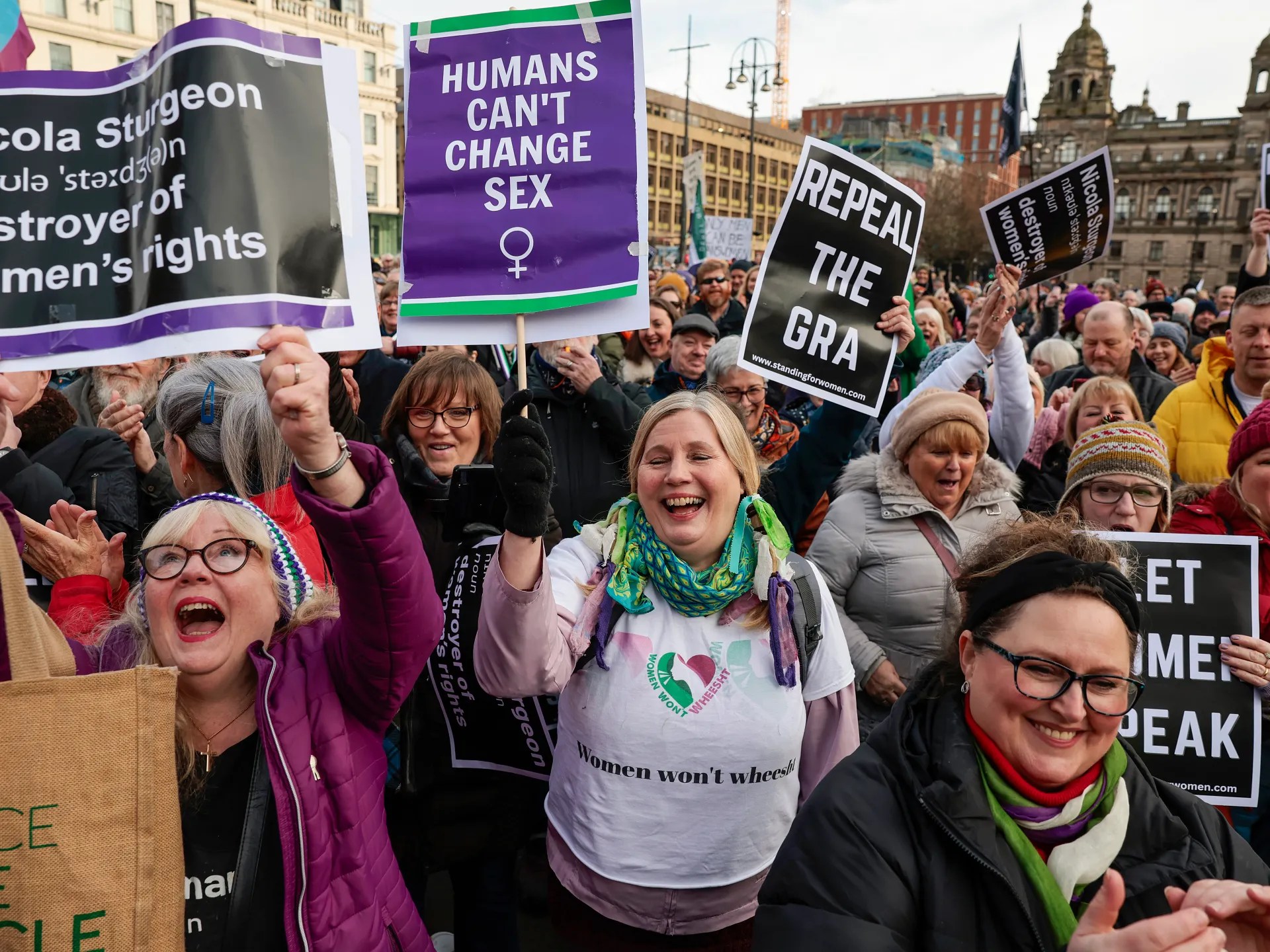
The demonstrations have a limited appeal and exhibit too much anger and aggressiveness, with too much misogynistic and fetishist behaviour to win any friends, although all these appear to be completely invisible to their self-identified left supporters.  The ideology does not fare well in open debate, which is why the mantra ‘no debate’ was more than a choice by trans activists.  The movement demanded that its claims be swallowed whole, and while some supporters now admit that this was a mistake, claiming the untrue and impossible, alongside a catalogue of male entitlements, means it has no internal dynamic for restraint.  Hence the ridiculous hyperbole that heightens fear in the most vulnerable people within its own ranks.  The movement offers less than nothing to many of its own supporters.

The widespread claim that the court’s judgement was flawed because it didn’t hear from trans people ignores the failure of the multiple trans lobby groups to openly argue their case, again not a glitch  The legal representatives of the Scottish Government and Amnesty International put it for them and they failed, the whole process was not inferior to the one that put the ideology into law in the first place.

The Labour Government and SNP have had their fingerprints all over the imposition of gender identity ideology and now hope that the whole issue will subside.  Their opportunism involved complete disregard for women’s rights, while appearing completely unaware that this was what they were doing.

The state bureaucrats responsible for HR policies in their organisations will therefore also be keen not to embarrass their political masters or expose their own position. They may be expected to generally implement the decision of the court while delaying where they can and doing as little as they can get away with .  This will not prevent gender identity activists continuing to push men into women’s and girls’ spaces but the road to stopping them is clear.  

This process can be expected to be repeated more or less in the north of Ireland where, of the two governing parties, the DUP is opposed to the ideology in principle and Sinn Fein doesn’t have any.  The media will be under pressure to drop its reverence for the ideology and is already under more obligation to acknowledge the opposition to it. In the Irish State, liberal and left opinion is even more wedded to it and the movement opposing it is weaker.  The façade of Irish liberalism faces increasing economic and political threats from Trump and the growth of anti-immigrant movements – fanned by the governing parties – so the right is therefore in a much better place to take the lead in opposing the ideology, facilitated by the stupidity of the left in defending it.

This left should consider the media spotlight thrown on certain British Green politicians who have embarrassed themselves in attempts to oppose the court judgement.  It has generally tail ended the most radical trans movement and thus swallowed whole and complete its demands, partly from the same opportunism as the main parties and partly from the moralistic character of its politics, where emotive claims to oppression substitute for argument and the politics of subjective identity substitutes for material reality.  

This is the politics of the petty bourgeoisie, which can come in either right or left variants. For those on the left, progressive politics arises from oppression (real or perceived) and not from the social and political power of the working class with its potential to create a new society as an alternative to capitalism.  This politics can go no further than seeking equality under capitalism and amelioration of the worst social conditions.

In the case of the Irish left in particular, it reflects their de facto accommodation with the trade union leadership and increasing deference to NGOs and their liberal progressivism.  It’s why the gender identity left are blind to the real nature of gender ideology and the reactionary manifestations of it in public demonstrations. It is why it is claimed that this identity ideology and its policy of gender self-identification, by men who claim to be women because they ‘identify’ as one, is not a form of identity politics!

1 Technically the law hasn’t changed and a woman has always been legally an adult human female. However the effect of the judgement is to make this clear and therefore, among other things, provides a robust legal route to defend single sex spaces or rights on the basis of women understood in this sense.

Forward to part 2

An exchange of views on Palestinian solidarity and Hamas

Sráid Marx has received a comment on the series of posts that were written on solidarity with Palestine from Socialist Democracy, having linked to one of its articles in my second post. I include their comment below and a brief reply.

* * *

A critique of our position on Gaza solidarity.
Are the politics of Hamas a defining issue?

Over the course of the ongoing genocide in Gaza Socialist Democracy has distributed thousands of leaflets and newsletters commenting on the struggle and the movement in solidarity in Ireland. The aim of that work has been to provoke a response and to support a debate in the movement about it’s future direction.


While we have had a number of interesting conversations, there has been no organised response, so it is with some pleasure that we read a commentary by Sraid Marx on their blogspot, especially as we are given a C‐ for our most recent publication.


However we have some difficulties in responding. The comrade does not mention our name or give a full account of our position, so we are being invited to reverse engineer to understand the comrades own position.


Essentially we feel that the Sraid Marx position is too formalistic, whereas our approach is more contextual.


A chief point in the ongoing offensive is the constant demand that we condemn Hamas. We are familiar with this approach from the troubles and constant demands to condemn the Republicans. The demand now is that we blame Hamas for the violence, ignore the Israeli and US previous drives towards genocide and agree that history started with the Hamas breakout.


We can’t agree, because that concedes to the imperialists. We can’t endorse the action because that would tie us to the strategy of Hamas. The answer is: What do you expect when you imprison millions in an open air concentration camp and constantly humiliate and murder them?


Much of the critique is given over to the nature of Hamas. We think that beside the point. The source of the violence rests with the US and Israel. The UK is a willing participant in genocide and Ireland a consistent facilitator and opposition must start from there.


A useful criticism of Hamas lies in the context of the Gaza outbreak. That was the Abraham accords, drafted by the first Trump regime and aimed at erasing discussion of Palestinian rights and winning endorsement of Israel by the Arab regimes. When Hamas launched the Al-Aqsa flood it was appealing to the Arab regimes on the basis of nationalism and to the Muslim world on the basis of religion. An immediate tactical aim was to do what they had done in the past – seize prisoners to use as bargaining chips and win concessions from Israel.


They were profoundly mistaken. Arab nationalism no longer has a progressive content. Imperialism is poised to establish complete control of West Asia, founded on establishing the absolute military primacy of the US and Israeli axis and the capitulation of the Arab regimes. Genocide is an acceptable cost of victory and dissent is to be crushed. The imperialists have scored remarkable but still incomplete victories. The final task is to crush Iran, but there are doubts about the military capacity of the US alliance and its failures in Yemen which are holding it back from regional war.


The Irish movement does not discuss politics. It remains fixed on Free Palestine and individual acts of BDS. Demands for government action do not lead to a consistent campaign against the government.


This political weakness has a material base. Much of the leadership is the decayed remnant of the anti-imperialist left. It is in alliance with Sinn Féin, who wanted to suggest anti-imperialist positions without breaking with imperialism. Sections of the trade union movement pose as defenders of Palestine without breaking their partnership with Irish capitalism. The core of the Palestinian diaspora are linked to the collaborationist Palestinian Authority and their ambassador to Ireland and are hostile to Hamas.


A new inflection came with a current associated with the group Rebel Breeze. They criticised the solidarity campaign for inaction and failure to target the US, Israel and the Irish government. We supported the criticism but did not support their position of uncritical support for the Palestinian resistance. We attempted to engage with them but they did not reply. So the current situation is that the solidarity movement is weak and has no mechanisms for national debate.


In relation to Sraid Marx we would be critical of the formalism which led to the analysis of the CounterPunch position. We see no reason to give credence to their analysis of Hamas and their Irish solution of a Palestinian Good Friday Agreement is risible.

These positions arise less from political theory than from a long tradition of opportunism. They are not a serious attempt to plot out a revolutionary position, more an attempt to align with a relatively non-political base.

Changes are taking place. The genocide in Gaza is related to the drive to war in Europe and the trade war with China. The UK is to the fore in urging warfare not welfare. The Irish government is every day taking measures to integrate with NATO and with European militarism. This feeds a growing outlawing of protest and use of state force.

The liberal virtue signalling of Irish leftism and of the NGO world will fade away like snow from a ditch. A genuine socialist and anti-imperialist movement will arise from recognising the role of local ruling classes as representatives of the imperialist world order.

* * *

You ask the question “Are the politics of Hamas a defining issue?’” to which the answer you give is presumably ‘no’ although that depends on what the issue is to be defined.  I was careful to define the issue of solidarity with Palestine in terms of the responsibility of the Irish state in collaborating with imperialism and the Zionist state in the first part of my series of posts; the general approach of socialists to solidarity in the second part and in relation to Hamas in particular in the third part.

This means that in order to rebut the legitimacy of criticism of Hamas you need to engage with the arguments of the second post and you have not.

Progress has been made, however, in that you are no longer claiming that ‘denunciation of HAMAS is simply a mechanism for supporting genocide’, which I pointed out in my second post.  Instead, you indicate that although you cannot endorse the actions of Hamas the correct response is to say “What do you expect when you imprison millions in an open air concentration camp and constantly humiliate and murder them?”  This may be a point to make in response to imperialist calls to condemn Hamas but it is woeful as a position in relation to how imperialism is to be defeated.

It would appear however that you do believe that criticism of Hamas is valid – “A useful criticism of Hamas lies in the context of the Gaza outbreak.”  This criticism includes Hamas’s reliance on reactionary Arab regimes “on the basis of nationalism and to the Muslim world on the basis of religion.”  You also concede that its tactical plan was a strategic disaster, so that “the imperialists have scored remarkable but still incomplete victories.”  As you say, Hamas “were profoundly mistaken” and “Arab nationalism no longer has a progressive content.”

You have therefore moved considerably but remain still a bit confused.  You argue that the critique of Hamas, specifically its nature that would account for and explain ,for example, all the criticism you make yourself, is “beside the point.” You are keen to argue that the political weakness of the Irish solidarity movement “has a material base” but do you not also believe that this is true of Hamas?

If you take your critique seriously you are obliged to advance the arguments that a working class alternative armed with socialist politics is required to help advance not only the solidarity movement but also the struggle of the Palestinian people against genocide.  This is what I attempted in the second post.

A penultimate point about trying to further debate in the solidarity movement.  You state of my posts, and their reference to the analysis of two authors in Counterpunch, that you see “no reason to give credence to their analysis of Hamas and their Irish solution of a Palestinian Good Friday Agreement is risible.”  

I make my own criticism of the authors references to Ireland clear, while it gets you nowhere to claim that their criticisms of Hamas should not be discussed because I should not “give credence to their analysis.”  If you think they are categorically wrong, you need to say why and where they go wrong.  Otherwise, dismissive comments are but another example of the refusal to engage in debate for which you criticise others.

A final point. You write that a “genuine socialist and anti-imperialist movement will arise from recognising the role of local ruling classes as representatives of the imperialist world order.” It will also require a political struggle against nationalism and fundamentalism and rejection of the petty bourgeois moralism that preaches that the leaders of oppressed groups are beyond criticism.

UK Supreme Court decides a woman is an adult human female

Although this is how the decision of the supreme court has been interpreted, the actual decision is the narrower one of what the GB Equality Act (EA) of 2010 means by ‘sex’, which it has decided means biological and not certified sex.  It has therefore been hailed by ‘gender critical’ activists as a victory for common sense and by certain trans activists as an attack on their human rights.

An alternative potential judgment – that the term ‘sex’ and thus sex itself – is determined by a certificate demonstrates how bizarre an alternative decision would have been.  In effect, it would mean one’s sex as far as the state is concerned was determined through its award of a certificate.  This would not have represented the continuation of the status quo, with the advances already achieved by the gender identity movement, but would have provided the grounds for a further attack on the rights of women, and then men.  If sex was certified, what obstacle would exist to certification being required?

The judgement of the court dealt with the problem of pretending that there were two types of women with all the incoherence that this would involve. Anyone from the left lamenting the judgment, and state interference in matters that do not belong to it, should consider how we got to this position through gender recognition certificates and how the scope for its massive inflation would have been prepared by the alternative decision some seem to have wanted.

The court ruled that ‘Any other interpretation would render the EA 2010 incoherent and impracticable to operate’, and rejected ‘the suggestion . . . that the words can bear a variable meaning so that in the provisions relating to pregnancy and maternity the EA 2010 is referring to biological sex only, while elsewhere it refers to certificated sex as well.’  (para 265) In doing so the court rejected the deliberate ambiguity and confusion of trans arguments presented by the lawyers for the Scottish government in which use of the words ‘sex’ and ‘gender’ can alternatively be employed as synonyms and as different concepts as suited their purposes.  I have looked at this sort of confusion before by what, for example, is meant by the word ‘gender’?

The court judgement stated that in getting a gender recognition certificate ‘there is nothing to suggest that undergoing such a process changes a person’s sex as a matter of law. It does not. Indeed, a full process of medical transition to the opposite gender without obtaining a GRC has no effect on the person’s sex as a matter of law.’ (para 200) It is also the case that this is true as a matter of fact, while the gender identity movement obviously thought the imprimatur of the law would allow them to claim this.

However, as the judgement stated: ‘a strong indicator that the words “sex”, “man” and “woman” in the EA 2010 have their biological meaning (and not a certificated sex meaning) is provided by sections 13(6), 17 and 18 (which relate to sex, pregnancy and maternity discrimination) and the related provisions. The protection afforded by these provisions is predicated on the fact of pregnancy or the fact of having given birth to a child and the taking of leave in consequence. Since as a matter of biology, only biological women can become pregnant, the protection is necessarily restricted to biological women.’ (para 177)

As the court notes ‘Put another way, if the acquisition of a certificate pursuant to section 9(1) of the Gender Recognition Act 2004 applies to these words, so that biological women living as trans men (with a GRC in the male gender) are male, they would nonetheless be excluded from protection when pregnant notwithstanding a continued capacity to become pregnant . . .’   So, some women (identifying as men) would lose the rights that come with pregnancy were sex to be defined by the gender recognition certificate they might have.

The court ruled that ‘We can identify no good reason why the legislature should have intended that sex-based rights and protections under the EA 2010 should apply to these complex, heterogenous groupings, rather than to the distinct group of (biological) women and girls (or men and boys) with their shared biology leading to shared disadvantage and discrimination faced by them as a distinct group.’ (para 172)  ‘Moreover, it makes no sense for conduct under the EA 2010 in relation to sex- based rights and protections to be regulated on a practical day-to-day basis by reference to categories that can only be ascertained by knowledge of who possesses a (confidential) certificate.’ (para 173).

Media reaction, and almost all previous media attention to the issue, has framed the judgement as one primarily impacting on trans women, much less on trans men (i.e. biological women), while some on the left that we have addressed before have repeatedly referred to the ‘small numbers’ (of trans people) involved, as if this meant that their feelings could be accommodated by any ‘solution’ regardless of any changed meaning to the word ‘women’, and thus the rights of half of humanity.

For all the faux left denunciations of a reactionary court by gender identity supporters, its recognition of the material reality of the sex class of women and of the shared ‘disadvantage, and discrimination faced by them as a distinct group’ shows it has a better grasp of reality and how to address it than some self-identified Marxists.

I am reminded of a tweet by the bête noir of the supporters of gender identity ideology, JK Rowling, who noted that she doubted Marx would have supported them:

‘Ironically, I can’t see Marx having any truck with gender ideology at all. He believed women were oppressed on the basis of their sex and I doubt he’d embrace a highly individualistic ideology that offers fertile new marketing opportunities for the capitalists of Big Pharma.’

The court seemed impressed by another argument that left supporters of gender identity ideology have failed to understand:

“Arguments concerning the definition of a protected characteristic are never simply  manifestations of individual claims. They are always group orientated. The claim that one is a woman is a claim to be included within a particular category of persons and to be excluded from another. It is also a claim to include some persons and to exclude other persons within the group that one is a part of. This matters especially for aspects of the Equality Act 2010 which require duty-bearers to be cognisant of how their conduct might affect those who share a protected characteristic or where there is an obligation to account for the distinct needs and interests of those who share a particular characteristic.” (para 142)

This blog has repeatedly criticised the moralistic politics of much of the left, which has departed from class analysis based on an understanding of objective reality to moralistic claims divorced from this reality.  So, their support for the supposed moral value of ‘inclusion’ means the inclusion of men in the category of women along with appropriation of their specific rights and prerogatives, regardless of women’s own views.  In fact, if challenged some of these men claim that as women they are the best defenders of such rights!

All this is based on purportedly unverifiable subjective claims that this left makes no attempt to verify or validate.  It thus accepts or acquiesces in all the most outlandish nonsense the radical trans movement throws out.  The claim to the impossible – to be, or to be able to change to, the other sex – defies reality and thus rational debate but becomes an assertion that is to be accepted without question or to be asserted and imposed.

This is the significance of the compelled use of the ‘right’ pronouns on others and the ‘crime’ of ‘misgendering’, which can demonstrate acceptance of, if not agreement to, the tenets of this ideology.  What is involved is not the exercise of rights but compulsion to unagreed social norms.  In capitalist society the state stands over the boundaries and content of many social norms and this defeat for gender identity ideology not only sets duties and responsibilities on state institutions and private bodies but frees up restrictions on social intercourse that the gender identity movement has been so successful in imposing.

The court noted the argument of Sex Matters that ‘many organisations feel pressured into accepting de facto self-identification for the purposes of identifying whom to treat as a woman or girl when seeking to apply the group-based rights and protections of the EA 2010 in relation to the protected characteristic of sex. The result in some cases is that certain women-only groups, organisations, and charities have come under pressure (including from funders and commissioners) to include trans women and policy decisions have been taken simply to accept members or users of the opposite biological sex . . .’ (para 203)

Judge Lord Hodge from the court said the ruling should not be seen as a triumph of one side over the other, but it is.

Solidarity with the Palestinian people (3 of 3) – Solidarity with Hamas?

National demonstration in support of Palestine, Dublin. Photograph: Dara Mac Dónaill / The Irish Times

In the previous post I stated that the October 7 attack by Hamas precipitated the current genocide in Gaza, as in to hasten the occurrence of something; hastily, or suddenly.  This does not make Hamas responsible for the genocide.  This responsibility belongs to the Zionist state and to its US sponsor as well as those states that have also supported and defended it.  As the first post made clear, this includes the Irish State, which studiously permits and facilitates the transfer of weapons and munitions from the US to Israel.

The responsibility of the Zionist state for genocide should not be a surprise, since the state itself is a settler colonial creation founded on the dispossession of the native Palestinian population subject to repeated expulsions and attacks.  The viciousness of the Zionist state and of its response to any challenge has routinely been disproportionate and the evolution of Zionist politics from labour to far-right reflects the logic of its existence.

All this does not excuse Hamas from criticism that it provoked an attack for which it was totally unable to defend the people that it claimed to represent.  This is essentially the argument of the Counterpunch article that I referenced before and which is illustrative of the arguments presented in the previous post. 

On the Oct 7 attack the Counterpunch article states that ‘Hamas must have known that Israel would react with massive destruction in Gaza after the October 7th attacks’ and that its  ‘military strategy was suicidal and poorly planned, also entailing war crimes against civilians which the leadership must have known would lead to the total destruction of Gaza.’  It further argues that ‘those who wish to engage in deluded fantasies like endless military confrontation having been the only avenue available to Hamas are quite deficient in their analysis which is bereft of intellectual rigor, to say the least. This sentiment is often felt by those attempting to appear the most revolutionary by taking what they perceive to be the most radical position.’

The failures of Hamas flow from the nature of the organisation: ‘the bulk of Palestinian resistance fighters—the actual fighters of Hamas and other entities—are acting out of anger and a desire for revenge, as the majority of them have lost family members due to Israeli attacks’; however ‘Hamas’ leaders . . . have climbed to the apex of power amongst the exploited and now seek their own privileges, power and financial gain.’

Hamas are described as corrupt ‘kleptocrats keen on getting rich, content with the privileges they possess in real life, and if they’re assassinated or killed in combat by the Israelis, then they believe they’ll be absolved in the afterlife—as Islamic fundamentalists do.’  An example of their corruption is provided – ‘Hamas had agreed to let the PA develop Gaza’s natural gas fields in exchange for a portion of the profits during negotiations with the US, Israel and Egypt. Simply put, Hamas’ leaders had decided they would sell their own people out to the Americans and Israelis—who effectively control the PA—in exchange for a cut on the back end.’

It is ironic therefore that the authors of the article argue that this is the alternative to HAMAS’s militarist adventurism and that the example provided by the Irish peace process is one to be emulated.  The Irish example helps point to why they are wrong.

The success of the Good Friday Agreement, such as it actually exists, is largely due to the failure and unpopularity of the militarism of the IRA.  What is wrong with this peace process is not that this militarism was abandoned but that without it the IRA and Irish republicanism generally had no political alternative to British imperialism.  The circumstances in Palestine are radically different from the North of Ireland, including that there was never any threat of genocide to the nationalist population.

So, while imperialism in Ireland and the Irish state are genuine in seeking a pacified Northern state with nationalist participation in the local administration, the view that ‘for now only a two state solution along the 1967 borders seems even remotely achievable’ after ‘Palestine [is] developed and modernized under US-Israeli-PA rule’ is hopelessly optimistic and misguided.  The two state policy has been endorsed by most of western imperialism for a long time and shown to be a fraud.  The Zionist regime has rejected it and, as the authors explain , its initial support for Hamas was precisely to help prevent it.

On its own, their proposal for the economic and social development of the Palestinian areas (under what currently could only be some sort of imperialist rule) is not wrong.  It is better, infinitely better, than genocide, but it fails to appreciate that the policy of genocide and steps to ethnic cleansing are a rejection of it by imperialism and Zionism, and of itself is not a policy of the working class, rather than simply potentially the best current conditions to allow one to develop. 

The article, at best, falls into the familiar trap of providing ‘solutions’ that are not those of the working class because the working class cannot provide its own. It does this instead of accepting weakness and pursuing a policy of opposition, one that doesn’t pretend to the current possibility of socialist revolution.  The writings of Marx and Engels are replete with such a policy where the working class is too weak or undeveloped to impose its own power but should not therefore politically support that of the bourgeoisie.

One of the ways by which better conditions for a working class alternative can be created is a working class led solidarity movement that sees this as one of its tasks.  This involves opposition to genocide and western imperialist complicity but also an open policy of supporting a working class policy and movement.

This is a long way from the current humanitarian solidarity that refuses to take a position on the political solution while, in doing so, leaving reactionary forces to fill in the gap.  It involves hoping that imperialism will do what it has demonstrated it has no intention of doing; hoping the Zionist state will be forced by imperialism to accept it, and hoping the reactionary Arab regimes will play a positive role in pushing this along, as opposed to their current closer and closer accommodation with both imperialism and Zionism.

Back to part 2

Solidarity with the Palestinian people (2 of 3) – Socialist solidarity

Belfast City Hall 5 April 2025

A friend sent me an article on the Counterpunch website that looked at Hamas and the October 7 attack that precipitated the current genocide in Gaza, which I will look at it in the next post.  It raises issues about solidarity with oppressed groups by socialists and what, if anything, socialists have to say that is different.  Having something different to say isn’t in itself a reason to say it, but if socialists think they have a distinctive view of the world and don’t have anything very different to say it implies that their socialism isn’t very important.

Socialism is international or it is nothing.  By this we mean that the cause of the working class in other countries is our cause and that socialism cannot exist within a single country.  This means that we seek to advance the socialist struggle of the workers in every country and that a victory in another country is a victory for us.  This is the material basis of solidarity for socialists.

Of course, in doing so we oppose oppression in every country, but you do not need to be a socialist to do this and we are socialists not just because we oppose oppression but because we believe only socialism – only the actions of the working class – can defeat oppression and establish freedom.  And this goes for the struggle in Palestine as well, although often these considerations appear to disappear when socialists discuss it.

Instead, we get statements such as the following – ‘that we must not only oppose oppression but support the oppressed, the right to resist oppression and the resistance itself.  We also get formulas that we should not take sides in intra-Palestinian political disputes, which only the Palestinians should engage in and determine.

If we work backwards – what is this last idea but a form of identity politics?  That Palestinians are a group apart with ideas and movements separate from the rest of the world’s struggles with nothing to learn from them; nothing to learn from the long history of working class struggle across the planet? If they are so different as to have nothing to learn then they would have nothing to teach us either. Either they are uniquely blessed with a political leadership beyond criticism because it never gets anything wrong, or it gets it wrong but is beyond help.  If neither of these are true, is it because we have no right to speak about their struggle or only to do so to voice our support? (Do we take this view about every struggle: of the French working class or German or any other?).

If it is the last argument, this simply leaves us back at the start and fails to argue why socialists have no right to state what we think is good or bad for the struggle; one that we have said is part of our own world-wide struggle and on which we are also at least partly dependent.  In short, the international struggle for socialism is something that involves Palestine and therefore involves us.

It might be argued that the struggle in Palestine is not about socialism, but this is no answer since socialists have a position on all struggles against oppression and these very often do not immediately raise the possibility of a socialist victory.  Otherwise, in today’s condition of the class struggle, we would silence ourselves across most of the world.

Of course, what we have to say should be within the framework of solidarity with the oppressed and should have something relevant and positive to contribute, but part of our solidarity is that we believe we do have something distinctive to contribute, not least because for us, solidarity is not an act of altruistic humanitarian concern for others but is part of our own fight.  The only basis for refusing to engage in debate on the way forward for the Palestinian struggle is the belief that it is separate from us: ‘In our thousands! In our millions! We are all Palestinians!’ becomes not only untrue (we are not suffering genocide!) but is also denied and rejected by the claim that we are not permitted to offer our own views.

This, however, is the most common view of solidarity, which thus becomes a sort of activist charitable exercise fed by the politics of self-determination of nations.  The socialist view is the primacy of self-determination of the working class, as an international class that can unite politically and organisationally, which is obviously impossible without debate, argument and disagreement.

Where does this leave us with the formulation that we must not only oppose oppression but support the oppressed, the right to resist oppression and the resistance itself? 

First, even oppressed people’s and nations are composed of classes involving class exploitation and oppression.  Genocide only partly qualifies this, as those with lots of money will always find a way to use it to their benefit.  Class divisions have a bearing not only on whether and how to resist oppression but also on the objectives of resistance.  Class struggle doesn’t disappear and socialists above all should recognise this in their solidarity and within the solidarity movement.

So what about the right to resist?  Socialists are in favour of the working class and other oppressed groups resisting exploitation and oppression but do so on the basis that capitalism exploits and oppresses, and that class struggle exists as a result.  As Marxists we understand that capitalism gives rise to the potential for socialism because of the nature of its development.  From this arises the struggle for socialism, not some moral right to resist that is independent of the circumstances and conditions in society.  This is important for how we resist, which we will explore in relation to Gaza in the next post.

In general, however, socialists are always to the fore in advocating resistance to exploitation and oppression, with the view that advancing towards the alternative is what matters above all.  We therefore support the oppressed by seeking to end their oppression, which ultimately can only be through the working class becoming the ruling class of society.

This leads to the final claim, that those in solidarity with the oppressed must also solidarize with the resistance and with the resistance movement, and this is where the biggest difference arises.  Since our view of solidarity is not dictated by any moral assertion there can be no moral claim on us to support resistance movements that are themselves reactionary, and this obviously includes Islamic political movements (as opposed to democratic and socialist movements composed of religious believers).

Solidarity arises from common interests and purposes.  What common interests and purposes arise between reactionary movements in conflict with imperialism and socialists?  To ask the question is almost to answer it.  Both can be opposed to imperialism on the grounds of some common effects of its rule or intervention but reactionary movements that come into conflict with imperialism are not anti-capitalist, never mind socialist, so their opposition is limited and qualified.  Ultimately their interests and purposes are opposed to those of socialists and is the reason for separate organisation and politics in the first place.

Since our primary interests and purposes are separate any common activity is also limited and qualified and there can be no unqualified or unconditional support.  Common objectives may allow episodic common actions and organisational cooperation to achieve them but there are no grounds for avoiding criticism or separate organisation.

We therefore do not give political support to reactionary movements on the grounds that they embody the resistance of the oppressed, because that resistance is politically reactionary and cannot represent their full and complete interests.  Whether these movements are in our own country or another does not fundamentally change this but at most determines the emphasis to be placed on opposition to our own state for whatever role it plays in the oppression.

In practice many socialists acknowledge this while denying it in words and will criticise the Palestinian Authority but not Hamas, for example on the illogical grounds that ‘denunciation of HAMAS is simply a mechanism for supporting genocide.’  Such an overblown statement scarcely warrants a response.  See below a better statement by this organisation to the Belfast rally pictured above. 

Back to part 1

Forward to part 3

Solidarity with the Palestinian people (1 of 3) – the Irish State

Richard Boyd Barrett asked the Taoiseach “is that where we’re headed” when he recounted the arrest of fourteen women from Mothers Against Genocide during their peaceful protest outside the Dáil on Mothers’ Day.

The right answer is yes and no.  Yes, we are heading towards a more repressive state and no, because we have been heading along this road for some time.  What has changed is the decision of the Irish state that it needs to abandon its appearance of some sort of neutrality, and defender of at least the appearance of international legality, and sign up to membership of NATO.

It’s difficult to sell the legitimacy of the state on current grounds when it has steadfastly refused to do anything meaningful to oppose genocide in Gaza.  It becomes impossible when it explicitly permits the use of Irish air space to transfer the weapons by which genocide is carried out, from the US to Israel.  Up until now it had appeared that the state had simply turned a blind eye to such flights while The Irish Times has now revealed that it has explicitly approved them.

The idea that the state is a leading defender of Palestinian rights is consequently as dead as a Dodo and the foot dragging on implementing the Occupied Territories Bill has become the least of the proof.  The decision of the new government to endorse the IHRA definition of antisemitism only makes sense in order to defend the Zionist state and to develop cover to those who defend and support its mass murder. The Irish state has already gone beyond both of these and is now revealed to be up to its neck in complicity with it.

Irish neutrality is a myth, as we have argued before (herehere and here), but it has involved constraints on its collaboration with NATO.  Now the state has decided that the drive towards war by the US and rest of Europe leaves it exposed just when it already faces severe threats to its economic role as a tax haven and general platform for US multinationals.  Pissing off Trump and the rest of the supporters of Zionism in the US is not going to help any special pleading it might want to make nor engender sympathy with the rest of the EU that backs genocide to the hilt.

Within this context, the attack on Palestine solidarity protests and signing up to defend the Zionist state makes perfect sense.  What doesn’t make any sense is to base a solidarity campaign on persuading this state to defend Palestinian rights, which is what the present campaign has been doing.  Repeated calls for the state to do this or that, pass the Occupied Territories Bill or new Air Navigation and Transport (Arms Embargo) Bill, has to ignore the determination of the state not to do anything like this.  

Instead, official Ireland has sought to protect itself by recognising the Palestinian state, which most countries have done to no effect, and intervene in the International Court of Justice case brought by South Africa, which also has little effect.  Of course, this has still upset the rabid Israeli regime despite secret calls from the Irish government that nothing is meant by such actions.  Meanwhile the Irish Central Bank helps Israel finance its genocide.

A solidarity campaign based on moral appeals to the amoral or to International law that Western imperialist powers decide to accept or reject as it suits, is to already accept hypocrisy as sincerity, imperialist actions as simply mistakes, and imperialism itself as capable of taking a progressive course.  It is fine to point out the hypocrisy, the real policy, and the nature of Irish state collaboration with imperialism, but it is simply foolish and futile to expect that anything meaningful will be achieved by this alone.

The picket at the trade union conference in Belfast, picked up by this Zionist news outlet, shows the beginnings of awareness that it is not enough for trade union figures to make fine speeches at demonstrations and demand that others, especially the government, take action, but that the trade unions themselves should take action and the campaign should focus on them and speak directly to workers.

It might appear that the widespread sympathy for the plight of the Palestinian people is a strong basis on which to force effective solidarity but the ability of the new government to ignore international law, stymie its own minimalist legislation, and go on the offensive to protect Zionism is all evidence of the limits of such popular opinion.

The general lack of understanding of the reasons for the genocide and the ability of the Zionist state to act with impunity is a result of the failure to appreciate the nature and current role of imperialism.  This can be seen in the acceptance of Irish sanctions against Russia and support for the US, EU and Britain in provoking and continuing the war in Ukraine.  In a world in which imperialism can ‘do the right thing’ in Ukraine, the possibility of persuading it to do the same in Gaza can appear as a reasonable possibility.

Only by rejecting the war in Ukraine as the product of inter-imperialist rivalry, as the result partly of deliberate US provocation, and acceptance of it as essentially an imperialist proxy war, with the Ukrainian state as the willing proxy, is it possible to see the perfect consistency of US, EU and British actions in both Palestine and Ukraine.  Unfortunately, much of the Irish left, just like the British, has capitulated and supported Western imperialism through its Ukrainian proxy.

The latest revelations of the major role of the US in the war, published by the New York Times, should leave no one able to claim the innocence – never mind progressiveness – of its role, or the claim that this is something other than an imperialist war.  To continue to do so is to wilfully ignore the evidence or make an unconscious claim to stupidity.  Absent both, the real condemnation is of the rotten politics of most of the Irish and British left.

For those in Ireland, the relationship between imperialism in Palestine and imperialism in Ukraine is bound up with the attempt by the state to dissolve the pretence of neutrality – as a stepping stone to open NATO membership as a junior component of the Western imperialist alliance.  It is the responsibility of socialists to explain this and to point the campaign towards the action of the working class as the mechanism to enforce effective solidarity.

Forward to part 2

The domestication of the Irish Left

Marxists believe that power in society resides in capital, in the capitalist system and its property relations in which ownership and control of the means of production etc. are monopolised by one class.  In the form of money, capital can be otherwise employed to gain political influence through the media, buy politicians and discipline governments through speculation on the bond markets.  Capital strikes can disable economies just as individual capitals can close down workplaces overnight destroying the livelihoods of their workers.

On top of this are states that defend these property relations through a multitude of laws bolstered by assumptions about the primacy of bourgeois private property rights that are considered holy writ.  Should this be questioned the state is also composed of forces armed with the monopoly of violence to police and impose the requirements of these property relations.  Since such relations involve the exclusion of ownership and control by the majority there is nothing democratic about them and no bourgeois claims to democracy entertain the notion that there should be democratic ownership and control of the economy.

Instead such claims to be democratic rely on parliamentary institutions that are dignified with reverential rules and procedures, the better to elevate their status above their essential subordination to the real power in society.  Incantations about their sacred embodiment of democracy cover for this subordination while most people vaguely register their awareness of the sham through a view of all politicians as essentially liars.

This, however, is a purely cynical reaction and is not the ground for either an adequate understanding of what is going on or the envisioning of a genuine democratic alternative.  Nationalism provides additional glue to bind workers to their (nation) state and the claims it makes for itself on their behalf, but more and more decisions are taken at an international level where real democracy is even more obviously absent. It is generally considered in most of Europe that its people live in a ‘democracy’.  The job of socialists is to make them aware that this is bourgeois democracy and that it is a sham that they should seek to change.  Moreover they need to be convinced that the state they are invoked to give allegiance to does not defend their interests.

One very small example of the fraudulent character of bourgeois parliamentary democracy has erupted in Ireland as the governing parties have voted to restrict the speaking time of the opposition, reduced its own exposure to questioning, and allocated opposition time to a group of ‘independents’ who have all declared full support for the government and have a number of members as ministers within it.  As all the opposition parties have put it, you are either in the government or in the opposition – you cannot be in both.

Dáil sitting has been suspended before in much disorder but was suspended again yesterday when the change in Dáil standing orders was pushed through without debate by the Ceann Comhairle (the Speaker of the House). She is supposed to be independent but was elected as a member of the same ‘independent’ group and appointed as part of the secret deal that no doubt lies behind the speaking privileges now given to it.

This is no doubt a cynical political stoke that should be opposed. The up-its-backside liberal propaganda news sheet ‘The Irish Times’ opined that “normal Dáil business” must “resume immediately” so that a list of issues can be discussed. These include climate and health care that “normal Dáil business” has failed to successfully address for decades.  Even these relatively minor attacks on democratic functioning do not find this liberal mouthpiece defending it.

Of course, the government is committing much greater crimes against democracy than these latest shenanigans, including allowing planes delivering arms to Israel to pass through Irish air space.  Like governing party claims before the general election about the number of houses that were being built or support for the Occupied Territories Bill, this is a government that cannot be trusted to tell the truth.

The opposition parties, including People before Profit, have united to ‘stridently’ oppose this ‘alarming’, ‘outrageous’ and ‘unprecedented’ plan and to defend the ‘fundamentals of parliamentary democracy’.  There has been a lot of talk about the government’s changed procedures reducing their ability to ‘hold the government to account’ and to ‘represent their constituents’.

But this follows People before Profit centring their recent electoral campaign on ending 100 years of unbroken office by the two ugly twins who nevertheless won the recent general election.  When has either Fianna Fail or Fine Gael been held to account over this 100 years?  When has it been punished for its failures, lies, hypocrisy and previous much more authoritarian measures?  In what way do impassioned speeches by People before Profit TDs excoriating government ministers to an almost empty Dáil chamber – shown regularly on social media – embody holding these ministers to account?

The man in the centre of it all,’independent’ TD Michael Lowry, has been found by a state tribunal to be “profoundly corrupt” but here he was giving two fingers to the PbP TD Paul Murphy! Why is he not in jail, never mind inducing the government to tear up Dáil standing orders on his behalf?  Tribunal after tribunal has demonstrated that there is no justice from the state and the Dáil chamber is incapable of delivering it either.  More evidence of the sham that is bourgeois democracy!  Why not say this?

Rather than use the episode to demonstrate this to the Irish working class, to further explain the limits and hypocrisy of bourgeois democracy, and to call out the alternative, People before Profit has decided to become bourgeois democracy’s most vocal defender.  Rather than use it as support for the argument that the working class will not find real democracy within a bourgeois parliament, it declares the vital need to support its fraudulent claims that it can allow workers to hold the government to account’, i.e. criticise and punish it.  Instead of exposing the hot-air bloviating that passes for democracy it holds out the necessity for extra hours of fine speeches.

Illusions in bourgeois democracy run deep in Irish society, as in most advanced capitalist states, with the continued election of Lowry and the ugly party twins as plenty of evidence.  Every opportunity to expose it should be grabbed.  Ironically, a previous posture of doing this – of exposing the hollowness of bourgeois democracy evidenced again by this latest stroke – would have been more powerful in embarrassing the government than the strident claims that more time to ask questions and talk to an almost empty room is vital to democracy.

To go back where we started – with Marxist principles.  These declare that the emancipation of the working class will come from the activity of the working class itself, a principle precisely counterposed to the parliamentary illusions of much of the left.  Real power comes from outside, that of both the capitalist system and of the working class.  It is on the power of the working class and its organisations outside that socialists need to focus, and which could do with much greater democratic functioning. Illusions in the Dáil are only for those for whom these illusions are comforting and who seek a career within it.

A ceasefire designed not to work

If Ukraine was winning the war Trump would not have humiliated Zelensky in Washington and probably claimed the victory as his own, through originally arming Ukraine with Javelin anti-tank missiles.  But Ukraine is not winning, and its defeat would also be that of the United States.  Besides his egotistical aversion to being a loser, he has admitted that the only alternative to ending the war through negotiations with Russia is to escalate with the increased risk of a world war.

Thus, we got the ham-fisted proposals for a temporary and unconditional ceasefire forced upon Ukraine without meeting its demand for what it calls a security guarantee – the promise of direct Western intervention.  The promise of such an intervention would require a capacity to quickly attack Russia that the US has rejected but the British and French have supported without, however, having the capacity to do it.

At most, while it would incentivise Ukrainian belligerence and Zelenskyy’s propensity to provocation, it would involve a combined Ukrainian army fighting alongside the British and French.  Such a war would have a natural dynamic to rapid escalation and Russia is no doubt wary of a temporary ceasefire that might allow the Western ‘coalition of the willing’ to openly put its troops into Ukraine, leaving another ‘ball in Russia’s court’ on whether to attack or accept their presence.

The proposal for a temporary and unconditional ceasefire is an obvious trap and consistent with the months of speculation in the Western media that the best outcome is to freeze the conflict and thus freeze the Russian offensive.  Since this is Minsk 3 and, like the previous two, is a proposal to give Ukraine a breather until it is better prepared to reengage in war, there is no reason for Russia to accept it.  Even some in the Western media have admitted that there is little reason for Russia to agree.

Ukraine has anyway made it clear that while it wants a temporary ceasefire, it wants a longer one, and also wants all its pre-2014 territory back; will not reduce the size and power of its large armed forces and will still pursue membership of NATO.  With such red lines any sort of truce is doomed and pointless from a Russian point of view.

There is still scope to tighten sanctions that will hurt Russia, especially if they successfully involve reducing the demand for Russian energy exports from India, for example.  The incentive for India would be to avoid US sanctions itself while gaining US support, for what that’s worth, while the disincentive in geopolitical terms is the greater dependence of Russia on China with whom India seeks to balance against.

The EU with the support of the US could seize Russia’s frozen assets but if this was clearly legal it would have happened already.  The West, especially but not only the US, has however demonstrated that ‘the international rules based order’ means whatever it says it is.

The assets could thus be confiscated but this would require getting someone to buy them.  If Russian bonds were bought by Western central banks it would be equivalent to printing money with inflationary effects while securitisation guarantees to commercial banks to buy them would be expensive.  Germany is already seeing the cost of selling its bonds increase due to its plans to massively increase borrowing and Britain is in an even more parlous situation as Starmer’s ‘growth’ agenda is flailing.  Seizure would weaken the confidence of third countries in the security of holding Euro assets, and while it is claimed that there is no indication of concern, reluctance to do it is evidence of it, while this would have massive confirmation if they were actually taken.  Robbing a state of hundreds of billions of financial assets in no small thing.

Keeping the assets frozen is therefore a useful means of continuing to put pressure on Russia to accept a deal although there is no indication that it is sufficient to deliver what is demanded.  The short pause in supply of weapons by the US was of little consequence, while it’s not clear that the denial of intelligence was complete or even real.  Trump demanded that European states start paying more for constraining Russia and their consternation and outrage propelled them to agreeing – under the banner of independence from the US!  Europe is now just as subordinated to the US as before by taking an aggressive stance against Russia, led by Britain under Starmer, who stupidly thinks he can balance the US against the EU.  Britian is now in competition with France and Germany to lead the continent.  But lead it where?

Britain still wants to believe that it can be the favourite vassal of the US and carry the rest of Europe behind it, while the EU has selected a foreign policy diplomatic representative, Kaja Kallas, who declared the break-up of Russia as a good idea just before she got the job.  Diplomatic or what?  Further she blurted out the complaint that how could Europe defeat China if it could not do so to Russia?  So defeating China is now a goal of the EU?   European independence from the US plus hostility to Russia and China is not a recipe for strategic independence but for isolation.

The blunt demands of Trump and belligerent approach to Russia have put the question of European unity to the fore, which pulls against the historic and current role of a Britain that hopes it will suffer a different fate than the EU in Trump’s tariff war.  The unity of Europe is historically a progressive task that would erode the petty nationalisms that fed two world wars and currently feeds the rise of the far right. However, under capitalism this is being done through the promise of the militarisation of Europe upon the backs of its working class who will pay for it through austerity.

No doubt this will propel the statist left to seek refuge in petty nationalisms under the rubric of a ‘national sovereignty’ that Trump is proving illusory.  The Irish state is vivid demonstration of this as its Taoiseach grovelled before Trump, applauding his idea that the housing crisis is a good problem to have and staying stum about his plans for ethnic cleansing in Gaza.  Ireland is only the most obvious example of the power of US capital in Europe and the difficulty of achieving any sort of autonomy from it.

The European powers are committed to continuing the war, unless Trump decides to make them desist, which will depend on the circumstances of the war and its prospective resolution.  In this the ruling parties in Europe will find willing allies in the petty bourgeois left for whom the righteousness of the Ukrainian cause is absolute, regardless of the reality of the war, its current and potential consequences, and of the ethno-nationalist character of the Ukrainian version of bourgeois democracy.