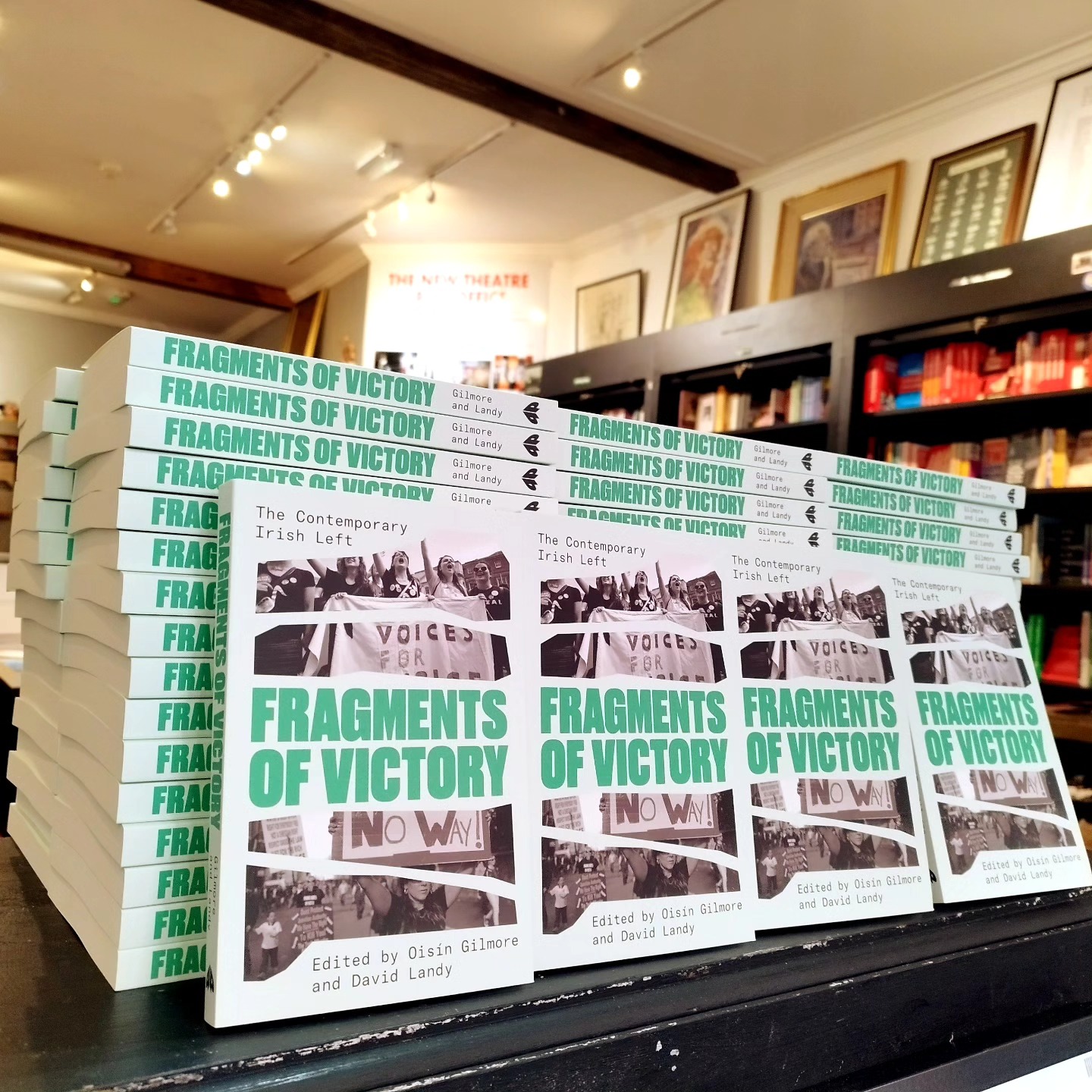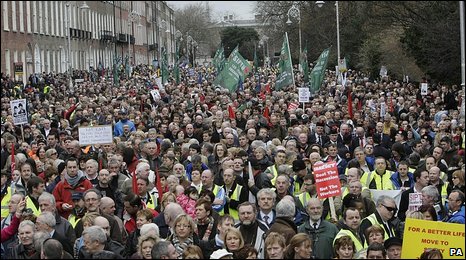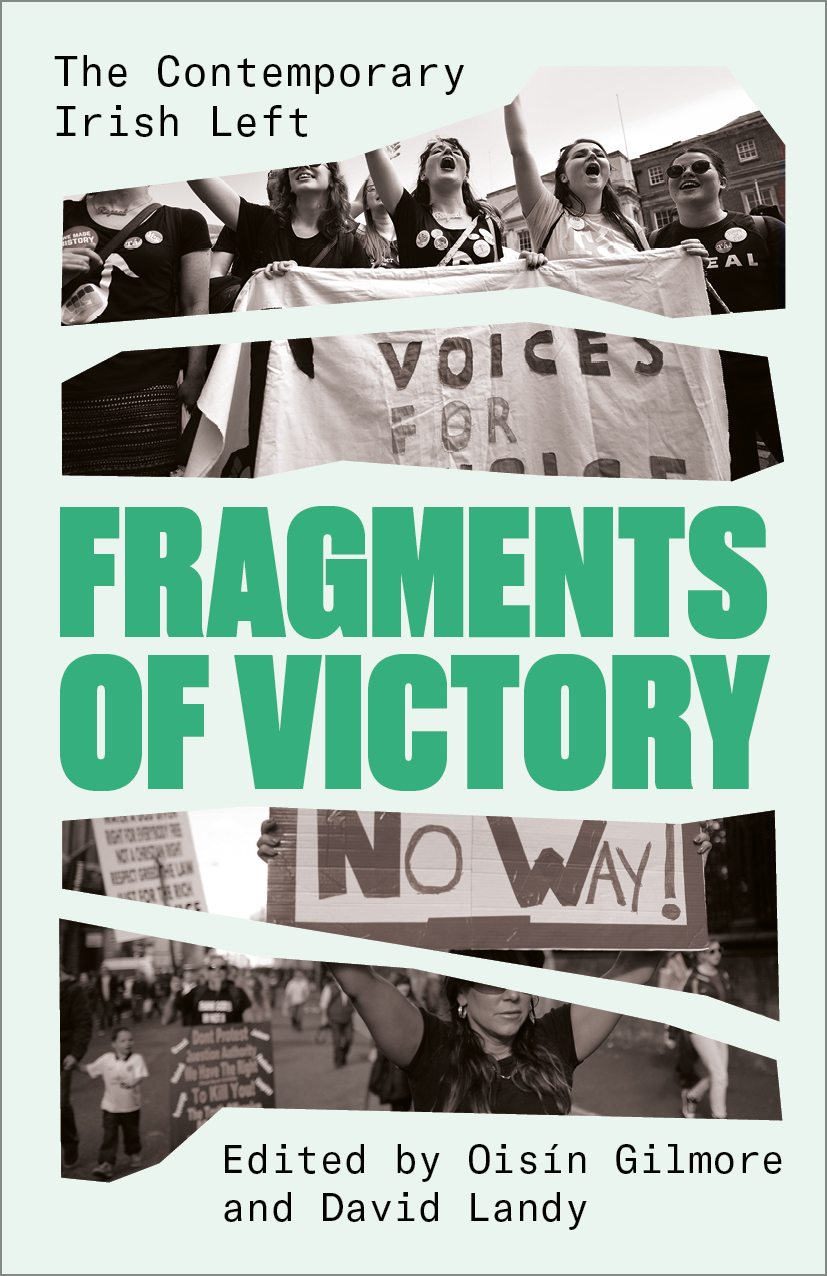
‘Fragments of Victory’: The Contemporary Irish Left’, book review (1 of 6)

Reading ‘Fragments’ I was reminded of the statement by Marx that ‘We develop new principles for the world out of the world’s own principles. We do not say to the world: cease your struggles, they are foolish; we will give you the true slogan of struggle. We merely show the world what it is really fighting for, and consciousness is something that it has to acquire, even if it does not want to.’

Fragments sets out to record the struggles of the Irish left (in the Irish state) over the past few decades so that the reader can form a view on its successes and failures.  In doing so we can apply Marx’s prescription and determine to what extent it shows the left ‘what it is really fighting for’ so that it can be conscious of the lessons that should be learned.

There are some obstacles in the way, including the variety of authors with different viewpoints although an introduction and conclusion is meant to summarise the results.  The major problem is the definition of what it means to be ‘left’.  In the introduction Sinn Fein and the Green Party are listed as left even though the major theme of the book is the response to the implementation of austerity following the collapse of the Celtic Tiger and the consequent bankruptcy of the State.

During this period Sinn Fein presided over austerity while in a coalition government with the DUP in the North, while the Green Party entered into a coalition with Fianna Fáil in 2007 that bailed out the banks and inaugurated widespread cuts in social welfare and wages.

As part of the relaunch of Stormont in 2015 the ‘Fresh Start’ agreement committed the parties, including Sinn Fein, to reducing NI civil service staff numbers: ‘Between April 2014 and March 2016, the NICS is set to reduce headcount by approximately 5,210 and between April 2015 and March 2016 a further 2,200 will exit from the wider public sector.’ The Green Party supported the bank bailout that the state could not afford, which resulted in the intervention of the Troika of the European Commission, European Central Bank and IMF, along with the huge austerity necessary to satisfy their demands.

Even taking account of the elastic possibilities permitted by employing a relative term such as ‘left’, it is difficult to sustain any claim that these parties are in any substantial or verifiable way left-wing.  Sinn Fein was described by a comrade of mine a long time ago as containing members with left-wing opinions and right-wing politics.  The party has, in the meantime, fully confirmed this judgement while in government.  The Green Party began life as The Ecology Party promising ‘a radical alternative to both Capitalism and Socialism’ but in office twice it has displayed no alternative to capitalism and therefore no alternative to socialism.

Looking at political struggle through the lens of ‘left’ versus ‘right’ has therefore the potential to obfuscate as much as it clarifies.  A more illuminating approach is to set out the class nature of the politics of a political party and to explain why different parties with generally similar class natures have the politics that they do, even if they have different colouration.

Thus, as a nationalist party, Sinn Fein is a petty bourgeois party that considers the Irish people as one, with any class distinctions completely secondary and subordinate to the interest of the nation and its state, which can represent the true interests of all the people simply because of their nationality.  The Green Party claimed at its birth to have a radical alternative but also rejected a class approach through its largely petty bourgeois base and ideology.  It confirmed its class character by its members enthusiastically joining Fianna Fáil in government (voting 86% in favour) and by its commitment to the banks and austerity.

It might appear difficult to assign a class identity to some parties, and any classification has to be justified, but this is precisely the point of identifying the class nature of the forces involved.  As petty bourgeois parties, both Sinn Fein and the Greens have imposed austerity on workers while espousing radical rhetoric.  Calling them left is an attempt to obscure this and works to introduce doubt that they will not always fall on the side of the capitalist class in a struggle.

Fragments demonstrates this repeatedly, even when making secondary observations, for example that individual members of Sinn Fein were active in the Campaign Against the Household and Water Taxes but that the party was not: ’This form of partial (non-)commitment proved to be the defining feature of Sinn Fein’s approach to most political struggles of the time.’ (p37)

Approaching politics this way allows us to make judgements of other ‘left’ parties such as the Labour Party and Social Democrats etc. and permits an understanding of their behaviour during this period.  While the Labour Party paraded its ‘Labour’s Way’ as resistance to ‘Frankfurt’s Way’ while in opposition, it had no alternative to austerity when in government.  The doubling of its vote in the 2011 general election was a prelude to its consequent decimation in the next one.  ‘Labour’s Way’ didn’t become Frankfurt’s Way’, not having an alternative meant it always was.

Was the 2011 vote for Labour therefore a victory for the ‘left’ and was its subsequent decimation a defeat?  Did those who voted Labour in 2011 make an advance in consciousness or do so by deserting it in 2016? Or were they just registering disappointment and resignation?

Fragments offers the view that despite Labour delivering austerity when in office ‘the new government retained a huge amount of goodwill . . . the crisis was clearly not their fault and . . . the harsh austerity measures they took were seen as both forced by the Troika and, while painful, necessary’, while ‘the ‘honeymoon lasted for much of 2011 . . .’  (p31) So, were these views completely discarded when the Labour Party was dumped out of office? Was there any real advance in consciousness of an alternative when it happened?  Is roping the Labour Party into ‘the Left’ clarifying either history or the future?

Today, all these parties are allied in supporting Catherine Connolly for the post of President with the additional enthusiastic support of People before Profit and Solidarity.  The latter’s politics are supposed to be based on the view that existing power in capitalist society does not come from parliament but from the permanent state apparatus and the economic and social power of the capitalist system, yet they promote the idea that election to a post that is admitted not only to be without power, but forbidden to exercise any, would be a major advance.

Paul Murphy, People before Profit TD, states on Facebook that ‘this is a rare opportunity for the left to come together, and elect a voice for workers, for women and for neutrality.  Change starts here.’ This is a left that includes all the parties above that have been tried and tested.

In doing so all sorts of illusions in the role of bourgeois politics and institutions; about the ability of one person to represent the nation, and all the people within it; because of a one-off vote, and of the way ‘change’ can be made, are strengthened against an alternative view that real change comes from the organisation and struggles of the working class itself.

Are such views ‘Trotskyist’, as Paul Murphy’s organisation is called in the book? Or is this term used because that is just how it is usually described, or should such a designation not require some comparison of its political practice to a reasonable account of what Trotskyism is?  The umbrella term of ‘left’ addresses these questions by rendering them unimportant, and this is a problem.

To anticipate one message of this review; Fragments provides enough testimony to show that a different approach is necessary and that an alternative is required to the illusion that there is a ‘left’ that should be united to advance the cause of the working class.

It demonstrates, in its own way, that only a class analysis can explain events, including the actions of the state, why it succeeded in imposing austerity and why the resistance to it was unable to rise to the challenge.  Explaining all this in terms of whether certain actors, institutions or policies were ‘left’ or ‘right’ is hopeless not only because of the vagueness of the terms but because all of these acted out of material interests, as they perceived them, and these in turn were based on objective factors that were fundamentally determined by class relations.

Forward to part 2

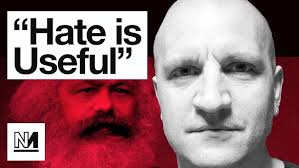
Hate is useful?

Raju Das, in an article on ‘The Communist Manifesto’ noted that:

‘Interest in anti-capitalism as well as socialism is growing in many parts of the world.  According to a poll conducted in 28 countries, including the United States, France, China, and Russia, 56% agree that “capitalism as it exists today does more harm than good in the world”. A June 2021 poll indicates that 36% of Americans have a negative view of capitalism; this number is much higher among the youth: 46% of 18–34-year-olds and 54% of those aged 18–24 view capitalism negatively. Conversely, and interestingly, 41% of respondents from all ages have a positive view of socialism. This number is higher for the younger people: 52% of 18–24-year-olds and 50% of young adults aged 25–34 have a positive view of socialism. An October 2021 poll shows that 53% of Americans have a negative view of big business . . . The situation outside of the United States within the advanced capitalist world is similar.’

A more recent opinion poll by the magazine Jacobin also recorded promising results on the advance of the idea of socialism in the US. Believing these views can be advanced further by more hate, as we have reviewed in previous posts, is a mistake, not least because it already exists is copious amounts. What is required is clarification and direction, not a greater emotional charge which is unlikely to provide either.

Anger and hatred at the iniquities of capitalism on their own, or even fore-grounded, invite moralistic evaluations that do not in themselves form an understanding of how capitalism can be replaced or the nature of the alternative.  The influence of capitalism on the working class, in terms of illusions, pessimism, demoralisation, passivity, and backward ideas, can cause those opposed to it to look for an alternative in various ideas and movements that ignore or reject the working class as the force that can bring about the alternative.

Historically, revolts based on hatred have been the province of peasant rebellions that fail to achieve any lasting change, even in circumstances where they appear to be successful.  Provocations by the capitalist state rely on hatred of their regimes in order to suppress developing movements before their time has come; something only clear-headed judgement can hope to determine. Hate is not therefore a distinguishing mark of successful movements and while extreme subjectivism may have become more prominent it is not an answer to objectively unfavourable circumstances or contributory to the working out of strategy.

For Marx the primary need for socialist revolution is not so much to overthrow capitalism as to make the working class fit for its own rule – the transformation of the working class so that the economic, social and political system can be transformed.  This involves opposition to ideas and practices that divide the working class such as nationalism, racism and sexism but hatred of these should not lead to the belief that these can and must first be completely eradicated within the working class before the building of a working class movement can be commenced or continued.                                           

Marx and Engels stated in ‘The German Ideology’ that ‘Communism is for us not a state of affairs which is to be established, an ideal to which reality [will] have to adjust itself. We call communism the real movement which abolishes the present state of things’.  This includes the existing working class that must make itself capable of creating this movement, which is only possible through struggle, not the assumption that it can come when the class has first purified itself.

Marx had no illusions about the shortcomings of the working class and refused to simply follow it when its actions were antithetical to its long term interests.  In the Critique of the Gotha Programme’ written in 1875, he explained the character of society following the capturing of political power by the working class:

‘What we have to deal with here is a communist society, not as it has developed on its own foundations, but, on the contrary, just as it emerges from capitalist society, which is thus in every respect, economically, morally and intellectually, still stamped with the birthmarks of the old society from whose womb it emerges.’ The working class will itself still be stamped with this birthmark, both ‘morally’ and ‘intellectually’, something that intensifying hatred will do nothing to remedy.

Even alienation, which we looked at before, through which the workings of capitalism disorients and oppresses the working class while also acting to suppress and hide its true nature, has its positive as well as negative character, which more hatred would do nothing to illuminate. As Sean Sayers set out in an article:

Alienated labour ‘is also the process by which the producers transform themselves. Through alienated labour and the relations it creates, people’s activities are expanded, their needs and expectations are widened, their relations and horizons are extended. Alienated labour thus also creates the subjective factors – the agents – who will abolish capitalism and bring about a new society.’

‘Seen in this light, alienated labour plays a positive role in the process of human development; it is not a purely negative phenomenon. It should not be judged as simply and solely negative by the universal and unhistorical standards invoked by the moral approach. Rather it must be assessed in a relative and historical way. Relative to earlier forms of society – strange as this may at first sound – alienation constitutes an achievement and a positive development. However, as conditions for its overcoming are created, it becomes something negative and a hindrance to further development. In this situation, it can be criticized, not by universal moral standards but in this relative way.’ (Sean Sayers 2011, ‘Alienation as a critical concept’, International Critical Thought, 1:3, 287-304).

Advocating greater hatred in order for workers to advance towards greater awareness of their class position assumes it is a pedagogical aid for a politics that is already sufficient for its task. It is not such an aid and the politics sufficient to its objective is still in the process of elaboration.

Karl Marx’s alternative to capitalism part 70

Back to part 69

Forward to part 71

Marx admires capitalism too much?

A worker gathers items for delivery from the warehouse floor at Amazon’s distribution centre in Phoenix, Arizona November 22, 2013. REUTERS/Ralph D. Freso

Marx’s alternative to capitalism explains that it arises from the contradictory nature of capitalism.  The simple and popular, but misleading, understanding of this is that it is primarily expressed in capitalist crises and class struggle, and although Marx had much to say about both, his alternative regarded these as arising from property relations, on which we based a large number of the previous posts in this series, and on his claim that communists put these to the fore in seeking social and political change.

We have noted the (one-sided) emphasis on resistance to capitalism – ‘anti-capitalism’ – and the impulse to state what you are against instead of what you are for, with what you are against being more concrete than what you are for.  Concrete issues and instances of exploitation and oppression are often denounced by abstract claims for justice within the existing capitalist system.

It is worth emphasising the contradictory character of capitalism because many of those claiming adherence to Marxism find it difficult to fully appreciate that, for all the horrors of capitalism, what in the end is most important is that it provides the grounds for socialism.  It is not a question of there being a good side to capitalism and a bad side such that they can be separated, except in the most superficial way of description, but that they are inseparable and that it is this integrity that involves contradiction and antagonism out of which a new society arises.

Even very informed views fail in this regard, so that there is a compulsion to emphasise the ‘bad’ while relegating the ‘good’ to some purely historical existence.  As we have explained in the previous post, in a reproduction and critical commentary on ‘The Communist Manifesto’, China Miéville records Samir Amin writing that it was a ‘hymn to the glory of capitalist modernity’, and repeats the words of Joseph Schumpeter that ‘Never, I repeat, and in particular by no modern defender of the bourgeois civilization, has anything like this been penned, never has a brief been composed on behalf of the business class from so profound and so wide a comprehension of what its achievement is and of what it means to humanity.’

Miéville complains that if this ‘is an exaggeration, it isn’t by much’.  The Manifesto ‘admires capitalism and bourgeois society and the bourgeoisie.  It admires them too much.’  He quotes ‘a phrase from Neary, in another context, The Communist Manifesto’s “negativity is not negative enough”. ‘It does not hate enough’, exclaims Miéville. (A Spectre Haunting: On the Communist Manifesto, p 176). We reviewed this request to ‘hate more’ in a general sense in the previous post.

This view not only does not consider the purpose of writing the Manifesto – for a particular organisation at a particular time – but also its status as the elaboration of a set of beliefs, principles and programme that has had lasting relevance.

In ‘The Communist Manifesto’, Marx writes that:

‘Modern bourgeois society, with its relations of production, of exchange and of property, a society that has conjured up such gigantic means of production and of exchange, is like the sorcerer who is no longer able to control the powers of the nether world whom he has called up by his spells.’

‘For many a decade past the history of industry and commerce is but the history of the revolt of modern productive forces against modern conditions of production, against the property relations that are the conditions for the existence of the bourgeois and of its rule . . . The productive forces at the disposal of society no longer tend to further the development of the conditions of bourgeois property; on the contrary, they have become too powerful for these conditions, by which they are fettered, and so soon as they overcome these fetters, they bring disorder into the whole of bourgeois society, endanger the existence of bourgeois property.’

‘The weapons with which the bourgeoisie felled feudalism to the ground are now turned against the bourgeoisie itself.  But not only has the bourgeoisie forged the weapons that bring death to itself; it has also called into existence the men who are to wield those weapons – the modern working class – the proletarians.’

So, Marx’s praise for ‘bourgeois civilisation’, ‘capitalist modernity’, and even perhaps his ‘admiration’, insufficiency of ‘negativity’ and ‘hate’ are not unrelated to the grand forces of production created by capitalism that are to be wielded by ‘the modern working class’.  

The ‘good’ and the ‘bad’ are not separate and attempts to keep the good ‘side’ of a phenomenon while discarding the bad are doomed to failure.  Worse than that, many of those that promise to do so reject the development and resolution of the contradictions contained in the phenomenon – this ‘civilisation’ and ‘modernity’ – with the assurance that it can be maintained either with ‘reforms’; by asserting that the bad can be removed, while refusing to supersede the phenomenon as a whole, or by the rapid instigation of planning as if this was the alternative to capitalism understood solely as a market phenomenon.

To see ‘bourgeois civilisation’ and ‘capitalist modernity’ as simply negative or to belittle their power is thus also to call into question the power of the weapons to be wielded by ‘the proletarians.’  Ultimately, to question the revolutionary consequences of the rule of the bourgeoisie is to question the revolutionary character of the working class and its future rule.

It is thus not enough to say that ‘It’s OK to be angry about capitalism’, in the words of Bernie Sanders.  Even in the citadel of world capitalism, in the United States, there is growing evidence of opposition to capitalism and sympathy with socialism, but it’s not enough to simply get angry or to hate.  Recent events have demonstrated that there is no shortage of both. It is necessary to understand and to do this requires appreciation of capitalism’s contradictions.

Karl Marx’s alternative to capitalism part 69

Back to part 68

Back to Part 1

Forward to part 70

The need to hate capitalism more

In the 1970s I used to sell the paper of the International Marxist Group Red Weekly every Saturday afternoon on Union Street in Glasgow at the side entrance of the Central Station. I remember one occasion when a visibly agitated man rushed up to me demanding to know whether I was a communist – ‘Are you a communist?’ ‘Are you a communist?’  He launched into a few remarks I barely took in at the time and don’t remember at all now.  I gathered that he was very angry about something and ‘communism’ was some sort of answer. He then exited as frantically as he had arrived.  I doubt very much he had anything to do with ‘communism’ thereafter.

I was reminded of this minor incident reading China Miéville’s book on Marx’s Communist Manifesto, in which he borrows a phrase employed by someone else, and in a different context, to say that The Communist Manifesto’s “negativity is not negative enough”. ‘It does not hate enough’, (A Spectre Haunting: On the Communist Manifesto, p 176)

This appears in a section entitled ‘On Hate’ in which he states that capitalism deserves to be hated, but that “a focus on hatred . . . is fraught, and dangerous territory . . . Hatred, after all, is an emotion that can short-circuit thought and analysis, can segue into violence, and not necessarily with any discrimination’; although he then notes that “hatred, particularly by the oppressed, is inevitable” (p170-171)

Against this he quotes Marx’s favourite maxim – Nihil humani a me alienum puto – nothing human is alien to me, and while he then states that it’s “hardly productive to pathologise hate per se, not least when it’s natural that it arises . . . the very absence of a critical mass of hatred may militate against resistance.”  He then quotes others on the need for ‘class hatred’ – “a radical structural hate for what the world has become” that is not “personal, psychological or pathological hate, but a structural hate.’  However, a hate that is neither personal nor psychological is not an emotion and a ‘structural hate’ must refer to something else entirely if it is to refer to anything at all.

Miéville is correct to refer to a statement about “deliberate hate as a rational category”.  The philosopher Martha Nussbaum noted that “emotions always involve thought of an object combined with thought of the object’s salience or importance; in that sense, they always involve appraisal or evaluation.”  The neurologist Antonio Damasio similarly comments that “Emotions provide a natural means for the brain and mind to evaluate the environment within and around the organism and respond accordingly and adaptively.”

This is the opposite of the view of emotions–that they cloud rationality, which they obviously can, and fits comfortably into the long tradition of Western philosophy focused on what is rational but which exaggerates both the disruptive potential of most emotions and the precision and certainty of human rationality.  Emotions are an evolutionary development of humanity that helps us quickly gather and process information about the world and respond to it accordingly.  

Some have made the comparison of thinking slow and fast, with emotions involving the latter entailing problems associated with ‘snap decisions’ and avoidance of ‘careful deliberation.’  If anyone was to look to Marx for inspiration, they might consider his long years in the British Library in London; his purported need to read all potentially relevant books on a subject before forming a definite view, and this resulting in missed deadlines and much unfinished work left to posterity.

Miéville believes that hate is not only necessary for resistance but “may help not only with strength but intellectual rigour, and of analysis, too” (p173). He quotes an Anglican priest, Steven Shakespeare, quoted above regarding hate’s “dangerous territory”, that it is necessary to be “more discriminatory about hate, where it comes from, where it should be directed, and how it gets captured for the purposes of others.’

So, we are into Goldilocks territory of not too much, and not too little, hate but just the right amount. Or we can appeal to Aristotle’s golden mean; where, for example, courage is a virtue but if taken to excess is recklessness and if too little, cowardice.  “Emotional intelligence” is a modern variation.  Cogitating on how much hate to evoke against capitalism is, however, a pretty unproductive pursuit.

Miéville, however, is particular about determining the need for greater hate, including that “Marx and Engels were too generous in their eulogy to its [capitalism’s] transformation and energetic properties, and to the bourgeoisie itself, as well as about the likelihood of its collapse.” (p175)

It might be more accurate to say that Marx and Engels were too sanguine, optimistic and confident about the overthrow of capitalism (not its collapse) but that they didn’t live to see the development of the workers’ movement or the programmes developed by its various parts that impacted on the outcome of subsequent failures.  The point of this series of posts is not to relay this long and involved history but to set out what their alternative to capitalism was, which should go some way to exposing the reasons for failure so far.

As for Marx and Engels being too generous about the transformational and energetic properties of capitalism, this is simply false; it is in fact one of their most brilliant judgements and predictions, fully confirmed by today’s capitalism and its spread across the globe.

Miéville says we should retain our “shock” at the iniquities that capitalism throws up and that provoke an “appropriate human response, the fury of solidarity, the loathing of such unnecessary suffering . . . We should feel hate beyond words.”  But the feeling of solidarity is also an emotion.  An emotion that we should wish to promote, which is not (simply) a “humane” one but one based on a feeling of class solidarity, to be combined with the emotions of pride in our cause and our movement, and growing confidence in our success.

If there is a deficiency in emotional investment it is in these, which are more vital to our future than learning to hate capitalism that bit more.  No one experiences only one emotion at a time (hence the falsity of the question repeated by Miéville “is your hate pure”); and as we have said, even the most instinctive emotion involves rationality and a degree of thought.

Marx noted, in relation to Miéville’s call that we should retain our “shock”, “fury” and “loathing” that some suffering has not been “unnecessary”, but absolutely necessary for the development not only of humanity in general but of capitalism and the grounds it creates for the subsequent potential for socialism.  Many still cannot get their head round this: that the suffering imposed by capitalism was unavoidable for its birth and development – and in this sense necessary – but that this does not in the least mean we do not cease to damn it and to seek its overthrow.

To claim otherwise – that much of the suffering endured through capitalism was unnecessary must explain a number of things.  How could capitalism birth and develop without suffering?  Is a non-suffering capitalism possible? Is socialism possible without capitalism (and therefore without this suffering but then also without the working class)?  Was all this suffering therefore without any historical meaning, but simply contingent and accidental?  Explain the laws of the development of capitalism and its relation to the possibility of socialism without contradiction and antagonism and therefore suffering!

Marx is criticised in Miéville for his greater criticism of other socialisms than of the bourgeoisie because the former has none of the “ambivalence” that he attaches to the latter. (p176) This “ambivalence”, however, was entirely appropriate in a period in which capitalism was more or less fully developed in only a couple of countries and had yet to supplant the legacies of feudalism.  Apart from recognition of the insights of the original utopian socialists, Marx admonished their succeeding followers because there was no merit in repeating anachronistic nostrums that were now reactionary.

Did Marx and Engels hate capitalism more than Weitling, Proudhon and Bakunin?  This would be a hard claim to sustain, but whose politics is the best guide to ending it, and would their’s have been better had they done so?

The emotion of hate has its (inevitable) place, but this does not mean “we must hate harder than did the Manifesto”; the demand for greater hate (“hate beyond words”) is a substitute for politics.  After all his detour on the need for hate, Miéville says that “Hate is not and cannot be the only or main drive to renewal.  That would be deeply dangerous.  We should neither celebrate nor trust our hate. But nor should we deny it.”  It would have been better had he started and elaborated on this than drop it into the end of a disquisition on how much we must hate more.

Karl Marx’s alternative to capitalism part 68

Back to part 67

Forward to part 69

Back to Part 1

What does “Don’t betray Ukraine?” mean (3 of 3)

In a Facebook discussion on why socialists should oppose the war I received a reply that stated:

‘In ninety cases out of a hundred the workers actually place a minus sign where the bourgeoisie places a plus sign. In ten cases however they are forced to fix the same sign as the bourgeoisie but with their own seal, in which is expressed their mistrust of the bourgeoisie. The policy of the proletariat is not at all automatically derived from the policy of the bourgeoisie, bearing only the opposite sign – this would make every sectarian a master strategist; no, the revolutionary party must each time orient itself independently in the internal as well as the external situation, arriving at those decisions which correspond best to the interests of the proletariat. This rule applies just as much to the war period as to the period of peace.’

This of course is a quote from Trotsky.  The problem is not to quote this as if this explains left support for the Ukrainian/Western imperialist alliance, but why this combination requires socialists to place a plus sign when the chances are only one in ten of that being correct.

If we look at the examples in the article from which the quote is taken, we see the sort of circumstances in which this would be correct.  These include when a ‘rebellion breaks out tomorrow in the French colony of Algeria’ and receives help from a rival imperialism such as Italy.  The second is when ‘the Belgian proletariat conquers power . . . Hitler will try to crush the proletarian Belgium’ and’ the French bourgeois government might find itself compelled to help the Belgian workers’ government with arms.’

In a footnote, Trotsky says that: ‘We can leave aside then the question of the class character of the USSR. We are interested in the question of policy in relation to a workers’ state in general or to a colonial country fighting for its independence.’

The Ukrainian working class has not come to power; Ukraine is not a workers’ state and has just celebrated Independence Day, so it is not a colony.  Some have tried to squeeze in the ridiculous idea that it is an oppressed country, but this is false.  It is a country backed by the whole of Western imperialism; is in an open alliance with it, and the war was provoked by both parties to this de facto alliance which sought to make it formal.

Ukraine will most likely lose territory but will not be totally occupied, unless Russia does something stupid, which it has not signalled it will do.  At least part of the territory occupied is pro-Russian so that it is not possible to see either sides’ occupation as being unambiguously liberating.  In other words, thinking in terms of oppressor and oppressed states does not provide a solution; more fundamentally because this is an imperialist war in which Ukraine is on one of the sides, and cloaking it with oppression does not explain either the origin and nature of the war or the approach that socialists should take to it. 

Victory for Ukraine, it is claimed, would be a victory against Russian imperialism, but it would also be a victory for Western imperialism with which Ukraine is now an ally. Claims that this is any sort of anti-imperialist war are therefore obviously spurious.  Only from a campist position can it be claimed that a victory for the camp of western imperialism is preferable to a victory of the Russian.  Complete disorientation and political degeneration explains why supporters of this position regularly accuse those opposed to it of ‘campism’ and describe themselves as ‘internationalist.’ 

It is irrelevant who fired the first shot, as Trotsky noted elsewhere:

‘Imperialism camouflages its own peculiar aims – seizure of colonies, markets, sources of raw material, spheres of influence – with such ideas as “safeguarding peace against the aggressors,” “defence of the fatherland,” “defence of democracy,” etc. These ideas are false through and through. It is the duty of every socialist not to support them but, on the contrary, to unmask them before the people.’

“The question of which group delivered the first military blow or first declare war,” wrote Lenin in March 1915, “has no importance whatever in determining the tactics of socialists. Phrases about the defence of the fatherland, repelling invasion by the enemy, conducting a defensive war, etc., are on both sides a complete deception of the people.”

He goes on: ‘The objective historical meaning of the war is of decisive importance for the proletariat: What class is conducting it? and for the sake of what? This is decisive, and not the subterfuges of diplomacy by means of which the enemy can always be successfully portrayed to the people as an aggressor. Just as false are the references by imperialists to the slogans of democracy and culture.’

Trotsky makes the following summary judgement: ‘If a quarter of a century ago Lenin branded as social chauvinism and as social treachery the desertion of socialists to the side of their nationalist imperialism under the pretext of defending culture and democracy, then from the standpoint of Lenin’s principles the very same policy today is all the more criminal.’  Over one hundred years has passed since Lenin’s judgement, how much more does this criminal treachery deserve condemnation today?

The depths of disorientation can be gleaned from one article reviewing the latest film documentary on the war, in which the author states that the film 2000 Meters to Andriivka is ‘the Ukrainian working class at war.’

‘The young men we see in this documentary about the capture of a village called Andriivka by the 3rd Assault Brigade of the Ukrainian army are a snapshot of the country’s working class. One is a lorry driver, their commander previously worked in a warehouse and a third is a polytechnic student studying electronics. They are virtually all in their early twenties and all volunteered to fight the Russian invasion.’ 

‘Ukraine continues to resist against overwhelming odds at the price of losing its bravest and most self-sacrificing young people’, while telling us why they are fighting, reminding him of the Soviet ‘partisans fighting Nazi invaders.’  What a pity for such a claim that it is the 3rd Assault Brigade of the Ukrainian army that the author lauds, which is composed of today’s Nazis, and hails as its historic heroes the Ukrainian fascists who collaborated with the Nazis in World War II and who fought Soviet partizans.

Aleksei ‘Kolovrat’ Kozhemyakin looks at a photo of himself. Exhibition opening in Kyiv, September 27, 2023. Source: Vechirnii Kyiv

The author, like me, will have been stopped in the streets of Belfast many times by soldiers of the British army who may have previously been lorry drivers or worked in a warehouse; certainly more or less all of them would have been working class.  This would not in the slightest have determined the nature of the British army or answered Lenin’s questions ‘What class is conducting it? and for the sake of what?’  Nor would – who fired the first shot? – have defined the conflict in the North of Ireland.

The working class British squaddies were fighting for an imperialist army in the interests of their imperialist state just as the Ukrainian workers in the 3rd Assault Brigade are fighting for the capitalist Ukrainian state in its alliance with western imperialism, from whom it will have received its funding, training, weapons and intelligence.  That the neo-Nazis within it are not the least bit interested in ‘democracy’ and are bitter enemies of anything remotely resembling socialism just puts the tin hat on the preposterous claims of the social imperialist supporters of Ukraine.

Quotes from Trotsky won’t therefore exculpate today’s social-imperialists who support imperialism while proclaiming socialism.  Even the isolated passage quoted at the start of this post assumes an independent working class movement to apply its own seal, but no such movement exists in Ukraine.  In raising the demand “Don’t betray Ukraine” the Ukraine Solidarity Campaign has fixed a plus sign to the actions of imperialism where no independent working class movement exists in Ukraine to place its own.

The demand “Don’t Betray Ukraine” is not therefore a call to take advantage of a contradiction within imperialism but to take one side of it instead of opposing both.   It is a demand for capitalist solidarity; that one section of it remain united in its struggle against the other. It is a call for Western imperialism to be united in full commitment to a particularly rotten capitalist state, signalling the total abasement of those declaring it.

Back to part 2

What does “Don’t betray Ukraine” mean? (2 of 3)

In a Democracy Now programme, US professor John Mearsheimer told the Ukrainian ‘democratic socialist’ Denys Pilash  that “the best outcome would be to settle this war now” since it will otherwise  be “settled on the battlefield.’  Pilash could only respond that there were still measures such as sanctions that could be taken by the West to pressure Russia into a ceasefire.  This is not a proposal to end the war but to allow Ukraine to regroup and the West to put itself in a better position to support it when it is recommenced.  Ukraine has not tried to disguise this intention and has not modified its maximal objectives.

The British and French have threatened to put their own troops into Ukraine and want the US to protect them under the formula of ‘security guarantees’.  They hope that this would dissuade Russia from taking the offensive again following any ceasefire, at least to the point that Ukraine thinks itself in a position to take the initiative.  It is not a solution but a transparent attempt to achieve the goals of Ukraine and the West later since they cannot be achieved now.  It promises not the end of the war but its resumption.  This is the position of the Ukrainian state, western imperialism and the ‘democratic socialist’ of Sotsialnyi Rukh interviewed by Democracy Now.

Trump has already moved to enact what Pilash proposed by raising tariffs on India for its purchase of Russian oil, although it has failed to do so on China.  This is a sign of weakness while India has signalled that it will continue buying from Russia.  So this proposal hasn’t worked, just as all the previous sanctions and previous financing, weapons, logistics, intelligence, planning and Western ‘volunteers’ haven’t delivered on their hopes.

Thus, the Sotsialnyi Rukh programme has already failed and promises only to prolong the war with its attendant death and destruction.  The objective for socialists should be to end it as quickly as possible while the policy of the Ukraine Solidarity Campaign and that of Sotsialnyi Rukh is to continue it to victory, apparently regardless of the cost.

Millions of Ukrainians have voted with their feet and have left the country while Trump is trying to send them back, which would only result in the men being conscripted, sent to the front and then killed.  A lot of Ukrainian soldiers have already voted with their feet and deserted, while those seeking to avoid conscription are voting with their feet by running away from recruitment press-gangs or attempting to escape the country.

Sotsialnyi Rukh could give a political voice to this instinctive opposition, born out of healthy suspicion and distrust of many Ukrainians for their state, but this is a road they will not take.  Instead, it champions a war its own state played a major role in creating, and a political and military alliance that subordinates the country to imperialism.  Its view of the war means it can do nothing other than tail-end a corrupt and ethno-nationalist state, its alliance with imperialism and a political regime that is responsible for both.

In Pilash’s fabricated reality Trump is supporting Putin; a view which requires ignoring the sanctions against Russia and the continuation of US military support.  Such a stupid statement so at odds with reality only confirms the reactionary character of the whole Sotsialnyi Rukh programme.

NATO is not the issue, says Pilash, but did he think repeated Russian warnings about Ukrainian membership were so much hot air?  Does its huge role in the war today not tell him something about its centrality to its origin and purpose, and does his enthusiasm for Western ‘security guarantees’ not confirm it?

Pilash thinks that Putin himself is the cause of the expansion of NATO – to Finland and Sweden – and look Russia hasn’t invaded them!  The problem, of course, is that he must assume the importance of NATO expansion for the argument to matter, while pretending that Russian warnings about Ukrainian membership are empty, even while his country is in the process of being devastated because of it.

His support for ‘security guarantees’, which means willingness to go to war against Russia, shows that the purported irrelevance of NATO is absurd, and his attempt to cover his ass by calling on the ‘global south’ to join western powers as guarantors is political camouflage.

Not even all the European NATO powers are prepared to put their troops into Ukraine, or at least to admit to it, including those in Eastern Europe; why would the ‘global south’?  And what, anyway, is the ‘global south’?  Does he want China, India, Brazil or South Africa to put troops into Ukraine?  Would they do it without Russian agreement, and would they want to be made hostage to the good intentions and behaviour of a Ukraine determined to get all its 1991 territory back?

The proposal for a ceasefire is thus not a promise to end the war, and not a resolution to it, but to put into Ukraine the exact forces that Russia invaded to keep out.  It is an incentive to Russia to continue hostilities in order to prevent it happening, and is a statement by the West that any end or even pause to the war will, absent an overall agreement, entail a NATO win. The cries for a ceasefire and peace are thus the habitual imperialist lies now trumpeted by some on the ‘left’.

Pilash states that Washington is about dividing the world into spheres of influence, as if this is something invented by Trump, and will not be the case in the form of the ‘security guarantees’ that he seeks.  Occupation of Ukraine by Western troops would be a fitting end to the claim to be fighting imperialism, colonialism and for independence.  And that’s if WWIII is avoided in the process.

He claims that there is a new axis of authoritarian regimes being created that includes Russia and calls for all the oppressed to unite against all the oppressors, mentioning Palestine as an example.  Who does he think was sitting in the White House with Trump while they discussed the possibility of guarantees; the prime candidates for providing and enforcing them?

Ursula Von der Leyen, who gave Israel a blank cheque to do what it wanted after October 7.  Keir Stamer, who announced on radio that Israel had the right to commit war crimes?  And Donald Trump the main provider of weapons and financing for the genocide.  Where does that leave his notion of uniting the ‘democratic’ countries against the authoritarian regimes in a fight against oppression?

The US, British and French states have a blood-soaked history of imperialist war and the German variety an unrivalled reputation for barbarity.  Their foreign expeditions have never stopped.   Today these states parade their democratic credentials while their foreign policy reverberates at home with threats of an approaching war with Russia and repression of domestic dissent.  

The christening of Ukraine as a beacon of democracy while its regime enforces martial law, refuses new elections, celebrates its fascist history and closes opposition media and political parties is testament to what Western states consider is democratic. 

The pro-war left always advises opponents of the war to follow the lead of the Ukrainian ‘socialists’ but these ‘socialists’ approve and flatter the actions of the imperialist states and encourage their aggression.  In following their lead their Western friends encourage the bellicosity of their own states and their movement to a war against Russia. It leads to them holding up as a beacon of democracy a state renowned as one of the most corrupt in Europe that the Ukrainian people themselves have made repeated attempts to change. 

The policy of supporting their own imperialism through its de facto military alliance with Ukraine is summed up in a few words – “Don’t Betray Ukraine”.

Back to part 1

Forward to part 3

What does “Don’t betray Ukraine” mean? (1 of 3)

The British Ukraine Solidarity Campaign publicised a rally under the slogans Don’t Betray Ukraine and Occupation is not Peace.  What do these slogans mean?

The demand not to ‘betray’ Ukraine was raised as Western leaders met to discuss the possibility of negotiations with Russia.  The call not to ‘betray’ is obviously directed to them.  So, let’s pause there for a moment.

When the Russian invasion was launched sections of the Western left stated that Ukraine had the right to get armed help from western imperialism (as if the Ukrainian army was not already being armed and trained by the West). While recognising that the West had its own selfish interests in doing so it affected to believe that this would not incur any political cost and would not determine the nature of the war.  Apparently, the selfishness of the west would somehow disappear; it would impose no demands on Ukraine and seek not to impose any of its interests.  A case of selfish imperialism becoming unselfish.

Today’s slogans go much further and it is now this left itself which is calling on their own imperialism to intervene and arm Ukraine.  The bedrock socialist belief that the state is a weapon of the ruling class and that it should be disarmed and abolished has been transformed into the need for it to use its armed forces to do good in the world, or at least in Ukraine.  This is apparently necessary because Russia is imperialist and must be defeated, although this doesn’t apply to the western variety; despite the watchword that the main enemy is at home there is no call for Russian imperialism to defeat their own. Not when it can do good.

The slogan Occupation is not Peace implies that the West must keep arming Ukraine and otherwise supporting it as long as any part of Ukraine is occupied.  In other words the call by the USC is for the war to continue until complete victory.  The implications and consequences of such a victory are many, but it is rarely stated what they are.  In fact, off the top of my head I can’t think of any time this has been explained. There have, of course, been many warnings about the consequences of Ukrainian defeat but that is not, quite obviously, the same thing.

At the moment Russia is winning the war.  Ukraine is increasingly stretched and suffers mainly from a shortage of people to fight for it.  Given what this implies for the number of casualties that the Ukrainian forces must have suffered, this in itself should give pause for thought.  I have read time and time again claims about the scale of Russian losses but a studied ignorance on the scale of Ukrainian deaths (when they are not being falsified).

Like the consequences of victory, left supporters of the war are both keen to proclaim its deathly consequences but seemingly reluctant to demand of Ukraine that it reveal its losses.  No doubt, this is because they believe this will demoralise Ukrainian society and set back the war effort, but this only reveals yet another aspect of the conflicting interests of the Ukrainian state and its western allies on one side and the Ukrainian people and its working class on the other.  The latter are paying the price, they should know exactly what it is.

The slogan Occupation is not Peace is therefore a call to continue a war that cannot be won.  There may be a belief that yet more western (unselfish!) intervention can turn the tide, but even the moron Donald Trump understands that this can only mean escalation that points towards World War III.  Zelensky thinks he can entice Trump by promising that he will buy $100bn of weapons from the US, paid for by ‘Europe’, which means European workers, but even this is an illusion.

Repeated injections of Western arms have been destroyed in the war, along with the Ukrainian troops using them; so much so that stocks in Western armouries have been sorely depleted.  The weapons are not there, and you can’t kill people with dollar bills.  The pro-war left says that the remaining weapons stored in the West should be sent to Ukraine, but this is just another illustration of the stupidity of pretending that western imperialist intervention is unselfish.  They want these weapons for themselves because they might want to fight other (unselfish?) wars, or perhaps ultimately in Ukraine itself

The US and European powers have said that they will build up their military-industrial complex to help produce the arms that can go to Ukraine, which leaves the pro-war left supporting the militarisation of their own countries.  But this will take time, and meanwhile the death and destruction will continue.

The negotiating positions of Ukraine and Russia are not miles apart, but light years, so the war is going to continue with all its disastrous consequences. If the pro-war left insists on complete victory it needs to spell out exactly the imperialist intervention that will be necessary to achieve it.

Don’t hold your breath.

Forward to part 2

Understanding ‘Citizen Marx’ 3 of 3

Engels once said that ‘Marx and I, for forty years, repeated ad nauseam that for us the democratic republic is the only, political form in which the struggle between the working class and the capitalist class can first be universalised and then culminate in the decisive victory of the proletariat.’

The context was a claim against him that when ‘the socialist party, will become the majority’ it will ‘then proceed to take power.’  Engels however stated that ‘For a start, I have never said the socialist party, will become the majority and then proceed to take power.  On the contrary, I have expressly said that the odds are ten to one that our rulers, well before that point arrives, will use violence against us, and this would shift us from the terrain of majority to the terrain of revolution . . .’

Responding to the question of what form this power would take – ‘Will it be monarchic, or republican, or will it go back to Weitling’s utopia’, Engels replied that of course the Reichstag deputies are republicans and revolutionaries, the question of a Republic being the most controversial political question in Imperial Germany at that time.

Engels goes on to ask whether it is implied ‘that the German socialists attribute no more importance to the social form than to the political form? Again he would be mistaken. He should be well enough acquainted with German socialism to know that it demands the socialisation of all the means of production. How can this economic revolution be accomplished? That will depend on the circumstances in which our party seizes power, on the moment at which and the manner in which that occurs.’ (Engels, Reply to the Honourable Giovanni Bovio MECW Vol 27 p271)

What Engels is making clear is that the fight for democracy is vital to the struggle of the working class to achieve political power not that it is necessary to have a republic as the first step to communism. Even where the question of a Republic was the unmentionable political issue, the objective was ‘the socialisation of all the means of production.’

On a separate occasion he said that ‘If one thing is certain it is that our party and the working class can only come to power in the form of the democratic republic. This is even the specific form for the dictatorship of the proletariat . .’ (emphasis added – SM) On the question of a Republic he explains the content of the demand, if it is not possible to employ the term itself: ‘But the fact that in Germany it is not permitted to advance even a republican party programme openly, proves how totally mistaken is the belief that a republic, and not only a republic, but also communist society, can be established in a cosy peaceful way’

‘However, the question of the republic could possibly be passed by. What, however, in my opinion should and could be included is the demand for the concentration of all political power in the hands of the people’s representatives. That would suffice for the time being if it is impossible to go any further.’ (Engels A critique of the draft Social-Democratic programme of 1891, MECW Vol 27 p227)

Engels in his postscript to Marx’s Civil War in France wrote ‘And people think they have taken quite an extraordinary bold step forward when they have rid themselves of belief in hereditary monarchy and swear by the democratic republic. In reality, however, the state is nothing but a machine for the oppression of one class by another, and indeed in the democratic republic no less than in the monarchy; and at best an evil inherited by the proletariat after its victorious struggle for class supremacy, whose worst sides the proletariat, just like the Commune, cannot avoid having to lop off at the earliest possible moment, until such time as a new generation, reared in new and free social conditions, will be able to throw the entire lumber of the state on the scrap-heap.’

‘From the outset the Commune was compelled to recognize that the working class, once come to power, could not manage with the old state machine . . .’  The bourgeois republic was not therefore the mechanism to advance towards communism.

Marx noted of the Paris Commune that ‘the political rule of the producer cannot co-exist with the perpetuation of his social slavery.’

Back to part 2

Understanding ‘Citizen Marx’ 2 of 3

In one review of Citizen MarxMike Macnair states that ‘the conception of the democratic republic as the necessary first step to communism was, in fact, Marx’s conception: comrade Leipold has, I think, shown this beyond rebuttal.’  If this is taken to mean that the struggle always and everywhere involves firstly a fight for a bourgeois republic then we see that this is not the case. In the Paris Commune the struggle went immediately beyond it and Leipold argues that Marx never looked at the struggle for bourgeois democracy – a bourgeois republic – in the same way after it (see the previous post).

It is not true today because in many countries, capitalism is ruled by states with a democratic and republican form.  There are all sorts of restrictions and qualifications to this bourgeois democracy, and Marx noted and opposed them in his day, but this did not transform the working class struggle – and communists bringing ‘to the front, as the leading question in each, the property question’ – into a struggle first for a bourgeois ‘democratic republic’.  This is simply old-fashioned Stalinism in which the working class struggle is always limited to a fight for bourgeois democracy, and only when successful, then a struggle for socialism.  This never comes because the bourgeois allies asserted as necessary in the first struggle betray not only the struggle of the working class for socialism but also any struggle for democracy that involves the working class as an independent force.

Macnair appears to accept grounds for rejecting this approach today, on the basis that ‘It is nonetheless arguable that the more advanced stage of the spread of capitalism across the whole globe, and its decline at its core, means that we should focus more on socialisation: the immediate need to move beyond markets and privately-owned concentrations of capital as the means of coordinating human productive activities. . .  . In this sense socialisation is more immediately posed than it was in the later 19th century.’

This means that the working class is the majority of society, with the existence of a much more developed capitalist system that brings to the fore the question of working class dissolution of capitalist private property through socialisation of the productive forces.  To defend this process requires a Commune type state and not a bourgeois republic that will, no matter how democratic or republican, stand upon and defend capitalist property relations.

Unfortunately, Macnair rejects this – ‘There are two problems with this line of argument’ he claims. ‘The first is the Soviet case’ in which economic planning failed.  He argues that ‘Democratic republicanism is essential to effective economic planning; and, because it is essential to effective economic planning, it is also essential to believable socialism/communism.’

In fact, the Soviet Union was not an example of an ‘advanced stage’ capitalism and the initial major problem with socialisation of production was the small size of the forces of production that could most easily be socialised, and thus the associated weakness of the working class that would carry it out. This experience is not therefore an argument against working class socialisation of the forces of production and a state form of the Commune type adequate to defend this process.

The second problem he identifies with a ‘focus more on socialisation: the immediate need to move beyond markets and privately-owned concentrations of capital’ is not so much a structural feature of the current stage of capitalism (that it rules out socialisation) but an obstacle to it.  What he poses is an obstacle to any and all independent political action by the working class, including reform of the capitalist state that Macnair poses as the ‘necessary first step to communism.’

He writes that it is ‘illusory to imagine that it is possible to fight for “workers’ democracy” against the bureaucracy, without simultaneously proposing a constitutional alternative to the regime of the capitalist state as such. Without challenging the capitalist constitutional order, it is impossible to render transparent the dictatorship of the labour bureaucracy in workers’ organisations.’  The capitalist state must be democratised before the working class movement can also be so transformed appears to be the argument.

Democratising the capitalist state requires a force to do it, which presumably is the working class, but as long as the workers’ movement is strangled by bureaucracy this is not going to be done.  In terms of voting, elections in most minimally democratic bourgeois republics involve a bigger turnout than elections within trade unions, which illustrates the necessity to politicise the working class movement.  The prior task to making changes to the capitalist state is to dissolve illusions in it, including that it can be ‘really’ democratic and that it can be made a (more?) neutral mechanism that can be employed by the working class for its own ends.

Any mass mobilisation of the working class will face the immediate task of sidelining or removing the labour bureaucracy because the organisations and mobilisations this bureaucracy stifles are the workers own.  This task will need to be both independent of any change to the ‘constitutional order of the capitalist state’ and go beyond it.  Constitutional forms can change but the essential nature of the state remains.  Prioritising changing this is to invest in the capitalist state the power of making changes that only the self-emancipation of the working class can accomplish.  Why would a capitalist state, again no matter how democratic or republican, help ‘render transparent the dictatorship of the labour bureaucracy in workers’ organisations?’

Removing or otherwise destroying the labour bureaucracy will undoubtedly be accompanied with the need to struggle for goals outside the workers’ organisations, but these struggles should not be under the misapprehension that what we need is reform of the capitalist state constitution in order to change the constitution of the workers own organisations.  In so far as we often seek to change the operation of the capitalist state it is often to remove its influence on workers’ organisations.  The functioning of this state is not an example to follow, or an aid to understanding working class interests, but an obstacle to overcome including the many illusions workers have in it.

Attempts to give a place to republican politics within socialism that it should not have ignores the class character of even the most radical republicanism and inevitably drags us back to accommodation with the capitalist state.  This is not a lesson Citizen Marx teaches.

Back to part 1

Forward to part 3

Understanding ‘Citizen Marx’ 1 of 3

The book Citizen Marx, which deals with Marx’s engagement with republicanism, has been favourably reviewed in a number of socialist publications.  In previous posts we have shown that this was an engagement coloured by competition for the allegiance of a radicalising working class.  This involved starting from a materialist analysis of the conditions facing workers and other classes, which brought to the fore the property question and involved a clear separation of socialist politics from even the most radical republicanism.

The book notes both Marx and Engels very brief alignment with anti-political communism that eschewed political struggles because of their claimed irrelevance to the over-riding social question, which resolved into the question of property.  For Marx and Engels this involved the socialisation of production by the working class that would lead to the abolition of all classes, including itself.

This required the conquering of political power by the working class and the book deals with Marx and Engels treatment of the Paris Commune as the first example of the capture of such power (with some qualifications).  Many of their tributes to it and the force of its example included elements of the democratic functioning of the Commune that were championed by republicanism, for example the direct election of workers’ delegates to state office and their being subject to recall.

This state however was to be a workers’ state, and qualitatively different to existing capitalist states, whether an absolute monarchy, constitutional monarchy or bourgeois republic.  It was to be a state not ‘superimposed upon society’ but ‘one completely subordinate to it.’ (Citizen Marx p 392)

‘It was essentially a working-class government, the produce of the struggle of the producing against the appropriating class, the political form at last discovered under which to work out the economical emancipation of Labour.’   (Marx and Engels Collected Works, Volume 22 p334)

The most famous lesson learned was that ‘the working class cannot simply lay hold on the ready-made state machinery and wield it for their own purpose. The political instrument of their enslavement cannot serve as the political instrument of their emancipation.’  (MECW Vol 22 p533)

This is not the bourgeois state democratised, à la radical republicanism, but the destruction of the bourgeois state and creation of one that would serve as a political instrument of working class emancipation.  And as the emancipation of the working class was to be achieved by the working class itself this meant not just creation of a workers’ state but the working class emancipating society from the state – a state not ‘superimposed upon society’ but ‘one completely subordinate to it.’  As Bruno Leipold notes in Citizen Marx, for Marx the Commune was a ’Revolution against the State itself . . . a resumption by the people for the people, of its own social life.’  It was “the people acting for itself by itself.’ (Citizen Marx p 389 & 366)

Leipold states that through the experience of the Commune Marx not only changed his understanding of what a ‘social republic’ was but that this also ‘went hand in hand with a new attitude to the bourgeois republic.  While his Commune writings contain similar condemnations of the emancipatory limits of the bourgeois republic that we find in his 1848 writings, we find no corresponding statements that the bourgeois republic still remains the terrain on which this emancipation is to be fought for.’ (Citizen Marx p 357)

Much of the book covers the period before the Paris Commune and deals with the role of the working class in a purely democratic revolution, i.e. a bourgeois revolution.  Marx and Engels set out the policy of communists, in which the working class, particularly in Germany, must fight for a democratic republic – as an independent force – alongside the bourgeoisie (if and when it does indeed fight) in circumstances where it cannot yet impose its own interests because of undeveloped material conditions.

Forward to part 2