The war in Ukraine (7) – unprovoked because unforeseen?

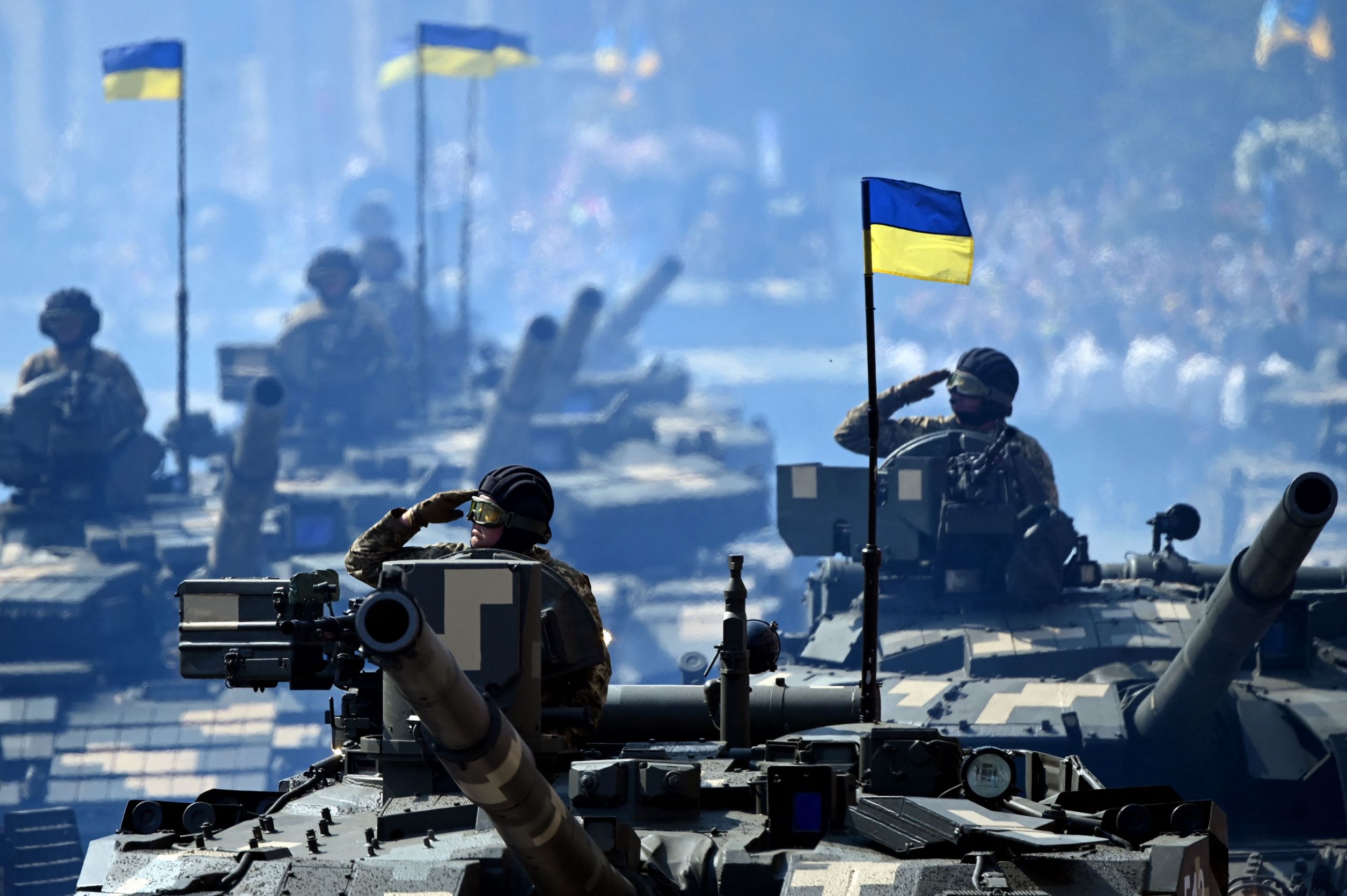
Ukrainian veterans of the Azov Battalion, formed by a white supremacist and previously banned from receiving U.S. aid, attend a rally in Kyiv on March 14, 2020.Vladimir Sindeyeve / NurPhoto via Getty Images

In 2008 a memo was sent from the US ambassador in Russia to Washington, which was later revealed by Wikileaks, entitled ‘Nyet means Nyet: Russia’s NATO redlines’.  It stated that “Foreign Minister Lavrov and other senior officials have reiterated strong opposition, stressing that Russia would view further eastward expansion as a potential military threat.  In Ukraine . . . there are fears that the issue could potentially split the country in two, leading to violence or even, some claim, civil war, which would force Russia to decide whether to intervene.”  A similar US intelligence report in 1994 had previously warned about divisions within the country that could lead to civil war. (Quoted in ‘Ukraine in the Crossfire’, Chris Kaspar de Ploeg)

A simple question therefore arises.  If the consequences of NATO expansion to Ukraine could be seen fifteen years ago, why can’t many on the Left not recognise it now when it is front of their eyes?

Of course, this left will claim that Russia has no right to invade Ukraine but this is not enough for them; for what they have to do is justify their support for the Ukrainian state, which must also have foreseen the potential ruinous consequences of its action. This left now justifies their defence of western imperialist intervention when it is this intervention that has precipitated the war.  Besides embellishing and decorating the Ukrainian state and absolving western imperialism of any culpability it must emphasise the responsibility of Russia and exaggerate its power, lest it be clear that the claims of Ukraine and western imperialism that Russia seeks to conquer not only Ukraine but also roll over Eastern Europe be seen for the fantasy that it is.

So, in order to do so we have the speculative interrogation of Putin’s mental state and blinkers placed on the interpretation of his actions, including ignoring his support for Russian membership of NATO; his support for US and NATO troops in Afghanistan; his backing of the sanctions against Iran, and his sharing of intelligence with the US.  As he later put it “Our most serious mistake in relations with the West is that we trusted you too much.  And your mistake is that you took that trust as weakness and abused it.”

In Ukraine, Putin did not instigate the rebellion in the East of the country in 2014 but tried to limit it and then control it, frequently being opposed to its leaders’ policies. Separate republics were not his optimal choice for this would remove his greatest leverage over the whole of the country.  Given the Maidan coup/revolution, he acted to defend Russian interests in Crimea against an anti-Russian regime that had come to power violently.  Some pro-Russians in the East also took up arms as some pro-western Ukrainians had done in the west of the country.

Through the Minsk agreements he subsequently hoped to retain the Donbas areas under Russian influence while supporting a degree of autonomy within Ukraine sovereignty.  The Ukrainian state rejected this and sought to reinterpret Minsk as first Ukrainian state control and then some steps to an autonomy that it rejected, not least because of opposition from its far-right and fascist forces.  Had Putin always wished to remove Ukraine from the map the poor state of the Ukrainian armed forces in 2014 made then the time to attempt it.

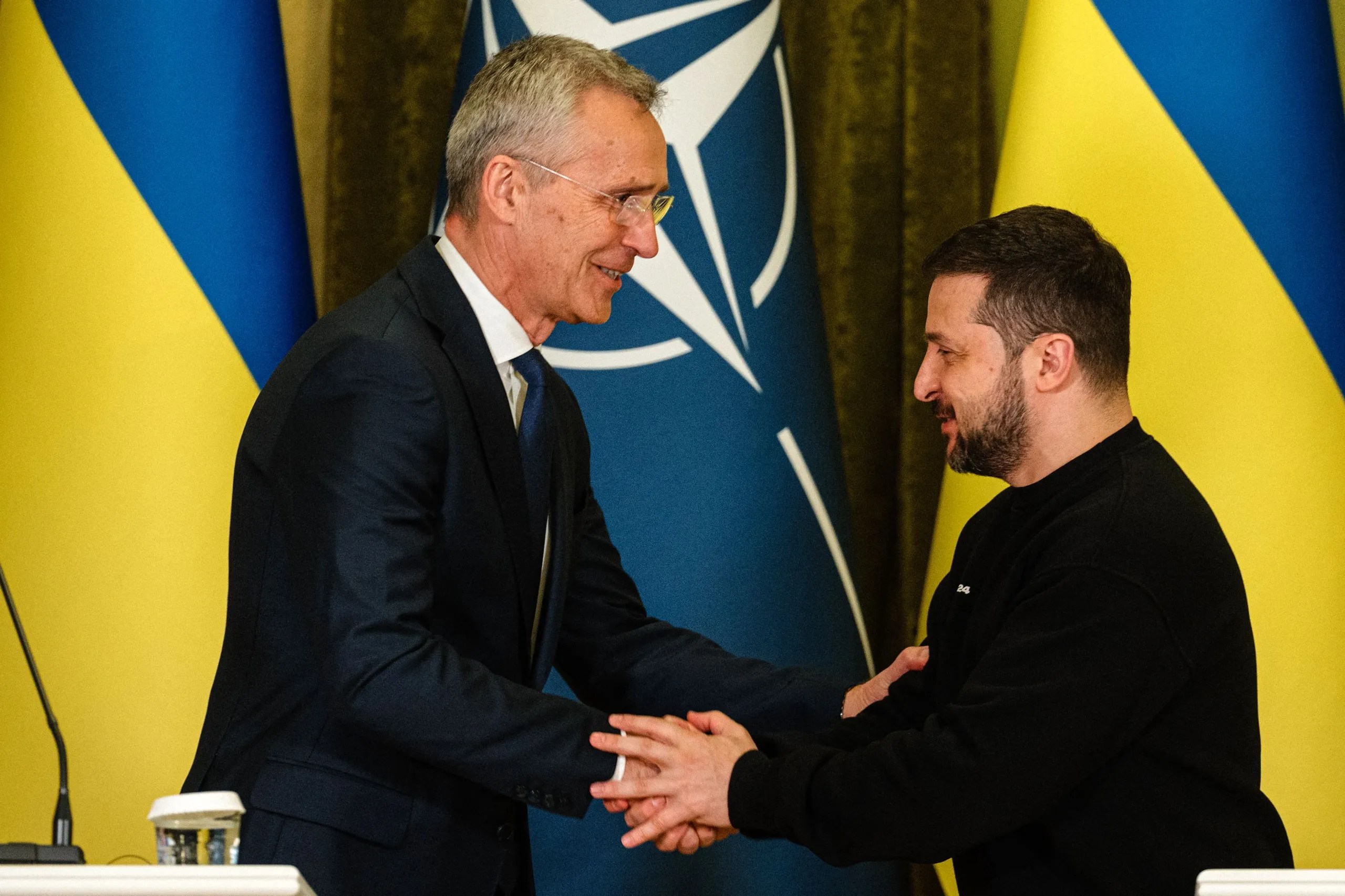
German officials claimed that the United States opposed the Minsk agreements and regularly pressurised Ukraine against their implementation, with the US Ambassador Geoffrey Pyatt meeting the Ukrainian President every two weeks.  German intelligence also claimed that CIA advisors had help set up a ‘functioning security structure’ in 2014 and hundreds of American private military contractors from Blackwater were sent to the East of the country. NATO then announced increased cooperation with Ukraine “to promote the development of greater interoperability between Ukrainian and NATO forces, including through regular Ukrainian participation in NATO exercises.” (This and the following quotation from ‘Ukraine in the Crossfire’, Chris Kaspar de Ploeg)

Ukraine itself became a significant exporter of arms even as it “was begging for newer weapons from the West.”  US politicians encouraged it to seek a military solution with Lindsey Graham visiting Ukrainian troops saying “Your fight is our fight, 2017 will be the year of offense” and John McCain stating that “I believe you will win.”  In the following year the US ambassador to NATO  threatened to “take out” any Russian missiles she thought violated existing Treaties and the Secretary of the Interior threatened a “naval blockade” of Russia.

At this time the people of Ukraine were divided on what role NATO was playing, with 35 per cent seeing it as a threat, 29 per cent as protection and 26 per cent as neither.  While Germany and France appeared as guarantors of Minsk the former chancellor and President, Merkel and Hollande, have stated that the agreements were needed for the purpose of letting Ukraine gain time and build up its military power for another conflict.

When this context is considered it explains why the supporters of the Ukrainian state have been so keen to argue as if the world began on 24 February 2022, and only the Russian invasion matters for any analysis and programmatic response.  It explains why the justification for this support, based on the idea that the Ukrainian capitalist state must be allowed the right of self-determination, must ignore its previous exercise of this right. Taking account of Ukraine’s ‘self-determination’ before this date would reveal this state’s role in deceiving its people on the road to war that it was embarking upon, and the role of the United States in creating that road.

Neither of these justify the invasion, but socialists must take the world as they find it, not as they would like it; not as they believe it should behave, and not with illusions on the role and function of any capitalist state, whether it be of Ukraine, the United States or Russia.  Above all it is the role of socialists to inculcate in all workers the deepest mistrust and hostility to the capitalist state, not defend its right to self-determination, behind which lies its determination to divide and exploit the working class.

This is the ABC of socialist politics, the slogan of ‘self-determination’ has become a reactionary formula behind which the real historical record of its exercise by the Ukrainian state has been hidden.  Support for it cannot survive exposure of its real existence beyond the slogan.

Back to part 6

Forward to part 8

The war in Ukraine (6) – NATO expansion against the Russian threat?

At the end of 1991 a plan was put together to determine how NATO would relate to the newly independent states in Eastern Europe through creating a new organisation, the North Atlantic Cooperation Council (NACC), open to all former Soviet Union republics as well as former Warsaw Pact members.  One country, however stood out from the rest–Ukraine.  The US ambassador to Russia stated that loss of Ukraine was a more revolutionary event than the fall of communism.  Gorbachev was furiously opposed to US communication with Kiev, pointing out its large Russian population and its artificial borders that included Donbas and Crimea.  The US “Draft Options Paper” thus recommended “the possibility of Ukraine joining the NATO liaison program at a later time.”

At this time the US was concerned with Ukraine’s possession of nuclear weapons and its policy that this was unacceptable, although some US officials argued that the problem would disappear if Ukraine joined NATO.  Clearly, they believed that the nuclear weapons that would be kept would be pointing at Moscow and not at Washington.

The view that won out was one of a step-by-step NATO expansion that was not too obvious but that “will, when it occurs, by definition be punishment, or ‘neo-containment,’ of the bad Bear.”  Even Yeltsin was compelled to complain of the creation of a “cold peace” while Bill Clinton believed “Russia can be bought off.”  Ukraine’s Deputy Foreign Minister Borys Tarayuk told the US that “No matter what we say publicly. I can tell you that we absolutely want to join NATO.’

Under the Clinton administration the US became Russia’s largest foreign investor but this did not prevent it going ahead with new missile deployment–the Theatre or Terminal High Altitude Area Defence system–reversing the previous view that it violated the Anti-Ballistic Missile Treaty, thus slowing down agreement over arms control.  Later, in 1997, fifty former US senators, cabinet secretaries, ambassadors, and others signed a letter demanding that “the NATO expansion process be suspended.”

Russian policy proposed collaboration in the defence industry, with legal prohibitions on nuclear weapons in new NATO states and stationing of foreign troops, but neither got anywhere while Clinton approved the testing of new nuclear weapons systems.  Promises from Yeltsin to potential NATO members of a security guarantee and complaints of Russian humiliation achieved nothing.  In any case, Yeltsin was Washington’s man with Clinton stating that “Yeltsin drunk is better than most alternatives sober.”

Supporting ‘Yeltsin drunk’ meant helping procure condition-free loans of $10.2 billion from the IMF to ensure Yeltsin’s re-election as President in 1996, while Russian oligarchs met privately at Davos to ensure a victory that would assist their procurement of state assets.  Despite suffering his second heart attack and virtually disappearing from public view he won the election.  Yeltsin had used the money to travel the country dispensing it to buy votes in what his campaign staff in night-time planning sessions called ‘what-shall-we-hand-out-tomorrow’ meetings.  As Clinton said, “If the Russian people knew how much I wanted him re-elected, it might actually hurt his chances.’  Time magazine hailed their intervention as “Yanks to the Rescue’ (July 15 1996.)

In effect, the US had interfered big time in the election to get its favoured candidate elected in a vote that involved “widespread voter fraud” according to a member of the OSCE election-observation team.  This observer also claimed that he was pressured to keep quiet about the irregularities, including that in Chechnya fewer than 500,000 adults remained but more than a million had voted, 70 per cent for Yeltsin.  All this puts into perspective more recent US Democrat complaints about purported Russian interference in Trump’s victory over Hilary Clinton. 

A new a NATO-Russia agreement in 1997 was sealed by yet more money from the US along with lots of promises, including that NATO had “no intention, no plan, and no reason to deploy nuclear weapons” or substantial combat forces.  Privately Clinton was assured that his early assessment was correct that no absolute commitments had actually been made, the only real one being simply a commitment to meet. By the end of the year Madeline Albright was already telling the Russians that the US “would not consult on future infrastructure including on the territories of the three invitees’–the newly invited Central and East European members of NATO.

In 1998 Yeltsin asked Clinton for more help with IMF loans but the money flowed out of the country almost as quickly as it flowed in, prompting US officials to note that “the infamous oligarchs continue to put their personal interests above the common good.” They seemed not to consider that this was a result of the introduction of capitalism into Russia that they had promoted, or that putting ‘personal interests above the common good’ was one description of what capitalism is all about.

Some US officials were wary of being too openly antagonistic to Russia and its long-term consequences, while French President Jacques Chirac told the US National Security Advisor Tony Lake that “we have humiliated them too much” and that “one day there will be dangerous nationalist backlash.”  Chancellor Kohl also worried about the long-term reaction to NATO expansion, and even the British worried about the Article 5 guarantee being too strong and risky to offer too widely.  The American proposer of the original post World War II American containment strategy, George Kennan, argued in 1997 that NATO’s expansion was “the most fateful error of American policy in the entire post-war era.”  

None of this advice for a more cautious approach prevented the US and NATO bombing Serbia without a UN Security Council resolution, without invoking an Article 5 guarantee and without aggression by another state.  To Russia this proved that NATO expansion was not about bringing peace to Europe and claims it was doing so were a lie, with Yeltsin’s critics saying ‘Belgrade today, Moscow tomorrow.’  The example of Kosovo and the justification for war was subsequently employed by Russia itself. The New York Times then reported that Russia had resumed “targeting NATO states with nuclear warheads.”

Looking back in 2015 Bill Clinton’s defence secretary Bill Perry concluded that arms control became “a casualty of NATO expansion” and that “the downsides of early NATO membership for Eastern European nations were even worse than I had feared.”  The CIA noted in 1999 that Vladimir Putin was concerned over the capabilities of its conventional forces, the increased threat from NATO, the need for new nuclear capability and the fear “that a future conflict could be waged on Russian soil.” 

NATO expansion was thus not a result of Russian aggression or threats, or of the need for NATO to establish peace in Europe, but a product of Russian weakness and US determination to impose the fruits of its victory in the Cold War.  Bourgeois figures in many countries noted the provocations involved and the future risks entailed.  Even Joe Biden admitted in 1997 that, rather than NATO membership, “continuing the Partnership for Peace . . . may arguably have been a better way to go.”  Yet now we are to believe that none of this is relevant to the war in Ukraine, with its constitutional imperative to join NATO.

Today’s leaders of these countries deny that the expansion of NATO and the steps towards Ukrainian membership have anything to do with current Russian policy and actions. How incredible is it then that certain parties on the Left agree with them, going so far as to support Ukraine and defend NATO and in doing so further, in so far as they can, membership of the former within the latter? And all this under the flag of ‘anti-imperialism’ and a war of national liberation!

Back to part 5

Forward to part 7

The War in Ukraine (5) – the amnesia of the pro-war Left

Getty Images

One of the problems with the view that the war in Ukraine is unprovoked is that it erases much of history, wipes clean western imperialist actions, supports the idea that this imperialism is democratic, and robs the working class of the knowledge it needs to orient itself in the world.

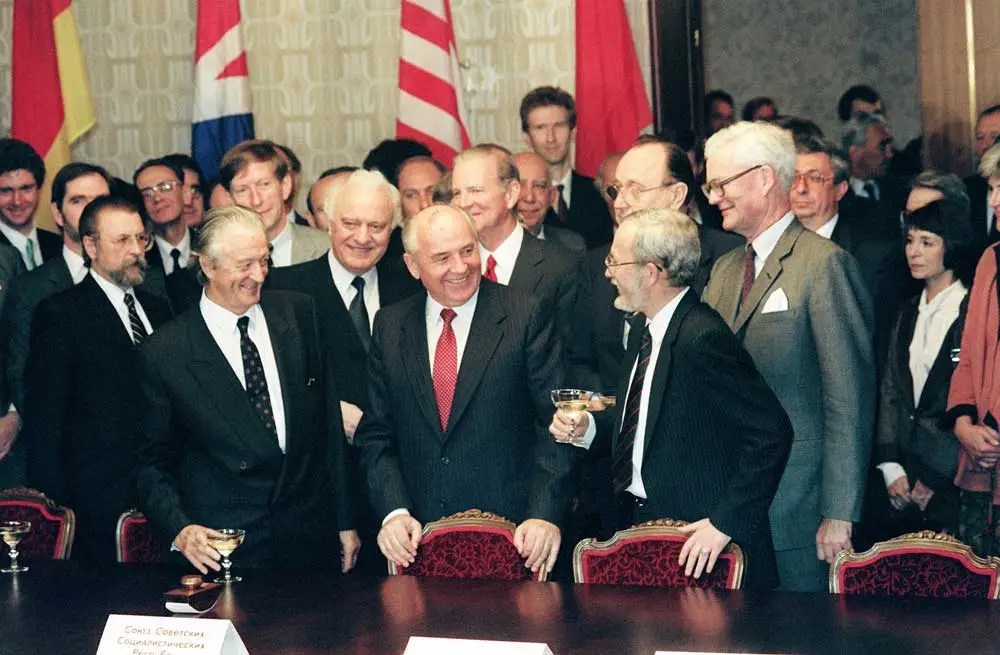
Far from being unprovoked the war is a result of repeated provocations that we can outline, beginning with the collapse of the Soviet Union and Warsaw Pact, when the Soviet foreign minister Eduard Shevardnadze made this “reasonable proposal” to James Baker, the US secretary of state: “Let’s disband both NATO and Warsaw Pact.”  It hardly needs saying what the reply was and how it relates to the current war; unless of course you belong to the band of ‘socialists’ who blame Russia in toto.

There was nevertheless an obvious problem for western imperialism, and the United States in particular: how to justify the existence of NATO as a ‘defensive’ alliance when the enemy no longer existed.  Further to this, the problem was couched in the context of a possible Soviet Union offer for quick unification of Germany in return for leaving NATO and declaring neutrality. This was even further complicated by the knowledge that this offer would have “widespread support among the members of the public in both East and West Germany”, as the German chancellor Helmut Kohl later admitted. Polling showed that 84 per cent of West Germans wanted to denuclearise their country and leaving NATO in return for German reunification would win widespread support across the country.

The US and NATO has portrayed its expansion into central and Eastern Europe as an exercise in democracy–’all the countries joined of their own free will’–but the German events are only one example of the dismissal of the views of local populations that was repeated later in Ukraine.  This includes Soviet offers to get rid of nuclear weapons that the US rejected but that, if we follow the logic of the pro-war left, we should now endorse.  Not that this left currently follows its own reasoning to its conclusion.  It is just that it has no logical claim to reject it, and leaves the working class in the West open to the argument that the problem is an aggressive Russia and the solution a suitably armed NATO with nuclear capability to prevent Russia from doing what it wants.

The US faced the additional problem that the German foreign minister Hans-Dietrich Genscher publicly supported the idea that there should be no expansion of NATO to the East, something repeated on several occasions.  The US was bitterly opposed, as one US official stated in an internal memorandum, this “would forfeit the prime assets . . . that have made the United States a post-war European power.”  However, when Gorbachev stated that any expansion of the “zone of NATO” was unacceptable, US secretary of state James Baker stated, according to Gorbachev, that “we agree with that.”  This, of course, was a lie, one that became particularly controversial and the focus of repeated complaints by the Russians that are still routinely derided by the western media today, but was repeated by Kohl in relation to the territory of the then East Germany.

While the German chancellor was saying that NATO would not expand its territory eastward into East Germany, Genscher repeated the position that “for us, it is clear: NATO will not extend itself to the East”. The secretary general of NATO, Manfred Worner, also asserted that the fact it would ‘not deploy NATO troops beyond the territory of the Federal Republic gives the Soviet Union firm security guarantees.’

After agreement to German reunification the problem then became how to remove Soviet troops without also having to remove NATO ones.  Proposals by Gorbachev for the Soviet Union to join NATO were rebuffed, as were later attempts by Yeltsin and still later ones by Putin for Russia to become a partner of western imperialism; something that discomforts both supporters of ‘Russia is to blame’ and ‘Russia is to be supported’ camps today. 

The weakness of the Soviet Union at this time was exposed by its requests to Germany for funding for its troops stationed in the country, a weakness that the West, and particularly the US, exploited when it promoted the shock therapy applied to introduce capitalism into Russia.  Throughout the NATO expansion, Russia was too weak to resist, and the US was able to proclaim a “new world order” that included this expansion and wars against Iraq and Afghanistan plus others.  It might seem impossible to separate this history of imperialist aggression from the war in Ukraine, but that is exactly what supporters of the war must affirm if it is to be seen as uniquely free from Western complicity.

However, as early as 1992 an official of the US State Department had contacted the Ukrainian ambassador in Washington to urge Ukraine to join NATO, while in the following year the Ukrainian deputy foreign minister was stating that it was “unacceptable for NATO to expand without Ukraine becoming a full member.”  Russian leaders were meanwhile saying that it should be first.

In 1994, Ukraine was the first post-Soviet country to conclude a framework agreement with NATO through the Partnership for Peace initiative, a road by which Central and Eastern European countries could join NATO, and was its most enthusiastic participant, seeking to join exercises and contributing 400 troops to the Implementation Force in Bosnia in 1995.  The next year its Foreign Minister discussed the potential to become an ‘Associate Member’ of NATO while Russia made it known that this would be considered an ‘unfriendly policy’ with ‘all the resulting consequences.’

In 1997 the Ukraine Foreign Minister went further in stating the strategic goal as complete integration into NATO.  Later he voiced concern that this might involve the deployment of nuclear weapons in Ukraine’s western neighbours and proposed a nuclear-weapons free zone, which NATO rejected.

Ukrainian President Kuchma continued steps to join the European Union and in 2002 established a schedule for meeting accession requirements by 2011, while the Ukrainian National Security and Defence Council also discussed the need to “start practical implementation of the course to join NATO”.   Ukraine continued to pass parliamentary resolutions stating its objective of joining NATO until mid-2004, sending 1,650 troops to support the US occupation of Iraq. In 2005 the new President, Yushchenko, sought a NATO Membership Action Plan, and in 2008 the Ukrainian government’s aspiration that Ukraine would become a member was approved at the NATO summit in Bucharest, pushed by the United States against some European reservations.

Yet opinion polls regularly recorded that there was still not majority support within the country for membership, with opposition reaching over 60 per cent in one poll, a result confirmed and reported in others here and here. One other from Gallup reported as its conclusion that ‘Ukrainians Likely Support Move Away From NATO, Residents more likely to view NATO as a threat than protection.’ 

As one of these argued: ‘As for public opinion, NATO membership should generally not be a matter of broad public acquiescence, but of a conscious geopolitical choice by a consolidated national elite. As part of NATO’s post-Soviet expansion, only Slovenia and Hungary have held referendums on membership – and Hungary’s was nonbinding. Slovakia’s 1997 referendum was declared invalid, as it gathered only 10 percent of eligible voters.’ 

Opinion polls in Ukraine repeatedly demonstrated majority opposition to NATO membership, or at least major division, even after the Ukrainian government approved ‘a four-year, $6 million “information campaign” to improve NATO’s image.’  The article quoted above argued that ‘While the jury is still out regarding its effectiveness, even with the best of PR campaigns and outreach programs, the West by now has generally accepted the uncomfortable fact that NATO may never gain broad popularity among Ukrainians, especially in the eastern regions of the country.’

We now know, of course, that the United States never gave up intervening into Ukrainian politics with the objective of moving the country into NATO. The author of these lines showed remarkable naivety in believing that popular opposition was anything more than an obstacle to be overcome rather than a democratic wish to be respected.  The price to be paid to overcome this obstacle was forecast right from the start, as we see below.

Russia reaffirmed its opposition to NATO expansion, and in particular into Ukraine and Georgia, on the grounds of violation of the principle of equal security and the creation of new dividing lines in Europe.  While Putin claimed that Russia had ‘no right to interfere’ with Ukraine foreign policy’, and if it wanted to restrict its sovereignty (by joining NATO) ‘that is its own business’, Foreign Minister Lavrov stated that “Russia will do everything it can to prevent the admission of Ukraine and Georgia into NATO’.

In the 2004 ‘Orange Revolution’ the American columnist Charles Krauthammer stated that ‘this is about Russia first, democracy only second . . . The West wants to finish the job begun with the fall of the Berlin Wall and continue Europe’s march to the east . . . The great prize is Ukraine’.  As Putin complained, they “have lied many times’ and in Ukraine “have crossed the line”.  “Everything has its limits.”  The Russian political scientist Sergei Karaganov was even more blunt in stating in 2011 that “NATO expansion into Ukraine is something Russia would view as absolutely unacceptable because it then becomes a vital threat.  In political jargon, this kind of threat means war.’ (The quotations not referenced are taken mainly from. ‘Not One Inch, America, Russia, and the Making of Post-Cold War Stalemate’, M E Sarotte, Yale University Press)

                *               *             *

At the start of the invasion I commented on Facebook that the Russians had warned that Ukraine could not join NATO and that this was a red line, only to be rebuked that, in effect, I was saying that Ukraine ‘was asking for it’.  I replied that this was, as a matter of simple fact, what had just happened.

Facebook is not a great medium for political debate so it should be elaborated here that, as we can see, the Ukrainian state played its own role in advancing the war through its repeated attempts to join NATO, even voting to place it as a constitutional imperative in 2019.  So, while the Ukrainian people did not invite war, its political leadership and its western backers certainly did.  How tragic is it then to now rally to the defence of the state that walked you into war and rely on western imperialist forces that led you there?

Even in 2012 only 28 per cent of Ukrainians supported membership of NATO.  What we see here is thus a sterling example of the old socialist maxim that ‘the main enemy is at home’; in this case the main enemy of the Ukrainian working class was its own capitalist state for whom it is now fighting and dying.  How much more obvious must it be that this should be opposed by all those who claim to be socialists and Marxists?  How obvious is it now that if they don’t, their claims to express any sort of socialism must be repudiated?

Back to part 4

Forward to part 6

The war in Ukraine (4) – the consequences of being ‘unprovoked’

On February 24 2022 the US President Joe Biden condemned Russia’s invasion as “a brutal assault on the people of Ukraine without provocation, without justification, without necessity” and a “flagrant violation of international law.” Putin he said, “rejected every good-faith effort the United States and our Allies and partners made to address our mutual security concerns through dialogue to avoid needless conflict and avert human suffering,”

Boris Johnson pronounced that ‘President Putin has chosen a path of bloodshed and destruction by launching this unprovoked attack on Ukraine’, while then foreign secretary, Liz Truss, said she had summoned the Russian ambassador “to meet me and explain Russia’s illegal, unprovoked invasion of Ukraine”.  The British Government website continues to have this as its leader – ‘The UK and our allies condemn the Russian government’s unprovoked and premeditated war against Ukraine.’  

The Irish Government as part of the EU has repeatedly supported its sanctions, even demanding they go further, joining Poland and Baltic states in calling for more.  Upon the invasion Tánaiste Leo Varadkar stated that whilst Ireland is militarily neutral, “in this conflict, Ireland is not neutral at all”, stating its “unwavering and unconditional” support for Ukraine.’

This Wikipedia entry sets out a whole list of States responses in which the word ‘unprovoked’ appears 29 times at my last count.

The media followed suit: the New York Times described it as ‘an unprovoked invasion’; the Financial Times a ‘naked and unprovoked aggression’; the Guardian ‘an unprovoked assault’, while the Economist thundered that ‘Russia’s president has launched an unprovoked assault on his neighbour.’

On 14 October 2022, Defenders Day in Ukraine, the US ambassador issued a video message saying:

‘The United States, our partners and allies, will continue to support Ukraine to hold those who commit war crimes accountable and to work to bring together the world to maintain pressure on the Kremlin until it ends its brutal, unprovoked war against Ukraine and our shared values. And we will continue to stand with Ukraine for as long as it takes.’

The position of much of the Western Left, certainly in Britain, is much the same, with a recent Ukraine Solidarity Campaign statement also calling for ‘a week of action’ against ‘the brutal and unprovoked invasion’.  It sees no provocation; absolves western imperialism and the Ukrainian state and regime of any responsibility; supports ‘Ukraine’s freedom, presented as ’self-determination’; has failed to oppose sanctions while mouthing hypocrisies about not supporting them either; sets no political limits to its support – that is ‘unconditional’; and supports western supply of arms, which along with sanctions and financial support are the main western imperialist interventions.

If anything, the political resources required by the support of the pro-war Left for Ukraine might seem to be much greater than that of the various capitalist states, politicians and media.  It has faced opposition from those socialists opposed to capitalist war, something that has been a principle of our politics at least from the exemplary case of the First World War, the character of which has recently been graphically exposed by the film “All Quiet on the Western Front’.  The pro-war left has had to face this opposition–which capitalist Governments and its bourgeois media are not of course concerned with–and reject its arguments, sometimes claiming how comfortable it is for its critics that they take such a position!

However, because it claims the mantle of socialism its position very quickly became dishonest, confused, as well as reactionary.  Consider the exchange of views in Britain between Anti-Capitalist Resistance (ACR) and the Stop the War coalition (StW).  Like many organisations not interested in principled politics, ACR argues the prime necessity for action and berates Stop the War for putting up conditions to joint activity.  

We have dealt with what sort of anti-war movement is required before, so suffice to say here that its own insistence on the absence of certain demands, such as opposition to NATO, is also a precondition.  The point of a political campaign is to fight for particular objectives that are directly relevant and to raise the consciousness of the working class.  To exclude certain demands is to avoid fighting for these objectives and failure to raise political consciousness around them.  Lack of concern for political principle leads to this obvious truth being passed over.

Since it is impossible to hide the political differences, it quickly became clear that those such as ACR calling for a broad approach, ‘designed to build the broadest possible movement against the war’, were not actually against the war but for it, war until Ukrainian victory.  This is where the pro-war position is dishonest.

ACR refuses to support demands opposing NATO, rejecting the view that ‘NATO’s expansion has “contributed to the war”’, stating that ‘this is not clear at all. It could equally be argued that Russia’s invasion of Ukraine was an act of unprovoked imperialist aggression.’  Having said that it could equally be argued that the war was the fault of Russia, what ACR really means is that Russia was wholly at fault, and the problem with the StW coalition is that it is not ‘engaging with the central issue: the unprovoked war on Ukraine.’

ACR wants to oppose an ‘unprovoked attack on Ukraine’, oppose the war and ‘to organise constructively against it – not in a way that fans the flames of war – which is why the demand “No to war” is included – but in a way that solidarises with the plight of the Ukrainian people.’  It thinks, or perhaps pretends to think, that you can demand solidarity with one of the sides waging without supporting war and without fanning its flames, all while supporting a greater and greater supply of weapons.  This is where the pro-war position is (shall we say?) confused

In their exchange of views the StW coalition raised the question of opposing arms expenditure as an urgent issue, but ACR regarded this as belonging to ‘a whole range of other criticisms’ that can be parked and not form part of the movement. But this identification of the issue by the StW coalition turned out to be very prescient: the British Trade Union Congress voted shortly after to support increased ‘defence spending’, more honestly stated as spending on war.  The ACR position would have left, and still would, any supposed anti-war position silent in this debate.  Since, in any case, the ACR defends the arming of Ukraine by the British state this is a perfectly logical position for it to take.  This is just one case in which the pro-war position is reactionary.

As the argument supported by ACR shows, the stance of the pro-war left rests, like that of western imperialism in general, on the view that the Russian invasion was unprovoked.  Of course, provocation does not equate to justification or automatically follow from it.  In the world of capitalist state competition provocation may be seen as sometimes inevitably resulting in war, but that does not require socialists to support either the provocation or the response.  In fact, opposition to both is clearly a principled socialist approach.

But this would not be enough for the pro-war left because admission of western imperialist and Ukrainian provocation would require taking this principled position.  Both western imperialism and Ukraine would then be seen as playing their own part in causing the war; Ukrainian agency as they call it, and having responsibility for it, in which case defending either would be anathema. The pro-war left cannot concede this reality; let’s call it the homage that treachery pays to principle.

The pro-war left denies reality when it absolves western imperialism and Ukraine of any provocation and therefore any responsibility.  In doing so, in denying recent history and current reality it signs up to an infantile view saturated with bourgeois morality in which Ukraine is Good and western imperialism Innocent; innocent of acting on its essential nature. 

The reality of capitalist war becomes instead a morality tale of heroic resistance, and the messy reality is only so much noise – unpleasant, unwelcome and better drowned out.  The unpleasant nature of Ukrainian nationalism for example, that shades into the relatively large constituency for fascism; or the fact that there are a large number of Ukrainians who support Russia, are just irrelevant noise to signal. 

Instead, they can fight for what is Good; while other socialists fight in opposition to their own capitalist state and capitalist class, watching and reading mass media propaganda about the ‘unprovoked’ war.

Back to part 3

Forward to part 5

The War in Ukraine (3) – a right to self-defence?

An argument related to the demand that Ukraine should be supported on the grounds of national self-determination is a general argument that there is a right to self-defence, although this is a no more cogent argument than that deriving from a claim to self-determination.  The civilian population of Donetsk could claim the same right to defend themselves from increased attacks by the Ukrainian military just before 24 February 2022, and the population of Crimea and Donbas more generally have the same right against the plans of the Ukrainian state to conquer and reoccupy their territories.  By demanding membership of NATO the Ukrainian state has given validity to assertion of this same right by the Russian state to defend itself and its supporters in these areas.  Lacking any class basis those supporting either Ukraine or Russia can, and do, parrot the same arguments that thus expose each other to the same rejoinder and counterclaim.

This argument is not to say that at the level of individual Ukrainians it is not permissible for them to defend themselves, but what the pro-war left is proposing is political support to the Ukrainian state and armed forces that are carrying out the fighting.  This is how those Ukrainians who are fighting for their state see it, expressed in nationalist terms as defence of their country.  But as Marxists maintain, countries are not united and the interests of the different classes composing it are antagonistic. At the level of individuals, it has made more sense to leave the county or relocate, as millions have done, and as we have noted before, those nearer the front line are more in favour of peace than those further away cheering for victory.

In other words, this claim that seems so straightforward, and may even appear to be so at the level of the individual, does not exist, and what we need is what we set out at the start – a Marxist analysis of the cause and nature of the war as determined by its historical origins and development and the nature of the participants and their objectives.

The reliance on an abstract right to self-defence is empty since socialists recognise no such right for the capitalist class or its state, which is why the support for the latter by the Second International was recognised as such a historical betrayal in August 1914.  What its twenty-first century imitators repeat is the lack of any principled Marxist position, retreating to the refuge of abstract moralism, which Marxists, going back as far as Marx himself, find repugnant because behind it lies the interests of the capitalist class–presented as universal truths–universal precisely because everyone, from right to left, can espouse them.

So, what we are left with are vacuous moral statements that don’t amount to an argument – that invasions are bad, that the Russians are aggressive and cruel and human rights must be protected.  That a Ukrainian invasion of Crimea would be bad, that the demand for NATO membership is aggressive and that Ukrainian fascists can hardly be trusted not to be cruel and deny human rights, are all objections to such claims.  It could be argued that the first catalogue of Russian immorality is what counts but that requires argument that the Ukrainian one doesn’t, (or perhaps doesn’t even exist if the western media is to be believed). But it’s obvious that occupation of Crimea would involve violence and oppression, that NATO is an aggressive imperialist alliance, that fascist units exist in the Ukrainian armed forces and that these armed forces are not the first to abide strictly by the laws of war.

So much of the argument in support of Ukraine is therefore based on arguments which dissolve when attached to concrete reality, only to return in abstract moral declarations.  We are not therefore on the terrain of Marxist analysis and Marxist politics, which explains why it is impossible for this left to take such a position.  It is why their arguments are so similar to that of western imperialism, its politicians, think tanks and media commentators, and their solutions so aligned.  

Marxism is thus utterly unnecessary and irrelevant to the arguments of the pro-war Left, all of which can be repeated without any reference to it, something that has escaped them.  There are no grounds presented for even the theoretical unity of all the workers of Ukraine and Russia; their support for war involves their unity with Ukrainian capitalism and western imperialism, something that doesn’t escape their notice but the significance of which does.

If successful, the victory of Ukraine, US imperialism and its NATO satraps would mean the occupation of areas where they are rejected by the local population and will see Ukraine subject to the tender mercies of western imperialism.  To expect ‘a more just and democratic post-war reconstruction’ from this partnership that they have supported is the height of naivety, if not stupidity.

The pro-war left claims ‘that If we are not seen to be on the side of the people of Ukraine, then the only voices they will hear will be those of western imperialists, not those of the socialists and internationalists.’ But if these so-called ‘socialist and internationalist’ voices are saying the same thing as the western imperialists, and they are, why should anyone care?

Back to part 2

Forward to part 4

The War in Ukraine (2) – the agency of Ukrainians

Supporters of Ukraine claim that those who refuse to support its state deny the agency of Ukrainians and make it all about the west and western imperialist intervention.  But it is these people who deny the agency of Ukraine and Ukrainians.

Ukraine, for them, has no role in starting the war but is simply its victim.  We are asked to support ‘Ukraine’ and the ‘Ukrainian resistance’ but these have no agency outside the Ukrainian state and the Ukrainian armed forces because outside them they don’t exist.  The first is a corrupt capitalist state on a level with Russia and the second is the major repressive force of this state, with particularly reactionary elements such as fascist units in the army.  Supporters of Ukraine do not so much justify support for them as dissolve them into abstractions that do not exist in concrete realties.

The motivation of western imperialist backing of Ukraine is usually not examined, or passed over with nebulous remarks that have no significance to taking a political stand.  The history of its intervention is treated as irrelevant; its inherently oppressive and repressive character has gone missing, and what this implies for the nature of its intervention in Ukraine and the politics of the war is normally terra incognita and is staying that way.  It would appear that all we can do is point out the absurdity of the demands of those supporting Ukraine, such as the call for Britain ‘gifting to Ukraine . . . all the surplus UK military equipment due to be replaced, especially the 79 Challenger tanks, 170 Scimitar reconnaissance vehicles, all Warrior infantry fighting vehicles, Typhoon fighter aircraft – to help Ukraine win more quickly, with less suffering.’

This must be the first time tanks, fighting vehicles and fighter aircraft will ensure ‘less suffering.’  It is assumed that Ukraine will win and win more quickly, presumably because the western media has told them this, and that winning more quickly will not involve inflicting suffering more quickly, or perhaps this is something that also does not exist–the suffering of others.  Meanwhile the British capitalist state can get on with modernising its tanks, fighting vehicles and war planes, perhaps for its next progressive imperialist intervention, or whatever.

However, yet another solidarity with Ukraine statement has felt the need to address the role of NATO but does so by somehow giving it no real agency in enforcing its own interests; becoming a prop in the war that is subsidiary in determining its nature, while the rest of the world, including the Ukrainian state, regards its role as vital and critical to success. The supporters of Ukraine again invent a world that does not exist.

The statement says that ‘we should be critical of of the Zelenski government which has embraced neoliberalism . . . and seeks to join the European Union and NATO’, but this criticism is not an obstacle to support! It says that ‘the supply of arms should be without strings or illusions in NATO and the West because the supply of arms can be used to control the scope and duration of the war’. So imperialism with not seek to impose its own interests but supply billions of dollars and Euros of weapons without strings, and this is called politics without illusions! When has imperialism not acted in its own interest but instead on behalf of a ‘national liberation’ struggle?

‘NATO and Western imperialism are backing Ukraine for their own geopolitical interests, so there should be no illusion that NATO and Western imperialism are forces for democracy’, the statement says. No more ‘illusions’ again; but if NATO is backing a ‘national liberation’ struggle then, by definition, it is a ‘force for democracy’. It doesn’t matter how many times you say ‘but NATO is not a force for democracy’ and ‘is the military wing of Western imperialism . . .’ and NATO is acting to ‘defend its geopolitical interests’ while it also supports a war that you claim is progressive and justified. Something has to give.

So who is mistaken here? Is imperialism being fooled into supporting a progressive war of national liberation, an anti-imperialist war? Or are the Left supporters of the Ukrainian state denying the reactionary character of the Ukrainian state and its pursuit of NATO membership; and wrongly supporting NATO intervention in the belief that its geopolitical interests advance democracy, although we are asked to believe that this is not what NATO is about? In what world does any of this make any sense?

Perhaps it is the one that exists in the ‘proxy war between Western and Russian imperialism’ in which ‘NATO has used the Russian invasion to give itself a new purpose’; but whatever new purpose NATO has given itself, it is not one of fighting for democracy. Such a world does not exist and all claims to it doing so are false, shockingly misleading the workers living in NATO countries.

But let us give it one more chance. We are told that ‘when internationalists support the Ukrainians’ right to resist military the Russian invasion and obtain arms from NATO countries, it is not an endorsement of NATO. There have been many movements of national liberation in the past which have called upon imperialist countries for arms without being condemned by socialists: Irish nationalists in 1917, the Spanish republic in 1936, the communist resistance in World War Two, to name a few.’

So maybe such a world existed in the past?

Let’s just take the Irish example. Was Ireland an independent state in 1916 or a British colony? Were the Irish rebels in 1916 seeking to join the German imperialist alliance, or did they claim ‘We serve neither King nor Kaiser’? Did the Irish workers movement participate as a separate political and armed force from the bourgeois nationalists, and did not James Connolly repeatedly declare the political independence of the Irish working class? Was his anti-imperialism the anti-imperialism of opposition to foreign rule or opposition also to capitalism and for the creation of a Socialist Republic? Where does the capitalist Ukrainian state and the ‘Ukrainian resistance’ stand on all these questions today?

But let’s not leave the Irish analogy there. What happened to the Irish national struggle when the forces of the working class proved to be too weak and the movement became a purely bourgeois one? ‘Labour’ was told to wait, just as in Ukraine today, and the forces of bourgeois nationalism accepted a settlement with imperialism that left the working class more divided than before, subject to two reactionary regimes that inflicted years of austerity, unemployment and emigration built upon Catholic Church abuse of women and children and Protestant sectarianism and discrimination. Today the capitalist Irish state supports the Ukrainian capitalist state and imperialism, particularly that of the US, upon which its current success depends; which brings us to the core argument of the left supporters of Ukraine.

Beside the unprecedented assortment of support from western imperialism the left supporters of Ukraine present one Marxist-sounding justification, although bourgeois politicians and the media state it as well.   This is the demand for Ukrainian self-determination, upon which we get the idea of national liberation and the analogy with Ireland.  In this there might seem an argument that at least exists, and it does, except it does not exist for Marxists.

After World War I, US President Woodrow Wilson made himself and the policy famous through his espousal of self-determination, but this is not the grounds for a socialist argument, including his ignoring the demands of some nationalities while upholding others.  Through the Treaty of Versailles, the ground was prepared for another world war that further exposed the elastic character of bourgeois support for self-determination. Even before this, the credo of self-determination of nations had failed in the 1848 revolutions in Europe.

The demand, in so far as Lenin actually upheld it, is subsidiary to the self-determination of the working class and involved supporting, if necessary, the demands of nationalities imprisoned within empires or held as colonies.  Ukraine became an independent state in 1991 and does not cease to be one because it is losing (or winning according to its supporters) a war with another independent capitalist state.  If it is further claimed that socialists should support the prerogatives of a capitalist state in war then it should be clear what this means – the demands of the capitalist state assume priority, which must necessarily therefore involve the subordination of the working class to its rights and requirements.

The interests of the working class either do not then exist, or are identical to those of its capitalist state.  If it is further claimed that it is only in this one respect that the interest of the working class and capitalist state are the same, then this fails to recogniser that self-determination of the Ukrainian capitalist state means that it determines what it requires, what it does, and its freedoms without restriction, otherwise it is not self-determining.

If the attempt is made to wriggle out of this definitional constraint and it is claimed that it is the country (or nationality) that self-determination applies to, then we must recall Marx’s description of history: ‘History does nothing . . . it “wages no battles”. It is man, real, living man who does all that, who possesses and fights; “history” is not, as it were, a person apart, using man as a means to achieve its own aims; history is nothing but the activity of man pursuing his aims.”  In our case, it is not ‘the country’, or ‘Ukraine’, that ‘wages battles’ but the Ukrainian state and its armed forces.

For the supporters of Ukraine the idea of an immaterial entity to which self-determination applies has been propagated through repeated use of the words Ukraine, Ukrainian resistance, and Ukrainian people when what that corresponds to in reality is the state, the armed forces of that state and a population divided by class in which these socialists wrap up the interests of the working class inside that of the first two – the state and its armed forces.

Reference is sometimes made to particular Ukrainian workers, with the pious invocation to accept their views, as if their coming from a Ukrainian must entail unimpeachable endorsement and acceptance, although their views are presented as privileged not because of their power to advance our understanding but because of their position as potential victims of war.  In effect they become props to a story that is being more and more determined by western imperialism, and certainly not by any independent political role that these workers play.

The term ‘Ukrainian people’ is an abstraction without apposite reality, since this people is divided, with some supporting Russia.  For supporters of the Ukrainian state this latter people effectively does not exist, so the argument for self-determination does not apply for them.  Not so much Lenin as Woodrow Wilson again.

In any case the Leninist argument advances only the right to set up a separate state and this the Ukrainians already have.  What the capitalists and its politicians do with this is something else entirely, and socialists do not follow them in order to ensure this capitalist state achieves maximum capacity to act autonomously and independently.  Even if we did, it would be a very hard argument to make that the dependence on western imperialism is the road to such freedoms.  Since Ukraine has been, and still does, seek membership of NATO, such membership could easily be accused of threatening the same rights that would logically have to apply to Russia.

The only counterargument to this is to claim that Ukraine should not be subordinated to imperialism (e.g. should not be subject to debt dependence), which as we have seen in the statement of the Ukrainian Solidarity Campaign is not an argument but a pious wish, and one that support for reliance on the west and its weapons exposes as either rank stupidity or hypocrisy. Again a reality is invoked that does not and cannot exist.

Back to part 1

Forward to part 3

The war in Ukraine (1) – picking sides

Imperial War Museum

“What appears to characterise (opportunist) practice above all? A certain hostility to ‘theory’.  This is quite natural, for our “theory”, that is, the principles of scientific socialism, impose clearly marked limitations to practical activity–insofar as it concerns the aims of this activity, the means used in attaining these aims, and the method employed in this activity.  It is quite natural for people who run after immediate “practical” results to want to free themselves from such limitations and to render their practice independent of our “theory”.  However, this outlook is refuted by every attempt to apply it in reality.”

Rosa Luxemburg, ‘Reform or Revolution’.

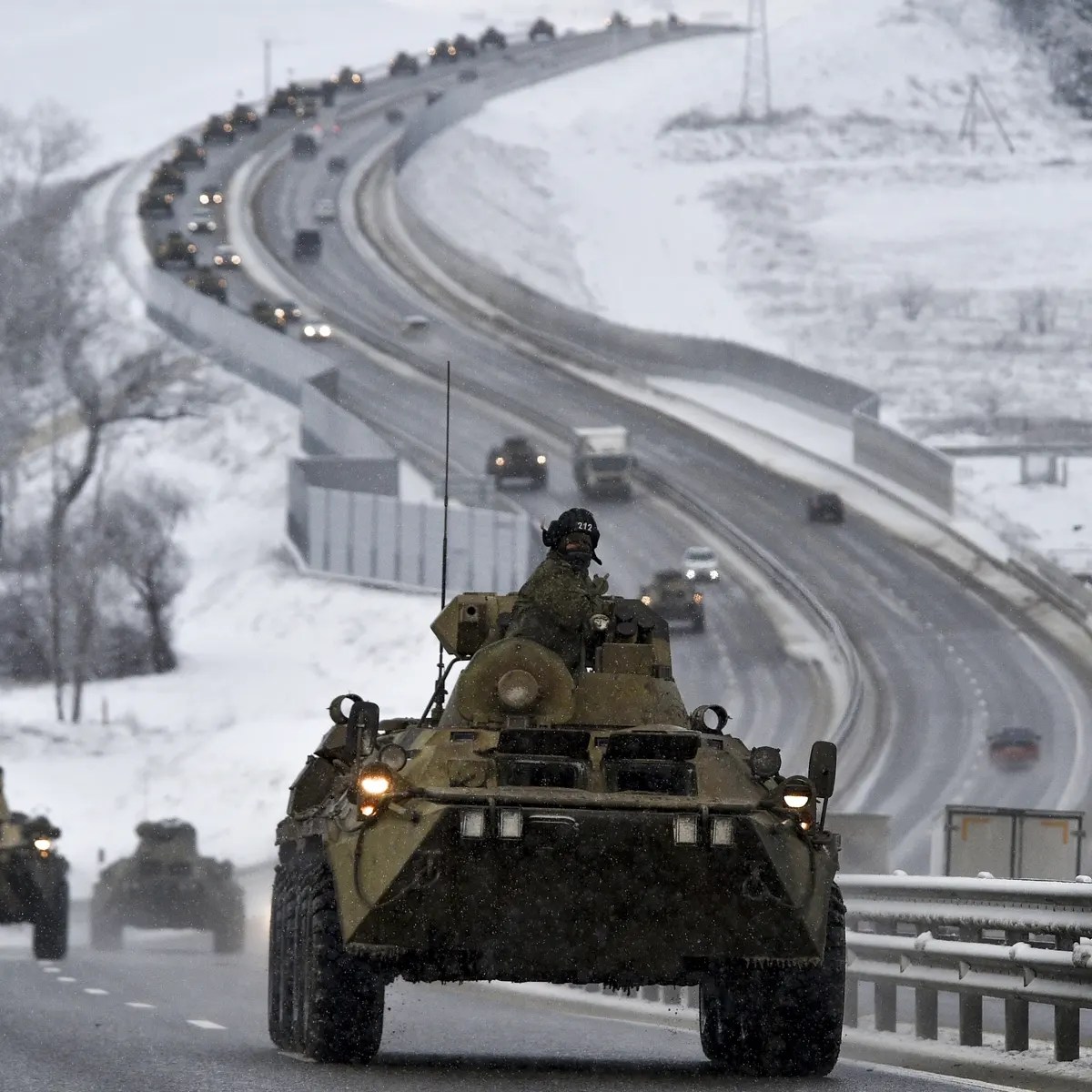
A year after the Russian invasion of Ukraine the clear and hard division in the socialist movement can hardly be said to have mellowed.  The escalation of western involvement has not caused supporters of Ukraine to miss a beat in their support, despite initial indications that they saw possible limits to their defence of imperialist intervention. Indeed, the most startling aspect of their response was the immediate support given to the intrusion of western imperialism, thus placing themselves on the same side as the US, and with objectives identical to it and its NATO allies.  Anti-imperialist rhetoric continues to be espoused by pointing solely at Russia while demanding that their own imperialist state intervene more strongly to arm the Ukrainian state.

So sudden and complete was this conversion to seeing western imperialism as key to a progressive solution that no further political moves were required to justify the alliance of this left with their own capitalist state and its imperialist allies.  This leap into bed with its previous class enemies was carried out with agreement on what the nature of the war was, who the necessary allies were, what the objectives of the war were, and what should be done about it.

Of course, like repeated references to a certain imperialism, the rhetoric has included left phraseology, but this can’t disguise the fundamental identities: the courtiers of western imperialism have themslves denounced imperialism.  Such has been the decisiveness of the embrace of the Ukrainian state that their ‘opposition’ to the war means opposition to Ukrainian defeat, not to the war itself, and Ukrainian victory is construed in the most comprehensive and absolute terms.

Their position is bolstered by the unprecedented support for the war by the Western media, which has been little more than propaganda for this imperialist alliance; war pornography but without the pictures that reveal the real brutality.  Their moral certitude, which they believe arises from the clarity of what is happening, is assisted enormously by the western media’s one-sided presentation.  Even when western diplomats get exasperated at Ukrainian lies, such as its continued claim that it was a Russian missile that landed in Poland and killed two men, this left does not miss a beat to ask what else might not be true?  The effect of sanctions on the world’s poor or on workers living standards in their own countries are all an inevitable price to be paid from the perspective of the war being Russia’s fault and its effects only to be ended by its defeat. Nothing its own imperialist state does can be challenged when it is recognised as the only force able to help win the war that it supports. When you have picked a horse, it is relatively easy to see everything through its blinkers.

A third factor is the unattractive nature of Russia itself, a corrupt and authoritarian capitalist state, but this only invites comparison with the Ukrainian state itself, which is hardly very different and certainly not when it is allied with western imperialism, whose toll of death and destruction dwarfs that of Russia.  If Putin is a criminal, Bush and Blair are godfathers, and their successors Biden and Johnson, Truss and Sunak etc. are no different.  But it is precisely the refusal to go there that is the problem, because the signal fact that the Russian invasion on 24 February was wrong cannot possibly justify support for the Ukrainian capitalist state and its imperialist backers.

Writing from Ireland it is beyond lamentable to see people who opposed the British armed forces in the North of Ireland suddenly find common cause; effectively demanding that the Minister of Defence, whose own military record here is censored, call for their power to be wielded to implement imperialist interests in Eastern Europe.

Condemning the Russian invasion on the grounds of opposition to imperialism while failing to recognise the Ukrainian desire to become part of the biggest imperialist alliance, and also failing to recognise the role of this alliance in a war in which Ukraine is its proxy, makes all claims to support for Ukraine on an ‘anti-imperialist’ basis not only groundless but thoroughly dishonest.

And this is the issue; a position on the war can only be satisfactorily approached through a Marxist analysis – of the cause and nature of the war as determined by its historical origins and development and the nature of the participants and their objectives.  When we look at it from this aspect, left support for Ukraine does not so much fall apart as simply not exist.

So right from 24 February 2022 their claim was that the war was caused by Putin.  One man caused it, arising out of his cranium with his imperialist obsession and a distorted and false view of Ukrainian history, including the view that Ukraine was not a real country and Ukrainians were a variety of Russian.  Far from looking for the material roots of a war that has impacted the world, the moral left discovered from the start that it was Putin’s view of history that explained it.

Not that Putin’s ideas explained everything, for this left everything did not have to be explained, only the invasion, as this determined everything relevant to understand and upon which to strike a political position.  And because nothing prior to this matters, and everything subsequent depends absolutely on it, disagreement with their political position is admission of moral failure.  As the late socialist Andrew Collier put it, ‘liberals have a notorious tendency to construct values which might explain their opponents’ policies.’

That this justification for their approach does not fall apart but simply does not exist is illustrated, among other things, by the fact that what Putin actually said before the invasion–that was most directly relevant to it–was all but ignored, which we shall look at in a future post along with other claims.

Forward to part 2

The Windsor Framework

Dan Kitwood UK in a Changing Europe

The ‘Windsor Framework’ agreement between the EU and Britain to maintain or replace (take your pick) the Northern Ireland Protocol to the Brexit Withdrawal Agreement is a truly remarkable document.  It allows Northern Ireland to have free access to both the EU single and UK markets for goods.

The British Prime Minister visited to ensure we knew how great this was even though, as a staunch Brexiteer, he had helped ensure that Britain walked away from this “privilege”, this “prize” that put Northern Ireland in a “unique”,  “unbelievably special position” . . . ‘like the world’s most exciting economic zone”, that ensures we are an “incredibly attractive place to invest for businesses”.  Perhaps the most fulsome declarations against Brexit I have ever heard.

Yet the truly remarkable factor is that such an arrangement is supposed to be impossible.  When Russia claimed that Ukraine could have close trading relationships with the EU and also with its own Eurasian Customs Union, the EU claimed it couldn’t be done.  Ukraine had to look decisively West and could not continue its attempts to straddle between it and Russia.  We know, of course, that this provoked the Maidan uprising in 2013-2014, when the Ukrainian President decided that the price of greater access to the EU and erecting barriers to Russia was too high.

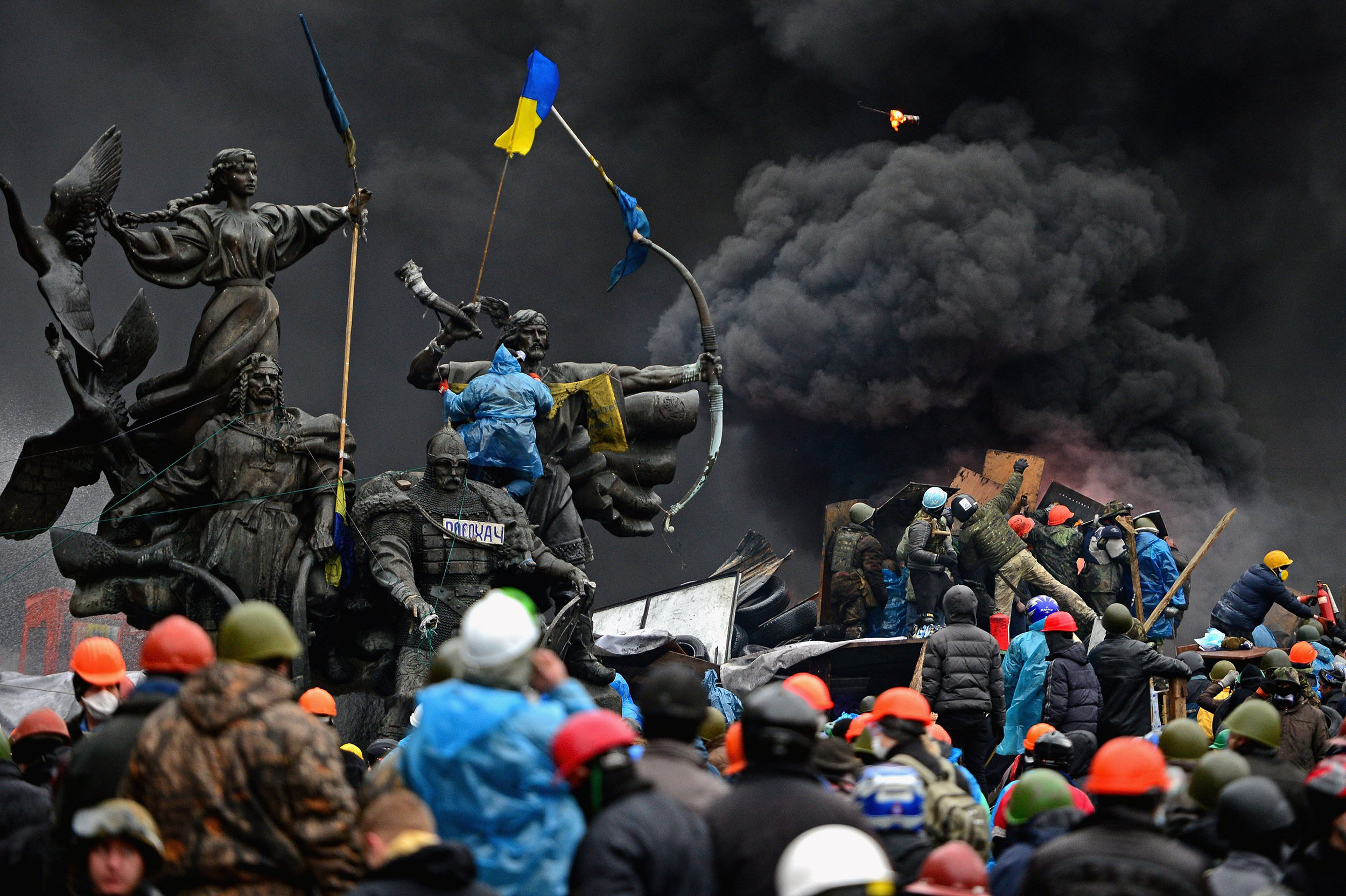
Ukraine split over his decision, with the open intervention of the United States, repression by the Ukrainian security forces, violence by protesters and seizure of weapons by pro-western elements, including the far right and fascists.  This led to a counter-mobilisation in the East of the country among pro-Russia Ukrainians and a civil war that led to Russian armed intervention in Crimea and then Donbas.  The conflict never really ended and, of course, we know that this eventually led to the Russian invasion and the proxy war between the US with its NATO allies, and Russia.

So, why is it that what has just been achieved in the North of Ireland could not be done in Ukraine?

The answer, of course, is that the decision in respect of Ukraine was a geopolitical one aimed not just at Ukraine but against Russia, even if some claim that the bureaucrats in Brussels did not fully appreciate this aspect of what they were doing.  In any case, the new ‘Windsor Framework’ is essentially a political agreement with political significance that does not primarily lie in the North of Ireland.

It has been pointed out by commentators that the EU and British have put entirely different spins on the significance of what has been agreed, with the former claiming that it has not “renegotiated the protocol” while the British have claimed that the deal “fundamentally amends the text and provisions of the original protocol”; lots of ‘dancing on the heads of pins’ according to one journalist.

Nevertheless, the protocol stays, there remains a ‘border on the Irish sea’ and not inside the island, and the fundamental relationship between the EU and Britain remains.  The EU has made concessions and the British have agreed measures that the EU thinks it can live with which minimise physical and other trade-related interventions.  The EU Q&A is replete with references to the limits of its flexibility. So, the trusted trader scheme can be suspended if ‘1) the UK fails to provide the EU with access to the relevant UK IT customs systems and databases, or 2) the UK does not live up to the commitments it undertook when setting up the trusted trader scheme.’  On excise ‘the UK will not be able to apply any duty rate below the EU minima’; on duty rates for small producers of alcoholic beverages ‘the UK will not be able to set duty rates for small producers below EU minima rates. The respect for EU minima rates will protect the level playing field with the EU’ etc.

Breaches of the controls are inevitable, but it must be considered that these are going to be relatively unimportant.  Northern Ireland is both small and peripheral and ultimately so in the political sense as well, a far cry from Ukraine.  The EU was quick to claim the deal as a one-off, so the Swiss can’t follow up on it.  The significance of the deal agreed lies in the British acceptance that the road is running out on hostilities with the EU, a project that is taking its Tory sponsors to electoral defeat.

The deal is not however the last word.  The disapplication of EU laws is still winding its way through Westminster and controls on imports to Britain have still not been introduced; Brexit has still not been ‘done’.  The ’Windsor Framework’ has still to be implemented while deadlines for the various steps are part of the agreement.  Beyond this, the problem of continued divergence between the EU and Britain remains, as does its potential impact.  While on the British side the debate is about the extent of future divergence, or even its advisability, on the EU side the debate will be about the potential benefits of further deepening, where consideration of its effect on relations with Britain will be a minor concern. 

The major innovation beyond the rather technical aspects of trade policy is the introduction of a ‘Stormont Brake’, as an ‘emergency mechanism that will allow the UK government, at the request of 30 Members of the Legislative Assembly in Northern Ireland (Stormont), in the most exceptional circumstances, as a last resort . . . to stop the application of amended or replacing provisions of EU law . . .’

‘The Stormont Brake can be triggered only after having used every other available mechanism, and where the amended or replacing EU act, or a part of it, significantly differs in scope or content from the previous one and application of such amended or replacing act would have a significant impact specific to everyday life of communities in Northern Ireland in a way that is liable to persist. . . . If triggered and if the conditions are met, the amended EU act would not apply automatically in Northern Ireland.’

This represents the introduction into the workings of the Protocol a mechanism akin to the ‘petition of concern’ introduced in the last British initiative to save the Stormont administration–New Decade, New Approach–meant to get Stormont to work after the previous breakdown.  The original devolution arrangements, meant to demonstrate that the Northern Ireland polity could function ‘normally’ and without conflict, introduced powers of veto for each sectarian bloc as a key incentive to make them work it.

The petition of concern was meant to be a last resort insurance-type mechanism but was reportedly used 115 times in five years, a testament not to it working, or to the number of issues absolutely vital to one side or the other, but to the degree of sectarian division.  It has quickly been speculated that the restrictive grounds of its use, mirrored in the wording of the new deal as set out above, would make no difference to the willingness of unionists to paralyse the Protocol agreement with the EU.  There is no reason why this might not be the case except for the different circumstances of the ‘Windsor Framework’.

Like the ‘New Decade, New Approach’ deal, it requires 30 members of Stormont to trigger it from at least two parties, and since there are 37 unionists out of a total of 90 members, this looks eminently possible, even accounting for those specifically excluded.  Once triggered it would take a harder to procure ‘cross-community’ vote to allow any suspension of a new EU law to be lifted.

While there are various other, on the face of it, rather onerous requirements, including for consultation, the key difference is that the British government is required to apply the veto on any new law, and the British government is not going to do this if it is not in their interest as well, regardless of what unionists think.  If it does, the EU can then take retaliatory measures that are proportionate.

It is just about feasible for unionists to repeatedly attempt to apply the brakes, but this would lead to ridicule for themselves and their Brexit cause, and would fail, not mainly because of this but because the British government is in charge.  The British, by making the agreement in the first place and failing to meet the Democratic Unionist Party’s seven tests, have shown that the demands of unionism are not its priority.  

The Stormont Brake has been characterised as a carrot to unionism but one that requires the DUP to return to Stormont and end its boycott, as it can only be triggered in a functioning Assembly.  The offer of a veto is thus a sardonic judgement on the power of the veto the DUP already wields.

It was widely thought, even before the appearance of the new deal, that the DUP would play for time so that it would withhold judgement before the local elections in May.  These, it is thought, would reveal the verdict of the majority of unionists on the deal to be negative, or certainly negative enough to damage the DUP should it accept it.  This would hardly be a surprise since an oft-repeated unionist expression is ‘not an inch’.  Unfortunately, it cannot retake the ground itself and the crisis is of its own making – by supporting Brexit, accepting the different circumstances of Northern Ireland, opposing the alternative Theresa May deal, even if it could have worked, and the initial support it gave for the Protocol’s benefits.  This leaves it ill-prepared for a battle against the British government.

Postponing decision on the deal might appear smart, especially since the party is divided, but it might not take that long before this looks weak, and vulnerable to accusations from rivals that it is.  The main rival is Traditional Unionist Voice, which is a one-man band, which itself illustrates the hollowness of unionist opposition. This, however, can just breed frustration and anger.  Far from protecting themselves, DUP delay may simply strengthen unionist opposition by opening the door to those willing to be clear and forthright, with resignation developing among others of its supporters.  In any event, in local terms, the Windsor Framework is a defeat for unionism.  You can tell this, when even the King gets it in the neck.

Thousands march in defence of refugees in Dublin

When the war in Ukraine broke out the Western powers rushed to supply weapons to the Ukrainian state, which became the purported bearer of freedom for the whole of Europe, if not the rest of the world because much of the rest of the world understood that the United States and Europe were not defenders of freedom.

In Ireland the government parties floated the idea of the state joining NATO so it too could supply weapons, but the rapid response by the Irish people showed that this idea was very unpopular and would require a lot more work to force through.  After an apparent slight from Volodymyr Zelensky about the Irish contribution to the Ukrainian cause the government parties proclaimed that their contribution would be to provide a refuge for Ukrainians fleeing the war.

Very quickly government ministers were predicting that as many as 200,000 Ukrainian refugees were to be supplied with accommodation, which on the face of it seemed incredible.  This was a government and state that had proved incapable of solving a homelessness problem of around 10,000, while massive house price increases had made buying one impossible for many, rents were astronomical, and much of the newly built housing stock was dangerous or becoming rapidly uninhabitable.

However an unprecedented propaganda campaign ensured that the cause of the Ukrainian state received much sympathy, and did so in Ireland, so much so that a state notorious for corruption and reactionary nationalism was embraced by almost everyone from right-wing governments to much of the left.  Ironically this left has just recalled thirty years since the massive anti-war demonstrations against the imminent invasion of Iraq by the US and Britain etc.  Today this left not only supports war but supports the US and Britain etc. supplying arms to ensure that the war continues to be fought, by a country that itself provided soldiers to occupy Iraq following the invasion.

Opposition to war has become support for war and opposition to western imperialism has become defence of western imperialism in its support for a state that wants to join its imperialist alliance.  From the cause of death and destruction and oppression, these powers are accepted as defenders against these calamities, and the massive drive to rearmament has left this left trailing behind, endorsing the supply of weapons to its new ally while stuck with a past politics that recognises western imperialism as a prime source of war and oppression in the world.  Of course, something will have to give here.

This is the first context to the refugee crisis in Ireland but one that was all but ignored by the demonstration in support of refugees in Dublin on Saturday, even though the massive increase in refugee numbers is mainly accounted for by Ukrainians.  Not one of the left leaflets distributed at the demonstration mentioned the war, or so much as mentioned Ukraine, and I saw only one makeshift flag in Ukrainian colours, with no identifiable Ukrainian contingent on the demonstration.

The second context is the crises in housing and health services and stress on the provision of state services more generally.  There is a valid argument that younger immigration will provide greater services than they will consume, but this will not immediately be the case and especially with so many Ukrainians being women with young children. Childcare costs can be extortionate in Ireland.  When we also consider that refugee provision has been placed in mainly working class areas or in small rural towns, but not in more affluent and middle class areas, we can see why it would cause resentment   Opinion polls have shown both support for refugees but also concern that the country has taken too many.  There are also widespread complaints of lack of consultation with local communities before placing refugees in accommodation.  Behind all this lies both valid complaints that there are inadequate services but also racism.

One reason why ‘war’ and ‘Ukraine’ was unmentioned at the demonstration is that the target of much racist invective, protest and attacks has been against non-Ukrainian asylum seekers.  This includes men from Georgia and Albania, who have been particularly targeted.  One can’t help but believe that were Georgia invaded by Russia or Albania by Serbia the Irish state would be proclaiming their needs and absolute requirement for emergency assistance.

The state and its governing parties have led the way into a crisis in which the far right and racist forces have mobilised in local areas to attack refugees and turn local people against them, with lurid stories of sexual harassment by refugees against Irish women and other racist tropes learnt from abroad.  Irish people and existing asylum seekers have seen their demand for accommodation grow, and their needs be unmet, only to witness the government parties proclaim emergency measures to accommodate Ukrainian refugees.

The prioritisation of Ukrainians and creation of double standards when it comes to treatment of those seeking refuge in Ireland has not prevented the state’s efforts to assist Ukrainians from staggering from crisis to crisis with no evidence of the ability to create the required capacity in the short term or existence of a longer-term plan.  This is not in the least surprising.  The Irish state has failed to provide adequate housing for the pre-existing population and its health services have continually been in crisis. It has been silent on complaints that large numbers of refugees will not help this situation while it has all but ignored the full needs it has created.

It has therefore opened the door to racist and xenophobic arguments and agitation and has now started to row in behind them.  It has promised to clamp down harder on asylum seekers while it proclaims the necessity to support more Ukrainian refugees, with the threat of more deportations of the former.  It makes claims of their cheating to be here in the first place as a result ”criminal gangs”’ and human “traffickers”; makes statements denying that single men are being placed in accommodation, as if they were indeed the threat proclaimed by racists, and the new Taoiseach Varadkar has now declared that immigration policy must become “firm and hard”.

The real failure of the state and government parties to provide adequate state services is being blamed on refugees by the far right, which has not targeted the largest group of arrivals–Ukrainians fleeing war–but instead refugees who are not so obviously white and ‘deserving’.  The state, on the other hand, has also declared these refugees uniquely deserving while it supports a war that has caused them to flee their homes in the first place, with continued support only promising more to follow.  This combination is one more reactionary consequence of a reactionary war.

The demonstration on Saturday was called after increasing anti-immigrant protests by the far right that have grown in number, particularly noticeable because of their previous absence and the naive and stupid notion that the Irish (of all people!) were immune from the racism that has grown across Europe.  I went down to it from Belfast to support it, see its size and its composition and because it was important to rebuff the mobilisations of the far right for whom control of the streets is a strategic objective.  A large demonstration would signal where it stood in terms of such mobilisation and the terms on which the whole argument could be waged.  A large demonstration of the left would not be enough to meet these requirements.

In the event the demonstration was larger than such a mobilisation, consisting of a wide cross-section of the population, from outside of the left or who it would normally be able to mobilise.  In this it was impressive and just about achieved its purpose.  It was not however, in my estimate and those of a couple of comrades, 50,000 strong, but perhaps just more than half that number.  It was largely Dublin-based and did not have the predominantly working class composition of the water charges demonstrations or of the very large demonstration against austerity that followed the crash of the Celtic Tiger.  It did however contain a significant number from ethnic minorities and from the left and some trade unions. These were predominantly its activists and not significant numbers from the trade union membership, which would have made it much larger.

The left has built itself an electoral base in Dublin and Cork and its grass-roots organisation should be well placed to defeat attempts by the far right to organise in local areas, but it is not quite as simple as that.  Building an electoral base is not the same as building a movement.  People before Profit seemed to be aware of this, as it faces defeat by Sinn Fein in the next elections, and its main message on the demonstration was for people to join it.  Unfortunately, it is not an organisation with the capacity to contain a mass membership and an electoral base is not an organisational one.  Its leaflet called for a left government and for everyone to support its legislative motion in the Dáil on housing, proposals that are hardly adequate.

Any left government will require a Sinn Fein leadership and its left credentials are threadbare, even if it may have the capacity and scope for some social-democratic measures.  What such a government could not be is a working class one – but then a ‘left’ government does not have to be working class, the term ‘left’ in an Irish context does not imply very much.  An organisation that thinks the role of working class activity is to support votes in parliament has got it arse about face.  Other left leaflets pointed to the need for working class unity and for it to organise and mobilise, but this requires challenging the bureaucratic character and leadership of the trade unions and these left organisations neither prioritise this nor have the capacity to be exemplars of healthy democratic organisation themselves.

It also requires the correct political approach, and too much of the demonstration was an expression of liberalism and not socialist politics.  Not so long ago the left exposed the inane character of abstract nouns, such as the ‘war on terror’ but now it appears not to object to the demand to oppose ‘hate’ or support ‘diversity’, as if there are not some things, such as racism, that should be hated.  Supporting ‘diversity’ is a bit like declaring your support for gravity, it doesn’t matter if you do or you don’t, it will still exist.  To paraphrase Terry Eagleton, a diverse number of racists would not be a step forward.  If you want the opposite of division it is called unity, and then you need to say who should unite and for what purpose.

The rise of the far right has been prepared by the failure for years of the Irish State and government parties to provide adequate state services for the majority of the Irish people, and for its similar failure in relation to those refugees it has, and has not, encouraged to come to Ireland.  Its policies have sewn the division between natives and refugees and between first class refugees who are white–and victims of a war it has supported–and those second class others seeking refuge who it has determined are a problem.

The crucial issues facing Irish workers, Ukrainian refugees and asylum seekers are therefore the same with the same guilty forces responsible for their plight.  Their common need should be clear, as is the need for working class unity and for working class organisation to express it. Many organisations supported the demonstration in Dublin on Saturday.  Those with a commitment to the interests of the working class, including Ukrainian refugees and asylum seekers, should form a united organisation that can provide a programme for further action at national and local level that offers not only opposition to the far right but an alternative.

The Story of Brexit (3 of 3) – Britain punching its weight

Book Review ‘Inside the Deal: How the EU got Brexit Done’, Stefaan De Rynck, Agenda, 2023

At one point in the Brexit negotiations Michel Barnier pointed out that in the area of security policy the UK was promising to do more together with the EU than it had done before; as De Rynck puts it, trying ‘briefly to hold on to its lead role on EU military operations.’  It continued to present itself as the bridge between the EU and US, except the EU ‘failed to see any benefit in not liaising directly with the US instead.’  When Johnson won the election in December 2019 this approach for a closer relationship on security and foreign policy was dropped.

What came later, we now know, is acting as an instrument of US policy in the war in Ukraine; scuppering early negotiations by promising western military support to the Ukrainian regime and continuing to ‘punch above its weight’ by promises of weapons deliveries like tanks designed more to pressurise others than to make a critical contribution itself.

De Rynck doesn’t explain the about-face, except that Trump had criticised NATO, implying a reduced priority for Europe ,while he had already promised Britain a trade deal “very quickly”.  His ambassador to the UK supported Brexit – “you have a great future outside the EU”  he said – while US State Department officials warned against no deal and stated their wish that security cooperation be maintained at “current levels”

De Rynck admits that the EU negotiators were initially less confident of maintaining a united front on foreign and security policy than on the economic front, and implies concern that some East European countries might want different outcomes.  He argues however that Brexit has strengthened EU security arrangements and its autonomous decision making in which the UK will no longer be involved.  He argues that weakening the single market would have eroded both and reduced the ‘strategic potential of a more Global Europe’.  On the other hand, its development, including a ‘single market for defence industries’, is a precondition for development of this role.

This assessment is informed by the start of the war in Ukraine and the alliance with the US in opposition to Russia, including sanctions that have substituted cheaper Russian energy for more expensive US sources.  The introduction of the Inflation Reduction Act in the US is now also a threat to EU industry with its subsidies attracting European industry to the US.  When the problem of Ukrainian refugees is added, it is clear that the ‘strategic potential of a more Global Europe’ faces a threat from the US in relation to which Britain has acted as supplicant and surrogate.

De Rynck makes none of these observations in the book but alludes to this role in recording previous US opposition to the EU’s satellite navigation system Galileo, which Britain had at first also opposed.   He reports that the EU Commission came close to abandoning the project, although went ahead when Denmark switched sides, Tony Blair withdrew British reservations and Germany promised to pay.  This then gave the EU its own alternative to the American Global Positioning System.

The British claimed that they had been able to limit Galileo to civil applications, and continued to veto military uses, but by 2015 they announced their intentions to use it for military purposes, including for the guidance of targeted weapons.  ‘Losing access’ to the system was therefore a significant Brexit problem.

De Rynck explains that the EU were willing to allow the UK to use the system’s military grade signal, but Britain also wanted access to the source code for economic and military purposes and complained it could not be the only member of the UN Security Council without full control of its own navigation system.  After a ‘bitter’ debate, and threat and counter-threat, the purpose claimed for Brexit of “taking back control” did indeed mean losing it, and Britain did become the only member of the UN Security Council without full control of its own navigation system.

A core justification of Brexit was the ‘opportunity’ to change its policies, regulations, and product requirements.  Brexit, it seemed to everyone, would be pointless without this.  However, rather than see how EU rules would continue to apply post-Brexit, the EU initially concentrated on what guarantees any alternative arrangements could offer, on effective dispute settlement and on credible unilateral remedies, all of which were agreed three years later.

In between the British complained that the EU approach did not seek to replicate its trade negotiations elsewhere, like those with Japan or New Zealand. Michael Gove said Britain was willing to reintroduce tariffs in exchange for the EU lowering its demands on a level playing field only to be told that there was no time to go line by line through each product, and in any case, it would not buy a lighter version of the level playing field.

Britain made proposals and then withdrew them; it proposed a Canada style trade agreement and then backtracked when what this meant was explained to them. ‘What makes the UK “so unworthy” complained David Frost, as the British declared their sovereignty, only to be told that sovereignty was a two-way street; the EU was itself annoyed that what was on offer to them was less than what the British were offering to Japan, Ukraine and Australia.

It seems almost incredible that, given the course of the negotiations recorded in the book, the British continued to argue that cooperation should rely on trust rather than rules.  The EU was perfectly aware that the negotiations were mainly just to ‘get Brexit done’ without any genuine commitment to any written agreement.

De Rynck states that ‘despite some failed EU demands and compromises, the outcome was largely in line with what the EU set out at the start.’   ‘The UK government played a game of chicken, by itself’ and ‘as a more diverse and bigger economy, the EU had no interest in accommodating the UK . . .’

The majority of the British people now regard Brexit as a mistake.  The sign on the side of the bus promising money to the NHS looks like the con it was as the NHS collapses, highlighted by media reports of incidents of raw sewage pouring out inside crumbling hospitals.  This, and every other Brexit promise, has literally turned to shit and the wonder is that anyone thinks being poorer is part of the solution to anything.

Guardian commentators like Polly Toynbee write articles setting out how awful Brexit has been but with no proposal to reverse it – ‘Most people are now in favour of rejoining the EU, but Labour is right to steer clear of another row over Europe’ she says.   Gideon Rachman writes columns for the ‘Financial Times’ about how it can be reversed but has nothing more to propose than two referendums on the tenth anniversary of the 2016 leave vote.

The British state is in confusion about what to do, evidenced by the meeting of the great and good, leavers and remainers, reported to arise because ‘Brexit is not delivering’.  Its proclaimed purpose however was “about moving on from leave and remain, and what are the issues we now have to face.”  As if the issue is not what brought them together in the first place and the answer obvious.

As one commentator in ‘The Irish Times’ said, ‘it is hard to understand the 40 per cent who still agree with the decision’.  On the left, among the Lexit supporters, there equally appears to be no remorse, just excuses like the assorted Tories, UKIPers, xenophobes and racists who were equally committed to a Britain-alone approach.

The book by the EU insider reveals no secrets but describes the British negotiation process as confused, inept and as full of wishful thinking as the Brexit project itself.  It faithfully records the bluster and threats that no one with any appreciation of the balance of power could take seriously.  It points to the folly of left supporters of Brexit who supported it when all this was obvious.  Did they expect the negotiations would deliver some advance for the British working class?  I suppose that they must, in which case the book is another testament to the stupidity of Brexit, Lexit or whatever its supporters want to call it, now that it’s no longer just an idea and so not what they wanted.

Back to part 2