Trusting the State (4) – Irish ‘neutrality’

The neutrality of the Irish state, that most of its people support, is a myth.  The Irish government has repeatedly stated that the state is militarily neutral but not politically.  Since its armed forces are tiny it might be said that its military neutrality doesn’t matter but its politics does.  It is also often said that its policy of neutrality is whatever its government decides it is.

Already the so-called policy of neutrality is variously referred to as ‘not clear’ and ‘flexible’, while the anti-communism of the cold war period was clear, and before that its neutrality in the Second World War was flexible in favour of the Allied powers.  Before that, the sympathies of Catholic Ireland with the nationalist and fascist forces of Franco was widespread.

At the minute the Government hides behind a ‘triple lock’ which mandates that more than twelve members of the armed forces can be sent overseas on operations only if the operation has been approved by the UN, the Government, and a resolution of Dáil Éireann.  It is now complaining about “the illegal and brutal full scale invasion of Ukraine by a permanent member of the UN Security Council”, and that because of the Russian and Chinese veto on the Council no sanction on Russia can be approved.  No such calls were made when the US or British engaged in recent “illegal and brutal” invasions, and the contrast with the approach of other countries such as India and South Africa at the recent G20 meeting is glaring.

The political practice of the Irish state has been to allow US troops to stop-over at Shannon airport on their way to its various wars and to have a deal with the British Royal Air Force to police its airspace. It has refused to assert its sovereignty by checking suspected US rendition flights and has always made clear its support for ‘the West’.  To think that a state so dependent on US investment and financial flows, plus its integration into the European Union, would be in any meaningful way neutral in the conflicts these various states are involved in is for the birds.

The claim to any sort of neutrality is not only bogus but also hypocritical and malevolent.  Hypocritical, because in the Irish State’s recent application to join the UN Security Council it made much of its non-membership of NATO while flying kites domestically in order to facilitate the first steps to joining it.  Leo Varadkar stated that trading on its former status as a colony had helped it gather support for Ukraine and oppose ‘Russian imperialism’.  The level of hypocrisy would be astonishing were it not so common; it claimed its privileged victim status in alliance with all the Western powers that are members of NATO, are former colonial powers, and currently comprise the biggest imperialist alliance in the world. All very ‘anti-imperialist’.

It is malevolent because it has combined lying with efforts to support the war in as strong a way as it can, without eliciting opposition from its own people.  So, it has ignored its own housing and homeless problem by welcoming one of the highest levels of Ukrainian refugees in order to demonstrate its political support.  Should anyone fall for the idea that this is the expression of some sort of (welcome) humanitarian concern, the previous and continuing policy on asylum seekers of direct provision should be noted, as should the second class status applied to refugees who aren’t Ukrainian.  Even with regard to Ukrainian refugees, Varadkar has made it clear on a number of occasions that while the door is open there’s nowhere to stay: the not so subtle message is ‘stay away’.

Implementation of the welcome has therefore stumbled from crisis measure to crisis measure with an eagerness the state did not previously display.  The self-image of ‘Cead Mile fáilte’ (“a hundred thousand welcomes”) does not withstand historical examination, including the referendum on the right of children born in Ireland to citizenship, which was targeted at excluding the children of non-EU nationals born in the Irish State.

The recent government sponsored ‘Consultative Forum on International Security Policy’, which was no more than an obvious attempt to advance the cause of NATO membership, majored on the threats to Irish security, while commentary has often focused on the vulnerability of undersea cabling off the Irish coast linking the US to Europe.  No one was so impolitic at this Forum to mention the threat to underwater infrastructure from the Americans, responsible for blowing up the new Nordstream gas pipeline to Germany.

The deceitful nature of the Forum was indirectly exposed by the Dame of the British Empire who was invited to oversee the proceedings.  She remarked that “I really don’t know any other country where they’ve done something like this, really tried to engage the entire population in an open conversation about a county’s role in the world, – national security is variably restricted to small groups of senior officials and decision makers.”

In fact, the Irish State is no different in this respect from other capitalist states, as the example of US military flights through Shannon airport demonstrates, and now the support given to Ukraine.  The Forum was not an exercise in conversing with the people of Ireland but an occasion to lecture them about the necessity to get on board with the rest of the West, led by the US, in its increasing polarisation of the world and aggression against its competitors – Russia and China.

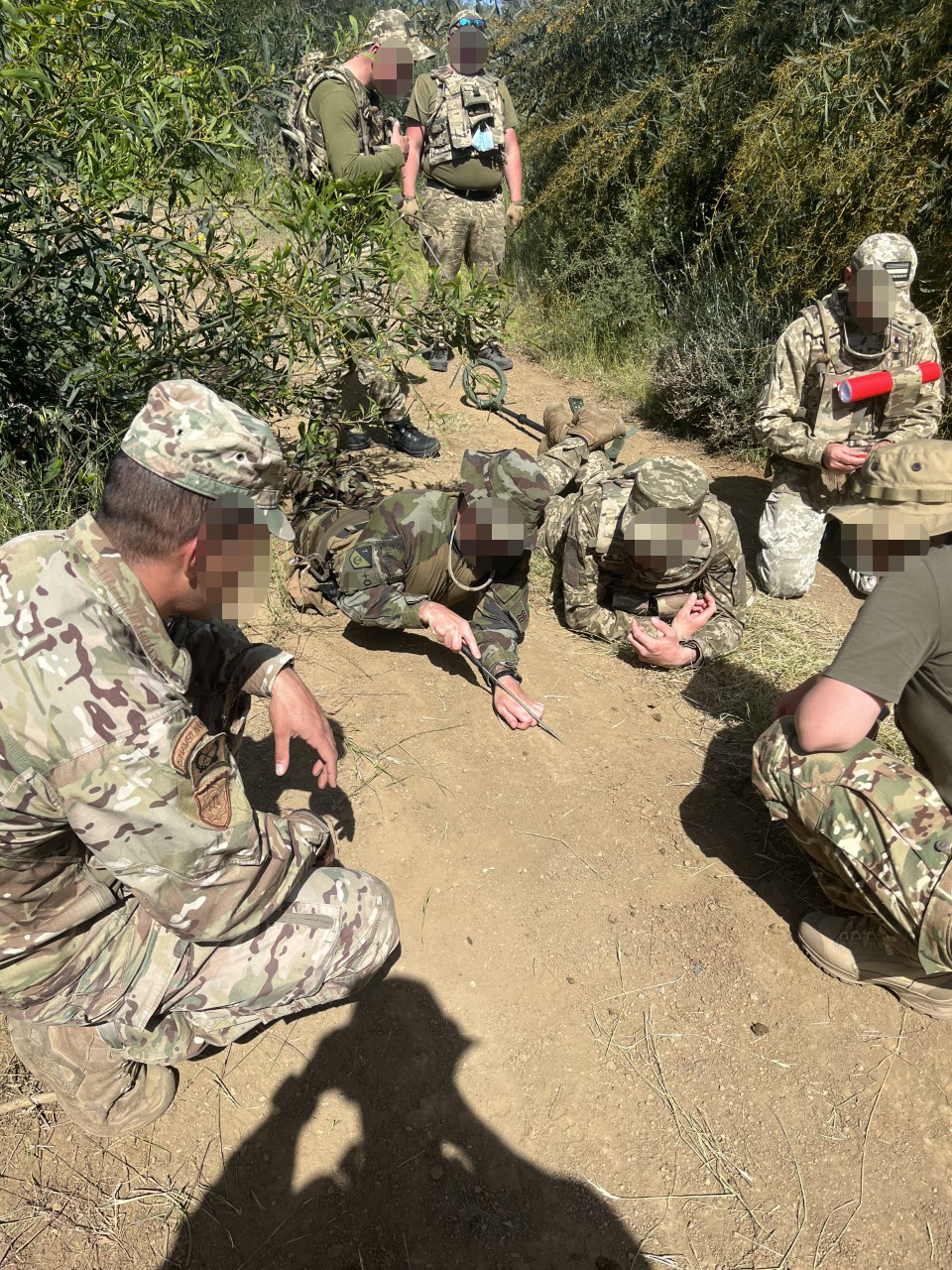
The Irish government claimed that its support for Ukraine was only going to involve provision of ‘non-lethal’ training to its armed forces, which included training in clearing mines and equipping it with two de-mining vehicles. Its ministers repeatedly emphasised the humanitarian nature of the training being provided. This claim was already something of a joke, given that clearing minefields was a crucial element of the Ukrainian offensive in which its armed forces have been thrown into a headlong assault against long-prepared Russian defences, only to be slaughtered in their tens of thousands.  All for the sake of complying with the United States and the Zelensky regime, with the miserable result of the uncertain capture of small settlements that have been utterly destroyed in the process. Lives exchanged for a few kilometres of bloody ruins.

The revelation that the ‘non-lethal’ training also includes weapons training and military tactics has exposed the government as liars.  Even the correspondent from the rabidly pro-war ‘Irish Times’ was compelled to admit that this was ‘a significant departure from the Government’s public position that Ireland is providing only non-lethal support.  Weapons training was not included in public announcements by the Government of the Defence Forces participation in the EU training mission. It contrasts with a statement by Tánaiste and Minister for Defence Micheál Martin earlier this year that the training would be in “non-lethal” areas.’

There was no reference to weapons training in any Government statements in the Dáil during debates on Irish involvement, yet in July the Cabinet had authorised this extension of support.  Just like other capitalist states, in Ireland “national security is variably restricted to small groups of senior officials and decision makers.”  The policy of neutrality is indeed whatever the government decides it is.  

The Department of Defence stated that the training presented “no conflict” with Irish military neutrality and denied any attempt to mislead the public on the nature of the training. It also said the training previously announced, which did not include any mention of weapons training, “was always intended to be indicative rather than exhaustive”.  It was, it said, only a “modest step-up”.  

What this “modest step-up” demonstrates is that the Irish State, through its participation in the EU’s Military Assistance Mission Ukraine (Eumam), is participating in a proxy war against Russia. It therefore also appropriates its own share of responsibility for its horrific results.

Back to part 3

An exchange of views on ‘Public Sector’ vs ‘Private Sector’

The comment below to a previous post is almost perfect in illustrating the illusions that exist on the role of the state and for which the series of posts were written.  It is therefore worthwhile bringing greater attention to it along with my response:

=====================================

I would have reservations about what you say about the State and capital relationship. Both sides of the equation seem to be too general, categories that are not specific to time and place. I find the categories of the public sector versus the private sector a little more specific. The key thing here is that there has occurred over the last thirty years a major transformation in the relation between the two sectors. In short hand, there really is no public sector to talk about in the way we once did. One should preface talk about the public sector with the phrase ‘so called public sector’. The public sector has been taken over by the private sector yet throws over this capture an appearance of being in the hands of and being managed in the interest of the public. 

When you use the public health service it is easy to believe that you are being served by what used to be known as the public sector, when in fact your are not, most of the services are provided to the hospital you are using by many private companies. This is just one example of many. It is interesting to see how in Britain many of what you would once have thought of as classic public services are in fact in the hands of private companies like SERCO.

I read the policy documents of the World Economic Forum and everything is dressed up in the clothes of Public Private Partnerships, something designed to deceive. What we mostly end up with, are private companies extracting money from what used to be called the Public Purse. Even the Dole broadly defined is operated by private companies pretending they are public bodies.

In a nut shell it is important to keep up with changes that have only recently occurred, over the last 30 years, not to get stuck using doctrines about State and Capital that are so universal that they pass over the particularities that now prevail. 

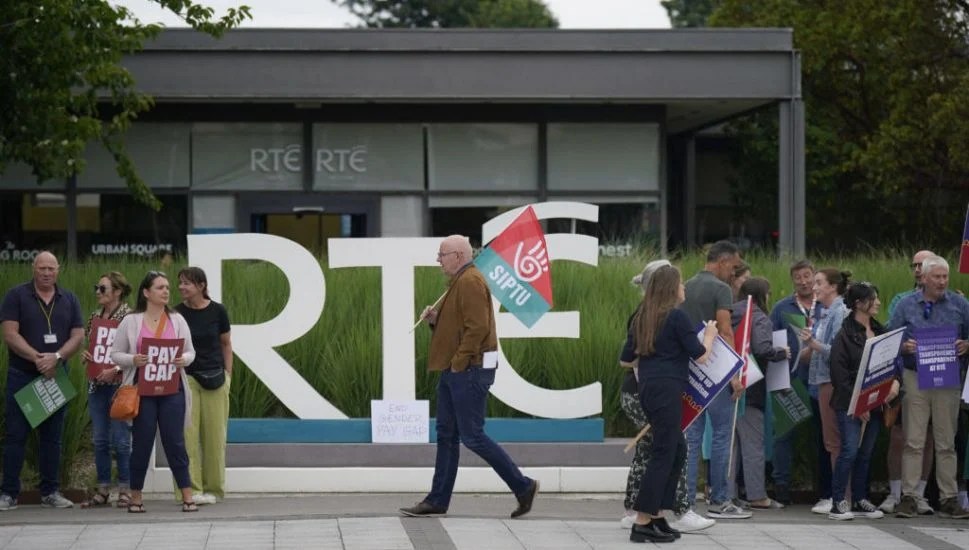
RTE was once upon a time a part of the public sector, yet the funding came from both the licence fee and income raised from commercials. A model I have to admit I never liked, when I watch it I can’t stop moaning about the deluge of commercials, I have to sit through, more frequent than the those you get with British commercial television, four breaks for ads every hour. So the public broadcaster always had one foot in the commercial private sector. I wonder if State capitalism ever actually existed in the Republic of Ireland. When I travel from the North to the South I am struck by how more commercial the South seems to be, maybe this is too is deceptive.

=================================================

You write that the categories of State and Capital “are not specific to time and place” and that “the categories of the public sector versus the private sector [are] a little more specific”, and that the public sector gives “an appearance of and being managed in the interest of the public.” Of course, the opposite is the case.

“Public” and “private” in these contexts are empty abstractions designed precisely to obfuscate the real situation and to give appearances that essentially deceive.  So-called public sector organisations are presented as if they serve the public but experience illustrates otherwise, as the posts on RTE demonstrate.  The reformist left pretends that failures are due to the corruption of ‘public’ sector ownership by ‘private’ interests but the ‘public’ (however understood) does not own or control it; as we have seen from their sale and from the complete and utter lack of democracy and accountability in their operation.

Even ‘private ownership’ is no longer dominated by single ‘private’ capitalists but by collective pools of capital, including pension funds of workers, as well as pools of money of separate capitalist companies and ultra-rich individuals. Capital is being socialised but is still capital, so operates according to the laws set out by Marx, while the state is not the depository of the ’public’ or general interest but of the interests of the capitalist class as a whole.  Again as set out by Marx.

It is a body separate and above society, which, while it rests on society, has its own interests that are intimately tied to the capitalist system and to various fractions of the capitalist class or to individual capitalists.  Precisely in what way permits greater specification of their forms that are “specific to time and place”, which you see as the shortcoming of these categories.  The general abstractions of ‘public’ and ‘private’ go nowhere, while the Marxist categories of ‘state’ and ‘capital’ have engendered whole libraries of analysis and empirical studies.

As I wrote on Facebook about the controversy at RTÉ – ‘it wasn’t commercial interests that decided to pay one presenter over €500,000 per year. It wasn’t they who doctored the accounts to hide this. It wasn’t they who cut other RTÉ workers’ salaries and conditions, and it wasn’t these interests who wasted millions by, for example, buying thousands of euros worth of flip flops on ‘barter accounts’. So what is it with “public service broadcasting” that requires so much forgiveness and support?’

Illusions in the ‘public sector’ are deep.  Consider these facts:

During the Covid-19 lockdown everyone was invited to clap for the NHS in the North and in Britain when it had closed its doors to other services, with lasting effects we still suffer from, while it spent billions of pounds on useless equipment from the cronies of the Tory Party.  Everyone now complains that they struggle to get a GP appointment, and that the service is crumbling, while more and more are signing up for private healthcare if they can afford it.  If the ‘public’ sector really was there to serve the public none of this would be happening.  If it really belonged to ‘the public’ it could be stopped but it can’t in its present form of state ownership.

The NHS is a bureaucratic monster.  We recently learned of the neonatal nurse, Lucy Letby, who murdered at least seven infants and attempted to murder at least six others in her care between June 2015 and June 2016. The worst serial killers in British history have been ‘public sector’ employees paid to care for the public.  It would be possible to write these off as tragic anomalies were it not for the fact that such scandals are exposed on a regular basis and are certain to recur.  Only when workers and patients have the power to control and make accountable these services will this change, and this will only happen when these services are removed from bureaucratic state control.

You write that “most of the services are provided to the hospital you are using by many private companies” but this has always been the case. One of my first jobs was processing invoices from these companies in the NHS, from medical devices to food to pest control.  The use of agency staff, employed indirectly through private companies, has certainly increased, but this is because the terms and conditions are better in some ways so workers such as nurses would rather work for an agency.  In the last year millions of ‘public sector’ workers have gone on strike to get higher wages in defence of living standards ravaged by inflation, in the teeth of opposition by their state employers.  Many workers in the private sector have already achieved higher pay increases without even having to go on strike.

You are correct to say that many previous state services have been privatised and often this leads to attacks on workers’ terms and conditions as well as deterioration in services.  This often obscures the poor services previously provided under state ownership, as evidenced by telecoms in the South of Ireland.  Much of the left opposed the creation of a single water authority in the Irish State, forgetting the failure of the previous mode of state ownership.

While it is correct to oppose privatisation it is no alternative to champion ownership by the state.  The use of the term Public Private Partnerships, which you state is “something designed to deceive” is only true in one sense, for those with the illusion that state ownership is on behalf of the public.  The purpose of the capitalist state is to protect capitalist ownership of the means of production, which is a sort of partnership.  The use of the term Public Private Partnership is therefore not “something designed to deceive” but is actually a more accurate description of the relationship between State and Capital.

The alternative is workers’ ownership and not the belief that capitalist state ownership can be made democratic.  This, of course, does not prevent us furthering any democratic changes that are possible without illusion that they are adequate or any sort of solution.

Trusting the State (3) – giving us the ‘right’ to housing

Queuing to look at one rental property in Dublin; pic Conor Finn, Sky News

Ireland suffered effective bankruptcy in 2007-08 through a property boom funded by a massive expansion of credit and crisis of overproduction, illustrated by employment in construction falling from 232,600 in in the last quarter of 2007 to 133,200 in the last quarter of 2017, a fall of 42.7%.  Yet the drop was even more precipitous than this: from 236,800 in 2007 to 83,400 in 2012, that is, by 65 per cent.  Almost one in every two workers who lost their jobs in the Irish state in the five years from 2007 to 2012 had previously been employed in construction.

The sector went from10.7 % of GDP in 2006 to 1.1% in 2011; going from the sixth largest share to the lowest in a group of around 50 countries during this period. The index of the value of residential construction fell from 751.7 In 2006 to 57.9 in 2012 while the index of non-residential construction fell from 115 to 73.59.  The growth in the stock of housing plummeted:

From an unsustainable boom to a collapse and again rapid growth, the boom-slump-boom Irish economy now has capacity constraints only partly made up by immigration, leading to a new housing crisis in which not enough houses are being built, house prices have become extortionate again, and not enough properties are available for rental.  To rub it in in, some of the partly finished houses from the boom were left to rot or demolished while the quality of much of what was built has become, or is becoming, uninhabitable because of poor materials or dangerous construction.  The banks that workers bailed out in the 2008 crisis are back in profit, having involved themselves in new rip-off scandals, and now criticised for pitiful savings rates while borrowing costs for its customers increase.  Despite their profits today their massive losses carried forward are set off against taxes, not a facility available to the working class.

The housing crisis dovetails with other aspects of the malfunctioning of Irish society including health and education.  More than 830,000 patients are on hospital waiting lists while staff vacancies are unfiled, including senior medical staff, while there are hundreds of teaching vacancies in schools.  Doctors, who in their career development will work for a year or two in Australia, aren’t coming back because they can’t afford houses in the areas they want to live.  Executives in US multinationals complain that housing is an issue for their recruitment of staff, thus raising the potential of lost foreign direct investment.

It is tempting to say that only Ireland could go from bankruptcy to growth of 26% in 2015 (and over 12% in 2022), and in some ways this is not just another example of the contradictions of capitalism in general but does speak to the particular character of the Irish variety.  Infamously, the Irish GDP figure is often ridiculed, and no longer accurately reflects real domestic economic activity; so although it has been boosted massively by US multinationals’ direct investment, it also reflects the massive impact of transfer of assets and production from elsewhere so that they can be taxed in the Irish State.  This has resulted in a massive growth in corporation tax receipts and its concentration in a few multinational companies, with around 60% of receipts come from only ten companies.

What the Celtic Tiger boom shows, and the vertiginous climb out of the following slump, is that even in good times capitalism is a problem and does not discard its contradictions.  The traditional Left alternative of spending more money by taxing the rich is not cutting to the root of the problems exposed, which arise from the contradiction of the development of productive forces coming up against the relations of production, which produce crises of overproduction and credit booms and slumps.

The unplanned and uneven development of these forces produces shiny new multinational offices beside small terraced houses that cost a fortune because not enough new housing has been built–in a city like Dublin that has witnessed an abundance of high cranes over its skyline for years.

The Government of the Irish State thus has a housing crisis and a surfeit of revenue.  Calls by opposition parties to solve the problem by spending more money and taxing the rich doesn’t recognise that this is not the problem.  The Irish state finds it both difficult and easy to spend money.  In the first three months of 2023 spending on housing was €80m behind budget, while spending on the new national children’s hospital has ballooned from a budget of €650m to an estimate of over €2bn, although nobody knows how much it will eventually actually cost or when it will be finished, being already years behind schedule.

The ability of capitalist states to waste money, which goes inevitably into the pockets of private capitalists, is not confined to Ireland, but the Irish state does seem to be good at it.  However, spending money to build houses requires workers to build them, land to build them on, and raw materials with which to build them.

Many workers and their skills have been lost following the Celtic Tiger collapse, as we have seen, and unemployment is low, falling from over 16% in 2012 to just over 4% now.  Land is privately owned and hoarded, and raw material costs have increased worldwide due to general inflation caused by monetary policies to protect the asset values of the world’s ruling class and the dislocation of supply caused by Covid lockdowns and sanctions arising from the war in Ukraine.  The Left, or some of it, thinks printing money is a solution, supported even stricter lockdowns, and supports western powers sanctions–so is in no position to parade its solutions.

In so far as it does, it calls upon the state to take direct action to build houses and acquire land.  The capacity constraints mentioned remain as does the record of failure of the Irish state.  The state itself is aware of this and the government in office has taken a host of initiatives to boost the housing market, mostly with the effect of increasing prices and relying on the private sector.  In turn, many private capitalists have suffered, as is the norm, from the workings of their own market.

Out of all this the governing parties decided that they wanted a Housing Commission to advise it on what it should do, including proposals for a constitutional referendum on housing, so that it to be some sort of right that people could refer to.   Not surprisingly, this has proven a problem.

It appears that there can be two approaches to putting such a right into the constitution.  First, it could be a statement of aspiration, which would involve more perspiration in writing it than any effective action arising out of it.  The second is the establishment of some legally enforceable obligation on the state, which the state fears will open it up to multiple legal challenges with all the horrific costs that this would entail.  Less money to spend on housing would result, they claim.

And here we come to the Karl Marx bit.  Famously, he said that ‘Right can never be higher than the economic structure of society and its cultural development conditioned thereby.’  In other words, if there aren’t the resources to build more houses the establishment of some ‘right’ to one will make no difference.  As one right-wing commentator rightly said, a referendum ‘won’t lay a single brick.’

As Marx also said: 

‘Right, by its very nature, can consist only in the application of an equal standard; but unequal individuals (and they would not be different individuals if they were not unequal) are measurable only by an equal standard insofar as they are brought under an equal point of view, are taken from one definite side only . . . one worker is married, another is not; one has more children than another, and so on and so forth. . . . To avoid all these defects, right, instead of being equal, would have to be unequal.’

So, to whom would a right to housing apply?  Everyone 18 and over, asylum seekers and refugees?  What sort of housing would a right entail – apartment, detached, terraced; where would it be sited and of what size?  And at what cost? Who would decide all this and what effective remedies would there be for non-compliance with any determined right?

It can be no surprise that Sinn Fein (paywall) fully supports a referendum, and no surprise what its reasons are.  Its housing spokesperson advances it because it ‘would restore trust in politics’ and would ‘put in place a basic floor of protection’, and ‘require the State, in its decisions and policies, to reasonably protect that right’; allowing ‘the courts to take the right into account where the State failed, manifestly to vindicate the right.’

However, just as a referendum will not lay a single brick, neither will any judge or judicial decision.  As if in recognition of this, the Sinn Fein author, Eoin Ó Broin, endorses the view that “its primary effect may actually be in the sphere of politics, administration and policy’, but doesn’t explain how the current forces prompting action we have noted above are less compelling now.  As for ‘restoring faith in politics’, the story of failure and ‘success’ set out above shows that faith in existing politics and the state is something to be overcome, not strengthened.

At the end of his piece the impotence of a constitutional right is acknowledged and then this acknowledgement denied–even on paper Sinn Fein can talk out of both sides of its mouth at the same time: ‘a constitutional right to housing will not, in and of itself, fix our broken housing system.  It would, however, place a firm legal obligation on the current and all future governments to realise that right through its laws, policies and budgets.’

The toothless nature of aspirations enshrined in the Irish constitution have been evidenced before: in its previous Articles 2 and 3, which stated that ‘The national territory consists of the whole island of Ireland, its islands and the territorial seas.’ And that ‘Pending the re-integration of the national territory, and without prejudice to the right of the parliament and government established by this constitution to exercise jurisdiction over the whole territory, the laws enacted by the parliament shall have the like area and extent of application as the laws of Saorstát Éireann and the like extra-territorial effect.’  Far from advancing the claimed sacred goal of national reunification the articles became an alibi for not doing anything remotely effective, until eventually they were overturned for something else that isn’t working.

A more recent example illustrates the feebleness of expecting economic and social ‘rights’ to mean anything. A few weeks ago the Ombudsman for Children criticised the state for “profound violation of children’s rights”, so that the Health Service Executive (HSE) had “seriously failed in its duty to uphold the rights of children to the best possible healthcare”.  “The examples of rights being ignored are numerous” he said, in a criticism that covered 20 years.

In reply, the HSE said that it had ‘prioritised targeted improvements and investment over recent years.”  It couldn’t even be bothered to explain or exculpate itself from the many previous years of failure, never mind guarantee future satisfaction of children’s healthcare needs.  Trusting the state or the constitution to deliver social and economic rights, that cannot even be precisely defined, is to trust the state and constitution that protects and legitimises the social and economic system that ensures that they are both needed and cannot be delivered.

Back to part 2

Forward to part 4

Trusting the State (2) – “RTÉ for the people”

PA Images

People before Profit (PbP) wants an “RTÉ for the people”, but just as the name ‘People before Profit’ invites the question–what people?– so does this new sort of RTÉ.  The elision of class in the PbP name pops up here again, where ‘the people’ doesn’t actually mean every person but perhaps only some, perhaps the poor, those not paid enough, or those considered to be suffering or illegitimately aggrieved.

PbP wants “genuine public service broadcasting [which] is more important than ever. But instead of being a valued public broadcaster, RTÉ has been undermined by underfunding by successive governments and by the deeply corrosive effects of advertising and sponsorships.”

But what is this ‘public service broadcasting’ that must be made “genuine”?  What service is being provided, by whom and to whom?

In so far as it shapes, and purposively shapes, social and political views, the service provided is the view of the Irish state.  This is most obvious when it openly decides to censor alternatives, as in Section 31 of the Broadcasting Authority Act 1960 , which allowed the relevant Minister to direct RTÉ “not to broadcast any matter, or any matter of any particular class”. In 1971 the first such directive was issued to direct RTÉ not to broadcast “any matter that could be calculated to promote the aims or activities of any organisation which engages in, promotes, encourages or advocates the attaining of any particular objective by violent means”. A year later the entire RTÉ Authority was removed over a report on an interview with the then leader of the Provisional IRA, with this censorship remaining in place until 1994. 

‘Public service broadcasting’ is supposedly provided for public benefit rather than to serve purely commercial interests, but this entails the common misconception–that socialists are supposed to disavow–that the state can in some way represent the interests of society as a whole.  And just as society is to be considered as a whole, and not one divided by classes with separate and antagonistic interests, so apparently we also have a classless ‘public’ just waiting to be served.  Hence the burial of the concept of class entailed in supporting ‘public service broadcasting’.

An undifferentiated public is supposed to be serviced by a state that can faithfully represent its interests as against the private interests of “advertising and sponsorships” and of “social media companies owned by billionaires”.   However, while it is one thing to oppose privatisation it is quite another to defend state ownership, although PbP gets it even more wrong!  It not only supports state ownership but wants to see it massively extended. 

It proposes “investment in a comprehensive national public media service, incorporating RTÉ and other public service media e.g. print, local radio, production companies, digital media, etc”, plus “annual public funding . . . increased to €500m, with guaranteed multi-annual funding to enable it to properly fulfil its public service broadcasting remit.”  It wants “an additional fund . . . [to] be made available to respond to the long-standing lack of investment in RTÉ and to rapidly up-grade its equipment and technology”, on top of the revenue increase of over 40 per cent.

But, and there is a but, People before Profit only propose this on certain conditions: that pay caps should be applied to the few high-earners; that “proper” pay and conditions should apply to all other workers; that there should be an end to low pay, to bogus self-employment and precarious contracts; and that there should be mandatory trade union recognition and democratisation of RTÉ.  And who should introduce this?

Well, presumably it is the proprietors who will ensure the introduction of “genuine public service broadcasting”.  Who else could fulfil these conditions but its owners–the Irish state?  So bang goes another principle of socialism–that “the emancipation of the working class is to be conquered by the working class itself”. ‘Proper’ pay, greater equality of income, working conditions, union recognition, and a say over the running of the company are all to be provided for workers by the state.

How do we know this is what is meant? Well, all the additional investment is to come through state taxation: “€500m through a 1% tax on all Information & communications companies” and “a further €500m through an additional 1.25% Big Tech Tax on the largest ICT companies.”  

Democratisation is to come from “replacement of the current Board with a Board representative of RTÉ workers and civil society”; “the board should not be dominated by people with private industry backgrounds”; there should be “development of additional mechanisms for democratic workers and public input into programming decisions”; and “Board members should be subject to recall.”  But who appoints the Board and who would have the power of recall, and recall before whom?  Will the capitalist state institute some form of workers’ control; and if it did–how would this be workers control?

These pick and mix proposals have been made up as its authors went along: who is in “civil society”–the province of private interests–but not “people with private industry backgrounds”, and what exactly are the “additional mechanisms for democratic workers and public input”?

It’s as if PbP had never heard of Karl Marx’s strident opposition to relying on the state to support working class encroachment on capitalist ownership.  It’s as if in the 19th century he anticipated the People before Profit proposals in his ‘Critique of the Gotha Programme’; were we not already aware that such rubbish has been part of the left for over 150 years and addressed here before in a number of posts.

It’s as if this Left has no idea of what an alternative programme would look like, a question they might find easier to answer if they first asked themselves who they are talking to–who they are addressing their programme to, who is it for?  Not the government sitting opposite them in the Dáil during fine speeches; not to a disembodied electorate–seeking votes to save their seats at the next election; and not potential allies like Sinn Fein with whom they want to be beside in the next government.

A socialist programme is addressed to the workers – this is what is meant by ‘the emancipation of the working classes must be conquered by the working classes themselves’. This means that ‘proper’ pay and conditions can only be won by the workers themselves, and only made permanent through their own ruling of society.  That union recognition is most powerful if achieved by the workers themselves–thus strengthening the possibility of avoiding a union sweet-heart deal with the employer, and some control over the union organisation itself. Only by doing it themselves will workers learn that the state broadcaster is not ‘theirs’ and will only be theirs if they take it over themselves, which is only likely and possible in a struggle to take over the running of the rest of society as well.  That is, only under socialism, which is why we fight for it, because working people’s control over their own lives will only occur upon assertion of their interests as a class and their creation of a new social and economic system, called socialism.

So, when PbP states that “ICTU and the NUJ, in their submissions to the Future of Media Commission, both called for a “‘windfall tax’ on the major digital platforms to help support public interest and public service media”, they should demand that they not implore the state to do what it has already rejected, but that they put forward and implement their own alternative. That is, workers media that give a platform to working class organisations through the skills and effort of media and other workers, and one not strangled by the bureaucrats who run trade unions that make their existing media so boring and irrelevant most workers don’t bother with it (which is certainly my experience).

PbP rightly observe that RTÉ “is a microcosm of the unjust class society we live in”, but instead of pointing the way to how it might be overcome it feeds illusions in the state that exists to defend it.  In the next post we will look at another current exercise that does the same thing.

Back to part 1

Forward to part 3

Trusting the State (1) RTÉ and Ryan Tubridy

It’s the subject that dominated the news for weeks in June and July and has now returned.  The RTÉ presenter Ryan Tubridy is not coming back to the state’s radio station.  The broadcaster’s most prominent and highly paid TV and radio presenter has eventually exited following the revelation that his salary was under-reported in the RTÉ accounts by €120,000 between 2017 and 2019 and €150,000 between 2020 and 2021.

A combination of RTÉ management’s concern to impose cuts on the rest of the workforce while keeping the appearance of Tubridy’s payments at under €500,000 a year, and some decidedly dodgy accounting treatment, has led to widespread complaints that RTÉ has been less than transparent and truthful.  And to top it off, the controversy also exposed the existence of previously unknown ‘barter accounts’ used to butter up corporate clients, including €5,000 spent on flip-flops for a party, and €4,200 for membership of an exclusive club in London. 

It has been feeding time at the zoo as the Irish media, including RTÉ itself, has reported endlessly over the convoluted unwinding of the story, with Oireachtas committees interrogation of most of the significant actors screened live on TV, and with some pubs streaming it live. Government Ministers have shaken their heads and commissioned a number of investigations and reports.  The talk is of RTÉ having betrayed its audience – the Irish people. How could they do it?

So, the light entertainment switches to lots of bloviating by politicians competing to show how clueless they are, and other media commentators showing inordinate zeal in going after Tubridy, giving plenty of evidence of jealousy and excessive professional disdain.  However, from the clueless to the haughtily disdainful, they all agree on what really matters – that RTÉ must win back the trust of its audience.  To which, the only serious response by socialists should be – oh no it shouldn’t!

RTÉ is the Irish State’s media arm, and abides by what is its own ‘Overton window’, the range of ideas that are considered acceptable for representation and, by default, those that lie outside this narrow range, that are too ‘extreme’, and which therefore must be disparaged when not being ignored entirely.  As the state broadcaster this range reflects the nature of the state, its character, and the particular complexion of its Irish variety.  Its coverage of the war in Ukraine is not significantly different from that of the BBC.  Since the British state makes no secret of its vanguard role in the proxy war against Russia, and the Irish state is supposed to be neutral, this might seem a greater condemnation of the Irish state, although this is not the case, which we will come to in a later post.

To sum it up, socialists do not want the general or specific views of the Irish state to be taken by the Irish working class as either unbiased, objective or truthful.  Above all we want workers not to trust the presentation of the world and its events from the point of view of the Irish capitalist state, by firstly recognising that this is what is actually involved.  That RTE lied about its ‘star personalities’ while attacking the pay and conditions of its workers should not be seen as some anomaly to be corrected but revealing of its true character.

Unfortunately, this is not the view of those elected representative of the Left who think of themselves as Marxists.  Their view is very different:

‘In a world dominated by social media companies owned by billionaires, genuine public service broadcasting is more important than ever. But instead of being a valued public broadcaster, RTÉ has been undermined by underfunding by successive governments and by the deeply corrosive effects of advertising and sponsorships.’ 

People before Profit quote approvingly the words of Harry Browne, Senior Lecturer in Media Studies at TU Dublin, who attended their press event, saying: “Ireland needs strong public service media. At last, this policy document points a way beyond the politics of scandal and outrage, towards a positive vision for RTÉ and other public oriented media.’  Attached to this is People before Profit’s support for the propaganda arm of the Irish state in the form of a report.

This starts by saying that ‘People are rightly disgusted at what has happened at RTÉ. It is a microcosm of the unjust class society we live in, where the highest paid and richest people are treated as the ‘talent’, while everybody else struggles to get by on low pay and precarious employment.’ 

Yes, it’s a microcosm of the unjust class society we live in, but its particular role is to spread the word that any injustices can be remedied, and by the state itself, including RTÉ, which has, for example, exposed abuse by the Catholic Church. This Left, by putting forward its support for ‘public service broadcasting’ with reforms, shows that it is part of this consensus.

Where this leaves this Left and the view of Marxists, which they claim to be, that the capitalist state must be smashed, is anyone’s guess. Like their perpetual demands for nationalisation and expansion of the role of the state in almost every area in order to deal with whatever problems capitalism throws up, the glaring contradiction of strengthening the state and the illusions in it, while claiming you’re going to destroy it, doesn’t seem to add up.

We’ll examine exactly what they propose in the next post.

Forward to part 2

‘Barbie’: the film

Warner Bros. Pictures

In the early 1970s it seemed to me that a product suddenly hit the shelves that as a child I spent all my pocket money on – Birds Eye Supermousse.  It was light, airy, sweet and utterly insubstantial.  For some reason it reminded me of ‘Barbie’.  They were a big hit at the time, as I remember, and now they have disappeared.  I forgot what they were called and had to search for their name.

At the weekend I went to see the film with my wife.  It was my idea, if only to see what all the fuss was about.  I had read numerous reviews that were generally favourable and a number of people I talked to appeared to have liked it to some degree.

The first reviews described a film of many levels: the product of a capitalist toy corporation that portrayed its Executive Board as greedy and stupid, about a product that many young girls disliked.  It was knowing and self-referential, like opposing mirrors that reflect your reflection.  It painted an ideal world of many different kinds of Barbie–to cover all the politically correct types that girls might aspire to be–with men as the subordinate sex, in obvious opposition to the real patriarchal world of male dominance.

Everything was cartoonish and pink but the reviews seemed to promise a more cerebral level and I wanted to see whether it existed and what it had to say.  Was this a feminist film that would succeed in advancing the confidence of young women?  What place might it have in the so-called ‘culture wars’?  Was it in any sense a ‘progressive’ film?  How could a product-placement film be progressive, or was this another variety of the ability of capitalism to commodifying everything; like putting Che Guevara on a T-shirt and flogging millions of them?

Well, I’m tempted to say that it isn’t for me to judge.  As a man long past his youth I’m not exactly the target demographic. However, talking to my wife she didn’t think older women would think much of it, in fact she thought it was awful, although I’m not sure many younger women will feel the same.

In any case, however one’s appreciation may differ, there is something definite to be said about the qualities of a film.  The plot, in so far as it existed, involved a doll that discovers death and leaves the dreamlike feminist ‘Barbie land’ to venture to the real world to sort out her existential angst.  She returns to the phantasy land of Barbie and engages with its newly ensconced patriarchy, which leads without any obvious rationale to the climax of the film.  

After just five minutes I wondered how I would see it through.  The opening cartoon-like world was silly, with the upturned sexual division of labour delivered with the subtlety of a hammer hitting a nail.  Later, feminist speeches came out of characters’ mouths like sermons delivered in a gender studies lecture; in a more real life setting their stilted and incongruous character might have stood out even more than they did.  Perhaps, especially for some younger women, this might have seemed novel and rebellious, but that would reflect more on the audience than the film.

This was, after all, a film about a doll that has been criticised for influencing young women to adopt a stereotypical view of what a woman should ideally be, one that almost all cannot hope to satisfy.  In today’s more PC environment (in some countries), capitalism can sell you difference as well, so you can now identify with and purchase many sorts of Barbie, including the late British Queen.  The film, however, sells it ‘radical’ feminist message through ‘stereotypical Barbie’, who remains as blonde and beautiful at the end of the film as she does at the beginning.  The other Barbies are just so many props that mark the difference.

At the start of the film we get a preposterous Helen Mirren voiceover –“Since Barbie can be anything, so can women . . . Girls become women who can achieve anything they put their minds to. Thanks to Barbie all the problems of feminism and equal rights have been solved.”  

Immediately we are invited to be sceptical of what we are about to see and hear, but to what end? And at the end?  What are we to think of a ‘feminist’ film that has its heroes achieve their aims through using their sexual appeal to men in order to set them in competition with each other and thereby achieve victory over them?  And what victory is this anyway – women on top?  On top of what?  All those dumb and doltish men?

In one speech a character states that it is: “literally impossible to be a woman. … we have to always be extraordinary, but somehow we’re always doing it wrong. You have to be thin, but not too thin. And you can never say you want to be thin. … You have to have money, but you can’t ask for money because that’s crass. You have to be a boss, but you can’t be mean. … You’re supposed to love being a mother, but don’t talk about your kids all the damn time. You have to be a career woman, but also always be looking out for other people. You have to answer for men’s bad behaviour, which is insane, but if you point that out, you’re accused of complaining…”

As issues facing women they don’t exactly stand out, unless you radically reframe them, but then the lightness of the film is hardly going to interrogate the perpetuation of the sexual division of labour, or could permit raw issues like abortion rights, domestic violence and rape to figure in it.

Of course, it is all supposed to be ironic, but because it is so confused it’s not clear what meaning is being subverted and by what other meaning.  Perhaps one reason why a number of reviews referred differently to its layers of meaning, including the idea that it is some sort of feminist statement, is that they went looking for some depth so they might see what they might like to see. 

A stereotypical Barbie Doll as a feminist hero is as strange as they come, but it has good company with the ideas of those for whom the rights of women can be asserted by men who simply claim that they are women themselves.  A film not so much of liberation as a faithful reflection of the poverty of the current politics of what is sometimes called woke capitalism.

As one reviewer put it in ‘The Irish Times’ (paywall), it is ‘a cosmically confused bore that seeks to moralise, but doesn’t know how’. . . [with] no real message and no understanding who its audience is.’   It is ‘a film so obsessed with being deemed acceptable by all groups at all times that it fails to do what it is supposed to: be good.’

Whatever serious message its creators think are contained within it, its delivery system didn’t work, while the message itself became a confused mess, especially at the end.  The film can’t overcome the shallowness of its origin which suits its cartoon character.  Not only did the plot fail to deliver, overwhelmed by its shallowness, but the most entertaining element was the male lead, who seemed to be the vehicle of what few jokes there were.  It would, however, have needed many more good ones to have made the film work in any significant way.

War as the continuation of politics by other means – the case of Ukraine 3 of 3

The latest weapons provided to Ukraine, including tanks, missiles and fighter aircraft, are the most recent of red lines previously declared by Western countries but then crossed.  Publications such as ‘The Economist’ and ‘The Guardian’ want to go much further because what is involved apparently is a righteous war of good against evil. From neoliberal to bleeding heart liberal the particular variety of liberal politics is of no consequence. They propose actions that, if followed through, would raise the potential of provoking nuclear war, all while blaming Putin for this possibility through threats that they claim he will not make good.

Some ‘left’ supporters of the war and Ukraine support this and present NATO as some sort of defensive organisation that should be supported.  In their case the politics is so aligned to the interests of Western imperialism that it can quite accurately be defined as bourgeois.

Yet another section of the supporters of Ukraine reveal all the political customs of the petty bourgeoisie and, like that class, are incapable of an independent political position.  This means that despite their proclaimed differences with these pro-NATO allies, they remain in the camp of the supporters of the war and the Ukrainian state.  They do so at the cost of incoherence as I have noted in a previous post.

In the latest example of this, their Professor, simultaneously opposes the ‘anti-NATO neo-campists [who] hide behind the argument that the ongoing war is one by proxy between two imperialist camps’ while also stating that ‘anti-Putin neo-campism, on the other hand, espouses the cause of Ukrainian maximalists by deliberately ignoring the fact that Ukraine is clearly being used as a proxy by NATO powers in order to cripple their Russian imperialist rival.’

Out of this dependence of Ukraine on Western imperialism he states that ‘the ongoing war remains at bottom until now an anti-imperialist war of self-defense on Ukraine’s side, even if it is indeed exploited by NATO powers for their own strategic interest.’  He pretends that precisely calibrating the type of weapons supplied to Ukraine can allow him to maintain his position of standing upright while lifting both feet off the ground at the same time. Thus he says that ‘I oppose anything that might tilt the balance toward turning this war into an essentially inter-imperialist one’, as if the weapons used determines its character.

For this political tendency the war has exposed existing weaknesses and errors that its membership would rather cling to, rather than to critically ask themselves how they got themselves into a position of alliance not only with the apologists of western imperialism but with western imperialism itself.  The price paid by them, however, in the material terms that might prod some reassessment, is rather puny, which is why they continue to support ‘anti-imperialist’ forces in usually far away countries that are also anti-working class.

Just as Ukraine became a piece on the chessboard of US hostility to Russia and China before the war, so its people are now only so many pawns to be sacrificed now it has begun. The NATO summit in Vlinius informed Ukraine that it will continue to encourage and support it fighting a war that it cannot win in order to join an imperialist alliance that will supposedly protect it, but not until it has been smashed by Russia because the rest of NATO doesn’t yet want the same war with Russia that it is fighting.

Just as Western imperialism led the Ukrainian state into war with Russia as its proxy, and this state in turn threw hundreds of thousands of its citizens to fight on behalf of this imperialism, so the price paid can be measured by the blood, flesh and bones of Ukrainian workers.  From the snipers’ massacre at the Maidan in 2014 to the war beginning in February 2022 the Ukrainian working class has paid for the criminal provocations of its own political leaders, its state, its far-right supporters, and the imperialist forces that stand behind them.  Following far in the rear comes the renegade ‘socialists’, idiot-like proclaiming their own support for this deadly charade where ‘self-determination’ is held up as the banner behind which the United States propels Ukraine forward into catastrophe.

The duplicity involved is made abundantly clear in the secret meetings between former senior US officials and Russia over the potential for negotiations to end the war.  So much for ‘nothing about Ukraine without Ukraine.’  Yet still the pro-war ‘left’ refuses to see that this is a proxy war, appearing to believe that the Ukrainian state is sacrificing its workers for ‘democracy’, and that the support from imperialism comes at no real cost.

It refuses to see what is reported every single day in the western media, that the war is part of a world-wide imperialist conflict that stretches to China and Taiwan and that a few weeks ago witnessed the EU attempt to recruit Latin America to the cause at the Community of Latin American and Caribbean States summit.  More immediately the war threatens to escalate further through Polish and Baltic states’ joining the conflict; conceivable because it has already escalated continuously; Ukraine is losing the war, and the Zelensky regime has shown a predilection for encouraging frightening escalation.

Even were this not to come to pass, and a negotiated agreement arise, any peace deal will be the imposition of the balance of forces between two capitalist blocs and will therefore be neither permanent nor present a road to permanent peace.  Satisfaction of the interests and needs of Ukraine’s workers or those of Russia will not be on the table.

In the event of any sort of gain by Western imperialism and its Ukrainian proxy, the settlement arrived at would ensure permanent conflict:

‘Some offi­cials have pitched the com­mit­ments as an “Israeli model” akin to the overt mil­it­ary sup­port Wash­ing­ton provides to the Jew­ish state.  The US cur­rently com­mits to mak­ing sure Israel has a “qual­it­at­ive mil­it­ary edge” in the Middle East and signs memor­andums of under­stand­ing every 10 years. Offi­cials envi­sion Ukraine could have something sim­ilar, put­ting the coun­try’s defences on a suit­able foot­ing.’  (Financial Times 11 July)

‘The idea would be to establish a unique military partnership with Ukraine involving the transfer of high-tech weaponry and intense military-to-military cooperation. The plan, says one US official, is to create a “defence-oriented force that would present too hard a target for any future Russian aggression”.  Geopolitical imperialist rivalry thus created the war; is an expression of it, and so will continue after it is ‘settled’.

It is, of course, not the case that the war will not change anything.  The destruction will be long lasting, and the bitterness and division created will endure for generations, visible today in the hundreds of thousands of disfigured, injured, and bitter casualties of war.

Support for either Ukraine and its imperialist sponsors, or for the Russian state, considered by others on the ‘left’ (by some act of transubstantiation?) to be ‘anti-imperialist’, will do nothing to bring working class unity any closer.  The left has been shattered into these competing blocs, continuing its long degeneration from any attachment to a belief in the potential of the working class to become a relevant actor on the world stage.

For those socialists who still hold to the idea that the working class represents a real alternative, one unfortunately not yet ready to impose itself, the purely temporary character of any end to the war, arrived at by negotiation between the warring parties, proves only negatively that we are right.

Supporters of Ukraine will find themselves supporting its war of ‘national liberation’ while its leaders negotiate a deal that prioritises their interests but will fail to deliver anything resembling ‘liberation’. They will still be championing its ‘self-determination’ even while the US negotiates the terms of its debacle. Just as before the war the Ukrainian state became an instrument of US imperialism, so now is this obvious in a war that would already be over were it not for US and other western support.

The US can now escalate the war again, perhaps with more stooges, in which case the role of Ukraine will be, even more obviously, one of a proxy in a much wider conflict, or its end can arrive sooner in negotiations that define Ukraine’s complete subordination. In either case imperialist competition will define the outcome, at least for the moment.

What other force can promise an end to the inter-imperialist rivalry that is both at the root of this war and its possible endings?  Would a victory for Ukraine and NATO be a great step forward for the workers across the world, in Latin America, Africa, Europe etc, or in the US itself?  Would a victory for the Russian state signal a step forward for the independent organisation of the working class in China, Russia or the rest of Asia for example?  Would the creation of a ‘multi-polar’ capitalism be a step forward or would the world look more like it did in 1914? Or do any of the ‘leftists’ promoting these outcomes believe anymore that Lenin was correct when he said that the end to war could come only from socialism?

The view that the tasks that only the working class can carry out can actually be accomplished by a capitalist state, which lies behind the support for Ukraine or Russia, is a continuation of the politics that has been peddled for a very long time by much of the left.  The war is a continuation of this politics by other means but these have demonstrated the political bankruptcy of this ‘left’ politics.

The alternative is to oppose the war, oppose both capitalist camps, and seek to create an anti-war movement among the working class that relies not on the outcome on the battlefield, imposed in imperialist negotiations, but on the mobilisation of the working class against the war, against the forces waging the war, and in favour of the imposition of the interests of the working class.

Back to part 2

War as the continuation of politics by other means – the case of Ukraine 2 of 3

Hopes that a new democratic and corruption-free Ukraine will arise out of the ashes of the conflict have been publicised by its supporters on the left by pointing to the popular mobilisation of many Ukrainians in support of the war effort.

Once again, however, this is not a new phenomenon and does not sustain the argument that a different, more democratic and less corrupt state will arise.  Already there is mounting evidence of this enthusiasm waning; understandable given the effects of the war but still damning for the hopes of the war’s supporters.  For the purposes of our longer perspective, it is confirmation of previous experience.

Ukrainians have participated before in a number of very large mobilisations against their exiting political regimes in favour of democracy and against corruption.  This was the case in the Orange revolution in 2004 and the Maidan uprising in 2014.  In the first case the new regime installed proved to be more corrupt than the one it took over from, and the new regime installed in 2014 quickly became more unpopular than the one it replaced.

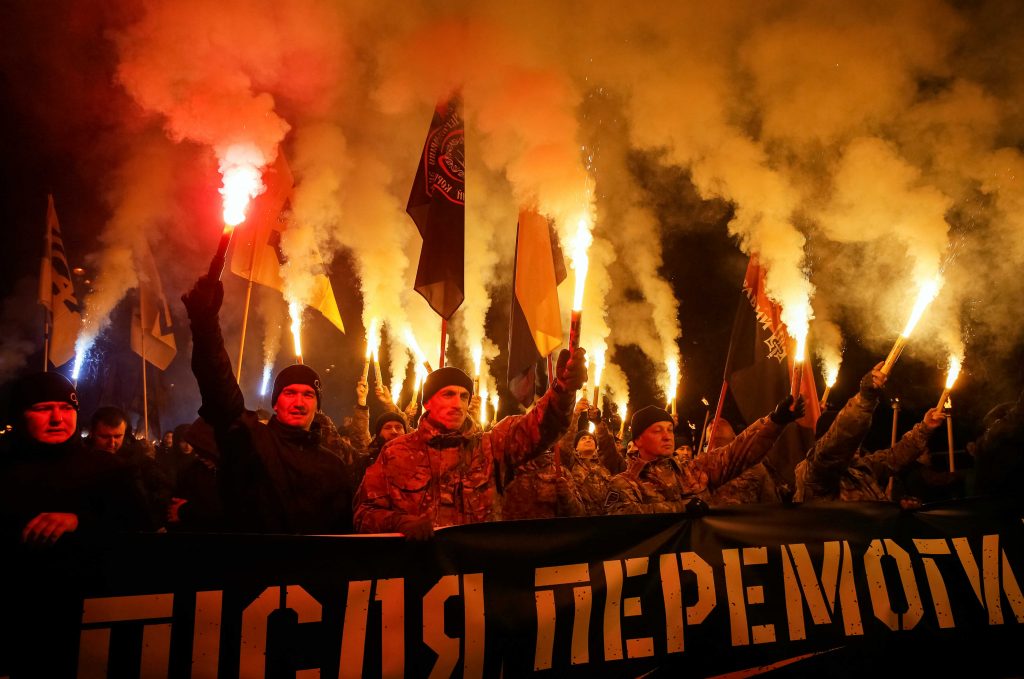
In both cases popular participation did not mean popular leadership, never mind one led by any sort of working class formation.  In 2014 it was far-right forces that formed the vanguard of its organisation, with western supported NGOs providing much of the veneer of a progressive movement.  The United States helped fund these NGOs and the Maidan protests that year provided the occasion for exposure of its political interference, through recordings its officials discussing who should, should not, and subsequently would be in the government.  This interference continued at the highest levels thereafter, so that Joe Biden, as US Vice President, boasted of his having more phone calls with the Ukrainian President than with his wife.  The war, and reliance on western arms, has simply made clear to even the meanest intellect the client relationship that developed.

Top-down manipulation, involving popular support and mobilisation often with progressive illusions in their enterprise–yet with oligarchic and imperialist objectives–have now taken the form of a war provoked by prospective membership of NATO.  Just like the previous mobilisations, except much more quickly and with much greater effect, these popular movements have led to bitter disappointment.  Today this results in military offensives that cannot succeed, except in killing and mutilating hundreds of thousands of Ukrainians in uniform.

Just as the working class was exploited by oligarchs before the war, protected by the Ukrainian state that was often their direct instrument, so it is working class men, in the main, who are dying and being mutilated in the war, although increasingly women are being recruited.  Just as before the war, the repeated hopes of many Ukrainians and desire for a more democratic and prosperous future is being dashed.

There is mounting evidence of the Ukrainian state having to press-gang men into the army and of many attempting to avoid it by leaving the country, joining millions who have already fled.  More Ukrainian soldiers are refusing to carry out suicidal orders or deserting.  Reports from many countries indicate that the refugees that have left may decide to stay away, rather than return to a war ravaged country and to a state once again promising probity and democracy.  There is particular concern about the demographic future of the country, with so many women and children having left, so that the pre-war population decline now threatens to become a ‘catastrophe‘.

The current offensive pushed by western imperialism and agreed by the Zelensky regime has little chance of succeeding in any significant way, admitted in secret US documents placed on the internet. This calls into question the whole initiative and the sacrifice of lives it is requiring, although not for western imperialism whose prime objective is not to take territory but attrition of the Russian forces and weakening of the Russian state.  It is openly admitted and reported, that the objective of some NATO members is to ‘break Russian power and to bring Ukraine into NATO’ with Poland hoping ‘that Rus­sia might even­tu­ally break apart’. (Financial Times 11 July)

Just as Ukraine was used, with the willing support of much of its ruling class, to support western imperialism by pushing for NATO membership, precipitating the war, so it continues to be propelled forward by Western arms and hollow promises of victory from the Ukrainian regime.  Just as the Ukrainian state lied about the security to be won by pursuing membership so its people are being fed lies about NATO weapons delivering victory.  Lies that the pro-war western ‘left’ endorses through its support for the war, support for the objectives of the Ukrainian state, and support for the western provision of arms that facilitate continuation of the war with all its casualties, but which will not bring the promised triumph.

Since the west has run out of conventional artillery shells of the required calibre it is now supplying cluster bombs and long range missiles, which again this ‘left’ must endorse or, like its ruling classes, have to admit that its policy has been an utter failure, one that hundreds of thousands have paid for with their lives.

This ‘left’ cannot admit it supports a proxy war by western imperialism even as both Ukraine and imperialism admits that western weapons are vital to the war effort.  Support for an imperialist war in which millions of workers have been casualties in one way or another is not something that can be admitted as a ‘mistake’, perhaps something to be forgotten or worse, rationalised and theorised for future such wars.  Just as the seeds of its capitulation were planted in previous errors, so the weeds they have sprouted have grown and taken over whatever was once worthwhile.

Back to part 1

Forward to part 3

Opposition to cluster bombs . . . whatever

source: A Jazeera

What are we to make of an article from a left web site that starts like this:

‘The supply of cluster munitions by the US to Ukraine must be opposed. Anti-capitalists and internationalists support unconditionally the people of Ukraine in their armed resistance to liberate their country from the Russian genocidal invasion. But the support for Ukraine is not necessarily uncritical. We have been critical of the Zelensky government attack on labour rights in the country and its embracing of neoliberal policies. Now we have to criticise its use of cluster munitions.’

The first sentence might seem to require no comment, but even this is not the case, what does opposition entail?

The second declares that the Russian invasion is ‘genocidal’, which is simply untrue.  However bad it is, the point of the invasion is not to destroy the Ukrainian people, and such claims only promote the war: after all, if this is the point of the invasion then there is no point in not fighting to the death, and, given such stakes, the use of old cluster bombs hardly looks excessive. 

The truth, however, is that the purpose of the Russian invasion, as the article later acknowledges, is not this, but ‘Ukraine’s de-Nazification and demilitarization and implicitly integration into Russia’s orbit.’  However one understands this, it is far from the destruction of the Ukrainian people, and the employment of the term not only belittles the history the word does apply to, but also shows scant regard to the real nature of the war, what approach should thereby be taken to it, and therefore how it might be ended.

We have been over many times the deception of describing the war as one of ‘the people of Ukraine in their armed resistance to liberate their country’, when the war is waged by the Ukrainian state and the liberation sought includes areas that wouldn’t welcome it.  What matters here is the assertion that ‘Anti-capitalists and internationalists support unconditionally’ Ukraine in its war.  In other words, all the words of condemnation of the use of cluster munitions will not dent their support for ‘Ukraine’, so simply dissolve into moral handwringing. 

How do we know that this condemnation is worthless?  Well, because it involves no change in approach, as the article acknowledges.  It says that ‘support for Ukraine is not necessarily uncritical. We have been critical of the Zelensky government attack on labour rights in the country and its embracing of neoliberal policies. Now we have to criticise its use of cluster munitions’.  So, previous criticism has not dented support and neither will the use of cluster munitions; just as previous claims that the supply of offensive weapons would not be supported, so this red line of the pro-war left breaks exactly at the same time as western imperialism crosses it, in perfect sequence.

If this ‘left’ can support a capitalist state when it attacks workers’ rights and imposes ‘neoliberalism’, by which is presumably meant rabidly pro-capitalist policies, what barriers remain?  What could the Ukrainian state do that would lead this ‘left’ to oppose it when its support is ‘unconditional’?  In the major geopolitical struggle in the world today, what role does this left play that is in any meaningful way different from western imperialism itself?  If ‘unconditional’ means what it says, then there can be no conditions placed on imperialist support for its ally.  This ‘left’ has bound itself in a tight embrace not only with the rotten and corrupt Ukrainian state and its ruling class but with their own states and their own ruling classes.

‘It is understandable that Ukraine wants to get all the arms necessary to get a quick and decisive victory against the Russian army’, says the article!  Has the author not noted that the war has been going on for 18 months; that the much anticipated Ukrainian counter-offensive is stalling and was never expected to achieve much anyway; that the Russians are now advancing as much as the Ukrainians?  Does this left accept every stupid statement of the Ukrainian state at face value; and if it does, how does this not invalidate its own qualms about cluster munitions if the possibility of ‘a quick and decisive victory’ is not a reasonable thing to anticipate?

Their lofty and high-minded approach departs further from the real world as it states that ‘whatever the military arguments, opposing the precepts of the Convention on Cluster Munitions will make it harder for Ukraine to argue for the international rule of law. If Ukraine gets weapons that most UN member states (including the UK) are seeking a ban on, it will affect its ability to win solidarity and condemnation of Russia’s illegal occupation by these states.’

What exactly is the ‘international rule of law’, perhaps their ‘left’ version of the imperialist ‘international rules-based order? ‘ Both equally fictitious and utterly irrelevant when conflict becomes a test of strength and power.  Who will be affected by the claimed reduced Ukrainian ability to ‘win solidarity’ when this left itself will not be impacted in its own support?  Does it believe western imperialism gives a shit about the impact of cluster munitions?

Perhaps it believes that there are sections of the world’s population who will oppose cluster munitions and not hold a position of ‘unconditional’ support to Ukraine; who might then question the virtue of this state and the justness of its war, and might then go on to draw conclusions about it–that it should be opposed, and the cluster munitions-wielding Ukraine should not be supported?

What then for the loyal left, which supports Ukraine ‘unconditionally?’  Surely it would be honour bound to redouble its defence of Ukraine against any possible wavering of support.  That, anyway, is the logic of its position, the logic of its ‘opposition’ to cluster munitions.

Of course, in mealy-mouthed fashion it notes that ‘Ukraine has also used cluster munitions, albeit on a much smaller scale. While not used on cities, they nevertheless did cause death and injuries to civilians.’

At this point one might wonder what the point of the article is; this boat has already sailed, so why the advice that ‘If Ukraine wants to maintain the solidarity around the world, it should not break the ban on cluster munitions by over 100 countries’?

Ukraine has not signed the Convention on Cluster Munitions, so has not and is not breaking from its policy, or previous practice (as in 2014-2015 in Donetsk city for example) and has repeatedly asked to be supplied by them.[i]  The pro-war left makes no distinction between solidarity with Ukraine as a state, as a people, or a working class, but in this case it is clearly only the state that can decide not to use cluster bombs.  So, it either has to appeal to this state to forego their use, which is hardly likely, or to its population or working class, although this would open up recognition of the difference and invite the conclusion that they are not synonymous and even have separate interests.

It is also a bit absent to dismiss the ‘military arguments’ with a ‘whatever.’  The pro-war left have pointed to the absolute necessity for military support–‘Ukraine also needs a mass solidarity internationalist movement that supports its armed resistance’–and since Ukraine is running out of ammunition, the US has stated it has no choice but to supply cluster munition because it doesn’t have any other.

The whole article is blind to its deception.  It reads as the necessity to maintain the reputation of the Ukrainian state, with opposition to cluster munitions entirely secondary.  Where, for example, is the appeal for the Russian state not to deploy them, or to the international working class to demand this?  But of course, on the coat tails of western states and their mass media, Russia, its people and its working class are beyond the pale.

Human Rights Watch is quoted as documenting their use, but that ‘Ukraine used cluster munitions, albeit on a much smaller scale. While not used on cities, they nevertheless did cause death and injuries to civilians.’  But this is not quite what the report, and one referenced by it, says:

‘Ukrainian cluster munition rocket attacks in the city of Izium in 2022 killed at least eight civilians and wounded 15 more, Human Rights Watch said. . . . The total number of civilians killed and wounded in the cluster munition attacks that Human Rights Watch examined is most likely greater. Russian forces took many injured civilians to Russia for medical care and many had not returned when Human Rights Watch visited.’

‘Ukrainian armed forces reportedly used cluster munitions in attacks on Izium city, Kharkivska region, between March and September 2022, when it was controlled by Russian armed forces, according to the Independent Commission of Inquiry on Ukraine. The commission provided three examples illustrating this use of cluster munitions in Izium..’

‘Anti-Capitalist Resistance’, that stands over this article, is blind to the reality of this war because it has abandoned a Marxist understanding of what is going on.  That is why the article is incoherent.   Nothing provides a better example of this than the statement that ‘Reconstruction after the war must be for another Ukraine with economic and social justice, not one where the country’s assets are handed over to western capitalism.’

How this is to be achieved through the arms of western imperialism wielded by a corrupt capitalist Ukrainian state is unexplained.  No explanation is possible.

Marx said of his politics that it did not appeal to “an ideal to which reality [will] have to adjust itself” but was based on “the real movement which abolishes the present state of things”.  The reality of the war in Ukraine will not adjust itself, during or after, to the otherworldly moralising of Anti-Capitalist Resistance, and the movement that will abolish war is that of the working class, not ‘the Ukrainian resistance’, not ‘a mass solidarity internationalist movement that supports its armed resistance’, and not the supply of only ‘good’ weapons by Western imperialism so that the blushes of ACR can be spared.


[i] These requests follow (according to a report) that ‘Ukraine in 2011 . . . cluster munitions constituted 35 percent of its stocks of conventional weapons, which totaled two million tons of ammunition.’

War as the continuation of politics by other means – the case of Ukraine 1 of 3

Marxists do not support or defend the capitalist state because we see it as an instrument that defends bourgeois private property, which exists only in so far as the working class is exploited and oppressed by capital and this capital accumulated to ensure further exploitation.  We do not do so in peacetime and there is no reason why we would do so in war, which has often been the product of the rivalry of competing capitalist powers, and amounts to their struggle over the relative shares of the resources for, and fruits of, exploitation. Why would we want to defend the structures of the system that ensures our exploitation?

Even when it comes to ensuring the most advantageous circumstances for our struggle against this exploitation and subjugation–through defending general civil and democratic rights that we sometimes have, we do not thereby either consciously or objectively support or defend the state within which we avail of them.  In fact, these struggles often involve struggles against the state and its efforts to restrict our rights and freedoms.

In anti-colonial struggles or against annexation within a larger empire these struggles are against the particular capitalist state.  They have, when successful, almost invariably led to the creation of new capitalist states but it is precisely socialists who will also oppose these new states and attempt through a strategy of permanent revolution to destroy them and create a new state based on the power of the working class.  Of course, for nationalists, it’s all about the creation of a new capitalist state, so that for them self-determination of nations equates to their creation.  For Marxists there is no reason to seek the creation of newer instruments that ensure exploitation of the working class.

For us, the struggle continues within the new state–as a class struggle with the objective of destroying it–because for us the objective is the self-determination of the working class and against any new state that will subordinate the working class to itself.  For us, support for the right to self-determination does not equate to support for separation or independence; support for the right to create one does not entail automatic support for its actual creation.

We are in general opposed to the splintering of larger states into smaller ones, which are usually the projects of petty bourgeois forces seeking to advance their social position through the offices and rewards to be garnered from creation of a new state apparatus.  The creation of new state borders increases divisions within the working class and obstacles to their organisation across them.

So, for example, Scottish nationalism seeks the division of the British working class, and instead of even uniting Scotland it has divided it down the middle–all in the name of the unity of the Scottish people.  Even in Ireland, with many years of prior unity, the partition of the island has deepened the divisions that already existed.

War itself causes bitterness and division and the war in Ukraine is no exception.  Not only has it deepened the division between Ukrainian and Russian workers, it has deepened the existing division within Ukraine, with a significant minority living in the east of the country seeking unity with Russia.  Internationally it has created deep and lasting divisions within the socialist movement, with many rejecting some or all of the arguments that will be made in this and the following post.

As part of the attempt by the US to reassert its world hegemony it has deepened division in the world with many countries seeking to avoid their subordination, and to develop their resilience to US demands and its existing military and financial power. The war has precipitated bellicose demands for rearmament and accelerated preparations for war, which are products of relative US economic decline and that has allowed developing countries more latitude in manoeuvring to protect their own state interests. Widespread rearmament and increased scope for assertion of state interests opens up the potential for yet more war.

*                     *                     *

That the onset of war doesn’t change the policy of Marxists should not be a surprise and is in accordance with the oft quoted observation of Carl von Clausewitz that “war is not merely a political act but a real political instrument, a continuation of political intercourse, a carrying out of the same by other means.”  This has profound implications for those self-styled Marxists who support either of the two warring states and the two largest capitalist states that stand behind them.

If they defend these capitalist states now there is no reason that they should not have done so before the war and should not continue to do so when it ends.  Their ‘Marxism’ is therefore fraudulent and worthless.

This ‘political continuation’ has had a long maturation, with the expansion of NATO across Eastern Europe eventually threatening to include Ukraine, and the crossing of the reddest of Russian red lines being the major casus belli for the Russian invasion.  It explains preceding events and the immediate prominent role of the US and NATO in supporting the Ukrainian state.

The ’continuation of political intercourse’ is further demonstrated by the features of the warring parties becoming clearer through war.  While western imperialism claims Ukraine is involved in a war for democracy and will be transformed by it, including by the eradication of corruption, all the developments since it erupted point to the intensification of all its previous features.

The divisions in Ukrainian society have become a chasm as the Russian leaning population will cleave to Russia even more as they become citizens of that state.  Rampant anti-Russian Ukrainian nationalism has intensified further with attacks on Russian culture and celebration of the most reactionary aspects of Ukrainian nationalist history, including its collaboration with fascism during the Second World War.  The trajectory of the pro-war left, determined by the objective logic of their pro-Ukraine position, and regardless of subjective intentions, has seen them prettify and decorate this reactionary movement through the disguise of ‘decolonialism’.

Far from corruption reducing as a result of war there are no indications of it falling: Transparency International records the score for Ukraine in 2022 being the same (at 33 out of 100) as the 2020 score, with even the BBC reporting on the corruption of payments by young Ukrainians in order to avoid conscription to the front. As the by-line of a Guardian article puts it ‘As the UK is set to hold a conference on how to rebuild post-war Ukraine, many worry what will happen to funds sent through a system where money disappears.’

It quotes Joe Biden in 2015 saying that “the corruption is so endemic and so deep and so consequential, it’s really, really, really, really hard to get it out of the system.”  The Guardian article reads not that the war has solved the problem but that it still exists and there is concern about what to do about it.  The article reports that Ukrainians don’t trust their own government to deal with the problem while some have faith that the EU might. At the same time a board member of the ‘Ukraine Anti-corruption Action Center’ blames Russia!

The article states that ‘many say checking the rise of a new oligarch class has been hampered by the abandonment under martial law of many of Ukraine’s extraordinary transparency measures, including registries of the property and income of public officials.’  The article then mentions that ‘one western lawyer closely involved in Ukrainian extradition cases over the past decade says he is still not sure European politicians quite understand how deeply corruption is ingrained in the political culture’, and notes that the court system is s big problem, and that ‘Zelenskiy has refused to accept the full recommendations from the Venice Commission to give a majority to the international judges that screen applicants for the constitutional court.’

The war has accelerated austerity, privatisation, attacks on workers’ rights, censorship, and attacks on media and opposition political parties by the Zelensky regime.  It has saddled the country with more debt and complete dependence on Western imperialism, with conferences openly discussing how money can be made out of it when the war ends.  It should be noted that many of the same measures in Ukraine are reflected in those western countries supporting it, including attacks on workers’ living standards through increased inflation; a media on a propaganda spree unprecedented for many years, and a threatened massive increase in arms spending.

The article from the rabidly pro-Ukraine Guardian is admission that the concentration of power in existing institutions combined with massive restrictions on democratic rights, alongside provision of huge resources (totalling $170bn) by the West to an already corrupt state is not a recipe to reduce corruption.  Foreign mercenaries fighting for Ukraine who have returned home have noted the graft involving weapon supplies, even at the front. The western powers have decided to accept this on the grounds of the greater objective of weakening their geopolitical rivals but aren’t buying their own message that Ukraine is a beacon of democracy.

The imperialist project for Ukraine is no different than it is for their own working classes but somehow some on the ‘left’ in the west see one as being progressive. Unfortunately or not, they cannot be separated.

Forward to part 2