The war in Ukraine (6) – NATO expansion against the Russian threat?

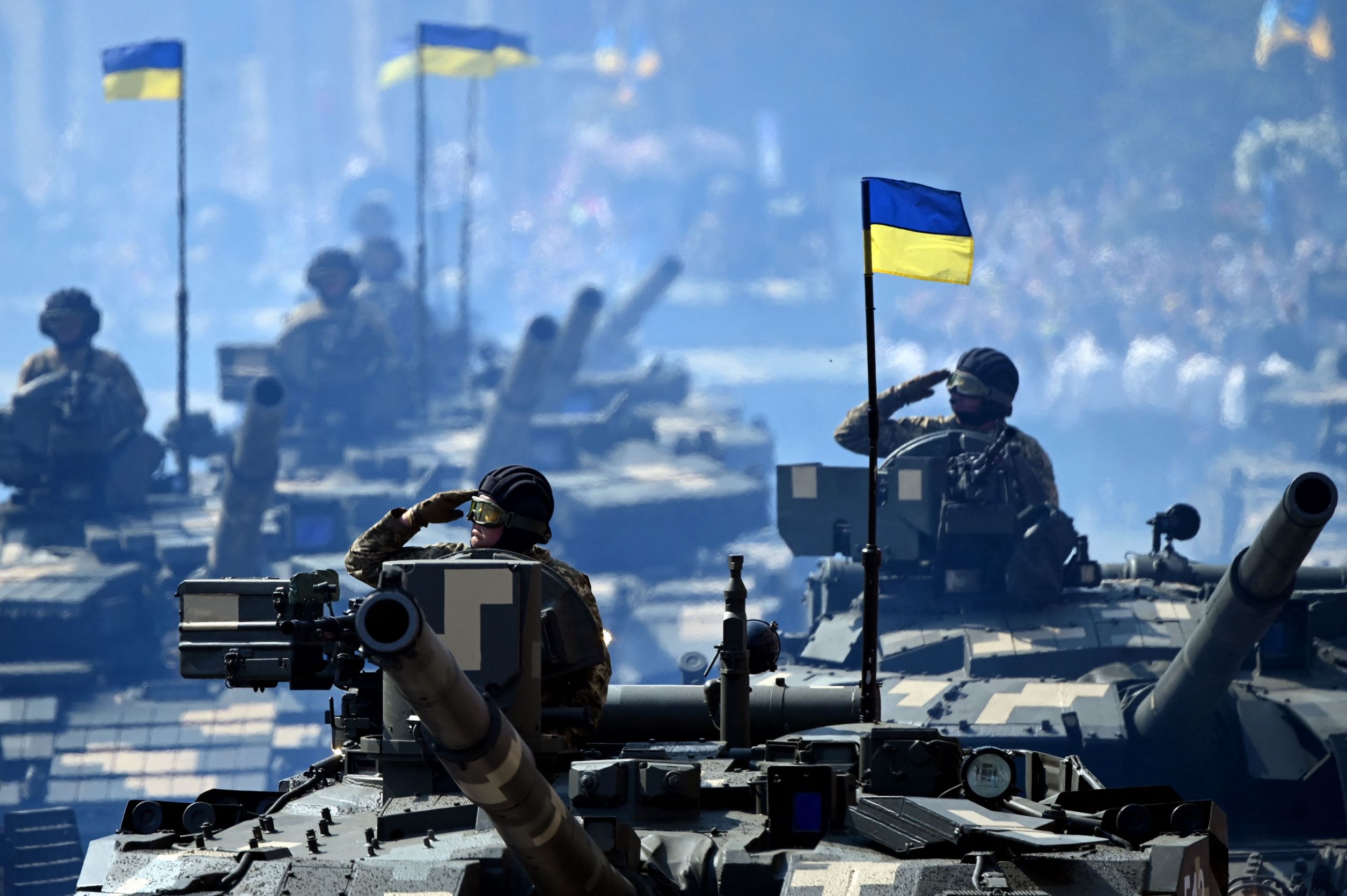
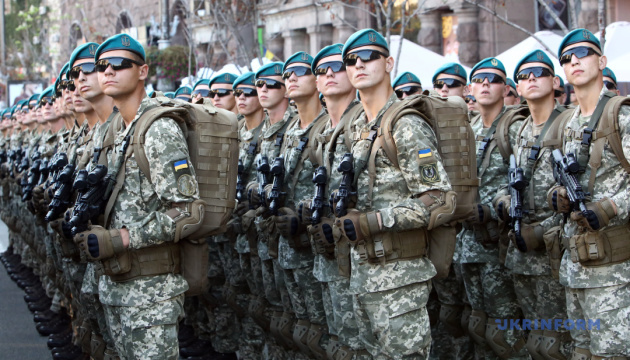
At the end of 1991 a plan was put together to determine how NATO would relate to the newly independent states in Eastern Europe through creating a new organisation, the North Atlantic Cooperation Council (NACC), open to all former Soviet Union republics as well as former Warsaw Pact members.  One country, however stood out from the rest–Ukraine.  The US ambassador to Russia stated that loss of Ukraine was a more revolutionary event than the fall of communism.  Gorbachev was furiously opposed to US communication with Kiev, pointing out its large Russian population and its artificial borders that included Donbas and Crimea.  The US “Draft Options Paper” thus recommended “the possibility of Ukraine joining the NATO liaison program at a later time.”

At this time the US was concerned with Ukraine’s possession of nuclear weapons and its policy that this was unacceptable, although some US officials argued that the problem would disappear if Ukraine joined NATO.  Clearly, they believed that the nuclear weapons that would be kept would be pointing at Moscow and not at Washington.

The view that won out was one of a step-by-step NATO expansion that was not too obvious but that “will, when it occurs, by definition be punishment, or ‘neo-containment,’ of the bad Bear.”  Even Yeltsin was compelled to complain of the creation of a “cold peace” while Bill Clinton believed “Russia can be bought off.”  Ukraine’s Deputy Foreign Minister Borys Tarayuk told the US that “No matter what we say publicly. I can tell you that we absolutely want to join NATO.’

Under the Clinton administration the US became Russia’s largest foreign investor but this did not prevent it going ahead with new missile deployment–the Theatre or Terminal High Altitude Area Defence system–reversing the previous view that it violated the Anti-Ballistic Missile Treaty, thus slowing down agreement over arms control.  Later, in 1997, fifty former US senators, cabinet secretaries, ambassadors, and others signed a letter demanding that “the NATO expansion process be suspended.”

Russian policy proposed collaboration in the defence industry, with legal prohibitions on nuclear weapons in new NATO states and stationing of foreign troops, but neither got anywhere while Clinton approved the testing of new nuclear weapons systems.  Promises from Yeltsin to potential NATO members of a security guarantee and complaints of Russian humiliation achieved nothing.  In any case, Yeltsin was Washington’s man with Clinton stating that “Yeltsin drunk is better than most alternatives sober.”

Supporting ‘Yeltsin drunk’ meant helping procure condition-free loans of $10.2 billion from the IMF to ensure Yeltsin’s re-election as President in 1996, while Russian oligarchs met privately at Davos to ensure a victory that would assist their procurement of state assets.  Despite suffering his second heart attack and virtually disappearing from public view he won the election.  Yeltsin had used the money to travel the country dispensing it to buy votes in what his campaign staff in night-time planning sessions called ‘what-shall-we-hand-out-tomorrow’ meetings.  As Clinton said, “If the Russian people knew how much I wanted him re-elected, it might actually hurt his chances.’  Time magazine hailed their intervention as “Yanks to the Rescue’ (July 15 1996.)

In effect, the US had interfered big time in the election to get its favoured candidate elected in a vote that involved “widespread voter fraud” according to a member of the OSCE election-observation team.  This observer also claimed that he was pressured to keep quiet about the irregularities, including that in Chechnya fewer than 500,000 adults remained but more than a million had voted, 70 per cent for Yeltsin.  All this puts into perspective more recent US Democrat complaints about purported Russian interference in Trump’s victory over Hilary Clinton. 

A new a NATO-Russia agreement in 1997 was sealed by yet more money from the US along with lots of promises, including that NATO had “no intention, no plan, and no reason to deploy nuclear weapons” or substantial combat forces.  Privately Clinton was assured that his early assessment was correct that no absolute commitments had actually been made, the only real one being simply a commitment to meet. By the end of the year Madeline Albright was already telling the Russians that the US “would not consult on future infrastructure including on the territories of the three invitees’–the newly invited Central and East European members of NATO.

In 1998 Yeltsin asked Clinton for more help with IMF loans but the money flowed out of the country almost as quickly as it flowed in, prompting US officials to note that “the infamous oligarchs continue to put their personal interests above the common good.” They seemed not to consider that this was a result of the introduction of capitalism into Russia that they had promoted, or that putting ‘personal interests above the common good’ was one description of what capitalism is all about.

Some US officials were wary of being too openly antagonistic to Russia and its long-term consequences, while French President Jacques Chirac told the US National Security Advisor Tony Lake that “we have humiliated them too much” and that “one day there will be dangerous nationalist backlash.”  Chancellor Kohl also worried about the long-term reaction to NATO expansion, and even the British worried about the Article 5 guarantee being too strong and risky to offer too widely.  The American proposer of the original post World War II American containment strategy, George Kennan, argued in 1997 that NATO’s expansion was “the most fateful error of American policy in the entire post-war era.”  

None of this advice for a more cautious approach prevented the US and NATO bombing Serbia without a UN Security Council resolution, without invoking an Article 5 guarantee and without aggression by another state.  To Russia this proved that NATO expansion was not about bringing peace to Europe and claims it was doing so were a lie, with Yeltsin’s critics saying ‘Belgrade today, Moscow tomorrow.’  The example of Kosovo and the justification for war was subsequently employed by Russia itself. The New York Times then reported that Russia had resumed “targeting NATO states with nuclear warheads.”

Looking back in 2015 Bill Clinton’s defence secretary Bill Perry concluded that arms control became “a casualty of NATO expansion” and that “the downsides of early NATO membership for Eastern European nations were even worse than I had feared.”  The CIA noted in 1999 that Vladimir Putin was concerned over the capabilities of its conventional forces, the increased threat from NATO, the need for new nuclear capability and the fear “that a future conflict could be waged on Russian soil.” 

NATO expansion was thus not a result of Russian aggression or threats, or of the need for NATO to establish peace in Europe, but a product of Russian weakness and US determination to impose the fruits of its victory in the Cold War.  Bourgeois figures in many countries noted the provocations involved and the future risks entailed.  Even Joe Biden admitted in 1997 that, rather than NATO membership, “continuing the Partnership for Peace . . . may arguably have been a better way to go.”  Yet now we are to believe that none of this is relevant to the war in Ukraine, with its constitutional imperative to join NATO.

Today’s leaders of these countries deny that the expansion of NATO and the steps towards Ukrainian membership have anything to do with current Russian policy and actions. How incredible is it then that certain parties on the Left agree with them, going so far as to support Ukraine and defend NATO and in doing so further, in so far as they can, membership of the former within the latter? And all this under the flag of ‘anti-imperialism’ and a war of national liberation!

Back to part 5

Forward to part 7

The War in Ukraine (5) – the amnesia of the pro-war Left

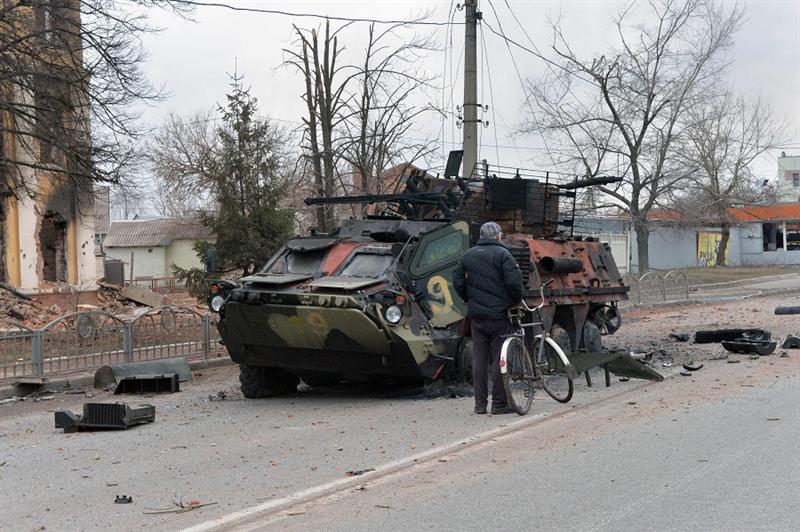
Getty Images

One of the problems with the view that the war in Ukraine is unprovoked is that it erases much of history, wipes clean western imperialist actions, supports the idea that this imperialism is democratic, and robs the working class of the knowledge it needs to orient itself in the world.

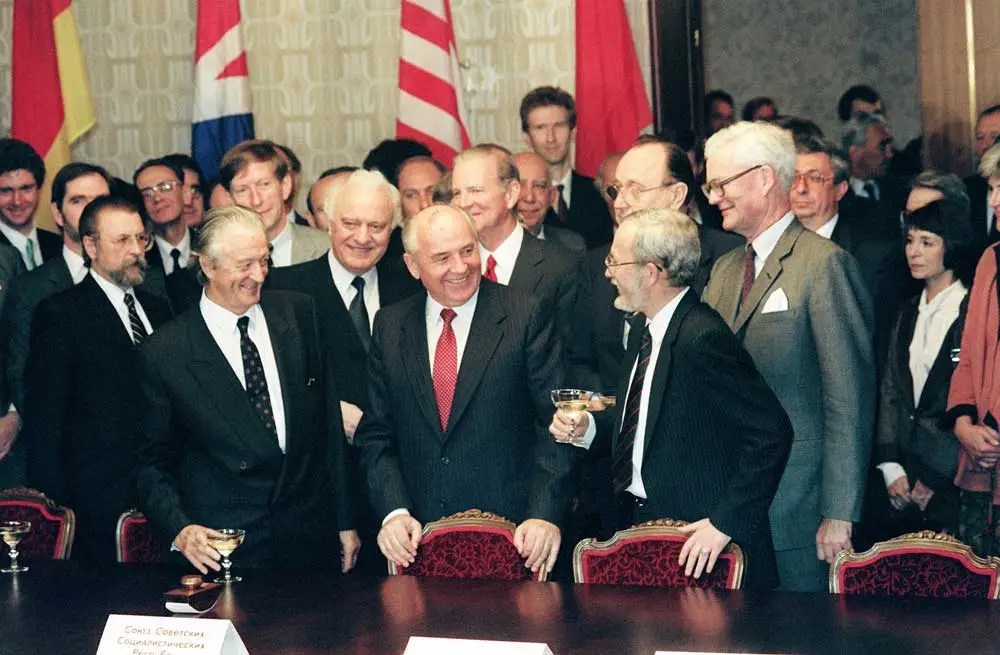
Far from being unprovoked the war is a result of repeated provocations that we can outline, beginning with the collapse of the Soviet Union and Warsaw Pact, when the Soviet foreign minister Eduard Shevardnadze made this “reasonable proposal” to James Baker, the US secretary of state: “Let’s disband both NATO and Warsaw Pact.”  It hardly needs saying what the reply was and how it relates to the current war; unless of course you belong to the band of ‘socialists’ who blame Russia in toto.

There was nevertheless an obvious problem for western imperialism, and the United States in particular: how to justify the existence of NATO as a ‘defensive’ alliance when the enemy no longer existed.  Further to this, the problem was couched in the context of a possible Soviet Union offer for quick unification of Germany in return for leaving NATO and declaring neutrality. This was even further complicated by the knowledge that this offer would have “widespread support among the members of the public in both East and West Germany”, as the German chancellor Helmut Kohl later admitted. Polling showed that 84 per cent of West Germans wanted to denuclearise their country and leaving NATO in return for German reunification would win widespread support across the country.

The US and NATO has portrayed its expansion into central and Eastern Europe as an exercise in democracy–’all the countries joined of their own free will’–but the German events are only one example of the dismissal of the views of local populations that was repeated later in Ukraine.  This includes Soviet offers to get rid of nuclear weapons that the US rejected but that, if we follow the logic of the pro-war left, we should now endorse.  Not that this left currently follows its own reasoning to its conclusion.  It is just that it has no logical claim to reject it, and leaves the working class in the West open to the argument that the problem is an aggressive Russia and the solution a suitably armed NATO with nuclear capability to prevent Russia from doing what it wants.

The US faced the additional problem that the German foreign minister Hans-Dietrich Genscher publicly supported the idea that there should be no expansion of NATO to the East, something repeated on several occasions.  The US was bitterly opposed, as one US official stated in an internal memorandum, this “would forfeit the prime assets . . . that have made the United States a post-war European power.”  However, when Gorbachev stated that any expansion of the “zone of NATO” was unacceptable, US secretary of state James Baker stated, according to Gorbachev, that “we agree with that.”  This, of course, was a lie, one that became particularly controversial and the focus of repeated complaints by the Russians that are still routinely derided by the western media today, but was repeated by Kohl in relation to the territory of the then East Germany.

While the German chancellor was saying that NATO would not expand its territory eastward into East Germany, Genscher repeated the position that “for us, it is clear: NATO will not extend itself to the East”. The secretary general of NATO, Manfred Worner, also asserted that the fact it would ‘not deploy NATO troops beyond the territory of the Federal Republic gives the Soviet Union firm security guarantees.’

After agreement to German reunification the problem then became how to remove Soviet troops without also having to remove NATO ones.  Proposals by Gorbachev for the Soviet Union to join NATO were rebuffed, as were later attempts by Yeltsin and still later ones by Putin for Russia to become a partner of western imperialism; something that discomforts both supporters of ‘Russia is to blame’ and ‘Russia is to be supported’ camps today. 

The weakness of the Soviet Union at this time was exposed by its requests to Germany for funding for its troops stationed in the country, a weakness that the West, and particularly the US, exploited when it promoted the shock therapy applied to introduce capitalism into Russia.  Throughout the NATO expansion, Russia was too weak to resist, and the US was able to proclaim a “new world order” that included this expansion and wars against Iraq and Afghanistan plus others.  It might seem impossible to separate this history of imperialist aggression from the war in Ukraine, but that is exactly what supporters of the war must affirm if it is to be seen as uniquely free from Western complicity.

However, as early as 1992 an official of the US State Department had contacted the Ukrainian ambassador in Washington to urge Ukraine to join NATO, while in the following year the Ukrainian deputy foreign minister was stating that it was “unacceptable for NATO to expand without Ukraine becoming a full member.”  Russian leaders were meanwhile saying that it should be first.

In 1994, Ukraine was the first post-Soviet country to conclude a framework agreement with NATO through the Partnership for Peace initiative, a road by which Central and Eastern European countries could join NATO, and was its most enthusiastic participant, seeking to join exercises and contributing 400 troops to the Implementation Force in Bosnia in 1995.  The next year its Foreign Minister discussed the potential to become an ‘Associate Member’ of NATO while Russia made it known that this would be considered an ‘unfriendly policy’ with ‘all the resulting consequences.’

In 1997 the Ukraine Foreign Minister went further in stating the strategic goal as complete integration into NATO.  Later he voiced concern that this might involve the deployment of nuclear weapons in Ukraine’s western neighbours and proposed a nuclear-weapons free zone, which NATO rejected.

Ukrainian President Kuchma continued steps to join the European Union and in 2002 established a schedule for meeting accession requirements by 2011, while the Ukrainian National Security and Defence Council also discussed the need to “start practical implementation of the course to join NATO”.   Ukraine continued to pass parliamentary resolutions stating its objective of joining NATO until mid-2004, sending 1,650 troops to support the US occupation of Iraq. In 2005 the new President, Yushchenko, sought a NATO Membership Action Plan, and in 2008 the Ukrainian government’s aspiration that Ukraine would become a member was approved at the NATO summit in Bucharest, pushed by the United States against some European reservations.

Yet opinion polls regularly recorded that there was still not majority support within the country for membership, with opposition reaching over 60 per cent in one poll, a result confirmed and reported in others here and here. One other from Gallup reported as its conclusion that ‘Ukrainians Likely Support Move Away From NATO, Residents more likely to view NATO as a threat than protection.’ 

As one of these argued: ‘As for public opinion, NATO membership should generally not be a matter of broad public acquiescence, but of a conscious geopolitical choice by a consolidated national elite. As part of NATO’s post-Soviet expansion, only Slovenia and Hungary have held referendums on membership – and Hungary’s was nonbinding. Slovakia’s 1997 referendum was declared invalid, as it gathered only 10 percent of eligible voters.’ 

Opinion polls in Ukraine repeatedly demonstrated majority opposition to NATO membership, or at least major division, even after the Ukrainian government approved ‘a four-year, $6 million “information campaign” to improve NATO’s image.’  The article quoted above argued that ‘While the jury is still out regarding its effectiveness, even with the best of PR campaigns and outreach programs, the West by now has generally accepted the uncomfortable fact that NATO may never gain broad popularity among Ukrainians, especially in the eastern regions of the country.’

We now know, of course, that the United States never gave up intervening into Ukrainian politics with the objective of moving the country into NATO. The author of these lines showed remarkable naivety in believing that popular opposition was anything more than an obstacle to be overcome rather than a democratic wish to be respected.  The price to be paid to overcome this obstacle was forecast right from the start, as we see below.

Russia reaffirmed its opposition to NATO expansion, and in particular into Ukraine and Georgia, on the grounds of violation of the principle of equal security and the creation of new dividing lines in Europe.  While Putin claimed that Russia had ‘no right to interfere’ with Ukraine foreign policy’, and if it wanted to restrict its sovereignty (by joining NATO) ‘that is its own business’, Foreign Minister Lavrov stated that “Russia will do everything it can to prevent the admission of Ukraine and Georgia into NATO’.

In the 2004 ‘Orange Revolution’ the American columnist Charles Krauthammer stated that ‘this is about Russia first, democracy only second . . . The West wants to finish the job begun with the fall of the Berlin Wall and continue Europe’s march to the east . . . The great prize is Ukraine’.  As Putin complained, they “have lied many times’ and in Ukraine “have crossed the line”.  “Everything has its limits.”  The Russian political scientist Sergei Karaganov was even more blunt in stating in 2011 that “NATO expansion into Ukraine is something Russia would view as absolutely unacceptable because it then becomes a vital threat.  In political jargon, this kind of threat means war.’ (The quotations not referenced are taken mainly from. ‘Not One Inch, America, Russia, and the Making of Post-Cold War Stalemate’, M E Sarotte, Yale University Press)

                *               *             *

At the start of the invasion I commented on Facebook that the Russians had warned that Ukraine could not join NATO and that this was a red line, only to be rebuked that, in effect, I was saying that Ukraine ‘was asking for it’.  I replied that this was, as a matter of simple fact, what had just happened.

Facebook is not a great medium for political debate so it should be elaborated here that, as we can see, the Ukrainian state played its own role in advancing the war through its repeated attempts to join NATO, even voting to place it as a constitutional imperative in 2019.  So, while the Ukrainian people did not invite war, its political leadership and its western backers certainly did.  How tragic is it then to now rally to the defence of the state that walked you into war and rely on western imperialist forces that led you there?

Even in 2012 only 28 per cent of Ukrainians supported membership of NATO.  What we see here is thus a sterling example of the old socialist maxim that ‘the main enemy is at home’; in this case the main enemy of the Ukrainian working class was its own capitalist state for whom it is now fighting and dying.  How much more obvious must it be that this should be opposed by all those who claim to be socialists and Marxists?  How obvious is it now that if they don’t, their claims to express any sort of socialism must be repudiated?

Back to part 4

Forward to part 6

The war in Ukraine (4) – the consequences of being ‘unprovoked’

On February 24 2022 the US President Joe Biden condemned Russia’s invasion as “a brutal assault on the people of Ukraine without provocation, without justification, without necessity” and a “flagrant violation of international law.” Putin he said, “rejected every good-faith effort the United States and our Allies and partners made to address our mutual security concerns through dialogue to avoid needless conflict and avert human suffering,”

Boris Johnson pronounced that ‘President Putin has chosen a path of bloodshed and destruction by launching this unprovoked attack on Ukraine’, while then foreign secretary, Liz Truss, said she had summoned the Russian ambassador “to meet me and explain Russia’s illegal, unprovoked invasion of Ukraine”.  The British Government website continues to have this as its leader – ‘The UK and our allies condemn the Russian government’s unprovoked and premeditated war against Ukraine.’  

The Irish Government as part of the EU has repeatedly supported its sanctions, even demanding they go further, joining Poland and Baltic states in calling for more.  Upon the invasion Tánaiste Leo Varadkar stated that whilst Ireland is militarily neutral, “in this conflict, Ireland is not neutral at all”, stating its “unwavering and unconditional” support for Ukraine.’

This Wikipedia entry sets out a whole list of States responses in which the word ‘unprovoked’ appears 29 times at my last count.

The media followed suit: the New York Times described it as ‘an unprovoked invasion’; the Financial Times a ‘naked and unprovoked aggression’; the Guardian ‘an unprovoked assault’, while the Economist thundered that ‘Russia’s president has launched an unprovoked assault on his neighbour.’

On 14 October 2022, Defenders Day in Ukraine, the US ambassador issued a video message saying:

‘The United States, our partners and allies, will continue to support Ukraine to hold those who commit war crimes accountable and to work to bring together the world to maintain pressure on the Kremlin until it ends its brutal, unprovoked war against Ukraine and our shared values. And we will continue to stand with Ukraine for as long as it takes.’

The position of much of the Western Left, certainly in Britain, is much the same, with a recent Ukraine Solidarity Campaign statement also calling for ‘a week of action’ against ‘the brutal and unprovoked invasion’.  It sees no provocation; absolves western imperialism and the Ukrainian state and regime of any responsibility; supports ‘Ukraine’s freedom, presented as ’self-determination’; has failed to oppose sanctions while mouthing hypocrisies about not supporting them either; sets no political limits to its support – that is ‘unconditional’; and supports western supply of arms, which along with sanctions and financial support are the main western imperialist interventions.

If anything, the political resources required by the support of the pro-war Left for Ukraine might seem to be much greater than that of the various capitalist states, politicians and media.  It has faced opposition from those socialists opposed to capitalist war, something that has been a principle of our politics at least from the exemplary case of the First World War, the character of which has recently been graphically exposed by the film “All Quiet on the Western Front’.  The pro-war left has had to face this opposition–which capitalist Governments and its bourgeois media are not of course concerned with–and reject its arguments, sometimes claiming how comfortable it is for its critics that they take such a position!

However, because it claims the mantle of socialism its position very quickly became dishonest, confused, as well as reactionary.  Consider the exchange of views in Britain between Anti-Capitalist Resistance (ACR) and the Stop the War coalition (StW).  Like many organisations not interested in principled politics, ACR argues the prime necessity for action and berates Stop the War for putting up conditions to joint activity.  

We have dealt with what sort of anti-war movement is required before, so suffice to say here that its own insistence on the absence of certain demands, such as opposition to NATO, is also a precondition.  The point of a political campaign is to fight for particular objectives that are directly relevant and to raise the consciousness of the working class.  To exclude certain demands is to avoid fighting for these objectives and failure to raise political consciousness around them.  Lack of concern for political principle leads to this obvious truth being passed over.

Since it is impossible to hide the political differences, it quickly became clear that those such as ACR calling for a broad approach, ‘designed to build the broadest possible movement against the war’, were not actually against the war but for it, war until Ukrainian victory.  This is where the pro-war position is dishonest.

ACR refuses to support demands opposing NATO, rejecting the view that ‘NATO’s expansion has “contributed to the war”’, stating that ‘this is not clear at all. It could equally be argued that Russia’s invasion of Ukraine was an act of unprovoked imperialist aggression.’  Having said that it could equally be argued that the war was the fault of Russia, what ACR really means is that Russia was wholly at fault, and the problem with the StW coalition is that it is not ‘engaging with the central issue: the unprovoked war on Ukraine.’

ACR wants to oppose an ‘unprovoked attack on Ukraine’, oppose the war and ‘to organise constructively against it – not in a way that fans the flames of war – which is why the demand “No to war” is included – but in a way that solidarises with the plight of the Ukrainian people.’  It thinks, or perhaps pretends to think, that you can demand solidarity with one of the sides waging without supporting war and without fanning its flames, all while supporting a greater and greater supply of weapons.  This is where the pro-war position is (shall we say?) confused

In their exchange of views the StW coalition raised the question of opposing arms expenditure as an urgent issue, but ACR regarded this as belonging to ‘a whole range of other criticisms’ that can be parked and not form part of the movement. But this identification of the issue by the StW coalition turned out to be very prescient: the British Trade Union Congress voted shortly after to support increased ‘defence spending’, more honestly stated as spending on war.  The ACR position would have left, and still would, any supposed anti-war position silent in this debate.  Since, in any case, the ACR defends the arming of Ukraine by the British state this is a perfectly logical position for it to take.  This is just one case in which the pro-war position is reactionary.

As the argument supported by ACR shows, the stance of the pro-war left rests, like that of western imperialism in general, on the view that the Russian invasion was unprovoked.  Of course, provocation does not equate to justification or automatically follow from it.  In the world of capitalist state competition provocation may be seen as sometimes inevitably resulting in war, but that does not require socialists to support either the provocation or the response.  In fact, opposition to both is clearly a principled socialist approach.

But this would not be enough for the pro-war left because admission of western imperialist and Ukrainian provocation would require taking this principled position.  Both western imperialism and Ukraine would then be seen as playing their own part in causing the war; Ukrainian agency as they call it, and having responsibility for it, in which case defending either would be anathema. The pro-war left cannot concede this reality; let’s call it the homage that treachery pays to principle.

The pro-war left denies reality when it absolves western imperialism and Ukraine of any provocation and therefore any responsibility.  In doing so, in denying recent history and current reality it signs up to an infantile view saturated with bourgeois morality in which Ukraine is Good and western imperialism Innocent; innocent of acting on its essential nature. 

The reality of capitalist war becomes instead a morality tale of heroic resistance, and the messy reality is only so much noise – unpleasant, unwelcome and better drowned out.  The unpleasant nature of Ukrainian nationalism for example, that shades into the relatively large constituency for fascism; or the fact that there are a large number of Ukrainians who support Russia, are just irrelevant noise to signal. 

Instead, they can fight for what is Good; while other socialists fight in opposition to their own capitalist state and capitalist class, watching and reading mass media propaganda about the ‘unprovoked’ war.

Back to part 3

Forward to part 5

The War in Ukraine (3) – a right to self-defence?

An argument related to the demand that Ukraine should be supported on the grounds of national self-determination is a general argument that there is a right to self-defence, although this is a no more cogent argument than that deriving from a claim to self-determination.  The civilian population of Donetsk could claim the same right to defend themselves from increased attacks by the Ukrainian military just before 24 February 2022, and the population of Crimea and Donbas more generally have the same right against the plans of the Ukrainian state to conquer and reoccupy their territories.  By demanding membership of NATO the Ukrainian state has given validity to assertion of this same right by the Russian state to defend itself and its supporters in these areas.  Lacking any class basis those supporting either Ukraine or Russia can, and do, parrot the same arguments that thus expose each other to the same rejoinder and counterclaim.

This argument is not to say that at the level of individual Ukrainians it is not permissible for them to defend themselves, but what the pro-war left is proposing is political support to the Ukrainian state and armed forces that are carrying out the fighting.  This is how those Ukrainians who are fighting for their state see it, expressed in nationalist terms as defence of their country.  But as Marxists maintain, countries are not united and the interests of the different classes composing it are antagonistic. At the level of individuals, it has made more sense to leave the county or relocate, as millions have done, and as we have noted before, those nearer the front line are more in favour of peace than those further away cheering for victory.

In other words, this claim that seems so straightforward, and may even appear to be so at the level of the individual, does not exist, and what we need is what we set out at the start – a Marxist analysis of the cause and nature of the war as determined by its historical origins and development and the nature of the participants and their objectives.

The reliance on an abstract right to self-defence is empty since socialists recognise no such right for the capitalist class or its state, which is why the support for the latter by the Second International was recognised as such a historical betrayal in August 1914.  What its twenty-first century imitators repeat is the lack of any principled Marxist position, retreating to the refuge of abstract moralism, which Marxists, going back as far as Marx himself, find repugnant because behind it lies the interests of the capitalist class–presented as universal truths–universal precisely because everyone, from right to left, can espouse them.

So, what we are left with are vacuous moral statements that don’t amount to an argument – that invasions are bad, that the Russians are aggressive and cruel and human rights must be protected.  That a Ukrainian invasion of Crimea would be bad, that the demand for NATO membership is aggressive and that Ukrainian fascists can hardly be trusted not to be cruel and deny human rights, are all objections to such claims.  It could be argued that the first catalogue of Russian immorality is what counts but that requires argument that the Ukrainian one doesn’t, (or perhaps doesn’t even exist if the western media is to be believed). But it’s obvious that occupation of Crimea would involve violence and oppression, that NATO is an aggressive imperialist alliance, that fascist units exist in the Ukrainian armed forces and that these armed forces are not the first to abide strictly by the laws of war.

So much of the argument in support of Ukraine is therefore based on arguments which dissolve when attached to concrete reality, only to return in abstract moral declarations.  We are not therefore on the terrain of Marxist analysis and Marxist politics, which explains why it is impossible for this left to take such a position.  It is why their arguments are so similar to that of western imperialism, its politicians, think tanks and media commentators, and their solutions so aligned.  

Marxism is thus utterly unnecessary and irrelevant to the arguments of the pro-war Left, all of which can be repeated without any reference to it, something that has escaped them.  There are no grounds presented for even the theoretical unity of all the workers of Ukraine and Russia; their support for war involves their unity with Ukrainian capitalism and western imperialism, something that doesn’t escape their notice but the significance of which does.

If successful, the victory of Ukraine, US imperialism and its NATO satraps would mean the occupation of areas where they are rejected by the local population and will see Ukraine subject to the tender mercies of western imperialism.  To expect ‘a more just and democratic post-war reconstruction’ from this partnership that they have supported is the height of naivety, if not stupidity.

The pro-war left claims ‘that If we are not seen to be on the side of the people of Ukraine, then the only voices they will hear will be those of western imperialists, not those of the socialists and internationalists.’ But if these so-called ‘socialist and internationalist’ voices are saying the same thing as the western imperialists, and they are, why should anyone care?

Back to part 2

Forward to part 4

The War in Ukraine (2) – the agency of Ukrainians

Supporters of Ukraine claim that those who refuse to support its state deny the agency of Ukrainians and make it all about the west and western imperialist intervention.  But it is these people who deny the agency of Ukraine and Ukrainians.

Ukraine, for them, has no role in starting the war but is simply its victim.  We are asked to support ‘Ukraine’ and the ‘Ukrainian resistance’ but these have no agency outside the Ukrainian state and the Ukrainian armed forces because outside them they don’t exist.  The first is a corrupt capitalist state on a level with Russia and the second is the major repressive force of this state, with particularly reactionary elements such as fascist units in the army.  Supporters of Ukraine do not so much justify support for them as dissolve them into abstractions that do not exist in concrete realties.

The motivation of western imperialist backing of Ukraine is usually not examined, or passed over with nebulous remarks that have no significance to taking a political stand.  The history of its intervention is treated as irrelevant; its inherently oppressive and repressive character has gone missing, and what this implies for the nature of its intervention in Ukraine and the politics of the war is normally terra incognita and is staying that way.  It would appear that all we can do is point out the absurdity of the demands of those supporting Ukraine, such as the call for Britain ‘gifting to Ukraine . . . all the surplus UK military equipment due to be replaced, especially the 79 Challenger tanks, 170 Scimitar reconnaissance vehicles, all Warrior infantry fighting vehicles, Typhoon fighter aircraft – to help Ukraine win more quickly, with less suffering.’

This must be the first time tanks, fighting vehicles and fighter aircraft will ensure ‘less suffering.’  It is assumed that Ukraine will win and win more quickly, presumably because the western media has told them this, and that winning more quickly will not involve inflicting suffering more quickly, or perhaps this is something that also does not exist–the suffering of others.  Meanwhile the British capitalist state can get on with modernising its tanks, fighting vehicles and war planes, perhaps for its next progressive imperialist intervention, or whatever.

However, yet another solidarity with Ukraine statement has felt the need to address the role of NATO but does so by somehow giving it no real agency in enforcing its own interests; becoming a prop in the war that is subsidiary in determining its nature, while the rest of the world, including the Ukrainian state, regards its role as vital and critical to success. The supporters of Ukraine again invent a world that does not exist.

The statement says that ‘we should be critical of of the Zelenski government which has embraced neoliberalism . . . and seeks to join the European Union and NATO’, but this criticism is not an obstacle to support! It says that ‘the supply of arms should be without strings or illusions in NATO and the West because the supply of arms can be used to control the scope and duration of the war’. So imperialism with not seek to impose its own interests but supply billions of dollars and Euros of weapons without strings, and this is called politics without illusions! When has imperialism not acted in its own interest but instead on behalf of a ‘national liberation’ struggle?

‘NATO and Western imperialism are backing Ukraine for their own geopolitical interests, so there should be no illusion that NATO and Western imperialism are forces for democracy’, the statement says. No more ‘illusions’ again; but if NATO is backing a ‘national liberation’ struggle then, by definition, it is a ‘force for democracy’. It doesn’t matter how many times you say ‘but NATO is not a force for democracy’ and ‘is the military wing of Western imperialism . . .’ and NATO is acting to ‘defend its geopolitical interests’ while it also supports a war that you claim is progressive and justified. Something has to give.

So who is mistaken here? Is imperialism being fooled into supporting a progressive war of national liberation, an anti-imperialist war? Or are the Left supporters of the Ukrainian state denying the reactionary character of the Ukrainian state and its pursuit of NATO membership; and wrongly supporting NATO intervention in the belief that its geopolitical interests advance democracy, although we are asked to believe that this is not what NATO is about? In what world does any of this make any sense?

Perhaps it is the one that exists in the ‘proxy war between Western and Russian imperialism’ in which ‘NATO has used the Russian invasion to give itself a new purpose’; but whatever new purpose NATO has given itself, it is not one of fighting for democracy. Such a world does not exist and all claims to it doing so are false, shockingly misleading the workers living in NATO countries.

But let us give it one more chance. We are told that ‘when internationalists support the Ukrainians’ right to resist military the Russian invasion and obtain arms from NATO countries, it is not an endorsement of NATO. There have been many movements of national liberation in the past which have called upon imperialist countries for arms without being condemned by socialists: Irish nationalists in 1917, the Spanish republic in 1936, the communist resistance in World War Two, to name a few.’

So maybe such a world existed in the past?

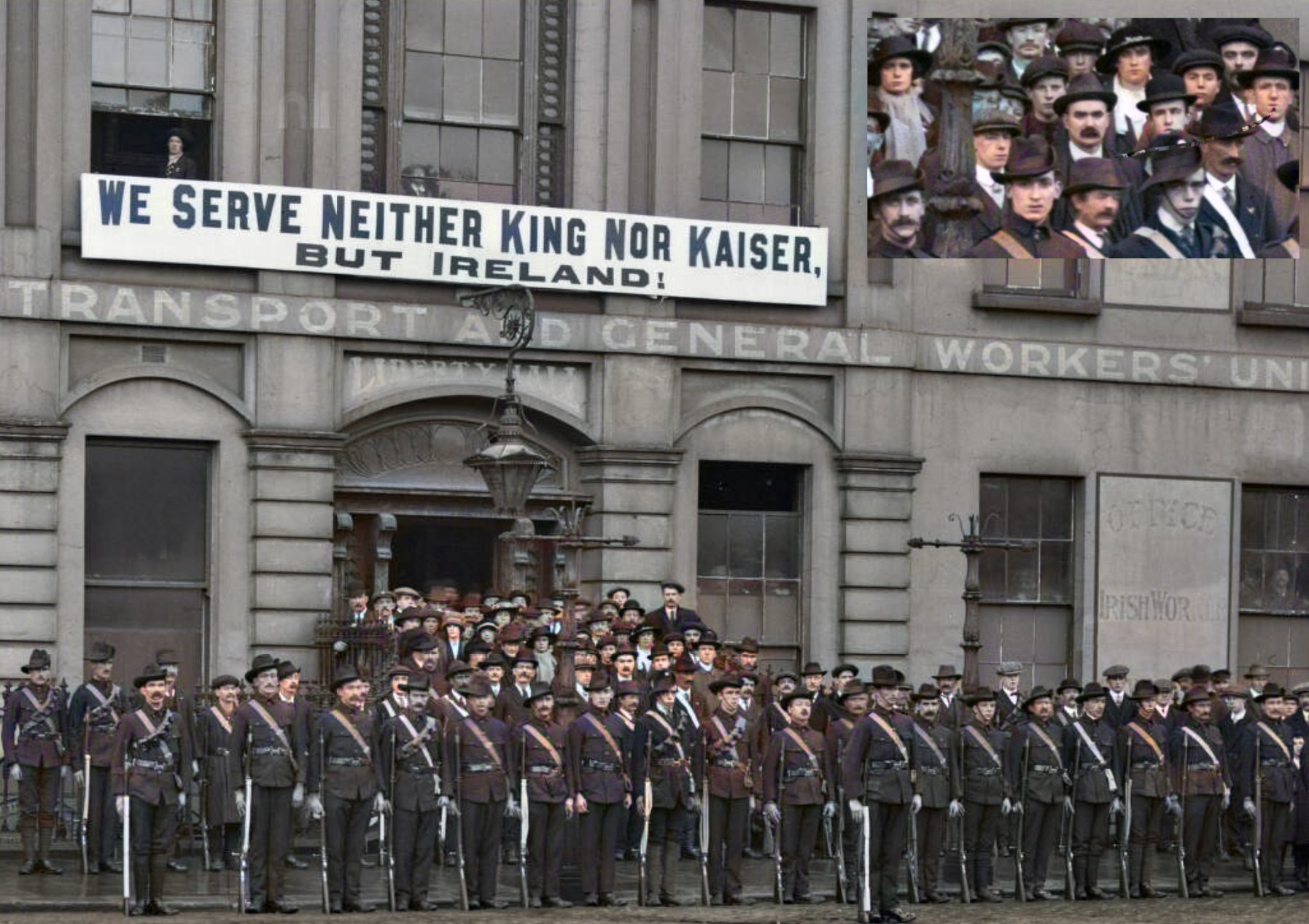
Let’s just take the Irish example. Was Ireland an independent state in 1916 or a British colony? Were the Irish rebels in 1916 seeking to join the German imperialist alliance, or did they claim ‘We serve neither King nor Kaiser’? Did the Irish workers movement participate as a separate political and armed force from the bourgeois nationalists, and did not James Connolly repeatedly declare the political independence of the Irish working class? Was his anti-imperialism the anti-imperialism of opposition to foreign rule or opposition also to capitalism and for the creation of a Socialist Republic? Where does the capitalist Ukrainian state and the ‘Ukrainian resistance’ stand on all these questions today?

But let’s not leave the Irish analogy there. What happened to the Irish national struggle when the forces of the working class proved to be too weak and the movement became a purely bourgeois one? ‘Labour’ was told to wait, just as in Ukraine today, and the forces of bourgeois nationalism accepted a settlement with imperialism that left the working class more divided than before, subject to two reactionary regimes that inflicted years of austerity, unemployment and emigration built upon Catholic Church abuse of women and children and Protestant sectarianism and discrimination. Today the capitalist Irish state supports the Ukrainian capitalist state and imperialism, particularly that of the US, upon which its current success depends; which brings us to the core argument of the left supporters of Ukraine.

Beside the unprecedented assortment of support from western imperialism the left supporters of Ukraine present one Marxist-sounding justification, although bourgeois politicians and the media state it as well.   This is the demand for Ukrainian self-determination, upon which we get the idea of national liberation and the analogy with Ireland.  In this there might seem an argument that at least exists, and it does, except it does not exist for Marxists.

After World War I, US President Woodrow Wilson made himself and the policy famous through his espousal of self-determination, but this is not the grounds for a socialist argument, including his ignoring the demands of some nationalities while upholding others.  Through the Treaty of Versailles, the ground was prepared for another world war that further exposed the elastic character of bourgeois support for self-determination. Even before this, the credo of self-determination of nations had failed in the 1848 revolutions in Europe.

The demand, in so far as Lenin actually upheld it, is subsidiary to the self-determination of the working class and involved supporting, if necessary, the demands of nationalities imprisoned within empires or held as colonies.  Ukraine became an independent state in 1991 and does not cease to be one because it is losing (or winning according to its supporters) a war with another independent capitalist state.  If it is further claimed that socialists should support the prerogatives of a capitalist state in war then it should be clear what this means – the demands of the capitalist state assume priority, which must necessarily therefore involve the subordination of the working class to its rights and requirements.

The interests of the working class either do not then exist, or are identical to those of its capitalist state.  If it is further claimed that it is only in this one respect that the interest of the working class and capitalist state are the same, then this fails to recogniser that self-determination of the Ukrainian capitalist state means that it determines what it requires, what it does, and its freedoms without restriction, otherwise it is not self-determining.

If the attempt is made to wriggle out of this definitional constraint and it is claimed that it is the country (or nationality) that self-determination applies to, then we must recall Marx’s description of history: ‘History does nothing . . . it “wages no battles”. It is man, real, living man who does all that, who possesses and fights; “history” is not, as it were, a person apart, using man as a means to achieve its own aims; history is nothing but the activity of man pursuing his aims.”  In our case, it is not ‘the country’, or ‘Ukraine’, that ‘wages battles’ but the Ukrainian state and its armed forces.

For the supporters of Ukraine the idea of an immaterial entity to which self-determination applies has been propagated through repeated use of the words Ukraine, Ukrainian resistance, and Ukrainian people when what that corresponds to in reality is the state, the armed forces of that state and a population divided by class in which these socialists wrap up the interests of the working class inside that of the first two – the state and its armed forces.

Reference is sometimes made to particular Ukrainian workers, with the pious invocation to accept their views, as if their coming from a Ukrainian must entail unimpeachable endorsement and acceptance, although their views are presented as privileged not because of their power to advance our understanding but because of their position as potential victims of war.  In effect they become props to a story that is being more and more determined by western imperialism, and certainly not by any independent political role that these workers play.

The term ‘Ukrainian people’ is an abstraction without apposite reality, since this people is divided, with some supporting Russia.  For supporters of the Ukrainian state this latter people effectively does not exist, so the argument for self-determination does not apply for them.  Not so much Lenin as Woodrow Wilson again.

In any case the Leninist argument advances only the right to set up a separate state and this the Ukrainians already have.  What the capitalists and its politicians do with this is something else entirely, and socialists do not follow them in order to ensure this capitalist state achieves maximum capacity to act autonomously and independently.  Even if we did, it would be a very hard argument to make that the dependence on western imperialism is the road to such freedoms.  Since Ukraine has been, and still does, seek membership of NATO, such membership could easily be accused of threatening the same rights that would logically have to apply to Russia.

The only counterargument to this is to claim that Ukraine should not be subordinated to imperialism (e.g. should not be subject to debt dependence), which as we have seen in the statement of the Ukrainian Solidarity Campaign is not an argument but a pious wish, and one that support for reliance on the west and its weapons exposes as either rank stupidity or hypocrisy. Again a reality is invoked that does not and cannot exist.

Back to part 1

Forward to part 3

The war in Ukraine (1) – picking sides

Imperial War Museum

“What appears to characterise (opportunist) practice above all? A certain hostility to ‘theory’.  This is quite natural, for our “theory”, that is, the principles of scientific socialism, impose clearly marked limitations to practical activity–insofar as it concerns the aims of this activity, the means used in attaining these aims, and the method employed in this activity.  It is quite natural for people who run after immediate “practical” results to want to free themselves from such limitations and to render their practice independent of our “theory”.  However, this outlook is refuted by every attempt to apply it in reality.”

Rosa Luxemburg, ‘Reform or Revolution’.

A year after the Russian invasion of Ukraine the clear and hard division in the socialist movement can hardly be said to have mellowed.  The escalation of western involvement has not caused supporters of Ukraine to miss a beat in their support, despite initial indications that they saw possible limits to their defence of imperialist intervention. Indeed, the most startling aspect of their response was the immediate support given to the intrusion of western imperialism, thus placing themselves on the same side as the US, and with objectives identical to it and its NATO allies.  Anti-imperialist rhetoric continues to be espoused by pointing solely at Russia while demanding that their own imperialist state intervene more strongly to arm the Ukrainian state.

So sudden and complete was this conversion to seeing western imperialism as key to a progressive solution that no further political moves were required to justify the alliance of this left with their own capitalist state and its imperialist allies.  This leap into bed with its previous class enemies was carried out with agreement on what the nature of the war was, who the necessary allies were, what the objectives of the war were, and what should be done about it.

Of course, like repeated references to a certain imperialism, the rhetoric has included left phraseology, but this can’t disguise the fundamental identities: the courtiers of western imperialism have themslves denounced imperialism.  Such has been the decisiveness of the embrace of the Ukrainian state that their ‘opposition’ to the war means opposition to Ukrainian defeat, not to the war itself, and Ukrainian victory is construed in the most comprehensive and absolute terms.

Their position is bolstered by the unprecedented support for the war by the Western media, which has been little more than propaganda for this imperialist alliance; war pornography but without the pictures that reveal the real brutality.  Their moral certitude, which they believe arises from the clarity of what is happening, is assisted enormously by the western media’s one-sided presentation.  Even when western diplomats get exasperated at Ukrainian lies, such as its continued claim that it was a Russian missile that landed in Poland and killed two men, this left does not miss a beat to ask what else might not be true?  The effect of sanctions on the world’s poor or on workers living standards in their own countries are all an inevitable price to be paid from the perspective of the war being Russia’s fault and its effects only to be ended by its defeat. Nothing its own imperialist state does can be challenged when it is recognised as the only force able to help win the war that it supports. When you have picked a horse, it is relatively easy to see everything through its blinkers.

A third factor is the unattractive nature of Russia itself, a corrupt and authoritarian capitalist state, but this only invites comparison with the Ukrainian state itself, which is hardly very different and certainly not when it is allied with western imperialism, whose toll of death and destruction dwarfs that of Russia.  If Putin is a criminal, Bush and Blair are godfathers, and their successors Biden and Johnson, Truss and Sunak etc. are no different.  But it is precisely the refusal to go there that is the problem, because the signal fact that the Russian invasion on 24 February was wrong cannot possibly justify support for the Ukrainian capitalist state and its imperialist backers.

Writing from Ireland it is beyond lamentable to see people who opposed the British armed forces in the North of Ireland suddenly find common cause; effectively demanding that the Minister of Defence, whose own military record here is censored, call for their power to be wielded to implement imperialist interests in Eastern Europe.

Condemning the Russian invasion on the grounds of opposition to imperialism while failing to recognise the Ukrainian desire to become part of the biggest imperialist alliance, and also failing to recognise the role of this alliance in a war in which Ukraine is its proxy, makes all claims to support for Ukraine on an ‘anti-imperialist’ basis not only groundless but thoroughly dishonest.

And this is the issue; a position on the war can only be satisfactorily approached through a Marxist analysis – of the cause and nature of the war as determined by its historical origins and development and the nature of the participants and their objectives.  When we look at it from this aspect, left support for Ukraine does not so much fall apart as simply not exist.

So right from 24 February 2022 their claim was that the war was caused by Putin.  One man caused it, arising out of his cranium with his imperialist obsession and a distorted and false view of Ukrainian history, including the view that Ukraine was not a real country and Ukrainians were a variety of Russian.  Far from looking for the material roots of a war that has impacted the world, the moral left discovered from the start that it was Putin’s view of history that explained it.

Not that Putin’s ideas explained everything, for this left everything did not have to be explained, only the invasion, as this determined everything relevant to understand and upon which to strike a political position.  And because nothing prior to this matters, and everything subsequent depends absolutely on it, disagreement with their political position is admission of moral failure.  As the late socialist Andrew Collier put it, ‘liberals have a notorious tendency to construct values which might explain their opponents’ policies.’

That this justification for their approach does not fall apart but simply does not exist is illustrated, among other things, by the fact that what Putin actually said before the invasion–that was most directly relevant to it–was all but ignored, which we shall look at in a future post along with other claims.

Forward to part 2

The war in Ukraine – ‘Truth will Out!’

Source: ‘The Irish Times’

Those socialists in Britain who might regularly read ‘The Guardian’ newspaper, and despair at the wretched propagandistic coverage of the war in Ukraine, should count themselves lucky that that they don’t live in Ireland and avail of the coverage of ‘The Irish Times’.  

Unable to contribute to the cause of western imperialism directly, the Irish State has cloaked its contribution in mawkish tones of hypocritical concern, loudly proclaiming that it too supports the war while condemning its inevitable results.  Like all western support, from right to left, it considers support for war has nothing to do with its consequences because “Russia started it.’

‘The Irish Times’ faithfully reflects the hypocritical self-righteousness of the Irish State and political establishment.  The Russian war is routinely damned and its purported atrocities highlighted but its true horrors, which might include graphic pictures of the dead and dying, are hidden. Even more unsettling, photographs and video of those killed by Ukrainians will not be front page or headline news.  War coverage in the West is so routinely censored that its presence is unnoticed.

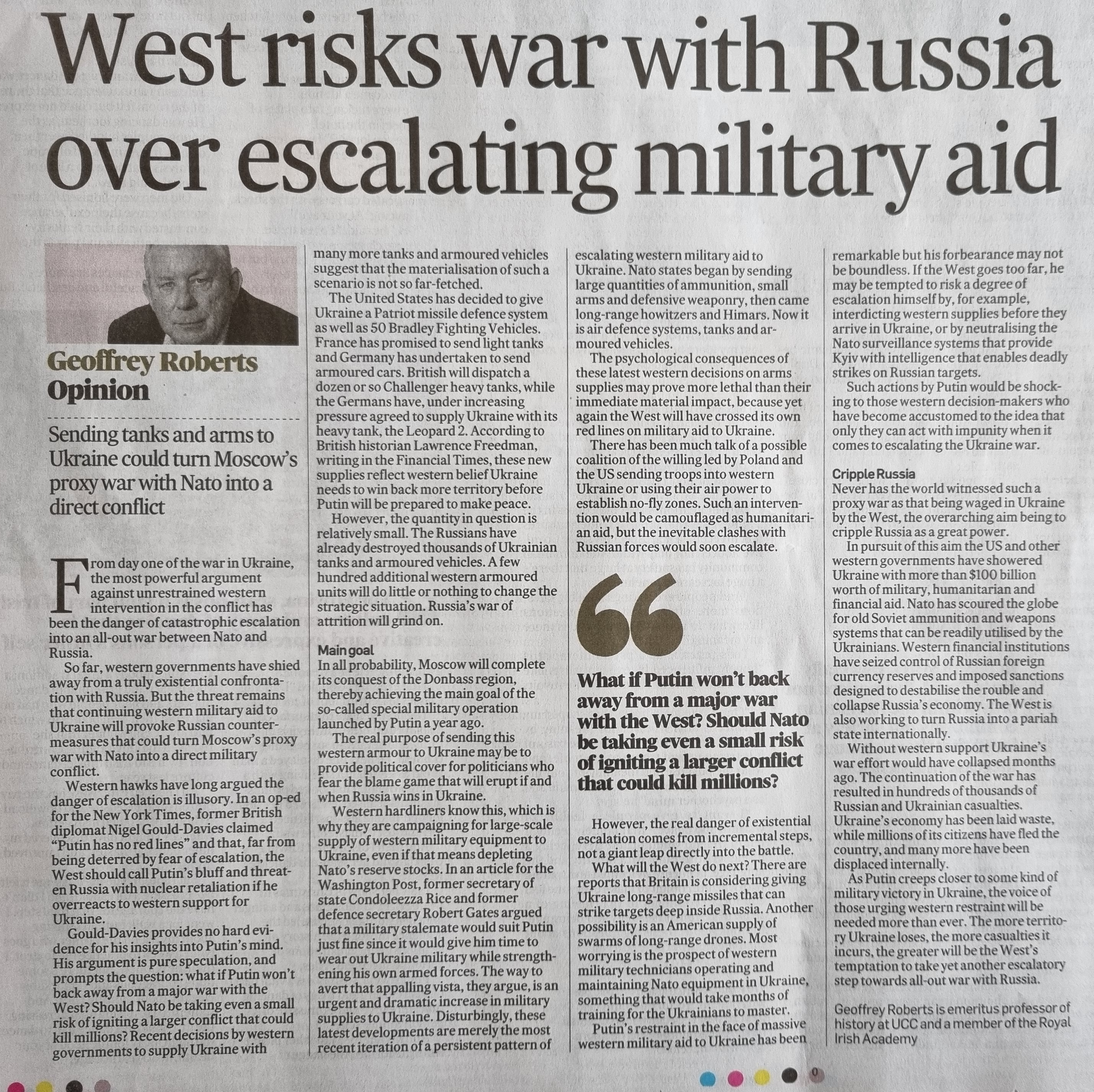
So imagine my surprise when today’s newspaper includes a column by the historian Geoffrey Roberts, who sets out the dangers of western escalation and its purpose. No doubt the rest of the week will see numerous letters of condemnation.

He notes that the West’s previous red lines on the supply of weapons have been crossed while significant political figures dismiss the possibility of Russian escalation in response.  He notes that such escalation ‘would be shocking to those western decision-makers who have become accustomed to the idea that only they can act with impunity when it comes to escalating the Ukraine war.’

Escalation includes main battle tanks and missiles with relatively long-range potential.  It also includes direct NATO personnel intervention through intelligence, training and targeting.  The provision of main battle tanks will involve significant maintenance support, and possibly NATO tank operators if they are to provide anywhere near their potential impact.

Previously, some left supporters of the Ukrainian state have made a distinction between defensive and offensive weapons and opposed ‘direct military intervention.’  Main battle tanks are clearly offensive weapons provided to Ukraine so it can carry out offensive operations, while missiles already supplied have the potential to hit Crimea, which previously was not simply a province of Ukraine but had autonomous status.  Today its population is clearly Russian and is considered by the Russian Federation to be part of its territory.  For those claiming justification for the war based on ‘self-determination’ this leaves something of a contradiction.

It is of course open to the supporters of Ukraine to support this state on the grounds that the war as a whole is purely a defensive one, but that does not avoid an existing problem and opens the door to another.

Those partisans of Ukraine who speak of supporting the Ukrainian people have the same problem as someone who recently posted on Facebook ‘victory to the Russian people in their struggle against NATO’.  Neither the Ukrainian nor Russian people are fighting this war, although it is they who are dying.  They are killing and being killed on behalf of the Ukrainian and Russian states, which are the real parties to the conflict.  In neither case is the working class independently organised and fighting in its own interest and for its own objectives.  

Either the respective supporters of the Ukrainian and Russian states believe that in this war one of these capitalist states is fighting for the interests of the working class or they can’t tell the difference between a capitalist state and its people, never mind its working class.  In neither case can the left supporters of either state be considered Marxist, which as a bare necessity requires the ability to distinguish between a capitalist state and a working class and, having done so, be able to identify and assert their separate and antagonistic interests.

If, on this occasion, they maintain that their interests are the same or aligned they face the question of how such an extraordinary convergence has occurred?  In the case of supporters of Ukraine – how did this alignment also include the whole of Western imperialism?  Why wouldn’t it happen again and how does this not invalidate Marxism, which teaches the irreconcilable antagonism between the working class and the capitalist state?  How often can the working class rely on the capitalist state to defend its interests? Do they know where this idea has led before and, if they do, can they not just do themselves and those of us who oppose this capitalist war a favour and take a short cut to openly repudiating Marxism?

The second, new problem opened up, is that if the character of the war is not to be defined by the infantile argument of who invaded who, then this must widen consideration of its nature to include the cause of the war, including the invasion; the objectives of the warring parties and the political character of these objectives and thus of the war itself.  In relation to this the article by Geoffrey Roberts is appropriate:

‘Never has the world witnessed such a proxy war as that being waged in Ukraine by the West, the overarching aim being to cripple Russia as a great power.’

‘In pursuit of this aim the US and other western governments have showered Ukraine with more than $100 billion worth of military, humanitarian and financial aid. Nato has scoured the globe for old Soviet ammunition and weapons systems that can be readily utilised by the Ukrainians. Western financial institutions have seized control of Russian foreign currency reserves and imposed sanctions designed to destabilise the rouble and collapse Russia’s economy. The West is also working to turn Russia into a pariah state internationally.’

‘Without western support Ukraine’s war effort would have collapsed months ago. The continuation of the war has resulted in hundreds of thousands of Russian and Ukrainian casualties. Ukraine’s economy has been laid waste, while millions of its citizens have fled the country, and many more have been displaced internally.’

Roberts is correct that without Western imperialism there would no longer be a war – Ukraine would have negotiated a peace.  To therefore pretend that western intervention is secondary is to deny reality.

Roberts presents one potential of the continuation of the war:

‘As Putin creeps closer to some kind of military victory in Ukraine, the voice of those urging western restraint will be needed more than ever. The more territory Ukraine loses, the more casualties it incurs, the greater will be the West’s temptation to take yet another escalatory step towards all-out war with Russia.’

The Outcome of the War in Ukraine?

It is obviously hazardous to predict the outcome of the war given the conflicting claims of both sides and the obvious propaganda character of most of what is published.  The involvement of so many actors makes it difficult to have confidence.  What role will Belarus play, and will a ‘coalition of the willing’ e.g. Poland etc. be the subterfuge that NATO will adopt for a more direct intervention? How much escalation will NATO go for on the basis that they argue that they will not be intimidated, Russia hasn’t reacted so far, and the threats from Russia are outrageous intimidation?

What one thinks will be the outcome very much reflects what one thinks is already happening.

A strange consensus exists in the Western media.  Ukraine is winning but there are repeated entreaties for the Western powers to maintain their support, calls really directed to the populations consuming their media.  The ‘between-the-lines’ message is that Ukraine will not win if the West does not continue to support it.  That Ukraine can win, and claims that it is doing so, are meant to convince that the sacrifices already made have achieved results and not been wasted, although apparent setbacks also give rise to the same appeals.

What this means is that while Ukrainians are doing almost all the fighting, they cannot continue without Western support.  In other words, the war must continue, and can only continue, if the West remains in the fight.  Despite this repeatedly admitted dependence of Ukraine on the West, by both parties, their leftist supporters still claim to support their war based on the idea of ‘self-determination’.

In point of fact self-determination was achieved by Ukraine when it became an independent state in 1991, whereupon it suffered an economic collapse.  It attempted to carry out an independent foreign policy by balancing between Russia and the West but this too failed.  Its dependence now on the West is complete and all talk of self-determination and independence is so much deceitful humbug.  Win or lose Ukraine–as it has existed–is not going to determine its own future, or be in any genuine way independent of imperialism: ‘self-determination’ has also failed.

Ukraine started the war with 43 million people and 5 million military-aged men, but according to the U.N.,14.3 million have fled and a further 9 million are in Russian-occupied territory. Ukraine is therefore reduced to about 20 to 27 million people and at this ratio it has less than 3 million draftable men. A million have already been drafted, and many of the rest are either not physically fit or have a vital role in the economy. The GDP of this economy has declined by an estimated 30 per cent.

It started with an army of 250,000 regular troops, together with 450,000 mobilised citizen soldiers, with 1,800 artillery pieces that allowed firing rates of 6,000 to 7,000 rounds a day, plus perhaps over 2,500 tanks.  The weapons supplied by the West are needed not to add to these totals but to replace them because Ukraine does not itself have the necessary military-industrial complex to do it.  If Ukraine could not defeat the invasion with these initial forces the lesser supplies from the West are not going to achieve this task despite the escalation in the power of the new weapons.  Their purpose is to keep the war going, with all the horror this must necessarily entail.

Ukraine and the West have been able to present the idea that not only can it win the war, but actually is, through two arguments about how it has proceeded so far.  First is the failure of the Russians to take Kyiv and its retreat from the city, and secondly the reverses and retreats in Kharkiv and Kherson, reducing Russian control to approximately 50% of the territory it had captured by the invasion on 24 February.

The Russian objective has been a neutral Ukraine if an allied one could not be attained, while Ukraine as a member of NATO is unacceptable.The initial invasion seemed to be based on the view that Russia could point the gun to the head of Ukraine’s political leadership in Kyiv and gain the concessions that it required without a full-scale war.  When this leadership, with western intervention, rejected this course the only alternative was the grinding conflict that the war has become.  

Since Russia has had no intention of occupying all of Ukraine the purpose of the invasion is to enlarge the buffer between it and the NATO powers and to destroy the military capacity of the country – to ‘demilitarise’ and ‘de-nazify’.  A buffer, even an enlarged one through annexing Ukrainian territory, is not enough; Russia already started the invasion with a buffer but a continuing military threat in the remaining un-occupied state would be a very meagre victory.

This is why Russia invaded with only around 200,000 troops made up of regular Russian forces and soldiers from the two separatist areas of Donetsk and Luhansk; less than the Ukrainian armed forces when an overwhelming numerical superiority would have been required.

The primary goal of the military conflict has therefore become the destruction of the Ukrainian armed forces, and not the acquisition of territory, which can be taken after a military victory.  This includes those oblasts which Russia now claims as its territory but which it currently does not completely control.  The primary purpose of Ukraine has been the recapture of territory lost; together these explain the character of Russian reverses in Kharkiv and Kherson.

In the former few Russian forces were in place to defend earlier gains and most of those that existed belonged to separatist militias; Russia did not have enough soldiers to maintain its occupation of the area.  It was however able, in due course, to halt the Ukrainian offensive and then consider a counter-attack.  In Kherson the Russian forces were exposed and retreated before this exposure crystallised into a more pressing threat.  The result was that it was able to keep its forces intact and strengthen its immediate strategic position.  In both Kharkiv and Kherson the maintenance of its armed forces was more important than territorial loss.  To these must now be added the partial mobilisation of a further claimed 300,000 Russian soldiers, giving its forces numerical superiority for the first time.

Pro-Russian commentators have therefore argued that the static conflict that has been in place for the last three to four months has not been a stalemate but a result of Russian strategy to engage greater and greater numbers of Ukrainian forces with the purpose of then destroying them with greater firepower.  So, while we have noted that Ukraine could fire 6,000 to 7,000 artillery rounds a day, Russia has been firing 40,000 to 50,000, with some reports stating that it has a six-to-one advantage in artillery pieces.  It is therefore obvious that this sort of war is to Russia’s advantage; it is also true that it is not a war that Ukraine can win.  

Attempts to keep it going by Western arms do not benefit Ukraine but will only result in the death of more Ukrainians, not to mention Russians.  The number of weapons, including their diversity and the logistical problems arising from this, are inadequate and cannot in themselves rebuild an army that superior Russian forces already degraded when this army had larger weapons systems on which it had already been trained.

The political leadership of Ukraine, who walked their country into this war and promised victory, will find it difficult to admit defeat and so face the wrath of its far-right supporters and the displeasure of its US backers.  EU leaders may decide that sanctions have failed to impose the costs on Russia that they expected; that they themselves can’t afford, and that would not be justified by the project of incorporating Ukraine in NATO.  The rest of the world outside what calls itself ‘the international community’ has not rallied to the demands of the US, and China has not decided that doing the bidding of its declared enemy is better than maintaining its alliance with its new friend.

These point to an end to the war sooner rather than later, but not until Russia has degraded the Ukrainian armed forces and occupied those parts of Ukraine it now claims as its own sovereign territory.

This, of course, will not end the hatred and division between Ukrainian and Russian, including their working classes, and will not end the mutual antagonism between the two states.  The US and its NATO creation will have suffered a reverse but these have happened before; military setbacks will not destroy western imperialism, and the Russian and Chinese states certainly won’t.

A victory for Ukraine and the US would have similar reactionary consequences and would not usher in any progressive Russian regime.  We will leave to left-wing bourgeois moralists any notion that a victory for Ukraine would be a victory for the working class anywhere, least of all in Ukraine itself, which would then in such an eventuality have its future celebrations consist of the triumph of western imperialism and of Ukraine’s most reactionary nationalist traditions.

A war with potentially only reactionary outcomes and consequences is not one that can be supported.  Its lasting tragedy may be that any sort of democratic and progressive peace settlement is impossible.  Right now it certainly looks extremely unlikely, which is unsurprising. This could only arise from a working class armed with its own political alternative, and not some second-hand programme that has already failed and which is the most impossible outcome of all.  

The Bad Ukrainian

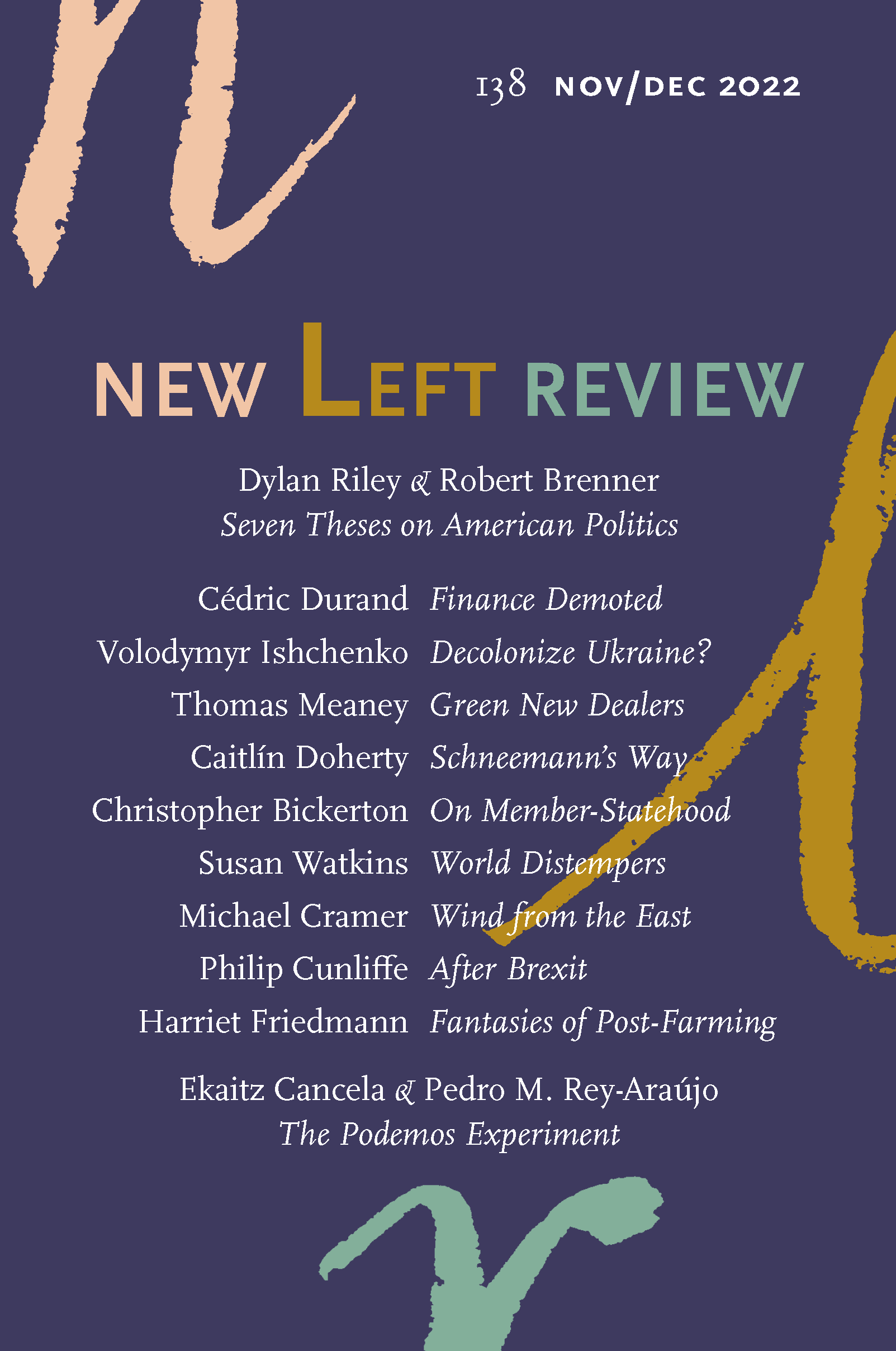
The Ukrainian sociologist Volodymyr Ishchenko has an article in the latest New Left Review, which apparently has created a bit of a stir.  Its audience is ‘Ukrainian scholars, intellectuals and artists’, who, he says ,‘face a dilemma.’  This dilemma is either to be ‘just another ‘voice’ in a very specific field of institutionalized identity politics in the West’, or ‘to articulate the questions of global relevance, search for their solutions, and contribute to universal human knowledge.’

What it really is, is a ‘J’accuse’ against his pro-Western peers who have stoutly defended the Ukrainian state in the war with Russia, more or less uncritically becoming a willing accomplice beside Western imperialism.  It is clearly directed to a small world so it is no surprise that it is seen by some as provocative.

The issue, however, is a decisive one in separating all leftists and Marxists into two broad camps, raising principled political differences that immediately entail taking a side in the war.  The obvious emotion aroused faithfully reflects the issues at stake; for both sides it is a question of betrayal.

The sociological jargon and the approach to the issue in terms of identity politics might seem to soften the polemic but you would have to be stupid to miss the point.  The dilemma is between identity politics that seeks recognition by western imperialism, so that Ukraine is viewed as really standing up for the freedom the West constantly claims – ‘Ukrainians are more Western than those who live in the West’; or, ‘to voice a universally relevant perspective on Ukraine, no matter how many Ukrainians would sympathize with it.’

The most stinging criticism is of some left Ukrainians, whose support for the project of ‘decolonisation’ of the country involves not much more than ‘abolishing anything related to Russian influence in culture, education and the public sphere.’  Since the support of the pro-war Left in the West for self-determination has no room for any class analysis and becomes purely endorsement of Ukrainian nationalism, this anti-Russian agenda has simply been endorsed.

Since self-determination without any qualification is upheld there can in principle be no opposition to the actions of the Ukrainian state in the war, including its ‘proceeding with privatizations, lowering taxes, scrapping protective labour legislation and favouring ‘transparent’ international corporations over ‘corrupt’ domestic firms. The plans for post-war reconstruction did read not like a programme for building a stronger sovereign state but like a pitch to foreign investors for a start-up.’

This is only the logical consequence of supporting self-determination for an already independent capitalist state, one that is not a colony or subjugated within a foreign empire.  The demand simply becomes one for it to be able to make its own political choices; the particular nature of the state regime or the policies it chooses are completely secondary.  In truth, this view of many on the Ukrainian left is more a result of material reality – of the strength of Ukrainian nationalism, the Ukrainian state and of Western imperialism.  The predominance of the demand for ‘self-determination’ also reflects the weakness of the working class movement in Ukraine and internationally.  It should be no surprise if social layers such as ‘scholars, intellectuals and artists’ reflect this.

So, states Ishchenko, ‘national liberation is no longer understood as intrinsically linked to social revolution, challenging the basis of capitalism and imperialism’ and ‘Ukraine’s ‘decolonization’ becomes a version of (national-)identity politics—that is, a politics centered around the affirmation of belonging to a particular essentialized group, with a projected shared experience.’

‘It is not surprising, therefore, that talk of Ukraine’s ‘decolonization’ is so much about symbols and identity, and so little about social transformation. If what is at stake is the defence of the Ukrainian state, what kind of state is it?’

And this is the central question for Ukrainian socialists who support the war and for their allies in the West.  How is it possible for socialists to support this state?  A capitalist state notoriously corrupt by European standards, which western ‘investors’ still remain extremely wary of entering post-war. A state that gave political and military support to US imperialism and NATO forces in Iraq and Afghanistan; in ‘Operation Iraqi Freedom’, ‘Operation Enduring Freedom’, and ‘Operation Freedom’s Sentinel’. Lots of ‘freedom’ it would seem. We are expected to believe that this same combination is now again defending our freedoms, this time in Europe.

How did the Ukrainian state become the bearer of such a noble mantle that it now inspires Western ‘Marxists’; and how did the US and NATO likewise transform itself – just by doing what it has always done – by confronting the evil Russian empire?

Ishchenko is scathing of this choice – ‘The Western elites are trying to save the fraying international order; the Russian elite is trying to revise it to get a better place in a new one. However, neither can clearly explain how exactly the rest of humanity wins from either outcome.’

The pro-war left can see no independent position for the working class in opposing both the Russian invasion and the Ukrainian state and Western imperialists. 

Instead, many pro-war voices in the West have exhorted us to listen to the voices of those Ukrainian leftists who have capitulated to their own state.  On this Ishchenko is particularly wounding:

‘ . . . there has been a huge surge of events, panels and sessions related to Ukraine, Russia and the war, and a high demand for ‘Ukrainian voices’ in these discussions. Certainly, Ukrainian scholars, artists and intellectuals should be included in international discussions—and not just about Ukraine. The problem, however, is not the quantity but the quality of such inclusion.’

He goes on:

‘We can already see the tokenism phenomenon, typical of contemporary identity politics, when a symbolic inclusion of ‘Ukrainian voices’ does not mean revising the structures of knowledge aligned with Western elite interests, beyond sharpening their guilt for appeasing Russia. Furthermore, the formalistic representation of tokenized ‘Ukrainian voices’ helps silence other ‘voices’ from Ukraine that are not so easy to instrumentalize. Are we really to believe that the English-speaking, West-connected intellectuals, typically working in Kiev or Lviv, and who often even personally know each other, represent the diversity of the 40-million-strong nation?’

‘The solution is obviously not to include even more ‘voices’ but to break with the fundamentally flawed logic of escalating national-identity politics.’

He concludes: ‘The narrow ‘decolonization’ agenda, reduced to anti-Russian and anti-communist identity politics, only makes it more difficult to voice a universally relevant perspective on Ukraine, no matter how many Ukrainians would sympathize with it.’

The war in Ukraine – support Russia?

A debate has been taking place on the nature of the war in Ukraine on the post put up immediately after it started.  Those familiar with this blog will be aware of the various arguments against those who would support the Ukrainian capitalist state and its western imperialist backers against the Russian invasion.

The supporters of Ukraine variously claim that it is a colony or simply a victim of invasion by a predatory imperialist power.  They demand that the working class stand with the Ukrainian capitalist state and excuse its alliance with western imperialism.  They are usually too embarrassed to argue direct support for US and NATO although they could claim that they are providing no political support to western imperialism but simply some acceptance of military commitment that can be distinguished from it.  This of course is nonsense.

The argument has been joined by the mirror opposite of this and it is claimed that because Russia is not an imperialist power in a ‘Marxist’ sense, and it faces an undoubted imperialist alliance that is imperialist in this sense, socialists must support Russia.

A number of questions are raised, including is the so-called ‘Marxist’ definition of imperialism employed correct and if it is, does Russia actually fall within it?

I am not going to address these questions which I have in other places argued are secondary.  I have contended that the support of one capitalist power against another in this war is a betrayal of the interests of the working class and of socialist principles.  It involves workers sacrificing themselves for either western imperialist interests or for Russian capitalism and it is nonsense to claim that because Russian capitalism is less advanced than western imperialism it should be supported!

It has been claimed that Russia is in some way analogous to Ethiopia in 1935 when Trotsky opposed the Italian imperialist invasion of that country and supported Ethiopia. However, Russia is not some underdeveloped country with a feudal monarchical regime being invaded by western imperialism in an attempt to colonise it; this argument will no more fly than the argument that Ukraine is a Russian colony, so there is no great point in attempting to shoot it down.   

The argument to support Russia is supported by appeals to Lenin and Trotsky but as it has been pointed out, they didn’t support Russia in the First World War.  At that time Russia was not an imperialist power by this ‘Marxist’ definition (in so far as it has been explained) and it faced in Germany an exemplar of finance-capital imperialism.  It is perhaps implied that they opposed Russia in the war because of its broader alliance with capitalist imperialist powers but Lenin repeatedly emphasised that Russian ‘imperialism’ was in respects worse than the others!

Far from supporting the argument that we should support the ‘non-imperialist’ capitalist states, they did the opposite and opposed both the imperialist and non-imperialist capitalist states (that is non-imperialist in the sense that it is employed to support Russia today).

The general approach of supporting less developed capitalisms against more developed forms is not only wrong politically but totally un-Marxist.  For Marx, socialism arises on the advances and development of capitalism and not from its backward forms.  It is what makes socialism possible.  The many posts on this blog on Marx’s alternative to capitalism explain this in detail.  It is the very definition of reactionary to believe that the road to socialism comes through defence and support for the most undeveloped and backward forms of capitalism.  Having stood Hegel on his head some want to turn Marx upside-down.

This relates to another problem reflected in both the appeal to Lenin and to the belief that opposition to imperialism today means support for non-imperialist capitalist states, just as previous socialists defended the right of nations to self-determination in the colonies and where nations were annexed to empires.

It was queried whether ‘anything qualitative has changed in the last hundred years to justify changing that approach’ to supporting non-imperialist states fighting imperialist ones.  I argued in return that:

‘When Lenin wrote on imperialism he said that capitalism had become characterised by monopolies and just as national economies were so dominated, so the world was divided up by imperialistic countries who turned each colony into their own property. The world was therefore divided into imperialist countries and colonies, between oppressor and oppressed nations.’

‘However, in the past one hundred years the Austro-Hungarian empire has disappeared, along with the Ottoman empire and by and large the European empires of Britain, France and Belgium etc. Almost all their colonies are politically independent capitalist states so the policy of self-determination does not apply, just as it is inapplicable to Ukraine today. It too is already an independent capitalist state and now with the backing of western imperialism.’

‘Many of these former colonies or dependencies are major capitalist powers in their own right including, for example, two of the biggest countries in the world – India and China. Capitalism has developed in leaps and bounds in many of these countries and with it the development of significant working classes. The role of socialists in these countries is not, as it was before, to seek to overthrow foreign imperialist rule so as to weaken the imperialist countries and thus advance the cause of socialism within them, but rather to advance the struggle of their own working classes to overthrow their own capitalism in unity with other previous colonies and the workers of the old imperialist countries.’

It was then queried whether the fact that ‘the colonies have achieved formal national independence?’ meant ‘subsequently that the political approach outlined in Permanent Revolution is also now invalid?’

Well, it must be obvious that if political independence has been achieved, and many of these former colonies have developed capitalisms with significant working classes, the scope of permanent revolution has in some respects changed.  For a start the bourgeois democratic tasks of the revolution – national independence, removal of feudal restrictions and classes – that were so prominent in permanent revolution are no longer so prominent.  To claim that they are, that in such developed capitalist societies the immediate tasks of the working class involve national independence etc. in some sort of joint struggle with native bourgeois forces would turn permanent revolution into its opposite and Trotskyism into Stalinism.

The argument to support Russia invites us to consider the big picture of what defeat for it would mean, presumably so that workers must rally to support it and prevent such defeat:

‘I think you might want to consider what is at stake for Russia in this conflict and what a victory for US/NATO imperialism in this conflict would mean for them. At the very least it is regime change in the Kremlin to install a compliant pro-imperialist puppet if not the actual dismembering of Russia into 3 or 4 smaller compliant states to better allow direct imperialist plunder of its resources.’

The same argument has been presented in favour of Ukraine and I have argued that it is not the job of socialists to come to the aid of capitalist powers just because they are losing.  Defeat undoubtedly inflicts misery and suffering and encouragement for the victor, but these are grounds to oppose the war, not to take sides in it.

Were the scenario above to transpire this would involve the dismemberment of the Russian state.  Russian military doctrine affirms that it could use nuclear weapons in response to a nuclear attack or an aggression involving conventional weapons that “threatens the very existence of the state”, which dismemberment would constitute.

The issue would then not simply be the subjugation of Russia but the immediate threat of nuclear war and the end of human civilisation as we know it.  I do not know at what point, if any, it would not become an issue of supporting the Russian capitalist state but ending the war through the activity of the working class.

Support for Russia is also argued for what might be seen as ‘positive’ reasons but personally I find this the most repulsive of all the arguments.

In arguing that Russia today is in some way comparable to Ethiopia in the 1930s the supporter of the Russian state inserts into the writings of Trotsky at that time the names of today’s combatants:

“If US/NATO and their Ukraine puppet triumphs, it means the reinforcement of fascism, the strengthening of imperialism, and the discouragement of the colonial peoples in Africa and elsewhere. The victory of Putin, however, would mean a mighty blow not only at Western imperialism but at imperialism as a whole, and would lend a powerful impulsion to the rebellious forces of the oppressed peoples. One must really be completely blind not to see this.”

We are asked to believe that the victory of Vladimir Putin would act as a beacon for the oppressed people of the world and be a blow against imperialism as a whole!  Does the writer really believe that Putin will inspire the workers of Europe and Americas to overthrow their oppression?  That is overthrow capitalism?  Will he inspire Russian and Ukrainian workers to overthrow their oppression?  Does he believe that millions of other workers and oppressed in Asia and Africa do not just see Western imperialism as murderous and hypocritical but also see Russia as their leader in a fight against their oppression?  And what if many did?  Would that be a cause for celebration, something to earnestly seek and support?

For Marxists, the emancipation of the working class will be achieved by the working class itself and not on the coat-tails of kleptocratic capitalist leaders.

The arguments in favour of supporting Russia in the war in Ukraine involve claiming Lenin and Trotsky would support the opposite of what they actually did; involves turning Marx upside-down; ignoring the effects of one hundred years of capitalist development, and the elevation of Vladimir Putin to the inspirer of the world’s oppressed. As one group of so-called socialists trail behind Zelensky and NATO another follows Putin and Russia.