What does “Don’t betray Ukraine?” mean (3 of 3)

In a Facebook discussion on why socialists should oppose the war I received a reply that stated:

‘In ninety cases out of a hundred the workers actually place a minus sign where the bourgeoisie places a plus sign. In ten cases however they are forced to fix the same sign as the bourgeoisie but with their own seal, in which is expressed their mistrust of the bourgeoisie. The policy of the proletariat is not at all automatically derived from the policy of the bourgeoisie, bearing only the opposite sign – this would make every sectarian a master strategist; no, the revolutionary party must each time orient itself independently in the internal as well as the external situation, arriving at those decisions which correspond best to the interests of the proletariat. This rule applies just as much to the war period as to the period of peace.’

This of course is a quote from Trotsky.  The problem is not to quote this as if this explains left support for the Ukrainian/Western imperialist alliance, but why this combination requires socialists to place a plus sign when the chances are only one in ten of that being correct.

If we look at the examples in the article from which the quote is taken, we see the sort of circumstances in which this would be correct.  These include when a ‘rebellion breaks out tomorrow in the French colony of Algeria’ and receives help from a rival imperialism such as Italy.  The second is when ‘the Belgian proletariat conquers power . . . Hitler will try to crush the proletarian Belgium’ and’ the French bourgeois government might find itself compelled to help the Belgian workers’ government with arms.’

In a footnote, Trotsky says that: ‘We can leave aside then the question of the class character of the USSR. We are interested in the question of policy in relation to a workers’ state in general or to a colonial country fighting for its independence.’

The Ukrainian working class has not come to power; Ukraine is not a workers’ state and has just celebrated Independence Day, so it is not a colony.  Some have tried to squeeze in the ridiculous idea that it is an oppressed country, but this is false.  It is a country backed by the whole of Western imperialism; is in an open alliance with it, and the war was provoked by both parties to this de facto alliance which sought to make it formal.

Ukraine will most likely lose territory but will not be totally occupied, unless Russia does something stupid, which it has not signalled it will do.  At least part of the territory occupied is pro-Russian so that it is not possible to see either sides’ occupation as being unambiguously liberating.  In other words, thinking in terms of oppressor and oppressed states does not provide a solution; more fundamentally because this is an imperialist war in which Ukraine is on one of the sides, and cloaking it with oppression does not explain either the origin and nature of the war or the approach that socialists should take to it. 

Victory for Ukraine, it is claimed, would be a victory against Russian imperialism, but it would also be a victory for Western imperialism with which Ukraine is now an ally. Claims that this is any sort of anti-imperialist war are therefore obviously spurious.  Only from a campist position can it be claimed that a victory for the camp of western imperialism is preferable to a victory of the Russian.  Complete disorientation and political degeneration explains why supporters of this position regularly accuse those opposed to it of ‘campism’ and describe themselves as ‘internationalist.’ 

It is irrelevant who fired the first shot, as Trotsky noted elsewhere:

‘Imperialism camouflages its own peculiar aims – seizure of colonies, markets, sources of raw material, spheres of influence – with such ideas as “safeguarding peace against the aggressors,” “defence of the fatherland,” “defence of democracy,” etc. These ideas are false through and through. It is the duty of every socialist not to support them but, on the contrary, to unmask them before the people.’

“The question of which group delivered the first military blow or first declare war,” wrote Lenin in March 1915, “has no importance whatever in determining the tactics of socialists. Phrases about the defence of the fatherland, repelling invasion by the enemy, conducting a defensive war, etc., are on both sides a complete deception of the people.”

He goes on: ‘The objective historical meaning of the war is of decisive importance for the proletariat: What class is conducting it? and for the sake of what? This is decisive, and not the subterfuges of diplomacy by means of which the enemy can always be successfully portrayed to the people as an aggressor. Just as false are the references by imperialists to the slogans of democracy and culture.’

Trotsky makes the following summary judgement: ‘If a quarter of a century ago Lenin branded as social chauvinism and as social treachery the desertion of socialists to the side of their nationalist imperialism under the pretext of defending culture and democracy, then from the standpoint of Lenin’s principles the very same policy today is all the more criminal.’  Over one hundred years has passed since Lenin’s judgement, how much more does this criminal treachery deserve condemnation today?

The depths of disorientation can be gleaned from one article reviewing the latest film documentary on the war, in which the author states that the film 2000 Meters to Andriivka is ‘the Ukrainian working class at war.’

‘The young men we see in this documentary about the capture of a village called Andriivka by the 3rd Assault Brigade of the Ukrainian army are a snapshot of the country’s working class. One is a lorry driver, their commander previously worked in a warehouse and a third is a polytechnic student studying electronics. They are virtually all in their early twenties and all volunteered to fight the Russian invasion.’ 

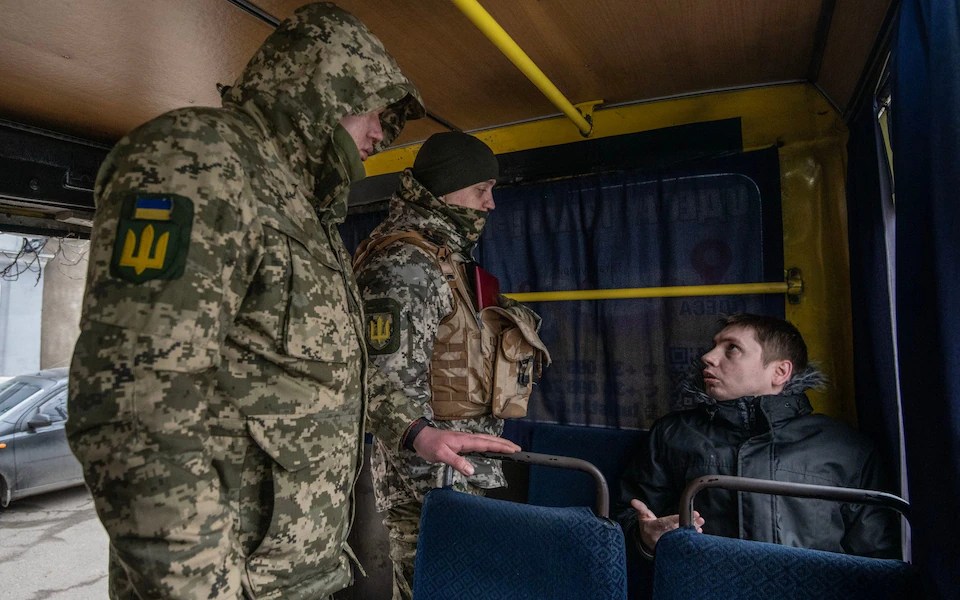
‘Ukraine continues to resist against overwhelming odds at the price of losing its bravest and most self-sacrificing young people’, while telling us why they are fighting, reminding him of the Soviet ‘partisans fighting Nazi invaders.’  What a pity for such a claim that it is the 3rd Assault Brigade of the Ukrainian army that the author lauds, which is composed of today’s Nazis, and hails as its historic heroes the Ukrainian fascists who collaborated with the Nazis in World War II and who fought Soviet partizans.

Aleksei ‘Kolovrat’ Kozhemyakin looks at a photo of himself. Exhibition opening in Kyiv, September 27, 2023. Source: Vechirnii Kyiv

The author, like me, will have been stopped in the streets of Belfast many times by soldiers of the British army who may have previously been lorry drivers or worked in a warehouse; certainly more or less all of them would have been working class.  This would not in the slightest have determined the nature of the British army or answered Lenin’s questions ‘What class is conducting it? and for the sake of what?’  Nor would – who fired the first shot? – have defined the conflict in the North of Ireland.

The working class British squaddies were fighting for an imperialist army in the interests of their imperialist state just as the Ukrainian workers in the 3rd Assault Brigade are fighting for the capitalist Ukrainian state in its alliance with western imperialism, from whom it will have received its funding, training, weapons and intelligence.  That the neo-Nazis within it are not the least bit interested in ‘democracy’ and are bitter enemies of anything remotely resembling socialism just puts the tin hat on the preposterous claims of the social imperialist supporters of Ukraine.

Quotes from Trotsky won’t therefore exculpate today’s social-imperialists who support imperialism while proclaiming socialism.  Even the isolated passage quoted at the start of this post assumes an independent working class movement to apply its own seal, but no such movement exists in Ukraine.  In raising the demand “Don’t betray Ukraine” the Ukraine Solidarity Campaign has fixed a plus sign to the actions of imperialism where no independent working class movement exists in Ukraine to place its own.

The demand “Don’t Betray Ukraine” is not therefore a call to take advantage of a contradiction within imperialism but to take one side of it instead of opposing both.   It is a demand for capitalist solidarity; that one section of it remain united in its struggle against the other. It is a call for Western imperialism to be united in full commitment to a particularly rotten capitalist state, signalling the total abasement of those declaring it.

Back to part 2

What does “Don’t betray Ukraine” mean? (2 of 3)

In a Democracy Now programme, US professor John Mearsheimer told the Ukrainian ‘democratic socialist’ Denys Pilash  that “the best outcome would be to settle this war now” since it will otherwise  be “settled on the battlefield.’  Pilash could only respond that there were still measures such as sanctions that could be taken by the West to pressure Russia into a ceasefire.  This is not a proposal to end the war but to allow Ukraine to regroup and the West to put itself in a better position to support it when it is recommenced.  Ukraine has not tried to disguise this intention and has not modified its maximal objectives.

The British and French have threatened to put their own troops into Ukraine and want the US to protect them under the formula of ‘security guarantees’.  They hope that this would dissuade Russia from taking the offensive again following any ceasefire, at least to the point that Ukraine thinks itself in a position to take the initiative.  It is not a solution but a transparent attempt to achieve the goals of Ukraine and the West later since they cannot be achieved now.  It promises not the end of the war but its resumption.  This is the position of the Ukrainian state, western imperialism and the ‘democratic socialist’ of Sotsialnyi Rukh interviewed by Democracy Now.

Trump has already moved to enact what Pilash proposed by raising tariffs on India for its purchase of Russian oil, although it has failed to do so on China.  This is a sign of weakness while India has signalled that it will continue buying from Russia.  So this proposal hasn’t worked, just as all the previous sanctions and previous financing, weapons, logistics, intelligence, planning and Western ‘volunteers’ haven’t delivered on their hopes.

Thus, the Sotsialnyi Rukh programme has already failed and promises only to prolong the war with its attendant death and destruction.  The objective for socialists should be to end it as quickly as possible while the policy of the Ukraine Solidarity Campaign and that of Sotsialnyi Rukh is to continue it to victory, apparently regardless of the cost.

Millions of Ukrainians have voted with their feet and have left the country while Trump is trying to send them back, which would only result in the men being conscripted, sent to the front and then killed.  A lot of Ukrainian soldiers have already voted with their feet and deserted, while those seeking to avoid conscription are voting with their feet by running away from recruitment press-gangs or attempting to escape the country.

Sotsialnyi Rukh could give a political voice to this instinctive opposition, born out of healthy suspicion and distrust of many Ukrainians for their state, but this is a road they will not take.  Instead, it champions a war its own state played a major role in creating, and a political and military alliance that subordinates the country to imperialism.  Its view of the war means it can do nothing other than tail-end a corrupt and ethno-nationalist state, its alliance with imperialism and a political regime that is responsible for both.

In Pilash’s fabricated reality Trump is supporting Putin; a view which requires ignoring the sanctions against Russia and the continuation of US military support.  Such a stupid statement so at odds with reality only confirms the reactionary character of the whole Sotsialnyi Rukh programme.

NATO is not the issue, says Pilash, but did he think repeated Russian warnings about Ukrainian membership were so much hot air?  Does its huge role in the war today not tell him something about its centrality to its origin and purpose, and does his enthusiasm for Western ‘security guarantees’ not confirm it?

Pilash thinks that Putin himself is the cause of the expansion of NATO – to Finland and Sweden – and look Russia hasn’t invaded them!  The problem, of course, is that he must assume the importance of NATO expansion for the argument to matter, while pretending that Russian warnings about Ukrainian membership are empty, even while his country is in the process of being devastated because of it.

His support for ‘security guarantees’, which means willingness to go to war against Russia, shows that the purported irrelevance of NATO is absurd, and his attempt to cover his ass by calling on the ‘global south’ to join western powers as guarantors is political camouflage.

Not even all the European NATO powers are prepared to put their troops into Ukraine, or at least to admit to it, including those in Eastern Europe; why would the ‘global south’?  And what, anyway, is the ‘global south’?  Does he want China, India, Brazil or South Africa to put troops into Ukraine?  Would they do it without Russian agreement, and would they want to be made hostage to the good intentions and behaviour of a Ukraine determined to get all its 1991 territory back?

The proposal for a ceasefire is thus not a promise to end the war, and not a resolution to it, but to put into Ukraine the exact forces that Russia invaded to keep out.  It is an incentive to Russia to continue hostilities in order to prevent it happening, and is a statement by the West that any end or even pause to the war will, absent an overall agreement, entail a NATO win. The cries for a ceasefire and peace are thus the habitual imperialist lies now trumpeted by some on the ‘left’.

Pilash states that Washington is about dividing the world into spheres of influence, as if this is something invented by Trump, and will not be the case in the form of the ‘security guarantees’ that he seeks.  Occupation of Ukraine by Western troops would be a fitting end to the claim to be fighting imperialism, colonialism and for independence.  And that’s if WWIII is avoided in the process.

He claims that there is a new axis of authoritarian regimes being created that includes Russia and calls for all the oppressed to unite against all the oppressors, mentioning Palestine as an example.  Who does he think was sitting in the White House with Trump while they discussed the possibility of guarantees; the prime candidates for providing and enforcing them?

Ursula Von der Leyen, who gave Israel a blank cheque to do what it wanted after October 7.  Keir Stamer, who announced on radio that Israel had the right to commit war crimes?  And Donald Trump the main provider of weapons and financing for the genocide.  Where does that leave his notion of uniting the ‘democratic’ countries against the authoritarian regimes in a fight against oppression?

The US, British and French states have a blood-soaked history of imperialist war and the German variety an unrivalled reputation for barbarity.  Their foreign expeditions have never stopped.   Today these states parade their democratic credentials while their foreign policy reverberates at home with threats of an approaching war with Russia and repression of domestic dissent.  

The christening of Ukraine as a beacon of democracy while its regime enforces martial law, refuses new elections, celebrates its fascist history and closes opposition media and political parties is testament to what Western states consider is democratic. 

The pro-war left always advises opponents of the war to follow the lead of the Ukrainian ‘socialists’ but these ‘socialists’ approve and flatter the actions of the imperialist states and encourage their aggression.  In following their lead their Western friends encourage the bellicosity of their own states and their movement to a war against Russia. It leads to them holding up as a beacon of democracy a state renowned as one of the most corrupt in Europe that the Ukrainian people themselves have made repeated attempts to change. 

The policy of supporting their own imperialism through its de facto military alliance with Ukraine is summed up in a few words – “Don’t Betray Ukraine”.

Back to part 1

Forward to part 3

A ceasefire designed not to work

If Ukraine was winning the war Trump would not have humiliated Zelensky in Washington and probably claimed the victory as his own, through originally arming Ukraine with Javelin anti-tank missiles.  But Ukraine is not winning, and its defeat would also be that of the United States.  Besides his egotistical aversion to being a loser, he has admitted that the only alternative to ending the war through negotiations with Russia is to escalate with the increased risk of a world war.

Thus, we got the ham-fisted proposals for a temporary and unconditional ceasefire forced upon Ukraine without meeting its demand for what it calls a security guarantee – the promise of direct Western intervention.  The promise of such an intervention would require a capacity to quickly attack Russia that the US has rejected but the British and French have supported without, however, having the capacity to do it.

At most, while it would incentivise Ukrainian belligerence and Zelenskyy’s propensity to provocation, it would involve a combined Ukrainian army fighting alongside the British and French.  Such a war would have a natural dynamic to rapid escalation and Russia is no doubt wary of a temporary ceasefire that might allow the Western ‘coalition of the willing’ to openly put its troops into Ukraine, leaving another ‘ball in Russia’s court’ on whether to attack or accept their presence.

The proposal for a temporary and unconditional ceasefire is an obvious trap and consistent with the months of speculation in the Western media that the best outcome is to freeze the conflict and thus freeze the Russian offensive.  Since this is Minsk 3 and, like the previous two, is a proposal to give Ukraine a breather until it is better prepared to reengage in war, there is no reason for Russia to accept it.  Even some in the Western media have admitted that there is little reason for Russia to agree.

Ukraine has anyway made it clear that while it wants a temporary ceasefire, it wants a longer one, and also wants all its pre-2014 territory back; will not reduce the size and power of its large armed forces and will still pursue membership of NATO.  With such red lines any sort of truce is doomed and pointless from a Russian point of view.

There is still scope to tighten sanctions that will hurt Russia, especially if they successfully involve reducing the demand for Russian energy exports from India, for example.  The incentive for India would be to avoid US sanctions itself while gaining US support, for what that’s worth, while the disincentive in geopolitical terms is the greater dependence of Russia on China with whom India seeks to balance against.

The EU with the support of the US could seize Russia’s frozen assets but if this was clearly legal it would have happened already.  The West, especially but not only the US, has however demonstrated that ‘the international rules based order’ means whatever it says it is.

The assets could thus be confiscated but this would require getting someone to buy them.  If Russian bonds were bought by Western central banks it would be equivalent to printing money with inflationary effects while securitisation guarantees to commercial banks to buy them would be expensive.  Germany is already seeing the cost of selling its bonds increase due to its plans to massively increase borrowing and Britain is in an even more parlous situation as Starmer’s ‘growth’ agenda is flailing.  Seizure would weaken the confidence of third countries in the security of holding Euro assets, and while it is claimed that there is no indication of concern, reluctance to do it is evidence of it, while this would have massive confirmation if they were actually taken.  Robbing a state of hundreds of billions of financial assets in no small thing.

Keeping the assets frozen is therefore a useful means of continuing to put pressure on Russia to accept a deal although there is no indication that it is sufficient to deliver what is demanded.  The short pause in supply of weapons by the US was of little consequence, while it’s not clear that the denial of intelligence was complete or even real.  Trump demanded that European states start paying more for constraining Russia and their consternation and outrage propelled them to agreeing – under the banner of independence from the US!  Europe is now just as subordinated to the US as before by taking an aggressive stance against Russia, led by Britain under Starmer, who stupidly thinks he can balance the US against the EU.  Britian is now in competition with France and Germany to lead the continent.  But lead it where?

Britain still wants to believe that it can be the favourite vassal of the US and carry the rest of Europe behind it, while the EU has selected a foreign policy diplomatic representative, Kaja Kallas, who declared the break-up of Russia as a good idea just before she got the job.  Diplomatic or what?  Further she blurted out the complaint that how could Europe defeat China if it could not do so to Russia?  So defeating China is now a goal of the EU?   European independence from the US plus hostility to Russia and China is not a recipe for strategic independence but for isolation.

The blunt demands of Trump and belligerent approach to Russia have put the question of European unity to the fore, which pulls against the historic and current role of a Britain that hopes it will suffer a different fate than the EU in Trump’s tariff war.  The unity of Europe is historically a progressive task that would erode the petty nationalisms that fed two world wars and currently feeds the rise of the far right. However, under capitalism this is being done through the promise of the militarisation of Europe upon the backs of its working class who will pay for it through austerity.

No doubt this will propel the statist left to seek refuge in petty nationalisms under the rubric of a ‘national sovereignty’ that Trump is proving illusory.  The Irish state is vivid demonstration of this as its Taoiseach grovelled before Trump, applauding his idea that the housing crisis is a good problem to have and staying stum about his plans for ethnic cleansing in Gaza.  Ireland is only the most obvious example of the power of US capital in Europe and the difficulty of achieving any sort of autonomy from it.

The European powers are committed to continuing the war, unless Trump decides to make them desist, which will depend on the circumstances of the war and its prospective resolution.  In this the ruling parties in Europe will find willing allies in the petty bourgeois left for whom the righteousness of the Ukrainian cause is absolute, regardless of the reality of the war, its current and potential consequences, and of the ethno-nationalist character of the Ukrainian version of bourgeois democracy.


Carving up Ukraine

Two years ago, the Ukrainian Defence Minister Alexei Reznikov, admitted during an appearance on local television that “Today, Ukraine is addressing [the] threat (of Russia). We’re carrying out NATO’s mission today, without shedding their blood. We shed our blood, so we expect them to provide weapons.”  Nothing could be clearer – Ukraine was fighting a proxy war for Western imperialism against Russia.

In January this year, it was reported that in a closed-door meeting with the Ukrainian parliament, military intelligence chief Kyrylo Budanov, predicted “If there are no serious negotiations by the summer, then very dangerous processes for the very existence of Ukraine may begin.”

In other words, Ukraine was losing the proxy war.  Despite all the support from the West, it was running out of soldiers while its Western sponsors were running down their own stock of weapons and ammunition; it had either been destroyed by the Russians or had been expended to no avail.

Now, with Donald Trump’s proposals, there is some prospect of “serious negotiations by the summer” and an end to Ukrainians “shedding their blood”.  The US has other concerns and has torpedoed the declared purpose of the war by declaring that Ukraine will not be a member of NATO, will not return to its 2014 borders, and no US troops will be placed in Ukraine at any time, even after the end of hostilities. European NATO countries will have to take up the burden.  He announced that ceasefire negotiations with Russia would start and of course, Ukraine would be involved, although it was not even informed of Defence Secretary Hegseth’s statement about the radically changed objectives of the war.

Zelenskyy’s ‘Victory Plan’ is dead in the water, as is his statement that US troops are essential for Ukraine in the event of a deal.  Having declared that it would be ‘very difficult’ to survive without U.S. military support, and that he doesn’t “want to think about” not having it, he now declares the need for an “army of Europe.”  It is a form of denial.

So is the statement by the ‘High Representative for Foreign Affairs and Security Policy and Vice-President of the European Commission’ Kaja Kallas, who said that ‘we must help Ukraine to defend itself against aggression so that there is no wider conflict.   It will be a dirty deal, which we’ve seen before, for example in Minsk, and it just won’t work. It won’t stop the killing. It’s not going to stop the war.”  “Why are we giving them [Russia] everything they want even before the negotiations have started? It’s appeasement. It has never worked.” “It is clear that any deal behind our backs will not work. You need the Europeans, you need the Ukrainians.”

Of course, Russia hasn’t been given everything it wants, and what the US administration has accepted is something it does not have the power to deny. Pretending you can go into negotiations demanding the impossible as a bargaining chip undermines your position from the start and subverts credibility.  It is a recipe for continued and ‘wider conflict’, which is what the EU and the British are proposing.  All the sanctimonious snivelling about ‘stopping the killing’ and ‘stopping the war’ is just so much hypocritical and cynical lying.  It is also a form of denial because the European arm of NATO cannot impose its will on Russia and cannot even police an eventual settlement with any degree of certainty.  Neither can Ukraine continue the war without avoiding defeat and the longer it goes on the worse it will be.  The so-called friends of the Ukrainian people in European governments are happy to continue to shed their blood even when NATO’s mission is dead.

If the European ‘friends’ of the Ukrainian people are false, so they are also betrayed by their own political leaders who, having declared the need to shed blood in a war for NATO and need for US military support, are now determined to continue to shed more blood without the declared objective and without this support.  Meanwhile Zelenskyy fends off the US emissary seeking his signature to Trump’s deal for his takeover of 50% of Ukraine’s mineral deposits.

Any observer with any appreciation of the reality of the war has noted that the first impact of Trump’s initiative is to further demoralise Ukraine, already suffering from exhaustion, desertion and draft-dodging.  Many Ukrainian workers are voting with their feet and see no sense in following orders that risk their lives on behalf of NATO or to allow the plundering of the country’s natural resources.  On top of these we now have the glaring reality that they cannot win.

In the absence of working class political opposition, the proxy nature of the war has imposed itself anyway, and many Ukrainian workers will not fight and die for it.  Despite this political absence the resistance to the war has weakened the West’s project and that  of the Ukrainian state and this can now can only increase.

Some observers have already noted the repeated attempts by the Zelenskyy regime to escalate the war with the latest being the false flag attack on Chernobyl nuclear power station, blamed of course on the Russians, who could blow it up if they wanted, have no interest in doing so, and especially at this time when it suits only Ukrainian attempts to drum up support.

It is by no means obvious that the road to ending the war is clear.  Not only the Zelensky regime but also the far-right Banderite factions stand in the way.  The nonsense that the West is fighting for democracy has again been exposed by Zelenskyy sanctioning his political rivals in preparation for elections that will come sooner or later.  The Banderites are another obvious threat to his regime and any attempt by it to negotiate a less damaging and humiliating peace agreement.  

Kaja Kallas, has stated EU opposition to “a dirty deal . . . for example in Minsk” and that “you need the Europeans, you need the Ukrainians.”  Her and the EU’s demands are and will be unacceptable to Russia while the Minsk agreements failed not least because Ukraine had no intention of implementing them and Germany and France had no intention of making it.  What this means is that Russia will itself not accept an updated version of Western promises that might not last longer than a change in the US administration.

Russia therefore has its own problems in enforcing a deal that cannot be unravelled later, including the extent of its territorial acquisitions and the nature of the rump Ukrainian state; the scale of its armed forces and the need to exclude NATO troops from it under the pretence of being ‘peace-keepers’.  It also needs the removal of sanctions, which the EU can stymie.  These point to pursuit of a definitive Ukrainian defeat and Russian victory which is not yet imminent, but which endangers any arrangement with Trump and provides more opportunity for Ukrainian provocation and European intervention.

The task of socialists is clear – no support to Trump and whatever plans he has, which can radically change; opposition to the attempts of European imperialism and the Ukrainian state to continue the war, and advance its end by explaining its reactionary character to the workers of all the combatant states, including Russia.  If the pro-war left in the West is consistent with its existing policy it will row in behind Starmer, Scholtz and Macron etc. in seeking to continue the war and in doing so increase the risk of a wider conflict with Russia.  It will leave European workers politically disarmed in opposing rearmament, the militarisation of their society and the austerity and repression that will be required for its implementation.

One supporter of the Russian invasion has stated that “we need to organise a mass movement to demand a just and democratic peace in Ukraine”, as if any peace agreement arising out of negotiations involving Trump, Putin, Zelenskyy and von der Leyen could possibly embody a democratic solution.  The only possible democratic solution to this war and to capitalist war in general is a working class revolution but neither the social-imperialist left in the West, or the so-called ‘anti-imperialist’ left that supports Russia, will contribute to this.  Instead, they will look to their favoured reactionary state to triumph.

Ukraine and imperialism after three years of war (2 of 2)

Credit: Julian Simmonds for The Telegraph

Western imperialism can keep providing war materiel for years, at greater or lesser amounts as it rebuilds its stocks and rearms, while continuing to encourage the Ukrainian state to hold out for maximalist demands it calls ‘justice’ but which promises only continued war.  This is called ‘fighting to the last Ukrainian’.  However, the problem with this is obvious – you eventually get to the last Ukrainian.

This is obviously not in the interests of the Ukrainian state, so if Western imperialism risks uncontrollable war if it further escalates its intervention, Ukraine risks complete devastation if it continues on its present course. Equally obviously, the war will not reach this stage because there will be too many Ukrainians who will have no intention of joining the queue to be the last one to die.  We already see this in the numbers of especially young men getting out of the country; in the number avoiding military recruitment and coming into conflict with the military recruiters, and the massively increased desertions from the army.

More and more Western politicians are calling for the age of mobilisation of men to be reduced from 25 to 18, which has been resisted by the Zelensky regime.  He claims that he needs more weapons for any mobilisation while the warmongers in the West say that more troops are necessary to wield them. Zelensky is acutely aware of the unpopularity of sending Ukraine’s youngest generation to their death: the previous mobilisation was not completely successful while the very need for another is proof of the massive number already killed.

The underlying problem is that Ukraine has relatively few under-25s due to the sharp decrease in birthrates in the 1990s, a consequence of the shock of the collapse of the Soviet Union and introduction of capitalism.  If all the other cohorts of men have been exhausted, the mobilisation of the youngest does not promise victory but future demographic collapse, caused by death and absence of the most fertile cohorts of the population.  Volodymyr Ishchenko, quoted in the previous post states that ‘according to the latest UN forecast, by the end of the century, the Ukrainian population is going to decrease to 15 million from the 52 million that Ukraine had in 1992 after the disintegration of USSR. This is not even the most pessimistic scenario.’  Demographic forecasts are uncertain but the probability of a greater number of war casualties than that admitted by the Ukrainian state makes it more likely the most pessimistic forecasts are the more accurate.

So what are we to make then of the repeated calls of the pro-war left that we should recognise Ukrainian ‘agency’?  What agency?  That of the Zelensky regime?  Does this left support his current refusal to draft the youngest or will it support his change of mind, or will it support whatever the regime decides to do, whatever that is?  In the latter case the demand for support for Ukrainian agency is actually a demand to deny one’s own; in the case of another mobilisation, to surrender it to the demands of Western imperialism.

In defending Ukrainian agency, this left in reality denies the agency of Western imperialism – of its own ruling class and its state. In this, the supporters of Ukraine and its Western sponsors make the same error (if you can call it that) as the supporters of Russia – they identify the interests of the working class with that of their state.  One or other of these states become the defender of the working class on the world stage, which condemns the working class of their particular saviour to complete subordination.

The consequence is that the working class is no longer a world class and socialism is no longer international, having in effect been subordinated to one or other nationalism.  Hence the prominence of ‘self-determination’ in the discourse of each – a nationalist demand unrelated to the policy of Lenin but a declaration of support to already independent capitalist states in an inter-imperialist war.

Volodymyr Ishchenko has interesting things to say about the power of this nationalism in Ukraine. He.states that ’There are multiple indications that the enthusiasm of 2022 was pretty fragile, and it is not the first time that we see this kind of dynamic. After the 2004 Orange revolution and the EuroMaidan revolution of 2014, people have had high expectations that quickly gave way to disappointment. A similar dynamic happened after the election of Zelensky in 2019 and then in 2022. One of the lines of interpretation is that those events were the manifestation of the rise of the Ukrainian Nation, according to a very linear teleological dynamic, as an ultimate culmination of the national liberation struggle.’  

He goes on to say – ‘the actual desire to sacrifice oneself for the state is very low’, introducing the key missing element by noting that ‘the class issue is very important because conscripts will come primarily from the lower classes, from the villages. Mainly, from among the poor people who could not bribe the recruitment officers . . . It is really difficult to argue that the war is still a kind of “people’s war” if the majority of Ukrainian men actually do not want to fight.’ 

Of the role of the working class, which is the agency that should concern socialists, he is much more honest than the pro-war left that avoids it – by substituting the agency of the state for it – ‘The working class cannot play a role in the current situation. The labor movement in Ukraine was weak well before the war. The last really massive political strike was by Donbas miners in 1993. They demanded the autonomy of Donbas and closer relations with Russia, ironically.’  So much for a Ukrainian take on Ukrainian agency.

In the previous episodes in 2004 and 2014 the Ukrainian people were lied to by all factions of the oligarchy and their foreign backers with the result that the drive towards NATO precipitated the current invasion.  Ukraine is losing and the longer the war continues the greater the loss – this is reality and not the bellicose propaganda of the British, whether from Starmer on his visit to Kyiv or from that county’s pro-war leftists.  Just as it was Boris Johnson who helped torpedo the early Istanbul negotiations that might had ended the war, so has Starmer turned up to make nonsensical promises of a 100 year partnership and £3bn a year in military aid “for as long as it takes.”  As a practised purveyor of untruth, we can be confident that this is another lie.

Russia too has good reason to seek an end to the conflict but too little reason to permit it to involve Western troops in unoccupied Ukraine, which would be both a permanent threat to it and incentive to whatever reactionary regime surfaces in Ukraine to provoke another war.  In such a case Western troops would immediately be involved, triggering a European-wide war that would quickly involve the US in defence of its European imperialist vassals.

Russia is also suffering from sanctions and the freezing of its assets, including $300bn in the EU, even if it has surprised the West by not collapsing and continuing to grow its economy.  However it is suffering from high inflation and high interest rates, which will hamper further growth.  It has survived as well as it has by measures it took following the first Western sanctions in 2014, which have involved increased state direction of the economy and diversification of markets, especially for its energy exports, some of which still go to the West through third parties such as India..

The change in the distribution of available productive resources through increased arms production creates its own disproportions. The part of constant capital – machinery, materials etc and labour power used to produce commodities the use value of which does not make possible either the reconstitution of this constant capital or the reconstitution of labour-power can slow down or even lead to the contraction of the economy’s reproduction if it leads to a reduced amount of this constant capital and labour-power.

It is thus not in the interests of any of the parties that the war continue indefinitely.  Its continuation promises a military defeat for Ukraine and thus for its Western imperialist sponsors that only unacceptable escalation could avoid at unpredictable cost for all involved.  Russia has interests to defend that the war damages, including its economy, and it is undoubtedly suffering significant losses, whatever its supporters on social media in the West like to pretend.

In all this the party with most interest in ending the war is the working class, particularly the sons and daughters of the working class dying and suffering as a result of it.  A working class organised to demand and compel an end to it should be the object of the socialist movement across the world.  Unfortunately too many on the left are tied to supporting either Ukraine and its imperialist allies or Russia, and are therefore also tied to whatever deal eventuates from their eventual negotiations, the terms of which will be determined by the interests of the respective capitalist states.

Back to part 1

Ukraine and imperialism after three years of war (1 of 2)

At the start of last year media in the West was still predicting Ukrainian victory, continuing the theme from early in the war by pointing to its invasion of Kursk and Zelensky’s ‘victory plan’. We were expected to forget the previous claims that accompanied the Ukrainian offensive in 2023, even when it was obviously failing; the repeated claims that Russia was running out of missiles, almost from the time it began using them in early 2022; that the Russian army was increasingly demoralised; that sanctions would turn the Ruble to rubble and the Russian economy would be cut in half, and repeated claims about Russian casualties while ignoring Ukrainian losses.

By the end of the year the media was speculating on how the West must avoid Ukrainian defeat and achieve stabilisation of the front in order to bolster its negotiating position.  Much ink has been spilt on what the West’s and Ukraine’s negotiating position should be, usually with no reference to what the Russians would find acceptable.  On occasions this has been taken into account it turns out that there is no basis for an agreement, on the grounds that Russia will not accept Ukrainian membership of NATO even if it is postponed for ten or twenty years, and no acceptance of a ceasefire that entails Ukrainian rejection of existing Russian territorial gains or limits to its future military capacity to recommence hostilities and recapture them.

Western imperialism is playing its part by continuing to supply weapons to Ukraine and to tighten sanctions but it has played almost all its hand of escalation, and its ability to supply more of the same weaponry is increasingly limited while escalatory risk in supplying new weaponry is considered unacceptable.  With daily advances by Russian forces it is clear that freezing the conflict is the preferred solution.  The point of the war from NATO’s point of view has been to weaken Russia and if possible reduce its capacity to stand against US  encroachment not only in Ukraine but also in Asia, all in order to press against China.

If Western imperialism really believed that the conquest of all of Ukraine is a prelude to Russian tanks driving through Eastern Europe (and consequently threatening Western Europe) it would have considered the risk of escalation of the war through more direct involvement one that already existed.  Despite current rearmament, the European NATO countries are in no position to fight a conventional war with Russia, not only because of military weakness but because of lack of domestic support.  Beside the cost in lives and in terms of living standards, the West’s support for Israeli genocide and repeated invasion of other countries, and potential war with Iran, means its credibility in selling sacrifices on humanitarian grounds is weak.  Already, the number of incumbent governments falling in elections is testament to widespread dissatisfaction to which the war is a major contributor.

The US is not prepared to make up for European imperialist weakness and is not in a position to engage in more direct war with Russia while supporting Israel, for example against Iran, and having a credible and increasing threat employed against China.  Trump’s threats against Canada, Greenland and Panama are testament that any continuing action he approves against Russia will not be for want of aggressive imperialist intentions but from recognition of these constraints on the projection of US power.  Liberals detest him most because he too openly reveals the naked imperialist interest behind the arrogant and hypocritical rhetoric about democracy.  One Financial Times columnist warned (Musk’s war on America’s allies) that if Musk’s support for the Alternative for Germany (AfD) is also that of Trump ‘the west is as good as dead.’ And this is without taking into account the threats to Canada and Denmark, in which even the most loyal lap dogs of the United States are treated with contempt, opening their leaders to justified criticism from their own populations.

Objectively then, Western imperialism faces challenges, not only from without – the failure of most of the population of the world and their governments to support its proxy war – but also from within, as the price of the war imposed by the US on Europe is further exposed by Trump’s threats.  While European NATO countries froth at the mouth at possible Russian and Chinese damaging of undersea cables in the Baltic and threaten direct action, we are supposed to forget the US destruction of the Nord Stream gas pipelines and these same countries looking the other way before calling off their ‘investigations.’

These contradictions should open possibilities for socialists to point out the real nature of US Imperialism and NATO, of the consequences of their governments’ support for the war, and the hypocrisy and fraud that is bourgeois democracy.

But then enter the pro-war left.  It declares that the occupation of Ukraine is a potential prelude to the invasion of Eastern Europe and that the war is one for democracy, forgetting that socialists oppose bourgeois democracy with that of the working class.  They pretend US imperialism can support the cause of democracy in Ukraine but not in Palestine, while we await without baited breath their reconciliation of this claim with Trump’s latest threats.  They support imperialism’s supply of weapons to Ukraine, which they portray as democratic even while it has banned opposition parties, censored opposition media, restricted workers’ rights and called off the scheduled Presidential election.

They do so while claiming that this does not require rearmament, even while European imperialism empties its arsenals, also claiming that no expansion of NATO is involved even while it supports Ukraine in a war that is all about its ability to join it.  It even complains that Western imperialism has been too reticent in supporting Ukraine – ‘the supply of arms to Ukraine has been insufficient and slow’ it says.  The demand is made that ‘Governments, including NATO countries, should provide the weapons necessary for Ukraine to win’ while it is claimed that ‘there is huge pressure on Ukraine by Western Imperialism to sue for peace and accept annexation.’

The article just quoted references the role of socialists in the First World War without having the faintest awareness that it is painting for Ukraine the same ‘stab in the back’ narrative that the Nazis employed in Germany after the war that helped advance their rise to power.  But of course, this left has already denied the role of the fascist forces in Ukraine that even the bourgeois media sometimes reports, and that one Ukrainian leftist has recently explained.

The Economist noted in its last issue that ‘the share of Ukrainians who view Bandera favourably reached 74% in 2022, up from only 22% ten years earlier.’  Volodymyr Ishchenko noted that ‘in France the far right, mainly the National Rally, Le Pen’s party, is way less extreme than those movements we discuss in Ukraine. Le Pen’s party probably doesn’t use Nazi symbols, and has a more sophisticated attitude towards the Vichy collaboration during the Second World War. They’re trying to detoxify themselves. It’s not like this in Ukraine and you mentioned Stephan Bandera, who is glorified openly; even more so, the Waffen SS is glorified, particularly by people in Azov. The scale of extremism of the Ukrainian far right is way higher than the western one . . . Unlike the major far-right parties in the west who are working on parliamentary status, the power of the far right in Ukraine has always been their capacity for street mobilization and the threat of violence . . . we need to think not only about the nominal far-right but also about the complicity of the Ukrainian and western elite in the whitewashing of Ukrainian far right and ethnonationalism.’  To this could be added the whitewashing of Ukrainian nationalism by the pro-war Western left.

Forward to part 2

Who will follow the road to World War III?

It is reported that the US has approved the use of long range missiles against Russia and that the first missiles have been fired.  This requires that US personnel participate directly in identifying the targets and programming the attacks, authorised by a President who is mentally decrepit.

It’s something like a nightmare scenario that the United States is going to attack Russia with its missiles using willing proxies.  Who can possibly think that this is a good idea?

Over two years ago the left supporters of Ukraine vehemently denied that the war was an inter-imperialist one, on the basis that ‘to describe the ongoing conflict in Ukraine, in which the latter country has no ambition, let alone intention, of seizing Russian territory . . . to call this conflict inter-imperialist, rather than an imperialist war of invasion, is an extreme distortion of reality.’  Now we are apparently told that the US will provide its missiles, programme them, and employ its ISR (Intelligence, Surveillance and Reconnaissance) in support only of the Ukrainian invasion of Russia in Kursk.  Does this make the idea any better?

Two years ago the left supporters of NATO intervention were claiming that ‘we must also oppose the delivery of air fighters to Ukraine that Zelensky has been demanding. Fighters are not strictly defensive weaponry, and their supply to Ukraine would actually risk significantly aggravating Russian bombing.’  These fighters have been provided and are in operation.

A year later the same supporters were stating that ‘NATO is not waging an all-out proxy war against Russia proper’, citing as evidence of this ‘Washington’s refusal to green-light Ukraine’s bombing of Russia’s territory or even Crimea, and to provide Kyiv with adequate means for that purpose. Joe Biden’s refusal to deliver the F-16 fighter jets that the Ukrainian government is requesting is a case in point.’

This month the same pro-imperialist left is stating that ‘the supply of arms to Ukraine has been insufficient and slow’ and ‘Governments, including NATO countries, should provide the weapons necessary for Ukraine to win.’  Since it is widely accepted by imperialist experts and commentators that even the long-range missiles now approved will not allow Ukraine to win, this pro-imperialist left is not just trailing behind US imperialism but is now in advance of it – in supporting provision of whatever weapons that ‘are necessary for Ukraine to win.’

They have written a blank cheque for imperialist intervention, one year after their previous article was entitled ‘Supporting Ukraine—without writing a blank check’!   Have they even noticed the shift, or does the righteousness of the Ukrainian cause lead them to ignore or dismiss or otherwise justify the risk of World War III?

In this article it is admitted that the aim of retaking Crimea is ‘an escalation by NATO . . . [that] would be reckless and should be opposed.’  It states that ‘the recovery of those parts of Eastern Ukraine identified by the 2015 Minsk II agreement or of the Crimean Peninsula cannot for that matter be regarded as Ukrainian war goals that should be supported.’  It says that ‘the only acceptable solution of such quarrels is by letting the original populations of the disputed territories vote freely and democratically for their self-determination.’  Presumably the forced reintegration of these by Ukraine would therefore be unacceptable?  Why then are they supporting a war which has precisely this aim?

There are now no limits set to supporting Ukrainian and Western imperialist war aims.  The previous claims about their objectives have been exposed as nonsense, having previously stated that imperialism ‘has not even agreed to help Ukraine recover all the territory that it lost since 2014, which includes parts of Donetsk and Luhansk as well as the whole of Crimea. There is no serious indication until now that this has been or has become Washington’s goal, while there are plenty of indications to the contrary. . .’  The much heralded Ukrainian counter-offensive in 2023, prepared and planned with NATO, had precisely these objectives. Did the pro-war left not notice?

On the other hand, it is still claimed that the war is ‘a struggle for national liberation and self-determination’ and ‘for independence’, even though it is admitted that Ukraine was and is already an ‘independent country’ and that the self-determination on offer from the West is a cynical pretence.

Their latest statement says that ‘NATO countries, should provide the weapons necessary for Ukraine to win. It should not entail an increase in their military expenditure, the promotion of militarism or the expansion NATO and other military blocs – which should be disbanded . . .’

Yet its previous statement argued that ‘short of benefiting from NATO’s Article 5, Ukraine has become a NATO member in all other respects and for all intents and purposes . . . NATO will certainly further build up Ukraine’s military capabilities after the ongoing war, so that Ukraine’s future deterrence of potential Russian aggression will be considerably enhanced. The country will hence become a precious de facto auxiliary to NATO in confronting Russia.’  The statement further admits that Zelenskyy ‘is inviting private venture capitalists such as Blackrock to invest and buy up Ukraine’s assets. For his government, the message is clear: Ukraine is for sale.’

How subordination within NATO and selling its productive assets is ‘national liberation’, ‘self-determination’ and ‘independence’ is anyone’s guess.  The invasion of the ‘territorial and (neo)colonial domain of another country’ that this pro-war left first denounced is now evident not just in the invasion by Russia, but also through the actions of the Ukrainian capitalist state and its alliance with Western imperialism, primarily the US, on which Ukraine is now utterly dependent.

Again and again the actions that are claimed would confirm the war as an inter-imperialist one have come to pass, to the point that the United States is employing Ukraine to attack Russia with its missiles.  Yet still it is denied. The cognitive confusion and degeneration of the titular leader of Western imperialism has its analogue in the confusion and political degeneration of large swathes of the Western left that criticises him for not being aggressive and bellicose enough.

Is it possible that it will find a reverse gear and admit that it has got it all wrong?

That might be true if all we had was confusion, but this confusion is a result of political degeneration.  The confirmation that Russian nuclear doctrine now entails the possible use of nuclear weapons upon attack by a non-nuclear power that is supported by a nuclear one makes clear the stakes involved in the recent US escalation. That Trump is now the promise of an end to the war, while most of the left supports its continuation, even while saying that it believes that “Ukraine cannot win the war’, is a criminal betrayal of both the working class, including the Ukrainian working class, and of socialism.

This left stupidly compares its support for war to support for a workers’ strike that is judged unwinnable.  Besides the fact that socialists, in certain circumstances, may seek to draw to a close a strike that will result in a greater defeat if it continues, the comparison of a workers’ struggle with that of a rotten and corrupt capitalist state, in alliance with western imperialism, shows a complete inability to understand class politics.  The repeated conflation of the Ukrainian working class, its separate interests and the need to oppose the NATO imperialist alliance on the one hand, with ‘Ukraine’, the capitalist Ukrainian state and its imperialist war, on the other, demonstrates that it has no way out of its capitulation.

A left that cannot oppose the drift to world war, in fact supporting the dynamic towards it, while surrendering the claim to prevent it to the reactionary right, is one utterly lost.  The ‘lesser evil’ Democratic Party has just demonstrated the poverty of this sort of politics.  Only among the most rabid imperialist neocons is support for intensified and unlimited war popular; them and the pro-war left.  The struggle against the war is a struggle against both.

A World going to War and the resistance (3 of 3) – a multipolar alternative?

In the previous post I said that the results of the war in Ukraine would include the deaths of hundreds of thousands; massive physical destruction; a Ukrainian state more corrupt and more subject to imperialist predation; increased division within the working class; and both NATO and the reactionary Russian belligerents remaining in place.

Yet the pro-war Western left defends NATO because without it Ukrainian victory would be inconceivable and it is this victory that they prioritise above all else.  This is an inescapable consequence of their position.

Alternatively, some other leftists, in mirror image, support the victory of Russia but in doing so also bear responsibility for supporting the consequences of the war. They take this position on the grounds of opposition to US imperialist hegemony and for some, that a more multipolar or ‘pluripolar’ world is the pivotal objective.  They do not seem to appreciate that the wars in Ukraine and Middle East are the results of the developing of this multipolar world, which is another name for imperialist rivalry and conflict.  Only the historically ignorant could believe that the development of a multipolar capitalist world would not lead to imperialist conflict and war.

The idea that a more multipolar world will lead to equality of nations makes no sense to anyone who believes that capitalist states are political formations that compete with each other in an analogous way that capital itself competes – by destroying or expropriating rivals.  Socialists believe that workers should not side with their own capitalist state and should fight it, just as we call on workers to oppose their own capitalist exploiter; supporting your own capitalist state is analogous to supporting you own exploiter.

That many have come to this sorry end means that they have also ended any real connection with socialism, regardless of any subjective beliefs.  It’s not that they are stupid; it takes some intelligence to construct the respective arguments but the results above are the same whatever the rationale advanced.

It matters not if you think China is socialist and therefore you should support its ally Russia, because this means you desert the Chinese working class and Russian.  It matters not that you do so to defend colonial or semi-colonial countries, because the point about multipolarity is that many of these countries have advanced and developed so that they exploit the rivalry within the multipolar system to defend their own state and class interests.  The language of anti-imperialism, or anti-colonialism, is often employed by them to denounce other capitalists’ interests and power.

By coincidence, a friend sent me a link to an article that illustrates one consequence of the development of the multipolar world – the ability of some states to balance between US & Western imperialism on the one hand and China & Russia on the other.  The article points to this in terms of economic collaboration between many BRICS countries and the Zionist state of Israel, exploding the idea that there is emerging some state alignment of the good guys against the bad.  Not only are there no good guys but even pretence that there is a unified group doesn’t survive the obvious divisions within them, as the article illustrates.

One rationale for support for Russia was made on Facebook, which read: ‘In truth what will bring about a new revitalised working class movement is the fall of US imperialism. The world policeman will no longer be able to intervene throughout the world to suppress movements fighting for social equality. A big step forward for humanity.  For instance, if there was no US imperialism there would be no genocide of the Palestinians and Israeli would cease to exist as a settler and apartheid state.’

The article referenced above makes clear that, while the US is currently decisive in defending the Zionist state, there are no principled reasons why other imperialist and capitalist powers would not do so also, just as they currently hypocritically collaborate with it.  The principal reason that they do not, or cannot do so now, is because US imperialism is already doing it.   Israel would not be averse to being someone else’s imperialist enforcer if it had to; its history shows previous reliance on the British, German and French imperialism, not to mention the early approval of the Soviet Union.

None of the capitalist states that are rivals of the US have demonstrated that they would not carry out the same policy as the US, were they in the same hegemonic position.  Belief in a multipolar world seems to be under the illusion that such a world would involve the removal or amelioration of inter-imperialist rivalry and conflict, as opposed to the reality of its intensification, demonstrated in the current wars in Europe and Middle East.  In such a situation, support for one or other imperialist alliance is not a temporary tactical or strategic approach but a fundamental capitulation to never-ending support for imperialism, whatever its particular variety might be.

There are two ways in which ‘the fall of US imperialism’ could occur and ‘the world policeman . . .no longer be able to intervene throughout the world’.  The first is if a rival imperialist bloc defeated it, in which case there would be a new imperialist hegemon ‘able to intervene throughout the world’.  What reason, let’s call it success, would lead this hegemon to behave differently?  Would its current left supporters then withdraw their support or stick with it?

The second is if the US hegemon was overthrown by the working class.  Let’s say through a combination of military defeat and internal revolt.  The task of the working class in these circumstances, assuming for the sake of argument that only US imperialism ‘fell’, would be to defend itself against the rival hegemonic imperialist alliance.  This would be because this new hegemon would recognise what its current left supporters do not, that its real enemies are the working class.  In this case it is more likely that the rival imperialist alliance would seek to defend the newly subordinated US imperialism from overthrow by the working class and seek to crush it themselves.

What sense does it make to support this potential alternative imperialist hegemon unless one swallows the nonsense that China is either socialist, or is some sort of peaceful version of capitalism, which in either case would require ditching everything taught by Karl Marx about what capitalism is and what is involved in rule by the working class?  Or even if one doesn’t consider oneself a Marxist, how is such a view given any confirmation by the history of the world over the last 150 years?

Whatever the steps necessary to establish an independent working class force in the world, they will not be taken through supporting either Western imperialism or the China-Russia Axis, not least because each makes their working class a prisoner of its own state and thereby prevents their unity across their division.

Back to part 2

A World going to War and the resistance (2 of 3) – Two proxy wars

Western imperialist support for the Zionist state and its genocide in Gaza has exposed its hypocrisy to millions across the world but the developing war against Iran exposes what lies behind this support.

The repeated provocations against Iran, involving assassination of leading figures and terrorist attacks in Lebanon have in each case been designed to provoke an Iranian response that would justify further Israeli attacks and increased intervention by the US.  The US has been saying two things during this Israeli escalation: promoting a ceasefire that will release Israeli hostages but that will permit continued Zionist aggression thereafter, and repeated declarations of support for the Zionist state, backed up with more and more weapons plus financing for a deficit that is forecast to be almost three times that expected before the war but will turn out to be even greater. 

The Western media repeats ad nauseum that the US has been struggling to prevent regional war and that it has also struggled to rein in Zionist bellicosity.  What it also occasionally reports is that a new ‘reformist’ President in Iran is seeking to improve relations with Western imperialism in order to reduce sanctions against his country, and that this is why Iran is deliberately seeking to prevent escalation in its responses to provocation.

If the US wanted to rein in Israeli aggression, it would not supply the weapons that allows the Zionist state to carry out genocide, invade Lebanon and attack Iran.  It would not supply the finance that allows the Zionist state to finance “the longest and most expensive war’ in its history, according to its finance minister.  In other words the US is lying and the Western media parrots its lies, which are reported as news and then recycled by its talking heads and columnists as the truth.

Since the real enemy of the Zionist state and threat to its regional hegemony is Iran, the target of escalation in the war – through the invasion of Lebanon with the purpose of smashing Hizbollah – is the organisation’s patron.  Since the Zionist state is the projection of US/Western imperialist power in the region the main enemy of the US is Iran, because behind it is Russia. And behind it – China.

The invasion of Lebanon and attacks on Iran are not something the US opposes but is its proxy war against Iran and Russia.  Israel is thus playing the same role as Ukraine is playing in the war against Russia, which is why the US has supplied weapons and financing for both and why the Western media displays its bias in favour of both. 

However, even the Western media is increasingly reporting that Ukraine is losing the war while trying to determine what can retrieved from the defeat.  Anyone relying on this media would be surprised by this turn of events having been fed a diet of Russian failure and Ukrainian valour and success.  The story now is very different.

In the Financial Times its reporters quotes the head of the Washington office of the European Council on Foreign Relations thar “we are losing the war” while the rabidly pro-imperialist Economist editorialises that ‘If Ukraine and its Western backers are to win, they must first have the courage to admit that they are losing’; rich coming from that publication – given the lateness to recognise it themselves.  Even now it ventures a cunning plan for victory, of sorts, through yet more money to build up a Ukrainian arms industry, which is admission that Western imperialism can no longer supply Ukraine with their own weapons, not least because they are needed to kill Palestinians, Lebanese and Iranians.  

Having advocated and heralded previous escalation by imperialism, The Economist sees no need to explain its own failure but simply supports yet more escalation and a plan even less credible than the one concocted by Zelensky.  

Both publications provide ample evidence that Ukraine is failing and that the views of Ukrainians themselves are changing, making them less willing to fight the proxy war, never mind ‘fight to the last Ukrainian’.

“Most players want de-escalation here’ says a senior Ukrainian official, while one Ukrainian commander states his fear of a “forever war”, and another officer notes that “if the US turns off the spigot, we’re finished.”  In The Economist yet another drone commander states that “the West and the United States in particular have an unequivocal responsibility for the deaths of Ukrainians.”

Both publications note the increasing corruption of the Ukrainian state: the forced mobilisation “is perceived as abusive, worse than if you are a criminal” according to the director of the Kyiv Centre for Economic Strategy.  “It tears people apart.  The real enemy is Russia, but at the same time they fear a corrupt, abusive enrolment office doing the wrong thing.”  The effect on the front reported by The Economist is that ‘many of those drafted into service are ill-suited to fighting: too old, too ill, too drunk.’  It notes that there is no clear path out of the army, making ‘being mobilised seem like a one-way ticket to the morgue’.  It states that 5-10% are absent without leave despite prosecutions and that ‘fewer than 30% of Ukrainians consider draft-dodging shameful.’

The Economist also notes that ‘corruption and nationalism are on the rise’ while the Financial Times reports a governing party MP that ‘the biggest domestic problem for Zelenskyy might come from a nationalist minority opposed to any compromise, some of whom are now armed and trained to fight . . . The far right in Ukraine is growing.  The right wing is a danger to democracy.”

Thus, many Ukrainians understand the important role of Western imperialist intervention, even if the pro-war Western left professes not to.  They understand the rampant corruption of the state, the life and death consequences for themselves, and seek to avoid them, while this left champions the defence of the state and supports the supply of weapons to Ukrainian conscripts who simply do not want to die.  The importance and threat of the far right is recognised while this left, never slow to denounce the fascist threat everywhere else, has minimised, glossed over and treated it as inconsequential.  All these failures flowing from the initial failure to understand the war as an imperialist one in which socialists should support neither side.

Both publications proffer incomplete and confused plans for ending the war, both of which appear to treat the Russian view of how it should end as secondary to their own.

What they both do, is treat the question of NATO membership as central, yet another vital element the pro-imperialist warmongers have treated as some sort of Russian excuse.  “Land for [Nato] membership is the only game in town, everyone knows it”, says one senior western official quoted by the FT.  “Nobody will say it out loud . . . but it’s the only strategy on the table.”  On the other hand the FT quotes a senior Ukrainian official as stating that “I don’t think Russia would agree to our participation in Nato.”

The gung-ho Economist supports Ukrainian NATO membership but simply glosses over the acknowledged risk – ‘If Russia struck Ukraine again, America could face a terrible dilemma: to back Ukraine and risk war with a nuclear foe; or refuse and weaken its alliance around the world.”  It fails to notice that the US has made a choice on NATO membership already (refusing immediate admission) and simply elides the risk by claiming that a choice of not giving membership would entail Ukraine’s defeat, which ‘would be much worse.’  What could be worse than a world war between two states armed to the teeth with nuclear weapons is not explained, but this, apparently, is the future promised by the prominent publication of Western imperialism.

For the moment, The Economist and Financial Times still support the war, with the former seeking to redefine victory as less than before.  However it ends, the war will have resulted in the deaths of hundreds of thousands with many more wounded; much of Ukraine will have been destroyed; the Ukrainian rump state will be weaker, more corrupt and more subject to imperialist predation than before; the political division within the former Ukrainian working class will have been immeasurably strengthened; and both NATO and the reactionary Russian regime will remain.

These are the already known inevitable results of the war that those leftists who think victory for one band of capitalist robbers is better than the other have to justify. Socialists will remain implacably opposed to both and will not entertain the claims of these leftist pretenders that after the fighting is over they will go back to opposing NATO or Putin.

Back to part 1

Forward to part 3

Russian Red Lines

Photo: Cemetery in Mykolaiv, southern Ukraine, Bulent Kilic/AFP via Getty Images

On top of the fog of war we have the additional problem of understanding due to the fog of the media.  Again and again we have been told that the West can increase its intervention because Putin’s red lines are a bluff.

In The Irish Times, its Ukraine correspondent commented (under the headline – ‘Ukrainian long-range strikes on Russian supply lines would likely expose Putin’s escalation bluff’) – that previous delivery of F16s and invasion of the Kursk area of Russia had not ‘triggered the escalation that Moscow threatens.’  The byline also states that ‘Permission from US and Britain for Kyiv to hit targets deeper inside Russia expected to spark closer Moscow link with Iran and North Korea, not conflict with Nato.’

A second IT article states that ‘The US may in the coming days grant the UK and France permission to let Kyiv use their long-range strike weapons, which rely on American navigational data, inside Russia as requested by Ukraine’s president Volodymyr Zelenskiy, said people familiar with the discussions.’  In the event, we have been told that this decision has been postponed.

The British, in the shape of Starmer and Lammy have been to the forefront in pushing their use, with Lammy rejecting Putin’s threats because he was just “throwing dust up into the air” with “a lot of bluster.”  Some voices urging caution have been reported (see the second link above) but no explicit explanation why Putin’s ‘threats’ might be real.

The western media pretends to the truth and objectivity but this whole narrative is suffused with propaganda and illustrative of how an unwitting and unwilling public could be dragged into war.  The US and UK threaten to hit Russia with long-range missiles, but it is Putin who issues ‘threats’.  The potential for escalation can be ignored because previous Russian red lines have been crossed without consequence, even if many of these red lines have been the creations of the Western politicians and media itself, under the cover of general Russian disapproval and vitriol.

The West threatens these attacks while dismissing Russian ‘escalation’ as if the word escalation is a Russian one, which only its actions involve. It has also been suggested that Russia doesn’t really have any red lines, a view which ironically helped bring about the war in the first place. If there are three claims made about it, it is that Russia carried out a full-scale invasion in 2022 that was illegal and unprovoked.  However, only one of these is correct.

Without doubt the invasion was illegal but it was not full scale and was not unprovoked.  The head of the Ukrainian armed forces Syrskyi recently admitted that Russia invaded with around 100,000 troops, a force far smaller than the Ukrainian army. Hardly full scale in terms of numbers and therefore in objectives.  Russia had for decades made it clear that Ukrainian membership of NATO was unacceptable and represented a threat to its security.  The Russian invasion took place because this red line was crossed, and the threat of long range missiles against it is confirmation of why it took this view.

This does not mean that its position is therefore justified and should be supported.  The nature of the war is determined by the nature of the forces involved and socialists cannot support either Russia or Ukraine/NATO without ceasing to be socialist.  Many in the West have taken this course and in doing so crossed class lines – the red lines that socialists have – to become traitors and enemies of the working class.

Repeated escalation of Western involvement has been accompanied by the claim that previous Russian red lines have been crossed while at the same time stating that they don’t exist.  Russian warnings can thus be acknowledged and then ignored, bit by bit habituating workers in the West to further and further aggression and steps towards outright war.  This has been clear from before the Russian invasion through NATO expansion into Eastern Europe but still many leftists in the West pretend there is not an imperialist proxy war, a claim more and more impossible to square with each escalation.

Putin, who the media is ever so keen to quote, has stated that in order for long range missiles to strike Russia NATO personnel must be directly involved, on top of provision of intelligence and targeting assistance.  This is one reason given why Germany has rejected such action – because it involves NATO in direct conflict in a new way.  The risks of a significant step towards world war are obvious, made all the more unjustifiable by repeated acknowledgement by those championing their use that these missiles ‘would have only “a limited effect” on the war as a whole’ and Lammy’s admission that “No war is won with any one weapon.”

Putin has stated  that “direct participation” of NATO countries in the war in Ukraine “would substantially change the very essence, the nature of the conflict. This will mean that NATO countries, the USA and European states, are fighting with Russia.”  The self-censorship of the Western media means that this statement is quoted without any attempt to acknowledge its truth or even to deny it.

There is a certain amount of irrationality in such a course and a number of ideas have been propounded about it, such as that the US and Russia will have an agreement that certain targets will be off-limits if/when these attacks are carried out. In any case, it is clear that Zelensky and the most rabid Ukrainian nationalists either cannot or will not survive politically without escalation, with their justification that it will bring the end of the war closer through Russian agreeing to negotiations already being disproved.

Ukraine is losing the war, and its only hope is increased US/NATO intervention, which it may seek to achieve through provocations against Russia producing a response that could be used as justification.  Just as Ukraine is losing, so is Russia winning, which is why so many of its purported red lines have been ignored while it has continued its objectives of degrading and neutering the Ukrainian armed forces. It has no reason to seek to go beyond its existing approach.

The goal of the US is degradation of Russia, and it has no interest in ending a war that achieves this or makes a significant contribution towards it.  At the same time, it has no interest in a war with Russia although miscalculation can play a part in creating one.  Its intervention so far has been to prolong the war through military support to Ukraine, without which it could not have continued, and scuppering the potential peace deal that was being negotiated, something given additional support by a recent interview with the US apparatchik Victoria Nuland.  If the war cannot be pursued through Ukrainian collapse the US with NATO may seek to freeze it in order to lay the ground for another one at a more propitious time, as it did with the MINSK agreements.

Whatever motives and calculations are being made by the various imperialist elites we can be sure that the fog of the media will not reveal them but provide the gloss necessary for their actions to maintain the passivity and ignorance of their populations.  The pro-war left go a step beyond this to prettify these motives, calculations and actions so that they are worse than the capitalist media. They too rely on it to ensure that the real nature of the war is covered up.

See also Sticking it to the Russians