Remembering the Rising part 3 – Who’s afraid of 1916?

easter 1There is a view of the world and its history that what matters most is not what it is or what it has been but how it is perceived and understood; first having recognised that the two are not the same.  There is a different view that the world may be misconceived and misunderstood but its true reality matters more and ‘will out’.  The misconceptions are themselves part of the real world and are themselves a reflection of it and often contain a grain or more of truth, while still being wrong.

We can thus learn and appreciate the Easter Rising in 1916 by looking at how it is variously understood.

In the January 15 copy of ‘The Irish News’ the Sinn Fein leader Martin McGuinness states:

“The Rising wasn’t simply a rebellion against British rule.  It was an insurrection against injustice, oppression and inequality.  It was a social as well as a political and national revolution.”

We have seen in the previous post that the Proclamation did not rail against imperial oppression and injustice but condemned British rule as illegitimate.  Its claims for equality were limited and were made in relation to the particular context of foreign fostered religious division.  The Proclamation does indeed talk of welfare and freedom and of the common good but it is the nation’s welfare and national freedom that is extoled and the common good is for the people to sacrifice themselves for. And even if these clear meanings are ignored there is no statement as to how any different sort of freedom, welfare or the common good can be defined and its promise made good.

The Proclamation is a nationalist declaration and did not and could not explain how it could deliver any promises that its readers may mistakenly or otherwise have read into it.  A century of national liberation struggles across the world against British and other colonial powers, often inspired by the Easter Rising, have failed to demonstrate how the most radical understandings of such promises, such as those stated by McGuinness,  can be made good by any sort of nationalism.

But perhaps McGuinness is claiming that the words of the Proclamation do not matter, it is the reality of the Rising that is important, although I doubt he would make such a claim.  So perhaps he is saying that there is more to the Rising than the Proclamation that the Proclamation did not announce.

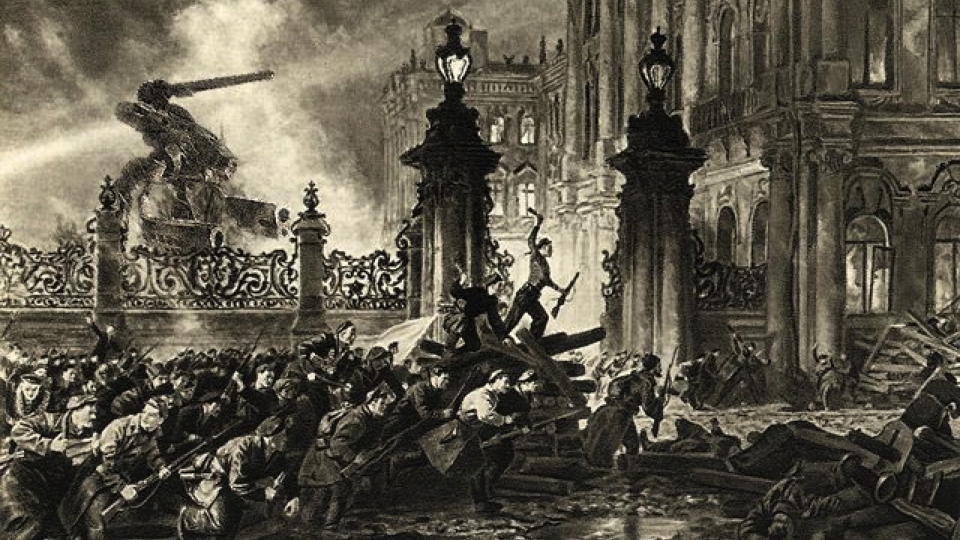
So the Rising was indeed a political revolution and a national one in so far as its aims were concerned although, by deliberate design, not national in scope – there was to be no Rising in Ulster.   However it was not a social revolution; it certainly didn’t pretend to be a socialist revolution.  We know what one of them might look like because we saw one the year after in 1917. And it wasn’t a social revolution of the land question.  If anyone deserves credit for the revolution in the transfer of land ownership from largely alien landlords to native tenant farmers it is the British who must stand first in line.  It must be said that in this they were helped by the massive loss caused by the famine for which they should also stand first in line, and were subject to agrarian agitation to force them.

So even in three very short sentences that are easily passed over as received wisdom the understanding of Martin McGuinness is inaccurate, just as 100 years ago the British and many others were wrong to see the Easter Rising as a Sinn Fein rebellion.  Sinn Fein had nothing to do with it and the party was led by a man who was not in favour of a Republic.

Does it matter that McGuinness’s understanding is so wrong?  Such misconceptions have been legion. The embers of the Rising were still warm before it was widely condemned as a ‘German plot’, all the better to damn it as a disloyal stab in the back in the middle of a real war.  The fiftieth anniversary celebrations have been blamed by Unionists for sparking ‘the Troubles’ in Northern Ireland, absolving the demands of Ian Paisley that the Tricolour be removed from the Falls Road for the trouble that erupted there in 1966, and later unionist attempts to attack demonstrations for civil rights for the eruption of violence in 1968 and 1969.

So yes, getting history wrong does matter because it will not explain why the Troubles broke out in the North of Ireland and it doesn’t explain why the 1916 Rising failed to achieve a truly national revolution never mind a social revolution.  If we dispense with incorrect explanations of the world and its history we are much better placed to seek better ones and in doing so better able to understand what is happening today.

For many what has happened during the centenary celebrations today is an “Irish capitalist class .  . overcome with embarrassment and revulsion, forced to commemorate something they despise”, according to one left wing leaflet handed out at a meeting in Belfast a few weeks ago.

For another left wing author “the notion that Enda Kenny owes his position as Taoiseach to republican guerrillas who stormed the GPO is, to put it mildly, deeply unsettling.  The political elite is therefore  approaching the centenary commemorations of the rising with profoundly ambivalent feelings and not a little trepidation”.

Two other authors have written a short book, ‘Who’s afraid of the Easter Rising? 1919 – 2016’.  They note the opposition to the Rising from those who think Ireland could have won its independence without the violence unleashed in 1916 and who therefore condemn it for the example it set to later generations of violent republicans.  They also characterise the attitude of the Irish Government to the commemoration of the Rising as one of “bad faith.  They talk in doublespeak  and clichés. Their energy is not directed at genuinely exploring or celebrating the legacy of the Rising but rather in controlling it.” In this desire for control however they are hardly alone.

“This political class is embarrassed by 1916 but most are afraid to say so publically, hence they practice the politics of ambiguity and dishonest historical revisionism as a way of avoiding the truth and real debate.”

But if the Irish establishment has been variously “uncomfortable”, embarrassed”, “afraid” and “nervous” they hid it well during the commemoration and scored a significant success, all the more significant depending on how much they were exposed to the emotions attributed to them by some left wing authors.

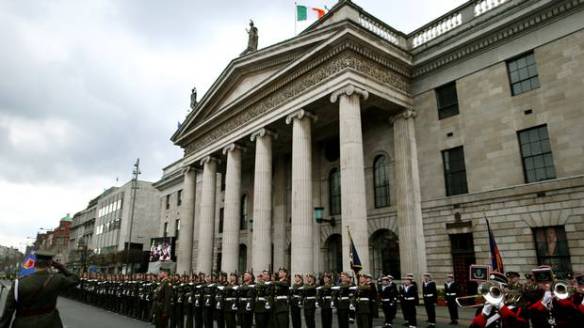
Far from ambiguity they presented a coherent narrative – we commemorate those gallant men and women who gave us our freedom today, a freedom expressed by the existence and independence of the Irish State which put its back bone on display through the military parade of its armed forces.  This is the State to which we owe loyalty and we celebrate the foundational act of that state – the Easter 1916 Rising. No one among the broadest ranks of Irish nationalism seeks to attack the institutions of this State, not even ‘dissident’ republicanism centred the North.

Easter 3

The celebrations were therefore a celebration not only of the Rising but of the legitimacy of the State and its institutions.  The highlighting of descendants of the 1916 rebels and later revolutionary heroes in the parade of today’s Armed Forces on Easter Sunday and the reading out of the Proclamation by an officer of the Irish Army was a coherent message that there is only one legitimate Óglaigh na hÉireann.  Loyalty to the state is mandated by the sacrifice of the men and women of 1916 whose creation it is.

And is this not at least partly true?  And if it is not by any means the whole story are we not then into more ambiguous territory and far from a simple story of misappropriation of a risen people by an elite?  Or, recalling our first post on remembering 1916; were Cosgrave, Collins and de Valera etc. not part of this risen people or, recalling the second post, did the Proclamation not address itself to national freedom and not any wider set of promises?

It is not that the Irish establishment finds nothing in the history of the Rising that it finds objectionable.  Who does not?  But among the emotions listed above there has also been indifference in the past, in commemorating the Rising and, for example, in maintaining and giving access to the historical records upon which its story can more truthfully be told.  In 1971 Garrett Fitzgerald stated that “this country will look very odd indeed in international eyes if Britain continues to release information about Irish matters before we do – as has already happened.  We will have to stop being afraid of our own history.”  His view reversed the previous Fianna Fail view of the late 1960s that access to state papers could result in “injury . . . to national unity and harmony.”  Taoiseach Jack Lynch said that even if the British opened papers the Irish Government would not because it “might well stir domestic controversies that best lie buried.”

In any case attempts to emulate the rebellious attitude of 1916 will not depend on seeking to emulate the Volunteers of 1916 but will come from the nature of the oppression and exploitation faced today and more importantly by the goals and strategies that channel this rebelliousness.  This is what makes the release of historical state papers possible – the historical controversies they relate to are relevant but  will not of themselves stir struggle today and are not amenable to a simple repetition of rebellion – what for, by whom, with what objectives and for what alternative?

We are called upon to commemorate those who fought in 1916 and to remember the Proclamation of the Republic they fought for, but on what grounds are we called upon to remember?  Who is asking us to commemorate and do we celebrate the same thing if we do?  Does this now matter, for will there now be any future anniversary with such resonance?
Easter 2

Back to part 2

Forward to part 4

Remembering the Rising part 1- the men of 1916

brendanrebels1916


When British Army reinforcements arrived in Kingstown to put down the Easter Rising in 1916 many of the soldiers thought they had been sent to France and one Cockney soldier ‘wondered how everyone he met spoke such good English.’  On Wednesday morning, on day three of the Rising, hundreds of these soldiers marched into South Dublin along Northumberland Road where Eamon De Valera, who was commandant of the 3rd Battalion of the Irish Volunteers, had anticipated this approach and had placed two outposts along the Road approaching Mount Street Bridge.

The Volunteers here waited until the advance detachment of the British had passed before opening fire: ‘those who came in our direction were completely wiped out’, said one Volunteer.  “Isn’t this a great day for Ireland” said Volunteer Paddy Doyle.  The engagement that followed at Mount Street Bridge accounted for almost half British Army casualties in the Rising and only sheer weight of numbers and superior firepower allowed the British forces to eventually push through.  Volunteer James Doyle, who had been knocked unconscious during the fighting, woke up to find that his outpost had been ripped apart by bullets and explosions and that his comrade Paddy Doyle was dead.

The 4th Battalion, ordered to take over the South Dublin Union -, the largest poorhouse in the country with three thousand inmates – included William Cosgrave who was quartermaster to Eamonn Ceannt, a signatory to the Proclamation of the Republic.  Cosgrave later took over command from Cathal Brugha after Brugha was so badly wounded by a grenade that he was not expected to survive.

Brugha “was a hard hater of everything British” and “knew nothing of fear and had little sympathy for anyone who did.”  When the Volunteers were forced to vacate their position in the nurse’s home  one asked Cosgrave if they would take Brugha with them even though Brugha, thinking he was done for, had told the volunteers to leave.  Cosgrave replied that “a soldier’s duty was to obey and pointed the way with a .45 revolver swinging on his finger.”  Nevertheless Brugha was later to say that he remembered Cosgrave’s “extreme kindness” when he was wounded and would not forget it.

Cosgrave had been at the inaugural meeting of the Volunteers at the Rotunda in Dublin and took part in the gun running at Howth. His brother also participated in the Rising and was shot dead by a British sniper during the fighting.  Though his garrison was complimented by one of the British commanders for having fought against great odds his court martial, lasting only ten to fifteen minutes, declared a sentence of “guilty, death by being shot.”  However, like many others receiving the same verdict he escaped the death penalty.

Commandant De Valera, who was responsible for the Volunteers at Mount Street Bridge and for the extent of the British losses inflicted there, also escaped execution by the British, the only commandant not to be shot by a British firing squad.

Cosgrave later became a leader of the pro-Treaty faction of the republican movement and became head of the Free State after the death of Michael Collins.  The split in the movement over the Treaty led to civil war, amongst the first casualties of which was Cathal Brugha.

In pursuit of this civil war Cosgrave introduced military courts, saying that “we are not going to treat rebels as prisoners of war.” This included the execution of four prominent members of the anti-Treaty movement in retaliation for the killing of a pro-Treaty TD, Cosgrave stating that “terror meets terror.”  One of the four was Rory O’Connor, who was wounded in the Rising, and another the radical republican Liam Mellows who in 1916 had led the biggest mobilisation of Volunteers outside Dublin in attacks in County Galway.

‘The Irish Times’ noted that this action “eclipses in sudden and tragic severity the sternest measures of the British Crown” and even Catholic Archbishop Byrne expressed dismay.  Seventy more anti-Treaty republicans were executed in the next five months, including Erskine Childers who had been on board the Asgard when it landed guns in Howth.

As later head of the new Free State Government Cosgrave introduced a conservative policy of low taxation, balanced budgets and free trade, leading for example to a cut in the pension for the blind and a particularly unpopular cut in the old age pension of 10 per cent in 1924.  Social policy included heavy censorship of films and literature, including a Committee on Evil Literature, plus legislation to outlaw divorce and “the unnatural prevention of conception”.

In 1932 the Cosgrave led Cumann na nGaedheal party failed to convince the electorate that the Fianna Fail party was communist, beginning decades of domination of that party led by De Valera before the reins of Taoiseach passed to fellow 1916 veteran Sean Lemass in 1959.  His economic policy was less centred on agriculture and during the protectionist 1930s he was willing to promote national industrial development behind tariffs.  His new constitution of the Irish State in 1937 recognised the special position of the Catholic Church and the position of women in the home.

He kept the Irish State out of and officially neutral during the Second World War and also used hated Cumann na nGaedheal laws to drag members of the remaining IRA before military tribunals, introducing internment of republicans and letting prisoners die on hunger strike. He also, like the Free State forces during the civil war and indeed the British, carried out executions of IRA members by firing squad.  These included Patrick McGrath, another veteran of 1916.

While Liam Mellows had led the largest mobilisation of Volunteers outside Dublin in 1916 it was the Volunteers of the 5th Battalion led by Thomas Ashe in North Dublin and Meath that inflicted the most casualties.  These forces led by Ashe were joined by another smaller group of Volunteers led by Richard Mulcahy, a future chief of staff of the Irish Republican Army.

Mulcahy’s plans for Easter originally involved a three-day religious retreat and a holiday with his family and while he got away on the first the second had to wait.  Suffering from the same confusion of many volunteers who had seen the countermanding order against mobilisation by the leader of the Volunteers, Eoin Mac Neill, he went out uniformed ready to take part in the Rising if one was to take place.

After bumping into James Connolly, who didn’t confirm any plans to him, he later met Thomas MacDonagh, who told him to be ready to “strike at twelve”.  This involved destruction of cables at Howth railway junction and with two other Volunteers he set off to carry out his orders, only to find out that one of his comrades had left his gun at home!  Having got the errant revolutionary to go home and get his weapon the group came across two members of the Royal Irish Constabulary (RIC), who fortunately were so used to Volunteers marching about that they passed them by with hardly a glance.  The Volunteers then carried out their orders and cut the Howth communication cables.

Having met up with Ashe, Mulcahy was made second-in-command, together leading the attack on two RIC barracks at Swords and Donabate.  It was the attack on the barracks at Ashbourne however that was to be most dramatic and testified to the leadership qualities of Mulcahy.

Realising that the Rising had not gone to plan a number of the 5th Battalion Volunteers questioned the legitimacy of their actions and continuation of their attacks.  In response Mulcahy gave a lecture on their duty to their country and after calling a vote only a handful failed to take the step forward that indicated their willingness to continue the fight.

The next day the Battalion attacked the Ashbourne barracks, defended by only ten RIC men.  Just as the RIC inside were about to surrender a seventeen –strong column of cars containing at least fifty-four police appeared, threatening to reverse the outcome of the engagement and provoke a panicked rout.

Mulcahy prevented the panic and led the outnumbered Volunteers in holding their ground against the new RIC column, surrounding it and subjecting it to relentless fire from all angles – one volunteer Bernard McAllister recalled that “we had a clear view and decimated them with our fire. Some took cover under the cars but were visible to us there. . . our fellows were making bets as to who would shoot the most.”

Pressing home the advantage in an engagement that lasted over five hours the Volunteers led by Mulcahy pushed forward, resulting in fierce close-quarters fighting:

“John Crinigan of Swords looked through a gap in the ditch to locate any police, he was seen by D.I. Smith [Smyth] who fired at and shot him through the head with a revolver.  Vice-Commandant Frank Lawless who was immediately behind joined fire on the D.I. with a Howth Mauser rifle at a distance of about 6 yards and shot him through the head.”

Richard Mulcahy then led a bayonet charge against the RIC who surrendered by throwing their rifles out on the road.

The victory was possible for a number of reasons, including that Mulcahy was able to convince Ashe not to retreat when the RIC column stumbled on the original attack.  In many ways this action was significant because it prefigured republican military tactics during the later War of Independence in which Mulcahy was to play a major role.  One of Mulcahy’s colleagues was to remark that he was the only one to come out of 1916 with a military reputation.

In the history of the later struggle however Mulcahy was very much overshadowed by the figure of Michael Collins, Minister of Finance in the Republican Government, Adjutant-General of the War of Independence Volunteers and Director of Intelligence, often portrayed as the tragic hero of the war against the British, comparable to those who were to be executed at the end of the Rising.

Collins too had taken part in the 1916 rebellion and though not then the renowned figure he was to become it has been noted that he stood out in a number of atypical ways.  Before and during the Rising Volunteers showed remarkable piety and religious observance.  This was a reflection of the strength of Catholicism in Irish society at the time, a strength which captured many later popular perceptions of the Rising as enshrining a Catholic ethos, leading to portrayal of the Rising in quasi-religious terms.

There are many reports of the Volunteers praying, holding rosary beads along with their guns, attending confession and receiving Holy Communion before and during the Rising.  But this was not true everyone.  Near the end of the week’s fighting as the morale of some began to falter Collins rounded on a fellow Volunteer for neglecting to focus on fighting by saying “Are you fucking praying too?”

Collins and Mulcahy were to become leading figures in the guerrilla war against Britain and then in the pro-Treaty regime that arose from acceptance of the peace terms dictated by the British.   During the war Collins became the celebrated organiser of a special assassination unit called ‘The Squad’ formed to kill British agents and informers.  Although criticised for his apparently ruthless approach he cited the universal war-time practise of executing enemy spies who were, in his words, “hunting victims for execution.”

In 1920 a bounty of £10,000 (equivalent in 2010 to £300,000/€360,000) was offered for information leading to his capture or death.   One of his operatives in the Squad was Vinnie Byrne who had also ‘fought’ in the Rising as a fifteen year old, although he later admitted he never fired a shot and was released when the Rising was over after a stern lecture by a British officer.

Collins shared the leadership of the military campaign against the British with Mulcahy who also supported the Treaty, serving as Defence Minister in the new Free State Government from January 1922 until March 1924.  During the civil war that followed the signing of the Treaty Mulcahy earned notoriety through his order that anti-Treaty activists captured carrying arms were liable for execution and a total of 77 anti-Treaty prisoners suffered this fate.

Another of Collins’ associates in the War against the British was Joseph McGrath who had taken part in fierce fighting in Marrowbone Lane in 1916 under the command of Eamonn Ceantt.   He also supported the Treaty and as head of the Criminal Investigation Unit was responsible for abducting and killing Anti-Treaty republicans during the civil war.  A policy of repression was also used against the regime’s first striking workers in September 1922 when the Free State Government opposed the right of postal workers to withdraw their labour.  One of the workers’ pickets was shot, surviving only because the bullet deflected off her suspender buckle.

Collins had fought in the Rising as Joseph Plunkett’s aide-de-camp at the GPO alongside Patrick Pearse and James Connolly.  Despite Pearse being commander-in-chief it was Connolly who was made Commandant-General of the Dublin Division, in effect leading the forces in the GPO, which was the headquarters of the Rising.  One Volunteer remembered that “his physical energy and strength were amazing.  He was always on the move”.  His principal weakness as a leader according to Oscar Traynor was his indifference to his own safety, which was characterised by other Volunteers as “remarkable coolness.”

William Whelan noted that when some of his number were shaken by crowds looting shops and began firing wildly “Connolly came out of the Post Office and marched up and down in front of it.  He said “Steady, we are going to have a good fight”.  He quelled the panic”.

Connolly was wounded twice, the second more seriously, ending his effective leadership of the Rising.  This also resulted in one of the most poignant episodes in the Rising – Connolly being carried on a stretcher to his execution as two members of the firing squad were ordered to aim at his head.  He died without any movement, the bullets shattering the back of his chair.

In his last meeting with his daughter Nora she recalled her Mother’s lament “But your beautiful life, James’.  “Hasn’t it been a full life?  Isn’t this a good end?” he said.  ‘Then they took us away.’

This full and beautiful life included founding the Irish Socialist Republican Party and the Irish Transport and General Workers Union; membership and organisation of socialist parties and the militant ‘Wobblies’ union in the United States; numerous Marxist writings on socialism, politics and Irish history and leadership of the Irish Citizens Army, which fought in the Rising.

In the centenary anniversary of the Rising we are called upon to remember those who fought.  Let us remember them all.

Forward to part 2

Is a Left Government a good idea?

PBPA-header-w814It reminds me of a football club that tries to buy a player from another club but fails because it can’t afford the transfer fee.  It is soon made clear that they didn’t really fancy the player anyway, that the price was too high, they wouldn’t be held to ransom and in any case, they’ve got better players in their own ranks.


So some recent statements by the Left on the question of forming a Left Government appear to throw doubt on this project, state that the political price of signing up to one is too high and anyway, they’d prefer to be in opposition.  In fact it’s maybe not even a good idea in the first place.

This is the impression given by the People before Profit Alliance (PbP) who, in a statement on a left Government, nowhere say that it is a good idea but instead pour cold water on the whole notion. It states that “our willingness to enter or, alternatively, support a left government from outside depends on agreement that our red line issues will be carried through.” So which is it – enter or support, and how might we expect the difference to be arrived at?

In terms of my previous posts, the strategic gap in the perspective of seeking a left Government is made to go away by seemingly orthodox Marxist criticisms of the whole idea.  So the statement quoted from above was preceded by a political article from a Socialist Workers Party (SWP) journal explaining its view of the socialist attitude to a Left Government.

“The purpose of this article is to demonstrate that the logic of parliamentary politics is a reformist politics that sees Cabinet as the place where changes are made, drawing movements into compromises, undermining the mobilising capacity of the working class and leading to the defeat of Left Governments and the wider working class movement . . .  spreading illusions in reforming the State can be fatal.”

Further on we are told that “we can also see in the desire for a ‘left government’ an initial and vague rejection of capitalism on the part of masses of workers. The growth of an ‘authentic’ Social Democratic or left reformist consciousness amongst hundreds of thousands of workers is a vital stepping stone to a revolutionary consciousness.”

And in the next paragraph:

“They [left formations seeking office] appeal to the desire to change things but they do so within the limits of the existing capitalist economy. Capitalists today cannot afford the reforms that they could during the post war boom, which lasted from the 1940s to 1973, and so any left government will very quickly have to decide whether or not to fight or capitulate as the ruling class can use their economic might, control of the banks and also the media to strangle the left or to force a capitulation which demoralises the working class support base of the Government.”

So where we have got to in this analysis is that left governments can result in compromise, which can be fatal, but reflect a vague rejection of capitalism by workers that is a vital stepping stone to revolutionary consciousness.   Since this social-democratic consciousness, which is “vital”, is based on illusions in the state bringing in reforms, and even socialism, we can see the immediate problem expressed in the view that such “illusions in reforming the State can be fatal.”

What makes everything even more difficult is that a left government doesn’t have very much time to turn this consciousness around because “any left government will very quickly have to decide whether or not to fight or capitulate.”

If all this is true then the SWP/PbP is correct to be lukewarm at best about any near-term prospect of a left Government, if this is what it is saying.   The Irish working class is not currently even vaguely rejecting capitalism and, if it did elect a Left Government, it would never develop the revolutionary consciousness or practical power to successfully challenge capitalism in the short period during which a Left Government would exist before it either compromised or was overthrown (according to the SWP).

My own view, expressed before in a series of posts, is that a more or less long period of preparation is needed before the working class can prepare itself (not by a left Government) to take power in society.  I have therefore argued that it is not the perspective of capturing office that is central to socialist strategy but building up the independent power of the working class in society which is fundamental.

The SWP states that:

“For revolutionaries though, the battle to render workers fit to self-govern is connected to the revolution itself- for it is in mass struggle that people throw off ruling class ideas and begin to grow in confidence. For us the foundation of socialism is not about a slow accumulation of reforms that gradually evolve into a new society – for revolutionaries the key foundation of socialism is the throwing off of ruling class ideas, what Marx called the ‘muck of ages’, the pessimistic, sexist and racist filth that flows from the ruling class and is accepted by workers because of oppression and atomisation.”

If we look at this statement firstly from the beginning – the battle to render workers fit to govern is indeed connected to the revolution but what socialism involves is a social revolution, not just a political one of taking over or replacing one form of political rule by another.  It is simply incredible to believe that in a few short months or even years workers will learn to be able, or even want, to take over the running of the economy from the capitalist class (without previous years of making attempts to do so).  Even in the Russian revolution, still held up as some sort of model, the workers looked to state ownership under the Bolsheviks as their saviour.  Mass political struggle is insufficient to generate the revolutionary consciousness or capability necessary for social revolution, and certainly not in the truncated period foreseen by the term of office of an uncompromising left Government supported initially by ‘vague’ ideas about anti-capitalism.

Thus when we approach the statement from its end, the ‘muck of ages’ will not be swept away in a few short years but will require an extended period of workers, not ‘vaguely’ seeking to overthrow  capitalism, but actively hoping for and fighting for socialism.  As Marx put it “they know that in order to work out their own emancipation, and along with it that higher form to which present society is irresistibly tending by its own economical agencies, they will have to pass through long struggles, through a series of historic processes, transforming circumstances and men.”

The lack of revolutionary consciousness among workers is not simply due to “oppression” and “atomisation” and is not simply reflected in pessimism, sexism and racism: it arises fundamentally because of the subordinate role the working class plays in capitalist society.  Their social consciousness is determined generally by their social position, the most fundamental aspect of which is their separation from ownership of the means of production and compulsion to sell their labour power to capitalists. Steps to challenge and begin to change this are fundamental to any social revolution and this isn’t the work of a parliamentary term of office, which the SWP appear to think a left government wouldn’t even get.

The problems that face the SWP perspective are actually demonstrated by the article to be worse than this – “clearly any movement that has illusions in the state, and believes that this machinery serves any purpose other than oppression, is blinding the working class to the key task of any revolution – the life-or-death necessity of dismantling these oppressive structures”; but isn’t it PbP which says that one of its red-line issues in determining support for a left Government is that it has a “strategy of using public resources to empower an active workers movement – the way that the state has been used up to now to shore up corporate interests”?

And further, having said that “we can also see in the desire for a ‘left government’ an initial and vague rejection of capitalism on the part of masses of workers”, and that this isn’t revolutionary consciousness, the article then says: “hence the all-important paradox: the advent of a left government will only strengthen the workers’ movement inasmuch as the class, or at least its vanguard, do not have illusions in this government.”

This must then rule out the pursuit of a left Government not only today but for ever in the future according to the analysis presented by the SWP writer.

Of course the get-out is reference to the vanguard, but it is the working class which will create socialism or it won’t be created at all so no devolving of tasks required of the working class to an undefined vanguard will solve this problem.

The conclusions of the article would appear to rule out the perspective of trying to form a left Government – “In the past socialists have dealt with left governments through the tactic of ‘external support’ – that means we would never run the oppressive state machinery but we would explain to workers that we are willing to support a left government as long as it acts in worker’s interests but from the opposition benches.”

This means that all the proposals in the PbP manifesto that require action by the state are a fraud – the PbP never intends to implement them because it will never be in government.  Are the PbP going to tell working class voters this when it knocks on doors?  Saying “we will not be joining any government that includes Fianna Fail, Fine Gael or Labour in its present form” is misleading and should be replaced by “we will not be joining any government.”  What it means by saying that it may talk to Sinn Fein and the left after the election about forming a left Government is anyone’s guess.  Since the Anti-Austerity Alliance is very much in favour of forming a left Government just what is their electoral alliance with it about?

If the left Government would receive PbP support when it acted in workers’ interests why would it not seek to act in their interests itself by joining the government?  In this we are back to the difficulties of trying to remain pure by staying outside government while still having to take political responsibility for keeping it in office (see the previous post).

The SWP is clear that “based on this understanding of the nature of the state machine as a repressive mechanism for holding the working class down, no revolutionary socialist can ever join a government under capitalism.”

It draws the conclusion that “therefore socialists should support a left government but from the opposition benches. We stand in elections for the sole purpose of building the extra-parliamentary struggle.”

So it would appear that it maintains its revolutionary purity, except that it stands in elections promoting reformist policies that could only be implemented by forming a government, not by “extra-parliamentary struggle.”  Its Marxism becomes an article of faith, with quotations from the prophets in special books to be read by members and might-be members, but with no practical programmatic application on this earth, in this world.

It enters an electoral alliance with the Anti-Austerity Alliance saying “we stand for a left government”.

It wants to “abolish austerity taxes and reverse the cuts.”  It wants to “invest in Health” and “build a National Health Service, free at the point of use and paid for through progressive central taxation.”  It similarly wants to “invest in education and childcare” and “reduce the pupil-teacher ratio” and “develop strategic public enterprise and industry and invest in public infrastructure” by making “the corporations pay their taxes”.  It wants to “take Ireland’s oil and gas resources into public ownership” and “recognise the Palestinian state” and much, much more; none of which is possible to implement without being in Government.

It is indeed difficult to make the pursuit of Marxist politics consistent with the current political development of the Irish working class, but Marx himself faced a similar problem.  The review above shows that the current approach by part of the Left is simply incoherent, an incoherence that fortunately for it will not be put to the test as a result of the election about to be called.

Back to part 5

Workers’ cooperatives as an alternative to Capitalism – 2

10698536_420301091453164_5593204590190940624_nMarxists believe that conditions determine consciousness.  The ideas that most people have are products of their circumstances.  Currently workers sell their labour power as a commodity.  That is why they concentrate efforts on the price of their labour power (wages) and the terms and conditions at which it is sold.

It is why they value those services that they cannot provide for themselves individually but are unable to provide collectively because they lack the consciousness and organisation to do so.  This includes such things as unemployment insurance, pensions, health care and education.

The sanctification of capitalist private property means that the former is not strictly political while the distribution of the revenue from capitalism is.  Through the latter the working class is made dependent on the state for these services, including through employment in their delivery.  The welfare dependency culture repeated like a mantra by the right has this much basis in fact.

What there is not therefore is the material basis for the growth of a consciousness that workers should own, manage and control the productive activities of the economy and the state.  Instead the growth of the state and its acknowledged political leadership are the grounds for the view that the redistributive powers of the state are the basis for a solution.  This mistaken view takes the extreme form on the Left that the state should take over production itself.  Of course this has been tried.  It didn’t work well.

What we have with the Keynesian alternative then is an expectation, doomed to disappointment, that the capitalist state will divide the fruits of capitalism to benefit those who have first been exploited in opposition to those who have carried out the exploitation, which must remain in place in order to continue funding the redistribution.

Marxists believe that the future socialist society is not utopian because current society contains its anticipation in various ways.  Capitalism is pregnant with the future socialism; except that if the state is the embryo then the pregnancy taken to full term does not result in socialism but something else entirely.

Workers’ cooperatives are one of the crucial elements of this anticipated new society growing within the womb of the old.  It reunites workers with the means of production and removes the capitalist from the workplace.  It gives ownership to the workers and elevates their power, confidence and consciousness.  It can prepare the workers involved and other workers for the task of making the whole economy the property of the working class, which is socialism.

Workers ownership can provide the basis for workers to provide the services that are currently provided by the state and which leaves them at the mercy of the state and the politicians who preside on top of it.  Such services include education, health, welfare and pensions.  Workers self-provision of this would result in their own priorities being imposed on their provision.

However to posit this as the alternative immediately demonstrates a major difficulty.  While it is possible to envisage workers cooperatives supplanting individual capitalist production it is much more difficult to envisage this in regard to the services now provided by the State.  What this once again demonstrates is the role of the state as defender of the capitalist system – through exclusion of the working class from direct control within society and protection of the accumulation needs of capitalism.

Workers’ self-provision of what are now services provided by the state would necessarily lead not to demanding more taxation by the state but less, so that workers would have more control of their earnings and would have more to pool together and employ to their collective benefit.  In short workers would take more and more responsibility for their own lives, even when temporarily or permanently unable to work.  The dependence on the capitalist state would be weakened, at least in this respect.

In Ireland workers would have the grounds for recognising that there is an alternative economic development model to reliance on US multinationals.  They would have an example of a model of development that didn’t rely on the state.  They would have a living alternative to the threats that they need the capitalist banks.

Instead of workers relying on the state to provide for them by taxing the rich or investing in infrastructure to promote private capitalist investment they would have an alternative in which it is their own activity which is the alternative to capitalist crisis.

Is this the viewpoint of a reformist and utopian scenario?  I think not.

Firstly thousands of cooperatives already exist; they are not purely idealistic mental constructions.  What’s more they can be, and many are, very successful; providing hundreds of thousands of jobs.  Living proof that workers can do without capitalists to tell them what to do.  Workers can take control, can make decisions and can be successful.

The spread of workers’ cooperatives in entirely possible, their growth and development is not precluded by any necessarily limiting factor in capitalist development, at least to the point where capitalist accumulation appears threatened by it.

The trade union movement and the political organisations of the working class can play an important role in their development.  Workers’ cooperatives are therefore not an alternative to the existing workers movement but are something that can be complementary to its development, freeing it more and more from dependence on private capital and the state.

In fact workers’ cooperatives will inevitably demonstrate through their development the antipathy of the state to workers ownership and the power that workers as a class will develop as a result of its development.  The state will inevitably be used by the class it serves, the capitalist class, to undermine competition from workers cooperatives and support private capitalist accumulation.  Such a development will clarify the lines of battle between the workers’ movement and the capitalist system.

Workers’ cooperatives are not an alternative to class struggle but a means of carrying it out.  The creation of workers’ cooperatives in Argentina following its capitalist crises is evidence of this – how much better to promote workers’ cooperatives before such cataclysmic crises rather than in their midst or aftermath.

When workers say – “where is your socialist alternative after over a 150 years of your movement?”, we might have a living movement to point to rather than a simple promise for the future.

And such a movement will be an international one because just as capitalist development has become international there is every reason why workers’ cooperative production should also be international.  Every bit of such development will strengthen the international bonds between workers and undermine nationalist solutions that are currently growing.

In other words workers’ cooperatives provide the living link between resistance against the injustice of the current system and the creation of a real alternative.  Instead of simple rejection of cuts and lack of democracy workers’ cooperatives not only posit employment and democracy within the cooperative but the transition to a new society.  Workers’ cooperatives thus provide the material basis for linking the struggle against capitalism to the creation of socialism.

Workers’ cooperatives are not a magic bullet answer to the current crisis on the Left.  There is no simple or singular programmatic answer to a crisis that exists at the level of working class consciousness and organisation.  But for the Left a programmatic answer is currently by far and away the most important contribution that it can provide to workers.

Traditionally the revolutionary left has rejected workers’ cooperatives because they have been seen as an alternative to revolution – a militant class struggle against capitalists and the state culminating in an insurrection, the smashing of the capitalist state and creation of a new one.  I don’t think anyone can credibly claim that the patient work of class organisation involved in union organising, party building and creation of workers’ cooperatives would get in the way of a burgeoning revolutionary movement.  Anyway, when was the last revolution in an advanced capitalist state, one in which the working class is the vast majority of society?

It can be legitimately claimed that workers in existing cooperatives lack socialist consciousness so how can they provide the material basis for socialism?  This objection however must also take on board the reality that decades of union organisation has also not turned the majority of trade unionists into socialists.  However no one advocates abandoning the organisation of trade unions.

Finally an objection is made that workers’ cooperatives will simply teach workers to exploit themselves within a market economy based on competition.  They will simply become their own capitalists.

However, at the extreme, the ownership of all production by the working class would not only remove the capitalist class but would also remove the need for all allocation by the market, or by socially necessary labour time, to use the strictly Marxist definition.  In other words workers’ cooperatives would cooperate with each other.  Such competition as would exist would not play the same role as capitalist competition just as the continued existence of money tokens would not make it a capitalist system.

So for example, a factory making shoes that became unfashionable would not close down and throw its workers into unemployment but would see them transfer to either production of shoes that were in demand or to some entirely different branch of production.  Other workers would support this because they would all know that what they produce might equally go out of fashion, become technologically obsolete or have its workforce reduced by automation.  In the same way the receipt of money as salaries and wages would not mean that this money would exist as capital, able to purchase labour power in the pursuit of profit.

The current value of workers’ cooperatives is not just as living practical examples of socialism but that they allow theoretical and political clarification of just exactly what socialism is.  They shine a light on the difference between workers power and all the solutions that rely on the state – from Keynesianism to nationalism.

This is the second part of the post.  The first part appeared here.

Workers’ Cooperatives as an alternative to capitalism – 1

420389_494371703955556_1654331871_nIn October I was invited to speak at a meeting organised by the Glasgow South branch of Left Unity on the subject of workers’ cooperatives.  The post below is the first part of the text on which the speech delivered was based.  I would like to thank the comrades for the invitation and for the couple of pints in the pub afterwards.


The first thing I want to do is look at two problems to which I think workers’ cooperatives can play an important role in providing an answer.

In 2008 the Irish banking system was on the verge of complete collapse.  It had lent exorbitant amounts of money to commercial property development and for the construction of houses.  Not only finance but employment and state revenue became overly dependent on construction.  When the price of houses rose beyond a certain point, and when the commercial property market became saturated, the over-extension of property developers became evident in bad loans that bankrupted the banks.

This was an international problem because much of the financing of Irish banks came from Britain, the US and Germany for example.  The bankruptcy of the Irish banks would thus have had severe repercussions for investors in these and other countries, including the financial institutions in these countries.

To save the Irish banking system, to bail out the native bankers and foreign investors, the Irish Government launched a bailout of the banks through a state guarantee of all their liabilities, worth around €440 billion in an economy nominally producing €154 billion a year.  It was declared ‘the cheapest (bailout) in the world’ by the Irish Finance Minister.  This could not possibly be afforded and has so far cost an estimated €64 billion, although the exact figure is still a matter for development.

This bill and the huge budget deficit caused by the collapse of construction resulted in a series of attacks on working class living standards involving seven austerity budgets consisting of a variety of tax increases, cuts in public services and investment, the robbery of workers’ pension funds, massive unemployment, emigration and lots of praise from around the world at how well the Irish swallowed the austerity medicine.  From poster boy for the boom the Irish have become poster child for austerity.

In the following election the ruling Fianna Fail party was badly mauled and a coalition of Fine Gael and Labour Party was elected on the promise of a ‘democratic revolution’ and by Labour the promise it would reign in Fine Gael.  The vote was a choice between ‘Labour’s way or Frankfurt’s way.’

In truth however no one could really be surprised that this coalition continued and intensified the policies of austerity began by Fianna Fail.  That anyone thought differently demonstrated only a very low political awareness.

On the ‘left’ 5 United Left Alliance candidates were also elected and 14 Sinn Fein TDs out of a total of 166, although Sinn Fein had also voted for the bail-out.

In 2012 the Irish State was compelled to hold a referendum on the new EU Fiscal Compact that limited state deficits and debt.  It basically required signing up to continued austerity which is why it was called the ‘austerity treaty’.  Despite the unpopularity of austerity it was approved by 60% to 40%.  In my view a crucial reason for this was the complete lack of a convincing alternative.

What was the alternative proposed?

This consisted of a number of elements – repudiating the debt, opposing austerity, taxing the rich, and increasing public expenditure in order to improve public services, boost employment and further economic growth.

There are two points to note about this alternative – first it doesn’t change the nature of the economic system, it is what is called Keynesianism.  This does not mean that socialists should not support some of these measures, or point out the hypocrisy in their not being implemented.  But the question is, if the problem is capitalism and this alternative doesn’t threaten the system then quite obviously it cannot be a solution.

The second flows from this, because if it isn’t a solution would it actually work?  I’ll just take two examples from this programme – why on earth would the rich allow their wealth and income to be taken off them?  And how then could the state increase public sector investment when it was heading towards budget deficits of over 13%?

This illustrates a deeper problem with looking to the state as a solution.  This is because the burden placed on Irish workers was not simply, or even mainly, carried out by the banks and property developers.  It was the State that made their debts the debts of the Irish people and it has been the State that has increased taxes and cut services, making their own particular contribution to cutting wages and increasing unemployment.

Since the state is a capitalist state, funded and staffed at the highest levels by the propertied classes this can really be no surprise.  The actions of the capitalist state are not therefore the answer.  Not only does it not have any interest in providing a solution but it is incapable of being the solution.  State ownership, bureaucratic ownership, is not democratic and is totally unsuited to running productive activities the civil servants that staff it have no knowledge of.

There is no point calling for the state to nationalise the banks – they did and that was precisely the problem!

At bottom this is the root of the failure of resistance to austerity and is why it has not only failed in Ireland but in every other country affected by the financial crash.

The second point is connected to all this.  If the Keynesian alternative is not a road to socialism what is the road to it?

The alternative to the view that the capitalist state will reform society is that the state is actually the mechanism for enforcing oppression and exploitation and should therefore be smashed.  In this scenario of revolution the oppression of capitalist society breeds resistance which develops into a revolutionary seizure of power by the working class that then proceeds to build a new socialist society.  In this society the market is replaced by planning and capitalist economic crises become history.

But how are workers to become aware that their own ownership and control is the alternative?  How does it not only come to consciousness of this but is actually trained, ready and able to play this role?  How in the middle of crisis is a workers’ economy supposed to rise from the ashes more or less fully formed and present itself as a qualitative advance on what has went before?

Of course in some ways capitalism itself anticipates this planning through the growth of big business with advanced forms of planning within it, increased cooperation between companies that ostensibly are in competition and increased interdependency of different firms and different countries, encapsulated in the term globalisation.  This has all been demonstrated negatively through the simultaneous near collapse of the financial system, world trade and economic growth through the credit crunch plus the increased role of the state despite privatisation.

There is however one thing missing from this anticipation of the new society in the existing one and one thing missing from the scenario of revolutionary overthrow.

The missing factor is what the new society, the harbinger of socialism, actually is – the rule of the working class and its allies; the rule of the majority of society in place of the capitalist class and its managers, bureaucrats and politicians who all currently administer its rule.

Where in the anticipation of socialism within existing capitalist society is the growth of workers participation in running the economy, in preparation for taking over complete control?  Where are the grounds for workers to build a new society before, during and after revolution?  Where is the alternative that would avoid a new version of Stalinism where the State rules society rather than a society ruled by workers subordinating the state? Where even arises the motivation for workers to see that their own rule is the only valid unfolding of their resistance to the exploitation, oppression and iniquity of current society?

How are workers to come to see that it is they that not only can but must take control of society and its productive powers if they do not first take initial steps now through workers’ cooperatives?  Are we to believe they will suddenly come to realise through a revolution – an episode of at most a few years – that they must take over the economy?  How will they come to seek this as their solution unless many of them have already tried to do it and become committed to it?


The debate on socialist strategy and the Irish Left – Part 6

istanbul-red1Again and again the socialism of Mendel-Gleason and O’Brien rests not on the initiative of the workers but dependence on the state and the support of its bureaucracy – “Only a mass party with roots throughout the community, with an organisational reach comparable to the Catholic Church of old, can hope to win the active and passive support from the bureaucracy which is necessary to carry through socialisation measures.”

To their credit however, Mendel-Gleason and O’Brien are too intelligent and honest not to acknowledge the obvious and very painful lessons of working class history.

They acknowledge the reactionary role of the state bureaucracy – “as it is, the bureaucracy stymies existing pro-capitalist governments all the time.”

And they acknowledge the potential for violence from the capitalist class and the necessity for the working class to prepare for it:

“At some point the reactionaries will try to move onto more aggressive measures, including investment strikes and ultimately a coup d’état. . . should the socialist-labour movement prove too resilient to fold before the disruption aimed at fostering economic breakdown, the doomsday weapon of violent reaction, whether through the mobilisation of a mass fascist movement or via a straight-forward coup d’état always looms over its head, ready to detonate. . . then an old-fashioned street revolution becomes not only desirable but inevitable.”

Unfortunately for them this acknowledgement renders much of their argument either mistaken or incoherent.

They do not develop what their acknowledgement of the potential for state violence means for their reliance on this same state to usher in socialism (at the behest of the workers’ movement). But they are hardly ignorant of how the state was behind the most vicious fascist and reactionary movements which decimated the working class movement in defeats that over 80 years later have not been reversed.

In the 1920s and 1930s in Italy, Germany and Spain and Chile in 1973 the capitalist state, under pressure from mass workers’ movements such that we do not have today, and in some cases with parties in Government with a perspective not very different from Mendel-Gleason and O’Brien, clamped down on workers independent activity precisely because initiative and control was to lie with the state.  The state then succumbed to fascism where it did not succumb to the workers and either directly or indirectly handed power over to fascist or military dictatorships.

Only workers independent organisation apart from and against the state could have prevented this.

Mendel-Gleason and O’Brien are correct to repeat the dictum of Marx that we must win the battle of democracy but they are wrong to see this battle within the terms presented by bourgeois democracy.

They are actually right to say that “parliamentary democracy . . . remains the best gauge of public support for a political tendency”.  Right in the sense that right now it accurately tells us where what passes for the socialist movement actually is, which is a small minority.

This means we must reject the phantasies of much of the so-called Marxist Left that workers are champing at the bit to vote for the left social democracy if only Marxists would forget their previous criticisms of this political tendency and pretend to be, or rather more accurately reveal themselves to be, left social democrats.

Parliamentary democracy will not and cannot, as the working class develops its organisation, political consciousness and power, reflect the support for socialism because it is not capable of expressing or reflecting the expansion of all of the aspects of socialist development of the working class.

I have said it does so now only because all these are at such a low ebb.  As they develop parliamentary democracy at best expresses the lag in development and its weakest aspects at that and it would be a cruel education of worker-socialists to tell them that their powers and potential are reflected in what they see in parliament.

The truth of this is so fundamental that it is true even in the opposite case – where parliamentary support for socialism exceeds the real social and political development of the working class in society.  The parliamentary road sought by Mendel-Gleason and O’Brien, and by the small Left organisations, walks wide-eyed and innocent into the trap explained by Engels:

“The worst thing that can befall a leader of an extreme party is to be compelled to take over a government in an epoch when the movement is not yet ripe for the domination of the class which he represents and for the realisation of the measures which that domination would imply.

What he can do depends not upon his will but upon the sharpness of the clash of interests between the various classes, and upon the degree of development of the material means of existence, the relations of production and means of communication upon which the clash of interests of the classes is based every time.

What to do, what his party demands of him, again depends not upon him, or upon the degree of development of the class struggle and its conditions. He is bound to his doctrines and the demands hitherto propounded which do not emanate from the interrelations of the social classes at a given moment, or from the more or less accidental level of relations of production and means of communication, but from his more or less penetrating insight into the general result of the social and political movement.

Thus he necessarily finds himself in a dilemma. What he can do is in contrast to all his actions as hitherto practised, to all his principles and to the present interests of his party; what he ought to do cannot be achieved. In a word, he is compelled to represent not his party or his class, but the class for whom conditions are ripe for domination. In the interests of the movement itself, he is compelled to defend the interests of an alien class, and to feed his own class with phrases and promises, with the assertion that the interests of that alien class are their own interests.

Whoever puts himself in this awkward position is irrevocably lost. We have seen examples of this in recent times. We need only be reminded of the position taken in the last French provisional government by the representatives of the proletariat, though they represented only a very low level of proletarian development.

Whoever can still look forward to official positions after having become familiar with the experiences of the February government — not to speak of our own noble German provisional governments and imperial regencies — is either foolish beyond measure, or at best pays only lip service to the extreme revolutionary party.” 

Without large and powerful trade unions and other workers’ societies standing proudly independent of the capitalist class and its state; without a large cooperative sector owned, controlled and managed by workers; without a mass workers’ party with deep roots in the working class, with the confidence and respect of the masses outside its ranks, the votes of workers and wider society will not provide strong enough  foundations either to overthrow capitalism in the advanced capitalist countries or begin the building of socialism.

But these hardly feature, have walk-on parts or have a purely supporting role in the Mendel-Gleason and O’Brien production.  For them “Electoralism is the most important political activity in the European and North American societies and in practice it forms the centrepiece.”

They say that “It is only as a component part of the strategy of attrition that electoralism plays a critical part in moving beyond capitalism. Winning power is therefore not the only goal of electoralism; every bit as important is the role it plays in building a mass socialist party capable of winning it and of controlling the apparatus when it gets there.”

But even here they get the order wrong.  “But in order to benefit from electoral work there has to be an institutionalisation of the gains, whether through increased participation in the party or union, more subscriptions to sympathetic left-wing media, joining a co-op or simply voting for the party come election time. These and other possible methods of harvesting the labour expended in the springtime of campaigning all depend on having institutions capable of soaking up the goodwill.”

Here it is electoralism that is the engine to drive working class organisation, that builds the other wings and activities of the working class movement.  In fact, as an old Official republican said to me a few years ago, it is in elections that you reap what you sow, even in the narrow terms posed by Mendel-Gleason and O’Brien.

The commitment by them to bourgeois democracy is ironic given the decay of this form.  At the beginning of March ‘The Economist’ had a six page essay and a front page that asked “What’s gone wrong with democracy”.

It noted – “Nor is the EU a paragon of democracy. The decision to introduce the euro in 1999 was taken largely by technocrats; only two countries, Denmark and Sweden, held referendums on the matter (both said no). Efforts to win popular approval for the Lisbon Treaty, which consolidated power in Brussels, were abandoned when people started voting the wrong way. During the darkest days of the euro crisis the euro-elite forced Italy and Greece to replace democratically elected leaders with technocrats. The European Parliament, an unsuccessful attempt to fix Europe’s democratic deficit, is both ignored and despised.”

“Adjusting to hard times will be made even more difficult by a growing cynicism towards politics. Party membership is declining across the developed world: only 1% of Britons are now members of political parties compared with 20% in 1950. Voter turnout is falling, too: a study of 49 democracies found that it had declined by 10 percentage points between 1980-84 and 2007-13. A survey of seven European countries in 2012 found that more than half of voters “had no trust in government” whatsoever. A YouGov opinion poll of British voters in the same year found that 62% of those polled agreed that “politicians tell lies all the time”.

images (5)

20140301_ESC004


All this reflects the supplicant position which reliance on the state places workers and the failure of the state to respond to popular opinion.  It reflects the legacy of the parties supported by workers who have embraced bourgeois democracy very much in the way proposed as much as it reflects the cynicism of other classes.

Mendel-Gleason and O’Brien are aware of the dangers of integration into the existing political-economic system, of a tendency towards conservatism and dangers of bureaucracy but their strategy of attrition and its reliance on the state and representation as opposed to direct participation all feed these problems.

This approach teaches passivity, that someone else has responsibility for political activity and leadership.  That power lies in a machine (the state) that exists outside your own competence and capability.  That your own activity is primarily to engage in voting for someone else to press forward your interests and that your own productive activity is not directly something that you should seek to control.

All this can be said of the existing capitalist state and its bourgeois politicians. What Mendel-Gleason and O’Brien see as important – the state and electoralism – does not go beyond this.

Their confused perspective leads to incoherence and what is generally well considered in their argument succeeds only in accurately enumerating problems.

Mendel-Gleason and O’Brien are correct when they say that we need to convince workers “that they have to do great things for the socialist organisation, that the future itself depends on us all playing our role in that great collective project, outside of which there is no salvation.”

My argument has been that their conception of this great collective project is mistaken and that within it there is no road to salvation.

Concluded


The debate on socialist strategy and the Irish Left – Part 4

picture-17

As part of the Mendel-Gleason and O’Brien argument that the state is not essentially a capitalist one they state that society is more complicated than it once was.   Implicitly they must be arguing that it is less fully capitalist since the state now performs functions that workers should be defending.  Indeed they go much further than this:

“A further reason for not smashing the existing state is that we need it. . . . The modern state is needed for the simple reason that it performs socially necessary functions without which a technologically advanced, densely populated society would collapse. And compared to the pre WW I state, today’s one runs vastly more essential services like healthcare, education, food and pharmaceutical safety regulation, environmental controls, provision of infrastructure, and a civil and criminal justice system.”

“If those functions go unfulfilled by a future socialist polity, the day-to-day experience of life for everyone will quickly degrade leading to an erosion of support for the socialist government (or polity). Court summonses for drink driving, to take just one example, will have to be issued under a socialist administration just as much as they would under a capitalist one. In theory, the state justice system can be replaced by popular tribunals but rules of procedure, expertise in summarising and arguing the law, administrative clerks and the like cannot just be recreated at will. The legal norms are the product of a long, messy, and less than edifying social evolutionary process. Limited as they may be, they have the under-appreciated virtue of actually existing — not a trivial accomplishment.”

The last part of this long quote is particularly bad, with it having more in common with Edmund Burke than Karl Marx.  It is also amusing that they choose what might seem an everyday and unremarkable state function such as enforcing road traffic laws since we have just seen how the Irish State through the Garda have torn up thousands of penalty points. Even in performing such a humdrum function the state exhibits its propensity to bias and corruption.

As for the response to their overall argument, it is not the point that certain state functions, or rather certain functions currently carried out by the state, should not be done.  The question is how and by whom and for what purpose?

When we look at how the current state performs these roles we can see how it does so in subordination to the capitalist economic system.

We shall do this ‘logically’ but it should not be forgotten that the historical evolution of the state shows how it acquires its capitalist character.  So for example, as Marx pointed out, the growth of the state and the debts of the state became a powerful means of developing capitalist accumulation.

When capitalists turn money capital into productive capital they need to buy labour power capable of carrying out certain tasks effectively and efficiently.  Workers need to be healthy and with increasing levels of education to carry out increasingly complex tasks.  Even routine and boring tasks are not completely devoid of training.

The capitalists could try to pay for the health and education of their own workforce by themselves.  Unfortunately if some capitalists did this other capitalists would not and would then poach the healthy and skilled workers educated and kept healthy by competitors.  Such is one of the contradictions of capitalism.  Much better then to socialise the cost by getting the state to provide health services and education.

The market provided by the health and education services can then be milked by capitalist providers of health and education products such as drugs, medical equipment and hospitals and schools built through Private Finance Initiatives.

This then costs the health and education services more than necessary and results in either poorer quality services or higher taxes. And although these taxes are paid overwhelmingly by workers, who pay for the welfare state, the capitalists prefer cheaper and effective health and education services so that the value of labour power they pay for does not decline by higher taxes on workers’ income putting pressure on them to raise wages to compensate.

So the contradiction within capitalism isn’t removed, it is just displaced.  Getting the state to carry out functions doesn’t resolve the contradiction between seeking healthy and skilled workers and keeping down the costs while trying as much as possible to make these services easily exploitable commodities subject to direct capitalist provision.

The capitalist system doesn’t find it easy to negotiate through these requirements so, for example, it constantly reorganises the NHS in Britain, boosts then restricts private finance, changes school governance one way and then another and seeks to make working class children more suitable for employment while trying to limit the costs of educating them.

But all these changes of policy and seemingly confused changes of direction within state provided services are not direct examples of struggle between a progressive state and private capital but expressions of the contradictions of the capitalist system itself.

They do not reflect the pressure of the working class as against that of capitalists, although the working class will have its own views and interests bound up in such issues.

In Ireland and in Britain the working class has not been so weak for a very long time and while welfare is being tightened it is not being abolished.  Were welfare states the simple result of the balance of forces between capitalist and workers we would have expected much greater changes.

When the capitalist has bought labour power the state does not generally intervene in their prerogatives or that of their managers and then only if these are challenged by workers.  Factories and offices however generally don’t work without infrastructural facilities such as roads, transport, water and power and sometimes the state provides these or regulates the private companies that do.

Again the desires the private companies that do can often conflict with the needs of the private companies that use their services.

When production has ceased and the goods and services need to be sold to workers or to other capitalists the state intervenes by setting minimal standards, including contract laws and customer protection legislation, and supporting trade through tariff reductions, provision of insurance and sponsoring trade promotion.

When money is recovered from sales it goes into the financial system in one way or another and once again the venality of this system is a problem not just for workers but also for certain capitalists who would like the state to increase credit to business, reduce charges  and make the financial capitalists less privileged.  Opposition to ‘parasitic’ finance is not the monopoly of the left but has been a theme of the most reactionary movements in history.

In summary the main functions of the state as it has developed both reflects the needs of the growing capitalist system and reflects its contradictions.

An historical analysis also undermines the view that such aspects of the state as welfare, the ‘welfare state’, are examples of working class influence on what the state does.  The first steps in welfareism were taken by Bismarck in Germany, by the Liberal Party and Conservatives in Britain and a welfare state exists in the Irish State where there has never been a social democratic government of any type.

The argument that state functions have to be carried out for society to function is true but this does not support the Mendel-Gleason and O’Brien argument but exposes their strategy, for it is not technical aspects that define state functions but the social relations of production that define the roles that are performed.

Were the state to start to carry out the economic functions currently performed by the capitalist class and on an international basis it would undermine the functioning of the capitalist system itself and would lead to economic dislocation and collapse.

This would happen because of the sabotage of the capitalist class itself, because of the internationalisation of capitalist production which the nation state cannot substitute for without enormous economic regression and because the state cannot carry out the economic functions of capitalism without either being the capitalist itself or it beoming the sort of society we saw in Eastern Europe and the Soviet Union.

This sort of society proved unviable. It collapsed almost everywhere and is no model to emulate where it has not.  The inability of the state to substitute itself for capitalism both shows that it is not the road to socialism, or socialism would also be unviable, and that it is workers’ owned means of production that is.

In other words the functions carried out by the state that are recorded above are necessary for society to work without severe economic regression but only in so far as the society is a capitalist one.  Too little state intervention and the economic system will regress but too much and it invades what are more properly tasks of private capitalists.  The contradictory nature of capitalism, the bureaucratic rationality of aspects of state functioning and ideological disputes all mean that the concrete operation and role of the state is constantly in dispute.

The working class has an interest in who wins (temporarily) in this struggle but it does not take sides but advances its own powers to impose its own solutions upon the system and its state by ultimately replacing both.

The functions of the capitalist state are therefore performed because of the way the capitalist system works and are performed in a way determined by that system.  Just as the way the capitalist system works seems natural so does the workings of the state and the respective roles that they both have. All seem natural.

The economic system produces what Marx calls commodity fetishism where the attributes of people become the attributes of things.  The productive relations formed by people to produce the things they need become requirements of ‘the economy’, which has demands which people can’t control but can only accede to.

The actions of the state are complimentary to this economic system so that what it does not do – the activities of the capitalist class – also seems natural.  Just as capitalism delivers economic growth the state is seen to distribute the fruits of that growth.

The need of the former for the services of the latter become, as in the argument of Mendel-Gleason and O’Brien, mere technical functions that must be performed regardless so that the class character of the state is not at all fundamental.

These technical requirements however only exist because of the capitalist nature of the mode of production and would not exist as they do in another mode of production.  For example under a socialist mode of production health services, education, product safety and infrastructure provision would not be carried out by the state or any state-like body.

The capitalist character of the state is therefore reflected in a number of ways.

So for example, the claim that the state is autonomous is also held to be proof that it is not capitalist.  But to the extent it is not autonomous it directly reflects particular (capitalist) interests and for socialists the fact that it does in general exist autonomously from society is also demonstration that it exits separate and opposed to it, including from  the vast majority of society, particularly its working class.  Under the new society no body autonomous from society with any political powers would exist.  The powers of society would be wholly integral to it under socialism.

We have seen that what the state does and does not do demonstrates its capitalist character.  Under a new society it will disappear and no coercive body above or autonomous from society would exist.  The state, as Marxists have claimed, will wither away.

The personnel of the state are carefully selected, vetted and trained.  In Britain the most important forces declare loyalty not to the people but to the Queen.  In Britain and Ireland and elsewhere there is no greater crime than those committed against the armed forces of the state.  Witness the media coverage of killings of Garda for example.

The most senior positions in the state are almost invariable held by members of the most privileged classes and their rank and position within the state cements this where it does not create it.  Many can make a lucrative career on the Boards of capitalist corporations when they leave state employment.

The bureaucratic and hierarchical structure of the state reflects its need to insulate itself from democratic control and accountability.  When it needs to enforce its wishes it acts with force and decisively, it is hard.  When it evades accountability it appears as a blancmange, a maze and an impenetrable system in which no one appears to know how things work and no one is responsible.  One may as well try to pick up mercury with tweezers or cut through water.  Excuses are offered that we have asystemic failure but no one in this system made up of people is responsible.  Once again the actions of people become the property of things.

Laws are broken by the state so we have an enquiry.  When laws are broken by workers they are put in jail.  In no other country in Western Europe more than Ireland is it less credible to believe that the state is a neutral upholder of the law.   A cursory examination of the actions by state forces in the North of the country would explode the most ingrained prejudices, except of course the North of Ireland is always held up as a place apart.  And so the state always upholds the law except when it doesn’t.

The state is also a nation state so right from the start loyalty to it immediately involves division, the division of the working class, even when the workers belong to the same firm and would be out of work were their fellow (foreign) workers to fail to carry out their labour as they should.  The state teaches dependency on it not on the cooperative labour of the working class of all countries without which “a technologically advanced, densely populated society would collapse.”

The symbols, rules, hierarchies, uniforms, traditions and ideology of the state all make it inimical to working class self-emancipation from the rules symbols, rules, hierarchies, uniforms, traditions and ideology that oppress it.

In the final part of this post I will look at the argument that the state is, on the contrary, the mechanism of working class liberation.

The debate on socialist strategy and the Irish Left – Part 3

medium_Capitalism

“Marxists see the state as a form of class rule. It is not a free floating entity above the messy reality of class conflict but rather a tool for suppressing the exploited, that is, an organisational tool of those in control of the means of production. For much of history, this is essentially an accurate description and it remains fundamentally true to this day. In Ireland alone, the continuous and truly massive transfer of wealth from workers to capitalists arising from the latter’s losses in property speculation is a graphic illustration of the balance of class power.”

“. . . But modern society is more complicated than pre-capitalist social formations. The exploited are not as powerless and thus have gained a measure of influence over the state itself, the degree of which depends on the balance of class forces at any given juncture. The strength of the working class in Europe over the 20th century is reflected in the significant gains that it made, winning concessions on everything from maternity pay to lower retirement, from national health services to a reduction in militarism.”

“The western state is open to influence by other sectors. That is, it is dominated by capitalists and will, when push comes to shove, tend to favour their interests rather than those of other sectors. That tendency, however, demonstrates not that the state is intrinsically structured to deliver capitalism but that the social dominance of the capitalists manifests itself in the political choices made by those who control the state. Capitalist control of the investment process is key because most states are dependent on capitalists for a functioning economy, which itself is necessary to keep its population relatively satisfied and to generate income via taxation.”

“The state’s own capacity to reproduce itself, then, is dependent on capitalist investment but importantly it is not itself a capitalist formation as is proven by the existence of non-capitalist sovereign powers throughout history. The state, as a powerful entity with a distinct history and a degree of freedom regarding accruing resources, could attempt to usurp the capitalist position by supplanting its role in the investment process. Indeed, that is what we largely advocate. . . and a process of democratisation of the state is best seen as a parallel process to democratising the ownership of capital itself, rather than as either as a precursor or a successor to it. Until that balance of power is altered there is little reason to expect the state to escape its subservience to the needs of capitalists.”

“The state, in other words, does not operate on capitalist lines. It operates in a capitalist context. . .  The state is not, then, an eternal verity destined to contaminate all those who touch it but rather a site of struggle that reflects the balance of forces in wider society. It is a tool whose usefulness depends very much on who is wielding it and for what purpose. . . . but even if the premise of the state as an intrinsically capitalist one does not hold up, there is the further issue of whether its form in the advanced capitalist countries is so antithetical to socialism that it is of little use in the project of socialist transformation.”

These are the views of Gavin Mendel-Gleason and James O’Brien on the state.  In summary they say that the state has become more complicated, and so it has, and give its welfare functions as evidence of this.  The state has had a long history and has not always been capitalist and nor is it intrinsically capitalist now.  Rather it is open to pressure from forces in society, including the working class.  However the role of investment by capitalists, on which the state itself depends for functioning, means that the state tends towards supporting capitalism.  This however can be changed as both the state and capital is democratised with democratisation of the former being the means to democratise the latter.  So much so that it can be used to transform current society into a socialist one.

The view of Mendel-Gleason and O’Brien is essentially of a rather passive reflector of outside forces that has developed its own interests but which is a powerful mechanism that can be employed to revolutionise society.  Not altogether a very consistent or coherent analysis.

Let’s take the role of investment which Mendel-Gleason and O’Brien say is the key question.

Why is it that only the capitalists invest and so can influence the form of the state and how it operates?

This is because capitalism rests on the exclusion of the working class from ownership of the means of production.  When capitalists invest they also buy the labour power of workers and in order to make a profit, to extract surplus value in Marxist terms, they must pay workers less for the labour they perform than is included in what they produce.  The value of the labour performed by workers that they receive in wages is less than the value of the goods and services they produce.  This surplus value pays for the state among other things.

This arrangement seems natural and democratic since no one is compelled to work for any particular employer, can start their own business if they want and can ask for higher wages if they think they deserve more.  They enter into an employment contract voluntarily and as citizens with equal rights.  The state sets laws which reflect and guarantee this natural, democratic and equitable arrangement.

Mendel-Gleason and O’Brien can presumably see that the process of investment is but one part of an economic arrangement that places some with the ownership of capital and the many without and that this is neither natural or democratic nor equitable.  The role of the state is to protect this system so why can they not see that it too is neither natural or democratic or equitable but is rather intrinsically oppressive because it is based on the capitalist system itself?

If the state more and more took over the role of investment, i.e. took over the role of employing workers to produce surplus value, it would not be democratising capital but itself becoming the capitalist.

The apparent harmony of the capitalist system is exposed when  workers challenge the right of capital to exploit them either through strikes, occupations, pickets or pursuit of any restriction on capital that the owners of the means of production find unacceptable.  The state in these cases protects strike breakers, expels workers occupying workplaces, restricts or attacks pickets and allows sometimes the most egregious behaviour of capitalists to go unpunished.

The state will often sacrifice its own tax revenue to defend capitalists and in the case of the Irish state will see itself go bankrupt to bail out native and foreign bond holders and the banks.

What the state does not do, and has never done, anywhere and at any time – even in periods of mass working class pressure when Mendel-Gleason and O’Brien say it should – is organise strikes, attack strike breakers, plan occupations and pass laws that threaten the profitability of capitalism.  Sometimes, in extremis, it will nationalise capitalist concerns but since the state is itself capitalist this can easily be reversed, as it has been so many times.

The harmony of capitalism is therefore undermined by class struggle and the state exists to resolve this conflict.  Since this conflict can be resolved in ‘normal’ and peaceful periods through negotiation or compromise the state will support this.  In periods of crisis when it cannot be resolved the state will apply its force to defend capitalism.

In normal times the basic legitimacy and rules of capitalism are not contested so resolution means defending capitalism by default.  In periods of crisis workers break the rules and the state, as rule maker, must defend these rules or see its role destroyed so that defending itself is coincidental with defending the capitalist system on which the rules are based.

Since the rules apply to everyone and, as we have said, the economic system seems natural, democratic and equitable the rules and the state that defends them appear not to be defending any particular interest but the general interest, the national interest.  Workers who break the rules are charged with attacking the national interest, which is one reason why socialists are so opposed to nationalism since it binds workers to a state that defends and protects their exploitation.

So the state does indeed reflect class struggle but it is the means by which one class deploys the overwhelming power it disposes of in society, by virtue of its monopoly of the ownership of the means of production, to dominate and suppress the class of workers on whom it relies to expand its capital.

As law maker it sets rules which can only be consistent with the dominant mode of production and which are ultimately enforced by the most openly and patently reactionary arms of the state – the police, army, prisons and judicial system.  By these rules, as the old English saying goes:

They hang the man and flog the woman,

Who steals the goose from off the common,

Yet let the greater villain loose,

That steals the common from the goose.

The capitalist state therefore appears to be autonomous from any particular economic interest but the essential characteristic of the state is not its autonomy but its class character.  This autonomy is often exaggerated by Marxists and it is not uncommon for particular capitalist class interests to dominate to the detriment of others.  Political history is replete with conflicts between various sections of the capitalist class – industrial versus landed, large versus small, monopoly versus competitive, national versus comprador and foreign, declining versus growing, financial versus manufacturing.  This is why ideally the state does have autonomy.  But it cannot have it from the system as a whole.

How the state does this is a question of historical development but we must nail the argument that just because the state existed before capitalism and therefore could not then have been capitalist, it is not its class character which is its essential nature.  Before the capitalist state there was a feudal state and sometimes the bourgeoisie fought what is termed ‘bourgeois revolutions’ in order to make the state a capitalist one.

In these cases the transference of power was one from one exploiting class to another while socialism is the taking of power by the exploited majority.  That is why it cannot be achieved by simply taking over an oppressive and exploitative mechanism and developing it into a mechanism of liberation and freedom.  But we shall come back to that.

The debate on socialist strategy and the Irish Left – Part 2

detroit-industry--north-wall-diego-riveraIn the first post I looked at those aspects of the Mendel-Gleason and O’Brien argument that I thought were broadly correct.  In this part I want to look at their other criticisms of what they see as the revolutionary approach and what I see as valid in their criticisms of what passes for revolutionary Marxism but what I believe is not necessary to it.

They state of the revolutionary approach that “destruction of the state is the order of the day, with the point of note being the sequence: first, the state, as the godfather of capital, must be taken out of the equation; only then can the working class organise, through new forms such as workers’ councils, the mass participation in public life necessary to the complete the journey to socialism.”

“Until a revolutionary situation arises in which the state can be smashed there are limits to what can be achieved on a mass scale since it is the process of revolution itself that draws the masses into public life.”

“The party that revolutionaries seek to build interacts with the masses during the revolutionary process and is the repository of the historical mission in less propitious times. But the revolutionary party itself has a different role than the workers councils and remains separate from them and pre-revolutionary mass organisations.  By separate we mean institutionally distinct, not that they never try to influence them.  Although naturally a pro-insurrectionary party would like to grow, it doesn’t aim to win a majority support for itself. . .”

“If anything the creation of permanent mass institutions becomes a fetter which prevents a revolutionary overthrow of capitalism by the treacherous actions of its bureaucratised leadership when the hour strikes.”

It is not that Mendel-Gleason and O’Brien are unaware of the dangers of bureaucratisation in the building of a socialist workers’ movement: “Clearly there is a danger that the day-to-day concerns force the grand vision into the background. Such is the risk of engaging with reality. But without being able to relate the day-to-day with the longterm project, the proponents of socialism will remain very isolated intellectuals.”

Mendel-Gleason and O’Brien also make criticisms of what they see as the anti-party and anti-political mindset of those who advocate workers’ councils but since I think this criticism is aimed mainly at anarchism and perhaps council communists I won’t take these arguments up.

If we work our way backwards through the criticisms above the first is the danger of bureaucratisation of workers’ organisations, especially through the long years (decades!) of non-revolutionary circumstances.  They are right to say that to try to seek to protect against this by avoiding the day-to-day concerns and small struggles of working people is failing to engage with reality.

We must start from where we are and not where we might want to be.  This might seem so obvious as to hardly require saying but take this from the British Socialist Workers’ Party article referred to in my last post:

“Who, after all, thinks that ‘in the present situation’ in France (or anywhere else) workers are going to try to centralise the power of their workers’ councils? The very precondition of such a development is that the ‘present situation’ has changed. The idea of revolution in a non-revolutionary situation is absurd. Every revolutionary situation has involved a split within the existing state apparatus and the existing ruling class. A revolutionary situation involves a crisis for the state, a loss of effectiveness. Without such a crisis there can be no revolution: that is part of the ABC of Marxism. It is precisely the crisis in the state which permits the emergence of a situation of ‘dual power’ and the possibility of a new form of state power conquering.”

The reformist approach to socialism is criticised by this writer for believing “the transition to socialism is to occur from the ‘present situation’ and without ‘economic collapse’.  In practice . . .  all reformists—seek(s) to construe a transition to socialism from the ‘present situation’.”

In other words revolutionary politics comes into its own when there is a revolutionary situation.  But of course how we get to this situation, how the working class is ready for it, how it has built its power and consciousness to the point where it can successfully challenge for power – all this has to be done precisely from the present situation.   After what has been decades in which there has patently not been revolutionary crises in the advanced capitalist states it is manifestly not enough to say that when such crises eventually erupt – although they will not even erupt without a prior revolutionising of working class consciousness, organisation and social power – we need to smash the capitalist state to effectively respond to the needs of such events.

Without a prior strategy to build up the power of the working class it will in all likelihood not be in a position to effectively challenge for power no matter what objective crisis capitalism undergoes.  The merit of the Mendel-Gleason and O’Brien argument is that they present this problem and it is the responsibility of Marxists to address it even if these authors use it as an argument against revolutionary destruction of the capitalist state.

There are other less crass ways of Marxists failing to engage with reality, such as demanding that campaigns or activity must meet some level of demands and therefore class consciousness that workers patently cannot rise to, at least not in current conditions or with the current level of political consciousness.  Some sections of the Left can then turn political demands not into bridges to advancing political consciousness but obstacles to action and subsequent rise in consciousness.

It is no doubt true that part of the reason for this is a belief by Marxists that the purpose of Marxism is to promote a revolutionary rupture and so seek to further this by advancing demands associated with partial struggles that if accepted by workers in such struggles can more or less quickly objectively clash with the logic of the capitalist system and therefore lead to revolutionary crisis.  The only problem of course is, as we have said above, it should be obvious that workers are many years from being in a position to perform such a role.  That many, many struggles cannot have a perspective of more or less raising the question of state power is hard to accept.

But it must be accepted because without being with the workers, no matter how backward their consciousness, socialism, real socialism, the socialism which is about the power of workers and not of the state, can by definition achieve nothing.

There are no formulas that guarantee this but it is important to dismiss formulas that guarantee against it.

Of course most left organisations claiming to be Marxist make the opposite mistake of dumbing down socialism so that it becomes an appeal to the state to accomplish what the working class is not yet willing or able to accomplish itself.

It is my view however that revolutionary politics not only exists in periods of relative class peace but must exist in such periods, if only because we have lived through decades of non-revolutionary conditions and the level of working class organisation and consciousness is now such that we cannot expect that this will be changed quickly.

Mendel-Gleason and O’Brien put forward similar ideas, without the view that revolution is necessary, but their argument is not always consistent.

Speaking of the tasks of the socialist movement now they say that: “We want to merge the socialists into mass organisations so that ideologically socialist parties exist on a truly large basis over a prolonged period of time, for decades at least, for centuries if necessary.”

But this sits uneasily with recognition of the dangers of bureaucratisation of the workers’ movement and how this weakens their case for a long term strategy of attrition: “The pressure of the wider pro-capitalist culture combined with the tendency towards increasing conservative apparatus makes the strategy of attrition a risky one. There is a race on between the socialist organisations aiming to transform capitalist society before capitalist society transforms them.”  A race lasting centuries?

Part of the problem Mendel-Gleason and O’Brien have is expressed in their description of their own strategy:

“The strategy of attrition is, therefore, compatible with a type of politics that is close to where many people already are. Its radicalism lies in its goals, not in its practice and this makes it easier to interact with non-socialists on an open basis. There is no need to hide its insurrectionary orientation because it doesn’t have one.”

The separation of goals and the practice of getting there inevitably means a failure to achieve the goals or leads to a different practice.  The view that socialism can be delivered by the state taking ownership of the economy, or redistributing wealth, does not lead to the working class achieving power but the extension of the power of the state.

Revolutionary politics therefore involves workers achieving what they can achieve by themselves.  The revolutionary content in any demand, or action or programme is the growth in the independent power and consciousness of the working class.  This obviously achieves its fullest extent when workers challenge for state power by attempting to destroy the state power wielded by the capitalist class and by creating its own.  But this does not prevent, rather it requires, years of workers learning that it is their own action that will deliver them what they want and what they need.

Building an independent trade union is more revolutionary than calling for increased taxation of the rich by the state even if some success attends the latter.  Creating a workers’ cooperative is more revolutionary than calling for the nationalisation of the banks even if banks, as they have been, are nationalised.  Workers fighting to control their own pension funds and taking them out of the hands of the bankers is more revolutionary than demanding that the state jail the corrupt bankers.  The latter happens in the US and the trial of the Anglo Irish bankers has begun.  They get jailed?  How does this advance the independent power of the working class?

We are now able to see how revolutionary politics is compatible with the long years of relative class peace as well as revolutionary crises.  We can evaluate political programmes as more or less revolutionary or reformist without being obliged to speculate on near-hand revolutionary crises.

We can say with Marx that:

“It is not a question of what this or that proletarian, or even the whole proletariat, at the moment regards as its aim. It is a question of what the proletariat is, and what, in accordance with this being, it will historically be compelled to do.”

But what the working class is and what it therefore does depends on its own existence, its own struggles and not on the actions of the state and those who inhabit it.

Much of the ‘transitional’ character of Trotsky’s transitional programme, upon which for many revolutionary politics must rest, does not connect the class struggle to the creation of an entirely new socialist mode of production.  This was something we saw in the first post and taken up in the comment to it.

That which does, the expropriation of capitalist enterprises, is wrongly bastardised into nationalisation by the capitalist state, see my earlier post.

We can now therefore look again at the description of revolutionary politics from Mendel-Gleason and O’Brien which we quoted earlier.

It is not necessary for revolutionary politics to claim that only revolution that can bring the working class into mass participation in politics.  Building workers cooperatives, trade unions and a workers’ political party are all necessary to stimulate and develop working class consciousness and organisation.  A revolution is not necessary for any of them.

It is a truism to say that only revolution expresses this participation to its fullest extent but even here the prior establishment, development and political defense of workers ownership requires certain levels and type of workers activity that political revolution is not a substitute for.  Cooperative production involves the working class learning the skills and experience of the future mode of production.

Revolutionaries do have to separately organise but this does not necessitate institutional separation in terms of a completely separate party.  Revolutionaries can seek to win a majority of the working class prior to a revolutionary situation.  It is not a fetter to win the majority of the working class to socialism; even if the majority of the working class did not actually support a revolutionary perspective.

The dangers of bureaucratisation and conservatism are real but deliberate minority status of the revolutionaries doesn’t protect either this minority or do anything to win a reformist majority.  Often of course reformist leaders will not give revolutionaries the choice of working within a larger reformist working class party but it is no answer to seek separation if revolutionaries are otherwise free to organise.

Revolutionaries do not believe that it is only after the working class has smashed the capitalist state that it can organise or we would have a classic chicken and egg situation – we can’t destroy the capitalist state until we are organised and can’t organise until we have destroyed the state.

It is in fact my argument that it is precisely the view of Mendel-Gleason and O’Brien, of attempting to use the existing state to create socialism and to organise primarily through electoralism, that restricts and limits the participation of workers in political activity and heightens the bureaucratisation of the workers’ movement.

It is obviously true that socialist revolution has not succeeded during the twentieth century but it is also true that this has been partly because the workers’ movement has been bureaucratised by and through the capitalist state that Mendel-Gleason and O’Brien think is the answer to the former failure.  And the strategy that produced this bureaucratisation was one of seeking election to office within the capitalist state when the working class was in a position only to administer capitalism not overthrow it.

In the next post I will look at the Mendel-Gleason and O’Brien view of the capitalist state some more.

The debate on socialist strategy and the Irish Left – Part 1

revolutionA couple of leading figures in the Irish Left Forum , Gavin Mendel-Gleason and James O’Brien, have written an extended piece on socialist strategy published here.   This has been subject to a ‘health warning’ and a critique on the Revolutionary Programme site here.  The latter is carried out mainly by simple reference to large quotations from Marx, Lenin and Trotsky.  The author gets away with this approach because these quotations are so apposite.

I welcome the intervention from the members of the Left Forum for the following reasons: They propose a strategy and practice that is already that of the Left groups in Ireland who claim to be Marxist.  The latter’s arguments are that the capitalist state can play a progressive role in the movement to socialism and that the main activity that workers and socialists should engage in is electoral intervention.  The left groups demands for nationalisation, increased state expenditure and taxation of the rich plus activity geared excessively to elections are evidence of this.

The difference between these groups and the Left Forum authors is that the latter put up an argument for such an approach.  Since it is common on the Left not to bother with such things this is to be welcomed.

The second reason is that the arguments put forward are important and some of them are correct.  These are not addressed in the reply noted above so I believe that some of the most important issues which they raise have not been adequately answered.

The third reason is that a debate on strategy is to be welcomed and if there is to be a debate there will be differences.  We should develop an ability to discuss them.  If we don’t or can’t then future initiatives at uniting socialists will be as unsuccessful as those in the past.

So what are the arguments and issues raised that are important and by and large correct? These are made mostly in the second part of the Mendel-Gleason and O’Brien piece.

The authors make the entirely valid point that “when capitalism tottered in September 2008 there wasn’t the slightest question that there was an alternative economic system that could step in and immediately take over.”  What this means is that we do not have an alternative, to be exact – an alternative that is both global and immediate.  We do have one that can grow and develop but not one that can challenge the capitalist system now.

It was lack of an alternative that explains why workers accepted, some even voted for, the imposition of manifestly unfair and hurtful measures in the EU referendum in Ireland in 2012.  In the post after the referendum I argued that it was precisely this lack of an alternative that was the main reason for the defeat in the austerity Treaty referendum, despite workers’ anger and frustration at what they were being asked to endorse.

is an expression of the weakness of the workers’ and socialist movement existing more or less everywhere, which Gavin Mendel-Gleason and James O’Brien also note. Their argument is that the perspective of a workers’ revolution to overthrow the capitalist state and usher in socialism is mistaken.

In making this argument they make some valid observations. They finish their analysis by saying, although they could have started it from here, that “Our short-term tasks do not involve overthrowing capitalism — a mode of production cannot even be overthrown. . .”  By this I assume that they mean that the capitalist mode of production cannot be overthrown without it being replaced (unless we envisage ruination as Marx put it in The Communist Manifesto) and it is the latter that is important, which might seem an obvious point except the question arises – replaced by what?

In the model of socialist revolution this is usually thought to mean replaced by ownership of the means of production by a workers’ state.  But states are just people organised in a certain way so how is this group of people to know how to run an economy and do so better than the capitalists if they have never done it before, have no practice and no plan to do so?

They have no plan to do so because the typical scenario for revolution is that it is a revolt against attacks on workers’ rights and not a conscious offensive to change the mode of production, which rather simply appears as a by-product of the need to smash the capitalist state through a mass strike and the creation of workers’ councils.

Some advocates of revolution accept this argument and therefore accept that socialist revolution will lead to economic collapse.  And although of course this is only temporary, a bit like a loss of form where your football team drops a few points – before going on to win the league, the prospect seems far from one that will sell socialism to most workers.  In fact it sometimes seems entirely light-headed and the product of a mentality entirely alien to most workers.

Take this example from the Socialist Workers Party in Britain. The writer says this – “we must be clear: a transition to socialism, to the complete reorganisation of society by the working class, cannot occur without ‘economic collapse’.  A socialist revolution involves ‘economic collapse’: the problem is to carry it through, decisively, so that economic recovery on a new basis can be started immediately.”

Let’s be very clear – if the socialist revolution leads to economic collapse it calls into question the readiness of the working class to be the new ruling class in the first place since it obviously lacks the power to prevent collapse and if this is the case what guarantees can there be that it would be capable of reversing it?  Especially “immediately”.

Mendel-Gleason and O’Brien state correctly that “getting past capitalism is an incredibly difficult problem,”  “At the outbreak of mass protest or revolution this is not a problem since the issue presents itself to the opposition in a simple way, e.g. “down with the regime”, “against the 1%”, “they all must go” (Argentina 2001). Sooner or later, however, it becomes necessary to move beyond a simple formulation of the problem and to advance structural solutions. “

“This transformation to socialism can only come from the working class having a pre-existing organisational capacity to take advantage of these developments, especially in the most advanced countries, of which the United States is currently the most important. That capacity takes decades to build up and it’s not a process that can be rushed or circumvented by some clever shortcuts and nor should it be.” “Unfortunately, it’s simply not possible to get big and capable institutions in one go.”

This seems obviously true and it is the necessity to build up the working class movement to such a position to effect revolution that is the task. Unfortunately this is not the task that Mendel-Gleason and O’Brien seek to solve by the strategy of increasing the power of the working class for they see the above problem as one that means that a revolutionary strategy is not appropriate.

One reason they posit for this is that the division of labour within modern economies has so developed that the intricate coordination necessary cannot arise from what is an essentially spontaneous process of revolution.  This view might therefore legitimately say that simply trying to make a virtue of this fact by admitting the inevitability of economic collapse also involves tacit admission of the dangers they see in revolution.

These include diminishing enthusiasm of the masses, because their revolutionary fervour is of recent, and therefore limited, vintage  since otherwise we would have had decades of a revolutionary situation, which is hardly credible.  This would be exacerbated by the drop in living standards consequent on ‘economic collapse’ and a similar consequential fall in political support for the revolutionary process.

These seem reasonable objections and it is up to those who defend and argue positively for the revolutionary overthrow of the capitalist state to present their strategy in such way that it plausibly answers this criticism. Before we look at this aspect however we should note other correct arguments advanced by Mendel-Gleason and O’Brien.

They rightly argue that there is “no shortcut to building up mass, popular organisations” and they are guilty only of exaggeration when they say that “in the absence of mass socialist-labour institutions workers’ capacity for action is restricted to protest and destruction.”

Protest demonstrations are the staple of left group activity and their electoral interventions are also a pure protest since they nowhere claim that they will form part of a government if elected. Mendel-Gleason and O’Brien argue that this is not enough “for the project of raising a socialist mode of production to dominance, via co-ops and labour unions.”

It is on building up this alternative that they concentrate their argument, pointing out the need to build specifically working class organisations , as the socialist movement used to do before the functions these organisations performed were taken over by the state and the majority of socialists took to believing that state action was somehow equivalent or substitute for working class self-activity. They point out the need for working class mass media and to the early history of the German Social Democratic Party and its ‘eco-system’ of social clubs, publications and summer camps etc.

They point out the failures of the Left’s favourite tactic of ‘single-issue’ campaigns which, besides usually being sectarian and right-ward looking fronts of one particular organisation, are incapable of getting beyond a single issue, incapable of broader radicalisation “so that when that campaign is over, irrespective of whether it has ended in victory or defeat, the next campaign must start from the same low basis.” These campaigns are structurally incapable of persisting through time and of achieving the cumulative growth of membership, organisation and consciousness on which alone a truly mass socialist working class movement can be developed

Some remarks on the internal organisation of the socialist movement are also in my view correct although not because of any original insight by Mendel-Gleason and O’Brien or myself.  Thus there is a need to fight for socialism within the working class movement of party, unions and cooperatives using the weapon of “freedom to organise and the freedom to articulate criticism and dissent.”  The petty bourgeois character of much of the left organisations is revealed by their inability to organise democratically.

So what is essentially valid in the argument is that while destruction of the capitalist state might solve the problem of armed reaction by that state (which is no small issue!) “it doesn’t . . . solve the problem of being able to transition to a socialist mode of production.” In the next part of this post I will look at what Mendel-Gleason and O’Brien have to say about the state itself.