Israel is reported to have killed more than a thousand people in its two weeks of bombing Lebanon and has now started a land invasion, which has caused a displacement of more than a million people, almost a fifth of the population. It continues to murder hundreds of civilians in Gaza with the death toll approaching 42,000, not including many more buried under the rubble of destroyed buildings. One estimate, and not the highest, is 186,000!
After repeated provocations Iran attacked Israel with an unknown number of missiles that Israel says were mainly shot down, while video evidence claimed to show that many were successful, although it is not obvious that they hit their intended targets. A main objective appears to have been to impact military airbases.
Iran reportedly gave notice to both the US and Israel that it was going to attack, allowing the Israelis to remove their aircraft from harm’s way, while it also said that its response to the provocations had finished.
Netanyahu shamelessly and offensively publicised his order to kill the leader of Hizbollah (and those unconnected who were near him) when he was at the UN in New York, straight after a speech in which he claimed that “Israel seeks peace. Israel yearns for peace. Israel has made peace and will make peace again.” After the Iranian missile strike he warned that Iran had made a “big mistake” and threatened that it “will pay for it”.
After the continuing genocide in Gaza, the more than thousand killed in Israeli bombing and now ground invasion of Lebanon, Keir Starmer declared that he and the country he claims to speak on behalf of, “stands with Israel” and recognises its right to self-defence. The Labour Defence Secretary John Healey said that British forces had “played their part in attempts to prevent further escalation”, which must be his way of boasting that British aircraft helped the genocidal Israeli military to stop the Iranian missiles. The US has already sent more military into the region and also boasted of its efforts against the missilles.
No one reading this will need an exposition of the lies and hypocrisy these statements involve, told by either the Zionist leaders or their Western backers: the selective condemnation of terrorism, selective endorsement of the right to self-defence, selective concern for civilian casualties and selective condemnation and sanctions against outside invasion. All this is obvious. Starmer’s support and defence of the genocidal Zionist regime has played a part in the collapse of his already low popularity and that of his government – his net approval number is now minus 30 and his government less popular than the one that has just been shredded:
More demonstrations are taking place and planned across the world, following the mass walk-out of delegates to the UN at the start of Netanyahu’s speech. The pathetic role of the Irish delegation was clearly exposed by their staying in their seats to listen to the latest catalogue of lies that insults its listeners.
The Irish people have an opportunity to demonstrate their opposition to genocide and the attack on Lebanon through a march on Saturday. The support declared for it reveals widespread support but also the depth of much of it. What is the purpose of this demonstration and the campaign generally? Is pointing out the hypocrisy of the government and its actions anywhere near enough?
The purpose, it would seem, can only be to put pressure on the government to take action but the repeated demands on the Government by some opposition TD’s have only been met by revelations that it will not even enforce its own laws that might somewhat inconvenience the transport of weapons to Israel – allowing flights over Irish airspace without any question. The governing parties are riding high in the polls and are busy bribing the population with their own money in the budget – their money and that amassed as a tax haven for US multinationals. If putting pressure on it is the objective, the question must be asked – what pressure?
The political voices of these 160 civil society organisations supporting the demo have been demanding various actions from the Irish government for a year, with no success beyond its hypocritical statements that rival those of the other Western powers. After a short time, this reveals not the power of public opinion but its weakness and that of the solidarity campaign that seeks to mobilise it. It reveals the political poverty of demanding that the Irish bourgeoisie do something that is not in its interest. If you expect they will do so you are naïve at best and if you don’t you are fooling your supporters and yourself.
Look at the organisations supporting the demonstration! They include the trade unions and will probably include Sinn Fein; the party that partied with genocide Joe on St Patricks day. Who could possibly feel pressure from such hypocrites? The governing parties could easily turn round to the trade unions and ask – what have you done to boycott the Zionist state?
In other words, the Palestine solidarity campaign should be demanding that those who claim to support it do something, beyond supporting demonstrations that long ago revealed that bourgeois governments don’t care what their populations think as long as they can get away with it. If these governments will not take action, it needs to be taken for them, or rather – against them.
That means demanding that Sinn Fein boycott the genocidal US regime and the trade unions campaign to persuade their members to take direct action to boycott Israeli bound armaments etc. and defend them when they do. If they don’t then their participation in solidarity demonstrations is a sham and by extension is a fraud on all the other participants who are genuinely opposed to the actions of the Zionist state and want to do something about it.
The Irish state is a very junior and subordinate partner in a Western imperialist alliance that supports the Zioinist state because this state is the West’s – primarily the US’s – instrument of power in the Arab world and beyond. To expect that it will rebel against its dominant partners is delusional, and continual demands that it do so miseducates and misdirects everyone who doesn’t understand this. It must stop, and the campaign look to Irish workers as the means to put pressure on imperialism, starting by opposing their own state that is a part of it.
When the Ukrainian regime first accepted responsibility for the invasion of the Kursk region of Russia the justification was that it was simply giving it to the Russians as the Russians had given it to them. And this, as far as it goes, is perfectly true. This will not give its supporters in the West any pause for thought that this equality might mean that both sides are equally reactionary. When one of the early apologists for the Ukrainian state justified support for it and its alliance with Western imperialism and NATO, he said that:
‘To describe the ongoing conflict in Ukraine, in which the latter country has no ambition, let alone intention, of seizing Russian territory, and in which Russia has the stated intention of subjugating Ukraine and seizing much of its territory – to call this conflict inter-imperialist, rather than an imperialist war of invasion, is an extreme distortion of reality.’
He went on to justify the supply of western weapons to Ukraine with the argument that:
‘Since the Ukrainians’ fight against the Russian invasion is just, it is quite right to help them defend themselves against an enemy far superior in numbers and armament. That is why we are without hesitation in favour of the delivery of defensive weapons to the Ukrainian resistance.’
“Defensive weapons” became the loophole through which this support for western imperialist intervention was smuggled in – ‘we must also oppose the delivery of air fighters to Ukraine that Zelensky has been demanding. Fighters are not strictly defensive weaponry, and their supply to Ukraine would actually risk significantly aggravating Russian bombing.’
This loophole has now been ripped apart to reveal wholehearted support for western imperialism, with the provision of main battle tanks spearheading the invasion of Russian territory; ATACMS /HIMARS/ storm shadow missiles hitting targets inside Russia; special forces troops on the ground ensuring their successful operation; attacks on Russian territory including on radar stations that warn of nuclear attack from the West; and now the F16 fighter planes that were claimed to typify a non-defensive weapon. By its own admission Ukraine and Western imperialism is on the offensive
The British Ukraine Solidarity Campaign has been urging its government to supply more military material than it has, in effect criticising one of the most hawkish western imperialist powers from the right – for not being aggressive enough! According to its earlier analysis the war is an imperialist proxy war and they should now be opposing the Ukrainian state and western imperialism.
They cannot because they will not, and they will not because they have decisively placed themselves as the ‘left’ of a pro-imperialist alliance. This formal and informal coalition has far, far stronger partners than them, from the imperialist states it calls on to arm Ukraine to the reformist left that is reformist precisely because it will never break from its own imperialist state. It does not have the political tools to explain its capitulation and navigate its way out of it. It can currently damn this imperialism for its role in perpetrating genocide in Palestine while urging it to greater action in Ukraine, as if it had a Jekyll-and-Hyde personality, a good side and a bad side, that will sometimes play a progressive role in advancing the interests of the working class.
It has hooked itself up to Western imperialism with excuses that by supporting the Ukrainian state it is supporting the Ukrainian people, while it disregards altogether the class nature of the state and of the different classes within it. By this logic we are now witnessing the invasion of Russia by the Ukrainian people. Given that the invasion is led by the most effective units of the Ukrainian armed forces, which are also among the most rabidly nationalistic and reactionary, we should also be hearing its support for the working class Russian conscripts fighting them.
We don’t because the reality of Ukraine has exposed the hollowness of its claims to victim status. It chose to build a large army trained by NATO and to allow the CIA to camp in its territory in order to assist its covert actions against Russia. It chose to seek NATO membership and float the idea of stationing nuclear weapons on its territory.
Whenever it is not urging increased intervention by its own imperialism the pro-war left is dispensing analysis oblivious to its meaning. Even in the paragraph quoted above, it is noted that Russia is ‘an enemy far superior in numbers and armament’. Left to itself, Ukraine would have already sued for peace. That it has not is because of the support of Western imperialism, and just as the war continues because of imperialism so is the nature of the war determined by it.
The Western media portrays the Kursk invasion as an ‘incursion’ even as it celebrates the magnitude of the territory conquered as much larger than that won by Russia over many months in the Donbas. It claims that the Western powers that finance and plan its war; that trains its army; provides the weapons, targeting and intelligence for its attacks on Crimea and Russia, had no knowledge of the invasion. Only the ignorant or stupid could swallow this nonsense. We are expected to believe that Ukraine has not told the US and NATO of its invasion when it is supposedly required to tell them how far it can fire its missiles. NATO helped plan its 2023 offensive, so the idea it has not done so now – peddled by the Western media – simply exposes its output as propaganda.
A western-planned invasion of Russia using US and German armoured vehicles, and British main battle tanks has crossed another Russian red line, just as many earlier ones have been erased. There is no reason to believe that this is the last, while such a course leads to a world war and a descent into hell.
The pro-war left feigns concern for the Ukrainian people while more of its young men try to escape from being sent to the front, recruiter’s vehicles are burned, and it faces into a freezing winter with a power system mostly destroyed. Instead of supporting the end of the war it rows in behind its own imperialism’s increasingly belligerent prosecution of it, using Ukraine as its proxy.
This support for continuation of the war is in the interest of neither the Ukrainian or Russian working class. It is not even in the interest of the Ukrainian state that is now bankrupt, in hock to western imperialism, and denuded of people and territory it will not get back. The Russian state has no interest in a forever war on its doorstep, or any peace deal that sees NATO camped in whatever is left of Ukraine and that is only a temporary respite before another NATO inspired conflict is provoked. Just like the previous Minsk Accords experience.
The only player that has an interest in continuation of the war is Western imperialism, which has no concern to end the bloodshed, as it has demonstrated in its support for the Zionist state in Palestine. But as we have argued, one other minor performer has evinced no interest in an end to the war without Ukrainian victory. Why would its position be any different, having hitched itself to Western imperialism?
The Ukrainian regime is now claiming that its invasion is intended to encourage negotiations, which Russia has said are impossible while its territory has been invaded. The invasion is an initiative born of approaching Ukrainian defeat that it cannot escape, from ‘an enemy far superior in numbers and armament.’ Either Western imperialism accepts this prospect and tries to extract something from it or it escalates and crosses more red lines and brings hell closer.
Socialists should be supporting the end of this war and opposing the supply of weapons and troops to Ukraine and Eastern Europe as a whole. If they continue to support it, their claims to socialism will be a case, not of wearing the emperor’s new clothes, but of wearing the uniforms of the armed forces of western imperialism.
As we noted in the previous post, the rejection of permanent revolution in practice is ultimately a result of the abandonment of any view that the working class and socialism are relevant. It is not that the objective prerequisites of socialism do not exist – in terms of development of the forces of production and creation of a large working class – but that this class is not conscious of its interests as a class and never will be. Supporting Western imperialism in Ukraine or supporting Hamas in Gaza is a result.
For defenders of these views, being on the right side of the struggle of the oppressed is enough and everything else is secondary. Other, perhaps ‘nice to have’ factors, like specifically working class political leadership, are relegated to an indefinite future. Socialism becomes something so distant from application that it becomes akin to the promise of life after death.
As far as campaigns go, humanitarian demands raised in solidarity with the oppressed suffice to address the issues, and de facto support is provided for whatever political leadership happens to exist, justified on the basis that it does exist – the oppressed have picked their political leadership and who are we to disagree? ‘Being on the right side’ and ‘supporting the leadership of the oppressed’ become moralistic incantations that are supposed to demonstrate one’s commitment to the struggle while ironically condemning it to defeat. This approach reaches its nadir when it entails support for Western imperialism in Ukraine or Islamic fundamentalism in Palestine.
Identification of the class forces involved and the distinctions arising go missing through talk, for example, of ‘Ukraine’ and the ‘Ukrainian resistance’. Concepts such as class and the necessity for socialist leadership are rehearsed when left organisations recruit young people and provide them with what passes for a basic education in Marxism but are often ignored when real struggles develop.
* * *
Permanent revolution does not claim that certain democratic advances cannot be made by bourgeois forces (or by petty bourgeois ones) in every instance, although in the case of Ukraine and Palestine this is clear. In Ukraine, western imperialism ignores the clampdown on democratic rights by the Zelensky regime including its lack of any constitutional legitimacy. In this it repeats the events of 2014 and provides another example of the rules-based international order being whatever the Western powers say it is.
In Palestine it routinely speculates on what sort of Palestinian regime will be installed once the Zionist state has halted its genocide, with not the slightest recognition of the right of the Palestinian people to select its own government. The leaderships that are touted as potential candidates are corrupt and designed to be weapons in the hands of the Zionist state (including the Palestinian Authority).
What democratic tasks that are achieved by bourgeois forces are carried out in their own interests, which interests demand that real democratic control by the majority of a country’s people is excluded. It is ironic that those who argue that Western imperialism is in effect defending democracy in Ukraine do so when the façade of what passes for democracy is more and more exposed as fraudulent by its policy of support for genocide in Palestine.
In the West the right to protest is under attack as students are clubbed by cops and Zionist thugs in the US, while meetings are proscribed and Palestinian speakers expelled in Germany. In the US the Presidential election is between two equally repulsive senile geriatrics, almost equally unpopular, where it is almost the case that Trump is the only candidate that Biden could possibly beat and Biden the only candidate that Trump will most likely defeat.
In Britain the choice between Sunak or Starmer is rendered fundamentally meaningless since no essential differences are involved so that there is no worthwhile choice to be made. When the limits of capitalist democracy are so blatantly exposed the stupidity of the claim that these forces are defending democracy becomes impossible to vindicate. This should provide the opportunity to tear away the fraudulent pretence that imperialism is in some way the protector of any sort of democracy but this requires putting forward an alternative.
In the 19th and early 20th centuries democracy was viewed as tied tightly to the working class movement and socialism so that Friedrich Engels was able to state at one point that the two were almost synonymous. The bureaucratisation of the workers’ movement, reaching its apogee in the Stalinist states, was a product of its incorporation into, and reconciliation with, the capitalist state, either in the form of reforming the state or in the form of ‘socialism in one country’ and its pursuit of accommodation with ‘democratic’ capitalism. In doing so it lost the identification of socialism with democracy.
The associated transformation of socialism into the idea that the capitalist state is the means to socialism, or even the potential embodiment of it, has meant that the central claim of Marxism, that the emancipation of the working class must be carried out by the working class itself, has been buried and lost. This distortion is so ubiquitous it is how the idea of socialism is habitually and unthinkingly understood.
So, in Ireland the idea of a ‘left government’ (of a capitalist state) is paraded as the answer while in Britain the idea of nationalisation (capitalist state ownership) was, in the form of clause 4 of the Labour Party, the totem of socialism. Other forms of capitalist rule, such as authoritarianism or fascism, thus become not just particular forms to be opposed but turn ‘democratic capitalism’ into the ‘lesser evil’ that must be positively supported. What democratic rights that do exist thus become not just elements to be defended but reasons to ‘suspend’ opposition to capitalism and ally and subordinate socialism to the demands of ‘democratic’ capitalism.
These corrupting assumptions makes it easier for many self-declared socialists to claim that the Ukrainian state, Western imperialism, or the Russian or Chinese varieties are today’s forces of democracy, ‘anti-imperialism’ or even socialism. All such claims are what permanent revolution rejects, and the road back to the central assertion of Marxism lies through reclaiming it.
* * *
In relation to Ukraine, permanent revolution means opposition to the Russian invasion, opposition to the Ukrainian state and opposition to the intervention of Western imperialism. Opposition to war thus means organisation of the working class in opposition to membership of NATO and its rearmament.
In Palestine it means opposition to the Zionist State and its genocide and the liberation of the Palestinian people through a permanent revolution that seeks the unity of the Arab working class of the region against their exploiters and oppressors. The liberation of the Palestinian people can only be achieved by the liberation of all the working classes and oppressed in the region, which alone can offer a socialist alternative to Jewish workers and an alternative to their allegiance to Zionism.
In this, we really have no choice. The ‘democratic’ governments and states of the West have provoked a war in Ukraine and their defence of the Zionist state has shown us that there are no limits to the barbarity they will support. Continued escalation of the war in Ukraine only points us to a world war.
Russia and China are no defence against such a war because ultimately their only weapon against their Western enemies is also war. The Russian invasion of Ukraine is proof, as are the repeated threats against Taiwan and the constant provocations of the United States that threaten to precipitate it.
Perhaps it will then be clear – even to the most stupid – that imperialism defends itself, is not interested in those it exploits and is no defender of democracy. The working class, whose members are always expected to fight and die in every war, will face the choice of war or peace and that peace can only come through ending capitalism. Once again it will be permanent revolution to end the war or war to end civilisation.
Of course, we are not there yet, but one product of the war in Ukraine has been the readiness of many in the West, normally opposed to war – as previously in Iraq – to rally behind this one. The fake-left supporters of war are only a small part of this much larger constituency. However the war in Ukraine ends, with some temporary ceasefire or agreement, the conflict and antagonism between rival imperialisms is not going to go away; imperialism itself has no way of ensuring that they do not intensify, and the world will face the possibility of their eventual resolution by way of force, in the way such conflicts have been settled before.
In some ways we are back to Marx, when the working class was not ready then either:
‘although the German workers cannot come to power and achieve the realisation of their class interests without passing through a protracted revolutionary development . . . they themselves must contribute most to their final victory, by informing themselves of their own class interests, by taking up their independent political position as soon as possible, by not allowing themselves to be misled by the hypocritical phrases of the democratic petty bourgeoisie into doubting for one minute the necessity of an independently organised party of the proletariat.’
How do we explain adherence to the theory of permanent revolution while abandoning it in practice?
If you read Trotsky’s basic postulates laid out in the previous post, with as few preconceptions as possible, the answer is rather obvious; the theory has been abandoned because it no longer appears to correspond with reality. There is little prospect of a democratic revolution, never mind a socialist revolution, in the near term in either Ukraine or Palestine for example, and, whatever about the objective premises of socialism being present (depending on what one considers objective factors) the crisis of humanity is not reducible to ‘the crisis of the revolutionary leadership.’
The last belief is comforting to the members, supporters and many ex-members of the small left wing groups because it licences their existence and previous years of activity. If the decisive requirement now for a socialist revolution is the existence of a sufficiently coherent and large revolutionary organisation, then building that organisation is key and the hinge upon which everything hangs.
However, reality impinges on even the most dogmatic. When the real world does not conform to what is desired and the agent of change – the working class – has suffered defeats and no longer seems to present an alternative, attempts to escape this take the form of politics based on the view of what should exist – justice and freedom etc. – expressed in terms of rights. However, the material interests that do exist will determine what justice and freedom will entail in the real world, which means that this sort of politics inevitably pretends that the world that exists is not the one we have come to know well.
Thus the right to self-determination of Ukraine (or Palestine), if dependent on US imperialism, will be expressed only in so far as it conforms to the interests of this imperialism. Justice and freedom will exist only in so far as they are consistent with its interests. Relying on US imperialism to deliver any of these because it is argued that there is something worse – Russian imperialism – must ignore its whole history.
The view that pressure from protests will force it to impose a progressive solution has no previous experience to support it and protests become a cry for help to precisely those we need to be saved from. In the case of Palestine, protests demand that US imperialism changes course and supports some sort of Palestinian state while solidarity with Ukraine demands that it drive forward with its current course and provide ever more powerful weapons.
Except ATACMS, HIMARS, F-16s, Bradley’s and Abram tanks are not the weapons of freedom and justice, never mind working class emancipation. Passive acceptance of the unlikelihood of working class action to end the war, resulting in substituting other agents of change, cannot get round the fact that working class emancipation cannot be achieved except by the working class itself. The view that it cannot provide the solution means not that some other agent will provide it but that a different solution will be imposed. In Ukraine this means ‘self-determination’ becomes a Ukrainian state with NATO membership, in permanent antagonism with Russia, with the permanent potential for further war; in other words no solution at all.
This demonstrates that demands such as self-determination dredged up from the past, that appear to have a revolutionary heritage, no longer have the same original rationale or purpose: support for the self-determination of nations in a world no longer consisting of empires and colonies but of independent capitalist states entwined in imperialist alliances usually only means support for one imperialism or another. Ukraine is so clearly an illustration of this that to declare support for it reveals a left not only no longer tied to socialist politics, but no longer tethered to the real world. This is one in which imperialism will do what it always does and the smaller capitalist states will follow.
It is instructive that polls showed no majority in Ukraine for NATO membership for years but that this didn’t stop the Ukrainian state creating CIA stations in the country to spy on Russia or pushing membership on a reluctant people, ultimately enshrining it in the constitution. Ukraine joined in the US-led invasion of Iraq in 2003 while continuing to signal its support for imperialism through its contingent of troops in the occupation of Afghanistan. While now claiming to be a victim of imperialism, its special forces are fighting in Somalia under the direction of the US. All are sterling examples of the reactionary character of support for self-determination for already independent capitalist states and the consequences of abandoning a socialist analysis that doesn’t confuse the working class with its state.
The demand for self-determination of nations that applied to annexed and colonial countries with large peasant populations, now asserted in support of independent capitalist states that are part of imperialist alliances at war, is not essentially different from the policy of those ‘socialist’ parties that sent millions of workers to their death in World War I. Supporters of the imperialist alliance that includes Ukraine claim that it is fighting a Russian colonial project while the supporters of the imperialist alliance that includes Russia claim they are opposing the Western colonial project of regime change and dismemberment of the Russian Federation. In World War I, Marxists did not support German imperialism because its enemy was the biggest empire and colonial power in the world and the absolutist regime in Russia, or support Britain because Germany was seeking to extend its own colonial plunder and was allied to the decrepit Austro-Hungarian Empire.
The current imperialist war that is being waged in Ukraine is thus supported by what can only be called deserters from socialism who refuse to see what is in front of their eyes – an old-fashioned capitalist war that is sending hundreds of thousands of workers to their deaths, inflicts catastrophic destruction on the livelihoods of millions of others, and binds most of the working class to their own nation, their own state and their own ruling class. Nationalism triumphs again while these apostates dress it up as progressive ‘patriotism’, ‘de-colonialism’ or even ‘anti-imperialism’. What they can’t dress it up as is socialism.
They do not lead the working class in any direction that might advance its class consciousness or create the possibility of a minority becoming aware of the class conflicts going on underneath the war propaganda of the mainstream media. Rather they follow the working class as it follows its ruling class. Their political arguments, such as they are, are essentially no different from the dominant reactionary narratives. One that easily extends from ‘defending Ukraine’ to supporting the West’s military alliance NATO.
In what possible way can the need for the working class to have its own politics independent of, and opposed to, that of the capitalist system be advanced by supporting an imperialist alliance in war on the grounds that it is defending the right of another capitalist state to join ithis alliance? In what way would this be opposing imperialist war and defending the interests of the working class?
This situation can only prevail because there is no significant movement of the working class in the West (or in Russia) opposed to the war so support for one imperialist side or the other is seen as the viable alternatives. Were there to be actions by workers in Western countries against the war the left supporters of the war would be thoroughly exposed. Their position therefore not only arises from the current passivity of the working class but depends upon it.
The price paid by the small renegade left organisations committed to this is that they are not so much the naked emperor as the naked emperor’s subjects. Thus, they continue their attempts to build small ‘revolutionary’ organisations which hide their irrelevance through their complete capitulation to the bourgeois politics of their own country. They swim comfortably in the public mood because this mood is consonant with the actions and propaganda of its rulers and mass media.
What we are seeing is not only a failure to see the relevance of permanent revolution to the conflicts which exist but the process itself in reverse. Not permanent revolution as a general process of radicalisation but an accelerated de-radicalisation reflecting the effect of the defeats of previous decades. From the working class – led by socialism – being the only effective leadership of democratic struggle, we instead are to accept that a rotten and corrupt capitalist state in the vanguard of Western imperialism is the centre of today’s democratic and anti-imperialist struggle. Put like that, it makes no sense at all.
The world is facing a Zeitenwende, an epochal tectonic shift, according to the German Chancellor Olaf Scholz, which he claims means that Germany and the rest of the EU, United States and NATO needs to protect “our open societies” and “stand up for our democratic values”.
The US Government-backed National Endowment for Democracy has reported the view that there are three possible outcomes of this Zeitenwende, or inflection point, as Joe Biden put it:
‘1. a reinvigoration and reinvention of our existing international liberal order.’
‘2. Chinese-led illiberal order.’
‘3. or the breakdown of world order on the model of Putin’s “law of the jungle”.’
The first primarily involves ensuring the strategic defeat of the second, while the second requires the failure of the first, and the third involves in various forms the results of both of these failing.
This is portrayed as a battle between democratic and autocratic systems, so while recognising that “we might all have become capitalists (with the possible exception of North Korea and a tiny handful of other countries) . . . it makes a huge difference whether capitalism is organized in a liberal, democratic way or along authoritarian lines.”
The realpolitik involved in these sonorous pronouncements is admitted by noting that in the ‘democratic’ alliance against autocracy “What’s crucial in the year ahead is for democracies to unify in a common cause to shape the global future alongside moderate, modern non-democracies that seek a more secure, prosperous, and just world.”
What we have then is not a battle of democracy against autocracy but competition between shifting capitalist alliances sharply exposed by the war in Ukraine, which the genocide of the Palestinian people has demonstrated has nothing to do with democracy of even the most diluted capitalist kind. Far from democracy being advanced by the war in Ukraine and support for the Zionist state, the former has been employed to justify shrill predictions of war across Europe and the need for massive rearmament, while the latter has involved damning those who oppose genocide as violent antic-semitic extremists who must be violently prevented from exercising their right to march and protest.
While for many new generations this is something new, it is far too familiar to anyone with any historical understanding not to recognise. When the world is described as turning upon competition between rival capitalist blocs, with the eruption of regional wars and threats of a much greater conflagration, we would have to be suffering from amnesia not to recall the precedents.
In World War I a rising German industrial power sought its own colonial outlets, which required domination of Europe and defeat of the existing British and French Empires. In Asia Japan sided with these old colonial powers and the United States but then itself sought its own Empire that brought it into conflict with the old European Empires and the US in the next war. It is uncontroversial to note that World War II was the continuation of World War I because both had the same fundamental causes even if the latter is more commonly retold as a war against fascism and Japanese barbarism.
The same dynamics lie behind the war in Ukraine and the defence of the Zionist state by its Western sponsors; also accompanied with the same ideological garbage of defending democracy against autocratic China and a barbaric Vladimir Putin. In turn China claims only to seek its own freedom for development as a new centre of expanding capitalist accumulation, while Russia claims simply its right to its own sphere of influence, which can only come up against that of its Western imperialist rivals. Or vice versa, if you prefer. Having sought alliance with Western imperialism through NATO membership, Russia, like Japan before WWII, has decided that this alliance is fundamentally anti-Russian and is now in a war against its Ukrainian proxy.
Democratic capitalism in World War II did not cease to demonstrate the hypocrisy of its liberal regime through its determination to hold on to its Empires regardless of the local desire for independence. So, the end of the war witnessed the French and the Dutch etc. – following their own occupation – fight to impose their own on their colonial possessions. Today, the claims of democratic capitalism against the Russian Bear and Chinese Dragon are similarly fraudulent as the West supports a genocidal Zionist state and uses its mass media to claim that this State is really the victim.
The Second World War was facilitated by the defeat of the revolutionary uprisings of the working class in Germany and Central Europe and the defeat of mass struggles in Italy, France and Britain etc. in the inter-war period. In Spain the democratic revolution was defeated by fascism because the struggle was led by forces that demanded that the workers go no further than support a democratic capitalism that would rather see the victory of fascism than open the door to socialist revolution. The same calls are made today to rally round the more ‘progressive’ capitalist parties in order to defeat Le Pen, Trump and Sunak etc. except that we have already gotten Macron and Biden to show that if you vote for the ‘lesser’ evil you do indeed get evil. In Britain the Labour Party leadership has demonstrated that democracy in its own party is to be strangled and Brexit made ‘to work’ while no promise of genuine reform is too mild not to be betrayed.
The dynamics of war are therefore the same now as they were prior to the First World War and prior to the Second. What is very different is the absence of a working class movement able to challenge the prospect of capitalist war and promise a socialist alternative. There is no working class alternative Zeitenwende, so no fourth alternative to the triumph of one capitalist hegemon or the other, or the mutual destruction of both.
The small left that claims to be the inheritor of the old revolutionary working class movement has swallowed the lie that Western imperialism is defending democracy in Ukraine and that the Ukrainian state should be defended because it is a capitalist democracy. It therefore supports one of the imperialist blocs. A smaller section within Europe supports Russia simply because it opposes the current imperialist hegemon, even though this policy simply means support to the rivals for such a status.
Competition between rival imperialist blocs cannot lead to some sort of accommodation that respects the interests of all of them in a ‘multi-polar’ world, for that is not the purpose of capitalist economic or state competition. The bloody history of the last 150 years demonstrates that this competition rejects any limits, and that even with only a single imperialist superpower war is ever present. Now, with the relative decline of that superpower we are returning to circumstances akin to World War I and II, so that what is at stake is not a new accommodation of regional alliances, or limited regional wars, but a global conflict.
If the fourth alternative is to be rebuilt those that are still Marxist in more than just name must set out what this is, which brings us to the ideas contained in permanent revolution. These began with the struggle for democracy by the working class, was made famous by the requirements of the revolutions in Russia in the first decades of the twentieth century, and now stand as the banner of the camp opposed to imperialist rivalry and to the ruination of the world that it threatens, already signposted in Ukraine and Palestine.
A couple of weeks ago at an anti-war meeting in Belfast a number of speakers remarked that the state of Israel had exposed itself through its open espousal of genocidal intentions and that the Western powers were similarly damned through their support for it. And this is true as far as it goes, which isn’t nearly far enough.
I made the observation that the open threat of genocide was a double-edged sword. The point I made was that the ability to openly threaten such a thing was dangerous and particularly when it is then carried out! The full-blooded support of the Western powers has not even been dented either.
The renewed threat of a wider regional war has now come to the fore following Iran’s attack on Israel with hundreds of drones and missiles. The immediate action of the US, Britain, France and a number of Arab countries has been to come to the aid of the genocidal state. The large number of drones and missiles has reportedly not killed anyone and it is pretty clear that this was not far from the Iranian intention, given that their attack was hardly a surprise and most of the weapons used were unlikely to breach Israeli defences.
Previously, I agreed with a large number of observers that Iran would be falling into a trap by reacting to Israel’s provocations, but it obviously believes that the repeated attacks on leading figures were going to continue; that this was damaging to its standing and that sooner or later some provocation would be too damaging to pass over. However, none of this is enough to explain its attack, while its statement that it has concluded its actions and will stop there is designed to draw a line under the exchange. Whether it believes this, given the purpose of the Israeli provocations, must be open to some doubt. It must therefore believe that it can weather a war with Israel or its action is a better alternative to continuous offences and accumulation of injuries.
On the Israeli side, the attack on the Iranian diplomatic facility in Syria was a clear provocation, or an invitation to attack it, to put it another way. It must be assumed that this is because a war with Iran will serve its purposes and it believes it can win, which is the common view of most commentators. The claimed 99% success in downing the drones and missiles is held up as evidence of Israeli military superiority, which needed only a casus belli for the Zionists to seek to impose it, one which its western imperialist supporters would immediately endorse regardless of the hypocrisy in defending the right of the genocidal state to self-defence while denying the same to Iran.
Supporters of Russia in their on-line channels have raised doubts about the more or less complete blocking claimed by both the Israeli state and Western media and have pointed to the success of the most advanced Iranian missiles in penetrating Israeli defences, while also arguing that the Iranians did not obviously seek to maximise casualties but to demonstrate intent and capability. They argue that this explains to some degree the weakness of the impact while also pointing out the benefit of the intelligence gained in observing the response to the attack and the huge cost of Israeli success. They also note the contribution of the Zionist state’s imperialist allies, which they claim is not certain to continue.
Whether Iran has greater offensive capacities is something that will be demonstrated should the conflict escalate. What almost all the commentary has claimed is that Western imperialist support is conditional and that its contribution to the attack by Iran is leverage for the widespread calls to Israel by Western leaders that there should be no escalation. And this is where the narrative stops making sense.
The Western imperialists, foremost the US, is supposed to be trying to pull Israel back from too aggressive a response to a regime it wants to overthrow. The same US that has armed and defended Israeli genocide is suddenly resisting its attack on Iran. Haven’t all the Western powers spent the last six months claiming to be deploring or holding back Zionist genocide? To what effect?
We are to believe that repeated Israeli provocations have not been approved by the US. How credible is this? Israel is more dependent on the US now than it has almost ever been but we are supposed to believe that it went ahead and triggered a potential war with Iran without getting the ok from the US?
Is the immediate defence against the Iranian attack not evidence of support for the Israeli stance, and is the failure to denounce its provocations only the result of embarrassment at Israeli actions? When the Biden regime once again declared its four-square support for Israel, was this a lie? Why would the US support provocations that can only lead to war if it was not going to back Israel when it would arrive?
The argument in response is that the US does not want another ‘forever war’ and that Biden will not want another one as he seeks re-election. But have those putting forward this argument not noted that the US has already provoked a war in Ukraine and is desperately seeking to keep Ukraine in the game, to keep the war going, and have they not also noted that a war by Israel against Iran will be more popular domestically than genocidal slaughter in Gaza, from which it might serve to divert attention? It may seem perverse that the US, with Israel, may seek to claim the moral high ground by commencing another war but they have already done so in Ukraine and Gaza.
It is impossible to ignore that just as Ukraine is a proxy for US imperialism in its rivalry with Russia and China so is Israel a proxy in its rivalry against Russia’s Iranian ally. The prospect of war between Israel and Iran has immediately involved Western imperialism directly and such continued support would make more obvious the reality of a world heading to a conflict between the old imperialist hegemonic alliance led by the United States, with its mostly European satraps, and the new capitalist rivals headed by China and Russia, supported by Iran and North Korea.
The duty of socialists is to oppose these wars and oppose the dynamic to a world conflagration. We should therefore oppose the drive to war by Israel and its imperialist sponsors and point out their prime responsibility for the current escalation. In doing so we must oppose the old imperialist hegemonic alliance and also oppose the claims of its rivals. These claims are not those of liberation but of their right to carve out their own ‘fair share’ of the wealth of the world created by its workers, who they both compete in exploiting.
This is a lesson forgotten by those ‘leftists’ who either support Ukraine or Israel and, on the other side, those who think themselves ‘anti-imperialist’ for supporting the new upstart capitalist powers in the shape of China and Russia. There is no ‘fair sharing’ involved in capitalist competition, not with the workers exploited or with rivals. What there is is permanent instability and conflict that inevitably erupts in war that working people pay for with their lives. Such are the lessons of history.
What is going to happen to Palestine? The sense that the catastrophic situation is almost hopeless and that nothing can be done is reflected in the short video by the Scottish blogger Craig Murray. The question was addressed from a Marxist viewpoint in Boffy’s Blog and we are obliged to consider whether he is he right about the future of the Palestinian cause. We can start to do this by looking at what is currently happening and what the past has to tell us about how we got here.
The invasion of Gaza was for months defended as ‘Israel’s right to self-defence’, with no one appearing on television being allowed to open their mouth before it being demanded that they agree and condemn Hamas. This ‘right’ was said to involve targeted strikes against Hamas and avoidance of civilian casualties, still claimed today by Zionist apologists but now with zero credibility.
It took no time at all before it became clear that the Israeli Defence Force (IDF) invasion was an exercise in mass murder, with the specific targeting of journalists who could report on it, aid workers who could feed the besieged population and medical staff who could treat the sick and wounded. It was claimed that hospitals were not being attacked and were not going to be attacked until now there are effectively none left. The targeting of journalists, aid workers and medical staff had its rationale in defending lies, starving the population and targeting the sick and injured so that nothing was out of bounds and no hope would remain.
Civilians, particularly children and women, became the main casualties in the ‘war against Hamas’. Advised by the IDF to move to ‘safe’ areas, they were then bombed. Millions were forced to leave their homes that had been totally destroyed and made to move further and further south in what had all the appearance of ethnic cleansing. Each atrocity merged into the next and the intensification of the viciousness of the IDF was made more cynical by the lies that accompanied each one of them.
The International Court of Justice found that there was a plausible case of genocide although the majority of world opinion had already arrived at this conclusion some time before and had demonstrated this though thousands of protests across the world. The speed of the killing and the callousness of the Zionist state left no room for illusions as to what was being carried out.
There was incredulity and horror when the death toll rose and rose to dwarf that of the Hamas attack on October 7th, while no crime seemed too atrocious for it not to be followed by something worse. Liberal illusions that an ICJ judgment might stop or even moderate the killing were swiftly dashed as were vague expectations that the pogrom might expend itself. Many hoped that there would be some sign of it ending but such hopes were repeatedly dashed by each new greater atrocity.
The reaction of Western governments was to repeat Zionist lies about forty beheaded babies and systematic rape etc. and continue to plead ‘Israel’s right to self-defence’. Biden went out in front by claiming to have seen the evidence and calling into question the number of dead Palestinians, the total of which is now many times the number he denied. The Western media sought to sow distrust of the scale of the killing through mandatory reference to the source of the numbers coming from the ‘Hamas-run’ Health Ministry.
The Zionist state was clearly breaking international law, as is all Western state support for it. This includes not only political cover but continued supply of weapons and ammunition; posting a naval armada around Gaza and beyond to defend it, and attacks on those such as the Houthis who carried out armed actions against Western shipping going to and from the Suez canal.
Far from attacking the forces that were committing genocide, a course of action no one in the world remotely expected, the US and British attacked those trying to stop it, Upon unproven allegations by the Israeli state, already repeatedly shown as pathological liars , a dozen Western powers stopped their aid going into Gaza. Now the inevitable famine is accelerating, food aid is blocked by the IDF and this week seven aid workers have been killed. The acme of cynicism can be seen by the US dropping tiny amounts of aid from aircraft while supplying the bombs that the IDF drops to kill the same people.
Each atrocity causes more dismay and outrage and each Zionist lie more anger and frustration as they are propagated by the Western media. The majority of the world knows that what is happening in Gaza is genocide and that each atrocity leads not to a step back but to a new level of barbarity so that the word is no exaggeration.
No step has been too barbaric for the western powers to row back and sanction the Zionist state while ‘international law’ is exposed to be whatever these powers decide. Reliance on the UN, always a liberal illusion, is exposed as so much handwringing. Who is going to impose sanctions and punishment?
The Arab regimes that were set to come to terms with the state of Israel before October 7th are dogs that have barely barked with no intention to bite. Iran is keen to stay out of war and for its own state interests is wise to do so; its conflict with the US has been subject to agreed limits but Israel increasingly shows that these are not theirs and is attempting to provoke a wider conflict. Those with the mistaken belief that the Israeli state is somehow losing the existing ‘war’ might consider all this.
So, who else is going to stop the genocide because it is not over yet, and any pause–like every other Zionist imposed ‘peace’–will simply set the scene for the next war. Even the declared objective of destroying Hamas is a project to destroy the Palestinians in Gaza as in any way politically relevant, leaving nothing to prevent whatever next steps the Zionist state decides to take. In the West Bank the repression of the Palestinians has accelerated as more land is expropriated and the Zionist settlers are allowed to do the IDF job for it, egged on by a Government of rabid racists and fascists. The remaining Palestinians within Israel will suffer more discrimination and oppression.
Knowing this, the answer to the question – what is going to happen to Palestine? – is that the objective of politically crushing Palestinian resistance of any sort will continue and all and every measure will be employed as the Zionist state, supported by the US, to achieve this objective. The population of Israel has moved sharply to the right and is now dominated by rabid racism, leaving even ‘liberal’ Zionism and those calling for peace small and isolated.
With the continued support of Western imperialism the Zionist state will continue its policy of erasure of the Palestinian people so that no state of their own can be realistically conceived. The so-called ‘two-state’ solution has been dead since it was first proposed by the United Nations in 1947 and then buried by the Zionist movement alongside the occupations by Egypt and Transjordan. The current genocide is perfectly consistent with the Zionist project and its enactment going back to this time and before. The extreme brutality and targeting of civilians is nothing new, as is the disproportionate violence inflicted following any form of Palestinian resistance. The supremely cruel and brutal response after October 7th could not be unexpected. It has stretched the previous murderous violence of the Zionist state but it is not qualitatively different from the policy of ethnic cleansing upon which the Zionist state was first constructed.
That this state has been able to so openly flout the pretences of the Western powers to defend human rights and lawful behaviour is because the Zionist state is an outpost of Western imperialism itself; it is its son of a bitch. Israel relies on this imperialism, especially the US. Who can the Palestinians rely on that can weigh against the overpowering position of the Zionist state when it has this support?
It is obvious that by themselves the Palestinians cannot win an independent state and that the solidarity movement cannot make the difference unless it were able to neuter the intervention of the Western powers. This might allow the workers and poor of the Arab world to join together to overthrow their own regimes and the Zionist state. Is there any sign that the support of Western imperialism has been in any way significantly damaged?
Let’s take the example of our own county: Ireland is supposed to be a beacon of support for the Palestinian cause but what is its contribution to the prevention of genocide? The UN special rapporteur Francesca Albanese put it plainly and honestly:
‘There’s this tendency to be very supportive with rhetoric, as Ireland has, but when it comes to taking concrete actions, there is zero. Not a little. Zero. The countries that have been most outspoken, like Ireland, what have they done in practice? Nothing. And this is shameful. It is disgraceful.’
Talk is cheap and the talk from many political forces in Ireland is very cheap, and they have not been challenged. Without challenge the cheap talk will continue until it is realised that those speaking it are part of the problem, not simply some inadequate or unsatisfactory opposition.
Socialists have an aphorism that the main enemy is at home, and this applies to those in solidarity with the Palestinian people, because the states that ensure Zionism can get away with genocide are the same states in which they live. The task therefore is not to plead with these states to stop Israel or to believe that some sort of pressure will do the job but to oppose their own states and build towards their own revolution.
If the solidarity movement really believes that genocide is being carried out, then it must face the reality of what has happened and accept all the consequences the word entails for its victims: ‘the deliberate and systematic extermination of a national, racial, political, or cultural group’. In the West the potential alternatives to two of the main supporters of this genocide are President Trump and Prime Minister Starmer, just as rabidly pro-Zionist, if not more so, than Genocide Joe and Sunak. This is more or less the case across the Western capitalist world.
In Ireland Sinn Fein sups with the devil on St Patricks day while being treated as part of the solidarity movement. Everyone is to boycott Israel but Sinn Fein is permitted to party with those providing the weapons through which the massacre is carried out. A solidarity movement that accepts such actions is not a solidarity movement at all. We don’t need a movement that accepts the hypocritical claims of concern from those responsible for genocide and excuses those who similarly express weasel words of sympathy while being careful not to challenge those behind the slaughter.
If a genocide supported by every bourgeois political force in Western capitalism does not teach the movement that this alliance as a whole is the enemy then expressions of solidarity will go no further than demonstrating opposition and an inability to do anything about it. What is required is not pressure, because what is the price to be paid for ignoring it? it is not simply disavowal of the current leaders, because the alternatives standing by as replacement are no better. And it is not BDS, because imperialism has made it clear that far from boycotting Israel it is supporting it and will continue to do so. It is not the working class that controls the societies and economies of imperialism, its investment and trade, so it is not we who will determine what relationships imperialism will have with the Zionist state. Such victories as the BDS movement might have can only be steps towards the organisation of something more fundamental that points towards taking control out of the hands of the capitalist class.
Building a working class alternative to all these forces is required in order for pressure to be threatening, for displacement of current political leaders to be meaningful, and for actions against links with the Zionist state to become an instrument towards the working class taking control.
All the liberal institutions of this world have been exposed, and so have the spurious claims on behalf of an alternative capitalist alliance formed around China and Russia; as if they represent something radically different that will stop what is happening.
If there is another road besides organising a working class movement for socialism that defeats imperialism and its allies then what is it? And if it does not yet exist do we build it or accept the consequences of genocide?
Just as political programmes have a logic of their own irrespective of intentions, and war is the continuation of politics by other means, so does war impose its logic on those who politically support it. The pro-war left has defended support for Ukraine and the intervention of Western imperialism, but as the war has developed it has been admitted by the leaders of both Ukraine and Western imperialism that for the war to continue Western imperialism must decisively increase its intervention.
One obvious consequence is that those who initially supported Ukraine on the grounds of self-determination can no longer honestly do so, given complete reliance on the West for its success. The only way out of this lack of self-determination (that is supposed to achieve self-determination) is to argue that, ultimately, Western imperialism is a benevolent ally with no interests of its own that might conflict with those of the Ukrainian people.
Such an argument would up-end everything socialists believe about capitalism, its imperialist form, and the interests of the working class. Whatever way you look at it there is no way to avoid this consequence. You can, however, avoid admitting it, but this can only be attempted by trying to cover it up and war is very unforgiving of attempts to deny reality.
Reliance on Western imperialism has revealed the conflict as a proxy war against Russia in which the role of Ukraine is to fight and die for NATO, justified by the Ukrainian state on the grounds that membership will provide its people with security! As we have explained in many posts, NATO powers provoked the war, with the complicity of the Ukrainian state, on the understanding that it would result in Russian defeat. The build-up of the Ukrainian armed forces with the assistance of Western powers, alongside unprecedented economic sanctions, would result at worst in the crippling of Russian power and at best a return to a subservient Russian regime à la Boris Yeltsin.
The pro-war left rejected the characterisation of the war as a proxy conflict but its continuation being possible only on the basis of Western intervention means that this is not credible. The evolution of the war has meant that the position of this left is now exposed: as the saying goes, when the tide goes out you find out those who are swimming naked. To mix the metaphors, standing still with the existing justification for supporting the war will not do and it is necessary to find a reverse gear. It appears the pro-war left don’t have one.
A recent article by a leader of the Fourth International, Catherine Samary, indicates that instead of either revising its view of the war to one of opposition, or even of attempting to substantiate the claim that there is no proxy war in place, it has decided to justify the proxy war!
Samary now admits that Ukraine ‘had a vital need for its [Western] financial and military aid in the face of Russian power’ and that ‘the war consolidated NATO and favoured the militarization of budgets.’ In addition to the ‘vital’ role of Western imperialism, the directlyregressive consequence of the war for the Western working class is admitted; as is the reactionary nature of the Ukrainian regime, characterised by the ‘social attacks of Zelensky’s neoliberal regime and its ideological positions’, including its apologetics for the “values” of the West.
So, the hypocritical claims of the West are highlighted, although not in relation to the war: the claims about Russian imperialism and sole responsibility for the war, its intention to threaten the rest of Europe, and absolute necessity for its defeat – all this is shared by this left.
* * *
The first reason given for rejecting the proxy nature of the war, and the irrelevance of the reactionary nature of the Kyiv regime and progressive character of Western intervention, is the ‘popular resistance to a Russian imperial invasion.’ This, it is claimed, is the ‘essential characteristic ignored by many left-wing movements’ – ‘the massive popular mobilization . . . in the face of the Russian invasion,’ which means that we must support ‘the reality of armed and unarmed popular resistance.’
Unfortunately the armed popular resistance she claims does not exist–there are no independent working class militias, and the unarmed resistance equally has no political independent organisation since opposition parties have been proscribed. Even popular enthusiasm for the war amongst the Ukrainian population opposed to the Russian invasion is draining away, as it inevitably does in capitalist wars. She quotes an article stating that ‘at the start of the invasion, citizens from all walks of life lined up in front of the recruitment centres. Nearly two years later, that is no longer the case . . .’
She quotes another article that ‘the fragilities of the popular resistance are real after two years, analyses Oksana Dutchak, member of the editorial board of the Ukrainian journal Common. She evokes a feeling of ‘injustice in relation to the mobilization process, where questions of wealth and/or corruption lead to the mobilization of the majority (but not exclusively) of the popular classes, which goes against the ideal image of the “people’s war” in which the whole of society participates.’
Samary states that ‘while the majority opposes and may even dislike many of the government’s actions (a traditional attitude in Ukraine’s political reality for decades), opposition to the Russian invasion and distrust of any possible “peace” agreement with the Russian government . . . are stronger and there is very little chance this will change in the future.’ With these words Samary does not appear to realise that she admits the lack of any popular control of the war and it lying in the hands of the ‘neoliberal’ regime that she professes to oppose, ‘and there is very little chance this will change.’ The choice of many Ukrainians has been to flee abroad while increasing numbers of soldiers are choosing to surrender rather than die. Some have even done so on condition that they are not sent back to Ukraine in any prisoner swap.
Even the Western media, at least sections of it in the United States, demolish the ‘ideal image’ that Samary wishes to project. The Washington Post (behind a paywall ), reports that:
‘Civilians here say that means military recruiters are grabbing everyone they can. In the west, the mobilization drive has steadily sown panic and resentment in small agricultural towns and villages like Makiv, where residents said soldiers working for draft offices roam the near-empty streets searching for any remaining men.’
The report goes on:
:
The Ukrainian state is not offering people ‘the opportunity to participate in defining the future of the country’ that she says is necessary for victory. Why would a ‘neoliberal’ regime do that? Many don’t want to take part in what Samary calls the ‘popular resistance’ because they don’t want to die and don’t trust their authorities not to throw their lives away.
She acknowledges the problem that ‘the majority opposes and may even dislike many of the government’s actions’ and are also in ‘opposition to the Russian invasion’ but calls on them to swallow their doubts and fight on the basis of a political perspective composed of fairy tale illusions. These include ‘a socially just view of wartime policies and post-war reconstruction’; ‘for social and environmental justice, for democracy and solidarity in the management of the “commons”, and the defeat of any relationship of neocolonial domination.’ How would an alliance of a neoliberal regime, a congenitally corrupt state and Western imperialism deliver any of that?
She says that those opposed to the war are ‘blind to the relations of neocolonial and imperial domination of Russia’ but she is oblivious to her own blindness to Western imperialist domination, which is now able to decide whether to dump its support to Ukraine or promise more escalation, with the former promising more death and destruction and the latter involving another step towards world war.
Under what political perspective would it be possible to both oppose oppression by Russia and avoid submission to being cannon fodder for the Ukrainian state and Western imperialism? Only a socialist policy could uphold commitment to this, the first practical steps of which would be opposition to the war, opposition to the Russian invasion and NATO expansion and organisation of resistance to the demands of the Ukrainian state.
Samary has no perspective of a socialist road out of the war so has no role for the Ukrainian working class except to fight and die for a ‘national liberation’ and a ‘self-determination’ that seeks to preserve the integrity of the capitalist state but condemns many of its workers to destruction.
The first rationale for supporting the proxy war is thus becoming less and less credible as it grinds on. The Western powers are not disturbed by the loss of Ukrainian lives; so we hear more calls by British and American politicians for the age of mobilisation to be dropped so that its youth can join the roll call of death – ‘young blood’, as it is quite accurately called. But what sort of socialist supports dying for a capitalist state fighting a proxy war for imperialism?
* * *
The second rationale from Samary is expressed succinctly in one sentence as she asks – ‘was the defence of Ukrainianness “reactionary” or “petty-bourgeois” in essence?’ To which the only socialist answer is Yes.
What is ‘Ukrainness’ but a nationalist confection to be put to use by the Ukrainian ruling classes? What is the democratic content of nationalist exclusiveness encapsulated in this word, especially in a country with historically very different conceptions of what is involved in being a Ukrainian? For what reason was the right to national self-determination historically supported by Marxists, except as a democratic demand for the right of an oppressed people to break its colonial chains and create a separate state? How could this apply to Ukraine, which had already become an independent state but decided that it would employ this independence to seek a military alliance with imperialism against a rival capitalist power? And now wishes to defend itself through nationalist ideological garbage! How can all this be called socialist?
Samary has a response to these objections, if not a credible reply – the Western military alliance is not a problem! Having signed up to support for the war and the Ukrainian capitalist state she has been compelled to find reasons to also support its imperialist backers. What are they?
She states– ‘As regards NATO, the European left missed the moment of a campaign for its dissolution when this was on the agenda, in 1991.’ So no more chance of opposing NATO! This organisation has no anti-Russian agenda, she says, blaming Russia itself–in the shape of Boris Yeltsin–for dismantling the USSR, ignoring that it was the United States who did its best to keep him in power, subsequently rebuffing Russia even when it wanted to join NATO and helped NATO in Afghanistan. She even admits that :
‘Putin hoped to consolidate the Eurasian Union with Ukraine’s participation in trade with the EU, on the one hand; and, on the other hand, he intended to offer the West the services of the CSTO (Collective Security Treaty Organization) after the collapse of the United States and NATO in Afghanistan.’ Yet the West refused this cooperation.
She states that this was because of ‘the consolidation of a strong Russian state, both internally and externally’. But why, if the West sought a strong alliance, did NATO not welcome Russia as a strong ally?
It can only be that being a strong state, Russia would have its own interests that it would want accommodated, which the West was not prepared to accept. Unfortunately, this then makes the West co-perpetrators of the conflict that Samary wants to pin blame solely on Russia. In fact, given the Russian offer of cooperation, it looks like it is the Western capitalist powers who are primarily responsible for the increased rivalry between Russia and the Western capitalist powers that has led to the war. This, however, is somewhere that Samary doesn’t want to go, because it is Ukraine and its NATO sponsors that she wants to defend.
She states that ‘NATO, led by the US, was . . . “brain dead” and not threatening on the eve of the Russian invasion;’ a view that ignores its nuclear posture, its expansion into Eastern Europe, its wars in Afghanistan and Libya, its support for the end of Ukrainian neutrality, its policy of supporting Ukraine re-taking Crimea, and its assistance in building up the Ukrainian armed forces to enable it to do so. The war, she claims, ‘gave back a “raison d’être” to NATO and the arms industries’, presumably because they didn’t have a reason to exist beforehand? Who can seriously believe such nonsense? And from someone claiming to be on the ‘left’!
If we sum up, support for the war now involves a new mobilisation in Ukraine while demoting its increasing unpopularity and the stench of corruption surrounding it. It means defending the role of the Western powers against Russia, despite the consequences of militarisation on workers in the West, including its impact on working class living standards.
It involves whitewashing the role of NATO while dismissing opposition to it as a bus that has been missed. It argues instead for ‘general socialized control over the production and use of armaments’, that is, workers control of militarisation and imperialist war! Impossible to conceive as something real and utterly reactionary as a mere concept.
The policy of support for the current war thus inevitably entails alliances with reactionary forces in the West: ‘broad fronts of solidarity with Ukraine can include – and this is important – an “anti-Russian” Ukrainian immigration supporting neoliberal policies like those of Zelensky, and uncritical of the EU and NATO. It is essential to work towards respecting pluralism within these fronts . . .’
The circle of a reactionary pact is completed. And all this under an article entitled Arguments for a “left agenda”. Whoever pretends such an agenda has anything ‘left’ about it is either an idiot or is seeking to recruit one.
At some point the war in Ukraine will end but the rationale for the pro-war left to continue to defend Western imperialism will remain. It will, in other words, continue an agenda best described, in Marxist terms, as social-imperialist – socialism in words (although Samary doesn’t even manage this!) and pro-imperialist in action.
In my previous post I noted that the logic of supporting the Ukrainian State, and the British state’s support for it, was to support the British state itself; just as the Ukrainian state itself committed itself to this in their joint security agreement.
Further evidence of the unfolding logic of support for Ukraine was provided by the text of an agreement by leftist organisations in Eastern Europe published on International Viewpoint. On top of vague anti-capitalist aspirations, this noted that among its ‘top priorities is countering Russian aggression, which is destroying Ukraine and threatening the entire region. “The only reason why Russian troops have not yet attacked Poland or Romania is because of the US troops deployed there. We are convinced that the countries of our region must jointly build their own subjectivity and strength,”
The statement thus endorses the view that Russia is an immediate threat, that the people of the region are being protected by US imperialism, and that the countries should strengthen the military power of their states. There was no critique of any of these positions by the hosts of this statement and it is not hard to understand why.
The ‘Fourth International’, whose publication International Viewpoint is, agrees that Russian imperialism is responsible for the war, that the Ukrainian state should be defended and that the support of US imperialism (and British) should also be defended. This too, for them, is a top priority. The statement of the Central Eastern European Green Left Alliance (CEEGLA) is consistent with the political line of the Fourth International, which prioritises opposition to aggressive Russian ‘imperialism’ and supports Western imperialism in this opposition.
The remilitarisation of the West has been accelerated and trumpeted with more and more bellicose rhetoric from Germany and Eastern European states on the need to face a coming Russian invasion. Ukraine of course has been making this claim for two years, arguing that the best place to stop it is in Ukraine; in other words, the Western powers should directly join with Ukraine in the war. However, since Western powers are unprepared for this, including that they have not prepared their own populations, they have taken the route of proffering weapons to the Ukrainian state so that its workers can do the fighting and dying in the meantime.
Now the British state has upped this rhetoric by the head of its (supposedly non-political) Army calling for a “citizen army”, which implies the introduction of conscription, although this is denied, for what that’s worth.
In one way this is preparation for a replacement narrative to the one sold up to now that Ukraine must be supported because Western support is helping defeat the Russians, who are often portrayed as being as brutally incompetent as they are simply brutal. Now that it is becoming clearer that the West does not have the means to ensure a Ukrainian victory and Russia is winning the war, previous escalation of the power of the weapons supplied cannot continue without such escalation increasing the risk of a qualitative change in its character, which again the West is not prepared for.
The call for a “citizen army” raises lots of issues, including the not irrelevant point that Britain including the bit of Ireland it controls, does not actually have citizens – it has subjects. It is also relevant that some parts of the UK will not provide many volunteers, one thinks of the North of Ireland and Scotland in particular; and while these two might find some more than willing, many in England and Wales might also not be so keen.
For the left supporters of the idea that Russian imperialism is a real threat, which must be opposed as a priority – even alongside and on behalf of capitalist states, it raises the question of how the British military is to be supported in the case of Ukraine but not otherwise. (I assume that the pro-Ukraine left has not followed its own logic and gone so far down the road as to support the defence of its own capitalist state, although I have little doubt it would, should a war with Russia eventuate).
This left can maintain this inconsistent view because it refuses to consider everything from the position of the interests of the working class, the class as a whole. Instead, it has a routine of political positions based on reforming capitalism through its state by way of a range of political formulations that hang together while appearing to hang apart, unacknowledged as reciprocal. This includes self-determination for independent capitalist states; state removal of oppression of social groupings through laws against discrimination; capitalist state ownership of the means of production; capitalist state provision of welfare services, and capitalist state enlargement through appropriation of greater resources through increased taxation. Bizarrely, it thinks that this is a road to smashing this state.
The most important failure then is not to see the capitalist world as a whole and recognise the consequences, So, for example, it supports Western imperialist intervention in Ukraine but not in Palestine. It genuflects to the imperialist interest and objective in intervening in Ukraine but gives it no role in determining the nature of the war. In fact it goes further and refuses the idea that this is a proxy war and would have us believe that Western imperialism is supporting an anti-imperialist war of national liberation.
When we simply add up the increasing military intervention of the West in Ukraine; Middle East, including Yemen; in economic sanctioning and forecast of war with China; mobilisation of the Russian armed forces and growth of its military-industrial complex; the growth of Chinese military power; and the increased fracturing and realignment of state alliances with the relative decline of US imperialism, what we have is a drift to war across the world. In other words – World War III. The inevitability of war as a result of capitalist competition has in the past been well understood.
It must be obvious, to even the meanest intellect of those on the Left in the Western countries, that opposing the steps to this war by their own capitalist state cannot be done by claiming that in some parts of the world these states are defending the interests of the working class; against other capitalist states that are workers’ primary enemy. By doing so you have already surrendered the foundations of any argument a socialist might have.
The calls for a citizen army by the General is part of the British state’s preparation of the working class for war on its behalf, so how does the pro-war left prepare the working class to resist the entreaties and demands of the state by validating its role in Ukraine?
Behind the war in Ukraine lies Russia, China, Iran and North Korea on one side and the United States/Europe etc. on the other, with other states negotiating a place between them. A similar split arises in the war by Israel against the Palestinians and threats against Iran and some Arab countries. War over Taiwan would involve China and the US with Europe dragooned into supporting the US and Russia having good reason to support China. In other words these wars are conflicts between the same forces and their eruption signals their coming together. The forces creating them are not for disappearing so hoping that they will dissipate and simply go away are forlorn.
As regards the proposal of a citizens’ army, Boffy has succinctly put forward the socialist view of such a proposal. It is incompatible with the notion that workers should willingly join the armies of the capitalist state and defend its sovereignty, either with nominally separate workers battalions utterly subordinated to the Army command, or as individuals. In the latter case, it would be the duty of socialists to still carry forward their arguments, in so far as individuals can, and not to put a shine on the patriotic lies of the capitalist state.
So, once again, the socialist alternative stands in opposition to those defending Ukraine in the war, as the Interview with a Ukrainian and a Russian ‘socialist’ previously mentioned, shows.
When the head of the British Army makes a political speech with such a far-reaching proposal, which assumes an approaching war, the proper reaction is not one of either complacency or dismissive of the inconsequential. It is a political intervention of some purpose and socialists must explain what this purpose is and why it must be opposed.
The Ukrainian and British Governments have just signed a security agreement that is supposed to be the first of many to follow with other Western countries. What attitude should the supporters of Ukraine take to this agreement? Should they support it? After all, it promises an increase in military commitment from £2.3bn in 2021 and 2022 to £2.5bn in 2024, and the pro-Ukrainian left supports the provision of arms to Ukraine because it knows that without it the country would already have lost the war.
The main objective of the Agreement is ‘to ensure Ukrainian Armed Forces and security forces are able to fully restore Ukraine’s territorial integrity within its internationally recognised borders,’ which is precisely the objective of the Ukraine supporting left.
Of course, the agreement is also ‘committed to implementing the full set of policy requirements as set out in the IMF programme’, with Ukraine being able to ‘attract private finance, boost investor confidence, tackle corruption and create a fair and level playing field for all parties, including through a reform of state-owned enterprises (SOEs).’ This is all to be ‘underpinned by a strong private sector-led economy. The UK will seek to build a modern, resilient and sustainable Ukrainian economy that is integrated into global markets, is not susceptible to hostile Russian influence . . . ‘
This is obviously an imperialist charter but the intervention of the Western powers is usually dismissed as ‘of course’ the West is intervening ‘in its own interests’, which is taken to effectively bat away the problem, although how it does so outside the world of the pro-Ukraine left remains a mystery. Would not NATO membership, as supported in the Agreement, swiftly follow ‘victory’? Not to mention widespread privatisation and exploitation? This is after all, what we mean by the West intervening ‘in its own interests’. In what way then is this a victory for the working class, unless the continued integrity of the Ukrainian state is paramount to this Left as it is to the Ukrainian ruling capitalist class and Western backers?
This left is keen that Ukraine is not saddled with onerous debt and the Agreement has an answer to this – ‘the Participants reaffirm that the Russian Federation must pay for the long-term reconstruction of Ukraine’, so that’s sorted? Well, the idea that Western countries such as the US and Britain will pay to restore Ukraine and scrub its debt, when the debt of these countries themselves has exploded, is another mysterious eventuality of the pro-Ukraine left.
Since military victory against the Russian invasion is the absolute priority, it is hard to see how this Left, including its British component, cannot support this Agreement. Since they advocate that everything else must wait until this success there can be no reason for it not to be welcomed. Besides, stating support for some of it and not for others is a bit like saying that I want the chocolate from the chocolate cake but not the sugar, butter, eggs and flour – good luck with that!
In fact, opposing it because of the clear imperialist intentions of Britain within the Agreement implies that Ukraine also cannot be supported because these intentions are agreed and shared. Unfortunately, prioritising support to Ukraine then means endorsing British imperialism, its partner in agreeing all the measures promised. In fact the Agreement declares that Ukraine will defend the British state should it be attacked! And why not? (section 5.7) By supporting the capitalist Ukrainian state which in turn supports the British imperialist state, by one remove, so does this British Left.
The Agreement caused some apprehension because it said that ‘in the event of future Russian armed attack against Ukraine, at the request of either of the Participants, the Participants will consult within 24 hours to determine measures needed to counter or deter the aggression. The UK undertakes that, in those circumstances . . . it would: provide Ukraine with swift and sustained security assistance, modern military equipment across all domains as necessary. . .’
It was thought that this might mean any new incursion by Russia into Ukraine, such as around Kharkiv or from Belarus, would cause direct British troop involvement, but this seems not to be the case. This would entail war between Britain and Russia. The British would need the US on-side and the US to believe that NATO would not fracture in such a situation with some European states perhaps considering that it was not in their interests to suffer the costs of fighting for Ukraine.
The Agreement also implies the threat to confiscate the estimated $300bn in assets of Russia currently frozen in the West, mainly in Europe; the latest wheeze that could save Western countries from an expense it is more and more unwilling to bear. The Russians have called this piracy, and it is difficult not to accept this description.
The pro-war Left might point to Western hypocrisy, especially its current support to Israel, but again, in the circumstances of absolute (that is unqualified) support to Ukraine, pointing to hypocrisy would be the height of their opposition. They could, I guess, say that two wrongs do not make a right and that therefore Russian ‘imperialism’ should be made to pay. What they can’t do is damn all the capitalist pirates and villains in the conflict because that again would include the West and its Ukrainian proxy.
Ukraine might not actually see much, if any, of this $300bn as much of it would go to the US (primarily) and other Western arms manufacturers to pay for past, current and future arms purchases. What isn’t military hardware would go to Western contractors in Ukraine, with no doubt something for the local oligarchs and some reduction of the burgeoning Ukrainian state debt.
The Agreement’s objective to ‘fully restore Ukraine’s territorial integrity within its internationally recognised borders’ is a recipe for slaughter and bloodshed on a massive scale. The summer 2023 Ukrainian offensive led to the massacre of tens of thousands of Ukrainian soldiers, and they didn’t even reach the first of three defensive lines. The offensive was called off because of the losses. To think that a new offensive can succeed is to support the press-gang of hundreds of thousands Ukrainian workers, men and women, many of whom have either fled the country, hope to escape, or hide in their homes out of fear of being apprehended on the streets by the recruiting commissars of the Ukrainian army. Even with this conscripted-against-their-will army Ukraine cannot succeed.
An interview with two supporters of this objective, who believe it can be achieved – one from Ukraine and one from Russia – declare that ‘we have to end the Russian invasion as a priority. They state that ‘the government’s stance is clear about fighting for the sovereignty of Ukraine’, and that the war ‘is, first and foremost, a people’s war for national liberation’. ‘The key priorities of the state should be based on the protection of people’s interests, fostering social cohesion, and promoting global solidarity against oppression.’
They repeat the maxim that ‘the Ukrainians have the right to defend themselves; they are the main victims in this conflict. This label of ‘proxy war’ doesn’t give any agency to the Ukrainians themselves.’ Yet it is acknowledged that, for the working class ‘there are not really other viable options in terms of separate fighting militias and units at the moment.’
The objectives and conduct of the war are thus in the hands of the Ukrainian state, in so far as it is not in the hands of its Western sponsors. Thus, the ‘agency’ we are to bow down to is that of this state, including its conscription of workers to be flung onto the front in meat-grinder assaults. The agency of Ukrainian workers does not stretch to having their own militias, never mind determining the objectives of the war and how it is to be conducted.
This is not considered a problem because ‘the sovereignty of Ukraine’, that is, the sovereignty of the Ukrainian capitalist state is what must be defended for these ‘socialists’; not that of the working class. They believe that the Ukrainian capitalist state can be made to base itself ‘on the protection of people’s interests, fostering social cohesion, and promoting global solidarity against oppression.’ What capitalist state has ever displayed these features?
The Agreement is further evidence that the Ukrainian state is basing itself on Western imperialism and that such lofty and fanciful views are preposterous and unbelievable, including its aspiration to ‘a hundred-year partnership.’
The Ukrainian interviewed believes that ‘some on the left . . . put an ideological lens on the war that obscures rather than clarifies, but actually obscures the situation for real people on the ground.’ Except hundreds of thousands of dead are not just ‘on the ground’ but underneath it, while tens of thousands more are disfigured and disabled above it. The coerced conscription of the unwilling, who are not prepared to die for their state, is forcing many to hide while hundreds of thousands of refugees will not go home. It is the supporters of Ukraine who give no evidence of appreciating the bloody consequences of the war while displaying total innocence of any understanding of its capitalist character.
The interviewee, Vasylyna, asserts that the war ‘is, first and foremost, a people’s war for national liberation’, while she admits the workers cannot even organise themselves in their own defence: since when did British imperialism ever support ‘a people’s war for national liberation’?
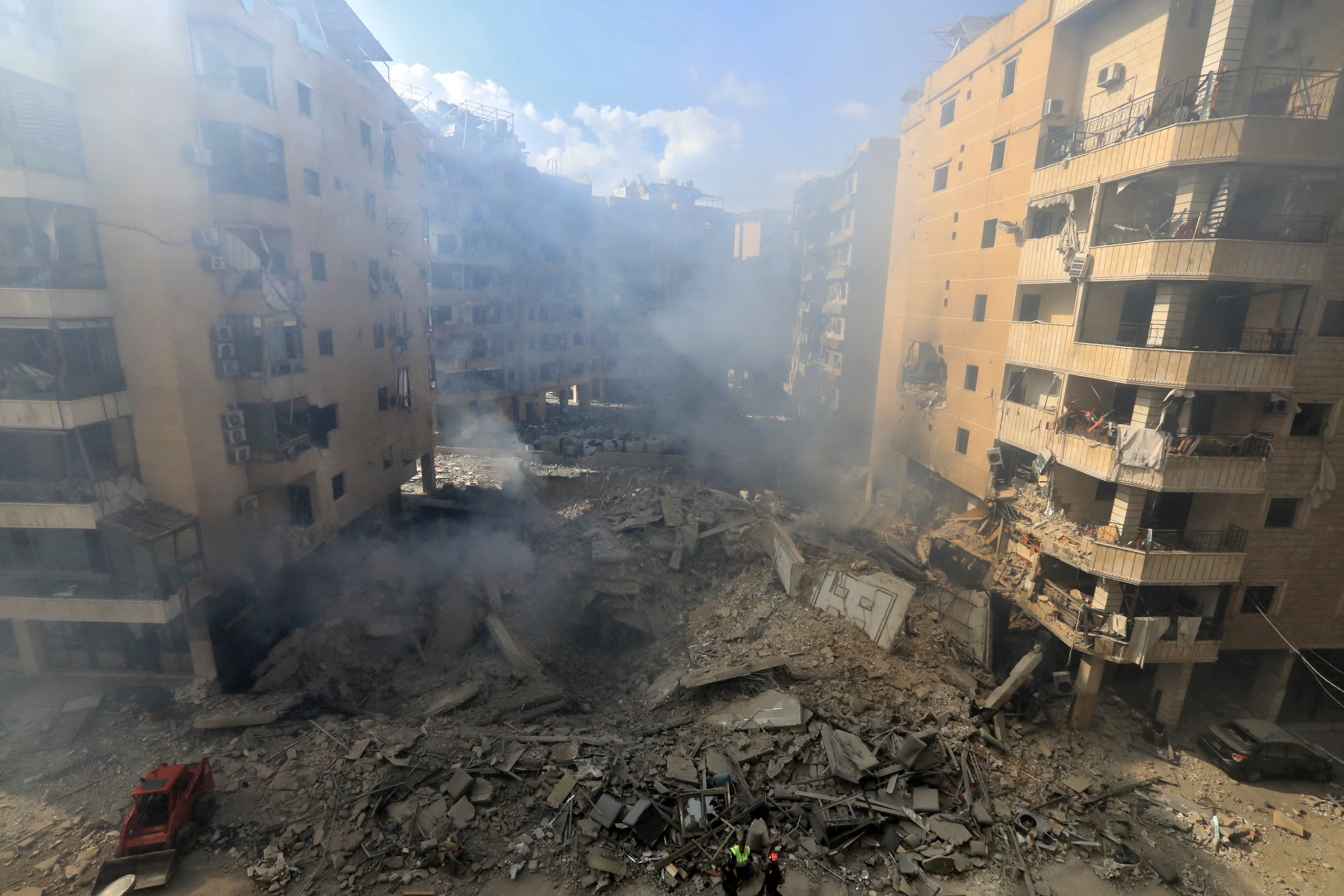
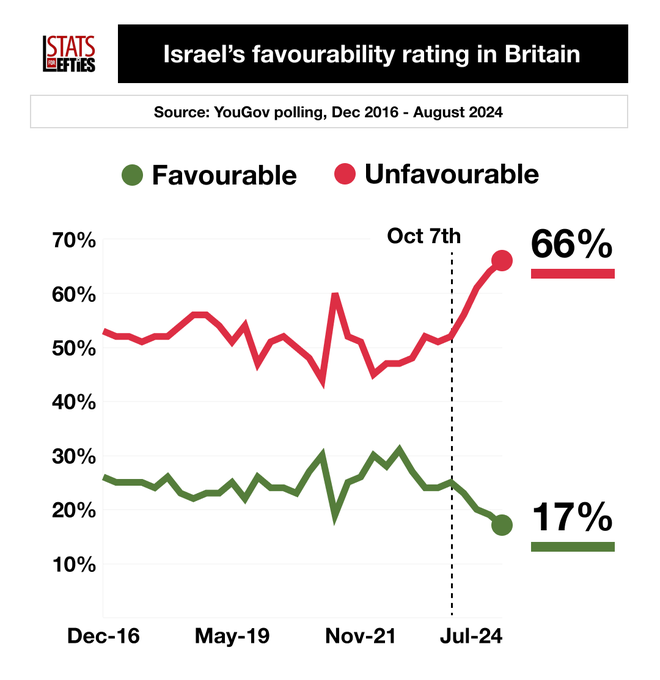


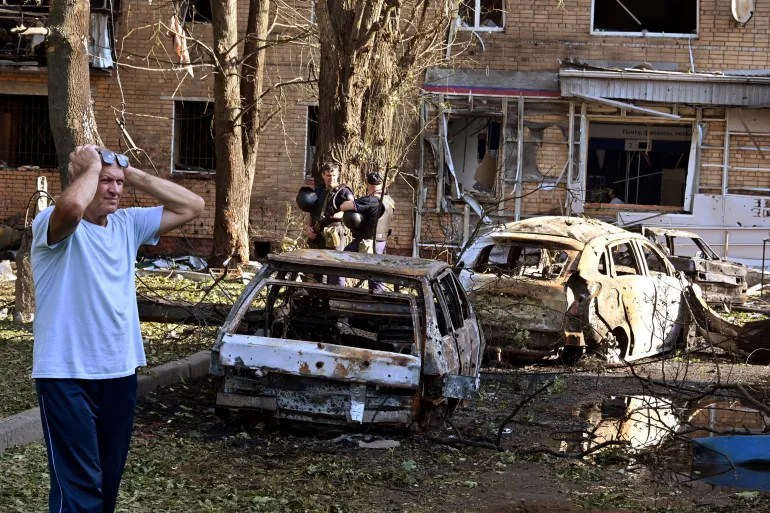
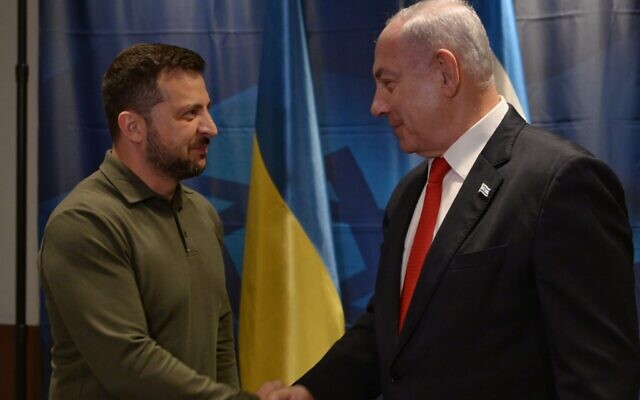




 Sráid Marx