Reflections on Brexit

EU referendumMy daughter wrote in her Facebook page that “I’ve attempted to write how disappointed and shocked I am over the results and I just can’t put it into words.”

My partner said she struggled to get to sleep because she was worried about Brexit, while earlier in the day she had long text conversations with her English cousins who were apologising for the result and (jokingly?) asking if they could come and live in Ireland.

In my office I signed an application for an Irish passport for someone who wants to retain EU citizenship and the freedom of movement it brings, while my partner says she’s going to stop calling herself Northern Irish and will also apply for an Irish passport.  Even in unionist areas applications for them have risen dramatically.

These personal responses to the Brexit vote are instinctive, since we don’t know exactly the changes coming down the line.  None of them are in themselves a political response in any real sense although they are healthy personal reactions.  However they aren’t answers.

Will the EU allow citizenship to those who are citizens of a state, the UK, that is not a member of the EU so that they could be both a citizen and non-citizen of the European Union?

Even assuming you wanted and were able to move to the Irish State the issues of nationalism, the EU and austerity would follow you.  The EU sent the Troika to impose austerity but thinking the Irish state can be some sort of protector is insane when you recall it would rather bankrupt itself than let down the gambling French and German bank bondholders.

And consider this: how fair is it that just because your parents were Irish you are entitled to Irish citizenship while children actually born in the Irish State are denied such citizenship?

The lovable and cosmopolitan Irish had their own referendum in 2004 in which they voted not to allow automatic Irish citizenship to children born in Ireland of foreign migrant (read – black) parents who were ‘obviously’ coming to Ireland to gain citizenship and residency for their whole family.  It was brutal and it was racist and the Irish voted almost 80 per cent in favour of it.

Today, after the Brexit vote, we have faced the smug and reactionary mug of Nigel Farage boasting that “real” and “decent” people have won “without a shot being fired” while these decent people are now emboldened to repeat xenophobic and racist comments to reporters, where previously they repeated them only in private.  The family and friends of the Labour MP murdered by a right wing zealot declaring ‘Britain First’, a rallying cry of the Brexit campaign, may stand shocked and horrified at the claim that not a shot has been fired.

Last night a TV reporter stated how difficult it has always been to get people on the streets to respond to political questions but that now in this Brexit town everyone was prepared to speak.  But of course now nationalist prejudice has been validated; it is now legitimate to repeat bigotry because the Brexit campaign won, it is the majority, its campaign was successful and it will now govern.

That this was a victory for the most reactionary forces is understood by many, and understood in the responses recounted at the start of the post, even by people who aren’t particularly political.  Not only was the campaign reactionary but so also are its consequences, including an invigorated Tory Party, soon under an even more reactionary leader; a rancorous exit procedure that will stir up xenophobic feeling even more; and further accommodation to racist attitudes by Blairite MPs who are plotting against Jeremy Corbyn.

So while the motives for the Brexit campaign have been reactionary and its campaign became even more so as it went along for some, despite all this, it must be considered  as some sort of workers’ revolt against austerity and denial of democracy.  Even Farage has claimed it was a campaign against the establishment, “against the multinationals” and “against the big merchant banks”. This, from an ex-City trader!  But it is no truer when mouthed by the left than it is when claimed by Farage.

Some on the Left have looked on the Brexit majorities in some working class towns and hailed this alienation from the political system as progressive, merely distorted somewhat by anti-immigrant attitudes but nevertheless a healthy revolt.  Since many of the same people also hailed the nationalist illusions of many Scottish workers in the Scottish referendum this creates something of a problem for their view of the world. I have yet to see a rationale for both a vote to remain by Scots and a vote to exit by the English both being valid expressions of opposition to the establishment.

I have also yet to hear what these left nationalists have to say about the millions of workers – including two thirds of Labour Party voters, in London, Manchester, Liverpool and Scotland who voted to remain, who obviously also oppose austerity but who refused to blame immigrants for their problems.  I doubt very much they have many great illusions in the EU either, certainly their leader Jeremy Corbyn gave them no reason to have any, and I don’t recall anyone saying the EU was wholly progressive.  Except of course the Blairite MPs who want to get closer to the one-third of Labour voters who endorsed the bigoted Leave campaign and get further away from the two-thirds who rejected its reactionary appeal to nationalism.

Which brings us to yet another reactionary consequence of the referendum – the renewed, but not entirely confident, demand for another Scottish referendum: a case of maybees aye, maybees naw.  After all, even the most wilfully blind Scottish nationalist is going to wonder how the Scottish state will finance state services with the price of oil through the floor.  Another Scottish nationalist vote against austerity that inevitably inflicts austerity is exactly the same sort of non-solution English workers voting Brexit have just embraced.

So Scottish nationalists, having played the nationalist card and lost, see English nationalists play their own and have responded in kind.  Like the Irish who have forgotten their own shameful racist referendum, Scots nationalists regard other peoples’ nationalism as ugly and their own always attractive.  Except for some really lost people on the left who now seem to regard all these nationalisms as healthy, at least underneath it all, and sometimes not even underneath.  Like most left nationalists they have left wing opinions and right wing politics.

Returning from work on Friday evening I had my MP3 player on, listening to the media show on Radio 4 in which some BBC editor was making a poor show of defending himself against the charge of one listener/viewer who said the BBC unduly emphasised the Tory versus Tory argument in its referendum coverage. Five minutes later the PM news programme headlines carried statements from Cameron, Sturgeon, Boris Johnson and a couple of others but not Jeremy Corbyn.  No wonder BBC pundits claim Corbyn didn’t do enough!

Like some on the Left they have an outsiders view of what is going on in the real world, where some workers are voting for racism but somehow are never themselves racist while workers who reject scapegoating are written out of the picture, swallowed up in categories such as youth, metropolitan elites or middle class because some of them have a good job.  Only voters against immigration apparently express genuine alienation while the others have uncomplicated pro-EU views.

But they, and the near 50 per cent who voted Remain, are the hope for the immediate future in this bleak hour.  The left that supported Brexit can get lost chasing an ‘anti-austerity’ vote consumed by reaction while the former is the basis for stemming the tide of reaction.  The anger expressed on social media, the barracking of Johnson as he travelled to his victory press conference, signal that though there has been initial despair this can translate into anger that can transform into action.

That the campaign was portrayed primarily as a Blue on Bluey fight, which of course was its catalyst, reflects deep divisions in the Tory party, although this is no time for purveying false confidence on this count.  The Tories heightened class consciousness has given them a keen sense of self-preservation and understanding of the need for unity.  Now that UKIP has achieved its programme many of these reactionaries may return to their Tory home.

However precisely because it is the Tories who wrought this overturning of the existing arrangements it is they who will have to account for it and all its looming failure to deliver on its promises.  Already the £350bn to the NHS has been dropped.  The reaction of EU leaders to the hope for a slow exit negotiation process is a warning that the other EU states have no incentive to pander to the requirements of a party that has threatened their project.  The arrogance of British nationalism will clash against the reality of Britain’s much reduced power in the world that has been reduced further by the vote.  Now more than ever the British state is reliant on “the kindness of strangers”, as the Governor of the Bank of England put it, in particular the US. The latter has no reason to disrupt the UK economy, particularly now, but now less reason to give it any privileged protection.

So if the Tories have the potential to split, and will be under stress for their responsibility for Brexit and all it will entail, it is the Labour Party and wider British labour movement that alone offers hope to the nearly half the voters who voted Remain, and even to those who opposed austerity by blaming immigration. Most unions supported Remain and in my own little part of the world, my own union NIPSA, which voted Brexit, got some considerable grief from many members who first heard of the debate after the decision was publicised.  In this decision it aligned itself with that bastion of progressive thought in Ireland – the Democratic Unionist Party.

The centrality of Corbyn to this fight is illustrated by that steadfast and trusted friend of the labour movement, Polly Toynbee in ‘The Guardian’ today:

“Jeremy Corbyn faces an immediate leadership challenge after a performance that was dismally inadequate, lifeless and spineless, displaying an inability to lead anyone anywhere. What absence of mind to emphasise support for free migration on the eve of a poll where Labour was haemorrhaging support for precisely those metropolitan views.”

These ‘metropolitan’ views are socialist views, it’s called freedom. Like all liberals, Toynbee will defend it except when it’s under attack.  Corbyn, to his eternal credit, defended it when every other leading politician was uttering weasel words of exclusion and discrimination.  Having defended these principles it is up to all those who voted Remain to defend him from the blinkered and opportunist attacks of Blairite MPs who would rather see a Tory victory than a Labour victory under Corbyn.

It is speculated that a general election will arise when the new righter-than-right Tory leader takes over, supposedly to give him or her a mandate but equally to protect them from the developing failure of a Brexit project that will breed disappointment and anger.  It is also speculated that this failure, and the anger that will flow from it, will not rebound on the promoters of this crazed project but will intensify antagonism to the already identified scapegoat – immigrants, ethnic minorities and foreigners.  But this is not inevitable, or at least the scale of it certainly is not.  But to ensure it is minimised and defeated requires a working class alternative based on those workers who have already rejected it, as many as possible of whom should be organised into the labour movement.

The underlying weakness of the Brexit project is revealed in its reliance on xenophobia and prejudice because it has no strong rationale of its own.  It will fail to make good its promises, which is why some have been deserted so quickly.  This weakness is reflected in the incredulity of some Leave voters that they actually won. More than one has revealed that they doubt they have made the correct decision.

The evening before the vote I heard an interview with two intending Leave voters who said they were ‘voting with their heart and not their head’; an admission that they couldn’t defend their decision.  This is not to say that the majority who voted leave are unsure, many are dyed-in-the-wool nationalists or even racists but many will not be.  But what will not convince them that they are wrong is the proposal from Toynbee, Blair, Mandelson and all the other career politicians that actually they are right!

The majority of young people voted Remain, another reason for hope.  The millions of EU citizens in the UK are also a reservoir of support.  Claims by the Leave campaign that their rights will be protected are exposed by the fact that they weren’t allowed to vote.

There are therefore some grounds for hope in what is an otherwise depressing situation.  But I am reasonably sure that my grounds for hope are stronger than the optimism that it must be assumed is felt by those lefties who ‘won’ through supporting Brexit.  Lexit was a failure.  The left case for Brexit or whatever you want to call it was and is miserable.

The Socialist Party (SP) in Ireland has claimed that the creation of an EU border in the middle of Ireland will not mean a “hard border” because the common travel area between the UK and the Irish State pre-dates EU membership.  They fail to recognise that both jurisdictions were then outside the EU; they were then both in and shortly one will be out. The only chances that there will not be a hard border is if the EU doesn’t care about its borders, the Brexit campaigners don’t care about immigration or they decide to keep all the Paddies at arms lengthy by putting the hard border at Holyhead, Stranraer, Glasgow airport or Heathrow etc.

The SP make the frankly nonsensical statement that “there is nothing genuinely internationalist about the EU.”  Where do you start with this?

Well you start with capitalism as it exists and fight to make a socialist society based on capitalism’s already international development, not try to wind the clock back to an earlier period that actually never existed.  In this the supporters of Lexit are the same as Brexit – pining for a mythical national development that, even were you to attempt to return to it, would lead forward again to internationalism.  The fact that the EU is an international  political arrangement of international capitalism makes the statement that the EU is not internationalist simply a stupid thing to say.

It may not be our internationalism but the nationalist socialism of the SP is not genuine internationalism either.  The failure of the Lexit campaign means that they may have been on the right side of the result but were on the wrong side of the campaign.  They too, just like the Tories, can look forward to telling us how the evolving exit from the EU is such a great step forward, for them supposedly for working people and for socialism.  Both promised money for the NHS and not the EU and that promise is as worthless from both.

What those disappointed by the result should do now is not simply put down in words how gutted they are but think for a while and put down what they think could be done to make things better.  Even working to understand the issues better is a contribution because out of understanding comes a realisation that there is an alternative and knowing this is an invitation to make it happen.

The EU: neoliberalism and democracy – part 2

images (10)An argument was made a long time ago by right wing ideologue Frederick Hayek that Europe could only be united on the basis of the free market.  Generally speaking, unity by state power can be achieved by conquest, or diplomatic alliance and compromise which would be slow, messy and prone to threats of resort to the former method. The Left supporters of Brexit also pose the unity being attempted by the EU as one underpinned by, in fact essentially and intrinsically comprised of, neoliberalism and its child austerity.  This approach is presented as a policy choice at the national level but essential to the EU, which doesn’t add up.

The imposition of austerity in the Eurozone for example is a policy choice determined by the conservative leadership of Germany and some other Northern European countries. In large part this is a reflection of the interests of their particular national capitalism, or its perceived interests, so not an inevitable feature of European capitalist integration.

The imposition of this particular national capitalist regime across Europe cannot work so it involves the subordination of weaker capitalisms such as the Greek etc.  The ultimate subordination is expulsion from the Euro club, whereupon the Greek state is free to reflect its weakness through devaluation, have greater freedom to preserve or expand crony state ownership and decide which sections of its population it wants to throw to the wolves and which to protect. What it could not do on its own is reverse austerity and develop a strong capitalist economy.  A separate Greek socialism is out of the question.

The refusal of the strongest national states within the EU to seek an alternative to austerity that addresses the needs of all member states is grounded on refusal to implement fiscal transfers between states, common and pooled debt and greater regulation.  This would involve not less but more European integration but will not be accepted by the conservative led national states without their much greater control of the EU.  The question then becomes one of democracy.

For the nationalist opponents of the EU, on the right and left, democracy can only be national.  The Irish People’s Movement repeats this again and again:

“The EU is most accurately seen as a supranational anti-democratic system that deprives Europe’s diverse living peoples of their democracy while serving the interests of its big state members, as mediated through their ruling politico-economic elite, interacting with the Brussels bureaucracy. The project of EU and euro-zone integration is at bottom an attempt to overturn throughout much of Europe the democratic heritage of the French Revolution: the right of nations to self-determination, national independence, and national democracy.”

“. . . This right to national self-determination is the foundational value of all modern democracies and of democratic politics within them. But it is anathema to the EU elite. . . . The core illusion of the EU elite is that the peoples of the euro zone will consent to abandon their national independence and democracy, reversing centuries of European history . . .”

Today the increasing lack of democracy across Europe is sometimes put down to a lack of accountability of the governing elites in Brussels to the electorate, but it is notable that this complaint is widely expressed at national level as well.  The Irish State for example has long had two major parties periodically alternating in office that have had no ideological differences and which have provided no meaningful political choice.  In the last election the electorate voted against the incumbent main party and got it back in government.  In some other counties there has been more appearance of choice but it has been obvious for years that even social democratic parties have embraced neoliberalism, so it is not an EU only phenomenon.

It is argued however that it is worse in the EU and, unlike at the level of the individual state, nothing can be done.  It must be noted however that this malaise at the EU is partially a result of the processes at national level and made worse by being filtered here first. If pressure from below is stifled by the national political system there is much less to transmit upwards to the EU’s bureaucratic machinery.  At this EU level there are no European political parties, the trade unions at a European level are a shell and there are no other vehicles for protest except protest itself and its campaigns that put pressure on institutions but fundamentally do not threaten them.

The organisation, or rather the lack of organisation, of workers at the European level is not something that can be rectified by more democratic arrangements at the EU, although this would obviously help.  It is a task for workers themselves and seeking the nationalist way out is not a solution but rather running away from a problem that cannot be escaped.

The nationalist nonsense that posits democracy rising from the nation ignores the existence of nations that have had precious little democracy and ignores the process of struggle that imposed on ruling elites what democracy there is.  The idea that centuries of European history were devoted to the development of national democracy is as fatuous as the idea that these nations were generally independent states. War and subjugation has been a feature of the history of European states as much, if not more, than any sort of mythical independence, which no longer exists even for large European states never mind the smaller ones.

What is true is that the development of capitalism took place at the national level and that this involved the creation of classes which had a material interest in forms of bourgeois democracy and which fought for them as a result.   The state form within which this development took place has been elevated into the development itself but it is capitalist economic development and the political struggles that it generated that are the real foundations of bourgeois democracy.

That capitalist economic development has burst the bounds of nation states has created problems in relation to the forms of democracy that have taken root at the national level.  At this level the machinery of the state has legitimised capitalism through nationalist ideology and the exercise of state power that has educated, subordinated and reformed the society in which everyone has grown up in; making nothing more natural than the idea of belonging to a nation.  From this ideology and the state’s power to mould society has come the view that rights, freedoms and politics in general can only be framed at the national level with anything above this simply being political relations between the states and therefore not actually above them.

History is further perverted in this nationalist version by declaring that the ideals of the French revolution were purely national, ignoring the proclamations within it relating to the rights of individuals, the freedom of individuals and the equality of individuals.  In the first part of these two posts it was noted that for some Irish nationalists these “are not unequivocal concepts. There is no Union-wide consensus on what constitutes a higher or lower standard of protection of rights; there is no consensus on the source of human rights, such as the theory of natural law, whether secularly or religiously based, that would permit a rational analysis and evaluation of conflicting positions.”  But we are expected to believe such problems of unequivocal definition, consensus on source and application of rights, disappear within the nation, with all its minorities subservient to whatever the national ideal of these happens to be.  Most important of all, the national definition of these non-unequivocal concepts is assumed to be superior to the different understandings of these concepts that arise from the class divisions within society.  Instead these are assumed to be erased by unity behind a mythical ‘national interest’.

This understanding of the world as fundamentally structured by nations within which coherent, consistent and valid interests are formed and expressed reaches its height when we are told that:

“Although the EU has most of the formal features of a state, and Euro-federalists aspire to it becoming a United States of Europe, comparable to the United States of America, outsiders hesitate to regard it as a state in its own right. They think that if it were such it must surely have its own people, who would identify with it and insist on endowing it with some meaningful democratic life. But such a people does not exist.”

If this means anything it means that democracy can only exist for a relatively homogenous people, defined by nationality, which is the worst sort of ethnic-centred nonsense to which all nationalism is prone to fall into. It condemns those states that are multi-national in composition, which must presumably not expect to have any sort of democratic political arrangements.  This also of course absolves the EU, because it too cannot be expected to be democratic.  In fact no future unity of peoples can be expected to be democratic either. The more one reads this short paragraph the worse it gets.

But for a socialist it is precisely the identity of interests within the nation that must be exposed and rejected a false.  In contrast it is the identity of the interests of working people regardless of nationality that is the essential socialist argument and historically the nation state that has been the last barrier to the creation of the new society that expresses these common interests.  Workers of the world unite! is the clarion call of socialism.  If capitalism seeks to unite Europe on its own terms it is not the job of socialists to seek to reverse its progress but to fight for creation of the socialist society on these foundations.

If the nationalist left does not know how democracy, workers unity and a socialist future can be fought for except within the realm of separated national states then it should step aside because whatever the problems posed to socialists by the EU they will continue to exist, in fact worsen, in the nationalist rat race that implementation of their policies would involve.

concluded

Back to part 1


The EU: neoliberalism and democracy – part 1

EU-TWEET-2Both right and left supporters of leaving the EU see it as some sort of emerging Super State, a bureaucratic Leviathan sitting on top of a population of so many Joseph Ks, captured by its labyrinthine rules, in a state of helpless and woeful ignorance of the malevolent plans to which they are subject.

Within its confines there is no way out, there is no solution.  Nothing is familiar.   It is foreign in every respect.  There is no democracy and you can do nothing to change it.  For the Left it cannot be reformed – its essential character is neoliberal – although it can be defeated, or rather it can be escaped from.  And this is what Brexit offers.

It offers release from a putative empire and its recognisable emperor – Germany.  The very breadth of the alternatives presented as possibilities outside its walls is testament to the potential freedom existing beyond its bewildering restrictions, its Treaties, Guidelines, Regulations and Directives. The natural territory of democracy is the nation and the return of national democracy will free Europe’s very different peoples to make their own decisions.

The differences between the British, the Finns, Bulgarians, Greeks and Italians etc. are simply too great.  No cultural commonality or elements of unity can be found and therefore no common political architecture can accommodate their different views, aspirations, values and demands.  Lack of democracy within any project that attempts it is therefore inevitable.

The ‘Peoples Movement’ in Ireland, which opposes the EU and supports Brexit puts it like this:

“The supposition in the EU Treaty that member-states already share a common value system is, moreover, a disingenuous fiction. The principles of “liberty, democracy, respect for human rights and fundamental freedoms and the rule of law” which are stated in article 2 of the Treaty on European Union to be the foundation of the EU, are not unequivocal concepts. There is no Union-wide consensus on what constitutes a higher or lower standard of protection of rights; there is no consensus on the source of human rights, such as the theory of natural law, whether secularly or religiously based, that would permit a rational analysis and evaluation of conflicting positions.”

——

Such an analysis is not one that any socialist can endorse or support.  In fact socialism rejects every substantive claim made above.

The EU is not even a State never mind a Super State.  If we begin with the understanding that the state consists above all of armed bodies of men and women then the EU has no army and no police with which to assert the class interests of European capitalism.  It often cannot unite politically even if it did have a single and coherent state apparatus to command. It had no such view when Yugoslavia disintegrated and it was NATO that went to war.  That it is not a Super State became clear in its failed intervention in the Ukraine, where it lacked the economic power, political unity of purpose and military prowess to counter Russia.

The illusion of a united, efficient and increasingly powerful bureaucratic apparatus reveals a view of bureaucracy as a predominantly rational and rules bound organisation that is internally coherent.  But not only is this not the case with any bureaucracy it is certainly not true of the EU.  Even its critics, or at least some of them, are not so much forced to acknowledge this but see it as a primary feature of the EU – that its rules are as often observed in the breech as in the observance.

There is apparently a remarkable level of non-compliance within the EU and its member states, in which EU Directives are not transposed into national law, rules are not adhered to, decisions at summits are not respected and European Court of Justice rulings are not enforced.  In other words the state machinery necessary to impose laws is not in place.

So the Maastricht rules dealing with debt and deficits were first broken by Germany and France while such rule breaking by Greece is anathema.  Much has been made of the Greeks fiddling statistics to get into the Euro but what they did was simply to follow what the Italians had done before, and everyone looks the other way when this is mentioned.  Bank stress tests are taken seriously by no one. The Eurogroup, the body that decides on these economic matters, that determines the economic policy in the Eurozone, has no legal standing and therefore doesn’t legally exist.

The incoherence of much of the bureaucratic machinery is illustrated in the inefficiency and corruption that besets the EU.  It lacks effective financial controls so that it has failed its own Court of Auditors for over twenty years.  In 2003 only 10 per cent of payments by the European Commission “faithfully reflected budgets and expenditure”, while the rest could not be accounted for and over 10,000 cases of larceny were uncovered in the year before. When the Chief Accountant reported that the EU budget “was an open till waiting to be robbed”, Neil Kinnock fired her. He also smeared another whistle-blower after she reported improprieties at Eurostat, a statistics agency whose figures were employed in allocating the EU budget. It has been investigated six times, during which shell companies, slush funds and “rake-offs” were all uncovered.

In his latest Book – ‘And the weak suffer what they must’ –the ex-Greek Finance Minister Yanis Varoufakis, rips into the failed design of the Euro and the rules it is based upon but admits that these rules are often in large part made up by the EU as it goes along.  This includes as a result of the struggle between the Bundesbank, its German ordo-liberals and the Draghi-led European Central Bank and its commitment to ‘do whatever it takes’ to save the Euro.

This is not some sort of all powerful juggernaut or all-powerful emerging German empire.  The GDP of Germany in 2015 was over €3 trillion while that of the EU as a whole was over €14.6 trillion, so the German share was around 20%.  Germany also lags behind Britain and France in terms of military capacity so whatever about its economic strength this is not basis for a fourth Reich.  Germany can lead but it cannot on its own determine the future of the EU.

The EU therefore lacks the scope and depth of function required of a state while aspiring to both, the difference for its critics often obscured by its declarations of intent and its bombastic and arrogant approach to what it does control.  It is not therefore easily identified, categorised and summed up so, when its more obviously nationalist critics denounce it, the simplicity of their analysis is often embarrassing. So the People’s Movement can’t help but notice that the EU has no army and police but “Their absence makes it all the easier to hide from ordinary citizens the reality of Europe’s hollowed-out nation-states and the failure of their own mainstream politicians to defend their national democracies.”  The People’s Movement declaration of hollowed out national states fails to register its admission that the EU proto-state is also empty of crucial functions.

The simple story of EU power also includes the declaration that the EU cannot be reformed as it is intrinsically a neo-liberal construct, one that enforces this economic policy on its members.  But as we have noted, such enforcement is not uniform.  The progenitor of the EU, the European Coal and Steel Community, was not a vehicle for the free market but a cartel arrangement for oligopolies. The EEC/EU was part and parcel of Europe-wide Keynesian policies in the 1960s and is now part of the neoliberal turn that was to be consolidated in the European Constitution but became part of the Lisbon Treaty when this constitution was rejected.  It is also strongly in evidence in the austerity agenda mandated by the Maastricht Treaty and enforced during the Eurozone crisis.  It has not therefore always been part of the EU and there is good reason why it may not remain part, including that it is not working, for example irrecoverable debt cannot be repaid.

While the EU has introduced state aid rules that restrict state subvention of private capital it does not prohibit it.  The Lisbon Strategy of 2000 called for it to be phased out but the reality became more rules that explain how it may be permitted.  In the years 2000 to 2011 its level didn’t change, amounting to 0.7 per cent of GDP, so argument continues as to whether public procurement in the EU is more or less open than its competitors in the US or Japan.

The EU is made up of states, which jealously guard not only the interests of their national capitals but also their own interests as states. This includes protection of state owned capital.  For example in the field of energy, where the EU has some competence i.e. it has some control, many components of this industry are still state owned. Even in the Irish State, at the depths of the crisis and diktats from the Troika of European Commission, European Central Bank and IMF, the state retained ownership of much of power generation through ESB and the electricity transmission and distribution system through EirGrid.

Those on the Left who regard the interests of nation states, and their powers of discretion, as the alternative to the neoliberalism of free markets have a lot of explaining to do, in particular how these states that barter and trade off the perceived benefits of trade to themselves, and the big capitalist businesses they seek to protect, are any sort of alternative.  The seeming obsession of the EU with competition rules is in part an inevitable result of any inter-state cooperation, which is undoubtedly more involved in the EU, but which would not disappear outside of it, that is if progress on trade and investment deals is to be made.

The emphasis on free markets and competition arises not just from a general and obvious commitment to capitalism by all the European capitalist states but from the desire to create a free trade area across Europe in the same way that there is generally free trade within the national states themselves.  This is not because the individual states do not want to intervene to bolster the position of national champions but because they must have rules and mechanisms that limit the same intervention by the other states that may be to the detriment of their own capitals.

The developing logic is to create not national champions but European ones, which leads to a similar process at the world level.  The US and Japan etc., like the EU, seek trade and investment deals that will allow the growth of their capitals without discriminatory barriers put in their way by other states.  Each therefore has to strike deals that limit such practices, not only between but also within their borders, and which protect their own big capitalist businesses. The confidence to exploit and exchange commodities that exists at the national level is sought at the European and world level through a single European market and world trade and investment deals.  To see these deals as the problem and not the system of exploitation and commodity exchange that is taken for granted at the national level is to forsake a socialist for a purely nationalist perspective and fail to understand the roots of what is going on.

A contradiction thus exists between the rhetoric of free competition and the state and EU interventions that seek to strengthen particular capitalist concerns.  From this also arises the repulsive system of lobbying by big business that is such a feature of the Brussels scene.  It brings to light the crony and corrupt interface between politicians and capitalists which has grown organically at nation state level and because of this is much better hidden from public view.

The contradiction is also expressed through the fact that the state at a national level not only provides for a level playing field that privileges the workings of capitalist competition, which finds expression through the market, but also intervenes positively to support groups of, or individual, capitalist concerns.

This not only involves what might be considered purely economic measures, such as grants, subsidies, and taxation arrangements but also purely political interventions that for example provide for or foreclose market access.  The rules and the wrangling in the EU are the outcome of the attempts to do this at a supra-national level.  Such activities would continue were Europe to revert to a world of separate nation states – the world beloved of nationalists and a left no longer confident of the future but hankering for a supposed golden age of social democracy, i.e. a particular form of capitalism.

What does change in the EU framework is acknowledgment that the state’s intervention in support of capitalism is no longer adequate if confined to the national level and that the political interventions required also have to take place at the European level.  The logic is creation of a political vehicle that can do this adequately, a European State.  If you don’t like this the answer is not to attempt to turn back the clock to an earlier form of capitalism that the development of the system has outgrown but to make the alternative to capitalism also international.

Forward to part 2

Brexit or Lexit?

CjC9SHcXAAAU8OOWhen the campaign over Brexit kicked off it appeared as an internal Tory argument over just how tough Cameron’s deal with the EU would be in hitting the welfare entitlement of migrant workers.  Two cheeks of one arse, as my granny would have said.

Socialists are against restrictions on the movement of workers and against cuts in welfare that are simply a means of hitting not only migrants but putting pressure on workers further up the ladder.  So socialists were on neither side of this particular argument.

The debate moved on to the economic impact of Brexit, with dire warnings of the impact on living standards of the UK leaving.  House prices will fall 18% says George Osborne, as if this were the worst nightmare of every civilised human being. The IMF also predicts drastic consequences while the OECD says it will cost UK households £2,200 by 2020 if we leave.  PricewaterhouseCoopers states that “by 2030 . . . EU exit could result in total UK GDP in 2030 being between 1.2% and 3.5% lower in our two exit scenarios”.  The UK Government brochure put through my door says “voting to leave the EU would . . . reduce investment and cost jobs.”

The ‘Northern Ireland Better in Europe’ leaflet that has sat about my house before I read it for this article lays it on thick – “leaving Europe is a leap in the dark for you and your family” – “NI Jobs AT RISK”; “Investment AT RISK”; “NI Security AT RISK”; “NI Farming AT RISK” and “NI Trade AT RISK”, at which point the author ran out of paper or things to put on the risk register.

In my work I get an email every morning, which is a digest of the local economic stories in the press and invariably over the last few weeks it has consisted of warnings of job losses and reductions in living standards if Brexit takes place.

Socialists don’t take kindly to such warnings as they usually greet any demand by workers for higher pay or better terms and conditions.  We are told that a major change like Brexit will create uncertainty and involve a leap in the dark, while socialists are of course in favour of even more fundamental change (though it cannot be a leap in the dark), so instant or unreflective rejection of such claims might be an instinctive reaction.

But such a reaction would be misplaced.  Going further, to conscious rejection, would be an example of taking one’s cue from the enemy and putting a minus sign where the establishment puts a plus.   In other words it would be a failure to form an independent view.

Similar warnings of disinvestment and threats to living standards surfaced in the Scottish independence referendum and I wrote at the time that there was no point in crying foul if you didn’t have a sound argument that either the threats were invented or that their effect could easily be countered.  Neither response could be said to be true in the Scottish referendum nor can they be said to be true now.

Whatever the exaggeration there is no doubt that a UK economy torn from the EU would witness increased barriers to trade and to domestic and foreign investment and that this would lead to job reductions and reduced living standards.  Since socialists are the most consistent defenders of workers and their conditions, and if we know that Brexit will have these effects, on what grounds could it possibly be supported?

Not caring for the good health of capitalism, which is a healthy socialist attitude, is not the same as basing one’s politics on seeking its malfunction and disintegration.  After all, we don’t advance policies to screw up capitalism, capitalist crises arise from its own contradictions – it screws itself up.  We advance a movement to replace it.

There are many people who claim to be anti-capitalist, but socialists don’t start from this but from the contradictions within capitalism, which show in what way the system contains an alternative, the replacement that is socialism.  We are not therefore in the business of seeking to prevent the development of capitalism, including its internationalisation, but in favour of building the alternative that will replace it as it develops.  It is this development that increasingly provides the grounds for the socialist alternative.

So on the two issues dominating the debate – on migration and economic consequences – socialists take a view.  We are not bystanders in this debate and when we look at the issues it should be clear on which side we stand.  We should know how this position not only informs our view of wider questions but how our wider view informs how we can understand the role of particular issues.

The left that supports Brexit have their own wider view of socialism, heavily reliant on action by the capitalist state as the vehicle for income and wealth redistribution and state ownership of the economy etc.  This nation-state centred view is revealed in their approach to Brexit.  They propose a different term -‘Lexit’, one with little currency that has even less purchase on either the debate or on the reality it purports to describe.  “Leaving the EU will be part of a process of creating a different Ireland which puts people before profit,” says one organisation, but what is this process?

People before Profit, from whom the statement above is taken, mention five grounds for leaving the EU and we will come to these in a moment.  But first, the essential socialist case for remaining in the EU is that it creates better grounds for fighting to create the international unity of workers than their separation into multiple nation states.

Those who propose Brexit base themselves in one way or another on nationalist solutions.  With the right wing of the Tory party this is obvious in what it says; when it comes to the left it is obvious in what it doesn’t say.

So we have a proposal that “leaving the EU is part of a process” but where is the international element of this process?  People before Profit believe that socialism is international so just where is the international aspect of this strategy?  In its statement on ‘Lexit’ it says nothing.  In its 2016 general election manifesto it also says nothing. (Opposition to war and to Israel do not constitute a strategy by which socialism may come about).

This stems from no serious consideration of how socialism can come about, aside from a moralistic opposition to an evil capitalism that culminates in a revolution that itself is just an accumulation of anger arising from this opposition. It’s a failure to understand that the alternative does not arise ex nihilo on the day of revolution but is built upon and arises out of the existing system and its development.  This is how the existing labour movement has been created; it could arise in no other way. The growth of People before Profit (PbP) itself is an illustration of this, being created out of the electoral system of the Irish state’s political structure. Whatever the limitations of this, and there are many, this is how People before Profit presents a strategy to Irish workers, so how does it think the socialist alternative can grow internationally?

As I said, it gives five grounds for a ‘No’ vote:

Neoliberal policies have been sealed into the EU – but the EU is a creation of nation states and so is its neoliberal policy but PbP wants to go back to these individual states.  It calls the EU a ‘bosses club’.  But who are the members of this club but the member states who in or out of the club will still be the bosses?  How does going back to separate bosses take us forward in defeating either particularly right wing policies or creating an alternative?

The EU is developing military structures to fight ‘resource wars’ – this is possibly the most patently weak argument because the EU is noted for not having an army, not having an armed force capable of asserting its collective capitalist interests and not being able to punch its weight in world affairs.  Again it is the individual states that have armies and that deploy these in capitalist wars.

The EU is fundamentally undemocratic – and so it is and so are the individual member states which are responsible for the EU’s undemocratic structure and functioning.  However it is not the job of socialists to exaggerate the democratic opportunities offered to the working class by the democratic features of capitalist states.  While these are important it is the democratic content of the working class’s own movement that will be decisive in the fight for socialism and the division of this movement by nationalism is one of the key fractures that has historically divided it and disfigured its development.

The EU legitimises racism though fortress Europe – the EU has indeed acted scandalously in its treatment of the refugee crisis but the actions of many individual states has been just as bad if not worse, including the British.  The refugee crisis is a particular example of a crisis that can only be addressed at a European level and hardly even on this scale.  It certainly cannot be solved at the level of the individual states.  How does Brexit or Lexit help?  How does Brexit help the common travel area within the EU or will this be sacrificed because it does not go far enough for those outside?  Will we go backward because we’re told we can’t go forwards?

Finally it is argued that claims that the EU protects workers’ rights are false – PbP argue that these came about during the boom times and capitalism is no longer booming.  In fact this isn’t even true and can British workers expect better working conditions arising from a right wing Tory Government?  One doesn’t need to dress up the EU to see this.  People before Profit say workers can defend existing gains, which draws attention to the real motor of advancement, but it should be obvious that separate states in competition to lower conditions is not advantageous to workers in defending legal rights and working terms and conditions.

The policies of People before Profit are themselves a good example of the difficulty of resisting this sort of capitalist state competition.  The Irish state’s 12.5% corporate tax rate is a central part of the state’s competitive strategy and has gained widespread acceptance in the process.  People before Profit also support it but just demand that 12.5% equals 12.5%.  It has accepted this race to lower taxation on corporate profits.  If there were a common EU-wide tax rate the grounds for such a strategy would be removed.  Why then would this not be supported rather than creating more grounds for state competition that impact negatively on workers?

The arguments for ‘Lexit’ do not add up.  We are debating Brexit, not the fantasy of a left exit, which is so fantastical that it cannot even be hypothesised how workers would be better off the day after exit and what the second step is to follow this first one.

The establishment say that Brexit is a leap in the dark and should be avoided.  In fact a vote to stay in the EU is more a vote for an unknown future than is voting to leave.  The political consequences, and onerous tasks, facing the British state for example, are known to a degree –   joining “the back of the queue in seeking a new trade deal” according to Obama, or making “the UK a less attractive destination for Japanese investment” according Japanese Prime Minister Shinzo Abe.

Staying in the EU on the other hand is not a vote for history to stop.  The EU will either move forward to further integration or it will start to move backwards; the Euro crisis and the treatment of Greece and the breakdown of the free movement of people within the EU are examples of this. Do we want to be part of this fight or declare that it is worthless because the EU cannot be changed?

The fundamentally conservative approach of People before Profit is illustrated when we consider how it would answer this question.  This conservatism appears everywhere, assuming bad things would change and good things not.  It assumes that border controls would not return within Ireland or between Ireland and Britain.  But why, when trade treaties are being torn up, would we have any reason to assume this to be the case?  Why would a common travel area continue when preventing unwanted migration is the major impetus behind Brexit?  Why would the Irish state be allowed to become the back door to entry into Britain from the EU?  It assumes the world will not essentially change for Ireland from a Brexit vote and that partition will not be strengthened.

It assumes that voting to exit is a ‘No’ vote to bad things it cannot possibly believe that it will be interpreted positively as a vote for workers and refugee rights, a vote against imperialist war, against neoliberalism or for a different national democracy.  But it is not even a negative vote, it implies something affirmative.  But what it affirms is nationalist – that in their separate little national states workers will be in a better position.

What to do about the European referendum?

DExpressNow that David Cameron has got his deal we will have a referendum on whether the UK remains in the European Union.  The decision is described as the biggest to be taken for decades, yet when we look at the narrow grounds of Cameron’s renegotiation it scarcely seems to measure up to these assertions.  They also look puny beside the strongest criticisms of membership and the confusion this creates feeds into the deeper ignorance, which most people, especially in the UK, have of the EU.  Given the reactionary terrain of the argument over renegotiation it would appear that the left is isolated from the debate.

What do we have to say and what do we face in the referendum?  One set of reactionary proposals from Cameron versus an even greater collection of reactionary interests expressed by his Tory and xenophobic critics?  Or an important decision which should also have significance for those on the left?  If it’s the latter, then what are the issues that need to be taken into account, and if they are important shouldn’t the left be campaigning on them already?

The history of the Irish and British lefts’ position on the EU is one of opposition.  In 1975 the British left in general voted to leave the European Economic Community.  In Ireland, the left in the Irish State has opposed the various EU Treaties, which the written constitution has compelled the Irish State to put to a vote in referenda, on the grounds that they impose reactionary duties on members, such as the criteria for a common currency or imposition of austerity policies.  When the Irish people have voted the ‘wrong’ way, as in the Nice and Lisbon Treaties, they have been compelled to vote again the next year, so they get it right.

In Britain the previous default position of opposition to the EU is under strain because this implies voting to leave the EU and this position is now dominated by the most right wing forces in British society.  As a recent article states – “the shape of the main ‘official’ No campaign is already clear.  Its central components will be UKIP and the Tory right.”

The left therefore seems isolated from the debate, with a history of opposition to the EU that appears to promise it only a subordinate role in campaigning and voting alongside reactionary forces for the UK to leave.  The article quoted seeks to avoid this position by noting that while previous left campaigns have included nationalistic motivations a different stream of past opposition has had a more progressive approach.  It notes that the British left has become more pro-EU over the years partly, it says, because politics in Britain has moved so much to the right that some aspects of EU policy are progressive in relation to it.

To sum up, the article calls for a vote to stay in the EU mainly because “any No vote is going to be seen as lining up with the racist elements that will be demanding this (a No vote). It will be very difficult to avoid (this)”; and “the conditions for a progressive and credible No campaign (i.e. on the basis of socialist and working class politics and significant forces) do not exist in Britain today.”  In addition there is “the rather important matter of the consequences of a vote for exit at this time and under these conditions—and this is clear. It would strengthen both the Tory right and UKIP.”

While these are no doubt important issues to be taken into account they are also second order factors.  When it comes to the actual question, the article has no strong arguments to justify its view that socialists should vote to stay in the EU.  The isolation of the left which weighs so heavily in this articles’ analysis would in no way be addressed by calling for a vote on such slender political grounds.  In fact the redundancy of socialist argument would be confirmed because it would be accepted that the socialist view had to be abandoned because it could not be distinguished from that of the right.  It can be guaranteed that with such a weak basis there could never be any grounds on which to build a successful campaign.

Yet if this referendum is deciding such an important question should the left not be trying to put together as strong a campaign as it can muster?  And how could we do that?

A first step would be to debate the issue openly because the first task is to determine what position to take.  If this can’t be distinguished from xenophobic nationalists there’s obviously something wrong.

The second issue, of making this distinction in practice, is firstly a matter of having a separate campaign from the right, which should not be a problem, and arguing along very different lines.  Unfortunately the article noted above presents contingent and not principled grounds for opposing exit from the EU and the idea that such grounds exist appear to be dismissed.

This failure arises from the core argument advanced, which is not so different from then left-nationalist argument about ‘national sovereignty’ that the author claims to reject.  This view is that advances by the working class will take place on a national basis, resulting in a left-led nation state having to face the opposition of an overarching capitalist EU.  Implicitly it is argued that while the nation state can be a vehicle for working class struggle and advance the framework and structures of the EU cannot. While the capitalist nation state can in some ways be reformed the EU cannot.

So we are informed that “If Britain elected a government that broke from austerity to any degree (or failed to implement it effectively) it would be a very different matter, the EU would be down on it like a ton of bricks.” So what we have is a defence of ‘left national sovereignty’, as opposed to the more obvious xenophobic and reactionary variety.

It is not that the idea of a left government is something to be dismissed (see my posts on this matter starting here).  The idea that a number of left wing members of the EU would make it harder for other states to isolate a British left wing Government; or that membership of the EU would give such a Government an arena to spread its struggle; or that the logical demand would be to seek to fight for a left wing EU do not appear as potential perspectives.

Yet if getting a left Government is so central to perspectives and it is also necessary to fight on an international basis, as the article argues, why would this perspective not also include fighting for a left Government across Europe? If such a task is possible in one state then it must be possible in others and why then should they not unite?  Why is the EU unreformable when its real power still lies in the collaboration of the separate nation states?

For those who see the advancement of socialism coming not from the actions of the capitalist state, a left government sitting on top of it or not, the benefit for the conditions of struggle provided by the EU is that it much more quickly puts the question of international workers unity to the fore and in doing so pushes against the nationalist poison that has so hobbled and disabled the working class of every country.

In this respect we are in favour of more, not less, European integration and in favour of fighting for reforms within this process of integration that strengthen the working class: such as levelling up the terms and conditions of workers and undermining the race to the bottom.  How else could measures to do this be taken and secured (insofar as they can under capitalism) except on an international basis?  How else are we to teach workers the necessity of international unity, and not just sympathy or temporary solidarity, if they are not bound together internationally more and more by the same conditions defined by the same laws?

How much easier would it be to organise workers unity across nationalities if they faced attacks from the same state?  How much less divided would they be if they could no longer be told that they must make sacrifices for their country in the face of foreign competition or aggression when they face the same state imposing these demands?  How less likely are they to agree to welfare cuts for others if it means exactly the same cuts for themselves?  Every step to such conditions should be welcomed on the basis that all workers in whatever part of the EU should partake of the gains achieved by the most advanced.

Such a programme seeks to reduce the barriers between workers from the start and not after some necessary stage of nationally based left advance having been taken first.  It is one thing to understand that workers’ struggles will develop at different rates in different countries, causing problems of potential isolation of the most advanced, and actually adopting a strategy that not only makes this inevitable but is actually its objective.

It is not a question of seeking to reform the EU into a workers paradise, which is no more possible than it is to achieve this in one or more isolated countries.  It is a question of advancing workers conditions, their organisations and their consciousness on an international basis as capitalism itself advances it organisation at an increasingly international level.  The answer to the latter is not to create hopeless socialist redoubts in the capitalist sea but to benefit from the internationalisation of capitalism by developing a parallel development of working class organisation. In much the same way as the development of national markets and national industry led to national trade unions, national working class parties and national workers’ cooperatives so must this now be accomplished at an international level.

It is possible to oppose the demands of the xenophobic right, and nationalist reformism inside the left, which wants out of the EU while also refusing to endorse the drive to strengthen capitalism at a European level through the current programme of the EU.

Those who think it is not possible to seek reforms at an international level that provide better circumstances within which workers can struggle to advance their interests will have a hard  job explaining how on the other hand an international socialist revolution is possible.

Socialists in Ireland, especially in the North, should be debating the coming referendum and how they can take the opportunity provided to advance a consistently internationalist case to a working class whose horizons have for too long been limited by nationalism.  Ironically the North provides an opportunity for the working classes of two member states to unite to put forward a different view of European unity than that peddled by the officialdom in Brussels, Berlin, Whitehall and every other European state bureaucracy.

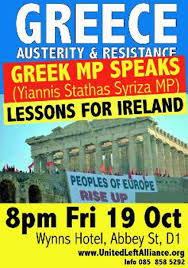
Nationalist answers 2 – Greece

Greece imagesIn the last post I noted that one view on the Left in Scotland was that it was not possible to call for a vote or support for a reformist SNP because, through being reformist, it could not face down the intransigence of international capitalism when it tried to introduce reforms.

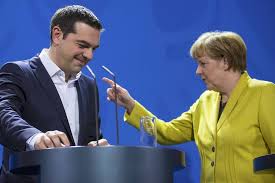
This would seem to be confirmed by the experience in Greece in which a reformist formation Syriza has just performed a humiliating U-turn and supported a third bailout that will impose greater austerity than that which it had previously opposed.

One of the many evaluations of this experience is here, which is also written by someone from the SWP tradition and which is based on the same political assumptions.  Unlike Davidson, who claims that the distinctions between reformists, revolutionaries and centrists are only understood by a relatively few revolutionaries, Kieran Allan argues that understanding such distinctions is vital:

“Ever since the crash of 2008, there has been an increasing call among activists to forget ‘old’ debates about reform or revolution. Yet the betrayal of Syriza re-opens this very question.”

One line of argument in response might be that Kieran Allen doesn’t actually advance a revolutionary programme himself – the SWP in Ireland doesn’t stand candidates in elections under a revolutionary banner but consistently stands as part of alliances that exclude it.  His definition of reformism applies equally to the various electoral projects of the left in Ireland over the past number of years:

“Despite opposing neoliberalism, Syriza embraced a reformist strategy. The term ‘reformism’ is not meant as one of abuse but it describes a strategy of using the mechanisms of the state to effect substantial changes on behalf of working people. It operates within the framework of capitalism and uses Keynesian economics to increase demand – rather than proposing the outright expropriation of capital.”

His criticism of Syriza can be made just as cogently against the United Left Alliance, People before Profit or Anti-Austerity Alliance:

“Some object to describing Syriza as a reformist because a) it leaders used a rhetoric about moving beyond capitalism and b) because there were avowed anti-capitalists elements within its coalition. However, this objection is somewhat facile as it was only in Bad Gotesberg programme in 1959 that the German SDP dropped their formal adherence to Marxism. In the early twentieth century many reformist parties combined a rhetoric about moving beyond capitalism as their maximum programme with a practice of seeking social reforms as their minimum programme.”

While he criticises the view “of democratising the apparatus of the capitalist state, transforming it into a valid tool for constructing a socialist society, without needing to destroy it radically by force’,” this is the alternative put forward by all these left alliances in Ireland.

This is certainly a problem but not the one I want to address here.  The latter is the problem of the strategy Allen puts forward as the alternative to Syriza’s reformism, not the similarity of this reformism to the SWP’s actual political practice.

Allen criticises “Syriza’s strategy of working exclusively through the state and through negotiations with the EU [which] could not match the courage of the Greek electorate.  This historic defeat, therefore, arose from a belief that control of the Greek state apparatus and appeals to EU solidarity was the method for bringing change. It never entered their heads to think about how the NO vote could be mobilised within Greece to physically face down EU efforts at blackmail. The sole agency was the Greek cabinet and its ability to negotiate with the EU bullies.”

Allen says that “they [Syriza] placed little emphasis on the role of Greek workers themselves taking action to break from capitalist control. . .  The mobilisation of workers in every area of society can stop the power of money and market forces.  Against the economic terrorism of the EU, people power and workers action is the only way to achieve change.”

When discussing lessons for Ireland he says that “In recent months there have been discussions about the need for a ‘progressive government’ in Ireland and interesting debates have occurred about policies. But there has been little talk about the methods by which such aspirations might be achieved.”

Unfortunately in reality neither does Allen, although this is the centre of his critique.  There are plenty of evocations of the need to mobilise workers to “face down the EU” but what does this mean?  What methods does he propose by which the aspirations of progressive change could be turned into reality?

What we have are calls to take action but total lack of clarity as to what action should be taken.

The first question is to identify the problem. And it’s not Syriza’s reformism.  Why is there a crisis in Greece in the first place?  Why not in Italy or Belgium – both have large debts?

The answer is well known.  Greece is relatively poor with a weak and not very productive capitalism. This makes not only Greek capitalism weak but its working class also weak, in a manner for which an increase in class struggle cannot compensate, or at least not very quickly.  This doesn’t enter Allen’s analysis.

The second question concerns the EU: “After the Greek crisis, the Irish left needs to drop any idea about the progressive nature of a social EU. It should note that Syriza was wrong to believe that it could combine an anti-austerity programme with support for the EU.  The reality is that the EU combines a soft rhetoric about ‘inclusion’, ‘solidarity’ and ‘respect for human right’ with a hard core neoliberalism that is embedded into its institutions.”

“The Irish left should, therefore, fully break with a ‘we will stick to the EU at any cost’ mentality because it was precisely this approach that gave the EU leaders a stick to beat Tsipras. Instead the left should advance its demands for a write down of debt, for nationalisation of natural resources, and a reversal of privatisation regardless of whether or not this is acceptable to the EU. It should indicate that it will not be bound by the rules of the Fiscal compact and that electoral support for the left means a mandate to defy such rules. It should make it clear that it favours the break-up of the EU in its current form and will seek its replacement by a federation of peoples based on democracy and control of capital.”

The EU is unreformable but if Allen has pretentions to Marxism he will also agree that the Greek State is also just as capitalist as the EU and also just as unreformable, yet he sees it as part of the solution through “a write down of debt, for nationalisation of natural resources, and a reversal of privatisation.”  Why would a capitalist Greece do this?  Is this not precisely the reformist approach that Allen excoriated earlier in his article? Or if an unreformable Greek state could do it why not a similarly unreformable EU?

He says that “Most modern European states are embedded in a network of EU institutions and so a strategy of working through the state also means working within those institutions. Syriza leaders correctly assumed that in an era of globalisation, there could be no purely national solutions to the crisis within capitalism.”

Yet in the proposals he advocates where is the recognition and incorporation of this impossibility of a “purely national solution”?

What we have in fact is the very opposite.  He proposes “A break from the euro [which] would have to be accompanied by a major programme to re-distribute wealth so that the costs of the change fall on those who can most afford it.”  But this is just the reformist programme he criticises while acknowledging that a new national currency cannot by itself be a solution. Yet a new national currency plus redistribution of wealth wouldn’t do it either.

Allen is right that any left Government “should [not] pretend that a different currency –such as the punt- can in itself solve problems. . . .  the key issue is not the currency but control of the economy.”  The problem, as we have seen above, is first that this economy is weak and second that the answer provided by Allen is always action by the state or rather by the national state, not internationally by the EU.

The nationalism that infects all inherently reformist projects appears explicitly in Allen’s perspective not just in rejection of the Euro or in rejection of the EU but in his support for “the break-up of the EU in its current form and . . . its replacement by a federation of peoples based on democracy and control of capital.”

This is something he “will seek” but as a policy it has no practical worth or educational propagandist value.  It simply states that a return to nation states and an end to capitalism is the answer and while the second is right and the first is wrong neither amounts to even the start of a strategy and adds nothing to any discussion of it.

This national road to socialism is made explicit in his statement that “it is possible to organise an advanced economy without a permanent need for substantial credit transfers. Ireland already has a high level of wealth but, unfortunately, its control lies in a few hands. Re-distribution of that wealth provides an alternative avenue to seeking ‘support’ from foreign creditors. Such a strategy does not preclude individual arrangements to access credit . Rather it suggests that a transitional economy that goes beyond capitalism would have to overwhelmingly rely on its own resources – rather than the type of EU ‘support’ that hung Greece.”

This in effect denies the international character of production from which there can be no going back and repudiates his statement that “in an era of globalisation, there could be no purely national solutions to the crisis within capitalism.” It asserts the opposite of everything that Allen professes to stand for.

He ends up arguing that “a transitional economy that goes beyond capitalism would have to overwhelmingly rely on its own resources” because the Greek crisis has not only tested and found wanting the reformism of Syriza but also exposed and found wanting the reformism within his own political conceptions based on action by the nation state.  In fact if anything, in its lack of any international perspective, it is worse than Syriza’s.

Nationalisation, redistribution of wealth and left governments astride capitalist states are not socialist solutions, even if in certain circumstances their effects can be welcomed and supported.  The example of Greece shows how one variant of such a solution can fail but the weakness of Greek capitalism placed major constraints on what could be done even if more could and still can be achieved.

Neither is nationalisation and redistribution by the state after a workers’ revolution socialism unless this state is the creation of workers themselves and not some minority party or group within it.  Freedom, as they say, is taken not given.

Socialism is the action of the immense majority of society, those who work and those rely on the wages of those who do so.  It is the actions of the working class that involve socialism.  It is not state ownership of production that is socialist but working class ownership that is socialist.  Before the political overthrow of the capitalist system and its state this must take the form of workers’ cooperatives.

The strategy of a purely political revolution, only after which comes social revolution; that is the strategy of seizing state power in advance of major gains in the economic and social power of workers achieved through workers ownership, leaves open the problem illustrated by the isolation faced by workers in the Russian revolution.

The alternative of more or less simultaneous revolutions in a number of economically advanced countries could only be conceived on the basis of a prior development of the economic and social strength and power of the working class on an international level.

This problem of isolation was and is faced by Greece but the socialism in one county approach of Kieran Allen is the wrong answer.

Seeking solutions at the level of the state in advance of the development of working class organisation at an international level provides the rationale for a programme which seeks not to advance beyond capitalist internationalism, which is what the EU is, but to regress from it mouthing fatuous phrases about international federations of peoples based on democracy and control of capital.

Nationalist answers 1 – Scotland

scoty images (11)A common analysis on much of the left is that the EU is a capitalist club that pursues an imperialist agenda, just confirmed by its brutal treatment of Greece.  The socialist answer is therefore to be in favour of leaving it.

Many of these same people argue that the UK is a capitalist state that has just re-elected a Tory Government committed to further austerity.  The election has shown that it too, just like the EU, is unreformable and should be split up; so for example Scotland should separate from it.

The answer to both is therefore a nationalist one.  Let’s not be distracted by the bells and whistles attached.  The objective is a change in the nature of the state but in both cases this means a return to the nation state, a smaller state, is the answer.

Ironically, as a recent post I read noted, while the treatment of Greece by the EU in the name of austerity has been acknowledged by more or less everyone to be brutal, the reaction of some nationalists has been much more muted.

Thus the SNP who are portrayed as opponents of austerity have rallied much of the British left around its nationalist argument for separation on the basis of its opposition to UK austerity.  It argues that any move to get out of the EU will see it demand a new indy referendum so Scotland can stay in.  Yet the austerity inflicted by the EU on Greece is of a magnitude many times greater than that directed from London.

From a socialist point of view it gets worse.  Their answer to this exposure to the contradictions of nationalism is to be even more nationalist than the nationalists.  Many of them demand that the UK (or the Irish State for that matter) leave the EU.  Of course it is claimed all the new states created will not be like their old incarnations  but progressive, if not socialist, but if they were there would be no need for them to be separate and if they are separate they will be in the position all nation states are in, which is in competition with each other.

We see such competition in the proposals of the various nationalists and left nationalists to reduce corporation tax.  Sinn Fein and the left in Ireland want to keep the low 12.5% rate but want it to be the effective rate while the SNP want a lower rate than the rest of the UK, whatever it is, and the Tories have just cut it to 18 per cent, so it now has to be lower than this.  When the Tories took office with the Liberal Democrats it was 28 per cent.  If my sums are right I think this makes Sinn Fein, the Irish Left and the SNP softer on the big corporations than Tony Blair.  But this doesn’t fit the narrative so let’s stick with it.

In an earlier post I promised I would look at an article notified to me by a friend, on the Left’s attitude to the SNP, just before the UK General Election so I’ll do that here.  I’ll also look in a second part at one of the many responses on the Left seeking to learn the lessons from the Syriza U-turn in Greece.  What they have in common is an accommodation to nationalism.

What they also have in common is being written from the Socialist Workers Party tradition.  As I noted before, this tradition, through their forerunner of the International Socialists, used to have much better positions on both the EU and Scottish nationalism.  However the two articles show that accommodation has not yet become capitulation.

The article in ‘Jacobin’ is in the form of an interview and it is revelatory that the first question doesn’t ask the interviewee why he supported Yes in the independence referendum but “what did you see in the movement that made it worthy of support?”

As I noted during the campaign, many on the left voted yes because they liked the campaign for it rather than any very compelling reasons for having a campaign for such an objective in the first place.

In this sense they were guilty of what Marx warned against – “Just as one does not judge an individual by what he thinks about himself, so one cannot judge such a period of transformation by its consciousness, but, on the contrary, this consciousness must be explained from the contradictions of material life. . “  Instead the Left supported a nationalist campaign, driven by social and economic concerns and desire for an alternative, and having done so declared it left wing.  It looked at itself in the mirror and liked what it saw.

Just like Sinn Fein in Ireland it does a grand job at telling itself and anyone else who will listen how great it is.  It might be something about nationalism.

I am also reminded by another less glorious figure in the history of the socialist movement who once declared “the movement means everything for me and . . . what is usually called “the final aim of socialism” is nothing.”

I exaggerate?  Well let’s look at the interview.  Davidson gives three reasons for changing his view to now supporting independence and, in his own words, he says that “the most important change was simply the nature of the campaign itself”

He says that “for many people it wasn’t about nationalism of any sort”. .  “It was about how to realise various social goals: an end to austerity, the removal of nuclear weapons, defence of the National Health Service”.  The fact that the answer to each of these problems is nationalism seems not to make the movement for it nationalist.

That the problems are not nationalist ones appears to mean that when the solution is national separation (“independence will improve their [workers’} situation immediately”) we don’t have to call it a nationalist solution.   Ironically if the problems were nationalist ones (like national oppression for example) a nationalist response might make more sense.

This self-regard leads to an exaggerated view of the role of the Left in the independence campaign, which, he says, dramatically changed its dynamic and drove the entire discussion of independence to the left.

In fact the landslide for the SNP in Scotland in the General election showed just who drove the campaign, who put independence on the agenda for decades before and who then benefited.

That the campaign for independence won the support of many working class people for a party Davidson admits is “on the extreme left of what I call “social neoliberalism” and “which broadly supports the neoliberal economic settlement”, i.e. austerity, is such an admission that it is simply staggering.

He supported separation because of the independence referendum campaign that led a neoliberal party to a landslide on the basis of that party claiming to lead opposition to austerity!

Davidson goes on to say that the SNP has moved to the left in economic terms “above all in rejection of austerity” and “is offering reforms” but also says they took up their “social democratic” position “in order to win votes” because “it would have been difficult to compete with New labour from the right”.

He accepts as good coin SNP claims of opposing austerity but fails utterly to examine its actual record in the Scottish Government, which would blow such claims out of the water.  Such an examination doesn’t fit the narrative.

In fact this narrative clashes obviously with reality.

He claims that the SNP sought an alliance with the Labour Party against the Tories, when in reality their strategy depended on destroying Labour in Scotland and keeping it to their right everywhere else.  Does he think the SNP would welcome a Jeremy Corbyn victory in the Labour leadership contest?

Why would it, since this would immediately demonstrate the efficacy of fighting together, that the Labour Party was not quite a dead loss and that there did actually exist a labour movement undivided by nationality.

He congratulates the SNP on their honesty, they’ll  never do a deal with the Tories he says, which means we can forget the one it had with them when in a minority administration in 2007 reliant on Tory support.

By supporting separation the pro-nationalist left has already separated itself from wider struggles.  In so far as there is a fight about austerity and its alternative in Britain today it is centred around the Corbyn campaign for leadership of the Labour Party.  I wondered on this blog whether the British Left would be part of it.  Were the unthinkable to happen and Corbyn actually win it could hardly be ignored.  Would an all-British movement against austerity in such circumstances be better than a purely Scottish one or would the Left insist on introducing national divisions where none were necessary?

It would appear that Davidson would answer the latter in the negative. “We must not give up the question of independence.  Unless a revolutionary situation emerges in England . . .”.  And of course Corbyn is far from being a revolutionary.

So it looks like English workers will have to deliver a revolutionary situation in England before the Scottish Left will be interested in political unity within one state.  (Talk about playing hard to get!) Not, mind you, that they are steaming ahead in the creation of a revolutionary party themselves because, Davidson says, “we are not in a position in Scotland to immediately set up a revolutionary party.”

Of course there are the ritualistic claims of wanting “solidarity” with English workers against the British State but not solidarity with English workers against a Scottish capitalist state which would replace the British one lording it over them come separation.  Joining with English workers to overthrow the Scottish state?  Now that really doesn’t fit the narrative.

Instead solidarity with English workers will mean we’ll demand the removal of Trident, which means moving these weapons to . . . err, England maybe?

And if the English follow this example and say that we’ll take the same position as you in Scotland and demand they’re not sited in our country, they can stay. . .err, in Scotland maybe?

What a splendid recipe for solidarity!

I mentioned that Davidson has accommodated to nationalism but not capitulated.  This is because although the article asks the question how the Left should relate to the SNP in advance of the General election he nowhere calls for a vote for the SNP.  The problem is, given what he says, I can’t see the reason for him not to.  Why not? given that he claims it opposes austerity, wants to introduce reforms, has moved to the Left and is now full of left-wing working class people who are ‘consolidating’ its position there.

It would be some slight comfort if it could be hoped that the reason for this is that, as a relatively recent convert to Scottish nationalism, at some level he just doesn’t quite believe his own argument.

Unfortunately the real reason may well be political sectarianism.  His reason appears to be that an SNP Government bent on reforms would face pressure and intransigence from capitalism when it would try to introduce its reforms.

He doesn’t say how this would not be the case in any other circumstance.  He doesn’t say how, what he might call a revolutionary party, would not face the same if not greater pressure.  He doesn’t say how it should be dealt with.  He doesn’t say why nationalist division prepares workers for such international capitalist intransigence and he does not say why this means that denial of support to the SNP now is justified by a future need for a revolutionary break, especially when he says the alternative party to be built now must not be revolutionary.  So how does he prepare all those inside and outside the SNP who must be prepared for this revolutionary break?

But what’s wrong with all this is not that Davidson should follow through on the implications of his analysis of the SNP and join it, but that his view of what is required of revolutionary politics now leads to a nationalist blind alley of supporting nationalist separatism now and being just as exposed to nationalist limitations when the grand day of revolutionary rupture might break out in the future.

His argument for national separation and endorsement of the SNP demand for independence falls apart because he refuses to support that party on the grounds that when it will be faced with international capitalist pressure it will be in no position to resist, most importantly because the working class will be divided by nationality whilst the capitalists won’t.

A convincing narrative or what?

Greece Crucified

ws jimagesAlexis Tsipras justified his humiliating U-turn, and commitment to imposition of austerity worse than he had just rejected, by saying that he had no mandate for Greece to exit the Euro.  Very true.  But he had just claimed that the referendum a week before had not been about the Euro.  By 61 to 39 per cent he has no mandate for austerity, which is what he said the referendum was really about.

He came into office promising an end to failed bail outs and has ended with a third one bigger than the first.  He called for debt reduction and now seeks support for debt inflation.

Such is the scale of the crushing terms of the latest ‘bailout’ that no one is attempting to say that it is nothing other than complete humiliation for Greece.  Even the Eurozone bureaucrats stated the truth behind the unpalatable words spewed out by their leaders – Tsipras had been subjected to “mental waterboarding” and had been “crucified”.

What has been mental torture for Tsipras will be brutal and catastrophic austerity for the Greek people.

I could write a whole blog on the capitulation of Tsipras and what looks like the majority of Syriza, and there would be good political reasons for doing so.  The policy and strategy of Syriza has been endorsed by Irish opponents of austerity such as Sinn Fein and these now lie in tatters.

In fact in my own view Sinn Fein is not even as radical as Syriza and this is an easy claim to substantiate.  It has already implemented austerity in the North of Ireland while hiding behind opposition to some welfare cuts.   In the South it supported the fateful decision to make the debts of corrupt banks and property speculators the burden of Irish workers and in doing so made the struggle against paying this odious debt much more difficult.

But there will be plenty of voices pointing out that what radical politics Sinn Fein has to offer have been trialled in a real life laboratory and been found wanting.  The capitulation of Syriza is in principle no greater than the Republican’s own acceptance of British rule in Ireland, acceptance of partition, surrender of weapons and dissolution of the IRA.  But that is all now a history that no one wants to talk about.

What is more important therefore is to try to understand what has happened and whether it could have been any different.  Not that it must be accepted that the ‘coup’ against Greece cannot or will not be resisted.  It can and will but it would be blindness to reality not to acknowledge that under Syriza the fight against austerity has suffered a demoralising defeat.

As that new aphorism says: it’s not the despair, I can take the despair.  It’s the hope.  Syriza gave hope.

Working out what has happened is not easy. For the man or woman on the street they see television reports of quantitative easing by the Eurozone involving the figurative printing of  millions of Euros by the European Central Bank, yet this same institution is involved in the vindictive pursuit of Greece for sums it could easily accommodate.

The proposals of the conservative leaders of the EU seem equally hard to understand or justify.  In fact for many they seem stupid, if not crazy. So draconian are they that they seem designed to achieve the very opposite of what they claim to be for.

The imposition of yet greater austerity when this austerity has demonstrably failed might be explained by ideological blindness.  And the humiliation involved might seem to invite rejection while being another attempt to remove Syriza from office.  But many commentators have explained that Syriza may possibly remain the only force that can push austerity through without complete chaos and collapse.

This humiliation is perhaps not just a message to a small and weak Greece but an unmistakeable one to a larger Italy and France: that the development of the EU will be under a model defined by Germany and its allies.  Yet even here the degree of malevolence can only invite small countries with parties equally blinded by reactionary ideology as Germany to wonder just what fate would befall them in an EU with such a definition of ‘solidarity.’

So while ‘good’ reasons might be found for what would appear to be ideological blindness the proposal for a “timeout” exit by Greece from the Euro appears as simply stupid; unless of course it is also a means of pushing Greece out permanently. But then it is such a stupid idea as justification that its purpose might only seem to be how open the imperial bullying can become, ‘pour encourager les autres’.

For the Greek people the surrender of even nominal control of their affairs is way beyond what has gone before.  The original proposal to ring fence €50 billion of Greek assets under German control,  to be sold at the discretion of its creditors, was such an open declaration of debt bondage as to render the humiliation utter and complete. What is yours is no longer even yours to sell.  Now it is reported it will simply be wasted on insolvent Greek banks with the needs of financial capital once again talking precedence not only over people but over real productive activities.

Thus in many ways, its failure to actually work being the first, its effects on undermining the legitimacy of the EU second and materially weakening the incentives to solidarity among its members third, all make the bailout deal a defeat for the idea of a European Union.  This is not even a European imperialism to rival the US, Russia or China but an imperial core and vassal periphery.

The price being paid seems so unnecessary because the main demand of Syriza – in order to give hope and reduce the impact of austerity, i.e. debt forgiveness, will be given and is already hinted.  Not in the shape of outright reduction but in the form of postponing or extending repayments and similar measures on the interest due.  After all, what cannot be repaid will not be repaid.

What matters however to the right wing conservative leadership of Germany, the Netherlands etc. is that their strength, and by extension that of the European imperialist project, is not diluted by the weak European nations and that the Euro remain in position as a world currency and not a vehicle for default and certainly not by what is considered an advanced nation.  Greece must be bled dry in order that the Euro remains strong and the pretensions of the EU remain in place.

The vision of a united Europe is not being abandoned by Germany etc, but it is one in which austerity is the bond that unites. It can be claimed that austerity will be inflicted on German workers if crisis hits the German banks; except of course that Germany has broken the rules before and would do so again.  It is easier to be ideologically blind when the price is paid by someone else.

Could it have worked out differently?    Syriza had hoped that enlightened self-interest would have combined with pressure from the US and the legitimacy gained by the referendum to mitigate the demands for austerity by Germany, The Netherlands and all the other little right-wing led states that curry favour with the powerful.  They have been rudely disabused of their illusions.

The more fundamental reason for this outcome is the weakness of the alternative at an international level.  Where were the left wing Governments calling for debt forgiveness, an alternative to austerity or even its reduction?  Where were the mass movements pressurising their Governments to accede to Greek requests?  Greece could not push back the demands of much stronger states on its own but on its own it was.

The demand for a revolutionary socialist alternative seeking the destruction of the Greek capitalist state and take-over of the Greek economy by its workers fails to provide any sort of immediate alternative, which is what we are discussing, for two rather obvious reasons.

Such a strategy relies on the aspiration and activity of the working class and the Greek working class neither desires nor is organised to destroy the existing state, create its own and take over the running of Greek production.  The anti-capitalist ANTARSYA for example got less than 1 per cent of the vote and Syriza, it should not need to be said, is not a revolutionary party.  How does a revolution arise out of this except through a long and painful process of learning lessons and making advances on this basis?

I was recently reading an article entitled ‘Marxism and Actually Existing Socialism’ written, what seems like a long time ago, before the collapse of the Soviet Union, and which defended Marx’s theory and politics.  In it the author wrote that:

“Marx envisaged that socialism would come first in the most advanced industrial societies of Europe, and it has not done so. Arguably, however, Marxism is capable of comprehending this fact. In any case, this is a matter of detail, even if an important one; and it seems difficult to resist the conclusion that, in its broad and general outlines, Marx’s account of the historical tendencies of capitalism has been remarkably confirmed by historical events.”

But of course the coming of socialist revolution not to the most advanced countries is not a detail, not even an important one.  It has been fundamental to the development and future possibility of socialism and has led to the very definition of socialism being distorted and disfigured.

Socialism is not possible in Greece alone any more, and certainly less, than it was in Russia not least because it is too weak and poor.   It is obvious that no other working class within any other country in Europe is at a stage of development where it could either join or support working class rule in Greece.

This does not mean Syriza should not have taken office or that it should not have engaged in negotiations with the Troika. Its strength however derives fundamentally from the class consciousness and organisation of the working class and not from any superior moral position.  The building of an international European party of the working class, of a militant current within the working class movement including trade unions, and of international workers’ cooperatives is the only road to creating the foundations for a successful conquest of political power.

On the other hand capitalist economic and political crises and socialist propaganda are, respectively, simply the occasion for such a conquest and the means of spreading word of the need for it.

As I have said before: the worst result would be Syriza implementing austerity.  It should now reject the bailout, call fresh elections on such a platform and if elected pursue an alternative.  If in opposition it should develop a movement as set out above.

The alternative it should pursue is that which the Irish should have carried out in 2008.  Let the banks go bust and let its owners and lenders take part in a ‘bail-in’ in which they pay the price for their investment in insolvent companies.  This is sometimes known as capitalism.

A radical Greek Government would encourage Greek workers to turn the banks into cooperatives that would shed their bad debts into a ‘bad bank’ (like NAMA in Ireland, in theory if not in its practice) and guarantee deposits that would fund development of worker owned enterprise.

The Greek debt would thereby suffer default and the reactionary gamblers Merkel, Juncker, Schäuble, Draghi and Dijsselbloem would see where the chips fall.

The blogger Boffy has suggested that a solution to the currency problem would involve electronic Euros that would allow circulation of money without the requirements for additional notes etc. from Brussels.  While this could work for the domestic economy I cannot see how it could function as a means of payment for international trade and, while Greece is a relatively closed economy, it cannot function without it.

In any case the leadership of the EU would, on current form, expel Greece from the Euro and introduce its own capital controls on the country.

Greece would be forced into issuing a new currency, a new Drachma, which the people do not want.  This could not be done quickly or without significant disruption.  It has been asserted that the argument that this would result in devaluation and a massive reduction in Greek living standards is false because the catastrophe predicted has already happened.  ‘Internal devaluation’ has already achieved what external devaluation of the new currency would otherwise have done.

I am not convinced by this argument but this too might be academic if the EU decided that Greece would no longer be part of the Euro.

The strategy suggested therefore provides no guarantee of success.  There is no ‘technical’ solution or answer in this sense.   And why should one be expected?

I have said that socialist revolution depends on the prior creation of a working class power consisting of an international party, international trade union action and development of workers’ cooperatives on an extensive scale.  What on earth could substitute itself for these?

What is suggested is a strategy for struggle and not a ‘solution’ but we have reached the stage where not even the leaders of the EU can present false promises on this with any credibility.  Austerity will continue not to work.  Struggle is what we have.


Some comments on the Greek referendum

Greece3543The decision of the Syriza Government to call a referendum on the proposed austerity proposals of the Troika (European Commission, European Central Bank and IMF) in return for another ‘bailout’ programme reminds me of the Irish austerity referendum three years ago.  It gave rise to one of the first posts on this blog.

The Irish people voted by a large majority to support austerity.  Will the Greeks do the same?

The Irish voted reluctantly to accept austerity (how else could you do so?) because there was no alternative at hand.   The arguments of the Left that the Irish State could lead a growth agenda of Keynesian stimulus hardly convinced when that State had just bankrupted itself bailing out the banks.

Both the reason for the defeat and its effects have not been appreciated.  Of the latter it is enough to ponder the proposals of the trade unions behind the largest sustained opposition to the austerity agenda – the Right2Water proposals for ‘A New Fiscal Framework for a Progressive Government’, which proposes additional State expenditure of €9.4 billion over 4 years.  This would amount to less than 4.5% of the 2014 level of Government expenditure.

The Right2Water’s ‘Policy Principles for a Progressive Irish Government’ contains a section which proclaims the need for additional investment in the water and sanitation system of “between €6 and €7 billion”, which leaves just around €2.5 to €3.5 billion for education, health, investment and everything else.  This is not so much an alternative to the current Government’s strategy as a variant of it.  So much have horizons been lowered.

According to the authors of this document the rules of the EU will be adhered to while seeking flexibility within them and negotiating additional scope for spending.  But the case of Greece exposes that the rules of the EU, ECB and IMF can be bent to suit.

So the claim that joining the Euro was irrevocable has been discarded by the leading powers in the EU to be replaced as the biggest threat to the Greek Government and people – vote against our austerity plan and you are voting to leave the Euro.

The propaganda campaign by the EU leaders includes European Commission President Jean Claude Juncker, who says he feels ‘betrayed’, and complains about a lack of “good faith” and “sincerity” from the Greeks.  This from a man who presided over the building of Luxembourg into a tax haven.  Yet he sees fit to question the Greek Government and people over their right and capacity to raise taxes.  Has the tax evasion facilitated by Luxembourg not contributed to the Greek predicament?

Christine Lagarde of the IMF proclaims she wants “adults in the room” with whom to negotiate, attempting to infantilise the Greek Government representatives and by extension the Greek people.  This is the Lagarde who has been placed ‘under investigation’ in a fraud case.  One can’t help but recall the behaviour of the previous head of the IMF, Dominic Strauss-Kahn.  Getting fucked by the IMF is a pleasure for no one.

In the current case this involves Troika demands for drastic reductions in the pensions of some of the poorest Greek pensioners and increases in VAT that will hit both those who will pay increased prices and the small businesses compelled to charge them.

On the Left these demands of the Troika are likewise treated as in effect an ultimatum which should lead to exiting the Euro – as the only effective response to the unceasing demands for austerity.  What for the leaders of the EU is a threat which the Greek people should retreat from is for some on the Left a major part of the solution.  What for the former is a recipe for chaos is for the latter the way out of it.

In my view the former are correct.  Exiting the Euro would lead to a new Drachma that would involve massive devaluation and a large reduction in Greek workers’ living standards.  Cutting one’s own throat is not preferable to having someone else do it.  If Greece is thrown out of the Euro it naturally has no choice but that is not a choice it should itself make.

It is clear however that the choice at the end of the day is not Greece’s to make.  It is not in a position to compel a significant reduction in austerity or debt relief even while many commentators who support the austerity demanded admit that debt relief is inevitable.  The reason that they demand austerity nevertheless, even while recognising that it has failed, is that they seek the removal of the Syriza Government.

The EU leaders tried it last week and now seek it this week through refusing to accept Syriza’s huge concessions, refusing to extend the ‘bailout’ and through freezing ECB liquidity provision to the Greek banks.

The Greek workers should reject the austerity plan from the EU and reject the non-solution of leaving the Euro.  Only on the basis of fighting austerity and refusing a go-it-alone nationalist solution can it minimally seek to build a movement that would stem the demands for austerity.  What the Greek crisis shows is that such austerity can only be fought at an international level.

What does this mean?

Well, let’s look at what the Channel 4 journalist Paul Mason, who is covering the crisis, had to say.   Exit from the Euro may be inevitable he says because of democracy – the population of Northern Europe would not support the transfers required to reverse austerity inflicted on Greece while the Greek people may no longer accept it.

In this he is at least partly right.  Only an international campaign of solidarity with the Greek people, which explained that the bailout was not for them, but for the German and French banks and hedge funds who invested in lending to Greece, could explain the real function of austerity and lay out the grounds for convincing those outside Greece to reject it.  On this basis it might force a retreat from the austerity demanded by other EU Governments, including the repulsive Irish one.

Within Greece it would require not just an ‘OXI’ vote but a mass movement that would compel implementation of a Syriza programme to tax the oligarchs through occupations to open the books of these businesses and in doing so help put in place a rigorous system of tax collection.

In itself this would only form the starting point of a workers’ alternative – one that is based on development of worker owned production.  Such workers’ cooperatives are the alternative to the weak and crony capitalism from which Greece suffers.  It offers practical proof of the socialist alternative and is a basis for its growth this side of political revolution.  The latter in turn will gain credibility from practical demonstration of a socialist programme.

The lack of such international and domestic conditions caused defeat for Irish workers in their referendum.  A very different vote in Greece would be a step forward for Irish workers now.

On the other hand the very worst result would be defeat in the referendum and a Syriza Government implementing austerity.

While the Dutch hatchet-man Jeroen Dijsselbloem again reveals the Euro leaders agenda of getting rid of the elected Greek Government – “ who are we trusting” he says if Syriza promised to implement the austerity it had just rejected, Varoufakis is quoted as saying that Syriza would do just this.  “If the people give us a clear instruction to sign up on the institutions’ proposals, we shall do whatever it takes to do so – even if it means a reconfigured government.”

Such an approach would discredit any sort of Left alternative and pave the way for a hard right Government to eventually push through austerity on a demoralised workers’ movement.

The long resistance of Greek workers to austerity has given hope that we are not yet at such a result and that the struggle against austerity will continue.

Syriza and Ireland

syrizaimagesThis Sunday the Greek people will go to the polls in an election that could see the beginning of the end of austerity in Europe.  That anyway is the view of some on the left across Europe.

The potential election of a Coalition of the Radical Left (Syriza) Government, promising a radical reduction in the debt burden, has the potential to galvanise and set an example to the rest of the PIIGS.  It could incite a combined movement in Portugal, Ireland, Italy, Greece and Spain that would reduce the debt of these countries which has been a prime driver of austerity.  Through radically reducing the requirement to service and pay down enormous debts such a step could launch a definitive movement away from neoliberalism towards a radically different Keynesian social democratic alternative.

The elections in Greece will be followed this year by elections in Spain, in which a like-minded Podemos movement has grown, and in Portugal, and may also be joined by an election in Ireland despite the claims of the current Government that it will run in office until 2016.  Of the five PIIGS therefore at least three and possibly four may see elections this year.  Even elections in Britain could see the ousting of the Tory devotees of austerity and neoliberalism.  In fact the policy that might inspire the PIIGS is not confined to them but might apply right across Europe.  And Syriza is in the vanguard of this movement.

Is such a scenario a real possibility?

Let us notice what makes such a claim plausible.

Firstly the proposals of Syriza are not solely on behalf of the Greek people although as a Government it will be able to negotiate only on their behalf.  Syriza proposes a European Debt Conference modelled, with delicious irony, on effective debt forgiveness of (West) Germany in 1952.  This was carried out explicitly in order, or so it was claimed, to normalise relations between Germany and its creditors and to promote economic development.   That deal wrote off half of the debt, stretched repayment of the rest and for the first few years provided only for payment of interest, which was also limited.

Syriza proposals are more limited. Their policy could be based on an academic paper which proposes that half of the debt would be bought up by the European Central Bank (ECB) with either an interest holiday or interest charged on the remaining debt at a low rate.  The debt taken on by the ECB would not be written off but would be paid back only when the remaining debt left to the country had been reduced to 20 per cent of Gross Domestic Product (GDP).  In effect economic growth and inflation will have eroded the real value and real impact of debt repayment.

However in one very important sense the proposals are much more radical than the German precedent, because the Syriza proposal is that this plan applies to every country in the Eurozone with debt over 50 per cent of GDP (all but three countries).  The Irish state for example would see its debt reduced from 108 per cent of GDP to 50 per cent, saving €3.7 billion each year in interest payments, so reducing the need for cuts or tax rises and facilitating greater state spending and investment.[i]

It has been estimated that this would reduce sovereign debt in the Eurozone area by about €4.5 trillion.  It is asserted that this would not risk inflation because the ECB debt purchases would be funded by massive borrowing from private banks.  There would be no money printing since the money is borrowed.  And sure why worry about inflation when deflation is so clearly the enemy?  And who pays the interest on these loans?

Well, it is recognised that there will be losses in paying back the private banks, between €50bn – €60bn in each of the first 5 years, and €1trilion over 40 years, but it is argued that the borrowing costs of the ECB would be low and that renewed economic growth would compensate.  It would be cheaper than the current policy of austerity and expansion of the ECB balance sheet required to bail out the banks.

It is recognised that this may not be enough in the short term for some countries so that, for example, in order to prevent continued austerity in Greece the ECB would have to take over the debt that would be required to be issued in the next five years.  This would also be required because over 50% of outstanding debt has to be paid back within the next 5 years in Italy, Spain, France, Holland and Belgium and to cover this new debts would have to be taken on.

For Marxists the point is not that some monetary scheme has been devised that will solve capitalisms’ problems.  Nor is it the point that Syriza will go into negotiations and cannot expect, as in all negotiations, to get its original plan agreed, even discounting some conscious intention to betray the hopes of its supporters in order to accept the logic of capitalism.

The significance of the proposals is that it provides a concrete platform around which workers across Europe can organise and struggle together, and a series of elections that can be a focus for such struggle.  This is not to invest illusions in either elections or Syriza, who are condemned by some for having shifted from a policy of debt repudiation to one of simply extending repayment under more favourable terms.   If a practice of simply condemning the limitations of reformist politics were the answer we would no longer have the problem.

The Syriza programme is one that workers and socialists can support because it reduces the burdens they face and would deal a big political and ideological blow to austerity and the parties who have peddled it.  It would deal a real blow to reactionary political parties seeking nationalist or fascist solutions.  Through a successful campaign workers could gain strength and confidence to build up their organisations, their own social and political power and their own confidence and class consciousness.  The latter is the role that Marxists can play by advancing a programme that does all these things.

The victory of Syriza would allow an opportunity to directly organise workers on an international programme on an international basis.  It is remarkable that this significance has been somewhat missed.  So, for example, the call promoted by the Fourth International correctly argues that “their victory will be ours, but their defeat too” but appears to fail to appreciate that this can be so because other European workers will not just be in solidarity with Greek workers but can actually be part of the same struggle, demanding the same deal for their country, so that “our victory will be ours and our defeat will be ours too.”

This is made tactically easier by Syriza not proposing either to leave the Euro or leave the EU.  There can be no pretext that the demands of Syriza can be dismissed because they no longer want to belong to the club.

These policies have been condemned as examples of betrayal of earlier more radical promise but they are not just tactically recommended.  As argued before in the various posts on ‘The Left Against Europe’, the growing unity of capitalism provides the material basis for the international unity of the working class.  This is why a united international struggle against austerity is more immediately and concretely possible in the Eurozone than one against similar policies pursued more or less independently by separate capitalist states each with their own currency.

So to return to our question – is such a scenario possible?

It is possible to argue that it is, for the simple reason that the Greek debt is too big to be paid back anyway.  Some means of addressing it is required and the Syriza route is eminently preferable for workers than the slow death march of austerity and repeated minor debt ‘haircut’ so far embarked upon.

The second is that by the very fact that the Syriza plan is reformist there is no necessity for a life and death struggle by the forces of capitalism to defeat it.  The Syriza plans do not call the system into question, which both sets limits to what it can achieve but also provides scope for negotiations between a Syriza Government (and other PIIIGS Governments should they be elected or so inclined) and the IMF/ECB /EU/German State alliance.

The rallying of the Greek workers behind Syriza is one of many proofs that a revolutionary overthrow of Greek capitalism is not currently on the cards and is not therefore a realistic immediate alternative.  The revolutionary alternative today consists of preparing for such an eventuality tomorrow.

Not by either passively or even ‘aggressively’ preparing for socialist revolution but by the cumulative development of the power of the working class suggested above, with the certain knowledge that a revolutionary break with the capitalist state and system will be required.

To condemn Syriza for negotiating with capitalism when it cannot be overthrown is a bit like condemning trade unions for negotiating a pay award when they should be overthrowing the wages system.

The third has been pointed out here – Syriza will be damned if it does not get some sort of result and the executor of that judgement may be the fascists of New Dawn.  It is not only Syriza who has an interest in ensuring this doesn’t happen.

‘Ireland is not Greece’ we have been told repeatedly over the past five years or so.  If Syriza is anyway half successful Ireland will look pretty stupid if it isn’t.

[i] It is interesting that the authors go beyond the argument that this is some sort of socialism saying that “The left ought to be strategically against privatizations, having at the same time as an ultimate target the gradual historical replacement of “state control” by democratic forms of social control (unfortunately this type of discussion has not been adequately developed within the left).”