Bourgeois democracy in Ireland in two Acts (1) – supporting the Palestinians

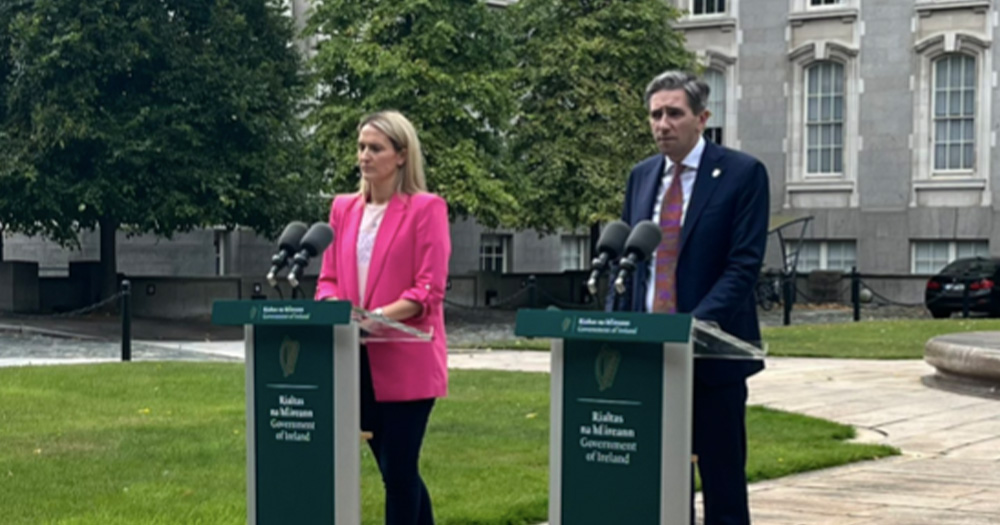
In June the Taoiseach Simon Harris assured the Dáil that “no airport in Ireland or Irish sovereign airspace is being used to transport weapons to the conflict in the Middle East or any other war”.  The Ditch web site in September began reporting that nine such flights had been made to Israel, although the site reported that there were, and no doubt still are, many more.  It noted that ‘Carrying munitions of war through Irish airspace without permission from the minister for transport is a criminal offence punishable by up to three years’ imprisonment.’   

Harris stated in June that “In relation to the overflights, the Government of Ireland has never provided any permission for such an overflight to take place in terms of carrying munitions and therefore the Government wouldn’t have been in a position to inform the Dáil of such a flight. That position is quite clear,” which means that unless the Government expressly permits the law to be broken, it hasn’t been.  It would appear that it is only broken when it has been admitted but since the Government is never going to ask to inspect aircraft overflying or landing, it is never going to be admitted, and we just have to accept that the law has not been broken and Irish neutrality policy has not been breached.

In response to the evidence that neither of these things are true the Government has called an investigation into its own actions, as if it doesn’t know what it has been doing. Meanwhile Harris accused his critic, Sinn Fein’s Mary Lou McDonald, of “misleading people” and of trying to “muddy the waters”, which would make more sense if it was self-criticism.

The Green Party Minister of Transport has claimed that “no airport in Ireland, or Irish sovereign airspace, has been used to transport weapons directly to Israel” while he has also claimed that he supports new legislation that would allow random checks.  The sponsors of separate legislation have pointed out that the government already has powers to carry out checks but it isn’t using them, while it’s opposing their own proposals. The Minister has promised to “sit down with my officials and with legal experts over the coming months to make sure that new legislation is developed that is watertight, is workable, and is compliant with international aviation law.” Sitting for months is as near an honest admission of what action it will take as the government is likely to provide.

The prospects of any further Government legislation that would be implemented can be gauged by the fate of the Occupied Territories Bill, which would ban and criminalise “trade with and economic support for illegal settlements in territories deemed occupied under international law”, most notably Israeli settlements in the occupied territories.

This was passed in both Houses of the Oireachtas but has been stymied for four years, with yet another statement by Harris that he would seek “fresh legal advice” to extend the never ending delay.  The message is that a majority in the legislature can vote for something that is undoubtedly approved by the majority of the people but this doesn’t mean the Government will do anything to implement it.  The Ditch again explained the precise mechanism employed in this particular case, one of the many in bourgeois democracies to ensure that what democracy there is is suited only for the bourgeoisie:

‘On 25 February, 2019 Hadie Cohen from the Israeli Ministry of Justice emailed colleagues.’

‘Cohen referred to a “confidential call” (emphasis Cohen’s own) with Paschal Donohoe. Cohen said Donohoe told Israeli finance minister Moshe Kahlon that the Irish government would “block” the bill.’

“We understand that during a confidential call on 13 February between the Irish Minister of Finance and his Israeli counterpart, the Irish minister confirmed that the Irish government will be using a procedure known as “money message” to seek to block the progress of the draft Irish legislation criminalising dealings with products and services from the settlements – the Control of Economic Activity (Occupied Territories) Bill 2018,” wrote Cohen.’

‘The “money message” was invoked by ‘then foreign minister SImon Coveny [who] said government would invoke article 17.2 of the constitution . . . Coveney said government had to do this, not to frustrate the democratic process as critics of the money message argue, but because government’s “view is that additional costs will also arise from voted funds for certain Irish diplomatic missions abroad should this bill be enacted. I should state clearly at this point that because of these costs across a wide range of areas, there can be no doubt that the bill will require a money message to proceed to committee stage.” More sitting down with legal experts perhaps to ensure nothing is done.

Paschal Donohoe has denied this call but only in the sort of non-denial denial manner, similar to the non-apology apology.  What all this demonstrates is that the Irish State is no different from every other capitalist state, which are committees to run the affairs of the bourgeoisie that inevitably involve conspiracies to lie to their own people.

The Irish State joins with the others in the West in having its fingerprints all over genocide in Palestine, laced with its own particular flavour of hypocrisy, all the more disgusting because it pretends to be the very opposite if what it claims – to be in support of the Palestinian people based on its own experience of colonialism. Its reputation as an ally of the Palestinian people is exposed as a fraud and its public spats with Israel a piece of theatre.

Given this exposure of gross hypocrisy we can clearly see the futility of repeated petitions and demands by many on the left that the Irish state take action against Israel in order to help bring an end to the genocide. It is simply not in its interest to do so. The state is in hock to US multinationals, something referenced every day in the media reports of the increase in corporation taxes received from them. When it looks like some gesture might be made the US has ensured that its client Israel is protected and the Irish told what it cannot do.

The only force in Ireland with the capacity to prevent the transportation of weapons, and this itself is limited, are Irish workers, but pointed questions, petitions and criticism is never levelled by the likes of People before Profit at the trade union leaders who refuse to organise and advocate such action. The various mechanisms employed by the state to avoid taking action will not be changed by speeches in the Dáil. Action must be taken outside it, advocated and encouraged through speeches at meetings and in workplaces of those we want to take the necessary direct action; against the wishes of the government and state and the genocidal governments it stands in support of.

Workers’ democracy is the alternative to the conspiracy and lies of bourgeois democracy, and no matter how weak workers’ democracy is, it is much, much stronger than reliance on the bourgeois kind.

Forward to part 2

What is bourgeois democracy?

Most of Europe is involved in a proxy war against Russia, costing billions of Euros and untold lives; untold because the personnel involved were not supposed to be in Ukraine in the first place.  Who voted for the war?

This question sums up bourgeois democracy.

This has not prevented many on the left enthusiastically supporting it.  This left, which normally would not dream of calling a strike without a ballot, has given a blank cheque to its ruling class and its state.  Rather than demand a vote in order to debate the purpose and objectives of the war, they have simply endorsed it and called for it to be supported more vigorously.  I doubt the idea of a debate and vote even crossed their minds, not least because they don’t have an alternative anyway.

The justification, ironically, is that Ukraine is a ‘democracy’ and Russia is not; even though the current president of Ukraine is no longer an elected leader, since his period of office has expired, while the President of Russia actually won an election, for what it’s worth.  In the last few days Zelensky has tried to concentrate even more power in his hands by sacking around half his cabinet.  That opposition parties and media are banned in Ukraine matters not a jot to these people while Russia’s elections are regarded as a sham.  Let’s think about that for a minute and consider recent elections in the ‘democratic’ West as a comparison.

First, we have the new Labour government in Britain, elected with an enormous parliamentary majority by only 20% of the electorate on the basis of not much more than not being the Tories.  Starmer and his colleagues did their best not to commit to any specific policies and have quickly broken promises that they did make – on energy prices and austerity.  No doubt, further measures will confirm this course.  The widespread opposition to genocide in Gaza, reflected in support for some independent candidates, could find no reflection in the choice of government as both Labour and Tories support it.

Second, we have the most powerful bourgeois democracy in the world in which counting the money is a better guide to who will win than the polling of support for the various policies that the candidates claim to support.  The US is possibly even worse than Britain in terms of the vacuum of debate on what exactly parties will do when elected, whether anything they say can be believed and is not just a catalogue of lies.  For every Donald Trump and Kamala Harris we have a Boris Johnson and Keir Starmer.  The main appeal of each candidate is aversion for the other.

When the usual mechanisms for making sure the ‘right’ candidates are selected fail these are ditched and the men and women with money and political power step in to make the ‘right’ selection.  After months of primaries and the votes of millions – 14.5 million in fact – the Democratic grandees and apparatchiks stepped in to ensure that Genocide Joe would not be the Presidential candidate.  In this he was simply the subject of the same machinations that ensured he was the candidate in 2020 instead of Bernie Sanders, who was judged too left wing regardless of the popularity of his policies or of himself.

Even the proponents of bourgeois democracy worry that all this is not sustainable, while certain sections of the left cling to it all the more firmly the more rotten it becomes.  In an opinion piece in the Financial Times, a contributing editor noted that Kamala Harris has given only one media interview and even that not by herself – ‘she seems to think that if voters understand what she will do as president, they will be less likely to support her.’  It notes the irony that, while claiming to defend democracy against the “existential threat” to it posed by Trump, the failure to do what you say you are going to do means that ‘rather embarrassingly, you will be the one undermining the system of representative government.”

The argument of socialists is that bourgeois democracy – “representative government” – is a sham.  How could it be otherwise in a system in which the means of production are controlled by the capitalist class, including the means of communication – of producing ‘the news’ and disseminating it, and the state machinery through which government policies are implemented – thorough its top personnel and the economic structures through which policies can be allowed to work or alternatively are throttled.

A final example of bourgeois democracy in action is in France, where the defeated Emmanuel Macron, having prevaricated for two months, has announced that Michel Barnier has been chosen by him to be Prime Minister.  Despite the New Popular Front having won a plurality of the votes he has selected a leader from the right wing Les Républicans, which won only 6.57% of the first round vote.

The leader of France Insoumise, Jean-Luc Mélenchon has declared that “We’ve been robbed in this election”. It is normally the largest formation that is permitted to form an administration but such normalities are always disregarded when the political establishment thinks that it faces some sort of threat, especially from the left.

The real anti-democratic nature of this move by Macron is not so much the abuse of this Presidential mechanism but what the employment of this power signifies.  The elections were a decisive rejection of Macron and his policies, reflected in the vote for the New Popular Front and in the rise of the far right Rassemblement National.  Yet Barnier was selected preciously in order to confirm and continue these policies.

The front page of the Financial Times explained that the purpose of Macron’s choice was to ‘find a candidate . . . who would not seek to undo his pro-business reforms.’  The fraudulent nature of the far right alternative to mainstream capitalist policies was revealed by the response of Marien Le Pen who is quoted as ‘cautiously’ welcoming the appointment and saying that “Barnier seems at least to meet one of the criteria we’d demanded . . . and be able to speak with the Rassemblement National.  That will be useful as compromises will need to solve the budget situation.”

An analyst from one of the think tanks that litter the capitalist political environment stated that his appointment would ‘help in France’s bid to reassure markets over the economy and public spending’.  “He’s a safe pair of hands known to market participants, known to Europe and the domestic political elite within France”, adding that he would be expected to ensure that ‘Macron’s labour and pension reforms would remain intact.’

So, there we have it.  An overwhelming vote against Macron’s policies is turned, or is attempting to be turned, into an administration that will ensure their maintenance.  It is not the clear wishes of the electorate that must be counted but that of the ‘markets’ – national and international capitalism – and the ‘political elite’ that counts.

For all the hypocritical cant about ‘democracy’ we have yet another example of how bourgeois democracy is democracy for the bourgeoisie.  For the majority, including the working class, democracy does not extend beyond occasional visits to the polling booth in which meaningful choice has often been removed, or when it has not, constitutional devices are employed until these too are insufficient whereupon more forceful measures are employed.

Mélenchon is reported to have called for protests against this subversion of the popular will, demonstrating that, for the working class, democracy can only be enforced and guaranteed by its own actions.  What this action cannot do, however, is democratise the state itself, which is the instrument of the political elite and the markets – the bourgeoisie and capitalism.

The resort to protest is testament to where power for the working class arises and where it must be advanced – in the organisation and mobilisation of the workers themselves.  Elections can measure its strength and level of politicisation but only the workers own organisations can form a democratic alternative to the political elite, the bourgeois class and its state.  This in turn demands that the organisation of the working class movement itself must be democratic, but until some current socialists stop supporting capitalist war in defence of bourgeois democracy they will have nothing but a reactionary role to play in building up the workers own democracy.

UK elections – who needs a majority?

The Labour majority of over 170 seats with only 34% of the vote is the lowest-ever winning share.  With around one third of the vote it gained two thirds of the seats. The turnout of around 60% was a drop from 67% in 2019 and the second lowest since 1918, meaning around 80 per cent of those eligible to vote didn’t vote for Starmer, whose personal rating is a net minus of 6.  Even in his own constituency his vote fell dramatically, by 15.6%.

His victory is due to the Conservatives having their worst ever result.  Polling indicated that 48% of those intending to vote for Labour were going to do so mainly to get rid of the Tories.  Had the Reform Party not existed, and its reactionary support voted Conservative, it would have beaten Labour by around 38% to 34%.  Yet for receiving 14% of the vote Reform got around 1% of the seats.

From this, two things are obvious: the British electoral system is a fraud with scant claims to democratic legitimacy and Starmer’s Government has the same lack of popular foundation.  The bourgeois media can’t ignore all this completely but can be expected to move quickly on.  One only has to recall that Starmer’s Labour received less votes than the supposedly disastrous Jeremy Corbyn in 2019 and 2017 to appreciate the treatment the media would dish out to the lack of legitimacy Starmer’s result would be accorded had Corbyn still been leader. In 2024 Starmer’s Labour won 9.7m votes with 33.8% of the vote while in 2019, in Labour’s supposedly worst result ever, Corbyn’s party won 10.2m votes with a share of 32.1%.  In 2017 Corbyn’s Labour won over 3 million votes more than Starmer did today – 12.9m as against 9.7m.

It is estimated that a quarter of 2019 conservative voters switched to Reform while the Liberal Democrats achieved their best ever result by surfing the wave of getting the Tories out by targeting their seats in the south and south-west of England.  Labour also benefited by the collapse of the SNP vote in Scotland following 17 years of failed SNP rule and the scandals that have engulfed the leadership of the party.

The short-sighted and primitive call from some on the left who simply called for the Tories to be kicked out has been exposed for the worse than useless advice that it so obviously was.  Everybody was out to get the Tories , and the election revolved around their losing it rather than Labour winning.  As we have seen – the Labour vote went down.

*                   *                   *

The Labour slogan was the vapid and vacuous one-word ‘Change’.  The bourgeois commentariat has welcomed it as a change from the incompetence, chaos and instability of fourteen years of Tory rule and a return to the previous, apparently boring politics.

True to their superficial appreciation of events, or at least as they recycle them for the consumption of the population, this ignores the commitment of Starmer to essentially continue with Tory policies.  This includes a commitment to ‘growth’, to retention of the commitment to reducing the debt over five years; minimal increase in taxation; resolution of the problems of the NHS; commitment to increased defence spending, and a promise not to reverse Brexit in his lifetime.  He has also committed to come down hard on immigration and to do so more effectively than the Tories.

How growth can be achieved without investment (increased borrowing and therefore increased debt); without a larger workforce (while reducing immigration), and without expanding either the domestic market (through pay increases Starmer has vowed to oppose) or the export market (while never rejoining the EU), is left unexplained.  It all looks exactly like the situation created by the Tories but without smug incompetence of Cameron, the wooden hopelessness of Theresa May, the performative chaos of Johnson, ideological blinkers of Truss, and the MBA qualification in cluelessness of Sunak.  All Starmer brings personally is his own brand of dislikeability and penchant for lying on the scale of Boris Johnson.

Normally a new right wing government with a mandate would be able to wield their electoral victory as a weapon against workers, through restricting public sector pay, reducing public services and welfare, and increasing taxation.  Given Starmer’s short but filled-to-the-brim history of U-turns, it would not be a surprise to see him attempt to impose austerity on public sector pay, reduce the scope of state services such as the NHS, increase taxation, take yet more reactionary measures to be seen to reduce immigration, and attempt unsuccessfully to get something meaningful from the EU in terms of better market access.  None of this will lead to significant additional growth.

Brexit is an issue that will not go away even if all the parties try to ignore it as they did in the election; just as the proxy war against the biggest nuclear arms power in the world was also ignored.  The previous election that promised that Brexit would get done resulted in it not getting done, thus not addressing all the problems created.  The lack of strong support for Starmer’s government will matter when he is called upon to do so.

*                   *                   *

Starmer managed to maintain the support of most of Labour’s voters while pivoting to the right, to win over disenchanted Tories and others simply wanting rid of them without caring particularly over who replaced them. This having been achieved, there is no reason for any of them to offer his Government any continuing support.  Even his claim to introduce integrity into government after years of Tory sleaze looks like previous broken promises given his huge catalogue of gifts and the sponsorship of his party and colleagues by private corporate interests.

His support for Brexit will anger the majority of Labour members and supporters who oppose it and who will see more and more evidence of why they are right to do so.  A harder line on immigration will do nothing to improve growth, will antagonise some supporters and will legitimise those on the right, including the Reform party, which is in second place in almost 100 constituencies, the majority of which are held by Labour.  Reform has already demonstrated that its rabid xenophobia is more convincing and attractive to reactionaries than that of the Tories, and this will apply to Starmer’s reactionary nationalism.  Pursuing the same policies will engender the same problems that brought down the Tories and the same vulnerability to right wing competitors, who will always be able to out-bid its reactionary solutions.

The Liberal Democrats did not increase its share of the vote but had its best result because it targeted Tory seats.  An anti-Brexit policy could protect those gains while targeting Labour supporters opposed to Brexit and Starmer’s continuing demonstration of its failure.  The Green Party also increased its vote and became a more credible alternative, even if its gains in two Conservative seats demonstrates its essentially petty bourgeois character and opposition to any sort of socialism.

Unfortunately, the pro-Palestine candidates elected are not a coherent left alternative while fortunately the false and fraudulent alternative represented by George Galloway was defeated.  The battle for the socialist movement is not through creation of yet another electoral alternative but assisting in the working class resisting the policies of Starmer’s government and defending its interests.  Only by working class resistance and a movement created out of it could an electoral vehicle be constructed as a subsidiary part of the movement.

The Conservative Party has lost many of its most rabid pro-Brexiteers and will always come second in competition with Reform on the basis of opposition to the EU.  Just as with the Labour Party, sooner or later being a bourgeois party will mean having to represent its interests, which means reversing Brexit.  This applies to the Liberal Democrats as well so that a party realignment to achieve this will have to take place.

Only the rabid reactionary nature of the Reform membership can hobble its further development or blow it up. There is no point in the traditional conservative section of the Tory party seeking any sort of accommodation with it, yet there is no point in the reactionary petty bourgeois sections of the Conservative Party and the Reform Party remaining separate.

The results of the election; the economic challenges facing the new government and resistance to it; and the proliferation and confusion of party supports, all point to a political realignment.  A real socialist alternative cannot be declared or created out of the organisations that exist but likewise can only come to the fore as a result of developments in the class struggle, arising as a result of working class opposition to the the new government and its attempt to carry through the failed policies of the Tory government that has just been humiliated.  A cause for some optimism. 

Permanent Revolution (3) – basic principles

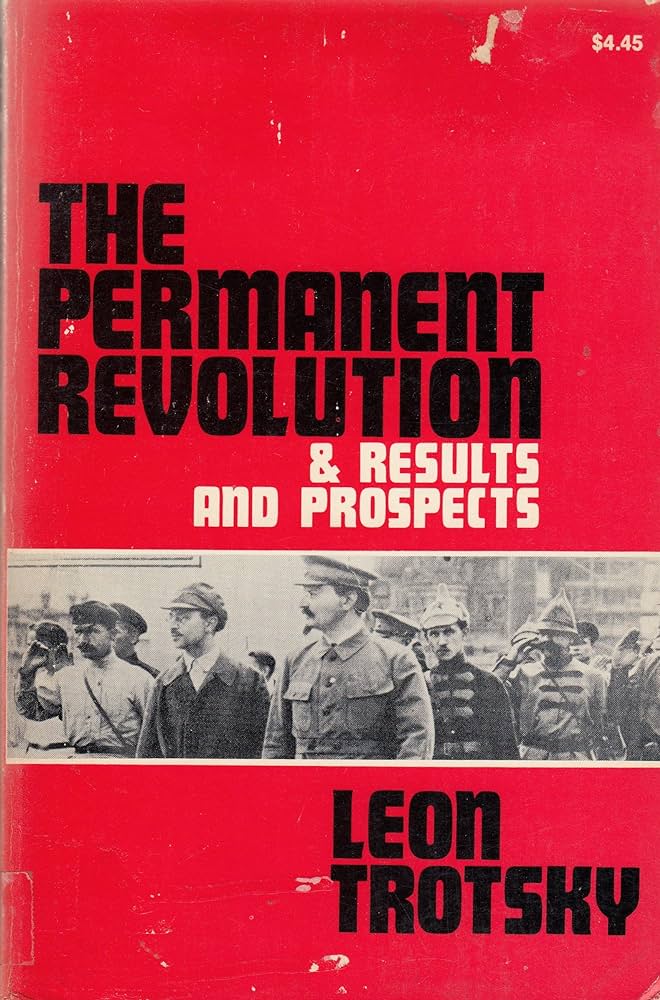
Trotsky, in his booklet The Permanent Revolution, set out a number of its ‘Basic Postulates’.  These include the following:

‘2. With regard to countries with a belated bourgeois development, especially the colonial and semi-colonial countries, the theory of the permanent revolution signifies that the complete and genuine solution of their tasks of achieving democracy and national emancipation is conceivable only through the dictatorship of the proletariat as the leader of the subjugated nation, above all of its peasant masses.’

‘3. Not only the agrarian, but also the national question assigns to the peasantry – the overwhelming majority of the population in backward countries – an exceptional place in the democratic revolution. Without an alliance of the proletariat with the peasantry the tasks of the democratic revolution cannot be solved, nor even seriously posed. But the alliance of these two classes can be realized in no other way than through an irreconcilable struggle against the influence of the national-liberal bourgeoisie.’

‘4. No matter what the first episodic stages of the revolution may be in the individual countries, the realization of the revolutionary alliance between the proletariat and the peasantry is conceivable only under the political leadership of the proletariat vanguard, organized in the Communist Party. This in turn means that the victory of the democratic revolution is conceivable only through the dictatorship of the proletariat which bases itself upon the alliance with the peasantry and solves first of all the tasks of the democratic revolution.’

‘8. The dictatorship of the proletariat which has risen to power as the leader of the democratic revolution is inevitably and very quickly confronted with tasks, the fulfilment of which is bound up with deep inroads into the rights of bourgeois property. The democratic revolution grows over directly into the socialist revolution and thereby becomes a permanent revolution.’

‘9. The conquest of power by the proletariat does not complete the revolution, but only opens it. Socialist construction is conceivable only on the foundation of the class struggle, on a national and international scale.’

‘10. The completion of the socialist revolution within national limits is unthinkable . . . The socialist revolution begins on the national arena, it unfolds on the international arena, and is completed on the world arena . . .’

‘11. The above-outlined sketch of the development of the world revolution eliminates the question of countries that are ‘mature’ or ‘immature’ for socialism in the spirit of that pedantic, lifeless classification given by the present programme of the Comintern. Insofar as capitalism has created a world market, a world division of labour and world productive forces, it has also prepared world economy as a whole for socialist transformation.’

‘13. The theory of Stalin and Bukharin, running counter to the entire experience of the Russian revolution, not only sets up the democratic revolution mechanically in contrast to the socialist revolution, but also makes a breach between the national revolution and the international revolution.’

        *         *          *

The number of ‘countries with a belated bourgeois development, especially the colonial and semi-colonial countries’ has decreased dramatically in the last one hundred years, most obviously with the massive growth of the working class, relative decline of the peasanty and the disappearance of most colonies.  Many of the semi-colonies are now important capitalist states, including those in the expanding BRICS collaboration.

It might therefore be considered that the theory of the permanent revolution, which ‘signifies that the complete and genuine solution of their tasks of achieving democracy and national emancipation is conceivable only through the dictatorship of the proletariat as the leader of the subjugated nation, above all of its peasant masses’ is of limited relevance today.

After all, how true is it that ‘the agrarian, but also the national question assigns to the peasantry – the overwhelming majority of the population in backward countries – an exceptional place in the democratic revolution’? Does this no longer apply in many countries?  We no longer consider that the question is one of democratic revolution but of socialist revolution in countries with widespread industrialisation and a large working class.  Even when Trotsky set out the basic ideas of Permanent Revolution, he was stating that his ‘sketch of the development of the world revolution eliminates the question of countries that are ‘mature’ or ‘immature’ for socialism.’

He went further to say, in the Transitional Programme in 1938 that ‘the economic prerequisite for the proletarian revolution has already in general achieved the highest point of fruition that can be reached under capitalism . . . All talk to the effect that historical conditions have not yet “ripened” for socialism is the product of ignorance or conscious deception . . . The objective prerequisites for the proletarian revolution have not only “ripened”; they have begun to get somewhat rotten . . .  The turn is now to the proletariat, i.e., chiefly to its revolutionary vanguard. The historical crisis of mankind is reduced to the crisis of the revolutionary leadership.’

Many who claim to be Trotskyist accept that the theory of Permanent Revolution applies today and also continue to argue that humanity’s crisis ‘is reduced to the crisis of the revolutionary leadership.’

We have seen, however, that despite this, many – if not most – agree to the theory but abandon it in practice.  They avoid cognitive dissonance by employing a different set of assumptions that enable the adoption of a different set of outwardly Marxist formulas to the actual struggles that arise and which previously would have been considered to come under the purview of the permanent revolution strategy.  Let’s take a look at Ukraine and Palestine.

In Ukraine, the supporters of that state who demand self-determination for Ukraine must presumably believe that the national question is key, and that therefore that the ‘democratic revolution’ is on the agenda, even if this no longer requires an alliance with the peasantry. But if this is so, where is the fight for the view that ‘the complete and genuine solution of their tasks of achieving democracy and national emancipation is conceivable only through the dictatorship of the proletariat?’  Why is support given to a bourgeois political regime and capitalist state when what is required is an ‘irreconcilable struggle against the influence of the national-liberal bourgeoisie’, with the need for ‘the political leadership of the proletariat vanguard, organised in the Communist Party?’

When have the supporters of ‘Ukraine’ ever put forward this argument to Ukrainian workers or those in their own country?  When has permanent revolution even been mentioned? Why do they defend the intervention of Western imperialism when ‘the democratic revolution grows over directly into the socialist revolution and thereby becomes a permanent revolution?’  How could Western imperialism fail to be a barrier to such an outcome? Why then do they support it?

The only political explanation is that they do not believe that permanent revolution is relevant, which means that socialism is not relevant and socialist revolution inconceivable and not in any way be a guide to longer term strategy. However, if this is so, the theory of permanent revolution states that there can’t be a democratic revolution either. They can’t believe the statement that in ‘the colonial and semi-colonial countries, the theory of the permanent revolution signifies that the complete and genuine solution of their tasks of achieving democracy and national emancipation is conceivable only through the dictatorship of the proletariat as the leader of the subjugated nation.’

They therefore cannot believe that ‘the objective prerequisites for the proletarian revolution have not only “ripened”; they have begun to get somewhat rotten . . .  The turn is now to the proletariat, i.e., chiefly to its revolutionary vanguard. The historical crisis of mankind is reduced to the crisis of the revolutionary leadership.’  If the problem was simply one of revolutionary leadership, why wouldn’t they be offering revolutionary politics?

In so far as the supporters of the Russian invasion advance the same arguments in relation to the democratic tasks supposedly devolving to the Putin regime and Russian state, purportedly justified by the rights of the Donetsk and Luhansk People’s  Republics, the same questions are posed to them!

If we turn our attention to Palestine, which is a question of (settler) colonialism, the genocide of the Palestinian people and the role of Western imperialism demonstrate that a revolution is required for their liberation.  Why is Western imperialism not their saviour as it is claimed it is for the ‘people of Ukraine’?  Why do the bourgeois Arab states not perform the same revolutionary democratic role played by the Ukrainian one?  Again, where are the arguments above advanced that this liberation can only come through permanent revolution?  A struggle that needs to be fought by the working class, under socialist leadership, ‘on the foundation of the class struggle, on a national and international scale’?

Instead, the debate revolves around a one state or two state solution, with neither having any particular class content, which, in effect, means that they are both proposals for a capitalist state and with no indication that a wider socialist revolution is necessary, in the Arab region or wider afield.

How are we to make sense of this à la carte Trotskyism – ‘God make me a Communist, but not just yet’?

Back to part 2

Forward to part 4

Permanent Revolution (2) – beginning with Marx

The theory of Permanent Revolution is associated with Leon Trotsky, although Marx is well known to have originated the term in his Address of the Central Committee to the Communist League in March 1850.  In this address he proclaimed that for German workers ‘their battle-cry must be: The Permanent Revolution.’

Marx called for this revolutionary strategy even though he noted that the situation was one in which ‘the German workers cannot come to power and achieve the realization of their class interests without passing through a protracted revolutionary development.’  They were to be comforted by the knowledge that ‘this time they can at least be certain that the first act of the approaching revolutionary drama will coincide with the direct victory of their own class in France and will thereby be accelerated.’

Their task was not one of immediate revolt but ‘must contribute most to their final victory, by informing themselves of their own class interests, by taking up their independent political position as soon as possible, by not allowing themselves to be misled by the hypocritical phrases of the democratic petty bourgeoisie into doubting for one minute the necessity of an independently organised party of the proletariat.’

Today, we are not in a situation in which the German or any other section of the working class is going to come to power, and ‘a protracted revolutionary development’ is required.  This is not admitted by many calling themselves Marxist but is imposed on them anyway.  The price paid is that they can’t consciously adjust their theoretical or strategic framework to adapt appropriately.

Today, we are again called upon to support ‘democracy’: for a ‘democratic’ Ukraine against autocratic Russia and to ‘defend the right of self-defence’ of the ‘only democracy in the Middle East’. The protests by students in US universities against the genocide carried out by this democracy is said by Antony Blinken to be a ‘hallmark of our democracy’ just as the students are attacked and locked up.  The ‘hypocritical phrases’ of the democratic bourgeoisie and petty bourgeoisie are thus louder now than they were when Marx called for their rejection 175 years ago, making his remarks as apposite now as they were then.

Unfortunately, much of the left has forgotten what it means to inform workers ‘of their own class interests, by taking up their independent political position as soon as possible’ and ‘by not allowing themselves to be misled by the hypocritical phrases’ of democracy.  Calls for national self-determination of Ukraine or Donbass simply become the hypocritical phrases by which to justify rallying behind Ukraine, because it is a ‘democratic’ capitalist state, or behind Russia, because it is fighting Western imperialism.

The capitalist character of both is rendered irrelevant by talking about ‘Ukraine’ or ‘Russia’ or the ‘people of Ukraine’ etc. while ignoring the need for the working class to ‘achieve the realisation’ of its ‘own class interests’ by ‘taking up their independent political position as soon as possible.’

On one side the Ukrainian capitalist state and Western imperialism are supported as defenders of these interests and on the other the Russian capitalist state is supposed to play the same role.  Neither can point to any independent role for the working class itself or even the existence of its own organisations that are not totally subordinated to, or in support of, their respective states.  In doing so it almost becomes superfluous to accuse them of abandoning Marxism.

The cognitive dissonance involved in defending a corrupt capitalist state, defending the massive intervention of western imperialism, and a war that continues only because of this intervention, can be seen in three defence mechanisms often employed to avoid accepting the patent contradictions: avoiding, delegitimising and belittling.

So, we get the avoidance of the implications of the points just raised and the commitment to a more straightforward campaign in support of the Palestinian people.  The arguments against support for the Ukrainian state are delegitimised by aping the propaganda of the mainstream media for whom opposition to Western imperialism and its proxy war can only equate to support for Russia.  Since this Left starts from opposition to the Russian invasion, its inability not to default immediately to support for Ukraine and the West reveals the utter irrelevance of any declared adherence to socialist politics separate and opposed to both.

Finally, the cognitive dissonance is limited through the importance of the war also being strictly circumscribed.  So, opposition to Russia becomes opposition to Russian imperialism while support for Western imperialist intervention is dismissed as the latter doing the right thing for its own reasons – without this having any significance for what it is actually doing.  The existence of a proxy war that defines a global conflict is also rendered irrelevant by the primary and over-riding issue being argued as the right to self-determination – of an independent capitalist state that had already determined its own future by allying with Western imperialism against its rival next door: not a very clever thing to do and a very reckless one for the interests of the Ukrainian working class.  The obvious danger of escalation of the conflict to a world war is also minimised but is implicit in the absolute priority given to the victory of the Ukrainian state and thereby, necessarily, of Western imperialism.

To claim that the invasion should not have taken place and is wrong.  That it should be opposed and the invaders blamed for the actions they have carried out, and for which they are responsible, is all very well but hardly constitutes an understanding of why it happened, what should be done about it, and by whom.  If you are a socialist, this socialism should have some role in answering these questions.  As has been stated many times on this blog, if you find yourself coming up with the same explanations and same policy as Western imperialism you need to deal with a lot of dissonance.  How could you start from a socialist position and end up with a policy indistinguishable in all essential and practical respects from Western imperialism? 

It is therefore relevant to look again at the ideas involved in permanent revolution to see how these should guide a socialist view of the current conflicts. 

Back tom part 1

Forward to part 3

The war in Ukraine (14) – for a democratic Ukraine?

The Irish TD Paul Murphy describes Ukraine as ‘a capitalist democracy’ while the Fourth International (FI) declares that ‘Ukraine is an independent country which has preserved a regime of formal democracy. Russia has an authoritarian, repressive parliamentary system with far-right members in the Duma.’

We will ignore the significant role of fascism in Ukraine for the moment, covered up by the western media and whitewashed by the pro-war Left, while we have already noted the similarity of the political regimes in both countries.  Most importantly, we will postpone further consideration of the claimed imperative for socialists to rally to the defence of ‘democratic’ capitalist states in war, except to note that this blog is written from the north of Ireland, a part of the territory of the United Kingdom, widely regarded, and not inaccurately, as one of the premier bourgeois democracies.

During my lifetime this ‘democratic’ state has imprisoned hundreds of suspected political opponents without trial for several years while torturing a number of them.  Its armed forces have opened fire and murdered 14 peaceful civil rights demonstrators and organised right wing terrorist groups to kill political opponents, the families of political opponents and random members of the communities within which they lived.  Leon Trotsky warned against support for ‘democratic’ capitalist sates in war against their enemies as they can easily put on another mask, and it’s one reason socialists determine their position in capitalist wars not on democratic forms but on the essential class nature of the state.

Ukraine is supported by the UK, which places itself to the vanguard of supplying weapons to Ukraine.  This should immediately have rung alarm bells among British socialists that the state they sometimes claim to oppose is such a prominent supporter of the Ukrainian cause.  Britain has taken part in 83 military interventions around the world since 1945, including Kenya, Malaya, Egypt, Iraq and Libya etc. etc. According to a study reported by the New York Times on 17 February 2018, the US government ran 81 ‘overt and covert election influence operations’ in foreign countries from 1946 to 2000’ while Soviet and post-Soviet Russia ran 36 during this time.  Does the pro-Ukraine left really believe that the intervention of the UK and US in Ukraine is uniquely progressive because the Russian is uniquely reactionary?

Russia is dammed for its authoritarian regime and its brutal aggression.  But who introduced the singularly powerful Presidential system into Russia in the first place and who did not object to its first incumbent shelling the Russian parliament in October 1993 as that parliament was dissolved?  It was Boris Yeltsin that arrogated power to the President and who the United States supported in help rig subsequent elections in 1996, as we have noted before.  Russian brutal aggression in Chechnya in 1994-96 was ignored when carried out by Yeltsin, with the US supporting his re-election while the war continued.

So much for the democratic credentials of Western imperialist powers and their opposition to Russian authoritarianism and aggression!  The pro-Ukraine left attempt to separate their support for Ukraine from the Western imperialist intervention, but we have already noted the identity of their political justifications.  This Left not only explicitly refuses to oppose Western imperialist intervention, so cannot even disassociate itself from their own ruling classes hypocritically, but actually supports its armed intervention. The well-known history of western imperialism is simply ignored and given no significance, and many of the posts in this series have pointed out how preposterous this is.  But what of Ukraine itself?

Over a number of posts we have pointed to the corruption of political life in Ukraine, both at the level of the centralised state and the daily corruption faced by many of its citizens, reflected in a number of indices of the low level of (bourgeois) democracy published by Western sources.  There is no justification for the view that any of this warrants defence or support for the Ukrainian state or all the apologetics for it that the pro-war left has indulged in, even were the fundamental capitalist character of the state to be wrongly ignored.

This does not mean that the political systems in Ukraine and Russia are exactly the same, although war has made both more repressive.  The state in Russia has stood over its various oligarchs, protecting its ill-gotten gains in general, while in Ukraine the various oligarchs have competed for ‘ownership’ of the state machinery so that they can protect and expand their particular interests.  While the latter has appeared to lead to more political competition, with the outward signs of bourgeois democracy as practised in western Europe, this competition has been determined by oligarchic factions and by the growing political division between those looking west and those looking towards Russia.

The eruption of mass protests in Ukraine, particularly the Orange ‘revolution’ in 2004 and Euromaidan in 2014, have been hailed as demonstrating widespread political participation and imposition of popular sovereignty in a way that the less frequent or significant events in Russia, such as the protests against electoral malpractice between 2011 and 2013, have not.  This has been accentuated by regular electoral reversals to the incumbent President in Ukraine as opposed to the long reign of Vladimir Putin.

In fact, these developments are illustrations of the weakness and limits of popular mobilisation and the continuing power of the oligarchs throughout all these upheavals. It is they who have alternated in office, often sponsored protests and benefited from them, and who have, for example, created their own private armies to make up for the weakness of the Ukrainian state in defending their interests.  The western media is full of forecasts that the strengthening of the Ukrainian state in the war will lead to the impartial rule of law and reduction of corruption, but the incorporation of fascist units into the armed forces and the continuation of corruption in the middle of war give the lie to their rosy predictions.

So, the ‘Orange revolution’ in 2004 against corruption led to a new even more corrupt regime while the liberal support for democracy and the EU in the Maidan protests in 2013-2014 led to another oligarchic government, even containing some fascists, with Its Prime minister hand-picked by the United States. This governmnet brought the country closer to NATO despite the opposition of many ordinary Ukrainians, so that the end result was the unconstitutional overthrow of one rotten government and replacement by another that quickly became even more unpopular than the one it replaced.

In other words, the Ukrainian state and the political regimes that have presided over it have not been expressions of the popular will, with the current regime walking the country into a war having been elected to deliver peace.  The country is now irretrievably divided, yet the only response from the Zelensky regime is further anti-Russian nationalism that signals the determination to deepen the division.  Much of the pro-Ukrainian left has endorsed this with the camouflage of ‘decolonisation’, as if ethno-nationalism is something progressive, demonstrating that when the rot sets in it spreads.

Time after time the Ukrainian people voted and protested against the corruption of their state and the direction it has taken society only for these to continue under a new form and new regime. By 2019 a Gallup poll had recorded that just 9 per cent of the citizens of the country had confidence in governmental agencies, the lowest level of trust in the world. Yet this is the state that, with help from a Russian invasion, workers in Ukraine are compelled to fight for while the pro-war left in the West supports its arming to the teeth by Western imperialism. The old and disreputable lie that war will purify the country is peddled again by the bourgeoise and imperialism and once again wide sections of the Left have swallowed it whole.

In Ukraine virulent nationalism has been mobilised to cover up for the repeated failure of successive regimes to deliver on their promises, with war always the most extreme way of achieving this and often successful, at least in the short term.  The ignorant misuse of the policy of self-determination of nations argued by Lenin has been brandished by some of the western left so that it effectively joins in the defence of this rotten nationalism and the capitalist state it vindicates.

Some supporters of the British section of this movement have recently taken to boasting of their success in uniting disparate forces on the left in support of this policy but they are really far too modest, for their alliance stretches way beyond the ranks of small left groups and left social democrats. It includes the whole Starmer Labour Party, prominent ex-left supporters of NATO such as Paul Mason, and more importantly–all the western capitalist states and their bourgeois political leaderships.  For the purposes of any alternative to these capitalist states and these leaderships they are worse than useless. The rot will kill.

Back to part 13

Forward to part 15

The war in Ukraine (13) – the unity for democracy

Extraordinary Summit of NATO Heads of State and Government held in Brussels, Belgium on March 24, 2022. (Photo by NATO Pool/Anadolu Agency via Getty Images)

In the previous post we repeated an earlier review of two of the many indices of democracy in the world and the ranking of Russia and Ukraine.  These indices are, of course, ideological constructs that compare the real world with a bourgeois ideal that excludes what Marxists consider real human freedom. For these bourgeois indices freedom includes ‘economic freedom’, which Marx described as the freedom to exploit.  The freedom to own capital is also the freedom to exclude ownership to the vast majority, which without their own capital have to work for those that do, and without which those that do have capital would be able to do nothing with it.  A society in which the working class collectively owns and controls the means of production and has ended private capitalist ownership does not exist but would be one that would really be on the road to freedom.

There is therefore no point to a Marxist index that reported that in no country does the mass of the people, especially the working class, control its own destiny and impose its own will through its economic and social power, with whatever state organisation is still required to defend its collective ownership of the productive powers of society.  The left supporters of Ukraine however claim that there is something qualitatively different to ‘democracy’ in Ukraine in comparison to ‘authoritarianism’ in Russia.  The indices that we have quoted are simply a demonstration that there isn’t.

The point is not only that both are capitalist societies defended by capitalist states, which is the difference that socialists consider determinant, but that there is little difference between them in terms of the functioning of bourgeois democracy.  For socialists such democracy is mainly of value in order for the working class to develop its political consciousness and its organisation more freely.  For the pro-war left this is irrelevant, for while it complains about the attacks on workers’ rights and organisation by the Zelensky regime it nevertheless defends this regime and the state it sits upon. It betrays the cause of the working class at both the level of principle and immediate practice.

Its rationale for this has been argued against repeatedly on this blog, as we have noted the identity of its argument to that of the western capitalist powers, recited endlessly by their state and corporate media.  We see this again with a third index of ‘democracy.’ 

This third index is that of The Economist Intelligence Unit, which reported in its 2021 index that ‘Ukraine’s score declined from 5.81 in 2020 to 5.57 in 2021, taking it further below the threshold of 6.00, above which countries are classified as a “flawed democracy”. Russia’s score, already a lowly 3.31 in 2020, fell further to 3.24 in 2021.’  This meant that Ukraine was 86 out of 167 countries while Russia came in at 124.  The report stated that ‘Ukraine’s score registered the steepest decline among the four east European countries in this category’, (Hybrid regimes in Eastern Europe), and ‘declined in part as a result of increased tensions with Russia. Government functioning under a direct military threat usually restricts democratic processes in favour of the centralisation of power in the hands of the executive and the security or military apparatus with the aim of guaranteeing public safety. In Ukraine, the military played a more prominent role in 2021 and exerted more influence over political decision-making; government policy also became less transparent.’ In the 2022 report Ukraine has dropped only one place to 87 out of 167 countries while Russia falls to 146 place from 124.

’The Economist’ is a virulently opinionated ‘newspaper’ that champions capitalism and Western imperialist ‘values’ so its rationale for its open support for Ukraine is striking for its more or less perfect alignment with the justification of support for Ukraine by the pro-war left.  One is almost tempted to say that one of them hasn’t quite understood what is going on, but it is too easy to identity the mistaken party.

’The Economist’ reports that ‘Ukraine’s score in the 2022 Democracy Index declines compared with 2021, from 5.57 to 5.42. . . . Despite the overall decline in Ukraine’s Democracy Index score in 2022, there were also many positive developments, not least in the way in which the war has given rise to a sense of nationhood and national solidarity. Ukraine’s resistance to the Russian invasion is a demonstration of how ordinary people are prepared to fight to defend the principles of national sovereignty and self-determination.’  

It goes on to say that ‘Russia’s invasion led to a strong “rally-around-the-flag” effect, after which trust in the country’s president, government and armed forces surged to all-time highs. Citizens’ engagement with politics and the news also increased. In response to the invasion, the Ukrainian government imposed martial law, which curtailed freedom of movement and placed sweeping emergency powers in the hands of the president, Volodymyr Zelenskyi. Checks and balances on Mr Zelenskyi’s authority were effectively suspended as normal political processes assumed a lower priority in the face of an existential external threat. The banning of pro-Russian political parties, such as Opposition Platform—For Life, as well as media outlets reporting pro-Russian views, is understandable in the context of the invasion and amid Ukraine’s attempts to consolidate and defend its national identity.’

‘However, in fighting a war that is widely understood to be existential, Ukraine’s leaders have sometimes curtailed the rights and freedoms of citizens, political parties and the media. Much of this is par for the course in wartime, but such extraordinary measures have inevitably resulted in downgrades in various indicators in the Democracy Index.’

‘The Economist’ index thus reports the continuing reduction in democracy with more sorrow than anger and reduces its impact on Ukraine’s overall score by increasing the score of the sub-category of ‘political participation’, which is not actually independent popular action but, as it says, a “rally-around-the-flag” mobilisation that subordinates the Ukrainian working class to its state.  That much of this has been voluntary simply emphasises the subservience.  It is no accident that this ‘political participation’ has been enthusiastically supported by the pro-war left as an example of working class mobilisation, another indication that it cannot distinguish between the power of the Ukrainian state and the power of the Ukrainian working class.

On one thing the magazine may appear obviously correct: ‘Every so often in history something happens that requires people to take sides as a matter of principle. In 2022 Russia’s invasion of Ukraine posed such a choice.’  The pro-war left has demonstrated that it agrees that it must ‘take sides’.

Boffy has ridiculed this idea, as if we must accept one of the alternatives presented by capitalism and the competition between its rival states; but the pro-war left has accepted this choice and in doing so has accepted the principles advanced by one of the alternatives, in its case the policy of the Western capitalist powers.  So, just like this pro-war left, ‘The Economist’ champions the centrality of ‘self-determination’, ironically also asserted by Russia and China in their own singing of the praises of national sovereignty: ‘Sovereignty and democracy are indivisible. Ukraine’s fight to defend its sovereignty has drawn attention to the importance of a principle that has been much denigrated . . .’

It then goes on to note, with total lack of self-awareness, that ‘Ukraine’s elections were marred by substantial irregularities that prevented them from being free and fair. There were serious constitutional flaws, with power being concentrated in the presidency rather than the legislature. The judiciary was far from being independent. Corruption was rife under a system dominated by oligarchs, who exercised huge influence over the main institutions of power. There was a pluralist media, but many outlets were owned by wealthy businessmen or controlled by vested interests. Public trust in government, political parties and the electoral process was very low.’

This however is blamed mainly on the influence of Russia, with the wishful thinking claim that the war ‘may have provided the shock that will ensure no return to the status quo ante in Ukraine. Russia’s war of aggression has raised the level of national consciousness and will amplify expectations of change afterwards.’

In fact, the opposite has already been the case, with nationalist radicalisation after 2014 being used as cover for the lack of economic and social progress and thorough democratisation.  Instead, national consciousness has amplified the worst parts of Ukraine’s past with its celebration of fascist predecessors who now play the most honoured role in Ukraine’s new nationalist revival.  Just like the pro-war left, this far-right is accorded no importance and the growth of nationalism celebrated.  Ethnic nationalism is endorsed through steps to erase Russian culture and define what is really Ukrainian, given a gloss on the left through stupid or dishonest claims that this is some sort of progressive decolonial project.

The pro-war left has therefore no essential difference with the ideological standard bearer of capitalism when the latter declares its verdict that:

‘Nothing that the Western powers did forced Russia to go to war in Ukraine. Russia had in late 2021 listed its grievances and concerns about NATO expansion, arms control and other matters, and the US’s door remained open for further discussion and diplomacy. The US made clear that it was ready to pursue negotiations with Russia. That Russia went to war in Ukraine is all down to the Kremlin.’

This Left holds this same view because its political conceptions are based on the same vacuous moralistic grounds declared by ‘The Economist’, which can be filled with whatever reactionary content is currently prevalent:

‘Democracy is a moral system as well as a system of government, and it is moral in the sense that it expresses an attitude towards people. The basic moral premise of democracy is the idea that all people are equal. Democracy is made for people, not the people for democracy.  From the idea of the equality of people follows the idea of the equality of nations: the principle of national sovereignty also has a moral dimension and is a bedrock of democracy.’ 

In expressing these political conceptions ‘The Economist’ faithfully grounds itself on the class interests of Western capitalism and can really only be charged with hypocrisy.  On the other hand, in basing itself on the same moral arguments and resulting political positions, the pro-war left betrays the class interests of those it claims to represent.

Back to part 12

Forward to part 14

The war in Ukraine (12) – democracy and authoritarianism?

The war is supported by the Western powers, its media and its pro-war left, and justified as a war of democracy against authoritarianism.  In several Facebook debates I engaged in with this left a version of Godwin’s law kicked in quite quickly as Russia was denounced as fascist, and everyone knows you can’t support fascism.  It appears that the logic is that you must then support Ukraine.  And if it turns out that supporting Ukraine also involves support for their significant fascist armed units, well, these apparently aren’t significant enough to matter.

None of this prevents the supporters of Ukraine also claiming that support for Ukrainian self-determination doesn’t depend on the nature of its regime!  The supporters of Russia take very much the same approach, on the grounds that US imperialism is the main enemy.  The nature of the Putin regime is entirely secondary to their support for a multi-polar world, although that did not really work out very well in the last century; particularly between the years 1914 to 1918 and 1939 to 1945, never mind the numerous smaller wars that have continued over the past number of decades.

Any attempt to present Russia as any sort of democracy, as supporters of Ukraine have pretended with their favourite capitalist state, faces the difficulty that Western propaganda has enough raw material to advance the case that it isn’t.  For a capitalist country Russia is not a very democratic bourgeois democracy; ‘The Economist’ magazine democracy index classifies it as ‘authoritarian’ while Ukraine is classified as a ‘hybrid regime,’ which sits below the categories of ‘democracy’ and ‘flawed democracy’.

One way the lack of democracy reveals itself is at ground level, where it impacts most on the most vulnerable, who became even more economically insecure because of the mass privatisations following the fall of the Soviet Union. This left many people more dependent on local political and economic elites, who were often the same people.  These elites were then able to engage in vote buying and coerced participation in demonstrations in support of favoured candidates etc., achieved through threats to the payment of wages; threats of unemployment; and threats to access to benefits, health and education services and to infrastructure, for example to gas supplies and public transport.

In areas with large facilities such as factories, agricultural enterprises, hospitals and schools and universities, political officials could demand political support from their workers and even relatives, with the open or veiled threat that the factory might close, the hospital staff might lose their jobs, or the school might not get the funds to maintain ageing infrastructure etc.  In one region the intervention of local officials had become so reliable and acute that in 2017 upon the expected visit of such officials on the first day of school the parents formally begged that the visit might happen on the second day.

In rural areas targeting voters has been carried out on a more individualistic basis with what might appear relatively minor figures wielding significant influence, often under pressure themselves, and so on up the tree of vertical command.  In one village, the mayor’s secretary worked on her homestead while also having a second job.  In her secretarial role she had lists of young men eligible for drafting into the army, which many avoided through payment at a widely known price.  This price went up from 200 in 2010 to 1,000 in 2019, although because of currency devaluation there was actually no significant increase.  During the war however the price shot up ten or twelve times the normal level.  During an electoral campaign this power could be put to good use to ensure a high turnout, with the implication that if you didn’t participate “we’ll take your son into the army.”  In small towns and villages, the political operatives would seek to ensure their instructions were followed by demanding that people bring their mobile phones and take a picture of their ballot paper.

These threats to withhold rights and benefits, which should be entitlements but became privileges, could be withheld if votes were not cast as required. Achieving compliance became easier using state resources, including databases of those receiving a pension or other government assistance. State employees were expected to see themselves as working for the current political leadership.  When one chief physician at a district hospital, whose wife was head midwife, was challenged by activists over his wife’s poor record in new-born mortality and his vote buying, he replied “I am not a public servant! I am not a public servant!”

While this is how political corruption operates at the lower level, it could not work so easily on those with some personal independence and therefore not so vulnerable, or with those so poor they might have nothing to lose.  At a higher level, political support has been wrought through increasing nationalism, which conveniently would play the role of diverting attention from the economic and social conditions that facilitated such corrupt political practices in the first place.

These individual stories and description of the general landscape of corruption are taken from a book ‘Staging Democracy, political performance in Ukraine, Russia and beyond’.  The author states that ‘Russia and Ukraine are widely viewed as occupying different places in regime-type taxonomies.  Yet key instruments of explicit political manipulation and control over most people’s everyday lives, if not the frequency of their use, are similar in the two countries.’  The examples quoted are all from Ukraine.

 *                    *                   *

In a previous post I noted the narrow differences in the political complexion of Ukraine and Russia:

‘The right wing US think-tank The CATO Institute has an annual ‘Human Freedom’ index, a combination of separate indices for personal and economic freedom.  Its 2021 report shows that Ukraine is the third worst country out of 22 in Eastern Europe while the Russian Federation is the worst.  Over 165 countries Ukraine is number 98 while Russia is 126.  The freest country at number 1 is Switzerland, which scores 9.11 for human freedom while Ukraine scores 6.86 (75% of the Swiss score) and Russia scores 6.23 (or 68% of the Swiss score).  We are expected to support the war of Ukraine with 75% of the ‘human freedom’ of the freest against Russia with 68%.  The war of 7%. It is relevant to note that while in 2021 Ukraine ranked 98th, it ranked higher at 82nd in 2008, so that relatively it has gotten worse, but so has Russia from 112th to 126th.’

‘The second index is that of ‘Transparency International’ which reports the perceived levels of public sector corruption in 180 countries/territories around the world. It scores these countries out of 100, with the lower the score the more corrupt a country is perceived to be.  The 2021 publication reports that the least corrupt countries included Denmark, Finland and New Zealand, scoring 88 each.  Ukraine is 123rd on the list while Russia is 139th. A better indication of the difference is that Ukraine scores 32 out of 100 while Russia scores 29, meaning that the former scores 36% of Denmark etc. while Russia scores 33%.  Not a pile of difference; 3 to be exact.’

In both countries the degree of political freedom has shrunk even further over the past year, at exactly the same time some from the pro-war Left have invited us to support one or the other capitalist state. While socialists should not do so in peacetime, we have even less reason to do so in war.

Back to part 11

Forward to part 13

The war in Ukraine (8) – Ukraine’s democratic revolution?

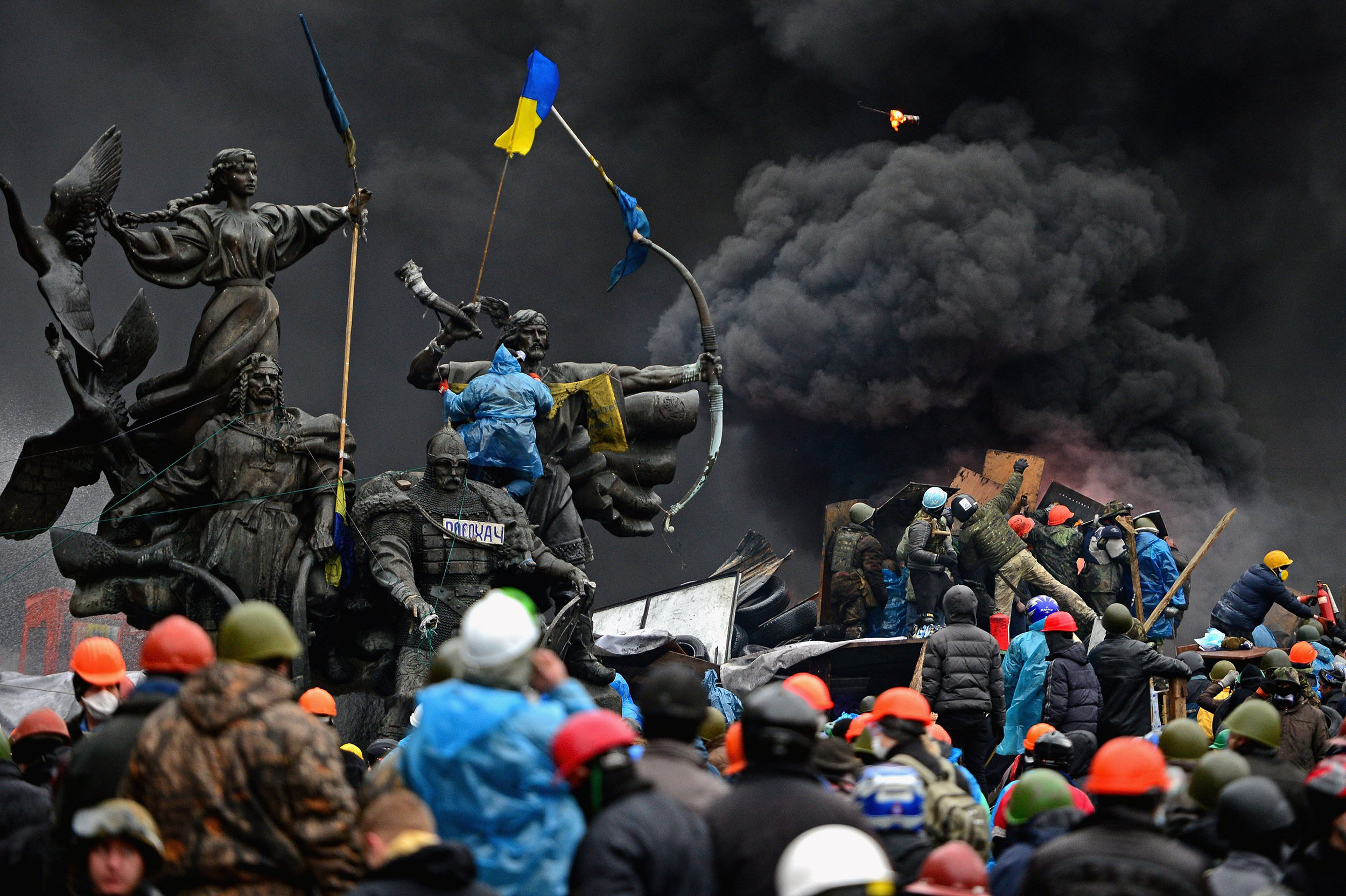
Maidan ‘revolution of dignity’ February 20, 2014 in Kyiv Photo by Jeff J Mitchell/Getty Images)

In explaining the Russian invasion supporters of Ukraine often proclaim the agency of ‘Ukraine’ while remaining silent on its agency in bringing it about. The purpose is to deny the critical role of Western imperialism in creating the war and sustaining it beyond anything purely Ukrainian agency could effect. They do however condemn imperialism, if only their Russian variety to any real purpose.  But what of the more powerful Western variety?  Can it really be claimed that its intervention now is without effect?  Why do they support NATO arms to Ukraine if this is to be without meaningful consequences?

Was its prior intervention–before February 2022–without effect?  How then do they explain the performance of the Ukrainian armed forces during the invasion, and their (mistaken) belief that they will prevail, given their previous quick defeat in 2014 by a much inferior Russian intervention?  Would this not be an indication of the agency of Western imperialism in strengthening these armed forces?  In other words, is not the agency of Ukraine a product not simply of the Ukrainian state itself?  Or does admission of this lead too readily to having to acknowledge the proxy character of the war?

Western intervention, in the shape of the catastrophic introduction of capitalism, similar in impact (if not worse) than that on Russia, was widely condemned by many of those who now support the Ukrainian state.  The role of western imperialist institutions such as the IMF was denounced, yet it is these organisations that are part and parcel of the intervention they now defend.

But it takes two to tango and we have already seen that the Ukrainian state has long actively sought to be a (subordinate) part of the architecture of Western imperialism.  We have also seen that the problem has been to convince the majority of Ukrainians that this is a good idea, the solution to which has ultimately been provocation of a war. 

This has required continuous outside political interventions, especially by the United States, involving investing over $5 billion in ‘Ukrainian democracy’, according to US Assistant Secretary of State Victoria Nuland in 2013.  This included sponsorship of pro-Western NGOs, of which one former Ukrainian government minister boasted the year before that “we now have 150 NGOs in all the major cities . . . The Orange revolution was a miracle . . . We want to do that again and we think we will.” As indeed they did, although it was not a miracle.

The US view of what constituted ‘Ukrainian democracy’ didn’t actually mean exercise of the will of the Ukrainian people, but the imposition of a pro-Western Government with the trappings of what comprises western democracy.  A 2009 Pew research survey found that two thirds of Ukrainians believed life was better under ‘communism’ while only 30 per cent approved of the change to the multi-part system–a sign of majority disenchantment with this ‘Ukrainian democracy’, and living proof of the travesty and deceit that is the reality of democracy in a capitalist state.  This had led to the Orange revolution, which then failed the democratic impulses of many of its supporters, which was to be repeated in the ’revolution of dignity’ in 2014, where Nuland and the NGOs played their allotted roles.

This ‘revolution’, which failed to unite Ukraine’s people precisely because it wasn’t one, became the launchpad for all subsequent events right up until the war today.  Its character is still misunderstood, especially by those on the left who should already know the nature of bourgeois democracy but now wave its flag as the solution–through demanding capitalist state ‘self-determination–to the problems that it itself has caused. The unity of the people of Ukraine could not be achieved under the Maidan ‘revolution of dignity’ banner and one wonders why this left considers itself socialist if the demands of socialism are not to be raised in circumstances where bourgeois democracy has failed.

*       *        *

Following the Maidan ‘revolution’/coup, which precipitated the division of the country, the Government in Kyiv became more involved with, and dependent upon, the West.  This included immediate agreement to the proposed deal with the EU by the Ukrainian politician favoured by the US and effectively put in place by it, as revealed in an infamous leaked discussion.  He did so before any new elections and without seeking to negotiate any of its conditions, which implied drastic consequences for uncompetitive Ukrainian industry, especially in the east of the country. 

Acceptance of a new $40 billion IMF loan entailed massive imposition of austerity, with salaries and pensions cut, state sector employment reduced by 20 per cent, and the healthcare system and 342 state enterprises privatised. State education services were slashed and 60 per cent of universities were closed.  By December 2015 a Gallup poll found only 8 per cent of the population still had confidence in their new government, down from 19 per cent for the previous Government of Yanukovych that had been overthrown by the Maidan ‘revolution’/coup.

For left supporters of the Ukrainian state Maidan was a revolution but it is a strange revolution that enthroned a government favoured by the US and that immediately included prominent fascist figures within its ranks.  It is a strange revolution in which these latter forces were able to intimidate left wing activists in the demonstrations and occupation at the Maidan that comprised it, and it is a strange revolutionary regime which effectively covered up responsibility for the violence that triggered the final collapse of the Yanukovych regime and the subsequent massacre in Odesa.  A strange revolution that put a ‘chocolate’ oligarch in power introducing a regime of austerity; and a strange revolutionary regime that had US Vice President Joe Biden declare that he had spent thousands of hours on the phone with this chocolate oligarch for “longer periods  . . . than with my wife.” All another example of Ukrainian reality defying the wishes of its own people and the apologetics of some on the left.

Only 13 per cent of Maidan protests took place in Kiev, with two-thirds occurring in the western and central regions. It did not have majority support in the southern and eastern regions, which had predominantly voted for the deposed Yanukovych, and the majority in these parts did not support either the EU Agreement or the protests.

The far right were legitimated as heroes of the ‘revolution’ and subsequently in the war, securing top positions within the security apparatus, and establishing armed military units under their control—now downplayed in the West or justified in the name of patriotism by many in Ukraine.  Its slogans of ‘Glory to Ukraine!–Glory to heroes!’, which had become the rallying cry of the Maidan protestors has now become the battle cry of the ‘Ukrainian resistance’ and evokes no aversion or rebuff when reported in western media.  

This doesn’t mean that everyone in Ukraine has become fascist but that their popular nationalism has swallowed its fascists whole.  Among the consequences are the exclusion of more democratic slogans and demands, despite these being the inspiration of many of the protesters, and more obviously exclusion of a fight against the fascists themselves.

One other result demonstrated immediately was that this nationalism could not unite everyone who was Ukrainian but started to define who could not be, a process that has intensified during the war, even as its most enthusiastic supporters are also the most enthusiastic about reunifying the state.

These were the circumstances in which Crimea was taken by Russia, and parts of the Donbas took up arms in imitation of the pro-Maidan insurgency in the west of the country.   This received decisive Russian assistance when it looked to be on the verge of defeat, but Putin did not instigate the rebellion, but rather tried to limit it and then control it, frequently being opposed to its original leaders. Separate republics were not his optimal choice.  

Given the coup/’revolution’ he acted to defend Russian state interests in Crimea and Donbas against an anti-Russian regime that had come to power violently, with the occasion to defend a pro-Russian rebellion in the east presenting both a challenge and an opportunity.  A challenge in relation to his authority inside Russia, and to Russian influence in Ukraine as a whole, which would be weakened by the exclusion of the population in the Donbas.  The opportunity was to address these problems through a peace agreement that would maintain this population inside the Ukrainian state but with a certain autonomy that could provide some guarantee of the population’s separate interests, and also of Russia’s.

This appeared to be achieved by the Minsk agreements but as we noted in the previous post, for western guarantors this was just considered a staging post before the renewal of war by Ukraine to recover its lost territory.  That this could be conceivable existed only because of Ukraine’s deepening relationship with NATO, and especially the United States.  The promise by the new Ukrainian President Poroshenko before his election that he would establish peace was broken within weeks (just as Zelensky was later also to promise peace but lead his country into an even more disastrous war).

Instead, the breakaway regions simply became an anti-terrorist problem to be solved by an Anti-Terrorist Operation, leading to regular attacks on civilians in the region.  The painting of such nationality problems as one of simple terrorism is, of course, a familiar one, usually involving state repression that socialists reject, even when we do not endorse the particular nationalist struggle or its political leadership.  That the Ukrainian state is absolved of such judgements is yet one more indication of the consequences of endorsing its ‘self-determination’.

This self-determination involved the banning of the Communist Party of Ukraine in 2015, despite having 13 per cent of the vote in 2012, as part of a drive to ‘decommunization’ that also included closing Russian media channels and banning Russian books.  As the Ukrainian sociologist Volodymyr Ishchenko has noted; ‘once the government defined what this actually meant polls showed that Ukrainians were not very interested in renaming the streets and cities or banning the Communist Party. At the same time, they were not ready to defend it, because they did not see it as particularly relevant to their politics. They were not however supporters of decommunization either; they were passively against it, though not actively resisting it. . .   Other groups were also targeted by the far right, like feminists, LGBT, Roma people, and the left.’  By 2018–19, when Ishchenko was still in Kiev and involved in organizing leftist media and conference projects, he noted that ‘we were having to operate in a kind of semi-underground manner.’  A strange situation arising, one might think, within a regime issuing from a democratic revolution.

Ishchenko noted that ‘Before the war, Zelensky failed in everything. . . . Zelensky also pushed through a land market reform, which has been a big question since Ukrainian independence and very unpopular; over 70 per cent of Ukrainians were against some of the clauses.  By the start of 2021, Zelensky had lost much of his popularity. The Opposition Platform—a successor to the Party of Regions and the runner-up in 2019—was ahead of the Servant of the People party in some polls.’ 

Zelensky began to impose serious sanctions on the opposition, with Viktor Medvedchuk—one of the leaders of the Opposition Platform party, which was ahead of Zelensky in the polls—a principal target.  The imposition of sanctions, sometimes without any serious evidence against the people they were targeting and taken by a small group, the National Security and Defence Council, was against Ukrainian citizens without a court ruling. They were however welcomed in striking terms by the US Embassy, shortly after Biden’s inauguration in late January 2021. The same Biden who had been in charge of Obama’s ‘project Ukraine’.

Zelensky’s repression included the imposition of sanctions much more widely, against oligarchs, those suspected of organized crime but also against other opposition media. By the start of 2022, his government had blocked most of the main opposition media, including one of Ukraine’s most popular websites, Strana.ua, and the most popular political blogger, Anatoly Shariy, who sought asylum in the EU.

Ishchenko argues that ‘Before the war, the polls were not good for him, and in some he was even losing to Poroshenko . . . the sanctions against Medvedchuk in late January 2021 were followed just a few weeks later by the first signs of Russia’s build-up on the Ukrainian border. Putin was able to take the exclusion of Medvedchuk from Ukrainian politics as a clear message— ‘an absolutely obvious purge of the political field.’’

The loss of Russian political influence in Ukraine was thus one cause of the invasion, which was in turn partly due to the nature of the bourgeois ‘democratic’ regime of the Ukrainian state, ironically accelerated by the Maidan ‘revolution of dignity.’  It was however not the main development within the Ukrainian state that precipitated Russian military action.

Back to part 7

Should socialists support a border poll? 4 – working class unity

It has been noted in an academic study  of the flag dispute that “it has taken a unique political ideology to turn a clear ‘victory’ – a triple lock on the union,a change to the Republic’s constitutional claim, the signing up of Sinn Féin to ‘partitionist’ institutions – into abject insecurity.”

But insecurity in unionism is nothing new, thirty-five years ago a book on Protestant politics was entitled ‘Ulster’s Uncertain Defenders.” Uncertainty and political paranoia are inevitable when sectarian rights are based on proxies (such as bourgeois democracy) that either reject such politics implicitly or threaten to undermine it.  A demand for equality is especially pernicious since it appears reasonable but threatens loss when your claim to sectarian rights is necessarily based on inequality – every issue is zero sum game precisely because supremacy is what is being defended.

The Socialist Party defence of the rights of Protestants is a defence of their rights as Protestants and thus lapses into a defence of sectarian rights.

It leads to seeking justification for the claims of Protestants as a sectarian group, with its own anterior rights, and covering up for its sectarian and reactionary character. So, even when that Party has in the past defended civil rights (by their nature civil rights are not sectarian group rights) the Party claims that such rights were, and still are, not enough, because equality of poverty holds no attraction for Protestant workers.  What good is equality of misery it says?  What is required is a socialist programme.

But whatever justification there is for a socialist programme, which of course I support, and regardless of what this might look like, it cannot be advanced in order to obfuscate the opposition of many Protestant workers to equality per se.  It is not therefore the case that Protestant workers oppose a united Ireland because it may not be socialist. Their pro-imperialist, monarchist and reactionary politics makes the majority averse to socialism in any case.  The possibility that a united Ireland might in some way be socialist is against everything their political heritage defends, and is enough to guarantee the opposition of those who maintain allegiance to any specifically Protestant politics.

How can Protestant workers be won to socialism and the radical equality it promises if they do not accept the equality of Catholic workers in the first place?  Unless they accept the political emancipation of Catholic workers they will be unable to play any positive role in achieving the social liberation of the working class that includes themselves.  To believe that they can fight for the latter while opposing or even being passive to the former is to excuse their prejudice and undermine the possibility and meaning of socialism.  That this is also true of the perspective that Catholic workers must take is simply to state that sectarian division must be ended by mutual recognition by all workers of their equality regardless of religion or nationality.

It is still unfortunately the case that the majority of Protestant workers are attached to reactionary unionist politics, so that it is necessary for socialists to oppose both their unionism and their sectarianism.  There is an alternative political identity that must be fought for and is in their interests as workers, not as Protestant workers.

So, to employ episodes such as unionist opposition to the reduced flying of the union flag outside Belfast City Hall as justification for acceptance of limitations on one’s programme is to leave one defenceless against whatever reactionary veto unionist reaction decides to erect to any progressive change.

Loyalists now claim that it is Protestants that are discriminated against and it is they who are disadvantaged, and there is even some slight evidence of the latter.  The Northern Ireland Labour Force Survey recorded that over the period 1993 to 2017 the proportion of working age economically active Protestants with no qualifications has decreased from 30% to 12% while that of Catholics decreased from 32% to 11%, so Catholics were in a slightly better position.

It is a repeated complaint of loyalists that working-class Protestants, especially the young, are educationally disadvantaged.  In the same academic study referenced above the authors record interviews with loyalists and others that “the importance of education was stressed, but education with a very particular purpose, as a community project leader explained: We’ve got the programme there and it’s empowerment through education … once you teach them about their own identity then they understand what’s going on around them, cos I would say 100 per cent of our kids haven’t a clue about where they came from. “

“In the interviews we conducted the issue of Protestant/Catholic reconciliation did not arise unless raised by us [i.e. the academics]. It simply was not on any interviewee’s immediate agenda.”

“For those, within the PUL [Protestant/Unionist/Loyalist] community trying to re-build after the ruptures that opened up during the protest the key category is cohesion, not reconciliation. There was seen to be a strong imperative to build unionist unity, and to imbue young people with a deeper awareness of their unionist identity.”

The authors quote another academic study dealing with a small Derry town, which finds that loyalists “see no purpose in conflict transformation as their cultural identity is built on a glorification of sectarian conflict, and they reject democratic politics as ‘it did not stop the flag from being ripped down.’“

Yet another study based on North Belfast finds that even the Protestant church representatives did not talk about reaching out across the sectarian divide, but rather about: “The need to create a new confidence and a new identity around loyalism, one that was not demonised, and one that people could easily understand what it represented.”

As one flag protestor said: “They talk about a shared future. I don’t think the Protestant community is ready for a shared future.”

In other words, these loyalists want to see reinforcement of their sectarian identity. Why would socialists, as the Socialist Party does, erect such views as the limit to a democratic and socialist programme?  The Party ends up deferring to those most bitterly opposed to workers’ unity on the grounds of supporting it.

Of course, not all Protestant workers are sectarian and for such workers it is reactionary to seek to win them to socialism by offering to accommodate a sectarian identity they either don’t have or can be more easily broken from.  But many are sectarian, to varying degrees, and it is only blind political correctness that prevents acknowledging the obvious.  Socialists will get nowhere by pretending it doesn’t exist, or that it is marginal, or in some sense justified, or must be deferred to in some way.  They will get totally lost if they hand over a veto to the most sectarian voices just because they advance protests and politics with which many other Protestant workers have sympathy.

None of this means we do not advance a non-sectarian and anti-sectarian programme, and a socialist programme.  We must do so, obviously because we are socialists and socialism is our goal – a society governed by the workers themselves.  But we must be clear what it means.

Socialism is just the rule of the working class, as a whole, not a part of it.  To say that socialism is the answer to the division of the working class is just to say that working class unity is the answer to working class division.  To claim that a working class party is necessary to unite the working class is to say that the party created by the working class should unite the working class.

Escape into such truisms arises because real answers beyond such abstractions do not present themselves as obvious solutions, but as political programmes that offer particular courses of struggle.  James Connolly is famously noted for having denounced partition, but to end it means going beyond what he said –

“. . . the betrayal of the national democracy of Industrial Ulster, would mean a carnival of reaction both North and South, would set back the wheels of progress, would destroy the oncoming unity of the Irish labour movement and paralyse all advanced movements while it lasted.”

A role for those dedicated to the interests of the working class must mean that we are not paralysed.

Back to part 3

Forward to part 5