Why have the Irish not revolted?

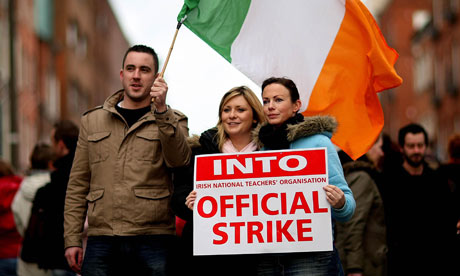
Public-service-workers-st-006The defeat of the opposition to the property tax and the ability of the Government to impose a second Croke Park austerity deal might lead many to conclude that resistance to austerity has been defeated.  Even before this many have commented that while Greece has witnessed violent protests and numerous general strikes the absence of such events from Ireland is notable and remarkable.  General strikes have also taken place in Spain and Portugal but not in the Irish State.

The relative electoral success of the United Left Alliance appeared to blind some to this but the collapse of the ULA has simply confirmed what is more generally understood to be the case.  More and more it is acknowledged on the Left that we have to face the reality as opposed to perennial false claims that an upsurge is taking place or is just around the corner.

Realistic assessments of the state of workers’ action have often been drowned out by childish claims that this shows one is insufficiently revolutionary, underestimates the workers , their ability to change their ideas quickly or that such views will not encourage workers to take action.  Not in front of the children appears to be the motto.  Workers are always ‘angry’ and all it needs is the right campaign, so long as it is active enough, to stir them into action.

Reality is imposing itself and no sound bites along the lines of ‘the darkest hour is just before dawn’ can hide the fact that the economic crisis has resulted in the imposition of austerity on workers without effective resistance.  Why is this?

First we must qualify the judgement that Irish workers are peculiarly useless.  Commentators have remarked in similar terms about the countries in southern Europe.  We have noted before that more or less spontaneous social explosions have not resulted in great advances by the working class.  Greek workers have been by far the most combative in terms of general strike action but in hardly anywhere has living standards plummeted so much.  I have also noted in one of my first posts that economic crises spurs growth in extreme reactionary forces and we have seen this is in Greece with the rise of the Golden Dawn movement.  So Greece is no model to seek to copy.

Secondly Irish workers have fought back albeit within very strict limits.  I can still remember the very large demonstration in November 2009 in Dublin, which had many working class people from outside the ranks of the trade unions taking part.  The following year public sector trade unions organised a successful strike.  At a local level in certain places and at certain times strong campaigns have developed against tax increases or hospital closures.  All this and more was reflected in the vote for ULA.

There is however an over-estimation about what workers can achieve within the limits of the capitalist system – a general misconception that workers’ struggles can overturn the laws of capitalism.    For example, if a company goes bust and attempts to close down, making all its workers redundant, it is pretty obvious that strike action will not achieve very much.

At this point many on the left propose that the capitalist state protect workers even though these same people have a part of their brain that tells them that the state is a weapon of the capitalist class that cannot be reformed and must be smashed.  They also believe that the emancipation of the working class must be achieved by workers themselves but usually object to the idea that, instead of the state, the workers should take over and own and run these workplaces as workers cooperatives.

It is a similar situation at the level of society as a whole and at an international level.  The Irish state was and still is bankrupt.  It needed a massive injection of money to save the banks and put itself in a position to start reducing its mushrooming debt.  Austerity is a means of doing this.  Again the Left argues that the state can adopt policies of taxing the rich and spending money on investment that will restore the capitalist economy to economic growth, which will then deal with the problem of the debt.

This is not however the view of socialists.  The socialist view, confirmed once again by recent events, is that capitalism inescapably produces economic crises which are dealt with and resolved by the laws by which the system works, including through unemployment and destruction of unsuccessful capital whose markets and sometimes businesses are picked up on the cheap by those remaining.  It is not possible for the capitalist system to prevent such crises by adopting policies of more investment, as for example argued by left followers of Keynes.

It is not therefore possible for workers no matter how well organised to prevent the laws of capitalism from working.  This at least was the view of Marx and the evidence of history would again confirm this.  So workers resistance against austerity may be able to ameliorate austerity but, in so far as they are necessary to lay the foundations of a new upturn, it is not possible for workers to prevent unemployment or wage cuts or tax increases in their entirety or even to a significant degree.  In other words it is not possible within the system to prevent capitalism periodically disrupting workers’ lives.  That’s why we oppose the system and why we propose a different one called socialism.  If we thought capitalism could work better without its nasty effects we wouldn’t be socialists would we?

Yet the left presents austerity as simply one policy option of the Government which it could choose to reject and replace with their own proposals.  But even the Keynesian alternative requires ‘counter cyclical’ state action.  In other words the austerity measures are simply postponed.  All the left’s proposals involve actions by the capitalist state in one way or another – tax changes, public investment, nationalisation etc.

The point in terms of the current argument is not that the Left is misleading workers into accepting reformist solutions that won’t work and this is a reason why resistance to austerity has been such a failure in Ireland.  These ideas are more widespread in southern Europe than they are here.  No, the issue is that, absent a socialist alternative being created, as long as capitalism exists the laws of capitalism will continue to work and impose themselves.  Resistance to austerity will therefore fail and this failure is bound in turn to lead to weakening of the resistance.

We must be careful however not to qualify the problem out of existence when it contains more than a grain of truth.  When Greek workers chanted “we are not Irish” on their May Day demonstration in Athens in 2010 they weren’t imagining the relative weakness of resistance in Ireland.

Nor can the question be dismissed by saying Irish workers did fight back – they did, but nowhere near to the extent required for success.

Nor is it credible to blame the poor politics or organisation of the Irish Left.

It is also not adequate to simply say that capitalism wins unless we create socialism. This is obviously true, although its logical implications for reformist strategies and policies are often ignored.  But it doesn’t come near explaining why the reformist strategies for resistance have elicited such weak workers’ action.  It’s hardly that Irish workers can see through such strategies and are ready for something more radical.

Socialism is not an event or a situation but a movement. Workers will only become capable of building a socialist movement and carrying out revolutionary change if they are also capable of mounting strong resistance to the ravages of capitalism.  In Ireland this hasn’t happened and there has been a retrogression of the small socialist movement, although this in itself is not particularly new.

So in Ireland the state has been able to pursue austerity policies that increase unemployment and wage restraint in order to restore its solvency in very much the same way capitalist crises work to   restore profitability in the private sector.  It has been able to do so without much of the resistance shown in other countries in a very similar situation.  This remains to be explained.

To be continued.

Anglo-Irish bank tapes – a rotten bank in a rotten State

swf+Anglo-Irish-BankRevelations by the ‘Irish Independent’ newspaper of taped telephone conversations between two senior Executives in the recently deceased Anglo-Irish Bank have aroused rage amongst a population already angry with bankers.

The expletive strewn – “we have to get the money in . . . get the fuckin’ money in, get it in” – and sometimes juvenile conversation – singing a comedy version of Deutschland Uber Allies – appears to show the two Executives planning to rope the Irish State, through the Central Bank, into bailing out Anglo to the tune of €7 billion, a number “picked out of my arse” as one Executive put it.  (The real figure proved to be over four times this amount!)

The cynicism and arrogance on display is summed up by their bragging that their losses are greater but that,  once hooked, the state will have to keep on paying  – “The reality is that, actually, we need more than that. But you know the strategy here is you pull them in, you get them to write a big cheque and they have to keep, they have to support their money” – while boasting that they would never pay it back.

On last nights’ ‘The Last Word’ radio programme the presenter Matt Cooper asked,in a tone of utter exasperation, whether this was a tipping point in the Irish population’s restrained reaction to the crisis, a crisis that has caused riots in other countries.   Would it lead to them . . . demanding a real inquiry into the banking crisis . . . because they needed someone to BLAME.  One of the interviewees however explained that inquiries are about finding out the facts.

The Government and opposition politicians have now rallied round a demand for another inquiry and the debate now will focus on what sort of inquiry will result.  Already however the call for an inquiry is being predicated on the view that the taped conversations demonstrate that the State was hoodwinked into bailing out the banks, particularly the exceptionally rotten Anglo-Irish.

I’m reminded of the words of the song from Alanis Morissette – “It’s the good advice that you just didn’t take. Who would’ve thought… it figures”.  That is because the State was not hoodwinked.  The State may well have been lied to, but the State turned round and lied to the Irish people.  Now the Irish State wants an inquiry, perhaps, all of five years afterwards so it can blame those already reviled and hated. This, so that it can continue to play the lead role in defending the banks and the economic system they sit upon.

The Irish State, its politicians and bureaucrats, claimed in September 2008 that the banking crisis was simply one of liquidity – the banks weren’t bust, they simply needed some cash to tide them over and then everything would be alright.  Basically the banks were solvent.

I claim no great powers of insight or clairvoyance when I say that I knew at the time that this was crap.  There were numerous voices, with no inside information, who knew it was crap and said so.  The inside information known to everyone that mattered would have proved it.  The Irish State was lying to save the bankers, the banks and the system.  This should not be a surprise for this is what the State is for.

And not just the local State, because the last five years have revealed that not only was it in support of bailing out banks that could not be saved but this was also the view of the European Union and the US Treasury.

Certainly, blame the banks for reckless and stupid lending but it was not the banks who made their debts the crippling burden on the people.  It took the State to do that.   Blaming the banks is a way of avoiding this, much harder to accept, reality.  Much harder to accept because we have just proved that you can change the government at the top of the State but you won’t change its role.  For the bleeding-heart liberals, and I include the leaders of the trade unions in this, this is especially a problem because the State is their only hope of making things better.

But there is an even more important reason to agree with the interviewee in the Today FM programme: that the point is to understand.  And what we have to understand is that the Irish bankers were not the only bankers to indulge in reckless lending.  It happened in the US, in Spain, in the UK and many other places right across the world.  It is happening in China today.  Criminal speculation is an inevitable part of economic booms under capitalism and cycles of boom and bust are an inevitable part of capitalism.

Blaming excessive credit expansion is fine, except that such expansion is inevitable in a boom – the bigger the boom the bigger the expansion of credit.  The problem is the system that makes credit expansion necessary.  No amount of regulation in a boom will prevent it.  New financial products, such as derivatives, or new institutions, such as a shadow banking system, are inevitable in a system defined by private property in the means of producing the wherewithal to live.   Blame greed – ok, but what other social pathology makes sense in the current economic system?  Blame the politicians – but how is the state to function without funding from the finance system?

In any new inquiry we will be invited to blame individuals, to which the implied answer is – ‘lock them up’, more power to the state, and individual banks, to which the answer is – ‘close them down’, when the real solution is to dismantle the economic system that makes such events inevitable.  Anglo will be made the focus of attention and held up as a rogue bank but Allied Irish cost almost as much and Irish Nationwide appears to have been even more rotten, however hard that may be to believe.

This view that the core and fundamental problem is the economic system and that the financial crisis and all its consequences are a result of it is not widely shared.  Yet the crisis demonstrates this dramatically.  Understanding this is an important and vital step to putting things right.  It is obvious that no State-backed inquiry could arrive at such conclusions.  We have had inquiries already which have been more soporific than enlightening.  That means the opportunity and necessity exists for the working class, or part of its movement, to launch their own inquiry to demonstrate the truthfulness of these claims.

Trade unionists should demand the unions launch their own inquiry.  The Left should campaign for this and if this fails it should launch its own inquiry, inviting evidence from workers in the banks and from left economists who can set out the mechanisms by which capitalism inevitably produces such crises.  An open forum of hearings and invitations to give evidence could provide the platform to educate workers and ourselves.  It might also invite proposals for alternatives.

In this respect the Left would do well to ponder the lessons to be derived from one part of the taped conversations.  In one recording, a Mr Bowe and another senior executive of Anglo, Peter Fitzgerald, are heard laughing about the prospect of nationalisation. They see it as “fantastic” and are delighted at the prospect of becoming civil servants.  This, of course, is exactly what happened. Why then would nationalisation be proposed by people calling themselves socialist?

G8: The Mafia Empire Part 2

obama in sunglasses

By Belfast Plebian

In 1967 LIFE Magazine published an exposé on organized crime in America. FBI Director J. Edgar Hoover admitted publicly for the first time that the Mafia did in fact exist and that the Gambino and Genovese families exercised ironclad control over the Waterfront Unions in New York and New Jersey.  Director Hoover had for thirty years refused to publicly acknowledge that the Mafia existed, his conviction was that organised labour in America had much more to fear from Communist and Socialist control than from mobsters. President Nixon stayed true to the FBI spirit when he commuted the jail sentence of Teamster President and Mafia candidate Jimmy Hoffa.

It is now part of common folklore that workers’ unions in the United States were often controlled by Mafia figures, films such as on the Waterfront have confirmed the idea . However what is less well know is the fact that Mafia figures were often encouraged by the spooks and right wing politicians to take control of the labour unions, indeed it is in this division of social life that they came together on mutual terms.  In July 1936 Luck Luciano was sentenced to 30 to 50 years in Sing Sing Correctional Facility. In 1942 the US government struck a deal with him, in return for a commutation of his sentence his union agents would monitor subversive activity on the docks on behalf of naval intelligence.  Here’s a report from a more recent study of the special relationship between the Mafia bosses and the right wing political bosses: 

‘Among the most unusual Federal Prosecutions during the 1980s were the weapons trafficking and murder solicitation trials of a rogue retired Officer of the U. S. Intelligence community, Ed Wilson.  As detailed in Peter Maas’ book MANHUNT, Ed Wilson’s career offered a rare glimpse into the interactions between the CIA and the labour union movement.  Recruited by the CIA while in college back in the dark days of the Cold War, the CIA first sent Wilson through the School for Industrial and Labour Relations at Cornell University in New York City.  After graduation Wilson convinced Paul Hall, the President of the International Seafarers Union to hire him as an Organizer. Hall sent Wilson to Belgium, where Wilson infiltrated the Communists involved in the Union movement and performed various ‘dirty tricks’ against Labour leaders. Wilson then returned to the United States where he obtained work in the International Department of the A.F.L. – C.I.O. Wilson’s biographer relates that while the Seafarers were not aware that Wilson was in fact working for the CIA, the AFL-CIO was aware. This organization has long maintained close ties to the U. S. Intelligence community and to this day labour activists in the United States will jokingly refer to this organization as the ‘AFL-CIA!’ The AFL-CIO then sent Wilson to Latin America to infiltrate the various Communist-dominated labour Unions.

The only point I am making here is that the labour unions are penetrated and controlled much more comprehensively by all sorts of political gangsters than from mobsters, entire union federations have been lost to independent workers. 

Next we come to violence and murder. Let’s compare G8 leader Obama with the very worst of the Mafia killers, Louis ‘Lepke’ Buchalter. Who the heck was he you ask?  Well he was another close associate of Lucky Luciano who back in the day controlled the garment unions of New York.  In the 1930’s Lepke was a pioneer labour racketeer and he wasn’t even Italian, he was in fact Jewish. What made Luciano stand out from the other mobsters was that he wasn’t a nationalist, he learnt his trade from New York’s Jewish mobsters especially Arnold the brain Rothstein and many of his long time friends Frank Costello and Meyer Lansky, who were also Jews. It was this willingness to associate with mobsters from outside of the Sicilian-Italian community that set him on a collision course with the traditional Bosses like Joe Masseria and Salvatore Maranzano.  Since all of the G8 leaders come to Fermanagh acting solely on the so called national interest, they walk at least one step behind the more open minded crime boss.

Lepke had another string to his bow apart from labour racketeering – hiring mobsters that he knew to kill people on contract.  In the early 1930s, Buchalter joined Charles “Lucky” Luciano and other Mob bosses to form the “National crime syndicate”.  Luciano’s associates Benjamin “Bugsy” Siegel and Meyer Lansky formed Murder Incorporated a name applied to them by the media when the first court cases came to light. Originally a band of killers, they were used to fulfil many non-Mob related contract killings. Buchalter and his partner, Albert “the Executioner” Anastasia would take control over Murder Inc. when Siegel and Lansky’s business endeavours became respectable. Buchalter was responsible for contract killings throughout the country, including the killing of the Mob hit man and bootlegger Dutch Schultz.

In 1935, law enforcement estimated that Buchalter and Shapiro had 250 assassins working for them, and Buchalter was grossing over $1 million per year in profit. They controlled rackets in the trucking, baking, and garment industries throughout New York. It is believed the corporate Jewish killers may have killed nearly a thousand people on contract before they were stopped.  The killers were put on a retainer fee and paid an extra $5,000 when the job was done; the most prolific of them Harry Pittsburg Phil Strauss notched up over a hundred burns. If the killers were caught the best Jewish lawyers, money could buy would represent them, and their families were looked after.

Their most famous hit was on one of their own; Dutch Schultz was planning to bump off special prosecutor and later to become a Presidential candidate Thomas E Dewey. The crime syndicate decided that Dutch needed to be taken care of as he was just so reckless.  Lepke the best organiser of Murder Incorporated was eventually caught and executed in Sing Sing prison  in March 1944.

Now this is all very serious stuff but in terms of well-organised killing it is still small-scale stuff.

Obama is openly referred to, even in a few of the mainstream media outlets, as the drone killer, the assassination President, and the police surveillance President.  One person who’s been working hard to expose what he has been sanctioning is investigative journalist Jeremy Scahill, a long-time war correspondent for the Nation and the writer, producer of the startling new film “Dirty Wars,” which hits the cinemas in America just this week. “Dirty Wars” documents Scahill’s exploration of the campaign of drone strikes outside the recognized battle zone, in countries like Pakistan, Yemen and Somalia.  He also found, after digging, the existence of the secret military strike force called the Joint Special Operations Command, or JSOC, which literally became famous overnight after the killing of Osama bin Laden.

He says ‘because Obama is who he is, an incredibly brilliant man who has the trust of the overwhelming majority of liberals — and probably a significant number of traditional conservatives, at least on these issues — he is going to go down in history as creating a systematized embrace of assassination as a central component of U.S. security policy. It’s not that the U.S. hasn’t been engaged in assassination basically from the beginning, but we now have this Nobel Peace Prize-winning transformational president, who is a constitutional lawyer, making it a permanent part of the national security infrastructure. While saying, ‘We don’t want a perpetual state of war,’ he’s building the machinery for a perpetual state of war.”

Here’s an exasperated review of a segment of the new film by journalist Andrew O Hehir  ‘Scahill’s film also spends quite a bit of time exploring the story of Anwar al-Awlaki the radical imam who was born in Las Cruces, N.M., and killed by a drone strike in Yemen in 2011. (His teenage son Abdulrahman, also a U.S. citizen, was later killed, apparently by accident or as collateral damage.) While the moral and legal quandaries posed by killing an American citizen without any pretence of due process have been much discussed – and we may never know exactly why the Obama administration deemed Awlaki such an imminent threat as to merit summary execution – “Dirty Wars” reminded me of the larger and more disturbing narrative that led up to that drone attack in the desert. In the immediate aftermath of the 9/11 attacks, Awlaki, who was then the imam of a Washington-area mosque, frequently appeared in the media as a voice of moderate Islam. He spoke out against terrorism, decried the 9/11 hijackers as Muslim renegades and was invited to speak at the Pentagon on the role of Islam in the contemporary world. The lunch menu that day, Scahill says, included bacon sandwiches. “Which gives you a sense of how awesome the Pentagon’s intelligence was? You invite an imam to come and speak about Islam, and you offer him a bacon sandwich.”

I am not going to pursue the Obama and murder theme any further, if you still need to be convinced, try watching the film ‘Dirty Wars.’

I think I have done enough to show there is a correspondence between the wicked ways of the Mafia Bosses and the self serving ways of the current crop of Political Bosses currently meeting as the G8 in Fermanagh.  I never claimed that they were identical and I would have to admit that the Political Bosses often have to face more complex dilemmas.  There is a serious case for the justification of Machiavellian politics which states that it is much easier for an ordinary person to refrain from doing bad things than it is for a Political Boss to do so.  This implies that a Mafia Boss can simply decide to abide by the law without prejudice to themselves while a Political Boss has no such luxury, if he did he might well bring a heap of trouble onto the citizens of his country.

The natural circumstance of politics is so extreme that the breaking of every moral convention and constitutional law is a sort of fait accompli for every potential the Political Boss. If you can’t stand the heat don’t even get into the kitchen.

Machiavelli is the political philosopher most often associated with training the political bosses to think and act in away that is incompatible with ordinary decency.  Leo Strauss once said he was inclined to the view that Machiavelli was a teacher of evil. This is what he said :

“What other description would fit a man who teaches lessons like these: princes ought to exterminate the families of rulers whose territory they wish to possess securely; princes ought to murder their opponents rather than to confiscate their property since those who have been robbed, but not those who are dead, can think of revenge, men forget the murder of their fathers sooner than the loss of their patrimony; true liberality  consists in being stingy with one’s own property and in being generous with what belongs to others; not virtue but the prudent use of virtue and vice leads to happiness; injuries ought all to be done together so that, being tasted less, they will hurt less, while benefits ought to be conferred little by little, so that they will be felt more strongly; a victorious general who fears that his prince might not reward him properly, may punish him for his anticipated ingratitude by raising the flag of rebellion; if one has to choose between inflicting severe injuries and inflicting light injuries one ought to inflict severe injuries; one ought not to say to someone whom one wants to kill ‘give me your gun, I want to kill you with it’ but merely, ‘give me your gun’ for once you have the gun in your hand, you can satisfy your desire. If it is true that only an evil man will stoop to teach maxims of public and private gangsterism, we are forced to say that Machiavelli was an evil man.” 

We will take it as evident that the political designation ‘Prince’ has wider application than just to a traditional Monarchy – it can refer to States, Heads of States, political parties, heads of political parties and so forth.  The Italian Marxist Gramsci sometimes abbreviated the revolutionary workers party with the designation Prince in his prison writing. In the same study above Professor Strauss referred to the modern alternative to the Politics of the Prince. He quotes Thomas Paine : ‘The Independence of America was accompanied by a revolution in the principles and practice of  Governments…Government founded on a moral theory, on a system of universal peace, on the hereditary Rights of Man, is now revolving from west to east by a stronger impulse than the Government of the sword revolved from east to west.’( Thomas Paine Rights of Man second introduction) 

Professor Strauss seems to be indicating that the new Democracy of America was founded on the basis of a moral and political law that had no room for Machiavellian style dirty politics. The politics of the new democracies were intended to be different from the Roman politics Machiavelli had studied. The G8 seems to point to a higher standard by excluding China, the second economy of the world from their deliberations presumably on the basis that it is not a democratic State.

Professor Strauss is famous for refuting what he called historicist accounts of political and social thought. What he meant by that was the thesis that the political philosophy of a certain historical period was necessarily bound to that period, so much so that it was an expression of it. So the harshness of Machiavelli political philosophy was merely a reflex of the division of Italy into warring city States and foreign kingdoms.  The political thought of Thomas Paine was a reflex of a middle class capitalist development and the political thought of Karl Marx was just a reflex of the early exploitative industrial capitalism of the nineteenth century.

He thought of political philosophy in terms of permanent alternatives rather than passing ideologies always to be superseded by historical change, and he thought of Machiavelli politics as one permanent alternative that could rise up in any era.  He thought of Marxism in terms of historicism and argued it was self- refuting because it predicted its own passing away due to necessary historical change.  How he asked could Marxist thought still claim to be relevant when the nineteenth century conditions that produced the ideas of Karl Marx no longer existed nearly 150 later

We will not seek to rule on Marxism and historicism here but suffice to say that we don’t think Machiavellian or its alternative Marxist politics has been superseded by necessary historical developments.  Machiavelli belongs to the long history of capitalism that includes the Italy of the city state and the merchant capitalism that originated in these very City States.  The politics of imperialism are linked by the capitalist economy so private and public gangster politics are as relevant now as they were in Michiavelli’s time.

G8: The Mafia Empire Part 1

putin in glasses

by Belfast Plebian

‘We shall not shock anyone, we shall merely expose ourselves to good-natured or at any rate harmless ridicule, if we profess ourselves inclined to the old fashioned and simple opinion according to which Machiavelli was a teacher of evil.’ Leo Strauss


The wiseguys are again meeting at a secluded location, not at the Apalachin retreat in upstate New York as depicted in the Godfather movie, they did that one back in 1957, but at a lakeside hotel in Fermanagh. The world’s most feared political gangsters are holding two days of much needed sorting out talks, for their dark mutterings and latent rivalries have reached a point of near breakdown in diplomacy. The quarrels between them have become so heated that they imply in an undeclared war over the future of Syria and beyond that you can see through in the ongoing currency war between them.

It is my contention that there is a strong correspondence between the politics of the G8 and the Mafia politics of the recent past.  When I say correspondence I do not mean identity.

The political gangsters of today are therefore obliged to acknowledge a debt to the late great mafia boss Salvatore Luciano, the mobster who dreamt up the idea of a Mafia Commission to settle intense quarrels over criminal opportunities. Lucky Luciano established the Mafia Commission in 1931, a corporate body to mitigate the violent disagreements among the warring crime gangs.  Luciano wanted to end the chaos that had led to a bloody and self -destructive gang war in New York and Chicago during the 1920s. In 1925 he was grossing over 12 million dollars a year and had a net income of around 4 million dollars after the cost of bribing the politicians, judges and police was deducted.

But his private fortune was put in jeopardy by the intense gang rivalries, which escalated into a fierce street battle known as the Castellammarese War, that raged from 1928 to 1931 and resulted in the deaths of at least 60 top mobsters. So he looked for a way to lessen the strife and violence and found it in the Commission, a corporate body that has endured for over seventy years.

Lucanio did not want to be an Italian- American Caesar. He realised that the best way for him to stay alive and rich was to let the most powerful crime families run there own internal affairs, but establish an administration to settle their differences and to mobilise enough combined muscle to crush any new rivals. He established a mob board of directors known as the Commission to oversee all criminal and business activities and to mediate strife between the contending families. It was to meet every five years and its decisions were non-negotiable.

The Commission officially comprised seven crime families; the heads of the New York five plus, the Chicago Outfit of Al Capone and the Buffalo based crime family led by Stefano Magaddino. The Commission did not stop all gang warfare, but it did reduce the number and scale of them; when one gang transgressed against another it would often find itself at war with all the rest. There was no single ruler of the Commission, but there was a nominated chairman who was oath honoured to stand for the common good.

The Commission largely succeeded, for what we find is that while the personnel of the ‘FAMILIES’ frequently changed, over time the same crime families stayed on top of the underworld from then until today: The Bonanno crime family, the Colombo crime family, the Gambino crime family, the Genovese crime family, the Lucchese crime family, the Philadelphia crime family and finally Al Capone’s Chicago outfit.  They established a better capitalist crime model for themselves than the current rather shaky G8 one and it is the reason why Time Magazine once called Lucky Luciano one of the most influential Americans of the twentieth century.

“I learned too late that you need just a good brain to make a crooked million as an honest million. These days you just apply for a license to steal from the public. If I had my time again I’d make sure I got my license first.”  Lucky Luciano.

The G8 – the people who got  the licence first.

If you succeed in politics you can usually surpass anything a Crime Family Boss can do in almost every division of life including killing and enriching yourself at the cost of others. Take Tony Blair for example.  Everyone knows about his illegal and immoral acts of killing, but what of his wealth? Here is a report just picked up from reading yesterday’s newspaper (Daily Mail Saturday 15, 2013). Depending on how you cut it Blair is now worth £60 million or £80 million.  He has set up a Byzantine network of inter-related companies to funnel his vast tribute for being a useful Prime Minister. Useful for whom you might ask, well useful for the Banksters.

His first tribute after leaving office came from the world’s leading investment bank JP Morgan Chase.  He has been a senior adviser for the last five years on a £2.5 million salary and his preferred mode of transport these days is a rented Gulf Stream V private jet. He says he was able to facilitate the bank’s clients due to high-level political contacts made with the Rwanda government when he was Prime Minister. The former PM has also done a deal to promote the dodgy government of Kazakhstan, he apparently gives it advice on good governance and this has already netted him £16 million

He has been receiving £1 million a year for advising the Abu Dhabi sovereign wealth fund where it is safe to invest their oil money. He is said to be as thick as thieves with the super rich Sheikh Hamad bin Jassim bin Jaber al Thani, the PM of Qatar. One of his other rewards for once holding political office came from the Kingdom of Kuwait – this netted him a swell £27million and his think tank was asked to produce a report on the future of the Kingdom called Kuwait Vision 2035.

There is plenty more of that sort of stuff in the newspaper article. Tony Blair is an example of a political mobster of the very successful type. The thing that makes these ‘democrats’ different is that they have to wait to leave political office before collecting the readies rather than taking it while they are in office, say like ‘oligarchs’ like President Putin, another of the G8 stars.

President Putin officially lists his salary at 5.8 million rubles, about $190,000  a good deal less than Obama’s official salary of $400,000.  He also claims that he has very little personal wealth.  During his election campaign he claimed he had $180.000 in his bank account, owned three Russian made cars and a small apartment in Moscow, so a lot less than Obama’s personal wealth estimate of $12million.

Here is an independent assessment of his personal wealth made by a celebrity magazine:

‘So what evidence is there of Putin’s secret obscene fortune? Let’s start with the small stuff. Putin is known to sport a $150,000 Patek Philippe watch on most occasions and his total collection has been valued at at $700,000.  He also has full access to a $40 million ultra luxury yacht that features a wine cellar, Jacuzzi, helipad and outdoor barbecue area   In terms of living accommodations, Putin has access to 20 mansions throughout the world including a lavish ski lodge and Medieval castle.  The crown jewel of his property portfolio is a $1 billion palace overlooking the Black Sea that he allegedly owns through an anonymous trust.  Furthermore, Putin makes frequent use of 15 Presidential helicopters and more than 40 private jets, many of which feature gold plated interiors . If Vladimir Putin’s net worth truly sits at $70 billion, that would be enough to make him the second richest person on the planet right behind Carlos Slim Helu. It would likely also represent one of the largest personal fortunes ever accumulated by a sitting President. The only other world leader who possibly looted more cash from his country was Muammar Gaddafi who after 40 years of power stashed away a reported $200 billion in ill-gotten oil money.’

It might of course be argued that Tony Blair is a rogue politician, that the Heads of States of our Democracies are usually very different from him and therefore different from the Bosses of the Mafia Families. Yet ex-President Clinton has trousered a lot more tribute than Tony Blair and Obama will certainly get filthy rich when he finally hangs his coat up on the White House door.

Some of our more notorious mobsters believe they have a good handle on the entire thing. Here are a few quotes from Al Capone about living in the world’s purest democracy.  Al didn’t ever get too caught up in the whole democracy thing ‘capitalism is just the legitimate racket of the ruling class’. . . ‘This American system ofours, call it what you will, gives each and every one of us a great opportunity if only we seize it withboth hands and make the most it’. The mobsters can never fathom how they are doing anything different from the politicians and that often is their weakness, the bankers and lawyers of the democracies get the law on their side before they commit the crimes, or if they do the crime without the assistance of the law they get the politicians to amend the law to make sure they avoid the normal consequences of the law.

In every episode of the Max Keiser show on Russia Today evidence is produced to demonstrate how the law is broken and amended to help the financial criminal elite of Wall Street and the City of London. In March of this year a US Senate committee compiled a 300 page report documenting the fraudulent and criminal practices sanctioned by Mr Blair’s favourite bank and the largest dealer in derivatives trading in the world.  Despite all the evidence, no legal action was deemed appropriate, and the CEO Jamie Dimon remains a Consigliere to the President concerning the financial markets.

The late John Gotti was once the Boss of the powerful Gambino family.  is advice to the young included the following: ‘be nice to the bankers. Always be nice to the pension fund managers. Always be nice to the media. In that particular order.’  The Mafia ‘philosophy of self enrichment without conscience’ is perfectly suited to the present condition of finance-dominated capitalism.  It is certainly difficult to spot the difference between what the law calls loan sharking and current legal lending.

The loan shark figures a lot in Mafia books and films, the person or business that offers loans at extremely high interest rates and the smaller the loan the more onerous the repayments. In the early days of Mafia loan sharking it was confined to payday lending on potential wages with most of the customers being office clerks and factory workers. The 1952 film ‘Loan Shark’, featuring mobster favourite George Raft, depicts the whole payday loan racket.

In the 1960s the Mob shifted their loansharking to small businesses as they had assets that could be confiscated if payment was overdue. The irony is that the Mafia historians tell us that payday lending to workers largely disappeared by the 1970s.  Now of course they are back with the sanction of the law and the backing of the politicians. In Britain the Campaign group Debt on our Doorstep campaigns against the practice, if you are interested go to their web site for some horrific stories.

One of the big players in the payday loan racket is Wonga, the sponsor of Blackpool football club.  Last year it declared £45million in profit, by advancing over 4million loans. The annual interest rate on its payday loan is 4,214 percent.  One of Wonga’s main stockholders is Dawn Capital, whose chairman is called Adrian Beecroft who is a donor to the Conservative party.  The Prime Minister David Cameron asked his friend Mr Beecroft to prepare a report on the future of employment law and he recommended that employers be given the right under the law to sack workers at will and without explanation.  The oily rag PM liked the idea but the Liberals thought it was a bit strong for now so it did not become law. Once again the immoral activities of the Mafia mobsters have been superseded by the legal activities of the political gangsters.

Lets move on to tax. The Mafia bosses never like to pay tax, they are very much in the low tax political camp. This brings us to Al Capone; in 1927 it is estimated he made about $100 million, the equivalent of about $1.2 BILLION today.  Despite his profession the authorities could never pin a serious crime on him with the Treasury Department attributing this to his ‘natural Italian secretiveness.’  He was maybe helped by the fact that no witnesses would testify against him, but the main reason was he was generous with his money.  It is estimated he spent over $30 million in 1927 on gifts to politicians, judges and police chiefs.

Al Capone was eventually convicted and sent down because he was a tax evader, yet how was this conviction lawful?  Capone had this to say: ‘the income tax law is a load of bunk. Thegovernment can’t collect legal taxes from illegal money.’  When he was sent down it was the toughest sentence ever imposed on a tax evader. Capone told the newspaper guys: ‘I’ve been made an issue, I guess I’m not complaining. But why don’t they go after all of those bankers who stole the savings of thousands of poor people and lost them in bank failures? How about that?  Isn’t it a lot worse to take the last few dollars some family has saved-perhaps to live on while the head of the family is out of a job-than to sell a little beer.’ 

This of course is an example of trying to get the victims of the capitalist system on to your side when you have just become undone and disgraced politicians frequently play this populist card, nevertheless we appreciate the point. Many respectable people got rich during the prohibition era by selling alcohol as a legal medicine.  The fine novel ‘The Great Gatsby’ is a fictional account of a legal medicinal bootlegger. The father of the Kennedy political dynasty held such a licence and he used it to stock his warehouses in the period just before the end of prohibition.

But what about tax evasion and tax avoidance?  Davis Cameron says this is to be one of the big-ticket items on the agenda of the G8 summit. He claims he wants to see companies pay their fair share in tax but he doesn’t try to define fair. One can just imagine him raising the matter at the G8 to the annoyance of the French President.  Here is what he had to say one year ago to the very day: “If the French go ahead with a 75% top rate of tax we will roll out the red carpet and welcome more French businesses to Britain and they will pay taxes in Britain and that will pay for our health service, and our schools and everything else.”

Let’s now add a little bit more beef to his speech from the G20 meeting in Mexico 2012: “Every country sets its own tax rates, but I think in a world of global capital, in a world where we’re competing with each other, in a world where we want to send a message that we want you to build businesses, grow businesses and invest, I think it’s wrong to have completely uncompetitive top rates of tax.”  The oily rag PM is just playing with the public over tax.

Consider this snippet from a recent white paper covering the status of the UK oversees territories: the UK’s parliament has “unlimited power to legislate for all its overseas territories and crown dependencies”.  He is putting on a show as if to say all he can do is try to persuade Bermuda, Cayman Islands and the Channel Islands etc to play fair on tax, when he could command them to do so.  They will of course carry on as before and Cameron will stand back and shrug his shoulders. You should not be fooled into thinking that the British government is responding to the campaigns of the NGO’s to make tax on companies into a social issue.  What he is defending Britain from is criticism from the other G8 political leaders, especially that coming out of the Congress in Washington who think the political class in Britain have effectively turned the country into one big Tax Haven to the detriment of Uncle Sam and others. 

BBC ‘Masters of Money’ considers Karl Marx (Part 2)

The BBC programme was called ‘Masters of Money’ and was ostensibly all about money but there was nothing said about Marx’s theory of money, which is fundamental to explaining the current economic crisis.

For mainstream economics money is essentially just paper that can be used to exchange commodities.  Provided it is not issued in too high a quantity it will maintain its value and is useful for this purpose.  Already we can see a problem.  What is the intrinsic value of pieces of paper or metal coins?  If it had an intrinsic value its issue would hardly be a problem. It becomes a problem because paper money cannot fulfil all the functions of money precisely because it does not have an intrinsic value.

The massive expansion of credit makes credit too look like money in that it is used to exchange commodities.  However at a certain point people want paid with money and not yet more credit.  When this happens credit stops being given to some people and we have a ‘credit crunch’ such as developed in the latest financial crisis when banks refused to lend to each other and Governments had to step in.

For Marx money is itself a commodity with an intrinsic value because it too is the product of human labour.  Historically it has taken the form of gold.  This is why commodity exchange is an exchange of equals because when money is exchanged for a commodity the money is either gold directly or indirectly if it is convertible into gold.  The end of such convertibility does not abolish exchange being one of equivalents.  Just as credit cannot become real money and this is proved during a credit crunch so paper money is exposed when it is over-issued and creates inflation and when in a crisis capitalist investors look to put their money into something that will preserve the real value of their wealth.

In fact this occurs during booms when speculation on one type of asset after another leads to bubbles – in high-tech company stocks, houses, commodities and now certain government bonds. The price of oil is one barometer of this activity.

Thus just as the massive expansion of credit is not a solution to the problem of capitalist crisis and the contradiction between a limited market and profitable production so also is the printing of money through quantitative easing not a solution.  Yet according to mainstream economics there is no reason why printing money should not be a solution.  The proof of the pudding is that while quantitative easing  has prevented collapse it has not abolished the crisis.

Many companies are sitting on piles of cash including US multinationals holding money outside the US and so evading US taxes.  There is an ‘investment strike’ because of the recession which has created unemployment, falling incomes, debt crises for many countries and austerity which promises not a recovery but continued recession.  All this is worse in Ireland because it is not mainly the policy of austerity which is the problem but a massive overhang of debt, which must otherwise be repaid, and shrinkage in demand due to lower wages, unemployment and emigration.

We are back to ‘solutions’ that are based on more investment and higher wagers but which ignore that it is the system based on profit which is the cause of the problems.

Two other issues occupied the last part of the BBC programme.  The first was whether capitalism would last more or less forever or would be temporary and replaced by something else. The programme accepted that Marx’s analysis of capitalism had a lot of sense to it but it did not, to no one’s surprise I am sure, think that he had any alternative.  In fact the very scarcity of his views on this was held up a number of times while recognising that no one else had much of a clue either.

This was more than a little disingenuous.  The programme started off with shots of the Berlin Wall being demolished and of pictures of Red Square in Moscow and of Stalin.  The presenter recalled that she was at university at the time the Berlin Wall came down and one thing she was aware of was that ‘communism’ had definitively failed. The programme she said would therefore not look at what Marx had to say about communism.  To return at the end of the programme and say that Marx had no alternative while excluding what he did say about an alternative is, well, not exactly fair.

Also unreasonable was the nonsense that Marx, although he had been poor, had towards the latter years of his life become a bit bourgeois.  This seemed to consist of such things as worrying over the future of his children and taking walks in the park in quite nice areas of London.  What a traitor!  He hadn’t even been down a coal mine, unlike the presenter who went down one for the programme.

That leaves me a bit conflicted as I worry over my children, like nice walks in the park (sometimes) but have been down a coal mine (once).

More importantly the programme argued that Marx had no alternative and implied that this explains the otherwise puzzling phenomenon, gleefully expressed by ex-Tory Chancellor of the Exchequer Nigel Lawson, that many people were not flocking to the banner of Marxism.  The latter is a fact, so is it the result of the former?

In an earlier post on the defeat of the opposition to the austerity referendum I asserted that the Left and the working class generally did not have a real alternative, as opposed to some theoretical one, and that this was fundamentally why many workers had voted for something that was against their interests and which some knew to be the case.  The programme actually expressed very well what is meant by an alternative, if I recall more or less accurately, it said that this would be when ‘a compelling alternative would appear.’  What is this ‘compelling alternative’?  If we are talking about the replacement of the political economy of capitalism we are also talking about its replacement by the political economy of the working class.  What is this?

Marx described the alternative to capitalism this way:

“But there was in store a still greater victory of the political economy of labour over the political economy of property. We speak of the co-operative movement, especially the co-operative factories raised by the unassisted efforts of a few bold “hands”. The value of these great social experiments cannot be overrated. By deed instead of by argument, they have shown that production on a large scale, and in accord with the behests of modern science, may be carried on without the existence of a class of masters employing a class of hands; that to bear fruit, the means of labour need not be monopolized as a means of dominion over, and of extortion against, the labouring man himself; and that, like slave labour, like serf labour, hired labour is but a transitory and inferior form, destined to disappear before associated labour plying its toil with a willing hand, a ready mind, and a joyous heart. In England, the seeds of the co-operative system were sown by Robert Owen; the workingmen’s experiments tried on the Continent were, in fact, the practical upshot of the theories, not invented, but loudly proclaimed, in 1848.”

(http://www.Marxists.org/archive/Marx/works/1864/10/27.htm)

The beginning of an alternative to capitalism arises only when the working class takes action, however small, and is not limited to creation of worker owned and controlled production.  The creation of its own organisations to defend itself against capitalism also foreshadows its future control over the whole of society.  The creation of its own workers party is the pinnacle of it being conscious of its tasks.  Many of the political organisations claiming the banner of the working class and the mantle of Marx replace the centrality of the working class itself with calls upon the state, the capitalist state, to take the action only the working class can take and only which if it does take, can it be considered any step towards socialism.

So the BBC programme on the alternative of Karl Marx got his essential teachings wrong but unfortunately, through empirical impressions, got the current weakness of the socialist alternative right.  The programme itself however is an indication that this alternative is as necessary as it ever was.

BBC ‘Masters of Money’ considers Karl Marx (Part 1)

BBC Karl MarxAs part of its ‘Masters of Money’ series the BBC 2 programme, which looked at the ideas of John Maynard Keynes and Friedrich Hayek, finished by looking at the economic ideas of Karl Marx.  The overall verdict?  It could have been a lot worse.

There were of course huge simplifications that erased exactly what Marx was saying.  These could have been avoided, and the dismissal of communism and what Marx had to say about it was on a par with cold war contempt, but despite this there was a coherent argument through the programme.

It was very much the creature of a mainstream bourgeois economist albeit one who thought there were important insights to be found in Marx, particularly his perspective on the inequality of capitalism and its instability.  It avoided some cheap shots and pointed out that Marx appreciated the revolutionising of production achieved by capitalism and its dynamic development across the world.  The presenter Stephanie Flanders repeated the often made observation that Marx’s description of capitalism is more true now than when it was first made.  She also correctly observed that profit is the soul of capitalism and made some correct remarks about the compulsive nature of the drive for profit within the system.

There were some strange observations which tried to tie the relevance of Marx’s views to particular periods which excluded the post war boom and included the 19th century but excluded the great depression of the thirties.  The whole point of the programme however was to assert the relevance of his views today and if it did no more than this then it must be judged positively.

There were some problems that, had they been addressed, would have made for a much better exposition of Marx’s ideas.  The first is that the programme avoided what Marx thought was his greatest economic discovery – the nature of surplus value.  This is the discovery that the economic value created by capitalism is the result of human labour and can be measured by the labour time necessary for its production.  The source of capitalist profit is the result of the difference between what the capitalist pays for this capacity to labour and what this labour actually produces.  This explains how a surplus can be produced and a profit arise when the exchange of commodities, including labour power, is the exchange of equivalents. It is not a question of workers being cheated when they receive a wage in return for their labour power or of unequal exchange of commodities.

This is not a particularly difficult concept to explain but it does very clearly reveal the exploitation of the working class and exposes all the hypocritical justifications of the system.

The second problem is not what was left out but what was included, that Marx held that the absolute level of wages would be held down under capitalism.  This doesn’t sit well with the programme’s acknowledgment of Marx’s view that capitalism develops the forces of production.  Who did Marx believe would buy the goods created by the development of these productive forces?  This of course was the central tenet of the programme: that for Marx this was precisely the problem.

Marx’s argument was held to be that the tendency to lower wages reduced the ability of workers to buy the goods they produced.  Increasing wages would only reduce profits, the objective of the system, so this is not a solution.  As a temporary ‘fix’ the system expanded credit to make up the shortfall in wages and allow all the goods produced to be purchased.  The explosion of credit therefore explains the current economic crisis emanating within the financial services industry.  The programme was actually quite good when it cut to the right-wing talking heads who pooh-poohed the idea that low wages contributed in any way to the crisis.  They looked neither comfortable nor convincing, or maybe that was just me.

The programme argued that Marx’s criticism went much deeper than any other but actually the programme didn’t go deep enough.  Not altogether its fault since there is widespread debate among Marxists about the causes of the current crisis and even about the fundamental mechanisms of what might be called ‘classic’ capitalist crises.

What can be said however is that the description of the crisis given in the programme and the role of credit and wages is only how the crisis manifests itself, not how it is caused.  To explain the latter would require one to start with the idea ignored – surplus value.

If low wages restricting the market were merely the problem the question would not be so acute.  The capitalists who had diddled the workers could simply purchase what the workers did not.  Everything would then be sold.  The problem is worse because the workers create added value over and above what they are paid, over and above what is required to maintain production and also above the conspicuous consumption of the capitalists, and this additional value produced must find a market.  Why can’t this too be solved by the capitalists buying the difference?

The answer is that it can but the question then is what is the result of this?  Additional value appropriated by capitalists can expand their luxurious lifestyles but the driving force of the system is not this but profit.  To increase this means expanding production both to garner extra profit and destroy competitors.  This means the capitalist must employ the additional value produced by the workers to further invest in more workers and also machinery, raw materials etc to expand output.  The problem is intensified as production increases, new markets are sought for the things that are produced and the amount of surplus value (unpaid labour) created is expanded.

In the longer term the rate of profit comes under pressure as the capitalists replace workers with machines in order to produce more cheaply or even to produce some goods at all (some high-tech ones for example).  However because profit comes from workers the value of production comprised of workers labour declines and so does the proportion made up of surplus value, from which profit comes.  Fewer workers will create proportionately less surplus value while the cost of machines and raw materials etc increases relatively, so reducing the rate of profit.  The capitalists with the lowest productivity and lowest profitability can be forced into bankruptcy.  Of course to some extent this too can be offset by lower wages but the increasing sophistication of production means that paying peanuts will not allow the ‘monkeys’ to engage in the skilled labour required.  This is a long term tendency but one we can see in operation through the economic history of the west and in the rapid economic development of Asia.  It implies that profit plays a smaller and smaller relative role in production which calls into question a system in which this is the whole purpose of its existence.

The regular periodic crisis, including the current crisis, is the route by which this longer term tendency operates.  The compulsion to produce more and more surplus value also produces these more regular booms and busts.  The drive to expand the creation of surplus value means increased accumulation of workers, machines and materials and the expansion of markets to purchase the additional production.  In an economy dedicated to the needs of the population such increased production can be consciously planned and coordinated and its limits set by society as a whole.  Under capitalism no such limits are acceptable.

The limits on production of surplus value are therefore not set by the needs of society or by the limits of the purchasing capacity of workers and capitalists.  To break from these limits credit is expanded to bridge the limitations on consumption that are the result of the limits of production.  Through credit capitalism seeks to satisfy the capitalist desire to expand production through the accumulation of more and more surplus value.  Credit expands the market for increased surplus value production.

This can produce fantastic economic booms of the sort we have seen in the last decade or so in Ireland and across much of the globe, from China to Brazil.  The attempt to expand real production and to create an even larger market for it must at some point necessarily collapse for the same reason that credit is originally introduced.  Just as increased credit is an attempt to increase profit so the collapse of credit is the result of credit no longer being able to expand profitable production.

Workers must pay back debt at some level and beyond a certain point this becomes impossible because of the limits to their real incomes determined by real production.  The same is true of the capitalists.  Ever more convoluted attempts to expand credit beyond the capacity to pay it back – through creation of yet more credit – is doomed to collapse as the ever expanding amount of debt requires greater and greater repayments to keep it going.  The fantastic expansion of the financial services industry is testament to how big such an exercise can become. A glance at the size of the balance sheets of the Irish banks in comparison to the size of the whole economy reveals the scale of the overproduction and credit expansion that can arise.

In Ireland and the US the limits were reached when workers could no longer pay for inflated housing or capitalists pay for inflated office and other building construction.  A surplus of such properties is eventually created, overproduction appears, prices collapse, capitalists cannot sell except at a loss and those who built the houses and offices go bankrupt, workers in construction are made unemployed and the banks which financed it all go bust.  At such points it can appear that the problem is that workers wages are not big enough to buy all that has been produced and that this is the problem.  Solutions are proffered by Keynesians who say that what is need is yet more investment to take the place of that which has just collapsed.  But as we see, these solutions do not address the underlying problem and provide a ‘solution’ only by postponing the collapse and stoking up a bigger tsunami when the boom busts later.

In these circumstances blame is also placed on the institutions which created the massive credit explosion – the banks – especially since such booms inevitably involve hugely speculative, criminal and stupid behaviour during a time when everyone thinks they should be getting rich quick.   No one needs regulation during a boom when money is being made and afterwards the call is made that we have to have stricter regulation when again, but for opposite reasons, no one needs regulation.  Regulation becomes the alibi for the systematic failures of the system.  Left wing critiques which focus on the banks play into the hands of those who want to ignore or are simply ignorant of the system itself being responsible for the bust.  That the bust is so spectacular is simply a result of earlier failure to burst the bubble.  For a longer and bigger boom the price paid has been a longer and bigger bust but either way capitalismproduces booms and crashes.  Keynesian solutions to extend the boom can simply create bigger crashes.

Forward to Part 2